

- Market Size (2026)
- USD 2480.6 Mn
- Forecast (2036)
- USD 4744.5 Mn
- CAGR (2026 to 2036)
- 6.7%
How big is the Removable Insulation Jackets Market in 2026?
USD 2,480.6 million in 2026 and USD 4,744.5 million by 2036 at a 6.7% CAGR.
Industrial energy teams are shifting heat-loss reviews from straight pipe runs to valves and flanges, driven by the need to cut losses without blocking maintenance access. The International Energy Agency reported in 2025 that industry accounted for nearly 40% of global final energy demand. That scale makes exposed service points commercially visible inside large process plants. Removable jackets convert small hot spots into repairable work orders inside broader industrial insulation programs. Plant teams also value covers that return to service after inspection instead of forcing repeated insulation rebuilds.
Refineries and power utilities buy removable jackets for valves and turbine auxiliaries that need recurring inspection. Chemical processors and pharma utilities use them to protect workers near hot surfaces and reduce re-insulation work after checks. Buyers compare jacket systems against technical insulation practices before they commit capital. Fixed tank insulation projects remain important for large assets. Removable covers add value around smaller components that need frequent access. This keeps the market tied to both maintenance workflows and plant energy-audit budgets.
Regional adoption differs by plant age and cost pressure. North America and Western Europe emphasize audit records, labor savings and safety documentation. East Asia and South Asia add demand from capacity expansion and factory efficiency programs. The strategic buyer case is tied to flexible insulation that preserves access instead of sealing components permanently. That point frames supplier selection around fit accuracy, jacket life and proof after repeated removal. Buyers therefore judge jackets by thermal performance and the ability to survive regular maintenance handling.
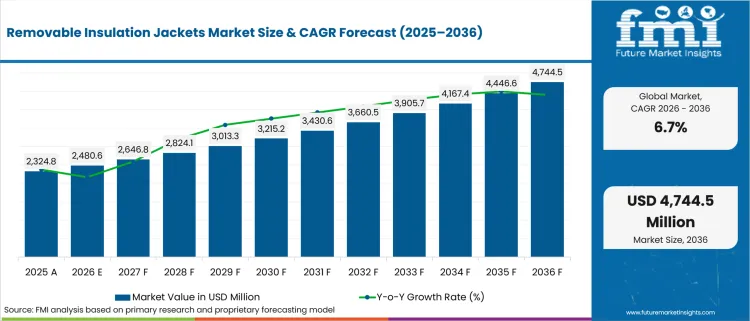
| Metric | Value |
|---|---|
| 2025 Market Size | USD 2,324.8 million |
| 2026 Market Size | USD 2,480.6 million |
| 2036 Market Size | USD 4,744.5 million |
| Forecast CAGR (2026-2036) | 6.7% |
| Material Focus | Fiberglass Jackets |
| Fiberglass Jackets Share (2026) | 42.5% |
| Application Focus | Valves |
| Valves Share (2026) | 34.0% |
| End Use Focus | Oil & Gas |
| Oil & Gas Share (2026) | 38.5% |
| Fastest-growing Country | India |
| India CAGR by 2036 | 8.0% |
Summary of the Removable Insulation Jackets Market
| Market Signal | Commercial Impact |
|---|---|
| Demand and Growth Drivers | Demand for removable insulation jackets is expected to expand steadily through 2036 as industrial facilities prioritize energy efficiency, maintenance accessibility, and thermal loss reduction across process equipment.
|
| Product and Segment View | Fiberglass jackets, valve insulation applications, and the oil & gas sector continue to lead their respective market segments.
|
| Geography and Growth Outlook | Asia and North America continue to drive market growth through industrial expansion, energy-efficiency investments, and maintenance modernization.
|
| Competitive Landscape | Competition increasingly focuses on custom fit, product durability, and maintenance support throughout the equipment lifecycle.
|
| Analyst Perspective | Removable insulation jackets are evolving from basic insulation products into maintenance-focused thermal management solutions that improve plant efficiency and equipment accessibility.
- Nikhil Kaitwade, Principal Consultant at Future Market Insights |
How is the removable insulation jackets market segmented?
The Removable Insulation Jackets industry is segmented by material, application, end use, temperature range, sales channel, and region.
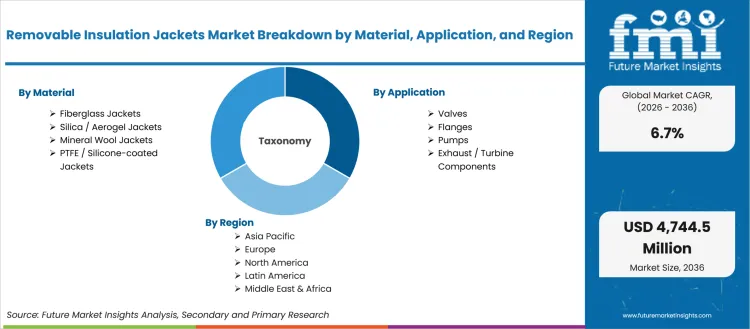
The removable insulation jackets market is segmented by material, application, end use, temperature range, sales channel, and region. Material covers Fiberglass Jackets, Silica / Aerogel Jackets, Mineral Wool Jackets and PTFE / Silicone-coated Jackets. Application includes Valves, Flanges, Pumps and Exhaust / Turbine Components. End use spans Oil & Gas, Power Generation, Chemicals and Food / Pharma / Other. Temperature range covers <250°C, 250-600°C and >600°C. Sales channel includes Direct Fabricators, MRO Distributors and EPC Contractors. Regional coverage extends across North America, Latin America, Europe, East Asia, South Asia and Pacific and the Middle East and Africa.
What explains fiberglass jacket preference within the material category?
Fabricators need materials that can be cut, sewn and repaired quickly during outage windows. Fiberglass jackets fit that need across standard valves and flanges. Buyers also know the fabric behavior from adjacent insulation work. This reduces qualification effort and helps MRO teams replace damaged covers without creating a long approval cycle. Material choice therefore becomes a risk-control decision before it becomes a thermal specification.
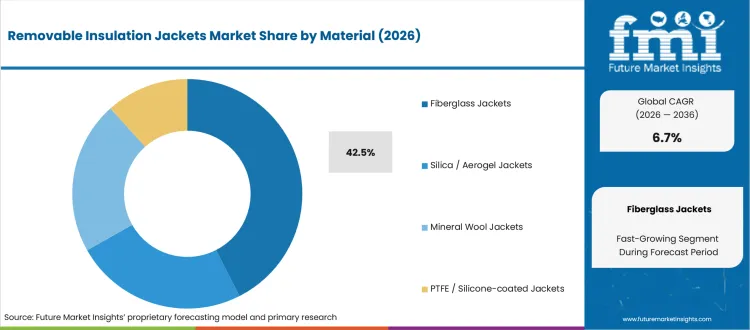
- Fiberglass Jackets are anticipated to hold 42.5% of material demand in 2026, supported by familiar fabrication methods and broad supplier availability. ASTM C1695-22 covers flexible removable blanket insulation for hot service up to 538°C. That standard helps buyers compare jacket construction against repeatable hot-service requirements and supplier quality claims during MRO planning.
- Plant buyers using fiberglass jackets can keep shutdown replacement practical, supported by a broad sewing base and known material behavior. The segment reduces procurement risk for routine valve and flange coverage. It also leaves room for thinner specialty alternatives in tighter asset spaces, which helps buyers match material cost to access difficulty.
Why do valves remain a notable application area?
Valve insulation creates a different problem from straight-pipe coverage. Stems and bonnets interrupt the insulation path. Flanges and actuators add further gaps. These components are also opened for checks and repairs. Removable covers help maintenance teams protect energy-control work without rebuilding fixed insulation around every service event. The application matters to buyers that need repeat access and still want thermal control to remain auditable.
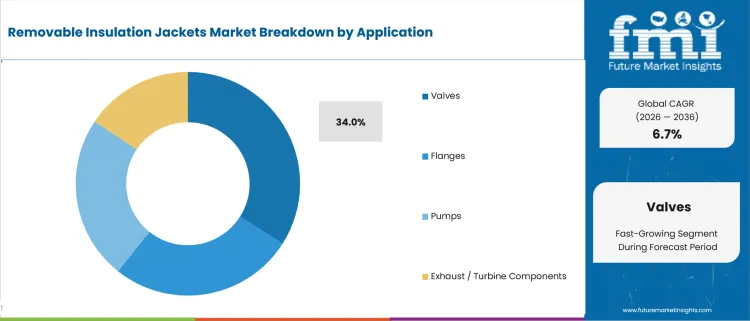
- Valves represent an estimated 34.0% share of application demand in 2026, driven by repeated access around pressure-control points. Forbes Marshall’s August 2024 pressure-reducing valve sheet describes ready-to-mount jackets for service use. That guidance supports the share position by showing how valve covers fit maintenance programs that need access and thermal control during outage planning.
- Maintenance teams value valve jackets that return to shape after removal, owing to the fit risk around stems and bonnet geometry. The category differs from straight pipe insulation coverage. Buyers assess fastening quality and access openings before they approve large valve-cluster programs, especially if repeated inspection can damage fixed covers and disrupt energy-control records.
How does Oil & Gas shape end-use demand?
Refineries and terminals have many hot service points that cannot remain sealed under fixed insulation. Turnaround schedules create a need for covers that can be removed and reinstalled quickly. Oil and gas buyers evaluate fire exposure, personnel safety and heat control together during asset-access planning. Jacket selection therefore reflects both the operating duty and the need to return assets to service after outage work.
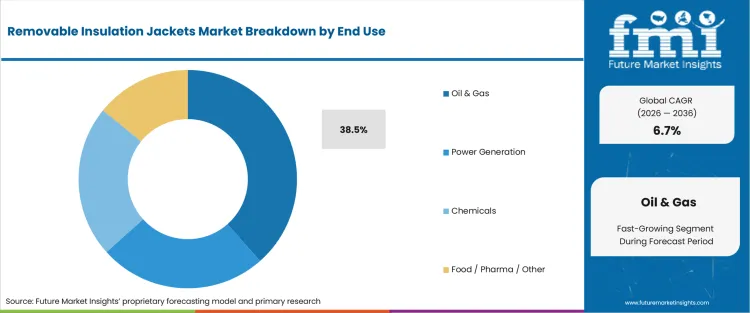
- Oil & Gas is projected to account for 38.5% share in 2026, attributable to refinery turnaround cycles and hot utility networks. EIA’s June 2026 outlook forecast USA crude oil and petroleum product net exports at 4.2 million b/d in 2026. That activity keeps process insulation work visible during asset-access planning for refineries and terminals.
- Refinery buyers use removable jackets to protect thermal control around valves, pumps and turbine auxiliaries without slowing inspection work. The operating value is access preservation. It reduces the chance that insulation is removed during repair and left unreplaced after the outage closes, which protects energy-control plans across repeated maintenance cycles.
What makes the 250-600°C range commercially meaningful?
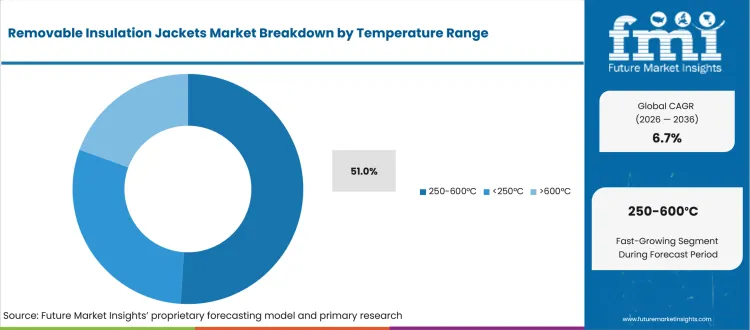
Steam, exhaust and turbine auxiliary assets often operate in a temperature band that needs durable fabrics and practical fastening. The range is above light-duty condensation control but below many refractory applications. Buyers therefore compare worker-touch protection, outer-fabric durability and reinstallation fit during specification reviews. The commercial issue is to avoid overbuilding each cover and still match thermal risk to service duty.
- The 250-600°C category is set to hold 51.0% share in 2026, shaped by common steam and exhaust duties. Pacor’s RapidWrap product information states that basic removable covers can withstand temperatures to 1200°F. That evidence supports mid-to-high heat use cases in plants that need covers to survive repeated handling and reinstallation during outage planning.
- Engineering teams selecting covers in this band compare high temperature insulation needs against access limits and maintenance frequency. The strategic value comes from matching heat protection to the asset instead of over-specifying every cover. That keeps cost and handling practical for MRO teams that remove covers during inspections and restart checks after maintenance.
How are Direct Fabricators positioned within the sales-channel category?
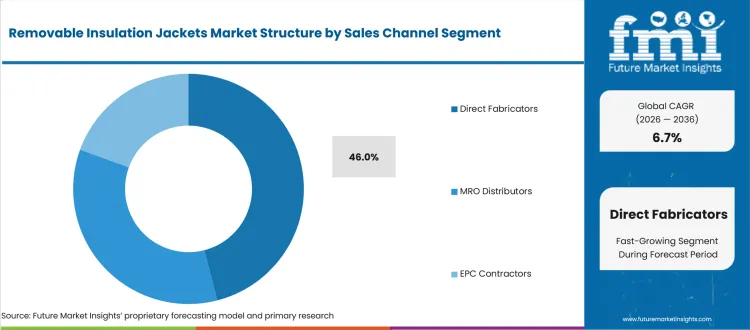
Direct buying is influencing growth in this market, due to the measurement work behind each jacket. Buyers need survey teams to capture asset geometry and tag covers for reinstallation. Distributor access still matters for standard covers. Complex valve clusters and turbine housings push plants toward suppliers that own fit responsibility. The sales-channel decision therefore depends on the complexity of the asset package and the buyer tolerance for handoffs.
- Direct Fabricators are expected to account for 46.0% of sales-channel demand in 2026, attributable to site measurement and pattern accountability. Thermaxx Jackets describes pressure-reducing-valve jackets that fit complex valve geometry. That evidence supports direct channels for assets that need survey control and repeatable reinstallation during planned plant shutdown programs and audit records.
- For plant managers, direct fabricator value is tied to one accountable source for survey and pattern design. It also covers post-shutdown support and tag upkeep. This reduces handoff risk after covers are removed. It helps buyers maintain jacket records across many valves and flanges without rebuilding responsibility across separate distributors and installers.
What are the drivers, restraints, and opportunities in the removable insulation jackets market?
Near-term purchases are being shaped by the access-led efficiency requirement, fit-validation constraint, and digital tagging expansion route outlined below.
- Driver: Plant energy audits are pushing buyers toward removable jackets, driven by exposed hot components that remain uncovered after repair work.
- Restraint: Fit uncertainty restrains adoption, owing to poor patterns that leave thermal gaps after repeated removal and reinstallation.
- Opportunity: Digital tagging opens supplier access, supported by buyer need to connect jacket records to inspection schedules and energy reports.
Plant maintenance buyers are moving jacket projects into broader efficiency programs instead of treating covers like minor accessories. Valves and flanges can be ranked by surface temperature, access frequency and repair history. The DOE Better Plants Program Overview released in April 2025 reported USD 14.1 billion in cost savings from partner efficiency work. That figure matters for removable jackets by showing buyers can justify retrofit packages only if energy and maintenance savings are documented in plant terms. Suppliers that provide survey records and payback notes can shift from spot orders into plant-wide retrofit scopes.
Specification risk still slows purchase approval for complex components. A poorly shaped cover reduces thermal control and weakens buyer trust after the first shutdown. Firwin’s April 2024 application guide noted that hard-coat insulation can cost 6 to 12 times more than standard removable blankets. That comparison matters to buyers that must choose between rugged fixed protection and serviceable covers. Suppliers that explain fit limits, fastening risks and material trade-offs can turn hesitation into a guided selection process. This improves the chance that a project moves forward instead of stalling during specification review.
Opportunity is opening for companies that combine jacket fabrication with asset records and repeat service access. Digital tags, drawings and reinstallation maps help buyers keep each cover tied to the right valve or flange. Shannon Global Energy states that it has designed and installed more than 750,000 removable reusable blankets from 1988 onward. That scale supports the opportunity for suppliers that pair field experience and better documentation across power and industrial sites. New entrants can compete by proving fit quality and simplifying post-maintenance identification.
Which country CAGRs are profiled in the removable insulation jackets market?
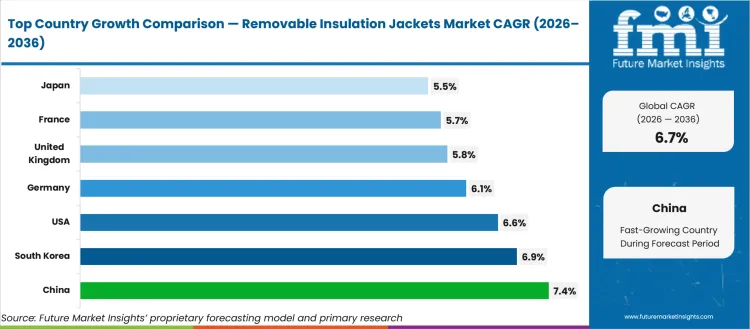
| Country | CAGR |
|---|---|
| United States | 6.6% |
| United Kingdom | 5.8% |
| Germany | 6.1% |
| France | 5.7% |
| Japan | 5.5% |
| China | 7.4% |
| South Korea | 6.9% |
| India | 8.0% |
How do country-level CAGRs compare in the removable insulation jackets market?
Country variation in removable insulation jackets reflects different reasons for preserving heat-loss control during maintenance. In North America and Western Europe, the case is tied to energy-cost pressure and retrofit economics. Labor discipline also shapes the purchase case. In East Asia, the case is closer to energy security and dense process-industry assets. In South Asia, the product is tied to industrial expansion and factory efficiency programs. Buyers should read CAGR differences to identify countries in which jacket suppliers need site service, pattern control and local MRO relationships. The variation also shows which countries need audit-backed retrofits and which need fast coverage for expanding industrial assets. This distinction should guide channel planning before suppliers scale sales teams.
- The United States is projected to record 6.6% CAGR by 2036, supported by a large base of steam and process assets. EIA reported in March 2025 that USA manufacturing energy consumption increased 6% between 2018 and 2022. That evidence matters to jacket suppliers by showing that plant energy use is still large enough to justify retrofit reviews. Compared with India and China, the USA profile is more retrofit-led and tied to outsourced MRO programs. Suppliers need audit support and fast replacement service to win repeat plant work.
- The United Kingdom is expected to grow at 5.8% CAGR during the forecast period, owing to energy-cost pressure in process industries. ONS reported in May 2025 that UK industrial electricity prices in 2023 were 46% higher than the IEA median. That gap makes payback evidence important before buyers approve jackets for valves and flanges. Compared with the United States, the UK profile is more price-sensitive and more dependent on documented energy-cost relief. This supports suppliers that can quantify heat-loss reduction during site surveys and audits.
- Germany is forecast to advance at 6.1% CAGR over the assessment period, attributable to high energy sensitivity across industrial buyers. The USA International Trade Administration reported in August 2025 that Germany planned about USD 11.3 billion by 2030 to subsidize power prices for energy-intensive industries. That policy context matters by showing how jacket projects compete for capital against broader energy-cost controls. Germany differs from France by tying insulation demand more closely to export-oriented manufacturing and power-cost relief. Suppliers need documented energy evidence for industrial accounts.
- France is estimated to rise at 5.7% CAGR between 2026 and 2036, shaped by carbon reporting and plant-level efficiency work. SDES reported that France emitted 369 Mt CO2 equivalent of greenhouse gases in 2024 excluding LULUCF. That evidence makes energy-management documentation relevant to buyers reviewing heat loss at exposed assets. Compared with Germany, France has a more compliance-led profile and a steadier retrofit path across regulated industrial sites. Suppliers need clear audit records to move beyond small replacement orders. This keeps service documentation central to supplier selection.
- Japan is likely to expand at 5.5% CAGR by 2036, influenced by energy-security pressure and selective plant renewal. The Agency for Natural Resources and Energy reported in 2026 that Japan’s FY2024 energy self-sufficiency ratio was 16.4%. That context keeps efficiency measures visible in industrial maintenance budgets. Japan compares differently from China by showing a slower capacity path and a stronger focus on preserving performance inside existing factories. Jacket suppliers therefore need evidence of fit reliability and material life. This creates demand for careful supplier qualification.
- Demand in China is projected to grow at 7.4% CAGR by 2036, driven by process-industry density and refinery activity. NBS reported in January 2026 that industrial value added above the designated size increased 5.9% in 2025. That official data supports the case for fitted covers around hot-service assets in large plants. China differs from Western Europe by tying jacket adoption to capacity utilization and asset scale. Suppliers need service models that can support plant clusters across petrochemical and power corridors.
- The removable insulation jackets sector in South Korea is forecast to record 6.9% CAGR over the assessment period, reinforced by heavy industry and energy-transition planning. IEA’s 2025 review stated that Korea projects 70% carbon-free electricity generation in 2038. That target keeps energy-management upgrades relevant for industrial sites that operate hot equipment and utility systems. South Korea compares with Japan as a quality-led market, although its profile has a stronger link to heavy industry renewal and energy-policy planning. Local service access remains important for shutdown work.
- India is expected to grow at 8.0% CAGR during the forecast period, propelled by factory expansion and steam-system modernization. Energy Statistics India 2025 reported that iron and steel accounted for 15.25% of industrial energy consumption. That sector exposure supports removable jacket demand in heat-intensive factories. India differs from Western European markets by showing a more expansion-led demand profile. Suppliers that combine site surveys and local installation capacity can address new plants and retrofit accounts. That mix rewards suppliers that can scale local field teams.
Who are the notable companies in the removable insulation jackets market?
Thermaxx Jackets, Firwin, Shannon Global Energy, InsulTech, Pacor, Forbes Marshall, Smart Shield, Heat Care and KLAY EnerSol are the notable companies shaping this market.
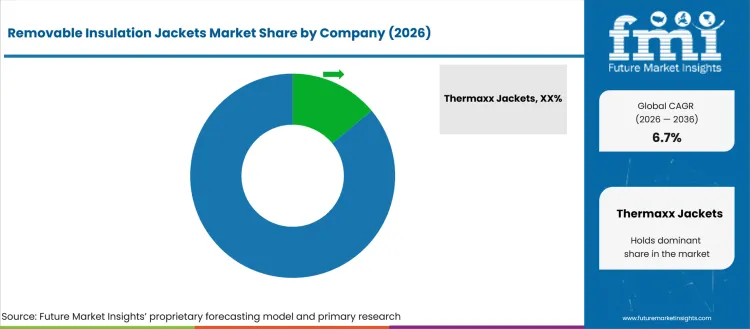
Supplier selection in removable insulation jackets depends on the buyer’s access problem. Thermaxx Jackets, Firwin, Shannon Global Energy, InsulTech and Pacor are more relevant in projects that need custom pattern work and repeatable reinstallation. Forbes Marshall becomes important in steam-system environments that need product fit around traps and pressure-reducing valves. Smart Shield, Heat Care and KLAY EnerSol gain relevance in regional accounts that need local site access. Buyers compare thermal insulation material knowledge against survey quality and service response. This makes supplier selection practical and less price-led.
- Thermaxx Jackets and Firwin are relevant in valve and equipment coverage projects, supported by application pages that show custom removable covers around irregular hot assets. Their role is practical for buyers that need burn-risk reduction and service access after routine inspection work.
- Buyers choosing Shannon Global Energy and InsulTech are typically looking for project execution capability, supported by documented experience across reusable blanket systems and thermal blanket installations. These suppliers matter in accounts that need survey work, custom patterning and reinstallation support.
- Forbes Marshall and Pacor focus on steam-system and removable cover requirements that fit pressure equipment and exhaust components. Their product scope matters in plants that want jacket specifications tied to steam-system maintenance, heat-control checks and recurring inspection access. This creates a practical route for buyers that want standard product guidance before commissioning or repair work.
- Regional suppliers including Smart Shield and Heat Care gain preference in local retrofit accounts, driven by site access and faster measurement response. KLAY EnerSol adds regional coverage for plant buyers that need local installation support and lower handoff risk during shutdown work.
Competitive Benchmarking: Removable Insulation Jackets Market
| Company | Custom Pattern Engineering | Hot-Service Material Range | MRO Reinstallation Support | Geographic Footprint |
|---|---|---|---|---|
| Thermaxx Jackets | High | Strong | Strong | North America |
| Shannon Global Energy | High | High | Strong | Global |
| InsulTech | High | High | Strong | North America |
| Firwin | High | Strong | Medium | North America |
| Pacor | Medium | Strong | Medium | North America |
| Forbes Marshall | Medium | Medium | Strong | India and exports |
| KLAY EnerSol | Medium | Medium | Medium | Southeast Asia |
| Smart Shield | Medium | Medium | Medium | India |
Source: Future Market Insights competitive analysis, 2026. Ratings reflect relative portfolio relevance, workflow or project fit, service capability, and geographic reach.
Key Developments in the Removable Insulation Jackets Market
- In April 2026, Shannon Global Energy described a Smithsonian Institution project using reusable insulation blankets for government-building applications. The action matters to the market, supported by demand for covers that reduce heat loss and still allow MRO access. It points to wider institutional use beyond heavy process plants.
- In May 2024, InsulTech completed a turnkey design-build-install thermal blanket project for AT&T generator-set exhaust systems in Northern California. This is important to jacket suppliers, driven by the need to support packaged power equipment outside refinery steam networks. It also shows how survey and installation capability can convert niche exhaust assets into repeat project work.
- In October 2024, Thermaxx Jackets published guidance on asset and insulation management using smart tagging. This holds significant to maintenance buyers, reinforced by the need to track cover location and inspection history after repeated removal. It signals a shift toward documented jacket ownership instead of simple one-time cover installation.
Key Players in the Removable Insulation Jackets Market
Custom Jacket Fabricators
- Thermaxx Jackets
- Firwin
- Shannon Global Energy
- InsulTech
- Pacor
Steam-System and Regional Specialists
- Forbes Marshall
- Smart Shield
- Heat Care
- KLAY EnerSol
Material and Technical Insulation Suppliers
- Lewco Specialty Products
- Knauf Insulation Technical Solutions
- ROCKWOOL Technical Insulation
Removable Insulation Jackets Market - Report Scope
| Coverage field | Report scope |
|---|---|
| Market breakdown | By Material, Application, End Use, Temperature Range, Sales Channel and Region |
| Market Definition | Custom-fit reusable thermal covers for valves, flanges, pumps, exhaust parts, turbine components and other hot-service assets. |
| Regions Covered | North America, Latin America, Europe, East Asia, South Asia and Pacific, Middle East and Africa |
| Countries Covered | United States, United Kingdom, Germany, France, Japan, China, South Korea, India and 30+ countries |
| Key Companies Profiled | Thermaxx Jackets, Firwin, Shannon Global Energy, InsulTech, Pacor, Forbes Marshall, Smart Shield, Heat Care, KLAY EnerSol |
| Forecast Period | 2026 to 2036 |
| Approach | Hybrid bottom-up and cross-check methodology using material mix, application intensity, country energy pressure and supplier evidence. |
Removable Insulation Jackets Market - Research Methodology
| Method | Approach |
|---|---|
| Primary Research | FMI analysts reviewed inputs from plant engineers, MRO contractors, energy managers and insulation fabricators. Discussions focused on access frequency, jacket life, temperature class and payback thresholds across process sites. |
| Desk Research | Desk research covered government energy data, standards references, product documentation and official company releases. Source categories were selected to validate energy-cost pressure, component access, temperature use and supplier relevance. |
| Market Sizing and Forecasting | The model combined jacket volumes, average selling price, material mix and country-level energy intensity. Segment shares were checked against buyer use cases and supplier portfolio evidence. |
| Data Validation | Forecasts were checked against parent insulation demand, industrial energy signals, company product coverage and country process-industry activity. Duplicate public evidence figures were removed before final drafting. |
Removable Insulation Jackets Market by Segments
Removable Insulation Jackets Market segmented by Material:
- Fiberglass Jackets
- Silica / Aerogel Jackets
- Mineral Wool Jackets
- PTFE / Silicone-coated Jackets
Removable Insulation Jackets Market segmented by Application:
- Valves
- Flanges
- Pumps
- Exhaust / Turbine Components
Removable Insulation Jackets Market segmented by End Use:
- Oil & Gas
- Power Generation
- Chemicals
- Food / Pharma / Other
Removable Insulation Jackets Market segmented by Temperature Range:
- <250°C
- 250-600°C
- >600°C
Removable Insulation Jackets Market segmented by Sales Channel:
- Direct Fabricators
- MRO Distributors
- EPC Contractors
Removable Insulation Jackets Market by Region:
- North America
- United States
- Canada
- Mexico
- Latin America
- Brazil
- Chile
- Rest of Latin America
- Western Europe
- Germany
- UK
- Italy
- Spain
- France
- Nordic
- BENELUX
- Rest of Western Europe
- Eastern Europe
- Russia
- Poland
- Hungary
- Balkan & Baltic
- Rest of Eastern Europe
- East Asia
- China
- Japan
- South Korea
- South Asia and Pacific
- India
- ASEAN
- Australia & New Zealand
- Rest of South Asia and Pacific
- Middle East & Africa
- Kingdom of Saudi Arabia
- Other GCC Countries
- Turkiye
- South Africa
- Other African Union
- Rest of Middle East & Africa
Research Sources and Bibliography
- International Energy Agency. (2025). Energy Efficiency 2025: Industry.
- USA Energy Information Administration. (2025, March 20). Preliminary estimates show increased total USA manufacturing energy consumption in 2022.
- USA Department of Energy. (2024, June 20). Pathways analysis summary: Decarbonization of industrial modeling.
- Department for Business and Trade. (2025, July 18). Huge boost for UK industry as Government powers ahead with cuts to electricity costs.
- Ministry of Statistics and Programme Implementation. (2025, March 27). Energy Statistics India 2025.
- National Bureau of Statistics of China. (2026, January 20). Energy Production in December 2025.
- USA Energy Information Administration. (2026, May 15). USA industrial natural gas consumption expected to hit records in 2026.
- USA Energy Information Administration. (2026, June 9). Short-Term Energy Outlook.
- USA International Trade Administration. (2025, August 1). Germany - Energy.
- Service des données et études statistiques. (2025). How are GHG emissions distributed by sector in France?
- Agency for Natural Resources and Energy. (2026). 10 questions for understanding the current energy situation.
- International Energy Agency. (2025, November 25). Korea 2025: Energy Policy Review.
- ASTM International. (2022). ASTM C1695-22: Standard Specification for Fabrication of Flexible Removable and Reusable Blanket Insulation for Hot Service.
- Firwin Corporation. (2024, April 16). Hard Coat vs. Removable Insulation Blankets.
- Thermaxx Jackets. (2024, October 24). Upgrade Asset and Insulation Management With Smart Tagging.
- Thermaxx Jackets. (2026). Removable Insulation Jackets for Pressure-Reducing Valves.
- InsulTech. (2024, May 3). Project Spotlight: Data Center Thermal Insulation.
- Forbes Marshall. (2024, August). IJ-FMPRV technical information sheet.
- Better Buildings Initiative. (2025). 2025 Progress Update. USA Department of Energy.
- USA Department of Energy. (2025, April). Better Plants Program Overview.
- International Energy Agency. (2025, June 17). Oil Market Report - June 2025.
- Press Information Bureau. (2026, March 30). Release of publication “Energy Statistics India 2026”.
- Office for National Statistics. (2025, May 19). The impact of higher energy costs on UK businesses: 2021 to 2024.
This bibliography is provided for reader reference and uses primary government, standards-body, official trade body, and company sources.
This Report Answers
- What is the expected global value of the Removable Insulation Jackets Market in 2026 and 2036?
- What CAGR is forecast for removable insulation jackets during the 2026 to 2036 period?
- Which material category is used to assess fiberglass jacket demand in 2026?
- Why do valves create a visible application pool for removable insulation jacket suppliers?
- How do energy-cost pressure and maintenance access shape jacket buying decisions?
- Which countries are compared in the removable insulation jackets forecast?
- Which companies compete across custom jackets and steam-system insulation products?
- What products are included within the removable insulation jackets definition?
- How does FMI size and validate removable insulation jacket demand across segments and countries?
- What implementation and supplier-selection factors should executives assess?
Frequently Asked Questions
Why should executives track the Removable Insulation Jackets Market?
Executives should track this market because removable insulation reduces energy loss while preserving maintenance access which directly affects operating cost safety compliance and plant uptime.
What business problem does the Removable Insulation Jackets Market address?
It controls heat loss at valves flanges and equipment that require frequent access without forcing repeated insulation removal and rebuild.
What should procurement leaders evaluate before selecting suppliers?
Procurement leaders should evaluate fit accuracy material durability temperature rating reinstallation performance and site measurement capability.
What can limit return on investment for buyers?
Return on investment can be limited by poor jacket fit material degradation and loss of thermal performance after repeated removal.
How can suppliers build executive confidence?
Suppliers build confidence by delivering precise patterning durable fabrics documented thermal performance and consistent support during maintenance cycles.
Preview the report firsthand - request a free sample
Get SampleGet the brochure for pricing and purchase details.
Get PDFTable of Content
- Key Takeaways
- Market Size and CAGR
- Top Growth Driver
- Fastest Growing Segment
- Leading Region
- Key Companies
- Emerging Opportunities
- Executive Summary
- Global Market Outlook
- Demand-side Trends
- Supply-side Trends
- Technology Roadmap Analysis
- Analysis and Recommendations
- Analyst Perspective (What is happening? Why now? What should investors know?)
- Key Questions Answered
- How large is the market?
- What is the CAGR?
- What are key trends?
- Which region dominates?
- Who are the leaders?
- Market Overview
- Market Coverage / Taxonomy
- Market Definition / Scope / Limitations
- Research Methodology
- Chapter Orientation
- Analytical Lens and Working Hypotheses
- Market Structure, Signals, and Trend Drivers
- Benchmarking and Cross-market Comparability
- Market Sizing, Forecasting, and Opportunity Mapping
- Research Design and Evidence Framework
- Desk Research Programme (Secondary Evidence)
- Expert Input and Fieldwork (Primary Evidence)
- Tooling, Models, and Reference Databases
- Data Engineering and Model Build
- Quality Assurance and Audit Trail
- Market Background
- Market Dynamics (Drivers, Restraints, Opportunity, Trends)
- Scenario Forecast (Optimistic, Likely, Conservative)
- Impact Analysis
- AI Impact
- Sustainability Impact
- Regulatory Impact
- Technology Impact
- Consumer / Buyer Analysis
- Purchase Drivers
- Adoption Barriers
- Buyer Journey
- Opportunity Map Analysis
- Product Life Cycle Analysis
- Supply Chain Analysis
- Investment Feasibility Matrix
- Value Chain Analysis
- PESTLE and Porter's Analysis
- Regulatory Landscape
- Regional Parent Market Outlook
- Production and Consumption Statistics
- Import and Export Statistics
- Global Market Analysis and Forecast, 2021 to 2036
- Historical Market Size Value (USD Million) & Volume (Unit) Analysis, 2021 to 2025
- Current and Future Market Size Value (USD Million) & Volume (Unit) Projections, 2026 to 2036
- Y-o-Y Growth Trend Analysis
- Absolute $ Opportunity Analysis
- Global Market Pricing Analysis, 2021 to 2036
- Global Market Analysis and Forecast, By Material, 2021 to 2036
- Introduction / Key Findings
- Historical Market Size Value (USD Million) & Volume (Unit) Analysis By Material, 2021 to 2025
- Current and Future Market Size Value (USD Million) & Volume (Unit) Analysis and Forecast By Material, 2026 to 2036
- Fiberglass Jackets
- Silica / Aerogel Jackets
- Mineral Wool Jackets
- PTFE / Silicone-coated Jackets
- Fiberglass Jackets
- Y-o-Y Growth Trend Analysis By Material, 2021 to 2025
- Absolute $ Opportunity Analysis By Material, 2026 to 2036
- Global Market Analysis and Forecast, By Application, 2021 to 2036
- Introduction / Key Findings
- Historical Market Size Value (USD Million) & Volume (Unit) Analysis By Application, 2021 to 2025
- Current and Future Market Size Value (USD Million) & Volume (Unit) Analysis and Forecast By Application, 2026 to 2036
- Valves
- Flanges
- Pumps
- Exhaust / Turbine Components
- Valves
- Y-o-Y Growth Trend Analysis By Application, 2021 to 2025
- Absolute $ Opportunity Analysis By Application, 2026 to 2036
- Global Market Analysis and Forecast, By End Use, 2021 to 2036
- Introduction / Key Findings
- Historical Market Size Value (USD Million) & Volume (Unit) Analysis By End Use, 2021 to 2025
- Current and Future Market Size Value (USD Million) & Volume (Unit) Analysis and Forecast By End Use, 2026 to 2036
- Oil & Gas
- Power Generation
- Chemicals
- Food / Pharma / Other
- Oil & Gas
- Y-o-Y Growth Trend Analysis By End Use, 2021 to 2025
- Absolute $ Opportunity Analysis By End Use, 2026 to 2036
- Global Market Analysis and Forecast, By Temperature Range, 2021 to 2036
- Introduction / Key Findings
- Historical Market Size Value (USD Million) & Volume (Unit) Analysis By Temperature Range, 2021 to 2025
- Current and Future Market Size Value (USD Million) & Volume (Unit) Analysis and Forecast By Temperature Range, 2026 to 2036
- 250-600°C
- <250°C
- >600°C
- 250-600°C
- Y-o-Y Growth Trend Analysis By Temperature Range, 2021 to 2025
- Absolute $ Opportunity Analysis By Temperature Range, 2026 to 2036
- Global Market Analysis and Forecast, By Sales Channel, 2021 to 2036
- Introduction / Key Findings
- Historical Market Size Value (USD Million) & Volume (Unit) Analysis By Sales Channel, 2021 to 2025
- Current and Future Market Size Value (USD Million) & Volume (Unit) Analysis and Forecast By Sales Channel, 2026 to 2036
- Direct Fabricators
- MRO Distributors
- EPC Contractors
- Direct Fabricators
- Y-o-Y Growth Trend Analysis By Sales Channel, 2021 to 2025
- Absolute $ Opportunity Analysis By Sales Channel, 2026 to 2036
- Global Market Analysis and Forecast, By Region, 2021 to 2036
- Introduction
- Historical Market Size Value (USD Million) & Volume (Unit) Analysis By Region, 2021 to 2025
- Current Market Size Value (USD Million) & Volume (Unit) Analysis and Forecast By Region, 2026 to 2036
- North America
- Latin America
- Western Europe
- Eastern Europe
- East Asia
- South Asia and Pacific
- Middle East & Africa
- Market Attractiveness Analysis By Region
- North America Market Analysis and Forecast, By Country, 2021 to 2036
- Historical Market Size Value (USD Million) & Volume (Unit) Trend Analysis By Market Taxonomy, 2021 to 2025
- Market Size Value (USD Million) & Volume (Unit) Forecast By Market Taxonomy, 2026 to 2036
- By Country
- USA
- Canada
- Mexico
- By Material
- By Application
- By End Use
- By Temperature Range
- By Sales Channel
- By Country
- Market Attractiveness Analysis
- By Country
- By Material
- By Application
- By End Use
- By Temperature Range
- By Sales Channel
- Key Takeaways
- Latin America Market Analysis and Forecast, By Country
- Historical Market Size Value (USD Million) & Volume (Unit) Trend Analysis By Market Taxonomy, 2021 to 2025
- Market Size Value (USD Million) & Volume (Unit) Forecast By Market Taxonomy, 2026 to 2036
- By Country
- Brazil
- Chile
- Rest of Latin America
- By Material
- By Application
- By End Use
- By Temperature Range
- By Sales Channel
- By Country
- Market Attractiveness Analysis
- By Country
- By Material
- By Application
- By End Use
- By Temperature Range
- By Sales Channel
- Key Takeaways
- Western Europe Market Analysis and Forecast, By Country
- Historical Market Size Value (USD Million) & Volume (Unit) Trend Analysis By Market Taxonomy, 2021 to 2025
- Market Size Value (USD Million) & Volume (Unit) Forecast By Market Taxonomy, 2026 to 2036
- By Country
- Germany
- UK
- Italy
- Spain
- France
- Nordic
- BENELUX
- Rest of Western Europe
- By Material
- By Application
- By End Use
- By Temperature Range
- By Sales Channel
- By Country
- Market Attractiveness Analysis
- By Country
- By Material
- By Application
- By End Use
- By Temperature Range
- By Sales Channel
- Key Takeaways
- Eastern Europe Market Analysis and Forecast, By Country
- Historical Market Size Value (USD Million) & Volume (Unit) Trend Analysis By Market Taxonomy, 2021 to 2025
- Market Size Value (USD Million) & Volume (Unit) Forecast By Market Taxonomy, 2026 to 2036
- By Country
- Russia
- Poland
- Hungary
- Balkan & Baltic
- Rest of Eastern Europe
- By Material
- By Application
- By End Use
- By Temperature Range
- By Sales Channel
- By Country
- Market Attractiveness Analysis
- By Country
- By Material
- By Application
- By End Use
- By Temperature Range
- By Sales Channel
- Key Takeaways
- East Asia Market Analysis and Forecast, By Country
- Historical Market Size Value (USD Million) & Volume (Unit) Trend Analysis By Market Taxonomy, 2021 to 2025
- Market Size Value (USD Million) & Volume (Unit) Forecast By Market Taxonomy, 2026 to 2036
- By Country
- China
- Japan
- South Korea
- By Material
- By Application
- By End Use
- By Temperature Range
- By Sales Channel
- By Country
- Market Attractiveness Analysis
- By Country
- By Material
- By Application
- By End Use
- By Temperature Range
- By Sales Channel
- Key Takeaways
- South Asia and Pacific Market Analysis and Forecast, By Country
- Historical Market Size Value (USD Million) & Volume (Unit) Trend Analysis By Market Taxonomy, 2021 to 2025
- Market Size Value (USD Million) & Volume (Unit) Forecast By Market Taxonomy, 2026 to 2036
- By Country
- India
- ASEAN
- Australia & New Zealand
- Rest of South Asia and Pacific
- By Material
- By Application
- By End Use
- By Temperature Range
- By Sales Channel
- By Country
- Market Attractiveness Analysis
- By Country
- By Material
- By Application
- By End Use
- By Temperature Range
- By Sales Channel
- Key Takeaways
- Middle East & Africa Market Analysis and Forecast, By Country
- Historical Market Size Value (USD Million) & Volume (Unit) Trend Analysis By Market Taxonomy, 2021 to 2025
- Market Size Value (USD Million) & Volume (Unit) Forecast By Market Taxonomy, 2026 to 2036
- By Country
- Kingdom of Saudi Arabia
- Other GCC Countries
- Türkiye
- South Africa
- Other African Union
- Rest of Middle East & Africa
- By Material
- By Application
- By End Use
- By Temperature Range
- By Sales Channel
- By Country
- Market Attractiveness Analysis
- By Country
- By Material
- By Application
- By End Use
- By Temperature Range
- By Sales Channel
- Key Takeaways
- Key Countries Market Analysis
- USA
- Pricing Analysis
- Market Share Analysis, 2025
- By Material
- By Application
- By End Use
- By Temperature Range
- By Sales Channel
- Canada
- Pricing Analysis
- Market Share Analysis, 2025
- By Material
- By Application
- By End Use
- By Temperature Range
- By Sales Channel
- Mexico
- Pricing Analysis
- Market Share Analysis, 2025
- By Material
- By Application
- By End Use
- By Temperature Range
- By Sales Channel
- Brazil
- Pricing Analysis
- Market Share Analysis, 2025
- By Material
- By Application
- By End Use
- By Temperature Range
- By Sales Channel
- Chile
- Pricing Analysis
- Market Share Analysis, 2025
- By Material
- By Application
- By End Use
- By Temperature Range
- By Sales Channel
- Germany
- Pricing Analysis
- Market Share Analysis, 2025
- By Material
- By Application
- By End Use
- By Temperature Range
- By Sales Channel
- UK
- Pricing Analysis
- Market Share Analysis, 2025
- By Material
- By Application
- By End Use
- By Temperature Range
- By Sales Channel
- Italy
- Pricing Analysis
- Market Share Analysis, 2025
- By Material
- By Application
- By End Use
- By Temperature Range
- By Sales Channel
- Spain
- Pricing Analysis
- Market Share Analysis, 2025
- By Material
- By Application
- By End Use
- By Temperature Range
- By Sales Channel
- France
- Pricing Analysis
- Market Share Analysis, 2025
- By Material
- By Application
- By End Use
- By Temperature Range
- By Sales Channel
- India
- Pricing Analysis
- Market Share Analysis, 2025
- By Material
- By Application
- By End Use
- By Temperature Range
- By Sales Channel
- ASEAN
- Pricing Analysis
- Market Share Analysis, 2025
- By Material
- By Application
- By End Use
- By Temperature Range
- By Sales Channel
- Australia & New Zealand
- Pricing Analysis
- Market Share Analysis, 2025
- By Material
- By Application
- By End Use
- By Temperature Range
- By Sales Channel
- China
- Pricing Analysis
- Market Share Analysis, 2025
- By Material
- By Application
- By End Use
- By Temperature Range
- By Sales Channel
- Japan
- Pricing Analysis
- Market Share Analysis, 2025
- By Material
- By Application
- By End Use
- By Temperature Range
- By Sales Channel
- South Korea
- Pricing Analysis
- Market Share Analysis, 2025
- By Material
- By Application
- By End Use
- By Temperature Range
- By Sales Channel
- Russia
- Pricing Analysis
- Market Share Analysis, 2025
- By Material
- By Application
- By End Use
- By Temperature Range
- By Sales Channel
- Poland
- Pricing Analysis
- Market Share Analysis, 2025
- By Material
- By Application
- By End Use
- By Temperature Range
- By Sales Channel
- Hungary
- Pricing Analysis
- Market Share Analysis, 2025
- By Material
- By Application
- By End Use
- By Temperature Range
- By Sales Channel
- Kingdom of Saudi Arabia
- Pricing Analysis
- Market Share Analysis, 2025
- By Material
- By Application
- By End Use
- By Temperature Range
- By Sales Channel
- Türkiye
- Pricing Analysis
- Market Share Analysis, 2025
- By Material
- By Application
- By End Use
- By Temperature Range
- By Sales Channel
- South Africa
- Pricing Analysis
- Market Share Analysis, 2025
- By Material
- By Application
- By End Use
- By Temperature Range
- By Sales Channel
- USA
- Market Structure Analysis
- Competition Dashboard
- Competition Benchmarking
- Market Share Analysis of Top Players
- By Regional
- By Material
- By Application
- By End Use
- By Temperature Range
- By Sales Channel
- Emerging Startups
- Innovation Benchmarking
- Competition Analysis
- Competition Deep Dive
- Thermaxx Jackets
- Overview
- Product Portfolio
- Profitability by Market Segments (Product/Region/Sales Channel)
- Sales Footprint
- Strategy Overview
- Marketing Strategy
- Product Strategy
- Channel Strategy
- Firwin
- Shannon Global Energy
- InsulTech
- Pacor
- Forbes Marshall
- Smart Shield
- Thermaxx Jackets
- Case Studies
- Success Stories
- Recent Developments
- Competition Deep Dive
- Assumptions & Acronyms Used


