
- Market Size (2026)
- USD 445.2 Mn
- Forecast (2036)
- USD 835.7 Mn
- CAGR (2026 to 2036)
- 6.5%
How big is the Restriction Endonucleases Market in 2026?
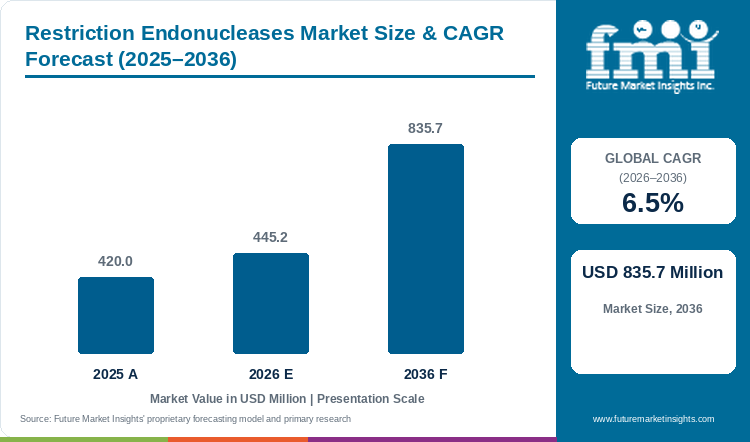
The global restriction endonucleases market should reach USD 835.7 million by 2036 at a 6.5% CAGR across 2026 to 2036. The market was valued at USD 420.0 million in 2025, and FMI estimates USD 445.2 million for 2026.
Restriction Endonucleases Market Size and Forecast
Table 1: Restriction Endonucleases Market Size and Forecast
| Market size and forecast | Value |
|---|---|
| Market size in 2025 | USD 420.0 million |
| Estimated market size in 2026 | USD 445.2 million |
| Projected market size by 2036 | USD 835.7 million |
| CAGR from 2026 to 2036 | 6.5% |
Source: Future Market Insights analysis of the restriction endonucleases market, 2026.
Revenue growth depends on which enzyme products remain specified when research methods become routine. Standard Type II products lead on base-year share, but high-fidelity enzymes grow faster at 8.6% through 2036. New England Biolabs explains that its high-fidelity products reduce unintended cleavage compared with corresponding wild-type enzymes. FMI's view is that this supports a premium where an unsuccessful preparation would delay an expensive downstream analysis.
Supplier competition also extends beyond the enzyme itself. Thermo Fisher's FastDigest range advertises 176 specificities within a common buffer system. An established catalogue can therefore compete through purchasing simplicity as well as individual product performance. In January 2025, Merck renewed its exclusive Roche biochemical-reagent distribution agreement through 2029, covering restriction enzymes among other products. NEB then opened its Indian subsidiary in March 2026 with local support and delivery among its stated aims. These developments show two different commercial responses: extending a distribution relationship and bringing technical service closer to buyers. The market sits within the broader molecular biology enzymes, kits and reagents industry, but this assessment isolates restriction endonucleases.
Key Market Trends & Insights
- Product mix shifts toward high-fidelity enzymes, whose share rises from 24.0% in 2026 to 29.3% in 2036. The commercial opening concerns reduced unwanted cleavage in qualified workflows.
- Seamless cloning limits enzyme consumption in some applications, and a supplier can hold both positions. Vazyme sells both SwiftCut restriction endonucleases and a seamless-cloning system that does not require restriction-site selection.
- Package configuration matters when laboratories compare purchase prices, because a vial count does not describe the amount of enzyme activity purchased. Promega offers standard and high-concentration formats in its restriction-enzyme catalogue.
Regional Highlights
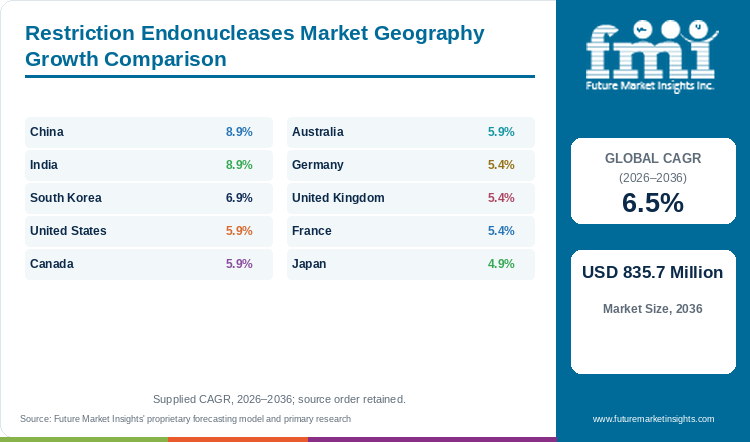
- China and India lead the country outlook with CAGRs of 8.9% each across 2026 to 2036, and South Korea follows at 6.9%, compared with 6.5% for the global market.
- Japan trails at a 4.9% CAGR over the same period. Germany, the United Kingdom and France follow jointly at 5.4%, so all four sit under the global rate.
Analyst Perspective
“FMI expects the strongest commercial positions to combine credible enzyme performance with dependable access. A broad catalogue wins initial evaluation, while consistent product documentation and local support help retain an established workflow. Sequencing growth should be assessed method by method: rising genomic activity does not mean that every library-preparation system consumes a restriction endonuclease.”
- Anurag Sharma, Principal Consultant, FMI
How is the Restriction Endonucleases Market segmented?
- By type: Type II standard enzymes, High-fidelity enzymes, and Enzyme kits and master mixes.
- By application: Cloning, Genotyping and mapping, Next-generation sequencing prep, and Other research and diagnostics.
- By end user: Academic and research institutes, Biotechnology and pharmaceutical firms, and Contract research organisations.
- By region: North America, Western Europe, East Asia, South Asia and Pacific, and Rest of world.
Why does the Type II standard enzymes segment lead by Type in the Restriction Endonucleases Market in 2026?
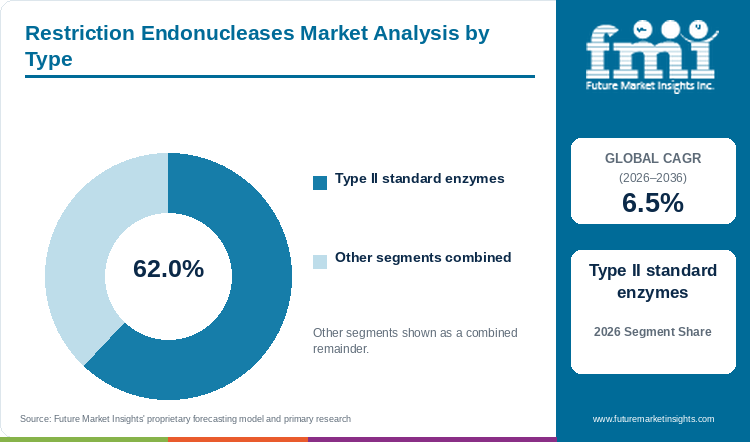
The Type II standard enzymes segment holds 62.0% of the Restriction Endonucleases Market by type in 2026.
The standard category benefits from the breadth of recurring research applications. Laboratories buying established enzyme products keep their existing version while their method performs adequately. FMI forecasts standard Type II revenue rising from USD 276.0 million in 2026 to USD 455.0 million in 2036. Its share nevertheless falls to 54.4% as the other commercial formats expand faster.
The relevant competitive question is how much additional assurance a buyer requires. NEB describes high-fidelity enzymes as engineered variants with less unwanted cleavage. That differentiation supports a separate purchase decision, while leaving room for economical standard products. Jena Bioscience also presents a broad restriction-enzyme finder and a common-buffer offering. Catalogue depth remains relevant when a research group needs an uncommon specificity or wants to consolidate ordering.
FMI therefore reads the falling standard share as a mix change within a growing market. Suppliers retaining standard lines still compete for substantial absolute revenue. Those withdrawing less frequently ordered products risk losing the associated account relationship, even where a single catalogue entry contributes little sales volume. Buyers should assess continuity and availability alongside the price of their most frequently reordered enzyme.
High-fidelity enzymes and Enzyme kits and master mixes together hold the remaining 38.0% by type.
Table 2: Type, 2026 Share
| Leading Share | 2026 market share |
|---|---|
| Type II standard enzymes | 62.0% |
| All Other Segments Combined Share | 38.0% |
Source: Future Market Insights analysis of the restriction endonucleases market, 2026.
Why does the Cloning segment lead by Application in the Restriction Endonucleases Market in 2026?
The Cloning segment holds 34.0% of the Restriction Endonucleases Market by application in 2026.
Cloning leads because restriction-enzyme purchases remain embedded in established molecular-research work. Thermo Fisher lists clone analysis and DNA preparation for cloning among FastDigest applications. These documented uses support continuing demand for established cloning workflows.
Seamless cloning is already visible in suppliers' own portfolios. The adjacent gene synthesis market sets another commercial boundary, since expenditure on a finished DNA construct is not revenue for an enzyme supplier in this assessment.
FMI projects cloning revenue of USD 256.6 million in 2036, compared with USD 313.8 million for next-generation sequencing prep. Sequencing's share reaches 37.5%, against 30.7% for cloning. This forecast concerns restriction-endonuclease products used in relevant preparation methods. It excludes revenue from sequencing instruments, unrelated preparation enzymes and the analytical service itself. Suppliers must identify the specific reagent opportunity within each workflow before assigning a sequencing programme to their addressable sales base.
Genotyping and mapping, Next-generation sequencing prep and Other research and diagnostics together hold the remaining 66.0% by application.
Table 3: Application, 2026 Share
| Leading Share | 2026 market share |
|---|---|
| Cloning | 34.0% |
| All Other Segments Combined Share | 66.0% |
Source: Future Market Insights analysis of the restriction endonucleases market, 2026.
Why does the Academic and research institutes segment lead by End User in the Restriction Endonucleases Market in 2026?
The Academic and research institutes segment holds 42.0% of the Restriction Endonucleases Market by end user in 2026.
Academic demand spans varied projects and enzyme requirements. This favours suppliers offering both a wide catalogue and accessible product information. Takara's restriction-enzyme navigator and Jena's enzyme finder illustrate the supporting information available around individual reagent sales. These resources support research purchasing.
The purchasing base also faces uneven funding conditions. NIH's fiscal 2025 report showed that new and renewal competing research-project awards declined even as total grant dollars rose. FMI's reading is that aggregate funding can coexist with fewer newly funded projects. Suppliers should therefore distinguish continuity in existing accounts from the creation of new buying laboratories.
Commercial end users become more important over time. Biotechnology and pharmaceutical firms reach USD 363.2 million in 2036, compared with USD 301.4 million for academic and research institutes. Contract research organisations reach USD 171.2 million. Repeatable purchasing, change management and product support become more commercially significant as these customers expand. Academic revenue still increases from USD 187.0 million in 2026. It changes which customers account for the largest portion of future sales.
Biotechnology and pharmaceutical firms and Contract research organisations together hold the remaining 58.0% by end user.
Table 4: End User, 2026 Share
| Leading Share | 2026 market share |
|---|---|
| Academic and research institutes | 42.0% |
| All Other Segments Combined Share | 58.0% |
Source: Future Market Insights analysis of the restriction endonucleases market, 2026.
What are the key drivers restraints and opportunities?
Continued molecular research supports demand, but alternative preparation methods limit simple volume extrapolation. Premium enzyme formats and closer technical service provide distinct commercial opportunities.
Driver
Funded genomics and molecular-research programmes maintain demand for laboratory preparation and validation reagents. Their restriction-enzyme content depends on the methods selected.
Restraint
Seamless cloning competes with restriction-based approaches in some applications. One supplier offers both product routes within its catalogue.
Opportunity
High-fidelity products and kits gain share, while local service can help suppliers support repeat orders beyond their original distribution footprint.
How do purchasing rules and qualification affect restriction endonucleases market demand?
The forecast adds USD 390.5 million of annual revenue between 2026 and 2036. A meaningful part of that opportunity lies in workflows that move from exploratory research into recurring commercial use. FMI projects biotechnology and pharmaceutical demand growing at 7.4% CAGR, compared with 4.9% for academic and research institutes. The end-user shift gives suppliers a reason to invest in continuing account support and product continuity.
National research programmes provide context for this expansion. Japan's AMED supports biobank use and genomics-based drug discovery, while India's GenomeIndia release gives researchers access to a national genomic resource. These are indicators of research infrastructure. Programmable editing products sit in the gene editing tool market, which is separate from the restriction enzymes that serve supporting research needs.
What limits reliable restriction endonucleases market supply and quality?
The main analytical risk is treating every increase in DNA research as an equivalent increase in restriction-enzyme use. Seamless cloning removes the restriction-site requirement. Some research expenditure therefore supports a competing preparation route. Suppliers with several reagent platforms may retain the customer even when the purchased chemistry changes.
Commercial comparisons also require care. Vials can contain different concentrations and amounts of enzyme activity. Research-use labels create a further boundary: the FastDigest brochure and the SwiftCut product page identify the products as research use only.
Where can suppliers win additional business in the restriction endonucleases market?
FMI forecasts high-fidelity products and kits together reaching 45.6% of type revenue in 2036, compared with 38.0% in 2026. Suppliers can address this shift through differentiated formulations and dependable technical documentation. A premium needs a meaningful requirement behind it.
Closer commercial support offers another route to retaining laboratory accounts. When a buyer can resolve a product question with the supporting sales organisation, a specialist catalogue becomes easier to evaluate. The supplier still needs an appropriate product and a credible fulfilment offer. Emerging applications such as engineered gene switches broaden the research context, but only direct sales of in-scope enzyme products enter this revenue assessment.
Restriction Endonucleases Market by Country (2026 to 2036)
Table 5: Restriction Endonucleases Market Country Growth Forecast
| Country | CAGR, 2026 to 2036 |
|---|---|
| China | 8.9% |
| India | 8.9% |
| South Korea | 6.9% |
| United States | 5.9% |
| Canada | 5.9% |
| Australia | 5.9% |
| Germany | 5.4% |
| United Kingdom | 5.4% |
| France | 5.4% |
| Japan | 4.9% |
Source: Future Market Insights analysis of the restriction endonucleases market, 2026.
China
China combines a growing research base with a domestic reagent supplier offering both restriction and alternative cloning products. The National Bureau of Statistics reported CNY 3,632.7 billion of total R&D expenditure in 2024, up 8.9%. Basic research spending reached CNY 250.1 billion.
The country's restriction endonucleases revenue is projected to grow at 8.9% CAGR between 2026 and 2036. FMI estimates its base-year market at USD 62.3 million and its 2036 revenue at USD 146.6 million. The commercial opportunity includes a larger domestic customer base, although successful suppliers must still win product-level adoption. China's 2026 revenue equals 14.0% of the global total. The market adds USD 84.3 million over the decade, and its 8.9% CAGR runs 2.4 percentage points above the 6.5% global rate.
The SwiftCut range supplies a documented restriction-enzyme offer with a common-buffer proposition. The company's seamless-cloning range shows that local biotechnology activity can also support competing reagent routes. An enzyme supplier's addressable sales therefore depend on which method a laboratory selects and continues to use.
FMI expects competition to concern continuity across product ranges as well as the initial purchase. A research group may require standard enzyme products for one task and a different preparation system for another. Domestic availability and technical service can support the commercial relationship without displacing international suppliers. China's projected share increase to 17.5% by 2036 reflects market expansion.
India
The release of GenomeIndia data and a new supplier office address different parts of India's market opportunity. In April 2025, the government confirmed completion of a resource covering more than 10,000 genomes and noted its dedication to researchers in January that year. In March 2026, NEB opened an Indian subsidiary in Bengaluru, describing improved local access and technical service.
India's restriction endonucleases revenue is projected to rise at 8.9% CAGR from 2026 to 2036. Its USD 17.8 million base-year market reaches USD 41.9 million by the end of the period. India's global share rises to 5.0% from 4.0%, with revenue adding USD 24.1 million. The two countries share the fastest CAGR, and India's base-year market equals 28.6% of China's.
GenomeIndia creates a research resource, and its commercial significance depends on subsequent experimental programmes and their selected methods. NEB's announcement is closer to the purchasing channel: it names local-time-zone support and an Experience Center. The company also referred to a footprint for local manufacturing activities.
FMI expects local account support to matter as more laboratories evaluate products and establish repeat purchasing. The opportunity is practical access to appropriate reagents, alongside the expansion of research activity. Suppliers still face competition from established distribution networks and alternative preparation products. Product suitability remains the link between a national scientific initiative and an actual enzyme order.
South Korea
South Korea's 2025 biotechnology outlook highlights the breadth of its research priorities. The Ministry of Science and ICT and KRIBB selected technologies including the human immunome, AI-designed gene editors and bio foundation models. The announcement concerns promising technologies over a five- to ten-year horizon.
A project focused on a digital model may have limited direct enzyme needs. Experimental development that follows from the model may generate reagent demand, but the chemistry and purchasing institution must still be identified. FMI therefore treats the national technology agenda as directional context for demand.
Supplier evaluation needs to cover the available support route alongside the product range. A laboratory selecting a specialist enzyme may need a different commercial offer from an account buying a recurring kit configuration. Suppliers can address both research evaluation and later commercial laboratory requirements, but their product must fit the chosen method. Competition from broader cloning platforms also affects the share of expenditure retained by restriction products. The market covers restriction-enzyme sales and not the full advanced-biotechnology agenda.
Against this research setting, South Korean revenue reaches USD 34.8 million in 2036, from USD 17.8 million in 2026. The 6.9% CAGR across that period reflects an expanding experimental market. Reagent demand needs to be distinguished from the computational activity that accompanies it, especially where a biotechnology programme encompasses both types of work.
United States
US demand is shaped by the distribution of research funding as well as its total amount. In March 2026, NIH reported USD 35.3 billion in competing and noncompeting grants for fiscal 2025. The same release showed a 20.5% decline in new or renewal competing research-project awards and a 13.0% success rate. This is a more complicated purchasing backdrop than a simple increase in national research dollars would suggest.
FMI forecasts the US restriction endonucleases market advancing at 5.9% CAGR from 2026 to 2036. Its 36.0% base-year share equals about USD 160.3 million of the USD 445.2 million global market and gives established research and commercial laboratories considerable weight in global purchasing. The funding evidence supports a distinction between retained grants and newly funded projects.
For suppliers, continuing accounts offer an opportunity to support both routine standard products and premium products where method requirements justify them. NEB's high-fidelity product explanation provides a documented example of differentiation through reduced unwanted cleavage. Commercial evaluation still belongs at the product and workflow level. An institute with a broad project portfolio may purchase different formats for different requirements.
FMI's central US implication is account retention under a selective funding environment. Reliable fulfilment and clear product documentation can matter alongside catalogue breadth. A newly announced research initiative reaches ordering accounts only after laboratories select their methods.
Canada
Canada's genomics strategy explicitly links scientific work with commercialization across several sectors. Launched in February 2025, it was backed by CAD 175.1 million over seven years beginning in 2024 to 2025. The government described applications in health, agriculture and clean technology. This broad remit creates a research setting that extends beyond clinical genomics.
The strategy's commercialization emphasis is relevant to repeat purchasing. A research project can generate intermittent orders, whereas a service or product under continuing development may establish a more regular requirement. Some supported genomics work is primarily computational and lies outside the vial-volume measure.
Institutional and commercial experimental work together support Canada's 5.9% forecast CAGR from 2026 to 2036. Revenue rises from USD 13.4 million to USD 23.8 million. The breadth of the national strategy gives suppliers several potential application routes, although product requirements still differ between a health-research laboratory and an agricultural biotechnology team. In 2026, Canada accounts for 3.0% of global revenue.
For suppliers, account access must be accompanied by an offer appropriate to research needs across human health and other biological applications. A diversified research base can support varied enzyme orders, although alternative cloning and preparation products continue to compete for the same laboratory budget. The purchasing institution's selected methods determine which part of its activity is addressable through restriction products.
Australia
Australia's Genomics Health Futures Mission provides a long-running framework for genomic medicine research. The government describes AUD 500.1 million of investment over ten years from 2018 to 2019 and notes publication of an updated roadmap in March 2025. The programme aims to support testing, diagnosis and translation into care.
For a supplier, national research priorities must be translated into actual experimental requirements. Work that improves interpretation of existing genomic data needs no additional restriction-enzyme vials. Research involving physical sample preparation or molecular validation may do so, depending on the method. The market assessment assigns enzyme purchases only to experimental work that uses them.
FMI's implication is that suppliers can compete through account service as well as catalogue breadth. Where individual orders are small or infrequent, clear availability and ordering support help make specialist products accessible. A premium offer still needs a specific performance rationale. The commercial offer should reflect the requirements of the research institution and not a single national purchasing pattern.
Australia is the smallest of the ten individually assessed markets in 2026, at USD 8.9 million. Its 5.9% CAGR to 2036 takes revenue to USD 15.8 million. Serving varied accounts economically is therefore as relevant as expanding the catalogue. Alternative preparation chemistries and competing laboratory priorities remain part of this smaller market's purchasing decisions.
Germany
Germany's biotechnology policy links additional genomic capacity with the development of personalized diagnostics and therapies. The federal Hightech Agenda describes support for expanding genome-sequencing capacity and for a gene- and cell-therapy translation centre in Berlin. These are programme commitments. They are evidence of intended research capability.
Restriction endonucleases revenue in Germany is forecast to expand at 5.4% CAGR from 2026 to 2036. The base-year value of USD 35.6 million reflects the country's position as the third-largest named market. Suppliers must compete across research institutions and commercial laboratories whose requirements can differ substantially.
Germany also has a documented specialist supply presence. Jena Bioscience offers restriction enzymes with an enzyme finder and common-buffer positioning. A Merck distribution agreement adds another commercial relationship for laboratory buyers, and the products distributed under it reach buyers through one channel. The relevant comparison concerns product availability and the party supporting the order.
FMI sees scope for specialist catalogues alongside broad laboratory purchasing platforms. A small order for a less frequently used enzyme can matter to a particular research programme, while commercial accounts may prioritize continuity in an established product line. The policy programme broadens the research setting, but a supplier still needs a specific offer that matches the laboratory's chosen preparation method. This keeps commercial qualification separate from the larger national biotechnology ambitions.
United Kingdom
The Generation Study demonstrates the scale of the UK's genomic research infrastructure. Genomics England describes a programme to sequence 100,000 newborn babies in partnership with the NHS, while evaluating the role of sequencing in identifying treatable conditions. This is a research study and is separate from standard newborn screening.
The commercial question is which preparation and follow-up research methods require products within this assessment. The answer depends on the assay chemistry and not on sequencing volume. An account tied to an established physical preparation method presents a different reagent opportunity from a project analysing previously generated genomic data.
An opportunity exists around research that follows from genomic discovery. Functional studies and preparation development may create different enzyme requirements from the original sequencing programme. FMI's UK outlook sets 2026 revenue at USD 26.7 million, with a 5.4% CAGR through 2036. Supplier information tools and continuing technical support become relevant when laboratories assess the product requirements behind that outlook.
The national forecast also includes commercial research purchasing beyond an individual public programme. A supplier able to support research evaluation and later repeat ordering has a broader opportunity than one focused on a single tender. The restraint is method substitution: a seamless-cloning offer confirms that some molecular-research tasks can use a different reagent route. UK growth therefore depends on the retained relevance of restriction products within a wider set of available laboratory methods.
France
France's health-research programme brings academic laboratories, clinical research and commercial development into closer institutional arrangements. The government's May 2023 account of Innovation Santé 2030 allocated EUR 1.7 billion to medical research capacity and described a EUR 300.0 million biocluster initiative. These are programme allocations announced in 2023.
French restriction endonucleases revenue is projected to expand at 5.4% CAGR from 2026 to 2036. FMI estimates the market at USD 13.4 million in the base year and USD 22.7 million in 2036. A useful commercial distinction is whether research activity remains exploratory or progresses into repeated commercial laboratory work. The latter can change the size and regularity of reagent orders.
Supplier access already includes documented international operations. Takara Bio's company history records its French reagent-sales presence dating to 1995. This supports an established commercial setting. Buyers still need an accurate view of availability for the particular reagent they intend to retain.
FMI sees an opportunity for product support across institutional boundaries. A research group and a commercial development team may require the same enzyme family while applying different documentation and ordering criteria. Suppliers must understand the actual customer requirement before presenting a premium product or wider service package. Biocluster expenditure also covers many activities beyond molecular reagents. The market forecast therefore covers direct restriction-endonuclease sales only.
Japan
Takara Bio has a long domestic restriction-enzyme history. The company records the start of Japanese-produced restriction-enzyme sales in 1979 and maintains a dedicated restriction-enzyme information tool. That presence illustrates the depth of existing supplier relationships.
Japan's AMED programmes connect biobank resources with genomic medicine and drug discovery. Its programme descriptions include BioBank Japan, the Tohoku Medical Megabank and genomics-based drug-discovery research. The commercial task is to identify the reagent-intensive experimental work within those programmes. Part of the biobank work consists of data analysis that needs no physical enzyme vial.
An established preparation method can favour continuity in enzyme supply, while a newly adopted method may create an opening for a premium formulation or a competing reagent system. FMI expects product relevance to carry more weight than a general claim about the size of Japan's genomics sector. Suppliers need to connect an available product to the research team's actual requirement. A Japanese laboratory changing a validated protocol must re-test its results, which favours suppliers that provide technical support alongside the enzyme.
This established purchasing base produces the lowest growth rate among the ten named countries, at 4.9% CAGR for 2026 to 2036. Japanese revenue rises from USD 26.7 million to USD 43.2 million. The forecast still represents incremental sales, with application mix determining where suppliers can participate. Japan reaches 5.2% of the global market by 2036.
Who are the notable companies in the Restriction Endonucleases Market?
Notable companies in the Restriction Endonucleases Market include New England Biolabs, Thermo Fisher Scientific, Takara Bio, Promega and Merck KGaA.
The supplier group includes broad molecular-biology reagent businesses and specialist enzyme catalogues. NEB differentiates high-fidelity products through reduced unwanted cleavage, while Thermo Fisher presents FastDigest around a common-buffer range. Takara Bio combines a documented restriction-enzyme history with broader molecular-research products and an enzyme information tool. Promega offers standard and high-concentration restriction-enzyme products within its research catalogue.
Jena Bioscience and SibEnzyme provide specialist breadth. Jena's catalogue includes an enzyme finder and common-buffer positioning. SibEnzyme describes a focus on restriction-endonuclease development and manufacture. These roles are assessed through actual product availability.
Two relationships require particular care. Merck distributes Roche biochemical reagents under an exclusive agreement renewed through 2029, so the names do not represent unrelated channels for those products. Vazyme participates through SwiftCut restriction products while also offering seamless-cloning alternatives. Its wider reagent portfolio can support the customer relationship even when a laboratory selects a method outside this market. Competitive positioning therefore turns on product scope, supporting information and purchasing access.
Broad molecular-biology catalogues: New England Biolabs, Thermo Fisher Scientific, Takara Bio, and Promega.
Linked biochemical-reagent manufacturer and distribution relationship: Roche and Merck KGaA.
Specialist and additional reagent offers: Jena Bioscience, Vazyme, and SibEnzyme.
Key Developments in the Restriction Endonucleases Market
- March 2026: New England Biolabs opened its Indian subsidiary in Bengaluru. The company identified local technical support, product access and customer collaboration among the office's purposes. This is a documented service expansion, without a claim that a restriction-enzyme factory began production.
Key Players in the Restriction Endonucleases Market
- New England Biolabs
- Thermo Fisher Scientific
- Takara Bio
- Promega
- Merck KGaA
- Roche
- Jena Bioscience
- Vazyme
- SibEnzyme
Restriction Endonucleases Market Report Scope
Table 6: Restriction Endonucleases Market Report Scope
| Coverage field | Report scope |
|---|---|
| Market definition | Restriction endonucleases sold as individual enzymes, high-fidelity variants and enzyme kits for in-scope research applications. |
| Product boundary | Direct restriction-endonuclease sales. Excludes unrelated preparation enzymes, instruments, outsourced sequencing and finished DNA constructs. |
| Revenue units | USD million. |
| Volume basis | Million commercial vials. Vial counts are not normalized enzyme-activity units. |
| Product breakdown | Type II standard enzymes, High-fidelity enzymes, Enzyme kits and master mixes. |
| Applications and end users | Cloning, genotyping and mapping, next-generation sequencing prep, other research and diagnostics. Academic institutes, biotechnology and pharmaceutical firms, contract research organisations. |
| Country coverage | United States, China, Germany, United Kingdom, Japan, India, South Korea, France, Canada and Australia |
| Company coverage | New England Biolabs, Thermo Fisher Scientific, Takara Bio, Promega, Merck KGaA, Roche, Jena Bioscience, Vazyme, SibEnzyme. |
| Commercial assessment | Product differentiation, method substitution, distribution relationships, national research context and documented company developments. |
| Quantitative Units | USD million |
Source: Future Market Insights analysis of the restriction endonucleases market, 2026.
Restriction Endonucleases Market Research Methodology
FMI's restriction endonucleases outlook was assessed through secondary review of original supplier documentation, government research programmes and public funding disclosures. The review checked units, segment totals, revenue boundaries and company relationships. Commercial interpretations distinguish research activity from direct enzyme purchases.
Restriction Endonucleases Market by Segments
Restriction Endonucleases Market segmented by Type:
- Type II standard enzymes
- High-fidelity enzymes
- Enzyme kits and master mixes
Restriction Endonucleases Market segmented by Application:
- Cloning
- Genotyping and mapping
- Next-generation sequencing prep
- Other research and diagnostics
Restriction Endonucleases Market segmented by End User:
- Academic and research institutes
- Biotechnology and pharmaceutical firms
- Contract research organisations
Restriction Endonucleases Market by Region
- North America
- United States
- Canada
- Western Europe
- Germany
- United Kingdom
- France
- East Asia
- China
- Japan
- South Korea
- South Asia and Pacific
- India
- Australia
- Rest of world
Research Sources and Bibliography
- Australian Government Department of Health, Disability and Ageing. Genomics Health Futures Mission. Accessed 9 November 2026. https://www.health.gov.au/our-work/mrff-genomics-health-futures-mission
- Genomics England. Newborn Genomes Programme: The Generation Study. Accessed 9 November 2026. https://www.genomicsengland.co.uk/initiatives/newborns
- German Federal Ministry of Research, Technology and Space. Hightech Agenda Deutschland: Biotechnologie. Accessed 9 November 2026. https://www.bmftr.bund.de/DE/Technologie/HightechAgenda/DossierHightechAgenda/Dossier_HightechAgenda/_documents/4_biotechnologie.html
- Government of France. Devenir la première nation européenne innovante et souveraine en santé. 23 May 2023. https://www.info.gouv.fr/actualite/devenir-la-premiere-nation-europeenne-innovante-et-souveraine-en-sante
- Government of India, Press Information Bureau. GenomeIndia whole-genome resource and researcher access. 30 April 2025. https://www.pib.gov.in/PressReleasePage.aspx?PRID=2125504&lang=2®=3
- Innovation, Science and Economic Development Canada. Government of Canada launches Canadian Genomics Strategy to drive innovation and foster economic growth. 6 February 2025. https://www.canada.ca/en/innovation-science-economic-development/news/2025/02/government-of-canada-launches-canadian-genomics-strategy-to-drive-innovation-and-foster-economic-growth.html
- Japan Agency for Medical Research and Development. Project for Data Utilization and Life Course Research and Development. Accessed 9 November 2026. https://www.amed.go.jp/en/program/index04.html
- Jena Bioscience. Restriction Enzymes. Product catalogue and enzyme finder. Accessed 9 November 2026. https://www.jenabioscience.com/molecular-biology/enzymes-protein-markers/restriction-enzymes
- Merck KGaA, Sigma-Aldrich. Roche Distribution Agreement. Renewal effective 1 January 2025; accessed 9 November 2026. https://www.sigmaaldrich.com/US/en/life-science/legal/product-licenses/roche-distribution-agreement
- National Bureau of Statistics of China, Ministry of Science and Technology, and Ministry of Finance. Communiqué on National Expenditures on Science and Technology in 2024. 30 September 2025. https://www.stats.gov.cn/english/PressRelease/202510/t20251010_1961462.html
- National Institutes of Health. Fiscal Year 2025 By the Numbers: Extramural Grant Investments in Research. 12 March 2026. https://grants.nih.gov/news-events/nih-extramural-nexus-news/2026/03/fiscal-year-2025-by-the-numbers-extramural-grant-investments-in-research
- New England Biolabs. What does the HF refer to following the name of a restriction enzyme? Product FAQ. Accessed 9 November 2026. https://www.neb.com/en-gb/faqs/what-does-the-hf-refer-to-following-the-name-of-a-restriction-enzyme1
- New England Biolabs. New England Biolabs opens subsidiary in India. 5 March 2026. https://www.neb.com/en/about-neb/news-and-press-releases/new-england-biolabs-opens-subsidiary-in-india
- Promega. EcoRI. Product catalogue. Accessed 9 November 2026. https://www.promega.com/products/cloning-and-dna-markers/restriction-enzymes/ecori/
- Republic of Korea Ministry of Science and ICT. From Observing Life Phenomena to Creation: Pioneering a New Future in Advanced Biotechnology. 2025. https://www.msit.go.kr/eng/bbs/view.do?bbsSeqNo=42&mId=4&mPid=2&nttSeqNo=1076&pageIndex=1&sCode=eng&searchOpt=ALL
- SibEnzyme. About company. Accessed 9 November 2026. https://sibenzyme.com/en/about/
- Takara Bio. Corporate History. Accessed 9 November 2026. https://www.takara-bio.com/en/company/history.html
- Takara Bio. Takara Cut-Site Navigator. Product information tool. Accessed 9 November 2026. https://www.takara-bio.co.jp/research/enzyme/enzyme_search.php
- Thermo Fisher Scientific. FastDigest restriction enzymes. Product brochure COL026888 0224. 2024. https://documents.thermofisher.com/TFS-Assets/LSG/brochures/fastdigest-restriction-enzymes-flyer.pdf
- Vazyme. ClonExpress Ultra One Step Cloning Kit. Product description. Accessed 9 November 2026. https://www.vazymeglobal.com/product-center/seamless-cloning/clonexpress-ultra-one-step-cloning-kit
- Vazyme. SwiftCut DpnI. Product description and research-use designation. Accessed 9 November 2026. https://www.vazymeglobal.com/product-center/pcr-related/swiftcut-dpni
This bibliography is provided for reader reference and is not exhaustive. The full report contains the complete reference list and detailed citations.
Table of Content
- Key Takeaways
- Market Size and CAGR
- Top Growth Driver
- Fastest Growing Segment
- Leading Region
- Key Companies
- Emerging Opportunities
- Executive Summary
- Global Market Outlook
- Demand-side Trends
- Supply-side Trends
- Technology Roadmap Analysis
- Analysis and Recommendations
- Analyst Perspective (What is happening? Why now? What should investors know?)
- Key Questions Answered
- How large is the market?
- What is the CAGR?
- What are key trends?
- Which region dominates?
- Who are the leaders?
Read More...
- Market Overview
- Market Coverage / Taxonomy
- Market Definition / Scope / Limitations
- Research Methodology
- Chapter Orientation
- Analytical Lens and Working Hypotheses
- Market Structure, Signals, and Trend Drivers
- Benchmarking and Cross-market Comparability
- Market Sizing, Forecasting, and Opportunity Mapping
- Research Design and Evidence Framework
- Desk Research Programme (Secondary Evidence)
- Expert Input and Fieldwork (Primary Evidence)
- Tooling, Models, and Reference Databases
- Data Engineering and Model Build
- Quality Assurance and Audit Trail
- Market Background
- Market Dynamics (Drivers, Restraints, Opportunity, Trends)
- Scenario Forecast (Optimistic, Likely, Conservative)
- Impact Analysis
- AI Impact
- Sustainability Impact
- Regulatory Impact
- Technology Impact
- Consumer / Buyer Analysis
- Purchase Drivers
- Adoption Barriers
- Buyer Journey
- Opportunity Map Analysis
- Product Life Cycle Analysis
- Supply Chain Analysis
- Investment Feasibility Matrix
- Value Chain Analysis
- PESTLE and Porter's Analysis
- Regulatory Landscape
- Regional Parent Market Outlook
- Production and Consumption Statistics
- Import and Export Statistics
- Global Market Analysis and Forecast, 2021 to 2036
- Historical Market Size Value (USD Million) Analysis, 2021 to 2025
- Current and Future Market Size Value (USD Million) Projections, 2026 to 2036
- Y-o-Y Growth Trend Analysis
- Absolute $ Opportunity Analysis
- Global Market Pricing Analysis, 2021 to 2036
- Global Market Analysis and Forecast, By Type, 2021 to 2036
- Introduction / Key Findings
- Historical Market Size Value (USD Million) Analysis By Type, 2021 to 2025
- Current and Future Market Size Value (USD Million) Analysis and Forecast By Type, 2026 to 2036
- Type II standard enzymes
- High-fidelity enzymes
- Enzyme kits and master mixes
- Y-o-Y Growth Trend Analysis By Type, 2021 to 2025
- Absolute $ Opportunity Analysis By Type, 2026 to 2036
- Global Market Analysis and Forecast, By Application, 2021 to 2036
- Introduction / Key Findings
- Historical Market Size Value (USD Million) Analysis By Application, 2021 to 2025
- Current and Future Market Size Value (USD Million) Analysis and Forecast By Application, 2026 to 2036
- Cloning
- Genotyping and mapping
- Next-generation sequencing prep
- Other research and diagnostics
- Y-o-Y Growth Trend Analysis By Application, 2021 to 2025
- Absolute $ Opportunity Analysis By Application, 2026 to 2036
- Global Market Analysis and Forecast, By End User, 2021 to 2036
- Introduction / Key Findings
- Historical Market Size Value (USD Million) Analysis By End User, 2021 to 2025
- Current and Future Market Size Value (USD Million) Analysis and Forecast By End User, 2026 to 2036
- Academic and research institutes
- Biotechnology and pharmaceutical firms
- Contract research organisations
- Y-o-Y Growth Trend Analysis By End User, 2021 to 2025
- Absolute $ Opportunity Analysis By End User, 2026 to 2036
- Global Market Analysis and Forecast, By Region, 2021 to 2036
- Introduction
- Historical Market Size Value (USD Million) Analysis By Region, 2021 to 2025
- Current Market Size Value (USD Million) Analysis and Forecast By Region, 2026 to 2036
- North America
- Western Europe
- East Asia
- South Asia and Pacific
- Market Attractiveness Analysis By Region
- North America Market Analysis and Forecast, By Country, 2021 to 2036
- Historical Market Size Value (USD Million) Trend Analysis By Market Taxonomy, 2021 to 2025
- Market Size Value (USD Million) Forecast By Market Taxonomy, 2026 to 2036
- By Country
- United States
- Canada
- By Type
- By Application
- By End User
- By Country
- Market Attractiveness Analysis
- By Country
- By Type
- By Application
- By End User
- Key Takeaways
- Western Europe Market Analysis and Forecast, By Country
- Historical Market Size Value (USD Million) Trend Analysis By Market Taxonomy, 2021 to 2025
- Market Size Value (USD Million) Forecast By Market Taxonomy, 2026 to 2036
- By Country
- Germany
- United Kingdom
- France
- By Type
- By Application
- By End User
- By Country
- Market Attractiveness Analysis
- By Country
- By Type
- By Application
- By End User
- Key Takeaways
- East Asia Market Analysis and Forecast, By Country
- Historical Market Size Value (USD Million) Trend Analysis By Market Taxonomy, 2021 to 2025
- Market Size Value (USD Million) Forecast By Market Taxonomy, 2026 to 2036
- By Country
- China
- Japan
- South Korea
- By Type
- By Application
- By End User
- By Country
- Market Attractiveness Analysis
- By Country
- By Type
- By Application
- By End User
- Key Takeaways
- South Asia and Pacific Market Analysis and Forecast, By Country
- Historical Market Size Value (USD Million) Trend Analysis By Market Taxonomy, 2021 to 2025
- Market Size Value (USD Million) Forecast By Market Taxonomy, 2026 to 2036
- By Country
- India
- Australia
- Rest of world
- By Type
- By Application
- By End User
- By Country
- Market Attractiveness Analysis
- By Country
- By Type
- By Application
- By End User
- Key Takeaways
- Key Countries Market Analysis
- United States
- Pricing Analysis
- Market Share Analysis, 2025
- By Type
- By Application
- By End User
- Canada
- Pricing Analysis
- Market Share Analysis, 2025
- By Type
- By Application
- By End User
- Germany
- Pricing Analysis
- Market Share Analysis, 2025
- By Type
- By Application
- By End User
- United Kingdom
- Pricing Analysis
- Market Share Analysis, 2025
- By Type
- By Application
- By End User
- France
- Pricing Analysis
- Market Share Analysis, 2025
- By Type
- By Application
- By End User
- India
- Pricing Analysis
- Market Share Analysis, 2025
- By Type
- By Application
- By End User
- China
- Pricing Analysis
- Market Share Analysis, 2025
- By Type
- By Application
- By End User
- Japan
- Pricing Analysis
- Market Share Analysis, 2025
- By Type
- By Application
- By End User
- South Korea
- Pricing Analysis
- Market Share Analysis, 2025
- By Type
- By Application
- By End User
- Australia
- Pricing Analysis
- Market Share Analysis, 2025
- By Type
- By Application
- By End User
- United States
- Market Structure Analysis
- Competition Dashboard
- Competition Benchmarking
- Market Share Analysis of Top Players
- By Regional
- By Type
- By Application
- By End User
- Emerging Startups
- Innovation Benchmarking
- Competition Analysis
- Competition Deep Dive
- New England Biolabs
- Overview
- Product Portfolio
- Profitability by Market Segments
- Sales Footprint
- Strategy Overview
- Marketing Strategy
- Product Strategy
- Channel Strategy
- Thermo Fisher Scientific
- Takara Bio
- Promega
- Merck KGaA and Roche
- Jena Bioscience
- Vazyme
- SibEnzyme
- Merck KGaA
- Roche
- New England Biolabs
- Case Studies
- Success Stories
- Recent Developments
- Competition Deep Dive
- Assumptions & Acronyms Used
List of Tables
- Table 1: Global Market Value (USD Million) Forecast by Region, 2021 to 2036
- Table 2: Global Market Value (USD Million) Forecast by Type, 2021 to 2036
- Table 3: Global Market Value (USD Million) Forecast by Application, 2021 to 2036
- Table 4: Global Market Value (USD Million) Forecast by End User, 2021 to 2036
- Table 5: North America Market Value (USD Million) Forecast by Country, 2021 to 2036
- Table 6: North America Market Value (USD Million) Forecast by Type, 2021 to 2036
- Table 7: North America Market Value (USD Million) Forecast by Application, 2021 to 2036
- Table 8: North America Market Value (USD Million) Forecast by End User, 2021 to 2036
- Table 9: Western Europe Market Value (USD Million) Forecast by Country, 2021 to 2036
- Table 10: Western Europe Market Value (USD Million) Forecast by Type, 2021 to 2036
- Table 11: Western Europe Market Value (USD Million) Forecast by Application, 2021 to 2036
- Table 12: Western Europe Market Value (USD Million) Forecast by End User, 2021 to 2036
- Table 13: East Asia Market Value (USD Million) Forecast by Country, 2021 to 2036
- Table 14: East Asia Market Value (USD Million) Forecast by Type, 2021 to 2036
- Table 15: East Asia Market Value (USD Million) Forecast by Application, 2021 to 2036
- Table 16: East Asia Market Value (USD Million) Forecast by End User, 2021 to 2036
- Table 17: South Asia and Pacific Market Value (USD Million) Forecast by Country, 2021 to 2036
- Table 18: South Asia and Pacific Market Value (USD Million) Forecast by Type, 2021 to 2036
- Table 19: South Asia and Pacific Market Value (USD Million) Forecast by Application, 2021 to 2036
- Table 20: South Asia and Pacific Market Value (USD Million) Forecast by End User, 2021 to 2036
List of Figures
- Figure 1: Global Market Pricing Analysis
- Figure 2: Global Market Value (USD Million) Forecast 2021-2036
- Figure 3: Global Market Value Share and BPS Analysis by Type, 2026 and 2036
- Figure 4: Global Market Y-o-Y Growth Comparison by Type, 2026-2036
- Figure 5: Global Market Attractiveness Analysis by Type
- Figure 6: Global Market Value Share and BPS Analysis by Application, 2026 and 2036
- Figure 7: Global Market Y-o-Y Growth Comparison by Application, 2026-2036
- Figure 8: Global Market Attractiveness Analysis by Application
- Figure 9: Global Market Value Share and BPS Analysis by End User, 2026 and 2036
- Figure 10: Global Market Y-o-Y Growth Comparison by End User, 2026-2036
- Figure 11: Global Market Attractiveness Analysis by End User
- Figure 12: Global Market Value (USD Million) Share and BPS Analysis by Region, 2026 and 2036
- Figure 13: Global Market Y-o-Y Growth Comparison by Region, 2026-2036
- Figure 14: Global Market Attractiveness Analysis by Region
- Figure 15: North America Market Incremental Dollar Opportunity, 2026-2036
- Figure 16: Western Europe Market Incremental Dollar Opportunity, 2026-2036
- Figure 17: East Asia Market Incremental Dollar Opportunity, 2026-2036
- Figure 18: South Asia and Pacific Market Incremental Dollar Opportunity, 2026-2036
- Figure 19: North America Market Value Share and BPS Analysis by Country, 2026 and 2036
- Figure 20: North America Market Value Share and BPS Analysis by Type, 2026 and 2036
- Figure 21: North America Market Y-o-Y Growth Comparison by Type, 2026-2036
- Figure 22: North America Market Attractiveness Analysis by Type
- Figure 23: North America Market Value Share and BPS Analysis by Application, 2026 and 2036
- Figure 24: North America Market Y-o-Y Growth Comparison by Application, 2026-2036
- Figure 25: North America Market Attractiveness Analysis by Application
- Figure 26: North America Market Value Share and BPS Analysis by End User, 2026 and 2036
- Figure 27: North America Market Y-o-Y Growth Comparison by End User, 2026-2036
- Figure 28: North America Market Attractiveness Analysis by End User
- Figure 29: Western Europe Market Value Share and BPS Analysis by Country, 2026 and 2036
- Figure 30: Western Europe Market Value Share and BPS Analysis by Type, 2026 and 2036
- Figure 31: Western Europe Market Y-o-Y Growth Comparison by Type, 2026-2036
- Figure 32: Western Europe Market Attractiveness Analysis by Type
- Figure 33: Western Europe Market Value Share and BPS Analysis by Application, 2026 and 2036
- Figure 34: Western Europe Market Y-o-Y Growth Comparison by Application, 2026-2036
- Figure 35: Western Europe Market Attractiveness Analysis by Application
- Figure 36: Western Europe Market Value Share and BPS Analysis by End User, 2026 and 2036
- Figure 37: Western Europe Market Y-o-Y Growth Comparison by End User, 2026-2036
- Figure 38: Western Europe Market Attractiveness Analysis by End User
- Figure 39: East Asia Market Value Share and BPS Analysis by Country, 2026 and 2036
- Figure 40: East Asia Market Value Share and BPS Analysis by Type, 2026 and 2036
- Figure 41: East Asia Market Y-o-Y Growth Comparison by Type, 2026-2036
- Figure 42: East Asia Market Attractiveness Analysis by Type
- Figure 43: East Asia Market Value Share and BPS Analysis by Application, 2026 and 2036
- Figure 44: East Asia Market Y-o-Y Growth Comparison by Application, 2026-2036
- Figure 45: East Asia Market Attractiveness Analysis by Application
- Figure 46: East Asia Market Value Share and BPS Analysis by End User, 2026 and 2036
- Figure 47: East Asia Market Y-o-Y Growth Comparison by End User, 2026-2036
- Figure 48: East Asia Market Attractiveness Analysis by End User
- Figure 49: South Asia and Pacific Market Value Share and BPS Analysis by Country, 2026 and 2036
- Figure 50: South Asia and Pacific Market Value Share and BPS Analysis by Type, 2026 and 2036
- Figure 51: South Asia and Pacific Market Y-o-Y Growth Comparison by Type, 2026-2036
- Figure 52: South Asia and Pacific Market Attractiveness Analysis by Type
- Figure 53: South Asia and Pacific Market Value Share and BPS Analysis by Application, 2026 and 2036
- Figure 54: South Asia and Pacific Market Y-o-Y Growth Comparison by Application, 2026-2036
- Figure 55: South Asia and Pacific Market Attractiveness Analysis by Application
- Figure 56: South Asia and Pacific Market Value Share and BPS Analysis by End User, 2026 and 2036
- Figure 57: South Asia and Pacific Market Y-o-Y Growth Comparison by End User, 2026-2036
- Figure 58: South Asia and Pacific Market Attractiveness Analysis by End User
- Figure 59: Global Market - Tier Structure Analysis
- Figure 60: Global Market - Company Share Analysis
Frequently Asked Questions
How big is the restriction endonucleases market in 2026?
FMI estimates the market at USD 445.2 million in 2026, up from USD 420.0 million in 2025. It is forecast to reach USD 835.7 million by 2036 at a 6.5% CAGR.
Which type leads the restriction endonucleases market in 2026?
Type II standard enzymes leads by type with 62.0% in 2026. All other segments together hold 38.0%.
Which application and end user lead in 2026?
Cloning holds 34.0% by application and Academic and research institutes holds 42.0% by end user in FMI's 2026 assessment.
Which market is forecast to grow fastest through 2036?
China and India tie for the highest forecast CAGR at 8.9% during 2026 to 2036, followed by South Korea at 6.9%.
Which named countries have the fastest forecast growth?
China and India each have an 8.9% CAGR after rounding for 2026 to 2036. The United States remains the largest base-year revenue market.
Preview the report firsthand - request a free sample
Get SampleGet the brochure for pricing and purchase details.
Get PDF
