

- Market Size (2026)
- USD 39.9 Bn
- Forecast (2036)
- USD 88.6 Bn
- CAGR (2026 to 2036)
- 8.3%
How big is the Fc Fusion Protein Market in 2026?
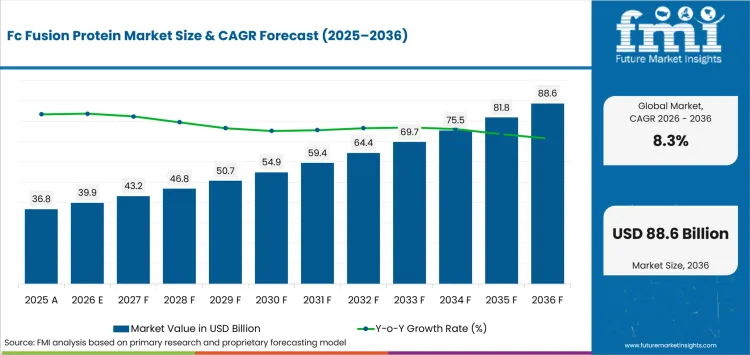
USD 39.9 billion in 2026 and USD 88.6 billion by 2036 at an 8.3% CAGR.
Sales in Fc fusion protein market are projected to rise from USD 39.9 billion in 2026 to USD 88.6 billion by 2036 at an 8.3% CAGR. Growth is supported by the expanding use of Fc fusion proteins and Fc-derived biologics across chronic inflammatory and bleeding disorders, where long dosing histories and established clinical outcomes support sustained treatment demand.
The retinal disease segment continues to benefit from broader availability of aflibercept-based therapies. The USA FDA approved EYDENZELT (aflibercept-boav), an aflibercept biosimilar, in October 2025 for four retinal indications: neovascular age-related macular degeneration, macular edema following retinal vein occlusion, diabetic macular edema and diabetic retinopathy. The introduction of additional aflibercept biosimilars expands treatment options within a major Fc fusion protein category and can improve product accessibility across retinal care settings. Payer reimbursement policies and clinic injection capacity remain important factors influencing biosimilar adoption and switching rates.
Key Takeaways of Fc Fusion Protein Market
- Established receptor traps and Fc-linked factors sustain repeat treatment across inflammatory, retinal and bleeding disorders.
- Therapeutic Fc fusion proteins are projected to represent 67.0% share by product in 2026, reflecting their widespread clinical use across inflammatory and hematological disorders.
- Autoimmune diseases are estimated to account for 46.0% in 2026, driven by the continued reliance on biologic therapies for long-term disease management.
- Injectable products are forecast to capture 91.0% of route demand in 2026, owing to the established administration requirements of most Fc fusion biologics.
- Manufacturing changes can alter glycosylation or aggregation, increasing analytical comparability work during transfers and presentation updates.
- Amgen Inc., Regeneron Pharmaceuticals, Inc., Sanofi S.A., Bayer AG, Sobi, Celltrion Inc., Biocon Biologics Ltd. and Samsung Bioepis Co., Ltd. are some notable companies.
Analyst Perspective
"Commercial evaluation starts with dosing value, analytical comparability and dependable sterile supply. Programs gain durable access where clinical advantages remain measurable under product-specific reimbursement rules."
- Anurag Sharma, Principal Consultant, Future Market Insights
How is the Fc Fusion Protein Market segmented?
The Fc Fusion Protein Market is segmented by Product, Application, Route of Administration, End User, Distribution Channel and Region.
Product covers therapeutic, research-grade, platform and biosimilar formats. Applications cover autoimmune disease, ophthalmology, oncology and rare disease. Routes include injectable, hospital-administered and home-administered therapy. End users include hospitals, specialty clinics and research institutes. Distribution covers hospital, specialty and retail or online pharmacies.
What supports therapeutic Fc fusion proteins within the product category?
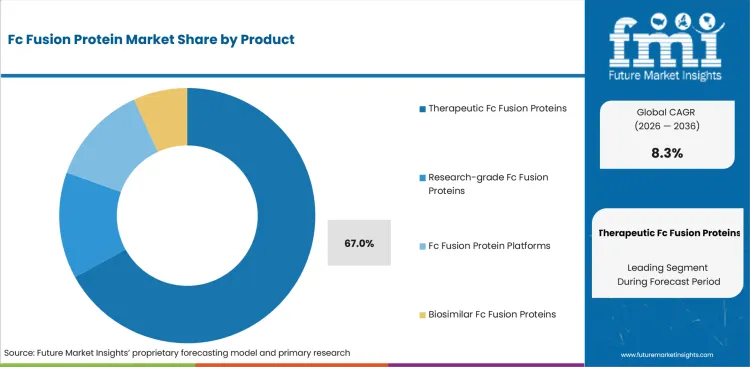
Therapeutic Fc fusion proteins combine receptor or factor activity with extended exposure across inflammatory, retinal and bleeding disorders. Amgen reported USD 99 million in first-quarter 2025 PAVBLU sales following its fourth-quarter 2024 launch.
- Based on product, therapeutic Fc fusion proteins are projected to account for 67.0% in 2026 due to established prescribing across several specialist indications.
- Research-grade proteins and engineered platforms support assay development and candidate design. Commercial transition requires product-specific clinical evidence plus reproducible manufacturing controls.
What makes autoimmune diseases central to the application category?
Autoimmune disease therapeutics provide an established application base for receptor-Fc medicines used in long-duration specialist care. Repeated administration sustains demand despite pricing pressure and changing formulary terms.
- Autoimmune diseases are projected to hold 46.0% share in 2026 owing to chronic receptor-Fc treatment across inflammatory conditions.
- Rheumatology teams compare persistence and infection risk across previously treated patients. In April 2026 Amgen reported USD 320 million in first-quarter Enbrel sales despite lower net pricing.
How does injectable administration shape route selection?
Fc fusion proteins require parenteral delivery since large recombinant molecules cannot achieve therapeutic exposure by ordinary oral administration. Intravenous, subcutaneous and intravitreal routes align delivery with tissue targets and clinical oversight.
- Injectable products are set to represent 91.0% of route demand in 2026 due to parenteral delivery requirements for large recombinant proteins.
- Subcutaneous presentations support repeated home dosing after teams confirm technique and patient capability. Intravitreal injections and complex infusions retain specialist monitoring during continuing treatment cycles.
What role do hospitals play within the end user category?
Hospitals combine specialist diagnosis with pharmacy control and monitored administration across rheumatology, ophthalmology and hemophilia services. Their infrastructure supports initiation, refrigerated storage and adverse-event management.
- The hospitals segment is likely to capture 45.0% share in 2026 attributable to specialist initiation and supervised administration.
- Specialty clinics manage scheduled repeat injections for stable patients. Research institutes conduct recombinant protein testing, yet hospitals retain responsibility for initial dosing and complex protocols.
What are the drivers, restraints and opportunities in the Fc Fusion Protein Market?
Established Fc fusion medicines sustain repeat treatment, while manufacturing comparability limits lifecycle flexibility and longer intervals reduce administration burdens.
- Driver: Marketed receptor traps and Fc-linked factors sustain recurring treatment across inflammatory, retinal and bleeding conditions.
- Restraint: Comparability requirements increase regulatory work and lifecycle costs during production-site or presentation changes.
- Opportunity: Longer dosing intervals and biosimilars can reduce treatment burden or acquisition costs within established reimbursement pathways.
Established products give prescribers disease-specific evidence across retinal care and hemophilia treatment. Repeat dosing converts clinical familiarity into recurring demand under separate administration and reimbursement pathways.
Biologics contract manufacturing adds capacity, yet process changes can alter glycosylation and higher-order structure. FDA guidance issued in September 2025 requires comparative analytical evidence during site transfers and presentation changes.
Longer approved intervals reduce visits for eligible retinal patients. Suppliers need durable injectable packaging and reimbursement evidence to compete for biosimilar volume in health-system tenders.
Which country CAGRs are profiled in the Fc Fusion Protein Market?
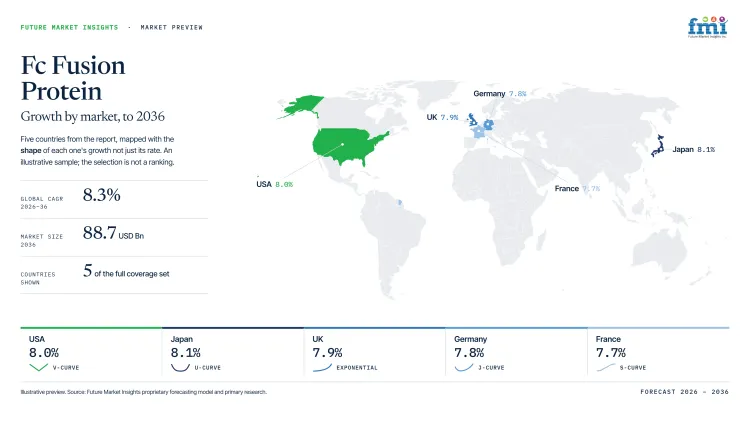
| Country | CAGR |
|---|---|
| Japan | 8.1% |
| USA | 8.0% |
| UK | 7.9% |
| Germany | 7.8% |
| France | 7.7% |
How do country-level CAGRs compare in the Fc Fusion Protein Market?
The country CAGRs span 0.4 percentage point and remain below the global 8.3% forecast. These rates describe forecast pace rather than current market size.
- Japan and the USA differ by 0.1 point despite distinct reimbursement systems and specialist access routes.
- The UK occupies the midpoint as national commissioning influences biosimilar placement across hospital services.
- Germany and France differ by 0.1 point under separate benefit-assessment and reimbursement procedures.
- All five rates remain below the global forecast, so markets outside this profile raise the worldwide average.
- Small forecast gaps require comparison of access rules and administration capacity during country resource planning.
Comparable CAGRs produce materially different commercial entry conditions across national reimbursement systems and treatment networks. The full report covers North America, Latin America, Western Europe, Eastern Europe, East Asia, South Asia and Pacific, and Middle East and Africa.
Country-wise Analysis
- Japan's metropolitan retina clinics rely on domestic distributors that schedule refrigerated aflibercept deliveries across regional referral networks serving patients from prefectures with fewer ophthalmologists and longer travel distances to specialist injection centers nationwide. Bayer reported Japanese approval of Eylea 8 mg for retinal vein occlusion in March 2026, giving clinicians a longer-interval option within established ophthalmic pathways and supporting broader treatment choice across major urban hospitals. Japan is estimated to post 8.1% CAGR over the forecast period, supported by established retina services despite reimbursement controls and limited injection capacity outside major cities that complicate repeated sterile administration across treatment networks.
- United States retina networks combine hospital outpatient departments with large specialty practices and payer authorization systems that coordinate repeated injections across urban centers and rural communities with longer travel to specialist ophthalmology services. The United States' Fc fusion protein outlook is anticipated to advance at 8.0% CAGR over the assessment period, aided by broad product availability despite site-of-care cost differences and uneven specialist access across care networks. Celltrion received FDA approval for EYDENZELT in October 2025 across four retinal indications, widening regulated biosimilar choice as payer contracting terms and reliable sterile supply govern commercial entry across major ophthalmology treatment channels.
- NHS England's March 2026 retinal guidance placed aflibercept biosimilars within first-line treat-and-extend pathways, connecting national purchasing recommendations with hospital ophthalmology services that manage high outpatient volumes and limited injection capacity across regional networks. Fc fusion protein demand in the United Kingdom is forecast to rise at 7.9% CAGR over the forecast period, influenced by coordinated commissioning despite tender timing and patient-specific treatment choices within managed hospital systems. Regional trusts retain implementation responsibility for medicine selection and switching, so suppliers need dependable distribution and clinical support for national recommendations to convert into consistent purchasing across local treatment networks and annual budget cycles.
- Germany routes Fc-linked biologics through specialist hospitals and regional pharmacies operating under statutory insurance, formal benefit assessment and reference-pricing rules that shape access across established hemophilia treatment networks and nationally coordinated specialist care services. The G-BA assigned Altuvoct to a fixed-price group in October 2024 following non-submission of the required dossier, demonstrating how evidence timing can restrict reimbursement access despite authorization and specialist clinical availability across Germany. Fc fusion protein sales in Germany are forecast to expand at 7.8% CAGR by 2036, reinforced by mature treatment infrastructure despite strict dossier requirements and regional prescribing controls across hospital-based hemophilia services nationwide.
- France channels Fc fusion therapies through hospital specialists and reimbursed pharmacy pathways that connect national clinical assessment with scheduled administration across regional retina services and defined patient eligibility rules for repeated intravitreal treatment. The French Fc fusion protein sector is projected to record 7.7% CAGR during the assessment period, shaped by established retinal capacity despite hospital budgets and presentation-specific value assessments across regional hospital care networks. HAS supported reimbursement for Eylea in defined wet macular degeneration and diabetic macular edema populations in December 2024, but found no added clinical value for the assessed prefilled presentation under current national coverage rules.
Who are the notable companies in the Fc Fusion Protein Market?
Amgen Inc., Regeneron Pharmaceuticals, Inc., Sanofi S.A., Bayer AG, Sobi, Celltrion Inc., Biocon Biologics Ltd. and Samsung Bioepis Co., Ltd.
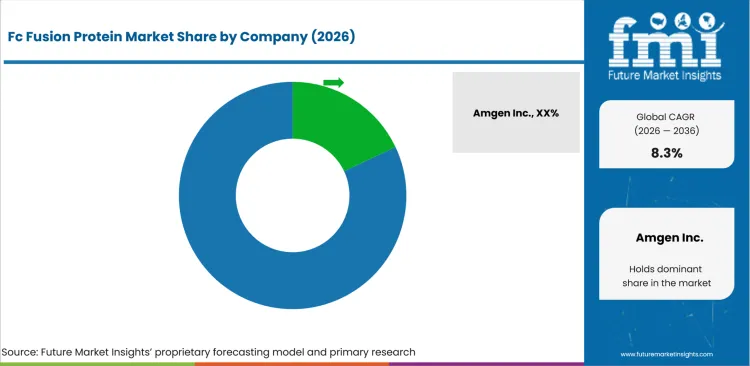
Competition centers on receptor-Fc, ligand-trap and Fc-linked factor franchises. Retinal entry increasingly depends on biosimilar comparability testing, sterile supply and access to specialist treatment channels.
- Amgen and Regeneron combine marketed originator or biosimilar positions with active inflammatory and retinal lifecycle programs.
- Sanofi, Bayer and Sobi connect Fc-linked portfolios with regional rights and continuing evidence generation.
- Celltrion, Biocon Biologics and Samsung Bioepis expand aflibercept competition through approvals and current launches.
Competitive Benchmarking: Fc Fusion Protein Market
| Company | Marketed Fc Fusion Portfolio | Lifecycle Activity | Biosimilar or Partnered Position | Geographic Reach |
|---|---|---|---|---|
| Amgen Inc. | High | High | High | Global |
| Regeneron Pharmaceuticals, Inc. | High | High | High | Global |
| Sanofi S.A. | High | High | High | Global |
| Bayer AG | High | High | High | Global |
| Sobi | High | High | High | Multi-region |
| Celltrion Inc. | Medium | High | Medium | Multi-region |
| Biocon Biologics Ltd. | Medium | High | High | Global |
| Samsung Bioepis Co., Ltd. | Medium | High | High | Multi-region |
Key Developments in the Fc Fusion Protein Market
- In April 2026, Regeneron received FDA approval for EYLEA HD dosing up to every twenty weeks after one successful treatment year. The label reduces annual visits for eligible retinal patients.
- In May 2026, Samsung Bioepis launched OPUVIZ across Europe by direct commercialization. The aflibercept biosimilar adds another vial option for hospital tenders.
- In December 2025, Biocon Biologics signed a worldwide aflibercept settlement and license agreement. The completed agreement enabled United Kingdom entry in January 2026 and wider settled-market access in March.
Key Players in the Fc Fusion Protein Market
Originator and Lifecycle Leaders
- Amgen Inc.
- Regeneron Pharmaceuticals, Inc.
- Sanofi S.A.
- Bayer AG
Fc-Linked Hemophilia Portfolio
- Sobi
Aflibercept Biosimilar Specialists
- Celltrion Inc.
- Biocon Biologics Ltd.
- Samsung Bioepis Co., Ltd.
Fc Fusion Protein Market - Report Scope
| Coverage field | Report scope |
|---|---|
| Market breakdown | By Product, Application, Route of Administration, End User, Distribution Channel and Region. |
| Quantitative Units | Revenue iin USD billion and CAGR in %. |
| Market Definition | Therapeutic, research-grade, platform and biosimilar Fc fusion proteins used across the stated clinical, administration, end-user and distribution categories. |
| Regions Covered | North America, Latin America, Western Europe, Eastern Europe, East Asia, South Asia and Pacific, and Middle East and Africa. |
| Countries Covered | Japan, USA, UK, Germany and France. |
| Key Companies Profiled | Amgen Inc.; Regeneron Pharmaceuticals, Inc.; Sanofi S.A.; Bayer AG; Sobi; Celltrion Inc.; Biocon Biologics Ltd.; Samsung Bioepis Co., Ltd. |
| Forecast Period | 2026 to 2036. |
| Approach | Primary and secondary research with market triangulation. |
Fc Fusion Protein Market - Research Methodology
| Method | Approach |
|---|---|
| Primary Research | FMI analysts gathered input from manufacturers, service providers, technology developers, distributors, end users, procurement teams, and subject-matter experts. Interviews examined purchasing decisions, product or service evaluation, adoption barriers, approval requirements, pricing considerations, and expectations for technical or commercial support. Respondents were also asked what evidence is required before a trial, pilot, or initial order develops into regular purchasing. |
| Desk Research | Desk research covered government statistics, regulatory publications, trade data, industry associations, technical literature, standards, company filings, product information, and official corporate announcements. Sources were reviewed for relevance, publication date, geographic coverage, and consistency with the defined market scope. Claims relating to performance, applications, approvals, capacity, investment, and commercial activity were retained only when supported by credible public evidence. |
| Market Sizing and Forecasting | The market model combined the baseline value with historical performance, segment structure, pricing and volume indicators, adoption levels, company participation, and country-level demand conditions. Forecast assumptions considered economic activity, investment trends, regulatory developments, technology adoption, purchasing cycles, supply availability, and barriers to wider market use. Segment and regional estimates were reconciled before the final market total was calculated. |
| Data Validation | Estimates were checked against multiple independent indicators, including public data, company activity, trade patterns, industry developments, and findings from primary interviews. Validation also tested whether products, services, applications, and company revenues fell within the defined market boundaries. Adjacent categories, unsupported claims, overlapping revenues, and activities without direct market relevance were excluded to reduce double counting and maintain consistency across segments and countries. |
Fc Fusion Protein Market by Segments
Fc Fusion Protein Market segmented by Product:
- Therapeutic Fc Fusion Proteins
- TNF Inhibitors
- VEGF Inhibitors
- IL Receptor Fusion Proteins
- Research-grade Fc Fusion Proteins
- Recombinant Fc Proteins
- Ligand Fc Fusion Proteins
- Cytokine Fc Fusion Proteins
- Fc Fusion Protein Platforms
- Long-acting Fusion Proteins
- Bispecific Fc Fusion Proteins
- Novel Fc-engineered Proteins
- Biosimilar Fc Fusion Proteins
- Etanercept Biosimilars
- Aflibercept Biosimilars
- Investigational Biosimilars
Fc Fusion Protein Market segmented by Application:
- Autoimmune Diseases
- Rheumatoid Arthritis
- Psoriatic Arthritis
- Ankylosing Spondylitis
- Ophthalmology
- Age-related Macular Degeneration
- Diabetic Macular Edema
- Retinal Vein Occlusion
- Oncology
- Solid Tumors
- Hematologic Malignancies
- Immuno-oncology
- Rare Diseases
- Hemophilia
- Primary Immunodeficiency
- Metabolic Disorders
Fc Fusion Protein Market segmented by Route of Administration:
- Injectable
- Intravenous Infusion
- Subcutaneous Injection
- Intramuscular Injection
- Hospital-administered Therapy
- Infusion Centers
- Day Care Oncology Centers
- Specialty Clinics
- Home Administration
- Autoinjectors
- Prefilled Syringes
- Self-administration
Fc Fusion Protein Market segmented by End User:
- Hospitals
- Tertiary Care Hospitals
- Specialty Hospitals
- Academic Medical Centers
- Specialty Clinics
- Rheumatology Clinics
- Ophthalmology Clinics
- Oncology Clinics
- Research Institutes
- Biotechnology Research
- Clinical Research Organizations
- Academic Institutes
Fc Fusion Protein Market segmented by Distribution Channel:
- Hospital Pharmacies
- Inpatient Pharmacies
- Outpatient Pharmacies
- Specialty Hospital Supply
- Specialty Pharmacies
- Biologics Distribution
- Rare Disease Pharmacies
- Cold Chain Distribution
- Retail & Online Pharmacies
- Chain Pharmacies
- E-pharmacy Platforms
- Home Delivery Services
Fc Fusion Protein Market by Region:
- North America
- United States
- Canada
- Mexico
- Latin America
- Brazil
- Chile
- Rest of Latin America
- Western Europe
- Germany
- United Kingdom
- Italy
- Spain
- France
- Nordics
- Benelux
- Rest of Western Europe
- Eastern Europe
- Russia
- Poland
- Hungary
- Balkan and Baltic States
- Rest of Eastern Europe
- East Asia
- China
- Japan
- South Korea
- South Asia and Pacific
- India
- ASEAN
- Australia and New Zealand
- Rest of South Asia and Pacific
- Middle East and Africa
- Kingdom of Saudi Arabia
- Other GCC Countries
- Türkiye
- South Africa
- Other African Union Countries
- Rest of Middle East and Africa
Research Sources and Bibliography
- Amgen Inc. (2025, May 1). AMGEN REPORTS FIRST QUARTER 2025 FINANCIAL RESULTS.
- Amgen Inc. (2026, April 30). AMGEN REPORTS FIRST QUARTER 2026 FINANCIAL RESULTS.
- USA Food and Drug Administration. (2025, September). Development of Therapeutic Protein Biosimilars: Comparative Analytical Assessment and Other Quality-Related Considerations Guidance for Industry.
- Bayer AG. (2026, March 23). Eylea™ 8 mg approved for third retinal indication in Japan.
- Celltrion Inc. (2025, October 10). Celltrion receives USA FDA approval for EYDENZELT® (aflibercept-boav), biosimilar referencing EYLEA® (aflibercept).
- NHS England. (2026, March 11). Commissioning recommendations for medical retinal vascular medicines following the national procurement for anti-vascular endothelial growth factors (VEGFs) and intravitreal steroid implants.
- Gemeinsamer Bundesausschuss. (2024, October 2). Nutzenbewertungsverfahren zum Wirkstoff Efanesoctocog alfa (Hämophilie A).
- Haute Autorité de Santé. (2024, December 3). EYLEA (aflibercept) - Dégénérescence maculaire liée à l’âge, œdème maculaire diabétique.
- Regeneron Pharmaceuticals, Inc. (2026, April 2). EYLEA HD® (aflibercept) Approved by FDA as First and Only Injectable Anti-VEGF with Dosing Intervals Up to 5 Months for Wet Age-related Macular Degeneration (wAMD) and Diabetic Macular Edema (DME).
- Samsung Bioepis Co., Ltd. (2026, May 29). Samsung Bioepis Launches OPUVIZ™ (Aflibercept) 40 mg/mL Vial Across Europe, to Treat Ophthalmic Conditions.
- Biocon Biologics Ltd. (2025, December 13). Biocon Biologics Signs Settlement and License Agreement to Commercialize Biosimilar Aflibercept Worldwide.
- Bayer AG. (2026, January 16). Eylea™ 8 mg approved in the EU for third retinal indication.
- Biocon Biologics Ltd. (2025, June 27). Biocon Biologics Receives Health Canada Approval for Yesafili™ (aflibercept); First Global Launch Scheduled for July 2025.
- Sobi. (2026, July 16). Sobi Q2 2026 report: Significant growth with important pipeline progress.
This bibliography is provided for reader reference and is not exhaustive. The full report contains the complete reference list and detailed citations.
This Report Answers
- What are the 2026 and 2036 Fc fusion protein market values?
- Which mechanisms sustain recurring Fc fusion protein demand?
- Which product category holds the approved 2026 share?
- Why do autoimmune diseases shape application demand?
- How do injectable routes influence treatment settings?
- How do the five profiled country CAGRs compare?
- Which companies hold originator, partner or biosimilar positions?
- Which comparability and reimbursement factors constrain adoption?
Frequently Asked Questions
How big is the Fc fusion protein market in 2026?
USD 39.9 billion is the 2026 value of the Fc fusion protein market across therapeutic products and biosimilars. Established receptor traps and Fc-linked factors support the projected increase to USD 88.6 billion by 2036 under recurring specialist care and product-specific reimbursement pathways.
What is the CAGR of the Fc fusion protein market from 2026 to 2036?
An 8.3% CAGR is projected for the Fc fusion protein market from 2026 to 2036. Established clinical use and broader biosimilar participation support the forecast across treatment settings, although manufacturing comparability, specialist administration and country-specific reimbursement govern product adoption.
Which product segment accounts for 67.0% of the Fc fusion protein market?
Therapeutic Fc fusion proteins are projected to represent 67.0% of product demand in the Fc fusion protein market during 2026. Marketed receptor-Fc products and ligand traps sustain repeat treatment across inflammatory disease, retinal disorders and Fc-linked replacement therapy within established specialist networks.
How much value is the Fc fusion protein market projected to add by 2036?
USD 48.88 billion is projected to be added to the Fc fusion protein market between 2026 and 2036. Repeat treatment and lifecycle expansion support the increase, although analytical comparability, sterile supply and reimbursement requirements affect commercial timing across individual products and countries.
Which companies are active in the Fc fusion protein market?
Companies form the reconciled Fc fusion protein market set across originator, partner and biosimilar positions. Amgen, Regeneron, Sanofi, Bayer, Sobi, Celltrion, Biocon Biologics and Samsung Bioepis cover inflammatory, retinal or hemophilia products within documented commercial routes in named markets.
Preview the report firsthand - request a free sample
Get SampleGet the brochure for pricing and purchase details.
Get PDFTable of Content
- Key Takeaways
- Market Size and CAGR
- Top Growth Driver
- Fastest Growing Segment
- Leading Region
- Key Companies
- Emerging Opportunities
- Executive Summary
- Global Market Outlook
- Demand-side Trends
- Supply-side Trends
- Technology Roadmap Analysis
- Analysis and Recommendations
- Analyst Perspective (What is happening? Why now? What should investors know?)
- Key Questions Answered
- How large is the market?
- What is the CAGR?
- What are key trends?
- Which region dominates?
- Who are the leaders?
- Market Overview
- Market Coverage / Taxonomy
- Market Definition / Scope / Limitations
- Research Methodology
- Chapter Orientation
- Analytical Lens and Working Hypotheses
- Market Structure, Signals, and Trend Drivers
- Benchmarking and Cross-market Comparability
- Market Sizing, Forecasting, and Opportunity Mapping
- Research Design and Evidence Framework
- Desk Research Programme (Secondary Evidence)
- Expert Input and Fieldwork (Primary Evidence)
- Tooling, Models, and Reference Databases
- Data Engineering and Model Build
- Quality Assurance and Audit Trail
- Market Background
- Market Dynamics (Drivers, Restraints, Opportunity, Trends)
- Scenario Forecast (Optimistic, Likely, Conservative)
- Impact Analysis
- AI Impact
- Sustainability Impact
- Regulatory Impact
- Technology Impact
- Consumer / Buyer Analysis
- Purchase Drivers
- Adoption Barriers
- Buyer Journey
- Opportunity Map Analysis
- Product Life Cycle Analysis
- Supply Chain Analysis
- Investment Feasibility Matrix
- Value Chain Analysis
- PESTLE and Porter's Analysis
- Regulatory Landscape
- Regional Parent Market Outlook
- Production and Consumption Statistics
- Import and Export Statistics
- Global Market Analysis and Forecast, 2021 to 2036
- Historical Market Size Value (USD Billion) Analysis, 2021 to 2025
- Current and Future Market Size Value (USD Billion) Projections, 2026 to 2036
- Y-o-Y Growth Trend Analysis
- Absolute $ Opportunity Analysis
- Global Market Pricing Analysis, 2021 to 2036
- Global Market Analysis and Forecast, By Product, 2021 to 2036
- Introduction / Key Findings
- Historical Market Size Value (USD Billion) Analysis By Product, 2021 to 2025
- Current and Future Market Size Value (USD Billion) Analysis and Forecast By Product, 2026 to 2036
- Therapeutic Fc Fusion Proteins
- TNF Inhibitors
- VEGF Inhibitors
- IL Receptor Fusion Proteins
- Research-grade Fc Fusion Proteins
- Recombinant Fc Proteins
- Ligand Fc Fusion Proteins
- Cytokine Fc Fusion Proteins
- Fc Fusion Protein Platforms
- Long-acting Fusion Proteins
- Bispecific Fc Fusion Proteins
- Novel Fc-engineered Proteins
- Biosimilar Fc Fusion Proteins
- Etanercept Biosimilars
- Aflibercept Biosimilars
- Investigational Biosimilars
- Therapeutic Fc Fusion Proteins
- Y-o-Y Growth Trend Analysis By Product, 2021 to 2025
- Absolute $ Opportunity Analysis By Product, 2026 to 2036
- Global Market Analysis and Forecast, By Application, 2021 to 2036
- Introduction / Key Findings
- Historical Market Size Value (USD Billion) Analysis By Application, 2021 to 2025
- Current and Future Market Size Value (USD Billion) Analysis and Forecast By Application, 2026 to 2036
- Autoimmune Diseases
- Rheumatoid Arthritis
- Psoriatic Arthritis
- Ankylosing Spondylitis
- Ophthalmology
- Age-related Macular Degeneration
- Diabetic Macular Edema
- Retinal Vein Occlusion
- Oncology
- Solid Tumors
- Hematologic Malignancies
- Immuno-oncology
- Rare Diseases
- Hemophilia
- Primary Immunodeficiency
- Metabolic Disorders
- Autoimmune Diseases
- Y-o-Y Growth Trend Analysis By Application, 2021 to 2025
- Absolute $ Opportunity Analysis By Application, 2026 to 2036
- Global Market Analysis and Forecast, By Route of Administration, 2021 to 2036
- Introduction / Key Findings
- Historical Market Size Value (USD Billion) Analysis By Route of Administration, 2021 to 2025
- Current and Future Market Size Value (USD Billion) Analysis and Forecast By Route of Administration, 2026 to 2036
- Injectable
- Intravenous Infusion
- Subcutaneous Injection
- Intramuscular Injection
- Hospital-administered Therapy
- Infusion Centers
- Day Care Oncology Centers
- Specialty Clinics
- Home Administration
- Autoinjectors
- Prefilled Syringes
- Self-administration
- Injectable
- Y-o-Y Growth Trend Analysis By Route of Administration, 2021 to 2025
- Absolute $ Opportunity Analysis By Route of Administration, 2026 to 2036
- Global Market Analysis and Forecast, By End User, 2021 to 2036
- Introduction / Key Findings
- Historical Market Size Value (USD Billion) Analysis By End User, 2021 to 2025
- Current and Future Market Size Value (USD Billion) Analysis and Forecast By End User, 2026 to 2036
- Hospitals
- Tertiary Care Hospitals
- Specialty Hospitals
- Academic Medical Centers
- Specialty Clinics
- Rheumatology Clinics
- Ophthalmology Clinics
- Oncology Clinics
- Research Institutes
- Biotechnology Research
- Clinical Research Organizations
- Academic Institutes
- Hospitals
- Y-o-Y Growth Trend Analysis By End User, 2021 to 2025
- Absolute $ Opportunity Analysis By End User, 2026 to 2036
- Global Market Analysis and Forecast, By Distribution Channel, 2021 to 2036
- Introduction / Key Findings
- Historical Market Size Value (USD Billion) Analysis By Distribution Channel, 2021 to 2025
- Current and Future Market Size Value (USD Billion) Analysis and Forecast By Distribution Channel, 2026 to 2036
- Hospital Pharmacies
- Inpatient Pharmacies
- Outpatient Pharmacies
- Specialty Hospital Supply
- Specialty Pharmacies
- Biologics Distribution
- Rare Disease Pharmacies
- Cold Chain Distribution
- Retail & Online Pharmacies
- Chain Pharmacies
- E-pharmacy Platforms
- Home Delivery Services
- Hospital Pharmacies
- Y-o-Y Growth Trend Analysis By Distribution Channel, 2021 to 2025
- Absolute $ Opportunity Analysis By Distribution Channel, 2026 to 2036
- Global Market Analysis and Forecast, By Region, 2021 to 2036
- Introduction
- Historical Market Size Value (USD Billion) Analysis By Region, 2021 to 2025
- Current Market Size Value (USD Billion) Analysis and Forecast By Region, 2026 to 2036
- North America
- Latin America
- Western Europe
- Eastern Europe
- East Asia
- South Asia and Pacific
- Middle East & Africa
- Market Attractiveness Analysis By Region
- North America Market Analysis and Forecast, By Country, 2021 to 2036
- Historical Market Size Value (USD Billion) Trend Analysis By Market Taxonomy, 2021 to 2025
- Market Size Value (USD Billion) Forecast By Market Taxonomy, 2026 to 2036
- By Country
- USA
- Canada
- By Product
- By Application
- By Route of Administration
- By End User
- By Distribution Channel
- By Country
- Market Attractiveness Analysis
- By Country
- By Product
- By Application
- By Route of Administration
- By End User
- By Distribution Channel
- Key Takeaways
- Latin America Market Analysis and Forecast, By Country
- Historical Market Size Value (USD Billion) Trend Analysis By Market Taxonomy, 2021 to 2025
- Market Size Value (USD Billion) Forecast By Market Taxonomy, 2026 to 2036
- By Country
- Brazil
- Mexico
- Chile
- Rest of Latin America
- By Product
- By Application
- By Route of Administration
- By End User
- By Distribution Channel
- By Country
- Market Attractiveness Analysis
- By Country
- By Product
- By Application
- By Route of Administration
- By End User
- By Distribution Channel
- Key Takeaways
- Western Europe Market Analysis and Forecast, By Country
- Historical Market Size Value (USD Billion) Trend Analysis By Market Taxonomy, 2021 to 2025
- Market Size Value (USD Billion) Forecast By Market Taxonomy, 2026 to 2036
- By Country
- Germany
- UK
- Italy
- Spain
- France
- Nordic
- BENELUX
- Rest of Western Europe
- By Product
- By Application
- By Route of Administration
- By End User
- By Distribution Channel
- By Country
- Market Attractiveness Analysis
- By Country
- By Product
- By Application
- By Route of Administration
- By End User
- By Distribution Channel
- Key Takeaways
- Eastern Europe Market Analysis and Forecast, By Country
- Historical Market Size Value (USD Billion) Trend Analysis By Market Taxonomy, 2021 to 2025
- Market Size Value (USD Billion) Forecast By Market Taxonomy, 2026 to 2036
- By Country
- Russia
- Poland
- Hungary
- Balkan & Baltic
- Rest of Eastern Europe
- By Product
- By Application
- By Route of Administration
- By End User
- By Distribution Channel
- By Country
- Market Attractiveness Analysis
- By Country
- By Product
- By Application
- By Route of Administration
- By End User
- By Distribution Channel
- Key Takeaways
- East Asia Market Analysis and Forecast, By Country
- Historical Market Size Value (USD Billion) Trend Analysis By Market Taxonomy, 2021 to 2025
- Market Size Value (USD Billion) Forecast By Market Taxonomy, 2026 to 2036
- By Country
- China
- Japan
- South Korea
- By Product
- By Application
- By Route of Administration
- By End User
- By Distribution Channel
- By Country
- Market Attractiveness Analysis
- By Country
- By Product
- By Application
- By Route of Administration
- By End User
- By Distribution Channel
- Key Takeaways
- South Asia and Pacific Market Analysis and Forecast, By Country
- Historical Market Size Value (USD Billion) Trend Analysis By Market Taxonomy, 2021 to 2025
- Market Size Value (USD Billion) Forecast By Market Taxonomy, 2026 to 2036
- By Country
- India
- ASEAN
- Australia & New Zealand
- Rest of South Asia and Pacific
- By Product
- By Application
- By Route of Administration
- By End User
- By Distribution Channel
- By Country
- Market Attractiveness Analysis
- By Country
- By Product
- By Application
- By Route of Administration
- By End User
- By Distribution Channel
- Key Takeaways
- Middle East & Africa Market Analysis and Forecast, By Country
- Historical Market Size Value (USD Billion) Trend Analysis By Market Taxonomy, 2021 to 2025
- Market Size Value (USD Billion) Forecast By Market Taxonomy, 2026 to 2036
- By Country
- Kingdom of Saudi Arabia
- Other GCC Countries
- Türkiye
- South Africa
- Other African Union
- Rest of Middle East & Africa
- By Product
- By Application
- By Route of Administration
- By End User
- By Distribution Channel
- By Country
- Market Attractiveness Analysis
- By Country
- By Product
- By Application
- By Route of Administration
- By End User
- By Distribution Channel
- Key Takeaways
- Key Countries Market Analysis
- USA
- Pricing Analysis
- Market Share Analysis, 2025
- By Product
- By Application
- By Route of Administration
- By End User
- By Distribution Channel
- Canada
- Pricing Analysis
- Market Share Analysis, 2025
- By Product
- By Application
- By Route of Administration
- By End User
- By Distribution Channel
- Mexico
- Pricing Analysis
- Market Share Analysis, 2025
- By Product
- By Application
- By Route of Administration
- By End User
- By Distribution Channel
- Brazil
- Pricing Analysis
- Market Share Analysis, 2025
- By Product
- By Application
- By Route of Administration
- By End User
- By Distribution Channel
- Chile
- Pricing Analysis
- Market Share Analysis, 2025
- By Product
- By Application
- By Route of Administration
- By End User
- By Distribution Channel
- Germany
- Pricing Analysis
- Market Share Analysis, 2025
- By Product
- By Application
- By Route of Administration
- By End User
- By Distribution Channel
- UK
- Pricing Analysis
- Market Share Analysis, 2025
- By Product
- By Application
- By Route of Administration
- By End User
- By Distribution Channel
- Italy
- Pricing Analysis
- Market Share Analysis, 2025
- By Product
- By Application
- By Route of Administration
- By End User
- By Distribution Channel
- Spain
- Pricing Analysis
- Market Share Analysis, 2025
- By Product
- By Application
- By Route of Administration
- By End User
- By Distribution Channel
- France
- Pricing Analysis
- Market Share Analysis, 2025
- By Product
- By Application
- By Route of Administration
- By End User
- By Distribution Channel
- India
- Pricing Analysis
- Market Share Analysis, 2025
- By Product
- By Application
- By Route of Administration
- By End User
- By Distribution Channel
- ASEAN
- Pricing Analysis
- Market Share Analysis, 2025
- By Product
- By Application
- By Route of Administration
- By End User
- By Distribution Channel
- Australia & New Zealand
- Pricing Analysis
- Market Share Analysis, 2025
- By Product
- By Application
- By Route of Administration
- By End User
- By Distribution Channel
- China
- Pricing Analysis
- Market Share Analysis, 2025
- By Product
- By Application
- By Route of Administration
- By End User
- By Distribution Channel
- Japan
- Pricing Analysis
- Market Share Analysis, 2025
- By Product
- By Application
- By Route of Administration
- By End User
- By Distribution Channel
- South Korea
- Pricing Analysis
- Market Share Analysis, 2025
- By Product
- By Application
- By Route of Administration
- By End User
- By Distribution Channel
- Russia
- Pricing Analysis
- Market Share Analysis, 2025
- By Product
- By Application
- By Route of Administration
- By End User
- By Distribution Channel
- Poland
- Pricing Analysis
- Market Share Analysis, 2025
- By Product
- By Application
- By Route of Administration
- By End User
- By Distribution Channel
- Hungary
- Pricing Analysis
- Market Share Analysis, 2025
- By Product
- By Application
- By Route of Administration
- By End User
- By Distribution Channel
- Kingdom of Saudi Arabia
- Pricing Analysis
- Market Share Analysis, 2025
- By Product
- By Application
- By Route of Administration
- By End User
- By Distribution Channel
- Türkiye
- Pricing Analysis
- Market Share Analysis, 2025
- By Product
- By Application
- By Route of Administration
- By End User
- By Distribution Channel
- South Africa
- Pricing Analysis
- Market Share Analysis, 2025
- By Product
- By Application
- By Route of Administration
- By End User
- By Distribution Channel
- USA
- Market Structure Analysis
- Competition Dashboard
- Competition Benchmarking
- Market Share Analysis of Top Players
- By Regional
- By Product
- By Application
- By Route of Administration
- By End User
- By Distribution Channel
- Emerging Startups
- Innovation Benchmarking
- Competition Analysis
- Competition Deep Dive
- Amgen Inc.
- Overview
- Product Portfolio
- Profitability by Market Segments
- Sales Footprint
- Strategy Overview
- Marketing Strategy
- Product Strategy
- Channel Strategy
- Regeneron Pharmaceuticals, Inc.
- Sanofi S.A.
- Pfizer Inc.
- AbbVie Inc.
- Bayer AG
- AstraZeneca PLC
- Johnson & Johnson
- Merck KGaA
- Biogen Inc.
- Amgen Inc.
- Case Studies
- Success Stories
- Recent Developments
- Competition Deep Dive
- Assumptions & Acronyms Used


