

- Market Size (2026)
- USD 7.5 Bn
- Forecast (2036)
- USD 33.4 Bn
- CAGR (2026 to 2036)
- 16.1%
How big is NFC / RFID smart label and tamper-detection market size?
USD 7.5 billion in 2026 and USD 33.4 billion by 2036 at a 16.1% CAGR.
Demand for NFC / RFID smart label and tamper-detection is projected to expand at 16.1% CAGR between 2026 and 2036, increasing valuation from USD 7.5 billion in 2026 to USD 33.4 billion by 2036. Packaging manufacturers are steadily expanding their product lines to include smart labels and RFID tags that consumers can easily scan and verify using their smartphones. In August 2025, Beontag reported having more than 80 standard RFID products. This broad selection helps packaging converters choose the right tag format much faster during their technical reviews and the company disclosed over 2,000 customized solutions. This extensive catalog reduces the need for costly redesigns when testing different packaging materials and coding systems.
International buyers evaluate smart labeling technologies based on distinct regional priorities. Buyers in the United States and Germany prioritize eco-friendly recycling compatibility along with clear traceability records and verified package integrity. Buyers in China and Japan emphasize large-scale manufacturing, compact tag designs, and dependable performance for food packaging. An extensive retail security programs highlights the increasing growth of this technology. In March 2025, Amazon reported having 88,000 enrolled brands and more than 2.5 billion verified product units. This significant scale supports unique, item-level authentication allowing shoppers to verify genuine products and helps companies prevent supply chain diversion without changing the printed artwork on the packaging.
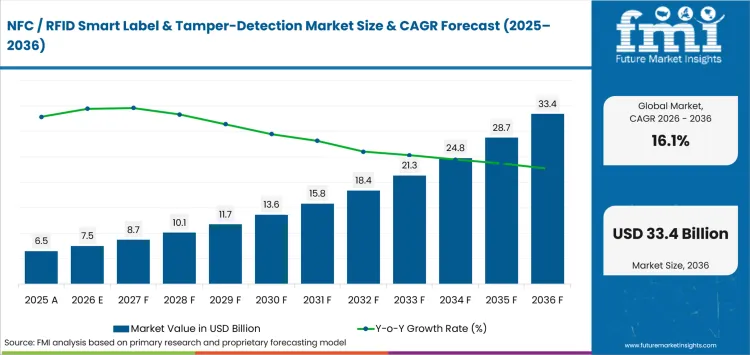
Key Takeaways for NFC / RFID Smart Label & Tamper-Detection Market
- Demand for NFC / RFID smart label and tamper-detection is driven by item authentication and traceability together with consumer interaction and package-integrity verification across regulated products.
- NFC is forecast to garner 60.2% share of technology in 2026, influenced by smartphone access and secure tap-based product verification.
- Tamper Detection is estimated to lead application with 40.0% share in 2026, backed by first-opening indication and seal-status verification.
- Antenna detuning and chip expense restrict deployment across liquid and metal packaging. Adhesive compatibility with privacy controls and recycling performance adds qualification work across varied package materials.
- Competition focuses on Pragmatic Semiconductor Ltd., Avery Dennison Corporation, Identiv, Inc., NXP Semiconductors N.V., Tageos SAS, Beontag, Schreiner Group GmbH & Co. KG, and SATO Holdings Corporation. Suppliers differ based on chip design and inlay conversion together with tamper functions and application support.
Analyst Perspective
“Connected labels create commercial value by delivering repeatable reads and secure identity across packaging structures suited to filling operations. Brand owners examine antenna behavior and seal failure evidence during supplier reviews across varied package formats. Commercial adoption improves as physical pack testing connects with traceability records under assigned converter responsibilities.”
- Nandini Roy Choudhury, Principal Consultant for Packaging at Future Market Insights
How is NFC / RFID Smart Label & Tamper-Detection Market segmented?
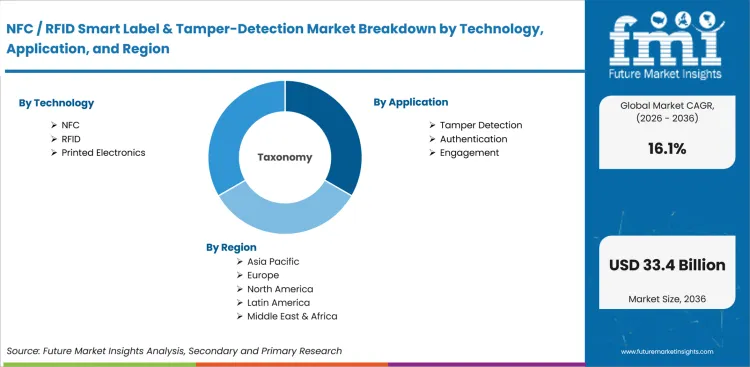
The NFC / RFID smart label and tamper-detection is segmented by technology, application, end use, and region.
The NFC / RFID smart label and tamper-detection is segmented by technology, application, end use, and region. Technology coverage separates NFC from RFID and printed electronics according to read range and identity method. Application coverage classifies tamper detection, authentication and engagement across package-security workflows. End use coverage distinguishes food from pharma and beauty using operating requirements and release controls. Regional coverage includes North America, Latin America, Western Europe, Eastern Europe. East Asia, South Asia and Pacific, Middle East and Africa within geographic assessment.
What supports NFC within technology selection?
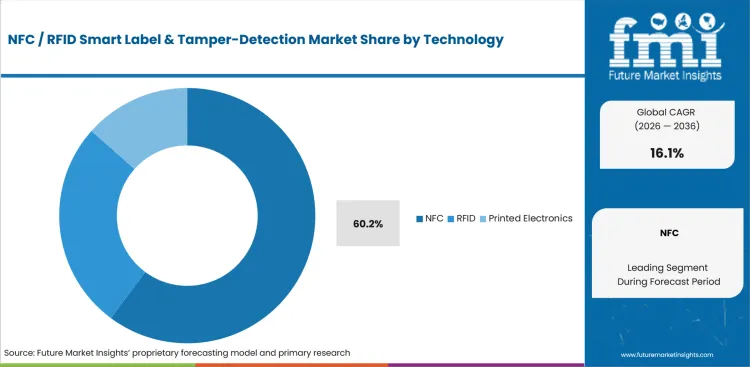
NFC supports smartphone-readable identity using consumer devices without dedicated scanning hardware across packaged consumer goods. Secure tag chips connect product records with tap-based authentication under controlled data-access rules throughout product lifecycles. NXP Semiconductors introduced NTAG X DNA with 16 KB memory during May 2025, supporting secure unique NFC authentication across connected tags. Expanded memory promotes richer product information and device diagnostics across NFC Tag ICs during authentication programs.
- NFC is predicted to represent 60.2% share of technology in 2026, led by smartphone compatibility and secure product checks. Brand teams examine tap consistency and cryptographic functions together with memory capacity and antenna behavior across finished packs.
- RFID supports longer-range inventory control across cases and assets under item-level traceability processes. Printed electronics provides flexible form factors for labels requiring thin conductors or sensors within reduced-material constructions.
Why does tamper detection lead application demand?
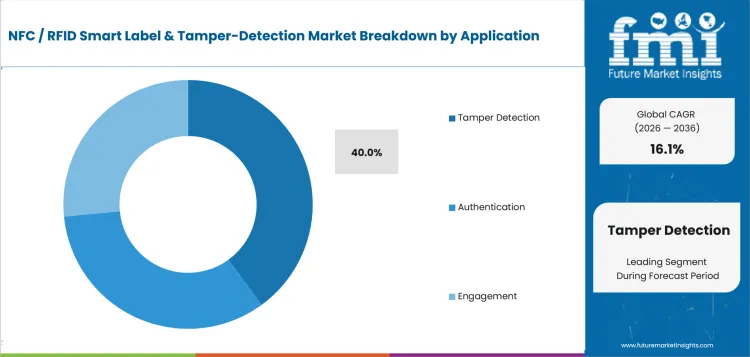
Tamper detection combines package-opening evidence with electronic status verification across brand-protection and regulated product programs. Conductive loops and fragile antennas help distinguish intact packs from opened or transferred labels during operational checks. Tageos introduced 2 NFC and dual-frequency products during November 2025, including EOS-620 Seal with an electronic tamper interface. Multi-frequency designs connect seal status with inventory records across tamper evident labels during item checks.
- By application, tamper detection is anticipated to reach 40.0% share in 2026 since being reflecting demand for first-opening evidence and product-integrity checks. Buyers examine loop placement and adhesive failure together with read response during finished-pack opening trials.
- Authentication verifies product origin using encoded credentials and secure chips under authorized manufacturing controls. Engagement provides instructions and recycling guidance using tap interactions without replacing package-security controls across brand programs.
What supports food across end use demand?
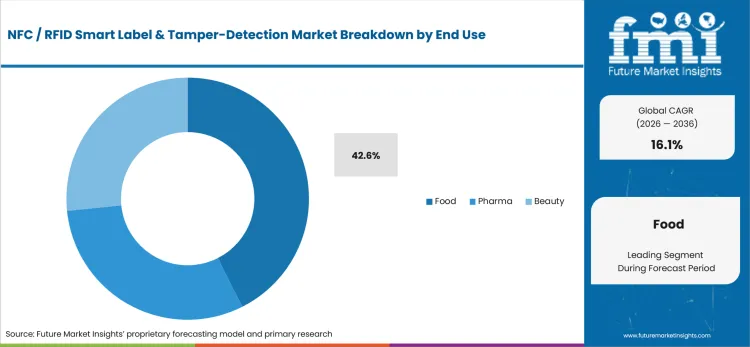
Food programs require rapid item recognition across production and inventory together with expiry control and reusable packaging. Moisture and microwave exposure complicate tag performance across curved containers holding high-water products during food-service use. Beontag reported eWave testing across 50 microwave cycles during March 2025 under food-service conditions. Testing used 1,800 W for 3.5 minutes per cycle, supporting demanding operating requirements across reusable packages. Durable label construction expands RFID deployment across returnable containers within intelligent packaging programs.
- Based on end use, food is likely to reach 42.6% share in 2026 as it is driven by traceability and expiry control across reusable-container and package-integrity programs. Processors assess read reliability near liquids and metals under cold storage with washing and heating exposure.
- Pharma emphasizes serialization and authenticated access with tamper evidence across medicine packs and devices under controlled distribution. Beauty programs apply compact security labels for product verification and controlled engagement during diversion detection.
What are drivers, restraints, and opportunities in NFC / RFID Smart Label & Tamper-Detection Market?
Traceability duties support adoption across food and pharma applications under documented product-integrity controls. Material recovery requirements restrict label constructions lacking proven separation behavior within established recycling systems.
- Driver: Brand owners need item identity connecting production records with inventory events under authenticated package-opening controls. Reliable encoded records improve traceability across manufacturing and distribution processes while supporting faster product-status verification.
- Restraint: Read variation across liquid and metal packaging raises testing expense under curved or multilayer pack conditions. Buyers require repeated antenna and adhesive assessments to confirm dependable performance across finished packaging structures.
- Opportunity: Thin chips and paper antennas support dual-frequency inlays with recyclable adhesives across mass packaging programs. Material-efficient designs help converters address identification and tamper requirements without adding excessive weight or complex package components.
Food traceability programs require structured records across covered supply-chain events during regulatory and operational reviews. United States Food and Drug Administration tabletop exercises tested sortable records supplied within 24 hours during June 2026, clarifying response readiness for affected food programs. Accurate encoding and event capture determine whether label identity accelerates record association under database governance. Track and trace packaging gains commercial value from dependable connections between physical items and retained event records.
Recycling compatibility restricts metal-bearing inlays and multilayer constructions under adhesive or liner recovery requirements. European Commission rules require recyclable design for all packaging by 2030 following regulation entry during February 2025. Label converters need separation evidence covering antennas and face stocks under established recycling processes. Connected-label proposals receive stronger approval from documented recovery performance across representative package structures.
Embedded RFID expands identification routes across reusable plastic items within molded packaging applications. Avery Dennison launched three RFID-enabled in-mold label solutions during July 2025, protecting embedded identity components from abrasion during injection molding. Protected inlays support repeated washing and handling across reusable assets with extended service requirements. Similar integration promotes stable read performance across connected packs exposed to prolonged operational use.
How are country CAGRs aligned in NFC / RFID Smart Label & Tamper-Detection Market?
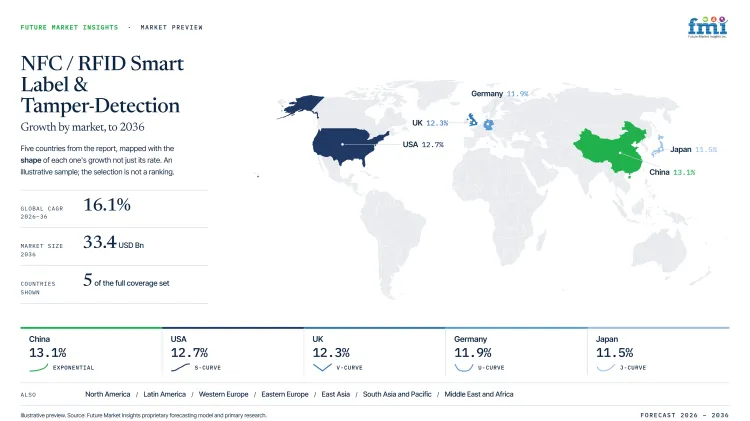
| Country | CAGR from 2026 to 2036 |
|---|---|
| China | 13.1% |
| USA | 12.7% |
| UK | 12.3% |
| Germany | 11.9% |
| Japan | 11.5% |
Source: Future Market Insights analysis, 2026.
How do country-level CAGRs compare in NFC / RFID Smart Label & Tamper-Detection Market?
Country comparison shows measured separation across disclosed rates under distinct manufacturing and regulatory conditions. China leads disclosed coverage based on manufacturing depth and expanding food-processing output. USA follows through traceability requirements and recyclable label development supported by established RFID infrastructure. UK and Germany form a close European band under packaging compliance and recycling-evidence requirements. Japan completes disclosed comparison based on advanced label production and resource-efficiency programs.
- China is anticipated to lead disclosed country coverage based on packaging conversion and electronics production capacity.
- USA is likely to follow China under established retail identification and food-traceability infrastructure.
- UK is expected to occupy the third position based on brand-protection and packaging-compliance investment.
- Germany is projected to follow UK under disciplined recycling and converter qualification practices.
- Japan is estimated to complete the comparison based on selective quality-sensitive adoption across consumer applications.
Markets carrying similar CAGRs may present distinct entry conditions under radio rules and privacy duties. Converter capacity and buyer validation practices influence commercial execution across every modeled region. Full report coverage extends across North America and Latin America together with Western Europe and Eastern Europe. East Asia and South Asia and Pacific join Middle East and Africa within expanded geographic assessment.
Country-wise Analysis
- Industry in China is estimated to expand at 13.1% CAGR from 2026 to 2036, led by extensive packaging conversion capacity and domestic electronics production. National Bureau of Statistics of China reported agricultural and sideline food processing activity increased 5.6% during 2025 in its February 2026 release, creating additional requirements for item identity and package-control records. Expanding production volumes increase potential label usage across food-processing plants and distribution operations. Local chip availability and encoding support influence supplier selection across high-speed packaging lines.
- Avery Dennison reported 96.0% of the top 50 brands having maintained recyclability and waste-management targets in June 2025, strengthening interest in RFID labels compatible with established recycling streams. Material compatibility connects item identity with recycling evidence across finished PET packaging structures. NFC / RFID smart label and tamper-detection adoption in the United States is projected to rise at 12.7% CAGR between 2026 and 2036, driven by food traceability and retail inventory programs. Qualified adhesives and reliable encoding services support wider implementation across regulated goods and consumer-product applications.
- British packaging teams examine product authentication together with privacy requirements and recycled-content evidence across consumer-readable labels. HM Revenue & Customs confirmed a 30.0% recycled-content threshold for Plastic Packaging Tax in December 2025, increasing scrutiny of label materials applied to plastic packaging. Face stocks and inlays require documented compatibility during material and tax reviews. Sales in UK are anticipated to increase at 12.3% CAGR during the forecast period, aided by brand-protection and traceability investment.
- Sector in Germany is predicted to grow at 11.9% CAGR during the study period, backed by strict recycling practices and established converting capabilities. German Environment Agency reported about 5.5 million tonnes of packaging waste were recycled during 2024 in its January 2026 release, reinforcing material-compatibility reviews for connected labels. High recovery volumes encourage suppliers to document adhesive separation and inlay composition across recycling processes. Careful validation supports adoption across food and pharmaceutical packaging programs.
- SATO reported an annual recycling plan covering approximately 19 tons of release-liner waste in February 2025, supporting lower-waste label conversion across Japanese production operations. Converter discipline strengthens thin-inlay integration and precise label placement across compact package formats. Demand in Japan is forecast to rise at 11.5% CAGR between 2026 and 2036, influenced by quality-sensitive adoption across food and consumer-goods applications. Dependable manufacturing and resource-efficiency requirements shape supplier approval across connected-label projects.
Who are notable companies in NFC / RFID Smart Label & Tamper-Detection Market?
Pragmatic Semiconductor Ltd., Avery Dennison Corporation, Identiv, Inc., NXP Semiconductors N.V., Tageos SAS, Beontag, Schreiner Group GmbH & Co. KG, and SATO Holdings Corporation are notable companies operating in the market.
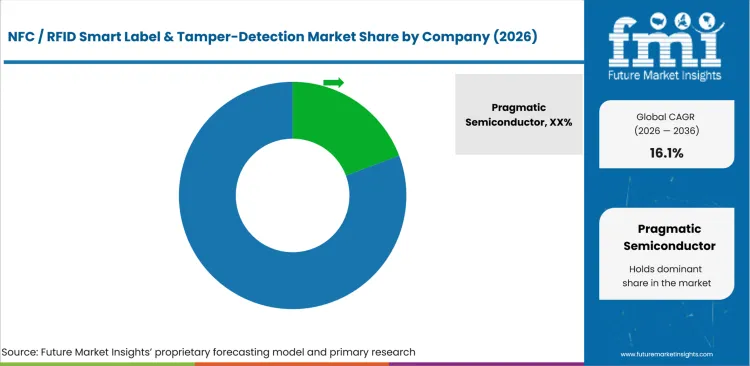
Competition centers on chip architecture and inlay conversion together with tamper indication and label-integration support. Semiconductor providers focus on flexible NFC chips and secure identity functions across compact packaging formats. Inlay manufacturers compete on antenna performance and material compatibility across high-volume label applications. Label specialists differentiate their offers using tamper-sensitive constructions and customer qualification assistance.
- Pragmatic Semiconductor Ltd. and NXP Semiconductors N.V. compete based on chip design connected with secure NFC identity and compact tag construction. Customer teams assess memory capacity and authentication functions together with compatibility across converted label formats.
- Avery Dennison Corporation and Beontag compete according to inlay depth connected with adhesives and recyclable face-stock constructions. Packaging teams examine read consistency and material compatibility across food and consumer-product applications.
- Identiv, Inc. and Schreiner Group GmbH & Co. KG compete using secure NFC designs connected with tamper indication and protected product identity. Buyers assess opening detection and authentication performance during finished-package qualification.
- Tageos SAS competes based on NFC and dual-frequency inlays supporting tamper detection and consumer interaction. SATO Holdings Corporation adds label-conversion and encoding capabilities supporting operational identification across customer programs.
Competitive Benchmarking: NFC / RFID Smart Label & Tamper-Detection Market
| Company | Chip or Inlay Depth | Tamper-Detection Match | Label Integration Support | Service Reach |
|---|---|---|---|---|
| Pragmatic Semiconductor Ltd. | High | Medium | High | Global |
| Avery Dennison Corporation | High | High | High | Global |
| Identiv, Inc. | High | High | High | Global |
| NXP Semiconductors N.V. | High | High | Medium | Global |
| Tageos SAS | High | High | High | Global |
| Beontag | High | Medium | High | Global |
| Schreiner Group GmbH & Co. KG | Medium | High | High | Global |
| SATO Holdings Corporation | Medium | Medium | High | Global |
Source: Future Market Insights competitive analysis, 2026.
Key Developments in NFC / RFID Smart Label & Tamper-Detection Market
- In June 2025, Tageos introduced the EOS-450 U9 RAIN RFID inlay for quick-service restaurants and food supply chains. ARC Spec Z approval supported case-level identification and expiry control across demanding food-service operations.
- In January 2026, NXP Semiconductors introduced UCODE X for high-volume RAIN RFID applications across retail and healthcare. Improved read and write sensitivity supported smaller label designs across food and logistics applications.
- In June 2026, Pragmatic Semiconductor launched Pragmatic NFC Protect PR1311 for tamper detection and product authentication. Flexible chip construction supported smartphone-based first-opening verification across food and pharmaceutical packaging.
Key Players in NFC / RFID Smart Label & Tamper-Detection Market
Global Identification Providers
- Avery Dennison Corporation
- NXP Semiconductors N.V.
- SATO Holdings Corporation
- Beontag
Specialist Connected-Label Providers
- Identiv, Inc.
- Tageos SAS
- Schreiner Group GmbH & Co. KG
Flexible Semiconductor Provider
- Pragmatic Semiconductor Ltd.
NFC / RFID Smart Label & Tamper-Detection Market Report Scope
| Coverage field | Report scope |
|---|---|
| Market Breakdown | NFC / RFID smart label and tamper-detection market breakdown by technology, application, end use, and region. |
| Quantitative Units | Revenue in USD Million, CAGR in %. |
| Market Definition | NFC / RFID smart label and tamper-detection covers NFC, RFID, and printed-electronic labels used for item identity, authentication, engagement, traceability, and package-opening evidence across Food, Pharma, and Beauty. |
| Regions Covered | North America, Latin America, Western Europe, Eastern Europe, East Asia, South Asia and Pacific, Middle East and Africa |
| Countries Covered | USA, Canada, Brazil, Mexico, Argentina, Chile, Germany, France, United Kingdom, Italy, Spain, Benelux, Nordics, Poland, Czech Republic, Romania, Hungary, China, Japan, South Korea, India, ASEAN, Australia and New Zealand, GCC Countries, South Africa, Türkiye, Israel |
| Key Companies Profiled | Pragmatic Semiconductor Ltd., Avery Dennison Corporation, Identiv, Inc., NXP Semiconductors N.V., Tageos SAS, Beontag, Schreiner Group GmbH & Co. KG, SATO Holdings Corporation |
| Forecast Period | 2026 to 2036 |
| Approach | Hybrid bottom-up and top-down methodology uses segment shares and country CAGRs. Company activity and buyer adoption support final market reconciliation. |
Source: Future Market Insights analysis, 2026.
NFC / RFID Smart Label & Tamper-Detection Market - Research Methodology
| Method | Approach |
|---|---|
| Primary Research | FMI analysts gathered input from manufacturers, service providers, technology developers, distributors, end users, sourcing teams, and subject-matter experts. Interviews examined purchasing decisions, product or service evaluation, adoption barriers, approval requirements, pricing considerations, and expectations for technical or commercial support. Respondents were also asked what evidence is required before a trial, pilot, or initial order develops into regular purchasing. |
| Desk Research | Desk research covered government statistics, regulatory publications, trade data, industry associations, technical literature, standards, company filings, product information, and official corporate announcements. Sources were reviewed for relevance, publication date, geographic coverage, and consistency with the defined market scope. Claims relating to performance, applications, approvals, capacity, investment, and commercial activity were retained only when supported by credible public evidence. |
| Market Sizing and Forecasting | The market model combined the baseline value with historical performance, segment structure, pricing and volume indicators, adoption levels, company participation, and country-level demand conditions. Forecast assumptions considered economic activity, investment trends, regulatory developments, technology adoption, purchasing cycles, supply availability, and barriers to wider market use. Segment and regional estimates were reconciled before the final market total was calculated. |
| Data Validation | Estimates were checked against multiple independent indicators, including public data, company activity, trade patterns, industry developments, and findings from primary interviews. Validation also tested whether products, services, applications, and company revenues fell within the defined market boundaries. Adjacent categories, unsupported claims, overlapping revenues, and activities without direct market relevance were excluded to reduce double counting and maintain consistency across segments and countries. |
Source: Future Market Insights analysis, 2026.
NFC / RFID Smart Label & Tamper-Detection Market by Segments
NFC / RFID Smart Label & Tamper-Detection Market segmented by Technology:
- NFC
- RFID
- Printed Electronics
NFC / RFID Smart Label & Tamper-Detection Market segmented by Application:
- Tamper Detection
- Authentication
- Engagement
NFC / RFID Smart Label & Tamper-Detection Market segmented by End Use:
- Food
- Pharma
- Beauty
NFC / RFID Smart Label & Tamper-Detection Market segmented by Region:
- North America
- United States
- Canada
- Latin America
- Brazil
- Mexico
- Argentina
- Chile
- Western Europe
- Germany
- France
- United Kingdom
- Italy
- Spain
- Benelux
- Nordics
- Eastern Europe
- Poland
- Czech Republic
- Romania
- Hungary
- East Asia
- China
- Japan
- South Korea
- South Asia and Pacific
- India
- ASEAN
- Australia and New Zealand
- Middle East and Africa
- GCC Countries
- South Africa
- Türkiye
- Israel
Research Sources and Bibliography
- Beontag. (2025, August 28). Beontag to Spotlight Labeling Materials and Smart Tag Innovations at LabelExpo Europe 2025.
- Amazon. (2025, March). Brand Protection Report.
- NXP Semiconductors. (2025, May 28). NXP Enables Secure Authentication with New NTAG X DNA Connected NFC Tag.
- Tageos. (2025, November 21). Tageos Launches New NFC and Dual-Frequency RFID Inlays for Enhanced Consumer Engagement and Anti-Tamper Applications.
- Beontag. (2025, March 18). Beontag expands RFID portfolio with microwave and waterproof resistant tag.
- USA Food and Drug Administration. (2026, June 10). FDA Releases Report on Traceability Readiness Tabletop Exercises and Updated FAQs.
- European Commission. (2025, February 11). Packaging waste.
- Avery Dennison Corporation. (2025, July 8). Avery Dennison launches RFID-enabled In-Mold Label solutions for enhanced traceability and reuse.
- National Bureau of Statistics of China. (2026, February 28). Statistical Communiqué of the People’s Republic of China on the 2025 National Economic and Social Development.
- Avery Dennison Corporation. (2025, June 25). Avery Dennison unveils industry-first RFID label recognized by APR for compatibility with PET recycling stream.
- HM Revenue & Customs. (2025, December 5). Budget 2025 Overview of tax legislation and rates.
- German Environment Agency. (2026, January 27). Facts against myths: Packaging waste recycling in Germany is working.
- SATO Corporation. (2025, February 13). SATO Kitakami Operations to Recycle 19 Tons of Label Liner Waste Annually.
- Pragmatic Semiconductor. (2025, March 27). Pragmatic Semiconductor set to revolutionise NFC connectivity with sustainable flexible chips.
- Avery Dennison Corporation. (2026, January 7). Turning potential into operational success: Avery Dennison gets set for Retail’s Big Show.
- Identiv, Inc. (2025, October 20). A New Standard for Trust: How IoT Is Transforming Wine Authentication.
- NXP Semiconductors. (2026, February 6). NTAG 223 / 224 DNA Certified NFC Security Chip Technology to Enable Trusted IoT Applications at Scale.
- Tageos. (2025, April 3). Tageos Launches Innovation Center of Excellence.
- Beontag. (2026, July 15). Beontag launches Steelwave Edge, the latest addition to the company’s on-metal RFID portfolio.
- Schreiner Group. (2025, April 9). NFC-labels from Schreiner MediPharm offer increased protection against counterfeit medicines.
- SATO America LLC. (2025, January 8). SATO America Brings Retail Digitization Solutions to NRF 2025.
- Tageos. (2025, June 10). Smarter Food Service Begins Here: Tageos Introduces Next-Gen EOS-450 U9 RFID inlay.
- NXP Semiconductors. (2026, January 11). NXP’s New UCODE X Delivers Industry-Leading RAIN RFID Performance for High-Volume Applications.
- Pragmatic Semiconductor. (2026, June 23). Pragmatic Semiconductor expands product portfolio with Pragmatic NFC Protect to combat product tampering and counterfeiting.
This bibliography is provided for reader reference and is not exhaustive. The full report contains the complete reference list and detailed citations.
This Report Answers
- How do segments influence demand across technology, application, and end use coverage?
- What criteria guide packaging teams evaluating NFC and RFID smart labels prior to commercial use?
- Why do country CAGRs differ across the key countries covered in the report?
- What companies compete based on chip architecture and inlay-conversion capabilities?
- How are forecasts validated using bottom-up and top-down analysis with independent indicators?
- What evidence supports brand-owner review prior to multi-site connected-label deployment?
- Why do antenna behavior and packaging materials influence label selection?
- How does weak recycling compatibility limit approval across package-conversion programs?
- How do tamper functions influence adoption across regulated product applications?
- What company capabilities improve long-term confidence and recurring label use?
Frequently Asked Questions
How big is the NFC / RFID smart label and tamper-detection market in 2026?
The NFC / RFID smart label and tamper-detection market is valued at USD 7.5 billion in 2026. Demand is projected to expand at a 16.1% CAGR through 2036, reaching USD 33.4 billion. Item authentication, traceability, consumer interaction, and package-integrity verification across regulated products drive sustained adoption globally.
What CAGR is projected for the NFC / RFID smart label and tamper-detection market, and what is the primary growth driver?
At 16.1% CAGR through 2036, the NFC / RFID smart label and tamper-detection market grows from USD 7.5 billion in 2026 to USD 33.4 billion. Brand owners requiring item identity connecting production records with inventory events under authenticated package-opening controls represent the primary driver of sustained demand growth.
Which technology segment leads the NFC / RFID smart label and tamper-detection market by revenue share?
NFC accounts for 60.2% share in 2026, leading the technology segment. Smartphone compatibility and secure tap-based product verification drive adoption across packaged consumer goods. Brand teams examine tap consistency, cryptographic functions, memory capacity, and antenna behavior across finished packs during supplier selection and qualification reviews.
Which country is growing fastest in the NFC / RFID Smart Label & Tamper-Detection Market?
China is projected to post the highest CAGR of 13.1% through 2036 in the NFC / RFID smart label and tamper-detection market. Extensive packaging conversion capacity and domestic electronics production underpin growth. Expanding food-processing volumes increase label usage across production plants, while local chip availability supports supplier selection across high-speed packaging lines.
Who are the key companies in the NFC / RFID smart label and tamper-detection market?
Key companies in the NFC / RFID smart label and tamper-detection market include Pragmatic Semiconductor Ltd., Avery Dennison Corporation, Identiv, Inc., NXP Semiconductors N.V., Tageos SAS, Beontag, Schreiner Group GmbH & Co. KG, and SATO Holdings Corporation. Competition centers on chip architecture, inlay conversion, tamper indication, and label-integration support across applications.
Preview the report firsthand - request a free sample
Get SampleGet the brochure for pricing and purchase details.
Get PDFTable of Content
- Key Takeaways
- Market Size and CAGR
- Top Growth Driver
- Fastest Growing Segment
- Leading Region
- Key Companies
- Emerging Opportunities
- Executive Summary
- Global Market Outlook
- Demand-side Trends
- Supply-side Trends
- Technology Roadmap Analysis
- Analysis and Recommendations
- Analyst Perspective (What is happening? Why now? What should investors know?)
- Key Questions Answered
- How large is the market?
- What is the CAGR?
- What are key trends?
- Which region dominates?
- Who are the leaders?
- Market Overview
- Market Coverage / Taxonomy
- Market Definition / Scope / Limitations
- Research Methodology
- Chapter Orientation
- Analytical Lens and Working Hypotheses
- Market Structure, Signals, and Trend Drivers
- Benchmarking and Cross-market Comparability
- Market Sizing, Forecasting, and Opportunity Mapping
- Research Design and Evidence Framework
- Desk Research Programme (Secondary Evidence)
- Expert Input and Fieldwork (Primary Evidence)
- Tooling, Models, and Reference Databases
- Data Engineering and Model Build
- Quality Assurance and Audit Trail
- Market Background
- Market Dynamics (Drivers, Restraints, Opportunity, Trends)
- Scenario Forecast (Optimistic, Likely, Conservative)
- Impact Analysis
- AI Impact
- Sustainability Impact
- Regulatory Impact
- Technology Impact
- Consumer / Buyer Analysis
- Purchase Drivers
- Adoption Barriers
- Buyer Journey
- Opportunity Map Analysis
- Product Life Cycle Analysis
- Supply Chain Analysis
- Investment Feasibility Matrix
- Value Chain Analysis
- PESTLE and Porter's Analysis
- Regulatory Landscape
- Regional Parent Market Outlook
- Production and Consumption Statistics
- Import and Export Statistics
- Global Market Analysis and Forecast, 2021 to 2036
- Historical Market Size Value (USD Billion) Analysis, 2021 to 2025
- Current and Future Market Size Value (USD Billion) Projections, 2026 to 2036
- Y-o-Y Growth Trend Analysis
- Absolute $ Opportunity Analysis
- Global Market Pricing Analysis, 2021 to 2036
- Global Market Analysis and Forecast, By Technology, 2021 to 2036
- Introduction / Key Findings
- Historical Market Size Value (USD Billion) Analysis By Technology, 2021 to 2025
- Current and Future Market Size Value (USD Billion) Analysis and Forecast By Technology, 2026 to 2036
- NFC
- RFID
- Printed Electronics
- NFC
- Y-o-Y Growth Trend Analysis By Technology, 2021 to 2025
- Absolute $ Opportunity Analysis By Technology, 2026 to 2036
- Global Market Analysis and Forecast, By Application, 2021 to 2036
- Introduction / Key Findings
- Historical Market Size Value (USD Billion) Analysis By Application, 2021 to 2025
- Current and Future Market Size Value (USD Billion) Analysis and Forecast By Application, 2026 to 2036
- Tamper Detection
- Authentication
- Engagement
- Tamper Detection
- Y-o-Y Growth Trend Analysis By Application, 2021 to 2025
- Absolute $ Opportunity Analysis By Application, 2026 to 2036
- Global Market Analysis and Forecast, By End Use, 2021 to 2036
- Introduction / Key Findings
- Historical Market Size Value (USD Billion) Analysis By End Use, 2021 to 2025
- Current and Future Market Size Value (USD Billion) Analysis and Forecast By End Use, 2026 to 2036
- Food
- Pharma
- Beauty
- Food
- Y-o-Y Growth Trend Analysis By End Use, 2021 to 2025
- Absolute $ Opportunity Analysis By End Use, 2026 to 2036
- Global Market Analysis and Forecast, By Region, 2021 to 2036
- Introduction
- Historical Market Size Value (USD Billion) Analysis By Region, 2021 to 2025
- Current Market Size Value (USD Billion) Analysis and Forecast By Region, 2026 to 2036
- North America
- Latin America
- Western Europe
- Eastern Europe
- East Asia
- South Asia and Pacific
- Middle East & Africa
- Market Attractiveness Analysis By Region
- North America Market Analysis and Forecast, By Country, 2021 to 2036
- Historical Market Size Value (USD Billion) Trend Analysis By Market Taxonomy, 2021 to 2025
- Market Size Value (USD Billion) Forecast By Market Taxonomy, 2026 to 2036
- By Country
- USA
- Canada
- By Technology
- By Application
- By End Use
- By Country
- Market Attractiveness Analysis
- By Country
- By Technology
- By Application
- By End Use
- Key Takeaways
- Latin America Market Analysis and Forecast, By Country
- Historical Market Size Value (USD Billion) Trend Analysis By Market Taxonomy, 2021 to 2025
- Market Size Value (USD Billion) Forecast By Market Taxonomy, 2026 to 2036
- By Country
- Brazil
- Mexico
- Chile
- Rest of Latin America
- By Technology
- By Application
- By End Use
- By Country
- Market Attractiveness Analysis
- By Country
- By Technology
- By Application
- By End Use
- Key Takeaways
- Western Europe Market Analysis and Forecast, By Country
- Historical Market Size Value (USD Billion) Trend Analysis By Market Taxonomy, 2021 to 2025
- Market Size Value (USD Billion) Forecast By Market Taxonomy, 2026 to 2036
- By Country
- Germany
- UK
- Italy
- Spain
- France
- Nordic
- BENELUX
- Rest of Western Europe
- By Technology
- By Application
- By End Use
- By Country
- Market Attractiveness Analysis
- By Country
- By Technology
- By Application
- By End Use
- Key Takeaways
- Eastern Europe Market Analysis and Forecast, By Country
- Historical Market Size Value (USD Billion) Trend Analysis By Market Taxonomy, 2021 to 2025
- Market Size Value (USD Billion) Forecast By Market Taxonomy, 2026 to 2036
- By Country
- Russia
- Poland
- Hungary
- Balkan & Baltic
- Rest of Eastern Europe
- By Technology
- By Application
- By End Use
- By Country
- Market Attractiveness Analysis
- By Country
- By Technology
- By Application
- By End Use
- Key Takeaways
- East Asia Market Analysis and Forecast, By Country
- Historical Market Size Value (USD Billion) Trend Analysis By Market Taxonomy, 2021 to 2025
- Market Size Value (USD Billion) Forecast By Market Taxonomy, 2026 to 2036
- By Country
- China
- Japan
- South Korea
- By Technology
- By Application
- By End Use
- By Country
- Market Attractiveness Analysis
- By Country
- By Technology
- By Application
- By End Use
- Key Takeaways
- South Asia and Pacific Market Analysis and Forecast, By Country
- Historical Market Size Value (USD Billion) Trend Analysis By Market Taxonomy, 2021 to 2025
- Market Size Value (USD Billion) Forecast By Market Taxonomy, 2026 to 2036
- By Country
- India
- ASEAN
- Australia & New Zealand
- Rest of South Asia and Pacific
- By Technology
- By Application
- By End Use
- By Country
- Market Attractiveness Analysis
- By Country
- By Technology
- By Application
- By End Use
- Key Takeaways
- Middle East & Africa Market Analysis and Forecast, By Country
- Historical Market Size Value (USD Billion) Trend Analysis By Market Taxonomy, 2021 to 2025
- Market Size Value (USD Billion) Forecast By Market Taxonomy, 2026 to 2036
- By Country
- Kingdom of Saudi Arabia
- Other GCC Countries
- Türkiye
- South Africa
- Other African Union
- Rest of Middle East & Africa
- By Technology
- By Application
- By End Use
- By Country
- Market Attractiveness Analysis
- By Country
- By Technology
- By Application
- By End Use
- Key Takeaways
- Key Countries Market Analysis
- USA
- Pricing Analysis
- Market Share Analysis, 2025
- By Technology
- By Application
- By End Use
- Canada
- Pricing Analysis
- Market Share Analysis, 2025
- By Technology
- By Application
- By End Use
- Mexico
- Pricing Analysis
- Market Share Analysis, 2025
- By Technology
- By Application
- By End Use
- Brazil
- Pricing Analysis
- Market Share Analysis, 2025
- By Technology
- By Application
- By End Use
- Chile
- Pricing Analysis
- Market Share Analysis, 2025
- By Technology
- By Application
- By End Use
- Germany
- Pricing Analysis
- Market Share Analysis, 2025
- By Technology
- By Application
- By End Use
- UK
- Pricing Analysis
- Market Share Analysis, 2025
- By Technology
- By Application
- By End Use
- Italy
- Pricing Analysis
- Market Share Analysis, 2025
- By Technology
- By Application
- By End Use
- Spain
- Pricing Analysis
- Market Share Analysis, 2025
- By Technology
- By Application
- By End Use
- France
- Pricing Analysis
- Market Share Analysis, 2025
- By Technology
- By Application
- By End Use
- India
- Pricing Analysis
- Market Share Analysis, 2025
- By Technology
- By Application
- By End Use
- ASEAN
- Pricing Analysis
- Market Share Analysis, 2025
- By Technology
- By Application
- By End Use
- Australia & New Zealand
- Pricing Analysis
- Market Share Analysis, 2025
- By Technology
- By Application
- By End Use
- China
- Pricing Analysis
- Market Share Analysis, 2025
- By Technology
- By Application
- By End Use
- Japan
- Pricing Analysis
- Market Share Analysis, 2025
- By Technology
- By Application
- By End Use
- South Korea
- Pricing Analysis
- Market Share Analysis, 2025
- By Technology
- By Application
- By End Use
- Russia
- Pricing Analysis
- Market Share Analysis, 2025
- By Technology
- By Application
- By End Use
- Poland
- Pricing Analysis
- Market Share Analysis, 2025
- By Technology
- By Application
- By End Use
- Hungary
- Pricing Analysis
- Market Share Analysis, 2025
- By Technology
- By Application
- By End Use
- Kingdom of Saudi Arabia
- Pricing Analysis
- Market Share Analysis, 2025
- By Technology
- By Application
- By End Use
- Türkiye
- Pricing Analysis
- Market Share Analysis, 2025
- By Technology
- By Application
- By End Use
- South Africa
- Pricing Analysis
- Market Share Analysis, 2025
- By Technology
- By Application
- By End Use
- USA
- Market Structure Analysis
- Competition Dashboard
- Competition Benchmarking
- Market Share Analysis of Top Players
- By Regional
- By Technology
- By Application
- By End Use
- Emerging Startups
- Innovation Benchmarking
- Competition Analysis
- Competition Deep Dive
- Pragmatic Semiconductor
- Overview
- Product Portfolio
- Profitability by Market Segments
- Sales Footprint
- Strategy Overview
- Marketing Strategy
- Product Strategy
- Channel Strategy
- Avery Dennison
- Identiv
- Thinfilm
- NXP
- Zebra
- Pragmatic Semiconductor
- Case Studies
- Success Stories
- Recent Developments
- Competition Deep Dive
- Assumptions & Acronyms Used


