

- Industry Size (2026)
- USD 0.7 Bn
- Forecast (2036)
- USD 2.3 Bn
- CAGR (2026 to 2036)
- 12.24%
NFC-Integrated Autoinjector Secondary Packaging Market Size, Market Forecast and Outlook By FMI
The NFC‑integrated autoinjector secondary packaging market was valued at USD 0.6 billion in 2025 and is projected to reach USD 0.7 billion in 2026, growing at a CAGR of 12.63%. Continued investment is expected to drive the market to USD 2.3 billion by 2036, as the need for verifiable temperature‑chain integrity makes NFC a standard requirement for biologic therapy packaging rather than a premium feature.
Biopharma procurement directors are currently forced into a decision between lower-cost passive packaging and the rising demand for real-time authentication in clinical trials. The stakes of delay are not just related to smart label adoption, but the potential loss of high-value biologic batches due to patient mishandling. While the obvious narrative centers on patient engagement, the structural shift is actually occurring in automated pharmacy dispensing where NFC eliminates manual entry errors. One non-obvious observation is that the integration of NFC into secondary cardboard structures is often more about preventing counterfeiting in emerging trade lanes than it is about providing dosage reminders to patients in developed regions.
Summary of NFC-Integrated Autoinjector Secondary Packaging Market
- NFC-Integrated Autoinjector Secondary Packaging Market Definition
- The market defines the specialized segment of active packaging where digital intelligence is built into the outer protective shell of drug delivery systems. It serves as the bridge between physical medicine and the digital health ecosystem, focusing on security and compliance.
- Demand Drivers in the Market
- The requirement for end-to-end chain of custody in decentralized clinical trials forces supply chain managers to adopt trackable secondary units.
- Global mandates for item-level serialization compel packaging engineers to look beyond 2D barcodes toward encrypted digital twins.
- Patient safety protocols for complex biologics obligate biotech firms to provide fail-safe digital instructions that cannot be lost like paper inserts.
- Key Segments Analyzed in the FMI Report
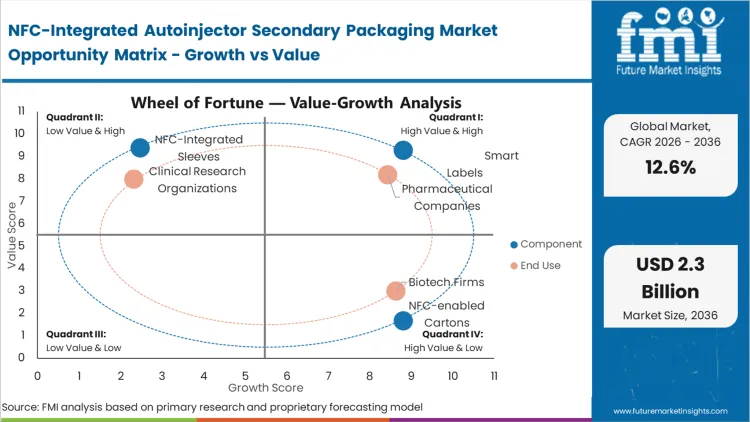
- Smart Labels: Smart Labels are expected to grab 45.2% share in 2026, as they offer a low-friction retrofit path for existing high-speed production lines.
- Pharmaceutical Companies: Pharmaceutical Companies are likely to account for 62.1% share in 2026, driven by the massive scale of chronic disease medication programs.
- Cardboard/Paperboard: This material leads with 58.4% share due to its established use in secondary cartons and superior recyclability profiles.
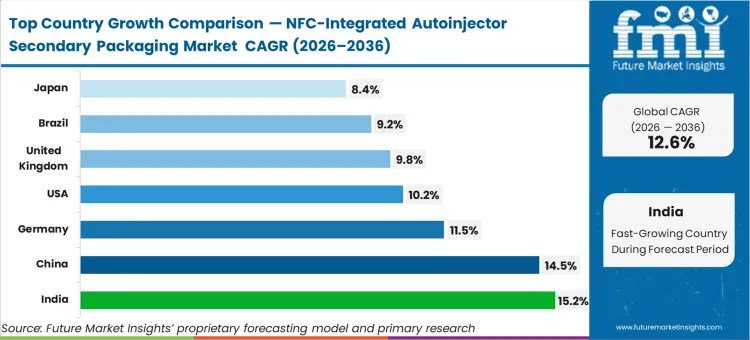
- India: 15.2% compound growth, fueled by the rapid expansion of domestic biosimilar manufacturing for export.
- Analyst Opinion at FMI
- Ismail Sutaria, Principal Analyst, Packaging, at FMI, opines, "The industry focuses heavily on patient engagement, but the practitioner paradox is that NFC's real value lies in the data the patient never sees. We have found that the most successful implementations are those that use NFC to automate the internal reconciliation of damaged or expired batches in the pharmacy, removing the human error that currently accounts for significant margin leakage in specialty pharma."
- Strategic Implications / Executive Takeaways
- Packaging engineers must prioritize the durability of the antenna-to-chip bond to ensure NFC readability throughout the 2-year shelf life of the product.
- Procurement officers should evaluate the total cost of ownership, accounting for the reduction in manual audit time and cold-chain waste.
- Product managers face a narrow window to establish NFC-enabled patient ecosystems before standardized digital health platforms lock in specific vendor protocols.
- Methodology
- Primary Research: Direct engagement with senior decision-makers in pharmaceutical packaging and digital health strategy.
- Desk Research: Aggregation of patent filings, regulatory directives on electronic labeling, and industry-specific NFC performance benchmarks.
- Market-Sizing: Utilization of a volume-to-value model based on autoinjector adoption in immunology and diabetes markets.
- Data Validation: Triangulation with shipment data from major silicon chip suppliers and high-speed folding carton manufacturers.
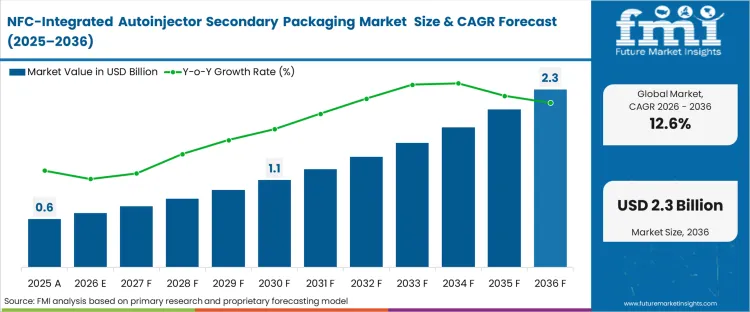
The growth becomes self-reinforcing once the cost of NFC inlay assembly drops below the cost of manual serialized labeling for high-volume autoinjectors. Tier-1 packaging converters trigger this gate by embedding packaging NFC tags directly into the paperboard converting process rather than applying them as secondary labels. Once this threshold is crossed, the incremental cost of "smartness" becomes negligible compared to the insurance value it provides for a USD 5,000 autoinjector.
India is expected to advance at a CAGR of 15.2%, followed by China at 14.5% and Germany at 11.5%. The USA sector is poised to register 10.2%, while the UK tracks at 9.8%, Brazil at 9.2%, and Japan at 8.4%. The structural divergence across these regions stems from the local manufacturing capacity for high-density NFC inlays versus the reliance on imported pre-converted smart cartons.
NFC-Integrated Autoinjector Secondary Packaging Market Key Takeaways
| Metric | Details |
|---|---|
| Industry Size (2026) | USD 0.7 billion |
| Industry Value (2036) | USD 2.3 billion |
| CAGR (2026-2036) | 12.24% |
Source: Future Market Insights (FMI) analysis, based on proprietary forecasting model and primary research
NFC-Integrated Autoinjector Secondary Packaging Market Definition
The market encompasses the design and manufacturing of secondary protective structures for autoinjectors, primarily cartons and sleeves, that feature embedded Near Field Communication (NFC) technology. This technology enables touchless data exchange between the package and an NFC-enabled device to verify authenticity, monitor temperature logs, and provide digital instructions for use. It is distinct from QR-code systems as it requires no line-of-sight and provides a unique hardware-level cryptographic signature.
NFC-Integrated Autoinjector Secondary Packaging Market Inclusions
Scope includes paperboard cartons with integrated antennas, plastic protective cases with NFC-enabled closures, and adhesive pharmaceutical smart labels designed for application on existing secondary boxes. It also covers NFC-integrated tamper-evident seals and multi-pack secondary containers used for chronic disease management kits. Service components such as pre-conversion programming and secure cloud-key management for unique ID tracking are included when bundled with the physical package.
NFC-Integrated Autoinjector Secondary Packaging Market Exclusions
The market excludes primary packaging components such as the autoinjector device itself, pre-filled syringes, or needle shields. External scanning hardware, generic RFID tags used exclusively for pallet-level logistics, and secondary packaging that relies solely on passive visual indicators (like thermochromic inks) are outside the scope. Additionally, mobile applications and back-end health data platforms are excluded unless they are provided as a direct integrated feature of the physical packaging sale.
NFC-Integrated Autoinjector Secondary Packaging Market Research Methodology
- Primary Research: Interviews with Clinical Trial Supply Managers, Pharmaceutical Packaging Engineers, and Procurement Heads at Global Biotech Firms.
- Desk Research: Analysis of GS1 digital link standards, FDA 21 CFR Part 11 compliance filings, and technical specifications for ISO 14443 NFC inlays.
- Market-Sizing and Forecasting: Baseline anchors to the total annual volume of biologic autoinjectors shipped, adjusted for the penetration rate of high-value specialty medicines.
- Data Validation and Update Cycle: Forecasts are cross-validated against the capital expenditure cycles of global packaging converters and the commercial launch timelines of new GLP-1 and immunology therapies.
Segmental Analysis
NFC-Integrated Autoinjector Secondary Packaging Market Analysis by Material
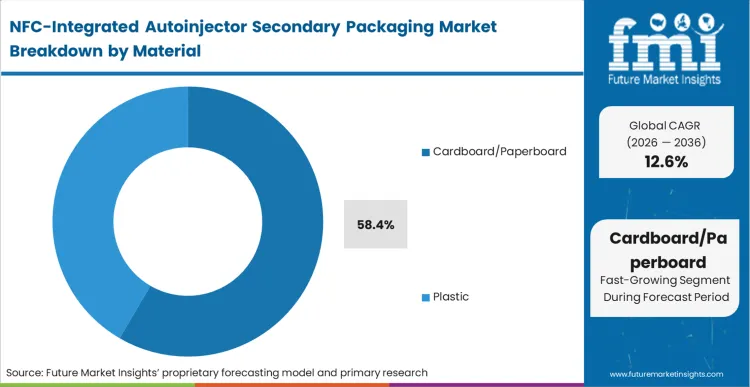
The displacement of traditional plastic-heavy secondary containers is accelerating as pharmaceutical brands seek to align their cold-chain logistics with corporate sustainability targets. This shift is not merely environmental; it is a response to the improved rigidity of engineered paperboard cartons that can now house delicate NFC antennas without the risk of circuit fracture. According to FMI's estimates, cardboard/paperboard holds 58.4% share in 2026 because it allows for high-speed integration of electronics during the printing stage, unlike plastic injection molding which requires secondary assembly steps. Packaging managers at biotech firms are increasingly qualifying fiber-based structures that offer the same structural integrity as polymers while reducing the carbon footprint of the protective packaging. Buyers who delay this transition face rising plastic taxes in European markets, which will eventually erode the margin of legacy secondary packs.
- Fulfillment efficiency: Integrated paperboard structures allow for flat-pack shipping to the filling facility, reducing inbound logistics costs. Logistics managers capture this value by reinvesting the savings into higher-grade NFC chips.
- Circuit durability: Engineered fiber materials provide a stable substrate for printed electronics, preventing antenna delamination during refrigerated storage. Quality control heads rely on this stability to ensure 100% scan rates at the point of care.
- Conversion speed: High-speed folding carton lines can now embed NFC inlays at rates exceeding 200 units per minute. Production directors choose this material to maintain throughput while adding digital functionality.
NFC-Integrated Autoinjector Secondary Packaging Market Analysis by Component
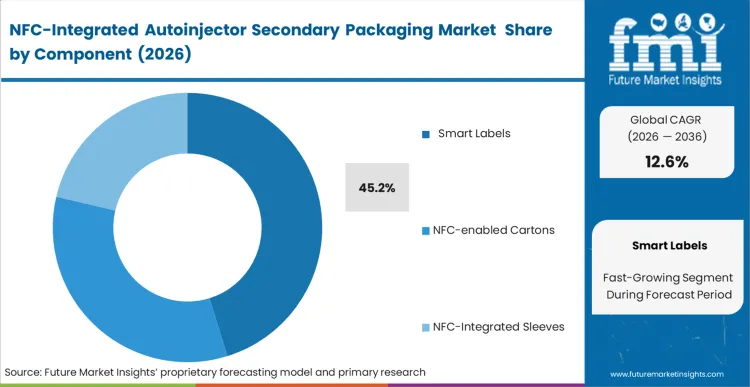
The reason smart labels hold 45.2% of this market comes down to a single operational reality: pharmaceutical companies cannot easily discard millions of dollars in existing carton packaging inventory to switch to integrated boxes. Smart labels offer a bridge, allowing for the addition of NFC functionality to legacy secondary packs without a complete line redesign. FMI analysts opine that this component segment leads because it offers the lowest barrier to entry for clinical trials where packaging formats are already fixed. The smart label serves as a digital skin, providing a secure link to electronic instructions for use (eIFU) and anti-tamper evidence. As the market moves toward 2036, the preference will shift toward fully integrated solutions, but for the current decade, adhesive digital twins remain the dominant choice for rapid deployment.
- Sensitivity range: High-performance labels utilize NFC chips that can be read through secondary cardboard and tertiary corrugated outer cases. Pharmacy technicians use this to conduct bulk inventory audits without opening individual boxes.
- Application versatility: Labels can be applied to diverse substrates, from paperboard sleeves to plastic autoinjector travel cases. Sourcing teams use this flexibility to standardize their digital security across multiple product lines.
- Tamper evidence: Advanced NFC labels incorporate a "tail" that, when broken, updates the digital chip status to "tampered." Security officers use this feature to eliminate the risk of product substitution in the supply chain.
NFC-Integrated Autoinjector Secondary Packaging Market Analysis by End Use
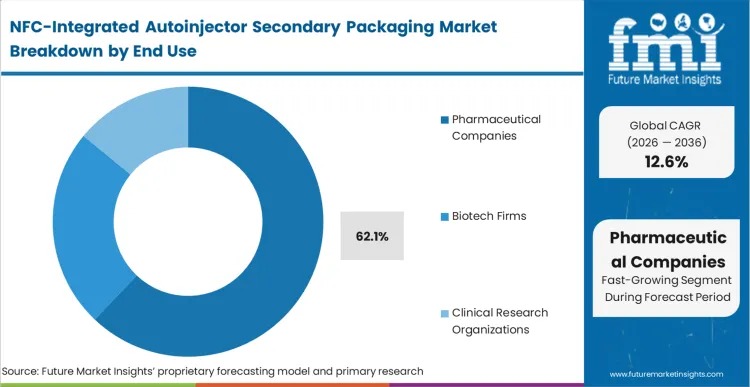
Pharmaceutical companies are currently facing the decision to either modernize their secondary packaging or face increasing pressure from payers to prove patient adherence. The stakes for delay are highest here, as reimbursement for specialty biologics is increasingly tied to "value-based" outcomes which require digital proof of injection. Based on FMI's assessment, these organizations dominate the market with a share of 62.1% because they control the global supply of the chronic disease medications that most require integrated packaging. One non-obvious dynamic is that the demand is being driven by the commercial teams rather than the R&D departments, as NFC becomes a key differentiator in crowded markets like GLP-1 agonists and TNF-alpha inhibitors. The outcome of choosing NFC-integrated packs is a direct increase in the quality of the real-world data collected during the drug's post-market surveillance phase.
- Pilot phase: Early adopters in the biopharma space use NFC to track the first 50,000 units of a new launch to identify patient bottlenecks. Product managers then use this data to refine the patient onboarding process.
- Qualification gate: Mid-tier firms follow once the regulatory pathways for electronic labeling are stabilized in major markets. These firms focus on the "insurance" value of NFC for preventing high-value product waste.
- Late conversion: Generic and biosimilar manufacturers reach this segment last, only adopting NFC when it becomes a mandatory requirement for government procurement contracts in export markets.
NFC-Integrated Autoinjector Secondary Packaging Market Drivers, Restraints, and Opportunities
The move toward home-based healthcare for chronic conditions forces pharmaceutical companies to replace traditional paper inserts with interactive digital support. This structural pressure is most acute in the biologics market, where the complexity of autoinjector operation leads to high rates of patient error. Commercial leaders name the reduction in "usage-related waste" as the primary economic driver, as every misfired autoinjector represents a significant loss to both the payer and the manufacturer. According to FMI, this forcing condition ensures that NFC adoption is not a marketing experiment but a fundamental restructuring of the drug delivery interface.
The primary restraint in the market is the organizational friction caused by the fragmentation of data ownership between the packaging converter, the pharma company, and the digital health provider. This is not a technical barrier but a structural one, as departments must agree on who manages the cryptographic keys and who owns the patient interaction data. This friction slows adoption even when the hardware cost is justified, as internal legal and IT qualification cycles can take longer than the packaging design itself. FMI notes that a partial solution is emerging through standardized packaging platforms, but these are currently limited by a lack of cross-industry data protocols.
Opportunities in the NFC-Integrated Autoinjector Secondary Packaging Market
- Audit automation: The move toward "dark warehouses" where robots handle individual packs creates an opportunity for NFC to replace optical scanning. Logistics providers who capture this can reduce pick-and-pack times for refrigerated autoinjectors by 40%.
- Recycling incentivization: Embedding NFC allows brands to verify when a package has been returned to a recycling bin. Sustainable brands can use this to offer rewards, effectively creating a circular economy for secondary cardboard.
- Clinical trial security: Decentralized trials require drug units to be shipped directly to patient homes. NFC provides the only structural way to verify that the patient, and not someone else, received and opened the high-value autoinjector kit.
Regional Analysis
Based on the regional analysis, the NFC-Integrated Autoinjector Secondary Packaging market is segmented into North America, Europe, Asia Pacific, and others across 40 plus countries.
.webp "Top Country Growth Comparison Nfc Integrated Autoinjector Secondary Packaging Market Cagr (2026 2036)")
| Country | CAGR (2026 to 2036) |
|---|---|
| India | 15.2% |
| China | 14.5% |
| Germany | 11.5% |
| USA | 10.2% |
| United Kingdom | 9.8% |
| Brazil | 9.2% |
| Japan | 8.4% |
Source: Future Market Insights (FMI) analysis, based on proprietary forecasting model and primary research
Europe NFC-Integrated Autoinjector Secondary Packaging Market Analysis
Europe's adoption pattern is defined by the early implementation of the Falsified Medicines Directive (FMD) and the subsequent adoption of GS1 Digital Link standards, which enable NFC and 2D DataMatrix to coexist in a unified data architecture. The structural condition here is policy-led, as European healthcare systems push for greater transparency in the biologic supply chain to combat the rising trade in counterfeit medical packaging. FMI views the region as a testing ground for high-density NFC integration in cardboard, with German and Swiss converters leading the development of antenna-embedding techniques. According to FMI's assessment, procurement directors in European hospital networks are increasingly favoring vendors who can provide a digital birth certificate for every autoinjector, making NFC a competitive necessity.
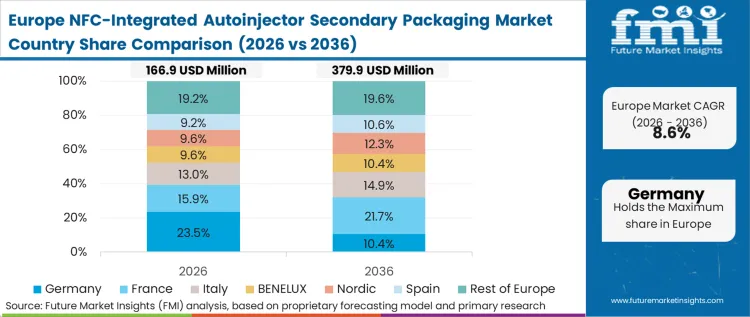
- Germany: Germany is advancing at an 11.5% compound annual rate through 2036 as the nation's specialty chemical and printing giants pivot toward smart packaging solutions. German pharmaceutical giants are the first to integrate NFC at the structural level rather than the label level. The country's market trajectory points toward a future where "dumb" packaging is excluded from the national health insurance's preferred list, creating a permanent operational advantage for firms that achieve early adoption.
- United Kingdom: The UK's rapid adoption of telehealth services forces a structural alignment between physical medicine and the NHS's digital backbone. NHS procurement heads require verifiable home-use data to justify the high cost of new biologics, creating a massive commercial opportunity for NFC-enabled secondary packs that log patient use. A CAGR of 9.8% is expected through the decade as the UK moves toward a digital-first pharmaceutical distribution model, ensuring that patients who successfully manage home administration improve their overall therapeutic outcomes.
FMI's report includes coverage of additional markets such as France and Italy. These regions show a structural pattern where the harmonization of digital traceability standards supports cross-border trade and stabilizes the biologic supply chain against volatility.
North America NFC-Integrated Autoinjector Secondary Packaging Market Analysis
North American market dynamics are shaped by the massive concentration of biotech innovation in hubs like Boston and San Francisco, where digital health is an expected component of every new therapy. The structural lens here is infrastructure-led, as the region already possesses the high-speed 5G networks and high smartphone penetration required to make NFC-enabled secondary packaging effective at the consumer level. Based on FMI's view, growth in the USA is driven by the patient experience competition between top-tier biopharma brands, each trying to offer the most frictionless home-injection support.
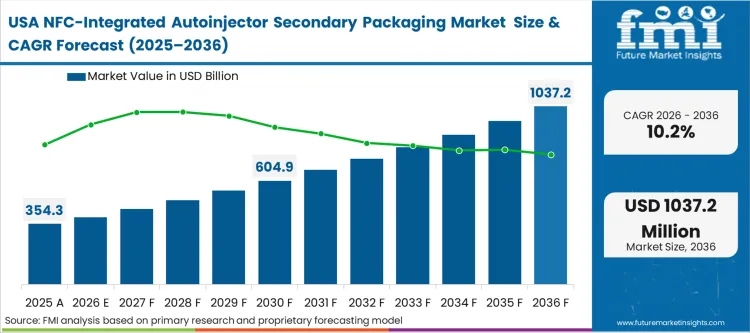
- USA: The specific structural condition defining the USA is the shift toward home-administered specialty drugs for auto-immune diseases. The USA's market sector is set to grow at 10.2% compound between 2026 and 2036 as insurance companies demand better adherence data to manage their soaring costs for immunology treatments. Clinical trial managers who successfully use integrated sustainable packaging reduce their study dropout rates, creating a significant competitive gap between firms that adopt smart tracking and those that remain tethered to legacy passive formats.
FMI's report includes additional coverage of the Canadian market. This region exhibits a trajectory where centralized healthcare procurement increasingly mandates digital verification to mitigate the economic impact of medication non-adherence.
South America NFC-Integrated Autoinjector Secondary Packaging Market Analysis
South America’s adoption pattern is governed by the structural transition of its largest pharmaceutical markets from a reliance on branded generics toward complex, home-administered biologic therapies. The region's growth is primarily economics-led, as domestic manufacturers in Brazil and Argentina aggressively pivot toward biosimilar production to offset the high costs of imported specialty medicines. This shift creates an immediate requirement for secondary packaging that can ensure cold-chain integrity and patient safety in geographies with fragmented logistics infrastructure. FMI's assessment suggests that the integration of NFC technology is becoming a critical tool for local brands to differentiate their high-value injectables and secure their position within public health procurement frameworks.
- Brazil: Brazil's 2026 pharmaceutical landscape is defined by the implementation of various law frameworks, which mandate item-level traceability and accelerate the domestic pipeline for high-volume biologic therapies. This regulatory shift compels local manufacturers to pivot from legacy generics toward complex injectables, necessitating a rapid upgrade to secondary structures that support patient self-administration and digital verification. Demand for NFC-integrated secondary packaging in Brazil is set to grow at a CAGR of 9.2% through 2036. As semaglutide and immunology patents expire, the surge in volume for home-based care forces procurement teams to integrate biologics delivery solutions to mitigate counterfeit risks in the expanding retail pharmacy channel.
FMI's report includes additional coverage of the Argentinian and Chilean markets, where the focus remains on the harmonization of digital traceability standards to support cross-border trade. The overarching regional pattern signals a transition toward a high-stakes rational market where packaging is no longer a commodity but a core component of therapeutic efficacy.
Asia Pacific NFC-Integrated Autoinjector Secondary Packaging Market Analysis
The structural condition making Asia's adoption pattern unique is the sheer volume of biosimilar production aimed at both domestic and export markets. This is an economics-led region where the priority is securing the export value of high-margin medicines against the high prevalence of local counterfeiting. FMI's report includes significant analysis of the packaging hubs in India and China that are now being forced to upgrade their flexible packaging and carton lines to meet Western digital standards.
- India: India's trajectory is defined by its role as the "pharmacy of the world," where domestic manufacturers must align with global digital serialization standards to maintain their export growth. The market expands at a CAGR of 15.2% between 2026 and 2036, reflecting the rapid capital refresh of the Indian packaging industry. Manufacturers who move first into active packaging capture preferred status in the lucrative North American and European supply chains, positioning themselves as high-value partners in the global biologic ecosystem.
- China: Counter-intuitive to the global narrative, China's NFC growth is driven by a massive internal push for secure healthcare systems that eliminate pharmacy-level fraud. Chinese consumers are more willing to engage with digital verification than their Western counterparts, a practitioner reality that makes the actual scan rate in China significantly higher than the global average. The market tracks at 14.5% compound between 2026 and 2036 as domestic firms expand their local smart-label production, clearing a major bottleneck in domestic patient safety protocols.
- Japan: Japan's structural condition is defined by an aging population that requires simplified medication management tools. Japanese packaging designers are focusing on assistive NFC that triggers audio instructions for elderly users. The market is anticipated to record an 8.4% CAGR over the forecast period as the focus shifts from security to accessibility, an operational outcome that reduces the burden on geriatric care facilities and improves home-care adherence.
FMI's report includes additional coverage of additional markets such as South Korea and Australia. These regions show a structural pattern where the professionalization of the local biopharma packaging industry is pushing the market toward high-fidelity digital solutions.
Competitive Aligners for Market Players
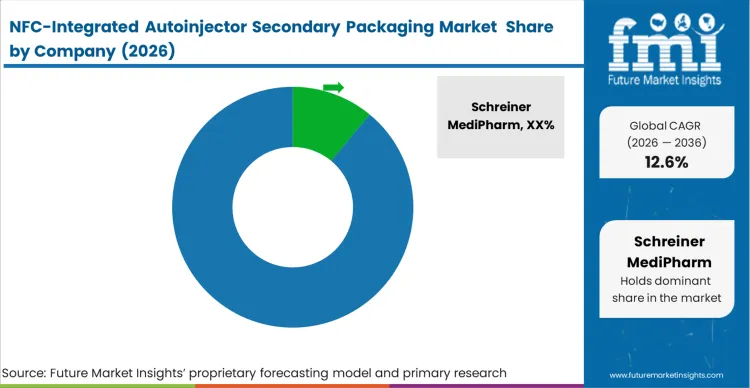
The structural reason for the market's moderate concentration level is the high capital requirement for cleanroom electronics assembly integrated with traditional printing. Leading companies like Schreiner MediPharm and Avery Dennison maintain their position not just through patent holdings, but through their ability to guarantee a 99.99% read-rate across millions of units, a benchmark that smaller converters struggle to meet. The primary variable buyers use to distinguish qualified vendors is the "antenna reliability score," which measures how many tags survive the high-pressure environment of an automated filling line.
Incumbent players like WestRock and Jones Healthcare Group hold a structural advantage because they own the relationship with both the biopharma brand and the machinery vendors. This allows them to design protective packaging that is perfectly tuned to the specific mechanical stresses of an autoinjector. A challenger must build a category of capability that includes both silicon expertise and fiber-science to be considered for tier-1 contracts. According to FMI, the competitive gap is widening between those who provide "commodity" boxes and those who provide "digital-ready" cartons.
Large buyers are resisting vendor lock-in by pushing for open-protocol NFC chips that can be read by any standardized mobile OS. This creates a structural tension between the dominant vendors' desire for proprietary ecosystems and the pharma industry's need for interoperability. Through 2036, the market will likely become more fragmented at the label level but more concentrated at the structural carton level, as only a few global firms can manage the complex supply chain required for global medicine launches.
Key Players in NFC-Integrated Autoinjector Secondary Packaging Market
- Schreiner MediPharm
- Avery Dennison
- Jones Healthcare Group
- WestRock
- Amcor
- Constantia Flexibles
- CCL Industries
- Körber AG
- Toppan Printing
- Stora Enso
- Blisterpak, Inc.
- Identiv, Inc.
Scope of the Report
| Metric | Value |
|---|---|
| Quantitative Units | USD 0.7 billion to USD 2.3 billion, at a CAGR of 12.24% |
| Market Definition | Functional segment of secondary packaging for drug delivery systems featuring embedded Near Field Communication technology for security, compliance, and patient support. |
| Material Segmentation | Cardboard/Paperboard, Plastic |
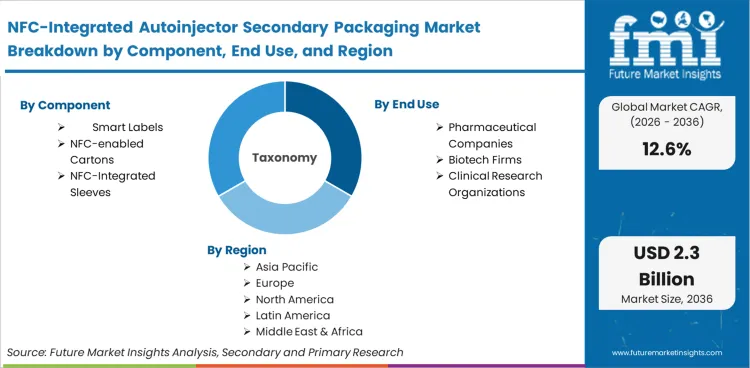
| Component Segmentation | Smart Labels, NFC-enabled Cartons, NFC-Integrated Sleeves |
| End Use Segmentation | Pharmaceutical Companies, Biotech Firms, Clinical Research Organizations |
| Regions Covered | North America, Europe, Asia Pacific, Latin America, Middle East, Africa |
| Countries Covered | India, China, Germany, USA, UK, Brazil, Japan, and 40 plus countries |
| Key Companies Profiled | Schreiner MediPharm, Avery Dennison, Jones Healthcare Group, WestRock, Amcor, Constantia Flexibles, CCL Industries, Körber AG |
| Forecast Period | 2026 to 2036 |
| Approach | Primary interviews with pharmaceutical supply chain leaders, baseline anchoring to global autoinjector volumes, and validation through NFC chip shipment data. |
Source: Future Market Insights (FMI) analysis, based on proprietary forecasting model and primary research
NFC-Integrated Autoinjector Secondary Packaging Market Analysis by Segments
Material:
- Cardboard/Paperboard
- Plastic
Component:
- Smart Labels
- NFC-enabled Cartons
- NFC-Integrated Sleeves
End Use:
- Pharmaceutical Companies
- Biotech Firms
- Clinical Research Organizations
Regions:
- North America
- United States
- Canada
- Mexico
- Latin America
- Brazil
- Argentina
- Europe
- Germany
- United Kingdom
- France
- Italy
- Spain
- East Asia
- China
- Japan
- South Korea
- South Asia
- India
- ASEAN
- Oceania
- Australia
- New Zealand
- Middle East & Africa
- GCC
- South Africa
Bibliography
- U.S. Food and Drug Administration. (2024). Conducting clinical trials with decentralized elements: Guidance for industry, investigators, and other interested parties.
- European Medicines Agency. (2024). Electronic product information (ePI) report: Experience gained from the creation of ePI during regulatory procedures for EU human medicines.
- Medicines and Healthcare products Regulatory Agency. (2024, November 19). Windsor Framework agreement on the supply of human medicines explained. UK Government.
- European Commission. (2025, April 1). Electronic product information: Background on current pilots and implementation.
- European Union Intellectual Property Office, & Organisation for Economic Co-operation and Development. (2025). Mapping global trade in fakes 2025.
- International Council for Harmonisation of Technical Requirements for Pharmaceuticals for Human Use. (2025). ICH harmonised guideline: Good clinical practice E6(R3).
- NFC Forum. (2024, August 7). Combatting counterfeiting: How NFC technology is providing protection to key industries
This bibliography is provided for reader reference. The full FMI report contains the complete reference list with primary source documentation.
This Report Addresses
- Market intelligence to support strategic decision making across NFC-integrated cartons, smart labels, and digital-ready secondary sleeves.
- Market size estimation and 10-year revenue forecasts from 2026 to 2036, supported by volume-to-value modeling of biologic autoinjectors.
- Growth opportunity mapping across pharmaceutical and biotech end uses with emphasis on the structural gate of chip-to-board integration.
- Segment and regional revenue forecasts covering India, China, and Germany across the regulatory environment of the Falsified Medicines Directive.
- Competition strategy assessment including antenna reliability scores, vendor-lock-in resistance, and global supply chain capacity.
- Product development tracking including ISO 14443 standards, tamper-evident NFC tails, and sustainable fiber-based smart cartons.
- Market access analysis covering FDA 21 CFR Part 11, GS1 digital link pathways, and European electronic labeling mandates.
- Market report delivery in PDF, Excel, PPT, and interactive dashboard formats for executive strategy, cold-chain waste reduction, and operational benchmarking use.
Frequently Asked Questions
How large is the NFC-Integrated Autoinjector Secondary Packaging Market in 2026?
The market is valued at USD 0.7 billion in 2026. This figure signals that the technology is moving out of the "niche" clinical trial stage into the early-majority stage of commercial biologic launches.
What will it be valued at by 2036?
The valuation is projected to reach USD 2.3 billion by 2036. This growth represents a fundamental shift in how secondary packaging is perceived, from a passive commodity to a critical digital health asset.
What CAGR is projected for this market?
A CAGR of 12.24% is expected during the forecast period. This rate reflects the pace of capital equipment upgrades in the global packaging industry as printers transition to electronic-integration lines.
Which component segment leads the market?
Smart Labels currently lead with 45.2% share. This leadership is sustained by the mechanism of retrofitting, where pharma companies add digital intelligence to existing inventory without re-qualifying their entire carton supply.
Which end use segment leads?
Pharmaceutical Companies lead with 62.1% share. They lead because the massive scale of diabetes and immunology medication programs requires standardized, high-volume digital solutions that only major players can implement.
Which material segment leads?
Cardboard/Paperboard leads with 58.4% share. This is driven by the structural mechanism of "embedding," where antennas are printed directly onto the board, offering a more sustainable and high-speed alternative to plastic.
What drives rapid growth in this market?
The primary driver is the structural pressure to prove patient adherence for high-cost biologics. Payers are increasingly tying reimbursement to digital proof of injection, a non-obvious mechanism that forces pharma brands to adopt NFC.
What is the primary restraint on adoption?
The primary restraint is the structural friction of data ownership between the packaging vendor and the pharma company. This non-obvious gate often takes longer to resolve than the actual engineering of the package.
Which country grows fastest in this sector?
India is the fastest-growing market at 15.2% CAGR. Compared to China's 14.5%, India's growth is more focused on export-led compliance for biosimilars heading to Western markets, requiring immediate alignment with global digital standards.
Is NFC technology compliant with global serialization laws?
Yes, NFC provides a structural layer that exceeds current 2D barcode requirements by offering hardware-level encryption. This allows for a more secure "digital twin" that supports the Drug Supply Chain Security Act (DSCSA) in the USA.
How does NFC improve cold-chain integrity?
NFC chips can be integrated with temperature-sensitive sensors that log thermal excursions directly onto the package. This cause-effect chain allows a patient to tap their phone to the box and instantly see if the medicine was ever stored incorrectly.
Why is there a shift toward cardboard in smart packaging?
Cardboard is being favored because it allows for "in-line" electronics integration, which is faster than applying labels to plastic cases. This operational shift reduces the unit cost of smartness, making it viable for high-volume medicines.
What is the risk of using "dumb" packaging for autoinjectors?
Manufacturers who resist NFC face the structural risk of being excluded from the "value-based" reimbursement models emerging in the USA and Europe. Without digital usage data, they cannot prove the efficacy of their drug in a real-world setting.
How does NFC help decentralized clinical trials?
In decentralized trials, drugs are shipped to homes; NFC provides the structural verification that the correct patient received the kit. This reduces the risk of protocol violations and helps supply chain managers maintain 100% chain of custody.
Can NFC packaging be recycled?
Yes, modern NFC antennas are being printed with aluminum or conductive inks that are compatible with standard paper recycling processes. This comparative advantage over multi-material plastic boxes is a major driver for sustainability-focused brands.
What distinguishes NFC from QR codes in this market?
NFC requires no line-of-sight and cannot be easily copied or photographed like a QR code. This comparative security makes it the preferred choice for high-value autoinjectors where counterfeiting is a significant threat.
Does the FMI report include the cost of mobile apps?
No, the report focuses on the physical secondary packaging and the integrated NFC chip. The software development for mobile apps is excluded unless it is provided as a direct value-add by the packaging converter.
How do packaging converters guarantee 100% read rates?
Converters utilize high-speed "read-after-write" testing stations on their production lines to verify every chip. This mechanism ensures that no dead antennas reach the pharma filling facility, preventing line stoppages.
What is the "digital birth certificate" for medicine?
This refers to the unique, encrypted identity stored in the NFC chip at the moment of manufacture. It creates a structural audit trail that follows the package from the factory to the patient's phone, ensuring authenticity.
How does Japan's market differ from the USA?
Japan focuses more on structural accessibility for its elderly population, using NFC to trigger audio instructions. The USA market is more focused on the economics of insurance reimbursement and adherence tracking.
What is the role of GS1 in this market?
GS1 provides the standardized "Digital Link" protocol that allows NFC chips to resolve to a web URL. This structural standard ensures that a package made in India can be read by a health system in Germany without custom software.
Are there any exclusions to the report scope?
The report excludes the primary autoinjector device and the medicine inside. It also excludes generic RFID tags used for warehouse pallet tracking that do not provide consumer-level NFC interaction.
Preview the report firsthand - request a free sample
Get SampleGet the brochure for pricing and purchase details.
Get PDFTable of Content
- Executive Summary
- Global Market Outlook
- Demand-side Trends
- Supply-side Trends
- Technology Roadmap Analysis
- Analysis and Recommendations
- Market Overview
- Market Coverage / Taxonomy
- Market Definition / Scope / Limitations
- Research Methodology
- Chapter Orientation
- Analytical Lens and Working Hypotheses
- Market Structure, Signals, and Trend Drivers
- Benchmarking and Cross-market Comparability
- Market Sizing, Forecasting, and Opportunity Mapping
- Research Design and Evidence Framework
- Desk Research Programme (Secondary Evidence)
- Company Annual and Sustainability Reports
- Peer-reviewed Journals and Academic Literature
- Corporate Websites, Product Literature, and Technical Notes
- Earnings Decks and Investor Briefings
- Statutory Filings and Regulatory Disclosures
- Technical White Papers and Standards Notes
- Trade Journals, Industry Magazines, and Analyst Briefs
- Conference Proceedings, Webinars, and Seminar Materials
- Government Statistics Portals and Public Data Releases
- Press Releases and Reputable Media Coverage
- Specialist Newsletters and Curated Briefings
- Sector Databases and Reference Repositories
- FMI Internal Proprietary Databases and Historical Market Datasets
- Subscription Datasets and Paid Sources
- Social Channels, Communities, and Digital Listening Inputs
- Additional Desk Sources
- Expert Input and Fieldwork (Primary Evidence)
- Primary Modes
- Qualitative Interviews and Expert Elicitation
- Quantitative Surveys and Structured Data Capture
- Blended Approach
- Why Primary Evidence is Used
- Field Techniques
- Interviews
- Surveys
- Focus Groups
- Observational and In-context Research
- Social and Community Interactions
- Stakeholder Universe Engaged
- C-suite Leaders
- Board Members
- Presidents and Vice Presidents
- R&D and Innovation Heads
- Technical Specialists
- Domain Subject-matter Experts
- Scientists
- Physicians and Other Healthcare Professionals
- Governance, Ethics, and Data Stewardship
- Research Ethics
- Data Integrity and Handling
- Primary Modes
- Tooling, Models, and Reference Databases
- Desk Research Programme (Secondary Evidence)
- Data Engineering and Model Build
- Data Acquisition and Ingestion
- Cleaning, Normalisation, and Verification
- Synthesis, Triangulation, and Analysis
- Quality Assurance and Audit Trail
- Market Background
- Market Dynamics
- Drivers
- Restraints
- Opportunity
- Trends
- Scenario Forecast
- Demand in Optimistic Scenario
- Demand in Likely Scenario
- Demand in Conservative Scenario
- Opportunity Map Analysis
- Product Life Cycle Analysis
- Supply Chain Analysis
- Investment Feasibility Matrix
- Value Chain Analysis
- PESTLE and Porter’s Analysis
- Regulatory Landscape
- Regional Parent Market Outlook
- Production and Consumption Statistics
- Import and Export Statistics
- Market Dynamics
- Global Market Analysis 2021 to 2025 and Forecast, 2026 to 2036
- Historical Market Size Value (USD Million) Analysis, 2021 to 2025
- Current and Future Market Size Value (USD Million) Projections, 2026 to 2036
- Y-o-Y Growth Trend Analysis
- Absolute $ Opportunity Analysis
- Global Market Pricing Analysis 2021 to 2025 and Forecast 2026 to 2036
- Global Market Analysis 2021 to 2025 and Forecast 2026 to 2036, By Component
- Introduction / Key Findings
- Historical Market Size Value (USD Million) Analysis By Component , 2021 to 2025
- Current and Future Market Size Value (USD Million) Analysis and Forecast By Component , 2026 to 2036
- Smart Labels
- NFC-enabled Cartons
- NFC-Integrated Sleeves
- Smart Labels
- Y-o-Y Growth Trend Analysis By Component , 2021 to 2025
- Absolute $ Opportunity Analysis By Component , 2026 to 2036
- Global Market Analysis 2021 to 2025 and Forecast 2026 to 2036, By End Use
- Introduction / Key Findings
- Historical Market Size Value (USD Million) Analysis By End Use, 2021 to 2025
- Current and Future Market Size Value (USD Million) Analysis and Forecast By End Use, 2026 to 2036
- Pharmaceutical Companies
- Biotech Firms
- Clinical Research Organizations
- Pharmaceutical Companies
- Y-o-Y Growth Trend Analysis By End Use, 2021 to 2025
- Absolute $ Opportunity Analysis By End Use, 2026 to 2036
- Global Market Analysis 2021 to 2025 and Forecast 2026 to 2036, By Material
- Introduction / Key Findings
- Historical Market Size Value (USD Million) Analysis By Material, 2021 to 2025
- Current and Future Market Size Value (USD Million) Analysis and Forecast By Material, 2026 to 2036
- Cardboard/Paperboard
- Plastic
- Cardboard/Paperboard
- Y-o-Y Growth Trend Analysis By Material, 2021 to 2025
- Absolute $ Opportunity Analysis By Material, 2026 to 2036
- Global Market Analysis 2021 to 2025 and Forecast 2026 to 2036, By Region
- Introduction
- Historical Market Size Value (USD Million) Analysis By Region, 2021 to 2025
- Current Market Size Value (USD Million) Analysis and Forecast By Region, 2026 to 2036
- North America
- Latin America
- Western Europe
- Eastern Europe
- East Asia
- South Asia and Pacific
- Middle East & Africa
- Market Attractiveness Analysis By Region
- North America Market Analysis 2021 to 2025 and Forecast 2026 to 2036, By Country
- Historical Market Size Value (USD Million) Trend Analysis By Market Taxonomy, 2021 to 2025
- Market Size Value (USD Million) Forecast By Market Taxonomy, 2026 to 2036
- By Country
- USA
- Canada
- Mexico
- By Component
- By End Use
- By Material
- By Country
- Market Attractiveness Analysis
- By Country
- By Component
- By End Use
- By Material
- Key Takeaways
- Latin America Market Analysis 2021 to 2025 and Forecast 2026 to 2036, By Country
- Historical Market Size Value (USD Million) Trend Analysis By Market Taxonomy, 2021 to 2025
- Market Size Value (USD Million) Forecast By Market Taxonomy, 2026 to 2036
- By Country
- Brazil
- Chile
- Rest of Latin America
- By Component
- By End Use
- By Material
- By Country
- Market Attractiveness Analysis
- By Country
- By Component
- By End Use
- By Material
- Key Takeaways
- Western Europe Market Analysis 2021 to 2025 and Forecast 2026 to 2036, By Country
- Historical Market Size Value (USD Million) Trend Analysis By Market Taxonomy, 2021 to 2025
- Market Size Value (USD Million) Forecast By Market Taxonomy, 2026 to 2036
- By Country
- Germany
- UK
- Italy
- Spain
- France
- Nordic
- BENELUX
- Rest of Western Europe
- By Component
- By End Use
- By Material
- By Country
- Market Attractiveness Analysis
- By Country
- By Component
- By End Use
- By Material
- Key Takeaways
- Eastern Europe Market Analysis 2021 to 2025 and Forecast 2026 to 2036, By Country
- Historical Market Size Value (USD Million) Trend Analysis By Market Taxonomy, 2021 to 2025
- Market Size Value (USD Million) Forecast By Market Taxonomy, 2026 to 2036
- By Country
- Russia
- Poland
- Hungary
- Balkan & Baltic
- Rest of Eastern Europe
- By Component
- By End Use
- By Material
- By Country
- Market Attractiveness Analysis
- By Country
- By Component
- By End Use
- By Material
- Key Takeaways
- East Asia Market Analysis 2021 to 2025 and Forecast 2026 to 2036, By Country
- Historical Market Size Value (USD Million) Trend Analysis By Market Taxonomy, 2021 to 2025
- Market Size Value (USD Million) Forecast By Market Taxonomy, 2026 to 2036
- By Country
- China
- Japan
- South Korea
- By Component
- By End Use
- By Material
- By Country
- Market Attractiveness Analysis
- By Country
- By Component
- By End Use
- By Material
- Key Takeaways
- South Asia and Pacific Market Analysis 2021 to 2025 and Forecast 2026 to 2036, By Country
- Historical Market Size Value (USD Million) Trend Analysis By Market Taxonomy, 2021 to 2025
- Market Size Value (USD Million) Forecast By Market Taxonomy, 2026 to 2036
- By Country
- India
- ASEAN
- Australia & New Zealand
- Rest of South Asia and Pacific
- By Component
- By End Use
- By Material
- By Country
- Market Attractiveness Analysis
- By Country
- By Component
- By End Use
- By Material
- Key Takeaways
- Middle East & Africa Market Analysis 2021 to 2025 and Forecast 2026 to 2036, By Country
- Historical Market Size Value (USD Million) Trend Analysis By Market Taxonomy, 2021 to 2025
- Market Size Value (USD Million) Forecast By Market Taxonomy, 2026 to 2036
- By Country
- Kingdom of Saudi Arabia
- Other GCC Countries
- Turkiye
- South Africa
- Other African Union
- Rest of Middle East & Africa
- By Component
- By End Use
- By Material
- By Country
- Market Attractiveness Analysis
- By Country
- By Component
- By End Use
- By Material
- Key Takeaways
- Key Countries Market Analysis
- USA
- Pricing Analysis
- Market Share Analysis, 2025
- By Component
- By End Use
- By Material
- Canada
- Pricing Analysis
- Market Share Analysis, 2025
- By Component
- By End Use
- By Material
- Mexico
- Pricing Analysis
- Market Share Analysis, 2025
- By Component
- By End Use
- By Material
- Brazil
- Pricing Analysis
- Market Share Analysis, 2025
- By Component
- By End Use
- By Material
- Chile
- Pricing Analysis
- Market Share Analysis, 2025
- By Component
- By End Use
- By Material
- Germany
- Pricing Analysis
- Market Share Analysis, 2025
- By Component
- By End Use
- By Material
- UK
- Pricing Analysis
- Market Share Analysis, 2025
- By Component
- By End Use
- By Material
- Italy
- Pricing Analysis
- Market Share Analysis, 2025
- By Component
- By End Use
- By Material
- Spain
- Pricing Analysis
- Market Share Analysis, 2025
- By Component
- By End Use
- By Material
- France
- Pricing Analysis
- Market Share Analysis, 2025
- By Component
- By End Use
- By Material
- India
- Pricing Analysis
- Market Share Analysis, 2025
- By Component
- By End Use
- By Material
- ASEAN
- Pricing Analysis
- Market Share Analysis, 2025
- By Component
- By End Use
- By Material
- Australia & New Zealand
- Pricing Analysis
- Market Share Analysis, 2025
- By Component
- By End Use
- By Material
- China
- Pricing Analysis
- Market Share Analysis, 2025
- By Component
- By End Use
- By Material
- Japan
- Pricing Analysis
- Market Share Analysis, 2025
- By Component
- By End Use
- By Material
- South Korea
- Pricing Analysis
- Market Share Analysis, 2025
- By Component
- By End Use
- By Material
- Russia
- Pricing Analysis
- Market Share Analysis, 2025
- By Component
- By End Use
- By Material
- Poland
- Pricing Analysis
- Market Share Analysis, 2025
- By Component
- By End Use
- By Material
- Hungary
- Pricing Analysis
- Market Share Analysis, 2025
- By Component
- By End Use
- By Material
- Kingdom of Saudi Arabia
- Pricing Analysis
- Market Share Analysis, 2025
- By Component
- By End Use
- By Material
- Turkiye
- Pricing Analysis
- Market Share Analysis, 2025
- By Component
- By End Use
- By Material
- South Africa
- Pricing Analysis
- Market Share Analysis, 2025
- By Component
- By End Use
- By Material
- USA
- Market Structure Analysis
- Competition Dashboard
- Competition Benchmarking
- Market Share Analysis of Top Players
- By Regional
- By Component
- By End Use
- By Material
- Competition Analysis
- Competition Deep Dive
- Schreiner MediPharm
- Overview
- Product Portfolio
- Profitability by Market Segments (Product/Age /Sales Channel/Region)
- Sales Footprint
- Strategy Overview
- Marketing Strategy
- Product Strategy
- Channel Strategy
- Avery Dennison
- Jones Healthcare Group
- WestRock
- Amcor
- Constantia Flexibles
- CCL Industries
- Schreiner MediPharm
- Competition Deep Dive
- Assumptions & Acronyms Used


