

- Market Size (2026)
- USD 7.5 Bn
- Forecast (2036)
- USD 13.4 Bn
- CAGR (2026 to 2036)
- 6.0%
How big is Fusion Bonded Epoxy Coatings Market in 2026?
USD 7.5 billion in 2026 and USD 13.4 billion by 2036 at a 6.0% CAGR.
Demand for fusion bonded epoxy coatings is projected to rise at 6.0% CAGR over the forecast period, increasing valuation from USD 7.5 billion in 2026 to USD 13.4 billion. Coating plants convert that forecast into revenue by holding steel cleanliness and cure within approved limits across each production lot. Current qualification requirements place application control beside formulation performance throughout project acceptance and coated-pipe production. The International Organization for Standardization published ISO 21809-2 in February 2026 for single-layer FBE material qualification and plant application. The combined controls connect powder selection with applicator discipline and reduce rejected lots across the wider pipe coatings market.
FBE approval follows local specifications and available coating capacity, so regional purchasing routes do not share one global qualification path. North American infrastructure programs often use approved-material lists that identify acceptable powders and reinforcing-steel standards. Caltrans updated its fusion bonded epoxy powder list in June 2025 and retained products under ASTM A775 and A934. Japanese projects place greater weight on certified plant capability and local technical support across dense municipal networks. European specifications use national editions of current ISO requirements and demand documented repair procedures across project routes. Regional qualification differences shape oil pipeline infrastructure and corrosion protection coatings demand without changing the approved global forecast.
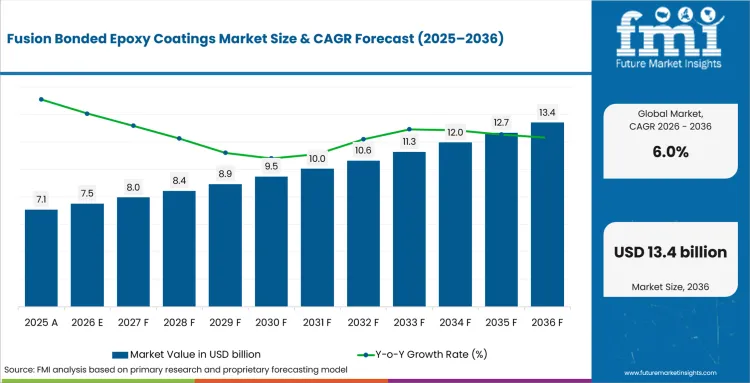
Key Takeaways of Fusion Bonded Epoxy Coatings Market
- Pipeline construction and rehabilitation require qualified corrosion protection across long buried steel assets and connected field joints throughout each project route.
- Fusion bonded epoxy powder coatings are expected to account for 46.0% in 2026 through standalone protection and multilayer primer use.
- Pipelines are projected to represent 71.0% by application in 2026 through extensive coated area and formal project-integrity specifications.
- The oil and gas segment is estimated to capture 57.0% in 2026 through demanding pressure and temperature qualification requirements.
- Poor steel preparation and transport damage can delay project acceptance by weakening adhesion or producing holidays across complete coating lots.
- 3M, Sherwin-Williams, Jotun, Axalta, AkzoNobel, Teknos, Tenaris, and Corinth Pipeworks compete through formulation breadth, qualified application capacity, or integrated pipe-coating execution.
Analyst Perspective
"Fusion bonded epoxy coatings compete through production discipline as much as powder chemistry across pipeline and infrastructure projects. Repeat business depends on applicators maintaining surface profile and preheat control with recorded cure and holiday inspection across complete lots. Integrated pipe coaters protect project schedules by limiting handoffs between steel production and coating acceptance across complex construction programs. Independent formulators need qualified local plants and responsive repair support to connect laboratory performance with consistent field acceptance."
- Nikhil Kaitwade, Principal Analyst, Future Market Insights
How is the Fusion Bonded Epoxy Coatings Market segmented?
The fusion bonded epoxy coatings market is segmented by Product Type, Application, End User, Distribution Channel, Technology, and Region.
The segmentation framework separates what is purchased, where the coating is applied, who approves the work, how material reaches projects, and which production process controls performance. Product type distinguishes standard powders from dual-layer and temperature-specific systems that address different service limits and installation risks. Application covers pipelines, reinforcing steel, valves, field joints, and water components with different preparation and repair requirements. End user separates energy operators from water utilities and infrastructure owners whose acceptance criteria differ across asset classes. Distribution channel distinguishes direct project sales from distributor and applicator routes that change technical responsibility. Technology separates established single-layer FBE from overlays that add abrasion or temperature resistance across demanding installations. The complete framework connects epoxy resin systems with the commercial route that turns qualified powder into an accepted steel asset.
What supports fusion bonded epoxy powder coatings within the product type category?
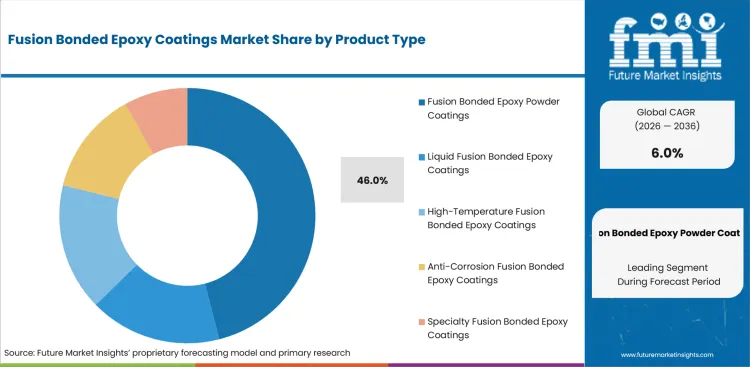
Powder FBE forms a continuous barrier through controlled heating that melts the formulation onto prepared steel and completes chemical curing. The category covers standalone coatings plus primers beneath abrasion-resistant or polyolefin layers across different service temperatures. PHMSA updated its pipeline construction guidance in June 2026 and retained sandblasting plus preheating as required FBE application controls. The guidance also requires thickness checks and calibrated holiday detection, making preparation and inspection discipline central to project acceptance.
- Based on product type, fusion bonded epoxy powder coatings are projected to account for 46.0% in 2026 due to their use as standalone barriers and primers beneath multilayer systems. Approved formulations can enter several specifications without requiring a separate coating platform for every service condition. Their position reflects qualification efficiency and formulation breadth rather than a universal advantage across every service condition.
- Coating plants purchase powder FBE that maintains stable flow and cure across repeated production lots. Inconsistent batch behavior can reduce usable line capacity and force additional inspection across accepted projects. Applicators compare local stock availability with technical response and repair compatibility before extending one formulation across longer production schedules and several project specifications.
Why do pipelines account for the largest application share?
Pipeline projects require continuous external protection across factory-coated lengths and repaired field joints throughout long installation routes. The North of the River Municipal Water District documented in August 2025 that its Dual Water System Improvement Project specified fusion bonded epoxy lining and coating for above-ground steel piping. Large coated surfaces convert one approved specification into sustained plant output and repeated inspection work. The requirement connects an active infrastructure project with exact FBE application and documented acceptance activity across installed steel piping.
- By application, pipelines are estimated to hold 71.0% in 2026 owing to their extensive coated area and formal corrosion-control specifications. Large project lots reinforce this position across anti-corrosion coatings demand because one specification can govern factory production and repair procedures along the complete route. Pipeline applications also require substantially more coated area than isolated valves or fittings across comparable project schedules.
- Pipeline operators adopt FBE systems that preserve traceable records from blasting through final holiday inspection across each construction lot. Transport damage can interrupt laying schedules and require coordinated repair near the right of way. Regional field support protects schedule continuity and prevents small coating defects from delaying acceptance across an otherwise completed pipeline section.
How does oil and gas shape the end user category?
Oil and gas transmission exposes buried steel to pressure service and long operating periods that make coating failure commercially expensive. Exact pipe diameters and project schedules determine which coating plants can accept each production package, making application capacity as important as formulation performance. L.B. Foster reported in its February 2026 annual filing that two United States locations apply FBE and abrasion-resistant coatings for oil and gas transmission pipelines. The filing confirms active exact-market capacity across North American energy projects and specialized pipeline coating programs.
- The oil and gas segment is set to lead the end user category with 57.0% share in 2026 due to strict integrity requirements across pressurized steel assets. Formal qualification across process pipe coating projects sustains this position through documented compatibility with pressure and temperature conditions. High asset values also justify detailed inspection and repair planning across complete production lots for project owners and engineering contractors.
- Engineering contractors evaluate FBE grades against steel chemistry and operating temperature across each oil and gas package. A weak handoff between the mill and coating plant can delay approval across complete pipe lots. Contractors favor one documented route that connects factory application with cutback treatment and field-joint repair throughout project execution.
What keeps direct sales ahead within the distribution channel?
Large FBE orders require specification review and clear responsibility for formulation changes across scheduled coating work. Direct commercial engagement reduces delays between powder manufacturers and plant engineers during qualification or troubleshooting. Tenaris reported in March 2025 that its expanded offshore portfolio combined pipe supply and coating services through the One Line model. The service structure shows how integrated technical review can reduce handoffs across complex coating packages while preserving responsibility for materials and delivery.
- The direct sales segment is likely to capture 34.0% share in 2026 attributable to specification-led purchasing and direct technical accountability. Major water infrastructure systems and energy projects often require one accountable route for qualification changes and production support. Direct engagement gives coating plants faster access to batch records and corrective guidance during long project runs.
- Coating plants use direct relationships to secure formulation guidance and consistent powder supply across long production schedules. Distributor inventory remains practical for established grades but complex orders need immediate technical decisions during line trials. Direct contact shortens the interval between a specification question and a documented plant response without changing the applicator approval process.
Which buying mechanism supports standard fusion bonded epoxy technology?
Standard FBE technology fits coating lines already configured for blasting and controlled preheating across mainstream pipeline specifications. AMPP launched a dedicated FBE application and inspection course in May 2025 for single-layer and dual-layer pipeline systems. Familiar plant settings reduce qualification work across repeat schedules and established inspection plans for recurring pipeline projects. The program connects established technology with repeatable application practices across coating personnel and project inspectors rather than introducing a different coating chemistry.
- The technology category is forecast to be led by standard fusion bonded epoxy technology at 32.0% share in 2026 due to installed coating-line capacity and familiar inspection routines. Existing plant settings reduce retraining and qualification burdens across routine service temperatures and familiar buried-pipeline specifications. Standard systems also work with established cathodic protection designs and familiar inspection procedures across recurring buried-pipeline projects.
- Applicators favor standard technology for repeatable line settings and familiar repair procedures across recurring project specifications. New formulations require production trials that consume line time and can generate rejected lots during qualification. Repeat orders depend on stable cure behavior and accepted inspection records rather than a lower powder price alone.
What are the drivers, restraints, and opportunities in the Fusion Bonded Epoxy Coatings Market?
Pipeline replacement and water-network renewal support qualified FBE demand; preparation errors and handling damage can delay acceptance; better curing control and abrasion-resistant overlays improve consistency across demanding routes.
- Driver: Pipeline replacement and water-network renewal increase the steel surface that requires qualified corrosion protection across construction and rehabilitation programs.
- Restraint: Poor steel preparation and handling damage can produce adhesion loss or holidays that raise inspection costs and delay project acceptance.
- Opportunity: Better curing control and abrasion-resistant systems can improve coating consistency across field joints and demanding installation routes.
Pipeline replacement supports FBE demand through construction specifications that require factory coating on new steel sections. Formal project approvals convert planned infrastructure spending into defined coating work for qualified plants and inspection teams. The Central Valley Flood Protection Board approved a San Joaquin River relocation in August 2025 that required factory-applied FBE on the replacement pipe. The specification directs revenue toward available surface protection services and inspection capacity rather than general infrastructure activity.
Preparation errors make application sensitivity a material restraint by undermining otherwise suitable powder across an entire production lot during scheduled application. AMPP explained in July 2025 that inadequate blasting and incorrect anchor profiles can reduce adhesion during FBE application. Coating plants therefore carry rejection risk from steel condition and process control throughout scheduled output. Technical support must protect line productivity and preserve the approved inspection plan across every accepted production lot.
Qualified workforce capacity provides a practical route for applicators that need consistent FBE production and inspection across several project specifications. Plant settings and defect decisions require shared technical judgment throughout qualification and routine production across multiple coating lines. A recognized credential can reduce repeated training effort without replacing project-specific production trials or mandatory inspection procedures. AMPP announced a new FBE certification pathway in June 2025 following its dedicated training course. Certified teams can present stronger evidence during project qualification and support consistent decisions across routine plant operations.
Which country CAGRs are profiled in the Fusion Bonded Epoxy Coatings Market?
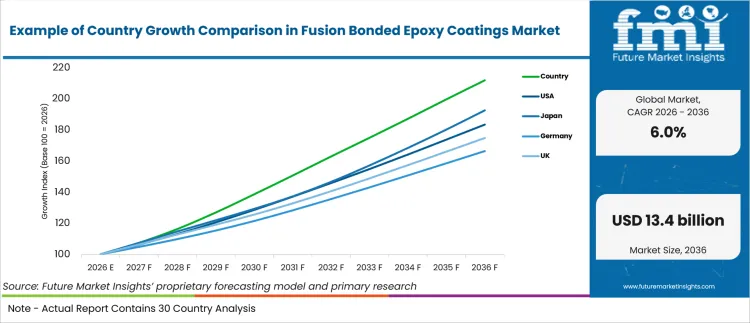
| Country | CAGR |
|---|---|
| Canada | 7.3% |
| Japan | 6.8% |
| USA | 6.3% |
| UK | 5.7% |
| Germany | 5.2% |
| South Korea | 4.7% |
| Brazil | 4.2% |
How do country-level CAGRs compare in the Fusion Bonded Epoxy Coatings Market?
Qualification routes explain the country pattern more clearly than headline growth rates across the seven profiled markets. Canada and Japan form the upper cluster through extensive infrastructure needs plus established technical controls across project acceptance. The USA follows through broad application capacity and local utility approval routes that vary between districts. The UK and Germany rely on current standards with detailed project review and documented plant inspection. South Korea and Brazil have defined investment routes but face narrower service coverage or longer logistics. The 3.1-percentage-point range therefore reflects different routes to qualified coating capacity and repair access rather than one common adoption model.
- Canada combines extensive regulated pipeline mileage with recurring rehabilitation work, yet regional service distance can delay rapid field repair across remote routes.
- Domestic powder-coating capability supports standards-based water infrastructure purchasing in Japan, although lengthy qualification favors established applicators with local technical teams.
- Utility-approved material lists connect United States projects with broad domestic coating capacity, but fragmented local specifications require repeated submittals across different districts.
- Current pipeline standards and documented plant inspection guide United Kingdom qualification, yet affordability reviews can delay unfamiliar systems needing additional production trials.
- Established industrial coating expertise supports Germany’s current national FBE requirements, though project timing remains tied to network investment and detailed technical review.
- Centralized gas-network purchasing can standardize qualification across South Korea, but limited approved service routes restrict new providers outside established partnerships.
- New gas-transport contracts provide a commercial route for coated-pipe work in Brazil, yet long distances raise field-support costs across energy corridors.
Similar CAGRs can produce different entry conditions because each country uses its own qualification route and service network. The full report provides country-level CAGR analysis across North America, Latin America, Europe, East Asia, South Asia, Oceania and the Middle East and Africa.
Country-wise Analysis
- Canada combines long interprovincial routes with separate federal and provincial oversight across extensive remote terrain. Remote sections also require repair support across long service distances and short construction seasons in several climate zones. In Canada, fusion bonded epoxy coatings demand is predicted to advance at 7.3% CAGR through 2036, enabled by pipeline rehabilitation across a large federally regulated network. The Canada Energy Regulator reported in August 2025 that it oversees more than 73,000 kilometers of interprovincial and international pipelines. Extensive mileage supports recurring rehabilitation work for qualified coating plants across planned maintenance and replacement programs. Formulators need regional applicator coverage and documented repair materials before expanding beyond established project corridors.
- Japanese water and civil works projects rely on local plant qualification plus exact documentation across dense municipal networks. Ajikawa Iron Works introduced a high-adhesion epoxy-coated reinforcing bar in October 2025 and identifies electrostatic powder application to preheated steel across its coating business. Local production supports valves and reinforcing steel through established domestic routes with nearby technical assistance. Fusion bonded epoxy coatings demand in Japan is forecast to rise at 6.8% CAGR over the forecast period, reinforced by standards-based water infrastructure purchasing and established powder-coating capability. The available capability can shorten technical response for water components and infrastructure steel across municipal projects. Lengthy qualification and limited acceptance of unfamiliar formulations remain material barriers outside established contractor relationships.
- United States purchasing routes vary across local utilities and transportation agencies that maintain separate approved-material requirements. By 2036, the fusion bonded epoxy coatings market in the USA is projected to grow at 6.3% CAGR, supported by utility material approvals and broad domestic application capacity. Broad domestic coating capacity supports project access across several regions but does not remove local submittal requirements. Coachella Valley Water District revised its approved materials list in May 2026 and retained fusion bonded epoxy lining and coating categories. Current utility approval gives qualified formulations a direct route into domestic water construction and rehabilitation projects. Separate district specifications can require repeated technical reviews and field-support arrangements for the same coating product.
- Water and pipeline projects across the United Kingdom use standards-led qualification with documented plant inspection and repair procedures. Engineering teams examine coating records during final acceptance to prevent one unresolved defect from holding a completed production lot. BSI published BS EN ISO 21809-2 in February 2026 with requirements for qualification and plant application of single-layer FBE. The UK’s fusion bonded epoxy coatings sector is projected to record 5.7% CAGR during the assessment period, influenced by current qualification standards for plant-applied pipeline coatings. The current standard gives coating plants a consistent technical route for regulated pipeline work and documented project acceptance. Affordability reviews can delay unfamiliar systems that require additional production trials or extended technical service commitments.
- German pipeline specifications connect national standards with detailed plant qualification and inspection across buried steel assets. Adoption of fusion bonded epoxy coatings in Germany is estimated to expand at 5.2% CAGR through 2036, aided by formal national adoption of current single-layer FBE requirements. Established industrial coating expertise and accessible testing services support project qualification across several asset classes. DIN Media published DIN EN ISO 21809-2 in May 2026 for single-layer FBE coatings used in pipeline transportation systems. The national edition supports repeatable technical review across approved coating plants and detailed infrastructure project specifications. Uncertain timing for network conversion projects can reduce production visibility and capacity planning for specialist coating applicators.
- South Korea operates a centralized gas transmission network that connects LNG terminals with city-gas companies and power producers. Korea Gas Corporation reported in June 2026 that its main pipeline network reached 5,346 kilometers with 445 supply stations. The network added 140 kilometers from January 2025 through June 2026, increasing the length of steel infrastructure requiring documented corrosion control across new connections and maintenance programs. South Korea’s fusion bonded epoxy coatings outlook is anticipated to advance at 4.7% CAGR over the assessment period, shaped by centralized transmission investment and concentrated utility purchasing. Limited approved service routes can restrict unfamiliar providers outside established utility relationships and local technical partnerships.
- Brazil combines offshore production activity with long transport distances between energy regions and qualified coating facilities. The fusion bonded epoxy coatings market in Brazil is estimated to post 4.2% CAGR over the forecast period, linked to new gas-transport contracting across established energy corridors. New transport commitments can support coated-pipe orders through established contractors and regional maintenance networks across energy corridors. The National Agency of Petroleum reported in May 2026 that firm gas-transport contracts increased 526% during 2025. Domestic energy projects provide a direct commercial route for plant-applied FBE and coordinated field repair across construction packages. Uneven service coverage raises logistics costs and lengthens response times across projects distant from coating capacity.
Who are the notable companies in the Fusion Bonded Epoxy Coatings Market?
3M, Sherwin-Williams, Jotun, Axalta, AkzoNobel, Teknos, Tenaris, and Corinth Pipeworks are notable companies in the fusion bonded epoxy coatings market.
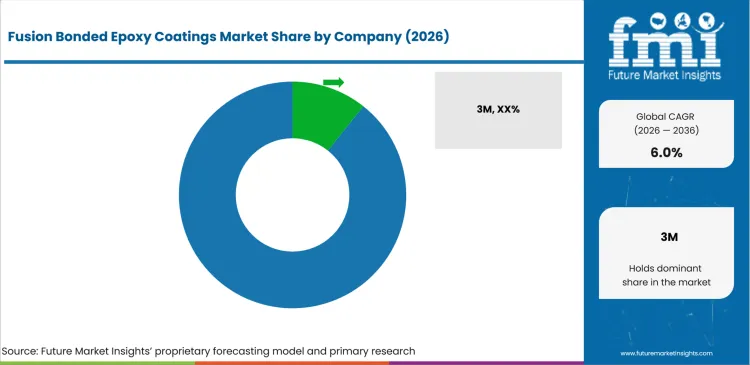
Formulation supply is concentrated among several global coatings companies whereas plant application remains more dispersed across approved coaters and integrated pipe producers. Global companies compete through single-layer and dual-layer FBE systems with temperature-specific grades and technical support for qualification. Tenaris and Corinth Pipeworks reduce commercial handoffs by combining steel pipe with plant-applied coating and project testing. A regional entrant can gain work through one qualified corridor if local repair support and inspection records are dependable. Commercial advantage therefore depends on linking formulation breadth with approved application across high-performance epoxy coatings projects.
- 3M and Sherwin-Williams offer broad FBE ranges for external pipe plus internal protection and related steel components. Jotun adds documented single-layer and dual-layer pipeline systems with technical support for project qualification and repair planning. Project selection depends on local applicator approval and responsive support near the coating plant rather than catalogue size alone.
- Axalta and AkzoNobel compete through established functional powder platforms whereas Teknos addresses external pipeline coating and internal lining requirements. Engineering teams compare operating-temperature coverage and repair compatibility across water and energy applications with different acceptance requirements. Regional growth depends on converting global formulations into approved local production routes with dependable batch support.
- Tenaris and Corinth Pipeworks combine steel pipe production with plant-applied coating and project testing across large infrastructure packages. Their integrated model reduces logistics handoffs and can improve schedule control across complex infrastructure coating packages. Project teams must confirm each FBE configuration and service route because integrated pipe supply does not replace coating-specific qualification.
Competitive Benchmarking: Fusion Bonded Epoxy Coatings Market
| Company | FBE System Breadth | Application and Inspection Support | Infrastructure Application Breadth | Geographic Reach |
|---|---|---|---|---|
| 3M | High | High | High | Global |
| Sherwin-Williams | High | High | High | Global |
| Jotun | High | Medium | Medium | Global |
| Axalta | High | Medium | High | Global |
| AkzoNobel | Medium | Medium | High | Global |
| Teknos | Medium | Medium | Medium | Multi-region |
| Tenaris | Medium | High | High | Global |
| Corinth Pipeworks | Medium | High | High | Europe and export projects |
Key Developments in the Fusion Bonded Epoxy Coatings Market
- In July 2025, Element delivered a mobile laboratory for Subsea7 projects offshore Angola and the Republic of Congo. The unit performed same-day cathodic disbondment and adhesion testing with differential scanning calorimetry for FBE cure. Rapid results shortened the interval between coating work and production decisions across remote field-joint activity. The delivery expanded portable qualification support for pipeline programs that cannot rely on distant laboratories.
- In May 2025, Corinth Pipeworks commissioned a concrete weight coating plant at its Thisvi site in Greece. The operating addition broadened integrated offshore coating packages for pipe already receiving anticorrosion layers at the same facility. Projects requiring FBE plus weight coating gained a one-site logistics and testing route with fewer interplant transfers, strengthening execution capacity for large complex offshore pipeline orders.
- In October 2025, Tenaris secured supply work for Mexico’s Trion project that included TenarisShawcor FBE across flowlines and risers. The award connected exact coating requirements with pipe manufacturing and project delivery through the One Line service model. Integrated execution reduced handoffs between steel supply and coating acceptance across a demanding offshore schedule. The contract documented commercial use of FBE within a named ultra-deepwater development and an integrated project-delivery route.
Fusion Bonded Epoxy Coatings Market - Report Scope
| Coverage field | Report scope |
|---|---|
| Market breakdown | Product Type, Application, End User, Distribution Channel, Technology, and Region. |
| Quantitative Units | Revenue in USD Billion and CAGR in %. |
| Market Definition | Powder epoxy coatings applied through fusion bonding to steel pipelines, reinforcing steel, valves, fittings, water components, and related infrastructure for corrosion protection. |
| Regions Covered | North America, Latin America, Europe, East Asia, South Asia, Oceania, and Middle East and Africa. |
| Countries Covered | Canada, Japan, USA, UK, Germany, South Korea, and Brazil. |
| Key Companies Profiled | 3M, Sherwin-Williams, Jotun, Axalta, AkzoNobel, Teknos, Tenaris, and Corinth Pipeworks. |
| Forecast Period | 2026 to 2036. |
| Approach | Hybrid bottom-up and top-down market sizing supported by primary interviews and official desk research. |
Fusion Bonded Epoxy Coatings Market - Research Methodology
| Method | Approach |
|---|---|
| Primary Research | FMI analysts gathered input from manufacturers, service providers, technology developers, distributors, end users, procurement teams, and subject-matter experts. Interviews examined purchasing decisions, product or service evaluation, adoption barriers, approval requirements, pricing considerations, and expectations for technical or commercial support. Respondents were also asked what evidence is required before a trial, pilot, or initial order develops into regular purchasing. |
| Desk Research | Desk research covered government statistics, regulatory publications, trade data, industry associations, technical literature, standards, company filings, product information, and official corporate announcements. Sources were reviewed for relevance, publication date, geographic coverage, and consistency with the defined market scope. Claims relating to performance, applications, approvals, capacity, investment, and commercial activity were retained only when supported by credible public evidence. |
| Market Sizing and Forecasting | The market model combined the baseline value with historical performance, segment structure, pricing and volume indicators, adoption levels, company participation, and country-level demand conditions. Forecast assumptions considered economic activity, investment trends, regulatory developments, technology adoption, purchasing cycles, supply availability, and barriers to wider market use. Segment and regional estimates were reconciled before the final market total was calculated. |
| Data Validation | Estimates were checked against multiple independent indicators, including public data, company activity, trade patterns, industry developments, and findings from primary interviews. Validation also tested whether products, services, applications, and company revenues fell within the defined market boundaries. Adjacent categories, unsupported claims, overlapping revenues, and activities without direct market relevance were excluded to reduce double counting and maintain consistency across segments and countries. |
Fusion Bonded Epoxy Coatings Market by Segments
Fusion Bonded Epoxy Coatings Market segmented by Product Type:
- Fusion Bonded Epoxy Powder Coatings
- Single-Layer FBE Systems
- Dual-Layer FBE Systems
- High-Temperature FBE Coatings
- FBE Primers for Multilayer Systems
Fusion Bonded Epoxy Coatings Market segmented by Application:
- Pipelines
- Reinforcing Steel
- Valves and Fittings
- Field Joints and Repairs
- Water Infrastructure Components
Fusion Bonded Epoxy Coatings Market segmented by End User:
- Oil and Gas
- Water and Wastewater
- Construction and Infrastructure
Fusion Bonded Epoxy Coatings Market segmented by Distribution Channel:
- Direct Sales
- Industrial Distributors
- Applicator Partnerships
- EPC and Project Contracts
- OEM Supply Agreements
Fusion Bonded Epoxy Coatings Market segmented by Technology:
- Standard Fusion Bonded Epoxy Technology
- Low-Application-Temperature FBE
- High-Operating-Temperature FBE
- Abrasion-Resistant Overcoat Systems
- Three-Layer Polyolefin Systems with FBE Primer
Fusion Bonded Epoxy Coatings Market by Region:
- North America
- United States
- Canada
- Latin America
- Brazil
- Mexico
- Argentina
- Chile
- Western Europe
- Germany
- France
- United Kingdom
- Italy
- Spain
- Benelux
- Nordics
- Eastern Europe
- Poland
- Czech Republic
- Romania
- Hungary
- East Asia
- China
- Japan
- South Korea
- South Asia and Pacific
- India
- ASEAN
- Australia and New Zealand
- Middle East and Africa
- GCC Countries
- South Africa
- Türkiye
- Israel
Research Sources and Bibliography
- International Organization for Standardization. (2026, February). ISO 21809-2:2026 Oil and gas industries including lower carbon energy - External coatings for buried or submerged pipelines used in pipeline transportation systems - Part 2: Single-layer fusion-bonded epoxy coatings.
- California Department of Transportation. (2025, June 16). Fusion Bonded Epoxy Powders for Coating Reinforcement Steel.
- Pipeline and Hazardous Materials Safety Administration. (2026, June 4). Pipeline Construction: Typical Construction Issues.
- North of the River Municipal Water District. (2025, August 29). Dual Water System Improvement Project.
- L.B. Foster Company. (2026, February 27). Annual Report on Form 10-K for the year ended December 31, 2025.
- Tenaris. (2025, March 6). Tenaris highlights enhanced portfolio for offshore projects at 2025 Subsea Tieback Forum.
- Association for Materials Protection and Performance. (2025, May 12). AMPP launches new Fusion-Bonded Epoxy (FBE) coating course to strengthen workforce training and industry standards.
- Central Valley Flood Protection Board. (2025, August 7). Permit No. 19984- Arroyo Fish Screen and Sack Dam Fish Passage Restoration Project- PG&E L-186 Pipe Relocation.
- Association for Materials Protection and Performance. (2025, July 30). FBE Application and Inspection: Common Challenges and How to Avoid Them.
- Association for Materials Protection and Performance. (2025, June 10). Discover What’s New and What’s Next in AMPP Certifications During June 19 Webcast.
- Canada Energy Regulator. (2025, August 14). 2024-25 Annual Report of the Canada Energy Regulator - Overview of the Canada Energy Regulator (CER).
- Coachella Valley Water District. (2026, May 21). Approved Materials List.
- British Standards Institution. (2026, February 28). BS EN ISO 21809-2:2026 Oil and gas industries including lower carbon energy. External coatings for buried or submerged pipelines used in pipeline transportation systems. Single layer fusion-bonded epoxy coatings.
- DIN Media. (2026, May). DIN EN ISO 21809-2:2026-05 Oil and gas industries including lower carbon energy - External coatings for buried or submerged pipelines used in pipeline transportation systems - Part 2: Single layer fusion-bonded epoxy coatings (ISO 21809-2:2026); English version EN ISO 21809-2:2026.
- Korea Gas Corporation. (2026, June 12).
- Agência Nacional do Petróleo, Gás Natural e Biocombustíveis. (2026, May 5). ANP publica Relatório de Gestão 2025.
- Element Materials Technology. (2025, July 31). Subsea7 Pipeline Coatings Testing Innovation | Case Study | Element.
- Corinth Pipeworks. (2025, May 6). Corinth Pipeworks launches state-of-the-art concrete weight coating plant.
- Tenaris. (2025, October 23). Tenaris joins Trion, Mexico’s first ultra-deepwater project.
- Axalta Coating Systems. (2026, July 23). AkzoNobel and Axalta enhance governance arrangements following shareholder dialogue.
- Ajikawa Iron Works Co., Ltd. (2025, October 1).
- Sherwin-Williams. (n.d.). Anti-Corrosive Coatings for Buried & Underground Pipelines.
This bibliography is provided for reader reference and is not exhaustive. The full report contains the complete reference list and detailed citations
This Report Answers
- How large is the fusion bonded epoxy coatings market in 2026 and 2036?
- Which pipeline and water-infrastructure conditions support fusion bonded epoxy coating demand?
- Why do fusion bonded epoxy powder coatings hold the product type share in 2026?
- How do pipeline application requirements influence coating qualification and repair planning?
- Why does oil and gas account for the end user share in 2026?
- How do country growth rates differ across Canada, Japan, the USA, the UK, Germany, South Korea, and Brazil?
- Which companies provide FBE formulations, plant application, or integrated coated-pipe services?
- What application defects and commercial frictions can delay wider FBE adoption?
- How can curing control and abrasion-resistant systems improve coating economics?
Frequently Asked Questions
How big is the Fusion Bonded Epoxy Coatings Market in 2026?
The fusion bonded epoxy coatings market is valued at USD 7.5 billion in 2026 and is forecast to reach USD 13.4 billion by 2036. Growth is supported by pipeline replacement and water-network renewal programs that sustain recurring demand for qualified corrosion protection across factory coating plants and field-joint repair routes.
What is the CAGR of the Fusion Bonded Epoxy Coatings Market from 2026 to 2036?
The fusion bonded epoxy coatings market grows at a CAGR of 6.0% between 2026 and 2036, supported by infrastructure programs adopting qualified FBE systems once formulations meet approved preparation, cure, and holiday-inspection requirements within defined project specifications across pipeline operators and water utilities.
Which product type leads the Fusion Bonded Epoxy Coatings Market?
Fusion bonded epoxy powder coatings account for 46.0% of the fusion bonded epoxy coatings market by product type in 2026, driven by their dual role as standalone barriers and multilayer primers that allow approved formulations to enter several specifications without requiring a separate coating platform for every service condition.
How much will the Fusion Bonded Epoxy Coatings Market add between 2026 and 2036?
The fusion bonded epoxy coatings market is set to add USD 5.9 billion between 2026 and 2036, growing from USD 7.5 billion to USD 13.4 billion as qualified powder systems and plant-applied coatings enter funded infrastructure specifications across a widening base of pipeline construction and rehabilitation programs.
Who are the leading companies in the Fusion Bonded Epoxy Coatings Market?
Eight companies lead the fusion bonded epoxy coatings market, including 3M, Sherwin-Williams, Jotun, Axalta, AkzoNobel, Teknos, Tenaris, and Corinth Pipeworks, competing through single-layer and dual-layer FBE formulations, plant application support, and integrated coated-pipe services across pipeline, water infrastructure, and energy project specifications worldwide.
Preview the report firsthand - request a free sample
Get SampleGet the brochure for pricing and purchase details.
Get PDFTable of Content
- Key Takeaways
- Market Size and CAGR
- Top Growth Driver
- Fastest Growing Segment
- Leading Region
- Key Companies
- Emerging Opportunities
- Executive Summary
- Global Market Outlook
- Demand-side Trends
- Supply-side Trends
- Technology Roadmap Analysis
- Analysis and Recommendations
- Analyst Perspective (What is happening? Why now? What should investors know?)
- Key Questions Answered
- How large is the market?
- What is the CAGR?
- What are key trends?
- Which region dominates?
- Who are the leaders?
- Market Overview
- Market Coverage / Taxonomy
- Market Definition / Scope / Limitations
- Research Methodology
- Chapter Orientation
- Analytical Lens and Working Hypotheses
- Market Structure, Signals, and Trend Drivers
- Benchmarking and Cross-market Comparability
- Market Sizing, Forecasting, and Opportunity Mapping
- Research Design and Evidence Framework
- Desk Research Programme (Secondary Evidence)
- Expert Input and Fieldwork (Primary Evidence)
- Tooling, Models, and Reference Databases
- Data Engineering and Model Build
- Quality Assurance and Audit Trail
- Market Background
- Market Dynamics (Drivers, Restraints, Opportunity, Trends)
- Scenario Forecast (Optimistic, Likely, Conservative)
- Impact Analysis
- AI Impact
- Sustainability Impact
- Regulatory Impact
- Technology Impact
- Consumer / Buyer Analysis
- Purchase Drivers
- Adoption Barriers
- Buyer Journey
- Opportunity Map Analysis
- Product Life Cycle Analysis
- Supply Chain Analysis
- Investment Feasibility Matrix
- Value Chain Analysis
- PESTLE and Porter's Analysis
- Regulatory Landscape
- Regional Parent Market Outlook
- Production and Consumption Statistics
- Import and Export Statistics
- Global Market Analysis and Forecast, 2021 to 2036
- Historical Market Size Value (USD billion) Analysis, 2021 to 2025
- Current and Future Market Size Value (USD billion) Projections, 2026 to 2036
- Y-o-Y Growth Trend Analysis
- Absolute $ Opportunity Analysis
- Global Market Pricing Analysis, 2021 to 2036
- Global Market Analysis and Forecast, By Product Type, 2021 to 2036
- Introduction / Key Findings
- Historical Market Size Value (USD billion) Analysis By Product Type, 2021 to 2025
- Current and Future Market Size Value (USD billion) Analysis and Forecast By Product Type, 2026 to 2036
- Fusion Bonded Epoxy Powder Coatings
- Single-Layer FBE Powder Coatings
- Multi-Layer FBE Powder Coatings
- Liquid Fusion Bonded Epoxy Coatings
- Solvent-Based Liquid Epoxy Coatings
- Water-Based Liquid Epoxy Coatings
- High-Temperature Fusion Bonded Epoxy Coatings
- High-Temperature Pipeline Coatings
- Thermal-Resistant Industrial Coatings
- Anti-Corrosion Fusion Bonded Epoxy Coatings
- Heavy-Duty Anti-Corrosion Coatings
- Chemical-Resistant Coatings
- Specialty Fusion Bonded Epoxy Coatings
- Abrasion-Resistant Coatings
- High-Performance Specialty Coatings
- Fusion Bonded Epoxy Powder Coatings
- Y-o-Y Growth Trend Analysis By Product Type, 2021 to 2025
- Absolute $ Opportunity Analysis By Product Type, 2026 to 2036
- Global Market Analysis and Forecast, By Application, 2021 to 2036
- Introduction / Key Findings
- Historical Market Size Value (USD billion) Analysis By Application, 2021 to 2025
- Current and Future Market Size Value (USD billion) Analysis and Forecast By Application, 2026 to 2036
- Pipelines
- Oil and Gas Pipelines
- Water and Wastewater Pipelines
- Rebar
- Steel Reinforcement Bars
- Precast Reinforcement Components
- Valves and Fittings
- Pipeline Valves
- Pipe Fittings and Connectors
- Structural Steel
- Steel Bridges and Infrastructure
- Industrial Structural Components
- Other Applications
- Storage Tanks
- Marine and Offshore Structures
- Pipelines
- Y-o-Y Growth Trend Analysis By Application, 2021 to 2025
- Absolute $ Opportunity Analysis By Application, 2026 to 2036
- Global Market Analysis and Forecast, By End User, 2021 to 2036
- Introduction / Key Findings
- Historical Market Size Value (USD billion) Analysis By End User, 2021 to 2025
- Current and Future Market Size Value (USD billion) Analysis and Forecast By End User, 2026 to 2036
- Oil and Gas
- Upstream Oil and Gas
- Midstream and Downstream Infrastructure
- Water and Wastewater
- Water Transmission Systems
- Wastewater Treatment Infrastructure
- Construction and Infrastructure
- Building Infrastructure
- Bridges and Transportation Infrastructure
- Chemical Processing
- Chemical Processing Plants
- Petrochemical Facilities
- Marine and Offshore
- Offshore Platforms
- Marine Pipelines and Structures
- Other End Users
- Power Generation
- Industrial Manufacturing
- Oil and Gas
- Y-o-Y Growth Trend Analysis By End User, 2021 to 2025
- Absolute $ Opportunity Analysis By End User, 2026 to 2036
- Global Market Analysis and Forecast, By Distribution Channel, 2021 to 2036
- Introduction / Key Findings
- Historical Market Size Value (USD billion) Analysis By Distribution Channel, 2021 to 2025
- Current and Future Market Size Value (USD billion) Analysis and Forecast By Distribution Channel, 2026 to 2036
- Direct Sales
- Direct Manufacturer Sales
- Long-Term Project Contracts
- Industrial Distributors
- Regional Coatings Distributors
- Specialty Industrial Coatings Distributors
- Pipeline Coating Contractors
- Pipeline Coating Service Providers
- Field Application Contractors
- OEM and Engineering Procurement Contracts
- Pipeline OEM Contracts
- Engineering and Construction Contracts
- Online and B2B Procurement Channels
- Industrial E-Commerce Platforms
- B2B Procurement Portals
- Direct Sales
- Y-o-Y Growth Trend Analysis By Distribution Channel, 2021 to 2025
- Absolute $ Opportunity Analysis By Distribution Channel, 2026 to 2036
- Global Market Analysis and Forecast, By Technology, 2021 to 2036
- Introduction / Key Findings
- Historical Market Size Value (USD billion) Analysis By Technology, 2021 to 2025
- Current and Future Market Size Value (USD billion) Analysis and Forecast By Technology, 2026 to 2036
- Standard Fusion Bonded Epoxy Technology
- Standard Single-Layer FBE
- Standard Multi-Layer FBE
- Dual-Layer Fusion Bonded Epoxy Technology
- FBE-FBE Dual-Layer Systems
- Dual-Layer Corrosion Protection
- Three-Layer Coating Technology
- Three-Layer Polyethylene Systems
- Three-Layer Polypropylene Systems
- High-Temperature FBE Technology
- High-Temperature Epoxy Formulations
- Thermal-Cycle Resistant Systems
- Advanced Modified Epoxy Technology
- Nanocomposite Epoxy Systems
- High-Performance Modified Epoxy Systems
- Standard Fusion Bonded Epoxy Technology
- Y-o-Y Growth Trend Analysis By Technology, 2021 to 2025
- Absolute $ Opportunity Analysis By Technology, 2026 to 2036
- Global Market Analysis and Forecast, By Region, 2021 to 2036
- Introduction
- Historical Market Size Value (USD billion) Analysis By Region, 2021 to 2025
- Current Market Size Value (USD billion) Analysis and Forecast By Region, 2026 to 2036
- North America
- Latin America
- Western Europe
- Eastern Europe
- East Asia
- South Asia and Pacific
- Middle East & Africa
- Market Attractiveness Analysis By Region
- North America Market Analysis and Forecast, By Country, 2021 to 2036
- Historical Market Size Value (USD billion) Trend Analysis By Market Taxonomy, 2021 to 2025
- Market Size Value (USD billion) Forecast By Market Taxonomy, 2026 to 2036
- By Country
- USA
- Canada
- By Product Type
- By Application
- By End User
- By Distribution Channel
- By Technology
- By Country
- Market Attractiveness Analysis
- By Country
- By Product Type
- By Application
- By End User
- By Distribution Channel
- By Technology
- Key Takeaways
- Latin America Market Analysis and Forecast, By Country
- Historical Market Size Value (USD billion) Trend Analysis By Market Taxonomy, 2021 to 2025
- Market Size Value (USD billion) Forecast By Market Taxonomy, 2026 to 2036
- By Country
- Brazil
- Mexico
- Chile
- Rest of Latin America
- By Product Type
- By Application
- By End User
- By Distribution Channel
- By Technology
- By Country
- Market Attractiveness Analysis
- By Country
- By Product Type
- By Application
- By End User
- By Distribution Channel
- By Technology
- Key Takeaways
- Western Europe Market Analysis and Forecast, By Country
- Historical Market Size Value (USD billion) Trend Analysis By Market Taxonomy, 2021 to 2025
- Market Size Value (USD billion) Forecast By Market Taxonomy, 2026 to 2036
- By Country
- Germany
- UK
- Italy
- Spain
- France
- Nordic
- BENELUX
- Rest of Western Europe
- By Product Type
- By Application
- By End User
- By Distribution Channel
- By Technology
- By Country
- Market Attractiveness Analysis
- By Country
- By Product Type
- By Application
- By End User
- By Distribution Channel
- By Technology
- Key Takeaways
- Eastern Europe Market Analysis and Forecast, By Country
- Historical Market Size Value (USD billion) Trend Analysis By Market Taxonomy, 2021 to 2025
- Market Size Value (USD billion) Forecast By Market Taxonomy, 2026 to 2036
- By Country
- Russia
- Poland
- Hungary
- Balkan & Baltic
- Rest of Eastern Europe
- By Product Type
- By Application
- By End User
- By Distribution Channel
- By Technology
- By Country
- Market Attractiveness Analysis
- By Country
- By Product Type
- By Application
- By End User
- By Distribution Channel
- By Technology
- Key Takeaways
- East Asia Market Analysis and Forecast, By Country
- Historical Market Size Value (USD billion) Trend Analysis By Market Taxonomy, 2021 to 2025
- Market Size Value (USD billion) Forecast By Market Taxonomy, 2026 to 2036
- By Country
- China
- Japan
- South Korea
- By Product Type
- By Application
- By End User
- By Distribution Channel
- By Technology
- By Country
- Market Attractiveness Analysis
- By Country
- By Product Type
- By Application
- By End User
- By Distribution Channel
- By Technology
- Key Takeaways
- South Asia and Pacific Market Analysis and Forecast, By Country
- Historical Market Size Value (USD billion) Trend Analysis By Market Taxonomy, 2021 to 2025
- Market Size Value (USD billion) Forecast By Market Taxonomy, 2026 to 2036
- By Country
- India
- ASEAN
- Australia & New Zealand
- Rest of South Asia and Pacific
- By Product Type
- By Application
- By End User
- By Distribution Channel
- By Technology
- By Country
- Market Attractiveness Analysis
- By Country
- By Product Type
- By Application
- By End User
- By Distribution Channel
- By Technology
- Key Takeaways
- Middle East & Africa Market Analysis and Forecast, By Country
- Historical Market Size Value (USD billion) Trend Analysis By Market Taxonomy, 2021 to 2025
- Market Size Value (USD billion) Forecast By Market Taxonomy, 2026 to 2036
- By Country
- Kingdom of Saudi Arabia
- Other GCC Countries
- Türkiye
- South Africa
- Other African Union
- Rest of Middle East & Africa
- By Product Type
- By Application
- By End User
- By Distribution Channel
- By Technology
- By Country
- Market Attractiveness Analysis
- By Country
- By Product Type
- By Application
- By End User
- By Distribution Channel
- By Technology
- Key Takeaways
- Key Countries Market Analysis
- USA
- Pricing Analysis
- Market Share Analysis, 2025
- By Product Type
- By Application
- By End User
- By Distribution Channel
- By Technology
- Canada
- Pricing Analysis
- Market Share Analysis, 2025
- By Product Type
- By Application
- By End User
- By Distribution Channel
- By Technology
- Mexico
- Pricing Analysis
- Market Share Analysis, 2025
- By Product Type
- By Application
- By End User
- By Distribution Channel
- By Technology
- Brazil
- Pricing Analysis
- Market Share Analysis, 2025
- By Product Type
- By Application
- By End User
- By Distribution Channel
- By Technology
- Chile
- Pricing Analysis
- Market Share Analysis, 2025
- By Product Type
- By Application
- By End User
- By Distribution Channel
- By Technology
- Germany
- Pricing Analysis
- Market Share Analysis, 2025
- By Product Type
- By Application
- By End User
- By Distribution Channel
- By Technology
- UK
- Pricing Analysis
- Market Share Analysis, 2025
- By Product Type
- By Application
- By End User
- By Distribution Channel
- By Technology
- Italy
- Pricing Analysis
- Market Share Analysis, 2025
- By Product Type
- By Application
- By End User
- By Distribution Channel
- By Technology
- Spain
- Pricing Analysis
- Market Share Analysis, 2025
- By Product Type
- By Application
- By End User
- By Distribution Channel
- By Technology
- France
- Pricing Analysis
- Market Share Analysis, 2025
- By Product Type
- By Application
- By End User
- By Distribution Channel
- By Technology
- India
- Pricing Analysis
- Market Share Analysis, 2025
- By Product Type
- By Application
- By End User
- By Distribution Channel
- By Technology
- ASEAN
- Pricing Analysis
- Market Share Analysis, 2025
- By Product Type
- By Application
- By End User
- By Distribution Channel
- By Technology
- Australia & New Zealand
- Pricing Analysis
- Market Share Analysis, 2025
- By Product Type
- By Application
- By End User
- By Distribution Channel
- By Technology
- China
- Pricing Analysis
- Market Share Analysis, 2025
- By Product Type
- By Application
- By End User
- By Distribution Channel
- By Technology
- Japan
- Pricing Analysis
- Market Share Analysis, 2025
- By Product Type
- By Application
- By End User
- By Distribution Channel
- By Technology
- South Korea
- Pricing Analysis
- Market Share Analysis, 2025
- By Product Type
- By Application
- By End User
- By Distribution Channel
- By Technology
- Russia
- Pricing Analysis
- Market Share Analysis, 2025
- By Product Type
- By Application
- By End User
- By Distribution Channel
- By Technology
- Poland
- Pricing Analysis
- Market Share Analysis, 2025
- By Product Type
- By Application
- By End User
- By Distribution Channel
- By Technology
- Hungary
- Pricing Analysis
- Market Share Analysis, 2025
- By Product Type
- By Application
- By End User
- By Distribution Channel
- By Technology
- Kingdom of Saudi Arabia
- Pricing Analysis
- Market Share Analysis, 2025
- By Product Type
- By Application
- By End User
- By Distribution Channel
- By Technology
- Türkiye
- Pricing Analysis
- Market Share Analysis, 2025
- By Product Type
- By Application
- By End User
- By Distribution Channel
- By Technology
- South Africa
- Pricing Analysis
- Market Share Analysis, 2025
- By Product Type
- By Application
- By End User
- By Distribution Channel
- By Technology
- USA
- Market Structure Analysis
- Competition Dashboard
- Competition Benchmarking
- Market Share Analysis of Top Players
- By Regional
- By Product Type
- By Application
- By End User
- By Distribution Channel
- By Technology
- Emerging Startups
- Innovation Benchmarking
- Competition Analysis
- Competition Deep Dive
- 3M
- Overview
- Product Portfolio
- Profitability by Market Segments
- Sales Footprint
- Strategy Overview
- Marketing Strategy
- Product Strategy
- Channel Strategy
- Sherwin-Williams
- Jotun
- SolEpoxy
- PPG Industries
- BASF SE
- Arkema
- Specialty Polymer Coatings
- VITRACOAT
- Tecosy
- 3M
- Case Studies
- Success Stories
- Recent Developments
- Competition Deep Dive
- Assumptions & Acronyms Used


