

- Market Size (2026)
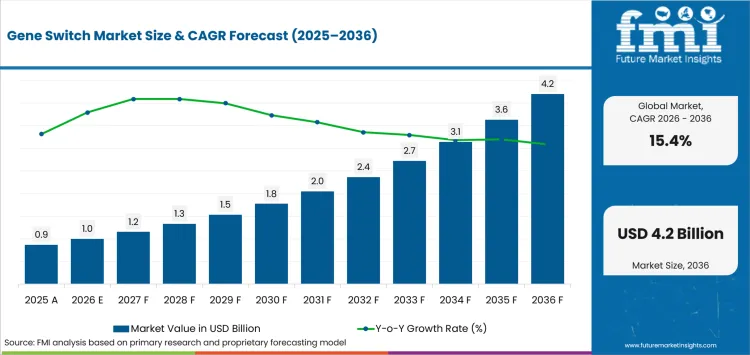
- USD 1.0 Bn
- Forecast (2036)
- USD 4.2 Bn
- CAGR (2026 to 2036)
- 15.4%
How big is the Gene Switch Market in 2026?
USD 1.0 billion in 2026 and USD 4.2 billion by 2036 at a 15.4% CAGR.
Sales of gene switch platform are estimated to rise from USD 1.0 billion in 2026 to USD 4.2 billion by 2036, expanding at a CAGR of 15.4% through the forecast period. Growth is anchored in the demands of advanced therapy manufacturing programs, which require reproducible activation, repression, and emergency shutoff functions that hold steady from early development through late stage clinical trials. Sponsors are under pressure to build switch systems that behave predictably across scale up, since any drift in control performance between preclinical and clinical batches can delay approval timelines. Regulatory clarity is accelerating adoption, as expanding review experience across complex genetic medicines gives sponsors clearer benchmarks for what documentation and performance data agencies expect from controllable platforms, a trend reflected in FDA's January 2026 report that CBER had approved close to 50 cell and gene therapies over the prior decade.
Restraints include the technical difficulty of designing switches that remain tightly controlled without off target activation, along with the added regulatory burden of validating switch behavior as a distinct component of the therapy. Opportunity lies in platforms that integrate switch design directly with gene editing tools, allowing sponsors to document performance across design, manufacturing, and clinical use within a single development pathway. Segment level activity spans switch design platforms, validation and testing services, and integration with delivery systems. Regionally, North America leads on regulatory precedent, while Europe and Asia Pacific adoption tracks growth in domestic cell and gene therapy pipelines.
Key Takeaways of Gene Switch Market
- Therapeutic developers need controllable expression systems that align biological activity with dosing, targeting and safety planning.
- Inducible gene switches are projected to represent 43.0% by technology in 2026 due to established molecular controls.
- Gene therapy is estimated to account for 38.0% by application in 2026 owing to adjustable therapeutic expression.
- Biopharmaceutical companies are forecast to capture 42.0% of end-user demand in 2026, supported by integrated design and regulatory capabilities.
- Basal leakage, off-target regulation and delivery limits can weaken control quality across promising therapeutic platforms.
- Sangamo Therapeutics, Inc., ElevateBio, Editas Medicine, Inc., Precigen, Inc., Senti Biosciences Holdings, Inc., Tune Therapeutics, Epicrispr Biotechnologies and Arsenal Biosciences, Inc. span gene regulation, gene circuits and safety-switch development.
Analyst Perspective
"Gene switch developers should reject platforms that lose control inside the final vector or engineered cell. Commercial value depends on measurable regulation that survives manufacturing changes, tissue exposure and emergency shutdown testing."
- Anurag Sharma, Principal Consultant, Future Market Insights
How is the Gene Switch Market segmented?
The Gene Switch Market is segmented by technology, application, end user, delivery method, therapeutic area and region.
The gene switch market is segmented by technology, application, end user, delivery method, therapeutic area and region. Technology covers inducible systems, optogenetic switches, CRISPR-based controls and synthetic gene circuits across the approved classification structure. Applications include gene therapy, cell therapy, drug discovery and synthetic biology across research and therapeutic development. End users comprise biopharmaceutical companies, research institutes and contract research organizations that develop or evaluate switch platforms. Delivery methods cover viral vectors, non-viral systems and ex vivo engineering across oncology, rare diseases and regenerative medicine.
What supports inducible gene switches within the technology category?
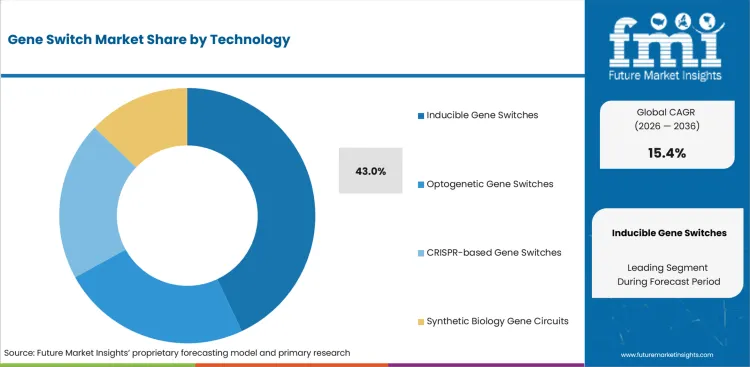
Inducible systems connect gene activity to an external input that researchers apply at a selected dose and time. Their value depends on low basal expression and measurable reversibility across CRISPR platforms that pair programmable effectors with external control during therapeutic development.
- Inducible gene switches are projected to hold 43.0% share in 2026 owing to familiar small-molecule triggers and defined dose-response control.
- Therapeutic teams need adjustable expression that remains measurable after delivery and manufacturing scale-up across complex programs. In July 2026, Senti Biosciences Holdings announced a proposed transaction that would retain its Regulator Dial platform for controllable genetic medicines.
What makes gene therapy central to the application category?
CNS gene therapy programs require switch controls that manage post-administration transgene exposure and confine activity to the intended biological context. FDA’s January 2024 guidance requires genome-editing sponsors to address product design and manufacturing together with nonclinical safety and clinical trial planning.
- By application, gene therapy is forecast to represent 38.0% in 2026 driven by the need to regulate therapeutic expression following administration.
- Control elements must fit vector capacity without weakening tissue targeting or release performance during clinical development. Developers therefore assess each switch with the complete investigational product and its intended treatment window across clinical stages.
How do biopharmaceutical companies evaluate gene switch platforms?
Biopharmaceutical companies coordinate target selection with switch design, delivery development and regulated manufacturing across one program. Integrated program ownership helps scientists separate control-element performance from vector behavior and cell therapy production variability during clinical translation and release testing.
- Based on end user, biopharmaceutical companies are projected to account for 42.0% in 2026 due to integrated capabilities across design and delivery with regulatory planning.
- Platform reuse depends on documented comparability across related submissions and manufacturing changes within connected therapeutic portfolios. In June 2026, FDA issued draft guidance describing how sponsors can use prior knowledge without repeating established genome-editing development work across connected programs.
Why do viral vector-based systems shape delivery-method selection?
Viral vector development provides durable gene transfer for in vivo therapies and stable modification across engineered cell products. In April 2025, Epicrispr reported FDA clearance for the AAV-delivered EPI-321 epigenetic therapy entering first-in-human development.
- The delivery method category is forecast to be led by viral vector-based systems at 46.0% share in 2026 due to established in vivo and ex vivo development routes.
- Development teams must balance payload capacity with tissue targeting and manufacturing consistency during product development. Epigenetic regulation also requires proof that the intended repression remains measurable following vector delivery and prolonged biological exposure in target tissues.
What are the drivers, restraints and opportunities in the Gene Switch Market?
Advanced therapies require control, but delivery risks constrain performance while logic-gated and epigenetic platforms broaden development options.
- Driver: Gene and cell therapy programs need activity that developers can activate, repress or terminate using controlled inputs.
- Restraint: Basal leakage, off-target activity and delivery variability can reduce safety margins across functional switch designs.
- Opportunity: Epigenetic silencers and logic-gated circuits can connect therapeutic output with disease-specific signals or control inputs.
Developers need control layers that limit therapeutic activity inside engineered cells or delivered vectors. In December 2025, Senti Bio reported clinical evidence that its SENTI-202 OR/NOT gate selectively targeted AML cells using synthetic biology programming.
Basal expression and unintended regulation narrow safety margins even if an intended switch responds correctly. FDA’s April 2026 draft guidance recommends NGS methods that assess off-target editing and genome integrity across candidate programs. Specialized off-target detection systems can support those studies during guide development in therapeutic programs.
Epigenetic silencers and logic-gated circuits provide distinct routes for durable repression and conditional cell activity. Platform developers can align switch design with gene editing delivery and manufacturing methods to reduce transfer work during clinical production.
Which country CAGRs are profiled in the Gene Switch Market?
| Country | CAGR |
|---|---|
| Japan | 15.3% |
| United Kingdom | 15.0% |
| United States | 14.7% |
| France | 14.4% |
| Germany | 14.1% |
How do country-level CAGRs compare in the Gene Switch Market?
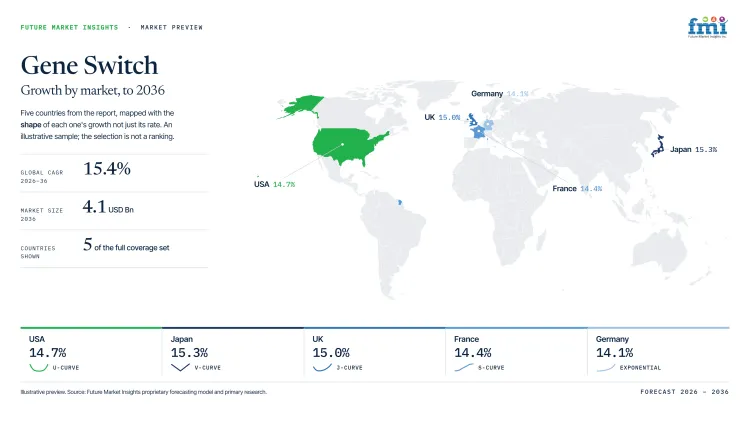
The five displayed CAGRs span 1.2 percentage points and measure forecast pace rather than current market size. Close spacing masks different regulatory and clinical operating conditions during commercial development across the profiled countries.
- Japan reflects dedicated regenerative-product review routes that accommodate target-specific in vivo gene therapy programs and clinical planning.
- The United Kingdom combines coordinated trial review with nationally connected university hospital networks for complex genetic medicines.
- The United States supports broad development activity with experienced regulators and extensive cell and gene therapy infrastructure.
- France pairs accelerated clinical-trial review with public biotherapy investment that supports selected development programs and local manufacturing.
- Germany combines specialist ATMP oversight with demanding quality evidence that lengthens preparation for complex programs.
Comparable CAGRs can produce different market entry conditions. The full report provides country-level CAGR analysis across North America, Latin America, Europe, East Asia, South Asia and Pacific, and the Middle East and Africa.
Country-wise Analysis
- Japan’s PMDA uses dedicated consultation routes for regenerative products and issued target-specific in vivo gene therapy guidance in August 2024 for sponsors planning complex programs across specialist hospitals and research laboratories nationwide. Gene switch sales in Japan are forecast to expand at 15.3% CAGR by 2036, supported by experienced investigators and a review framework designed for advanced genetic medicines with product-specific quality requirements during development. Domestic vector capacity remains concentrated around major centers and can extend release testing or distribution schedules for multicenter studies that serve hospitals beyond established metropolitan research networks and nearby specialist manufacturing facilities.
- United Kingdom programs use combined MHRA and HRA review across university hospitals that coordinate early genetic medicine studies with national patient follow-up, specialist manufacturing support and regional trial sites serving complex therapies nationwide. The United Kingdom’s gene switch market outlook is anticipated to advance at 15.0% CAGR over the assessment period, reinforced by April 2026 reforms that reduced trial setup from 169 to 122 days. Limited manufacturing capacity and synchronized site training can delay dosing beyond established academic hubs despite the faster review route and a nationally connected clinical research network serving participating treatment centers and distant hospital sites.
- United States biotechnology clusters link cellular therapy centers with specialist manufacturing sites and FDA consultation pathways for complex gene-control programs across major academic medical regions alongside commercial development networks and regional trial operations nationwide. Adoption of gene switch platforms in the United States is estimated to expand at 14.7% CAGR through 2036, aided by FDA’s May 2026 CMC flexibility guidance for human cellular and gene therapies. Sponsors must prove product-specific potency and genome integrity across manufacturing changes before programs expand across multiple production sites and geographically distributed treatment networks that require consistent release testing and clinical oversight at scale.
- France combines hospital research centers with national biotherapy investment and introduced a fast-track clinical trial route in March 2026 for eligible therapeutic studies across regional development networks and specialist bioproduction sites serving complex therapies. France is estimated to post 14.4% CAGR over the forecast period, supported by faster review and expanding bioproduction resources for oncology and rare disease programs across coordinated hospital research networks during development. Specialist vector capacity remains uneven across regions and requires coordinated release testing before multicenter studies can maintain dependable supply across hospital sites located beyond the strongest domestic manufacturing clusters and distribution routes nationwide.
- Germany’s Paul-Ehrlich-Institut updated its advice framework in September 2025 and gives developers early guidance on therapy concepts and manufacturing questions across major university hospitals and biotechnology centers in several federal research regions. The German gene switch sector is projected to record 14.1% CAGR during the assessment period, shaped by established ATMP expertise and specialist clinical research teams across several federal states and academic treatment networks. Centralized European procedures and specialized logistics can lengthen multicenter deployment unless sponsors coordinate quality records and transport routes across participating manufacturing sites and treatment centers serving geographically dispersed patient populations reliably at scale.
Who are the notable companies in the Gene Switch Market?
Sangamo Therapeutics, Inc., ElevateBio, Editas Medicine, Inc., Precigen, Inc., Senti Biosciences Holdings, Inc., Tune Therapeutics, Epicrispr Biotechnologies and Arsenal Biosciences, Inc.
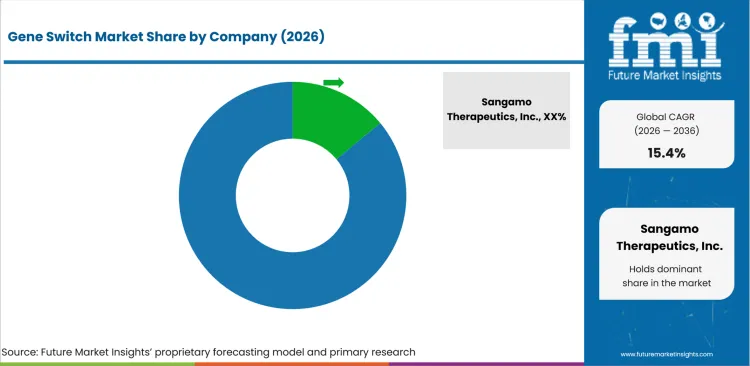
The gene switch market remains concentrated among specialist genomic medicine companies due to combined proof requirements for control quality and delivery performance. Competition separates into epigenetic regulation, logic-gated cell therapy and regulatory-region editing. Entry requires disease-specific evidence that preserves controllability inside final products including engineered cells used in regenerative medicine.
- Epigenetic regulation specialists include Sangamo Therapeutics, ElevateBio, Tune Therapeutics and Epicrispr Biotechnologies with verified therapeutic activation or silencing programs.
- Logic-gated or safety-switch cell platforms include Precigen, Senti Biosciences Holdings and Arsenal Biosciences with controlled therapeutic-output designs.
- Editas Medicine develops in vivo CRISPR gene editing that reduces target-gene expression, exemplified by EDIT-401, a hyperlipidemia program that lowers LDL-C, Lp(a) and ApoB.
Competitive Benchmarking: Gene Switch Market
| Company | Programmable Regulation | Switch or Logic-Gate Evidence | Delivery or Cell Engineering | Geographic Reach |
|---|---|---|---|---|
| Sangamo Therapeutics, Inc. | High | Medium | High | United States and United Kingdom |
| ElevateBio | High | Medium | High | United States |
| Editas Medicine, Inc. | High | Low | High | United States |
| Precigen, Inc. | Medium | High | High | United States |
| Senti Biosciences Holdings, Inc. | High | High | High | United States |
| Tune Therapeutics | High | Medium | High | New Zealand, and Hong Kong |
| Epicrispr Biotechnologies | High | Medium | High | United States, New Zealand and Australia |
| Arsenal Biosciences, Inc. | Medium | High | High | United States |
Scoring basis: programmable regulation is High for verified direct activation or repression, Medium for circuit control without direct locus regulation and Low for active editing without tunable expression control. Switch or logic-gate evidence is High for a triggerable safety switch or multi-input gate. Medium denotes tunable regulation without an external trigger. Low denotes programs without a documented trigger or gate. Delivery or cell engineering is High for active in vivo delivery or engineered-cell development, Medium for narrower research delivery and Low for preclinical formats with limited deployment evidence. Geographic reach records documented study or development regions supported by official company or clinical registry sources.
Key Developments in the Gene Switch Market
- In July 2026, Epicrispr Biotechnologies completed enrollment and dose escalation for the first-in-human EPI-321 trial with twelve participants dosed across two cohorts.
- In May 2026, Tune Therapeutics presented Phase 1b/2a data that linked TUNE-401 with direct epigenetic silencing of hepatitis B viral DNA across three study locations.
- In May 2026, Sangamo Therapeutics reported six active Phase 1/2 STAND study sites evaluating the AAV-delivered zinc finger epigenetic regulator ST-503.
Key Players in the Gene Switch Market
Epigenetic Gene Regulation Platforms
- Sangamo Therapeutics, Inc.
- ElevateBio
- Tune Therapeutics
- Epicrispr Biotechnologies
Logic-Gated and Safety-Switch Platforms
- Precigen, Inc.
- Senti Biosciences Holdings, Inc.
- Arsenal Biosciences, Inc.
Regulatory-Region Gene Activation
- Editas Medicine, Inc.
Gene Switch Market - Report Scope
| Coverage field | Report scope |
|---|---|
| Market breakdown | By technology, application, end user, delivery method, therapeutic area and region. |
| Quantitative Units | USD billion. |
| Market Definition | Programmable systems that activate, repress or conditionally terminate gene expression using molecular triggers, epigenetic regulators, gene circuits or engineered safety switches. |
| Regions Covered | North America, Latin America, Europe, East Asia, South Asia and Pacific, and Middle East and Africa. |
| Countries Covered | Japan, United Kingdom, United States, France, Germany, and 20+ countries included in the full report. |
| Key Companies Profiled | Sangamo Therapeutics, Inc., ElevateBio, Editas Medicine, Inc., Precigen, Inc., Senti Biosciences Holdings, Inc., Tune Therapeutics, Epicrispr Biotechnologies and Arsenal Biosciences, Inc. |
| Forecast Period | 2026 to 2036. |
| Approach | Primary and secondary research with market triangulation. |
Gene Switch Market - Research Methodology
| Method | Approach |
|---|---|
| Primary Research | FMI analysts gathered input from manufacturers, service providers, technology developers, distributors, end users, procurement teams, and subject-matter experts. Interviews examined purchasing decisions, product or service evaluation, adoption barriers, approval requirements, pricing considerations, and expectations for technical or commercial support. Respondents were also asked what evidence is required before a trial, pilot, or initial order develops into regular purchasing. |
| Desk Research | Desk research covered government statistics, regulatory publications, trade data, industry associations, technical literature, standards, company filings, product information, and official corporate announcements. Sources were reviewed for relevance, publication date, geographic coverage, and consistency with the defined market scope. Claims relating to performance, applications, approvals, capacity, investment, and commercial activity were retained only when supported by credible public evidence. |
| Market Sizing and Forecasting | The market model combined the baseline value with historical performance, segment structure, pricing and volume indicators, adoption levels, company participation, and country-level demand conditions. Forecast assumptions considered economic activity, investment trends, regulatory developments, technology adoption, purchasing cycles, supply availability, and barriers to wider market use. Segment and regional estimates were reconciled before the final market total was calculated. |
| Data Validation | Estimates were checked against multiple independent indicators, including public data, company activity, trade patterns, industry developments, and findings from primary interviews. Validation also tested whether products, services, applications, and company revenues fell within the defined market boundaries. Adjacent categories, unsupported claims, overlapping revenues, and activities without direct market relevance were excluded to reduce double counting and maintain consistency across segments and countries. |
Gene Switch Market by Segments
Gene Switch Market segmented by Technology:
- Inducible Gene Switches
- Tetracycline-inducible Systems
- Rapamycin-inducible Systems
- Hormone-responsive Systems
- Optogenetic Gene Switches
- Blue Light-responsive Systems
- Red Light-responsive Systems
- Near-infrared Light Systems
- CRISPR-based Gene Switches
- CRISPR Activation Systems
- CRISPR Interference Systems
- Epigenetic Gene Switches
- Synthetic Biology Gene Circuits
- Synthetic Promoters
- Logic Gate Circuits
- Autonomous Gene Regulation Systems
Gene Switch Market segmented by Application:
- Gene Therapy
- Oncology Gene Therapy
- Rare Genetic Disorders
- Inherited Metabolic Diseases
- Cell Therapy
- CAR-T Cell Therapy
- Stem Cell Therapy
- Immune Cell Engineering
- Drug Discovery & Development
- Target Validation
- Functional Genomics
- High-throughput Screening
- Synthetic Biology
- Biosensor Development
- Metabolic Engineering
- Biomanufacturing
Gene Switch Market segmented by End User:
- Biopharmaceutical Companies
- Biotechnology Companies
- Gene Therapy Developers
- Cell Therapy Companies
- Academic & Research Institutes
- Universities
- Government Research Institutes
- Translational Research Centers
- Contract Research Organizations
- Preclinical Research Services
- Gene Engineering Services
- Analytical Research Services
Gene Switch Market segmented by Delivery Method:
- Viral Vector-based Systems
- Adeno-associated Virus Vectors
- Lentiviral Vectors
- Adenoviral Vectors
- Non-viral Delivery Systems
- Lipid Nanoparticles
- Polymer-based Carriers
- Electroporation Systems
- Ex Vivo Gene Engineering
- Cell Modification Platforms
- Gene Editing Workflows
- Patient-specific Cell Processing
Gene Switch Market segmented by Therapeutic Area:
- Oncology
- Hematological Malignancies
- Solid Tumors
- Precision Oncology
- Rare Diseases
- Neuromuscular Disorders
- Lysosomal Storage Disorders
- Hereditary Blood Disorders
- Regenerative Medicine
- Tissue Engineering
- Stem Cell Regeneration
- Gene-regulated Tissue Repair
Gene Switch Market by Region:
- North America
- United States
- Canada
- Mexico
- Latin America
- Brazil
- Chile
- Rest of Latin America
- Western Europe
- Germany
- United Kingdom
- Italy
- Spain
- France
- Nordics
- Benelux
- Rest of Western Europe
- Eastern Europe
- Russia
- Poland
- Hungary
- Balkan and Baltic States
- Rest of Eastern Europe
- East Asia
- China
- Japan
- South Korea
- South Asia and Pacific
- India
- ASEAN
- Australia and New Zealand
- Rest of South Asia and Pacific
- Middle East and Africa
- Kingdom of Saudi Arabia
- Other GCC Countries
- Türkiye
- South Africa
- Other African Union Countries
- Rest of Middle East and Africa
Research Sources and Bibliography
- USA Food and Drug Administration. (2026, January 11). FDA Increases Flexibility on Requirements for Cell and Gene Therapies to Advance Innovation.
- Senti Biosciences Holdings, Inc. (2026, July 15). Senti Biosciences Holdings, Inc. Announces a Strategic Transaction to Unlock Value for its Gene-Circuit-Enabled Pipeline, Including SENTI-202, and to Sharpen its Focus on Next-Generation Controllable Genetic Medicines Powered by its Regulator Dial™ Technology Platform.
- USA Food and Drug Administration. (2024, January). Human Gene Therapy Products Incorporating Human Genome Editing: Guidance for Industry.
- USA Food and Drug Administration. (2026, June). Leveraging Prior Knowledge in the Development of Human Gene Therapy Products Incorporating Genome Editing.
- Epicrispr Biotechnologies. (2025, April 3). Epicrispr Biotechnologies Announces FDA Clearance of IND Application for EPI-321, A First-in-Class Epigenetic Therapy for FSHD.
- Senti Biosciences, Inc. (2025, December 9). Senti Bio Announces Updated SENTI-202 Clinical Data from Ongoing Phase 1 Trial in Relapsed or Refractory Acute Myeloid Leukemia Patients, Demonstrating Deep, MRD Negative, Durable Complete Remissions and a Favorable Safety Profile.
- USA Food and Drug Administration. (2026, April). Safety Assessment of Genome Editing in Human Gene Therapy Products Using Next-Generation Sequencing.
- Pharmaceuticals and Medical Devices Agency. (2024, August 20). Points to Consider in the Development of in vivo Gene Therapy Products with Target Specificity - Including in vivo CAR-T Development.
- Medicines and Healthcare products Regulatory Agency & Health Research Authority. (2026, April 27). Launch of clinical trial reforms.
- USA Food and Drug Administration. (2026, May). Chemistry, Manufacturing, and Controls Flexibilities for Developing Human Cellular and Gene Therapy Products for a Biologics License Application.
- Ministère de la Santé. (2026, March 5). Dispositif d’évaluation accélérée des essais cliniques en France: les promoteurs pourront soumettre leurs demandes dès le 16 mars 2026.
- Paul-Ehrlich-Institut. (2025, September 3). Innovation Office at the Paul-Ehrlich-Institut - Informal Advice for the development of ATMP, Advice Concept.
- Sangamo Therapeutics, Inc. (2026, May 14). Sangamo Therapeutics Reports Recent Business Highlights and First Quarter 2026 Financial Results.
- ElevateBio, LLC. (2026, January 8). ElevateBio Achieves Sixth Consecutive Year of Revenue Growth Driven by Expansion of its Genetic Medicine Technology and Manufacturing Business." (confirms addition of targeted insertion and epigenetic editing modalities to the Life Edit gene-editing toolbox — directly relevant to the gene switch market)
- ElevateBio, LLC. (2025, April 28). ElevateBio Announces David Hallal Transition." (or substitute another confirmed 2025–2026 official release if a second citation is required).
- Editas Medicine, Inc. (2026, May 5). Editas Medicine Announces First Quarter 2026 Results and Business Updates.
- Precigen, Inc. (2025, May 14). Precigen Reports First Quarter 2025 Financial Results and Business Updates.
- Tune Therapeutics. (2025, January 7). Tune Therapeutics Receives Approval to Initiate Clinical Trial in Hong Kong for HepB Epigenetic Silencer.
- Epicrispr Biotechnologies. (2026, July 7). Epicrispr Completes Enrollment and Dose Escalation in First-in-Human EPI-321 Trial for FSHD.
- Tune Therapeutics. (2026, May 30). Tune Therapeutics Presents Positive Phase 1b/2a Proof of Concept Data on TUNE-401: a First-in-Class Epigenetic Silencer for Patients with Hepatitis B at EASL 2026.
- Tune Therapeutics. (2025, January 13). Tune Therapeutics Completes Over $175M in Series B Financing to Advance Field-Leading Epigenome Editing Programs.
- Epicrispr Biotechnologies. (2025, March 26). Epicrispr Biotechnologies Secures $68 Million Series B to Initiate Clinical Trial for First-in-Class Disease-Modifying Epigenetic Neuromuscular Therapy for FSHD.
- Arsenal Biosciences, Inc. (2025, January 13). ArsenalBio and Bristol Myers Squibb Achieve Milestone for AB-4000 Series as Part of Ongoing Multi-Program Collaboration to Advance Next-Generation T Cell Therapies for Solid Tumors.
- Senti Biosciences Holdings, Inc. (2026, May 14). Senti Biosciences Holdings Announces Positive FDA RMAT Meeting on Registrational Clinical and CMC Strategy for SENTI-202 in Relapsed/Refractory AML, Along with Important Efficacy and Durability Updates on the SENTI-202 Clinical Program.
This bibliography is provided for reader reference and is not exhaustive. The full report contains the complete reference list and detailed citations.
This Report Answers
- How large is the Gene Switch Market in 2026 and 2036?
- Which operating conditions support demand for controllable gene-expression platforms?
- Which technology and application segments account for the significant 2026 shares?
- How do delivery methods influence gene switch performance and development planning?
- Which factors constrain activation, repression and safety-switch reliability?
- How do country growth rates differ across the five profiled markets?
- Which companies develop epigenetic regulators, logic-gated circuits and safety switches?
- What recent programs are shaping commercial gene switch development?
Frequently Asked Questions
How big is the Gene Switch Market in 2026?
USD 1.0 billion is the Gene Switch Market value in 2026. The Gene Switch Market is projected to reach USD 4.2 billion by 2036 as developers connect measurable expression control with reliable delivery and manufacturing evidence in research and therapeutic programs.
What is the CAGR of the Gene Switch Market from 2026 to 2036?
15.4% is the projected Gene Switch Market CAGR from 2026 to 2036. The Gene Switch Market forecast depends on platforms that maintain low basal activity and predictable responses inside the intended delivery system while sponsors document safety across manufacturing and clinical development.
Which technology is projected to account for 43.0% of the Gene Switch Market?
43.0% is the projected technology share for inducible gene switches in the Gene Switch Market during 2026. The Gene Switch Market uses established molecular inputs that give researchers defined activation timing and dose control across laboratory models and therapeutic evaluation.
Which delivery method is projected to account for 46.0% of the Gene Switch Market?
46.0% is the projected 2026 delivery-method share for viral vector-based systems in the Gene Switch Market. The Gene Switch Market benefits from durable in vivo expression and stable ex vivo cell engineering although payload capacity and immune response remain material constraints.
Which companies are active in the Gene Switch Market?
Eight companies form the profiled Gene Switch Market company set in 2026. The Gene Switch Market includes Sangamo Therapeutics, ElevateBio, Editas Medicine, Precigen, Senti Biosciences Holdings, Tune Therapeutics, Epicrispr Biotechnologies and Arsenal Biosciences across regulation, logic-gated circuits and safety-switch development.
Preview the report firsthand - request a free sample
Get SampleGet the brochure for pricing and purchase details.
Get PDFTable of Content
- Key Takeaways
- Market Size and CAGR
- Top Growth Driver
- Fastest Growing Segment
- Leading Region
- Key Companies
- Emerging Opportunities
- Executive Summary
- Global Market Outlook
- Demand-side Trends
- Supply-side Trends
- Technology Roadmap Analysis
- Analysis and Recommendations
- Analyst Perspective (What is happening? Why now? What should investors know?)
- Key Questions Answered
- How large is the market?
- What is the CAGR?
- What are key trends?
- Which region dominates?
- Who are the leaders?
- Market Overview
- Market Coverage / Taxonomy
- Market Definition / Scope / Limitations
- Research Methodology
- Chapter Orientation
- Analytical Lens and Working Hypotheses
- Market Structure, Signals, and Trend Drivers
- Benchmarking and Cross-market Comparability
- Market Sizing, Forecasting, and Opportunity Mapping
- Research Design and Evidence Framework
- Desk Research Programme (Secondary Evidence)
- Expert Input and Fieldwork (Primary Evidence)
- Tooling, Models, and Reference Databases
- Data Engineering and Model Build
- Quality Assurance and Audit Trail
- Market Background
- Market Dynamics (Drivers, Restraints, Opportunity, Trends)
- Scenario Forecast (Optimistic, Likely, Conservative)
- Impact Analysis
- AI Impact
- Sustainability Impact
- Regulatory Impact
- Technology Impact
- Consumer / Buyer Analysis
- Purchase Drivers
- Adoption Barriers
- Buyer Journey
- Opportunity Map Analysis
- Product Life Cycle Analysis
- Supply Chain Analysis
- Investment Feasibility Matrix
- Value Chain Analysis
- PESTLE and Porter's Analysis
- Regulatory Landscape
- Regional Parent Market Outlook
- Production and Consumption Statistics
- Import and Export Statistics
- Global Market Analysis and Forecast, 2021 to 2036
- Historical Market Size Value (USD Billion) Analysis, 2021 to 2025
- Current and Future Market Size Value (USD Billion) Projections, 2026 to 2036
- Y-o-Y Growth Trend Analysis
- Absolute $ Opportunity Analysis
- Global Market Pricing Analysis, 2021 to 2036
- Global Market Analysis and Forecast, By Technology, 2021 to 2036
- Introduction / Key Findings
- Historical Market Size Value (USD Billion) Analysis By Technology, 2021 to 2025
- Current and Future Market Size Value (USD Billion) Analysis and Forecast By Technology, 2026 to 2036
- Inducible Gene Switches
- Tetracycline-inducible Systems
- Rapamycin-inducible Systems
- Hormone-responsive Systems
- Optogenetic Gene Switches
- Blue Light-responsive Systems
- Red Light-responsive Systems
- Near-infrared Light Systems
- CRISPR-based Gene Switches
- CRISPR Activation Systems
- CRISPR Interference Systems
- Epigenetic Gene Switches
- Synthetic Biology Gene Circuits
- Synthetic Promoters
- Logic Gate Circuits
- Autonomous Gene Regulation Systems
- Inducible Gene Switches
- Y-o-Y Growth Trend Analysis By Technology, 2021 to 2025
- Absolute $ Opportunity Analysis By Technology, 2026 to 2036
- Global Market Analysis and Forecast, By Application, 2021 to 2036
- Introduction / Key Findings
- Historical Market Size Value (USD Billion) Analysis By Application, 2021 to 2025
- Current and Future Market Size Value (USD Billion) Analysis and Forecast By Application, 2026 to 2036
- Gene Therapy
- Oncology Gene Therapy
- Rare Genetic Disorders
- Inherited Metabolic Diseases
- Cell Therapy
- CAR-T Cell Therapy
- Stem Cell Therapy
- Immune Cell Engineering
- Drug Discovery & Development
- Target Validation
- Functional Genomics
- High-throughput Screening
- Synthetic Biology
- Biosensor Development
- Metabolic Engineering
- Biomanufacturing
- Gene Therapy
- Y-o-Y Growth Trend Analysis By Application, 2021 to 2025
- Absolute $ Opportunity Analysis By Application, 2026 to 2036
- Global Market Analysis and Forecast, By End User, 2021 to 2036
- Introduction / Key Findings
- Historical Market Size Value (USD Billion) Analysis By End User, 2021 to 2025
- Current and Future Market Size Value (USD Billion) Analysis and Forecast By End User, 2026 to 2036
- Biopharmaceutical Companies
- Biotechnology Companies
- Gene Therapy Developers
- Cell Therapy Companies
- Academic & Research Institutes
- Universities
- Government Research Institutes
- Translational Research Centers
- Contract Research Organizations
- Preclinical Research Services
- Gene Engineering Services
- Analytical Research Services
- Biopharmaceutical Companies
- Y-o-Y Growth Trend Analysis By End User, 2021 to 2025
- Absolute $ Opportunity Analysis By End User, 2026 to 2036
- Global Market Analysis and Forecast, By Delivery Method, 2021 to 2036
- Introduction / Key Findings
- Historical Market Size Value (USD Billion) Analysis By Delivery Method, 2021 to 2025
- Current and Future Market Size Value (USD Billion) Analysis and Forecast By Delivery Method, 2026 to 2036
- Viral Vector-based Systems
- Adeno-associated Virus Vectors
- Lentiviral Vectors
- Adenoviral Vectors
- Non-viral Delivery Systems
- Lipid Nanoparticles
- Polymer-based Carriers
- Electroporation Systems
- Ex Vivo Gene Engineering
- Cell Modification Platforms
- Gene Editing Workflows
- Patient-specific Cell Processing
- Viral Vector-based Systems
- Y-o-Y Growth Trend Analysis By Delivery Method, 2021 to 2025
- Absolute $ Opportunity Analysis By Delivery Method, 2026 to 2036
- Global Market Analysis and Forecast, By Therapeutic Area, 2021 to 2036
- Introduction / Key Findings
- Historical Market Size Value (USD Billion) Analysis By Therapeutic Area, 2021 to 2025
- Current and Future Market Size Value (USD Billion) Analysis and Forecast By Therapeutic Area, 2026 to 2036
- Oncology
- Hematological Malignancies
- Solid Tumors
- Precision Oncology
- Rare Diseases
- Neuromuscular Disorders
- Lysosomal Storage Disorders
- Hereditary Blood Disorders
- Regenerative Medicine
- Tissue Engineering
- Stem Cell Regeneration
- Gene-regulated Tissue Repair
- Oncology
- Y-o-Y Growth Trend Analysis By Therapeutic Area, 2021 to 2025
- Absolute $ Opportunity Analysis By Therapeutic Area, 2026 to 2036
- Global Market Analysis and Forecast, By Region, 2021 to 2036
- Introduction
- Historical Market Size Value (USD Billion) Analysis By Region, 2021 to 2025
- Current Market Size Value (USD Billion) Analysis and Forecast By Region, 2026 to 2036
- North America
- Latin America
- Western Europe
- Eastern Europe
- East Asia
- South Asia and Pacific
- Middle East & Africa
- Market Attractiveness Analysis By Region
- North America Market Analysis and Forecast, By Country, 2021 to 2036
- Historical Market Size Value (USD Billion) Trend Analysis By Market Taxonomy, 2021 to 2025
- Market Size Value (USD Billion) Forecast By Market Taxonomy, 2026 to 2036
- By Country
- USA
- Canada
- By Technology
- By Application
- By End User
- By Delivery Method
- By Therapeutic Area
- By Country
- Market Attractiveness Analysis
- By Country
- By Technology
- By Application
- By End User
- By Delivery Method
- By Therapeutic Area
- Key Takeaways
- Latin America Market Analysis and Forecast, By Country
- Historical Market Size Value (USD Billion) Trend Analysis By Market Taxonomy, 2021 to 2025
- Market Size Value (USD Billion) Forecast By Market Taxonomy, 2026 to 2036
- By Country
- Brazil
- Mexico
- Chile
- Rest of Latin America
- By Technology
- By Application
- By End User
- By Delivery Method
- By Therapeutic Area
- By Country
- Market Attractiveness Analysis
- By Country
- By Technology
- By Application
- By End User
- By Delivery Method
- By Therapeutic Area
- Key Takeaways
- Western Europe Market Analysis and Forecast, By Country
- Historical Market Size Value (USD Billion) Trend Analysis By Market Taxonomy, 2021 to 2025
- Market Size Value (USD Billion) Forecast By Market Taxonomy, 2026 to 2036
- By Country
- Germany
- UK
- Italy
- Spain
- France
- Nordic
- BENELUX
- Rest of Western Europe
- By Technology
- By Application
- By End User
- By Delivery Method
- By Therapeutic Area
- By Country
- Market Attractiveness Analysis
- By Country
- By Technology
- By Application
- By End User
- By Delivery Method
- By Therapeutic Area
- Key Takeaways
- Eastern Europe Market Analysis and Forecast, By Country
- Historical Market Size Value (USD Billion) Trend Analysis By Market Taxonomy, 2021 to 2025
- Market Size Value (USD Billion) Forecast By Market Taxonomy, 2026 to 2036
- By Country
- Russia
- Poland
- Hungary
- Balkan & Baltic
- Rest of Eastern Europe
- By Technology
- By Application
- By End User
- By Delivery Method
- By Therapeutic Area
- By Country
- Market Attractiveness Analysis
- By Country
- By Technology
- By Application
- By End User
- By Delivery Method
- By Therapeutic Area
- Key Takeaways
- East Asia Market Analysis and Forecast, By Country
- Historical Market Size Value (USD Billion) Trend Analysis By Market Taxonomy, 2021 to 2025
- Market Size Value (USD Billion) Forecast By Market Taxonomy, 2026 to 2036
- By Country
- China
- Japan
- South Korea
- By Technology
- By Application
- By End User
- By Delivery Method
- By Therapeutic Area
- By Country
- Market Attractiveness Analysis
- By Country
- By Technology
- By Application
- By End User
- By Delivery Method
- By Therapeutic Area
- Key Takeaways
- South Asia and Pacific Market Analysis and Forecast, By Country
- Historical Market Size Value (USD Billion) Trend Analysis By Market Taxonomy, 2021 to 2025
- Market Size Value (USD Billion) Forecast By Market Taxonomy, 2026 to 2036
- By Country
- India
- ASEAN
- Australia & New Zealand
- Rest of South Asia and Pacific
- By Technology
- By Application
- By End User
- By Delivery Method
- By Therapeutic Area
- By Country
- Market Attractiveness Analysis
- By Country
- By Technology
- By Application
- By End User
- By Delivery Method
- By Therapeutic Area
- Key Takeaways
- Middle East & Africa Market Analysis and Forecast, By Country
- Historical Market Size Value (USD Billion) Trend Analysis By Market Taxonomy, 2021 to 2025
- Market Size Value (USD Billion) Forecast By Market Taxonomy, 2026 to 2036
- By Country
- Kingdom of Saudi Arabia
- Other GCC Countries
- Türkiye
- South Africa
- Other African Union
- Rest of Middle East & Africa
- By Technology
- By Application
- By End User
- By Delivery Method
- By Therapeutic Area
- By Country
- Market Attractiveness Analysis
- By Country
- By Technology
- By Application
- By End User
- By Delivery Method
- By Therapeutic Area
- Key Takeaways
- Key Countries Market Analysis
- USA
- Pricing Analysis
- Market Share Analysis, 2025
- By Technology
- By Application
- By End User
- By Delivery Method
- By Therapeutic Area
- Canada
- Pricing Analysis
- Market Share Analysis, 2025
- By Technology
- By Application
- By End User
- By Delivery Method
- By Therapeutic Area
- Mexico
- Pricing Analysis
- Market Share Analysis, 2025
- By Technology
- By Application
- By End User
- By Delivery Method
- By Therapeutic Area
- Brazil
- Pricing Analysis
- Market Share Analysis, 2025
- By Technology
- By Application
- By End User
- By Delivery Method
- By Therapeutic Area
- Chile
- Pricing Analysis
- Market Share Analysis, 2025
- By Technology
- By Application
- By End User
- By Delivery Method
- By Therapeutic Area
- Germany
- Pricing Analysis
- Market Share Analysis, 2025
- By Technology
- By Application
- By End User
- By Delivery Method
- By Therapeutic Area
- UK
- Pricing Analysis
- Market Share Analysis, 2025
- By Technology
- By Application
- By End User
- By Delivery Method
- By Therapeutic Area
- Italy
- Pricing Analysis
- Market Share Analysis, 2025
- By Technology
- By Application
- By End User
- By Delivery Method
- By Therapeutic Area
- Spain
- Pricing Analysis
- Market Share Analysis, 2025
- By Technology
- By Application
- By End User
- By Delivery Method
- By Therapeutic Area
- France
- Pricing Analysis
- Market Share Analysis, 2025
- By Technology
- By Application
- By End User
- By Delivery Method
- By Therapeutic Area
- India
- Pricing Analysis
- Market Share Analysis, 2025
- By Technology
- By Application
- By End User
- By Delivery Method
- By Therapeutic Area
- ASEAN
- Pricing Analysis
- Market Share Analysis, 2025
- By Technology
- By Application
- By End User
- By Delivery Method
- By Therapeutic Area
- Australia & New Zealand
- Pricing Analysis
- Market Share Analysis, 2025
- By Technology
- By Application
- By End User
- By Delivery Method
- By Therapeutic Area
- China
- Pricing Analysis
- Market Share Analysis, 2025
- By Technology
- By Application
- By End User
- By Delivery Method
- By Therapeutic Area
- Japan
- Pricing Analysis
- Market Share Analysis, 2025
- By Technology
- By Application
- By End User
- By Delivery Method
- By Therapeutic Area
- South Korea
- Pricing Analysis
- Market Share Analysis, 2025
- By Technology
- By Application
- By End User
- By Delivery Method
- By Therapeutic Area
- Russia
- Pricing Analysis
- Market Share Analysis, 2025
- By Technology
- By Application
- By End User
- By Delivery Method
- By Therapeutic Area
- Poland
- Pricing Analysis
- Market Share Analysis, 2025
- By Technology
- By Application
- By End User
- By Delivery Method
- By Therapeutic Area
- Hungary
- Pricing Analysis
- Market Share Analysis, 2025
- By Technology
- By Application
- By End User
- By Delivery Method
- By Therapeutic Area
- Kingdom of Saudi Arabia
- Pricing Analysis
- Market Share Analysis, 2025
- By Technology
- By Application
- By End User
- By Delivery Method
- By Therapeutic Area
- Türkiye
- Pricing Analysis
- Market Share Analysis, 2025
- By Technology
- By Application
- By End User
- By Delivery Method
- By Therapeutic Area
- South Africa
- Pricing Analysis
- Market Share Analysis, 2025
- By Technology
- By Application
- By End User
- By Delivery Method
- By Therapeutic Area
- USA
- Market Structure Analysis
- Competition Dashboard
- Competition Benchmarking
- Market Share Analysis of Top Players
- By Regional
- By Technology
- By Application
- By End User
- By Delivery Method
- By Therapeutic Area
- Emerging Startups
- Innovation Benchmarking
- Competition Analysis
- Competition Deep Dive
- Sangamo Therapeutics, Inc.
- Overview
- Product Portfolio
- Profitability by Market Segments
- Sales Footprint
- Strategy Overview
- Marketing Strategy
- Product Strategy
- Channel Strategy
- Precigen, Inc.
- Mammoth Biosciences
- Synthego Corporation
- ElevateBio
- Bluebird Bio, Inc.
- CRISPR Therapeutics AG
- Editas Medicine, Inc.
- Intellia Therapeutics, Inc.
- Poseida Therapeutics, Inc.
- Sangamo Therapeutics, Inc.
- Case Studies
- Success Stories
- Recent Developments
- Competition Deep Dive
- Assumptions & Acronyms Used


