

- Market Size (2026)
- USD 353.6 Mn
- Forecast (2036)
- USD 621.4 Mn
- CAGR (2026 to 2036)
- 5.8%
How big is Rotary Atomizing Nozzles Market in 2026?
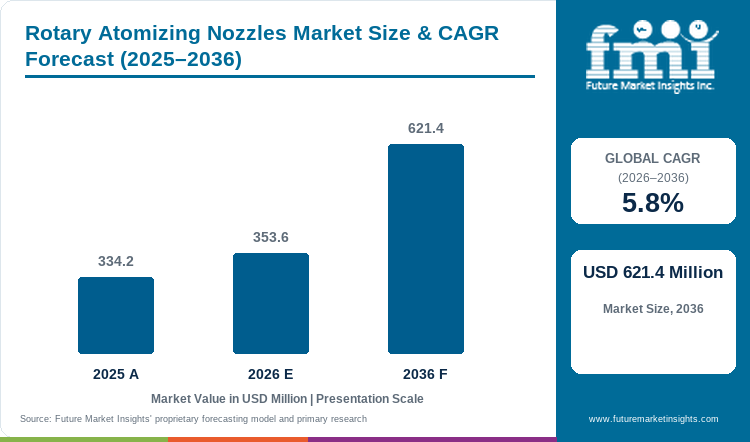
USD 353.6 Million in 2026 and USD 621.4 Million by 2036 at a 5.8% CAGR.
The Rotary Atomizing Nozzles market stood at USD 334.2 Million in 2025, is estimated at USD 353.6 Million in 2026, and is forecast to reach USD 621.4 Million by 2036 at a 5.8% CAGR from 2026 to 2036.
The market moves from USD 353.6 Million in 2026 to USD 621.4 Million by 2036 as finishers place greater value on paint yield, stable spray patterns, and automated process control.
ABB announced in October 2024 that its RB 1000i-S atomizer can improve transfer efficiency by up to 10% versus its predecessor while reducing paint waste by at least 30%. That operating logic matters because coating material that reaches the target becomes productive output rather than booth loss or recovery load.
Automotive and general industrial plants therefore assess rotary atomizers against material consumption and finish consistency. They also compare color-change time with maintenance burden. Demand rises when a new applicator can be validated within the existing robot and fluid architecture.
Purchasing decisions are increasingly tied to measurable line economics rather than atomizer price alone.
Country conditions alter how quickly those economics translate into orders. Germany combines highly automated vehicle production with frequent model and powertrain changes, so suppliers are tested on uptime during retooling.
South Korean plants place similar emphasis on automation as electric and hybrid production expands. Mexico offers a large manufacturing base where local service coverage and spare-part availability can determine whether a plant accepts a new platform.
In the USA, emissions obligations and a mature installed base make retrofit compatibility especially relevant. Japan remains more replacement-led, which raises the evidence threshold for a change to existing equipment.
Across these markets, interest becomes a purchase only after the atomizer demonstrates coating compatibility and safe integration. Buyers also require repeatable finish quality plus a credible service path.
Key Takeaways
- The market is estimated at USD 353.6 Million in 2026 and is forecast to reach USD 621.4 Million by 2036 at a 5.8% CAGR.
- Rotary cup atomizers lead the market in 2026. Air turbine driven systems lead in 2026.
- Automotive paint leads the market in 2026. Robot-mounted systems lead in 2026. Coating equipment OEMs lead the market in 2026.
- Driver: Pressure to reduce paint waste and hold repeatable finish quality is raising the value of high-efficiency rotary atomization.
- Restraint: New atomizers must pass coating and safety checks plus robot, fluid, and process validation before production teams will accept line risk.
- Opportunity: Retrofit kits and modular robot-ready architectures can capture installed-base replacement without requiring a full paint-shop rebuild. Germany has the highest profiled country CAGR at 6.6%, compared with Japan at 4.8%.
Analyst Perspective
Revenue capture depends on removing the implementation risk around the atomizer. Suppliers must prove finish quality at the customer's actual coating chemistry and production speed.
- Nikhil Kaitwade, Principal Consultant, Future Market Insights
How is the Rotary Atomizing Nozzles Market segmented?
The market is segmented by Product Type, Drive, Application, Automation Level, and Sales Channel.
Product Type separates the physical atomizing architecture used to create and shape droplets. Drive distinguishes how rotational energy is supplied to the atomizer. Application reflects the coating or process outcome that buyers need to achieve.
Automation Level captures whether the atomizer is mounted on a robot, operated manually, or installed in a fixed automated cell. Sales Channel separates equipment-OEM supply from direct manufacturer relationships, system-integration routes, and aftermarket replacement.
These axes matter because the same rotary principle can face very different validation requirements depending on the coating chemistry, line design, maintenance model, and process environment.
What makes Rotary cup atomizers central to the Product Type category?
Rotary cup atomizers lead when plants need fine droplet formation at high delivery rates without giving up control over spray shape. Centrifugal force creates the primary atomization mechanism while shaping air adjusts the plume around the target.
That combination fits automated coating lines where finish uniformity and edge control are measured alongside material yield. Bell and cup assemblies are replaceable wear components, which supports a defined aftermarket.
Dürr reported in June 2026 that EcoBell4 beta installations were operating under real production conditions with monitored atomizer behavior and rapid color changes. The proof point shows why cup-based architectures stay close to the production-control layer rather than functioning as simple consumable nozzles.
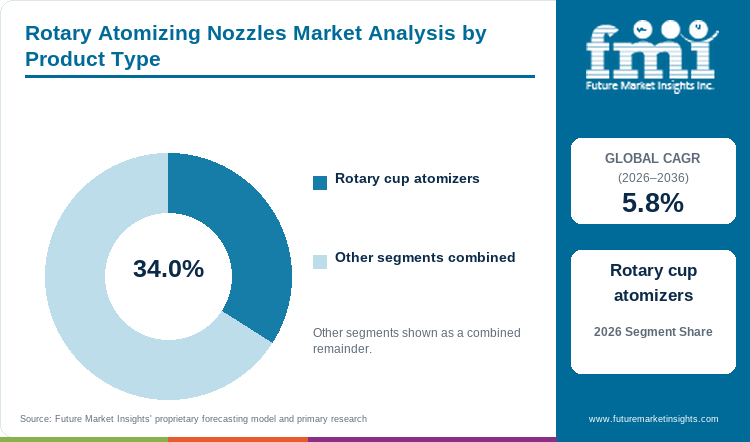
- Rotary cup atomizers account for 34.0% of the market in 2026 because controlled centrifugal atomization supports high-throughput finish requirements.
- Dürr reported in June 2026 that EcoBell4 installations used RFID and vibration monitoring under production conditions, linking the atomizer to predictive maintenance and process control.
Why does Air turbine driven lead the Drive category?
Air turbine drive remains the reference architecture where very high rotational speed must be delivered inside a compact paint applicator.
Compressed air drives the bell without a conventional motor at the atomizing head. This suits many hazardous coating environments and simplifies the rotating assembly. The trade-off is air use and the need to maintain clean air as well as bearings and turbines.
Suppliers compete on air efficiency and vibration control as well as serviceability. ABB stated in October 2024 that the RB 1000i-S was designed to reduce compressed-air use while improving paint transfer. Turbine efficiency has become part of the purchase case.
- Air turbine driven systems hold a 48.0% share in 2026 because pneumatic high-speed rotation remains well matched to established robotic coating architectures.
- ABB announced in October 2024 that its RB 1000i-S atomizer targeted lower compressed-air use alongside higher transfer efficiency, tying drive economics to paint-shop operating cost.
How does Automotive paint shape the Application category?
Automotive paint leads because vehicle body finishing combines high line speed with strict appearance requirements and costly coating materials. Rotary atomizers can meter fine droplets across primers, basecoats, and clearcoats while robotic motion keeps film build repeatable.
The process also places unusual value on color-change speed because each flush consumes paint and solvent while the line is not coating a saleable body. Emissions obligations add another reason to improve transfer efficiency.
ABB announced in October 2024 that its new atomizer was developed for automotive paint shops and could reduce paint waste versus the prior model. That direct link between yield and body-shop productivity keeps automotive applications at the center of supplier development.
- Automotive paint represents 32.0% of the market in 2026 because coating quality and paint utilization are tightly linked to line economics.
- ABB announced in October 2024 that the RB 1000i-S was launched for automotive paint shops with a stated transfer-efficiency improvement of up to 10% versus its predecessor.
What supports Robot-mounted systems in the Automation Level category?
Robot mounting lets the atomizer hold a controlled distance and orientation as it follows complex parts. That capability is important for vehicle bodies, plastic components, and other three-dimensional work where a fixed gun cannot maintain the same geometry.
The atomizer must still integrate with motion control and high-voltage systems. Fluid delivery and hazardous-area safeguards must also fit the cell. Buyers therefore evaluate the applicator and robot as one operating cell.
FANUC unveiled the CRX-10iA/L Paint in May 2024 as an explosion-proof collaborative paint robot for coating applications. The development illustrates a wider automation path in which safer robot architectures can extend controlled spray motion beyond traditional high-volume automotive lines.
- Robot-mounted systems hold a 49.0% share in 2026 because programmable motion improves coverage repeatability on complex coated parts.
- FANUC unveiled the CRX-10iA/L Paint in May 2024 for painting and powder or gel coating work. The launch expanded the range of robot configurations available to finishing cells.
What drives Coating equipment OEMs in the Sales Channel category?
Coating equipment OEMs lead the route to market because rotary atomizers rarely operate as isolated components in automated finishing. The buyer also needs compatible fluid delivery and controls. Robot interfaces, electrostatic hardware where applicable, and commissioning support must fit the same platform.
Bundling those elements under an equipment platform reduces interface risk and gives maintenance teams a clearer service path. It also allows a plant to specify spare bells, turbines, and upgrade kits against a known installed base.
ABB stated in October 2024 that the RB 1000i-S could be supplied with new robots and through a service-kit upgrade for existing equipment. That mix of new-build and retrofit supply strengthens the OEM channel.
- Coating equipment OEMs account for 35.0% of the market in 2026 because customers often buy the atomizer as part of a validated finishing architecture.
- ABB announced in October 2024 that the RB 1000i-S could be ordered with a new paint robot or used through an upgrade kit for installed RB 1000i equipment.
What are the drivers, restraints, and opportunities in the Rotary Atomizing Nozzles Market?
Higher coating-material yield and automated line productivity support demand, while qualification and integration costs slow replacement decisions and modular retrofits widen the addressable installed base.
- Driver: Pressure to reduce paint waste and hold repeatable finish quality is raising the value of high-efficiency rotary atomization.
- Restraint: New atomizers must pass coating and safety checks plus robot, fluid, and process validation before production teams will accept line risk.
- Opportunity: Retrofit kits and modular robot-ready architectures can capture installed-base replacement without requiring a full paint-shop rebuild.
Paint yield is a direct operating-cost driver because every percentage of overspray affects coating purchases, booth loading, and waste handling. The US Environmental Protection Agency maintained emission standards for new or modified automobile and light-duty truck coating operations in its March 2026 update.
Those rules sit alongside plant-level efforts to reduce material loss and solvent use. ABB announced in October 2024 that the RB 1000i-S targeted both higher transfer efficiency and lower paint waste.
The commercial mechanism is straightforward: when an atomizer converts more purchased coating into acceptable film on the part, engineering teams can justify replacement through material savings and process stability rather than capacity expansion alone.
The binding restraint appears during qualification rather than at the point of initial interest. A rotary atomizer must work with the plant's coating rheology and electrostatic settings. Robot path and fluid pressures must also be validated against booth airflow and hazardous-area requirements.
A mismatch can create finish defects or unplanned downtime, so plant engineers often require trials before a production change. FANUC's May 2024 introduction of an explosion-proof collaborative paint robot highlights the safety layer that surrounds automated coating hardware.
This integration burden delays orders because the buyer must coordinate controls and maintenance. EHS review and production windows must also align. Demand remains intact, but the path from technical interest to approved equipment is longer.
Retrofit design creates the clearest near-term opportunity because much of the addressable demand sits in existing paint cells. ABB's October 2024 service kit for the RB 1000i-S was designed to replace key parts of an installed predecessor rather than force a complete robot replacement.
Graco's ProBell platform was introduced as a modular architecture that could be configured for fixed systems, reciprocators and robot mounting. Suppliers can extend that logic with common controls, prevalidated interfaces and service kits that shorten commissioning.
The winners will be those that document performance on installed equipment and support conversion in the customer's planned maintenance window.
Which country CAGRs are profiled in the Rotary Atomizing Nozzles Market?
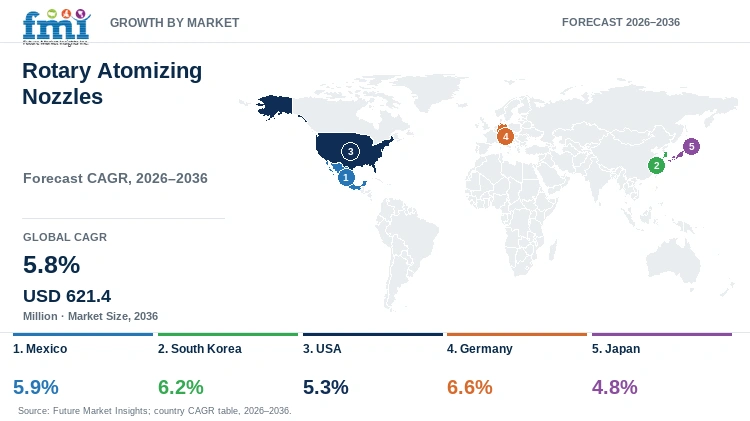
| Country | CAGR |
|---|---|
| Mexico | 5.9% |
| South Korea | 6.2% |
| USA | 5.3% |
| Germany | 6.6% |
| Japan | 4.8% |
How do country-level CAGRs compare in the Rotary Atomizing Nozzles Market?
Germany records the fastest profile at 6.6% CAGR from 2026 to 2036, while Japan records the slowest at 4.8%. The spread is 1.8 percentage points. Germany and South Korea form the upper growth band because both combine deep automation capability with active vehicle-production changeovers.
Mexico sits close behind at 5.9% as its manufacturing base creates recurring finishing demand. USA follows at 5.3% in a more mature installed environment. Japan grows at 4.8%, where replacement discipline and long qualification cycles temper the pace.
These differences indicate timing rather than absolute country market size.
- Germany exceeds South Korea by 0.4 percentage points, suggesting a slightly faster cadence for automation upgrades and service investment in Germany.
- South Korea exceeds Mexico by 0.3 percentage points, so both can support focused technical coverage without implying identical buyer behavior.
- Mexico exceeds USA by 0.6 percentage points, pointing to stronger incremental line and capacity effects relative to a more mature US installed base.
- USA exceeds Japan by 0.5 percentage points, which favors retrofit and compliance-led selling in the USA while Japan remains more replacement selective.
CAGR alone does not determine the size of a supplier opportunity. A smaller fast-growing country can still generate fewer absolute orders than a larger mature installed base. Conversion also depends on plant count and coating-line age.
Qualification rules and local service coverage matter as well, as does the share of production that uses rotary atomization. The broader regional analysis therefore treats country growth as one input alongside manufacturing intensity and installed equipment conditions.
Country-wise Analysis
- Mexico: Automotive and industrial finishers tend to value equipment that can be serviced quickly across established manufacturing corridors. Demand for Rotary Atomizing Nozzles Market products in Mexico is forecast to expand at 5.9% CAGR from 2026 to 2036. INEGI updated its light-vehicle production series on 7 August 2026 documenting the continuing scale of vehicle manufacturing through 2025. The local friction is not only capital approval; plants also need dependable spares and application support during constrained maintenance windows. Suppliers that localize service stock, run coating trials and support system integrators can shorten the distance between specification and repeat orders.
- South Korea: Buyers operate in an environment where automotive manufacturing and advanced automation move together so new applicators must fit fast line conversions. Demand for Rotary Atomizing Nozzles Market products in South Korea is forecast to expand at 6.2% CAGR from 2026 to 2036. MOTIE reported on 20 May 2025 that April automobile production reached 385,621 units while electric and hybrid sales increased. Model and powertrain transitions can compress commissioning windows. Suppliers need robot-ready interfaces, documented cycle performance and local engineering support that can validate a change without destabilizing production.
- USA: Plants often buy against a mature installed base, which makes retrofit compatibility and compliance documentation as important as peak atomizer performance. Demand for Rotary Atomizing Nozzles Market products in the USA is forecast to expand at 5.3% CAGR from 2026 to 2036. The US Environmental Protection Agency updated its automobile and light-duty truck surface-coating standards page on 4 March 2026 reinforcing the emissions framework applied to relevant new or modified operations. Hazardous-area requirements and legacy controls can lengthen qualification. Suppliers can respond with upgrade kits, service continuity and transfer-efficiency evidence tied to the customer's existing line.
- Germany: Paint-shop buyers typically demand high automation uptime and detailed process evidence before accepting a hardware change. Demand for Rotary Atomizing Nozzles Market products in Germany is forecast to expand at 6.6% CAGR from 2026 to 2036. VDA reported on 2 September 2026 that German passenger-car production totaled 2.65 million units from January through August while electric-vehicle registrations were expanding. The same manufacturing base faces retooling and utilization pressure, which makes downtime costly. Suppliers that combine application efficiency with condition monitoring, rapid service and validated changeover procedures are better placed to capture replacement and modernization spending.
- Japan: Procurement is comparatively replacement disciplined, so established equipment is likely to remain in service until a new platform shows a clear production advantage. Demand for Rotary Atomizing Nozzles Market products in Japan is forecast to expand at 4.8% CAGR from 2026 to 2036. METI's 29 May 2026 manufacturing white paper emphasized medium-term growth investment plus the use of AI and digital technologies to sustain competitiveness. Long validation cycles can slow conversion where existing finish quality is acceptable. Suppliers need localized technical support, backward-compatible upgrades and maintenance data that demonstrate lower lifecycle risk rather than relying on new-equipment performance claims alone.
Who are the notable companies in the Rotary Atomizing Nozzles Market?
Dürr and SAMES Kremlin are profiled. Carlisle Fluid Technologies and Graco are also covered. Nordson and ABB are also covered. FANUC and Spraying Systems Co. are also covered. GEA and Bühler complete the notable-company set.
Competition is shaped by how close a supplier sits to the full atomization workflow. Dürr, ABB and FANUC operate nearest to robotic paint-line integration where atomizer performance is coordinated with motion, controls and plant commissioning.
SAMES Kremlin and Carlisle Fluid Technologies compete alongside Graco and Nordson in applicator hardware. Their offers span electrostatic and non-electrostatic configurations with retrofit paths.
Spraying Systems Co., GEA, and Bühler bring broader process-atomization or spray-drying capabilities into applications where droplet generation is part of a larger process system. Buyers therefore compare more than nozzle geometry. They assess application proof and integration responsibility.
Service access also matters, as does the supplier's ability to support the production environment in which the rotary device will operate.
- Integrated robotic paint systems: Dürr and ABB compete alongside FANUC. They coordinate applicators and robots with controls and line-level engineering.
- Rotary application hardware specialists: SAMES Kremlin and Carlisle Fluid Technologies compete alongside Graco and Nordson. Their offers span atomizer architecture and controls with retrofit flexibility.
- Process atomization and drying specialists: Spraying Systems Co., GEA, and Bühler participate where atomization choices interact with spray-drying or broader process design.
Competitive Benchmarking: Rotary Atomizing Nozzles Market
| Company | Rotary Bell / High-Speed Atomizer Hardware | Robotic & Paint-Line Integration | Process / Drying Atomization Coverage | Geographic Reach |
|---|---|---|---|---|
| Dürr | High | High | Low | Global |
| SAMES Kremlin | High | Medium | Low | North America and Europe are covered. Coverage extends to East Asia and Latin America. |
| Carlisle Fluid Technologies | High | Medium | Low | North America, Europe, and Mexico |
| Graco | High | Medium | Low | Global distributor coverage |
| Nordson | High | Medium | Low | Global |
| ABB | High | High | Low | Global |
| FANUC | Medium | High | Low | Global |
| Spraying Systems Co. | Low | Low | High | Global |
| GEA | Low | Medium | High | Global |
| Bühler | Low | Medium | Medium | Global |
Scoring basis: Rotary Bell / High-Speed Atomizer Hardware measures documented ownership of rotary bell or closely related high-speed atomizing hardware. Robotic & Paint-Line Integration measures documented ability to connect atomization with robots and controls. It also covers fluid systems or line engineering.
Process / Drying Atomization Coverage measures documented atomization capability inside spray-drying or process systems. High indicates broad documented capability and Medium indicates credible but narrower coverage. Low is reserved for a documented limitation; unavailable public information is left Low.
Geographic Reach reflects evidenced commercial or service presence relevant to the compared capability.
Key Developments in the Rotary Atomizing Nozzles Market
- In June 2026, Dürr reported EcoBell4 beta-site operation under real production conditions. The installations combined rotary atomization with RFID identification and vibration monitoring. They also included rapid color change and production-rate testing. The development increases the amount of field evidence available to buyers that need to validate uptime and maintenance behavior before changing an established paint-line atomizer.
- In October 2024, ABB launched the RB 1000i-S paint atomizer for automotive paint shops. ABB stated that the design could improve transfer efficiency by up to 10% and reduce paint waste by at least 30% versus the predecessor while supporting upgrades to installed RB 1000i units. The launch strengthens the retrofit case around measurable material savings.
- In May 2024, FANUC unveiled the CRX-10iA/L Paint collaborative robot for painting and for powder or gel coating applications. The product was designed for explosion-proof operation under US safety requirements and for high-mix, low-volume environments. The development broadens the automation architectures that can carry controlled finishing equipment beyond traditional high-volume robotic paint cells.
Key Players in the Rotary Atomizing Nozzles Market
Integrated Robotic Paint-Line Platforms
- Dürr
- ABB
- FANUC
Rotary Application Hardware Specialists
- SAMES Kremlin
- Carlisle Fluid Technologies
- Graco
- Nordson
Process Atomization and Drying Specialists
- Spraying Systems Co.
- GEA
- Bühler
Rotary Atomizing Nozzles Market - Report Scope
| Coverage field | Report scope |
|---|---|
| Market breakdown | Product Type; Drive; Application; Automation Level; Sales Channel |
| Quantitative Units | USD Million |
| Market Definition | Market revenue includes sales of rotary atomizing nozzles and rotary atomizer heads within the stated Product Type, Drive, Application, Automation Level, and Sales Channel classifications. Revenue from complete paint robots, spray booths, complete spray dryers, coatings, downstream finished products, and standalone non-rotary atomizers is excluded. |
| Regions Covered | North America; Latin America; Western Europe; Eastern Europe; East Asia; South Asia and Pacific; Middle East and Africa |
| Countries Covered | Mexico; South Korea; USA; Germany; Japan; more than twenty-five additional countries in the full report |
| Key Companies Profiled | Dürr; SAMES Kremlin; Carlisle Fluid Technologies; Graco; Nordson; ABB; FANUC; Spraying Systems Co.; GEA; Bühler |
| Forecast Period | 2026 to 2036 |
| Approach | A hybrid bottom-up and top-down sizing approach reconciles supplier revenue indicators, unit demand, average selling values, application intensity, channel checks, and country-level production context. |
Rotary Atomizing Nozzles Market - Research Methodology
| Method | Approach |
|---|---|
| Primary Research | FMI consults manufacturers and coating system integrators. Plant engineers and end users explain purchase triggers and service expectations. The research tests purchase criteria and adoption barriers. |
| Desk Research | FMI reviews manufacturing statistics and environmental rules. Technical literature and company documentation support the defined scope. Sources are retained when they support the defined market boundary. |
| Market Sizing and Forecasting | FMI reconciles demand by product type and coating application. Forecasts reflect line additions and installed-base replacement. Country conditions and channel structure are checked against the revenue boundary. |
| Data Validation | Findings are checked against independent evidence. The estimate excludes integrated-equipment revenue and standalone substitute atomizers. Duplicate value and downstream products are removed. |
Rotary Atomizing Nozzles Market by Segments
Rotary Atomizing Nozzles Market segmented by Product Type:
- Rotary cup atomizers
- Rotary disc atomizers
- Spinning wheel atomizers
- Rotary spray heads
- By Nozzle Type
Rotary Atomizing Nozzles Market segmented by Drive:
- Air turbine driven
- Electric motor driven
- Hydraulic driven
- By Pressure Rating
Rotary Atomizing Nozzles Market segmented by Application:
- Automotive paint
- Industrial coatings
- Powder / spray drying
- Agricultural spray
- Pharma coating
- By Material
Rotary Atomizing Nozzles Market segmented by Automation Level:
- Robot-mounted
- Manual / handheld
- Fixed automated systems
- By End Use
Rotary Atomizing Nozzles Market segmented by Sales Channel:
- Coating equipment OEMs
- Direct manufacturer
- System integrators
- Aftermarket replacement
- By Sales Channel
Rotary Atomizing Nozzles Market by Region:
- North America
- United States
- Canada
- Latin America
- Brazil
- Mexico
- Argentina
- Chile
- Western Europe
- Germany
- France
- United Kingdom
- Italy
- Spain
- Benelux
- Nordics
- Eastern Europe
- Poland
- Czech Republic
- Romania
- Hungary
- East Asia
- China
- Japan
- South Korea
- South Asia and Pacific
- India
- ASEAN
- Australia and New Zealand
- Middle East and Africa
- GCC Countries
- South Africa
- Türkiye
- Israel
Research Sources and Bibliography
- Dürr (2026, June 16). Greater efficiency. Higher quality. EcoBell4.
- ABB (2024, October 18). ABB launches new paint atomizer for efficient and sustainable paint shops.
- FANUC America (2024, May 6). FANUC's New CRX-10iA/L Paint: World's First Global Ex-Proof Collaborative Paint Robot.
- GEA (2024, September 16). New valve technology from GEA reduces microbiological risks in spray drying process.
- Graco (2016, October 5). Graco Introduces New ProBell Rotary Applicator.
- US Environmental Protection Agency (2026, March 4). Automobile and Light-Duty Truck Surface Coating Operations: New Source Performance Standards.
- INEGI (2026, August 7). Venta, producción y exportación de vehículos ligeros.
- Ministry of Trade, Industry and Energy, Republic of Korea (2025, May 20). Korea's April automobile production and domestic sales trends.
- German Association of the Automotive Industry (VDA) (2026, September 2). Production in Germany in August 2026.
- Ministry of Economy, Trade and Industry, Japan (2026, May 29). 2026 White Paper on Manufacturing Industries.
- SAMES Kremlin (n.d.). Nanobell 805 robotic electrostatic rotary bell atomizer.
- Carlisle Fluid Technologies (n.d.). ICE Bell rotary atomizer.
- Nordson (n.d.). RA-20 Rotary Atomizers.
- Spraying Systems Co. (n.d.). Spray Drying Nozzles and Applications, Technical Manual 402.
- Bühler (n.d.). Protein Application Center.
This bibliography is provided for reader reference and is not exhaustive. The full report contains the complete reference list and detailed citations.
This Report Answers
- What is the Rotary Atomizing Nozzles Market size in 2026 and how large is it forecast to become by 2036?
- Which coating-efficiency and process-control pressures support demand for rotary atomizing nozzles?
- Why do Rotary cup atomizers hold the leading position within Product Type?
- How does the leading Air turbine driven segment influence operating economics and system design?
- Why does Automotive paint hold the leading position within Application?
- How do the profiled country growth rates compare for the Rotary Atomizing Nozzles market?
- Which companies provide rotary application hardware, robotic integration, or process-atomization capabilities?
- What qualification and integration requirements limit adoption of new rotary atomizing nozzle platforms?
Frequently Asked Questions
What is driving growth in the Rotary Atomizing Nozzles Market?
Growth is driven by the need to convert more purchased coating into acceptable film while holding finish quality at automated production speed. Retrofit demand also rises when new atomizers can reduce waste or maintenance without forcing replacement of the complete paint cell.
Who are the key players in the Rotary Atomizing Nozzles Market?
Dürr, SAMES Kremlin and Carlisle Fluid Technologies are among the profiled companies. The wider group listed under Key Players spans robotic paint lines and rotary hardware as well as process atomization and spray drying.
What notable restraint affects the Rotary Atomizing Nozzles Market?
Qualification is the main restraint because a new atomizer must work with the plant's coating chemistry and controls. It must also fit robot motion, the fluid system, and safety requirements before production approval on the line.
Why should executives track the Rotary Atomizing Nozzles Market?
Rotary atomization affects coating material use and finish consistency, while it also influences maintenance cost and line availability. Executives should track whether new designs improve those economics enough to justify retrofit spending across a productive installed base.
What business problem does the Rotary Atomizing Nozzles Market address?
The market addresses the need to create controlled droplets and deposit them consistently at industrial production rates. In coating applications, that job reduces overspray and film variation; in process applications, atomization quality influences downstream drying behavior and product characteristics.
What should paint-shop engineering teams evaluate in the Rotary Atomizing Nozzles Market?
Paint-shop engineering teams should compare transfer efficiency with pattern control and coating compatibility. They should test color-change performance and robot integration while confirming that service access and planned support fit the available maintenance window.
What limits return on investment in the Rotary Atomizing Nozzles Market?
Return on investment is reduced when integration work and validation time outweigh material savings. Compressed-air demand, spare parts, and unplanned downtime can further weaken the business case over the equipment life even when the acquisition price is low.
What supports long-term commercial confidence in the Rotary Atomizing Nozzles Market?
Long-term confidence comes from durable demand for controlled coating and atomization plus a large installed base that requires service and replacement. Field evidence from suppliers increasingly links new atomizers to measurable paint yield, monitored maintenance, and retrofit compatibility rather than performance claims alone.
Preview the report firsthand - request a free sample
Get SampleGet the brochure for pricing and purchase details.
Get PDFTable of Content
- Key Takeaways
- Market Size and CAGR
- Top Growth Driver
- Fastest Growing Segment
- Leading Region
- Key Companies
- Emerging Opportunities
- Executive Summary
- Global Market Outlook
- Demand-side Trends
- Supply-side Trends
- Technology Roadmap Analysis
- Analysis and Recommendations
- Analyst Perspective (What is happening? Why now? What should investors know?)
- Key Questions Answered
- How large is the market?
- What is the CAGR?
- What are key trends?
- Which region dominates?
- Who are the leaders?
- Market Overview
- Market Coverage / Taxonomy
- Market Definition / Scope / Limitations
- Research Methodology
- Chapter Orientation
- Analytical Lens and Working Hypotheses
- Market Structure, Signals, and Trend Drivers
- Benchmarking and Cross-market Comparability
- Market Sizing, Forecasting, and Opportunity Mapping
- Research Design and Evidence Framework
- Desk Research Programme (Secondary Evidence)
- Expert Input and Fieldwork (Primary Evidence)
- Tooling, Models, and Reference Databases
- Data Engineering and Model Build
- Quality Assurance and Audit Trail
- Market Background
- Market Dynamics (Drivers, Restraints, Opportunity, Trends)
- Scenario Forecast (Optimistic, Likely, Conservative)
- Impact Analysis
- AI Impact
- Sustainability Impact
- Regulatory Impact
- Technology Impact
- Consumer / Buyer Analysis
- Purchase Drivers
- Adoption Barriers
- Buyer Journey
- Opportunity Map Analysis
- Product Life Cycle Analysis
- Supply Chain Analysis
- Investment Feasibility Matrix
- Value Chain Analysis
- PESTLE and Porter's Analysis
- Regulatory Landscape
- Regional Parent Market Outlook
- Production and Consumption Statistics
- Import and Export Statistics
- Global Market Analysis and Forecast, 2021 to 2036
- Historical Market Size Value (USD Million) Analysis, 2021 to 2025
- Current and Future Market Size Value (USD Million) Projections, 2026 to 2036
- Y-o-Y Growth Trend Analysis
- Absolute $ Opportunity Analysis
- Global Market Pricing Analysis, 2021 to 2036
- Global Market Analysis and Forecast, By Product Type, 2021 to 2036
- Introduction / Key Findings
- Historical Market Size Value (USD Million) Analysis By Product Type, 2021 to 2025
- Current and Future Market Size Value (USD Million) Analysis and Forecast By Product Type, 2026 to 2036
- Rotary cup atomizers
- Rotary disc atomizers
- Spinning wheel atomizers
- Rotary spray heads
- By Nozzle Type
- Y-o-Y Growth Trend Analysis By Product Type, 2021 to 2025
- Absolute $ Opportunity Analysis By Product Type, 2026 to 2036
- Global Market Analysis and Forecast, By Drive, 2021 to 2036
- Introduction / Key Findings
- Historical Market Size Value (USD Million) Analysis By Drive, 2021 to 2025
- Current and Future Market Size Value (USD Million) Analysis and Forecast By Drive, 2026 to 2036
- Air turbine driven
- Electric motor driven
- Hydraulic driven
- By Pressure Rating
- Y-o-Y Growth Trend Analysis By Drive, 2021 to 2025
- Absolute $ Opportunity Analysis By Drive, 2026 to 2036
- Global Market Analysis and Forecast, By Application, 2021 to 2036
- Introduction / Key Findings
- Historical Market Size Value (USD Million) Analysis By Application, 2021 to 2025
- Current and Future Market Size Value (USD Million) Analysis and Forecast By Application, 2026 to 2036
- Automotive paint
- Industrial coatings
- Powder / spray drying
- Agricultural spray
- Pharma coating
- By Material
- Y-o-Y Growth Trend Analysis By Application, 2021 to 2025
- Absolute $ Opportunity Analysis By Application, 2026 to 2036
- Global Market Analysis and Forecast, By Automation Level, 2021 to 2036
- Introduction / Key Findings
- Historical Market Size Value (USD Million) Analysis By Automation Level, 2021 to 2025
- Current and Future Market Size Value (USD Million) Analysis and Forecast By Automation Level, 2026 to 2036
- Robot-mounted
- Manual / handheld
- Fixed automated systems
- By End Use
- Y-o-Y Growth Trend Analysis By Automation Level, 2021 to 2025
- Absolute $ Opportunity Analysis By Automation Level, 2026 to 2036
- Global Market Analysis and Forecast, By Sales Channel, 2021 to 2036
- Introduction / Key Findings
- Historical Market Size Value (USD Million) Analysis By Sales Channel, 2021 to 2025
- Current and Future Market Size Value (USD Million) Analysis and Forecast By Sales Channel, 2026 to 2036
- Coating equipment OEMs
- Direct manufacturer
- System integrators
- Aftermarket replacement
- By Sales Channel
- Y-o-Y Growth Trend Analysis By Sales Channel, 2021 to 2025
- Absolute $ Opportunity Analysis By Sales Channel, 2026 to 2036
- Global Market Analysis and Forecast, By Region, 2021 to 2036
- Introduction
- Historical Market Size Value (USD Million) Analysis By Region, 2021 to 2025
- Current Market Size Value (USD Million) Analysis and Forecast By Region, 2026 to 2036
- North America
- Latin America
- Western Europe
- Eastern Europe
- East Asia
- South Asia and Pacific
- Middle East and Africa
- Market Attractiveness Analysis By Region
- North America Market Analysis and Forecast, By Country, 2021 to 2036
- Historical Market Size Value (USD Million) Trend Analysis By Market Taxonomy, 2021 to 2025
- Market Size Value (USD Million) Forecast By Market Taxonomy, 2026 to 2036
- By Country
- United States
- Canada
- By Product Type
- By Drive
- By Application
- By Automation Level
- By Sales Channel
- By Country
- Market Attractiveness Analysis
- By Country
- By Product Type
- By Drive
- By Application
- By Automation Level
- By Sales Channel
- Key Takeaways
- Latin America Market Analysis and Forecast, By Country
- Historical Market Size Value (USD Million) Trend Analysis By Market Taxonomy, 2021 to 2025
- Market Size Value (USD Million) Forecast By Market Taxonomy, 2026 to 2036
- By Country
- Brazil
- Mexico
- Argentina
- Chile
- By Product Type
- By Drive
- By Application
- By Automation Level
- By Sales Channel
- By Country
- Market Attractiveness Analysis
- By Country
- By Product Type
- By Drive
- By Application
- By Automation Level
- By Sales Channel
- Key Takeaways
- Western Europe Market Analysis and Forecast, By Country
- Historical Market Size Value (USD Million) Trend Analysis By Market Taxonomy, 2021 to 2025
- Market Size Value (USD Million) Forecast By Market Taxonomy, 2026 to 2036
- By Country
- Germany
- France
- United Kingdom
- Italy
- Spain
- Benelux
- Nordics
- By Product Type
- By Drive
- By Application
- By Automation Level
- By Sales Channel
- By Country
- Market Attractiveness Analysis
- By Country
- By Product Type
- By Drive
- By Application
- By Automation Level
- By Sales Channel
- Key Takeaways
- Eastern Europe Market Analysis and Forecast, By Country
- Historical Market Size Value (USD Million) Trend Analysis By Market Taxonomy, 2021 to 2025
- Market Size Value (USD Million) Forecast By Market Taxonomy, 2026 to 2036
- By Country
- Poland
- Czech Republic
- Romania
- Hungary
- By Product Type
- By Drive
- By Application
- By Automation Level
- By Sales Channel
- By Country
- Market Attractiveness Analysis
- By Country
- By Product Type
- By Drive
- By Application
- By Automation Level
- By Sales Channel
- Key Takeaways
- East Asia Market Analysis and Forecast, By Country
- Historical Market Size Value (USD Million) Trend Analysis By Market Taxonomy, 2021 to 2025
- Market Size Value (USD Million) Forecast By Market Taxonomy, 2026 to 2036
- By Country
- China
- Japan
- South Korea
- By Product Type
- By Drive
- By Application
- By Automation Level
- By Sales Channel
- By Country
- Market Attractiveness Analysis
- By Country
- By Product Type
- By Drive
- By Application
- By Automation Level
- By Sales Channel
- Key Takeaways
- South Asia and Pacific Market Analysis and Forecast, By Country
- Historical Market Size Value (USD Million) Trend Analysis By Market Taxonomy, 2021 to 2025
- Market Size Value (USD Million) Forecast By Market Taxonomy, 2026 to 2036
- By Country
- India
- ASEAN
- Australia and New Zealand
- By Product Type
- By Drive
- By Application
- By Automation Level
- By Sales Channel
- By Country
- Market Attractiveness Analysis
- By Country
- By Product Type
- By Drive
- By Application
- By Automation Level
- By Sales Channel
- Key Takeaways
- Middle East and Africa Market Analysis and Forecast, By Country
- Historical Market Size Value (USD Million) Trend Analysis By Market Taxonomy, 2021 to 2025
- Market Size Value (USD Million) Forecast By Market Taxonomy, 2026 to 2036
- By Country
- GCC Countries
- South Africa
- Türkiye
- Israel
- By Product Type
- By Drive
- By Application
- By Automation Level
- By Sales Channel
- By Country
- Market Attractiveness Analysis
- By Country
- By Product Type
- By Drive
- By Application
- By Automation Level
- By Sales Channel
- Key Takeaways
- Key Countries Market Analysis
- United States
- Pricing Analysis
- Market Share Analysis, 2025
- By Product Type
- By Drive
- By Application
- By Automation Level
- By Sales Channel
- Canada
- Pricing Analysis
- Market Share Analysis, 2025
- By Product Type
- By Drive
- By Application
- By Automation Level
- By Sales Channel
- Mexico
- Pricing Analysis
- Market Share Analysis, 2025
- By Product Type
- By Drive
- By Application
- By Automation Level
- By Sales Channel
- Brazil
- Pricing Analysis
- Market Share Analysis, 2025
- By Product Type
- By Drive
- By Application
- By Automation Level
- By Sales Channel
- Chile
- Pricing Analysis
- Market Share Analysis, 2025
- By Product Type
- By Drive
- By Application
- By Automation Level
- By Sales Channel
- Germany
- Pricing Analysis
- Market Share Analysis, 2025
- By Product Type
- By Drive
- By Application
- By Automation Level
- By Sales Channel
- United Kingdom
- Pricing Analysis
- Market Share Analysis, 2025
- By Product Type
- By Drive
- By Application
- By Automation Level
- By Sales Channel
- Italy
- Pricing Analysis
- Market Share Analysis, 2025
- By Product Type
- By Drive
- By Application
- By Automation Level
- By Sales Channel
- Spain
- Pricing Analysis
- Market Share Analysis, 2025
- By Product Type
- By Drive
- By Application
- By Automation Level
- By Sales Channel
- France
- Pricing Analysis
- Market Share Analysis, 2025
- By Product Type
- By Drive
- By Application
- By Automation Level
- By Sales Channel
- India
- Pricing Analysis
- Market Share Analysis, 2025
- By Product Type
- By Drive
- By Application
- By Automation Level
- By Sales Channel
- ASEAN
- Pricing Analysis
- Market Share Analysis, 2025
- By Product Type
- By Drive
- By Application
- By Automation Level
- By Sales Channel
- Australia and New Zealand
- Pricing Analysis
- Market Share Analysis, 2025
- By Product Type
- By Drive
- By Application
- By Automation Level
- By Sales Channel
- China
- Pricing Analysis
- Market Share Analysis, 2025
- By Product Type
- By Drive
- By Application
- By Automation Level
- By Sales Channel
- Japan
- Pricing Analysis
- Market Share Analysis, 2025
- By Product Type
- By Drive
- By Application
- By Automation Level
- By Sales Channel
- South Korea
- Pricing Analysis
- Market Share Analysis, 2025
- By Product Type
- By Drive
- By Application
- By Automation Level
- By Sales Channel
- Poland
- Pricing Analysis
- Market Share Analysis, 2025
- By Product Type
- By Drive
- By Application
- By Automation Level
- By Sales Channel
- Hungary
- Pricing Analysis
- Market Share Analysis, 2025
- By Product Type
- By Drive
- By Application
- By Automation Level
- By Sales Channel
- Türkiye
- Pricing Analysis
- Market Share Analysis, 2025
- By Product Type
- By Drive
- By Application
- By Automation Level
- By Sales Channel
- South Africa
- Pricing Analysis
- Market Share Analysis, 2025
- By Product Type
- By Drive
- By Application
- By Automation Level
- By Sales Channel
- United States
- Market Structure Analysis
- Competition Dashboard
- Competition Benchmarking
- Market Share Analysis of Top Players
- By Regional
- By Product Type
- By Drive
- By Application
- By Automation Level
- By Sales Channel
- Emerging Startups
- Innovation Benchmarking
- Competition Analysis
- Competition Deep Dive
- Dürr
- Overview
- Product Portfolio
- Profitability by Market Segments
- Sales Footprint
- Strategy Overview
- Marketing Strategy
- Product Strategy
- Channel Strategy
- SAMES Kremlin
- Carlisle Fluid Technologies
- Graco
- Nordson
- ABB
- FANUC
- Spraying Systems Co.
- GEA
- Bühler
- Dürr
- Case Studies
- Success Stories
- Recent Developments
- Competition Deep Dive
- Assumptions & Acronyms Used


