

- Market Size (2026)
- USD 586.6 Mn
- Forecast (2036)
- USD 1040.6 Mn
- CAGR (2026 to 2036)
- 5.9%
How big is Safety Razors Market in 2026?
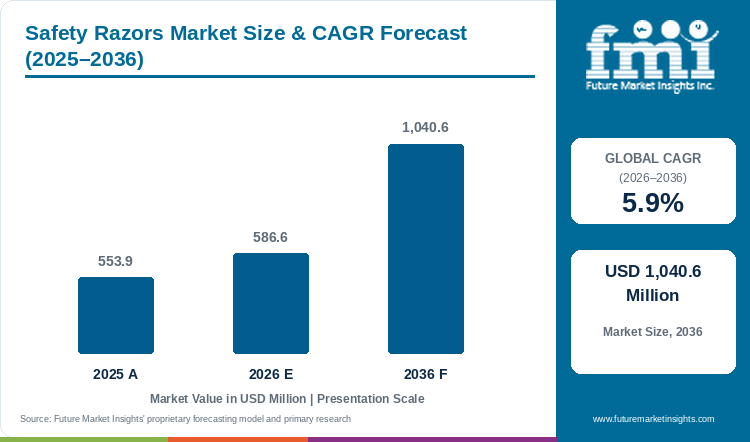
USD 586.6 Million in 2026 and USD 1,040.6 Million by 2036 at a 5.9% CAGR.
Spending on safety razors is estimated at USD 553.9 Million in 2025 and USD 586.6 Million in 2026, as per FMI. Revenue is projected to reach USD 1,040.6 Million by 2036 at a 5.9% CAGR, opening USD 454.0 Million of new sales for razor and blade suppliers. Edgewell’s August 2025 account of Schick Progista in Japan links the razor with pre- and post-shave care, showing how established grooming brands compete for the whole routine [1].
A durable safety-razor handle can attract a buyer once, but compatible blade replenishment sustains the relationship. Handling confidence and readily available refills therefore matter more than heritage styling on its own. The category can grow through small changes in an existing shaving habit, provided the user sees a clear reason to keep the tool. Starter packs and straightforward instructions can make that transition less demanding.
Analysts at FMI see refill continuity and shaving comfort as the strongest defences against cartridge and electric alternatives. Edgewell relaunched Quattro across Europe, China and Oceania in May 2026, reinforcing competition from the cartridge format [2]. Safety-razor suppliers will need to make blade compatibility, lifetime purchase costs and routine support easy to assess. Retailers that keep refills beside the handle can convert initial trial into a repeat purchase pattern.
Key Takeaways
- Demand mechanism: durable handles and replaceable blades can lower repeat-purchase friction when compatible refills are easy to source.
- Product Type: Core / classic lines lead with a 32.0% share in 2026 because familiar double-edge architecture makes blade compatibility and product comparison straightforward.
- Nature: Conventional leads with a 54.0% share in 2026 because stainless-steel blade systems remain the reference configuration for performance and availability.
- Format: Cream & balm leads with a 34.0% share in 2026 as routine-based merchandising links the razor purchase to skin preparation and post-shave comfort.
- Purchasing friction: technique, blade handling and irritation risk can delay repeat use even when the handle economics are attractive.
- Profiled companies: L'Oreal, Shiseido, Wahl, Henkel, Church & Dwight, Beiersdorf, Kenvue, Unilever, Edgewell Personal Care and Procter & Gamble.
Analyst Perspective
“Demand converts into recurring revenue when buyers perceive the handle as durable and the blade system as easy to source, then master the technique well enough to avoid irritation.”
- Rahul Pandita, Principal Consultant, FMI
How is the safety razors market segmented?
The market is segmented by Product Type, Nature, Format, Price Positioning and Sales Channel.
Product Type comprises Core / classic lines, Targeted treatment lines, Sensitive & gentle lines, Premium & clinical lines and Kits & sets. Nature comprises Conventional, Vegan & cruelty-free, Natural & organic, Dermocosmetic / clinical and Fragrance-free & sensitive. Format comprises Cream & balm, Liquid & serum, Stick & solid, Spray & mist, Sheet & patch and Powder. Price Positioning comprises Mass, Masstige, Premium and Professional. Sales Channel comprises E-commerce & DTC, Specialty beauty retail, Pharmacies & drugstores, Supermarkets & hypermarkets and Salons & spas. Format is treated as a commercial offer classification around the shaving routine and does not extend counted revenue to standalone creams or other adjacent preparations.
What keeps Core / classic lines central to the Product Type category?
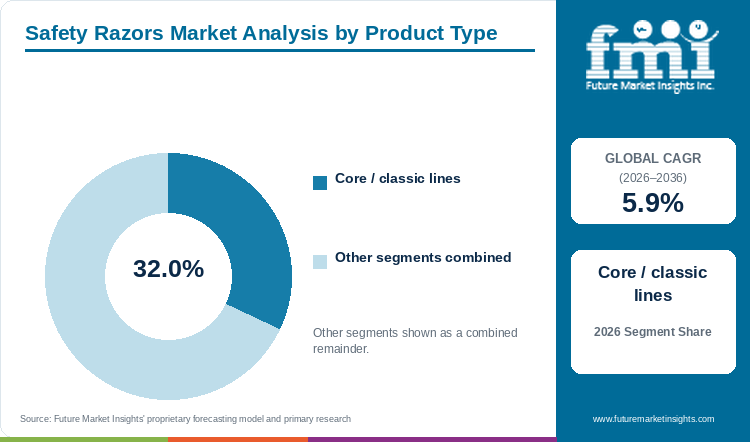
Core / classic lines hold 32.0% of Product Type in 2026.
Core / classic lines benefit from the defining safety-razor proposition: a durable handle, a removable head and a standardized replaceable blade. Buyers can understand the mechanism without learning a proprietary cartridge architecture. Gillette describes its King C. product as a single-blade double-edge safety razor with a chrome-plated handle and replaceable platinum-coated stainless-steel blades. [3] The commercial value comes from a stable hardware-and-refill relationship rather than from frequent handle replacement.
- Core / classic lines hold 32.0% because the familiar double-edge configuration supports transparent blade compatibility and straightforward replacement economics.
- In May 2026, Edgewell Personal Care relaunched its Quattro razor range across Europe, China and Oceania. The action sits in the broader wet-shave set, but it illustrates how established razor franchises are refreshed to defend familiar line architectures. [2]
Why does Conventional remain the largest Nature classification?
Conventional accounts for 54.0% of Nature in 2026.
Conventional products remain the reference because safety razors are engineered primarily around metal geometry, blade sharpness, coatings and handle control. Those performance variables are easier to verify than lifestyle claims around natural or organic positioning. Sustainability can still be added within conventional engineering. The resulting purchasing test is whether a material change preserves blade performance and handling rather than whether the product adopts a separate ingredient-led identity.
- Conventional accounts for 54.0% as mainstream metal-and-blade configurations remain the broadest basis for safety-razor purchase and replenishment.
How does Cream & balm shape the Format classification?
Cream & balm represents 34.0% of the Format classification in 2026.
The Format axis captures how safety-razor propositions are merchandised within the broader shaving routine. Cream and balm are the leading offer context because preparation can soften hair and lubrication can reduce drag, while post-shave care addresses visible irritation. Those products are not counted as safety-razor revenue when sold alone. Their importance is commercial: they can influence kit construction, shelf adjacency and the buyer’s confidence in adopting a technique-sensitive manual razor.
- Cream & balm represents 34.0% because these formats are closely tied to preparation and post-shave comfort in routine-based merchandising.
Why does Mass anchor Price Positioning?
Mass holds 40.0% of Price Positioning in 2026.
Mass positioning lowers the trial barrier for buyers who are comparing a safety razor with familiar cartridge systems. The purchase decision also includes future blade cost, so a handle that is accessible at first purchase can make the refill economics easier to evaluate. Premium products can differentiate through materials and finish. Professional offers can emphasize control. The mass tier still has the broadest route to trial because it reaches general retail and online shoppers without specialist-store dependence.
- 2026 leading share: Mass holds 40.0% because accessible handle pricing and broad retail reach reduce the first-purchase hurdle for users moving from cartridge or disposable formats.
- Dated example: P&G’s August 2025 annual report described a major Venus razor upgrade supported by coordinated in-store and online retail execution. The example is from adjacent manual wet shave, but it shows why large-scale razor platforms compete through shelf visibility and digital assortment as well as product engineering. [4] [5]
What makes E-commerce & DTC the leading Sales Channel?
E-commerce & DTC accounts for 28.0% of Sales Channel in 2026.
Safety razors benefit disproportionately from digital merchandising because product pages can explain blade fit, technique and refill choices in more detail than a small shelf label. Online channels also make low-ticket blade replenishment easier to repeat. The U.S. Census Bureau’s second-quarter 2026 data shows e-commerce at 17.1% of total U.S. retail sales. [6] That broad infrastructure supports specialist discovery without requiring a dense physical store network.
- 2026 leading share: E-commerce & DTC accounts for 28.0% because search, education and replenishment can be combined in one purchase path.
- P&G’s 2025 annual report places retail execution and value alongside product performance in its growth approach [5]. Safety-razor sellers can apply that discipline by making compatible refills visible wherever the handle is sold.
What are the drivers, restraints and opportunities in the safety razors market?
Demand is supported by durable handles and refill economics, while technique and irritation risk constrain conversion and digital education creates an opportunity to improve trial and replenishment.
- Driver: Reusable handle economics and replaceable double-edge blades can make repeat purchasing simpler once a user accepts the technique.
- Restraint: Correct blade angle, light pressure and blade handling create a learning curve that cartridge and electric substitutes can avoid.
- Opportunity: E-commerce can pair education, refill availability and routine-based merchandising to reduce both trial and replenishment friction.
The core demand mechanism is the separation of durable hardware from the consumable blade. Gillette’s King C. Double Edge Safety Razor uses a metal handle and removable head with replaceable stainless-steel blades. Wilkinson Sword also markets a traditional double-edge platform with replacement blades. [3] [7] [8] That architecture can make the long-run purchase logic easy to understand because the handle is retained while blades are replenished. The advantage only becomes revenue when buyers value control and refill economics enough to switch from familiar cartridge or disposable products.
Technique can slow adoption when a new razor feels less familiar than the buyer’s existing tool. Dove Men+Care’s June 2025 shaving guidance emphasizes preparation and careful handling [9]. Safety-razor suppliers can reduce hesitation through concise instructions, a comfortable grip and readily available refills. The commercial objective is a routine the user can repeat confidently, because a handle left unused will not generate blade replenishment.
Digital retail creates a route to expand the addressable audience without changing the basic razor architecture. Official 2025 and 2026 statistics show established online purchasing across several profiled countries [6] [10] [11] [12] [13]. Suppliers need clear blade-compatibility information, technique content and dependable refill availability. Those capabilities can turn a one-time curiosity purchase into a repeat blade relationship. Brands with wet-shave hardware and adjacent shave-care content can build a complete purchase and replenishment journey.
Which country CAGRs are profiled in the safety razors market?
The profiled country CAGRs cover 2026 to 2036.
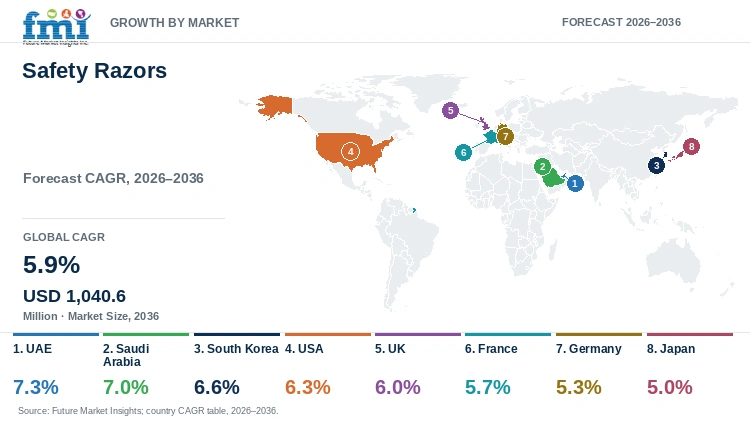
| Country | CAGR |
|---|---|
| UAE | 7.3% |
| Saudi Arabia | 7.0% |
| South Korea | 6.6% |
| USA | 6.3% |
| UK | 6.0% |
| France | 5.7% |
| Germany | 5.3% |
| Japan | 5.0% |
How do country-level CAGRs compare in the safety razors market?
The profiled rates form three practical bands. UAE and Saudi Arabia sit at 7.0% or higher, South Korea and USA occupy the middle-high band above 6.0%, while UK, France, Germany and Japan range from 5.0% to 6.0%. The spread between UAE at 7.3% and Japan at 5.0% is 2.3 percentage points. These figures compare growth rates only. They do not indicate which country has the largest absolute market.
- UAE: Dubai’s licensing framework allows existing retailers to extend into digital channels, which supports low-friction online route-to-market expansion.
- Saudi Arabia: fast e-commerce activity is paired with explicit store-compliance requirements around returns, privacy and business identification.
- South Korea: mobile commerce is deeply embedded, giving product education and replenishment a mobile-first route to purchase.
- USA: a large e-commerce base supports specialist discovery and direct refill purchasing even when physical shelf space is limited.
- UK: online retail has a high share of total spending and Wilkinson Sword provides a direct digital route to traditional double-edge hardware and blades.
- France: online buying is widespread among younger adults, but the forecast rate remains below the fastest Middle East and Asian profiles.
- Germany: online purchasing is mature, so suppliers must compete on replacement logic and product distinction rather than basic digital access.
- Japan: digital commerce continues to expand, while locally tailored grooming systems show that skin comfort and routine integration matter in a mature shaving culture.
The profile set spans North America, Western Europe, East Asia and the Gulf. Country signals should therefore be read as adoption conditions rather than as a single global demand pattern. A strong digital channel can speed discovery, but technique confidence and refill availability still determine repeat purchase.
Country-wise Analysis
- The UAE leads the safety-razor profiles at a 7.3% CAGR through 2036, with digital checkout supporting specialist grooming retail. Aani reached 12.5 million registered users in April 2026 [14]. Suppliers can use that access to sell a starter handle and compatible refills together. Local delivery and clear blade availability matter because the buyer needs confidence that a durable tool will remain usable after the first pack runs out.
- Saudi Arabia pairs digital-retail growth with more formal store standards, supporting a 7.0% CAGR through 2036. The Ministry of Commerce assessed major e-stores against ten criteria in August 2025 [15]. Safety-razor sellers can make refill compatibility and clear returns part of a trustworthy storefront. A compelling handle price will have less value if blades are difficult to identify or regularly unavailable.
- Mobile purchasing shapes South Korea’s route to specialist grooming tools, with a 6.6% CAGR forecast through 2036. Statistics Korea’s August 2025 online-shopping release documents the importance of mobile transactions [13]. A safety-razor listing needs to explain grip, blade loading and refill choice in that compact buying journey. Suppliers that make the first purchase understandable can improve the chance of subsequent blade orders.
- US retail breadth gives buyers many alternatives to a safety razor, and the market is forecast at a 6.3% CAGR through 2036. Census reported a 17.1% online share of retail sales in its August 2026 release [6]. Brands can use product pages to show the cost and handling of the complete routine. Clear compatibility and replenishment options will help turn a one-time handle sale into a continuing customer relationship.
- Great Britain’s established online retail supports the UK’s 6.0% CAGR outlook through 2036. ONS put the annual internet share at 27.4% in 2025 [16]. Shoppers can compare specialist handles and refill prices before visiting a store. Suppliers will need a clear account of build quality and ongoing costs, with starter instructions that reduce uncertainty for users moving from a cartridge razor.
- France’s digitally reachable grooming audience supports a 5.7% CAGR through 2036. Insee recorded recent online buying by 63.6% of people aged 15 or older in 2025 [17]. The commercial task is to distinguish the safety razor through handling, durability and refill economics. Shaving-care bundles can help explain the routine, while the market’s revenue boundary continues to cover the razor and blade rather than the accompanying formula.
- Germany’s mature online channel makes the product comparison more demanding, with a 5.3% CAGR forecast through 2036. Destatis found that 70% of people aged 16 to 74 had bought online in the previous three months in 2025 [18]. Safety-razor suppliers should make replacement-blade choice and maintenance transparent. Durable construction can support the first sale, but dependable consumable supply will determine the longer customer relationship.
- Japan’s grooming brands compete on the complete shaving experience, even as safety-razor sales are forecast at a slower 5.0% CAGR through 2036. Edgewell described Schick Progista’s linked pre-shave, razor and aftercare system in August 2025 [1]. That is an adjacent cartridge proposition, but it raises the standard for routine support. Safety-razor suppliers need to make comfort, handling and replenishment as clear as the hardware’s appeal.
Who are the notable companies in the safety razors market?
L'Oreal, Shiseido, Wahl, Henkel, Church & Dwight, Beiersdorf, Kenvue, Unilever, Edgewell Personal Care and Procter & Gamble are the notable companies profiled in this market.
The profiled set spans three different competitive roles. Procter & Gamble and Edgewell Personal Care have the clearest public evidence of manual wet-shave hardware and blade systems. Wahl is documented in professional trimmers and foil shavers, which creates a grooming-hardware adjacency but not verified double-edge safety-razor participation. L'Oreal, Shiseido, Henkel, Beiersdorf and Unilever have documented shaving-care or skin-support offerings. Church & Dwight and Kenvue have broad personal-care portfolios, yet direct safety-razor hardware evidence was not verified by the publication cutoff. This distinction matters because adjacency can support merchandising without proving revenue inside the defined market.
- Direct manual wet-shave hardware: Procter & Gamble and Edgewell Personal Care have documented razor platforms, replacement blades and supporting shave-care ecosystems.
- Professional grooming hardware adjacency: Wahl is documented in professional trimmers and shavers, while a double-edge safety-razor line was not verified.
- Shave-care and broader personal-care adjacency: L'Oreal, Shiseido, Henkel, Church & Dwight, Beiersdorf, Kenvue and Unilever are retained as profiled market participants. Public evidence supports varying degrees of shave-care or personal-care relevance, but not a verified double-edge hardware role for this group.
Competitive Benchmarking: Safety Razors Market
| Company | Double-Edge Hardware | Compatible Blade Ecosystem | Shave-Routine Support | Geographic Reach |
|---|---|---|---|---|
| L'Oreal | Unscored | Unscored | Medium | Global beauty footprint; shaving-care evidence verified in the UK [19] |
| Shiseido | Unscored | Unscored | Medium | Global beauty footprint; men’s shaving-care evidence verified in the U.S. [20] |
| Wahl | Unscored | Unscored | Unscored | Professional grooming channels; safety-razor-specific reach not verified [21] |
| Henkel | Unscored | Unscored | High | International personal-care footprint; La Toja shaving-care role documented [22] |
| Church & Dwight | Unscored | Unscored | Unscored | Domestic and international consumer-products footprint; safety-razor role not verified [23] |
| Beiersdorf | Unscored | Unscored | High | International NIVEA MEN platform, including an October 2025 limited edition across more than 40 countries [24] |
| Kenvue | Unscored | Unscored | Unscored | Global consumer-health footprint; safety-razor role not verified [25] |
| Unilever | Unscored | Unscored | High | Broader personal-care platform with June 2025 Dove Men+Care shaving guidance [9] |
| Edgewell Personal Care | High | High | High | 50+ markets; wet-shave activity documented across U.S., Japan, Germany, France and UK [7] [8] [26] |
| Procter & Gamble | High | High | High | Operations in about 70 countries; Gillette double-edge products documented in U.S. and Gulf markets [3] [27] [4] |
Scoring basis: Double-Edge Hardware is High when a current double-edge safety-razor platform is directly documented, Medium for narrower documented manual safety-razor capability and Low only for a documented limitation. Compatible Blade Ecosystem applies the same scale to dedicated replacement-blade support. Shave-Routine Support is High for broad documented pre-shave or post-shave coverage and Medium for narrower verified support. Low indicates a documented limitation; unavailable public information is left Unscored.
Key Developments in the Safety Razors Market
- P&G’s 2025 annual report emphasizes product, packaging, retail execution and value [5]. Gillette’s current King C. catalogue includes a double-edge safety razor [3]. For the category, the commercial test is whether that complete offer makes both initial handling and later blade replenishment easy.
- In May 2026, Edgewell Personal Care relaunched its Quattro razor range across Europe, China and Oceania under Wilkinson Sword and Wilkinson Sword Intuition. Quattro is an adjacent cartridge platform rather than a double-edge safety razor, but the rollout raises the performance and comfort benchmark against which manual safety-razor buyers compare alternatives. [2]
- In October 2025, Beiersdorf announced a NIVEA MEN x Real Madrid limited edition across more than 40 countries [24]. The adjacent men’s-care activity shows how established brands can bring shoppers into a grooming routine that also includes the choice of razor.
Key Players in the Safety Razors Market
Documented Manual Wet-Shave Hardware
- Edgewell Personal Care
- Procter & Gamble
Professional Grooming Hardware Adjacency
- Wahl
Shave-Care and Personal-Care Adjacency
- L'Oreal
- Shiseido
- Henkel
- Church & Dwight
- Beiersdorf
- Kenvue
- Unilever
Safety Razors Market - Report Scope
| Coverage field | Report scope |
|---|---|
| Market breakdown | Product Type; Nature; Format; Price Positioning; Sales Channel |
| Quantitative Units | USD Million |
| Market Definition | Revenue includes safety razor handles, heads and compatible replaceable double-edge blades sold within the stated segmentation. Bundled kits are included only for the value attributable to the razor or blades; cartridge and disposable razors, electric shavers or trimmers, standalone shaving preparations and adjacent skin-care products are excluded when they are substitute or downstream products, while Format labels describe the commercial offer context only. |
| Regions Covered | North America; Latin America; Western Europe; Eastern Europe; East Asia; South Asia and Pacific; Middle East and Africa |
| Countries Covered | USA, Germany, France, UK, Saudi Arabia, UAE, Japan, South Korea |
| Key Companies Profiled | L'Oreal, Shiseido, Wahl, Henkel, Church & Dwight, Beiersdorf, Kenvue, Unilever, Edgewell Personal Care, Procter & Gamble |
| Forecast Period | 2026 to 2036 |
| Approach | Primary and secondary research with market triangulation. |
Safety Razors Market - Research Methodology
| Method | Approach |
|---|---|
| Primary Research | FMI analysts gathered input from manufacturers, service providers, technology developers, distributors, end users, procurement teams and subject-matter experts. Interviews examined purchasing decisions, product or service evaluation, adoption barriers, approval requirements, pricing considerations and expectations for technical or commercial support. Respondents were also asked what evidence is required before a trial, pilot, or initial order develops into regular purchasing. |
| Desk Research | Desk research covered government statistics, regulatory publications, trade data, industry associations, technical literature, standards, company filings, product information and official corporate announcements. Sources were reviewed for relevance, publication date, geographic coverage and consistency with the defined market scope. Claims relating to performance, applications, approvals, capacity, investment and commercial activity were retained only when supported by credible public evidence. |
| Market Sizing and Forecasting | The market model combined the baseline value with historical performance, segment structure, pricing and volume indicators, adoption levels, company participation and country-level demand conditions. Forecast assumptions considered economic activity, investment trends, regulatory developments, technology adoption, purchasing cycles, supply availability and barriers to wider market use. Segment and regional estimates were reconciled before the final market total was calculated. |
| Data Validation | Estimates were checked against multiple independent indicators, including public data, company activity, trade patterns, industry developments and findings from primary interviews. Validation also tested whether products, services, applications and company revenues fell within the defined market boundaries. Adjacent categories, unsupported claims, overlapping revenues and activities without direct market relevance were excluded to reduce double counting and maintain consistency across segments and countries. |
Safety Razors Market by Segments
Safety Razors Market segmented by Product Type:
- Core / classic lines
- Targeted treatment lines
- Sensitive & gentle lines
- Premium & clinical lines
- Kits & sets
Safety Razors Market segmented by Nature:
- Conventional
- Vegan & cruelty-free
- Natural & organic
- Dermocosmetic / clinical
- Fragrance-free & sensitive
Safety Razors Market segmented by Format:
- Cream & balm
- Liquid & serum
- Stick & solid
- Spray & mist
- Sheet & patch
- Powder
Safety Razors Market segmented by Price Positioning:
- Mass
- Masstige
- Premium
- Professional
Safety Razors Market segmented by Sales Channel:
- E-commerce & DTC
- Specialty beauty retail
- Pharmacies & drugstores
- Supermarkets & hypermarkets
- Salons & spas
Safety Razors Market by Region:
- North America
- United States
- Canada
- Latin America
- Brazil
- Mexico
- Argentina
- Chile
- Western Europe
- Germany
- France
- United Kingdom
- Italy
- Spain
- Benelux
- Nordics
- Eastern Europe
- Poland
- Czech Republic
- Romania
- Hungary
- East Asia
- China
- Japan
- South Korea
- South Asia and Pacific
- India
- ASEAN
- Australia and New Zealand
- Middle East and Africa
- GCC Countries
- South Africa
- Türkiye
- Israel
Research Sources and Bibliography
- [1] Edgewell Personal Care (2025, August 28). Progista: How Schick Japan Launched the First Total Grooming Care Brand for Men.
- [2] Edgewell Personal Care (2026, May 8). Quattro Razors Relaunches in Europe, China and Oceania.
- [3] Gillette (n.d.). King C. Gillette Double Edge Safety Razor. Current page, accessed 6 October 2026.
- [4] Procter & Gamble (2025, August 30). P&G Releases 2025 Annual Report.
- [5] Procter & Gamble (2025). Superiority | P&G 2025 Annual Report.
- [6] U.S. Census Bureau (2026, August 18). Quarterly Retail E-Commerce Sales.
- [7] Wilkinson Sword (n.d.). Classic Double Edge Razor. Current page, accessed 6 October 2026.
- [8] Wilkinson Sword (n.d.). Classic Double Edge Razor Blades. Current page, accessed 6 October 2026.
- [9] Dove Men+Care (2025, June 16). How To Stop Shaving Rash for Men.
- [10] Statistisches Bundesamt (Destatis) (2026, August 25). Verbreitung von Onlineshopping: Deutschland über EU-Durchschnitt.
- [11] Insee (2025, October 14). Achats de produits et de services en ligne.
- [12] Office for National Statistics (2026, January 23). Retail sales, Great Britain: December 2025.
- [13] Statistics Korea (2025, October 1). Online Shopping in August 2025.
- [14] Al Etihad Payments (2026, April 10). Aani reaches 12.5 million registered users.
- [15] Ministry of Commerce, Saudi Arabia (2025, August 18). Ministry of Commerce Announces the Results of E-Commerce Store Evaluation.
- [16] Office for National Statistics (2026, August 21). Internet sales as a percentage of total retail sales, series J4MC: 2025 annual figure.
- [17] Insee (2025, December 2). Household use of information and communication technologies: 2025 results.
- [18] Destatis (2026, April 20). Internet use and online shopping over time: 2025 results.
- [19] L'Oreal Paris (n.d.). Barber Club Shaving Cream Repairing After-Shave Balm. Current page, accessed 6 October 2026.
- [20] Shiseido (n.d.). Shiseido Men Face Cleanser. Current page, accessed 6 October 2026.
- [21] Wahl Professional (n.d.). Trimmers & Shavers. Current page, accessed 6 October 2026.
- [22] Henkel (n.d.). La Toja. Current page, accessed 6 October 2026.
- [23] Church & Dwight (2026, January 30). Church & Dwight Reports Q4 2025 and 2025 Results and Provides 2026 Outlook.
- [24] Beiersdorf (2025, October 2). NIVEA MEN and Real Madrid extend global partnership through 2030.
- [25] Kenvue (2026, August 6). Kenvue Reports Second Quarter 2026 Results.
- [26] Edgewell Personal Care (n.d.). Company Profile. Current page, accessed 6 October 2026.
- [27] Gillette Saudi Arabia (n.d.). King C. Gillette Double Edge Razor. Current page, accessed 6 October 2026.
"This bibliography is provided for reader reference and is not exhaustive. The full report contains the complete reference list and detailed citations."
This Report Answers
- How large is the Safety Razors Market in 2026 and what value is forecast for 2036?
- Which industry pressures are supporting demand for safety razors and replacement blades?
- Why do Core / classic lines lead Product Type in 2026?
- Why does Conventional lead the Nature classification in 2026?
- How do profiled country growth rates differ from UAE through Japan?
- Which profiled companies supply relevant razor, shaving-care or adjacent grooming capabilities?
- What limits safety-razor adoption or switching from cartridge and electric alternatives?
- What should buyers evaluate before purchasing a safety razor or committing to a refill system?
Frequently Asked Questions
How big is the Safety Razors Market in 2026, and what is forecast for 2036?
The market is valued at USD 586.6 Million in 2026 and is forecast to reach USD 1,040.6 Million by 2036. The forecast reflects continued demand for reusable manual shaving systems and their replaceable blades.
What is the CAGR of the Safety Razors Market from 2026 to 2036?
The market is forecast to grow at a 5.9% CAGR from 2026 to 2036. Growth depends on converting product trial into repeat blade purchasing rather than on handle sales alone.
Which Product Type segment leads the Safety Razors Market?
Core / classic lines lead Product Type with a 32.0% share in 2026. Their familiar double-edge architecture supports straightforward compatibility and replacement logic.
Which Nature segment leads the Safety Razors Market?
Conventional leads Nature with a 54.0% share in 2026. Mainstream metal-and-blade engineering remains the broadest reference configuration for performance and availability.
Which profiled countries have the highest growth rates in the Safety Razors Market?
UAE has the highest profiled CAGR at 7.3% from 2026 to 2036, followed by Saudi Arabia at 7.0%. Their rates indicate faster forecast growth, not necessarily larger absolute market size.
Which companies are active in the Safety Razors Market?
The profiled companies are L'Oreal, Shiseido, Wahl, Henkel, Church & Dwight, Beiersdorf, Kenvue, Unilever, Edgewell Personal Care and Procter & Gamble. Direct public evidence of double-edge safety-razor hardware is strongest for Procter & Gamble and Edgewell Personal Care, while several other participants are documented mainly in adjacent shaving care or grooming.
Preview the report firsthand - request a free sample
Get SampleGet the brochure for pricing and purchase details.
Get PDFTable of Content
- Key Takeaways
- Market Size and CAGR
- Top Growth Driver
- Fastest Growing Segment
- Leading Region
- Key Companies
- Emerging Opportunities
- Executive Summary
- Global Market Outlook
- Demand-side Trends
- Supply-side Trends
- Technology Roadmap Analysis
- Analysis and Recommendations
- Analyst Perspective (What is happening? Why now? What should investors know?)
- Key Questions Answered
- How large is the market?
- What is the CAGR?
- What are key trends?
- Which region dominates?
- Who are the leaders?
- Market Overview
- Market Coverage / Taxonomy
- Market Definition / Scope / Limitations
- Research Methodology
- Chapter Orientation
- Analytical Lens and Working Hypotheses
- Market Structure, Signals, and Trend Drivers
- Benchmarking and Cross-market Comparability
- Market Sizing, Forecasting, and Opportunity Mapping
- Research Design and Evidence Framework
- Desk Research Programme (Secondary Evidence)
- Expert Input and Fieldwork (Primary Evidence)
- Tooling, Models, and Reference Databases
- Data Engineering and Model Build
- Quality Assurance and Audit Trail
- Market Background
- Market Dynamics (Drivers, Restraints, Opportunity, Trends)
- Scenario Forecast (Optimistic, Likely, Conservative)
- Impact Analysis
- AI Impact
- Sustainability Impact
- Regulatory Impact
- Technology Impact
- Consumer / Buyer Analysis
- Purchase Drivers
- Adoption Barriers
- Buyer Journey
- Opportunity Map Analysis
- Product Life Cycle Analysis
- Supply Chain Analysis
- Investment Feasibility Matrix
- Value Chain Analysis
- PESTLE and Porter's Analysis
- Regulatory Landscape
- Regional Parent Market Outlook
- Production and Consumption Statistics
- Import and Export Statistics
- Global Market Analysis and Forecast, 2021 to 2036
- Historical Market Size Value (USD Million) Analysis, 2021 to 2025
- Current and Future Market Size Value (USD Million) Projections, 2026 to 2036
- Y-o-Y Growth Trend Analysis
- Absolute $ Opportunity Analysis
- Global Market Pricing Analysis, 2021 to 2036
- Global Market Analysis and Forecast, By Product Type, 2021 to 2036
- Introduction / Key Findings
- Historical Market Size Value (USD Million) Analysis By Product Type, 2021 to 2025
- Current and Future Market Size Value (USD Million) Analysis and Forecast By Product Type, 2026 to 2036
- Core / classic lines
- Targeted treatment lines
- Sensitive & gentle lines
- Premium & clinical lines
- Kits & sets
- Y-o-Y Growth Trend Analysis By Product Type, 2021 to 2025
- Absolute $ Opportunity Analysis By Product Type, 2026 to 2036
- Global Market Analysis and Forecast, By Nature, 2021 to 2036
- Introduction / Key Findings
- Historical Market Size Value (USD Million) Analysis By Nature, 2021 to 2025
- Current and Future Market Size Value (USD Million) Analysis and Forecast By Nature, 2026 to 2036
- Conventional
- Vegan & cruelty-free
- Natural & organic
- Dermocosmetic / clinical
- Fragrance-free & sensitive
- Y-o-Y Growth Trend Analysis By Nature, 2021 to 2025
- Absolute $ Opportunity Analysis By Nature, 2026 to 2036
- Global Market Analysis and Forecast, By Format, 2021 to 2036
- Introduction / Key Findings
- Historical Market Size Value (USD Million) Analysis By Format, 2021 to 2025
- Current and Future Market Size Value (USD Million) Analysis and Forecast By Format, 2026 to 2036
- Cream & balm
- Liquid & serum
- Stick & solid
- Spray & mist
- Sheet & patch
- Powder
- Y-o-Y Growth Trend Analysis By Format, 2021 to 2025
- Absolute $ Opportunity Analysis By Format, 2026 to 2036
- Global Market Analysis and Forecast, By Price Positioning, 2021 to 2036
- Introduction / Key Findings
- Historical Market Size Value (USD Million) Analysis By Price Positioning, 2021 to 2025
- Current and Future Market Size Value (USD Million) Analysis and Forecast By Price Positioning, 2026 to 2036
- Mass
- Masstige
- Premium
- Professional
- Y-o-Y Growth Trend Analysis By Price Positioning, 2021 to 2025
- Absolute $ Opportunity Analysis By Price Positioning, 2026 to 2036
- Global Market Analysis and Forecast, By Sales Channel, 2021 to 2036
- Introduction / Key Findings
- Historical Market Size Value (USD Million) Analysis By Sales Channel, 2021 to 2025
- Current and Future Market Size Value (USD Million) Analysis and Forecast By Sales Channel, 2026 to 2036
- E-commerce & DTC
- Specialty beauty retail
- Pharmacies & drugstores
- Supermarkets & hypermarkets
- Salons & spas
- Y-o-Y Growth Trend Analysis By Sales Channel, 2021 to 2025
- Absolute $ Opportunity Analysis By Sales Channel, 2026 to 2036
- Global Market Analysis and Forecast, By Region, 2021 to 2036
- Introduction
- Historical Market Size Value (USD Million) Analysis By Region, 2021 to 2025
- Current Market Size Value (USD Million) Analysis and Forecast By Region, 2026 to 2036
- North America
- Latin America
- Western Europe
- Eastern Europe
- East Asia
- South Asia and Pacific
- Middle East and Africa
- Market Attractiveness Analysis By Region
- North America Market Analysis and Forecast, By Country, 2021 to 2036
- Historical Market Size Value (USD Million) Trend Analysis By Market Taxonomy, 2021 to 2025
- Market Size Value (USD Million) Forecast By Market Taxonomy, 2026 to 2036
- By Country
- United States
- Canada
- By Product Type
- By Nature
- By Format
- By Price Positioning
- By Sales Channel
- By Country
- Market Attractiveness Analysis
- By Country
- By Product Type
- By Nature
- By Format
- By Price Positioning
- By Sales Channel
- Key Takeaways
- Latin America Market Analysis and Forecast, By Country
- Historical Market Size Value (USD Million) Trend Analysis By Market Taxonomy, 2021 to 2025
- Market Size Value (USD Million) Forecast By Market Taxonomy, 2026 to 2036
- By Country
- Brazil
- Mexico
- Argentina
- Chile
- By Product Type
- By Nature
- By Format
- By Price Positioning
- By Sales Channel
- By Country
- Market Attractiveness Analysis
- By Country
- By Product Type
- By Nature
- By Format
- By Price Positioning
- By Sales Channel
- Key Takeaways
- Western Europe Market Analysis and Forecast, By Country
- Historical Market Size Value (USD Million) Trend Analysis By Market Taxonomy, 2021 to 2025
- Market Size Value (USD Million) Forecast By Market Taxonomy, 2026 to 2036
- By Country
- Germany
- France
- United Kingdom
- Italy
- Spain
- Benelux
- Nordics
- By Product Type
- By Nature
- By Format
- By Price Positioning
- By Sales Channel
- By Country
- Market Attractiveness Analysis
- By Country
- By Product Type
- By Nature
- By Format
- By Price Positioning
- By Sales Channel
- Key Takeaways
- Eastern Europe Market Analysis and Forecast, By Country
- Historical Market Size Value (USD Million) Trend Analysis By Market Taxonomy, 2021 to 2025
- Market Size Value (USD Million) Forecast By Market Taxonomy, 2026 to 2036
- By Country
- Poland
- Czech Republic
- Romania
- Hungary
- By Product Type
- By Nature
- By Format
- By Price Positioning
- By Sales Channel
- By Country
- Market Attractiveness Analysis
- By Country
- By Product Type
- By Nature
- By Format
- By Price Positioning
- By Sales Channel
- Key Takeaways
- East Asia Market Analysis and Forecast, By Country
- Historical Market Size Value (USD Million) Trend Analysis By Market Taxonomy, 2021 to 2025
- Market Size Value (USD Million) Forecast By Market Taxonomy, 2026 to 2036
- By Country
- China
- Japan
- South Korea
- By Product Type
- By Nature
- By Format
- By Price Positioning
- By Sales Channel
- By Country
- Market Attractiveness Analysis
- By Country
- By Product Type
- By Nature
- By Format
- By Price Positioning
- By Sales Channel
- Key Takeaways
- South Asia and Pacific Market Analysis and Forecast, By Country
- Historical Market Size Value (USD Million) Trend Analysis By Market Taxonomy, 2021 to 2025
- Market Size Value (USD Million) Forecast By Market Taxonomy, 2026 to 2036
- By Country
- India
- ASEAN
- Australia and New Zealand
- By Product Type
- By Nature
- By Format
- By Price Positioning
- By Sales Channel
- By Country
- Market Attractiveness Analysis
- By Country
- By Product Type
- By Nature
- By Format
- By Price Positioning
- By Sales Channel
- Key Takeaways
- Middle East and Africa Market Analysis and Forecast, By Country
- Historical Market Size Value (USD Million) Trend Analysis By Market Taxonomy, 2021 to 2025
- Market Size Value (USD Million) Forecast By Market Taxonomy, 2026 to 2036
- By Country
- GCC Countries
- South Africa
- Türkiye
- Israel
- By Product Type
- By Nature
- By Format
- By Price Positioning
- By Sales Channel
- By Country
- Market Attractiveness Analysis
- By Country
- By Product Type
- By Nature
- By Format
- By Price Positioning
- By Sales Channel
- Key Takeaways
- Key Countries Market Analysis
- United States
- Pricing Analysis
- Market Share Analysis, 2025
- By Product Type
- By Nature
- By Format
- By Price Positioning
- By Sales Channel
- Canada
- Pricing Analysis
- Market Share Analysis, 2025
- By Product Type
- By Nature
- By Format
- By Price Positioning
- By Sales Channel
- Mexico
- Pricing Analysis
- Market Share Analysis, 2025
- By Product Type
- By Nature
- By Format
- By Price Positioning
- By Sales Channel
- Brazil
- Pricing Analysis
- Market Share Analysis, 2025
- By Product Type
- By Nature
- By Format
- By Price Positioning
- By Sales Channel
- Chile
- Pricing Analysis
- Market Share Analysis, 2025
- By Product Type
- By Nature
- By Format
- By Price Positioning
- By Sales Channel
- Germany
- Pricing Analysis
- Market Share Analysis, 2025
- By Product Type
- By Nature
- By Format
- By Price Positioning
- By Sales Channel
- United Kingdom
- Pricing Analysis
- Market Share Analysis, 2025
- By Product Type
- By Nature
- By Format
- By Price Positioning
- By Sales Channel
- Italy
- Pricing Analysis
- Market Share Analysis, 2025
- By Product Type
- By Nature
- By Format
- By Price Positioning
- By Sales Channel
- Spain
- Pricing Analysis
- Market Share Analysis, 2025
- By Product Type
- By Nature
- By Format
- By Price Positioning
- By Sales Channel
- France
- Pricing Analysis
- Market Share Analysis, 2025
- By Product Type
- By Nature
- By Format
- By Price Positioning
- By Sales Channel
- India
- Pricing Analysis
- Market Share Analysis, 2025
- By Product Type
- By Nature
- By Format
- By Price Positioning
- By Sales Channel
- ASEAN
- Pricing Analysis
- Market Share Analysis, 2025
- By Product Type
- By Nature
- By Format
- By Price Positioning
- By Sales Channel
- Australia and New Zealand
- Pricing Analysis
- Market Share Analysis, 2025
- By Product Type
- By Nature
- By Format
- By Price Positioning
- By Sales Channel
- China
- Pricing Analysis
- Market Share Analysis, 2025
- By Product Type
- By Nature
- By Format
- By Price Positioning
- By Sales Channel
- Japan
- Pricing Analysis
- Market Share Analysis, 2025
- By Product Type
- By Nature
- By Format
- By Price Positioning
- By Sales Channel
- South Korea
- Pricing Analysis
- Market Share Analysis, 2025
- By Product Type
- By Nature
- By Format
- By Price Positioning
- By Sales Channel
- Poland
- Pricing Analysis
- Market Share Analysis, 2025
- By Product Type
- By Nature
- By Format
- By Price Positioning
- By Sales Channel
- Hungary
- Pricing Analysis
- Market Share Analysis, 2025
- By Product Type
- By Nature
- By Format
- By Price Positioning
- By Sales Channel
- Türkiye
- Pricing Analysis
- Market Share Analysis, 2025
- By Product Type
- By Nature
- By Format
- By Price Positioning
- By Sales Channel
- South Africa
- Pricing Analysis
- Market Share Analysis, 2025
- By Product Type
- By Nature
- By Format
- By Price Positioning
- By Sales Channel
- UAE
- Pricing Analysis
- Market Share Analysis, 2025
- By Product Type
- By Nature
- By Format
- By Price Positioning
- By Sales Channel
- Saudi Arabia
- Pricing Analysis
- Market Share Analysis, 2025
- By Product Type
- By Nature
- By Format
- By Price Positioning
- By Sales Channel
- United States
- Market Structure Analysis
- Competition Dashboard
- Competition Benchmarking
- Market Share Analysis of Top Players
- By Regional
- By Product Type
- By Nature
- By Format
- By Price Positioning
- By Sales Channel
- Emerging Startups
- Innovation Benchmarking
- Competition Analysis
- Competition Deep Dive
- L'Oreal
- Overview
- Product Portfolio
- Profitability by Market Segments
- Sales Footprint
- Strategy Overview
- Marketing Strategy
- Product Strategy
- Channel Strategy
- Shiseido
- Wahl
- Henkel
- Church & Dwight
- Beiersdorf
- Kenvue
- Unilever
- Edgewell Personal Care
- Procter & Gamble
- L'Oreal
- Case Studies
- Success Stories
- Recent Developments
- Competition Deep Dive
- Assumptions & Acronyms Used


