

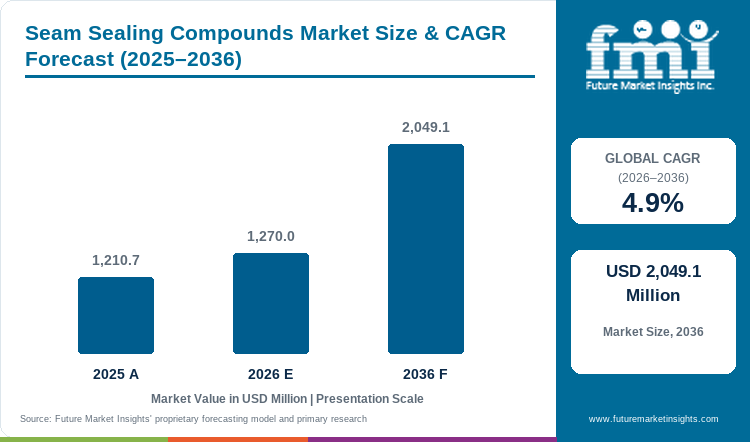
- Market Size (2026)
- USD 1270.0 Mn
- Forecast (2036)
- USD 2049.1 Mn
- CAGR (2026 to 2036)
- 4.9%
How big is Seam Sealing Compounds Market in 2026?
USD 1,270.0 million in 2026 and USD 2,049.1 million by 2036 at a 4.9% CAGR.
Sales of seam sealing compounds are estimated to rise at 4.9% CAGR through 2036. Valuation rises from USD 1,210.7 million in 2025 to USD 1,270.0 million in 2026 and reaches USD 2,049.1 million by 2036. OEM materials teams are updating specifications as joints and body materials change. In April 2026, Henkel introduced Teroson MS 9381 HPT for vehicle and heavy-equipment seam and joint sealing. The product is primerless and moisture-cured. Its chemistry excludes isocyanates, solvents, silicones and PVC. MS polymer sealants give plants a lower-hazard option without adding a separate oven stage.
Plant size and approval routines affect country growth. By 2036, the Czech Republic is projected to grow at 5.9% CAGR, supported by its export-heavy vehicle production base. AutoSAP reported in January 2026 that Czech plants produced 1,445,776 passenger cars in 2025. More than 92.5% were exported. Japan is estimated to post 3.9% CAGR over the forecast period. Its mature vehicle base makes specification changes more deliberate. Automotive sealants still need plant-specific trials before an approved grade changes.
Key Takeaways
- Body and paint-shop changes are increasing the need for seam protection. Plants still need corrosion control without longer production cycles.
- By chemistry, PVC plastisols are estimated to hold 36.0% share in 2026. Installed paint-shop equipment and bake schedules support this position.
- In 2026, automotive body seams are expected to lead application demand with 46.0% share. Repeated welded and flanged joints drive this position.
- By cure type, heat-cure is forecast to represent 38.0% in 2026, supported by existing OEM oven sequences.
- Long approval cycles slow switching. Compounds must pass substrate, coating, dispensing, cure and worker-safety checks.
- Some of the key players in this market include Henkel AG & Co. KGaA, Sika AG, 3M Company, PPG Industries, Inc., H.B. Fuller Company, Bostik (Arkema Group), Dow Inc., Wacker Chemie AG and Parker Hannifin Corporation.
Analyst Perspective
"Suppliers win repeat seam-sealer orders after they prove bead control in the customer’s real coating and cure process. Local line support then helps a successful trial move into regular production."
- Nikhil Kaitwade, Principal Consultant, Future Market Insights
How is the seam sealing compounds market segmented?
The seam sealing compounds market is segmented by Chemistry, Application, Cure Type, End Use, Sales Channel and Region.
The seam sealing compounds market is segmented by chemistry, application, cure type, end use, sales channel and region. The forecast period runs from 2026 to 2036. Chemistry covers PVC plastisols, PU, MS polymer, epoxy and silicone sealers. Application covers automotive body, aircraft, appliance, construction-panel and industrial-enclosure seams. Cure type includes heat, moisture, room-temperature and two-component systems. End use shows where the compound is used. Sales channel shows how the compound reaches the customer.
How do installed paint-shop systems support PVC plastisols within the chemistry category?
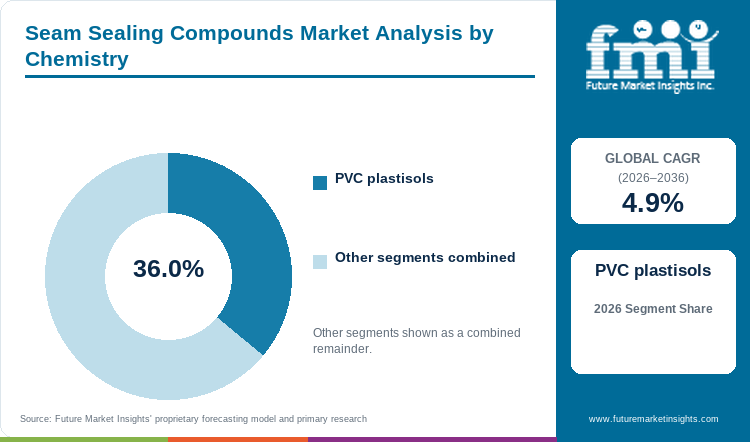
PVC plastisols are common in established paint shops. These lines can dispense the material before controlled bake cycles. Existing pumps and ovens reduce the risk of changing materials on long seam runs. In May 2025, Wacker Chemie began hybrid-polymer production at Nünchritz for high-performance adhesives and sealants. The new binder capacity gives formulators another option for one-component sealers. Plants comparing PVC with polyurethane adhesives still test washout, paint compatibility and cure behavior on the same line.
- Based on chemistry, PVC plastisols are projected to account for 36.0% in 2026. Established body-shop equipment and bake windows support this position.
- Plants also consider MS polymer and PU systems for ambient cure and lower exposure. These chemistries can also help with mixed substrates.
How do automotive body seams shape the application category?
Automotive bodies contain many floor, wheelhouse, roof, pillar and closure joints. These joints need water and corrosion protection. In August 2025, Bostik introduced VSR 400A. The SMP seam sealer was developed with a truck OEM for SMC hoods. The material combines conductivity with sealing. The combined function removes a separate conductive-primer step before electrostatic painting. Automotive refinish coatings remain part of the repair process because sealed joints must accept the required finish.
- In 2026, automotive body seams are expected to lead application demand with 46.0% share. High seam density in serial vehicle production supports this position.
- Aircraft seams use smaller volumes and need more traceability. Their approval cycles are also longer. Construction panels often use construction sealants to handle weather exposure and larger joint movement.
How do paint-shop oven cycles support heat-cure within the cure type category?
Heat-cure compounds remain practical on parts that already pass through a controlled oven. In June 2025, Škoda Auto said its planned Mladá Boleslav paint shop will use robotic PVC-based sealant application. The project keeps sealing inside an automated paint process. Plants use silicone adhesives and sealants when heat, substrate, or service needs call for a different chemistry.
- By cure type, heat-cure is estimated to hold 38.0% in 2026. Established OEM ovens and repeatable line timing support this position.
- Moisture-cure and room-temperature systems work better for repair and large assemblies. They also suit plants without a fixed oven cycle.
How do serial-production approvals shape automotive OEM demand within the end use category?
Automotive OEMs approve seam compounds before serial production. They then use the approved material through long model runs. In February 2026, VDA reported that Germany produced 1.67 million electric passenger cars in 2025. These cars made up 40% of domestic passenger-car production. The volume keeps sealing decisions tied to fast production lines. Aerospace adhesives and sealants use a separate approval route with stricter traceability.
- Based on end use, automotive OEMs are projected to account for 44.0% in 2026. Serial production and high switching costs support this position.
- Repair users buy smaller packs. They value texture matching, paintability and shorter cure times more than plant-scale dispensing support.
Why does application engineering favor OEM direct sales within the sales channel category?
OEM direct purchasing includes technical support and material supply. Suppliers help set pumps and robotic paths before volume release. They also support oven trials and change-control records. In September 2025, Henkel opened its Shanghai Adhesive Technologies center. More than 500 scientists and technical experts work there on development and application tasks. Direct access helps plants solve process problems before a material change reaches production. Industrial adhesives can use distributors more often when customers need less line-side support.
- By sales channel, OEM direct is forecast to represent 42.0% in 2026. Plant trials and direct technical responsibility drive this position.
- Distributors remain important for smaller plants and repair shops. These customers value local stock, pack choice and fast restocking.
What are the drivers, restraints and opportunities in the Seam Sealing Compounds Market?
Paint-shop changes support demand, qualification and VOC controls slow switching and lower-hazard sealants can remove process steps.
- Driver: Vehicle and equipment plants are using new body materials and automated paint lines. They still need reliable seam protection.
- Restraint: Plants must test a new compound before regular production. Checks cover application, coating, cure, safety and emissions.
- Opportunity: Primerless and isocyanate-free sealants can remove handling steps. Vehicle and heavy-equipment plants can use them during assembly.
Vehicle makers change joint shapes, paint steps and nearby materials. Each new design still needs water and rust protection at line speed. In June 2025, Sika expanded its Suzhou site. The site makes high-viscosity polyurethane materials. These thick materials are used for automotive bonding and sealing. The investment puts technical support closer to plants changing their assembly lines. Vehicle programs also use automotive seals and gaskets around doors and openings. These parts help keep out water and survive long use.
Approval can delay a material change even when lab tests look good. Plants still check flow, adhesion, paint appearance, cure response and worker safety. In September 2026, South Coast AQMD posted preliminary draft changes to Rule 1168. The rule covers adhesive and sealant work. The draft keeps VOC limits part of formula and approval decisions at affected California sites.
Lower-hazard chemistries can cut preparation steps without reducing seal performance. In March 2025, Henkel introduced a two-part polyurethane foam gasket for automotive door modules. Automated equipment applies the gasket. It blocks water and dust. The product reduces handling while keeping a clear production step. Suppliers can pair structural adhesives with flexible sealants. A vehicle program may need both strong bonds and weather protection.
Which country CAGRs are profiled in the Seam Sealing Compounds Market?
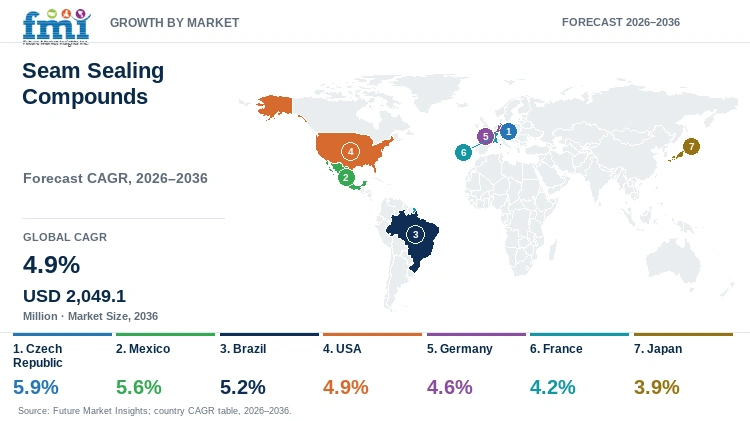
| Country | CAGR |
|---|---|
| Czech Republic | 5.9% |
| Mexico | 5.6% |
| Brazil | 5.2% |
| USA | 4.9% |
| Germany | 4.6% |
| France | 4.2% |
| Japan | 3.9% |
How do country-level CAGRs compare in the Seam Sealing Compounds Market?
The profiled country CAGRs span 2.0 percentage points. The Czech Republic is at 5.9%, while Japan is at 3.9%. Mexico and Brazil are also above the global 4.9% rate. Germany and France are below it. The spread measures forecast speed, not current revenue. Plant size and approval routines differ by country.
- Czech export schedules reward nearby stock and rapid support.
- Mexican shared platforms reward multi-program approvals.
- Brazil’s mixed plant ages keep two cure routes relevant.
- US demand spans OEM, aerospace and repair channels.
- German paint shops favor proven bake-sequence fit.
- French aerospace work raises traceability requirements.
- Japanese change controls favor continuity and complete records.
Similar CAGRs can still create different entry conditions. Approval cycles and production structures vary by country. The full report provides country-level CAGR analysis across North America, Latin America, Western Europe, Eastern Europe, East Asia, South Asia and Pacific and the Middle East and Africa.
Country-wise Analysis
- US vehicle assembly supports seam-sealer use in factories and repair shops. By 2036, the USA is projected to grow at 4.9% CAGR, influenced by its large manufacturing base and local rules. Federal Reserve data published in September 2026 put August 2026 motor vehicle assemblies at 10.4255 million units on a seasonally adjusted annual rate. The large assembly base uses sealers again and again. Each plant still follows its own paint and approval steps. Suppliers need local stock and grades that work with OEM paint systems and regional VOC rules. Repair shops also value products that copy the factory bead without adding repair time.
- German vehicle plants use robots to apply seam sealers and follow strict paint-shop recipes. By 2036, Germany is projected to grow at 4.6% CAGR, supported by its large production base and established oven processes. VDA reported in January 2026 that Germany produced 4.15 million passenger cars in 2025. Production was 2% higher than in 2024. Large output makes plant trials and paint fit important before a material change. Suppliers need sealers that flow well, bake reliably and come with fast technical help. Lower-emission chemistry must still work in the approved coating process.
- Japan has factory demand and a mature passenger-car ownership base. By 2036, Japan is projected to grow at 3.9% CAGR, linked to repeat repair work and modest growth in the installed base. JAMA reported in April 2026 that 71.9% of Japanese households owned a passenger car in its 2025 national survey. The mature vehicle base supports collision repair. It does not point to fast growth in new factory capacity. Suppliers need steady bead behavior, clear records and local engineering help. Long vehicle service lives make supply continuity important during approval.
- Brazil has vehicle plants with different ages and levels of automation. By 2036, Brazil is projected to grow at 5.2% CAGR, supported by higher vehicle output and exports. ANFAVEA reported in January 2026 that Brazil produced 2.644 million vehicles in 2025. Production was 3.5% higher than in 2024. Exports rose 32.1%. Newer and older lines keep both moisture-cure and heat-cure products useful. Suppliers need local stock and support for different process windows. Local filling can also reduce delays tied to imported materials.
- Czech factories run large export programs with little room for missed deliveries. By 2036, the Czech Republic is projected to grow at 5.9% CAGR, reinforced by export-heavy passenger-car production. AutoSAP reported in April 2026 that Czech plants produced 396,880 passenger cars in the first quarter of 2026. More than 93% were exported. Export work raises the cost of approval errors and supply breaks. Suppliers need nearby stock and quick line support. They also need approvals that can serve several OEM programs. Electric models add more body designs to these plants.
- French demand comes from vehicle plants and a large civil aerospace industry. By 2036, France is projected to grow at 4.2% CAGR, influenced by strict aerospace approval needs. GIFAS reported in May 2026 that civil aeronautics represented 74% of French aerospace activity in 2025. Sector exports rose 14.6%. Aircraft programs need batch records and careful material changes over long service cycles. Suppliers need clear records and local support to pass aerospace approval. A vehicle-grade material still needs its own approval before aircraft use.
- Mexican vehicle plants follow North American export schedules and customer approval systems. By 2036, Mexico is projected to grow at 5.6% CAGR, supported by its large export-focused vehicle industry. INEGI reported in January 2026 that Mexico produced 3,953,494 light vehicles in 2025. The country exported 3,385,785 of them. Export schedules make local stock and consistent formulas important. Suppliers need plant-specific approval help and bilingual technical service. Local inventory also cuts the effect of cross-border delays on production.
Who are the notable companies in the Seam Sealing Compounds Market?
Henkel AG & Co. KGaA, Sika AG, 3M Company, PPG Industries, Inc., H.B. Fuller Company, Bostik (Arkema Group), Dow Inc., Wacker Chemie AG and Parker Hannifin Corporation are active within the defined seam sealing compounds supply boundary.
Four company types compete in this market. OEM paint-shop suppliers form one group. Collision-repair specialists form another. Industrial adhesive companies and silicone-material producers also compete. New compounds face strict entry checks. Plants test each product on their own substrates and coatings. Technical service also matters when a plant changes bead settings or cure times.
- Henkel AG & Co. KGaA, Sika AG, PPG Industries, Inc. and Bostik (Arkema Group) document work in vehicle sealing and paint shops.
- 3M Company and Parker Hannifin Corporation support repair work. H.B. Fuller Company supports industrial sealing and bonding.
- Dow Inc. and Wacker Chemie AG supply silicone and polymer materials. Their materials are used in factories, electronics, vehicles and buildings.
Competitive Benchmarking: Seam Sealing Compounds Market
| Company | OEM Integration Support | Chemistry Breadth | Application / Channel Reach | Geographic Reach |
|---|---|---|---|---|
| Henkel AG & Co. KGaA | High | High | High | Global |
| Sika AG | High | High | High | Global |
| 3M Company | Medium | High | High | Global |
| PPG Industries, Inc. | High | Medium | High | Global |
| H.B. Fuller Company | Medium | High | High | Global |
| Bostik (Arkema Group) | High | High | High | Global |
| Dow Inc. | Medium | High | Medium | Global |
| Wacker Chemie AG | Medium | High | Medium | Global |
| Parker Hannifin Corporation | High | Medium | High | North America and selected global repair markets |
Scoring basis: High means strong public proof for the named criterion. Medium means narrower public proof. Low means little public proof. Geographic reach only shows where a company operates. It is not scored.
Key Developments in the Seam Sealing Compounds Market
- In June 2026, Dow Inc. announced about USD 100 million of investment through 2027. The spending covers specialty-silicones manufacturing and innovation. It includes mobility capacity in the United States, China and Japan.
- In May 2026, H.B. Fuller Company announced a new Aerospace Manufacturing Center of Excellence in Charlotte, North Carolina. Certified manufacturing is planned for 2027. Testing and quality work are also planned there.
- In May 2025, PPG Industries, Inc. announced a new North Carolina factory for aerospace coatings and sealants. Production is planned for the first half of 2027.
Key Players in the Seam Sealing Compounds Market
OEM paint-shop and vehicle sealing
- Henkel AG & Co. KGaA
- Sika AG
- PPG Industries, Inc.
- Bostik (Arkema Group)
Repair and industrial application support
- 3M Company
- H.B. Fuller Company
- Parker Hannifin Corporation
Silicone and polymer platforms
- Dow Inc.
- Wacker Chemie AG
Seam Sealing Compounds Market - Report Scope
| Coverage field | Report scope |
|---|---|
| Market breakdown | By chemistry, application, cure type, end use, sales channel and region. |
| Quantitative Units | USD million. |
| Market Definition | Commercial compounds used to seal body, aircraft, appliance, construction-panel and industrial-enclosure seams are included. Adjacent glazing-only and general caulking products are excluded. |
| Regions Covered | North America, Latin America, Western Europe, Eastern Europe, East Asia, South Asia and Pacific and Middle East and Africa. |
| Countries Covered | Czech Republic, Mexico, Brazil, USA, Germany, France, Japan and 20+ countries included in the full report. |
| Key Companies Profiled | Henkel AG & Co. KGaA, Sika AG, 3M Company, PPG Industries, Inc., H.B. Fuller Company, Bostik (Arkema Group), Dow Inc., Wacker Chemie AG and Parker Hannifin Corporation. |
| Forecast Period | 2026 to 2036. |
| Approach | Primary and secondary research with market triangulation. |
Seam Sealing Compounds Market - Research Methodology
| Method | Approach |
|---|---|
| Primary Research | FMI analysts gathered input from manufacturers, service providers, technology developers, distributors, end users, procurement teams and subject-matter experts. Interviews examined purchasing decisions, product or service evaluation, adoption barriers, approval requirements, pricing considerations and expectations for technical or commercial support. Respondents were also asked what evidence is required before a trial, pilot, or initial order develops into regular purchasing. |
| Desk Research | Desk research covered government statistics, regulatory publications, trade data, industry associations, technical literature, standards, company filings, product information and official corporate announcements. Sources were reviewed for relevance, publication date, geographic coverage and consistency with the defined market scope. Claims relating to performance, applications, approvals, capacity, investment and commercial activity were retained only when supported by credible public evidence. |
| Market Sizing and Forecasting | The market model combined the baseline value with historical performance, segment structure, pricing and volume indicators, adoption levels, company participation and country-level demand conditions. Forecast assumptions considered economic activity, investment trends, regulatory developments, technology adoption, purchasing cycles, supply availability and barriers to wider market use. Segment and regional estimates were reconciled before the final market total was calculated. |
| Data Validation | Estimates were checked against multiple independent indicators, including public data, company activity, trade patterns, industry developments and findings from primary interviews. Validation also tested whether products, services, applications and company revenues fell within the defined market boundaries. Adjacent categories, unsupported claims, overlapping revenues and activities without direct market relevance were excluded to reduce double counting and maintain consistency across segments and countries. |
Seam Sealing Compounds Market by Segments
Seam Sealing Compounds Market segmented by Chemistry:
- PVC plastisols
- PU seam sealers
- MS polymer sealers
- Epoxy sealers
- Silicone sealers
Seam Sealing Compounds Market segmented by Application:
- Automotive body seams
- Aircraft seams
- Appliance seams
- Construction panels
- Industrial enclosures
Seam Sealing Compounds Market segmented by Cure Type:
- Heat-cure
- Moisture-cure
- Room-temperature cure
- Two-component cure
Seam Sealing Compounds Market segmented by End Use:
- Automotive OEMs
- Vehicle repair
- Aerospace
- Industrial manufacturing
- Construction
Seam Sealing Compounds Market segmented by Sales Channel:
- OEM direct
- Adhesive distributors
- Aftermarket repair
- Contract manufacturers
Seam Sealing Compounds Market by Region:
- North America
- United States
- Canada
- Latin America
- Brazil
- Mexico
- Chile
- Rest of Latin America
- Western Europe
- Germany
- United Kingdom
- Italy
- Spain
- France
- Nordics
- Benelux
- Rest of Western Europe
- Eastern Europe
- Russia
- Poland
- Hungary
- Balkan and Baltic States
- Rest of Eastern Europe
- East Asia
- China
- Japan
- South Korea
- South Asia and Pacific
- India
- ASEAN
- Australia and New Zealand
- Rest of South Asia and Pacific
- Middle East and Africa
- Kingdom of Saudi Arabia
- Other GCC Countries
- Türkiye
- South Africa
- Other African Union Countries
- Rest of Middle East and Africa
Research Sources and Bibliography
- Henkel. (2026, April 7). Henkel Teroson MS 9381 HPT tin-free adhesive sealant delivers simplified solution for heavy equipment sector.
- Czech Automotive Industry Association (AutoSAP). (2026, January 27). 2025: Second strongest year in passenger car production and a record year for bus production.
- Wacker Chemie AG. (2025, May 14). WACKER starts production of hybrid polymers at its Nünchritz site.
- Bostik. (2025, August). Bostik introduces an innovative conductive seam sealant.
- Škoda Auto. (2025, June 25). Future-proofing its headquarters: Škoda Auto lays the foundation stone for a state-of-the-art paint shop.
- German Association of the Automotive Industry (VDA). (2026, February 3). New record: Electric vehicles reach 40% of passenger-car production in 2025.
- Henkel. (2025, September 22). Henkel opens Inspiration Center Shanghai for Adhesive Technologies in China.
- Sika AG. (2025, June 18). Sika strengthens global presence with investments in China, Brazil and Morocco.
- South Coast Air Quality Management District. (2026, September 18). Proposed amended Rule 1168: Adhesive and sealant applications, preliminary draft materials.
- German Association of the Automotive Industry (VDA). (2026, January 5). Passenger car production in 2025 slightly above previous year's level.
- Board of Governors of the Federal Reserve System. (2026, September 18). Motor vehicle assemblies: Total motor vehicle assemblies, August 2026.
- Japan Automobile Manufacturers Association. (2026, April 14). 2025 passenger car market trend survey results. [English translation].
- Brazilian Association of Automotive Vehicle Manufacturers (ANFAVEA). (2026, January 15). Vehicle production and sales grow in 2025, with further growth projected for 2026. [English translation].
- GIFAS. (2026, May 11). 2025 results: The French aerospace industry remains strongly positioned for the future.
- National Institute of Statistics and Geography (INEGI). (2026, January 9). Administrative Registry of the Light Vehicle Automotive Industry: December 2025 results. [English translation].
- Dow Inc. (2026, June 23). Dow expands product and innovation capabilities to support continued growth in specialty silicones markets.
- PPG Industries. (2025, May 8). PPG to build a new U.S. manufacturing facility for aerospace coatings and sealants in Shelby, North Carolina.
- H.B. Fuller Company. (2026, May 6). H.B. Fuller announces Aerospace Manufacturing Center of Excellence.
- Sika. (2025, July). Sikaflex-529 Evolution promotional campaign for certified automotive workshops in Malaysia.
- Dow Inc. (2025, September 4). Dow launches DOWSIL EG-4175 silicone gel for higher-voltage power electronics.
- 3M. (2026). RepairStack Quality Control Guide: OEM recommendations for aftermarket body repair. Updated August 2025.
- Henkel. (2025, September 25). Henkel completes expansion of its Brandon, South Dakota manufacturing facility.
- PPG Industries. (2026, June 9). PPG showcases aerospace innovations that improve customer productivity.
- Wacker Chemie AG. (2025, January 23). WACKER expands production capacity for specialty silicones in Asia.
- Henkel. (2025, March 18). New material properties for sealing car door modules.
- Henkel. (2025, April 3). Henkel expands rapid-cure gasketing sealant range with Loctite AA 5885, optimized for automotive electronics applications.
- Bostik. (2025, November 27). Driving sealant innovations in transportation industry.
- H.B. Fuller Company. (2025, May 16). H.B. Fuller expands manufacturing capabilities in the India, Middle East and Africa region.
- Parker Hannifin Corporation. (2025, May). Fusor 123 seam sealer family.
- Dow Inc. (2026, January). Dow recognized with four wins in the 2026 BIG Innovation Awards.
This bibliography is provided for reader reference and is not exhaustive. The full report contains the complete reference list and detailed citations.
This Report Answers
- What is the seam sealing compounds market value in 2026 and 2036?
- Which plant changes are increasing seam-protection demand?
- Why do PVC plastisols account for 36.0% of chemistry demand in 2026?
- Why do automotive body seams account for 46.0% of application demand in 2026?
- Why does heat-cure account for 38.0% of cure type in 2026?
- How do the seven country CAGRs differ?
- Which checks slow replacement of an approved compound?
- Which companies serve the main supply roles?
- Which chemistry leads the seam sealing compounds market in 2026?
Frequently Asked Questions
How big is the seam sealing compounds market in 2026?
The seam sealing compounds market is valued at USD 1,270.0 million in 2026. It is projected to reach USD 2,049.1 million by 2036 at a 4.9% CAGR.
What is the CAGR of the seam sealing compounds market from 2026 to 2036?
The seam sealing compounds market is projected to grow at 4.9% CAGR from 2026 to 2036. Changing vehicle structures and repeat seam-protection needs support this growth.
Which chemistry leads the seam sealing compounds market in 2026?
The PVC plastisols segment is estimated to hold 36.0% of chemistry demand in 2026. Installed body-shop equipment and bake windows reduce conversion risk on high-volume lines.
Which application leads the seam sealing compounds market in 2026?
The automotive body seams segment is projected to hold 46.0% of application demand in 2026. Repeated welded and flanged joints keep demand high during serial vehicle production.
Which cure type leads the seam sealing compounds market in 2026?
Heat-cure is forecast to represent 38.0% of cure type demand in 2026. Existing OEM ovens support repeatable curing during serial production.
Which countries are projected to record the highest growth in the seam sealing compounds market?
The Czech Republic is projected to grow at 5.9% CAGR, followed by Mexico at 5.6% and Brazil at 5.2% through 2036. Export-oriented vehicle production and local support needs shape these growth rates.
Which companies are active in the seam sealing compounds market?
Key companies include Henkel AG & Co. KGaA, Sika AG, 3M Company, PPG Industries, Inc., H.B. Fuller Company, Bostik (Arkema Group), Dow Inc., Wacker Chemie AG and Parker Hannifin Corporation. They serve OEM sealing, repair, aerospace, industrial and materials-supply roles.
What is a key restraint in the seam sealing compounds market?
Long approval cycles can slow material changes. Plants must check adhesion, paint compatibility, dispensing, cure behavior, safety and emissions before regular production.
Preview the report firsthand - request a free sample
Get SampleGet the brochure for pricing and purchase details.
Get PDFTable of Content
- Key Takeaways
- Market Size and CAGR
- Top Growth Driver
- Fastest Growing Segment
- Leading Region
- Key Companies
- Emerging Opportunities
- Executive Summary
- Global Market Outlook
- Demand-side Trends
- Supply-side Trends
- Technology Roadmap Analysis
- Analysis and Recommendations
- Analyst Perspective (What is happening? Why now? What should investors know?)
- Key Questions Answered
- How large is the market?
- What is the CAGR?
- What are key trends?
- Which region dominates?
- Who are the leaders?
- Market Overview
- Market Coverage / Taxonomy
- Market Definition / Scope / Limitations
- Research Methodology
- Chapter Orientation
- Analytical Lens and Working Hypotheses
- Market Structure, Signals, and Trend Drivers
- Benchmarking and Cross-market Comparability
- Market Sizing, Forecasting, and Opportunity Mapping
- Research Design and Evidence Framework
- Desk Research Programme (Secondary Evidence)
- Expert Input and Fieldwork (Primary Evidence)
- Tooling, Models, and Reference Databases
- Data Engineering and Model Build
- Quality Assurance and Audit Trail
- Market Background
- Market Dynamics (Drivers, Restraints, Opportunity, Trends)
- Scenario Forecast (Optimistic, Likely, Conservative)
- Impact Analysis
- AI Impact
- Sustainability Impact
- Regulatory Impact
- Technology Impact
- Consumer / Buyer Analysis
- Purchase Drivers
- Adoption Barriers
- Buyer Journey
- Opportunity Map Analysis
- Product Life Cycle Analysis
- Supply Chain Analysis
- Investment Feasibility Matrix
- Value Chain Analysis
- PESTLE and Porter's Analysis
- Regulatory Landscape
- Regional Parent Market Outlook
- Production and Consumption Statistics
- Import and Export Statistics
- Global Market Analysis and Forecast, 2021 to 2036
- Historical Market Size Value (USD Million) Analysis, 2021 to 2025
- Current and Future Market Size Value (USD Million) Projections, 2026 to 2036
- Y-o-Y Growth Trend Analysis
- Absolute $ Opportunity Analysis
- Global Market Pricing Analysis, 2021 to 2036
- Global Market Analysis and Forecast, By Chemistry, 2021 to 2036
- Introduction / Key Findings
- Historical Market Size Value (USD Million) Analysis By Chemistry, 2021 to 2025
- Current and Future Market Size Value (USD Million) Analysis and Forecast By Chemistry, 2026 to 2036
- PVC plastisols
- PU seam sealers
- MS polymer sealers
- Epoxy sealers
- Silicone sealers
- Y-o-Y Growth Trend Analysis By Chemistry, 2021 to 2025
- Absolute $ Opportunity Analysis By Chemistry, 2026 to 2036
- Global Market Analysis and Forecast, By Application, 2021 to 2036
- Introduction / Key Findings
- Historical Market Size Value (USD Million) Analysis By Application, 2021 to 2025
- Current and Future Market Size Value (USD Million) Analysis and Forecast By Application, 2026 to 2036
- Automotive body seams
- Aircraft seams
- Appliance seams
- Construction panels
- Industrial enclosures
- Y-o-Y Growth Trend Analysis By Application, 2021 to 2025
- Absolute $ Opportunity Analysis By Application, 2026 to 2036
- Global Market Analysis and Forecast, By Cure Type, 2021 to 2036
- Introduction / Key Findings
- Historical Market Size Value (USD Million) Analysis By Cure Type, 2021 to 2025
- Current and Future Market Size Value (USD Million) Analysis and Forecast By Cure Type, 2026 to 2036
- Heat-cure
- Moisture-cure
- Room-temperature cure
- Two-component cure
- Y-o-Y Growth Trend Analysis By Cure Type, 2021 to 2025
- Absolute $ Opportunity Analysis By Cure Type, 2026 to 2036
- Global Market Analysis and Forecast, By End Use, 2021 to 2036
- Introduction / Key Findings
- Historical Market Size Value (USD Million) Analysis By End Use, 2021 to 2025
- Current and Future Market Size Value (USD Million) Analysis and Forecast By End Use, 2026 to 2036
- Automotive OEMs
- Vehicle repair
- Aerospace
- Industrial manufacturing
- Construction
- Y-o-Y Growth Trend Analysis By End Use, 2021 to 2025
- Absolute $ Opportunity Analysis By End Use, 2026 to 2036
- Global Market Analysis and Forecast, By Sales Channel, 2021 to 2036
- Introduction / Key Findings
- Historical Market Size Value (USD Million) Analysis By Sales Channel, 2021 to 2025
- Current and Future Market Size Value (USD Million) Analysis and Forecast By Sales Channel, 2026 to 2036
- OEM direct
- Adhesive distributors
- Aftermarket repair
- Contract manufacturers
- Y-o-Y Growth Trend Analysis By Sales Channel, 2021 to 2025
- Absolute $ Opportunity Analysis By Sales Channel, 2026 to 2036
- Global Market Analysis and Forecast, By Region, 2021 to 2036
- Introduction
- Historical Market Size Value (USD Million) Analysis By Region, 2021 to 2025
- Current Market Size Value (USD Million) Analysis and Forecast By Region, 2026 to 2036
- North America
- Latin America
- Western Europe
- Eastern Europe
- East Asia
- South Asia and Pacific
- Middle East and Africa
- Market Attractiveness Analysis By Region
- North America Market Analysis and Forecast, By Country, 2021 to 2036
- Historical Market Size Value (USD Million) Trend Analysis By Market Taxonomy, 2021 to 2025
- Market Size Value (USD Million) Forecast By Market Taxonomy, 2026 to 2036
- By Country
- United States
- Canada
- By Chemistry
- By Application
- By Cure Type
- By End Use
- By Sales Channel
- By Country
- Market Attractiveness Analysis
- By Country
- By Chemistry
- By Application
- By Cure Type
- By End Use
- By Sales Channel
- Key Takeaways
- Latin America Market Analysis and Forecast, By Country
- Historical Market Size Value (USD Million) Trend Analysis By Market Taxonomy, 2021 to 2025
- Market Size Value (USD Million) Forecast By Market Taxonomy, 2026 to 2036
- By Country
- Brazil
- Mexico
- Chile
- Rest of Latin America
- By Chemistry
- By Application
- By Cure Type
- By End Use
- By Sales Channel
- By Country
- Market Attractiveness Analysis
- By Country
- By Chemistry
- By Application
- By Cure Type
- By End Use
- By Sales Channel
- Key Takeaways
- Western Europe Market Analysis and Forecast, By Country
- Historical Market Size Value (USD Million) Trend Analysis By Market Taxonomy, 2021 to 2025
- Market Size Value (USD Million) Forecast By Market Taxonomy, 2026 to 2036
- By Country
- Germany
- United Kingdom
- Italy
- Spain
- France
- Nordics
- Benelux
- Rest of Western Europe
- By Chemistry
- By Application
- By Cure Type
- By End Use
- By Sales Channel
- By Country
- Market Attractiveness Analysis
- By Country
- By Chemistry
- By Application
- By Cure Type
- By End Use
- By Sales Channel
- Key Takeaways
- Eastern Europe Market Analysis and Forecast, By Country
- Historical Market Size Value (USD Million) Trend Analysis By Market Taxonomy, 2021 to 2025
- Market Size Value (USD Million) Forecast By Market Taxonomy, 2026 to 2036
- By Country
- Russia
- Poland
- Hungary
- Balkan and Baltic States
- Rest of Eastern Europe
- By Chemistry
- By Application
- By Cure Type
- By End Use
- By Sales Channel
- By Country
- Market Attractiveness Analysis
- By Country
- By Chemistry
- By Application
- By Cure Type
- By End Use
- By Sales Channel
- Key Takeaways
- East Asia Market Analysis and Forecast, By Country
- Historical Market Size Value (USD Million) Trend Analysis By Market Taxonomy, 2021 to 2025
- Market Size Value (USD Million) Forecast By Market Taxonomy, 2026 to 2036
- By Country
- China
- Japan
- South Korea
- By Chemistry
- By Application
- By Cure Type
- By End Use
- By Sales Channel
- By Country
- Market Attractiveness Analysis
- By Country
- By Chemistry
- By Application
- By Cure Type
- By End Use
- By Sales Channel
- Key Takeaways
- South Asia and Pacific Market Analysis and Forecast, By Country
- Historical Market Size Value (USD Million) Trend Analysis By Market Taxonomy, 2021 to 2025
- Market Size Value (USD Million) Forecast By Market Taxonomy, 2026 to 2036
- By Country
- India
- ASEAN
- Australia and New Zealand
- Rest of South Asia and Pacific
- By Chemistry
- By Application
- By Cure Type
- By End Use
- By Sales Channel
- By Country
- Market Attractiveness Analysis
- By Country
- By Chemistry
- By Application
- By Cure Type
- By End Use
- By Sales Channel
- Key Takeaways
- Middle East and Africa Market Analysis and Forecast, By Country
- Historical Market Size Value (USD Million) Trend Analysis By Market Taxonomy, 2021 to 2025
- Market Size Value (USD Million) Forecast By Market Taxonomy, 2026 to 2036
- By Country
- Kingdom of Saudi Arabia
- Other GCC Countries
- Türkiye
- South Africa
- Other African Union Countries
- Rest of Middle East and Africa
- By Chemistry
- By Application
- By Cure Type
- By End Use
- By Sales Channel
- By Country
- Market Attractiveness Analysis
- By Country
- By Chemistry
- By Application
- By Cure Type
- By End Use
- By Sales Channel
- Key Takeaways
- Key Countries Market Analysis
- United States
- Pricing Analysis
- Market Share Analysis, 2025
- By Chemistry
- By Application
- By Cure Type
- By End Use
- By Sales Channel
- Canada
- Pricing Analysis
- Market Share Analysis, 2025
- By Chemistry
- By Application
- By Cure Type
- By End Use
- By Sales Channel
- Mexico
- Pricing Analysis
- Market Share Analysis, 2025
- By Chemistry
- By Application
- By Cure Type
- By End Use
- By Sales Channel
- Brazil
- Pricing Analysis
- Market Share Analysis, 2025
- By Chemistry
- By Application
- By Cure Type
- By End Use
- By Sales Channel
- Chile
- Pricing Analysis
- Market Share Analysis, 2025
- By Chemistry
- By Application
- By Cure Type
- By End Use
- By Sales Channel
- Germany
- Pricing Analysis
- Market Share Analysis, 2025
- By Chemistry
- By Application
- By Cure Type
- By End Use
- By Sales Channel
- United Kingdom
- Pricing Analysis
- Market Share Analysis, 2025
- By Chemistry
- By Application
- By Cure Type
- By End Use
- By Sales Channel
- Italy
- Pricing Analysis
- Market Share Analysis, 2025
- By Chemistry
- By Application
- By Cure Type
- By End Use
- By Sales Channel
- Spain
- Pricing Analysis
- Market Share Analysis, 2025
- By Chemistry
- By Application
- By Cure Type
- By End Use
- By Sales Channel
- France
- Pricing Analysis
- Market Share Analysis, 2025
- By Chemistry
- By Application
- By Cure Type
- By End Use
- By Sales Channel
- India
- Pricing Analysis
- Market Share Analysis, 2025
- By Chemistry
- By Application
- By Cure Type
- By End Use
- By Sales Channel
- ASEAN
- Pricing Analysis
- Market Share Analysis, 2025
- By Chemistry
- By Application
- By Cure Type
- By End Use
- By Sales Channel
- Australia and New Zealand
- Pricing Analysis
- Market Share Analysis, 2025
- By Chemistry
- By Application
- By Cure Type
- By End Use
- By Sales Channel
- China
- Pricing Analysis
- Market Share Analysis, 2025
- By Chemistry
- By Application
- By Cure Type
- By End Use
- By Sales Channel
- Japan
- Pricing Analysis
- Market Share Analysis, 2025
- By Chemistry
- By Application
- By Cure Type
- By End Use
- By Sales Channel
- South Korea
- Pricing Analysis
- Market Share Analysis, 2025
- By Chemistry
- By Application
- By Cure Type
- By End Use
- By Sales Channel
- Russia
- Pricing Analysis
- Market Share Analysis, 2025
- By Chemistry
- By Application
- By Cure Type
- By End Use
- By Sales Channel
- Poland
- Pricing Analysis
- Market Share Analysis, 2025
- By Chemistry
- By Application
- By Cure Type
- By End Use
- By Sales Channel
- Hungary
- Pricing Analysis
- Market Share Analysis, 2025
- By Chemistry
- By Application
- By Cure Type
- By End Use
- By Sales Channel
- Kingdom of Saudi Arabia
- Pricing Analysis
- Market Share Analysis, 2025
- By Chemistry
- By Application
- By Cure Type
- By End Use
- By Sales Channel
- Türkiye
- Pricing Analysis
- Market Share Analysis, 2025
- By Chemistry
- By Application
- By Cure Type
- By End Use
- By Sales Channel
- South Africa
- Pricing Analysis
- Market Share Analysis, 2025
- By Chemistry
- By Application
- By Cure Type
- By End Use
- By Sales Channel
- Czech Republic
- Pricing Analysis
- Market Share Analysis, 2025
- By Chemistry
- By Application
- By Cure Type
- By End Use
- By Sales Channel
- United States
- Market Structure Analysis
- Competition Dashboard
- Competition Benchmarking
- Market Share Analysis of Top Players
- By Regional
- By Chemistry
- By Application
- By Cure Type
- By End Use
- By Sales Channel
- Emerging Startups
- Innovation Benchmarking
- Competition Analysis
- Competition Deep Dive
- Henkel AG & Co. KGaA
- Overview
- Product Portfolio
- Profitability by Market Segments
- Sales Footprint
- Strategy Overview
- Marketing Strategy
- Product Strategy
- Channel Strategy
- Sika AG
- 3M Company
- PPG Industries, Inc.
- H.B. Fuller Company
- Bostik (Arkema Group)
- Dow Inc.
- Wacker Chemie AG
- Parker Hannifin Corporation
- Henkel AG & Co. KGaA
- Case Studies
- Success Stories
- Recent Developments
- Competition Deep Dive
- Assumptions & Acronyms Used


