

- Market Size (2026)
- USD 9.5 Mn
- Forecast (2036)
- USD 49.5 Mn
- CAGR (2026 to 2036)
- 17.9%
How Big is the Ski Flywheel Market in 2026?
The ski flywheel market is valued at USD 9.5 Million in 2026 compared with USD 8.0 Million in 2025.
FMI forecasts the market to reach USD 49.5 Million by 2036 at a 17.9% CAGR. Existing ski resorts will provide most of the demand for flywheel systems. Smart Altitude data from four Alpine resorts show that ski lifts account for 15% to 37% of winter energy use. Flywheels can support short and repeated power demand from this equipment because they respond quickly and can operate through many charge and discharge cycles. [1] [2]
France reported 3,384 lift and mountain-conveyor installations in 2025 while Austria had more than 2,500 cableway and drag-lift systems. France also invested EUR 555 million in ski areas during 2025. This creates demand for flywheel systems during ski lift modernization, electrical upgrades and energy-efficiency projects. Existing resorts therefore provide a larger near-term sales opportunity than new ski-area construction. [3] [4] [14]
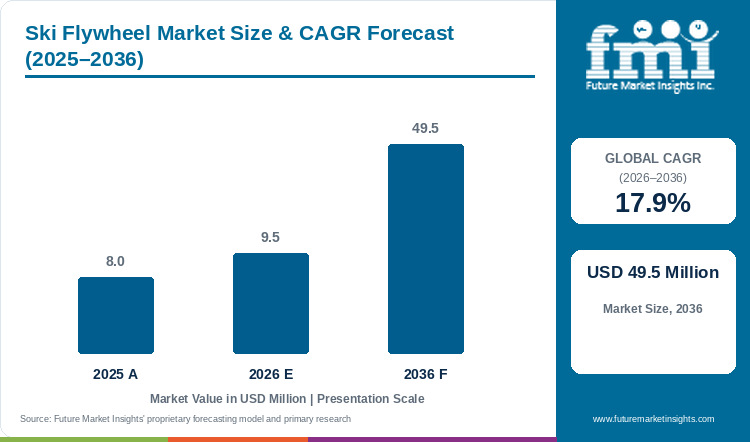
Key Takeaways
- Lift Systems will remain the main application, with 80.0% of market revenue in 2026.
- Systems rated Up to 250 kW are expected to represent 70.0% of demand. This rating fits the smaller power requirement of individual lift and resort applications.
- Rotor and Bearing Assemblies are projected to hold 55.0% of Component revenue in 2026, making them the largest hardware cost block.
- Direct and OEM-Integrated sales are expected to account for 65.0% of revenue as most projects still require supplier involvement in system design and integration.
- Sweden is expected to post the fastest profiled country CAGR at 20.2% from 2026 to 2036.
- Piller Power Systems, Stornetic, Teraloop and Amber Kinetics are among the notable flywheel suppliers relevant to ski-resort power quality and energy-storage projects.
Analyst Perspective
“Flywheels are unlikely to replace batteries across ski resorts. Their strongest use is in applications that need fast power response and frequent cycling. Lift drives, power-quality support and short backup periods fit this requirement better than long-duration energy storage.”
- Nikhil Kaitwade, Principal Consultant, Future Market Insights
How is the Ski Flywheel Market Segmented?
FMI segments the ski flywheel market by Component, Power Rating, Application, Sales Channel, and Region.
By Component, the market is segmented into Rotor and Bearing Assembly and Motor-Generator and Power Electronics. By Power Rating, it is segmented into Up to 250 kW and Above 250 kW. By Application, it is segmented into Lift Systems and Grid. By Sales Channel, it is segmented into Direct and OEM-Integrated and Distributor and Third-Party Integrator. Regional coverage follows the standard FMI global hierarchy.
Why do Rotor and Bearing Assemblies lead demand within the Component category?
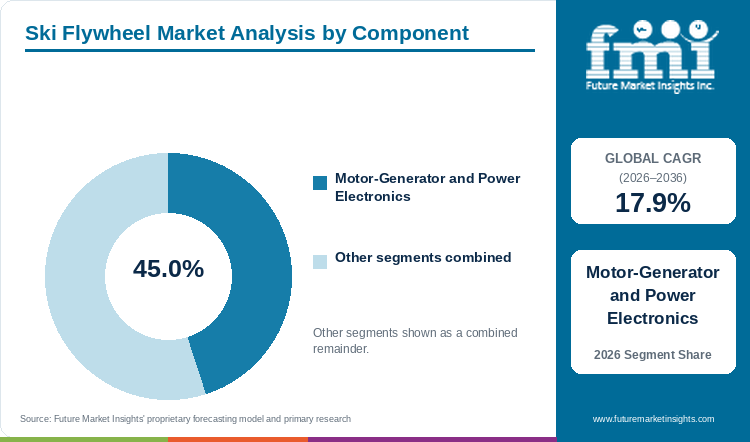
Rotor and Bearing Assemblies are projected to account for 55.0% of Component revenue in 2026.
The rotor and bearing system carries the main mechanical load in a flywheel. It must run at very high speed while keeping friction and vibration low. [10]
- By Component, Rotor and Bearing Assemblies are projected to account for 55.0% of market revenue in 2026.
- Motor-Generator and Power Electronics are expected to account for 45.0% of Component revenue in 2026.
Why do Up to 250 kW systems lead demand within the Power Rating category?
Up to 250 kW systems are projected to account for 70.0% of Power Rating revenue in 2026.
Up to 250 kW systems suit projects where power support is needed at one lift station or one part of the resort. These installations require less capacity than a system designed for the entire site. They can also be added during lift modernization or electrical upgrades without creating a large central storage project. Systems above 250 kW are more suitable when several lifts or a wider resort microgrid are being supported.
Existing flywheel products already cover the smaller power range. For instance, Stornetic offers 60 kW and 130 kW units while Teraloop lists a 250 kW Power Loop system. These products show that suitable power ratings are available even though ski-resort use remains an emerging application. [10] [11]
- Up to 250 kW systems are projected to account for 70.0% of Power Rating revenue in 2026.
- Above 250 kW systems are expected to account for the remaining 30.0%.
Why do Lift Systems lead demand within the Application category?
Lift Systems are projected to account for 80.0% of Application revenue in 2026.
Lift systems account for a large share of electricity use at many ski resorts and create repeated demand for power-quality management. This makes lift stations a clear investment area when operators upgrade electrical systems or modernize older lift infrastructure. Smart Altitude measured lift consumption at 15% to 37% of winter energy use across four Alpine resorts. The same project identifies fast-response storage as relevant to short-duration power requirements. [1] [2]
Spending is also easier to justify when the storage system is linked to a defined lift or electrical upgrade. Resort-wide storage projects involve more loads and a larger investment decision. Lift-related projects can therefore provide an earlier route for flywheel energy storage suppliers entering the ski industry.
- Lift Systems are projected to account for 80.0% of Application revenue in 2026.
- Grid applications are expected to account for the remaining 20.0% of Application revenue.
Why do Direct and OEM-Integrated sales lead demand within the Sales Channel category?
Direct and OEM-Integrated sales are projected to account for 65.0% of Sales Channel revenue in 2026.
Direct and OEM-Integrated sales lead because most projects still require site-specific engineering. Power rating, electrical connection and control integration have to be decided before installation. Ski resorts therefore depend more on manufacturers and engineering partners than on standard equipment distributors.
This channel structure also reflects the small installed base of ski-specific flywheel projects. Suppliers need to support project design and commissioning before repeat configurations become common. Distributor-led sales are likely to increase only after the technology becomes more standardized across resort applications. [9] [10] [11]
- Direct and OEM-Integrated sales are projected to account for 65.0% of Sales Channel revenue in 2026.
- Distributor and Third-Party Integrator sales are expected to account for the remaining 35.0%.
What are the Drivers, Restraints, and Opportunities in the Ski Flywheel Market?
Driver: resort electrification is increasing short-term power needs. Restraint: flywheels cost more for long-duration storage. Opportunity: hybrid storage can combine fast flywheels with batteries.
- Driver: Ski resorts are increasing electricity use through lift upgrades, snowmaking, electric vehicles and charging infrastructure. Higher peak demand increases the need for equipment that can support short periods of heavy power use and improve power quality.
- Restraint: Flywheels compete with batteries and other storage technologies for resort investment. DOE notes that flywheels provide fast response and high cycle life but store less energy than systems designed for longer discharge periods. Ski resorts are already using batteries for peak reduction, so flywheel suppliers need a clear cost and performance case for short-duration applications. [2] [8]
- Opportunity: Hybrid storage gives suppliers a route into larger resort energy projects. Flywheels can be used for frequent short-duration events while batteries support longer periods of demand. This allows resorts to select each technology for a different part of the electrical load rather than rely on one storage system for every requirement. [2] [8]
The strongest near-term demand is likely to come from resorts that are already investing in lift modernization, power-quality equipment and site electrification. These projects create a defined budget and installation point for storage. Wider investment across mountain and ski resorts can therefore expand the market without requiring operators to build a separate storage project from the start.
Which country CAGRs are profiled in the Ski Flywheel Market?
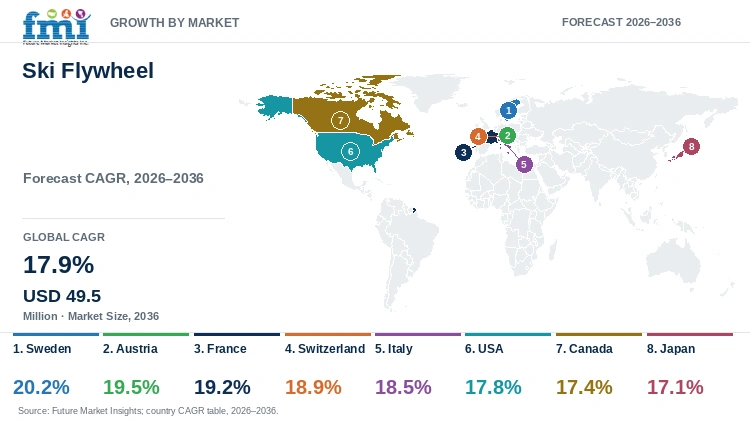
| Country | CAGR |
|---|---|
| Sweden | 20.2% |
| Austria | 19.5% |
| France | 19.2% |
| Switzerland | 18.9% |
| Italy | 18.5% |
| USA | 17.8% |
| Canada | 17.4% |
| Japan | 17.1% |
Country CAGRs are FMI analyst estimates for 2026 to 2036.
Country-wise Analysis
- Sweden: The Ski Flywheel Market is projected to grow at 20.2% CAGR through 2036. SkiStar has already installed an 860 kWh battery system at Hundfjället to reduce peak demand and improve energy use. This shows that storage is already part of resort energy planning. Flywheel suppliers can compete for the shorter and more frequent power events within these projects. [8]
- Austria: The market is projected to expand at 19.5% CAGR through 2036. Austria operates more than 2,500 cableway and drag-lift systems and recorded about 54 million first entries in winter 2025/26. This large installed base creates regular demand for lift upgrades and electrical modernization. Flywheel adoption will depend on whether these projects include power-quality or peak-load management. [4]
- France: The market is projected to grow at 19.2% CAGR through 2036. France had 3,384 lift and mountain-conveyor installations in 2025 and ski-area investment reached EUR 555 million. High capital spending gives storage suppliers a route into planned lift and electrical upgrades. Existing resorts are therefore more important to market growth than new ski-area construction. [3] [14]
- Switzerland: The market is projected to rise at 18.9% CAGR through 2036. Switzerland has around 2,400 cableway installations across a mature mountain-transport network. Most growth will therefore come from modernization rather than expansion of the lift base. Flywheel suppliers need to show a clear operating or cost benefit within these upgrade projects. [5]
- Italy: The market is projected to expand at 18.5% CAGR through 2036. Madonna di Campiglio has already tested integrated resort energy management using real-time operating data and renewable-energy planning. This type of site-level energy management makes it easier to identify where storage can reduce peak demand or support individual loads. Flywheel suppliers can enter through these wider energy-upgrade projects. [16]
- USA: The market is projected to grow at 17.8% CAGR through 2036. The USA has a large ski-area base and domestic access to flywheel technology through suppliers such as Amber Kinetics. Resorts can also choose batteries and power-electronics systems for the same capital budget. Flywheel growth will therefore depend on projects where frequent cycling and fast power support provide a better commercial case. [12] [15]
- Canada: The market is projected to rise at 17.4% CAGR through 2036. Canada recorded 19.5 million skier visits in 2024/25 and western ski areas generated CAD 2.67 billion in economic activity. Large destination resorts have enough electrical demand to justify dedicated energy-management projects. Storage investment will be strongest where peak charges or grid limits create a measurable cost. [6]
- Japan: The market is projected to grow at 17.1% CAGR through 2036. Major resorts are replacing older lifts with higher-capacity gondolas at sites such as Niseko and Iwatake. These projects require new electrical equipment as well as new transport infrastructure. Storage suppliers therefore have a better sales opportunity during major lift replacement than through standalone retrofit proposals. [7]
Who are the notable companies in the Ski Flywheel Market?
Piller Power Systems, Stornetic, Teraloop and Amber Kinetics are notable flywheel suppliers relevant to ski-resort power quality and energy storage.
Competition is split by application rather than by ski-specific branding. Piller focuses on critical-power and ride-through systems. Stornetic offers 60 kW and 130 kW units for repeated short-duration use. Teraloop has a 250 kW system that fits the main power range in this market. Amber Kinetics is positioned more toward longer-duration storage and renewable integration. [9] [10] [11] [12]
Most suppliers still sell general flywheel systems rather than products made only for ski resorts. This means ski projects will be won through system fit, installation support and project economics. Suppliers need to show that the selected unit matches the site load and offers a clear benefit against batteries or power-electronics systems.
- Short-duration power quality: Piller, Stornetic and Teraloop are better aligned with projects that need fast response and frequent cycling.
- Grid and renewable integration: Amber Kinetics and Teraloop are better aligned with wider resort energy-storage and grid-support projects.
Competitive Benchmarking: Ski Flywheel Market
| Company | Short-duration power fit | Modular ski-site fit | Microgrid / renewable fit | Geographic reach |
|---|---|---|---|---|
| Piller Power Systems | High | Medium | Medium | High |
| Stornetic | High | High | Medium | Medium |
| Teraloop | High | High | High | Medium |
| Amber Kinetics | Medium | Medium | High | High |
High indicates broad documented capability or strong fit. Medium indicates a credible but narrower role. Low indicates a limited role. Ratings do not represent market share or product quality.
Key Developments in the Ski Flywheel Market
- In July 2025, Amber Kinetics and Kawasaki Heavy Industries extended their collaboration to pair flywheel storage with virtual synchronous generator technology for grid stability. [13]
- In March 2025, Piller reported an expansion of a European data-center installation that doubled flywheel-backed UPS capacity to 34.4 MVA. The project shows continued demand for kinetic storage in high-power quality applications. [17]
- In 2026, Teraloop lists its 250 kW Power Loop as shipping and a 1 MW version for 2027. The 250 kW rating sits directly in the leading power band used in this report. [11]
Key Players
Critical-Power and Short-Duration Flywheel Suppliers
- Piller Power Systems
- Stornetic
- Teraloop
Grid and Renewable Flywheel Supplier
- Amber Kinetics
Report Scope and Methodology
| Coverage field | Report scope |
|---|---|
| Market breakdown | Component; Power Rating; Application; Sales Channel; Region |
| Quantitative units | USD Million |
| Market definition | Revenue from flywheel energy storage systems and in-scope components sold for ski-resort lift power support, site power quality, ride-through and resort grid applications. Batteries, supercapacitors and non-flywheel power-quality equipment are excluded. |
| Countries profiled | Sweden; Austria; France; Switzerland; Italy; USA; Canada; Japan |
| Key companies profiled | Piller Power Systems; Stornetic; Teraloop; Amber Kinetics |
| Forecast period | 2026 to 2036 |
Research Methodology
| Method | Approach |
|---|---|
| Primary and desk research | FMI reviews lift-operator activity, ski-area investment, energy-management programs, government energy-storage material and current flywheel supplier documentation. Primary research covers resort operators, lift integrators, storage suppliers and electrical contractors. |
| Market sizing and forecasting | Market sizing starts from the approved 2025 and 2026 values. Forecasting considers the ski-lift installed base, resort electrical loads, flywheel power ratings, project economics and competing storage technologies. |
| Country forecasting | Country CAGRs are FMI analyst estimates. They consider ski-lift density, resort investment, storage adoption, electrification and current supplier access. |
| Data validation | Technical claims are checked against government, industry-association or supplier sources. Flywheel revenue is kept separate from batteries and other power-quality systems. |
Ski Flywheel Market by Segments
Ski Flywheel Market Segmented by Component
- Rotor and Bearing Assembly
- Motor-Generator and Power Electronics
Ski Flywheel Market Segmented by Power Rating
- Up to 250 kW
- Above 250 kW
Ski Flywheel Market Segmented by Application
- Lift Systems
- Grid
Ski Flywheel Market Segmented by Sales Channel
- Direct and OEM-Integrated
- Distributor and Third-Party Integrator
Ski Flywheel Market by Region
- North America
- United States
- Canada
- Latin America
- Brazil
- Mexico
- Argentina
- Chile
- Western Europe
- Germany
- France
- United Kingdom
- Italy
- Spain
- Benelux
- Nordics
- Eastern Europe
- Poland
- Czech Republic
- Romania
- Hungary
- East Asia
- China
- Japan
- South Korea
- South Asia and Pacific
- India
- ASEAN
- Australia and New Zealand
- Middle East and Africa
- GCC Countries
- South Africa
- Türkiye
- Israel
Research Sources and Bibliography
- [1] Interreg Alpine Space Smart Altitude. Renewable Energy and Sustainable Mobility toolkit.
- [2] U.S. Department of Energy. Energy Storage Technology and Cost Characterization Report.
- [3] STRMTG, French Ministry of Transport. French ski-lift and mountain-conveyor fleet, updated September 2026.
- [4] Austrian Federal Economic Chamber. Austrian cableway industry data, November 2025.
- [5] Swiss Federal Office of Transport. Cableways in Switzerland, June 2025.
- [6] Canada West Ski Areas Association. Data and Metrics for Ski Areas Report, July 2025.
- [7] Japan National Tourism Organization. The Opening of Japan’s 2024-25 Ski Season.
- [8] SkiStar. Fossil-free ski resort and energy-storage deployment at Hundfjället.
- [9] Piller Power Systems. Energy Storage Flywheels and Battery Systems.
- [10] Stornetic. EnWheel high-performance kinetic flywheel machine.
- [11] Teraloop. Power Loop flywheel solutions.
- [12] Amber Kinetics. Current flywheel energy storage system and company information.
- [13] Amber Kinetics. Kawasaki Heavy Industries and Amber Kinetics launch a new technology system modernizing power grids, July 31, 2025.
- [14] Domaines Skiables de France. French ski areas invested EUR 555 million in 2025, March 2, 2026.
- [15] National Ski Areas Association. U.S. ski industry statistics, 2024/25 and 2025/26.
- [16] Fondazione Bruno Kessler. Smart Altitude Integrated Energy Management System at Madonna di Campiglio.
- [17] Piller Power Systems. Leading Global Bank Expands Piller IP-Bus Systems for Maximum Power Security, March 11, 2025.
This bibliography is provided for reader reference. The full report contains the complete reference list and supporting research.
This Report Answers
- What is the Ski Flywheel Market size in 2026?
- What value is forecast for the Ski Flywheel Market by 2036?
- Which Component holds the leading share in 2026?
- Which Power Rating holds the leading share in 2026?
- Why do Lift Systems lead Application demand?
- Which countries have the fastest growth outlook through 2036?
- What limits wider flywheel adoption at ski resorts?
- Which companies supply relevant flywheel technology?
Frequently Asked Questions
How big is the Ski Flywheel Market in 2026?
As per FMI, the Ski Flywheel Market is valued at USD 9.5 Million in 2026 compared with USD 8.0 Million in 2025. Sales are forecast to reach USD 49.5 Million by 2036.
What is the CAGR of the Ski Flywheel Market from 2026 to 2036?
The market is forecast to expand at a 17.9% CAGR between 2026 and 2036.
Which Component holds the largest share of the Ski Flywheel Market?
Rotor and Bearing Assemblies are projected to account for 55.0% of Component revenue in 2026.
Which Application holds the largest share of the Ski Flywheel Market?
Lift Systems are projected to account for 80.0% of Application revenue in 2026.
Which country has the strongest growth outlook?
Sweden is expected to record the fastest profiled CAGR at 20.2% from 2026 to 2036. Resort electrification and active storage deployment support the forecast.
Which are the notable companies in the Ski Flywheel Market?
Piller Power Systems, Stornetic, Teraloop and Amber Kinetics are notable suppliers of flywheel technology relevant to ski-resort power quality and energy storage.
Preview the report firsthand - request a free sample
Get SampleGet the brochure for pricing and purchase details.
Get PDFTable of Content
- Key Takeaways
- Market Size and CAGR
- Top Growth Driver
- Fastest Growing Segment
- Leading Region
- Key Companies
- Emerging Opportunities
- Executive Summary
- Global Market Outlook
- Demand-side Trends
- Supply-side Trends
- Technology Roadmap Analysis
- Analysis and Recommendations
- Analyst Perspective (What is happening? Why now? What should investors know?)
- Key Questions Answered
- How large is the market?
- What is the CAGR?
- What are key trends?
- Which region dominates?
- Who are the leaders?
- Market Overview
- Market Coverage / Taxonomy
- Market Definition / Scope / Limitations
- Research Methodology
- Chapter Orientation
- Analytical Lens and Working Hypotheses
- Market Structure, Signals, and Trend Drivers
- Benchmarking and Cross-market Comparability
- Market Sizing, Forecasting, and Opportunity Mapping
- Research Design and Evidence Framework
- Desk Research Programme (Secondary Evidence)
- Expert Input and Fieldwork (Primary Evidence)
- Tooling, Models, and Reference Databases
- Data Engineering and Model Build
- Quality Assurance and Audit Trail
- Market Background
- Market Dynamics (Drivers, Restraints, Opportunity, Trends)
- Scenario Forecast (Optimistic, Likely, Conservative)
- Impact Analysis
- AI Impact
- Sustainability Impact
- Regulatory Impact
- Technology Impact
- Consumer / Buyer Analysis
- Purchase Drivers
- Adoption Barriers
- Buyer Journey
- Opportunity Map Analysis
- Product Life Cycle Analysis
- Supply Chain Analysis
- Investment Feasibility Matrix
- Value Chain Analysis
- PESTLE and Porter's Analysis
- Regulatory Landscape
- Regional Parent Market Outlook
- Production and Consumption Statistics
- Import and Export Statistics
- Global Market Analysis and Forecast, 2021 to 2036
- Historical Market Size Value (USD Million) Analysis, 2021 to 2025
- Current and Future Market Size Value (USD Million) Projections, 2026 to 2036
- Y-o-Y Growth Trend Analysis
- Absolute $ Opportunity Analysis
- Global Market Pricing Analysis, 2021 to 2036
- Global Market Analysis and Forecast, By Component, 2021 to 2036
- Introduction / Key Findings
- Historical Market Size Value (USD Million) Analysis By Component, 2021 to 2025
- Current and Future Market Size Value (USD Million) Analysis and Forecast By Component, 2026 to 2036
- Rotor and Bearing Assembly
- Motor-Generator and Power Electronics
- Y-o-Y Growth Trend Analysis By Component, 2021 to 2025
- Absolute $ Opportunity Analysis By Component, 2026 to 2036
- Global Market Analysis and Forecast, By Power Rating, 2021 to 2036
- Introduction / Key Findings
- Historical Market Size Value (USD Million) Analysis By Power Rating, 2021 to 2025
- Current and Future Market Size Value (USD Million) Analysis and Forecast By Power Rating, 2026 to 2036
- Up to 250 kW
- Above 250 kW
- Y-o-Y Growth Trend Analysis By Power Rating, 2021 to 2025
- Absolute $ Opportunity Analysis By Power Rating, 2026 to 2036
- Global Market Analysis and Forecast, By Application, 2021 to 2036
- Introduction / Key Findings
- Historical Market Size Value (USD Million) Analysis By Application, 2021 to 2025
- Current and Future Market Size Value (USD Million) Analysis and Forecast By Application, 2026 to 2036
- Lift Systems
- Grid
- Y-o-Y Growth Trend Analysis By Application, 2021 to 2025
- Absolute $ Opportunity Analysis By Application, 2026 to 2036
- Global Market Analysis and Forecast, By Sales Channel, 2021 to 2036
- Introduction / Key Findings
- Historical Market Size Value (USD Million) Analysis By Sales Channel, 2021 to 2025
- Current and Future Market Size Value (USD Million) Analysis and Forecast By Sales Channel, 2026 to 2036
- Direct and OEM-Integrated
- Distributor and Third-Party Integrator
- Y-o-Y Growth Trend Analysis By Sales Channel, 2021 to 2025
- Absolute $ Opportunity Analysis By Sales Channel, 2026 to 2036
- Global Market Analysis and Forecast, By Region, 2021 to 2036
- Introduction
- Historical Market Size Value (USD Million) Analysis By Region, 2021 to 2025
- Current Market Size Value (USD Million) Analysis and Forecast By Region, 2026 to 2036
- North America
- Latin America
- Western Europe
- Eastern Europe
- East Asia
- South Asia and Pacific
- Middle East and Africa
- Market Attractiveness Analysis By Region
- North America Market Analysis and Forecast, By Country, 2021 to 2036
- Historical Market Size Value (USD Million) Trend Analysis By Market Taxonomy, 2021 to 2025
- Market Size Value (USD Million) Forecast By Market Taxonomy, 2026 to 2036
- By Country
- United States
- Canada
- By Component
- By Power Rating
- By Application
- By Sales Channel
- By Country
- Market Attractiveness Analysis
- By Country
- By Component
- By Power Rating
- By Application
- By Sales Channel
- Key Takeaways
- Latin America Market Analysis and Forecast, By Country
- Historical Market Size Value (USD Million) Trend Analysis By Market Taxonomy, 2021 to 2025
- Market Size Value (USD Million) Forecast By Market Taxonomy, 2026 to 2036
- By Country
- Brazil
- Mexico
- Argentina
- Chile
- By Component
- By Power Rating
- By Application
- By Sales Channel
- By Country
- Market Attractiveness Analysis
- By Country
- By Component
- By Power Rating
- By Application
- By Sales Channel
- Key Takeaways
- Western Europe Market Analysis and Forecast, By Country
- Historical Market Size Value (USD Million) Trend Analysis By Market Taxonomy, 2021 to 2025
- Market Size Value (USD Million) Forecast By Market Taxonomy, 2026 to 2036
- By Country
- Germany
- France
- United Kingdom
- Italy
- Spain
- Benelux
- Nordics
- By Component
- By Power Rating
- By Application
- By Sales Channel
- By Country
- Market Attractiveness Analysis
- By Country
- By Component
- By Power Rating
- By Application
- By Sales Channel
- Key Takeaways
- Eastern Europe Market Analysis and Forecast, By Country
- Historical Market Size Value (USD Million) Trend Analysis By Market Taxonomy, 2021 to 2025
- Market Size Value (USD Million) Forecast By Market Taxonomy, 2026 to 2036
- By Country
- Poland
- Czech Republic
- Romania
- Hungary
- By Component
- By Power Rating
- By Application
- By Sales Channel
- By Country
- Market Attractiveness Analysis
- By Country
- By Component
- By Power Rating
- By Application
- By Sales Channel
- Key Takeaways
- East Asia Market Analysis and Forecast, By Country
- Historical Market Size Value (USD Million) Trend Analysis By Market Taxonomy, 2021 to 2025
- Market Size Value (USD Million) Forecast By Market Taxonomy, 2026 to 2036
- By Country
- China
- Japan
- South Korea
- By Component
- By Power Rating
- By Application
- By Sales Channel
- By Country
- Market Attractiveness Analysis
- By Country
- By Component
- By Power Rating
- By Application
- By Sales Channel
- Key Takeaways
- South Asia and Pacific Market Analysis and Forecast, By Country
- Historical Market Size Value (USD Million) Trend Analysis By Market Taxonomy, 2021 to 2025
- Market Size Value (USD Million) Forecast By Market Taxonomy, 2026 to 2036
- By Country
- India
- ASEAN
- Australia and New Zealand
- By Component
- By Power Rating
- By Application
- By Sales Channel
- By Country
- Market Attractiveness Analysis
- By Country
- By Component
- By Power Rating
- By Application
- By Sales Channel
- Key Takeaways
- Middle East and Africa Market Analysis and Forecast, By Country
- Historical Market Size Value (USD Million) Trend Analysis By Market Taxonomy, 2021 to 2025
- Market Size Value (USD Million) Forecast By Market Taxonomy, 2026 to 2036
- By Country
- GCC Countries
- South Africa
- Türkiye
- Israel
- By Component
- By Power Rating
- By Application
- By Sales Channel
- By Country
- Market Attractiveness Analysis
- By Country
- By Component
- By Power Rating
- By Application
- By Sales Channel
- Key Takeaways
- Key Countries Market Analysis
- United States
- Pricing Analysis
- Market Share Analysis, 2025
- By Component
- By Power Rating
- By Application
- By Sales Channel
- Canada
- Pricing Analysis
- Market Share Analysis, 2025
- By Component
- By Power Rating
- By Application
- By Sales Channel
- Mexico
- Pricing Analysis
- Market Share Analysis, 2025
- By Component
- By Power Rating
- By Application
- By Sales Channel
- Brazil
- Pricing Analysis
- Market Share Analysis, 2025
- By Component
- By Power Rating
- By Application
- By Sales Channel
- Chile
- Pricing Analysis
- Market Share Analysis, 2025
- By Component
- By Power Rating
- By Application
- By Sales Channel
- Germany
- Pricing Analysis
- Market Share Analysis, 2025
- By Component
- By Power Rating
- By Application
- By Sales Channel
- United Kingdom
- Pricing Analysis
- Market Share Analysis, 2025
- By Component
- By Power Rating
- By Application
- By Sales Channel
- Italy
- Pricing Analysis
- Market Share Analysis, 2025
- By Component
- By Power Rating
- By Application
- By Sales Channel
- Spain
- Pricing Analysis
- Market Share Analysis, 2025
- By Component
- By Power Rating
- By Application
- By Sales Channel
- France
- Pricing Analysis
- Market Share Analysis, 2025
- By Component
- By Power Rating
- By Application
- By Sales Channel
- India
- Pricing Analysis
- Market Share Analysis, 2025
- By Component
- By Power Rating
- By Application
- By Sales Channel
- ASEAN
- Pricing Analysis
- Market Share Analysis, 2025
- By Component
- By Power Rating
- By Application
- By Sales Channel
- Australia and New Zealand
- Pricing Analysis
- Market Share Analysis, 2025
- By Component
- By Power Rating
- By Application
- By Sales Channel
- China
- Pricing Analysis
- Market Share Analysis, 2025
- By Component
- By Power Rating
- By Application
- By Sales Channel
- Japan
- Pricing Analysis
- Market Share Analysis, 2025
- By Component
- By Power Rating
- By Application
- By Sales Channel
- South Korea
- Pricing Analysis
- Market Share Analysis, 2025
- By Component
- By Power Rating
- By Application
- By Sales Channel
- Poland
- Pricing Analysis
- Market Share Analysis, 2025
- By Component
- By Power Rating
- By Application
- By Sales Channel
- Hungary
- Pricing Analysis
- Market Share Analysis, 2025
- By Component
- By Power Rating
- By Application
- By Sales Channel
- Türkiye
- Pricing Analysis
- Market Share Analysis, 2025
- By Component
- By Power Rating
- By Application
- By Sales Channel
- South Africa
- Pricing Analysis
- Market Share Analysis, 2025
- By Component
- By Power Rating
- By Application
- By Sales Channel
- Sweden
- Pricing Analysis
- Market Share Analysis, 2025
- By Component
- By Power Rating
- By Application
- By Sales Channel
- Austria
- Pricing Analysis
- Market Share Analysis, 2025
- By Component
- By Power Rating
- By Application
- By Sales Channel
- Switzerland
- Pricing Analysis
- Market Share Analysis, 2025
- By Component
- By Power Rating
- By Application
- By Sales Channel
- United States
- Market Structure Analysis
- Competition Dashboard
- Competition Benchmarking
- Market Share Analysis of Top Players
- By Regional
- By Component
- By Power Rating
- By Application
- By Sales Channel
- Emerging Startups
- Innovation Benchmarking
- Competition Analysis
- Competition Deep Dive
- Piller Power Systems
- Overview
- Product Portfolio
- Profitability by Market Segments
- Sales Footprint
- Strategy Overview
- Marketing Strategy
- Product Strategy
- Channel Strategy
- Stornetic
- Teraloop
- Amber Kinetics
- Piller Power Systems
- Case Studies
- Success Stories
- Recent Developments
- Competition Deep Dive
- Assumptions & Acronyms Used


