

- Market Size (2026)
- USD 4.2 Bn
- Forecast (2036)
- USD 7.6 Bn
- CAGR (2026 to 2036)
- 6.1%
How big is Skin Structure Infections Market in 2026?
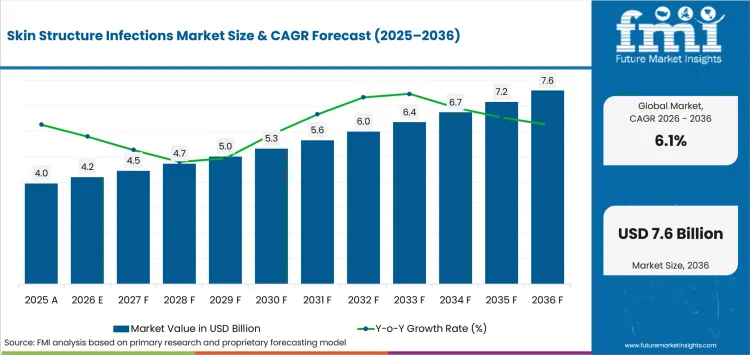
USD 4.2 billion in 2026 and USD 7.6 billion by 2036 at a 6.1% CAGR.
Demand for skin structure infection therapies is forecast to rise at a 6.1% CAGR through 2036, increasing from USD 4.2 billion in 2026 to USD 7.6 billion by 2036. Treatment decisions depend on the infection setting and disease severity, followed by susceptibility evidence and the route needed at the point of care.
Commercial differentiation is linked to coverage of resistant Gram-positive organisms, dosing burden and the ability to support treatment beyond the inpatient stay. Antimicrobial resistance keeps demand focused on evidence-backed therapies, while stewardship controls limit indiscriminate use and strengthen the role of products with a clear label fit.
Key Takeaways of Skin Structure Infections Market
- The market is projected to increase from USD 4.2 billion in 2026 to USD 7.6 billion by 2036 at a 6.1% CAGR.
- Community-Acquired Skin & Skin Structure Infections are expected to lead the type of infection category with 62.0% share in 2026.
- Glycopeptides & Lipoglycopeptides are projected to account for 29.0% share in 2026 due to their established role in serious Gram-positive infections.
- Parenteral administration is forecast to hold 56.0% share in 2026 because complicated cases often begin with supervised systemic therapy.
- Hospital Pharmacies and Hospitals are expected to lead with 51.0% and 52.0% shares, respectively, as formulary control remains concentrated in acute care.
- Pfizer Inc., Merck & Co., Inc., AbbVie Inc., GSK plc, Melinta Therapeutics, Inc., Paratek Pharmaceuticals, Inc., Novartis AG, Teva Pharmaceutical Industries Ltd., Glenmark Pharmaceuticals Ltd. and Basilea Pharmaceutica Ltd. participate in the market through branded therapies, specialist anti-infective portfolios or generic supply.
Analyst Perspective
"Growth will depend less on broad antibiotic volume and more on the match between pathogen coverage and route, followed by dosing burden and stewardship requirements. Suppliers that support hospital initiation with practical outpatient continuation can improve formulary relevance while preserving responsible use."
- Anurag Sharma, Principal Consultant at Future Market Insights
How is the Skin Structure Infections Market segmented?
The skin structure infections market is segmented by type of infection, drug class, route of administration, distribution channel, end user and region.
Type of infection separates community-acquired demand from hospital-acquired demand. Drug class covers Glycopeptides & Lipoglycopeptides, Oxazolidinones, Cephalosporins and Tetracyclines. Route analysis includes Parenteral, Oral and Topical administration. Distribution covers Hospital Pharmacies, Retail Pharmacies and Online Pharmacies. End-user coverage includes Hospitals, Specialty Clinics, Ambulatory Surgical Centers and Others.
Why do Community-Acquired Skin & Skin Structure Infections lead the type of Infection category?
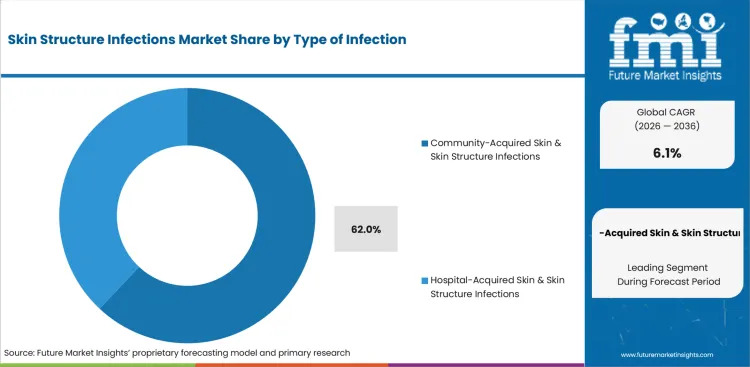
Community-acquired infections enter care through emergency departments and urgent care, followed by primary or specialty clinics. Cellulitis and cutaneous abscesses create a broad treatment base, while escalation to hospital care depends on severity and comorbidity as well as suspected resistance.
- Community-Acquired Skin & Skin Structure Infections are set to lead with 62.0% share in 2026 because they cover frequent presentations across ambulatory and acute-care pathways.
- Hospital-Acquired Skin & Skin Structure Infections remain clinically important through Surgical Site Infections and Device-Associated Infections, where prevention protocols and targeted therapy guide product selection.
Why do Glycopeptides & Lipoglycopeptides lead the Drug Class category?
The class combines established hospital use with longer-acting products that can reduce repeat administration for selected Gram-positive infections. The category includes Vancomycin and Oritavancin, while product selection is increasingly influenced by MRSA testing and local susceptibility patterns.
- Glycopeptides & Lipoglycopeptides are projected to hold 29.0% share in 2026 due to their established role against serious Gram-positive infections and the availability of long-acting agents.
- Oxazolidinones support oral and intravenous continuity, while Cephalosporins and Tetracyclines broaden competition through products with distinct ABSSSI labels and dosing schedules.
Why does Parenteral administration lead the Route category?
Parenteral treatment supports controlled delivery when severity or absorption concerns make supervised systemic therapy necessary. Intravenous use remains central for complicated cases, while intramuscular options address narrower care settings within the market.
- Parenteral administration is forecast to account for 56.0% share in 2026 because complicated infections often begin with monitored systemic treatment.
- Oral Tablets and Oral Capsules support step-down or outpatient care when clinically appropriate. Topical anti-infective drugs remain relevant for localized applications through Creams & Ointments and Topical Solutions.
Why do Hospital Pharmacies lead the Distribution Channel category?
Hospital pharmacies connect formulary review with inpatient supply and hospital-outpatient dispensing. Their position is reinforced by restricted-antibiotic controls and the need to align treatment with local susceptibility information before repeat purchasing.
- Hospital Pharmacies are estimated to hold 51.0% share in 2026, supported by Inpatient Pharmacies and Hospital Outpatient Pharmacies.
- Retail Pharmacies serve chain and independent channels, while Online Pharmacies extend prescription access where local regulations permit remote dispensing.
Why do Hospitals lead the End-user category?
Hospitals manage severe infection assessment and diagnostic work, followed by initiation of systemic therapy. Tertiary Care Hospitals address complex cases, while General Hospitals handle a broader acute-care base and coordinate discharge treatment.
- Hospitals are projected to represent 52.0% of end-user demand in 2026 because treatment initiation and formulary control remain concentrated in acute-care settings.
- Specialty Clinics and Ambulatory Surgical Centers support follow-up or selected outpatient administration. Other demand comes from Community Health Centers and Long-Term Care Facilities.
What are the drivers, restraints and opportunities in the Skin Structure Infections Market?
Resistance-aware prescribing sustains demand for targeted antibacterial therapy, while stewardship controls and generic competition limit volume-led growth. Long-acting infusions and oral or intravenous continuity create opportunity beyond prolonged inpatient care.
- Driver: Resistant organisms and hospital treatment pathways sustain demand for therapies with clear pathogen coverage, practical dosing and label support.
- Restraint: Stewardship programs restrict unnecessary broad-spectrum use and raise the evidence threshold for formulary access.
- Opportunity: Long-acting infusions and oral or intravenous continuity can lower administration burden for suitable patients and support outpatient care.
Clinical demand is shaped by resistance patterns and the need to match therapy with antibiotic susceptibility testing. Current labels for linezolid and tedizolid support oral and intravenous use, while dalbavancin and oritavancin provide longer-acting intravenous options. Omadacycline and ceftobiprole add newer choices with specific ABSSSI indications.
Stewardship also restrains commercial expansion. CDC guidance asks hospital programs to use facility treatment recommendations based on national guidance and local susceptibility information. This limits promotion based on broad volume and shifts market access toward label fit, evidence quality and cost control. Generic alternatives add pricing pressure in established classes.
The main opportunity is continuity across care settings. SIVEXTRO allows adult treatment by oral or intravenous routes without a dose adjustment during switching. DALVANCE supports single-dose or two-dose intravenous regimens, while NUZYRA provides once-daily oral and intravenous dosing. These options can reduce repeat administration for suitable patients and support hospital-outpatient pathways.
Which country CAGRs are included in the Skin Structure Infections Market?
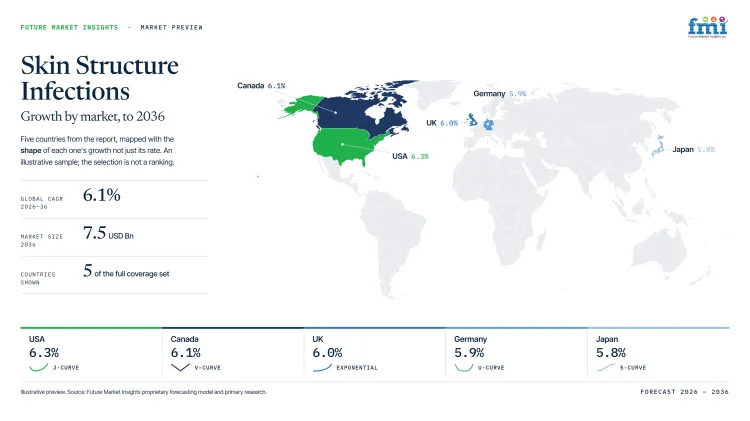
| Country | CAGR |
|---|---|
| United States | 6.3% |
| Japan | 5.8% |
| Germany | 5.9% |
| United Kingdom | 6.0% |
| Canada | 6.1% |
| Australia | 5.9% |
| South Korea | 6.7% |
How do country-level CAGRs compare in the Skin Structure Infections Market?
The seven country CAGRs span 0.9 percentage point, from 5.8% in Japan to 6.7% in South Korea. The narrow range indicates broad demand continuity, although national stewardship systems and hospital formularies create different market-access conditions.
- South Korea leads at 6.7% as strong hospital infrastructure and sustained antimicrobial-resistance surveillance support demand for targeted therapies.
- The United States records 6.3% as hospital stewardship programs and formulary controls maintain demand for evidence-backed treatment options.
- Canada is forecast at 6.1% as coordinated antimicrobial-resistance initiatives support continued adoption across provincial healthcare systems.
- The United Kingdom advances at 6.0% as infection-prevention policies and responsible-use requirements shape treatment selection.
- Germany is projected at 5.9% as resistance monitoring and hospital stewardship reinforce the use of therapies aligned with local susceptibility patterns.
- Australia is forecast at 5.9% as national antimicrobial-resistance programs encourage controlled use across hospital and outpatient settings.
- Japan closes the comparison at 5.8% as its mature regulatory environment supports steady demand for well-documented therapies.
Country-wise Analysis
- United States: Demand is forecast to expand at 6.3% CAGR through 2036. CDC hospital stewardship guidance keeps treatment linked to local susceptibility patterns and appropriate spectrum. Companies therefore need strong formulary evidence across inpatient and hospital-outpatient settings.
- Japan: The market is projected to rise at 5.8% CAGR through 2036. Japan's National Action Plan on Antimicrobial Resistance for 2023 to 2027 supports surveillance and appropriate use. Uptake is likely to favor products with clear dosing and quality documentation, followed by a defined place in treatment protocols.
- Germany: Sales are anticipated to grow at 5.9% CAGR through 2036. Robert Koch Institute programs connect antibiotic resistance surveillance with consumption monitoring. Evidence packages therefore need to address resistance patterns and hospital stewardship requirements.
- United Kingdom: The market is estimated to advance at 6.0% CAGR through 2036. The national action plan for antimicrobial resistance covering 2024 to 2029 emphasizes infection prevention and diagnostics, followed by responsible use. Suppliers should frame value around clinical fit and controlled deployment.
- Canada: Demand is forecast to increase at 6.1% CAGR through 2036. The Pan-Canadian Action Plan on Antimicrobial Resistance for 2023 to 2027 coordinates surveillance and stewardship across jurisdictions. Market access depends on hospital formulary relevance and reliable provincial distribution.
- Australia: The market is projected to record 5.9% CAGR through 2036. Australia's national response treats antimicrobial resistance as a long-term One Health issue and promotes appropriate use. Suppliers need practical stewardship support alongside dependable hospital and retail supply.
- South Korea: Demand is forecast to rise at 6.7% CAGR through 2036, the highest rate in the country comparison. The Korea Disease Control and Prevention Agency coordinates antimicrobial resistance measures through a multi-ministerial strategy. Products with clear hospital use and stewardship evidence are positioned to address growth within this control framework.
Who are the notable companies in the Skin Structure Infections Market?
Pfizer Inc., Merck & Co., Inc., AbbVie Inc., GSK plc, Melinta Therapeutics, Inc., Paratek Pharmaceuticals, Inc., Novartis AG, Teva Pharmaceutical Industries Ltd., Glenmark Pharmaceuticals Ltd. and Basilea Pharmaceutica Ltd. are notable companies serving the skin structure infections market.
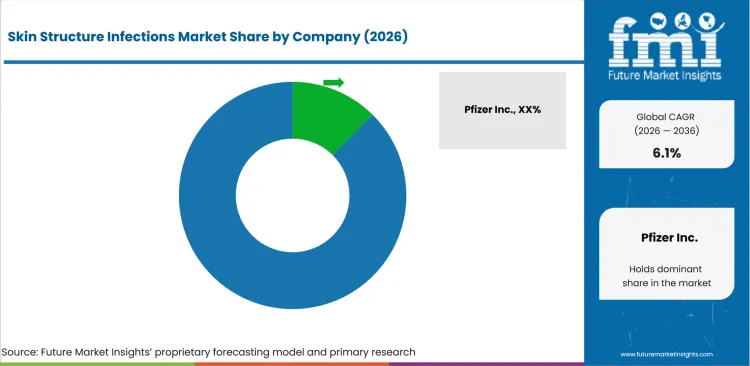
Competition includes diversified pharmaceutical groups and specialist anti-infective developers. Differentiation comes from current ABSSSI labels and route flexibility, followed by pediatric coverage and recent regulatory or clinical activity.
- Pfizer Inc. and Merck & Co., Inc. compete through oxazolidinone products that support oral and intravenous treatment continuity.
- AbbVie Inc. and Melinta Therapeutics, Inc. address parenteral treatment through long-acting products, while Melinta also offers oral and intravenous delafloxacin.
- Paratek Pharmaceuticals, Inc. and Basilea Pharmaceutica Ltd. compete through newer products with ABSSSI labels and recent clinical or commercial activity.
- GSK plc, Novartis AG, Teva Pharmaceutical Industries Ltd. and Glenmark Pharmaceuticals Ltd. add broader pharmaceutical or generic supply capabilities, although the reviewed official sources showed less current ABSSSI-focused branded depth.
Competitive Benchmarking: Skin Structure Infections Market
| Company | Portfolio Depth | Route Breadth | Pediatric Coverage | 2021-2026 Activity |
|---|---|---|---|---|
| Pfizer Inc. | High | High | Medium | Medium |
| Merck & Co., Inc. | Medium | High | Medium | High |
| AbbVie Inc. | Medium | Medium | Medium | Medium |
| GSK plc | Low | Low | Low | Low |
| Melinta Therapeutics, Inc. | High | High | Low | Medium |
| Paratek Pharmaceuticals, Inc. | Medium | High | Low | High |
| Novartis AG | Low | Low | Low | Low |
| Teva Pharmaceutical Industries Ltd. | Low | Low | Low | Low |
| Glenmark Pharmaceuticals Ltd. | Low | Low | Low | Low |
| Basilea Pharmaceutica Ltd. | Medium | Medium | Low | High |
Scoring basis: Portfolio Depth is High when at least two current ABSSSI-branded products were identified, Medium for one and Low when no current branded product was confirmed in the reviewed official materials. Route Breadth is High for oral and parenteral coverage, Medium for one systemic route and Low when exact route evidence was not confirmed. Pediatric Coverage is Medium when one ABSSSI product has a pediatric label and Low when none was identified. Activity is High for verified 2024 to 2026 regulatory, commercial or clinical activity, Medium for verified 2021 to 2023 activity and Low when no market-specific activity was found. Low ratings do not describe a company's broader anti-infective portfolio.
Key Developments in the Skin Structure Infections Market
- In April 2026, Paratek Pharmaceuticals, Inc. announced pooled safety findings from four Phase 3 NUZYRA studies, including the OASIS-1 and OASIS-2 ABSSSI trials, for presentation at ESCMID Global 2026.
- In May 2025, Basilea Pharmaceutica Ltd. reported that Zevtera became commercially available in the United States through Innoviva Specialty Therapeutics after its FDA approval for adult ABSSSI and other indications.
- In April 2025, the FDA expanded SIVEXTRO labeling to pediatric ABSSSI patients who are at least 26 weeks gestational age and weigh at least 1 kg.
Key Players in the Skin Structure Infections Market
Diversified Pharmaceutical Companies
- Pfizer Inc.
- Merck & Co., Inc.
- AbbVie Inc.
- GSK plc
- Novartis AG
- Teva Pharmaceutical Industries Ltd.
- Glenmark Pharmaceuticals Ltd.
Specialist Anti-Infective Companies
- Melinta Therapeutics, Inc.
- Paratek Pharmaceuticals, Inc.
- Basilea Pharmaceutica Ltd.
Skin Structure Infections Market - Report Scope
| Coverage field | Report scope |
|---|---|
| Market breakdown | By type of infection, drug class, route of administration, distribution channel, end user and region. |
| Quantitative Units | USD Billion. |
| Market Definition | Commercially supplied antibacterial therapies used to treat skin and skin structure infections across community-acquired and hospital-acquired settings. Revenue includes branded and generic systemic or topical products that fall within the stated segmentation. |
| Regions Covered | North America, Latin America, Western Europe, Eastern Europe, East Asia, South Asia and Pacific, and Middle East and Africa. |
| Countries Covered | United States, Japan, Germany, United Kingdom, Canada, Australia and South Korea. |
| Key Companies | Pfizer Inc., Merck & Co., Inc., AbbVie Inc., GSK plc, Melinta Therapeutics, Inc., Paratek Pharmaceuticals, Inc., Novartis AG, Teva Pharmaceutical Industries Ltd., Glenmark Pharmaceuticals Ltd. and Basilea Pharmaceutica Ltd. |
| Forecast Period | 2026 to 2036. |
| Approach | Primary and secondary research with market triangulation. |
Skin Structure Infections Market - Research Methodology
| Method | Approach |
|---|---|
| Primary Research | FMI analysts gathered input from manufacturers and distributors, followed by hospital pharmacy teams and clinicians. Interviews examined treatment selection, formulary access, route preference and adoption barriers. |
| Desk Research | Research covered official regulatory labels and approval documents, followed by government antimicrobial resistance plans and company disclosures. Clinical and stewardship materials were reviewed where they clarified market access or treatment pathways. |
| Market Sizing and Forecasting | Models combined the baseline value with segment shares and country growth rates, followed by treatment pathways, product availability and pricing signals across assessed regions. |
| Data Validation | Findings were checked through source comparison and triangulation, followed by expert review across regional operating conditions. Products without direct relevance to the market definition were excluded. |
Skin Structure Infections Market by Segments
Skin Structure Infections Market segmented by Type of Infection:
- Community-Acquired Skin & Skin Structure Infections
- Cellulitis
- Cutaneous Abscesses
- Hospital-Acquired Skin & Skin Structure Infections
- Surgical Site Infections
- Device-Associated Infections
Skin Structure Infections Market segmented by Drug Class:
- Glycopeptides & Lipoglycopeptides
- Vancomycin
- Oritavancin
- Oxazolidinones
- Linezolid
- Tedizolid
- Cephalosporins
- Ceftaroline Fosamil
- Ceftobiprole
- Tetracyclines
- Tigecycline
- Omadacycline
Skin Structure Infections Market segmented by Route of Administration:
- Parenteral
- Intravenous
- Intramuscular
- Oral
- Oral Tablets
- Oral Capsules
- Topical
- Creams & Ointments
- Topical Solutions
Skin Structure Infections Market segmented by Distribution Channel:
- Hospital Pharmacies
- Inpatient Pharmacies
- Hospital Outpatient Pharmacies
- Retail Pharmacies
- Chain Pharmacies
- Independent Pharmacies
- Online Pharmacies
- E-commerce Pharmacies
- Direct-to-Consumer Online Pharmacies
Skin Structure Infections Market segmented by End User:
- Hospitals
- Tertiary Care Hospitals
- General Hospitals
- Specialty Clinics
- Dermatology Clinics
- Infectious Disease Clinics
- Ambulatory Surgical Centers
- Outpatient Surgical Centers
- Urgent Care Centers
- Others
- Community Health Centers
- Long-Term Care Facilities
Skin Structure Infections Market by Region:
- North America
- United States
- Canada
- Mexico
- Latin America
- Brazil
- Chile
- Rest of Latin America
- Western Europe
- Germany
- United Kingdom
- Italy
- Spain
- France
- Nordics
- Benelux
- Rest of Western Europe
- Eastern Europe
- Russia
- Poland
- Hungary
- Balkan and Baltic States
- Rest of Eastern Europe
- East Asia
- China
- Japan
- South Korea
- South Asia and Pacific
- India
- ASEAN
- Australia and New Zealand
- Rest of South Asia and Pacific
- Middle East and Africa
- Kingdom of Saudi Arabia
- Other GCC Countries
- Türkiye
- South Africa
- Other African Union Countries
- Rest of Middle East and Africa
Research Sources and Bibliography
- USA Food and Drug Administration. (2024, April 3). FDA Approves New Antibiotic for Three Different Uses.
- USA Food and Drug Administration. (2025, April). SIVEXTRO prescribing information.
- USA Food and Drug Administration. (2024). ZYVOX prescribing information.
- USA Food and Drug Administration. (2025). TYGACIL prescribing information.
- USA Food and Drug Administration. (2025). DALVANCE prescribing information.
- USA Food and Drug Administration. (2023). BAXDELA prescribing information.
- USA Food and Drug Administration. (2025). NUZYRA prescribing information.
- AbbVie Inc. (2021, July 23). DALVANCE Receives FDA Approval to Treat Acute Bacterial Skin and Skin Structure Infections in Pediatric Patients.
- Melinta Therapeutics, Inc. (2023, July 10). Melinta Therapeutics Partners with BARDA to Advance Two FDA-Approved Antibiotics.
- Paratek Pharmaceuticals, Inc. (2026, April 16). Paratek to Present New NUZYRA Data at ESCMID Global 2026.
- Basilea Pharmaceutica Ltd. (2025, May 20). Basilea Announces Commercial Availability of Zevtera in the United States.
- Centers for Disease Control and Prevention. Core Elements of Hospital Antibiotic Stewardship Programs.
- Government of the United Kingdom. (2024, May 8). UK 5-year action plan for antimicrobial resistance 2024 to 2029.
- Government of Canada. (2023, June 22). Pan-Canadian Action Plan on Antimicrobial Resistance.
- Australian Government Department of Health, Disability and Ageing. Tackling antimicrobial resistance.
- Robert Koch Institute. (2025). Antibiotic resistance and national surveillance activities.
- Ministry of Health, Labour and Welfare, Japan. (2023, April 7). National Action Plan on Antimicrobial Resistance 2023 to 2027.
- Korea Disease Control and Prevention Agency. Implementation of national antimicrobial resistance measures.
This bibliography is provided for reader reference and is not exhaustive. The full report contains the complete reference list and detailed citations.
This Report Answers
- How large is the Skin Structure Infections Market in 2026 and 2036?
- Which type of infection holds the leading share in 2026?
- Which drug class leads the market segmentation?
- How do route of administration and distribution channel shape demand?
- Which end user accounts for the leading share in 2026?
- How do country growth rates differ across the forecast period?
- Which companies participate in the competitive landscape?
- What limits adoption and volume growth in the market?
- Where do long-acting and oral or intravenous treatment models create opportunity?
Frequently Asked Questions
How big is the Skin Structure Infections Market in 2026?
The market is valued at USD 4.2 billion in 2026. Demand comes from antibacterial therapies used across community-acquired and hospital-acquired infection pathways. Product selection depends on disease severity and likely pathogen coverage, followed by local susceptibility information and the route suitable for supervised or outpatient care.
What is the CAGR of the Skin Structure Infections Market from 2026 to 2036?
A 6.1% CAGR is forecast between 2026 and 2036, taking market value to USD 7.6 billion. Expansion is supported by persistent treatment needs and newer route options, although stewardship programs limit unnecessary broad-spectrum use and require stronger evidence before hospitals add or expand formulary access.
Which segments lead the Skin Structure Infections Market in 2026?
Community-Acquired Skin & Skin Structure Infections lead type demand at 62.0%. Glycopeptides & Lipoglycopeptides account for 29.0% by drug class, while Parenteral administration holds 56.0%. Hospital Pharmacies lead distribution at 51.0%, and Hospitals represent 52.0% of end-user demand.
How much will the Skin Structure Infections Market add between 2026 and 2036?
The market is expected to add USD 3.3 billion between 2026 and 2036. Commercial opportunity is concentrated in therapies that match susceptible pathogens and practical treatment pathways. Long-acting infusions and oral or intravenous continuity can support discharge planning and selected outpatient administration without relying on broad volume growth.
Which companies are active in the Skin Structure Infections Market?
Notable participants include Pfizer Inc., Merck & Co., Inc., AbbVie Inc., Melinta Therapeutics, Inc., Paratek Pharmaceuticals, Inc. and Basilea Pharmaceutica Ltd. GSK plc, Novartis AG, Teva Pharmaceutical Industries Ltd. and Glenmark Pharmaceuticals Ltd. add broader pharmaceutical or generic supply capabilities.
Preview the report firsthand - request a free sample
Get SampleGet the brochure for pricing and purchase details.
Get PDFTable of Content
- Key Takeaways
- Market Size and CAGR
- Top Growth Driver
- Fastest Growing Segment
- Leading Region
- Key Companies
- Emerging Opportunities
- Executive Summary
- Global Market Outlook
- Demand-side Trends
- Supply-side Trends
- Technology Roadmap Analysis
- Analysis and Recommendations
- Analyst Perspective (What is happening? Why now? What should investors know?)
- Key Questions Answered
- How large is the market?
- What is the CAGR?
- What are key trends?
- Which region dominates?
- Who are the leaders?
- Market Overview
- Market Coverage / Taxonomy
- Market Definition / Scope / Limitations
- Research Methodology
- Chapter Orientation
- Analytical Lens and Working Hypotheses
- Market Structure, Signals, and Trend Drivers
- Benchmarking and Cross-market Comparability
- Market Sizing, Forecasting, and Opportunity Mapping
- Research Design and Evidence Framework
- Desk Research Programme (Secondary Evidence)
- Expert Input and Fieldwork (Primary Evidence)
- Tooling, Models, and Reference Databases
- Data Engineering and Model Build
- Quality Assurance and Audit Trail
- Market Background
- Market Dynamics (Drivers, Restraints, Opportunity, Trends)
- Scenario Forecast (Optimistic, Likely, Conservative)
- Impact Analysis
- AI Impact
- Sustainability Impact
- Regulatory Impact
- Technology Impact
- Consumer / Buyer Analysis
- Purchase Drivers
- Adoption Barriers
- Buyer Journey
- Opportunity Map Analysis
- Product Life Cycle Analysis
- Supply Chain Analysis
- Investment Feasibility Matrix
- Value Chain Analysis
- PESTLE and Porter's Analysis
- Regulatory Landscape
- Regional Parent Market Outlook
- Production and Consumption Statistics
- Import and Export Statistics
- Global Market Analysis and Forecast, 2021 to 2036
- Historical Market Size Value (USD Billion) Analysis, 2021 to 2025
- Current and Future Market Size Value (USD Billion) Projections, 2026 to 2036
- Y-o-Y Growth Trend Analysis
- Absolute $ Opportunity Analysis
- Global Market Pricing Analysis, 2021 to 2036
- Global Market Analysis and Forecast, By Type of Infection, 2021 to 2036
- Introduction / Key Findings
- Historical Market Size Value (USD Billion) Analysis By Type of Infection, 2021 to 2025
- Current and Future Market Size Value (USD Billion) Analysis and Forecast By Type of Infection, 2026 to 2036
- Community-Acquired Skin & Skin Structure Infections
- Cellulitis
- Cutaneous Abscesses
- Hospital-Acquired Skin & Skin Structure Infections
- Surgical Site Infections
- Device-Associated Infections
- Community-Acquired Skin & Skin Structure Infections
- Y-o-Y Growth Trend Analysis By Type of Infection, 2021 to 2025
- Absolute $ Opportunity Analysis By Type of Infection, 2026 to 2036
- Global Market Analysis and Forecast, By Drug Class, 2021 to 2036
- Introduction / Key Findings
- Historical Market Size Value (USD Billion) Analysis By Drug Class, 2021 to 2025
- Current and Future Market Size Value (USD Billion) Analysis and Forecast By Drug Class, 2026 to 2036
- Glycopeptides & Lipoglycopeptides
- Vancomycin
- Oritavancin
- Oxazolidinones
- Linezolid
- Tedizolid
- Cephalosporins
- Ceftaroline Fosamil
- Ceftobiprole
- Tetracyclines
- Tigecycline
- Omadacycline
- Glycopeptides & Lipoglycopeptides
- Y-o-Y Growth Trend Analysis By Drug Class, 2021 to 2025
- Absolute $ Opportunity Analysis By Drug Class, 2026 to 2036
- Global Market Analysis and Forecast, By Route of Administration, 2021 to 2036
- Introduction / Key Findings
- Historical Market Size Value (USD Billion) Analysis By Route of Administration, 2021 to 2025
- Current and Future Market Size Value (USD Billion) Analysis and Forecast By Route of Administration, 2026 to 2036
- Parenteral
- Intravenous
- Intramuscular
- Oral
- Oral Tablets
- Oral Capsules
- Topical
- Creams & Ointments
- Topical Solutions
- Parenteral
- Y-o-Y Growth Trend Analysis By Route of Administration, 2021 to 2025
- Absolute $ Opportunity Analysis By Route of Administration, 2026 to 2036
- Global Market Analysis and Forecast, By Distribution Channel, 2021 to 2036
- Introduction / Key Findings
- Historical Market Size Value (USD Billion) Analysis By Distribution Channel, 2021 to 2025
- Current and Future Market Size Value (USD Billion) Analysis and Forecast By Distribution Channel, 2026 to 2036
- Hospital Pharmacies
- Inpatient Pharmacies
- Hospital Outpatient Pharmacies
- Retail Pharmacies
- Chain Pharmacies
- Independent Pharmacies
- Online Pharmacies
- E-commerce Pharmacies
- Direct-to-Consumer Online Pharmacies
- Hospital Pharmacies
- Y-o-Y Growth Trend Analysis By Distribution Channel, 2021 to 2025
- Absolute $ Opportunity Analysis By Distribution Channel, 2026 to 2036
- Global Market Analysis and Forecast, By End User, 2021 to 2036
- Introduction / Key Findings
- Historical Market Size Value (USD Billion) Analysis By End User, 2021 to 2025
- Current and Future Market Size Value (USD Billion) Analysis and Forecast By End User, 2026 to 2036
- Hospitals
- Tertiary Care Hospitals
- General Hospitals
- Specialty Clinics
- Dermatology Clinics
- Infectious Disease Clinics
- Ambulatory Surgical Centers
- Outpatient Surgical Centers
- Urgent Care Centers
- Others
- Community Health Centers
- Long-Term Care Facilities
- Hospitals
- Y-o-Y Growth Trend Analysis By End User, 2021 to 2025
- Absolute $ Opportunity Analysis By End User, 2026 to 2036
- Global Market Analysis and Forecast, By Region, 2021 to 2036
- Introduction
- Historical Market Size Value (USD Billion) Analysis By Region, 2021 to 2025
- Current Market Size Value (USD Billion) Analysis and Forecast By Region, 2026 to 2036
- North America
- Latin America
- Western Europe
- Eastern Europe
- East Asia
- South Asia and Pacific
- Middle East & Africa
- Market Attractiveness Analysis By Region
- North America Market Analysis and Forecast, By Country, 2021 to 2036
- Historical Market Size Value (USD Billion) Trend Analysis By Market Taxonomy, 2021 to 2025
- Market Size Value (USD Billion) Forecast By Market Taxonomy, 2026 to 2036
- By Country
- USA
- Canada
- By Type of Infection
- By Drug Class
- By Route of Administration
- By Distribution Channel
- By End User
- By Country
- Market Attractiveness Analysis
- By Country
- By Type of Infection
- By Drug Class
- By Route of Administration
- By Distribution Channel
- By End User
- Key Takeaways
- Latin America Market Analysis and Forecast, By Country
- Historical Market Size Value (USD Billion) Trend Analysis By Market Taxonomy, 2021 to 2025
- Market Size Value (USD Billion) Forecast By Market Taxonomy, 2026 to 2036
- By Country
- Brazil
- Mexico
- Chile
- Rest of Latin America
- By Type of Infection
- By Drug Class
- By Route of Administration
- By Distribution Channel
- By End User
- By Country
- Market Attractiveness Analysis
- By Country
- By Type of Infection
- By Drug Class
- By Route of Administration
- By Distribution Channel
- By End User
- Key Takeaways
- Western Europe Market Analysis and Forecast, By Country
- Historical Market Size Value (USD Billion) Trend Analysis By Market Taxonomy, 2021 to 2025
- Market Size Value (USD Billion) Forecast By Market Taxonomy, 2026 to 2036
- By Country
- Germany
- UK
- Italy
- Spain
- France
- Nordic
- BENELUX
- Rest of Western Europe
- By Type of Infection
- By Drug Class
- By Route of Administration
- By Distribution Channel
- By End User
- By Country
- Market Attractiveness Analysis
- By Country
- By Type of Infection
- By Drug Class
- By Route of Administration
- By Distribution Channel
- By End User
- Key Takeaways
- Eastern Europe Market Analysis and Forecast, By Country
- Historical Market Size Value (USD Billion) Trend Analysis By Market Taxonomy, 2021 to 2025
- Market Size Value (USD Billion) Forecast By Market Taxonomy, 2026 to 2036
- By Country
- Russia
- Poland
- Hungary
- Balkan & Baltic
- Rest of Eastern Europe
- By Type of Infection
- By Drug Class
- By Route of Administration
- By Distribution Channel
- By End User
- By Country
- Market Attractiveness Analysis
- By Country
- By Type of Infection
- By Drug Class
- By Route of Administration
- By Distribution Channel
- By End User
- Key Takeaways
- East Asia Market Analysis and Forecast, By Country
- Historical Market Size Value (USD Billion) Trend Analysis By Market Taxonomy, 2021 to 2025
- Market Size Value (USD Billion) Forecast By Market Taxonomy, 2026 to 2036
- By Country
- China
- Japan
- South Korea
- By Type of Infection
- By Drug Class
- By Route of Administration
- By Distribution Channel
- By End User
- By Country
- Market Attractiveness Analysis
- By Country
- By Type of Infection
- By Drug Class
- By Route of Administration
- By Distribution Channel
- By End User
- Key Takeaways
- South Asia and Pacific Market Analysis and Forecast, By Country
- Historical Market Size Value (USD Billion) Trend Analysis By Market Taxonomy, 2021 to 2025
- Market Size Value (USD Billion) Forecast By Market Taxonomy, 2026 to 2036
- By Country
- India
- ASEAN
- Australia & New Zealand
- Rest of South Asia and Pacific
- By Type of Infection
- By Drug Class
- By Route of Administration
- By Distribution Channel
- By End User
- By Country
- Market Attractiveness Analysis
- By Country
- By Type of Infection
- By Drug Class
- By Route of Administration
- By Distribution Channel
- By End User
- Key Takeaways
- Middle East & Africa Market Analysis and Forecast, By Country
- Historical Market Size Value (USD Billion) Trend Analysis By Market Taxonomy, 2021 to 2025
- Market Size Value (USD Billion) Forecast By Market Taxonomy, 2026 to 2036
- By Country
- Kingdom of Saudi Arabia
- Other GCC Countries
- Türkiye
- South Africa
- Other African Union
- Rest of Middle East & Africa
- By Type of Infection
- By Drug Class
- By Route of Administration
- By Distribution Channel
- By End User
- By Country
- Market Attractiveness Analysis
- By Country
- By Type of Infection
- By Drug Class
- By Route of Administration
- By Distribution Channel
- By End User
- Key Takeaways
- Key Countries Market Analysis
- USA
- Pricing Analysis
- Market Share Analysis, 2025
- By Type of Infection
- By Drug Class
- By Route of Administration
- By Distribution Channel
- By End User
- Canada
- Pricing Analysis
- Market Share Analysis, 2025
- By Type of Infection
- By Drug Class
- By Route of Administration
- By Distribution Channel
- By End User
- Mexico
- Pricing Analysis
- Market Share Analysis, 2025
- By Type of Infection
- By Drug Class
- By Route of Administration
- By Distribution Channel
- By End User
- Brazil
- Pricing Analysis
- Market Share Analysis, 2025
- By Type of Infection
- By Drug Class
- By Route of Administration
- By Distribution Channel
- By End User
- Chile
- Pricing Analysis
- Market Share Analysis, 2025
- By Type of Infection
- By Drug Class
- By Route of Administration
- By Distribution Channel
- By End User
- Germany
- Pricing Analysis
- Market Share Analysis, 2025
- By Type of Infection
- By Drug Class
- By Route of Administration
- By Distribution Channel
- By End User
- UK
- Pricing Analysis
- Market Share Analysis, 2025
- By Type of Infection
- By Drug Class
- By Route of Administration
- By Distribution Channel
- By End User
- Italy
- Pricing Analysis
- Market Share Analysis, 2025
- By Type of Infection
- By Drug Class
- By Route of Administration
- By Distribution Channel
- By End User
- Spain
- Pricing Analysis
- Market Share Analysis, 2025
- By Type of Infection
- By Drug Class
- By Route of Administration
- By Distribution Channel
- By End User
- France
- Pricing Analysis
- Market Share Analysis, 2025
- By Type of Infection
- By Drug Class
- By Route of Administration
- By Distribution Channel
- By End User
- India
- Pricing Analysis
- Market Share Analysis, 2025
- By Type of Infection
- By Drug Class
- By Route of Administration
- By Distribution Channel
- By End User
- ASEAN
- Pricing Analysis
- Market Share Analysis, 2025
- By Type of Infection
- By Drug Class
- By Route of Administration
- By Distribution Channel
- By End User
- Australia & New Zealand
- Pricing Analysis
- Market Share Analysis, 2025
- By Type of Infection
- By Drug Class
- By Route of Administration
- By Distribution Channel
- By End User
- China
- Pricing Analysis
- Market Share Analysis, 2025
- By Type of Infection
- By Drug Class
- By Route of Administration
- By Distribution Channel
- By End User
- Japan
- Pricing Analysis
- Market Share Analysis, 2025
- By Type of Infection
- By Drug Class
- By Route of Administration
- By Distribution Channel
- By End User
- South Korea
- Pricing Analysis
- Market Share Analysis, 2025
- By Type of Infection
- By Drug Class
- By Route of Administration
- By Distribution Channel
- By End User
- Russia
- Pricing Analysis
- Market Share Analysis, 2025
- By Type of Infection
- By Drug Class
- By Route of Administration
- By Distribution Channel
- By End User
- Poland
- Pricing Analysis
- Market Share Analysis, 2025
- By Type of Infection
- By Drug Class
- By Route of Administration
- By Distribution Channel
- By End User
- Hungary
- Pricing Analysis
- Market Share Analysis, 2025
- By Type of Infection
- By Drug Class
- By Route of Administration
- By Distribution Channel
- By End User
- Kingdom of Saudi Arabia
- Pricing Analysis
- Market Share Analysis, 2025
- By Type of Infection
- By Drug Class
- By Route of Administration
- By Distribution Channel
- By End User
- Türkiye
- Pricing Analysis
- Market Share Analysis, 2025
- By Type of Infection
- By Drug Class
- By Route of Administration
- By Distribution Channel
- By End User
- South Africa
- Pricing Analysis
- Market Share Analysis, 2025
- By Type of Infection
- By Drug Class
- By Route of Administration
- By Distribution Channel
- By End User
- USA
- Market Structure Analysis
- Competition Dashboard
- Competition Benchmarking
- Market Share Analysis of Top Players
- By Regional
- By Type of Infection
- By Drug Class
- By Route of Administration
- By Distribution Channel
- By End User
- Emerging Startups
- Innovation Benchmarking
- Competition Analysis
- Competition Deep Dive
- Pfizer Inc.
- Overview
- Product Portfolio
- Profitability by Market Segments
- Sales Footprint
- Strategy Overview
- Marketing Strategy
- Product Strategy
- Channel Strategy
- Merck & Co., Inc.
- AbbVie Inc.
- GSK plc
- Melinta Therapeutics, Inc.
- Paratek Pharmaceuticals, Inc.
- Novartis AG
- Teva Pharmaceutical Industries Ltd.
- Glenmark Pharmaceuticals Ltd.
- Basilea Pharmaceutica Ltd.
- Others
- Pfizer Inc.
- Case Studies
- Success Stories
- Recent Developments
- Competition Deep Dive
- Assumptions & Acronyms Used


