- Market Size (2026)
- USD 25.2 Bn
- Forecast (2036)
- USD 43.0 Bn
- CAGR (2026 to 2036)
- 5.5%
How Big Is the Sleepwear Market in 2026?
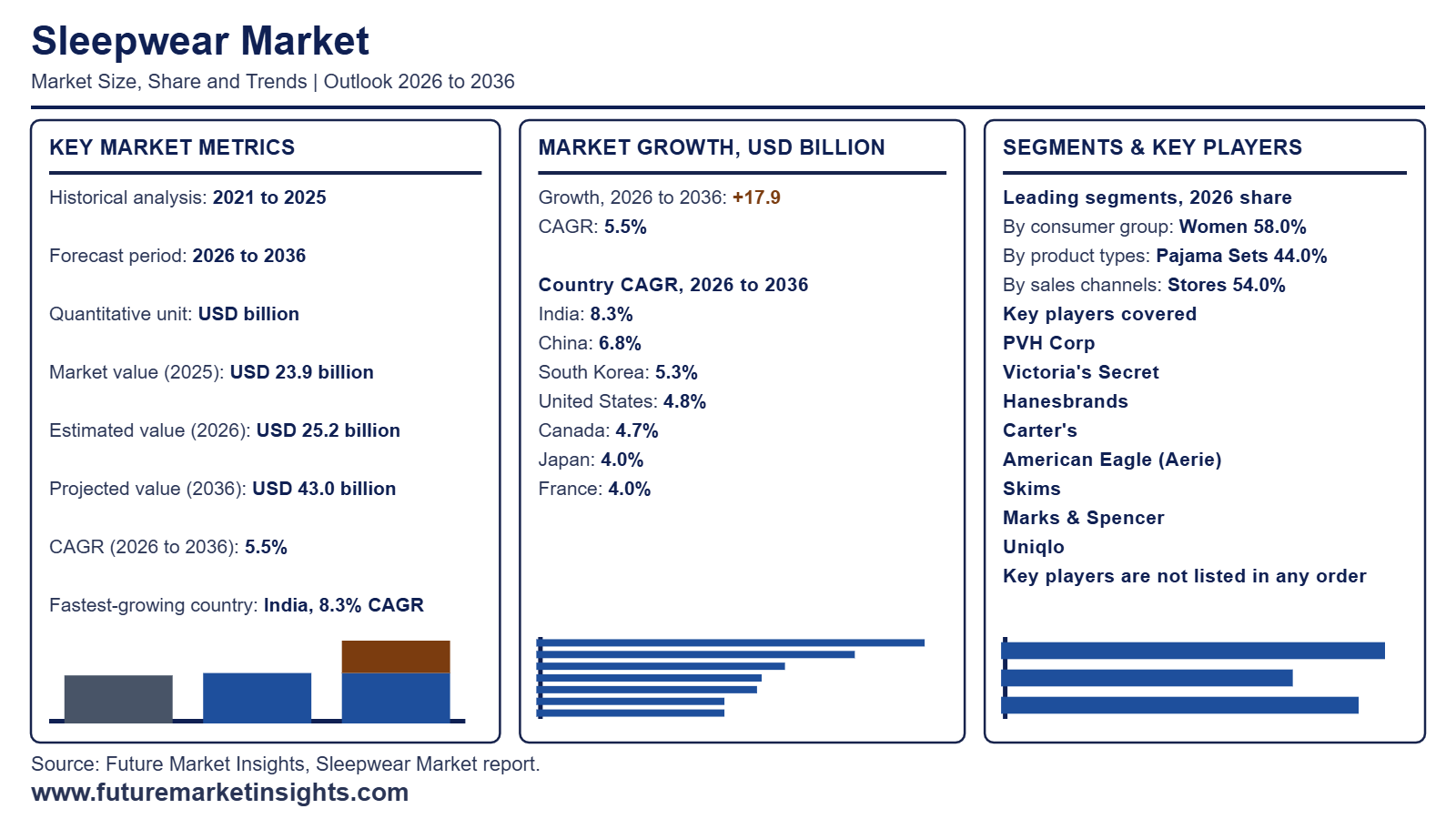
The global sleepwear market is valued at USD 25.2 billion in 2026, up from USD 23.9 billion in 2025, and is projected by Future Market Insights (FMI) to reach USD 43.0 billion by 2036, expanding at a 5.5% CAGR from 2026 to 2036 and generating USD 17.9 billion in incremental revenue over the 10-year forecast period.
| Market Metric | Valuation / Share / Forecast Benchmark |
|---|---|
| 2025 Market Size (Historical) | USD 23.9 billion |
| 2026 Market Size (Estimated) | USD 25.2 billion |
| 2036 Market Size (Projected) | USD 43.0 billion |
| Compound Annual Growth Rate (2026 to 2036) | 5.5% CAGR |
| Incremental Dollar Opportunity (2026 to 2036) | USD 17.9 billion |
| Dominant Consumer Group (2026 to 2036 Share) | Women (58.0% in 2026, 58.5% by 2036) | Children fastest at 5.8% CAGR |
| Leading & Fastest-Growing Product Types | Pajama Sets (44.0% share in 2026; 5.2% CAGR) | Loungewear Sets (fastest, 7.0% CAGR) |
| Leading & Fastest-Growing Sales Channels | Stores (54.0% share in 2026; 3.8% CAGR) | Online (fastest, 8.0% CAGR) |
| Largest Country Markets (2026 Global Share) | United States (27.0%), China (13.0%), Japan (7.0%) |
| Fastest-Growing Country Markets (2026 to 2036) | India (8.3% CAGR), China (6.8% CAGR), South Korea (5.3% CAGR) |
| Leading Tier-1 Companies | PVH Corp, Victoria's Secret, Hanesbrands, Carter's, American Eagle (Aerie), Skims, Marks & Spencer, Uniqlo |
Source: Future Market Insights analysis of the sleepwear market, 2026.
Executive Market Overview
Adoption of sleepwear as everyday loungewear is widening the market beyond clothes worn only in bed. Younger shoppers wear pajama sets and lounge pieces at home, on short trips and when working remotely. Many also pair sleep tops with jeans or joggers. As a result, buyers are replacing sleepwear more often and choosing styles that look good outside the bedroom. Loungewear sets are taking about 22% of revenue in 2026 and growing at around 7.0% a year. Pajama sets, however, remain the largest product with about 44% of revenue. The market as a whole is growing at about 5.5% a year, a pace expected to hold through 2036.
Sales of children's sleepwear and online purchases are rising faster than the rest of the market. For example, Carter's said in October 2026 that third-quarter sleepwear sales grew by double digits in units and dollars. This followed the launch of a simpler sleepwear range. Children's sleepwear is taking about 18% of revenue in 2026 and growing at about 5.8% a year. Online channels, meanwhile, hold about 38% of revenue and are growing at around 8.0% a year. Shoppers can compare fabrics, sizes and prices easily and buy matching family sets online.
Analyst Perspective
"Sleepwear is being bought for the whole day, not just the night, which is raising replacement rates. Lingerie and children's brands are reporting double-digit gains where ranges have been refreshed. Online sales and loungewear will take most of the growth. Basic pajamas sold in stores, however, will grow slowly."
- Rahul Pandita, Principal Consultant, Future Market Insights (FMI)
Major Market Trends and Insights
- Shoppers Are Wearing Sleepwear Outside the Home: Demand for pajama sets and lounge pieces that work at home, outdoors and while travelling is rising. Younger women, in particular, mix sleep tops and lounge trousers with everyday clothes. This raises the number of items bought each year. Brands such as Aerie, Skims and Pink, in turn, have built large sleep and lounge ranges. As a result, shoppers are paying higher prices for well-cut lounge pieces.
- Lingerie and Sleep Brands Are Returning to Growth: Sales at large lingerie and sleepwear sellers are rising after several weak years. For example, Victoria's Secret reported a 10% rise in second-quarter 2026 net sales to USD 1.61 billion. Comparable sales rose 9%, and the company raised its full-year outlook. Stronger full-price selling shows shoppers will pay for comfort and design. Brands are also adding wider size ranges, which brings in new customers.
- Shoppers Are Choosing Sleepwear for Sleep Quality: Purchases are shifting toward natural and cooling fabrics as shoppers pay more attention to sleep quality. Cotton, modal and silk, for instance, are gaining favour over cheaper synthetic blends. Some brands sell temperature-control ranges with claims about better rest. Matching family sets for holidays and gifts, meanwhile, add seasonal peaks. Sales are highest in the last quarter of the year as a result.
What Are the Main Drivers, Restraints, and Opportunities?
Growth in sleepwear sales is driven by greater focus on comfort and sleep, lounge use and online and gift buying. Price competition and rising cotton costs restrain growth, while loungewear, children's ranges and online channels offer the largest new revenue.
Driver: Comfort, Sleep Health and Loungewear
Demand for comfortable sleepwear is rising as people pass more time at home and focus on sleep quality. Remote and hybrid work, in turn, has made lounge pieces part of daily clothing for many workers. Gifting at holidays and birthdays also supports steady demand. As a result, women's sleepwear is set to add about USD 10.6 billion of revenue by 2036.
Restraint: Price Competition and Rising Costs
Prices for basic sleepwear stay low, since many shoppers buy low-priced sets from supermarkets and online marketplaces. Some consumers, especially men, replace sleepwear only rarely. Rising cotton, labour and shipping costs, meanwhile, reduce margins. Tariffs on clothing imports have also raised costs for brands selling into the United States. Large discounts during sales events keep average prices low as a result.
Opportunity: Loungewear, Children's Ranges and Online Sales
Online sales of sleepwear are set to add about USD 11.1 billion by 2036, the largest investment opportunity in the market. Loungewear sets, in turn, are growing at about 7.0% a year. Children's sleepwear is growing at about 5.8% a year as parents buy themed and matching family sets. India, at about 8.3% a year, is the fastest-growing profiled country. Rising incomes are spreading branded sleepwear beyond large cities there.
How Is the Sleepwear Market Segmented?
The sleepwear market is segmented into consumer group, product type, sales channel and region, with values shown in USD billion.
| Segmentation Axis | Sub-Segments Covered | 2026 Leading Segment & Share | Main Growth Benchmark (2026 to 2036) |
|---|---|---|---|
| Consumer Group | Women, Men, Children | Women (58.0% revenue share) | Children (5.8% CAGR) vs. Men (5.0% CAGR) |
| Product Type | Pajama Sets, Nightgowns & Sleep Shirts, Loungewear Sets, Robes & Others | Pajama Sets (44.0% revenue share) | Loungewear Sets (7.0% CAGR) vs. Nightgowns (4.6% CAGR) |
| Sales Channel | Stores, Online, Others | Stores (54.0% revenue share) | Online leads growth at an 8.0% CAGR vs. Stores at 3.8% |
| Region | North America, Europe, East Asia, South Asia & Pacific, Latin America, Middle East & Africa | North America (30.0% revenue share) | South Asia & Pacific leads regional growth at an 8.0% CAGR; India leads national growth at an 8.3% CAGR |
Source: Future Market Insights analysis of the sleepwear market, 2026.
Why Does the Women's Segment Lead by Consumer Group?
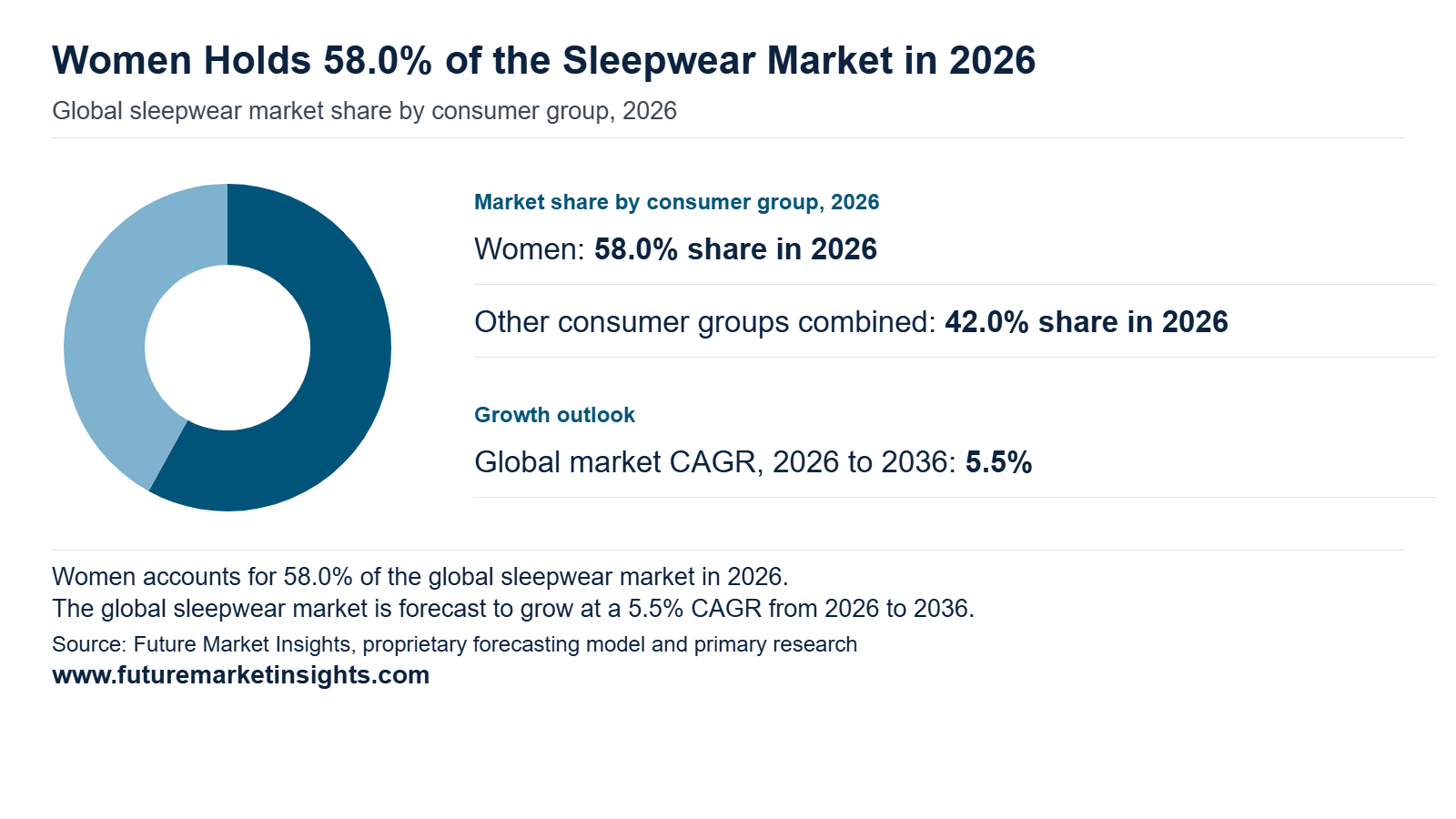
Women's sleepwear makes up about 58% of revenue in 2026, worth USD 14.6 billion. Women buy sleepwear more often, choose from a wider range of styles and are the main buyers of lounge pieces. This group is growing at about 5.6% a year. Children's sleepwear, however, is growing fastest at close to 5.8%, from about 18% of revenue. Themed prints and matching family sets support this growth. Men's sleepwear holds about 24% and is growing at around 5.0%.
Why Does the Pajama Set Segment Lead by Product Type?
Purchases of pajama sets lead by product type, since these sets are the most common sleepwear across all age groups. Pajama sets therefore account for about 44% of revenue in 2026, worth USD 11.1 billion. Growth, however, is about 5.2% a year, below loungewear sets. Loungewear sets, at about 22%, are growing fastest at close to 7.0%. Nightgowns and sleep shirts hold about 22% and are growing at around 4.6%. Robes and other items hold about 12% and are growing at about 5.2% a year.
Why Does the Store Segment Lead by Sales Channel?
Department stores, supermarkets and clothing chains sell large volumes of sleepwear, often in gift and holiday ranges. Stores therefore hold about 54% of revenue in 2026, worth USD 13.6 billion. Store sales, however, are growing at only about 3.8% a year. Online channels, at about 38%, are growing fastest at close to 8.0%. As a result, online sales are set to reach nearly half of revenue by 2036. Other channels, such as hotel shops and direct sales, hold about 8% and are growing at around 2.6% a year.
Sleepwear Market by Region and Country (2026 to 2036)
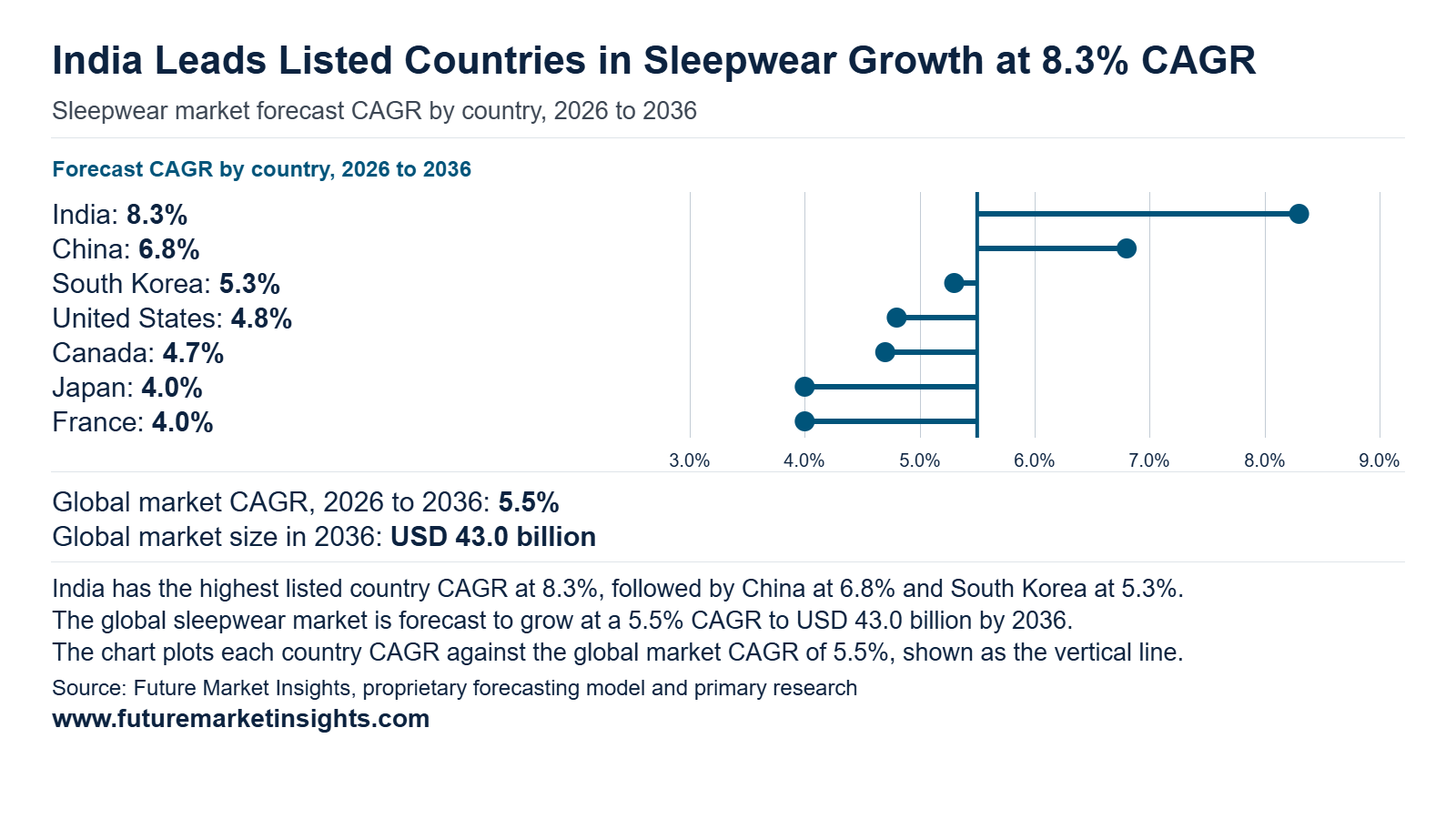
Sales of sleepwear are highest in North America, where purchases per shopper and lounge and gift buying are strong. North America is likely to remain the highest market, holding about 30% of global revenue in 2026. Growth there is about 4.8% a year. Europe, at about 26%, is the slowest region at close to 4.0%. East Asia holds roughly 24% and is growing at around 6.2%, led by China. South Asia and Pacific, however, is the fastest-growing region at about 8.0% a year, led by India. The Middle East and Africa is growing at around 7.5% and Latin America at about 6.0%. The ten profiled countries make up around 77% of global revenue.
| Country | 2026 Revenue | 2036 Revenue | 10-Year Addition | 2026 to 2036 CAGR | Global Share (2026 → 2036) |
|---|---|---|---|---|---|
| United States | USD 6.80 billion | USD 10.87 billion | +USD 4.07 billion | 4.8% | 27.0% → 25.3% |
| China | USD 3.28 billion | USD 6.33 billion | +USD 3.05 billion | 6.8% | 13.0% → 14.7% |
| Japan | USD 1.76 billion | USD 2.61 billion | +USD 0.85 billion | 4.0% | 7.0% → 6.1% |
| United Kingdom | USD 1.51 billion | USD 2.20 billion | +USD 0.68 billion | 3.8% | 6.0% → 5.1% |
| Germany | USD 1.51 billion | USD 2.15 billion | +USD 0.64 billion | 3.6% | 6.0% → 5.0% |
| India | USD 1.26 billion | USD 2.80 billion | +USD 1.54 billion | 8.3% | 5.0% → 6.5% |
| France | USD 1.13 billion | USD 1.68 billion | +USD 0.55 billion | 4.0% | 4.5% → 3.9% |
| South Korea | USD 0.76 billion | USD 1.27 billion | +USD 0.51 billion | 5.3% | 3.0% → 2.9% |
| Italy | USD 0.76 billion | USD 1.07 billion | +USD 0.31 billion | 3.5% | 3.0% → 2.5% |
| Canada | USD 0.63 billion | USD 1.00 billion | +USD 0.37 billion | 4.7% | 2.5% → 2.3% |
Source: Future Market Insights analysis of the sleepwear market, 2026.
United States
Strong lounge and gift buying is projected to keep the US the largest sleepwear market. In 2026, the market in the US is valued at USD 6.8 billion. Through 2036, it is likely to grow to USD 10.9 billion at a CAGR of 4.8%. Key trends to look for include renewed growth at lingerie and children's brands. For example, Victoria's Secret reported 10% sales growth in its second quarter of 2026. Carter's, in turn, reported double-digit growth in sleepwear sales in its third quarter. Matching family pajamas for the holidays are a large seasonal category. Shoppers often buy several sets at once for gifts. Tariffs on clothing imports, however, have raised costs for many brands. Online brands, meanwhile, are growing through social media and wide size ranges.
China
Purchases of comfortable home clothing are rising among middle-income households in China. Local brands such as Ubras, Bananain and Gukoo sell sleep and lounge sets mainly through Tmall, JD.com and Douyin live-streaming. Shoppers favour soft cotton and silk and pay attention to fabric quality. Victoria's Secret, meanwhile, said its China business grew strongly in 2026. Live-stream sales events such as Singles' Day on 11 November create large peaks in demand. China is also the largest producer of sleepwear for global brands. Factories in Zhejiang and Guangdong supply both local and export ranges. Valued at USD 3.3 billion in 2026, the market in China is set to reach USD 6.3 billion by 2036. Growth is at a CAGR of 6.8%, the second fastest among the profiled countries.
Japan
Seasonal buying shapes sleepwear demand in Japan, where shoppers buy cooling fabrics in summer and warm sets in winter. Uniqlo, Muji, Wacoal and Gelato Pique are leading brands. Gift buying for family members is common, especially at year-end. Department stores, in turn, remain important for gift purchases. A shrinking population, however, limits volume growth. Older shoppers buy higher-priced sets made with natural fabrics as a result. Convenience stores, meanwhile, sell basic sleepwear for travellers and single-person households. The market in Japan is valued at USD 1.8 billion in 2026. By 2036, it is projected to reach USD 2.6 billion, growing at a CAGR of 4.0%. Japan's share of global revenue falls to about 6.1% by 2036, as other markets grow faster.
United Kingdom
Gift buying and supermarket clothing ranges support sleepwear sales in the United Kingdom. Marks & Spencer is the leading seller of sleepwear in the country. Primark, Next and online brands such as Boux Avenue, meanwhile, offer lower-priced ranges. Christmas pajamas, dressing gowns and matching family sets create a large peak at the end of the year. Premium brands such as The White Company sell cotton and silk sets. Online sales are growing quickly, and many shoppers buy lounge sets for working from home. Price competition, however, is strong among supermarket ranges and discount chains. The market in the UK stands at USD 1.5 billion in 2026 and is set to reach USD 2.2 billion by 2036. This represents a CAGR of 3.8%.
Germany
Demand for long-lasting cotton nightwear is strong in Germany. German brands such as Schiesser, Mey and Calida are known for this quality. Shoppers buy through department stores, clothing chains and online sellers such as Zalando and Otto. Discount chains such as Lidl and Aldi, in turn, sell low-priced sleepwear in weekly promotions. Interest in organic cotton is rising. Cold winters also support sales of warm flannel and jersey sets. Many shoppers buy lounge pieces for home working as well. Online sales, meanwhile, are growing faster than store sales among younger buyers in Berlin and Munich. In 2026, the market in Germany is worth USD 1.5 billion. By 2036, it is projected to reach USD 2.2 billion at a CAGR of 3.6%.
India
Shoppers in India are moving from unbranded nightwear to branded sets with better fit and fabric. As a result, India is the fastest-growing sleepwear market among the profiled countries. Brands such as Jockey, Zivame and Clovia sell nightwear and lounge sets through stores and online. Online platforms such as Myntra and Nykaa Fashion, meanwhile, reach buyers in smaller cities. Hot weather favours light cotton fabrics. Many women also buy nighties and kaftans as everyday home wear. Low-priced local makers, however, still hold a large share of sales, especially in smaller towns and rural areas. In 2026, the market in India is valued at USD 1.3 billion. By 2036, it is projected to reach USD 2.8 billion, growing at a CAGR of 8.3%.
France
Sales of silk and cotton sleepwear benefit from France's strong lingerie industry. Brands such as Etam, Princesse tam.tam and Monoprix sell sleep and lounge pieces at many price levels. Premium brands such as Eres and Carine Gilson, in turn, sell silk nightwear at home and abroad. Department stores and specialist lingerie shops remain important channels. Online sales, meanwhile, are growing among younger shoppers. Textile waste rules push brands toward organic cotton. Gift buying at Christmas and Mother's Day creates seasonal peaks. Paris remains the main centre for premium sleepwear sales, helped by tourist buying. Valued at USD 1.1 billion in 2026, the market in France is expected to reach USD 1.7 billion by 2036. Growth is at a CAGR of 4.0%.
South Korea
Adoption of lounge sets for short trips to convenience stores and cafés is common among young shoppers in South Korea. Local brands such as Spao and platforms such as Musinsa sell low-priced sets with popular character prints. Shoppers often buy matching couple and family sets. Online and mobile shopping, in turn, account for a large share of sales. Cold winters support demand for fleece sets. Brands also link sleepwear to popular television dramas and celebrities, which drives quick sales of new designs. The market in South Korea is valued at USD 0.76 billion in 2026. Through 2036, it is likely to grow to USD 1.3 billion at a CAGR of 5.3%. This is the third fastest rate among the profiled countries.
Italy
An ageing population limits volume growth in Italy, the slowest-growing sleepwear market among the profiled countries. Older shoppers in northern cities, however, buy higher-quality sets more often. Brands such as Intimissimi, Calzedonia and Golden Lady sell sleepwear through large store networks. Italian shoppers favour natural fabrics and well-cut designs. Premium silk and cotton sleepwear made in Italy, in turn, is exported to Europe, the United States and the Middle East. Discount stores, markets and supermarkets sell lower-priced ranges. Online sales, meanwhile, are growing among younger shoppers in Milan and Rome, who buy lounge sets. In 2026, the market in Italy stands at USD 0.76 billion. By 2036, it is projected to reach USD 1.1 billion at a CAGR of 3.5%.
Canada
Cold winters support demand for flannel and fleece sleepwear in Canada, especially in Ontario and Quebec. Retailers such as La Senza and Roots sell sleepwear alongside US brands such as Victoria's Secret and Aerie. Matching family pajamas for the holidays are a large seasonal category. Online shopping, meanwhile, is growing quickly, and Canadian shoppers often order from US retailers. Interest in organic and locally made sleepwear is rising among younger urban shoppers. Gift buying, in turn, adds steady demand at year-end. Price-conscious shoppers also buy from discount chains and supermarkets, which keeps average prices low. Worth USD 0.63 billion in 2026, the market in Canada is set to reach USD 1.0 billion by 2036. Growth is at a CAGR of 4.7%.
Competitive Environment and Notable Companies
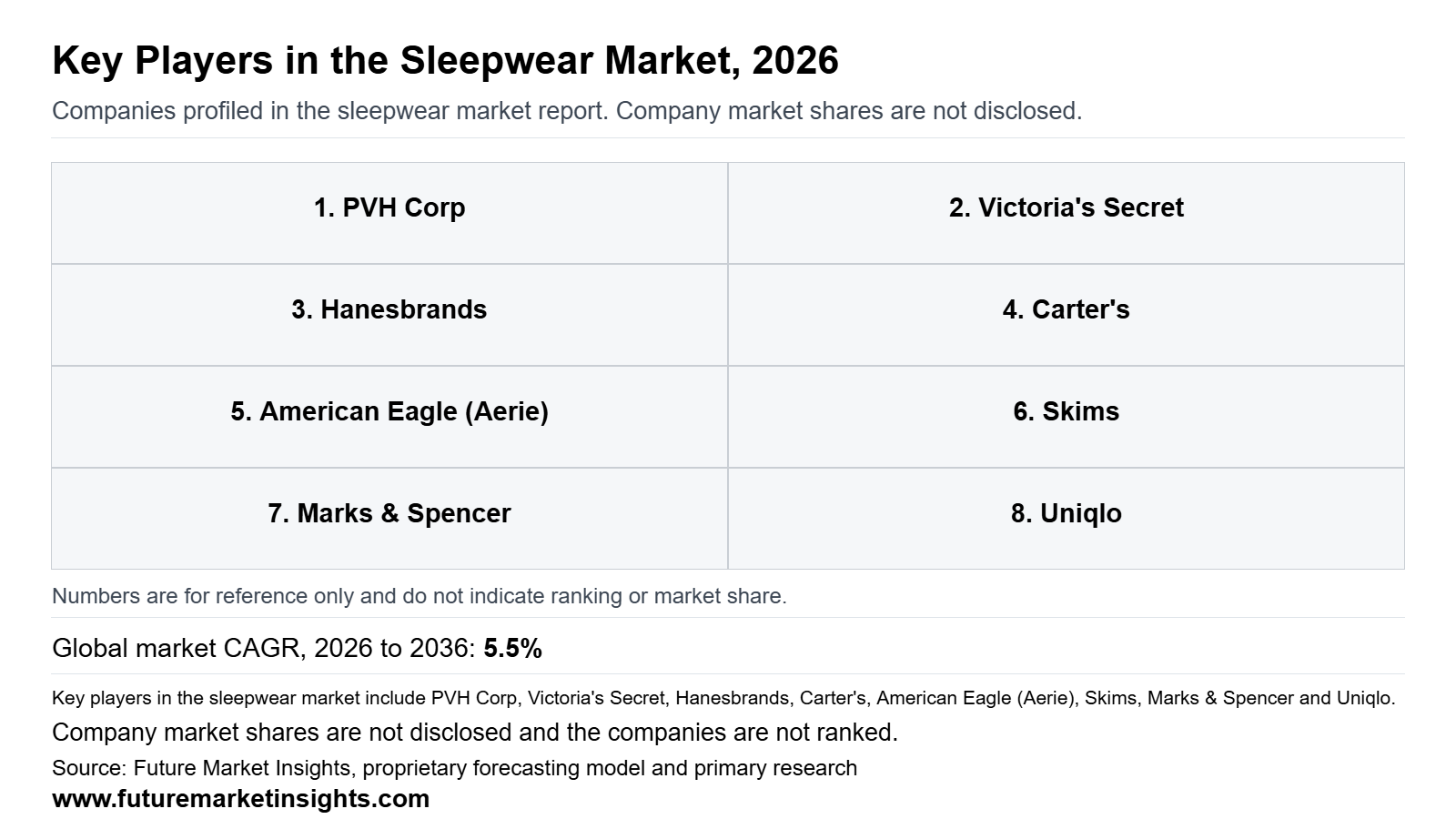
The sleepwear market is split between lingerie and apparel groups and specialist brands. Notable companies include PVH Corp, Victoria's Secret, Hanesbrands, Carter's and American Eagle (Aerie). Skims, Marks & Spencer, Calzedonia and Uniqlo are also active, along with many online brands. Apparel groups sell sleepwear as part of wider ranges, while specialist brands focus on comfort and design. Since shoppers wear sleepwear outside the home, brands are expanding lounge ranges. As a result, competition is shifting toward fabric quality, fit, design and size range. Price, however, still decides most basic purchases.
How Are Companies Positioned in the Sleepwear Market?
Brands are refreshing ranges and widening sizes. For example, Victoria's Secret reported 10% sales growth in September 2026 and raised its full-year outlook. Carter's, in turn, reported double-digit growth in sleepwear sales in October 2026 after launching a new range. Brands are expanding lounge collections. Online brands, meanwhile, are adding matching family and couple sets.
How Do Shoppers Choose Sleepwear?
Shoppers compare sleepwear first on comfort and fabric. Fit and design come next, especially for lounge pieces worn outside the home. Price then decides most basic purchases. Many shoppers also buy sleepwear as gifts and look for matching sets.
Which Capabilities Distinguish Brand Offers?
Soft natural fabrics are the main point of difference between sleepwear brands. Wide size ranges, in turn, bring in new customers. Matching family and couple sets raise order values during holidays. Strong online stores also help brands reach buyers outside large cities.
How Does Geographic Reach Affect Competition?
Global brands sell similar ranges in many countries, which lowers costs. Local brands, however, understand climate and taste better. Seasonal demand also differs by hemisphere. As a result, global brands can move stock between regions to sell all year. Local makers lead in markets with low prices, such as India.
| Verified Company Evidence (2026) | Commercial Effect | Buyer Action |
|---|---|---|
| 3 September 2026: Victoria's Secret reported Q2 net sales of USD 1.611 billion, up 10%, with comparable sales up 9%, and raised its full-year sales outlook to USD 7.10-7.18 billion (Victoria's Secret; Just Style, September 2026). | Shows renewed demand for lingerie, sleep and lounge ranges. | Increase orders of full-price lounge and sleep sets for holiday season. |
| September 2026: Victoria's Secret said international sales grew 20%, led by China and European online sales (Webull/Benzinga, September 2026). | International markets are adding growth for US sleep and lingerie brands. | Review ranges for overseas online sales. |
| October 2026: Carter's said its sleepwear category delivered double-digit growth in units and dollar sales in Q3 after launching its Stellar Sleep System range (The Cerbat Gem, October 2026). | Shows strong demand for simple, well-organised children's sleepwear ranges. | Simplify children's sleepwear ranges by age and size. |
Source: Verified corporate disclosures and Future Market Insights analysis, 2026.
| Company | Core Positioning | Verified Activity & Source Attribution |
|---|---|---|
| Victoria's Secret & Co. | Lingerie, sleepwear and Pink lounge ranges | Q2 2026 net sales up 10% (Victoria's Secret, September 2026). |
| Carter's | Children's clothing and sleepwear | Double-digit sleepwear growth in Q3 2026 (The Cerbat Gem, October 2026). |
| Hanesbrands | Basics, underwear and sleepwear | Company information. |
| Marks & Spencer | Leading UK sleepwear seller | Company information. |
Source: Verified corporate disclosures and Future Market Insights analysis, 2026.
Sleepwear Market Report Scope and Research Methodology
Sleepwear sales by country form the base of FMI's estimate. These sales are taken from retail statistics, company reports and online sales data. Sales are split by consumer group, product type and channel. Country totals are then added to give regional and global values. Forecasts are built on population, income, online shopping growth, fashion trends and prices. Company results from 2026, such as category growth at Carter's, are used to check recent demand. As a final step, FMI checks the results against the reported sleepwear revenue of listed apparel companies. Any country where figures do not match is adjusted.
| Coverage Field | Report Scope |
|---|---|
| Market definition | Clothing designed for sleeping and relaxing at home, including pajama sets, nightgowns, sleep shirts, loungewear sets and robes. |
| Consumer groups | Women, men and children. |
| Product types | Pajama sets, nightgowns and sleep shirts, loungewear sets, and robes and others. |
| Sales channels | Stores, online and others. |
| Fabrics | Cotton, silk, modal, bamboo-based fabrics and synthetic blends. |
| Customer types | Household shoppers and gift buyers. |
| Revenue basis | Retail sales value of sleepwear products. |
| Exclusions | Underwear, hosiery, bedding and medical garments. |
| Quantitative units | USD billion for value. |
| Volume basis | Units sold, used to check value estimates. |
| Value basis | Retail sales recognised in the country of the shopper. |
| Regions covered | North America, Europe, East Asia, South Asia & Pacific, Latin America, and Middle East & Africa. |
| National coverage | United States, China, Japan, United Kingdom, Germany, India, France, South Korea, Italy, Canada. |
| Companies covered | PVH Corp, Victoria's Secret, Hanesbrands, Carter's, American Eagle, Skims, Marks & Spencer, Calzedonia and Uniqlo. |
Source: Future Market Insights analysis of the sleepwear market, 2026.
Research Sources and Bibliography
- Victoria's Secret & Co. (2026, September 3). Victoria's Secret & Co. reports second quarter 2026 results (Form 8-K, Exhibit 99.1).
- Just Style. (2026, September 4). Victoria's Secret lifts full-year outlook on strong Q2 net sales growth.
- Webull / Benzinga. (2026, September). Transcript: Victoria's Secret Q2 2026 earnings conference call.
- The Cerbat Gem. (2026, October). Carter's Q3 earnings call highlights.
- FashionUnited. (2026, August 3). Carter's net sales up 5 percent in Q2 2026, exceeds prior outlook.
Table of Content
- Key Takeaways
- Market Size and CAGR
- Top Growth Driver
- Fastest Growing Segment
- Leading Region
- Key Companies
- Emerging Opportunities
- Executive Summary
- Global Market Outlook
- Demand-side Trends
- Supply-side Trends
- Technology Roadmap Analysis
- Analysis and Recommendations
- Analyst Perspective (What is happening? Why now? What should investors know?)
- Key Questions Answered
- How large is the market?
- What is the CAGR?
- What are key trends?
- Which region dominates?
- Who are the leaders?
Read More...
- Market Overview
- Market Coverage / Taxonomy
- Market Definition / Scope / Limitations
- Research Methodology
- Chapter Orientation
- Analytical Lens and Working Hypotheses
- Market Structure, Signals, and Trend Drivers
- Benchmarking and Cross-market Comparability
- Market Sizing, Forecasting, and Opportunity Mapping
- Research Design and Evidence Framework
- Desk Research Programme (Secondary Evidence)
- Expert Input and Fieldwork (Primary Evidence)
- Tooling, Models, and Reference Databases
- Data Engineering and Model Build
- Quality Assurance and Audit Trail
- Market Background
- Market Dynamics (Drivers, Restraints, Opportunity, Trends)
- Scenario Forecast (Optimistic, Likely, Conservative)
- Impact Analysis
- AI Impact
- Sustainability Impact
- Regulatory Impact
- Technology Impact
- Consumer / Buyer Analysis
- Purchase Drivers
- Adoption Barriers
- Buyer Journey
- Opportunity Map Analysis
- Product Life Cycle Analysis
- Supply Chain Analysis
- Investment Feasibility Matrix
- Value Chain Analysis
- PESTLE and Porter's Analysis
- Regulatory Landscape
- Regional Parent Market Outlook
- Production and Consumption Statistics
- Import and Export Statistics
- Global Sleepwear Market Analysis and Forecast, 2021 to 2036
- Historical Market Size Value (USD Billion) Analysis, 2021 to 2025
- Current and Future Market Size Value (USD Billion) Projections, 2026 to 2036
- Y-o-Y Growth Trend Analysis
- Absolute $ Opportunity Analysis
- Global Sleepwear Market Pricing Analysis, 2021 to 2036
- Global Sleepwear Market Analysis and Forecast, By Consumer Group, 2021 to 2036
- Introduction / Key Findings
- Historical Market Size Value (USD Billion) Analysis By Consumer Group, 2021 to 2025
- Current and Future Market Size Value (USD Billion) Analysis and Forecast By Consumer Group, 2026 to 2036
- Women
- Men
- Children
- Y-o-Y Growth Trend Analysis By Consumer Group, 2021 to 2025
- Absolute $ Opportunity Analysis By Consumer Group, 2026 to 2036
- Global Sleepwear Market Analysis and Forecast, By Product Type, 2021 to 2036
- Introduction / Key Findings
- Historical Market Size Value (USD Billion) Analysis By Product Type, 2021 to 2025
- Current and Future Market Size Value (USD Billion) Analysis and Forecast By Product Type, 2026 to 2036
- Pajama Sets
- Nightgowns & Sleep Shirts
- Loungewear Sets
- Robes & Others
- Y-o-Y Growth Trend Analysis By Product Type, 2021 to 2025
- Absolute $ Opportunity Analysis By Product Type, 2026 to 2036
- Global Sleepwear Market Analysis and Forecast, By Sales Channel, 2021 to 2036
- Introduction / Key Findings
- Historical Market Size Value (USD Billion) Analysis By Sales Channel, 2021 to 2025
- Current and Future Market Size Value (USD Billion) Analysis and Forecast By Sales Channel, 2026 to 2036
- Stores
- Online
- Others
- Y-o-Y Growth Trend Analysis By Sales Channel, 2021 to 2025
- Absolute $ Opportunity Analysis By Sales Channel, 2026 to 2036
- Global Sleepwear Market Analysis and Forecast, By Region, 2021 to 2036
- Introduction
- Historical Market Size Value (USD Billion) Analysis By Region, 2021 to 2025
- Current Market Size Value (USD Billion) Analysis and Forecast By Region, 2026 to 2036
- North America
- Europe
- East Asia
- South Asia & Pacific
- Latin America
- Middle East & Africa
- Market Attractiveness Analysis By Region
- North America Sleepwear Market Analysis and Forecast, By Country, 2021 to 2036
- Historical Market Size Value (USD Billion) Trend Analysis By Market Taxonomy, 2021 to 2025
- Market Size Value (USD Billion) Forecast By Market Taxonomy, 2026 to 2036
- By Country
- United States
- Canada
- Rest of North America
- By Consumer Group
- By Product Type
- By Sales Channel
- By Country
- Market Attractiveness Analysis
- By Country
- By Consumer Group
- By Product Type
- By Sales Channel
- Key Takeaways
- Europe Sleepwear Market Analysis and Forecast, By Country, 2021 to 2036
- Historical Market Size Value (USD Billion) Trend Analysis By Market Taxonomy, 2021 to 2025
- Market Size Value (USD Billion) Forecast By Market Taxonomy, 2026 to 2036
- By Country
- United Kingdom
- Germany
- France
- Italy
- Rest of Europe
- By Consumer Group
- By Product Type
- By Sales Channel
- By Country
- Market Attractiveness Analysis
- By Country
- By Consumer Group
- By Product Type
- By Sales Channel
- Key Takeaways
- East Asia Sleepwear Market Analysis and Forecast, By Country, 2021 to 2036
- Historical Market Size Value (USD Billion) Trend Analysis By Market Taxonomy, 2021 to 2025
- Market Size Value (USD Billion) Forecast By Market Taxonomy, 2026 to 2036
- By Country
- China
- Japan
- South Korea
- Rest of East Asia
- By Consumer Group
- By Product Type
- By Sales Channel
- By Country
- Market Attractiveness Analysis
- By Country
- By Consumer Group
- By Product Type
- By Sales Channel
- Key Takeaways
- South Asia & Pacific Sleepwear Market Analysis and Forecast, By Country, 2021 to 2036
- Historical Market Size Value (USD Billion) Trend Analysis By Market Taxonomy, 2021 to 2025
- Market Size Value (USD Billion) Forecast By Market Taxonomy, 2026 to 2036
- By Country
- India
- Rest of South Asia & Pacific
- By Consumer Group
- By Product Type
- By Sales Channel
- By Country
- Market Attractiveness Analysis
- By Country
- By Consumer Group
- By Product Type
- By Sales Channel
- Key Takeaways
- Latin America Sleepwear Market Analysis and Forecast, By Country, 2021 to 2036
- Historical Market Size Value (USD Billion) Trend Analysis By Market Taxonomy, 2021 to 2025
- Market Size Value (USD Billion) Forecast By Market Taxonomy, 2026 to 2036
- By Country
- Rest of Latin America
- By Consumer Group
- By Product Type
- By Sales Channel
- By Country
- Market Attractiveness Analysis
- By Country
- By Consumer Group
- By Product Type
- By Sales Channel
- Key Takeaways
- Middle East & Africa Sleepwear Market Analysis and Forecast, By Country, 2021 to 2036
- Historical Market Size Value (USD Billion) Trend Analysis By Market Taxonomy, 2021 to 2025
- Market Size Value (USD Billion) Forecast By Market Taxonomy, 2026 to 2036
- By Country
- Rest of Middle East & Africa
- By Consumer Group
- By Product Type
- By Sales Channel
- By Country
- Market Attractiveness Analysis
- By Country
- By Consumer Group
- By Product Type
- By Sales Channel
- Key Takeaways
- Key Countries Market Analysis
- United States
- Pricing Analysis
- Market Share Analysis, 2025
- By Consumer Group
- By Product Type
- By Sales Channel
- China
- Pricing Analysis
- Market Share Analysis, 2025
- By Consumer Group
- By Product Type
- By Sales Channel
- Japan
- Pricing Analysis
- Market Share Analysis, 2025
- By Consumer Group
- By Product Type
- By Sales Channel
- United Kingdom
- Pricing Analysis
- Market Share Analysis, 2025
- By Consumer Group
- By Product Type
- By Sales Channel
- Germany
- Pricing Analysis
- Market Share Analysis, 2025
- By Consumer Group
- By Product Type
- By Sales Channel
- India
- Pricing Analysis
- Market Share Analysis, 2025
- By Consumer Group
- By Product Type
- By Sales Channel
- France
- Pricing Analysis
- Market Share Analysis, 2025
- By Consumer Group
- By Product Type
- By Sales Channel
- South Korea
- Pricing Analysis
- Market Share Analysis, 2025
- By Consumer Group
- By Product Type
- By Sales Channel
- Italy
- Pricing Analysis
- Market Share Analysis, 2025
- By Consumer Group
- By Product Type
- By Sales Channel
- Canada
- Pricing Analysis
- Market Share Analysis, 2025
- By Consumer Group
- By Product Type
- By Sales Channel
- United States
- Market Structure Analysis
- Competition Dashboard
- Competition Benchmarking
- Market Share Analysis of Top Players
- By Regional
- By Consumer Group
- By Product Type
- By Sales Channel
- Emerging Startups
- Innovation Benchmarking
- Competition Analysis
- Competition Deep Dive
- PVH Corp
- Overview
- Product Portfolio
- Profitability by Market Segments
- Sales Footprint
- Strategy Overview
- Marketing Strategy
- Product Strategy
- Channel Strategy
- Victoria's Secret
- Hanesbrands
- Carter's
- American Eagle
- Skims
- Marks & Spencer
- Calzedonia
- Uniqlo
- PVH Corp
- Case Studies
- Success Stories
- Recent Developments
- Competition Deep Dive
- Assumptions & Acronyms Used
List of Tables
- Table 1: Global Sleepwear Market Value (USD Billion) Forecast by Region, 2021 to 2036
- Table 2: Global Sleepwear Market Value (USD Billion) Forecast by Consumer Group, 2021 to 2036
- Table 3: Global Sleepwear Market Value (USD Billion) Forecast by Product Type, 2021 to 2036
- Table 4: Global Sleepwear Market Value (USD Billion) Forecast by Sales Channel, 2021 to 2036
- Table 5: North America Sleepwear Market Value (USD Billion) Forecast by Country, 2021 to 2036
- Table 6: North America Sleepwear Market Value (USD Billion) Forecast by Consumer Group, 2021 to 2036
- Table 7: North America Sleepwear Market Value (USD Billion) Forecast by Product Type, 2021 to 2036
- Table 8: North America Sleepwear Market Value (USD Billion) Forecast by Sales Channel, 2021 to 2036
- Table 9: Europe Sleepwear Market Value (USD Billion) Forecast by Country, 2021 to 2036
- Table 10: Europe Sleepwear Market Value (USD Billion) Forecast by Consumer Group, 2021 to 2036
- Table 11: Europe Sleepwear Market Value (USD Billion) Forecast by Product Type, 2021 to 2036
- Table 12: Europe Sleepwear Market Value (USD Billion) Forecast by Sales Channel, 2021 to 2036
- Table 13: East Asia Sleepwear Market Value (USD Billion) Forecast by Country, 2021 to 2036
- Table 14: East Asia Sleepwear Market Value (USD Billion) Forecast by Consumer Group, 2021 to 2036
- Table 15: East Asia Sleepwear Market Value (USD Billion) Forecast by Product Type, 2021 to 2036
- Table 16: East Asia Sleepwear Market Value (USD Billion) Forecast by Sales Channel, 2021 to 2036
- Table 17: South Asia & Pacific Sleepwear Market Value (USD Billion) Forecast by Country, 2021 to 2036
- Table 18: South Asia & Pacific Sleepwear Market Value (USD Billion) Forecast by Consumer Group, 2021 to 2036
- Table 19: South Asia & Pacific Sleepwear Market Value (USD Billion) Forecast by Product Type, 2021 to 2036
- Table 20: South Asia & Pacific Sleepwear Market Value (USD Billion) Forecast by Sales Channel, 2021 to 2036
- Table 21: Latin America Sleepwear Market Value (USD Billion) Forecast by Country, 2021 to 2036
- Table 22: Latin America Sleepwear Market Value (USD Billion) Forecast by Consumer Group, 2021 to 2036
- Table 23: Latin America Sleepwear Market Value (USD Billion) Forecast by Product Type, 2021 to 2036
- Table 24: Latin America Sleepwear Market Value (USD Billion) Forecast by Sales Channel, 2021 to 2036
- Table 25: Middle East & Africa Sleepwear Market Value (USD Billion) Forecast by Country, 2021 to 2036
- Table 26: Middle East & Africa Sleepwear Market Value (USD Billion) Forecast by Consumer Group, 2021 to 2036
- Table 27: Middle East & Africa Sleepwear Market Value (USD Billion) Forecast by Product Type, 2021 to 2036
- Table 28: Middle East & Africa Sleepwear Market Value (USD Billion) Forecast by Sales Channel, 2021 to 2036
List of Figures
- Figure 1: Global Sleepwear Market Pricing Analysis
- Figure 2: Global Sleepwear Market Value (USD Billion) Forecast 2021-2036
- Figure 3: Global Sleepwear Market Value Share and BPS Analysis by Consumer Group, 2026 and 2036
- Figure 4: Global Sleepwear Market Y-o-Y Growth Comparison by Consumer Group, 2026-2036
- Figure 5: Global Sleepwear Market Attractiveness Analysis by Consumer Group
- Figure 6: Global Sleepwear Market Value Share and BPS Analysis by Product Type, 2026 and 2036
- Figure 7: Global Sleepwear Market Y-o-Y Growth Comparison by Product Type, 2026-2036
- Figure 8: Global Sleepwear Market Attractiveness Analysis by Product Type
- Figure 9: Global Sleepwear Market Value Share and BPS Analysis by Sales Channel, 2026 and 2036
- Figure 10: Global Sleepwear Market Y-o-Y Growth Comparison by Sales Channel, 2026-2036
- Figure 11: Global Sleepwear Market Attractiveness Analysis by Sales Channel
- Figure 12: Global Sleepwear Market Value (USD Billion) Share and BPS Analysis by Region, 2026 and 2036
- Figure 13: Global Sleepwear Market Y-o-Y Growth Comparison by Region, 2026-2036
- Figure 14: Global Sleepwear Market Attractiveness Analysis by Region
- Figure 15: North America Sleepwear Market Incremental Dollar Opportunity, 2026-2036
- Figure 16: Europe Sleepwear Market Incremental Dollar Opportunity, 2026-2036
- Figure 17: East Asia Sleepwear Market Incremental Dollar Opportunity, 2026-2036
- Figure 18: South Asia & Pacific Sleepwear Market Incremental Dollar Opportunity, 2026-2036
- Figure 19: Latin America Sleepwear Market Incremental Dollar Opportunity, 2026-2036
- Figure 20: Middle East & Africa Sleepwear Market Incremental Dollar Opportunity, 2026-2036
- Figure 21: North America Sleepwear Market Value Share and BPS Analysis by Country, 2026 and 2036
- Figure 22: North America Sleepwear Market Value Share and BPS Analysis by Consumer Group, 2026 and 2036
- Figure 23: North America Sleepwear Market Y-o-Y Growth Comparison by Consumer Group, 2026-2036
- Figure 24: North America Sleepwear Market Attractiveness Analysis by Consumer Group
- Figure 25: North America Sleepwear Market Value Share and BPS Analysis by Product Type, 2026 and 2036
- Figure 26: North America Sleepwear Market Y-o-Y Growth Comparison by Product Type, 2026-2036
- Figure 27: North America Sleepwear Market Attractiveness Analysis by Product Type
- Figure 28: North America Sleepwear Market Value Share and BPS Analysis by Sales Channel, 2026 and 2036
- Figure 29: North America Sleepwear Market Y-o-Y Growth Comparison by Sales Channel, 2026-2036
- Figure 30: North America Sleepwear Market Attractiveness Analysis by Sales Channel
- Figure 31: Europe Sleepwear Market Value Share and BPS Analysis by Country, 2026 and 2036
- Figure 32: Europe Sleepwear Market Value Share and BPS Analysis by Consumer Group, 2026 and 2036
- Figure 33: Europe Sleepwear Market Y-o-Y Growth Comparison by Consumer Group, 2026-2036
- Figure 34: Europe Sleepwear Market Attractiveness Analysis by Consumer Group
- Figure 35: Europe Sleepwear Market Value Share and BPS Analysis by Product Type, 2026 and 2036
- Figure 36: Europe Sleepwear Market Y-o-Y Growth Comparison by Product Type, 2026-2036
- Figure 37: Europe Sleepwear Market Attractiveness Analysis by Product Type
- Figure 38: Europe Sleepwear Market Value Share and BPS Analysis by Sales Channel, 2026 and 2036
- Figure 39: Europe Sleepwear Market Y-o-Y Growth Comparison by Sales Channel, 2026-2036
- Figure 40: Europe Sleepwear Market Attractiveness Analysis by Sales Channel
- Figure 41: East Asia Sleepwear Market Value Share and BPS Analysis by Country, 2026 and 2036
- Figure 42: East Asia Sleepwear Market Value Share and BPS Analysis by Consumer Group, 2026 and 2036
- Figure 43: East Asia Sleepwear Market Y-o-Y Growth Comparison by Consumer Group, 2026-2036
- Figure 44: East Asia Sleepwear Market Attractiveness Analysis by Consumer Group
- Figure 45: East Asia Sleepwear Market Value Share and BPS Analysis by Product Type, 2026 and 2036
- Figure 46: East Asia Sleepwear Market Y-o-Y Growth Comparison by Product Type, 2026-2036
- Figure 47: East Asia Sleepwear Market Attractiveness Analysis by Product Type
- Figure 48: East Asia Sleepwear Market Value Share and BPS Analysis by Sales Channel, 2026 and 2036
- Figure 49: East Asia Sleepwear Market Y-o-Y Growth Comparison by Sales Channel, 2026-2036
- Figure 50: East Asia Sleepwear Market Attractiveness Analysis by Sales Channel
- Figure 51: South Asia & Pacific Sleepwear Market Value Share and BPS Analysis by Country, 2026 and 2036
- Figure 52: South Asia & Pacific Sleepwear Market Value Share and BPS Analysis by Consumer Group, 2026 and 2036
- Figure 53: South Asia & Pacific Sleepwear Market Y-o-Y Growth Comparison by Consumer Group, 2026-2036
- Figure 54: South Asia & Pacific Sleepwear Market Attractiveness Analysis by Consumer Group
- Figure 55: South Asia & Pacific Sleepwear Market Value Share and BPS Analysis by Product Type, 2026 and 2036
- Figure 56: South Asia & Pacific Sleepwear Market Y-o-Y Growth Comparison by Product Type, 2026-2036
- Figure 57: South Asia & Pacific Sleepwear Market Attractiveness Analysis by Product Type
- Figure 58: South Asia & Pacific Sleepwear Market Value Share and BPS Analysis by Sales Channel, 2026 and 2036
- Figure 59: South Asia & Pacific Sleepwear Market Y-o-Y Growth Comparison by Sales Channel, 2026-2036
- Figure 60: South Asia & Pacific Sleepwear Market Attractiveness Analysis by Sales Channel
- Figure 61: Latin America Sleepwear Market Value Share and BPS Analysis by Country, 2026 and 2036
- Figure 62: Latin America Sleepwear Market Value Share and BPS Analysis by Consumer Group, 2026 and 2036
- Figure 63: Latin America Sleepwear Market Y-o-Y Growth Comparison by Consumer Group, 2026-2036
- Figure 64: Latin America Sleepwear Market Attractiveness Analysis by Consumer Group
- Figure 65: Latin America Sleepwear Market Value Share and BPS Analysis by Product Type, 2026 and 2036
- Figure 66: Latin America Sleepwear Market Y-o-Y Growth Comparison by Product Type, 2026-2036
- Figure 67: Latin America Sleepwear Market Attractiveness Analysis by Product Type
- Figure 68: Latin America Sleepwear Market Value Share and BPS Analysis by Sales Channel, 2026 and 2036
- Figure 69: Latin America Sleepwear Market Y-o-Y Growth Comparison by Sales Channel, 2026-2036
- Figure 70: Latin America Sleepwear Market Attractiveness Analysis by Sales Channel
- Figure 71: Middle East & Africa Sleepwear Market Value Share and BPS Analysis by Country, 2026 and 2036
- Figure 72: Middle East & Africa Sleepwear Market Value Share and BPS Analysis by Consumer Group, 2026 and 2036
- Figure 73: Middle East & Africa Sleepwear Market Y-o-Y Growth Comparison by Consumer Group, 2026-2036
- Figure 74: Middle East & Africa Sleepwear Market Attractiveness Analysis by Consumer Group
- Figure 75: Middle East & Africa Sleepwear Market Value Share and BPS Analysis by Product Type, 2026 and 2036
- Figure 76: Middle East & Africa Sleepwear Market Y-o-Y Growth Comparison by Product Type, 2026-2036
- Figure 77: Middle East & Africa Sleepwear Market Attractiveness Analysis by Product Type
- Figure 78: Middle East & Africa Sleepwear Market Value Share and BPS Analysis by Sales Channel, 2026 and 2036
- Figure 79: Middle East & Africa Sleepwear Market Y-o-Y Growth Comparison by Sales Channel, 2026-2036
- Figure 80: Middle East & Africa Sleepwear Market Attractiveness Analysis by Sales Channel
- Figure 81: Global Sleepwear Market - Tier Structure Analysis
- Figure 82: Global Sleepwear Market - Company Share Analysis
Frequently Asked Questions
How big is the sleepwear market in 2026?
Future Market Insights estimates the global sleepwear market at USD 25.2 billion in 2026, up from USD 23.9 billion in 2025. Lounge use and online buying are driving this growth.
How fast is the sleepwear market expected to grow through 2036?
FMI projects a 5.5% CAGR from 2026 to 2036, taking the market to USD 43.0 billion by 2036. This adds USD 17.9 billion in revenue, led by online channels and loungewear.
Which consumer group leads the sleepwear market?
Women's sleepwear leads with 58.0% of 2026 revenue, as women buy more often. Children's sleepwear is growing fastest, at about 5.8% a year, as parents buy matching family sets.
Which product type leads the sleepwear market?
Pajama sets hold 44.0% of 2026 revenue, as these are the most common sleepwear. Loungewear sets are growing fastest, at about 7.0% a year, as sleepwear is worn outside the home.
Which sales channel leads the sleepwear market?
Stores account for 54.0% of 2026 revenue, led by gift and holiday ranges. Online channels are growing fastest, at about 8.0% a year from 2026 to 2036.
Which country is the largest sleepwear market?
The United States is the largest market, with 27.0% of global revenue in 2026, worth USD 6.8 billion. China follows at 13.0% (USD 3.3 billion) and Japan at 7.0%.
Which countries are expected to grow fastest in the sleepwear market?
India is projected to grow fastest, at an 8.3% CAGR from 2026 to 2036, as shoppers move to branded sets. China follows at 6.8% and South Korea at 5.3%.
What drives demand for sleepwear?
Greater focus on comfort and sleep quality and the use of sleepwear as loungewear are the main drivers. Gift buying and easy online shopping are also adding sales.
Preview the report firsthand - request a free sample
Get SampleGet the brochure for pricing and purchase details.
Get PDF