

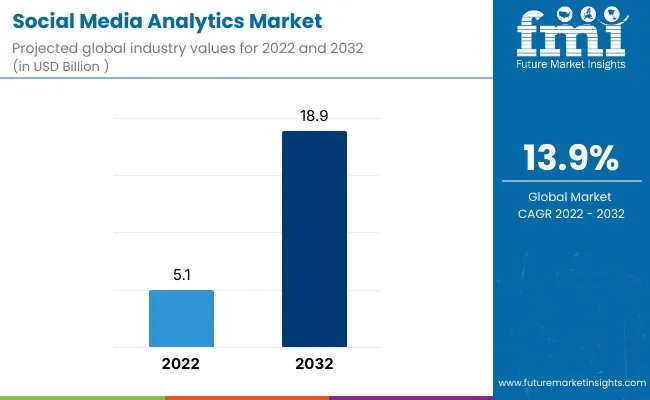
- Industry Size (2022)
- USD 5.1 Bn
- Forecast (2032)
- USD 18.9 Bn
- CAGR (2022 to 2032)
- 13.9%
Social Media Analytics Market Outlook (2022-2032)
[250 Pages Report] Social Media Analytics Market analysis report by Future Market Insights shows that global sales of Social Media Analytics Market in 2021 was held at US$ 4.5 Bn. The projected market growth during 2022 is expected to be 13.9%. Social Media Analytics Software is expected to be the highest revenue-generating segment, projected to grow at a CAGR of around 14.1% during 2022 – 2032.
| Attributes | Details |
| Global Social Media Analytics Market Size (2022) | US$ 5.1 Bn |
| Global Social Media Analytics Market Size (2032) | US$ 18.9 Bn |
| Global Social Media Analytics Market CAGR (2022-2032) | 13.9% |
| U.S. Social Media Analytics Market Size (2032) | US$ 3 Bn |
| Key Companies Covered |
|
Revenue of Social Media Analytics Market from 2015 to 2021 Compared to Demand Outlook for 2022 to 2032
As per the Social Media Analytics Market research by Future Market Insights - a market research and competitive intelligence provider, historically, from 2015 to 2022, the market value of the Social Media Analytics Market increased at around 15.7% CAGR.
The cause for market expansion may be related to organizations' demand for solutions to measure, monitor, and analyze social media data to understand client attitudes. Social media analytics suppliers provide software that helps businesses gather and analyze data to gain relevant insights into consumer attitudes, voice of the consumer, and post volume.
What Factors are Propelling the Social Media Analytics Demand?
The growth in social media users is driving the market and is projected to continue over the forecast period. This allows social media analytics organizations to collect greater consumer data and do more in-depth customer behavioral research. The usage of mobile phones, laptop computers, and PCs with an internet connection has grown throughout the years. This has largely impacted social media sites.
With the advancement of digital technology, individuals have begun to use social media for online shopping, communication, as well as other social connectivity pursuits. These have pushed businesses to use social media analytics systems to better understand their consumers' requirements and expectations, as well as the serviceability of their commodities. Currently, countless users are addicted to different social media platforms considering them a good source of entertainment and information. As the need for social media grows, so does the market for social media analytics, which is likely to expand further.
Most people are using mobile social media as their main source of internet-based communication. Companies such as Google are also working to increase mobile data use. To encourage space market penetration, Google is decreasing the purchase price of its Android-enabled devices. As the increased use of smartphones across various social-media platforms and social networking sites results in upgraded applications for these devices, their internet use among the younger generation continues to grow.
Facebook developed its mobile platform in 2013 to allow makers of mobile robotic apps to connect to the outer surface and integrate their software into universal platforms. Mobile developers now have access to a wider selection of data from social media networks, allowing for an enhanced range of perceptive purposes.
With the growth of social networking, the volume of information that needs to be gathered via social media has increased significantly, particularly with the development of smartphones and the ease with which social media can be used. There was a time existed when industry businesses employed social media analytics. It is also used by companies alongside businesses in order to get a clearer understanding of what their clients like and to even locate their most common interests in real-time.
A large number of enterprises are either adopting cloud or plan to do so, resulting in the market's exponential expansion. While start-ups and small businesses readily adopt cloud, the key firms are more hesitant for transition to cloud. Data security is one of the most significant barriers to business cloud adoption. Despite these reservations, cloud adoption is accelerating due to the clear advantages of efficiency and cost savings that it provides over conventional systems. The increased prevalence of cloud computing is a potential opportunity for the worldwide social media analytics industry.
Businesses are facing more competition, and are also looking for innovative methods to save costs. Companies require corporate information as well as customer data to learn more about their customers. Customers nowadays expect higher-quality goods and services at cheaper rates and with faster delivery. Analytics is assisting businesses in meeting their objectives. Social media analytics aids in the analysis of unstructured data to adapt to dynamic marketplaces and achieve high sales and profits. Businesses may utilize social media analytics to strengthen their market presence and obtain client feedback, which is another driver of the social media analytics industry.
Region-wise Analysis
Which Region is projected to Offer the Largest Opportunity for Social Media Analytics Market?
During the projected period, North America held the largest share in global Social Media Analytics Market with a market size of over US$ 3 Bn. The growing requirement to generate consumer engagement indicators for organizational growth is likely to drive growth in the market for social media analytics. Increasing knowledge of benefits such as enhanced company productivity provided by important suppliers in the region, on the other hand, is a factor supporting the growth of the social media analytics industry in this area. Most businesses and verticals in North America see competitive intelligence and marketing and sales management as extremely successful.
Due to the expanding digitization and desire for centrally controlled systems, the North America Social Media Analytics Market is witnessing a significant increase in the implementation of social media analytics.
Country-wise Analysis
Which Country Lies at the CenterStage for Social Media Analytics Market Revenue?
The United States is expected to account for the largest market valued at US$ 3 Bn by the end of 2032, with an expected CAGR of 13.5% by the end of 2032. The remarkable progression from business intelligence (BI) methodologies to advanced analytics techniques, as well as the significant increase in the popularity of social media, have increased the usage of social media analytics throughout the world.
The growing popularity of social media has been and will remain a primary driving force in the U.S. throughout the forecast period. As of April 2019, there were around 190 Mn active Facebook users in the U. S., according to Facebook’s We Are Social statistics. According to We Are Social, North America had the largest worldwide social media network penetration rate in January 2019 at 70%, followed by East Asia. This allows social media analytics organizations to collect more client data and do more in-depth customer behavioral research.
Category-wise Insights
Which Social Media Analytics Segment is projected to Witness Fastest Growth among Social Media Analytics interface by Component?
Social Media Analytics Software revenue is forecasted to grow at the highest CAGR of around 14.1% during 2022-2032. The increased usage of social media software solutions among small and medium-sized businesses, owing to the large volume of data provided by social media platforms, has propelled market expansion. However, the lack of standard procedures for social media platform and a single solution to handle the growing unstructured data is projected to limit industry growth.
Which End-Use Industry of Social Media Analytics is expected to Score Highest Growth in the Coming Years?
Social Media Analytics market growth through BFSI industry is forecasted to be the highest at 13.7%, during 2022-2032. In a market characterized by economic uncertainty and growing competition, the banking and financial services industry's key goal is client acquisition and retention. Banks compete with individualized service offers and solutions that adapt to specific client preferences and investing patterns to reach out to prospective customers.
Obtaining information about target consumers, their choices, and financial preferences, on the other hand, is a difficult undertaking given the massive quantity of data that must be effectively obtained, processed, evaluated, and interpreted to drive good business decisions. Die to this factor Social Analytics demand has been on surge. MasterCard’s "Priceless Engine" analytics harnesses the power of social media and analytics to optimize revenue to its partners and merchants.
Competitive Analysis
The social media analytics industry is very competitive and has multiple participants, resulting in a rather fragmented market. Most of the key competitors in the social media analytics market provide all-encompassing packages with a wide variety of features. However, niche businesses are developing new capabilities. Key players in social media analytics market include Oracle Corporation, SAS Institute Inc., GoogleData Corporation, Clarabridge, Inc., Crimson Hexagon, Brandwatch, Sysomos, Talkwalker, Cision, and Hootsuite.
For example, Dataroma built a real-time analytics solution that identifies optimization potential. As a result of such changes, the market is ripe for consolidation via mergers and acquisitions. To enhance its market share and profitability, the corporations are also using strategic joint projects.
Some of the recent developments in Social Media Analytics market include:
- In October 2021, Talkwalker, a provider of consumer information, announced the acquisition of discover.ai, a customer and cultural insights platform. This extends Talkwalker's industry consolidation, allowing more businesses to benefit from meaningful customer insight and achieve business impact.
This is a significant step in gaining a more comprehensive understanding of Talkwalker's service offering. Due to discover.ai's blend of machine learning (ML) and human insight, Talkwalker includes a deeper understanding of the human tales and emotive human sensitive drivers that lay underneath and beyond the knowledge, they deliver through data into their services.
- In January 2021, Hootsuite declared the takeover of Sparkcentral, a prominent SaaS company enabling the future of digital client interaction through one-on-one conversational messaging channels such as Instagram, Twitter, Facebook Messenger, WhatsApp, SMS, WeChat, and Chat.
- In June 2021, Cision publicized that it has completed its takeover of digital consumer analytics firm Brandwatch. Cision's long-standing expertise in media intelligence is combined with Brandwatch's AI and ML technologies, as well as deep social listening.
Besides, Cision is also planning to integrate the ability of Brandwatch with Falcon.io, a Cision subsidiary recognized for its powerful social media management skills, when the purchase closes. The integrated social organization will become a 1,000-person social media powerhouse along with the goal of delivering interesting new capabilities in this rapidly expanding field.
Similarly, the team at Future Market Insights has tracked recent developments related to Social Media Analytics Market companies, which are available in the full report.
Market Segments Covered in Social Media Analytics Market Analysis
By Component:
- Software
- On premise based
- Cloud based
- Services
- Professional Services
- Support & Maintenance
- Others
By End-use Industry:
- BFSI
- Retail
- Telecommunication & IT
- Transportation & Logistics
- Media & Entertainment
- Others
By Region:
- North America Social Media Analytics Market
- Europe Social Media Analytics Market
- Asia Pacific Social Media Analytics Market
- Middle East and Africa Social Media Analytics Market
- Latin America Social Media Analytics Market
Frequently Asked Questions
How much is the current worth of the Social Media Analytics Market?
The global Social Media Analytics Market is worth more than US$ 4.5 Bn at present.
What is the sales forecast for Social Media Analytics Market?
The value of Social Media Analytics Market is projected to increase at a CAGR of around 13.9% during 2022 – 2032.
What was the last 5 year’s market CAGR?
The value of Social Media Analytics Market increased at a CAGR of around 15.7% during 2015 – 2021.
What is a key trend shaping the growth of Social Media Analytics Market?
The collaboration for technology sharing to offer optimized customer experience has been shaping the social media analytics market.
At what percentage is sales of Social Media Analytics Market going to register growth in US?
The market for Social Media Analytics Market in the US is projected to expand at a CAGR of around 13.5% during 2022 – 2032.
Preview the report firsthand - request a free sample
Get SampleGet the brochure for pricing and purchase details.
Get PDFTable of Content
1. Executive Summary
1.1. Global Market Outlook
1.2. Demand-side Trends
1.3. Supply-side Trends
1.4. Technology Roadmap Analysis
1.5. Analysis and Recommendations
2. Market Overview
2.1. Market Coverage / Taxonomy
2.2. Market Definition / Scope / Limitations
3. Market Background
3.1. Market Dynamics
3.1.1. Drivers
3.1.2. Restraints
3.1.3. Opportunity
3.1.4. Trends
3.2. Scenario Forecast
3.2.1. Demand in Optimistic Scenario
3.2.2. Demand in Likely Scenario
3.2.3. Demand in Conservative Scenario
3.3. Opportunity Map Analysis
3.4. Investment Feasibility Matrix
3.5. PESTLE and Porter’s Analysis
3.6. Regulatory Landscape
3.6.1. By Key Regions
3.6.2. By Key Countries
4. Global Social Media Analytics Market Analysis 2015-2021 and Forecast, 2022-2032
4.1. Historical Market Size Value (US$ Mn) Analysis, 2015-2021
4.2. Current and Future Market Size Value (US$ Mn) Projections, 2022-2032
4.2.1. Y-o-Y Growth Trend Analysis
4.2.2. Absolute $ Opportunity Analysis
5. Global Social Media Analytics Market Analysis 2015-2021 and Forecast 2022-2032, By Component
5.1. Introduction / Key Findings
5.2. Historical Market Size Value (US$ Mn) Analysis By Component, 2015-2021
5.3. Current and Future Market Size Value (US$ Mn) Analysis and Forecast By Component, 2022-2032
5.3.1. Software
5.3.1.1. On premise based
5.3.1.2. Cloud based
5.3.2. Services
5.3.2.1. Professional Services
5.3.2.2. Support & Maintainance
5.3.2.3. Others
5.4. Y-o-Y Growth Trend Analysis By Component, 2015-2021
5.5. Absolute $ Opportunity Analysis By Component, 2022-2032
6. Global Social Media Analytics Market Analysis 2015-2021 and Forecast 2022-2032, By End Use Industry
6.1. Introduction / Key Findings
6.2. Historical Market Size Value (US$ Mn) Analysis By End Use Industry, 2015-2021
6.3. Current and Future Market Size Value (US$ Mn) Analysis and Forecast By End Use Industry, 2022-2032
6.3.1. BFSI
6.3.2. Retail
6.3.3. Telecommunication & IT
6.3.4. Transportation & Logistics
6.3.5. Media & Entertainment
6.3.6. Other End Use Industries
6.4. Y-o-Y Growth Trend Analysis By End Use Industry, 2015-2021
6.5. Absolute $ Opportunity Analysis By End Use Industry, 2022-2032
7. Global Social Media Analytics Market Analysis 2015-2021 and Forecast 2022-2032, By Region
7.1. Introduction
7.2. Historical Market Size Value (US$ Mn) Analysis By Region, 2015-2021
7.3. Current Market Size Value (US$ Mn) Analysis and Forecast By Region, 2022-2032
7.3.1. North America
7.3.2. Latin America
7.3.3. Europe
7.3.4. Asia Pacific
7.3.5. MEA
7.4. Market Attractiveness Analysis By Region
8. North America Social Media Analytics Market Analysis 2015-2021 and Forecast 2022-2032, By Country
8.1. Historical Market Size Value (US$ Mn) Trend Analysis By Market Taxonomy, 2015-2021
8.2. Market Size Value (US$ Mn) Forecast By Market Taxonomy, 2022-2032
8.2.1. By Country
8.2.1.1. U.S.
8.2.1.2. Canada
8.2.2. By Component
8.2.3. By End Use Industry
8.3. Market Attractiveness Analysis
8.3.1. By Country
8.3.2. By Component
8.3.3. By End Use Industry
8.4. Key Takeaways
9. Latin America Social Media Analytics Market Analysis 2015-2021 and Forecast 2022-2032, By Country
9.1. Historical Market Size Value (US$ Mn) Trend Analysis By Market Taxonomy, 2015-2021
9.2. Market Size Value (US$ Mn) Forecast By Market Taxonomy, 2022-2032
9.2.1. By Country
9.2.1.1. Brazil
9.2.1.2. Mexico
9.2.1.3. Rest of Latin America
9.2.2. By Component
9.2.3. By End Use Industry
9.3. Market Attractiveness Analysis
9.3.1. By Country
9.3.2. By Component
9.3.3. By End Use Industry
9.4. Key Takeaways
10. Europe Social Media Analytics Market Analysis 2015-2021 and Forecast 2022-2032, By Country
10.1. Historical Market Size Value (US$ Mn) Trend Analysis By Market Taxonomy, 2015-2021
10.2. Market Size Value (US$ Mn) Forecast By Market Taxonomy, 2022-2032
10.2.1. By Country
10.2.1.1. Germany
10.2.1.2. Italy
10.2.1.3. France
10.2.1.4. U.K.
10.2.1.5. Spain
10.2.1.6. Russia
10.2.1.7. BENELUX
10.2.1.8. Rest of Europe
10.2.2. By Component
10.2.3. By End Use Industry
10.3. Market Attractiveness Analysis
10.3.1. By Country
10.3.2. By Component
10.3.3. By End Use Industry
10.4. Key Takeaways
11. Asia Pacific Social Media Analytics Market Analysis 2015-2021 and Forecast 2022-2032, By Country
11.1. Historical Market Size Value (US$ Mn) Trend Analysis By Market Taxonomy, 2015-2021
11.2. Market Size Value (US$ Mn) Forecast By Market Taxonomy, 2022-2032
11.2.1. By Country
11.2.1.1. China
11.2.1.2. Japan
11.2.1.3. South Korea
11.2.1.4. India
11.2.1.5. Rest of Asia Pacific
11.2.2. By Component
11.2.3. By End Use Industry
11.3. Market Attractiveness Analysis
11.3.1. By Country
11.3.2. By Component
11.3.3. By End Use Industry
11.4. Key Takeaways
12. MEA Social Media Analytics Market Analysis 2015-2021 and Forecast 2022-2032, By Country
12.1. Historical Market Size Value (US$ Mn) Trend Analysis By Market Taxonomy, 2015-2021
12.2. Market Size Value (US$ Mn) Forecast By Market Taxonomy, 2022-2032
12.2.1. By Country
12.2.1.1. GCC
12.2.1.2. Rest of MEA
12.2.2. By Component
12.2.3. By End Use Industry
12.3. Market Attractiveness Analysis
12.3.1. By Country
12.3.2. By Component
12.3.3. By End Use Industry
12.4. Key Takeaways
13. Key Countries Social Media Analytics Market Analysis
13.1. U.S.
13.1.1. Pricing Analysis
13.1.2. Market Share Analysis, 2021
13.1.2.1. By Component
13.1.2.2. By End Use Industry
13.2. Canada
13.2.1. Pricing Analysis
13.2.2. Market Share Analysis, 2021
13.2.2.1. By Component
13.2.2.2. By End Use Industry
13.3. Brazil
13.3.1. Pricing Analysis
13.3.2. Market Share Analysis, 2021
13.3.2.1. By Component
13.3.2.2. By End Use Industry
13.4. Mexico
13.4.1. Pricing Analysis
13.4.2. Market Share Analysis, 2021
13.4.2.1. By Component
13.4.2.2. By End Use Industry
13.5. Argentina
13.5.1. Pricing Analysis
13.5.2. Market Share Analysis, 2021
13.5.2.1. By Component
13.5.2.2. By End Use Industry
13.6. Germany
13.6.1. Pricing Analysis
13.6.2. Market Share Analysis, 2021
13.6.2.1. By Component
13.6.2.2. By End Use Industry
13.7. Italy
13.7.1. Pricing Analysis
13.7.2. Market Share Analysis, 2021
13.7.2.1. By Component
13.7.2.2. By End Use Industry
13.8. France
13.8.1. Pricing Analysis
13.8.2. Market Share Analysis, 2021
13.8.2.1. By Component
13.8.2.2. By End Use Industry
13.9. U.K.
13.9.1. Pricing Analysis
13.9.2. Market Share Analysis, 2021
13.9.2.1. By Component
13.9.2.2. By End Use Industry
13.10. Spain
13.10.1. Pricing Analysis
13.10.2. Market Share Analysis, 2021
13.10.2.1. By Component
13.10.2.2. By End Use Industry
13.11. Russia
13.11.1. Pricing Analysis
13.11.2. Market Share Analysis, 2021
13.11.2.1. By Component
13.11.2.2. By End Use Industry
13.12. BENELUX
13.12.1. Pricing Analysis
13.12.2. Market Share Analysis, 2021
13.12.2.1. By Component
13.12.2.2. By End Use Industry
13.13. China
13.13.1. Pricing Analysis
13.13.2. Market Share Analysis, 2021
13.13.2.1. By Component
13.13.2.2. By End Use Industry
13.14. Japan
13.14.1. Pricing Analysis
13.14.2. Market Share Analysis, 2021
13.14.2.1. By Component
13.14.2.2. By End Use Industry
13.15. South Korea
13.15.1. Pricing Analysis
13.15.2. Market Share Analysis, 2021
13.15.2.1. By Component
13.15.2.2. By End Use Industry
13.16. India
13.16.1. Pricing Analysis
13.16.2. Market Share Analysis, 2021
13.16.2.1. By Component
13.16.2.2. By End Use Industry
13.17. GCC Countries
13.17.1. Pricing Analysis
13.17.2. Market Share Analysis, 2021
13.17.2.1. By Component
13.17.2.2. By End Use Industry
14. Market Structure Analysis
14.1. Competition Dashboard
14.2. Competition Benchmarking
14.3. Market Share Analysis of Top Players
14.3.1. By Regional
14.3.2. By Component
14.3.3. By End Use Industry
15. Competition Analysis
15.1. Competition Deep Dive
15.1.1. Oracle Corporation
15.1.1.1. Overview
15.1.1.2. Product Portfolio
15.1.1.3. Profitability by Market Segment
15.1.1.4. Sales Footprint
15.1.1.5. Strategy Overview
15.1.1.5.1. Marketing Strategy
15.1.1.5.2. Product Strategy
15.1.2. SAS Institute, Inc.
15.1.2.1. Overview
15.1.2.2. Product Portfolio
15.1.2.3. Profitability by Market Segment
15.1.2.4. Sales Footprint
15.1.2.5. Strategy Overview
15.1.2.5.1. Marketing Strategy
15.1.2.5.2. Product Strategy
15.1.3. Google Data Corporation
15.1.3.1. Overview
15.1.3.2. Product Portfolio
15.1.3.3. Profitability by Market Segment
15.1.3.4. Sales Footprint
15.1.3.5. Strategy Overview
15.1.3.5.1. Marketing Strategy
15.1.3.5.2. Product Strategy
15.1.4. Clarabridge, Inc.
15.1.4.1. Overview
15.1.4.2. Product Portfolio
15.1.4.3. Profitability by Market Segment
15.1.4.4. Sales Footprint
15.1.4.5. Strategy Overview
15.1.4.5.1. Marketing Strategy
15.1.4.5.2. Product Strategy
15.1.5. Crimson Hexagon
15.1.5.1. Overview
15.1.5.2. Product Portfolio
15.1.5.3. Profitability by Market Segment
15.1.5.4. Sales Footprint
15.1.5.5. Strategy Overview
15.1.5.5.1. Marketing Strategy
15.1.5.5.2. Product Strategy
15.1.6. Brandwatch
15.1.6.1. Overview
15.1.6.2. Product Portfolio
15.1.6.3. Profitability by Market Segment
15.1.6.4. Sales Footprint
15.1.6.5. Strategy Overview
15.1.6.5.1. Marketing Strategy
15.1.6.5.2. Product Strategy
15.1.7. Sysomos
15.1.7.1. Overview
15.1.7.2. Product Portfolio
15.1.7.3. Profitability by Market Segment
15.1.7.4. Sales Footprint
15.1.7.5. Strategy Overview
15.1.7.5.1. Marketing Strategy
15.1.7.5.2. Product Strategy
15.1.8. Talkwalker
15.1.8.1. Overview
15.1.8.2. Product Portfolio
15.1.8.3. Profitability by Market Segment
15.1.8.4. Sales Footprint
15.1.8.5. Strategy Overview
15.1.8.5.1. Marketing Strategy
15.1.8.5.2. Product Strategy
15.1.9. Cision
15.1.9.1. Overview
15.1.9.2. Product Portfolio
15.1.9.3. Profitability by Market Segment
15.1.9.4. Sales Footprint
15.1.9.5. Strategy Overview
15.1.9.5.1. Marketing Strategy
15.1.9.5.2. Product Strategy
15.1.10. HootSuite
15.1.10.1. Overview
15.1.10.2. Product Portfolio
15.1.10.3. Profitability by Market Segment
15.1.10.4. Sales Footprint
15.1.10.5. Strategy Overview
15.1.10.5.1. Marketing Strategy
15.1.10.5.2. Product Strategy
16. Assumptions & Acronyms Used
17. Research Methodology


