

- Industry Size (2026)
- USD 4.17 Bn
- Forecast (2036)
- USD 17.90 Bn
- CAGR (2026 to 2036)
- 15.7%
Enterprise Social Graph Market Size, Market Forecast and Outlook By FMI
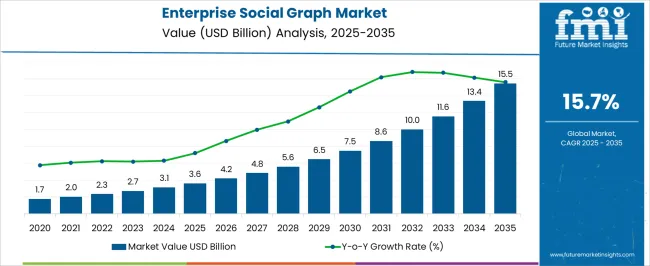
The enterprise social graph market was valued at USD 3.60 billion in 2025, projected to reach USD 4.17 billion in 2026, and is forecast to expand to USD 17.90 billion by 2036 at a 15.7% CAGR. As per FMI, the acceleration of hybrid work models and the growing criticality of organizational network intelligence are converting social graph platforms from discretionary HR analytics tools into mandatory components of enterprise workforce planning infrastructure.
Summary of Enterprise Social Graph Market
- Market Snapshot
- The enterprise social graph market is valued at USD 3.60 billion in 2025 and is projected to reach USD 17.90 billion by 2036.
- The industry is expected to grow at a 15.7% CAGR from 2026 to 2036, creating an incremental opportunity of USD 13.73 billion.
- The market operates as a workforce intelligence category where hybrid work measurement needs and organizational network analytics drive enterprise procurement decisions.
- Demand and Growth Drivers
- Demand is rising as hybrid work models create organizational visibility gaps that traditional hierarchy charts cannot address, forcing enterprises to adopt graph-based collaboration analytics.
- Post-acquisition integration teams deploy social graph platforms to map communication bridges between legacy and acquired organization units.
- Predictive attrition models integrating social graph data provide measurably earlier intervention windows compared to survey-based engagement measurement.
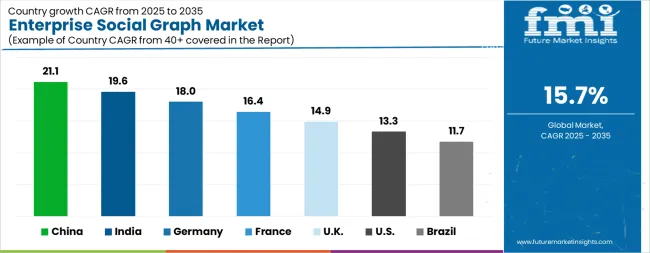
- Among key countries, China leads at 21.1% CAGR, followed by India at 19.6%, Germany at 18.0%, the United States at 13.3%, and Brazil at 11.7%.
- Product and Segment View
- The market includes social graph construction engines, relationship analytics platforms, organizational network analysis modules, and collaboration pattern visualization tools.
- These solutions ingest data from enterprise communication systems, project management tools, and meeting scheduling platforms to construct dynamic relationship maps.
- Unimodal network analysis leads by network type with 55.1% share in 2026, mapping single-entity employee-to-employee collaboration patterns.
- Information Technology Industry leads by end user with 57.6% share in 2026, driven by distributed workforce structures and DevOps collaboration measurement needs.
- The scope excludes consumer-facing social media analytics, standalone HRIS platforms, and basic communication tools without persistent graph data models.
- Geography and Competitive Outlook
- China and India are the fastest-growing markets driven by enterprise digitization at scale and IT services workforce optimization, while the United States and Western Europe represent mature, high-value demand bases.
- Competition is shaped by data ingestion breadth, graph analytics accuracy, and privacy compliance capabilities, with key players including Microsoft Corporation, Google Inc., IBM Corporation, Cisco Systems, Salesforce, and SAP SE.
- Vendor consolidation is advancing as large platform providers acquire specialized organizational network analytics startups to embed social graph capabilities within broader digital workplace suites.
- Analyst Opinion at FMI
- Sudip saha, Principal Consultant at Future Market Insights, opines: 'In my analysis, I have observed that the enterprise social graph market is crossing from an optional workforce analytics layer into a mandatory organizational intelligence platform. Enterprises attempting to manage hybrid work models without graph-based visibility into actual collaboration patterns face measurable productivity decline as informal knowledge networks that previously sustained face-to-face collaboration deteriorate. Organizations that invest in social graph infrastructure ahead of their next major restructuring or acquisition integration will execute those transitions with measurably lower attrition and faster knowledge transfer timelines.'
- Strategic Implications / Executive Takeaways
- HR technology directors should integrate social graph analytics with existing talent management platforms to create unified workforce intelligence systems that combine performance data with collaboration network metrics.
- M&A integration leads must deploy social graph measurement tools within the first 90 days of acquisition close to establish baseline connectivity metrics and track cross-organization communication bridge formation.
- IT infrastructure architects should prioritize social graph platforms that offer pre-built data connectors for the enterprise's existing communication and project management tool ecosystem to accelerate time-to-value.
Enterprise Social Graph Market Key Takeaways
| Metric | Details |
|---|---|
| Industry Size (2026) | USD 4.17 billion |
| Industry Value (2036) | USD 17.90 billion |
| CAGR (2026-2036) | 15.7% |
Source: Future Market Insights, 2026
The structural shift toward hybrid and distributed work models has created an organizational visibility gap that traditional hierarchy charts cannot address. Enterprises managing thousands of employees across multiple time zones and project teams require real-time graph analytics that map actual collaboration patterns, not just formal reporting lines. This visibility gap drives procurement of social graph platforms that ingest data from enterprise communication systems, project management tools, and meeting scheduling platforms to construct dynamic relationship maps. IT procurement teams now evaluate social graph capabilities as part of broader digital workplace transformation contracts.
China leads global expansion at a 21.1% CAGR through 2036, driven by rapid enterprise digitization across state-owned conglomerates deploying workforce analytics at scale. India follows at 19.6%, fueled by IT services firms adopting social graph tools to optimize resource allocation across distributed delivery centers. Germany registers 18.0% growth, anchored by manufacturing conglomerates mapping cross-plant collaboration networks to reduce knowledge silos. France expands at 16.4% as government-backed digital transformation programs incorporate organizational analytics mandates. The United Kingdom tracks at 14.9%, the United States at 13.3% supported by enterprise-wide adoption in financial services and technology sectors, and Brazil at 11.7% as large conglomerates digitize internal collaboration measurement.
Enterprise Social Graph Market Definition
Enterprise social graph platforms map, analyze, and operationalize the relationship networks that exist within and between organizations. These systems construct graph-based data models that capture communication patterns, collaboration frequency, reporting hierarchies, and cross-functional project linkages across enterprise communication channels. IT departments, human resources teams, and organizational development units use social graph analytics to identify knowledge bottlenecks, measure team connectivity, and optimize workforce restructuring decisions.
Enterprise Social Graph Market Inclusions
Market scope covers social graph construction engines, relationship analytics platforms, organizational network analysis modules, and collaboration pattern visualization tools. Coverage spans global and regional market sizes for the 2026 to 2036 forecast period, segmented by network type, end user, and geography.
Enterprise Social Graph Market Exclusions
The scope excludes consumer-facing social media analytics platforms, standalone HR information systems without graph-based relationship mapping, and basic communication tools that do not construct persistent graph data models of organizational relationships.
Enterprise Social Graph Market Research Methodology
- Primary Research: Analysts conducted structured interviews with IT infrastructure directors, HR analytics leads, and organizational development consultants to map procurement triggers and deployment timelines for social graph platforms.
- Desk Research: Publicly available organizational science research, workforce analytics framework publications, and vendor annual reports provided foundational benchmarks.
- Market-Sizing and Forecasting: Baseline values derive from a bottom-up aggregation of enterprise analytics software licenses and SaaS subscriptions, applying industry-specific adoption curves to project graph platform deployment velocity.
- Data Validation and Update Cycle: Projections are tested against quarterly enterprise software revenue disclosures from publicly listed collaboration analytics vendors and cross-referenced with IT spending surveys.
Why is the Enterprise Social Graph Market Growing?
The Enterprise Social Graph market is witnessing strong growth, driven by the increasing need for organizations to visualize, analyze, and leverage relationships and interactions within internal and external networks. Enterprises are adopting social graph solutions to gain actionable insights into communication patterns, collaboration effectiveness, and knowledge flow across teams and departments. The market is further supported by advancements in AI-powered analytics, graph database technologies, and real-time data processing, which enable comprehensive mapping of organizational networks.
Integration with enterprise software, including CRM, collaboration tools, and business intelligence platforms, enhances decision-making and operational efficiency. Organizations are leveraging social graph insights to optimize workforce collaboration, improve customer engagement, and identify influential nodes within networks.
The growing emphasis on data-driven strategies, digital transformation, and cross-functional knowledge sharing is accelerating adoption across industries As businesses seek scalable and intelligent platforms to manage complex networks of relationships and interactions, the Enterprise Social Graph market is expected to sustain robust growth, supported by continuous technological innovation and increasing demand for actionable insights from organizational data.
Segmental Analysis
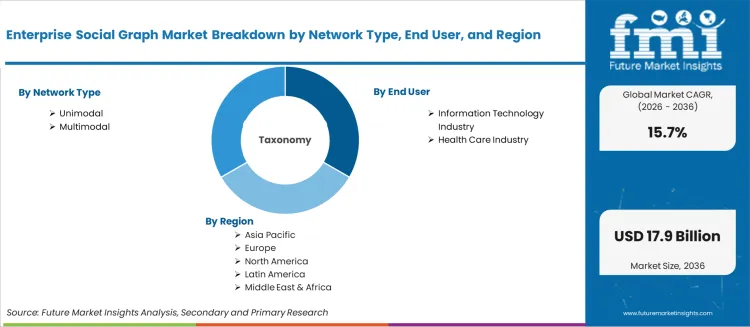
The enterprise social graph market is segmented by network type, end user, and geographic regions. By network type, enterprise social graph market is divided into Unimodal and Multimodal. In terms of end user, enterprise social graph market is classified into Information Technology Industry and Health Care Industry. Regionally, the enterprise social graph industry is classified into North America, Latin America, Western Europe, Eastern Europe, Balkan & Baltic Countries, Russia & Belarus, Central Asia, East Asia, South Asia & Pacific, and the Middle East & Africa.
Insights into the Unimodal Network Type Segment
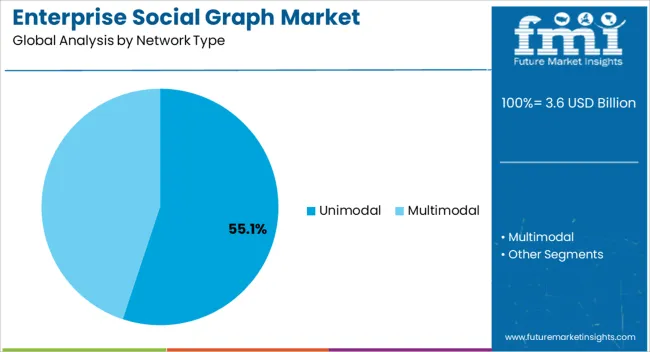
The unimodal network type segment is projected to hold 55.1% of the market revenue in 2026, establishing it as the leading network type. Its dominance is being driven by the simplicity and efficiency of mapping single entity types, such as employees, departments, or products, which allows organizations to gain actionable insights without excessive data complexity. Unimodal networks enable streamlined analysis of collaboration patterns, knowledge flow, and communication structures within organizations.
Integration with existing enterprise systems, including workflow management and business intelligence tools, further enhances operational efficiency. Advanced analytics and visualization capabilities allow organizations to identify central nodes, key influencers, and potential bottlenecks in information sharing.
The scalability and adaptability of unimodal networks make them suitable for diverse applications, ranging from workforce optimization to customer engagement analysis As enterprises continue to prioritize data-driven decision-making and efficient internal collaboration, the unimodal network type is expected to maintain its leadership position, supported by robust integration capabilities, AI-driven analytics, and ease of deployment.
Insights into the Information Technology Industry End User Segment
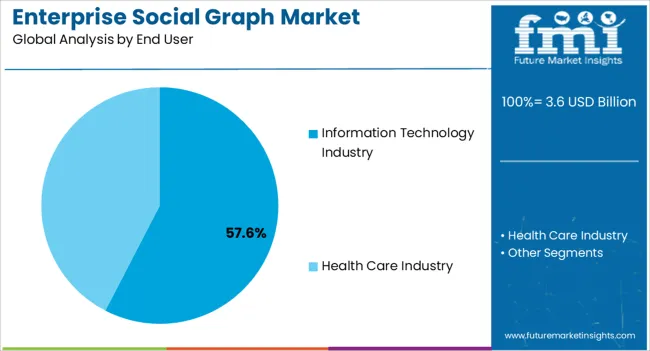
The information technology industry end user segment is anticipated to account for 57.6% of the market revenue in 2026, making it the leading end-user category. Growth in this segment is being driven by the high reliance of IT organizations on digital collaboration, knowledge management, and project coordination. Enterprise social graph solutions enable IT companies to map complex communication networks, monitor project collaboration, and enhance knowledge sharing across geographically dispersed teams.
Advanced analytics, AI-powered insights, and integration with IT service management and workflow tools improve operational efficiency and decision-making. Organizations leverage social graph data to identify key influencers, optimize resource allocation, and drive innovation by enhancing collaboration across teams and departments.
The increasing emphasis on digital transformation, agile methodologies, and remote work adoption is further accelerating demand in this sector As IT companies continue to focus on scalable, intelligent solutions for workforce optimization and internal knowledge management, the information technology industry is expected to remain the primary driver of market growth, maintaining its leading revenue share.
Market Overview
Enterprise Social Graph Market Overview
Social network sites are becoming poplar. People are connected to their colleagues, peers through these online spaces. These types of technology enables user to stay up-to-date and exploit the social network for many tasks. The global enterprise social graph is a representation of social network of a particular business. It encompass the relationships among the employees, customers, and the public.
It is the best way to support organization to flow the communication easily. Enterprise social graph enables employees can quickly gather information from the organization and take smart decisions with democratized communication. Enterprise social graph provides quick way to collect the feedback and make decisions. It can improve information flow and communication among the people in the organization.
Organizational hierarchies can be streamlined to support conversations and agile time management on enterprise social graph. Enterprise social graph is enriched with data, interests, roles, expertise, and rich profiles including past work history.
The enterprise social graph market spur new opportunities for the companies which are plunged in enterprise social network system.Global enterprise social graph market is expected exhibit significant CAGR as well as unprecedented annual growth over the forecast period.
Analysis of Enterprise Social Graph Market By Key Countries
.webp "Top Country Growth Comparison Enterprise Social Graph Market Cagr (2026 2036)")
| Country | CAGR |
|---|---|
| China | 21.1% |
| India | 19.6% |
| Germany | 18.0% |
| France | 16.4% |
| UK | 14.9% |
| USA | 13.3% |
| Brazil | 11.7% |
Source: FMI analysis based on primary research and proprietary forecasting model
Country-wise Analysis
The Enterprise Social Graph Market is expected to register a CAGR of 15.7% during the forecast period, exhibiting varied country level momentum. China leads with the highest CAGR of 21.1%, followed by India at 19.6%. Developed markets such as Germany, France, and the UK continue to expand steadily, while the USA is likely to grow at consistent rates. Brazil posts the lowest CAGR at 11.7%, yet still underscores a broadly positive trajectory for the global Enterprise Social Graph Market. In 2024, Germany held a dominant revenue in the Western Europe market and is expected to grow with a CAGR of 18.0%. The USA Enterprise Social Graph Market is estimated to be valued at USD 1.3 billion in 2026 and is anticipated to reach a valuation of USD 4.5 billion by 2036. Sales are projected to rise at a CAGR of 13.3% over the forecast period between 2026 and 2036. While Japan and South Korea markets are estimated to be valued at USD 174.1 million and USD 117.9 million respectively in 2026.
Key Players in the Enterprise Social Graph Market
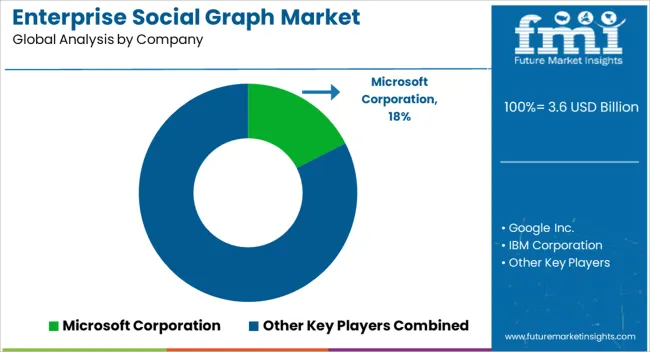
- Microsoft Corporation
- Google Inc.
- IBM Corporation
- Cisco Systems
- Salesforce
- SAP SE
- VMware
- TIBCO Software
- Axero Solutions
- Jive Software
Scope of the Report
| Metric | Value |
|---|---|
| Quantitative Units | USD 4.17 billion to USD 17.90 billion, at a CAGR of 15.7% |
| Market Definition | Enterprise social graph platforms map, analyze, and operationalize the relationship networks that exist within and between organizations. These systems construct graph-based data models that capture communication patterns, collaboration frequency, reporting hierarchies, and cross-functional project linkages across enterprise communication channels. |
| Network Type Segmentation | Unimodal, Multimodal |
| End User Segmentation | Information Technology Industry, Health Care Industry |
| Regions Covered | North America, Latin America, Europe, East Asia, South Asia, Oceania, Middle East & Africa |
| Countries Covered | China, India, Germany, France, United Kingdom, United States, Brazil, and 40 plus countries |
| Key Companies Profiled | Microsoft Corporation, Google Inc., IBM Corporation, Cisco Systems, Salesforce, SAP SE, VMware, TIBCO Software, Axero Solutions, Jive Software |
| Forecast Period | 2026 to 2036 |
| Approach | Baseline values derive from a bottom-up aggregation of enterprise analytics software licenses and SaaS subscriptions, applying industry-specific adoption curves to project graph platform deployment velocity. |
Enterprise Social Graph Market by Segments
Network Type:
- Unimodal
- Multimodal
End User:
- Information Technology Industry
- Health Care Industry
Region:
- North America
- USA
- Canada
- Mexico
- Latin America
- Brazil
- Chile
- Rest of Latin America
- Western Europe
- Germany
- UK
- Italy
- Spain
- France
- Nordic
- BENELUX
- Rest of Western Europe
- Eastern Europe
- Russia
- Poland
- Hungary
- Balkan & Baltic
- Rest of Eastern Europe
- East Asia
- China
- Japan
- South Korea
- South Asia and Pacific
- India
- ASEAN
- Australia & New Zealand
- Rest of South Asia and Pacific
- Middle East & Africa
- Kingdom of Saudi Arabia
- Other GCC Countries
- Turkiye
- South Africa
- Other African Union
- Rest of Middle East & Africa
Bibliography
- Organisation for Economic Co-operation and Development. (2024). OECD Future of Work: Measuring Hybrid Work Collaboration Patterns. OECD.
- World Economic Forum. (2025). The Future of Jobs Report: Organizational Analytics and Workforce Planning. WEF.
- Microsoft Corporation. (2025). Microsoft Work Trend Index Annual Report. Microsoft.
- International Labour Organization. (2024). ILO Working Paper: Digital Tools for Organizational Measurement. ILO.
- IBM Corporation. (2025). IBM Annual Report and Form 10-K Filing. IBM.
- European Commission. (2024). Digital Economy and Society Index (DESI): Enterprise Digital Transformation Metrics. EC.
This bibliography is provided for reader reference. The full Future Market Insights report contains the complete reference list with primary research documentation.
Frequently Asked Questions
How large is the demand for Enterprise Social Graph in the global market in 2026?
Demand for enterprise social graph platforms in the global market is estimated to be valued at USD 4.17 billion in 2026.
What will be the market size of Enterprise Social Graph in the global market by 2036?
Market size for enterprise social graph platforms is projected to reach USD 17.90 billion by 2036.
What is the expected demand growth for Enterprise Social Graph between 2026 and 2036?
Demand for enterprise social graph platforms is expected to grow at a CAGR of 15.7% between 2026 and 2036.
Which Network Type is poised to lead global adoption by 2026?
Unimodal network analysis accounts for 55.1% share in 2026, as enterprises prioritize single-entity employee-to-employee collaboration pattern mapping for workforce restructuring and knowledge network optimization.
How significant is the role of Information Technology Industry in driving adoption in 2026?
Information Technology Industry holds 57.6% of end user share, driven by distributed workforce structures, DevOps collaboration measurement mandates, and the technical infrastructure required for graph platform integration.
What is driving demand in China?
Rapid enterprise digitization across state-owned conglomerates deploying workforce analytics at scale fuels adoption, with China projected to grow at a 21.1% CAGR through 2036.
What is India's growth outlook in this report?
India is projected to grow at a CAGR of 19.6% during 2026 to 2036, driven by IT services firms optimizing resource allocation across distributed delivery centers using social graph analytics.
Preview the report firsthand - request a free sample
Get SampleGet the brochure for pricing and purchase details.
Get PDFTable of Content
- Executive Summary
- Global Market Outlook
- Demand-side Trends
- Supply-side Trends
- Technology Roadmap Analysis
- Analysis and Recommendations
- Market Overview
- Market Coverage / Taxonomy
- Market Definition / Scope / Limitations
- Research Methodology
- Chapter Orientation
- Analytical Lens and Working Hypotheses
- Market Structure, Signals, and Trend Drivers
- Benchmarking and Cross-market Comparability
- Market Sizing, Forecasting, and Opportunity Mapping
- Research Design and Evidence Framework
- Desk Research Programme (Secondary Evidence)
- Company Annual and Sustainability Reports
- Peer-reviewed Journals and Academic Literature
- Corporate Websites, Product Literature, and Technical Notes
- Earnings Decks and Investor Briefings
- Statutory Filings and Regulatory Disclosures
- Technical White Papers and Standards Notes
- Trade Journals, Industry Magazines, and Analyst Briefs
- Conference Proceedings, Webinars, and Seminar Materials
- Government Statistics Portals and Public Data Releases
- Press Releases and Reputable Media Coverage
- Specialist Newsletters and Curated Briefings
- Sector Databases and Reference Repositories
- FMI Internal Proprietary Databases and Historical Market Datasets
- Subscription Datasets and Paid Sources
- Social Channels, Communities, and Digital Listening Inputs
- Additional Desk Sources
- Expert Input and Fieldwork (Primary Evidence)
- Primary Modes
- Qualitative Interviews and Expert Elicitation
- Quantitative Surveys and Structured Data Capture
- Blended Approach
- Why Primary Evidence is Used
- Field Techniques
- Interviews
- Surveys
- Focus Groups
- Observational and In-context Research
- Social and Community Interactions
- Stakeholder Universe Engaged
- C-suite Leaders
- Board Members
- Presidents and Vice Presidents
- R&D and Innovation Heads
- Technical Specialists
- Domain Subject-matter Experts
- Scientists
- Physicians and Other Healthcare Professionals
- Governance, Ethics, and Data Stewardship
- Research Ethics
- Data Integrity and Handling
- Primary Modes
- Tooling, Models, and Reference Databases
- Desk Research Programme (Secondary Evidence)
- Data Engineering and Model Build
- Data Acquisition and Ingestion
- Cleaning, Normalisation, and Verification
- Synthesis, Triangulation, and Analysis
- Quality Assurance and Audit Trail
- Market Background
- Market Dynamics
- Drivers
- Restraints
- Opportunity
- Trends
- Scenario Forecast
- Demand in Optimistic Scenario
- Demand in Likely Scenario
- Demand in Conservative Scenario
- Opportunity Map Analysis
- Product Life Cycle Analysis
- Supply Chain Analysis
- Investment Feasibility Matrix
- Value Chain Analysis
- PESTLE and Porter’s Analysis
- Regulatory Landscape
- Regional Parent Market Outlook
- Production and Consumption Statistics
- Import and Export Statistics
- Market Dynamics
- Global Market Analysis 2021 to 2025 and Forecast, 2026 to 2036
- Historical Market Size Value (USD Million) Analysis, 2021 to 2025
- Current and Future Market Size Value (USD Million) Projections, 2026 to 2036
- Y-o-Y Growth Trend Analysis
- Absolute $ Opportunity Analysis
- Global Market Pricing Analysis 2021 to 2025 and Forecast 2026 to 2036
- Global Market Analysis 2021 to 2025 and Forecast 2026 to 2036, By Network Type
- Introduction / Key Findings
- Historical Market Size Value (USD Million) Analysis By Network Type , 2021 to 2025
- Current and Future Market Size Value (USD Million) Analysis and Forecast By Network Type , 2026 to 2036
- Unimodal
- Multimodal
- Unimodal
- Y-o-Y Growth Trend Analysis By Network Type , 2021 to 2025
- Absolute $ Opportunity Analysis By Network Type , 2026 to 2036
- Global Market Analysis 2021 to 2025 and Forecast 2026 to 2036, By End User
- Introduction / Key Findings
- Historical Market Size Value (USD Million) Analysis By End User, 2021 to 2025
- Current and Future Market Size Value (USD Million) Analysis and Forecast By End User, 2026 to 2036
- Information Technology Industry
- Health Care Industry
- Information Technology Industry
- Y-o-Y Growth Trend Analysis By End User, 2021 to 2025
- Absolute $ Opportunity Analysis By End User, 2026 to 2036
- Global Market Analysis 2021 to 2025 and Forecast 2026 to 2036, By Region
- Introduction
- Historical Market Size Value (USD Million) Analysis By Region, 2021 to 2025
- Current Market Size Value (USD Million) Analysis and Forecast By Region, 2026 to 2036
- North America
- Latin America
- Western Europe
- Eastern Europe
- East Asia
- South Asia and Pacific
- Middle East & Africa
- Market Attractiveness Analysis By Region
- North America Market Analysis 2021 to 2025 and Forecast 2026 to 2036, By Country
- Historical Market Size Value (USD Million) Trend Analysis By Market Taxonomy, 2021 to 2025
- Market Size Value (USD Million) Forecast By Market Taxonomy, 2026 to 2036
- By Country
- USA
- Canada
- Mexico
- By Network Type
- By End User
- By Country
- Market Attractiveness Analysis
- By Country
- By Network Type
- By End User
- Key Takeaways
- Latin America Market Analysis 2021 to 2025 and Forecast 2026 to 2036, By Country
- Historical Market Size Value (USD Million) Trend Analysis By Market Taxonomy, 2021 to 2025
- Market Size Value (USD Million) Forecast By Market Taxonomy, 2026 to 2036
- By Country
- Brazil
- Chile
- Rest of Latin America
- By Network Type
- By End User
- By Country
- Market Attractiveness Analysis
- By Country
- By Network Type
- By End User
- Key Takeaways
- Western Europe Market Analysis 2021 to 2025 and Forecast 2026 to 2036, By Country
- Historical Market Size Value (USD Million) Trend Analysis By Market Taxonomy, 2021 to 2025
- Market Size Value (USD Million) Forecast By Market Taxonomy, 2026 to 2036
- By Country
- Germany
- UK
- Italy
- Spain
- France
- Nordic
- BENELUX
- Rest of Western Europe
- By Network Type
- By End User
- By Country
- Market Attractiveness Analysis
- By Country
- By Network Type
- By End User
- Key Takeaways
- Eastern Europe Market Analysis 2021 to 2025 and Forecast 2026 to 2036, By Country
- Historical Market Size Value (USD Million) Trend Analysis By Market Taxonomy, 2021 to 2025
- Market Size Value (USD Million) Forecast By Market Taxonomy, 2026 to 2036
- By Country
- Russia
- Poland
- Hungary
- Balkan & Baltic
- Rest of Eastern Europe
- By Network Type
- By End User
- By Country
- Market Attractiveness Analysis
- By Country
- By Network Type
- By End User
- Key Takeaways
- East Asia Market Analysis 2021 to 2025 and Forecast 2026 to 2036, By Country
- Historical Market Size Value (USD Million) Trend Analysis By Market Taxonomy, 2021 to 2025
- Market Size Value (USD Million) Forecast By Market Taxonomy, 2026 to 2036
- By Country
- China
- Japan
- South Korea
- By Network Type
- By End User
- By Country
- Market Attractiveness Analysis
- By Country
- By Network Type
- By End User
- Key Takeaways
- South Asia and Pacific Market Analysis 2021 to 2025 and Forecast 2026 to 2036, By Country
- Historical Market Size Value (USD Million) Trend Analysis By Market Taxonomy, 2021 to 2025
- Market Size Value (USD Million) Forecast By Market Taxonomy, 2026 to 2036
- By Country
- India
- ASEAN
- Australia & New Zealand
- Rest of South Asia and Pacific
- By Network Type
- By End User
- By Country
- Market Attractiveness Analysis
- By Country
- By Network Type
- By End User
- Key Takeaways
- Middle East & Africa Market Analysis 2021 to 2025 and Forecast 2026 to 2036, By Country
- Historical Market Size Value (USD Million) Trend Analysis By Market Taxonomy, 2021 to 2025
- Market Size Value (USD Million) Forecast By Market Taxonomy, 2026 to 2036
- By Country
- Kingdom of Saudi Arabia
- Other GCC Countries
- Turkiye
- South Africa
- Other African Union
- Rest of Middle East & Africa
- By Network Type
- By End User
- By Country
- Market Attractiveness Analysis
- By Country
- By Network Type
- By End User
- Key Takeaways
- Key Countries Market Analysis
- USA
- Pricing Analysis
- Market Share Analysis, 2025
- By Network Type
- By End User
- Canada
- Pricing Analysis
- Market Share Analysis, 2025
- By Network Type
- By End User
- Mexico
- Pricing Analysis
- Market Share Analysis, 2025
- By Network Type
- By End User
- Brazil
- Pricing Analysis
- Market Share Analysis, 2025
- By Network Type
- By End User
- Chile
- Pricing Analysis
- Market Share Analysis, 2025
- By Network Type
- By End User
- Germany
- Pricing Analysis
- Market Share Analysis, 2025
- By Network Type
- By End User
- UK
- Pricing Analysis
- Market Share Analysis, 2025
- By Network Type
- By End User
- Italy
- Pricing Analysis
- Market Share Analysis, 2025
- By Network Type
- By End User
- Spain
- Pricing Analysis
- Market Share Analysis, 2025
- By Network Type
- By End User
- France
- Pricing Analysis
- Market Share Analysis, 2025
- By Network Type
- By End User
- India
- Pricing Analysis
- Market Share Analysis, 2025
- By Network Type
- By End User
- ASEAN
- Pricing Analysis
- Market Share Analysis, 2025
- By Network Type
- By End User
- Australia & New Zealand
- Pricing Analysis
- Market Share Analysis, 2025
- By Network Type
- By End User
- China
- Pricing Analysis
- Market Share Analysis, 2025
- By Network Type
- By End User
- Japan
- Pricing Analysis
- Market Share Analysis, 2025
- By Network Type
- By End User
- South Korea
- Pricing Analysis
- Market Share Analysis, 2025
- By Network Type
- By End User
- Russia
- Pricing Analysis
- Market Share Analysis, 2025
- By Network Type
- By End User
- Poland
- Pricing Analysis
- Market Share Analysis, 2025
- By Network Type
- By End User
- Hungary
- Pricing Analysis
- Market Share Analysis, 2025
- By Network Type
- By End User
- Kingdom of Saudi Arabia
- Pricing Analysis
- Market Share Analysis, 2025
- By Network Type
- By End User
- Turkiye
- Pricing Analysis
- Market Share Analysis, 2025
- By Network Type
- By End User
- South Africa
- Pricing Analysis
- Market Share Analysis, 2025
- By Network Type
- By End User
- USA
- Market Structure Analysis
- Competition Dashboard
- Competition Benchmarking
- Market Share Analysis of Top Players
- By Regional
- By Network Type
- By End User
- Competition Analysis
- Competition Deep Dive
- Microsoft Corporation
- Overview
- Product Portfolio
- Profitability by Market Segments (Product/Age /Sales Channel/Region)
- Sales Footprint
- Strategy Overview
- Marketing Strategy
- Product Strategy
- Channel Strategy
- Google Inc.
- IBM Corporation
- Cisco Systems
- Salesforce
- SAP SE
- VMware
- TIBCO Software
- Axero Solutions
- Jive Software
- Microsoft Corporation
- Competition Deep Dive
- Assumptions & Acronyms Used


