

- Market Size (2026)
- USD 358.7 Mn
- Forecast (2036)
- USD 991.3 Mn
- CAGR (2026 to 2036)
- 10.7%
How big is Specialty Bread Flour Market in 2026?
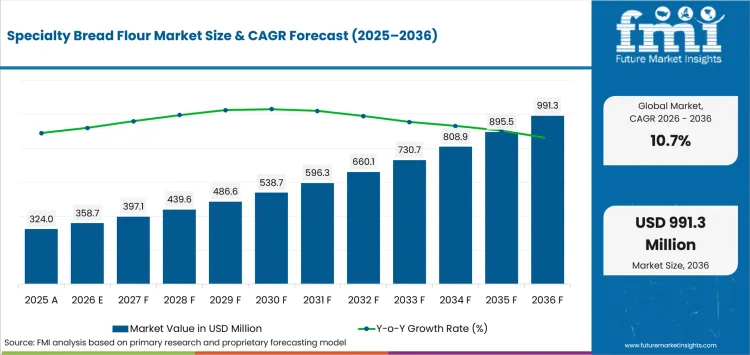
USD 358.7 Million in 2026 and USD 991.3 Million by 2036 at a 10.7% CAGR.
Demand for specialty bread flour is projected to expand at 10.7% CAGR between 2026 and 2036, lifting valuation from USD 358.7 million in 2026 to USD 991.3 million by 2036. Specialty bread flour spending rises when bakery buyers need flour to do more than provide starch and gluten. Industrial and institutional bakers increasingly specify protein strength and absorption before a formula reaches production. They may also require fermentation tolerance or documented nutrition and traceability claims. The USA school meal standard illustrates this requirement-led buying pattern. The USDA Food and Nutrition Service stated in its December 2024 meal-pattern guidance that at least 80% of weekly grains offered at breakfast must be whole grain-rich. For a bakery supplier, the commercial issue is not the rule alone. The flour must still support dough handling and acceptable finished-product quality at production scale. This shifts purchasing toward documented specifications and repeatable milling performance instead of undifferentiated flour procurement.
Country conversion paths differ even when the final use is bread. UK millers and importers must prepare for folic acid fortification of non-wholemeal common wheat flour from 13 December 2026. Japan operates through a state-managed imported wheat resale system and raised the April 2026 weighted average price by 2.5% to JPY 62,520 per ton. Saudi Arabia relies on formal wheat import tenders with defined protein specifications, while the UAE applies price controls to bread and wheat as essential goods. Suppliers therefore win when they can meet local composition rules and control input variability without disrupting bakery economics.
Key Takeaways
- Bakeries are moving selected flour purchases from generic grades toward specifications that solve a dough-performance, nutrition, traceability or process-consistency problem.
- Standard milling grade accounts for 39.0% of 2026 revenue. Its position reflects broad compatibility with established bakery recipes and industrial handling systems.
- Powder / dry holds 45.0% of 2026 revenue. Established storage, bulk transport, and metering systems make dry flour the lowest-friction form for most bakery operations.
- Bread & rolls represent 28.0% of 2026 revenue. The segment leads because flour is a primary structural ingredient and performance variations are visible in dough handling and finished loaf quality.
- Conventional accounts for 50.0% of 2026 revenue. Its position reflects the large installed base of bakery formulas and procurement programs built around standardized flour specifications.
- Direct to industrial bakeries holds 54.0% of 2026 revenue. The channel leads because bulk volume, quality communication, and production scheduling are best coordinated close to the miller-bakery relationship.
- Wheat variability and line qualification make switching costly, but flours that deliver a claim or processing benefit without destabilizing absorption and fermentation can earn a premium.
- Milling and specialty-flour suppliers include Ardent Mills, ADM, Bay State Milling, Limagrain Ingredients, GoodMills Group, King Arthur Baking, Bob's Red Mill, Doves Farm, Manildra Group, and Scoular.
Analyst Perspective
“A specialty flour has to work on the line, not just on the label. Bakers will pay for protein, absorption, traceability or nutritional differentiation when the flour also reduces adjustment, keeps dough behavior predictable and arrives with dependable technical support.”
- Nandini Roy Choudhury, Principal Consultant, Future Market Insights
How is the Specialty Bread Flour Market segmented?
The market is segmented by Grade, Form, Application, Claim, and Sales Channel.
Grade separates conventional milling specifications from finer pastry-oriented grades and certified or identity-preserved offers. Form captures how the flour or flour preparation is supplied into handling systems. Application distinguishes the finished bakery use that determines protein, absorption, and dough behavior requirements. Claim separates conventional products from clean-label, organic, and identity-preserved positioning. Sales Channel shows whether the buyer sources directly from a miller or through another route. Those routes include ingredient distribution, artisan and foodservice supply, and online B2B platforms.
Why do Bread & rolls lead the Application category?
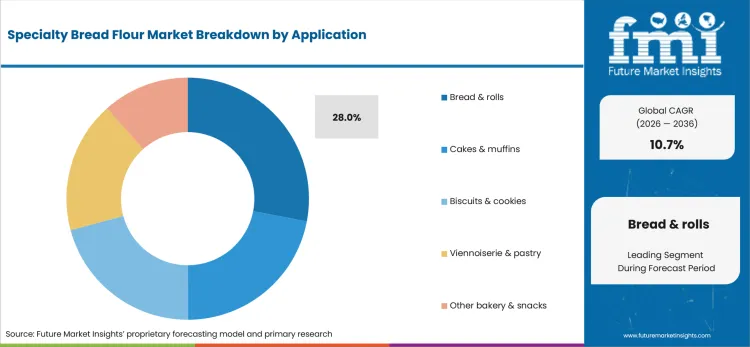
Bread and roll production puts flour performance under continuous mechanical and fermentation stress. Buyers monitor protein and gluten development because small flour changes can affect throughput. Absorption and gas retention also influence mixing tolerance and finished-product consistency. Specialty flour is therefore valuable when it changes nutrition or labeling while preserving those process controls. The institutional market provides a clear example. USDA school meal standards require at least 80% of weekly grains in breakfast programs to be whole grain-rich. Bakeries serving specification-led channels need flour systems that satisfy grain composition rules without losing acceptable machinability, volume, or eating quality. Industrial buyers compare specialty flour with bread improvers when targeting volume, tolerance or shelf-life improvements.
- Bread & rolls represent 28.0% of 2026 revenue. The segment leads because flour is a primary structural ingredient and performance variations are visible in dough handling and finished loaf quality.
- The USDA Food and Nutrition Service confirmed in December 2024 that at least 80% of weekly grains offered in the School Breakfast Program must be whole grain-rich. This creates a defined formulation requirement for institutional bread and bakery suppliers.
Why does Standard milling grade lead the Grade category?
Standard milling grade remains the practical reference point for bread manufacturers that need dependable flour behavior at scale. Its advantage comes from compatibility with established formulas, silo systems, and quality-control routines. Millers can tune protein and treatment choices around a known base specification while bakers can qualify lots against familiar absorption and mixing windows. Specialty value can still be layered onto this base through enrichment, whole-grain content, or process adjustments. Ardent Mills noted in February 2026 that flour treatments are used to improve consistency and dough performance across applications. That reinforces why a stable milling specification remains commercially important even as specialty requirements become more complex. Specialty flour increasingly competes for budget alongside other bakery ingredients that promise measurable line or finished-product benefits.
- Standard milling grade accounts for 39.0% of 2026 revenue. Its position reflects broad compatibility with established bakery recipes and industrial handling systems.
- Ardent Mills reported in February 2026 that treatment choices can improve flour consistency and dough strength. The company also linked treatments with fermentation behavior and shelf-life performance. The proof point shows how millers add functional control around a standard flour base.
Why does Powder / dry lead the Form category?
Powder / dry flour fits the infrastructure already installed across mills, ingredient warehouses, and bakeries. Dry product can move through bags or bulk tankers with limited change to core plant design. Silos and pneumatic transfer also fit established flour-handling systems. It also gives formulation teams a straightforward way to blend specialty flour with conventional flour or other dry bakery ingredients. The key advantage is operational familiarity rather than novelty. A dry specialty flour can enter an existing flour room and still deliver a differentiated protein or fiber profile. It can also support a claim or process requirement. This lowers switching friction for industrial customers that prioritize line continuity and storage efficiency. Performance-led grades can reduce the need for a separate flour improver when the mill can build functionality into the flour specification.
- Powder / dry holds 45.0% of 2026 revenue. Established storage, bulk transport, and metering systems make dry flour the lowest-friction form for most bakery operations.
- GoodMills Innovation introduced a low-dust process flour in March 2026. The thermally modified dry flour reduces fine particles and shows how suppliers can improve handling behavior without moving away from established powder systems.
Why does Conventional lead the Claim category?
Conventional flour remains the reference claim position because most bakery lines are designed around standardized wheat flour specifications. Buyers often begin with performance and cost before deciding whether organic, clean-label, or identity-preserved certification creates enough commercial value to justify segregation and documentation. Conventional does not mean technically simple. Protein targets and enrichment can still be tightly controlled. Treatment choices and local compositional rules add further specification requirements. The UK illustrates that mainstream flour can carry substantial compliance obligations. Government guidance published in April 2025 requires defined nutrient levels in non-wholemeal common wheat flour and adds folic acid from December 2026. Standardized compliance therefore supports large conventional flows. Nutrition-led demand also intersects with whole-wheat flour where grain identity and sensory performance shape formulation choices.
- Conventional accounts for 50.0% of 2026 revenue. Its position reflects the large installed base of bakery formulas and procurement programs built around standardized flour specifications.
- UK government guidance published in April 2025 set mandatory nutrient levels for non-wholemeal common wheat flour and specified folic acid addition from 13 December 2026. Mainstream flour therefore remains a controlled specification category rather than an unregulated commodity.
Why do Direct to industrial bakeries lead the Sales Channel category?
Direct supply matters when flour is a high-volume input whose performance must be coordinated with production schedules. Industrial bakeries want lot consistency and delivery reliability. They also need technical troubleshooting and rapid communication when crop quality changes. Direct relationships also allow millers to manage bulk logistics and specification changes without adding another commercial handoff. This channel becomes more important as flour moves from a simple commodity toward a plant-specific ingredient specification. The buyer is not only purchasing tonnage. Procurement and technical teams are managing continuity of dough behavior. Direct mill-to-bakery delivery can therefore become part of the product value proposition when service and quality control are integrated. Some process targets remain linked to a separate baking enzyme strategy, so flour suppliers need to show where their specification adds distinct value.
- Direct to industrial bakeries holds 54.0% of 2026 revenue. The channel leads because bulk volume, quality communication, and production scheduling are best coordinated close to the miller-bakery relationship.
- ADM reported in September 2024 that it had delivered two trailer loads of 23 tons of flour from its Corby mill directly to Jacksons Bakery. The trial illustrates how logistics capability is embedded in industrial flour supply.
What are the drivers, restraints and opportunities in the Specialty Bread Flour Market?
Performance-led bakery reformulation supports demand, while wheat variability and qualification costs constrain switching, and low-friction nutritional or traceable flour creates the clearest opportunity.
- Driver: Bakery buyers increasingly specify flour for nutrition, claim, and process outcomes rather than price alone.
- Restraint: Wheat price and quality variability can raise blending, testing, and customer qualification costs.
- Opportunity: Specialty flour that delivers a clear nutrition or traceability benefit without changing the bakery process can expand addressable use.
The main driver is specification-led reformulation. Bakers face requests for whole-grain and higher-fiber products while still being measured on throughput and consistency. Organic, clean-label, and traceability requirements add further specification pressure. That combination turns flour selection into a technical purchase. USDA meal-pattern guidance updated in December 2024 requires at least 80% of weekly grains in school breakfast programs to be whole grain-rich. The rule is one institutional example of a broader buying mechanism. When a customer must meet a defined nutrition or composition target, millers can compete on flour specifications that help the bakery meet the target without destabilizing production.
The most binding restraint is raw-material and specification variability. Bread flour performance depends on wheat characteristics that move with crop quality and origin. Protein level and price can also shift between buying periods. Japan shows how input economics can change even in a structured procurement system. The Ministry of Agriculture, Forestry and Fisheries raised the April 2026 government resale price for imported wheat by 2.5% to JPY 62,520 per ton. For specialty flour, testing and segregation amplify cost pressure. Blending and customer validation add further expense. The result is usually slower switching rather than lost demand because buyers protect proven formulas when the technical case for change is weak.
The most pronounced opportunity is low-friction differentiation. A specialty flour gains commercial reach when it creates a defensible nutrition or clean-label claim but still fits existing mixing and handling conditions. Limagrain Ingredients described LifyWheat in January 2024 as a white wheat flour with ten times more fiber than traditional flour and stated that it can partially or fully replace wheat flour without process change. Bay State Milling similarly positions HealthSense as a one-for-one white flour substitution for fiber enrichment. Suppliers that combine this functionality with traceability and stable supply can target industrial bakers that want product renovation without an expensive line redesign.
Which country CAGRs are profiled in the Specialty Bread Flour Market?
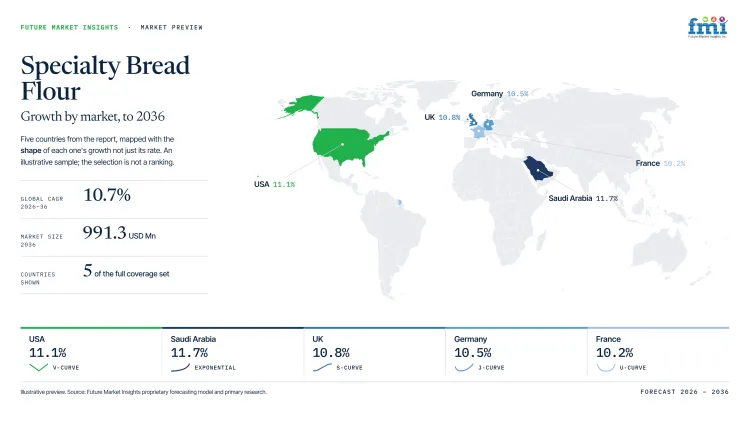
| Country | CAGR (2026-2036) |
|---|---|
| USA | 11.1% |
| Germany | 10.5% |
| France | 10.2% |
| UK | 10.8% |
| Saudi Arabia | 11.7% |
| UAE | 12.0% |
| Japan | 9.9% |
| South Korea | 11.4% |
How do country-level CAGRs compare in the Specialty Bread Flour Market?
The profiled country growth rates span 2.1 percentage points from UAE at 12.0% to Japan at 9.9%. UAE and Saudi Arabia sit in the higher-growth group above 11%. South Korea and USA are also above that threshold. UK, Germany, and France sit in a tighter middle band from 10.2% to 10.8%. Japan is below that band but still expands at 9.9%. The differences are commercially meaningful because they point to different investment pacing. They do not establish which country has the leading revenue base.
- USA is forecast at 11.1% CAGR. Industrial bakeries and institutional food suppliers purchase flour against repeatable protein, grain-content, and handling specifications.
- German bakery buyers balance industrial consistency with a strong organic and specialty-food infrastructure. In Germany, that operating setting accompanies a 10.5% CAGR through 2036.
- A 10.2% CAGR places France within the profiled set, but purchasing hinges on a specific condition: French bakers operate across industrial bread supply and an artisan market where flour type and origin can influence product positioning.
- UK's 10.8% outlook is shaped by execution conditions. UK buyers increasingly treat flour composition and labeling as a procurement-control issue as well as a baking-performance issue.
- For Saudi Arabia, the forecast reaches 11.7% CAGR. Saudi flour economics are closely linked to imported wheat quality and public food-security procurement.
- UAE bakery demand is served through an import-intensive food system and a large hospitality and foodservice channel. That gives UAE a distinct specialty bread flour path within its 12.0% CAGR forecast.
- Japan carries a 9.9% CAGR through 2036, with conversion tied to this market reality: Japanese millers and bakers work within a structured imported-wheat system where named wheat classes are matched to end uses.
- At 11.4% CAGR, South Korea remains commercially distinct. South Korean bakeries purchase wheat flour in a market where imported flour competes with policy-backed domestic grain alternatives.
CAGR should therefore be used as a pacing indicator rather than a ranking of country value. Revenue potential also depends on bakery concentration and imported wheat exposure. Regulation and claim requirements can change the qualification burden. Channel structure then affects how quickly a new flour specification reaches buyers. The broader report scope covers additional countries so suppliers can compare growth rate with local operating conditions before committing capacity or sales resources.
Country-wise Analysis
- USA: Industrial bakeries and institutional food suppliers purchase flour against repeatable protein, grain-content, and handling specifications. The specialty bread flour outlook for USA points to an 11.1% CAGR from 2026 to 2036. The USDA Food and Nutrition Service updated school meal guidance in December 2024 and requires at least 80% of weekly grains in breakfast programs to be whole grain-rich. The main commercial hurdle is making nutrition requirements work at scale without sacrificing dough tolerance or finished-product acceptance. Vendors need stable whole-grain or specialty flour performance plus technical support that reduces reformulation risk.
- Germany: German bakery buyers balance industrial consistency with a strong organic and specialty-food infrastructure. For Germany, the specialty bread flour market is projected to advance at 10.5% CAGR through 2036. In November 2023, the federal agriculture ministry presented its 2030 Organic Strategy and set a goal for 30% organic production while addressing barriers across the value chain. Organic flour still carries segregation, certification, and cost requirements that can narrow the practical buyer pool. Suppliers should pair certified sourcing with dependable milling specifications so bakeries can add organic lines without creating disproportionate process or inventory complexity.
- France: French bakers operate across industrial bread supply and an artisan market where flour type and origin can influence product positioning. specialty bread flour sales in France are expected to grow at 10.2% CAGR over 2026 to 2036. The Ministry of Agriculture reported in July 2025 that France's organic market reached EUR 12.2 billion in 2024 and household consumption returned to growth. The constraint is that organic demand does not automatically solve cereal availability or price volatility for every flour specification. Competitive suppliers need traceable grain programs and application support that fit both artisan fermentation practices and larger bakery production systems.
- UK: UK buyers increasingly treat flour composition and labeling as a procurement-control issue as well as a baking-performance issue. A 10.8% CAGR is projected for specialty bread flour in UK between 2026 and 2036. Government guidance published in April 2025 requires folic acid in non-wholemeal common wheat flour from 13 December 2026 and also specifies other mandatory nutrients. The transition adds formulation, documentation, and label-management work for millers and bakery manufacturers. Suppliers that can provide compliant flour specifications with clear technical documentation will be better placed to retain direct industrial bakery accounts during the changeover.
- Saudi Arabia: Saudi flour economics are closely linked to imported wheat quality and public food-security procurement. Through 2036, the market for specialty bread flour in Saudi Arabia is set to register an 11.7% CAGR. In October 2024, the General Food Security Authority awarded its fourth imported-wheat tender of the year, while its published wheat procurement specifications use defined hard-wheat protein requirements. Import dependence makes origin, freight, and protein consistency important operating variables for millers. Account teams need blending discipline and dependable grain access so specialty bakery flour can be delivered to industrial users without widening performance variation.
- UAE: UAE bakery demand is served through an import-intensive food system and a large hospitality and foodservice channel. Growth in specialty bread flour across UAE is projected at 12.0% CAGR from 2026 to 2036. The Ministry of Economy announced in December 2024 that a new pricing policy covering bread and wheat would take effect in January 2025 and require prior approval for price increases. This limits easy cost pass-through on staple products. Suppliers should target specialty flour where higher value is tied to visible performance, certification, or premium bakery use rather than relying on commodity price increases.
- Japan: Japanese millers and bakers work within a structured imported-wheat system where named wheat classes are matched to end uses. The ten-year forecast for specialty bread flour in Japan reaches 9.9% CAGR. In March 2026, the Ministry of Agriculture, Forestry and Fisheries set the April resale price for imported wheat at JPY 62,520 per ton. This represented a 2.5% increase while the agency also identified several North American classes used mainly for bread. Input-price resets can pressure margin and formulation choices. Local partners need stable bread-wheat specifications and careful cost management to justify specialty premiums in established bakery channels.
- South Korea: South Korean bakeries purchase wheat flour in a market where imported flour competes with policy-backed domestic grain alternatives. Between 2026 and 2036, sales of specialty bread flour in South Korea are expected to rise at 11.4% CAGR. In April 2025, the Ministry of Agriculture, Food and Rural Affairs launched a project supporting new floury-rice bread and confectionery recipes. About 100 bakeries were participating. This creates a direct substitution challenge for some wheat-flour applications. Specialty flour suppliers need to prove superior bread structure, process consistency, or premium claims that rice-based alternatives cannot match as easily.
Who are the notable companies in the Specialty Bread Flour Market?
Ardent Mills, ADM, Bay State Milling, Limagrain Ingredients, GoodMills Group, King Arthur Baking, Bob's Red Mill, Doves Farm, Manildra Group, and Scoular.
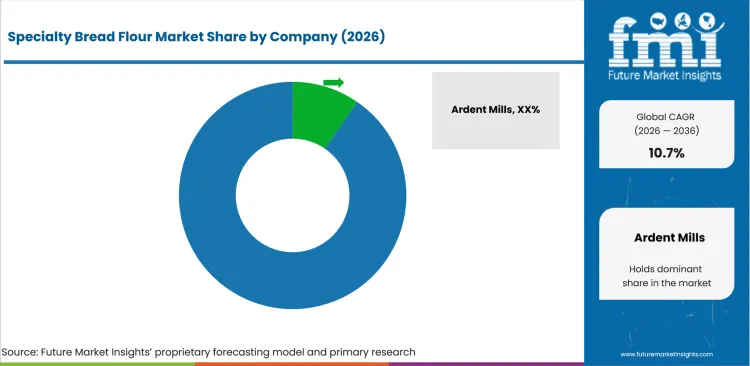
Competition spans industrial millers, specialty ingredient platforms and premium baking brands. Ardent Mills, ADM, GoodMills Group and Manildra Group bring large-scale milling and bakery supply; Bay State Milling, Limagrain Ingredients and Scoular emphasize specialty functionality, traceability or identity-preserved sourcing; King Arthur Baking, Bob's Red Mill and Doves Farm connect specialty flour with professional, artisan and premium channels.
- Industrial Milling and Direct Bakery Supply: Ardent Mills, ADM, GoodMills Group and Manildra Group compete through milling scale, technical consistency and direct bakery relationships.
- Specialty Function and Traceability: Bay State Milling, Limagrain Ingredients and Scoular focus on differentiated functionality, nutrition, traceability or identity-preserved supply.
- Professional and Premium Baking Brands: King Arthur Baking, Bob's Red Mill and Doves Farm bring strong artisan, professional or premium baking recognition.
Competitive Benchmarking: Specialty Bread Flour Market
| Company | Bread-Flour Position | Specialty / Claim Capability | Buyer Interface | Commercial Reach |
|---|---|---|---|---|
| Ardent Mills | Industrial bread-flour platform | Specialty grain and bakery specifications | Direct bakery and technical support | North America |
| ADM | Large milling and ingredient platform | Functional and nutrition-linked ingredient capability | Industrial accounts | Global |
| Bay State Milling | Specialty flour and grain supplier | Nutrition, identity-preserved and specialty grains | Technical and industrial bakery support | North America |
| Limagrain Ingredients | Functional cereal ingredient specialist | Functional flours and cereal-based solutions | Technical ingredient selling | Europe and international |
| GoodMills Group | Industrial flour milling group | Bakery and specialty flour portfolio | Direct industrial and regional channels | Europe |
| King Arthur Baking | Premium baking flour brand | High-specification and specialty flours | Retail, professional and DTC | North America |
| Bob's Red Mill | Natural and specialty flour brand | Whole grain, gluten-free and specialty formats | Retail and foodservice | North America and exports |
| Doves Farm | Organic and specialty flour brand | Organic and specialty baking flours | Retail, professional and bulk formats | UK and selected exports |
| Manildra Group | Integrated flour and wheat platform | Industrial and specialty bakery flour capability | Direct industrial supply | Australia and export markets |
| Scoular | Ingredient and grain supply platform | Specialty grain and traceability capability | Ingredient and supply-chain relationships | International |
The benchmark compares milling scale, specialty specification depth, buyer-facing technical support and the routes through which flour moves into industrial, professional or premium baking applications.
Key Developments in the Specialty Bread Flour Market
- In July 2025, Ardent Mills entered an agreement to acquire Stone Mill in North Dakota. Stone Mill specializes in cleaning and processing certified gluten-free and identity-preserved grains, pulses, and seeds. The transaction broadens Ardent Mills' control over specialty grain processing and can improve supply-chain consistency for customers that require segregation or identity-preserved inputs.
- In May 2025, Limagrain Ingredients highlighted broader commercial use of LifyWheat as a high-fiber wheat flour. The company cited bread and pastry uses as well as cereal bars. It also stated that the flour contains ten times more fiber than standard wheat flour and can be integrated without changing manufacturing processes. This positions nutrition enhancement as a lower-friction specialty-flour proposition for bakery reformulation.
- In July 2026, GoodMills Innovation introduced GOOD NatureRelax, a clean-label wheat-germ ingredient designed to reduce excessive dough elasticity on mechanical and industrial bakery equipment. The product uses naturally occurring components in stabilized wheat germ to support dough relaxation. The launch shows how milling groups are extending from flour supply into process-control solutions that address bakery handling problems.
Key Players in the Specialty Bread Flour Market
Industrial Flour Milling
- Ardent Mills
- ADM
- GoodMills Group
- Manildra Group
Specialty and Functional Flour
- Bay State Milling
- Limagrain Ingredients
- Scoular
Premium Baking Brands
- King Arthur Baking
- Bob's Red Mill
- Doves Farm
Specialty Bread Flour Market - Report Scope
| Coverage field | Report scope |
|---|---|
| Market breakdown | Grade, Form, Application, Claim, Sales Channel, and Region |
| Quantitative Units | USD Million |
| Market Definition | Revenue from specialty bread flour and flour preparations sold within the stated Grade, Form, Application, Claim, and Sales Channel universe. Downstream finished bakery revenue and adjacent or substitute product revenue are excluded. |
| Regions Covered | North America; Latin America; Western Europe; Eastern Europe; East Asia; South Asia and Pacific; Middle East and Africa |
| Countries Covered | USA, Germany, France, UK, Saudi Arabia, UAE, Japan, and South Korea, plus more than twenty-five additional countries in the full report |
| Key Companies Profiled | Ardent Mills; ADM; Bay State Milling; Limagrain Ingredients; GoodMills Group; King Arthur Baking; Bob's Red Mill; Doves Farm; Manildra Group; Scoular |
| Forecast Period | 2026 to 2036 |
| Approach | Market sizing uses a hybrid bottom-up and top-down approach that reconciles supplier activity, channel demand, application use, and country-level operating conditions within the defined revenue boundary. |
Specialty Bread Flour Market - Research Methodology
| Method | Approach |
|---|---|
| Primary Research | Structured discussions with millers, ingredient suppliers, distributors, bakery manufacturers, foodservice buyers, procurement teams, and technical specialists are used to test purchasing criteria, qualification frictions, channel behavior, and specification requirements. |
| Desk Research | Company filings and first-party product material are reviewed alongside government rules, food standards, agriculture statistics, trade and procurement information, and other authoritative public sources relevant to wheat, flour, and bakery operations. |
| Market Sizing and Forecasting | Base-year and forecast values are assessed against supplier participation, flour use by application, channel structure, country growth conditions, and the effect of regulation or raw-material economics on specialty-product adoption. |
| Data Validation | Findings are cross-checked across source types and market boundaries. Finished bakery revenue, adjacent ingredients, substitute products, double counting across channels, and claims without adequate support are excluded from the market estimate. |
Specialty Bread Flour Market by Segments
Specialty Bread Flour Market segmented by Grade:
- Standard milling grade
- Fine / patisserie grade
- Organic certified
- Identity-preserved specialty
Specialty Bread Flour Market segmented by Form:
- Powder / dry
- Liquid
- Paste / semi-solid
- Granules / pieces
Specialty Bread Flour Market segmented by Application:
- Bread & rolls
- Cakes & muffins
- Biscuits & cookies
- Viennoiserie & pastry
- Other bakery & snacks
Specialty Bread Flour Market segmented by Claim:
- Conventional
- Clean label
- Organic
- Non-GMO / identity preserved
Specialty Bread Flour Market segmented by Sales Channel:
- Direct to industrial bakeries
- Ingredient distributors
- Foodservice & artisan supply
- Online B2B
Specialty Bread Flour Market by Region:
- North America
- United States
- Canada
- Latin America
- Brazil
- Mexico
- Argentina
- Chile
- Western Europe
- Germany
- France
- United Kingdom
- Italy
- Spain
- Benelux
- Nordics
- Eastern Europe
- Poland
- Czech Republic
- Romania
- Hungary
- East Asia
- China
- Japan
- South Korea
- South Asia and Pacific
- India
- ASEAN
- Australia and New Zealand
- Middle East and Africa
- GCC Countries
- South Africa
- Türkiye
- Israel
Research Sources and Bibliography
- USA Department of Agriculture, Food and Nutrition Service (2024, December 4). School Breakfast Program Meal Pattern.
- Department for Environment, Food & Rural Affairs and Food Standards Agency (2025, April 23). Bread and flour: labelling and composition.
- Federal Ministry of Food and Agriculture, Germany (2023, November 16). 2030 Organic Strategy: National Strategy for 30% Organic Production in the Farming and Food Sector by 2030.
- Ministry of Agriculture and Food Sovereignty, France (2025, July 1). Agriculture biologique: des signes encourageants en 2024.
- General Food Security Authority, Saudi Arabia (2024, October 7). GFSA Awards Fourth Tender of Imported Wheat for 2024.
- Ministry of Economy, UAE (2024, December 24). New pricing policy for nine categories of essential consumer goods.
- Ministry of Agriculture, Forestry and Fisheries, Japan (2026, March 11). Revision of Government Resale Price for Imported Wheat.
- Ministry of Agriculture, Food and Rural Affairs, South Korea (2025, April 2). Invigorating the Floury Rice Industry: a Win-Win Situation for Both Bakeries and Farmers.
- Ardent Mills (2025, July 31). Ardent Mills Enters Agreement to Acquire Stone Mill in North Dakota, Expanding Emerging Nutrition Portfolio.
- ADM (2024, September 3). ADM, Voltloader Expand Partnership to Implement Innovative Electric Tractor Units for Direct Flour Deliveries.
- Limagrain Ingredients (2025, May 20). Unlock the power of fibre with LifyWheat.
- GoodMills Innovation (2026, July 17). GOOD NatureRelax: Groundbreaking ingredient for reliable dough relaxation.
- Ardent Mills (2026, February 16). The Ardent Mills guide to flour treatments: An overview of options for improving flour performance.
- Bay State Milling (2025). HealthSense High Fiber Wheat Flour (2025 Update).
- King Arthur Baking Company (2025, March 5). What is bread flour?
This Report Answers
- How is demand for the Specialty Bread Flour Market expected to evolve through 2036?
- Which bakery, nutrition, regulatory, and operating pressures support demand for specialty bread flour?
- Why does Standard milling grade hold the leading position within Grade?
- How does Powder / dry influence handling, storage, and downstream bakery use?
- Why do Bread & rolls hold the leading position within Application?
- How do growth rates differ across USA, Germany, France, UK, Saudi Arabia, UAE, Japan, and South Korea?
- Which companies compete in the Specialty Bread Flour Market and how do their strategic roles differ?
- How do wheat-price variability, specification risk, and qualification requirements limit adoption?
- What should bakery procurement and technical teams evaluate before selecting a specialty bread flour supplier?
Frequently Asked Questions
What is driving growth in the Specialty Bread Flour Market?
Growth is driven by bakery buyers seeking flour that supports nutrition and process targets without sacrificing line performance. Organic and clean-label requirements create extra purchase triggers when the new specification must still deliver repeatable dough behavior at industrial or professional scale.
Who are the key players in the Specialty Bread Flour Market?
Key players include Ardent Mills, ADM, Bay State Milling, Limagrain Ingredients, GoodMills Group, King Arthur Baking, Bob's Red Mill, Doves Farm, Manildra Group and Scoular. They differ by milling scale, specification depth, claim capability and bakery-facing technical support.
What notable restraint affects the Specialty Bread Flour Market?
Wheat quality and price variability can change protein, absorption, and dough behavior while raising the cost of blending and qualification. Buyers therefore resist switching when a specialty claim lacks enough technical evidence to protect throughput and finished-product consistency.
Why should executives track the Specialty Bread Flour Market?
The market shows how bakery value is moving from generic flour tonnage toward documented performance and differentiated claims. Executives can use that shift to prioritize milling control and specialty grain sourcing while strengthening technical service, certification support, or direct bakery relationships.
What business problem does the Specialty Bread Flour Market address?
Specialty bread flour helps bakers retain wheat flour's structural role while targeting stronger dough or higher fiber. It can also support organic certification and cleaner labels while enabling identity preservation or more consistent handling on automated equipment.
What should bakery procurement teams evaluate in the Specialty Bread Flour Market?
Procurement teams should compare protein and ash targets alongside absorption and fermentation tolerance. They should also test claim documentation and traceability then require production-scale evidence of lot consistency and delivery reliability.
What limits return on investment in the Specialty Bread Flour Market?
Return can be reduced by premium raw-material cost and segregation as well as certification or reformulation work. The most pronounced ROI occurs when qualification time is short and the specialty attribute supports a sellable claim or operating benefit without major equipment changes.
What supports long-term commercial confidence in the Specialty Bread Flour Market?
Long-term confidence comes from durable bakery demand combined with precise nutrition and sourcing requirements. Suppliers with repeatable milling specifications and direct technical support can convert those requirements into recurring ingredient revenue across multiple bakery applications and channels.
Preview the report firsthand - request a free sample
Get SampleGet the brochure for pricing and purchase details.
Get PDFTable of Content
- Key Takeaways
- Market Size and CAGR
- Top Growth Driver
- Fastest Growing Segment
- Leading Region
- Key Companies
- Emerging Opportunities
- Executive Summary
- Global Market Outlook
- Demand-side Trends
- Supply-side Trends
- Technology Roadmap Analysis
- Analysis and Recommendations
- Analyst Perspective (What is happening? Why now? What should investors know?)
- Key Questions Answered
- How large is the market?
- What is the CAGR?
- What are key trends?
- Which region dominates?
- Who are the leaders?
- Market Overview
- Market Coverage / Taxonomy
- Market Definition / Scope / Limitations
- Research Methodology
- Chapter Orientation
- Analytical Lens and Working Hypotheses
- Market Structure, Signals, and Trend Drivers
- Benchmarking and Cross-market Comparability
- Market Sizing, Forecasting, and Opportunity Mapping
- Research Design and Evidence Framework
- Desk Research Programme (Secondary Evidence)
- Expert Input and Fieldwork (Primary Evidence)
- Tooling, Models, and Reference Databases
- Data Engineering and Model Build
- Quality Assurance and Audit Trail
- Market Background
- Market Dynamics (Drivers, Restraints, Opportunity, Trends)
- Scenario Forecast (Optimistic, Likely, Conservative)
- Impact Analysis
- AI Impact
- Sustainability Impact
- Regulatory Impact
- Technology Impact
- Consumer / Buyer Analysis
- Purchase Drivers
- Adoption Barriers
- Buyer Journey
- Opportunity Map Analysis
- Product Life Cycle Analysis
- Supply Chain Analysis
- Investment Feasibility Matrix
- Value Chain Analysis
- PESTLE and Porter's Analysis
- Regulatory Landscape
- Regional Parent Market Outlook
- Production and Consumption Statistics
- Import and Export Statistics
- Global Market Analysis and Forecast, 2021 to 2036
- Historical Market Size Value (USD Million) Analysis, 2021 to 2025
- Current and Future Market Size Value (USD Million) Projections, 2026 to 2036
- Y-o-Y Growth Trend Analysis
- Absolute $ Opportunity Analysis
- Global Market Pricing Analysis, 2021 to 2036
- Global Market Analysis and Forecast, By Grade, 2021 to 2036
- Introduction / Key Findings
- Historical Market Size Value (USD Million) Analysis By Grade, 2021 to 2025
- Current and Future Market Size Value (USD Million) Analysis and Forecast By Grade, 2026 to 2036
- Standard milling grade
- Fine / patisserie grade
- Organic certified
- Identity-preserved specialty
- Standard milling grade
- Y-o-Y Growth Trend Analysis By Grade, 2021 to 2025
- Absolute $ Opportunity Analysis By Grade, 2026 to 2036
- Global Market Analysis and Forecast, By Form, 2021 to 2036
- Introduction / Key Findings
- Historical Market Size Value (USD Million) Analysis By Form, 2021 to 2025
- Current and Future Market Size Value (USD Million) Analysis and Forecast By Form, 2026 to 2036
- Powder / dry
- Liquid
- Paste / semi-solid
- Granules / pieces
- Powder / dry
- Y-o-Y Growth Trend Analysis By Form, 2021 to 2025
- Absolute $ Opportunity Analysis By Form, 2026 to 2036
- Global Market Analysis and Forecast, By Application, 2021 to 2036
- Introduction / Key Findings
- Historical Market Size Value (USD Million) Analysis By Application, 2021 to 2025
- Current and Future Market Size Value (USD Million) Analysis and Forecast By Application, 2026 to 2036
- Bread & rolls
- Cakes & muffins
- Biscuits & cookies
- Viennoiserie & pastry
- Other bakery & snacks
- Bread & rolls
- Y-o-Y Growth Trend Analysis By Application, 2021 to 2025
- Absolute $ Opportunity Analysis By Application, 2026 to 2036
- Global Market Analysis and Forecast, By Claim, 2021 to 2036
- Introduction / Key Findings
- Historical Market Size Value (USD Million) Analysis By Claim, 2021 to 2025
- Current and Future Market Size Value (USD Million) Analysis and Forecast By Claim, 2026 to 2036
- Conventional
- Clean label
- Organic
- Non-GMO / identity preserved
- Conventional
- Y-o-Y Growth Trend Analysis By Claim, 2021 to 2025
- Absolute $ Opportunity Analysis By Claim, 2026 to 2036
- Global Market Analysis and Forecast, By Sales Channel, 2021 to 2036
- Introduction / Key Findings
- Historical Market Size Value (USD Million) Analysis By Sales Channel, 2021 to 2025
- Current and Future Market Size Value (USD Million) Analysis and Forecast By Sales Channel, 2026 to 2036
- Direct to industrial bakeries
- Ingredient distributors
- Foodservice & artisan supply
- Online B2B
- Direct to industrial bakeries
- Y-o-Y Growth Trend Analysis By Sales Channel, 2021 to 2025
- Absolute $ Opportunity Analysis By Sales Channel, 2026 to 2036
- Global Market Analysis and Forecast, By Region, 2021 to 2036
- Introduction
- Historical Market Size Value (USD Million) Analysis By Region, 2021 to 2025
- Current Market Size Value (USD Million) Analysis and Forecast By Region, 2026 to 2036
- North America
- Latin America
- Western Europe
- Eastern Europe
- East Asia
- South Asia and Pacific
- Middle East & Africa
- Market Attractiveness Analysis By Region
- North America Market Analysis and Forecast, By Country, 2021 to 2036
- Historical Market Size Value (USD Million) Trend Analysis By Market Taxonomy, 2021 to 2025
- Market Size Value (USD Million) Forecast By Market Taxonomy, 2026 to 2036
- By Country
- USA
- Canada
- By Grade
- By Form
- By Application
- By Claim
- By Sales Channel
- By Country
- Market Attractiveness Analysis
- By Country
- By Grade
- By Form
- By Application
- By Claim
- By Sales Channel
- Key Takeaways
- Latin America Market Analysis and Forecast, By Country
- Historical Market Size Value (USD Million) Trend Analysis By Market Taxonomy, 2021 to 2025
- Market Size Value (USD Million) Forecast By Market Taxonomy, 2026 to 2036
- By Country
- Brazil
- Mexico
- Chile
- Rest of Latin America
- By Grade
- By Form
- By Application
- By Claim
- By Sales Channel
- By Country
- Market Attractiveness Analysis
- By Country
- By Grade
- By Form
- By Application
- By Claim
- By Sales Channel
- Key Takeaways
- Western Europe Market Analysis and Forecast, By Country
- Historical Market Size Value (USD Million) Trend Analysis By Market Taxonomy, 2021 to 2025
- Market Size Value (USD Million) Forecast By Market Taxonomy, 2026 to 2036
- By Country
- Germany
- UK
- Italy
- Spain
- France
- Nordic
- BENELUX
- Rest of Western Europe
- By Grade
- By Form
- By Application
- By Claim
- By Sales Channel
- By Country
- Market Attractiveness Analysis
- By Country
- By Grade
- By Form
- By Application
- By Claim
- By Sales Channel
- Key Takeaways
- Eastern Europe Market Analysis and Forecast, By Country
- Historical Market Size Value (USD Million) Trend Analysis By Market Taxonomy, 2021 to 2025
- Market Size Value (USD Million) Forecast By Market Taxonomy, 2026 to 2036
- By Country
- Russia
- Poland
- Hungary
- Balkan & Baltic
- Rest of Eastern Europe
- By Grade
- By Form
- By Application
- By Claim
- By Sales Channel
- By Country
- Market Attractiveness Analysis
- By Country
- By Grade
- By Form
- By Application
- By Claim
- By Sales Channel
- Key Takeaways
- East Asia Market Analysis and Forecast, By Country
- Historical Market Size Value (USD Million) Trend Analysis By Market Taxonomy, 2021 to 2025
- Market Size Value (USD Million) Forecast By Market Taxonomy, 2026 to 2036
- By Country
- China
- Japan
- South Korea
- By Grade
- By Form
- By Application
- By Claim
- By Sales Channel
- By Country
- Market Attractiveness Analysis
- By Country
- By Grade
- By Form
- By Application
- By Claim
- By Sales Channel
- Key Takeaways
- South Asia and Pacific Market Analysis and Forecast, By Country
- Historical Market Size Value (USD Million) Trend Analysis By Market Taxonomy, 2021 to 2025
- Market Size Value (USD Million) Forecast By Market Taxonomy, 2026 to 2036
- By Country
- India
- ASEAN
- Australia & New Zealand
- Rest of South Asia and Pacific
- By Grade
- By Form
- By Application
- By Claim
- By Sales Channel
- By Country
- Market Attractiveness Analysis
- By Country
- By Grade
- By Form
- By Application
- By Claim
- By Sales Channel
- Key Takeaways
- Middle East & Africa Market Analysis and Forecast, By Country
- Historical Market Size Value (USD Million) Trend Analysis By Market Taxonomy, 2021 to 2025
- Market Size Value (USD Million) Forecast By Market Taxonomy, 2026 to 2036
- By Country
- Kingdom of Saudi Arabia
- Other GCC Countries
- Türkiye
- South Africa
- Other African Union
- Rest of Middle East & Africa
- By Grade
- By Form
- By Application
- By Claim
- By Sales Channel
- By Country
- Market Attractiveness Analysis
- By Country
- By Grade
- By Form
- By Application
- By Claim
- By Sales Channel
- Key Takeaways
- Key Countries Market Analysis
- USA
- Pricing Analysis
- Market Share Analysis, 2025
- By Grade
- By Form
- By Application
- By Claim
- By Sales Channel
- Canada
- Pricing Analysis
- Market Share Analysis, 2025
- By Grade
- By Form
- By Application
- By Claim
- By Sales Channel
- Mexico
- Pricing Analysis
- Market Share Analysis, 2025
- By Grade
- By Form
- By Application
- By Claim
- By Sales Channel
- Brazil
- Pricing Analysis
- Market Share Analysis, 2025
- By Grade
- By Form
- By Application
- By Claim
- By Sales Channel
- Chile
- Pricing Analysis
- Market Share Analysis, 2025
- By Grade
- By Form
- By Application
- By Claim
- By Sales Channel
- Germany
- Pricing Analysis
- Market Share Analysis, 2025
- By Grade
- By Form
- By Application
- By Claim
- By Sales Channel
- UK
- Pricing Analysis
- Market Share Analysis, 2025
- By Grade
- By Form
- By Application
- By Claim
- By Sales Channel
- Italy
- Pricing Analysis
- Market Share Analysis, 2025
- By Grade
- By Form
- By Application
- By Claim
- By Sales Channel
- Spain
- Pricing Analysis
- Market Share Analysis, 2025
- By Grade
- By Form
- By Application
- By Claim
- By Sales Channel
- France
- Pricing Analysis
- Market Share Analysis, 2025
- By Grade
- By Form
- By Application
- By Claim
- By Sales Channel
- India
- Pricing Analysis
- Market Share Analysis, 2025
- By Grade
- By Form
- By Application
- By Claim
- By Sales Channel
- ASEAN
- Pricing Analysis
- Market Share Analysis, 2025
- By Grade
- By Form
- By Application
- By Claim
- By Sales Channel
- Australia & New Zealand
- Pricing Analysis
- Market Share Analysis, 2025
- By Grade
- By Form
- By Application
- By Claim
- By Sales Channel
- China
- Pricing Analysis
- Market Share Analysis, 2025
- By Grade
- By Form
- By Application
- By Claim
- By Sales Channel
- Japan
- Pricing Analysis
- Market Share Analysis, 2025
- By Grade
- By Form
- By Application
- By Claim
- By Sales Channel
- South Korea
- Pricing Analysis
- Market Share Analysis, 2025
- By Grade
- By Form
- By Application
- By Claim
- By Sales Channel
- Russia
- Pricing Analysis
- Market Share Analysis, 2025
- By Grade
- By Form
- By Application
- By Claim
- By Sales Channel
- Poland
- Pricing Analysis
- Market Share Analysis, 2025
- By Grade
- By Form
- By Application
- By Claim
- By Sales Channel
- Hungary
- Pricing Analysis
- Market Share Analysis, 2025
- By Grade
- By Form
- By Application
- By Claim
- By Sales Channel
- Kingdom of Saudi Arabia
- Pricing Analysis
- Market Share Analysis, 2025
- By Grade
- By Form
- By Application
- By Claim
- By Sales Channel
- Türkiye
- Pricing Analysis
- Market Share Analysis, 2025
- By Grade
- By Form
- By Application
- By Claim
- By Sales Channel
- South Africa
- Pricing Analysis
- Market Share Analysis, 2025
- By Grade
- By Form
- By Application
- By Claim
- By Sales Channel
- USA
- Market Structure Analysis
- Competition Dashboard
- Competition Benchmarking
- Market Share Analysis of Top Players
- By Regional
- By Grade
- By Form
- By Application
- By Claim
- By Sales Channel
- Emerging Startups
- Innovation Benchmarking
- Competition Analysis
- Competition Deep Dive
- Ardent Mills
- Overview
- Product Portfolio
- Profitability by Market Segments
- Sales Footprint
- Strategy Overview
- Marketing Strategy
- Product Strategy
- Channel Strategy
- ADM
- Bay State Milling
- Limagrain Ingredients
- GoodMills Group
- King Arthur Baking
- Bob's Red Mill
- Doves Farm
- Manildra Group
- Scoular
- Ardent Mills
- Case Studies
- Success Stories
- Recent Developments
- Competition Deep Dive
- Assumptions & Acronyms Used


