

- Market Size (2026)
- USD 1430.9 Mn
- Forecast (2036)
- USD 5258.3 Mn
- CAGR (2026 to 2036)
- 13.9%
How big is Spring Roll & Samosa Pastry Sheets Market in 2026?
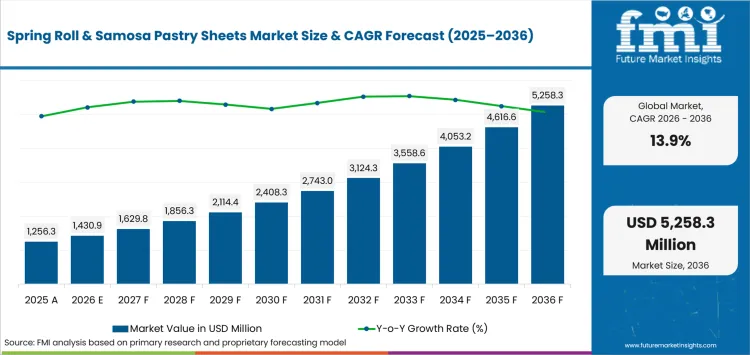
USD 1430.9 Million in 2026 and USD 5258.3 Million by 2036 at a 13.9% CAGR.
Demand for spring roll and samosa pastry sheets is projected to expand at 13.9% CAGR between 2026 and 2036, lifting valuation from USD 1,430.9 million in 2026 to USD 5,258.3 million by 2036. USDA Economic Research Service reported in June 2026 that food away from home represented 56.3% of total USA food expenditures in 2025. That scale matters because commissaries and foodservice kitchens value inputs that remove mixing and rolling steps. Pre-portioned sheets shift labor toward filling and cooking while limiting thickness variation. Retail demand creates a second route because fresh and frozen packs let households assemble familiar snacks with less preparation. Buyers still test seal strength and sheet integrity before changing suppliers. They also test temperature handling and unit economics. Conversion therefore depends on whether labor savings survive the buyer’s actual fry or bake process.
Country conditions change the route to purchase. Germany has a large food-processing base that rewards consistent specifications but exposes suppliers to price pressure and rising production costs. In the UAE, reliance on imported ingredients and expanding local processing raise the value of dependable distribution. Japan places a premium on repeatable food-processing performance within a mature sector. Saudi Arabia adds a retail channel that is expanding through physical stores and online platforms. These differences favor suppliers that can adjust pack size and temperature format without weakening pastry handling. A buyer may show interest in a new wrapper because it saves preparation time. The order converts only after the sheet performs consistently through storage and forming while meeting the local labeling requirements.
Key Takeaways
- Ready pastry sheets convert labor-saving demand into a repeat purchase by removing dough mixing, rolling and portioning while keeping wrapper thickness more consistent.
- Vegetable samosas account for 37.0% of Product Type demand in 2026, reflecting broad filling flexibility and repeatable wrapper specifications.
- Conventional holds a 52.0% share of Claim / Nature demand in 2026 because familiar formulations lower the number of claim-specific qualification steps.
- Fresh represents 32.0% of Format demand in 2026 because buyers can use pliable sheets without a thawing stage.
- Multipack accounts for 35.0% of Packaging Format demand in 2026 because it combines repeat-use economics with manageable storage quantities.
- Supermarkets & hypermarkets hold 39.0% of Sales Channel demand in 2026 because they combine broad shopper traffic with chilled and frozen category infrastructure.
- Thin sheets are sensitive to drying, sticking and breakage, but suppliers that control peelability, cold-chain behavior and pack architecture can win both household and foodservice users.
- Direct wrapper and pastry-sheet manufacturers include Tee Yih Jia / Spring Home, Kawan Food / KG Pastry, PA Food / uPastry, Nafees Frozen Foods, Golden Loaf, and Joyfun Food.
Analyst Perspective
“The sheet has to survive the buyer’s handling before it can prove itself in the fryer or oven. Thickness consistency, easy separation, seal behavior and temperature-state control are the commercial basics; claims and pack innovation matter only after those are reliable.”
- Nandini Roy Choudhury, Principal Consultant, Future Market Insights
How is the Spring Roll & Samosa Pastry Sheets Market segmented?
The market is segmented by Product Type, Claim / Nature, Format, Packaging Format, and Sales Channel.
Product Type distinguishes the finished application that the pastry sheet is designed to support. Claim / Nature separates standard formulations from products that carry clean-label or nutrition-related positioning. Format captures the temperature state and finishing work required before forming. Packaging Format reflects the number of sheets or service units purchased at one time. Sales Channel identifies where retail consumers or professional buyers obtain the product. These axes matter because a sheet that performs well in a fresh supermarket multipack may not meet the holding requirements of a frozen foodservice operation. The leading position on each axis therefore reflects a different purchase test rather than one universal preference.
Why does Conventional lead the Claim / Nature category?
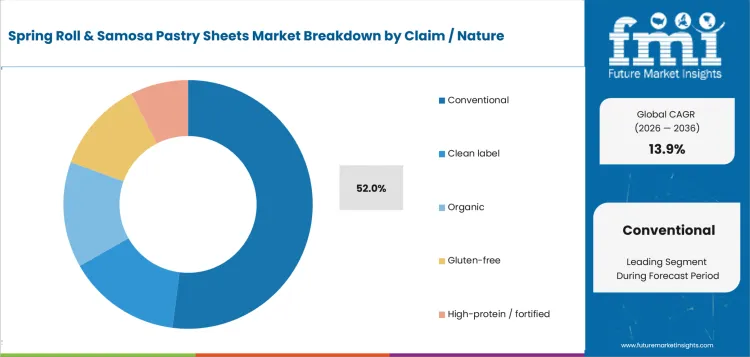
Conventional sheets retain the leading position because they minimize the formulation and qualification work required for high-throughput production. Buyers can focus on thickness and sealing performance without adding organic certification or gluten-control requirements to the approval process. That matters in a wheat-based product where label accuracy is a material compliance issue. The USA Food and Drug Administration’s January 2025 allergen guidance confirms that wheat is one of the major allergens that must be declared on FDA-regulated food labels. A conventional product does not remove that obligation. It does reduce the number of additional claims that a supplier must substantiate. This keeps purchasing centered on performance and cost for the broadest buyer group. Foodservice buyers also source pastry sheets alongside frozen baked products that use centralized production to reduce site labor.
- Conventional holds a 52.0% share of Claim / Nature demand in 2026 because familiar formulations lower the number of claim-specific qualification steps.
- FDA’s January 2025 allergen guidance lists wheat among major food allergens, which makes ingredient declaration and cross-contact controls relevant to pastry-sheet suppliers.
Why do Vegetable samosas lead the Product Type category?
Vegetable samosas lead because pastry sheets used for this application can support a wide range of fillings without the meat-specific handling steps that shape some professional workflows. Vegetable fillings also allow operators to vary seasoning and portion size while keeping the wrapper specification stable. That favors standardized sheets across mixed menus and buffet programs. The commercial test is still mechanical. Sheets must fold without cracking and seal without excessive moisture migration from the filling. Plant-forward savoury launches continue to shape filling and handling briefs for pastry systems. The Compleat Food Group introduced new vegan savoury slices in May 2025, showing why sheet suppliers must maintain foldability across vegetable-led recipes. Frozen sheet formats sit close to the wider frozen pastries category because storage stability determines whether thin dough stays workable.
- Vegetable samosas account for 37.0% of Product Type demand in 2026, reflecting broad filling flexibility and repeatable wrapper specifications.
- In May 2025, The Compleat Food Group expanded Wall’s Pastry with vegan savoury slices for nationwide Tesco distribution, showing ongoing development around plant-forward pastry formats.
Why does Fresh lead the Format category?
Fresh sheets lead where buyers prioritize immediate pliability and short preparation time. A refrigerated wrapper can move from pack to forming station without a thaw step. This reduces waiting time for restaurants and households that assemble in smaller batches. The tradeoff is tighter control of shelf life and temperature. A fresh sheet that dries at the edge or absorbs surface moisture can lose sealing performance quickly. Fresh dough products already distributed through refrigerated retail demonstrate the importance of immediate pliability and controlled presentation. Wewalka's current portfolio uses pre-rolled presentation to reduce preparation work, a handling principle relevant to pastry-sheet suppliers serving predictable-turnover accounts. Cold-chain expansion broadens access to the frozen food channel that can preserve sheet flexibility over longer distribution routes.
- Fresh represents 32.0% of Format demand in 2026 because buyers can use pliable sheets without a thawing stage.
- Wewalka’s current 2026 portfolio markets fresh puff pastry pre-rolled on baking paper, demonstrating a ready-to-handle dough format built around immediate use.
Why does Multipack lead the Packaging Format category?
Multipacks balance unit economics with protection against drying and handling damage. Households can prepare several pieces in one session without buying a bulk foodservice case. Small professional kitchens gain the same advantage when demand is frequent but not high enough for industrial packs. The pack must also manage inter-sheet sticking because a low headline price loses value if wrappers tear during separation. Pre-portioned dough formats teach buyers to expect ready-to-fill convenience. Goya's frozen empanada discs illustrate how portioned sheets remove forming work before filling and support different cooking methods. Multipacks lead when portion count and separation design match the operator’s batch size. Wrapper demand rises with the menu breadth of frozen snacks that rely on repeatable forming and frying performance.
- Multipack accounts for 35.0% of Packaging Format demand in 2026 because it combines repeat-use economics with manageable storage quantities.
- Goya Foods’ current frozen empanada dough portfolio offers ready-to-fill discs for baking or frying, illustrating the commercial value of pre-portioned pastry units.
Why do Supermarkets & hypermarkets lead the Sales Channel category?
Supermarkets & hypermarkets lead because they combine chilled and frozen merchandising with routine household food shopping. The channel can position pastry sheets beside fillings and sauces while also supporting larger multipacks. That gives consumers a clear use occasion without requiring a specialist bakery visit. It also creates a demanding supplier test because retailers expect consistent case configuration and shelf life. France offers a useful retail signal. Insee reported in June 2026 that in-store food sales increased around 2% in 2025 while out-of-store sales also increased by more than 2%. The data confirm that physical food retail remains commercially relevant even as alternative channels expand. Retail multipacks extend the same labor-saving proposition into the household convenience food occasion.
- Supermarkets & hypermarkets hold 39.0% of Sales Channel demand in 2026 because they combine broad shopper traffic with chilled and frozen category infrastructure.
- Insee reported in June 2026 that French in-store food sales rose around 2% in 2025, supporting the continuing importance of physical grocery retail for packaged food discovery.
What are the drivers, restraints and opportunities in the Spring Roll & Samosa Pastry Sheets Market?
Prepared-food convenience supports demand, while handling and compliance can delay conversion, and claim-led formats create room for differentiated sheet systems.
- Driver: Foodservice and retail buyers use pre-portioned sheets to remove dough preparation and standardize output.
- Restraint: Thin pastry is sensitive to temperature and moisture while wheat-based labeling adds compliance work.
- Opportunity: Suppliers can build higher-value sheets around validated claims and application-specific finishing performance.
Labor and throughput are the main demand mechanism. USDA Economic Research Service reported in June 2026 that food away from home represented 56.3% of USA food expenditures in 2025. A larger foodservice base increases the number of kitchens where preparation minutes matter. Ready sheets remove flour mixing and rolling from the workflow. They also help operators target a repeatable piece weight. The same proposition works in retail when a consumer wants to assemble snacks without making dough. The commercial gain is not automatic because the wrapper still has to survive filling and cooking. Demand strengthens when a sheet can reduce preparation time without creating higher breakage or inconsistent finished texture.
Handling and compliance create the most practical restraint. Thin wheat sheets can stick when moisture rises and crack when they dry. Frozen formats add thaw discipline while fresh formats depend on stable chilled distribution. Claim-led products create another layer of qualification. FDA’s January 2025 guidance identifies wheat as a major allergen that must be declared on regulated food labels in the United States. Similar buyer scrutiny applies to gluten-free or other special claims because a label promise must be supported by formulation and process controls. These requirements do not remove demand. They lengthen approval when a buyer must validate storage behavior and label language before adding a new supplier.
A practical opportunity is to design sheets around specific finishing and claim combinations rather than treat wrappers as interchangeable commodities. The Compleat Food Group launched a high-protein Wall’s sausage roll in May 2026 after a year of development. The company positioned the product around 16 grams of protein and HFSS compliance. The launch signals that savoury-pastry developers are asking dough systems to tolerate more demanding nutrition briefs. Sheet suppliers can respond with fortified or clean-label options that retain foldability and sealing performance. Vendors that pair formulation capability with pack formats suited to retail and foodservice batch sizes are better placed to capture this demand.
Which country CAGRs are profiled in the Spring Roll & Samosa Pastry Sheets Market?
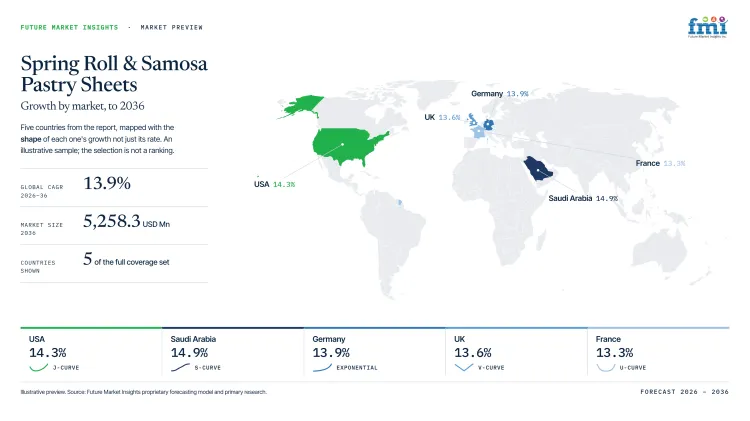
| Country | CAGR (2026-2036) |
|---|---|
| USA | 14.3% |
| Germany | 13.9% |
| France | 13.3% |
| UK | 13.6% |
| Saudi Arabia | 14.9% |
| UAE | 15.2% |
| Japan | 13.0% |
| South Korea | 14.6% |
How do country-level CAGRs compare in the Spring Roll & Samosa Pastry Sheets Market?
The profiled rates span 2.2 percentage points from UAE at 15.2% to Japan at 13.0% between 2026 and 2036. UAE, Saudi Arabia, and South Korea form the upper band at 14.6% to 15.2%. USA and Germany sit in a middle band at 13.9% to 14.3%. UK, France, and Japan range from 13.0% to 13.6%. The differences are meaningful for investment timing but they do not indicate absolute country market size. A smaller market can post a faster percentage rate when modern retail or foodservice capacity expands from a lower base.
- USA's 14.3% outlook is shaped by execution conditions. USA demand is shaped by foodservice throughput and a retail market that supports frozen convenience formats.
- For Germany, the forecast reaches 13.9% CAGR. German buyers operate inside a large and highly competitive food-processing system where cost control is persistent.
- French purchasing combines established physical food retail with growing out-of-store commerce. That gives France a distinct Spring Roll & Samosa Pastry Sheets path within its 13.3% CAGR forecast.
- UK carries a 13.6% CAGR through 2036, with conversion tied to this market reality: UK buyers increasingly balance convenience with value and nutrition expectations.
- At 14.9% CAGR, Saudi Arabia remains commercially distinct. Saudi buyers are moving through a retail system that is adding stores and digital purchasing routes.
- UAE is forecast at 15.2% CAGR. UAE purchasing is strongly influenced by imported food inputs and a diverse foodservice economy.
- Japanese buyers operate within a mature food-processing system where consistency and presentation can outweigh rapid range expansion. In Japan, that operating setting accompanies a 13.0% CAGR through 2036.
- A 14.6% CAGR places South Korea within the profiled set, but purchasing hinges on a specific condition: South Korean buyers combine a substantial processing base with strong demand for convenient prepared foods.
CAGR should therefore be treated as one planning variable. Channel size and local processing depth determine the addressable order base. Temperature logistics affect which formats can scale. Buyer price pressure influences how much value a supplier can capture. The broader report covers additional countries so investment decisions can be tested against both growth rate and route-to-market conditions.
Country-wise Analysis
- USA: USA demand is shaped by foodservice throughput and a retail market that supports frozen convenience formats. A 14.3% CAGR is projected for Spring Roll & Samosa Pastry Sheets in USA between 2026 and 2036. USDA Economic Research Service reported in June 2026 that food away from home represented 56.3% of total USA food expenditures in 2025. One persistent challenge is that buyers still need reliable handling plus accurate allergen labeling for wheat-based sheets. Suppliers can win by offering foodservice pack sizes and frozen or fresh formats that reduce labor without increasing breakage.
- Germany: German buyers operate inside a large and highly competitive food-processing system where cost control is persistent. Through 2036, the market for Spring Roll & Samosa Pastry Sheets in Germany is set to register a 13.9% CAGR. USDA Foreign Agricultural Service reported in March 2025 that food processing was Germany’s fifth-leading industry and processed food and drink production reached USD 252.1 billion in 2023. The same report cited subdued private consumption and rising production costs as challenges. Suppliers therefore need stable specifications and disciplined pricing. Private-label readiness and dependable case economics can be decisive in retailer negotiations.
- France: French purchasing combines established physical food retail with growing out-of-store commerce. Growth in Spring Roll & Samosa Pastry Sheets across France is projected at 13.3% CAGR from 2026 to 2036. Insee reported in June 2026 that in-store food sales increased around 2% in 2025 while out-of-store sales rose by more than 2%. What slows conversion is cost pressure across commercial sectors and the need to satisfy retailer-specific pack expectations. Suppliers should support supermarket multipacks while maintaining formats that can travel through online fulfillment. Clear preparation instructions can reduce consumer failure with thin pastry sheets.
- UK: UK buyers increasingly balance convenience with value and nutrition expectations. The ten-year forecast for Spring Roll & Samosa Pastry Sheets in UK reaches 13.6% CAGR. The UK government launched the Good Food Cycle in July 2025 with priorities around a healthier and more resilient food system. Food price pressure remains a commercial constraint for households and retailers. This makes premium claims harder to monetize unless the handling benefit is visible. Suppliers should pair affordable conventional lines with differentiated clean-label or fortified options that maintain pastry texture and fit supermarket or online grocery packs.
- Saudi Arabia: Saudi buyers are moving through a retail system that is adding stores and digital purchasing routes. Between 2026 and 2036, sales of Spring Roll & Samosa Pastry Sheets in Saudi Arabia are expected to rise at 14.9% CAGR. USDA Foreign Agricultural Service reported in December 2024 that the country’s food retail market exceeded USD 51 billion in 2023 and was expected to grow as physical locations and online platforms expanded. A local execution risk is reliable import and storage execution across temperature-sensitive formats. Suppliers should work through capable distributors and use pack specifications that tolerate transport while preserving separation and foldability.
- UAE: UAE purchasing is strongly influenced by imported food inputs and a diverse foodservice economy. The Spring Roll & Samosa Pastry Sheets outlook for UAE points to a 15.2% CAGR from 2026 to 2036. USDA Foreign Agricultural Service reported in June 2025 that the country had more than 570 food and beverage processors and that e-commerce was increasingly important to sector growth. Limited local agricultural production also increases dependence on imported ingredients. The main commercial hurdle is maintaining shelf life and handling consistency through import logistics. Vendors need disciplined inventory positioning and distributor support for fresh or frozen products.
- Japan: Japanese buyers operate within a mature food-processing system where consistency and presentation can outweigh rapid range expansion. For Japan, the Spring Roll & Samosa Pastry Sheets market is projected to advance at 13.0% CAGR through 2036. USDA Foreign Agricultural Service reported in April 2025 that Japan’s food-processing sector produced USD 174 billion of food in 2024 after a 3.9% increase in value. A practical constraint is the high cost of product failure in a market that expects repeatable quality. Suppliers should emphasize dimensional consistency and small-batch usability. Frozen options also need predictable thaw behavior before forming.
- South Korea: South Korean buyers combine a substantial processing base with strong demand for convenient prepared foods. Spring Roll & Samosa Pastry Sheets sales in South Korea are expected to grow at 14.6% CAGR over 2026 to 2036. USDA Foreign Agricultural Service reported in May 2025 that the food-processing industry generated more than KRW 85 trillion in 2023 and relied heavily on imported agricultural inputs. Import dependence creates opportunity but also exposes buyers to landed-cost movements. Suppliers should build price visibility and reliable local inventory. Multipacks and frozen formats can support both retail and professional preparation when separation quality is consistent.
Who are the notable companies in the Spring Roll & Samosa Pastry Sheets Market?
Tee Yih Jia / Spring Home, Kawan Food / KG Pastry, PA Food / uPastry, Nafees Frozen Foods, Golden Loaf, and Joyfun Food.
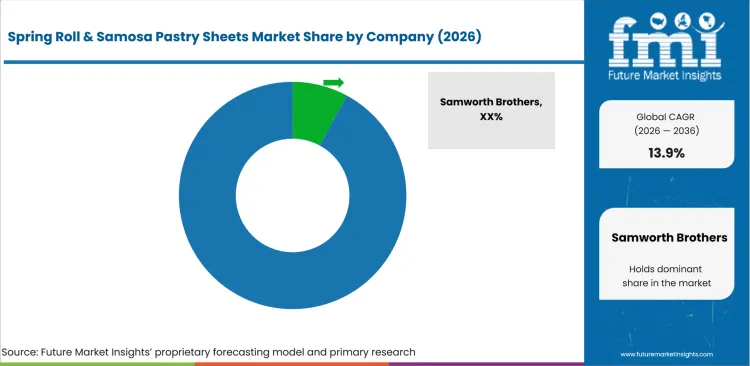
The direct competitive set is led by manufacturers that explicitly sell spring-roll pastry, samosa pads or both. Tee Yih Jia supplies Spring Home pastry across a wide export footprint; Kawan Food markets KG Pastry spring-roll pastry and samosa pads; PA Food sells multiple uPastry sheet sizes; Nafees Frozen Foods focuses on samosa and spring-roll sheets in India. Golden Loaf and Joyfun Food add regional retail and OEM routes. Filled spring rolls and samosas are downstream products; their manufacturers influence specifications but do not supply the wrapper market unless they sell sheets separately.
- Large Export Wrapper Platforms: Tee Yih Jia / Spring Home and Kawan Food / KG Pastry combine frozen pastry manufacturing with international distribution.
- Specialist Sheet Producers: PA Food / uPastry and Nafees Frozen Foods compete through dedicated sheet formats, sizes and handling performance.
- Regional and OEM Supply: Golden Loaf and Joyfun Food add regional retail access and private-label or OEM manufacturing routes.
Competitive Benchmarking: Spring Roll & Samosa Pastry Sheets Market
| Company | Direct Category Role | Core Sheets / Formats | Route to Market | Geographic Reach |
|---|---|---|---|---|
| Tee Yih Jia / Spring Home | Large frozen wrapper manufacturer | Spring-roll pastry and samosa pastry | Branded and B2B frozen channels | 80+ countries |
| Kawan Food / KG Pastry | Frozen pastry manufacturer | Spring-roll pastry and samosa pads | Branded and wholesale | International |
| PA Food / uPastry | Frozen pastry manufacturer | Spring-roll pastry in multiple sheet sizes | Retail and B2B | Malaysia and export markets |
| Nafees Frozen Foods | Dedicated sheet manufacturer | Samosa and spring-roll sheets | B2B and retail supply | India |
| Golden Loaf | Bakery and frozen pastry supplier | Frozen spring-roll pastry | Retail and foodservice | UAE |
| Joyfun Food | OEM/ODM frozen pastry manufacturer | Spring-roll wrappers and pastry | OEM and B2B export | China and export markets |
The comparison uses direct sheet production, format breadth, route-to-market and geographic reach rather than downstream filled-snack scale.
Key Developments in the Spring Roll & Samosa Pastry Sheets Market
- In May 2026, The Compleat Food Group launched the Wall’s High Protein Sausage Roll into UK retail. The product was developed over a year and delivers 16g of protein while meeting HFSS requirements. The launch shows that savoury-pastry developers are placing more nutrition demands on dough systems, which raises the value of sheet formulations that preserve handling under fortified recipes.
- In June 2026, Aryzta announced that its French Coup de Pates business was acquiring 100% of Société Européenne des Beurres. The target specializes in frozen-product distribution in south-west France and has distributed Aryzta-related brands around Bordeaux since 1991. The transaction strengthens frozen route-to-market density in France, which is relevant to pastry-sheet suppliers that depend on dependable storage and local replenishment.
- In February 2026, Ruiz Foods expanded its convenience-store foodservice portfolio with new chimichangas, a breakfast burrito, and sweet mini chimis. NACS reported that the products were available immediately for c-store foodservice. The action points to continued demand for compact filled formats that can move through labor-light preparation. Upstream sheet suppliers can use that signal when designing mini geometries and frozen handling performance.
Key Players in the Spring Roll & Samosa Pastry Sheets Market
Export Wrapper Platforms
- Tee Yih Jia / Spring Home
- Kawan Food / KG Pastry
Specialist Sheet Producers
- PA Food / uPastry
- Nafees Frozen Foods
Regional and OEM Suppliers
- Golden Loaf
- Joyfun Food
Spring Roll & Samosa Pastry Sheets Market - Report Scope
| Coverage field | Report scope |
|---|---|
| Market breakdown | Product Type; Claim / Nature; Format; Packaging Format; Sales Channel |
| Quantitative Units | USD Million |
| Market Definition | Revenue from fresh, chilled, frozen, ambient packaged, and par-baked pastry sheets or wrappers sold for spring roll and samosa assembly within the stated segmentation universe. Revenue from fillings, finished filled snacks, unrelated savoury pastries, and substitute wrapper categories is excluded. |
| Regions Covered | North America; Latin America; Western Europe; Eastern Europe; East Asia; South Asia and Pacific; Middle East and Africa |
| Countries Covered | USA, Germany, France, UK, Saudi Arabia, UAE, Japan, South Korea, and more than twenty-five additional countries in the full report |
| Key Companies Profiled | Tee Yih Jia / Spring Home; Kawan Food / KG Pastry; PA Food / uPastry; Nafees Frozen Foods; Golden Loaf; Joyfun Food |
| Forecast Period | 2026 to 2036 |
| Approach | Hybrid bottom-up and top-down sizing that reconciles product format, channel demand, country conditions, and the defined revenue boundary. |
Spring Roll & Samosa Pastry Sheets Market - Research Methodology
| Method | Approach |
|---|---|
| Primary Research | Manufacturer, distributor, retail, foodservice, procurement, and subject-matter perspectives are used to test product specifications, purchasing criteria, channel economics, and adoption barriers without relying on a single buyer type. |
| Desk Research | Government statistics, food regulations, trade material, company filings, official product documentation, and dated company announcements are reviewed for scope fit and claim relevance. |
| Market Sizing and Forecasting | A hybrid bottom-up and top-down framework reconciles product formats, packaging, channel demand, country operating conditions, and the defined exclusions across the 2026 to 2036 forecast period. |
| Data Validation | Cross-checks reconcile channel and product views, remove downstream finished-product revenue, avoid double counting, and exclude unsupported claims or adjacent substitute categories. |
Spring Roll & Samosa Pastry Sheets Market by Segments
Spring Roll & Samosa Pastry Sheets Market segmented by Product Type:
- Vegetable samosas
- Meat samosas
- Cocktail / mini
- Baked formats
Spring Roll & Samosa Pastry Sheets Market segmented by Claim / Nature:
- Conventional
- Clean label
- Organic
- Gluten-free
- High-protein / fortified
Spring Roll & Samosa Pastry Sheets Market segmented by Format:
- Fresh
- Frozen
- Ambient packaged
- Chilled
- Par-baked / thaw-and-serve
Spring Roll & Samosa Pastry Sheets Market segmented by Packaging Format:
- Multipack
- Single-serve
- Family / loaf pack
- Bulk foodservice
Spring Roll & Samosa Pastry Sheets Market segmented by Sales Channel:
- Supermarkets & hypermarkets
- Artisan & specialty bakeries
- Convenience & forecourt
- Online & DTC
- Foodservice distributors
Spring Roll & Samosa Pastry Sheets Market by Region:
- North America
- USA
- Canada
- Latin America
- Brazil
- Mexico
- Argentina
- Chile
- Western Europe
- Germany
- France
- UK
- Italy
- Spain
- Benelux
- Nordics
- Eastern Europe
- Poland
- Czech Republic
- Romania
- Hungary
- East Asia
- China
- Japan
- South Korea
- South Asia and Pacific
- India
- ASEAN
- Australia and New Zealand
- Middle East and Africa
- GCC Countries
- South Africa
- Türkiye
- Israel
Research Sources and Bibliography
- USA Department of Agriculture, Economic Research Service (2026, June 11). Total USA food spending reached $2.51 trillion in 2025.
- USA Food and Drug Administration (2025, March 26). Frequently Asked Questions: Food Allergen Labeling Guidance for Industry.
- USA Department of Agriculture, Foreign Agricultural Service (2025, March 21). Germany: Food Processing Ingredients Annual.
- Institut national de la statistique et des études économiques (2026, June 18). The economic situation of trade in 2025 and early 2026.
- UK Department for Environment, Food & Rural Affairs (2025, July 15). Government launches Good Food Cycle to transform Britain’s food system.
- USA Department of Agriculture, Foreign Agricultural Service (2024, December 16). Saudi Arabia: Retail Foods Annual.
- USA Department of Agriculture, Foreign Agricultural Service (2025, June 9). United Arab Emirates: Food Processing Ingredients Annual.
- USA Department of Agriculture, Foreign Agricultural Service (2025, April 1). Japan: Food Processing Ingredients Annual.
- USA Department of Agriculture, Foreign Agricultural Service (2025, May 5). South Korea: Food Processing Ingredients Annual.
- Goya Foods (n.d.). Empanada Dough for Baking.
- Wewalka (n.d.). Our irresistibly delicious puff pastry.
- The Compleat Food Group (2026, May 25). Wall’s Pastry Introduces the first ever High Protein Sausage Roll to UK retail.
- ARYZTA AG (2026, June 23). ARYZTA acquires French distribution business.
- NACS (2026, February 27). Ruiz Foods Expands C-Store Foodservice Portfolio.
- SmartParc (2024, June 10). Greggs invests in state-of-the-art frozen manufacturing and logistics facility at SmartParc SEGRO Derby.
- Tee Yih Jia Food Manufacturing. (2026). Spring Home Spring Roll Pastry and Samosa Pastry.
- Kawan Food. (2026). KG Pastry Spring Roll Pastry and Samosa Pads.
- PA Food. (2026). uPastry Spring Roll Pastry.
- Nafees Frozen Foods. (2026). Samosa and Spring Roll Sheets.
- Golden Loaf. (2026). Frozen Spring Roll Pastry.
- Joyfun Food. (2026). Spring Roll Pastry and Wrapper OEM/ODM Portfolio.
This Report Answers
- How is demand for the Spring Roll & Samosa Pastry Sheets Market expected to evolve through 2036?
- What foodservice and retail pressures support demand for ready-to-use pastry sheets?
- Why do Vegetable samosas hold the leading position within Product Type?
- How does Conventional positioning influence qualification and downstream purchasing?
- Why does Fresh hold the leading position within Format?
- How do the profiled CAGRs compare across USA, Germany, France, UK, Saudi Arabia, UAE, Japan, and South Korea?
- Which companies provide direct dough capability and which act as savoury-pastry or foodservice reference operators?
- What handling and compliance constraints can delay adoption of new pastry-sheet suppliers?
- What should retail buyers, foodservice operators, and manufacturers evaluate before purchasing Spring Roll & Samosa Pastry Sheets?
Frequently Asked Questions
What is driving growth in the Spring Roll & Samosa Pastry Sheets Market?
Growth is driven by buyers that want to remove dough preparation while keeping portion size and wrapper thickness more consistent. Foodservice scale and household convenience support repeat purchases when sheets withstand storage and the intended fry or bake process.
Who are the key players in the Spring Roll & Samosa Pastry Sheets Market?
Key players include Tee Yih Jia / Spring Home, Kawan Food / KG Pastry, PA Food / uPastry, Nafees Frozen Foods, Golden Loaf and Joyfun Food. They compete through sheet consistency, format range, cold-chain execution, retail reach and OEM capability.
What notable restraint affects the Spring Roll & Samosa Pastry Sheets Market?
Handling sensitivity is a major restraint because thin pastry can dry, stick, or crack before forming. Wheat allergen labeling and claim validation add qualification work, especially when suppliers move beyond conventional sheets into gluten-free or fortified formulations.
Why should executives track the Spring Roll & Samosa Pastry Sheets Market?
The category links labor-saving preparation with a fast-growing packaged-food and foodservice opportunity. Executives should track it because route-to-market choices and temperature formats can change margins even when the underlying wrapper specification appears similar.
What business problem does the Spring Roll & Samosa Pastry Sheets Market address?
The market addresses the time and variability involved in mixing, rolling, and portioning thin dough before filling. Ready sheets can standardize forming work while letting a kitchen or household focus on filling choice and final cooking.
What should procurement teams evaluate in the Spring Roll & Samosa Pastry Sheets Market?
Procurement teams should test thickness consistency, separation, seal strength, storage tolerance, and fry or bake behavior under their own process. They should also compare pack count and claim compliance because a cheaper sheet can create higher waste or approval costs.
What limits return on investment in the Spring Roll & Samosa Pastry Sheets Market?
Return on investment falls when sheets tear during separation or require more handling than the buyer expected. Poor cold-chain fit and short usable life can also increase waste, while claim-led products may carry validation costs that need sufficient sales volume to recover.
What supports long-term commercial confidence in the Spring Roll & Samosa Pastry Sheets Market?
Long-term confidence comes from the durable need for convenient preparation across retail and professional kitchens. Suppliers can convert that need into repeat demand by protecting sheet performance through storage and matching format design to each channel’s operating model.
Preview the report firsthand - request a free sample
Get SampleGet the brochure for pricing and purchase details.
Get PDFTable of Content
- Key Takeaways
- Market Size and CAGR
- Top Growth Driver
- Fastest Growing Segment
- Leading Region
- Key Companies
- Emerging Opportunities
- Executive Summary
- Global Market Outlook
- Demand-side Trends
- Supply-side Trends
- Technology Roadmap Analysis
- Analysis and Recommendations
- Analyst Perspective (What is happening? Why now? What should investors know?)
- Key Questions Answered
- How large is the market?
- What is the CAGR?
- What are key trends?
- Which region dominates?
- Who are the leaders?
- Market Overview
- Market Coverage / Taxonomy
- Market Definition / Scope / Limitations
- Research Methodology
- Chapter Orientation
- Analytical Lens and Working Hypotheses
- Market Structure, Signals, and Trend Drivers
- Benchmarking and Cross-market Comparability
- Market Sizing, Forecasting, and Opportunity Mapping
- Research Design and Evidence Framework
- Desk Research Programme (Secondary Evidence)
- Expert Input and Fieldwork (Primary Evidence)
- Tooling, Models, and Reference Databases
- Data Engineering and Model Build
- Quality Assurance and Audit Trail
- Market Background
- Market Dynamics (Drivers, Restraints, Opportunity, Trends)
- Scenario Forecast (Optimistic, Likely, Conservative)
- Impact Analysis
- AI Impact
- Sustainability Impact
- Regulatory Impact
- Technology Impact
- Consumer / Buyer Analysis
- Purchase Drivers
- Adoption Barriers
- Buyer Journey
- Opportunity Map Analysis
- Product Life Cycle Analysis
- Supply Chain Analysis
- Investment Feasibility Matrix
- Value Chain Analysis
- PESTLE and Porter's Analysis
- Regulatory Landscape
- Regional Parent Market Outlook
- Production and Consumption Statistics
- Import and Export Statistics
- Global Market Analysis and Forecast, 2021 to 2036
- Historical Market Size Value (USD Million) Analysis, 2021 to 2025
- Current and Future Market Size Value (USD Million) Projections, 2026 to 2036
- Y-o-Y Growth Trend Analysis
- Absolute $ Opportunity Analysis
- Global Market Pricing Analysis, 2021 to 2036
- Global Market Analysis and Forecast, By Product Type, 2021 to 2036
- Introduction / Key Findings
- Historical Market Size Value (USD Million) Analysis By Product Type, 2021 to 2025
- Current and Future Market Size Value (USD Million) Analysis and Forecast By Product Type, 2026 to 2036
- Vegetable samosas
- Meat samosas
- Cocktail / mini
- Baked formats
- Vegetable samosas
- Y-o-Y Growth Trend Analysis By Product Type, 2021 to 2025
- Absolute $ Opportunity Analysis By Product Type, 2026 to 2036
- Global Market Analysis and Forecast, By Claim / Nature, 2021 to 2036
- Introduction / Key Findings
- Historical Market Size Value (USD Million) Analysis By Claim / Nature, 2021 to 2025
- Current and Future Market Size Value (USD Million) Analysis and Forecast By Claim / Nature, 2026 to 2036
- Conventional
- Clean label
- Organic
- Gluten-free
- High-protein / fortified
- Conventional
- Y-o-Y Growth Trend Analysis By Claim / Nature, 2021 to 2025
- Absolute $ Opportunity Analysis By Claim / Nature, 2026 to 2036
- Global Market Analysis and Forecast, By Format, 2021 to 2036
- Introduction / Key Findings
- Historical Market Size Value (USD Million) Analysis By Format, 2021 to 2025
- Current and Future Market Size Value (USD Million) Analysis and Forecast By Format, 2026 to 2036
- Fresh
- Frozen
- Ambient packaged
- Chilled
- Par-baked / thaw-and-serve
- Fresh
- Y-o-Y Growth Trend Analysis By Format, 2021 to 2025
- Absolute $ Opportunity Analysis By Format, 2026 to 2036
- Global Market Analysis and Forecast, By Packaging Format, 2021 to 2036
- Introduction / Key Findings
- Historical Market Size Value (USD Million) Analysis By Packaging Format, 2021 to 2025
- Current and Future Market Size Value (USD Million) Analysis and Forecast By Packaging Format, 2026 to 2036
- Multipack
- Single-serve
- Family / loaf pack
- Bulk foodservice
- Multipack
- Y-o-Y Growth Trend Analysis By Packaging Format, 2021 to 2025
- Absolute $ Opportunity Analysis By Packaging Format, 2026 to 2036
- Global Market Analysis and Forecast, By Sales Channel, 2021 to 2036
- Introduction / Key Findings
- Historical Market Size Value (USD Million) Analysis By Sales Channel, 2021 to 2025
- Current and Future Market Size Value (USD Million) Analysis and Forecast By Sales Channel, 2026 to 2036
- Supermarkets & hypermarkets
- Artisan & specialty bakeries
- Convenience & forecourt
- Online & DTC
- Foodservice distributors
- Supermarkets & hypermarkets
- Y-o-Y Growth Trend Analysis By Sales Channel, 2021 to 2025
- Absolute $ Opportunity Analysis By Sales Channel, 2026 to 2036
- Global Market Analysis and Forecast, By Region, 2021 to 2036
- Introduction
- Historical Market Size Value (USD Million) Analysis By Region, 2021 to 2025
- Current Market Size Value (USD Million) Analysis and Forecast By Region, 2026 to 2036
- North America
- Latin America
- Western Europe
- Eastern Europe
- East Asia
- South Asia and Pacific
- Middle East & Africa
- Market Attractiveness Analysis By Region
- North America Market Analysis and Forecast, By Country, 2021 to 2036
- Historical Market Size Value (USD Million) Trend Analysis By Market Taxonomy, 2021 to 2025
- Market Size Value (USD Million) Forecast By Market Taxonomy, 2026 to 2036
- By Country
- USA
- Canada
- By Product Type
- By Claim / Nature
- By Format
- By Packaging Format
- By Sales Channel
- By Country
- Market Attractiveness Analysis
- By Country
- By Product Type
- By Claim / Nature
- By Format
- By Packaging Format
- By Sales Channel
- Key Takeaways
- Latin America Market Analysis and Forecast, By Country
- Historical Market Size Value (USD Million) Trend Analysis By Market Taxonomy, 2021 to 2025
- Market Size Value (USD Million) Forecast By Market Taxonomy, 2026 to 2036
- By Country
- Brazil
- Mexico
- Chile
- Rest of Latin America
- By Product Type
- By Claim / Nature
- By Format
- By Packaging Format
- By Sales Channel
- By Country
- Market Attractiveness Analysis
- By Country
- By Product Type
- By Claim / Nature
- By Format
- By Packaging Format
- By Sales Channel
- Key Takeaways
- Western Europe Market Analysis and Forecast, By Country
- Historical Market Size Value (USD Million) Trend Analysis By Market Taxonomy, 2021 to 2025
- Market Size Value (USD Million) Forecast By Market Taxonomy, 2026 to 2036
- By Country
- Germany
- UK
- Italy
- Spain
- France
- Nordic
- BENELUX
- Rest of Western Europe
- By Product Type
- By Claim / Nature
- By Format
- By Packaging Format
- By Sales Channel
- By Country
- Market Attractiveness Analysis
- By Country
- By Product Type
- By Claim / Nature
- By Format
- By Packaging Format
- By Sales Channel
- Key Takeaways
- Eastern Europe Market Analysis and Forecast, By Country
- Historical Market Size Value (USD Million) Trend Analysis By Market Taxonomy, 2021 to 2025
- Market Size Value (USD Million) Forecast By Market Taxonomy, 2026 to 2036
- By Country
- Russia
- Poland
- Hungary
- Balkan & Baltic
- Rest of Eastern Europe
- By Product Type
- By Claim / Nature
- By Format
- By Packaging Format
- By Sales Channel
- By Country
- Market Attractiveness Analysis
- By Country
- By Product Type
- By Claim / Nature
- By Format
- By Packaging Format
- By Sales Channel
- Key Takeaways
- East Asia Market Analysis and Forecast, By Country
- Historical Market Size Value (USD Million) Trend Analysis By Market Taxonomy, 2021 to 2025
- Market Size Value (USD Million) Forecast By Market Taxonomy, 2026 to 2036
- By Country
- China
- Japan
- South Korea
- By Product Type
- By Claim / Nature
- By Format
- By Packaging Format
- By Sales Channel
- By Country
- Market Attractiveness Analysis
- By Country
- By Product Type
- By Claim / Nature
- By Format
- By Packaging Format
- By Sales Channel
- Key Takeaways
- South Asia and Pacific Market Analysis and Forecast, By Country
- Historical Market Size Value (USD Million) Trend Analysis By Market Taxonomy, 2021 to 2025
- Market Size Value (USD Million) Forecast By Market Taxonomy, 2026 to 2036
- By Country
- India
- ASEAN
- Australia & New Zealand
- Rest of South Asia and Pacific
- By Product Type
- By Claim / Nature
- By Format
- By Packaging Format
- By Sales Channel
- By Country
- Market Attractiveness Analysis
- By Country
- By Product Type
- By Claim / Nature
- By Format
- By Packaging Format
- By Sales Channel
- Key Takeaways
- Middle East & Africa Market Analysis and Forecast, By Country
- Historical Market Size Value (USD Million) Trend Analysis By Market Taxonomy, 2021 to 2025
- Market Size Value (USD Million) Forecast By Market Taxonomy, 2026 to 2036
- By Country
- Kingdom of Saudi Arabia
- Other GCC Countries
- Türkiye
- South Africa
- Other African Union
- Rest of Middle East & Africa
- By Product Type
- By Claim / Nature
- By Format
- By Packaging Format
- By Sales Channel
- By Country
- Market Attractiveness Analysis
- By Country
- By Product Type
- By Claim / Nature
- By Format
- By Packaging Format
- By Sales Channel
- Key Takeaways
- Key Countries Market Analysis
- USA
- Pricing Analysis
- Market Share Analysis, 2025
- By Product Type
- By Claim / Nature
- By Format
- By Packaging Format
- By Sales Channel
- Canada
- Pricing Analysis
- Market Share Analysis, 2025
- By Product Type
- By Claim / Nature
- By Format
- By Packaging Format
- By Sales Channel
- Mexico
- Pricing Analysis
- Market Share Analysis, 2025
- By Product Type
- By Claim / Nature
- By Format
- By Packaging Format
- By Sales Channel
- Brazil
- Pricing Analysis
- Market Share Analysis, 2025
- By Product Type
- By Claim / Nature
- By Format
- By Packaging Format
- By Sales Channel
- Chile
- Pricing Analysis
- Market Share Analysis, 2025
- By Product Type
- By Claim / Nature
- By Format
- By Packaging Format
- By Sales Channel
- Germany
- Pricing Analysis
- Market Share Analysis, 2025
- By Product Type
- By Claim / Nature
- By Format
- By Packaging Format
- By Sales Channel
- UK
- Pricing Analysis
- Market Share Analysis, 2025
- By Product Type
- By Claim / Nature
- By Format
- By Packaging Format
- By Sales Channel
- Italy
- Pricing Analysis
- Market Share Analysis, 2025
- By Product Type
- By Claim / Nature
- By Format
- By Packaging Format
- By Sales Channel
- Spain
- Pricing Analysis
- Market Share Analysis, 2025
- By Product Type
- By Claim / Nature
- By Format
- By Packaging Format
- By Sales Channel
- France
- Pricing Analysis
- Market Share Analysis, 2025
- By Product Type
- By Claim / Nature
- By Format
- By Packaging Format
- By Sales Channel
- India
- Pricing Analysis
- Market Share Analysis, 2025
- By Product Type
- By Claim / Nature
- By Format
- By Packaging Format
- By Sales Channel
- ASEAN
- Pricing Analysis
- Market Share Analysis, 2025
- By Product Type
- By Claim / Nature
- By Format
- By Packaging Format
- By Sales Channel
- Australia & New Zealand
- Pricing Analysis
- Market Share Analysis, 2025
- By Product Type
- By Claim / Nature
- By Format
- By Packaging Format
- By Sales Channel
- China
- Pricing Analysis
- Market Share Analysis, 2025
- By Product Type
- By Claim / Nature
- By Format
- By Packaging Format
- By Sales Channel
- Japan
- Pricing Analysis
- Market Share Analysis, 2025
- By Product Type
- By Claim / Nature
- By Format
- By Packaging Format
- By Sales Channel
- South Korea
- Pricing Analysis
- Market Share Analysis, 2025
- By Product Type
- By Claim / Nature
- By Format
- By Packaging Format
- By Sales Channel
- Russia
- Pricing Analysis
- Market Share Analysis, 2025
- By Product Type
- By Claim / Nature
- By Format
- By Packaging Format
- By Sales Channel
- Poland
- Pricing Analysis
- Market Share Analysis, 2025
- By Product Type
- By Claim / Nature
- By Format
- By Packaging Format
- By Sales Channel
- Hungary
- Pricing Analysis
- Market Share Analysis, 2025
- By Product Type
- By Claim / Nature
- By Format
- By Packaging Format
- By Sales Channel
- Kingdom of Saudi Arabia
- Pricing Analysis
- Market Share Analysis, 2025
- By Product Type
- By Claim / Nature
- By Format
- By Packaging Format
- By Sales Channel
- Türkiye
- Pricing Analysis
- Market Share Analysis, 2025
- By Product Type
- By Claim / Nature
- By Format
- By Packaging Format
- By Sales Channel
- South Africa
- Pricing Analysis
- Market Share Analysis, 2025
- By Product Type
- By Claim / Nature
- By Format
- By Packaging Format
- By Sales Channel
- USA
- Market Structure Analysis
- Competition Dashboard
- Competition Benchmarking
- Market Share Analysis of Top Players
- By Regional
- By Product Type
- By Claim / Nature
- By Format
- By Packaging Format
- By Sales Channel
- Emerging Startups
- Innovation Benchmarking
- Competition Analysis
- Competition Deep Dive
- Samworth Brothers
- Overview
- Product Portfolio
- Profitability by Market Segments
- Sales Footprint
- Strategy Overview
- Marketing Strategy
- Product Strategy
- Channel Strategy
- The Compleat Food Group
- Pukka Pies
- Patties Foods
- Goya Foods
- Ruiz Foods
- Greggs
- Wewalka
- Aryzta
- Vandemoortele
- Samworth Brothers
- Case Studies
- Success Stories
- Recent Developments
- Competition Deep Dive
- Assumptions & Acronyms Used


