

- Market Size (2026)
- USD 839.3 Mn
- Forecast (2036)
- USD 1750.0 Mn
- CAGR (2026 to 2036)
- 7.6%
How big is the Sterile Barrier Recyclable Medical Packaging Market in 2026?
USD 839.3 million in 2026 and USD 1750.0 million by 2036 at a 7.6% CAGR.
Sales of sterile barrier recyclable medical packaging are estimated to rise at 7.6% CAGR through 2036, increasing valuation from USD 839.3 million in 2026 to USD 1750.0 million by 2036. Medical device manufacturers need paper and film systems that preserve package integrity through sterilization, distribution and aseptic opening. The FDA standards database recognizes ISO 11607-1 for materials and sterile barrier systems used with terminally sterilized medical devices. The standard requires packaging to maintain sterility until use and support a controlled opening process. These requirements favor designs that reduce material within validated sealing windows instead of replacing complete package systems at once. Related sterile barrier packaging programs reward regional testing and coating capacity that shortens qualification work for medical device packaging changes.
European adoption follows a separate route under packaging rules that protect contact-sensitive medical and nutrition formats. Regulation (EU) 2025/40 entered into force in February 2025 and generally applies from August 2026 across member states. The regulation exempts selected medical-device packages and food-for-special-medical-purpose formats from certain recyclability or recycled-content duties. These exemptions let product teams preserve qualified primary barriers while redesigning lower-risk secondary layers and transport components. Recyclable packaging programs therefore need a documented recovery route for each changed layer rather than a broad claim covering the complete package. Related pharmaceutical packaging projects gain a clearer investment case through measured material reduction and verified disposal pathways.
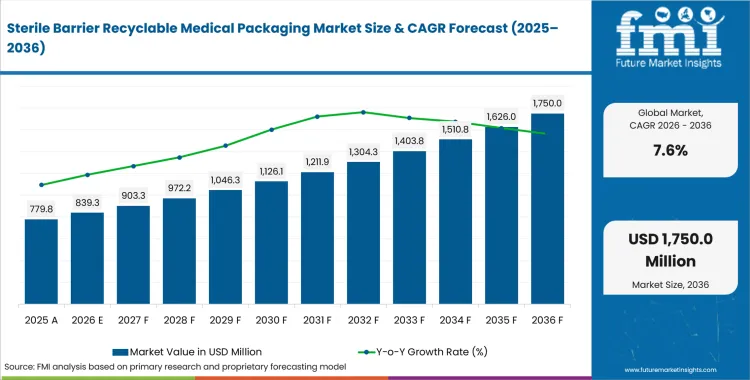
Key Takeaways of Sterile Barrier Recyclable Medical Packaging Market
- Demand is supported by medical device manufacturers seeking lower-material package systems that preserve sterile integrity and validated seal performance throughout commercial production.
- Paper is expected to account for 34.0% share in 2026, supported by breathable coated structures compatible with established sterilization and package-conversion processes.
- Pouches are projected to represent 15.0% share in 2026, owing to efficient sealing and controlled aseptic presentation across varied clinical workflows.
- Food is anticipated to capture 25.0% share in 2026, underpinned by medical nutrition formats requiring protected contact and documented shelf life.
- Mixed laminates and limited healthcare recovery systems restrain conversion since technically recoverable components often lack qualified collection and processing routes.
- Competition includes Amcor; DuPont Tyvek; TekniPlex; Nelipak; Sterimed; Billerud; Oliver Healthcare Packaging; and Coveris across materials, conversion and validation support.
Analyst Perspective
"Recyclable sterile barrier programs succeed through material changes that protect seal integrity, sterilization compatibility and clean opening across the full device shelf life. Strong commercial plans separate the primary sterile barrier from secondary layers and qualify each redesign against an actual recovery route. Regional testing capacity shortens development cycles without weakening the evidence required for regulatory review and commercial approval."
- Nandini Roy Choudhury, Principal Analyst, Future Market Insights
How is the Sterile Barrier Recyclable Medical Packaging Market segmented?
The sterile barrier recyclable medical packaging industry is segmented by material, format, barrier or feature, end use, and region.
The sterile barrier recyclable medical packaging industry is segmented by material, format, barrier or feature, end use, and region. Material analysis covers paper, molded fiber, recycled PET, mono-material PE, and bio-based polymers used across distinct regulated package structures. Format includes pouches, trays, labels, mailers, and inserts used across distinct sealing and handling workflows. Barrier or feature separates grease resistance, high-barrier protection, tamper evidence, and traceability functions that affect package qualification. End use includes food for special medical purposes, pharmaceutical products, e-commerce distribution, personal care, and cold chain applications within the defined scope. Regional analysis compares production capacity, sterilization practices, recovery infrastructure, and regulatory requirements across major sterile packaging centers. The segmentation distinguishes each commercial route without treating conventional retail packaging as part of tracked sterile barrier demand.
Why does paper lead material demand in the sterile barrier recyclable medical packaging market?
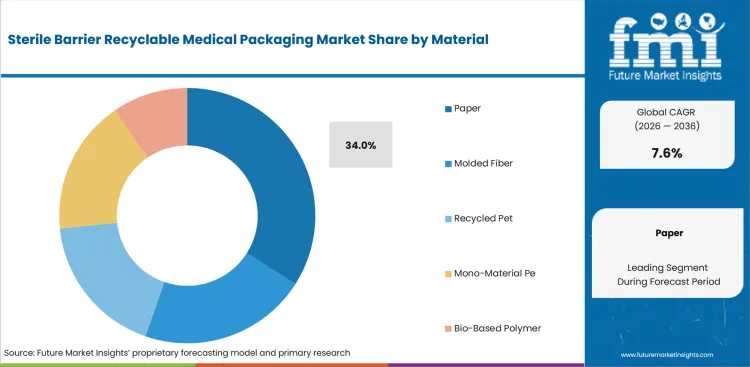
Breathable medical paper supports ethylene oxide sterilization and established coating processes across many device-packaging lines. In April 2026, Amcor opened a USD 35 million healthcare coating facility in Malaysia for regional sterile packaging production. The site manufactures coated medical paper through controlled air-knife coating and regulated production systems for healthcare applications. Regional capacity reduces sample transport and replenishment delays during package qualification across Asian manufacturing programs. Engineering teams must confirm porosity and seal performance across the complete package under commercial sterilization conditions.
- Paper is projected to hold 34.0% share in 2026 owing to broad coating availability and compatibility with breathable sterilization routes. Medical device manufacturers can evaluate paper through familiar seal-strength and microbial-barrier tests on existing lines. Its position in sterile medical packaging also reflects use across lidding and pouch formats for routine sterile devices.
- Lower-basis-weight coated grades support adoption by reducing material without narrowing the validated sealing window across production lines. Fiber-based structures also offer a clearer recovery route if functional coatings remain compatible with paper recycling systems. Moisture-intensive processes and sharp devices create a practical limit through stronger puncture and barrier requirements.
Why do pouches remain central to format demand?
Pouches combine a controlled sterile barrier with low material use and clean opening at the point of care. In April 2026, DNP launched a mono-material medical sterilization pouch made with more than 90% polyethylene-based materials. DNP reported seal strength comparable to conventional sterilization pouches together with lint-free peel performance during controlled opening. The development gives medical device programs a commercial sample route for testing recyclability without abandoning core pouch functions. Each device family requires separate sealing and aseptic-opening validation under its intended sterilization and distribution conditions.
- By format, pouches are forecast to represent 15.0% share in 2026 driven by flexible sizing and efficient use of barrier material. Their position depends on repeatable seals and visible package integrity through distribution and clinical handling. Pouches also fit automated forming lines without the tooling investment required by many rigid tray systems.
- Healthcare manufacturers use pouches for dressings and smaller procedure components that require clean aseptic presentation. Medical devices secondary packaging can add recyclable protection around a qualified primary pouch during regulated transport. Heavy or sharp devices create a separate need for puncture-resistant films or rigid support across extended distribution routes.
Why does grease resistant matter within the barrier or feature category?
Grease-resistant barriers protect print zones and seal areas in medical nutrition packages that contain oils or fatty ingredients. In April 2026, BASF expanded its ecovio portfolio with adjustable barriers against grease and liquids for flexible packaging. The company also identified healthcare articles among the supported applications and enabled paper-recycling options for selected structures. The launch provides current commercial material options for barrier redesign across paper and flexible healthcare packaging formats. Sterile or product-contact use requires separate validation under the intended filling process and complete shelf-life conditions.
- The grease resistant segment is likely to capture 22.0% share in 2026 attributable to cleaner handling surfaces and protected identification panels. The feature limits residue transfer near seals and identification panels during filling and clinical preparation activities. Commercial acceptance depends on barrier chemistry remaining compatible with the selected substrate and verified recovery route.
- Packaging plants favor thin coatings that provide necessary surface protection without creating excessive material complexity across recoverable structures. Flexible packaging paper offers a useful comparison for balancing grease resistance with fiber recovery across coated structures. Adoption slows if a barrier improves handling performance but causes repulping losses or blocks an established collection stream.
What makes food central to the end use category?
Food demand in this market covers nutrition used under medical supervision rather than conventional retail products. In March 2026, Nestlé Health Science introduced Compleat Paediatric Oral Blends in a portable pouch for children with specialized medical nutrition needs. The launch confirms commercial use of protected food-for-special-medical-purpose formats across home care and travel settings outside clinical facilities. Recyclable changes require separate review for product-contact layers and protective outer components during filling and shelf-life testing.
- By end use, food is estimated to hold 25.0% share in 2026 owing to medical nutrition formats that require protected contact and documented shelf life. These packages need dependable seals through filling and distribution for contamination-sensitive products consumed under medical supervision. The segment position reflects regulated protection needs rather than conventional food-packaging volume across general retail channels.
- Medical nutrition producers can reduce material through recyclable outer structures while primary packs retain required contact protection and validated barriers. The approach creates measurable material reductions without introducing recycled content into sensitive contact layers or qualified primary barriers. Food-contact compliance and shelf-life testing create commercial friction through coordinated review across each package change and production site.
What are the drivers, restraints, and opportunities in the Sterile Barrier Recyclable Medical Packaging Market?
Recyclable conversion advances where material reduction preserves sterile integrity and where collection systems can recover the selected packaging structure.
- Driver: Sterilization continuity supports reduced-material designs that preserve cycle compatibility and validated microbial barrier performance across regulated product lifecycles.
- Restraint: Multilayer structures and weak healthcare collection routes limit practical recycling even if individual components have technically recoverable properties.
- Opportunity: Regional coating and testing capacity can shorten package qualification and reduce dependence on distant production sites for commercial redesign programs.
Sterilization continuity creates the strongest demand pressure for reduced-material sterile barrier designs across regulated medical device programs. In March 2026, the EPA stated that ethylene oxide remains essential for many medical devices under proposed commercial-sterilizer revisions. Medical packaging programs therefore need structures that perform within established sterilization cycles and documented distribution controls. A redesign gains approval faster through measured material reduction that preserves validated sealing parameters and microbial protection.
Material complexity is one the practical restraint across sterile barriers that combine paper, films and functional coatings within one qualified system. The FDA recognition record for ISO/TS 16775 covers material selection and sealing validation for terminally sterilized medical devices. A recyclable component provides limited commercial value if separation damages the barrier or requires a recovery route that healthcare facilities cannot access. Medical device manufacturers therefore face added testing costs and uncertain recovery outcomes across structures that cannot be separated safely.
Regional technical centers is offering an opportunity by bringing design trials and validation support closer to medical-device manufacturing clusters. In March 2026, Nelipak opened an Asia-Pacific Technical Development Center in Singapore for flexible and rigid sterile barrier development. Local testing reduces sample iterations and shipment delays across regional production programs for newly qualified package designs. The opportunity becomes commercially useful through approved designs that transfer into nearby production without restarting each qualification stage.
Which country CAGRs are profiled in the Sterile Barrier Recyclable Medical Packaging Market?
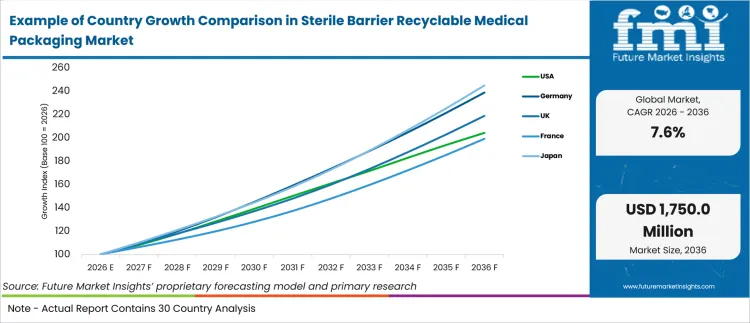
| Country | CAGR |
|---|---|
| India | 10.3% |
| United States | 9.5% |
| United Kingdom | 8.7% |
| France | 8.0% |
| Japan | 7.2% |
| Germany | 6.5% |
How do country-level CAGRs compare in the Sterile Barrier Recyclable Medical Packaging Market?
The country forecasts show a steady progression across the sterile barrier recyclable medical packaging market, reflecting different levels of adoption of sustainable packaging solutions within regulated healthcare environments. India and the United States define the upper end of the comparison, supported by increasing demand for sterile packaging formats that can meet both infection-control and sustainability objectives. The United Kingdom and France create a middle band where recyclable packaging initiatives are gaining traction alongside broader healthcare waste reduction efforts. Japan and Germany follow with more measured forecasts, although the transition between countries remains gradual rather than segmented.
- India benefits from expanding healthcare infrastructure and increasing attention to environmentally responsible packaging solutions across medical device and pharmaceutical supply chains.
- The United States reflects strong demand for packaging systems that preserve sterility while helping manufacturers and healthcare providers advance packaging sustainability targets.
- The United Kingdom continues to support adoption through healthcare sector initiatives focused on reducing packaging waste and improving material circularity without compromising patient safety.
- France's outlook is influenced by growing regulatory and industry emphasis on recyclable healthcare packaging materials and sustainable procurement practices.
- Japan maintains steady market development as packaging suppliers focus on material innovation that can satisfy stringent quality, sterilization and product protection requirements.
- Germany's position reflects a highly regulated medical packaging environment where adoption of recyclable sterile barrier systems remains closely linked to compliance, performance verification and lifecycle assessment considerations.
Similar CAGRs do not necessarily translate into identical commercialization conditions. Differences in sterilization methods, medical packaging regulations, recycling infrastructure and healthcare procurement standards can significantly influence the adoption of recyclable sterile barrier solutions. The full report provides country-level CAGR analysis across North America, Latin America, Europe, East Asia, South Asia, Oceania and the Middle East and Africa.
Country-wise Analysis
- India combines developing medical-device parks with shared testing laboratories that support local sterile package qualification. Adoption of sterile barrier recyclable medical packaging in India is estimated to expand at 10.3% CAGR through 2036, supported by new manufacturing capacity and regional technical services. Press Information Bureau reported in March 2026 that three medical-device parks had allocated land to 199 manufacturers and 34 units had started construction. Common laboratories can reduce travel and sample lead times for medical-device companies entering regulated commercial production. Smaller plants often lack packaging engineers and reliable collection routes for local recyclable production offcuts. Testing providers therefore need affordable services and documented recovery routes suited to each qualified material stream.
- United States medical-device plants operate under detailed manufacturing controls and established ethylene oxide sterilization networks. The EPA finalized an interim ethylene oxide decision in January 2025 with lower worker exposure limits and tighter cycle controls. Sterile barrier recyclable medical packaging sales in the United States are forecast to expand at 9.5% CAGR by 2036, reinforced by package redesign and regional technical investment. Domestic coating and cleanroom sites give engineering teams a faster route from material trials to commercial qualification. Changes to a validated sterilization cycle can extend testing across registered device families and existing supply agreements. Commercial package designs must reduce material without disrupting approved sterilization parameters or critical supply continuity.
- Great Britain applies defined post-market surveillance duties to medical devices placed on its market from June 2025. The United Kingdom's sterile barrier recyclable medical packaging outlook is anticipated to advance at 8.7% CAGR over the assessment period, shaped by documentation updates and continuing device activity. MHRA published revised surveillance guidance in January 2025 and updated the page as the requirements took effect. Local responsible persons and testing laboratories provide established routes for evidence management and technical review. Cross-border portfolios can create duplicate records between Great Britain and European Union systems for the same device. Packaging programs therefore need strict version control across labels and sterile barrier validation records throughout distribution.
- France combines medical-device production with producer responsibility for packaging used by professional organizations across commercial operations. The ecological transition ministry updated its professional-packaging guidance in January 2026 following a November 2025 decree that established the broader framework. The French sterile barrier recyclable medical packaging sector is projected to record 8.0% CAGR during the assessment period, aided by regulated recovery planning and regional conversion capacity. National laboratories and packaging plants provide a direct route for testing and production transfer within Europe. Primary sterile barriers can remain outside practical recovery routes despite wider responsibility for professional packaging waste. Producers must separate recoverable transport layers from patient-contact structures during compliance planning and material selection.
- Japan applies a detailed medical-device quality system that rewards material consistency and complete manufacturing records. Sterile barrier recyclable medical packaging demand in Japan is forecast to rise at 7.2% CAGR over the forecast period, influenced by controlled package changes and quality-focused manufacturing. Japan's health ministry revised QMS inspection procedures in July 2025 to standardize review across public authorities and registered certification bodies. Domestic converting quality and long-term manufacturing relationships support controlled package implementation across qualified medical-device production lines. Changes affecting sterilization or shelf-life evidence can extend regulatory evaluation timelines across approved medical-device families and sites. Local testing and controlled production transfer reduce the risk of inconsistent package performance across qualified sites.
- Germany combines formal recyclability measurement with established medical-device quality systems and mature package-validation practices nationwide. The Federal Environment Agency published the 2025 minimum standard for measuring packaging recyclability in August 2025. In Germany, sterile barrier recyclable medical packaging demand is predicted to advance at 6.5% CAGR through 2036 owing to package redesign and mature healthcare manufacturing. Strong paper and coating industries provide technical depth for controlled redesign across domestic medical-device programs. The minimum standard mainly covers system-participating packaging and does not remove sterile barrier constraints for medical devices. Engineering teams need separate evidence for functional safety and actual recovery compatibility across each selected structure.
Who are the notable companies in the Sterile Barrier Recyclable Medical Packaging Market?
Amcor, DuPont Tyvek, TekniPlex, Nelipak, Sterimed, Billerud, Oliver Healthcare Packaging, and Coveris supply medical-grade materials, sterile barrier conversion, validation support, or recyclable package development.
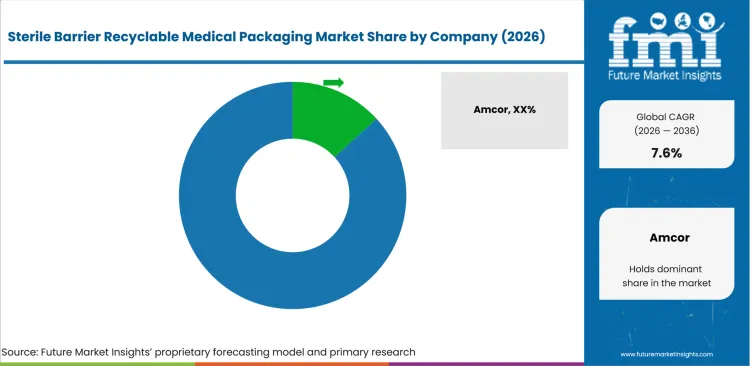
The competitive field combines substrate developers, sterile barrier manufacturers and integrated healthcare packaging groups with different validation capabilities. In June 2026, Sterimed completed the Simagec acquisition and added rigid packaging with contract packaging and validation services. The transaction extends Sterimed beyond medical papers and flexible structures into broader package execution for device and pharmaceutical programs. Amcor and TekniPlex operate coating and sterile package production networks across several major healthcare manufacturing regions. Nelipak and Oliver Healthcare Packaging add package design, laboratory testing and cleanroom conversion across regulated healthcare programs. DuPont Tyvek and Billerud focus on medical-grade substrates supported through authorized conversion routes and documented sterilization performance. Coveris contributes European flexible packaging capacity and a commercial closed-loop development for sterile medical pouches.
- Amcor and TekniPlex combine sterile barrier materials with regional coating capacity and technical support across several healthcare manufacturing centers. Nelipak adds integrated flexible and rigid design services that help transfer approved specifications into commercial production. These groups compete through qualification speed and supply continuity rather than broad packaging scale alone.
- DuPont Tyvek and Billerud compete through specialized medical-grade substrates that require close coordination with authorized packaging plants and device manufacturers. Sterimed adds medical papers and flexible structures alongside acquired contract packaging and validation services for regulated medical programs. Their commercial value depends on documented sterilization compatibility and responsive technical support during package qualification.
- Oliver Healthcare Packaging focuses on flexible sterile formats through seal technologies and application support for medical-device programs. Coveris adds European pouch production and a commercial closed-loop project linking hospital collection with attributed medical-grade resin. Both companies address defined implementation needs through specialized sterile formats and regional technical support for selected healthcare applications.
Competitive Benchmarking: Sterile Barrier Recyclable Medical Packaging Market
| Company | Recyclable Sterile-Barrier Portfolio | Validation and Converting Support | Healthcare Production Reach | Geographic Reach |
|---|---|---|---|---|
| Amcor | High | High | High | Global |
| DuPont Tyvek | Medium | Medium | Medium | Global channels |
| TekniPlex | Medium | High | High | Global |
| Nelipak | High | High | Medium | North America and Europe; Asia-Pacific support |
| Sterimed | Medium | High | High | Global |
| Billerud | Medium | Medium | Low | Europe |
| Oliver Healthcare Packaging | Medium | High | High | Global |
| Coveris | Medium | Medium | Low |
Europe
|
Key Developments in the Sterile Barrier Recyclable Medical Packaging Market
- In October 2025, Amcor launched AmSecure thermoformed trays and rollstock for medical and pharmaceutical packaging. The APET-based system supports standard thermoforming processes and common sterilization methods across qualified healthcare applications. APR Design for Recyclability recognition documents compatibility with applicable recovery systems used for qualifying recyclable thermoformed structures. The launch adds a commercial rigid option for programs seeking material recovery without replacing established forming equipment or validated sterilization routes.
- In June 2025, TekniPlex Healthcare commenced production at its Barrier Protection Systems facility in Madison within Wisconsin. The site manufactures coated Tyvek and medical papers through high-volume coating and printing equipment for healthcare programs. The investment expands North American sterile barrier capacity and provides dedicated materials-science support for package development. Medical device manufacturers gain a regional route for qualification and commercial supply without depending on distant coating operations.
- In September 2025, Nelipak and Cook Medical announced packaging for two stent systems using Tyvek with Renewable Attribution. The collaboration integrated the attributed material through an authorized conversion route without redesigning the qualified sterile barrier. The project reduced fossil-feedstock reliance while retaining established material performance across named commercial devices and production processes. The development demonstrates market use through specific device programs rather than a laboratory concept or undated product claim.
- In October 2025, Coveris joined SABIC and Zuyderland Medical Centre with Artivion in a closed-loop medical packaging project. Non-contaminated hospital plastic waste became attributed medical-grade resin that returned as sterile pouches for guidewire packaging. The project connected hospital collection with resin production and pouch conversion across a complete material loop. Each stage retained documented healthcare safety requirements and produced a named commercial packaging application for deployment.
Key Players in the Sterile Barrier Recyclable Medical Packaging Market
Integrated Sterile Barrier Converters
- Amcor
- TekniPlex
- Nelipak
Material Technology Specialists
- DuPont Tyvek
- Sterimed
- Billerud
Flexible Packaging Specialists
- Oliver Healthcare Packaging
- Coveris
Sterile Barrier Recyclable Medical Packaging Market - Report Scope
| Coverage field | Report scope |
|---|---|
| Market breakdown | Material, format, barrier or feature, end use, and region. |
| Quantitative Units | Revenue in USD Million, CAGR in %. |
| Market Definition | Commercial demand for recyclable or reduced-material sterile barrier packaging used across medical devices, pharmaceuticals, and defined medical nutrition applications. |
| Regions Covered | North America, Latin America, Europe, East Asia, South Asia and Pacific, and Middle East and Africa. |
| Countries Covered | India, United States, United Kingdom, France, Japan, Germany, and 30+ additional countries. |
| Key Companies Profiled | Amcor, DuPont Tyvek, TekniPlex, Nelipak, Sterimed, Billerud, Oliver Healthcare Packaging, and Coveris |
| Forecast Period | 2026 to 2036. |
| Approach | Hybrid bottom-up and top-down market sizing supported by primary interviews and official desk research. |
Sterile Barrier Recyclable Medical Packaging Market - Research Methodology
| Method | Approach |
|---|---|
| Primary Research | FMI analysts gathered input from manufacturers, service providers, technology developers, distributors, end users, procurement teams, and subject-matter experts. Interviews examined purchasing decisions, product or service evaluation, adoption barriers, approval requirements, pricing considerations, and expectations for technical or commercial support. Respondents were also asked what evidence is required before a trial, pilot, or initial order develops into regular purchasing. |
| Desk Research | Desk research covered government statistics, regulatory publications, trade data, industry associations, technical literature, standards, company filings, product information, and official corporate announcements. Sources were reviewed for relevance, publication date, geographic coverage, and consistency with the defined market scope. Claims relating to performance, applications, approvals, capacity, investment, and commercial activity were retained only when supported by credible public evidence. |
| Market Sizing and Forecasting | The market model combined the baseline value with historical performance, segment structure, pricing and volume indicators, adoption levels, company participation, and country-level demand conditions. Forecast assumptions considered economic activity, investment trends, regulatory developments, technology adoption, purchasing cycles, supply availability, and barriers to wider market use. Segment and regional estimates were reconciled before the final market total was calculated. |
| Data Validation | Estimates were checked against multiple independent indicators, including public data, company activity, trade patterns, industry developments, and findings from primary interviews. Validation also tested whether products, services, applications, and company revenues fell within the defined market boundaries. Adjacent categories, unsupported claims, overlapping revenues, and activities without direct market relevance were excluded to reduce double counting and maintain consistency across segments and countries. |
Sterile Barrier Recyclable Medical Packaging Market by Segments
Sterile Barrier Recyclable Medical Packaging Market segmented by Material:
- Paper
- Molded Fiber
- Recycled PET
- Mono-material PE
- Bio-based Polymer
Sterile Barrier Recyclable Medical Packaging Market segmented by Format:
- Pouches
- Trays
- Labels
- Mailers
- Inserts
Sterile Barrier Recyclable Medical Packaging Market segmented by Barrier or Feature:
- Grease Resistant
- High Barrier
- Tamper Evident
- Traceable
- Freshness Indicating
Sterile Barrier Recyclable Medical Packaging Market segmented by End Use:
- Food
- Pharmaceutical
- E-commerce
- Personal Care
- Cold Chain
Sterile Barrier Recyclable Medical Packaging Market by Region:
- North America
- United States
- Canada
- Europe
- Germany
- United Kingdom
- France
- Italy
- Spain
- East Asia
- China
- Japan
- South Korea
- South Asia and Pacific
- India
- ASEAN
- Australia and New Zealand
- Latin America
- Brazil
- Mexico
- Middle East and Africa
- GCC Countries
- South Africa
- Türkiye
Research Sources and Bibliography
- USA Food and Drug Administration. (2023, December 18). Recognized Consensus Standards: Medical Devices [ISO 11607-1, Second edition 2019-02, including AMD1:2023].
- European Parliament and Council of the European Union. (2025, January 22). Regulation (EU) 2025/40 of the European Parliament and of the Council of 19 December 2024 on packaging and packaging waste, amending Regulation (EU) 2019/1020 and Directive (EU) 2019/904, and repealing Directive 94/62/EC (Text with EEA relevance).
- Amcor. (2026, April 24). Amcor opens advanced healthcare packaging coating facility in Malaysia.
- Dai Nippon Printing Co., Ltd. (2026, April 16). DNP Launches Recyclable Mono-Material Medical Sterilization Pouch.
- BASF. (2026, April 29). New ecovio® portfolio for flexible packaging: multiple barrier options combined with organic or paper recycling.
- Nestlé Health Science. (2026, March 30). Nestlé introduces an innovative complete nutritional solution for children with special medical nutrition needs.
- USA Environmental Protection Agency. (2026, March 13). EPA Releases Proposal for Commercial Sterilizers to Safeguard the Supply of Life-Saving Medical Tools.
- USA Food and Drug Administration. (2023, May 29). Recognized Consensus Standards: Medical Devices [ISO/TS 16775, Second edition 2021-11].
- Nelipak. (2026, March 11). Nelipak Announces Opening of Asia-Pacific Technical Development Center.
- European Commission. (2026, June 10). Commission Notice - Guidance document for Regulation (EU) 2025/40 on packaging and packaging waste.
- Press Information Bureau. (2026, March 21). India’s Pharmaceuticals in Global Healthcare.
- USA Environmental Protection Agency. (2025, January 14). EPA Finalizes Protections for Workers and Communities from Cancer-Causing Ethylene Oxide Pollution.
- Medicines and Healthcare products Regulatory Agency. (2025, January 15). Medical devices: post-market surveillance requirements.
- Ministère de la Transition écologique. (2026, January 21). Emballages professionnels.
- Ministry of Health, Labour and Welfare. (2025, July 8). [Partial revision of the QMS inspection procedures].
- Umweltbundesamt. (2025, August 29). Recyclingfähigkeit von Verpackungen: Mindeststandard 2025.
- Sterimed. (2026, June 23). The French group Simagec joins the Sterimed adventure.
- Amcor. (2025, October 16). Amcor launches AmSecure™ thermoformed trays and rollstock, part of the HealthCare™ portfolio.
- TekniPlex. (2025, June 12). TekniPlex Healthcare Opens New Flagship Barrier Protection Systems Facility in Madison, Wisconsin.
- Nelipak. (2025, September 3). Cook Medical and Nelipak create healthcare packaging solutions enabled by Tyvek® with Renewable Attribution.
- Coveris. (2025, October 9). Coveris teams up with SABIC for fully closing the loop in medical packaging.
- DuPont. (2025, June 5). DuPont Expands Healthcare Manufacturing Site in Costa Rica, Adding Sterile Packaging Capacity.
- Billerud. (2026, April 1). Billerud publishes annual report 2025.
- Oliver Healthcare Packaging. (2025, May 16). Oliver Healthcare Packaging Opens State-of-the-Art Manufacturing Facility in Johor to Meet the Needs of Pharmaceutical and Medical Device Companies in Asia-Pacific.
- Amcor. (2026, June 1). Amcor achieves cleanroom certification in Puerto Rico.
- Hyland, L. (2026, June 30). Investigating Seal Creep: Looking Beyond the Packaging.
This bibliography is provided for reader reference and is not exhaustive. The full report contains the complete reference list and detailed citations
This Report Answers
- How large is the sterile barrier recyclable medical packaging market in 2026 and 2036?
- Which operating pressures support recyclable conversion without weakening sterile barrier performance?
- Why does paper account for the largest material share in 2026?
- How do pouches balance material efficiency with aseptic presentation requirements?
- Why does grease resistant hold a notable barrier or feature share?
- How do country growth rates differ across India, the United States, Europe and Japan?
- Which companies provide materials, converting capacity, validation support or closed-loop development?
- What limits practical recycling across multilayer sterile barrier structures and healthcare waste systems?
- How can manufacturers separate primary barrier safety from secondary packaging reduction opportunities?
Frequently Asked Questions
How big is the Sterile Barrier Recyclable Medical Packaging Market in 2026?
The sterile barrier recyclable medical packaging market is valued at USD 839.3 million in 2026 and is forecast to reach USD 1,750.0 million by 2036, supported by medical device manufacturers seeking lower-material package systems that preserve sterile integrity and validated seal performance throughout commercial production and distribution.
What is the CAGR of the Sterile Barrier Recyclable Medical Packaging Market from 2026 to 2036?
The sterile barrier recyclable medical packaging market is valued at USD 839.3 million in 2026 and is forecast to reach USD 1,750.0 million by 2036, supported by medical device manufacturers seeking lower-material package systems that preserve sterile integrity and validated seal performance throughout commercial production and distribution.
What is the CAGR of the Sterile Barrier Recyclable Medical Packaging Market from 2026 to 2036?
The sterile barrier recyclable medical packaging market is projected to grow at a CAGR of 7.6% between 2026 and 2036, supported by sterilization continuity requirements, expanding recyclability regulations across major healthcare markets, and growing demand for reduced-material package designs that preserve validated microbial barrier performance.
Which material leads the Sterile Barrier Recyclable Medical Packaging Market?
Paper accounts for 34.0% of the sterile barrier recyclable medical packaging market by material in 2026, driven by broad coating availability and compatibility with breathable sterilization routes, allowing medical device manufacturers to evaluate paper through familiar seal-strength and microbial-barrier tests on existing production lines.
How much will the Sterile Barrier Recyclable Medical Packaging Market add between 2026 and 2036?
The market addresses material reduction without compromising sterile protection across qualified sealing and sterilization processes for regulated medical products. It connects recyclable design with distribution performance and aseptic-opening requirements across complete commercial packaging systems.
What should decision-makers evaluate in the sterile barrier recyclable medical packaging market?
Decision-makers should compare barrier integrity and recovery compatibility across complete systems under the intended sterilization route and shelf-life conditions. Project teams should assess regional converting capacity and validation support ahead of commercial packaging changes.
Who are the leading companies in the Sterile Barrier Recyclable Medical Packaging Market?
Leading companies in the sterile barrier recyclable medical packaging market include Amcor, DuPont Tyvek, TekniPlex, Nelipak, Sterimed, Billerud, Oliver Healthcare Packaging, and Coveris, competing across integrated sterile barrier conversion, medical-grade substrate development, and flexible packaging with validation and closed-loop development capabilities.
Preview the report firsthand - request a free sample
Get SampleGet the brochure for pricing and purchase details.
Get PDFTable of Content
- Key Takeaways
- Market Size and CAGR
- Top Growth Driver
- Fastest Growing Segment
- Leading Region
- Key Companies
- Emerging Opportunities
- Executive Summary
- Global Market Outlook
- Demand-side Trends
- Supply-side Trends
- Technology Roadmap Analysis
- Analysis and Recommendations
- Analyst Perspective (What is happening? Why now? What should investors know?)
- Key Questions Answered
- How large is the market?
- What is the CAGR?
- What are key trends?
- Which region dominates?
- Who are the leaders?
- Market Overview
- Market Coverage / Taxonomy
- Market Definition / Scope / Limitations
- Research Methodology
- Chapter Orientation
- Analytical Lens and Working Hypotheses
- Market Structure, Signals, and Trend Drivers
- Benchmarking and Cross-market Comparability
- Market Sizing, Forecasting, and Opportunity Mapping
- Research Design and Evidence Framework
- Desk Research Programme (Secondary Evidence)
- Expert Input and Fieldwork (Primary Evidence)
- Tooling, Models, and Reference Databases
- Data Engineering and Model Build
- Quality Assurance and Audit Trail
- Market Background
- Market Dynamics (Drivers, Restraints, Opportunity, Trends)
- Scenario Forecast (Optimistic, Likely, Conservative)
- Impact Analysis
- AI Impact
- Sustainability Impact
- Regulatory Impact
- Technology Impact
- Consumer / Buyer Analysis
- Purchase Drivers
- Adoption Barriers
- Buyer Journey
- Opportunity Map Analysis
- Product Life Cycle Analysis
- Supply Chain Analysis
- Investment Feasibility Matrix
- Value Chain Analysis
- PESTLE and Porter's Analysis
- Regulatory Landscape
- Regional Parent Market Outlook
- Production and Consumption Statistics
- Import and Export Statistics
- Global Market Analysis and Forecast, 2021 to 2036
- Historical Market Size Value (USD Million) Analysis, 2021 to 2025
- Current and Future Market Size Value (USD Million) Projections, 2026 to 2036
- Y-o-Y Growth Trend Analysis
- Absolute $ Opportunity Analysis
- Global Market Pricing Analysis, 2021 to 2036
- Global Market Analysis and Forecast, By Material, 2021 to 2036
- Introduction / Key Findings
- Historical Market Size Value (USD Million) Analysis By Material, 2021 to 2025
- Current and Future Market Size Value (USD Million) Analysis and Forecast By Material, 2026 to 2036
- Paper
- Molded Fiber
- Recycled Pet
- Mono-Material Pe
- Bio-Based Polymer
- Paper
- Y-o-Y Growth Trend Analysis By Material, 2021 to 2025
- Absolute $ Opportunity Analysis By Material, 2026 to 2036
- Global Market Analysis and Forecast, By Format, 2021 to 2036
- Introduction / Key Findings
- Historical Market Size Value (USD Million) Analysis By Format, 2021 to 2025
- Current and Future Market Size Value (USD Million) Analysis and Forecast By Format, 2026 to 2036
- Pouches
- Trays
- Labels
- Mailers
- Inserts
- Pouches
- Y-o-Y Growth Trend Analysis By Format, 2021 to 2025
- Absolute $ Opportunity Analysis By Format, 2026 to 2036
- Global Market Analysis and Forecast, By Barrier or Feature, 2021 to 2036
- Introduction / Key Findings
- Historical Market Size Value (USD Million) Analysis By Barrier or Feature, 2021 to 2025
- Current and Future Market Size Value (USD Million) Analysis and Forecast By Barrier or Feature, 2026 to 2036
- Grease Resistant
- High Barrier
- Tamper Evident
- Traceable
- Freshness Indicating
- Grease Resistant
- Y-o-Y Growth Trend Analysis By Barrier or Feature, 2021 to 2025
- Absolute $ Opportunity Analysis By Barrier or Feature, 2026 to 2036
- Global Market Analysis and Forecast, By End Use, 2021 to 2036
- Introduction / Key Findings
- Historical Market Size Value (USD Million) Analysis By End Use, 2021 to 2025
- Current and Future Market Size Value (USD Million) Analysis and Forecast By End Use, 2026 to 2036
- Food
- Pharmaceutical
- E-Commerce
- Personal Care
- Cold Chain
- Food
- Y-o-Y Growth Trend Analysis By End Use, 2021 to 2025
- Absolute $ Opportunity Analysis By End Use, 2026 to 2036
- Global Market Analysis and Forecast, By Region, 2021 to 2036
- Introduction
- Historical Market Size Value (USD Million) Analysis By Region, 2021 to 2025
- Current Market Size Value (USD Million) Analysis and Forecast By Region, 2026 to 2036
- North America
- Latin America
- Western Europe
- Eastern Europe
- East Asia
- South Asia and Pacific
- Middle East & Africa
- Market Attractiveness Analysis By Region
- North America Market Analysis and Forecast, By Country, 2021 to 2036
- Historical Market Size Value (USD Million) Trend Analysis By Market Taxonomy, 2021 to 2025
- Market Size Value (USD Million) Forecast By Market Taxonomy, 2026 to 2036
- By Country
- USA
- Canada
- By Material
- By Format
- By Barrier or Feature
- By End Use
- By Country
- Market Attractiveness Analysis
- By Country
- By Material
- By Format
- By Barrier or Feature
- By End Use
- Key Takeaways
- Latin America Market Analysis and Forecast, By Country
- Historical Market Size Value (USD Million) Trend Analysis By Market Taxonomy, 2021 to 2025
- Market Size Value (USD Million) Forecast By Market Taxonomy, 2026 to 2036
- By Country
- Brazil
- Mexico
- Chile
- Rest of Latin America
- By Material
- By Format
- By Barrier or Feature
- By End Use
- By Country
- Market Attractiveness Analysis
- By Country
- By Material
- By Format
- By Barrier or Feature
- By End Use
- Key Takeaways
- Western Europe Market Analysis and Forecast, By Country
- Historical Market Size Value (USD Million) Trend Analysis By Market Taxonomy, 2021 to 2025
- Market Size Value (USD Million) Forecast By Market Taxonomy, 2026 to 2036
- By Country
- Germany
- UK
- Italy
- Spain
- France
- Nordic
- BENELUX
- Rest of Western Europe
- By Material
- By Format
- By Barrier or Feature
- By End Use
- By Country
- Market Attractiveness Analysis
- By Country
- By Material
- By Format
- By Barrier or Feature
- By End Use
- Key Takeaways
- Eastern Europe Market Analysis and Forecast, By Country
- Historical Market Size Value (USD Million) Trend Analysis By Market Taxonomy, 2021 to 2025
- Market Size Value (USD Million) Forecast By Market Taxonomy, 2026 to 2036
- By Country
- Russia
- Poland
- Hungary
- Balkan & Baltic
- Rest of Eastern Europe
- By Material
- By Format
- By Barrier or Feature
- By End Use
- By Country
- Market Attractiveness Analysis
- By Country
- By Material
- By Format
- By Barrier or Feature
- By End Use
- Key Takeaways
- East Asia Market Analysis and Forecast, By Country
- Historical Market Size Value (USD Million) Trend Analysis By Market Taxonomy, 2021 to 2025
- Market Size Value (USD Million) Forecast By Market Taxonomy, 2026 to 2036
- By Country
- China
- Japan
- South Korea
- By Material
- By Format
- By Barrier or Feature
- By End Use
- By Country
- Market Attractiveness Analysis
- By Country
- By Material
- By Format
- By Barrier or Feature
- By End Use
- Key Takeaways
- South Asia and Pacific Market Analysis and Forecast, By Country
- Historical Market Size Value (USD Million) Trend Analysis By Market Taxonomy, 2021 to 2025
- Market Size Value (USD Million) Forecast By Market Taxonomy, 2026 to 2036
- By Country
- India
- ASEAN
- Australia & New Zealand
- Rest of South Asia and Pacific
- By Material
- By Format
- By Barrier or Feature
- By End Use
- By Country
- Market Attractiveness Analysis
- By Country
- By Material
- By Format
- By Barrier or Feature
- By End Use
- Key Takeaways
- Middle East & Africa Market Analysis and Forecast, By Country
- Historical Market Size Value (USD Million) Trend Analysis By Market Taxonomy, 2021 to 2025
- Market Size Value (USD Million) Forecast By Market Taxonomy, 2026 to 2036
- By Country
- Kingdom of Saudi Arabia
- Other GCC Countries
- Türkiye
- South Africa
- Other African Union
- Rest of Middle East & Africa
- By Material
- By Format
- By Barrier or Feature
- By End Use
- By Country
- Market Attractiveness Analysis
- By Country
- By Material
- By Format
- By Barrier or Feature
- By End Use
- Key Takeaways
- Key Countries Market Analysis
- USA
- Pricing Analysis
- Market Share Analysis, 2025
- By Material
- By Format
- By Barrier or Feature
- By End Use
- Canada
- Pricing Analysis
- Market Share Analysis, 2025
- By Material
- By Format
- By Barrier or Feature
- By End Use
- Mexico
- Pricing Analysis
- Market Share Analysis, 2025
- By Material
- By Format
- By Barrier or Feature
- By End Use
- Brazil
- Pricing Analysis
- Market Share Analysis, 2025
- By Material
- By Format
- By Barrier or Feature
- By End Use
- Chile
- Pricing Analysis
- Market Share Analysis, 2025
- By Material
- By Format
- By Barrier or Feature
- By End Use
- Germany
- Pricing Analysis
- Market Share Analysis, 2025
- By Material
- By Format
- By Barrier or Feature
- By End Use
- UK
- Pricing Analysis
- Market Share Analysis, 2025
- By Material
- By Format
- By Barrier or Feature
- By End Use
- Italy
- Pricing Analysis
- Market Share Analysis, 2025
- By Material
- By Format
- By Barrier or Feature
- By End Use
- Spain
- Pricing Analysis
- Market Share Analysis, 2025
- By Material
- By Format
- By Barrier or Feature
- By End Use
- France
- Pricing Analysis
- Market Share Analysis, 2025
- By Material
- By Format
- By Barrier or Feature
- By End Use
- India
- Pricing Analysis
- Market Share Analysis, 2025
- By Material
- By Format
- By Barrier or Feature
- By End Use
- ASEAN
- Pricing Analysis
- Market Share Analysis, 2025
- By Material
- By Format
- By Barrier or Feature
- By End Use
- Australia & New Zealand
- Pricing Analysis
- Market Share Analysis, 2025
- By Material
- By Format
- By Barrier or Feature
- By End Use
- China
- Pricing Analysis
- Market Share Analysis, 2025
- By Material
- By Format
- By Barrier or Feature
- By End Use
- Japan
- Pricing Analysis
- Market Share Analysis, 2025
- By Material
- By Format
- By Barrier or Feature
- By End Use
- South Korea
- Pricing Analysis
- Market Share Analysis, 2025
- By Material
- By Format
- By Barrier or Feature
- By End Use
- Russia
- Pricing Analysis
- Market Share Analysis, 2025
- By Material
- By Format
- By Barrier or Feature
- By End Use
- Poland
- Pricing Analysis
- Market Share Analysis, 2025
- By Material
- By Format
- By Barrier or Feature
- By End Use
- Hungary
- Pricing Analysis
- Market Share Analysis, 2025
- By Material
- By Format
- By Barrier or Feature
- By End Use
- Kingdom of Saudi Arabia
- Pricing Analysis
- Market Share Analysis, 2025
- By Material
- By Format
- By Barrier or Feature
- By End Use
- Türkiye
- Pricing Analysis
- Market Share Analysis, 2025
- By Material
- By Format
- By Barrier or Feature
- By End Use
- South Africa
- Pricing Analysis
- Market Share Analysis, 2025
- By Material
- By Format
- By Barrier or Feature
- By End Use
- USA
- Market Structure Analysis
- Competition Dashboard
- Competition Benchmarking
- Market Share Analysis of Top Players
- By Regional
- By Material
- By Format
- By Barrier or Feature
- By End Use
- Emerging Startups
- Innovation Benchmarking
- Competition Analysis
- Competition Deep Dive
- Amcor
- Overview
- Product Portfolio
- Profitability by Market Segments
- Sales Footprint
- Strategy Overview
- Marketing Strategy
- Product Strategy
- Channel Strategy
- DuPont Tyvek
- TekniPlex
- Nelipak
- Sterimed
- Billerud
- Oliver Healthcare Packaging
- Coveris
- Amcor
- Case Studies
- Success Stories
- Recent Developments
- Competition Deep Dive
- Assumptions & Acronyms Used


