

- Industry Size (2026)
- USD 660.3 Mn
- Forecast (2036)
- USD 1239.5 Mn
- CAGR (2026 to 2036)
- 6.5%
Succinic Acid Plasticizer Derivatives Market Forecast and Outlook 2026 to 2036
The succinic acid plasticizer derivatives market is projected to expand from USD 660.3 million in 2026 to USD 1,239.5 million by 2036, growing at a CAGR of 6.5%. Market performance is closely tied to production structure rather than end-use demand acceleration. Manufacturing remains concentrated among suppliers with access to stable succinic acid feedstocks, esterification capability, and consistent purification control, creating natural entry barriers. Dependence on upstream succinic acid availability both petro-based and bio-derived directly influences cost stability and delivery reliability. Regional manufacturing control plays a decisive role in supplier selection, particularly for PVC and flexible vinyl compounders that operate on tight production schedules. Buyers favor producers with local or regional production footprints to reduce logistics risk and exposure to feedstock price volatility. Supply reliability outweighs price competition in long-term contracts, as formulation requalification carries cost and performance risk. Between 2026 and 2036, value retention will depend on feedstock security, process consistency, and the ability to supply large volumes without disruption rather than on aggressive capacity additions or short-term pricing tactics.
Quick Stats for Succinic Acid Plasticizer Derivatives Market
- Succinic Acid Plasticizer Derivatives Market Value (2026): USD 660.3 Million
- Succinic Acid Plasticizer Derivatives Market Forecast Value (2036): USD 1,239.5 Million
- Succinic Acid Plasticizer Derivatives Market Forecast CAGR (2026 to 2036): 6.5%
- Leading Derivative Type in Succinic Acid Plasticizer Derivatives Market: Dialkyl Succinate Plasticizers (38% share)
- Key Growth Regions in Succinic Acid Plasticizer Derivatives Market: Asia Pacific, Europe, North America, Latin America, Middle East & Africa
- Top Key Players in Succinic Acid Plasticizer Derivatives Market: BASF SE, Roquette Frères, Mitsubishi Chemical Group, DSM-Firmenich, Novamont, BioAmber (IP & successors), Evonik Industries AG, Lanxess AG, Perstorp Group, UPC Technology Corporation
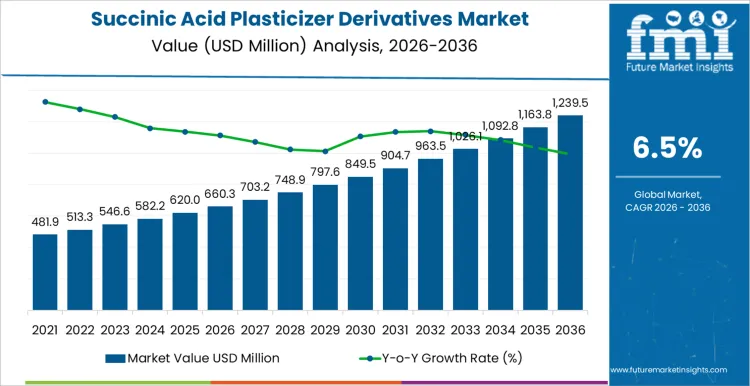
Succinic Acid Plasticizer Derivatives Market Key Takeaways
| Metric | Value |
|---|---|
| Succinic Acid Plasticizer Derivatives Market Value (2026) | USD 660.3 Million |
| Succinic Acid Plasticizer Derivatives Market Forecast Value (2036) | USD 1,239.5 Million |
| Succinic Acid Plasticizer Derivatives Market Forecast CAGR (2026 to 2036) | 6.5% |
How are Regulatory Substitution and Performance Parity Driving Adoption of Succinic Acid Plasticizer Derivatives?
The succinic acid plasticizer derivatives market is expanding as manufacturers seek viable alternatives to conventional phthalate plasticizers while preserving processing efficiency and end-use performance. These derivatives are increasingly adopted in flexible PVC, synthetic rubber, and specialty polymer applications where regulatory scrutiny and customer specifications limit the use of traditional plasticizers. For producers and compounders, demand is driven less by novelty and more by the ability of succinic-based derivatives to meet compliance requirements without requiring major formulation redesigns.
Formulation performance and processing compatibility are central to purchasing decisions. Polymer processors evaluate succinic acid plasticizer derivatives based on plasticizing efficiency, volatility, migration resistance, and impact on mechanical properties such as flexibility and tensile strength. Derivatives that offer stable performance across a wide temperature range and maintain compatibility with existing stabilizer and filler systems are gaining preference. Suppliers that provide multiple ester variants and application-specific guidance are reducing customer qualification timelines and supporting faster commercial adoption.
Supply assurance and cost positioning are also shaping long-term contracts. As demand grows across automotive interiors, wire & cable, flooring, and consumer goods, buyers are prioritizing plasticizers with predictable pricing and scalable production. Integration with established succinic acid supply chains both petro-based and bio-derived is improving availability and supporting global sourcing strategies. For manufacturers and suppliers, competitive advantage increasingly depends on balancing regulatory alignment, formulation flexibility, and reliable supply positioning succinic acid plasticizer derivatives as a steady, substitution-driven growth segment within the broader plasticizers market.
How is The Succinic Acid Plasticizer Derivatives Market Structured by Derivative Type and Polymer Application?
The succinic acid plasticizer derivatives market is segmented by derivative type and polymer application, reflecting how molecular structure and compatibility requirements influence plasticizer selection. By derivative type, dialkyl succinate plasticizers represent the leading segment, widely used due to their balanced plasticizing efficiency and processing behavior. Other derivative types include polymeric and oligomeric succinate plasticizers, bio-based succinate esters, and other specialized succinic derivatives designed for targeted polymer systems. By polymer application, PVC and flexible vinyl account for the largest demand, followed by bioplastics such as PLA and PBS, polyesters, and other polymer uses where flexibility, durability, and migration control are required.
Why Do Dialkyl Succinate Plasticizers Lead Derivative Type Adoption in the Succinic Acid Plasticizer Derivatives Market?

Dialkyl succinate plasticizers hold 38% share of the succinic acid plasticizer derivatives market because they provide effective flexibility enhancement while maintaining good compatibility with a wide range of polymer matrices. Their relatively low molecular weight allows efficient plasticization at moderate loading levels, supporting ease of processing and uniform dispersion. Manufacturers favor dialkyl succinates for applications requiring consistent softness, clarity, and mechanical stability. These plasticizers perform well under standard compounding and extrusion conditions without significantly affecting polymer viscosity. Broad availability and predictable performance across flexible formulations explain why dialkyl succinate plasticizers remain the most widely adopted derivative type.
Why Does PVC And Flexible Vinyl Dominate Polymer Application Demand In The Succinic Acid Plasticizer Derivatives Market?

PVC and flexible vinyl applications account for 34% share of the succinic acid plasticizer derivatives market because plasticizers are essential for converting rigid PVC into flexible, processable materials. Succinic acid-based plasticizers are used in films, cables, flooring, and coated fabrics where flexibility and durability are critical. High global PVC production volumes create sustained demand for compatible plasticizer systems. Manufacturers prioritize plasticizers that deliver stable mechanical properties and reliable processing behavior across temperature ranges. Frequent replacement and maintenance cycles in flexible vinyl products further support consumption. These volume-driven and application-critical factors explain why PVC and flexible vinyl remain the largest polymer application segment.
What are Key Dynamics of the Succinic Acid Plasticizer Derivatives Market?
The succinic acid plasticizer derivatives market is driven by growing interest in plasticizers that deliver reliable flexibility, durability, and processing performance in polymers such as polyvinyl chloride (PVC), thermoplastic elastomers, and biodegradable resins. Succinic acid, a dicarboxylic acid, serves as a building block for ester-based plasticizers that impart low temperature flexibility, good compatibility, and reduced migration compared with some traditional phthalate plasticizers. For chemical manufacturers and compounders, derivative purity, consistent esterification performance, integration with resin systems, and competitive cost per unit performance are central procurement factors. Industry adoption is influenced by formulation requirements across industrial, consumer, and technical applications where polymer performance matters.
How are Technology and Application Trends Shaping This Market?
Technology and application trends are shaping the succinic acid plasticizer derivatives market through demand for customized plasticizer profiles, enhanced polymer compatibility, and performance optimization. Suppliers are developing succinate esters with tailored molecular structures that balance plasticizing efficiency with low volatility and reduced migration in flexible PVC and other polymer systems. Integration of succinic acid plasticizers in compound formulations for consumer goods, automotive interiors, electrical cables, and flexible films responds to end-use performance demands such as low temperature bend resistance and long-term flexibility retention. Advancements in catalyst technologies and process optimization help improve derivative yield and purity, which enhances formulation consistency for downstream converters.
Why Do Cost And Technical Compatibility Challenges Restrain Market Growth?
Cost and technical compatibility challenges restrain growth in the succinic acid plasticizer derivatives market because bio-based and specialty plasticizers typically carry higher raw material and processing costs compared with commodity phthalates. Succinic acid derived plasticizers must compete on total cost of formulation performance rather than on raw material price alone, which can limit adoption in price-sensitive segments. Achieving broad compatibility across diverse resin systems and additive packages requires formulation expertise and extensive validation, which increases development time for compounders. Technical barriers such as ensuring low migration and maintaining mechanical performance across service conditions add complexity to product qualification and slow market penetration in established plasticizer applications.
How is the Succinic Acid Plasticizer Derivatives Market Growing across Key Countries?
The succinic acid plasticizer derivatives market is expanding steadily as manufacturers seek alternatives to conventional plasticizers across flexible plastics, coatings, and specialty polymer applications. These derivatives are valued for their ability to improve flexibility, processability, and mechanical performance while meeting evolving regulatory and performance requirements. Growth varies by country depending on polymer production volumes, regulatory pressure on traditional plasticizers, and adoption across packaging, automotive interiors, consumer goods, and industrial materials. High-growth markets are supported by expanding plastics manufacturing and formulation shifts, while mature regions focus on material optimization, compliance-driven substitution, and stable demand from high-value applications.

| Country | CAGR (%) |
|---|---|
| China | 7.7 |
| Brazil | 7.3 |
| Germany | 6.1 |
| South Korea | 5.7 |
| Japan | 5.0 |
Why Is China Leading the Succinic Acid Plasticizer Derivatives Market?
Demand for succinic acid plasticizer derivatives in China is expanding at a CAGR of 7.7% during 2026 to 2036, driven by the country’s large-scale plastics manufacturing base and ongoing shifts in formulation practices. Demand is strong across flexible PVC, synthetic leather, packaging films, and consumer goods, where plasticizers play a critical role in improving flexibility and processing efficiency. As regulatory oversight on traditional plasticizers tightens, manufacturers are increasingly evaluating alternative chemistries, including succinic acid derivatives, to maintain product performance while meeting compliance requirements. Chinese producers prioritize plasticizer derivatives that offer consistent compatibility with PVC and other polymers, stable thermal behavior, and reliable supply at competitive cost. Domestic chemical manufacturers benefit from integrated supply chains and large-scale production capabilities, allowing rapid volume expansion and pricing flexibility. Procurement decisions emphasize batch consistency, formulation stability, and the ability to supply large volumes for mass-market applications.
Why is Brazil Seeing Growing Demand for Succinic Acid Plasticizer Derivatives?
Sale of succinic acid plasticizer derivatives in Brazil is growing at a CAGR of 7.3% during 2026 to 2036, supported by expanding demand from flexible plastics, construction materials, and consumer product manufacturing. As domestic plastics processors modernize formulations, interest is rising in alternative plasticizers that offer balanced flexibility, durability, and regulatory acceptance. Growth is particularly visible in PVC-based applications such as flooring, cables, hoses, and synthetic leather. Brazilian buyers prioritize cost-effectiveness, formulation versatility, and performance under high-temperature and humid operating conditions. Succinic acid plasticizer derivatives are valued for their ability to improve material flexibility while maintaining mechanical integrity in demanding environments. Adoption remains gradual, reflecting price sensitivity and the need for validation across multiple end-use applications. Procurement decisions often favor suppliers offering technical formulation assistance, regional distribution capabilities, and compatibility with existing polymer systems.
How is Germany Driving Adoption of Succinic Acid Plasticizer Derivatives?
Demand for succinic acid plasticizer derivatives in Germany is expanding at a CAGR of 6.1% during 2026 to 2036, driven by strict material regulations and the country’s focus on advanced polymer engineering. German manufacturers are actively evaluating alternative plasticizers to replace conventional options in automotive interiors, industrial components, and high-performance PVC applications. Demand is concentrated in applications requiring predictable material behavior, low migration, and long service life. Precision, consistency, and compliance are critical selection criteria. Buyers prioritize plasticizer derivatives that deliver stable performance across temperature ranges and processing conditions. Succinic acid derivatives are increasingly considered for applications where formulation control and material reliability are essential. Adoption is driven more by regulatory and performance requirements than by cost considerations. Procurement decisions favor suppliers with strong quality systems, detailed technical documentation, and the ability to support customized formulations.
How is South Korea Expanding Use of Succinic Acid Plasticizer Derivatives?
South Korea’s succinic acid plasticizer derivatives market is growing at a CAGR of 5.7% during 2026 to 2036, supported by demand from electronics, automotive components, and flexible plastics manufacturing. As manufacturers refine polymer formulations to meet export-market requirements, interest is increasing in alternative plasticizers that offer stable processing and consistent material performance. Buyers emphasize compatibility with high-quality polymer systems, low volatility, and suitability for precision applications. Adoption is strongest in value-added products such as automotive interiors, electronic housings, and specialty films. Domestic chemical producers and compounders play a key role in supporting formulation development and supply continuity. Procurement decisions are influenced by supplier reliability, technical collaboration, and the ability to meet strict quality specifications.
What is Driving Demand for Succinic Acid Plasticizer Derivatives in Japan?
Demand for succinic acid plasticizer derivatives in Japan is expanding at a CAGR of 5.0% during 2026 to 2036, driven by a strong emphasis on material reliability, safety, and long-term performance. Japanese manufacturers adopt alternative plasticizers selectively, focusing on applications where formulation stability and controlled material behavior are critical. Demand is strongest in automotive components, consumer electronics, and specialty PVC products. Buyers prioritize proven performance, low migration characteristics, and precise manufacturing tolerances. Succinic acid plasticizer derivatives are evaluated carefully through extended validation cycles before commercial adoption. Integration with conservative yet highly reliable polymer systems is essential. Procurement decisions favor suppliers with established track records, consistent quality, and long-term supply assurance. While growth is moderate, ongoing material optimization and gradual replacement of conventional plasticizers continue to support steady market expansion.
How are Chemical Producers Competing in the Succinic Acid Plasticizer Derivatives Market?

Competition in the succinic acid plasticizer derivatives market is shaped by feedstock strategy, performance consistency, and suitability for flexible polymers used in packaging, automotive interiors, coatings, and specialty elastomers. BASF SE positions its succinate-based plasticizer derivatives around balanced plasticization efficiency, low migration, and broad polymer compatibility, targeting PVC and bio-based polymer formulations that demand stable mechanical properties over long service life. Roquette Frères competes by leveraging fermentation-derived succinic intermediates, emphasizing controlled molecular profiles and reliable performance in bio-attributed and specialty plasticizer systems.
Bio-based chemistry and materials integration define another competitive layer. DSM-Firmenich and Novamont focus on succinic acid derivatives aligned with renewable polymer platforms, highlighting compatibility with biodegradable and compostable materials. Their positioning centers on predictable flexibility, processability, and alignment with evolving material specifications. Mitsubishi Chemical Group differentiates through high-purity succinate derivatives engineered for consistent plasticization behavior in technical polymers and specialty applications.
Large specialty chemical suppliers compete on formulation breadth and industrial scalability. Evonik Industries AG and Lanxess AG position succinic acid-based plasticizers around performance tuning, focusing on low volatility, thermal stability, and compatibility with demanding processing conditions. Perstorp Group emphasizes tailored ester chemistries for flexible plastics and coatings, while UPC Technology Corporation competes through cost-efficient production and regional supply strength. BioAmber, through licensed technology and successor operations, continues to influence market direction. Across the market, competitive advantage is defined by feedstock flexibility, derivative purity, and formulation reliability rather than plasticizer pricing alone.
Succinic Acid Plasticizer Derivatives Market
- BASF SE
- Roquette Frères
- Mitsubishi Chemical Group
- DSM-Firmenich
- Novamont
- BioAmber (IP and legacy capacity via successors)
- Evonik Industries AG
- Lanxess AG
- Perstorp Group
- UPC Technology Corporation
Scope of Report
| Attribute | Details |
|---|---|
| Market Size Unit | USD Million |
| Derivative Type Covered | Dialkyl Succinate Plasticizers, Polymeric & Oligomeric Succinate Plasticizers, Bio-Based Succinate Esters, Other Succinic Acid Plasticizer Derivatives |
| Polymer Application Covered | PVC & Flexible Vinyl, Bioplastics (PLA, PBS, and related polymers), Polyesters & Other Engineering Polymers, Other Polymer Applications |
| Countries Covered | China, Japan, South Korea, India, Australia & New Zealand, ASEAN, Rest of Asia Pacific, Germany, United Kingdom, France, Italy, Spain, Nordic, BENELUX, Rest of Europe, United States, Canada, Mexico, Brazil, Chile, Rest of Latin America, Kingdom of Saudi Arabia, Other GCC Countries, Turkey, South Africa, Other African Union, Rest of Middle East & Africa |
| Regions Covered | Asia Pacific, Europe, North America, Latin America, Middle East & Africa |
| Key Companies Profiled | BASF SE, Roquette Frères, Mitsubishi Chemical Group, DSM-Firmenich, Novamont, BioAmber (IP and legacy capacity via successors), Evonik Industries AG, Lanxess AG, Perstorp Group, UPC Technology Corporation |
| Additional Attributes | Dollar sales by derivative type and polymer application are evaluated across flexible vinyl and bio-polymer formulations. The scope analyzes plasticization efficiency, migration resistance, compatibility, and bio-based content. Country-level assessment reflects regulatory pressure on phthalates, adoption of bio-plasticizers, and polymer processing shifts toward low-toxicity additives. |
Succinic Acid Plasticizer Derivatives Market
Derivative Type
- Dialkyl Succinate Plasticizers
- Polymeric & Oligomeric Succinate Plasticizers
- Bio-Based Succinate Esters
- Other Succinic Derivatives
Polymer Application
- PVC & Flexible Vinyl
- Bioplastics (PLA, PBS, etc.)
- Polyesters & Other Polymers
- Other Uses
Region
- Asia Pacific
- China
- Japan
- South Korea
- India
- Australia & New Zealand
- ASEAN
- Rest of Asia Pacific
- Europe
- Germany
- United Kingdom
- France
- Italy
- Spain
- Nordic
- BENELUX
- Rest of Europe
- North America
- United States
- Canada
- Mexico
- Latin America
- Brazil
- Chile
- Rest of Latin America
- Middle East & Africa
- Kingdom of Saudi Arabia
- Other GCC Countries
- Turkey
- South Africa
- Other African Union
- Rest of Middle East & Africa
Bibliography
- European Chemicals Agency. (2024). REACH restrictions on phthalates and evaluation of safer alternatives. European Chemicals Agency.
- United States Environmental Protection Agency. (2024). Phthalates action plan: Chemical risk management and safer alternatives. United States Environmental Protection Agency.
- Organisation for Economic Co-operation and Development. (2024). Policies for chemicals of concern: Plasticizers and alternatives in polymer supply chains. Organisation for Economic Co-operation and Development.
- World Health Organization. (2023). Concise international chemical assessment document on phthalates: Human health and environmental effects. World Health Organization.
- Smith, L. J., & Patel, R. (2024). Succinic acid-based esters as sustainable plasticizers: Synthesis, compatibility, and migration in PVC systems. Journal of Applied Polymer Science, 141(5), Article 51852.
Frequently Asked Questions
How big is the succinic acid plasticizer derivatives market in 2026?
The global succinic acid plasticizer derivatives market is estimated to be valued at USD 660.3 million in 2026.
What will be the size of succinic acid plasticizer derivatives market in 2036?
The market size for the succinic acid plasticizer derivatives market is projected to reach USD 1,239.5 million by 2036.
How much will be the succinic acid plasticizer derivatives market growth between 2026 and 2036?
The succinic acid plasticizer derivatives market is expected to grow at a 6.5% CAGR between 2026 and 2036.
What are the key product types in the succinic acid plasticizer derivatives market?
The key product types in succinic acid plasticizer derivatives market are dialkyl succinate plasticizers, polymeric & oligomeric succinate plasticizers, bio-based succinate esters and other succinic derivatives.
Which polymer application segment to contribute significant share in the succinic acid plasticizer derivatives market in 2026?
In terms of polymer application, pvc & flexible vinyl segment to command 34.0% share in the succinic acid plasticizer derivatives market in 2026.
Preview the report firsthand - request a free sample
Get SampleGet the brochure for pricing and purchase details.
Get PDFTable of Content
- Executive Summary
- Global Market Outlook
- Demand-side Trends
- Supply-side Trends
- Technology Roadmap Analysis
- Analysis and Recommendations
- Market Overview
- Market Coverage / Taxonomy
- Market Definition / Scope / Limitations
- Market Background
- Market Dynamics
- Drivers
- Restraints
- Opportunity
- Trends
- Scenario Forecast
- Demand in Optimistic Scenario
- Demand in Likely Scenario
- Demand in Conservative Scenario
- Opportunity Map Analysis
- Product Life Cycle Analysis
- Supply Chain Analysis
- Investment Feasibility Matrix
- Value Chain Analysis
- PESTLE and Porter’s Analysis
- Regulatory Landscape
- Regional Parent Market Outlook
- Production and Consumption Statistics
- Import and Export Statistics
- Market Dynamics
- Global Market Analysis 2021 to 2025 and Forecast, 2026 to 2036
- Historical Market Size Value (USD Million) Analysis, 2021 to 2025
- Current and Future Market Size Value (USD Million) Projections, 2026 to 2036
- Y-o-Y Growth Trend Analysis
- Absolute $ Opportunity Analysis
- Global Market Pricing Analysis 2021 to 2025 and Forecast 2026 to 2036
- Global Market Analysis 2021 to 2025 and Forecast 2026 to 2036, By Derivative Type
- Introduction / Key Findings
- Historical Market Size Value (USD Million) Analysis By Derivative Type , 2021 to 2025
- Current and Future Market Size Value (USD Million) Analysis and Forecast By Derivative Type , 2026 to 2036
- Dialkyl Succinate Plasticizers
- Polymeric & Oligomeric Succinate Plasticizers
- Bio-Based Succinate Esters
- Other Succinic Derivatives
- Dialkyl Succinate Plasticizers
- Y-o-Y Growth Trend Analysis By Derivative Type , 2021 to 2025
- Absolute $ Opportunity Analysis By Derivative Type , 2026 to 2036
- Global Market Analysis 2021 to 2025 and Forecast 2026 to 2036, By Polymer Application
- Introduction / Key Findings
- Historical Market Size Value (USD Million) Analysis By Polymer Application, 2021 to 2025
- Current and Future Market Size Value (USD Million) Analysis and Forecast By Polymer Application, 2026 to 2036
- PVC & Flexible Vinyl
- Bioplastics (PLA, PBS, etc.)
- Polyesters & Other Polymers
- Other Uses
- PVC & Flexible Vinyl
- Y-o-Y Growth Trend Analysis By Polymer Application, 2021 to 2025
- Absolute $ Opportunity Analysis By Polymer Application, 2026 to 2036
- Global Market Analysis 2021 to 2025 and Forecast 2026 to 2036, By Region
- Introduction
- Historical Market Size Value (USD Million) Analysis By Region, 2021 to 2025
- Current Market Size Value (USD Million) Analysis and Forecast By Region, 2026 to 2036
- North America
- Latin America
- Western Europe
- Eastern Europe
- East Asia
- South Asia and Pacific
- Middle East & Africa
- Market Attractiveness Analysis By Region
- North America Market Analysis 2021 to 2025 and Forecast 2026 to 2036, By Country
- Historical Market Size Value (USD Million) Trend Analysis By Market Taxonomy, 2021 to 2025
- Market Size Value (USD Million) Forecast By Market Taxonomy, 2026 to 2036
- By Country
- USA
- Canada
- Mexico
- By Derivative Type
- By Polymer Application
- By Country
- Market Attractiveness Analysis
- By Country
- By Derivative Type
- By Polymer Application
- Key Takeaways
- Latin America Market Analysis 2021 to 2025 and Forecast 2026 to 2036, By Country
- Historical Market Size Value (USD Million) Trend Analysis By Market Taxonomy, 2021 to 2025
- Market Size Value (USD Million) Forecast By Market Taxonomy, 2026 to 2036
- By Country
- Brazil
- Chile
- Rest of Latin America
- By Derivative Type
- By Polymer Application
- By Country
- Market Attractiveness Analysis
- By Country
- By Derivative Type
- By Polymer Application
- Key Takeaways
- Western Europe Market Analysis 2021 to 2025 and Forecast 2026 to 2036, By Country
- Historical Market Size Value (USD Million) Trend Analysis By Market Taxonomy, 2021 to 2025
- Market Size Value (USD Million) Forecast By Market Taxonomy, 2026 to 2036
- By Country
- Germany
- UK
- Italy
- Spain
- France
- Nordic
- BENELUX
- Rest of Western Europe
- By Derivative Type
- By Polymer Application
- By Country
- Market Attractiveness Analysis
- By Country
- By Derivative Type
- By Polymer Application
- Key Takeaways
- Eastern Europe Market Analysis 2021 to 2025 and Forecast 2026 to 2036, By Country
- Historical Market Size Value (USD Million) Trend Analysis By Market Taxonomy, 2021 to 2025
- Market Size Value (USD Million) Forecast By Market Taxonomy, 2026 to 2036
- By Country
- Russia
- Poland
- Hungary
- Balkan & Baltic
- Rest of Eastern Europe
- By Derivative Type
- By Polymer Application
- By Country
- Market Attractiveness Analysis
- By Country
- By Derivative Type
- By Polymer Application
- Key Takeaways
- East Asia Market Analysis 2021 to 2025 and Forecast 2026 to 2036, By Country
- Historical Market Size Value (USD Million) Trend Analysis By Market Taxonomy, 2021 to 2025
- Market Size Value (USD Million) Forecast By Market Taxonomy, 2026 to 2036
- By Country
- China
- Japan
- South Korea
- By Derivative Type
- By Polymer Application
- By Country
- Market Attractiveness Analysis
- By Country
- By Derivative Type
- By Polymer Application
- Key Takeaways
- South Asia and Pacific Market Analysis 2021 to 2025 and Forecast 2026 to 2036, By Country
- Historical Market Size Value (USD Million) Trend Analysis By Market Taxonomy, 2021 to 2025
- Market Size Value (USD Million) Forecast By Market Taxonomy, 2026 to 2036
- By Country
- India
- ASEAN
- Australia & New Zealand
- Rest of South Asia and Pacific
- By Derivative Type
- By Polymer Application
- By Country
- Market Attractiveness Analysis
- By Country
- By Derivative Type
- By Polymer Application
- Key Takeaways
- Middle East & Africa Market Analysis 2021 to 2025 and Forecast 2026 to 2036, By Country
- Historical Market Size Value (USD Million) Trend Analysis By Market Taxonomy, 2021 to 2025
- Market Size Value (USD Million) Forecast By Market Taxonomy, 2026 to 2036
- By Country
- Kingdom of Saudi Arabia
- Other GCC Countries
- Turkiye
- South Africa
- Other African Union
- Rest of Middle East & Africa
- By Derivative Type
- By Polymer Application
- By Country
- Market Attractiveness Analysis
- By Country
- By Derivative Type
- By Polymer Application
- Key Takeaways
- Key Countries Market Analysis
- USA
- Pricing Analysis
- Market Share Analysis, 2025
- By Derivative Type
- By Polymer Application
- Canada
- Pricing Analysis
- Market Share Analysis, 2025
- By Derivative Type
- By Polymer Application
- Mexico
- Pricing Analysis
- Market Share Analysis, 2025
- By Derivative Type
- By Polymer Application
- Brazil
- Pricing Analysis
- Market Share Analysis, 2025
- By Derivative Type
- By Polymer Application
- Chile
- Pricing Analysis
- Market Share Analysis, 2025
- By Derivative Type
- By Polymer Application
- Germany
- Pricing Analysis
- Market Share Analysis, 2025
- By Derivative Type
- By Polymer Application
- UK
- Pricing Analysis
- Market Share Analysis, 2025
- By Derivative Type
- By Polymer Application
- Italy
- Pricing Analysis
- Market Share Analysis, 2025
- By Derivative Type
- By Polymer Application
- Spain
- Pricing Analysis
- Market Share Analysis, 2025
- By Derivative Type
- By Polymer Application
- France
- Pricing Analysis
- Market Share Analysis, 2025
- By Derivative Type
- By Polymer Application
- India
- Pricing Analysis
- Market Share Analysis, 2025
- By Derivative Type
- By Polymer Application
- ASEAN
- Pricing Analysis
- Market Share Analysis, 2025
- By Derivative Type
- By Polymer Application
- Australia & New Zealand
- Pricing Analysis
- Market Share Analysis, 2025
- By Derivative Type
- By Polymer Application
- China
- Pricing Analysis
- Market Share Analysis, 2025
- By Derivative Type
- By Polymer Application
- Japan
- Pricing Analysis
- Market Share Analysis, 2025
- By Derivative Type
- By Polymer Application
- South Korea
- Pricing Analysis
- Market Share Analysis, 2025
- By Derivative Type
- By Polymer Application
- Russia
- Pricing Analysis
- Market Share Analysis, 2025
- By Derivative Type
- By Polymer Application
- Poland
- Pricing Analysis
- Market Share Analysis, 2025
- By Derivative Type
- By Polymer Application
- Hungary
- Pricing Analysis
- Market Share Analysis, 2025
- By Derivative Type
- By Polymer Application
- Kingdom of Saudi Arabia
- Pricing Analysis
- Market Share Analysis, 2025
- By Derivative Type
- By Polymer Application
- Turkiye
- Pricing Analysis
- Market Share Analysis, 2025
- By Derivative Type
- By Polymer Application
- South Africa
- Pricing Analysis
- Market Share Analysis, 2025
- By Derivative Type
- By Polymer Application
- USA
- Market Structure Analysis
- Competition Dashboard
- Competition Benchmarking
- Market Share Analysis of Top Players
- By Regional
- By Derivative Type
- By Polymer Application
- Competition Analysis
- Competition Deep Dive
- BASF SE
- Overview
- Product Portfolio
- Profitability by Market Segments (Product/Age /Sales Channel/Region)
- Sales Footprint
- Strategy Overview
- Marketing Strategy
- Product Strategy
- Channel Strategy
- Roquette Frères
- Mitsubishi Chemical Group
- DSM-Firmenich
- Novamont
- BioAmber (IP and legacy capacity via successors)
- Evonik Industries AG
- Lanxess AG
- Perstorp Group
- UPC Technology Corporation
- BASF SE
- Competition Deep Dive
- Assumptions & Acronyms Used
- Research Methodology


