

- Industry Size (2026)
- USD 31.1 Mn
- Forecast (2036)
- USD 75.0 Mn
- CAGR (2026 to 2036)
- 9.2%
Bio-Based Succinic Acid Derivatives for Plasticizers Market Size, Market Forecast and Outlook By FMI
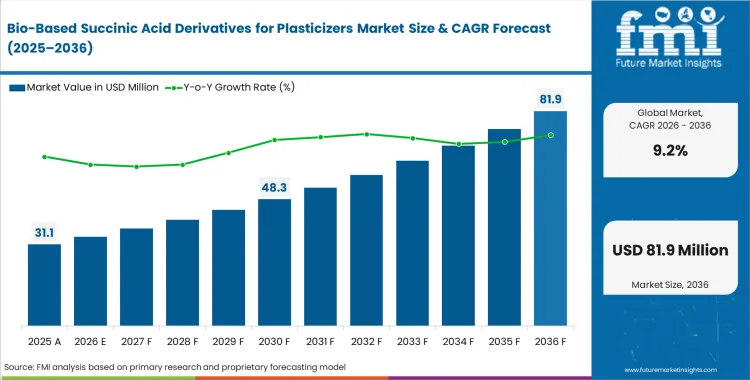
The bio-based succinic acid derivatives for plasticizers market stood at USD 28.5 million in 2025. Industry revenue is expected to surpass USD 31.1 million in 2026 at a CAGR of 9.2% during the forecast period. Steady incline of market profits propels total valuation to USD 75.0 million through 2036 as chemical manufacturers transition away from fossil-derived additives under strict European and North American regulatory mandates, actively seeking reliable non-phthalate succinate plasticizers.
Summary of Bio-based Succinic Acid Derivatives for Plasticizers Marke
- The market is forecast to reach USD 75.0 million by 2036.
- The market is expected to grow at a CAGR of 9.2% through 2036.
- The market was estimated at USD 28.5 million in 2025.
- The forecast period represents an incremental opportunity of USD 43.9 million.
- The market is driven by the shift toward safer, bio-based alternatives to traditional plasticizers amid tightening chemical safety regulations.
- Growth is supported by increasing commercialization of plant-based plasticizers and rising bioplastics production capacity.
- Dialkyl succinates dominate the product segment due to their compatibility as direct replacements for conventional plasticizers.
- Flexible PVC compounds remain the leading application, while packaging is a key growth area driven by food-safe bioplastic demand.
- China, India, and Germany are among the fastest-growing markets, with China leading at a 10.4% CAGR through 2036.
- Sugar starch remains the primary raw material due to established supply chains and scalability.
- Key players in the market include Roquette Frères, AHB Advanced Biotechnology Co., Ltd., Mitsubishi Chemical Group Corporation, DIC Corporation, Teknor Apex Company, and Valtris Specialty Chemicals.
PVC product manufacturers are under growing pressure to replace conventional additives with safer alternatives across everyday contact applications. Regulatory tightening is accelerating this shift, especially in categories where material safety and long-term exposure have become more closely scrutinized. Bio-based alternatives are gaining relevance because they help manufacturers align with compliance requirements without weakening product durability. Preference for these materials is also supported by their ability to remain embedded within the polymer matrix, which improves suitability for applications where permanence and migration resistance matter.
Adoption is likely to widen as bio-based ingredients gain acceptance across higher-specification end uses that require stronger safety validation. Once materials prove suitable for more demanding product environments, usage can extend into adjacent applications with similar performance and compliance needs. Larger-scale production is also expected to improve commercial viability by supporting more competitive pricing across the supply chain. Better cost availability, in turn, can make transition planning more practical for smaller manufacturers updating existing production lines.
China is projected to expand at a CAGR of 10.4% from 2026 to 2036, supported by continued scale-up in fermentation-based chemical capacity and stronger export-oriented supply development. India is likely to register 10.0% over the same period as bio-based manufacturing infrastructure gains wider support. Germany is estimated to grow at a CAGR of 9.8% from 2026 to 2036, reflecting demand for compliant additive substitution under tighter material safety requirements. Japan is projected to record 9.5%, supported by steady demand for permanent plasticizers in performance-sensitive applications such as wire coatings. France is likely to witness 9.3% CAGR through 2036 as packaging material conversion supports broader use of safer additive systems. United States is expected to advance at 8.6% from 2026 to 2036, while Italy is projected to grow at 8.4%. Regional variation is being shaped by a mix of regulation-led substitution in Europe and capacity-led expansion across Asia.
Segmental Analysis
Bio-Based Succinic Acid Derivatives for Plasticizers Market Analysis by Derivative Type
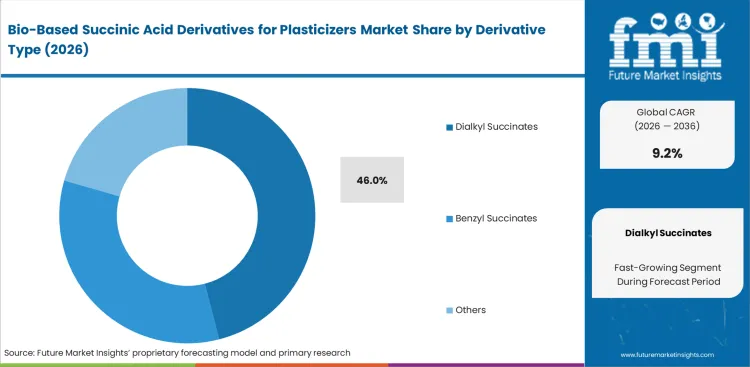
Dialkyl succinates maintain a strong lead because their molecular setup is very similar to old-fashioned phthalates, which lets factories use them without changing their machines. The market is expected to witness dialkyl succinates account for 46.0% share in 2026 as the primary choice for standard plastic production. Choosing these additives helps plant officers avoid the high costs and long delays of resetting their extrusion equipment. While these options are the easiest to start using, they sometimes require more material to reach the same level of flexibility as older chemicals. Failing to account for these higher volumes can lower the profit made on long-term supply deals for items like medical tubes or flexible wraps. Regional producers often look toward Japan bio-plasticizers to help stabilize these material costs while they work on more advanced, leak-resistant options.
- Initial Substitution Ease: Drop-in compatibility allows immediate replacement of toxic phthalates. Plant officers avoid extensive downtime for equipment recalibration.
- Loading Volume Penalty: Formulators must often increase total plasticizer content to match legacy flexibility metrics. Buyers face hidden formulation cost increases.
- Long-Term Contract Risk: Miscalculating required volumes damages profitability on extended supply agreements. Financial controllers must adjust pricing models to reflect actual chemical consumption.
Bio-Based Succinic Acid Derivatives for Plasticizers Market Analysis by Function
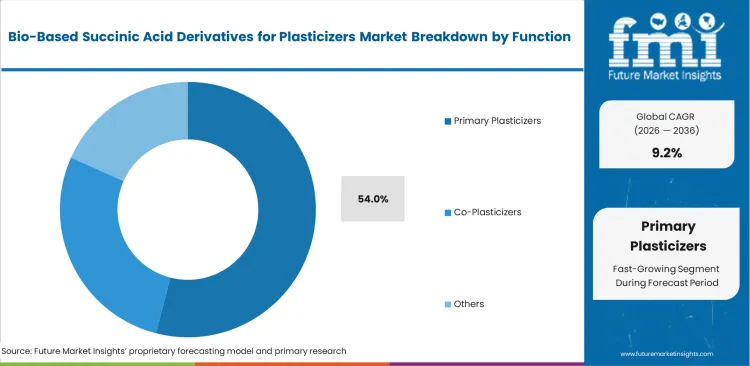
In 2026, primary plasticizers are estimated to account for 54.0% of the market, supported by their core role in most plastic formulations. These materials function as the main flexibility-enabling component and play an important part in shaping softness, durability, and long-term performance in the final product. Formulation stability also depends heavily on primary plasticizer quality, since secondary additives are less effective when polymer compatibility is weak at the base level. Lower-grade inputs can raise the risk of migration or surface exudation over time, which may affect product reliability and increase quality-control concerns. Demand is therefore expected to remain concentrated around high-quality bio-plasticizers that offer stronger permanence within the polymer matrix.
- Baseline Flexibility Establishment: Primary agents set the fundamental mechanical limits of the polymer. Chief chemists rely on consistent performance for baseline formulation.
- Compatibility Dependence: The chemical must perfectly match the host polymer's polarity. R&D heads reject agents that show early signs of phase separation.
- Exudation Failure Penalty: Poor quality primary plasticizers migrate to the surface over time. Quality assurance leads face massive liability when flexible medical or packaging products fail.
Bio-Based Succinic Acid Derivatives for Plasticizers Market Analysis by Application
Standard PVC compounds are the biggest area for growth because new safety laws are banning the old, toxic chemicals used in everyday items. Most factory owners prefer to fix their current PVC production lines with better additives rather than spending millions on entirely new machines. Some operators even find that these bio-based options melt and mix a bit faster, which can actually speed up the whole production process. Companies that wait too long to make the switch risk being legally blocked from selling their goods in major stores. Using poly butylene succinate and related additives provides a fast way to meet safety standards while keeping the factory running smoothly. Bio-based succinate esters for flexible PVC are set to capture a 44.0% market share in 2026 as manufacturers rush to update their recipes.
- Equipment Preservation Necessity: Upgrading additives saves existing manufacturing infrastructure. Extrusion factories avoid massive capital expenditures on entirely new processing lines.
- Processing Speed Advantage: Bio-based variants can reduce melt viscosity during compounding. Operators gain unexpected throughput increases on legacy PVC equipment.
- Distribution Lockout Risk: Failure to meet new toxicity standards stops product shipments instantly. Compliance officers face total loss of access to major international retail channels.
Bio-Based Succinic Acid Derivatives for Plasticizers Market Analysis by End Use
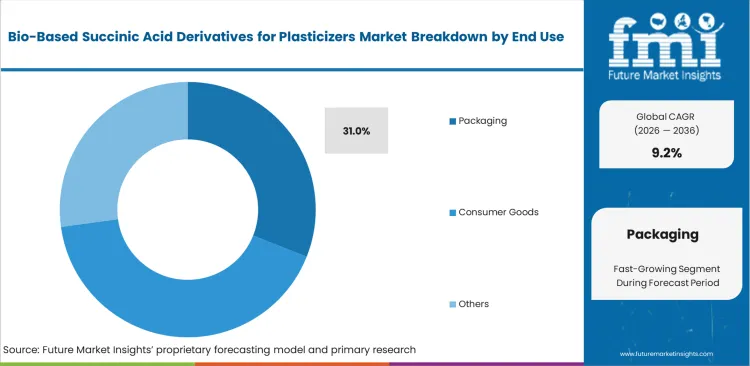
Packaging manufacturers are under growing pressure to adopt safer additive systems because food-contact applications require tighter control over migration, odor, and taste performance. Each additive used in this segment must support product safety while preserving packaging integrity under demanding end-use conditions. Packaging is estimated to account for 31.0% of market share in 2026, supported by continued movement away from conventional plastic wrap structures. Processing performance remains a key consideration, as newer materials can respond differently during high-speed heat-sealing operations. Seal quality may weaken when line settings are not aligned with material behavior, which can affect pack integrity during storage and transport. PBS film adoption, therefore, depends not only on material selection but also on careful process adjustment across production lines.
- Food Safety Validation: Strict migration limits govern all chemical additives in this sector. Packaging engineers must secure comprehensive toxicity clearances before commercialization.
- Heat-Seal Parameter Shift: Bio-plasticizers alter the thermal properties of flexible films. Line supervisors must recalibrate high-speed sealing jaws to prevent packaging failures.
- Transport Integrity Loss: Rushed implementations lead to weak seals and compromised barriers. Packaging heads face total product loss if films fail during logistics and distribution.
Bio-Based Succinic Acid Derivatives for Plasticizers Market Analysis by Feedstock
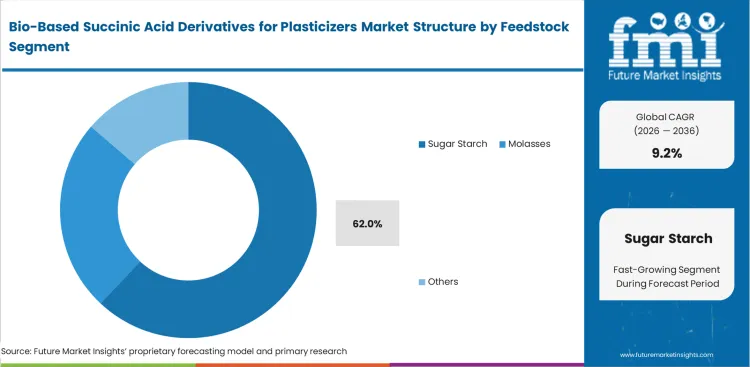
Sugar starch is estimated to account for 62.0% of market share in 2026, supported by its cost stability and established processing base. Its position remains strong because large-scale agricultural availability supports more predictable feedstock output and improves supply consistency for plasticizer production. A steady crop base also helps reduce short-term pricing volatility in the final material. Reliance on food-linked feedstocks, at the same time, can introduce cost pressure when harvest quality weakens or food demand rises. For this reason, producers are increasingly assessing alternatives such as corn stover and woody biomass to improve raw material flexibility. Broader feedstock diversification is likely to support production continuity when one input source becomes less economical or harder to secure.
- Yield Predictability Advantage: Established fermentation processes guarantee consistent chemical output. Supply chain officers secure stable long-term pricing based on known conversion metrics.
- Agricultural Tension Point: Raw material sourcing competes directly with food production. Purchasers must navigate complex agricultural commodity pricing fluctuations.
- Single-Source Vulnerability: Relying exclusively on one crop exposes production to weather and harvest risks. Strategic sourcing heads must validate alternative feedstock pathways to ensure continuity.
Bio-Based Succinic Acid Derivatives for Plasticizers Market Drivers, Restraints, and Opportunities
Stricter chemical safety requirements across Europe and North America are accelerating the shift away from conventional phthalate additives in polymer manufacturing. Compliance pressure is increasing the need for substitute materials that can support product safety without disrupting formulation performance. Bio-based succinate plasticizers are gaining attention because they offer a more compliant route while preserving flexibility in the final plastic. Demand is therefore being shaped by the need to maintain supply continuity, protect product acceptability, and keep production lines aligned with changing material standards.
Commercial rollout remains measured because qualification cycles for new plasticizer systems are still time-intensive. Manufacturers typically require stability, migration, and aging validation before a reformulated compound is approved for broader production use. Comparative assessment of succinate plasticizers and citrate-based alternatives also takes time, since a change in the primary flexibility agent can influence durability, stress response, and long-term material behavior. Adoption is moving more gradually where formulators lack advanced testing capacity or need longer evaluation windows to confirm performance consistency. Limited availability of application-ready formulation guidance can add to this delay, which keeps some demand in the validation stage rather than immediate scale-up.
- Medical Tubing Applications: Developing extremely pure medical polymer plasticizers from succinic acid solves strict healthcare safety challenges. Creating materials that refuse to leak into intravenous fluids allows formulators to secure high-value contracts with hospitals.
- Electrical Wiring Jackets: Formulating fire-resistant bioplastic for interior and electrical insulation gives chemical producers a new revenue stream. Offering non-toxic cable coatings helps secure large infrastructure projects where safety standards reject traditional fossil-based plastics.
- Permanent Binding Solutions: Building specialized esters that attach directly to the core structure of the plastic eliminates chemical leakage entirely. Solving this long-term stability issue guarantees strong demand from durable goods manufacturers needing materials that last for decades.
Regional Analysis
Global phase-outs of fossil-derived chemical additives unfold at different speeds across various geographies. Examining local regulatory bans and regional fermentation capabilities reveals distinct timelines for adoption and raw material scaling.
.webp "Top Country Growth Comparison Bio Based Succinic Acid Derivatives For Plasticizers Market Cagr (2026 2036)")
| Country | CAGR (2026 to 2036) |
|---|---|
| China | 10.4% |
| India | 10.0% |
| Germany | 9.8% |
| Japan | 9.5% |
| France | 9.3% |
| United States | 8.6% |
| Italy | 8.4% |
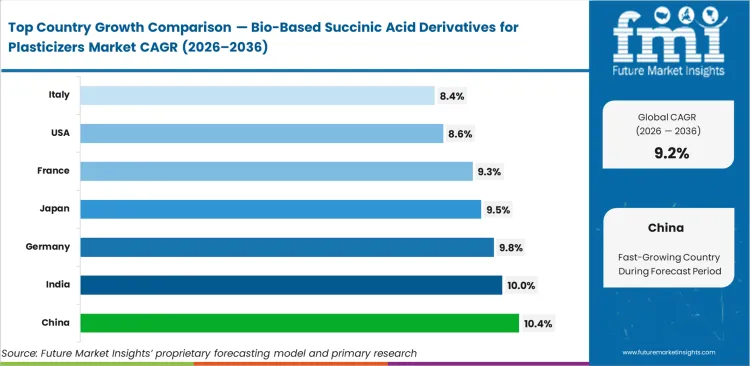
Source: Future Market Insights (FMI) analysis, based on proprietary forecasting model and primary research
Asia-Pacific Bio-Based Succinic Acid Derivatives for Plasticizers Market Analysis
Massive fermentation capacity investments transform this region into the primary global supply engine for bio-based chemical intermediates. Production facilities focus on scaling yields to drive down per-unit costs below western competitors.
- China: Export-focused chemical giants aggressively expand domestic starch fermentation infrastructure. Securing dominant supply positions allows these producers to dictate global pricing floors for primary bio-plasticizers. This rapid capacity expansion supports demand across China, which is anticipated to rise at a CAGR of 10.4% through 2036, overwhelming international competitor pricing models.
- Japan: Electronics manufacturers require zero-migration oligomeric esters for premium consumer wiring applications. This strict technical requirement pushes the Japan succinate ester plasticizers sector to expand at a CAGR of 9.5% through 2036, establishing local chemical suppliers at the absolute premium end of the formulation ecosystem. Securing these high-performance materials guarantees long-term reliability for advanced electronics.
- India: India is projected to expand at a CAGR of 10.0% from 2026 to 2036, supported by continued development of domestic biomanufacturing capacity. Strong biomass availability is likely to improve feedstock access for local producers and support more competitive raw material economics. Market growth is also expected to reflect rising interest in export-oriented production supported by broader availability of bio-based inputs.
FMI analyses, utilizing agricultural waste rather than competing for global starch supplies insulates regional manufacturers from international commodity shocks. Such localized feedstock strategy creates a highly resilient and competitive export dynamic.
Western Europe Bio-Based Succinic Acid Derivatives for Plasticizers Market Analysis
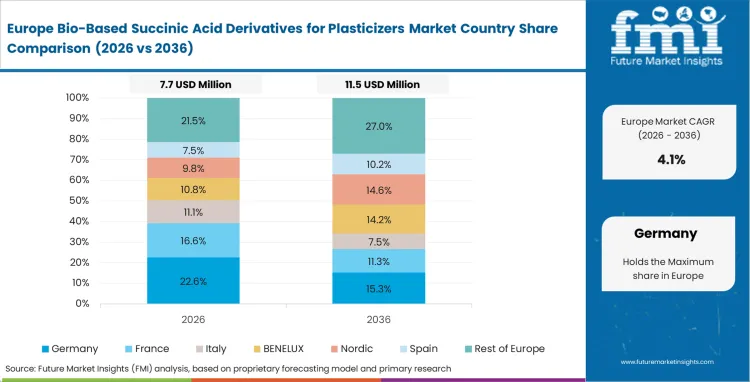
Stringent REACH enforcement physically removes toxic phthalates from the regional supply chain, forcing mandatory substitution across all polymer processing facilities. Such uncompromising regulatory environment drastically accelerates qualification cycles compared to less regulated geographies.
- Germany: Strict chemical safety audits force automotive and industrial compounders to integrate renewable alternatives immediately. Demand for Germany bio-based succinic acid derivatives is set to record a CAGR of 9.8% during the assessment period, pushing plant operators to completely overhaul their extrusion parameters. Resolving these processing challenges creates a practical blueprint for industrial adaptation.
- France: Aggressive packaging waste legislation pushes converters away from legacy plastics entirely. Engineers scramble to validate non-toxic films for immediate commercial rollout. Securing compliant film structures for major retail networks ensures France is likely to post a CAGR of 9.3% by 2036, safeguarding access to strict European distribution channels.
- Italy: Expected to register a CAGR of 8.4% from 2026 to 2036, the country experiences strong demand from premium consumer goods brands updating their synthetic leather specifications. Product designers mandate bio-based plasticizers in all new elastomer applications to protect brand equity against emerging toxicity claims.
FMI reports, compliance leaders face zero flexibility regarding phase-out timelines across these highly regulated nations. Adapting formulations using Germany bio-plasticizers and similar regional supply chains becomes the only viable path to maintaining factory operations.
North America Bio-Based Succinic Acid Derivatives for Plasticizers Market Analysis
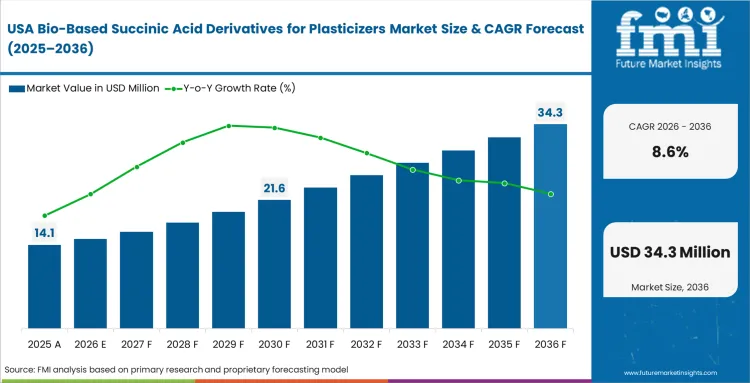
Fragmented state-level chemical restrictions create a chaotic compliance landscape for national polymer manufacturers. Adopting bio-based succinates provides a universal compliance solution, allowing companies to standardize their product lines rather than managing dozens of regional variants.
- United States: Increasing consumer litigation regarding chemical exposure forces major retail chains to ban specific legacy plasticizers. Sales of USA bio-plasticizers are expected to increase at a CAGR of 8.6% during the forecast period as supply chain heads proactively switch to bio-based alternatives. This proactive substitution serves as a critical defensive strategy to avoid massive retail de-listings.
FMI assesses, navigating this fractured regulatory environment forces domestic compounders to prioritize universally safe additives. Standardizing on non-toxic esters simplifies national distribution logistics and shields brands from sudden shifts in local consumer safety laws.
Competitive Aligners for Market Players
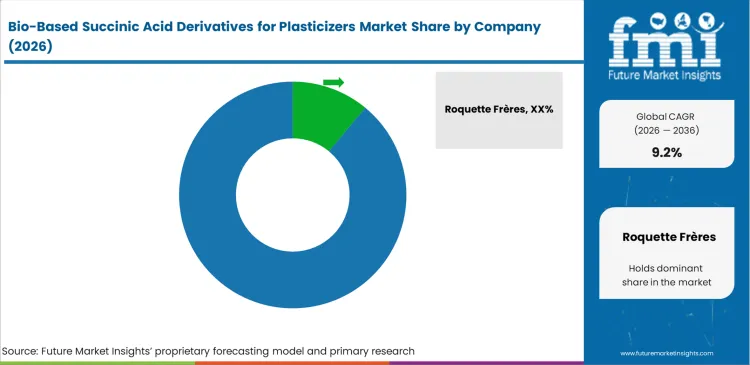
Established chemical producers are managing the shift to renewable materials with some caution. Expansion in fermentation-based capacity is happening alongside existing fossil-based product lines, so the transition is not entirely straightforward. Bio-based succinic acid plasticizers are more often being positioned in higher-value, tightly regulated uses such as medical tubing and food-contact biodegradable packaging. This helps suppliers build traction in renewable inputs where compliance needs are stronger and pricing is usually more supportive. Growth in this space, for that reason, is looking more like a phased portfolio adjustment than a rapid substitution cycle.
Smaller biotechnology firms are more exposed to feedstock fluctuations, which makes raw material planning especially important for them. Long-term sourcing arrangements can improve visibility on biomass availability and help keep production schedules more stable. Flexibility in processing is becoming valuable as well, particularly for producers working with inputs such as molasses or agricultural waste. Their ability to compete often depends on maintaining dependable input economics in a market where larger suppliers still hold scale advantages.
Polymer compounders are also giving more importance to multi-source qualification, so they are not overly dependent on one producer. Formulations backed by more than one chemical manufacturer are generally more attractive where they supply continuity matters for PVC compounds and other volume applications. This is encouraging wider use of licensing, shared production models, and geographically spread supply arrangements. Over time, such a structure can improve supply resilience and support more stable material availability.
Key Players in Bio-Based Succinic Acid Derivatives for Plasticizers Market
- Roquette Frères
- AHB Advanced Biotechnology Co., Ltd.
- Mitsubishi Chemical Group Corporation
- DIC Corporation
- Teknor Apex Company
- Valtris Specialty Chemicals
Scope of the Report
| Metric | Value |
|---|---|
| Quantitative Units | USD 31.1 million to USD 75.0 million, at a CAGR of 9.2% |
| Market Definition | Bio-Based Succinic Acid Derivatives for Plasticizers function as renewable chemical additives that impart flexibility to rigid polymers, replacing toxic fossil-based phthalates across sensitive applications. |
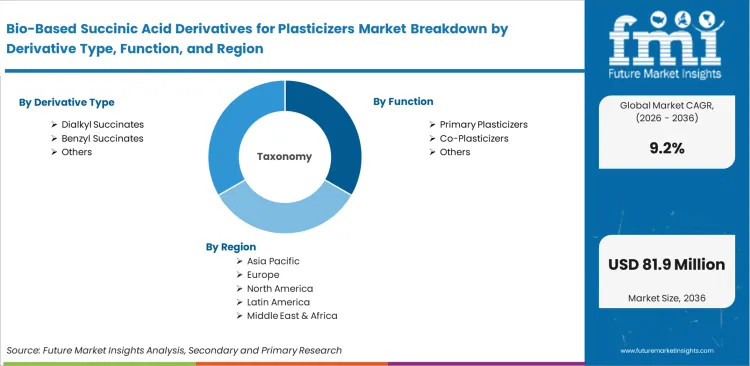
| Segmentation | Derivative Type, Function, Application, End Use, Feedstock, and Region |
| Regions Covered | North America, Latin America, Western Europe, Eastern Europe, East Asia, South Asia & Pacific, Middle East & Africa |
| Countries Covered | China, India, Germany, Japan, France, United States, Italy |
| Key Companies Profiled | Roquette Frères, AHB Advanced Biotechnology Co., Ltd., Mitsubishi Chemical Group Corporation, DIC Corporation, Teknor Apex Company, Valtris Specialty Chemicals |
| Forecast Period | 2026 to 2036 |
| Approach | Production volume assessments from leading succinic acid fermentation plants combined with global toxicity regulation tracking. |
Source: Future Market Insights (FMI) analysis, based on proprietary forecasting model and primary research
Segments
Derivative Type
- Dialkyl succinates
- Benzyl succinates
- Polymeric succinates
- Oligomeric esters
Function
- Primary plasticizers
- Co-plasticizers
- Permanent plasticizers
- Reactive plasticizers
Application
- PVC compounds
- Bioplastics
- Elastomers
- Coatings
End Use
- Packaging
- Consumer goods
- Medical devices
- Wire cable
- Flooring
Feedstock
- Sugar starch
- Molasses
- Lignocellulose
- Glycerol
Regions:
- Asia Pacific
- India
- China
- Japan
- South Korea
- Indonesia
- Australia & New Zealand
- ASEAN
- Rest of Asia Pacific
- Europe
- Germany
- Italy
- France
- United Kingdom
- Spain
- Benelux
- Nordics
- Central & Eastern Europe
- Rest of Europe
- North America
- United States
- Canada
- Mexico
- Latin America
- Brazil
- Argentina
- Chile
- Rest of Latin America
- Middle East & Africa
- Kingdom of Saudi Arabia
- United Arab Emirates
- South Africa
- Turkey
- Rest of Middle East & Africa
Bibliography
- Mitrea, L., Teleky, B.-E., Nemes, S.-A., Plamada, D., Varvara, R.-A., Pascuta, M.-S., Ciont, C., Cocean, A.-M., Medeleanu, M., Nistor, A., Rotar, A.-M., & Vodnar, D.-C. (2024). Succinic acid - A run-through of the latest perspectives of production from renewable biomass. Heliyon, 10(3), e25551.
- Sun, S., Weng, Y.-X., & Zhang, C. (2024). Recent advancements in bio-based plasticizers for polylactic acid (PLA): A review. Polymer Testing, 140, 108603.
- Silva, D. A. S., Luque, R., Delgado-Arcaño, Y., Perpetuo, E. A., Ruy, A. D. da S., Souza, A. L. B. de, & Pontes, L. A. M. (2025). Prospecting technology and economic potential to produce bio-succinic acid: A review. Biotechnology Reports, 48, e00920.
- Zhang, Q., Sun, J., Yao, Z., Ding, X., Wang, Z., & Zhang, L. (2024). Synthesis and performance evaluation of low-molecular-weight biobased polyester rubber as a novel eco-friendly polymeric plasticizer for polyvinyl chloride. Frontiers in Materials, 11, 1406469.
- Ledniowska, K., Janik, W., Nosal-Kovalenko, H., Sabura, E., Basiak, E., Jaszkiewicz, A., & Rybak, A. (2024). Epoxidized esters of succinic acid, oleic acid and propylene glycol as an effective bioplasticizer for PVC: A study of processing conditions on the physico-chemical properties. Journal of Applied Polymer Science, 141(15), e55218.
- Howell, B. A. (2024). The Future of Plasticizers: Biobased and Oligomeric. Journal of Renewable Materials, 12(11), 1857–1861.
This bibliography is provided for reader reference. The full FMI report contains the complete reference list with primary source documentation.
This Report Addresses
- Exactly how regional REACH enforcement accelerates dialkyl succinate qualification timelines.
- Which specific agricultural feedstocks offer the highest yield predictability for fermentation.
- Why packaging converters face unique heat-sealing challenges during chemical substitution.
- What structural constraints limit the rapid commercialization of oligomeric esters.
- How primary plasticizers influence the glass transition temperature of PVC compounds.
- Which Japanese electronics manufacturers drive demand for permanent non-migrating additives.
- How dual-sourcing strategies protect polymer compounders against incumbent pricing power.
- Where immediate capital expenditure is required to upgrade factory floor mixing equipment.
Frequently Asked Questions
What are bio-based succinic acid derivatives used for in plasticizers?
These renewable chemical additives are incorporated into rigid polymers like PVC to impart essential flexibility, durability, and workability without introducing toxic elements.
How big is the bio-based succinic acid derivatives for plasticizers market?
The sector was valued at USD 28.5 million in 2025 and is poised to reach USD 75.0 million by 2036.
What is driving demand for succinate plasticizers?
Strict international regulations phasing out fossil-derived phthalates force chemical formulators to transition immediately to safe, renewable alternatives to maintain retail distribution access.
Why are succinate plasticizers replacing phthalates?
They offer comparable or superior mechanical flexibility while completely eliminating the severe human toxicity and environmental persistence risks associated with legacy phthalate chemicals.
Which end uses account for the largest demand?
Packaging applications lead the transition, driven heavily by stringent global food-contact safety regulations that mandate immediate removal of migratory toxins from consumer films.
Which countries are growing fastest in succinate plasticizers?
China leads global expansion with a 10.4% CAGR by rapidly building domestic fermentation capacity, closely followed by India at 10.0%.
Who are the key companies in bio-based succinic acid plasticizers?
Major participants in this chemical value chain include Roquette Frères, Mitsubishi Chemical Group Corporation, DIC Corporation, and Teknor Apex Company.
How do succinate plasticizers compare with citrate and epoxidized oil plasticizers?
Succinate variants often provide superior long-term migration resistance and thermal stability compared to citrates or epoxidized oils, making them highly valuable for durable goods.
Are bio-based succinic acid plasticizers used in PVC?
They are heavily integrated into flexible PVC compounds because their molecular structure allows them to easily replace legacy phthalates using existing extrusion equipment.
What feedstocks are used to make bio-based succinic acid derivatives?
Chemical producers rely primarily on sugar starch for its high extraction yield, alongside molasses, lignocellulose, and glycerol to insulate supply chains against agricultural price volatility.
What is the CAGR of the succinate plasticizers market?
Demand across this specialized chemical segment is projected to grow at a CAGR of 9.2% between 2026 and 2036.
Give me the market size and forecast for bio-based succinic acid derivatives used as plasticizers?
Sales are expected to expand from USD 31.1 million in 2026 up to USD 75.0 million by the end of the forecast period.
What operational challenge do packaging converters face with these new materials?
Bio-plasticizers subtly alter the thermal properties of flexible films, requiring supervisors to recalibrate high-speed heat-sealing jaws to prevent barrier failure.
What technical risk occurs if formulators use substandard primary plasticizers?
Poorly matched chemicals suffer phase separation and migrate to the polymer surface, causing severe exudation and catastrophic product failure.
Why do Japanese electronics firms demand specialized oligomeric esters?
Premium wiring applications require permanent plasticizers that completely resist migration even under extreme thermal and environmental stress over decades.
How does the United States regulatory environment influence chemical substitution?
Fragmented state-level restrictions and rising consumer litigation push national supply chain heads to adopt universal bio-based compliance solutions proactively.
What prevents smaller compounders from adopting these alternatives faster?
Extensive stability and aging qualification cycles require dedicated testing infrastructure that mid-sized facilities simply cannot finance or execute quickly.
Why must purchasers calculate total formulation cost rather than per-kilo price?
Some bio-based variants require significantly higher loading volumes to achieve identical flexibility metrics, completely altering the compound's final economic profile.
How do government incentives reshape the Indian biomanufacturing sector?
State subsidies for agricultural waste valorization allow local producers to exploit cheap molasses, insulating them from volatile global starch pricing.
How do incumbent chemical giants protect their profitability during this transition?
Top-tier producers specifically target high-margin, heavily regulated sectors like medical devices before shifting bulk commodity lines to renewable feedstocks.
Why do compounders insist on dual-sourcing strategies for new bio-plasticizers?
Distributing production contracts across multiple suppliers prevents incumbent chemical firms from exploiting temporary regional supply shortages to raise prices.
What happens if a medical device manufacturer delays the transition away from phthalates?
Failure to secure non-toxic alternatives immediately risks total exclusion from lucrative European healthcare contracts enforcing strict new migration limits.
Preview the report firsthand - request a free sample
Get SampleGet the brochure for pricing and purchase details.
Get PDFTable of Content
- Executive Summary
- Global Market Outlook
- Demand-side Trends
- Supply-side Trends
- Technology Roadmap Analysis
- Analysis and Recommendations
- Market Overview
- Market Coverage / Taxonomy
- Market Definition / Scope / Limitations
- Research Methodology
- Chapter Orientation
- Analytical Lens and Working Hypotheses
- Market Structure, Signals, and Trend Drivers
- Benchmarking and Cross-market Comparability
- Market Sizing, Forecasting, and Opportunity Mapping
- Research Design and Evidence Framework
- Desk Research Programme (Secondary Evidence)
- Company Annual and Sustainability Reports
- Peer-reviewed Journals and Academic Literature
- Corporate Websites, Product Literature, and Technical Notes
- Earnings Decks and Investor Briefings
- Statutory Filings and Regulatory Disclosures
- Technical White Papers and Standards Notes
- Trade Journals, Industry Magazines, and Analyst Briefs
- Conference Proceedings, Webinars, and Seminar Materials
- Government Statistics Portals and Public Data Releases
- Press Releases and Reputable Media Coverage
- Specialist Newsletters and Curated Briefings
- Sector Databases and Reference Repositories
- FMI Internal Proprietary Databases and Historical Market Datasets
- Subscription Datasets and Paid Sources
- Social Channels, Communities, and Digital Listening Inputs
- Additional Desk Sources
- Expert Input and Fieldwork (Primary Evidence)
- Primary Modes
- Qualitative Interviews and Expert Elicitation
- Quantitative Surveys and Structured Data Capture
- Blended Approach
- Why Primary Evidence is Used
- Field Techniques
- Interviews
- Surveys
- Focus Groups
- Observational and In-context Research
- Social and Community Interactions
- Stakeholder Universe Engaged
- C-suite Leaders
- Board Members
- Presidents and Vice Presidents
- R&D and Innovation Heads
- Technical Specialists
- Domain Subject-matter Experts
- Scientists
- Physicians and Other Healthcare Professionals
- Governance, Ethics, and Data Stewardship
- Research Ethics
- Data Integrity and Handling
- Primary Modes
- Tooling, Models, and Reference Databases
- Desk Research Programme (Secondary Evidence)
- Data Engineering and Model Build
- Data Acquisition and Ingestion
- Cleaning, Normalisation, and Verification
- Synthesis, Triangulation, and Analysis
- Quality Assurance and Audit Trail
- Market Background
- Market Dynamics
- Drivers
- Restraints
- Opportunity
- Trends
- Scenario Forecast
- Demand in Optimistic Scenario
- Demand in Likely Scenario
- Demand in Conservative Scenario
- Opportunity Map Analysis
- Product Life Cycle Analysis
- Supply Chain Analysis
- Investment Feasibility Matrix
- Value Chain Analysis
- PESTLE and Porter’s Analysis
- Regulatory Landscape
- Regional Parent Market Outlook
- Production and Consumption Statistics
- Import and Export Statistics
- Market Dynamics
- Global Market Analysis 2021 to 2025 and Forecast, 2026 to 2036
- Historical Market Size Value (USD Million) Analysis, 2021 to 2025
- Current and Future Market Size Value (USD Million) Projections, 2026 to 2036
- Y-o-Y Growth Trend Analysis
- Absolute $ Opportunity Analysis
- Global Market Pricing Analysis 2021 to 2025 and Forecast 2026 to 2036
- Global Market Analysis 2021 to 2025 and Forecast 2026 to 2036, By Derivative Type
- Introduction / Key Findings
- Historical Market Size Value (USD Million) Analysis By Derivative Type , 2021 to 2025
- Current and Future Market Size Value (USD Million) Analysis and Forecast By Derivative Type , 2026 to 2036
- Dialkyl Succinates
- Benzyl Succinates
- Others
- Dialkyl Succinates
- Y-o-Y Growth Trend Analysis By Derivative Type , 2021 to 2025
- Absolute $ Opportunity Analysis By Derivative Type , 2026 to 2036
- Global Market Analysis 2021 to 2025 and Forecast 2026 to 2036, By Function
- Introduction / Key Findings
- Historical Market Size Value (USD Million) Analysis By Function, 2021 to 2025
- Current and Future Market Size Value (USD Million) Analysis and Forecast By Function, 2026 to 2036
- Primary Plasticizers
- Co-Plasticizers
- Others
- Primary Plasticizers
- Y-o-Y Growth Trend Analysis By Function, 2021 to 2025
- Absolute $ Opportunity Analysis By Function, 2026 to 2036
- Global Market Analysis 2021 to 2025 and Forecast 2026 to 2036, By Application
- Introduction / Key Findings
- Historical Market Size Value (USD Million) Analysis By Application, 2021 to 2025
- Current and Future Market Size Value (USD Million) Analysis and Forecast By Application, 2026 to 2036
- PVC compounds
- Bioplastics
- Others
- PVC compounds
- Y-o-Y Growth Trend Analysis By Application, 2021 to 2025
- Absolute $ Opportunity Analysis By Application, 2026 to 2036
- Global Market Analysis 2021 to 2025 and Forecast 2026 to 2036, By End Use
- Introduction / Key Findings
- Historical Market Size Value (USD Million) Analysis By End Use, 2021 to 2025
- Current and Future Market Size Value (USD Million) Analysis and Forecast By End Use, 2026 to 2036
- Packaging
- Consumer Goods
- Others
- Packaging
- Y-o-Y Growth Trend Analysis By End Use, 2021 to 2025
- Absolute $ Opportunity Analysis By End Use, 2026 to 2036
- Global Market Analysis 2021 to 2025 and Forecast 2026 to 2036, By Feedstock
- Introduction / Key Findings
- Historical Market Size Value (USD Million) Analysis By Feedstock, 2021 to 2025
- Current and Future Market Size Value (USD Million) Analysis and Forecast By Feedstock, 2026 to 2036
- Sugar Starch
- Molasses
- Others
- Sugar Starch
- Y-o-Y Growth Trend Analysis By Feedstock, 2021 to 2025
- Absolute $ Opportunity Analysis By Feedstock, 2026 to 2036
- Global Market Analysis 2021 to 2025 and Forecast 2026 to 2036, By Region
- Introduction
- Historical Market Size Value (USD Million) Analysis By Region, 2021 to 2025
- Current Market Size Value (USD Million) Analysis and Forecast By Region, 2026 to 2036
- North America
- Latin America
- Western Europe
- Eastern Europe
- East Asia
- South Asia and Pacific
- Middle East & Africa
- Market Attractiveness Analysis By Region
- North America Market Analysis 2021 to 2025 and Forecast 2026 to 2036, By Country
- Historical Market Size Value (USD Million) Trend Analysis By Market Taxonomy, 2021 to 2025
- Market Size Value (USD Million) Forecast By Market Taxonomy, 2026 to 2036
- By Country
- USA
- Canada
- Mexico
- By Derivative Type
- By Function
- By Application
- By End Use
- By Feedstock
- By Country
- Market Attractiveness Analysis
- By Country
- By Derivative Type
- By Function
- By Application
- By End Use
- By Feedstock
- Key Takeaways
- Latin America Market Analysis 2021 to 2025 and Forecast 2026 to 2036, By Country
- Historical Market Size Value (USD Million) Trend Analysis By Market Taxonomy, 2021 to 2025
- Market Size Value (USD Million) Forecast By Market Taxonomy, 2026 to 2036
- By Country
- Brazil
- Chile
- Rest of Latin America
- By Derivative Type
- By Function
- By Application
- By End Use
- By Feedstock
- By Country
- Market Attractiveness Analysis
- By Country
- By Derivative Type
- By Function
- By Application
- By End Use
- By Feedstock
- Key Takeaways
- Western Europe Market Analysis 2021 to 2025 and Forecast 2026 to 2036, By Country
- Historical Market Size Value (USD Million) Trend Analysis By Market Taxonomy, 2021 to 2025
- Market Size Value (USD Million) Forecast By Market Taxonomy, 2026 to 2036
- By Country
- Germany
- UK
- Italy
- Spain
- France
- Nordic
- BENELUX
- Rest of Western Europe
- By Derivative Type
- By Function
- By Application
- By End Use
- By Feedstock
- By Country
- Market Attractiveness Analysis
- By Country
- By Derivative Type
- By Function
- By Application
- By End Use
- By Feedstock
- Key Takeaways
- Eastern Europe Market Analysis 2021 to 2025 and Forecast 2026 to 2036, By Country
- Historical Market Size Value (USD Million) Trend Analysis By Market Taxonomy, 2021 to 2025
- Market Size Value (USD Million) Forecast By Market Taxonomy, 2026 to 2036
- By Country
- Russia
- Poland
- Hungary
- Balkan & Baltic
- Rest of Eastern Europe
- By Derivative Type
- By Function
- By Application
- By End Use
- By Feedstock
- By Country
- Market Attractiveness Analysis
- By Country
- By Derivative Type
- By Function
- By Application
- By End Use
- By Feedstock
- Key Takeaways
- East Asia Market Analysis 2021 to 2025 and Forecast 2026 to 2036, By Country
- Historical Market Size Value (USD Million) Trend Analysis By Market Taxonomy, 2021 to 2025
- Market Size Value (USD Million) Forecast By Market Taxonomy, 2026 to 2036
- By Country
- China
- Japan
- South Korea
- By Derivative Type
- By Function
- By Application
- By End Use
- By Feedstock
- By Country
- Market Attractiveness Analysis
- By Country
- By Derivative Type
- By Function
- By Application
- By End Use
- By Feedstock
- Key Takeaways
- South Asia and Pacific Market Analysis 2021 to 2025 and Forecast 2026 to 2036, By Country
- Historical Market Size Value (USD Million) Trend Analysis By Market Taxonomy, 2021 to 2025
- Market Size Value (USD Million) Forecast By Market Taxonomy, 2026 to 2036
- By Country
- India
- ASEAN
- Australia & New Zealand
- Rest of South Asia and Pacific
- By Derivative Type
- By Function
- By Application
- By End Use
- By Feedstock
- By Country
- Market Attractiveness Analysis
- By Country
- By Derivative Type
- By Function
- By Application
- By End Use
- By Feedstock
- Key Takeaways
- Middle East & Africa Market Analysis 2021 to 2025 and Forecast 2026 to 2036, By Country
- Historical Market Size Value (USD Million) Trend Analysis By Market Taxonomy, 2021 to 2025
- Market Size Value (USD Million) Forecast By Market Taxonomy, 2026 to 2036
- By Country
- Kingdom of Saudi Arabia
- Other GCC Countries
- Turkiye
- South Africa
- Other African Union
- Rest of Middle East & Africa
- By Derivative Type
- By Function
- By Application
- By End Use
- By Feedstock
- By Country
- Market Attractiveness Analysis
- By Country
- By Derivative Type
- By Function
- By Application
- By End Use
- By Feedstock
- Key Takeaways
- Key Countries Market Analysis
- USA
- Pricing Analysis
- Market Share Analysis, 2025
- By Derivative Type
- By Function
- By Application
- By End Use
- By Feedstock
- Canada
- Pricing Analysis
- Market Share Analysis, 2025
- By Derivative Type
- By Function
- By Application
- By End Use
- By Feedstock
- Mexico
- Pricing Analysis
- Market Share Analysis, 2025
- By Derivative Type
- By Function
- By Application
- By End Use
- By Feedstock
- Brazil
- Pricing Analysis
- Market Share Analysis, 2025
- By Derivative Type
- By Function
- By Application
- By End Use
- By Feedstock
- Chile
- Pricing Analysis
- Market Share Analysis, 2025
- By Derivative Type
- By Function
- By Application
- By End Use
- By Feedstock
- Germany
- Pricing Analysis
- Market Share Analysis, 2025
- By Derivative Type
- By Function
- By Application
- By End Use
- By Feedstock
- UK
- Pricing Analysis
- Market Share Analysis, 2025
- By Derivative Type
- By Function
- By Application
- By End Use
- By Feedstock
- Italy
- Pricing Analysis
- Market Share Analysis, 2025
- By Derivative Type
- By Function
- By Application
- By End Use
- By Feedstock
- Spain
- Pricing Analysis
- Market Share Analysis, 2025
- By Derivative Type
- By Function
- By Application
- By End Use
- By Feedstock
- France
- Pricing Analysis
- Market Share Analysis, 2025
- By Derivative Type
- By Function
- By Application
- By End Use
- By Feedstock
- India
- Pricing Analysis
- Market Share Analysis, 2025
- By Derivative Type
- By Function
- By Application
- By End Use
- By Feedstock
- ASEAN
- Pricing Analysis
- Market Share Analysis, 2025
- By Derivative Type
- By Function
- By Application
- By End Use
- By Feedstock
- Australia & New Zealand
- Pricing Analysis
- Market Share Analysis, 2025
- By Derivative Type
- By Function
- By Application
- By End Use
- By Feedstock
- China
- Pricing Analysis
- Market Share Analysis, 2025
- By Derivative Type
- By Function
- By Application
- By End Use
- By Feedstock
- Japan
- Pricing Analysis
- Market Share Analysis, 2025
- By Derivative Type
- By Function
- By Application
- By End Use
- By Feedstock
- South Korea
- Pricing Analysis
- Market Share Analysis, 2025
- By Derivative Type
- By Function
- By Application
- By End Use
- By Feedstock
- Russia
- Pricing Analysis
- Market Share Analysis, 2025
- By Derivative Type
- By Function
- By Application
- By End Use
- By Feedstock
- Poland
- Pricing Analysis
- Market Share Analysis, 2025
- By Derivative Type
- By Function
- By Application
- By End Use
- By Feedstock
- Hungary
- Pricing Analysis
- Market Share Analysis, 2025
- By Derivative Type
- By Function
- By Application
- By End Use
- By Feedstock
- Kingdom of Saudi Arabia
- Pricing Analysis
- Market Share Analysis, 2025
- By Derivative Type
- By Function
- By Application
- By End Use
- By Feedstock
- Turkiye
- Pricing Analysis
- Market Share Analysis, 2025
- By Derivative Type
- By Function
- By Application
- By End Use
- By Feedstock
- South Africa
- Pricing Analysis
- Market Share Analysis, 2025
- By Derivative Type
- By Function
- By Application
- By End Use
- By Feedstock
- USA
- Market Structure Analysis
- Competition Dashboard
- Competition Benchmarking
- Market Share Analysis of Top Players
- By Region
- By Derivative Type
- By Function
- By Application
- By End Use
- By Feedstock
- Competition Analysis
- Competition Deep Dive
- Roquette Frères
- Overview
- Product Portfolio
- Profitability by Market Segments (Product/Age /Sales Channel/Region)
- Sales Footprint
- Strategy Overview
- Marketing Strategy
- Product Strategy
- Channel Strategy
- AHB Advanced Biotechnology Co., Ltd.
- Mitsubishi Chemical Group Corporation
- DIC Corporation
- Teknor Apex Company
- Valtris Specialty Chemicals
- Roquette Frères
- Competition Deep Dive
- Assumptions & Acronyms Used


