
- Market Size (2026)
- USD 22.1 Bn
- Forecast (2036)
- USD 36.0 Bn
- CAGR (2026 to 2036)
- 5.0%
How Big Is the Swimwear Market in 2026?
The global swimwear market is valued at USD 22.1 billion in 2026, up from USD 21.1 billion in 2025, and is projected by Future Market Insights (FMI) to reach USD 36.0 billion by 2036, expanding at a 5.0% CAGR from 2026 to 2036 and generating USD 13.9 billion in incremental revenue over the 10-year forecast period.
| Market Metric | Valuation / Share / Forecast Benchmark |
|---|---|
| 2025 Market Size (Historical) | USD 21.1 billion |
| 2026 Market Size (Estimated) | USD 22.1 billion |
| 2036 Market Size (Projected) | USD 36.0 billion |
| Compound Annual Growth Rate (2026 to 2036) | 5.0% CAGR |
| Incremental Dollar Opportunity (2026 to 2036) | USD 13.9 billion |
| Dominant Consumer Group (2026 to 2036 Share) | Women (56.0% in 2026, 57.1% by 2036; fastest at 5.2% CAGR) |
| Leading & Fastest-Growing Product Types | Fashion & Beachwear (58.0% share in 2026; 4.7% CAGR) | Modest & Specialty (fastest, 7.0% CAGR) |
| Leading & Fastest-Growing Sales Channels | Stores (52.0% share in 2026; 3.6% CAGR) | Online (fastest, 7.4% CAGR) |
| Largest Country Markets (2026 Global Share) | United States (28.0%), China (9.0%), Brazil (7.0%) |
| Fastest-Growing Country Markets (2026 to 2036) | China (6.9% CAGR), Brazil (5.4% CAGR), Australia (5.0% CAGR) |
| Leading Tier-1 Companies | Nike, Adidas, Pentland Group (Speedo), Arena, PVH Corp, Victoria's Secret, Calzedonia, Seafolly |
Source: Future Market Insights analysis of the swimwear market, 2026.
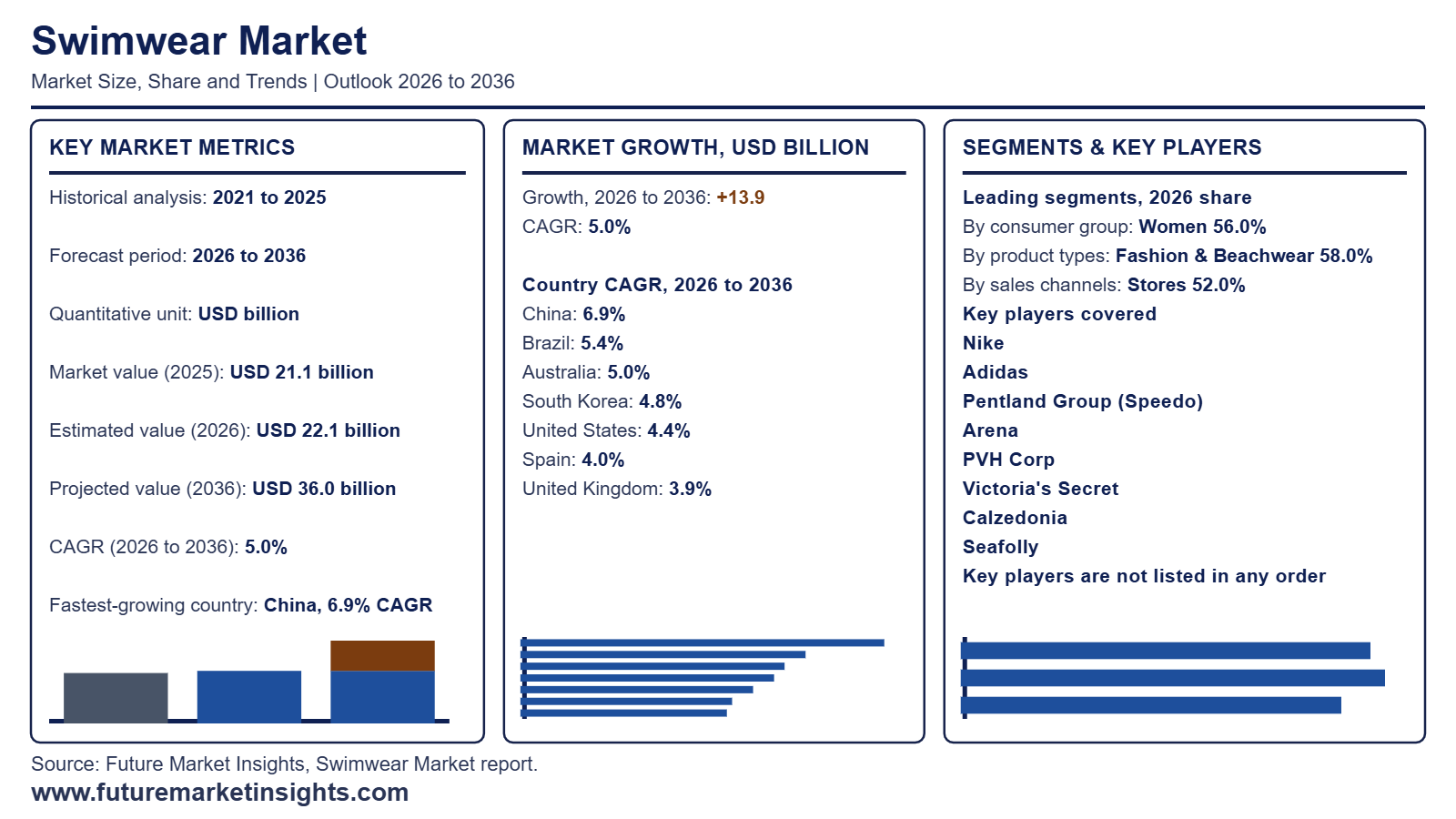
Executive Market Overview
Demand for swimwear is rising with more frequent beach and resort holidays and wider interest in swimming for fitness. Sales, however, rise and fall with travel, weather and the timing of summer collections. Shoppers are also buying earlier for summer trips. For example, Particl data shows sales across 500 leading online brands reached about USD 97 million in April and May 2026. This was up from about USD 75 million a year earlier. Women's swimwear is taking about 56% of revenue in 2026. The market as a whole is growing at about 5.0% a year, a pace expected to hold through 2036.
Sales of swimwear online are growing fastest, as shoppers compare sizes, read fit reviews and return items easily. Online channels are therefore taking about 34% of revenue in 2026 and growing at around 7.4% a year. Modest and specialty designs, meanwhile, are the fastest-growing type at about 7.0% a year. These designs serve plus-size, maternity and adaptive shoppers that older brands overlooked. Performance and training swimwear holds about 20% of revenue. For instance, Arena reported 8% sales growth to EUR 193 million in 2025.
Analyst Perspective
"Swimwear buyers are shopping earlier and online, and wider size and coverage ranges are bringing in new shoppers. Beachwear and matching holiday pieces will keep raising the value of each order. Weather and delivery timing, however, will still cause sharp swings from one season to the next."
- Rahul Pandita, Principal Consultant, Future Market Insights (FMI)
Major Market Trends and Insights
- Shoppers Are Buying Complete Holiday Outfits: Purchases of matching beachwear, cover-ups and accessories are rising alongside swimsuits. Brands are adding sandals, bags and shirts to sell more items in each order. For example, Arena said in 2026 that it plans a stronger push into beachwear. Resort pieces are also bought for city summers and winter sun trips. As a result, the value of each sale is rising and the selling season is getting longer.
- Shoppers Are Ordering Earlier and Online: Online swimwear sales are starting in late winter and spring, well before the main season. Particl data, for instance, shows online swimwear sales in March 2026 were ahead of March 2025. May 2026 was the strongest month in its tracking window. Many shoppers order several sizes and return the ones that do not fit. Brands are therefore investing in fit tools and detailed size guides to cut return costs.
- Brands Are Moving Premium Lines to Recycled Fabrics: Demand for recycled materials is rising as EU textile waste rules tighten and buyers ask about sustainability. Brands are labelling materials more clearly as a result. Recycled fabrics, however, cost more than standard fabrics. Brands therefore use these fabrics first in premium lines before extending use to lower-priced ranges. Italy, a centre for swimwear fabric production, supplies many of these materials.
What Are the Main Drivers, Restraints, and Opportunities?
Demand for swimwear is driven by holiday travel, swimming for fitness and wider size and style ranges. Strong seasonality and high return rates restrain growth, while online sales and modest and inclusive designs offer the largest new revenue.
Driver: Travel, Fitness and More Choice
Sales of swimwear are supported by recovered international travel and more beach and resort holidays. Swimming is also popular for exercise across age groups, which keeps training suit demand steady. Brands, in turn, offer more sizes, cuts and coverage levels. Shoppers who used to struggle to find suitable swimwear are buying more as a result. Women's swimwear is set to add about USD 8.2 billion of revenue by 2036, the largest gain by consumer group.
Restraint: Seasonality, Weather and Returns
Swimwear purchases are concentrated in a few months, so a cold or rainy summer can cut sales sharply. Delivery timing also moves sales between periods. For example, Björn Borg reported that sales of other products, including swimwear, fell 24% in the first half of 2026. Summer deliveries came earlier in the year. Online sales, meanwhile, bring high return rates, which add shipping and handling costs. Low-cost online sellers also put pressure on prices for basic designs.
Opportunity: Online Sales, Modest Designs and New Markets
Online channels offer the largest investment opportunity in the swimwear market, set to add about USD 7.8 billion of revenue by 2036. Modest and specialty swimwear, in turn, is growing at about 7.0% a year. Children's swimwear is growing at around 4.9% a year as more children take swimming lessons. China, at about 6.9% a year, is the fastest-growing profiled country. Beach travel and swimming are both becoming more popular there.
How Is the Swimwear Market Segmented?
The swimwear market is segmented into consumer group, product type, sales channel and region, with values shown in USD billion.
| Segmentation Axis | Sub-Segments Covered | 2026 Leading Segment & Share | Main Growth Benchmark (2026 to 2036) |
|---|---|---|---|
| Consumer Group | Women, Men, Children | Women (56.0% revenue share) | Women (5.2% CAGR) vs. Men (4.6% CAGR) |
| Product Type | Fashion & Beachwear, Performance & Training, Cover-Ups & Accessories, Modest & Specialty | Fashion & Beachwear (58.0% revenue share) | Modest & Specialty (7.0% CAGR) vs. Fashion & Beachwear (4.7% CAGR) |
| Sales Channel | Stores, Online, Others | Stores (52.0% revenue share) | Online leads growth at a 7.4% CAGR vs. Stores at 3.6% |
| Region | North America, Europe, East Asia, Latin America, South Asia & Pacific, Middle East & Africa | North America (32.0% revenue share) | Middle East & Africa leads regional growth at an 8.2% CAGR; China leads national growth at a 6.9% CAGR |
Source: Future Market Insights analysis of the swimwear market, 2026.
Why Does the Women's Segment Lead by Consumer Group?
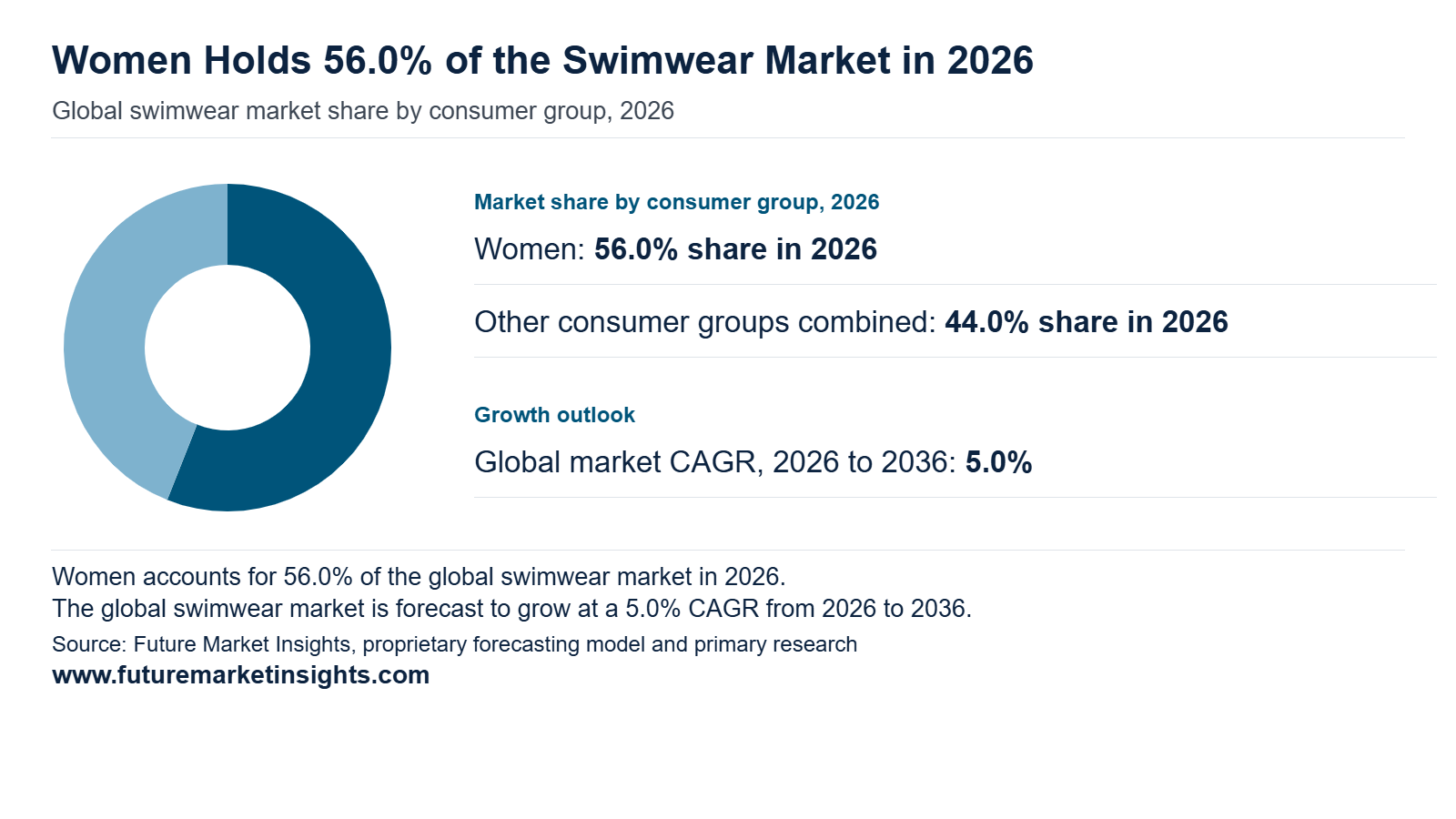
Women's swimwear makes up about 56% of revenue in 2026, worth USD 12.4 billion. Women buy swimwear more often and choose from a wider range of styles. As a result, women's swimwear is also the fastest-growing group at about 5.2% a year. Men's swimwear, at about 26%, is growing at around 4.6%, led by swim shorts and training trunks. Children's swimwear holds about 18% and is growing at close to 4.9% a year. Swimming lessons and family holidays support this group.
Why Does the Fashion and Beachwear Segment Lead by Product Type?
Purchases for holidays, pools and beaches lead by product type, since most swimsuits are not bought for sport. Fashion and beachwear therefore holds about 58% of revenue in 2026, worth USD 12.8 billion. This type is growing at about 4.7% a year. Modest and specialty swimwear, however, is growing fastest at around 7.0%, from about 10% of revenue. Performance and training swimwear (20%) is rising at around 5.0%. Cover-ups and beach accessories hold about 12% and are growing at close to 4.8%.
Why Does the Store Segment Lead by Sales Channel?
Stores account for about 52% of swimwear revenue in 2026, worth USD 11.5 billion. Many shoppers still want to try swimwear on before buying, since fit matters so much. Store sales, however, are growing at only about 3.6% a year. Online channels, at about 34%, are growing fastest at close to 7.4%. Other channels, such as resort shops, sports clubs and pool shops, hold about 14% and are growing at around 3.3% a year.
Swimwear Market by Region and Country (2026 to 2036)
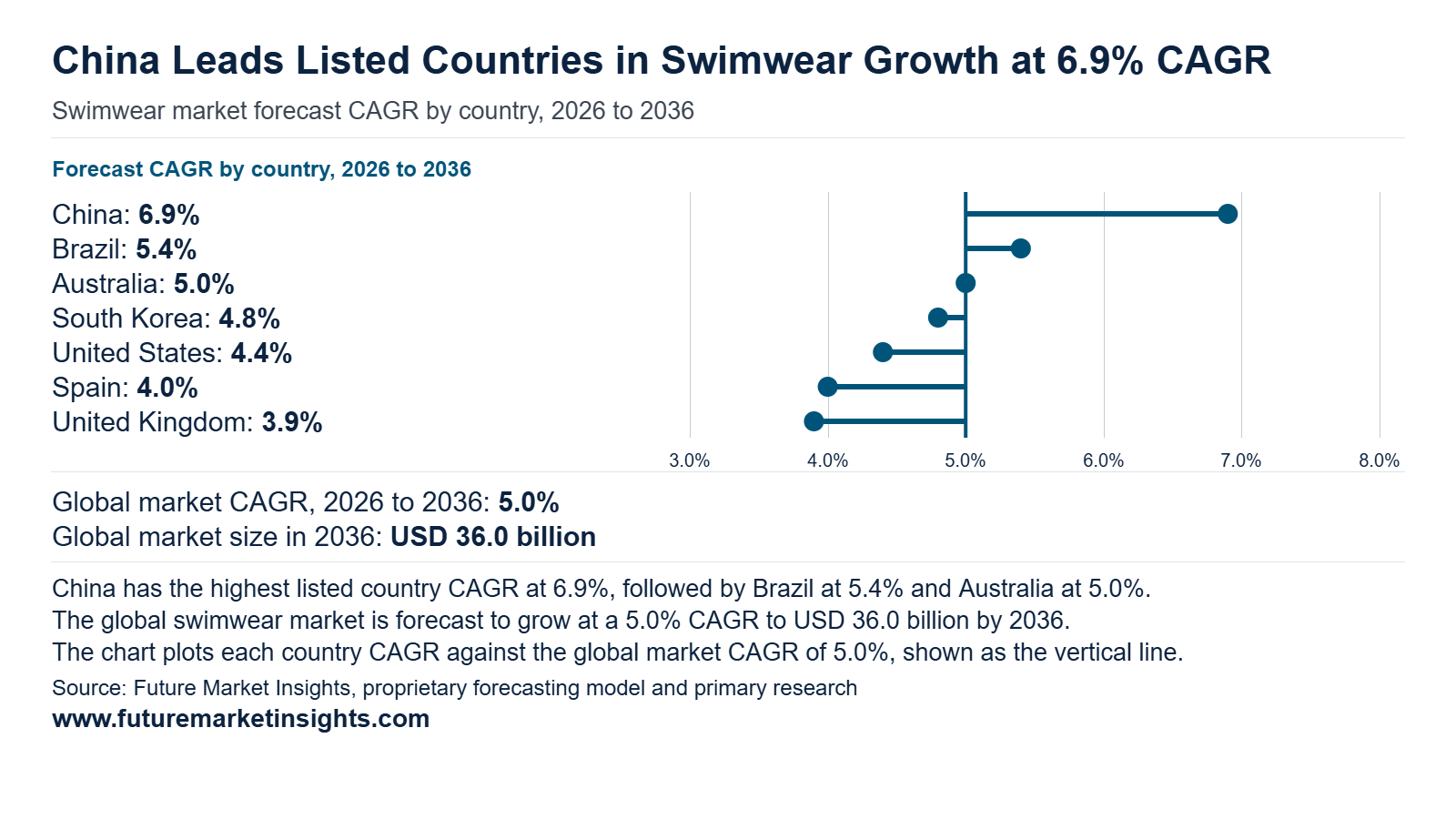
Sales of swimwear are highest in North America, led by the largest single market in the United States. North America is likely to remain the highest market, holding about 32% of global revenue in 2026. Growth there is about 4.4% a year. Europe, at about 30%, is the slowest region at close to 3.8%. East Asia holds roughly 16% and is growing at around 6.2%, led by China. Latin America, with about 10%, is growing at about 5.5%. South Asia and Pacific is growing at around 6.5%. The Middle East and Africa, however, is the fastest-growing region at about 8.2%, from a small base. The ten profiled countries make up around 72% of global revenue.
| Country | 2026 Revenue | 2036 Revenue | 10-Year Addition | 2026 to 2036 CAGR | Global Share (2026 → 2036) |
|---|---|---|---|---|---|
| United States | USD 6.19 billion | USD 9.52 billion | +USD 3.33 billion | 4.4% | 28.0% → 26.4% |
| China | USD 1.99 billion | USD 3.88 billion | +USD 1.89 billion | 6.9% | 9.0% → 10.8% |
| Brazil | USD 1.55 billion | USD 2.62 billion | +USD 1.07 billion | 5.4% | 7.0% → 7.3% |
| United Kingdom | USD 1.11 billion | USD 1.62 billion | +USD 0.52 billion | 3.9% | 5.0% → 4.5% |
| Germany | USD 1.11 billion | USD 1.56 billion | +USD 0.45 billion | 3.5% | 5.0% → 4.3% |
| France | USD 1.00 billion | USD 1.43 billion | +USD 0.44 billion | 3.7% | 4.5% → 4.0% |
| Italy | USD 0.88 billion | USD 1.26 billion | +USD 0.38 billion | 3.6% | 4.0% → 3.5% |
| Spain | USD 0.88 billion | USD 1.31 billion | +USD 0.43 billion | 4.0% | 4.0% → 3.6% |
| Australia | USD 0.77 billion | USD 1.26 billion | +USD 0.49 billion | 5.0% | 3.5% → 3.5% |
| South Korea | USD 0.44 billion | USD 0.71 billion | +USD 0.26 billion | 4.8% | 2.0% → 2.0% |
Source: Future Market Insights analysis of the swimwear market, 2026.
United States
Warm coastal states, many pools and strong holiday travel are projected to keep the US the largest swimwear market. In 2026, the market in the US is valued at USD 6.2 billion. Through 2036, it is likely to grow to USD 9.5 billion at a CAGR of 4.4%. Key trends to look for include earlier online buying. Particl data, for example, shows online swimwear sales rose strongly in spring 2026. Florida, California and Texas account for a large share of sales, since the swim season lasts most of the year. Tariffs on clothing imports from Asia, however, have raised costs. Some brands have moved production to Latin America to keep prices stable. Fit-focused online brands are growing through social media advertising.
China
Rising interest in beach holidays and swimming for fitness is making China the fastest-growing swimwear market among the profiled countries. Domestic tourism to Hainan, Xiamen and Qingdao has grown strongly, and many hotels and water parks have opened. Local brands such as Yingfa compete with Speedo and Arena in performance swimwear. Modest designs with longer sleeves and sun protection are popular. China is also the largest producer of swimwear for global brands, with many factories in Xingcheng. As a result, local brands launch new designs quickly and at low cost. Online platforms, meanwhile, sell most swimwear to younger shoppers in large cities. Valued at USD 2.0 billion in 2026, the market in China is set to reach USD 3.9 billion by 2036. Growth is at a CAGR of 6.9%.
Brazil
Year-round beach use in many parts of Brazil reduces the seasonality seen in other markets. A long coastline and strong beach culture support this demand. Brazilian brands such as Água de Coco and Lenny Niemeyer are known internationally for bold beachwear designs. Local production keeps prices competitive, and many small brands sell through social media. Carnival and summer holidays from December to March create the main sales peak. Payment in instalments, in turn, helps shoppers buy premium pieces. Brazil also exports swimwear to the United States and Europe, which supports local factories outside the main season. In 2026, the market in Brazil is worth USD 1.5 billion. By 2036, it is projected to reach USD 2.6 billion, growing at a CAGR of 5.4%.
United Kingdom
Demand for summer holidays abroad drives swimwear purchases in the United Kingdom. Most swimwear is bought for trips to Spain, Greece and other warm destinations, so sales peak before the summer holidays. Retailers such as Marks & Spencer and Next, meanwhile, sell a wide range of sizes. Supermarket clothing ranges such as George at Asda and Tu at Sainsbury's sell low-priced swimwear in large volumes. Wet summers at home limit local beach use. Indoor swimming for fitness, however, supports year-round sales of training suits. Online brands such as ASOS, in turn, offer wide size ranges for younger shoppers. The market in the UK stands at USD 1.1 billion in 2026 and is set to reach USD 1.6 billion by 2036. This represents a CAGR of 3.9%.
Germany
Purchases of training suits for pool swimming add steady demand in Germany, alongside fashion swimwear for holidays. A large network of public pools supports this pattern. Sports retailers and online sellers such as Zalando are major channels. Discount chains such as Lidl and Aldi, in turn, sell low-cost swimwear before the summer holidays. Price sensitivity, however, limits growth in premium lines. Lake swimming in summer adds local demand, especially in Bavaria and the north. For example, Björn Borg reported strong growth in Germany as a strategic market in 2026. In 2026, the market in Germany is valued at USD 1.1 billion. Through 2036, it is likely to grow to USD 1.6 billion at a CAGR of 3.5%, the slowest among the profiled countries.
France
Sales of premium swimwear are strong in France, supported by Mediterranean and Atlantic coasts and a strong fashion industry. French brands such as Eres, Vilebrequin and Banana Moon sell premium swimwear at home and abroad. Arena, founded in Alsace in 1973, supplies many swimming clubs. Tourists, meanwhile, add strong sales in coastal resorts during summer. Department stores and specialist shops remain important channels. Online sales, however, are growing quickly among younger shoppers. Textile waste rules are also pushing brands to use recycled fabrics. Swimming clubs and schools add steady demand for training suits across the year. Valued at USD 1.0 billion in 2026, the market in France is expected to reach USD 1.4 billion by 2036. Growth is at a CAGR of 3.7%.
Italy
Tourist demand at coastal resorts is a large source of swimwear sales in Italy. Many local shops in Sardinia, Sicily and Puglia rely on summer visitors for most swimwear sales. Italian brands such as Calzedonia, Tezenis and La Perla, in turn, offer swimwear at many price levels. Calzedonia's large store network makes swimwear easy to find across the country. The brand also sells to tourists in airports and city centres. Italy is a centre for swimwear fabric production as well, including recycled fabrics. Long summers and a strong beach culture support local demand. The market in Italy is valued at USD 0.88 billion in 2026. By 2036, it is projected to reach USD 1.3 billion at a CAGR of 3.6%.
Spain
Millions of tourists visit Spanish beaches each summer, and many buy swimwear during the stay. Zara, Oysho and Women'secret, all Spanish brands, sell swimwear widely through large store networks and online. Local swimwear makers in Catalonia and Valencia, meanwhile, supply many smaller brands. The long summer season supports sales from April to October. The Balearic and Canary Islands, in turn, add sales in spring and autumn. Warm weather keeps local demand steady as well. Store sales dominate, since many shoppers buy during holidays rather than in advance. In 2026, the market in Spain stands at USD 0.88 billion. Through 2036, it is likely to grow to USD 1.3 billion at a CAGR of 4.0%. Spain's share of global revenue stays near 3.6% by 2036.
Australia
Demand for sun-protective swimwear is high in Australia, since UV levels are among the highest in the world. Children's rash vests are widely used as a result. Australian brands such as Seafolly and Zimmermann are known worldwide. Surf culture along the east coast also supports demand for board shorts and swim leggings. School swimming programmes, in turn, keep children's sales steady. Online sales are strong, and Australian brands export to the United States and Europe. This lets brands sell in both hemispheres across the year and smooth seasonal swings. Worth USD 0.77 billion in 2026, the market in Australia is set to reach USD 1.3 billion by 2036. Growth is at a CAGR of 5.0%, the third fastest among the profiled countries.
South Korea
Adoption of indoor swimming as a hobby among young adults is supporting demand for training suits in South Korea. Water parks and hotel pools in Seoul are also popular in summer. Local brands such as Barrel compete with global names. Modest designs with rash guards and leggings are common. Holiday travel to Southeast Asia, meanwhile, adds demand for beachwear. Online platforms such as Musinsa sell swimwear to young shoppers. As a result, online sales are growing faster than store sales. Fitness centres with pools are also opening in large cities, which adds new swimmers. The market in South Korea is valued at USD 0.44 billion in 2026. By 2036, it is projected to reach USD 0.71 billion, growing at a CAGR of 4.8%.
Competitive Environment and Notable Companies
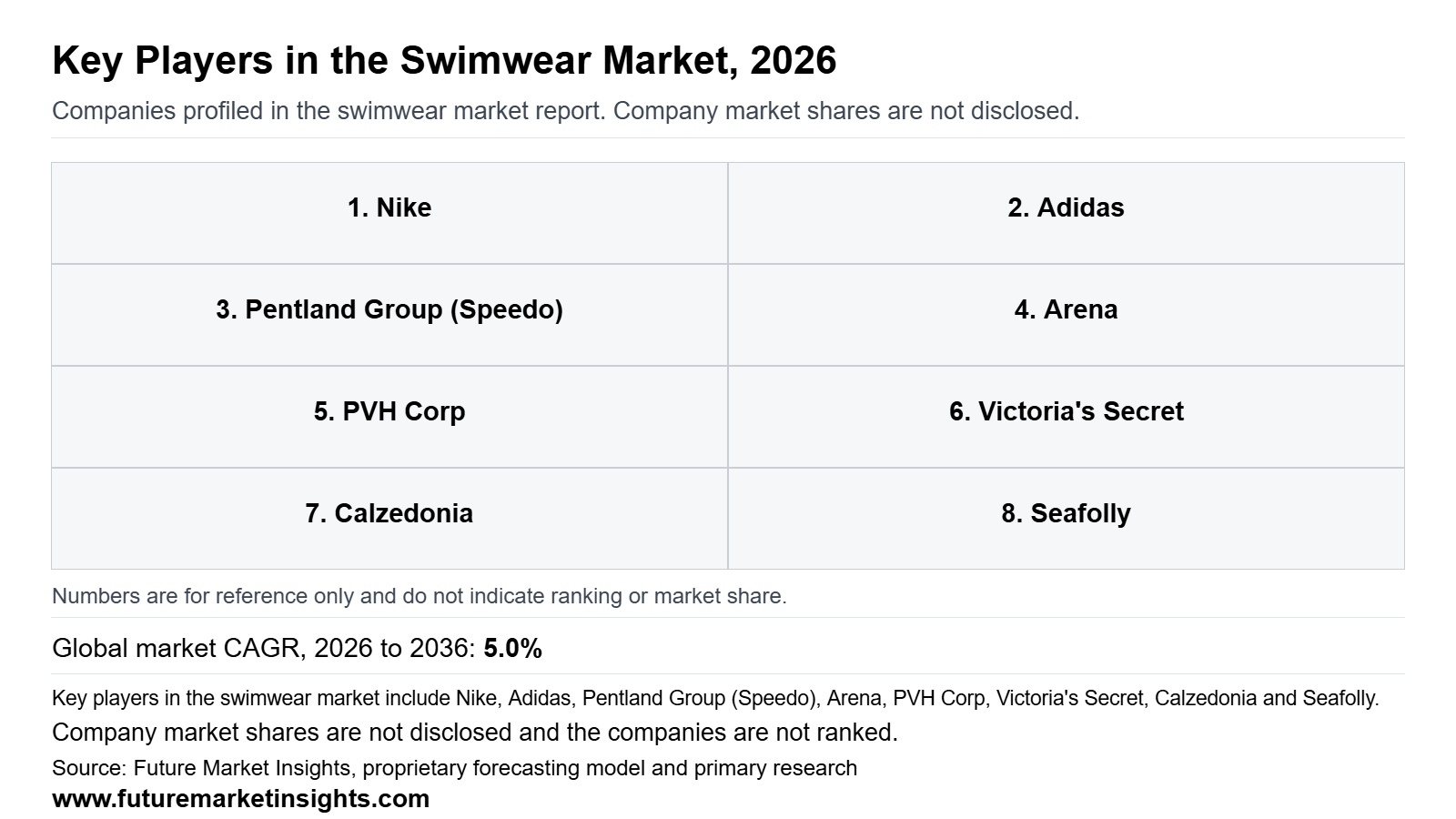
The swimwear market is split between sports brands and fashion brands. Notable companies include Nike, Adidas, Pentland Group (Speedo), Arena and PVH Corp. Victoria's Secret, Calzedonia, Seafolly and Inditex are also active, along with many independent online brands. Sports brands lead in performance swimwear, while fashion brands and online sellers compete in beachwear. Since shoppers want wider size ranges, online brands are growing quickly. As a result, competition is shifting toward fit, design, fabric quality and price. Matching beachwear collections, meanwhile, are raising order values.
How Are Companies Positioned in the Swimwear Market?
Brands are widening ranges and adding beachwear. For example, Arena reported 8% sales growth in 2025 and is expanding into beachwear. Björn Borg, in turn, reported lower swimwear sales in August 2026 due to earlier summer deliveries. Online brands are growing through wider size ranges. Fashion retailers, meanwhile, are launching summer collections earlier in the year.
How Do Shoppers Choose Swimwear?
Shoppers compare swimwear first on fit and style. Comfort and fabric quality come next, especially for training suits. Price and size range then decide the final choice. Many shoppers also read reviews and look at photos from other buyers before ordering online.
Which Capabilities Distinguish Brand Offers?
Wide size ranges are the main point of difference between swimwear brands. Fit tools for online shoppers, in turn, reduce returns. Chlorine-resistant and recycled fabrics support training and premium lines. Matching beachwear collections also raise the value of each order.
How Does Geographic Reach Affect Competition?
Swim seasons differ between the northern and southern hemispheres. As a result, global brands can sell all year by shifting stock between regions. Local brands, however, lead in countries with strong beach cultures, such as Brazil and Australia. Production close to main markets helps brands restock during short seasons.
| Verified Company Evidence (2026) | Commercial Effect | Buyer Action |
|---|---|---|
| 2026: Particl estimated online swimwear sales across 500 leading brands at about USD 97 million in April-May 2026, up from about USD 75 million a year earlier (Particl, 2026). | Shows earlier and stronger online buying before summer. | Launch summer ranges online earlier in the year. |
| 23 April 2026: Arena reported 2025 sales of EUR 193 million, up 8%, and plans about 7% annual growth with a push into beachwear (FashionUnited, April 2026). | Performance brands are widening into beachwear. | Add matching beachwear to performance swimwear ranges. |
| 14 August 2026: Björn Borg reported that other products, including swimwear and socks, fell 24% in H1 2026 as summer deliveries moved into Q1 (FashionUnited, August 2026). | Shows the effect of delivery timing on swimwear sales. | Plan stock and deliveries around shifting summer demand. |
Source: Verified corporate disclosures and Future Market Insights analysis, 2026.
| Company | Core Positioning | Verified Activity & Source Attribution |
|---|---|---|
| Arena | Performance swimwear brand expanding into beachwear | 2025 sales of EUR 193 million, up 8% (FashionUnited, April 2026). |
| Björn Borg | Sports fashion brand with swimwear lines | H1 2026 other products including swimwear down 24% (FashionUnited, August 2026). |
| Pentland Group (Speedo) | Leading performance swimwear brand | Company information. |
| Seafolly | Australian beachwear brand | Company information. |
Source: Verified corporate disclosures and Future Market Insights analysis, 2026.
Swimwear Market Report Scope and Research Methodology
Swimwear sales by country form the base of FMI's estimate. These sales are taken from retail statistics, company reports and online sales tracking. Sales are split by consumer group, product type and channel. Country totals are then added to give regional and global values. Forecasts are built on population, travel trends, climate, online shopping growth and prices. Online sales tracking for spring 2026 is used to check the timing of seasonal demand. As a final step, FMI checks the results against the reported swimwear revenue of listed brands. Any country where figures do not match is adjusted.
| Coverage Field | Report Scope |
|---|---|
| Market definition | Clothing designed for swimming, beach and pool use, including swimsuits, swim shorts and related beachwear. |
| Consumer groups | Women, men and children. |
| Product types | Fashion and beachwear, performance and training, cover-ups and accessories, and modest and specialty. |
| Sales channels | Stores, online and others. |
| Price levels | Value, mid-range and premium. |
| Customer types | Household shoppers, swimmers and athletes. |
| Revenue basis | Retail sales value of swimwear products. |
| Exclusions | Wetsuits for diving and surfing, swimming equipment such as goggles and fins, and second-hand swimwear. |
| Quantitative units | USD billion for value. |
| Volume basis | Units sold, used to check value estimates. |
| Value basis | Retail sales recognised in the country of the shopper. |
| Regions covered | North America, Europe, East Asia, Latin America, South Asia & Pacific, and Middle East & Africa. |
| National coverage | United States, China, Brazil, United Kingdom, Germany, France, Italy, Spain, Australia, South Korea. |
| Companies covered | Nike, Adidas, Pentland Group, Arena, PVH Corp, Victoria's Secret, Calzedonia, Seafolly, Inditex and independent brands. |
Source: Future Market Insights analysis of the swimwear market, 2026.
Research Sources and Bibliography
- Particl. (2026). Beyond the beach: Swim and resort wear in 2026.
- FashionUnited. (2026, April 23). Arena wächst weiter und klettert aus dem Wettkampfbecken.
- FashionUnited. (2026, August 14). Björn Borg records highest H1 operating profit in company history despite sales dip.
- FashionUnited. (2026, April 29). Björn Borg achieves strongest Q1 in company history with double-digit growth in sports apparel.
- SGI Europe. (2026, August). Björn Borg's growth streak ends with Q2 but gross margin hits new high.
Table of Content
- Key Takeaways
- Market Size and CAGR
- Top Growth Driver
- Fastest Growing Segment
- Leading Region
- Key Companies
- Emerging Opportunities
- Executive Summary
- Global Market Outlook
- Demand-side Trends
- Supply-side Trends
- Technology Roadmap Analysis
- Analysis and Recommendations
- Analyst Perspective (What is happening? Why now? What should investors know?)
- Key Questions Answered
- How large is the market?
- What is the CAGR?
- What are key trends?
- Which region dominates?
- Who are the leaders?
Read More...
- Market Overview
- Market Coverage / Taxonomy
- Market Definition / Scope / Limitations
- Research Methodology
- Chapter Orientation
- Analytical Lens and Working Hypotheses
- Market Structure, Signals, and Trend Drivers
- Benchmarking and Cross-market Comparability
- Market Sizing, Forecasting, and Opportunity Mapping
- Research Design and Evidence Framework
- Desk Research Programme (Secondary Evidence)
- Expert Input and Fieldwork (Primary Evidence)
- Tooling, Models, and Reference Databases
- Data Engineering and Model Build
- Quality Assurance and Audit Trail
- Market Background
- Market Dynamics (Drivers, Restraints, Opportunity, Trends)
- Scenario Forecast (Optimistic, Likely, Conservative)
- Impact Analysis
- AI Impact
- Sustainability Impact
- Regulatory Impact
- Technology Impact
- Consumer / Buyer Analysis
- Purchase Drivers
- Adoption Barriers
- Buyer Journey
- Opportunity Map Analysis
- Product Life Cycle Analysis
- Supply Chain Analysis
- Investment Feasibility Matrix
- Value Chain Analysis
- PESTLE and Porter's Analysis
- Regulatory Landscape
- Regional Parent Market Outlook
- Production and Consumption Statistics
- Import and Export Statistics
- Global Swimwear Market Analysis and Forecast, 2021 to 2036
- Historical Market Size Value (USD Billion) Analysis, 2021 to 2025
- Current and Future Market Size Value (USD Billion) Projections, 2026 to 2036
- Y-o-Y Growth Trend Analysis
- Absolute $ Opportunity Analysis
- Global Swimwear Market Pricing Analysis, 2021 to 2036
- Global Swimwear Market Analysis and Forecast, By Consumer Group, 2021 to 2036
- Introduction / Key Findings
- Historical Market Size Value (USD Billion) Analysis By Consumer Group, 2021 to 2025
- Current and Future Market Size Value (USD Billion) Analysis and Forecast By Consumer Group, 2026 to 2036
- Women
- Men
- Children
- Y-o-Y Growth Trend Analysis By Consumer Group, 2021 to 2025
- Absolute $ Opportunity Analysis By Consumer Group, 2026 to 2036
- Global Swimwear Market Analysis and Forecast, By Product Type, 2021 to 2036
- Introduction / Key Findings
- Historical Market Size Value (USD Billion) Analysis By Product Type, 2021 to 2025
- Current and Future Market Size Value (USD Billion) Analysis and Forecast By Product Type, 2026 to 2036
- Fashion & Beachwear
- Performance & Training
- Cover-Ups & Accessories
- Modest & Specialty
- Y-o-Y Growth Trend Analysis By Product Type, 2021 to 2025
- Absolute $ Opportunity Analysis By Product Type, 2026 to 2036
- Global Swimwear Market Analysis and Forecast, By Sales Channel, 2021 to 2036
- Introduction / Key Findings
- Historical Market Size Value (USD Billion) Analysis By Sales Channel, 2021 to 2025
- Current and Future Market Size Value (USD Billion) Analysis and Forecast By Sales Channel, 2026 to 2036
- Stores
- Online
- Others
- Y-o-Y Growth Trend Analysis By Sales Channel, 2021 to 2025
- Absolute $ Opportunity Analysis By Sales Channel, 2026 to 2036
- Global Swimwear Market Analysis and Forecast, By Region, 2021 to 2036
- Introduction
- Historical Market Size Value (USD Billion) Analysis By Region, 2021 to 2025
- Current Market Size Value (USD Billion) Analysis and Forecast By Region, 2026 to 2036
- North America
- Europe
- East Asia
- Latin America
- South Asia & Pacific
- Middle East & Africa
- Market Attractiveness Analysis By Region
- North America Swimwear Market Analysis and Forecast, By Country, 2021 to 2036
- Historical Market Size Value (USD Billion) Trend Analysis By Market Taxonomy, 2021 to 2025
- Market Size Value (USD Billion) Forecast By Market Taxonomy, 2026 to 2036
- By Country
- United States
- Rest of North America
- By Consumer Group
- By Product Type
- By Sales Channel
- By Country
- Market Attractiveness Analysis
- By Country
- By Consumer Group
- By Product Type
- By Sales Channel
- Key Takeaways
- Europe Swimwear Market Analysis and Forecast, By Country, 2021 to 2036
- Historical Market Size Value (USD Billion) Trend Analysis By Market Taxonomy, 2021 to 2025
- Market Size Value (USD Billion) Forecast By Market Taxonomy, 2026 to 2036
- By Country
- United Kingdom
- Germany
- France
- Italy
- Spain
- Rest of Europe
- By Consumer Group
- By Product Type
- By Sales Channel
- By Country
- Market Attractiveness Analysis
- By Country
- By Consumer Group
- By Product Type
- By Sales Channel
- Key Takeaways
- East Asia Swimwear Market Analysis and Forecast, By Country, 2021 to 2036
- Historical Market Size Value (USD Billion) Trend Analysis By Market Taxonomy, 2021 to 2025
- Market Size Value (USD Billion) Forecast By Market Taxonomy, 2026 to 2036
- By Country
- China
- South Korea
- Rest of East Asia
- By Consumer Group
- By Product Type
- By Sales Channel
- By Country
- Market Attractiveness Analysis
- By Country
- By Consumer Group
- By Product Type
- By Sales Channel
- Key Takeaways
- Latin America Swimwear Market Analysis and Forecast, By Country, 2021 to 2036
- Historical Market Size Value (USD Billion) Trend Analysis By Market Taxonomy, 2021 to 2025
- Market Size Value (USD Billion) Forecast By Market Taxonomy, 2026 to 2036
- By Country
- Brazil
- Rest of Latin America
- By Consumer Group
- By Product Type
- By Sales Channel
- By Country
- Market Attractiveness Analysis
- By Country
- By Consumer Group
- By Product Type
- By Sales Channel
- Key Takeaways
- South Asia & Pacific Swimwear Market Analysis and Forecast, By Country, 2021 to 2036
- Historical Market Size Value (USD Billion) Trend Analysis By Market Taxonomy, 2021 to 2025
- Market Size Value (USD Billion) Forecast By Market Taxonomy, 2026 to 2036
- By Country
- Australia
- Rest of South Asia & Pacific
- By Consumer Group
- By Product Type
- By Sales Channel
- By Country
- Market Attractiveness Analysis
- By Country
- By Consumer Group
- By Product Type
- By Sales Channel
- Key Takeaways
- Middle East & Africa Swimwear Market Analysis and Forecast, By Country, 2021 to 2036
- Historical Market Size Value (USD Billion) Trend Analysis By Market Taxonomy, 2021 to 2025
- Market Size Value (USD Billion) Forecast By Market Taxonomy, 2026 to 2036
- By Country
- Rest of Middle East & Africa
- By Consumer Group
- By Product Type
- By Sales Channel
- By Country
- Market Attractiveness Analysis
- By Country
- By Consumer Group
- By Product Type
- By Sales Channel
- Key Takeaways
- Key Countries Market Analysis
- United States
- Pricing Analysis
- Market Share Analysis, 2025
- By Consumer Group
- By Product Type
- By Sales Channel
- China
- Pricing Analysis
- Market Share Analysis, 2025
- By Consumer Group
- By Product Type
- By Sales Channel
- Brazil
- Pricing Analysis
- Market Share Analysis, 2025
- By Consumer Group
- By Product Type
- By Sales Channel
- United Kingdom
- Pricing Analysis
- Market Share Analysis, 2025
- By Consumer Group
- By Product Type
- By Sales Channel
- Germany
- Pricing Analysis
- Market Share Analysis, 2025
- By Consumer Group
- By Product Type
- By Sales Channel
- France
- Pricing Analysis
- Market Share Analysis, 2025
- By Consumer Group
- By Product Type
- By Sales Channel
- Italy
- Pricing Analysis
- Market Share Analysis, 2025
- By Consumer Group
- By Product Type
- By Sales Channel
- Spain
- Pricing Analysis
- Market Share Analysis, 2025
- By Consumer Group
- By Product Type
- By Sales Channel
- Australia
- Pricing Analysis
- Market Share Analysis, 2025
- By Consumer Group
- By Product Type
- By Sales Channel
- South Korea
- Pricing Analysis
- Market Share Analysis, 2025
- By Consumer Group
- By Product Type
- By Sales Channel
- United States
- Market Structure Analysis
- Competition Dashboard
- Competition Benchmarking
- Market Share Analysis of Top Players
- By Regional
- By Consumer Group
- By Product Type
- By Sales Channel
- Emerging Startups
- Innovation Benchmarking
- Competition Analysis
- Competition Deep Dive
- Nike
- Overview
- Product Portfolio
- Profitability by Market Segments
- Sales Footprint
- Strategy Overview
- Marketing Strategy
- Product Strategy
- Channel Strategy
- Adidas
- Pentland Group
- Arena
- PVH Corp
- Victoria's Secret
- Calzedonia
- Seafolly
- Inditex
- independent brands
- Nike
- Case Studies
- Success Stories
- Recent Developments
- Competition Deep Dive
- Assumptions & Acronyms Used
List of Tables
- Table 1: Global Swimwear Market Value (USD Billion) Forecast by Region, 2021 to 2036
- Table 2: Global Swimwear Market Value (USD Billion) Forecast by Consumer Group, 2021 to 2036
- Table 3: Global Swimwear Market Value (USD Billion) Forecast by Product Type, 2021 to 2036
- Table 4: Global Swimwear Market Value (USD Billion) Forecast by Sales Channel, 2021 to 2036
- Table 5: North America Swimwear Market Value (USD Billion) Forecast by Country, 2021 to 2036
- Table 6: North America Swimwear Market Value (USD Billion) Forecast by Consumer Group, 2021 to 2036
- Table 7: North America Swimwear Market Value (USD Billion) Forecast by Product Type, 2021 to 2036
- Table 8: North America Swimwear Market Value (USD Billion) Forecast by Sales Channel, 2021 to 2036
- Table 9: Europe Swimwear Market Value (USD Billion) Forecast by Country, 2021 to 2036
- Table 10: Europe Swimwear Market Value (USD Billion) Forecast by Consumer Group, 2021 to 2036
- Table 11: Europe Swimwear Market Value (USD Billion) Forecast by Product Type, 2021 to 2036
- Table 12: Europe Swimwear Market Value (USD Billion) Forecast by Sales Channel, 2021 to 2036
- Table 13: East Asia Swimwear Market Value (USD Billion) Forecast by Country, 2021 to 2036
- Table 14: East Asia Swimwear Market Value (USD Billion) Forecast by Consumer Group, 2021 to 2036
- Table 15: East Asia Swimwear Market Value (USD Billion) Forecast by Product Type, 2021 to 2036
- Table 16: East Asia Swimwear Market Value (USD Billion) Forecast by Sales Channel, 2021 to 2036
- Table 17: Latin America Swimwear Market Value (USD Billion) Forecast by Country, 2021 to 2036
- Table 18: Latin America Swimwear Market Value (USD Billion) Forecast by Consumer Group, 2021 to 2036
- Table 19: Latin America Swimwear Market Value (USD Billion) Forecast by Product Type, 2021 to 2036
- Table 20: Latin America Swimwear Market Value (USD Billion) Forecast by Sales Channel, 2021 to 2036
- Table 21: South Asia & Pacific Swimwear Market Value (USD Billion) Forecast by Country, 2021 to 2036
- Table 22: South Asia & Pacific Swimwear Market Value (USD Billion) Forecast by Consumer Group, 2021 to 2036
- Table 23: South Asia & Pacific Swimwear Market Value (USD Billion) Forecast by Product Type, 2021 to 2036
- Table 24: South Asia & Pacific Swimwear Market Value (USD Billion) Forecast by Sales Channel, 2021 to 2036
- Table 25: Middle East & Africa Swimwear Market Value (USD Billion) Forecast by Country, 2021 to 2036
- Table 26: Middle East & Africa Swimwear Market Value (USD Billion) Forecast by Consumer Group, 2021 to 2036
- Table 27: Middle East & Africa Swimwear Market Value (USD Billion) Forecast by Product Type, 2021 to 2036
- Table 28: Middle East & Africa Swimwear Market Value (USD Billion) Forecast by Sales Channel, 2021 to 2036
List of Figures
- Figure 1: Global Swimwear Market Pricing Analysis
- Figure 2: Global Swimwear Market Value (USD Billion) Forecast 2021-2036
- Figure 3: Global Swimwear Market Value Share and BPS Analysis by Consumer Group, 2026 and 2036
- Figure 4: Global Swimwear Market Y-o-Y Growth Comparison by Consumer Group, 2026-2036
- Figure 5: Global Swimwear Market Attractiveness Analysis by Consumer Group
- Figure 6: Global Swimwear Market Value Share and BPS Analysis by Product Type, 2026 and 2036
- Figure 7: Global Swimwear Market Y-o-Y Growth Comparison by Product Type, 2026-2036
- Figure 8: Global Swimwear Market Attractiveness Analysis by Product Type
- Figure 9: Global Swimwear Market Value Share and BPS Analysis by Sales Channel, 2026 and 2036
- Figure 10: Global Swimwear Market Y-o-Y Growth Comparison by Sales Channel, 2026-2036
- Figure 11: Global Swimwear Market Attractiveness Analysis by Sales Channel
- Figure 12: Global Swimwear Market Value (USD Billion) Share and BPS Analysis by Region, 2026 and 2036
- Figure 13: Global Swimwear Market Y-o-Y Growth Comparison by Region, 2026-2036
- Figure 14: Global Swimwear Market Attractiveness Analysis by Region
- Figure 15: North America Swimwear Market Incremental Dollar Opportunity, 2026-2036
- Figure 16: Europe Swimwear Market Incremental Dollar Opportunity, 2026-2036
- Figure 17: East Asia Swimwear Market Incremental Dollar Opportunity, 2026-2036
- Figure 18: Latin America Swimwear Market Incremental Dollar Opportunity, 2026-2036
- Figure 19: South Asia & Pacific Swimwear Market Incremental Dollar Opportunity, 2026-2036
- Figure 20: Middle East & Africa Swimwear Market Incremental Dollar Opportunity, 2026-2036
- Figure 21: North America Swimwear Market Value Share and BPS Analysis by Country, 2026 and 2036
- Figure 22: North America Swimwear Market Value Share and BPS Analysis by Consumer Group, 2026 and 2036
- Figure 23: North America Swimwear Market Y-o-Y Growth Comparison by Consumer Group, 2026-2036
- Figure 24: North America Swimwear Market Attractiveness Analysis by Consumer Group
- Figure 25: North America Swimwear Market Value Share and BPS Analysis by Product Type, 2026 and 2036
- Figure 26: North America Swimwear Market Y-o-Y Growth Comparison by Product Type, 2026-2036
- Figure 27: North America Swimwear Market Attractiveness Analysis by Product Type
- Figure 28: North America Swimwear Market Value Share and BPS Analysis by Sales Channel, 2026 and 2036
- Figure 29: North America Swimwear Market Y-o-Y Growth Comparison by Sales Channel, 2026-2036
- Figure 30: North America Swimwear Market Attractiveness Analysis by Sales Channel
- Figure 31: Europe Swimwear Market Value Share and BPS Analysis by Country, 2026 and 2036
- Figure 32: Europe Swimwear Market Value Share and BPS Analysis by Consumer Group, 2026 and 2036
- Figure 33: Europe Swimwear Market Y-o-Y Growth Comparison by Consumer Group, 2026-2036
- Figure 34: Europe Swimwear Market Attractiveness Analysis by Consumer Group
- Figure 35: Europe Swimwear Market Value Share and BPS Analysis by Product Type, 2026 and 2036
- Figure 36: Europe Swimwear Market Y-o-Y Growth Comparison by Product Type, 2026-2036
- Figure 37: Europe Swimwear Market Attractiveness Analysis by Product Type
- Figure 38: Europe Swimwear Market Value Share and BPS Analysis by Sales Channel, 2026 and 2036
- Figure 39: Europe Swimwear Market Y-o-Y Growth Comparison by Sales Channel, 2026-2036
- Figure 40: Europe Swimwear Market Attractiveness Analysis by Sales Channel
- Figure 41: East Asia Swimwear Market Value Share and BPS Analysis by Country, 2026 and 2036
- Figure 42: East Asia Swimwear Market Value Share and BPS Analysis by Consumer Group, 2026 and 2036
- Figure 43: East Asia Swimwear Market Y-o-Y Growth Comparison by Consumer Group, 2026-2036
- Figure 44: East Asia Swimwear Market Attractiveness Analysis by Consumer Group
- Figure 45: East Asia Swimwear Market Value Share and BPS Analysis by Product Type, 2026 and 2036
- Figure 46: East Asia Swimwear Market Y-o-Y Growth Comparison by Product Type, 2026-2036
- Figure 47: East Asia Swimwear Market Attractiveness Analysis by Product Type
- Figure 48: East Asia Swimwear Market Value Share and BPS Analysis by Sales Channel, 2026 and 2036
- Figure 49: East Asia Swimwear Market Y-o-Y Growth Comparison by Sales Channel, 2026-2036
- Figure 50: East Asia Swimwear Market Attractiveness Analysis by Sales Channel
- Figure 51: Latin America Swimwear Market Value Share and BPS Analysis by Country, 2026 and 2036
- Figure 52: Latin America Swimwear Market Value Share and BPS Analysis by Consumer Group, 2026 and 2036
- Figure 53: Latin America Swimwear Market Y-o-Y Growth Comparison by Consumer Group, 2026-2036
- Figure 54: Latin America Swimwear Market Attractiveness Analysis by Consumer Group
- Figure 55: Latin America Swimwear Market Value Share and BPS Analysis by Product Type, 2026 and 2036
- Figure 56: Latin America Swimwear Market Y-o-Y Growth Comparison by Product Type, 2026-2036
- Figure 57: Latin America Swimwear Market Attractiveness Analysis by Product Type
- Figure 58: Latin America Swimwear Market Value Share and BPS Analysis by Sales Channel, 2026 and 2036
- Figure 59: Latin America Swimwear Market Y-o-Y Growth Comparison by Sales Channel, 2026-2036
- Figure 60: Latin America Swimwear Market Attractiveness Analysis by Sales Channel
- Figure 61: South Asia & Pacific Swimwear Market Value Share and BPS Analysis by Country, 2026 and 2036
- Figure 62: South Asia & Pacific Swimwear Market Value Share and BPS Analysis by Consumer Group, 2026 and 2036
- Figure 63: South Asia & Pacific Swimwear Market Y-o-Y Growth Comparison by Consumer Group, 2026-2036
- Figure 64: South Asia & Pacific Swimwear Market Attractiveness Analysis by Consumer Group
- Figure 65: South Asia & Pacific Swimwear Market Value Share and BPS Analysis by Product Type, 2026 and 2036
- Figure 66: South Asia & Pacific Swimwear Market Y-o-Y Growth Comparison by Product Type, 2026-2036
- Figure 67: South Asia & Pacific Swimwear Market Attractiveness Analysis by Product Type
- Figure 68: South Asia & Pacific Swimwear Market Value Share and BPS Analysis by Sales Channel, 2026 and 2036
- Figure 69: South Asia & Pacific Swimwear Market Y-o-Y Growth Comparison by Sales Channel, 2026-2036
- Figure 70: South Asia & Pacific Swimwear Market Attractiveness Analysis by Sales Channel
- Figure 71: Middle East & Africa Swimwear Market Value Share and BPS Analysis by Country, 2026 and 2036
- Figure 72: Middle East & Africa Swimwear Market Value Share and BPS Analysis by Consumer Group, 2026 and 2036
- Figure 73: Middle East & Africa Swimwear Market Y-o-Y Growth Comparison by Consumer Group, 2026-2036
- Figure 74: Middle East & Africa Swimwear Market Attractiveness Analysis by Consumer Group
- Figure 75: Middle East & Africa Swimwear Market Value Share and BPS Analysis by Product Type, 2026 and 2036
- Figure 76: Middle East & Africa Swimwear Market Y-o-Y Growth Comparison by Product Type, 2026-2036
- Figure 77: Middle East & Africa Swimwear Market Attractiveness Analysis by Product Type
- Figure 78: Middle East & Africa Swimwear Market Value Share and BPS Analysis by Sales Channel, 2026 and 2036
- Figure 79: Middle East & Africa Swimwear Market Y-o-Y Growth Comparison by Sales Channel, 2026-2036
- Figure 80: Middle East & Africa Swimwear Market Attractiveness Analysis by Sales Channel
- Figure 81: Global Swimwear Market - Tier Structure Analysis
- Figure 82: Global Swimwear Market - Company Share Analysis
Frequently Asked Questions
How big is the swimwear market in 2026?
Future Market Insights estimates the global swimwear market at USD 22.1 billion in 2026, up from USD 21.1 billion in 2025. More holiday travel and earlier online buying are driving this growth.
How fast is the swimwear market expected to grow through 2036?
FMI projects a 5.0% CAGR from 2026 to 2036, taking the market to USD 36.0 billion by 2036. This adds USD 13.9 billion in revenue, led by women's swimwear and online channels.
Which consumer group leads the swimwear market?
Women's swimwear leads with 56.0% of 2026 revenue, as women buy more often from wider style ranges. Women's swimwear is also growing fastest, at about 5.2% a year.
Which product type leads the swimwear market?
Fashion and beachwear holds 58.0% of 2026 revenue, as most swimsuits are bought for holidays. Modest and specialty swimwear is growing fastest, at about 7.0% a year.
Which sales channel leads the swimwear market?
Stores account for 52.0% of 2026 revenue, as shoppers like to try swimwear on. Online channels are growing fastest, at about 7.4% a year from 2026 to 2036.
Which country is the largest swimwear market?
The United States is the largest market, with 28.0% of global revenue in 2026, worth USD 6.2 billion. China follows at 9.0% (USD 2.0 billion) and Brazil at 7.0%.
Which countries are expected to grow fastest in the swimwear market?
China is projected to grow fastest, at a 6.9% CAGR from 2026 to 2036, as beach travel and swimming spread. Brazil follows at 5.4% and Australia at 5.0%.
What drives demand for swimwear?
Holiday travel and swimming for fitness are the main drivers. Wider size and style ranges and easy online shopping are also adding new buyers.
Preview the report firsthand - request a free sample
Get SampleGet the brochure for pricing and purchase details.
Get PDF
