

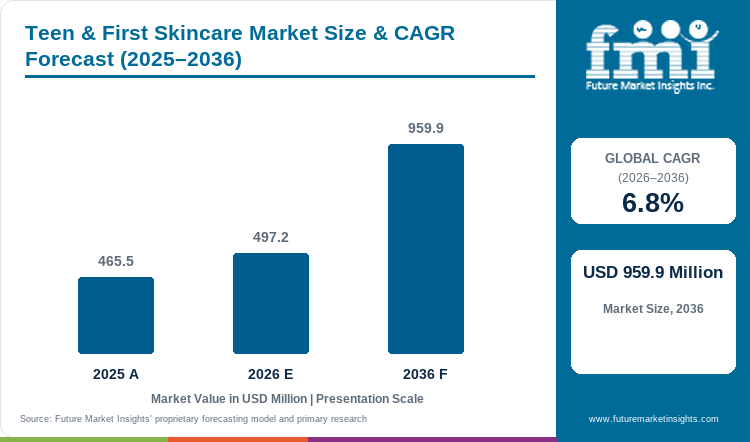
- Market Size (2026)
- USD 497.2 Mn
- Forecast (2036)
- USD 959.9 Mn
- CAGR (2026 to 2036)
- 6.8%
How big is Teen & First Skincare Market in 2026?
USD 497.2 Million in 2026 and USD 959.9 Million by 2036 at a 6.8% CAGR.
Sales of teen & first skincare products are estimated to grow at 6.8% from USD 497.2 Million in 2026 to USD 959.9 Million by 2036. The market reached USD 465.5 Million in 2025. Parents and caregivers often influence what is bought, especially when it comes to price and ingredients. Treatment limits also matter. This creates demand for products that make a first skincare routine easy to understand.
Digital content introduces younger consumers to skincare at an earlier age, but seeing a product does not always lead to a purchase. A 2025 Pediatrics study found that youth skincare videos featured an average of six products and a regimen cost of USD 168. Sunscreen appeared in only 26.2% of the videos reviewed. This creates room for shorter and more affordable routines. Clear guidance on when acne or sensitivity requires additional care can also help parents feel more comfortable with a purchase.
Key Takeaways
- Puberty-related acne and oiliness create regular skincare needs. Dryness and sensitivity can also drive demand. Repeat purchases are more likely when the routine remains short enough for daily use.
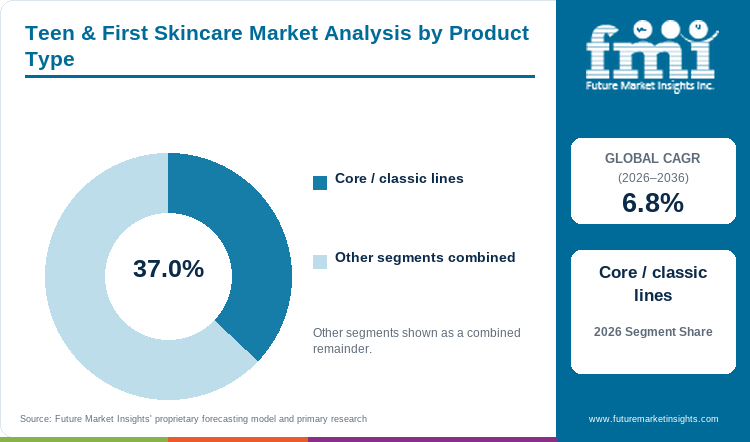
- Core / classic lines lead Product Type demand at 37.0% in 2026. Cleansers and moisturizers address common first-routine needs without requiring a complicated treatment routine.
- Conventional products hold 56.0% of Nature demand. Cream & balm accounts for 33.0% of Format demand, while Mass represents 41.0% of Price Positioning in 2026.
- Routine overload remains a major restraint. A 2025 Pediatrics study found that youth skincare videos featured an average of six products and cost USD 168 per regimen. These routines also frequently exposed users to potentially irritating ingredients.
- UAE is likely to grow at a CAGR at 8.1%. Saudi Arabia follows at 7.8%, while South Korea is at 7.5%. Product registration and channel conditions differ across these markets.
- Notable companies include Kao Corporation and Amorepacific. Other companies include L'Oréal, Beiersdorf, Shiseido, Galderma, Kenvue, Procter & Gamble, Unilever, and e.l.f. Beauty.
Analyst Perspective
“The main commercial issue is keeping the routine under control. Teen skincare can attract attention through new products, but repeat demand is more likely to come from products that young users can use correctly and parents are comfortable buying. Retailers also need to be able to explain the routine without making basic skincare feel like an adult treatment program. Brands that become part of the first two or three steps can build a relationship with consumers before their skincare needs become more specific.”
- Rahul Pandita, Principal Consultant, Future Market Insights
How is the teen & first skincare market segmented?
The teen & first skincare market is segmented by Product Type, Nature, Format, Price Positioning, Sales Channel, and Region.
Product Type includes Core / classic lines and Targeted treatment lines. It also covers Sensitive & gentle lines, Premium & clinical lines, and Kits & sets. Nature includes Conventional and Vegan & cruelty-free products. It also includes Natural & organic, Dermocosmetic / clinical, and Fragrance-free & sensitive products. Format includes Cream & balm and Liquid & serum. Other formats include Stick & solid, Spray & mist, Sheet & patch, and Powder. Price Positioning covers Mass and Masstige, along with Premium and Professional products. Sales Channel includes E-commerce & DTC and Specialty beauty retail. It also covers Pharmacies & drugstores, Supermarkets & hypermarkets, and Salons & spas.
Why do Core / classic lines lead demand within the Product Type category?
Core / classic lines handle the basic jobs that a new skincare user can easily understand. They remove oil and dirt while helping replace moisture and protect the skin during normal daily activity. They also make it easier for parents to decide what to buy.
Targeted acne products become more relevant when breakouts continue. Sensitive and clinical products serve more specific needs, while kits provide another option for consumers who want a ready-made routine.
Core / classic lines lead because these products are used regularly and need to be replaced. Their position does not depend on having the strongest active formula. In January 2026, Procter & Gamble described OLAY Cleansing Melts as precisely dosed water-activated cleanser squares made with eight or fewer ingredients. This shows how a familiar skincare step can be simplified without adding another product to the routine.
- Core / classic lines account for 37.0% of Product Type demand in 2026, supported by frequent cleanser and moisturizer replenishment.
- A basic routine gives households a simple starting point. Concern-led treatments or premium clinical products can be added later if needed.
Why does Conventional lead demand within the Nature category?
Conventional formulations remain the most widely used option because brands have more flexibility in how they manage preservation and texture. They can also adjust cleansing strength and price for different channels.
Ethical or botanical claims can influence which brand a consumer chooses. However, young consumers still need products that are comfortable to use and perform consistently as their skin changes. The natural cosmetics market gives values-led buyers more options. Dermocosmetic and fragrance-free products become more relevant when acne or sensitivity limits the ingredients a consumer can use.
Conventional products therefore lead because they are available across a broad range of formulations and channels.
- Conventional products hold 56.0% of Nature demand in 2026, giving them the broadest presence across price points and retail channels.
- Natural or vegan claims can be more useful when they address a clear consumer need. The same applies to clinical and fragrance-free positioning.
Why does Cream & balm lead demand within the Format category?
Cream and balm formats make it easy for users to see how much product they are applying. They are also closely associated with moisturization and support for the skin barrier.
This is useful for young consumers whose skin may shift between oiliness and dryness. Acne treatments or over-cleansing can also leave the skin dry. The same need is seen in the sensitive skin solutions market, where barrier support and low-irritation products are important.
Liquid serums are more suited to targeted active ingredients. Sticks and patches work well for specific areas or portable use, while mists tend to be used less often. Cream and balm formats lead because they fit into a regular skincare step and can stay in the routine even when other products change.
- Cream & balm represents 33.0% of Format demand in 2026 because moisturization and barrier care can be used in both morning and evening routines.
- Beiersdorf relaunched Eucerin DERMOPURE CLINICAL in 2025 for blemish- and acne-prone skin. The launch also shows the value of addressing acne while maintaining skin comfort.
Why does Mass lead demand within the Price Positioning category?
Mass pricing fits a first skincare routine because parents often pay for the products and skin needs can change quickly during puberty. Lower prices make it easier to keep basic products such as cleansers and moisturizers in the routine while deciding whether a more targeted product is needed.
Masstige products can offer stronger ingredient positioning or more distinctive packaging. Premium and professional products become more relevant once the consumer has a specific concern or receives specialist advice.
Mass leads because these products need to remain affordable when they are replaced regularly.
- Mass products hold 41.0% of Price Positioning demand in 2026, supported by lower trial risk and wider household access.
- Premium pricing becomes easier to justify when the buyer has a clear acne or sensitivity need. A specific treatment requirement can also support a higher price.
Why does E-commerce & DTC lead demand within the Sales Channel category?
E-commerce and DTC bring product discovery and purchase into the same journey. Consumers can compare ingredients and learn how to use a routine before placing an order. Reviews can also help with the decision.
This is especially useful when the person using the product is not the person paying for it. A young consumer can shortlist a product online before a parent makes the purchase. Online product pages also give brands more space to explain how products should be used and when they need to be replaced.
Physical stores remain important for authenticity and reassurance. In September 2025, e.l.f. Beauty moved rhode from a DTC-led model into Sephora stores across the United States and Canada. This shows how digital demand can later expand into physical retail.
- E-commerce & DTC accounts for 27.0% of Sales Channel demand in 2026. It provides a short path between discovery and purchase while also supporting product education.
- Specialty beauty stores remain important for shoppers who want to compare products in person. Pharmacies and drugstores can provide additional reassurance before repeat use.
What are the drivers, restraints and opportunities in the Teen & First Skincare Market?
Puberty-related skin changes create repeat demand. At the same time, complicated routines can increase irritation and make parents less comfortable with a purchase. Simple starter routines focused on skin barrier care offer a clear opportunity.
- Driver: Puberty-related acne and oiliness can turn skincare into a repeat household purchase. Dryness and sensitivity can create the same need.
- Restraint: Adult-focused active ingredients and long social-media routines can increase irritation risk and raise the cost of the routine. They can also make parents question what young skin actually needs.
- Opportunity: Two-step and three-step starter systems can make skincare easier to follow. They can combine gentle cleansing with barrier support and daytime protection. Targeted acne care can then be added when needed.
Puberty Turns Skin Maintenance Into a Repeat Purchase
Demand starts when changes in the skin give young consumers a practical reason to use skincare. Simply seeing beauty content does not create the same need.
Acne is especially important because it often begins during puberty. It can turn cleansing and oil-control products into regular purchases. This also expands the younger customer base for the anti-acne cosmetics market. However, stronger treatment claims and ingredients require more care than ordinary maintenance products.
Brands are more likely to generate repeat sales when the basic routine remains useful between breakouts. Consumers should not need to replace the entire routine every time their skin changes.
Routine Overload Converts Discovery Into Irritation Risk
Problems can begin when young users copy routines designed around adult active ingredients or creator content instead of their own skin needs.
The 2025 Pediatrics study of youth skincare videos found an average of six products and USD 168 per regimen. The most-viewed videos also included many potentially irritating active ingredients. This can increase the chance of redness or contact allergy. It may also cause users to stop following the routine.
Long routines can also be harder for parents to approve. In March 2025, FDA testing of 95 benzoyl peroxide acne products led to limited retail recalls for a small number of products with elevated benzene levels.
For suppliers, the challenge is keeping active acne treatment credible and easy to use while limiting unnecessary irritation.
Barrier-First Starter Systems Create a Scalable Entry Point
A starter system works best when it reduces the number of decisions a young consumer needs to make. It should not simply bundle more products together.
A practical routine can start with gentle cleansing and moisturization. Daytime protection can then be added, with targeted treatment used when there is a clear need.
This also connects teen skincare with the sun care products market. Sunscreen is often missing from youth routines even when users are applying active ingredients.
Suppliers can address this gap with compact kits and simple instructions for morning and evening use. Replenishment formats can also make the cost of the routine easier to understand. The value for young users and parents comes from reducing guesswork.
How do country-level CAGRs compare in the Teen & First Skincare Market?
The country CAGRs range from 5.9% to 8.1% from 2026 to 2036. UAE leads at 8.1%, followed by Saudi Arabia at 7.8%. South Korea is at 7.5%. USA stands at 7.2%, while UK is at 6.9%. France is at 6.6% and Germany at 6.3%. Japan is at 5.9%.
Similar growth rates do not mean that brands can use the same approach in every country. Gulf markets are influenced by imported products and registration requirements. South Korea has its own rules for functional cosmetics and converts trends quickly. Western markets and Japan have more established retail habits through drugstores and specialist channels.
- UAE is likely to grow at a stable rate during the forecast period. Cross-border brand exposure is high, making product registration and authorized digital stores important early in the launch.
- Saudi Arabia follows closely. Pharmacy and distributor execution matter, while imported cosmetics also require Arabic-language communication and national notification.
- South Korea can move quickly from ingredient trends to acne-care demand. Functional claims are subject to a formal testing and review framework.
- USA provides broad opportunities across mass retail and specialty channels. Online channels also support product testing, while acne products face closer scrutiny when cosmetic positioning moves into treatment claims.
- UK operates within a heavily notified cosmetics market. Responsible-person requirements and product notification affect market entry and ongoing compliance.
- France combines pharmacy credibility with a strong beauty retail market. Clear labels and supportable claims are important for first-routine products.
- German drugstores play a major role in cosmetics purchasing. This gives accessible routine products a route to households without requiring prestige pricing.
- Japan is expected to grow more steadily. Its large skincare base and strong drugstore channel favor products that fit easily into everyday routines.
Country-wise Analysis
- USA: Teen & first skincare demand in the USA is forecast to expand at 7.2% CAGR from 2026 to 2036. Young users can move quickly from creator content to physical or online retail. This makes the USA a useful market for testing new routine concepts. In March 2025, the FDA reported testing 95 benzoyl peroxide acne products. More than 90% had undetectable or extremely low benzene levels. A limited number were recalled at retail because of elevated findings. Brands can therefore benefit from keeping a gentle basic routine separate from targeted acne products instead of treating every first-time buyer as an acne-treatment customer.
- Germany: Sales are projected to rise at 6.3% CAGR through 2036. German drugstores play a major role in everyday beauty purchases. IKW reported in December 2025 that drugstores held 53% of cosmetics sales. E-commerce grew 22.5% and reached 7% share, while skin and face care grew 11.1% in 2025. This market structure supports mass and masstige routines that are easy to understand in stores and simple to buy again locally. Sensitive-skin and fragrance-free products also have room to grow. The main commercial advantage comes from fitting existing drugstore buying habits instead of depending only on prestige retail.
- France: Demand is forecast to increase at 6.6% CAGR from 2026 to 2036. Pharmacy trust exists alongside specialty beauty retail and online discovery. This gives brands several credible routes into a first skincare routine. DGCCRF guidance published in December 2025 emphasized cosmetic labelling and ingredient disclosure. It also emphasized claims that can be supported. For teen products, simple benefit language can therefore work better than aggressive treatment claims. A cleanser or moisturizer can focus on its everyday purpose, while stronger acne claims need clearer evidence and careful separation from medical treatment.
- UK: Adoption is projected to grow at 6.9% CAGR through 2036. Consumers can buy skincare through drugstores and beauty specialists as well as DTC brands and marketplace OPSS reported 861,686 cosmetic notifications and 24,112 registered Responsible Persons as of May 28, 2026. The practical challenge is standing out without making the routine complicated. Brands can make social discovery easier to convert into a purchase by clearly presenting product identity and responsible-person information. Use instructions also need to be easy to find.
- Saudi Arabia: Sales are forecast to increase at 7.8% CAGR from 2026 to 2036. Family approval and pharmacy credibility remain important as digital beauty discovery grows. In June 2025, the Saudi Food and Drug Authority adopted updated Gulf technical regulations covering cosmetic safety and claims. Imported teen skincare therefore needs local execution alongside a global campaign. Arabic-language communication must work with local notification requirements. Distributor execution and appropriate claim wording are also important before a popular product can become a regular purchase.
- UAE: Demand is forecast to expand at 8.1% CAGR through 2036, the fastest rate among the profiled countries. Dubai gives new beauty brands exposure through e-commerce and physical retail. However, products still need local consumer-product registration before sale. Dubai Municipality currently operates Montaji for the assessment and registration of cosmetics and other consumer products. Suppliers can reduce the gap between online awareness and authorized local sales by preparing product information for local conformity while building consumer demand.
- Japan: Sales are forecast to grow at 5.9% CAGR from 2026 to 2036. This is lower than the Gulf and South Korean outlooks, but Japan already has a large skincare market. The Japan Cosmetics Industry Association reported that skin-use cosmetics represented 45.2% of 2025 cosmetics shipment value. METI said pharmaceuticals and cosmetics retail was the largest contributor to 2025 retail sales growth by industry and that drugstore sales increased.
- South Korea: Adoption is forecast to rise at 7.5% CAGR from 2026 to 2036. Ingredient discussions can move quickly into e-commerce and specialist retail demand, but acne-related functions follow a formal regulatory route. In December 2025, the Ministry of Food and Drug Safety revised its human application test guideline for cosmetics that help alleviate acne-prone skin. Suppliers can use this framework when making stronger functional claims. Gentle cleansing and barrier products remain a simpler starting point for younger users who do not need a treatment-focused routine.
Who are the notable companies in the Teen & First Skincare Market?
Kao Corporation, Amorepacific, L'Oréal, Beiersdorf, Shiseido, Galderma, Kenvue, Procter & Gamble, Unilever, and e.l.f. Beauty.
Companies compete through different positions in the market. Kao and Amorepacific have a strong presence in dermocosmetic or sensitive-skin products. Beiersdorf and Shiseido also compete in this area, along with Galderma. Their products focus on concerns such as barrier care and blemish management while benefiting from specialist trust.
Kenvue and Procter & Gamble have broad retail access and familiar daily-care products. Unilever and L'Oréal also compete through large consumer platforms.
e.l.f. Beauty follows a more digital-led route. Its accessible pricing and social discovery support customer acquisition, while the rhode portfolio provides a simpler barrier-focused skincare routine.
A strong first-skincare offer does not need the largest product range. It needs to keep the routine easy to understand while giving consumers a clear path toward acne or sensitivity products when their needs change. Higher-value care can follow later.
- Dermocosmetic and sensitive-skin systems include Kao and Amorepacific. Beiersdorf, Shiseido, and Galderma also compete in this area, where barrier science and specialist retail can reduce perceived risk.
- Mass and household-scale platforms include Kenvue and Procter & Gamble. Unilever and L'Oréal also provide basic routine products across major retail channels.
- Digital-first accessible beauty is represented by e.l.f. Beauty. Its acquisition of rhode adds a curated skincare routine and provides a route from DTC demand into Sephora retail.
Competitive Benchmarking: Teen & First Skincare Market
| Company | First-Routine Breadth | Acne & Sensitive-Skin Relevance | Digital-to-Retail Access | Geographic Reach |
|---|---|---|---|---|
| Kao Corporation | High | High | Medium | Japan, Asia, Europe, North America |
| Amorepacific | High | High | High | South Korea, East Asia, North America, Europe |
| L'Oréal | High | High | High | Global multi-channel presence |
| Beiersdorf | High | High | High | Europe, Americas, Asia, Middle East |
| Shiseido | High | High | High | Japan, Asia, North America, Europe |
| Galderma | High | High | High | Global dermatology and skincare presence |
| Kenvue | High | High | High | Global consumer skin-health presence |
| Procter & Gamble | High | Medium | High | Global mass and e-commerce presence |
| Unilever | High | Medium | High | Global beauty and wellbeing presence |
| e.l.f. Beauty | High | Medium | High | North America, UK, selected European markets |
Key Developments in the Teen & First Skincare Market
- In January 2025, Amorepacific launched AESTURA at more than 400 Sephora locations in the United States and on Sephora.com. The dermocosmetic brand focuses on sensitive skin through its ATOBARRIER365 routine. The launch gives Amorepacific a specialist skincare system within a mainstream prestige retailer.
- In September 2025, rhode launched across Sephora stores and online in the United States and Canada after its acquisition by e.l.f. Beauty. The move brought a curated DTC-led skincare line into large-scale physical retail without turning it into a broad multi-step range.
- In June 2026, Kao announced the launch of Curél through Etos Derma stores across the Netherlands. The move expanded a sensitive-skin brand through a drugstore environment focused on derma care. It followed Curél launches in Germany and France during 2025.
Key Players in the Teen & First Skincare Market
Dermocosmetic and Sensitive-Skin Systems
- Kao Corporation
- Amorepacific
- L'Oréal
- Beiersdorf
- Shiseido
- Galderma
Household-Scale Daily-Routine Platforms
- Kenvue
- Procter & Gamble
- Unilever
Digital-First Accessible Beauty
- e.l.f. Beauty
Teen & First Skincare Market - Report Scope
| Coverage field | Report scope |
|---|---|
| Market breakdown | Product Type, Nature, Format, Price Positioning, Sales Channel, and Region |
| Quantitative Units | USD Million |
| Market Definition | Revenue includes net brand-owner sales of finished skincare products explicitly positioned for teen, tween, adolescent, or first-routine use within the stated segmentation. It excludes retailer markups, professional services, prescription acne medicines, makeup, beauty devices, and general adult skincare without first-use positioning. |
| Regions Covered | North America, Latin America, Western Europe, Eastern Europe, East Asia, South Asia and Pacific, and Middle East and Africa |
| Countries Covered | USA, Germany, France, UK, Saudi Arabia, UAE, Japan, South Korea, and more than twenty-five additional countries in the full report |
| Key Companies Profiled | Kao Corporation, Amorepacific, L'Oréal, Beiersdorf, Shiseido, Galderma, Kenvue, Procter & Gamble, Unilever, e.l.f. Beauty |
| Forecast Period | 2026 to 2036 |
| Approach | Hybrid bottom-up and top-down sizing using brand revenue, channel activity, product mix, price architecture, and country demand indicators. |
Teen & First Skincare Market - Research Methodology
| Method | Approach |
|---|---|
| Primary Research | FMI engages brand owners, contract manufacturers, distributors, retailers, pharmacists, dermatology professionals, parents and caregivers, and category specialists. Discussions examine pricing, routine formation, channel conversion, claims, safety expectations, and repeat purchase. |
| Desk Research | FMI reviews regulatory releases, clinical literature, company filings, current product documentation, retailer materials, trade statistics, and first-party announcements relevant to teen and first-routine skincare. |
| Market Sizing and Forecasting | The model uses brand-level revenue indicators, channel activity, product mix, price positioning, youth skincare need states, repeat-purchase behavior, and country operating conditions. Forecast assumptions consider routine penetration, channel shift, compliance burden, and product replacement cycles. |
| Data Validation | Findings are triangulated across primary and desk research, with channel, product, price, and country indicators reconciled before final market sizing and forecast outputs are produced. |
Teen & First Skincare Market by Segments
Teen & First Skincare Market segmented by Product Type:
- Core / classic lines
- Targeted treatment lines
- Sensitive & gentle lines
- Premium & clinical lines
- Kits & sets
Teen & First Skincare Market segmented by Nature:
- Conventional
- Vegan & cruelty-free
- Natural & organic
- Dermocosmetic / clinical
- Fragrance-free & sensitive
Teen & First Skincare Market segmented by Format:
- Cream & balm
- Liquid & serum
- Stick & solid
- Spray & mist
- Sheet & patch
- Powder
Teen & First Skincare Market segmented by Price Positioning:
- Mass
- Masstige
- Premium
- Professional
Teen & First Skincare Market segmented by Sales Channel:
- E-commerce & DTC
- Specialty beauty retail
- Pharmacies & drugstores
- Supermarkets & hypermarkets
- Salons & spas
Teen & First Skincare Market by Region
- North America
- United States
- Canada
- Latin America
- Brazil
- Mexico
- Argentina
- Chile
- Western Europe
- Germany
- France
- United Kingdom
- Italy
- Spain
- Benelux
- Nordics
- Eastern Europe
- Poland
- Czech Republic
- Romania
- Hungary
- East Asia
- China
- Japan
- South Korea
- South Asia and Pacific
- India
- ASEAN
- Australia and New Zealand
- Middle East and Africa
- GCC Countries
- South Africa
- Türkiye
- Israel
Research Sources and Bibliography
- American Academy of Dermatology. (2025, February 11). Skin conditions by the numbers.
- Hales, M., Rigali, S., Paller, A., Liszewski, W., and Lagu, T. (2025, June 9). Pediatric Skin Care Regimens on TikTok. Pediatrics.
- U.S. Food and Drug Administration. (2025, March 11). Limited number of voluntary recalls initiated after FDA testing of acne products for benzene.
- Industrieverband Körperpflege- und Waschmittel e. V. (IKW). (2025, December 3). Renewed Growth for the Beauty and Home Care Industry.
- Direction générale de la concurrence, de la consommation et de la répression des fraudes. (2025, December 4). Les produits cosmétiques.
- Office for Product Safety and Standards. (2026, July 17). New data on UK cosmetic product safety notifications.
- Saudi Food and Drug Authority. (2025, June 24). Updated Gulf technical regulations for cosmetic products.
- Dubai Municipality. (2026). Dubai Municipality Services: Register Consumer Products (Montaji). Retrieved September 21, 2026
- Ministry of Economy, Trade and Industry, Japan. (2026, April 14). Review of retail sales in 2025.
- Japan Cosmetics Industry Association. (2026, September 17). Cosmetics shipments.
- Ministry of Food and Drug Safety, Republic of Korea. (2025, December 23). Human application test guideline for cosmetics that help alleviate acne-prone skin.
- Kao Corporation. (2026, June 2). Kao Accelerates Skin Care Growth in EMEA with Launch of Japan's Leading Sensitive Skincare Brand Curél in the Netherlands.
- Amorepacific. (2025, January 23). AESTURA, Korea's No. 1 Dermatologist-Recommended Dermocosmetic Brand Launches Exclusively at Sephora.
- Procter & Gamble. (2026, January 8). From Concept to Counter: P&G Drives Skincare Innovation with OLAY Cleansing Melts.
- L'Oréal. (2025). 2025 Universal Registration Document, acquisition of Gowoonsesang Cosmetics / Dr.G finalized March 25, 2025.
- Beiersdorf. (2025). Annual Report 2025: Research and Development, Eucerin DERMOPURE CLINICAL relaunch.
- Shiseido. (2025, August 21). d program launches new sensitive-skin lotion and emulsion based on stratum-corneum barrier care.
- Galderma. (2025, August 25). Galderma introduces Cetaphil Nourishing Oil to Foam Cleanser for sensitive skin.
- Kenvue. (2026, March 27). Neutrogena, Aveeno and Rogaine release new dermatology research and clinical skincare innovations
- Unilever. (2026). Annual Report and Accounts 2025.
- e.l.f. Beauty. (2025, September 4). rhode Launches in Sephora.
This bibliography is provided for reader reference and is not exhaustive. The full report contains the complete reference list and detailed citations.
This Report Answers
- What is the Teen & First Skincare Market size in 2026 and what value is forecast for 2036?
- Which puberty-linked skin needs convert first-time skincare trial into repeat purchase?
- Why do Core / classic lines hold the leading Product Type position in 2026?
- Why do Conventional products and Cream & balm formats lead their respective categories?
- How does E-commerce & DTC connect social discovery with parent-approved purchasing and replenishment?
- How do growth rates differ across USA, Germany, France, UK, Saudi Arabia, UAE, Japan, and South Korea?
- Which companies compete through dermocosmetic trust, household-scale access, and digital-first beauty?
- How do routine overload, active ingredients, and claim boundaries limit repeat use among younger consumers?
Frequently Asked Questions
How big is the Teen & First Skincare Market in 2026?
The market is valued at USD 497.2 Million in 2026 and is forecast to reach USD 959.9 Million by 2036. The 2025 market value is USD 465.5 Million.
What is the CAGR of the Teen & First Skincare Market from 2026 to 2036?
The market is forecast to expand at 6.8% CAGR from 2026 to 2036, supported by earlier routine formation and recurring demand for cleansing, moisturization, acne care, and sensitive-skin support.
Which Product Type leads the Teen & First Skincare Market in 2026?
Core / classic lines lead Product Type demand with 37.0% share in 2026 because simple cleanser and moisturizer routines solve the most common first-use jobs and are easy to replenish.
Which Sales Channel leads the Teen & First Skincare Market in 2026?
E-commerce & DTC leads Sales Channel demand with 27.0% share in 2026. Digital channels combine discovery, ingredient comparison, routine education, and repeat ordering in the same purchase path.
Which profiled countries have the fastest growth through 2036?
UAE leads the profiled country outlook at 8.1% CAGR, followed by Saudi Arabia at 7.8% and South Korea at 7.5%. Each market has different product-registration, claims, and channel requirements.
Which companies are notable in the Teen & First Skincare Market?
Kao Corporation, Amorepacific, L'Oréal, Beiersdorf, Shiseido, Galderma, Kenvue, Procter & Gamble, Unilever, and e.l.f. Beauty are notable companies profiled in the market. Key Players
Preview the report firsthand - request a free sample
Get SampleGet the brochure for pricing and purchase details.
Get PDFTable of Content
- Key Takeaways
- Market Size and CAGR
- Top Growth Driver
- Fastest Growing Segment
- Leading Region
- Key Companies
- Emerging Opportunities
- Executive Summary
- Global Market Outlook
- Demand-side Trends
- Supply-side Trends
- Technology Roadmap Analysis
- Analysis and Recommendations
- Analyst Perspective (What is happening? Why now? What should investors know?)
- Key Questions Answered
- How large is the market?
- What is the CAGR?
- What are key trends?
- Which region dominates?
- Who are the leaders?
- Market Overview
- Market Coverage / Taxonomy
- Market Definition / Scope / Limitations
- Research Methodology
- Chapter Orientation
- Analytical Lens and Working Hypotheses
- Market Structure, Signals, and Trend Drivers
- Benchmarking and Cross-market Comparability
- Market Sizing, Forecasting, and Opportunity Mapping
- Research Design and Evidence Framework
- Desk Research Programme (Secondary Evidence)
- Expert Input and Fieldwork (Primary Evidence)
- Tooling, Models, and Reference Databases
- Data Engineering and Model Build
- Quality Assurance and Audit Trail
- Market Background
- Market Dynamics (Drivers, Restraints, Opportunity, Trends)
- Scenario Forecast (Optimistic, Likely, Conservative)
- Impact Analysis
- AI Impact
- Sustainability Impact
- Regulatory Impact
- Technology Impact
- Consumer / Buyer Analysis
- Purchase Drivers
- Adoption Barriers
- Buyer Journey
- Opportunity Map Analysis
- Product Life Cycle Analysis
- Supply Chain Analysis
- Investment Feasibility Matrix
- Value Chain Analysis
- PESTLE and Porter's Analysis
- Regulatory Landscape
- Regional Parent Market Outlook
- Production and Consumption Statistics
- Import and Export Statistics
- Global Market Analysis and Forecast, 2021 to 2036
- Historical Market Size Value (USD Million) Analysis, 2021 to 2025
- Current and Future Market Size Value (USD Million) Projections, 2026 to 2036
- Y-o-Y Growth Trend Analysis
- Absolute $ Opportunity Analysis
- Global Market Pricing Analysis, 2021 to 2036
- Global Market Analysis and Forecast, By Product Type, 2021 to 2036
- Introduction / Key Findings
- Historical Market Size Value (USD Million) Analysis By Product Type, 2021 to 2025
- Current and Future Market Size Value (USD Million) Analysis and Forecast By Product Type, 2026 to 2036
- Core / classic lines
- Targeted treatment lines
- Sensitive & gentle lines
- Premium & clinical lines
- Kits & sets
- Y-o-Y Growth Trend Analysis By Product Type, 2021 to 2025
- Absolute $ Opportunity Analysis By Product Type, 2026 to 2036
- Global Market Analysis and Forecast, By Nature, 2021 to 2036
- Introduction / Key Findings
- Historical Market Size Value (USD Million) Analysis By Nature, 2021 to 2025
- Current and Future Market Size Value (USD Million) Analysis and Forecast By Nature, 2026 to 2036
- Conventional
- Vegan & cruelty-free
- Natural & organic
- Dermocosmetic / clinical
- Fragrance-free & sensitive
- Y-o-Y Growth Trend Analysis By Nature, 2021 to 2025
- Absolute $ Opportunity Analysis By Nature, 2026 to 2036
- Global Market Analysis and Forecast, By Format, 2021 to 2036
- Introduction / Key Findings
- Historical Market Size Value (USD Million) Analysis By Format, 2021 to 2025
- Current and Future Market Size Value (USD Million) Analysis and Forecast By Format, 2026 to 2036
- Cream & balm
- Liquid & serum
- Stick & solid
- Spray & mist
- Sheet & patch
- Powder
- Y-o-Y Growth Trend Analysis By Format, 2021 to 2025
- Absolute $ Opportunity Analysis By Format, 2026 to 2036
- Global Market Analysis and Forecast, By Price Positioning, 2021 to 2036
- Introduction / Key Findings
- Historical Market Size Value (USD Million) Analysis By Price Positioning, 2021 to 2025
- Current and Future Market Size Value (USD Million) Analysis and Forecast By Price Positioning, 2026 to 2036
- Mass
- Masstige
- Premium
- Professional
- Y-o-Y Growth Trend Analysis By Price Positioning, 2021 to 2025
- Absolute $ Opportunity Analysis By Price Positioning, 2026 to 2036
- Global Market Analysis and Forecast, By Sales Channel, 2021 to 2036
- Introduction / Key Findings
- Historical Market Size Value (USD Million) Analysis By Sales Channel, 2021 to 2025
- Current and Future Market Size Value (USD Million) Analysis and Forecast By Sales Channel, 2026 to 2036
- E-commerce & DTC
- Specialty beauty retail
- Pharmacies & drugstores
- Supermarkets & hypermarkets
- Salons & spas
- Y-o-Y Growth Trend Analysis By Sales Channel, 2021 to 2025
- Absolute $ Opportunity Analysis By Sales Channel, 2026 to 2036
- Global Market Analysis and Forecast, By Region, 2021 to 2036
- Introduction
- Historical Market Size Value (USD Million) Analysis By Region, 2021 to 2025
- Current Market Size Value (USD Million) Analysis and Forecast By Region, 2026 to 2036
- North America
- Latin America
- Western Europe
- Eastern Europe
- East Asia
- South Asia and Pacific
- Middle East and Africa
- Market Attractiveness Analysis By Region
- North America Market Analysis and Forecast, By Country, 2021 to 2036
- Historical Market Size Value (USD Million) Trend Analysis By Market Taxonomy, 2021 to 2025
- Market Size Value (USD Million) Forecast By Market Taxonomy, 2026 to 2036
- By Country
- United States
- Canada
- By Product Type
- By Nature
- By Format
- By Price Positioning
- By Sales Channel
- By Country
- Market Attractiveness Analysis
- By Country
- By Product Type
- By Nature
- By Format
- By Price Positioning
- By Sales Channel
- Key Takeaways
- Latin America Market Analysis and Forecast, By Country
- Historical Market Size Value (USD Million) Trend Analysis By Market Taxonomy, 2021 to 2025
- Market Size Value (USD Million) Forecast By Market Taxonomy, 2026 to 2036
- By Country
- Brazil
- Mexico
- Argentina
- Chile
- By Product Type
- By Nature
- By Format
- By Price Positioning
- By Sales Channel
- By Country
- Market Attractiveness Analysis
- By Country
- By Product Type
- By Nature
- By Format
- By Price Positioning
- By Sales Channel
- Key Takeaways
- Western Europe Market Analysis and Forecast, By Country
- Historical Market Size Value (USD Million) Trend Analysis By Market Taxonomy, 2021 to 2025
- Market Size Value (USD Million) Forecast By Market Taxonomy, 2026 to 2036
- By Country
- Germany
- France
- United Kingdom
- Italy
- Spain
- Benelux
- Nordics
- By Product Type
- By Nature
- By Format
- By Price Positioning
- By Sales Channel
- By Country
- Market Attractiveness Analysis
- By Country
- By Product Type
- By Nature
- By Format
- By Price Positioning
- By Sales Channel
- Key Takeaways
- Eastern Europe Market Analysis and Forecast, By Country
- Historical Market Size Value (USD Million) Trend Analysis By Market Taxonomy, 2021 to 2025
- Market Size Value (USD Million) Forecast By Market Taxonomy, 2026 to 2036
- By Country
- Poland
- Czech Republic
- Romania
- Hungary
- By Product Type
- By Nature
- By Format
- By Price Positioning
- By Sales Channel
- By Country
- Market Attractiveness Analysis
- By Country
- By Product Type
- By Nature
- By Format
- By Price Positioning
- By Sales Channel
- Key Takeaways
- East Asia Market Analysis and Forecast, By Country
- Historical Market Size Value (USD Million) Trend Analysis By Market Taxonomy, 2021 to 2025
- Market Size Value (USD Million) Forecast By Market Taxonomy, 2026 to 2036
- By Country
- China
- Japan
- South Korea
- By Product Type
- By Nature
- By Format
- By Price Positioning
- By Sales Channel
- By Country
- Market Attractiveness Analysis
- By Country
- By Product Type
- By Nature
- By Format
- By Price Positioning
- By Sales Channel
- Key Takeaways
- South Asia and Pacific Market Analysis and Forecast, By Country
- Historical Market Size Value (USD Million) Trend Analysis By Market Taxonomy, 2021 to 2025
- Market Size Value (USD Million) Forecast By Market Taxonomy, 2026 to 2036
- By Country
- India
- ASEAN
- Australia and New Zealand
- By Product Type
- By Nature
- By Format
- By Price Positioning
- By Sales Channel
- By Country
- Market Attractiveness Analysis
- By Country
- By Product Type
- By Nature
- By Format
- By Price Positioning
- By Sales Channel
- Key Takeaways
- Middle East and Africa Market Analysis and Forecast, By Country
- Historical Market Size Value (USD Million) Trend Analysis By Market Taxonomy, 2021 to 2025
- Market Size Value (USD Million) Forecast By Market Taxonomy, 2026 to 2036
- By Country
- GCC Countries
- South Africa
- Türkiye
- Israel
- By Product Type
- By Nature
- By Format
- By Price Positioning
- By Sales Channel
- By Country
- Market Attractiveness Analysis
- By Country
- By Product Type
- By Nature
- By Format
- By Price Positioning
- By Sales Channel
- Key Takeaways
- Key Countries Market Analysis
- United States
- Pricing Analysis
- Market Share Analysis, 2025
- By Product Type
- By Nature
- By Format
- By Price Positioning
- By Sales Channel
- Canada
- Pricing Analysis
- Market Share Analysis, 2025
- By Product Type
- By Nature
- By Format
- By Price Positioning
- By Sales Channel
- Mexico
- Pricing Analysis
- Market Share Analysis, 2025
- By Product Type
- By Nature
- By Format
- By Price Positioning
- By Sales Channel
- Brazil
- Pricing Analysis
- Market Share Analysis, 2025
- By Product Type
- By Nature
- By Format
- By Price Positioning
- By Sales Channel
- Chile
- Pricing Analysis
- Market Share Analysis, 2025
- By Product Type
- By Nature
- By Format
- By Price Positioning
- By Sales Channel
- Germany
- Pricing Analysis
- Market Share Analysis, 2025
- By Product Type
- By Nature
- By Format
- By Price Positioning
- By Sales Channel
- United Kingdom
- Pricing Analysis
- Market Share Analysis, 2025
- By Product Type
- By Nature
- By Format
- By Price Positioning
- By Sales Channel
- Italy
- Pricing Analysis
- Market Share Analysis, 2025
- By Product Type
- By Nature
- By Format
- By Price Positioning
- By Sales Channel
- Spain
- Pricing Analysis
- Market Share Analysis, 2025
- By Product Type
- By Nature
- By Format
- By Price Positioning
- By Sales Channel
- France
- Pricing Analysis
- Market Share Analysis, 2025
- By Product Type
- By Nature
- By Format
- By Price Positioning
- By Sales Channel
- India
- Pricing Analysis
- Market Share Analysis, 2025
- By Product Type
- By Nature
- By Format
- By Price Positioning
- By Sales Channel
- ASEAN
- Pricing Analysis
- Market Share Analysis, 2025
- By Product Type
- By Nature
- By Format
- By Price Positioning
- By Sales Channel
- Australia and New Zealand
- Pricing Analysis
- Market Share Analysis, 2025
- By Product Type
- By Nature
- By Format
- By Price Positioning
- By Sales Channel
- China
- Pricing Analysis
- Market Share Analysis, 2025
- By Product Type
- By Nature
- By Format
- By Price Positioning
- By Sales Channel
- Japan
- Pricing Analysis
- Market Share Analysis, 2025
- By Product Type
- By Nature
- By Format
- By Price Positioning
- By Sales Channel
- South Korea
- Pricing Analysis
- Market Share Analysis, 2025
- By Product Type
- By Nature
- By Format
- By Price Positioning
- By Sales Channel
- Poland
- Pricing Analysis
- Market Share Analysis, 2025
- By Product Type
- By Nature
- By Format
- By Price Positioning
- By Sales Channel
- Hungary
- Pricing Analysis
- Market Share Analysis, 2025
- By Product Type
- By Nature
- By Format
- By Price Positioning
- By Sales Channel
- Türkiye
- Pricing Analysis
- Market Share Analysis, 2025
- By Product Type
- By Nature
- By Format
- By Price Positioning
- By Sales Channel
- South Africa
- Pricing Analysis
- Market Share Analysis, 2025
- By Product Type
- By Nature
- By Format
- By Price Positioning
- By Sales Channel
- United States
- Market Structure Analysis
- Competition Dashboard
- Competition Benchmarking
- Market Share Analysis of Top Players
- By Regional
- By Product Type
- By Nature
- By Format
- By Price Positioning
- By Sales Channel
- Emerging Startups
- Innovation Benchmarking
- Competition Analysis
- Competition Deep Dive
- Kao Corporation
- Overview
- Product Portfolio
- Profitability by Market Segments
- Sales Footprint
- Strategy Overview
- Marketing Strategy
- Product Strategy
- Channel Strategy
- Amorepacific
- L'Oréal
- Beiersdorf
- Shiseido
- Galderma
- Kenvue
- Procter & Gamble
- Unilever
- e.l.f. Beauty
- Kao Corporation
- Case Studies
- Success Stories
- Recent Developments
- Competition Deep Dive
- Assumptions & Acronyms Used


