

- Market Size (2026)
- USD 420.6 Mn
- Forecast (2036)
- USD 782.1 Mn
- CAGR (2026 to 2036)
- 6.4%
How big is First Flush Diverter Market in 2026?
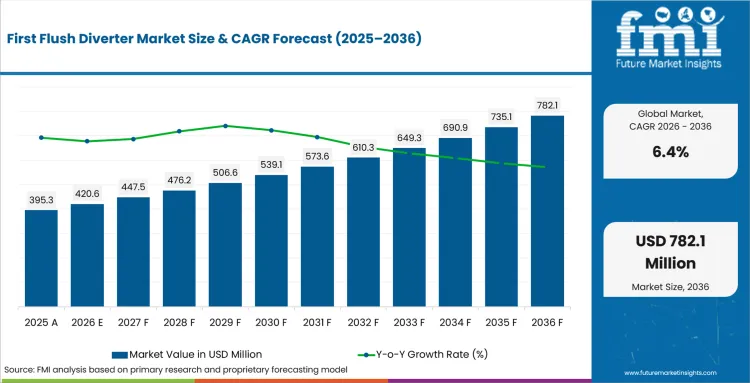
USD 420.6 million in 2026 and USD 782.1 million by 2036 at a 6.4% CAGR.
Sales of first flush diverters are estimated to rise at 6.4% CAGR through 2036, increasing valuation from USD 420.6 million in 2026 to USD 782.1 million by 2036. Roof area and contaminant loading determine the opening runoff volume requiring separation before water reaches storage. EPA’s April 2026 Arkansas summary requires an automatic first-flush diverter and filtration of 100 microns or finer for toilet and urinal flushing. That treatment sequence makes serviceable upstream diversion a functional requirement rather than an optional accessory. Residential water filters cannot replace a first-flush chamber that drains fully and reliably between rainfall events.
Residential installers compare debris load and intended water use before selecting a chamber that drains fully between storms. Underground rainwater modules preserve outdoor space while keeping first-flush control upstream of buried storage tanks. Water-level monitoring software helps commercial facilities coordinate stored volume with overflow control across connected reuse systems.
Key Takeaways of First Flush Diverter Market
- Roof contamination control is increasing demand for diverters that separate opening runoff from storage inflow.
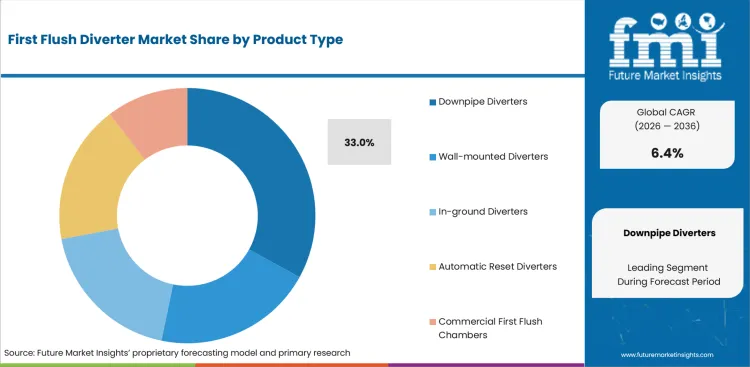
- Downpipe diverters are projected to account for 33.0% share in 2026 owing to straightforward retrofits across common vertical drainage layouts.
- Units rated from 20-100 L are estimated to capture 41.0% share in 2026 due to practical sizing across common catchments.
- PVC/uPVC is forecast to represent 48.0% share in 2026 supported by corrosion resistance and familiar plumbing methods.
- Blocked outlets remain a material restraint as incomplete drainage prevents dependable reset between closely spaced rainfall events.
- Rain Harvesting, Kingspan Water + Energy, GRAF, Tank Shop, Bushman Tanks, Polymaster, Rainwater Management Solutions and AquaBarrel serve exact first-flush applications.
Analyst Perspective
“First-flush performance depends less on oversized chambers than on reliable drainage between storms at each site. Installers protect stored-water quality and service margins by matching contaminant loading with an accessible reset path.”
- Nikhil Kaitwade, Principal Consultant, Future Market Insights
How is the First Flush Diverter Market segmented?
The first flush diverter industry is segmented by product type, capacity, material, application, sales channel and region.
Product type covers downpipe diverters, wall-mounted diverters, in-ground diverters, automatic reset diverters and commercial first-flush chambers. Capacity categories cover below 20 L, 20-100 L, 100-500 L and above 500 L across property scales. Material choices include PVC/uPVC, HDPE/polypropylene, stainless steel and concrete/modular tanks for exposed or buried configurations. Applications include residential rainwater harvesting, commercial buildings, industrial sites, agricultural water storage and municipal or institutional facilities. Sales channels include plumbing distributors, rainwater system installers, direct manufacturers and retail or e-commerce routes.
What makes downpipe diverters central to the product type category?
Downpipe diverters fit existing vertical drainage routes without separate excavation and preserve direct access to screens or drain outlets. Rain Harvesting supports wall-mounted, in-ground and electronic-release configurations that let installers match service access with the available property layout.
- The product type category is forecast to be led by downpipe diverters at 33.0% share in 2026 due to direct compatibility with common roof drainage layouts.
- Rain barrels support simple residential retrofits while automatic drainage reduces manual intervention between storms and protects available diversion volume. Technicians can inspect the chamber and outlet without opening the sealed storage tank during routine service visits.
Why does the 20-100 L segment support the capacity category?
Capacity selection begins with roof area and expected contaminant loading while storage volume follows later in the design decision. The 20-100 L range serves many homes and smaller commercial roofs without the wall weight or footprint required by larger treatment chambers.
- By capacity, 20-100 L units are estimated to hold 41.0% share in 2026 owing to balanced diversion volume across common residential and light-commercial catchments.
- Flexible water tanks can expand storage without changing the first-flush chamber while complete drainage preserves usable volume for the next rainfall event. Standardized fittings also let plumbing distributors support several catchment sizes through one serviceable component family.
How does PVC/uPVC shape the material category?
PVC/uPVC components suit exposed downpipes through familiar cutting and solvent-welding methods that use standard plumbing tools. Specifications that include low-carbon PVC piping can retain familiar installation methods while adding material records to the local project approval package.
- PVC/uPVC is set to lead the material category with 48.0% share in 2026 due to corrosion resistance and established plumbing distribution.
- Plumbing distributors stock polyvinyl chloride fittings across broad service territories, which reduces substitution work during routine repairs. Familiar components let plumbers repair exposed assemblies without specialist fabrication or long replacement delays across household and light-commercial properties.
What supports residential rainwater harvesting within the application category?
Households use first-flush diversion to protect stored water used for irrigation or non-potable indoor applications during recurring rainfall. Wall-mounted assemblies preserve direct access to the chamber and drain outlet across compact residential layouts.
- In 2026, residential rainwater harvesting is expected to lead the application category with 41.0% share because visible components suit routine household inspection and cleaning.
- Bushman Tanks offers an automatic ball-and-seat device that diverts contaminated opening runoff without electrical controls during normal household operation. Local plumbers can inspect the screen and drain outlet without disturbing the storage tank or interrupting the connected irrigation route.
What are the drivers, restraints and opportunities in the first flush diverter market?
Local rainwater regulations drive first-flush control adoption, but sediment buildup can impair performance, creating opportunities for adjustable chambers that simplify installation across varying catchment sizes.
- Driver: Plumbing rules and rainwater guidance increasingly require documented separation of contaminated opening runoff from storage inflow.
- Restraint: Fine debris can obstruct drainage outlets and reduce available diversion volume during the following rainfall event.
- Opportunity: Adjustable chambers and release controls let installers serve several roof sizes through one maintainable component family.
First-flush separation now belongs inside the collection route as a defined water-quality control for storage systems. Victorian health guidance updated in February 2026 recommends first-flush diversion and cleaning after rainfall, while downstream water treatment systems cannot restore capacity lost through incomplete drainage.
Fine sediment can restrict chamber drainage between rainfall events, so water testing kits cannot replace clear outlets and accessible service space around every reset component.
Adjustable chambers reduce equipment changes across varied catchment sizes, while commercial booster pumps maintain pressure and modular fittings simplify regional inventory across connected reuse systems.
Which country CAGRs are profiled in the first flush diverter market?
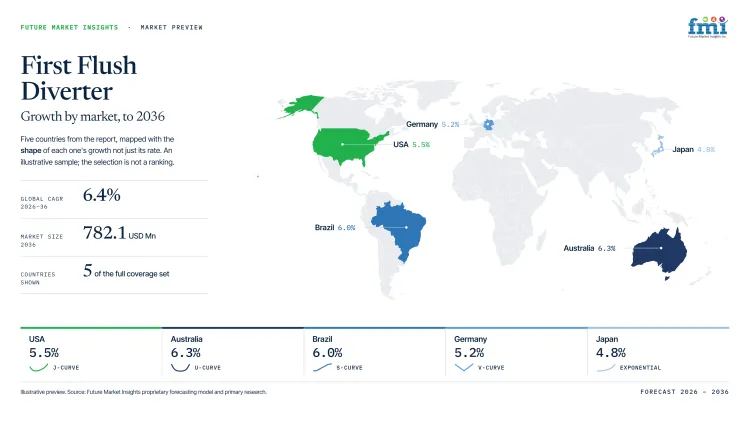
| Country | CAGR |
|---|---|
| United States | 5.5% |
| Germany | 5.2% |
| Japan | 4.8% |
| Australia | 6.3% |
| Brazil | 6.0% |
How do country-level CAGRs compare in the First Flush Diverter Market?
The country forecasts remain relatively close across the first flush diverter market, with a 1.5 percentage point gap between Australia and Japan. Australia and Brazil form an upper group, reflecting strong emphasis on rainwater harvesting, water conservation and stormwater management practices. The United States follows within a narrow range and benefits from growing adoption of rooftop rainwater collection systems in residential and commercial settings. Germany and Japan create a lower pair with limited separation, indicating steady demand supported by sustainable water infrastructure initiatives and green building practices. The pattern suggests that growth is being shaped by water security concerns, urban runoff management and increasing investment in decentralized water collection systems.
- Australia benefits from widespread use of rainwater harvesting systems and ongoing efforts to improve water resilience in drought-prone regions.
- Brazil supports market growth through increasing adoption of rooftop water collection solutions for residential, agricultural and institutional applications.
- The United States reflects steady demand as property owners and municipalities expand rainwater management and conservation initiatives.
- Germany maintains growth through sustainable building standards and continued focus on efficient stormwater management infrastructure.
- Japan supports market development through urban water management programs and growing interest in localized water collection systems.
Comparable CAGRs may still reflect different market conditions because rainfall patterns, water conservation policies, building regulations and adoption of rainwater harvesting systems vary across countries. The full report provides country-level CAGR analysis across North America, Latin America, Europe, East Asia, South Asia, Oceania and the Middle East and Africa.
Country-wise Analysis
- United States household installations commonly begin with small residential rain-barrel projects that depend on state reuse rules and serviceable downspout access nationwide. EPA’s Colorado summary updated in December 2025 allows two rain barrels holding up to 110 gallons without a permit and recommends first-flush screening for roof contaminants. The United States' first flush diverter market outlook is anticipated to advance at 5.5% CAGR over the assessment period, supported by established dealers and plumbing services across retrofit channels. Local stock shortens replacement visits, but different state and municipal rules raise training and warranty costs for national distributors serving several jurisdictions.
- German household rainwater systems depend on qualified plumbing installation and recurring maintenance across decentralized service networks serving older homes and smaller commercial properties across dense urban districts. Adoption of first flush diverters in Germany is estimated to expand at 5.2% CAGR through 2036, reinforced by specialist technical channels and dependable replacement access across established plumbing territories. Federal Environment Agency guidance updated in July 2025 requires expert installation and regular maintenance across domestic rainwater systems. Older building layouts can restrict drainage routes and exterior inspection access, increasing technician time during seasonal cleaning or component replacement visits in dense urban districts.
- Japanese household installations often fit compact rainwater equipment into narrow side passages that require coordinated service access around existing building systems and shared utility corridors. The transport ministry revised rainwater-use guidance in March 2025 and reported roughly 300 municipal incentive programs across the country with different local conditions. First flush diverter demand in Japan is forecast to rise at 4.8% CAGR over the forecast period, aided by compact configurations and established equipment channels serving household retrofit programs. Local subsidies support installation, but limited access raises labor requirements for cleaning and replacement across homes or small institutions outside major urban centers.
- Australian rainwater systems operate under national plumbing guidance while state and local authorities apply additional requirements across climate zones and connected household uses across urban and regional properties. First flush diverter sales in Australia are forecast to expand at 6.3% CAGR by 2036, driven by established tank distribution and household retrofit activity across urban and rural properties. Victoria updated its rainwater tank guidance in May 2026 and requires licensed plumbing for regulated downpipe or internal connections under applicable state rules. Long service distances increase inspection and travel costs across remote agricultural or coastal properties with limited local technician coverage.
- Brazilian urban drainage projects increasingly place source-control equipment within municipal plans that define responsibilities across drainage infrastructure and long-term service arrangements across growing secondary cities. The National Water and Sanitation Agency approved Reference Standard 12/2025 in March 2025 and defined technical qualification for local implementing bodies. Brazil is estimated to post 6.0% CAGR over the forecast period, shaped by clearer municipal source-control planning and defined municipal drainage service responsibilities. National guidance supports specification, but uneven municipal implementation complicates maintenance responsibility and access to trained installation teams across secondary cities outside major capitals during public works and contract renewal cycles.
Who are the notable companies in the First Flush Diverter Market?
Rain Harvesting, Kingspan Water + Energy, GRAF, Tank Shop, Bushman Tanks, Polymaster, Rainwater Management Solutions and AquaBarrel are notable companies serving this market.
The competition remains moderately fragmented as specialist diverter brands compete beside tank manufacturers and rainwater-system integrators. Entry depends on configuration breadth, installation support and spare-part access across regional service routes over time.
- Rain Harvesting and Tank Shop cover several diverter formats across household and commercial roof-water systems.
- Kingspan Water + Energy, GRAF, Bushman Tanks and Polymaster pair diversion components with broader tank or stormwater packages.
- Rainwater Management Solutions and AquaBarrel extend North American access through project design and specialist household distribution.
Competitive Benchmarking: First Flush Diverter Market
| Company | Diverter Portfolio | Application Breadth | Installation Support | Geographic Reach |
|---|---|---|---|---|
| Rain Harvesting | High | High | High | Multi-region |
| Kingspan Water + Energy | Low | Low | High | Australia |
| GRAF | High | Medium | Medium | Europe and selected export markets |
| Tank Shop | High | High | Medium | Australia |
| Bushman Tanks | Low | Low | Medium | Australia |
| Polymaster | Low | Medium | Medium | Australia |
| Rainwater Management Solutions | Low | Medium | High | North America |
| AquaBarrel | Low | Low | Medium | North America |
Key Developments in the First Flush Diverter Market
- In April 2026, Qazi Ashique E. Mowla and Syeda Tasbiha Dewan Kabir monitored eight rainfall events across residential zones in Dhaka. The study assessed pollutant wash-off against the Bangladesh National Building Code’s time-based guidance, supporting locally calibrated diverters instead of universal diversion settings.
- In October 2025, Stratco expanded Australian retail availability for Rain Harvesting’s chamberless First Flush Carrot and integrated Total Rain systems. The Carrot diverts the initial 20 liters without a conventional chamber, while Total Rain combines leaf screening with first-flush diversion for compact household retrofits.
First Flush Diverter Market - Report Scope
| Coverage field | Report scope |
|---|---|
| Market breakdown | By product type, capacity, material, application, sales channel and region. |
| Quantitative Units | Revenue USD million and CAGR in %. |
| Market Definition | The market covers products that divert contaminated initial roof runoff upstream of storage or reuse systems. |
| Regions Covered | North America, Latin America, Western Europe, Eastern Europe, East Asia, South Asia and Pacific, and Middle East and Africa. |
| Countries Covered | United States, Germany, Japan, Australia, Brazil and 20+ countries included in the full report. |
| Key Companies Profiled | Rain Harvesting, Kingspan Water + Energy, GRAF, Tank Shop, Bushman Tanks, Polymaster, Rainwater Management Solutions and AquaBarrel. |
| Forecast Period | 2026 to 2036. |
| Approach | Primary and secondary research with market triangulation. |
First Flush Diverter Market - Research Methodology
| Method | Approach |
|---|---|
| Primary Research | FMI analysts gathered input from manufacturers, service providers, technology developers, distributors, end users, procurement teams, and subject-matter experts. Interviews examined purchasing decisions, product or service evaluation, adoption barriers, approval requirements, pricing considerations, and expectations for technical or commercial support. Respondents were also asked what evidence is required before a trial, pilot, or initial order develops into regular purchasing. |
| Desk Research | Desk research covered government statistics, regulatory publications, trade data, industry associations, technical literature, standards, company filings, product information, and official corporate announcements. Sources were reviewed for relevance, publication date, geographic coverage, and consistency with the defined market scope. Claims relating to performance, applications, approvals, capacity, investment, and commercial activity were retained only when supported by credible public evidence. |
| Market Sizing and Forecasting | The market model combined the baseline value with historical performance, segment structure, pricing and volume indicators, adoption levels, company participation, and country-level demand conditions. Forecast assumptions considered economic activity, investment trends, regulatory developments, technology adoption, purchasing cycles, supply availability, and barriers to wider market use. Segment and regional estimates were reconciled before the final market total was calculated. |
| Data Validation | Estimates were checked against multiple independent indicators, including public data, company activity, trade patterns, industry developments, and findings from primary interviews. Validation also tested whether products, services, applications, and company revenues fell within the defined market boundaries. Adjacent categories, unsupported claims, overlapping revenues, and activities without direct market relevance were excluded to reduce double counting and maintain consistency across segments and countries. |
First Flush Diverter Market by Segments
First Flush Diverter Market segmented by Product Type:
- Downpipe Diverters
- Wall-mounted Diverters
- In-ground Diverters
- Automatic Reset Diverters
- Commercial First Flush Chambers
First Flush Diverter Market segmented by Capacity:
- 20-100 L
- <20 L
- 100-500 L
- >500 L
First Flush Diverter Market segmented by Material:
- PVC / uPVC
- HDPE / Polypropylene
- Stainless Steel
- Concrete / Modular Tanks
First Flush Diverter Market segmented by Application:
- Residential Rainwater Harvesting
- Commercial Buildings
- Industrial Sites
- Agricultural Water Storage
- Municipal / Institutional
First Flush Diverter Market segmented by Sales Channel:
- Plumbing Distributors
- Rainwater System Installers
- Direct Manufacturer
- Retail / E-commerce
First Flush Diverter Market by Region:
- North America
- United States
- Canada
- Latin America
- Brazil
- Chile
- Mexico
- Rest of Latin America
- Western Europe
- Germany
- United Kingdom
- Italy
- Spain
- France
- Nordics
- Benelux
- Rest of Western Europe
- Eastern Europe
- Russia
- Poland
- Hungary
- Balkan and Baltic States
- Rest of Eastern Europe
- East Asia
- China
- Japan
- South Korea
- South Asia and Pacific
- India
- ASEAN
- Australia and New Zealand
- Rest of South Asia and Pacific
- Middle East and Africa
- Kingdom of Saudi Arabia
- Other GCC Countries
- Türkiye
- South Africa
- Other African Union Countries
- Rest of Middle East and Africa
Research Sources and Bibliography
- United States Environmental Protection Agency. (2026, April 22). Summary of Arkansas’ Water Reuse Guideline or Regulation for Onsite Non-potable Water Reuse.
- State of Victoria. (2026, February 9). Rainwater.
- United States Environmental Protection Agency. (2025, December 9). Summary of Colorado’s Water Reuse Guidelines or Regulations for Consumption by Livestock, Landscaping and Onsite Non-potable Water Reuse.
- Umweltbundesamt. (2025, July 11). Tipps für eine nachhaltige Regenwassernutzung.
- Ministry of Land, Infrastructure, Transport and Tourism. (2025, March).
- State of Victoria. (2026, May 20). How to get the most out of your rain water tank.
- Agência Nacional de Águas e Saneamento Básico. (2025, April 3). Norma de referência da ANA define serviços, atividades e infraestruturas dos serviços públicos de drenagem e manejo de águas pluviais urbanas.
- Bushman Tanks. (n.d.). 90mm Rain Harvesting First Flush Diverter.
- Rainwater Management Solutions. (n.d.). WISY Polypropylene Downspout Rainwater Filter.
- Polymaster. (2026, July 8). Water Storage: Liquid Asset Protection.
- Bushman Tanks. (2025, July 1). Queensland Floods: How to Use Rainwater Tanks to Manage Overflow and Protect Your Property.
- Chenkin, B. (2025, April 25). Downspout Diverter Clogging? How to Clear and Prevent It for Good.
This Report Answers
- How large is the first flush diverter market in 2026 and 2036?
- Which operating conditions support demand for first flush diverters across roof-water systems?
- Which product type is projected to hold the largest share during 2026?
- How does diversion capacity influence installation and maintenance decisions across properties?
- Which material supports broad plumbing compatibility across exposed first-flush assemblies?
- How do country growth rates translate into different commercial entry conditions?
- Which companies provide exact first-flush products or related project support?
- What currently limits dependable chamber reset across recurring rainfall events?
- How should project teams compare diverter configurations before final specification?
Frequently Asked Questions
How big is the First Flush Diverter Market in 2026?
The first flush diverter market is valued at USD 420.6 million in 2026 and is forecast to reach USD 782.1 million by 2036. Growth is supported by rainwater regulations that require documented separation of contaminated opening runoff from storage inflow across residential and commercial catchment systems.
What is the CAGR of the First Flush Diverter Market from 2026 to 2036?
The first flush diverter market grows at a CAGR of 6.4% between 2026 and 2036, driven by plumbing rules and rainwater guidance that increasingly require documented contaminant separation, while sediment buildup restricts drainage and creates demand for adjustable, serviceable chamber designs.
Which product type leads the First Flush Diverter Market?
Downpipe diverters lead the first flush diverter market by product type, holding 33.0% share in 2026 due to direct compatibility with common vertical roof drainage layouts. Their fit with existing routes avoids separate excavation and preserves service access to screens and drain outlets.
How much will the First Flush Diverter Market add between 2026 and 2036?
The first flush diverter market is set to add USD 361.5 million between 2026 and 2036, growing from USD 420.6 million to USD 782.1 million as rainwater regulations and decentralized water collection systems expand demand across residential, commercial and municipal catchment applications.
Who are the leading companies in the First Flush Diverter Market?
Eight companies lead the first flush diverter market, including Rain Harvesting, Kingspan Water + Energy, GRAF, Tank Shop, Bushman Tanks, Polymaster, Rainwater Management Solutions, and AquaBarrel, competing through diverter portfolio breadth, installation support and regional tank or stormwater system integration.
Preview the report firsthand - request a free sample
Get SampleGet the brochure for pricing and purchase details.
Get PDFTable of Content
- Key Takeaways
- Market Size and CAGR
- Top Growth Driver
- Fastest Growing Segment
- Leading Region
- Key Companies
- Emerging Opportunities
- Executive Summary
- Global Market Outlook
- Demand-side Trends
- Supply-side Trends
- Technology Roadmap Analysis
- Analysis and Recommendations
- Analyst Perspective (What is happening? Why now? What should investors know?)
- Key Questions Answered
- How large is the market?
- What is the CAGR?
- What are key trends?
- Which region dominates?
- Who are the leaders?
- Market Overview
- Market Coverage / Taxonomy
- Market Definition / Scope / Limitations
- Research Methodology
- Chapter Orientation
- Analytical Lens and Working Hypotheses
- Market Structure, Signals, and Trend Drivers
- Benchmarking and Cross-market Comparability
- Market Sizing, Forecasting, and Opportunity Mapping
- Research Design and Evidence Framework
- Desk Research Programme (Secondary Evidence)
- Expert Input and Fieldwork (Primary Evidence)
- Tooling, Models, and Reference Databases
- Data Engineering and Model Build
- Quality Assurance and Audit Trail
- Market Background
- Market Dynamics (Drivers, Restraints, Opportunity, Trends)
- Scenario Forecast (Optimistic, Likely, Conservative)
- Impact Analysis
- AI Impact
- Sustainability Impact
- Regulatory Impact
- Technology Impact
- Consumer / Buyer Analysis
- Purchase Drivers
- Adoption Barriers
- Buyer Journey
- Opportunity Map Analysis
- Product Life Cycle Analysis
- Supply Chain Analysis
- Investment Feasibility Matrix
- Value Chain Analysis
- PESTLE and Porter's Analysis
- Regulatory Landscape
- Regional Parent Market Outlook
- Production and Consumption Statistics
- Import and Export Statistics
- Global Market Analysis and Forecast, 2021 to 2036
- Historical Market Size Value (USD Million) Analysis, 2021 to 2025
- Current and Future Market Size Value (USD Million) Projections, 2026 to 2036
- Y-o-Y Growth Trend Analysis
- Absolute $ Opportunity Analysis
- Global Market Pricing Analysis, 2021 to 2036
- Global Market Analysis and Forecast, By Product Type, 2021 to 2036
- Introduction / Key Findings
- Historical Market Size Value (USD Million) Analysis By Product Type, 2021 to 2025
- Current and Future Market Size Value (USD Million) Analysis and Forecast By Product Type, 2026 to 2036
- Downpipe Diverters
- Wall-mounted Diverters
- In-ground Diverters
- Automatic Reset Diverters
- Commercial First Flush Chambers
- Downpipe Diverters
- Y-o-Y Growth Trend Analysis By Product Type, 2021 to 2025
- Absolute $ Opportunity Analysis By Product Type, 2026 to 2036
- Global Market Analysis and Forecast, By Capacity, 2021 to 2036
- Introduction / Key Findings
- Historical Market Size Value (USD Million) Analysis By Capacity, 2021 to 2025
- Current and Future Market Size Value (USD Million) Analysis and Forecast By Capacity, 2026 to 2036
- 20-100 L
- <20 L
- 100-500 L
- >500 L
- 20-100 L
- Y-o-Y Growth Trend Analysis By Capacity, 2021 to 2025
- Absolute $ Opportunity Analysis By Capacity, 2026 to 2036
- Global Market Analysis and Forecast, By Material, 2021 to 2036
- Introduction / Key Findings
- Historical Market Size Value (USD Million) Analysis By Material, 2021 to 2025
- Current and Future Market Size Value (USD Million) Analysis and Forecast By Material, 2026 to 2036
- PVC / uPVC
- HDPE / Polypropylene
- Stainless Steel
- Concrete / Modular Tanks
- PVC / uPVC
- Y-o-Y Growth Trend Analysis By Material, 2021 to 2025
- Absolute $ Opportunity Analysis By Material, 2026 to 2036
- Global Market Analysis and Forecast, By Application, 2021 to 2036
- Introduction / Key Findings
- Historical Market Size Value (USD Million) Analysis By Application, 2021 to 2025
- Current and Future Market Size Value (USD Million) Analysis and Forecast By Application, 2026 to 2036
- Residential Rainwater Harvesting
- Commercial Buildings
- Industrial Sites
- Agricultural Water Storage
- Municipal / Institutional
- Residential Rainwater Harvesting
- Y-o-Y Growth Trend Analysis By Application, 2021 to 2025
- Absolute $ Opportunity Analysis By Application, 2026 to 2036
- Global Market Analysis and Forecast, By Sales Channel, 2021 to 2036
- Introduction / Key Findings
- Historical Market Size Value (USD Million) Analysis By Sales Channel, 2021 to 2025
- Current and Future Market Size Value (USD Million) Analysis and Forecast By Sales Channel, 2026 to 2036
- Plumbing Distributors
- Rainwater System Installers
- Direct Manufacturer
- Retail / E-commerce
- Plumbing Distributors
- Y-o-Y Growth Trend Analysis By Sales Channel, 2021 to 2025
- Absolute $ Opportunity Analysis By Sales Channel, 2026 to 2036
- Global Market Analysis and Forecast, By Region, 2021 to 2036
- Introduction
- Historical Market Size Value (USD Million) Analysis By Region, 2021 to 2025
- Current Market Size Value (USD Million) Analysis and Forecast By Region, 2026 to 2036
- North America
- Latin America
- Western Europe
- Eastern Europe
- East Asia
- South Asia and Pacific
- Middle East & Africa
- Market Attractiveness Analysis By Region
- North America Market Analysis and Forecast, By Country, 2021 to 2036
- Historical Market Size Value (USD Million) Trend Analysis By Market Taxonomy, 2021 to 2025
- Market Size Value (USD Million) Forecast By Market Taxonomy, 2026 to 2036
- By Country
- USA
- Canada
- By Product Type
- By Capacity
- By Material
- By Application
- By Sales Channel
- By Country
- Market Attractiveness Analysis
- By Country
- By Product Type
- By Capacity
- By Material
- By Application
- By Sales Channel
- Key Takeaways
- Latin America Market Analysis and Forecast, By Country
- Historical Market Size Value (USD Million) Trend Analysis By Market Taxonomy, 2021 to 2025
- Market Size Value (USD Million) Forecast By Market Taxonomy, 2026 to 2036
- By Country
- Brazil
- Mexico
- Chile
- Rest of Latin America
- By Product Type
- By Capacity
- By Material
- By Application
- By Sales Channel
- By Country
- Market Attractiveness Analysis
- By Country
- By Product Type
- By Capacity
- By Material
- By Application
- By Sales Channel
- Key Takeaways
- Western Europe Market Analysis and Forecast, By Country
- Historical Market Size Value (USD Million) Trend Analysis By Market Taxonomy, 2021 to 2025
- Market Size Value (USD Million) Forecast By Market Taxonomy, 2026 to 2036
- By Country
- Germany
- UK
- Italy
- Spain
- France
- Nordic
- BENELUX
- Rest of Western Europe
- By Product Type
- By Capacity
- By Material
- By Application
- By Sales Channel
- By Country
- Market Attractiveness Analysis
- By Country
- By Product Type
- By Capacity
- By Material
- By Application
- By Sales Channel
- Key Takeaways
- Eastern Europe Market Analysis and Forecast, By Country
- Historical Market Size Value (USD Million) Trend Analysis By Market Taxonomy, 2021 to 2025
- Market Size Value (USD Million) Forecast By Market Taxonomy, 2026 to 2036
- By Country
- Russia
- Poland
- Hungary
- Balkan & Baltic
- Rest of Eastern Europe
- By Product Type
- By Capacity
- By Material
- By Application
- By Sales Channel
- By Country
- Market Attractiveness Analysis
- By Country
- By Product Type
- By Capacity
- By Material
- By Application
- By Sales Channel
- Key Takeaways
- East Asia Market Analysis and Forecast, By Country
- Historical Market Size Value (USD Million) Trend Analysis By Market Taxonomy, 2021 to 2025
- Market Size Value (USD Million) Forecast By Market Taxonomy, 2026 to 2036
- By Country
- China
- Japan
- South Korea
- By Product Type
- By Capacity
- By Material
- By Application
- By Sales Channel
- By Country
- Market Attractiveness Analysis
- By Country
- By Product Type
- By Capacity
- By Material
- By Application
- By Sales Channel
- Key Takeaways
- South Asia and Pacific Market Analysis and Forecast, By Country
- Historical Market Size Value (USD Million) Trend Analysis By Market Taxonomy, 2021 to 2025
- Market Size Value (USD Million) Forecast By Market Taxonomy, 2026 to 2036
- By Country
- India
- ASEAN
- Australia & New Zealand
- Rest of South Asia and Pacific
- By Product Type
- By Capacity
- By Material
- By Application
- By Sales Channel
- By Country
- Market Attractiveness Analysis
- By Country
- By Product Type
- By Capacity
- By Material
- By Application
- By Sales Channel
- Key Takeaways
- Middle East & Africa Market Analysis and Forecast, By Country
- Historical Market Size Value (USD Million) Trend Analysis By Market Taxonomy, 2021 to 2025
- Market Size Value (USD Million) Forecast By Market Taxonomy, 2026 to 2036
- By Country
- Kingdom of Saudi Arabia
- Other GCC Countries
- Türkiye
- South Africa
- Other African Union
- Rest of Middle East & Africa
- By Product Type
- By Capacity
- By Material
- By Application
- By Sales Channel
- By Country
- Market Attractiveness Analysis
- By Country
- By Product Type
- By Capacity
- By Material
- By Application
- By Sales Channel
- Key Takeaways
- Key Countries Market Analysis
- USA
- Pricing Analysis
- Market Share Analysis, 2025
- By Product Type
- By Capacity
- By Material
- By Application
- By Sales Channel
- Canada
- Pricing Analysis
- Market Share Analysis, 2025
- By Product Type
- By Capacity
- By Material
- By Application
- By Sales Channel
- Mexico
- Pricing Analysis
- Market Share Analysis, 2025
- By Product Type
- By Capacity
- By Material
- By Application
- By Sales Channel
- Brazil
- Pricing Analysis
- Market Share Analysis, 2025
- By Product Type
- By Capacity
- By Material
- By Application
- By Sales Channel
- Chile
- Pricing Analysis
- Market Share Analysis, 2025
- By Product Type
- By Capacity
- By Material
- By Application
- By Sales Channel
- Germany
- Pricing Analysis
- Market Share Analysis, 2025
- By Product Type
- By Capacity
- By Material
- By Application
- By Sales Channel
- UK
- Pricing Analysis
- Market Share Analysis, 2025
- By Product Type
- By Capacity
- By Material
- By Application
- By Sales Channel
- Italy
- Pricing Analysis
- Market Share Analysis, 2025
- By Product Type
- By Capacity
- By Material
- By Application
- By Sales Channel
- Spain
- Pricing Analysis
- Market Share Analysis, 2025
- By Product Type
- By Capacity
- By Material
- By Application
- By Sales Channel
- France
- Pricing Analysis
- Market Share Analysis, 2025
- By Product Type
- By Capacity
- By Material
- By Application
- By Sales Channel
- India
- Pricing Analysis
- Market Share Analysis, 2025
- By Product Type
- By Capacity
- By Material
- By Application
- By Sales Channel
- ASEAN
- Pricing Analysis
- Market Share Analysis, 2025
- By Product Type
- By Capacity
- By Material
- By Application
- By Sales Channel
- Australia & New Zealand
- Pricing Analysis
- Market Share Analysis, 2025
- By Product Type
- By Capacity
- By Material
- By Application
- By Sales Channel
- China
- Pricing Analysis
- Market Share Analysis, 2025
- By Product Type
- By Capacity
- By Material
- By Application
- By Sales Channel
- Japan
- Pricing Analysis
- Market Share Analysis, 2025
- By Product Type
- By Capacity
- By Material
- By Application
- By Sales Channel
- South Korea
- Pricing Analysis
- Market Share Analysis, 2025
- By Product Type
- By Capacity
- By Material
- By Application
- By Sales Channel
- Russia
- Pricing Analysis
- Market Share Analysis, 2025
- By Product Type
- By Capacity
- By Material
- By Application
- By Sales Channel
- Poland
- Pricing Analysis
- Market Share Analysis, 2025
- By Product Type
- By Capacity
- By Material
- By Application
- By Sales Channel
- Hungary
- Pricing Analysis
- Market Share Analysis, 2025
- By Product Type
- By Capacity
- By Material
- By Application
- By Sales Channel
- Kingdom of Saudi Arabia
- Pricing Analysis
- Market Share Analysis, 2025
- By Product Type
- By Capacity
- By Material
- By Application
- By Sales Channel
- Türkiye
- Pricing Analysis
- Market Share Analysis, 2025
- By Product Type
- By Capacity
- By Material
- By Application
- By Sales Channel
- South Africa
- Pricing Analysis
- Market Share Analysis, 2025
- By Product Type
- By Capacity
- By Material
- By Application
- By Sales Channel
- USA
- Market Structure Analysis
- Competition Dashboard
- Competition Benchmarking
- Market Share Analysis of Top Players
- By Regional
- By Product Type
- By Capacity
- By Material
- By Application
- By Sales Channel
- Emerging Startups
- Innovation Benchmarking
- Competition Analysis
- Competition Deep Dive
- Rain Harvesting Supplies
- Overview
- Product Portfolio
- Profitability by Market Segments
- Sales Footprint
- Strategy Overview
- Marketing Strategy
- Product Strategy
- Channel Strategy
- Kingspan Water & Energy
- Graf
- WISY
- Iplex Pipelines
- Bushman Tanks
- Tank Shop
- Rainwater Management Solutions
- Polymaster
- AquaBarrel
- Rain Harvesting Supplies
- Case Studies
- Success Stories
- Recent Developments
- Competition Deep Dive
- Assumptions & Acronyms Used


