

- Market Size (2026)
- USD 195.3 Mn
- Forecast (2036)
- USD 318.1 Mn
- CAGR (2026 to 2036)
- 5.0%
How big is Thermal & Glacier Water Ingredients Market in 2026?
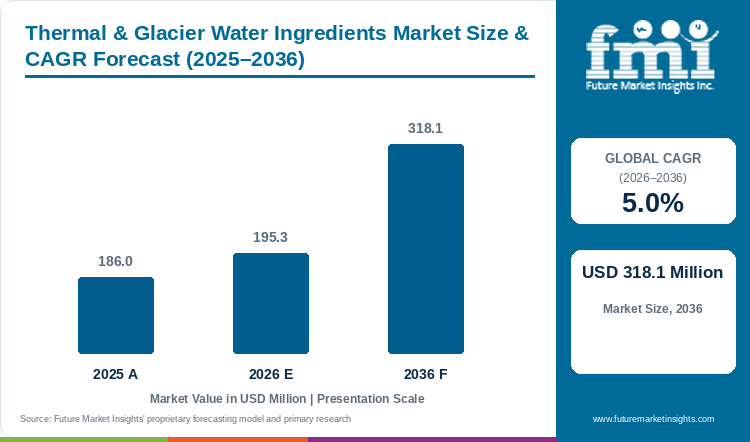
Thermal and glacier water ingredients were worth USD 186.0 million in 2025, rise to USD 195.3 million in 2026 and reach USD 318.1 million in 2036. Sales will expand at a 5% CAGR from 2026 to 2036, as skincare brands pay a premium for named spring and glacial water backed by test data.
Demand for thermal and glacier water ingredients is increasing as skincare formulators ask for composition, microbiology and claim files before ordering a named water. In March 2026, an Applied Sciences review reported 46% lower blood flow on irritated skin treated with a La Roche-Posay thermal water gel, against 15% for demineralised water [1]. Dermocosmetic sales back this pull, as L'Oréal's Dermatological Beauty division sold EUR 7,204.1 million in 2025, up 5.5% like-for-like [2]. Apart from that, in May 2026, Pierre Fabre announced nearly EUR 50 million to raise Avène plant output from 100 million to 200 million units a year by 2029 [3]. FMI finds that standard grade holds the leading 42% share in 2026, as formulators drop this grade into emulsions, gels and sprays without a clinical test file. Makers of facial care products will keep looking for spring and glacier inputs backed by test data.
Key Market Trends & Insights
- By product type, standard grade led with a 42% share in 2026, as cosmetic chemists prefer one repeatable water input that fits routine specifications and cost targets.
- By function, anti-aging accounts for 29% of revenue in 2026. In April 2026, Symrise launched Cellexora MD and SymConcentrole Barrier Boost for regeneration, barrier strength and elasticity [4].
- By application, facial skincare stays in front at 39% in 2026, as serums, essences and face mists print the water source on the front of the pack.
- By grade, standard cosmetic grade holds 50% of revenue in 2026, as mainstream skincare briefs ask for safety and quality data without a special certificate. Certified grades are gaining ground, with COSMOS counting more than 11,800 certified raw materials [5].
- By sales channel, direct to brands takes 50% of revenue in 2026, as approving a new water calls for close work between supplier and brand formulator.
Regional Highlights
- Fastest-growing profiled country: South Korea, with a 6.3% CAGR from 2026 to 2036, ahead of the 5% global rate.
- By country: the USA follows at 5.3%, France at 4.7% and Japan at 4.4%, and Germany posts the lowest profiled CAGR at 4.1% through 2036.
- Korean skincare exports keep orders for glacier water rising, as Ministry of Food and Drug Safety data put 2025 cosmetics exports at a record USD 11.4 billion, up 11.8% [6].
Market Size & Forecast
Table 1: Market Size and Forecast for the Thermal & Glacier Water Ingredients Market (USD million and percentage), 2025 to 2036
| Metric | Value |
|---|---|
| 2025 Market Size | USD 186.0 million |
| Estimated Market Size in 2026 | USD 195.3 million |
| Projected Market Size by 2036 | USD 318.1 million |
| CAGR, 2026 to 2036 | 5% |
| Added Revenue, 2026 to 2036 | USD 122.8 million |
| Market Expansion Multiple | 1.6x |
Sales of thermal and glacier water ingredients are concentrated among a small group of dermocosmetic brands and the ingredient houses supplying competing labels. Spring-owning brands set the reference point, so rival labels need a named water with comparable test records. Shoppers keep buying spa-origin skincare, as Eau Thermale Avène grew 3.9% at constant exchange rates in 2025 [3]. Suppliers of functional cosmetic ingredients are widening the range of actives held in one water phase, and Clariant added the natural-origin preservative Nipaguard SCE Vita in March 2025 [7]. However, mineral content differs widely between springs, and finished labels often list the water only as Aqua or Water, which limits the price premium [1] [8]. Documented water systems clearing brand approval quickly are expected to set the pace of new orders through 2036.
Skin Evidence, Approval Readiness and Beauty Export Scale
Demand for thermal and glacier water ingredients is shifting toward suppliers able to prove what is in the water. In March 2026, an Applied Sciences review reported soothing, hydrating, antioxidant and barrier-restoring effects for thermal spring waters [1]. Most covered studies are company-linked, due to which buyers are asking for independent trials before paying a premium [1]. Spa brands keep adding output, and Pierre Fabre is aiming the larger Avène plant at shoppers in China and the United States [3]. Apart from that, ingredient houses now sell the water with the actives a formula needs, such as the Symrise launches of April 2026 [4]. Clariant added the Nipaguard SCE Vita preservative blend in March 2025 [7]. Certified grades have a wide base, as COSMOS counted more than 11,800 certified and 11,400 approved raw materials in January 2026 [5]. The same COSMOS data showed over 31,100 certified products sold in 80 countries [5]. Mibelle Biochemistry sells Lipobelle Glacier with COSMOS and NATRUE approval at a suggested use level of 1-5% [8]. In the USA, more than 14,000 cosmetic facilities renew registration every two years under MoCRA [9]. A shift in mineral content can force brands to redo files across a whole range, so fixed specifications carry a premium. FMI expects ready-made, certified and documented water systems to gain share through 2036.
Sales of named waters vary by country with export scale and the paperwork behind each launch. South Korea shipped USD 10.2 billion of cosmetics in 2024, up 20.3% and third worldwide, in a ranking that put French exports at USD 23.25 billion [10]. French cosmetics exports reached EUR 22.5 billion in 2024, with makeup and facial care worth about EUR 11 billion [11]. In Germany, an IKW projection from December 2025 put 2025 home sales of personal and household care at EUR 23.9 billion, up 5.5%, with foreign sales down 2.1% [12]. Japanese brands treat quality and safety as the most basic requirement for any new ingredient, so new waters enter formulas slowly [13]. Korean skincare exporters keep searching for fresh skin-calming inputs such as glacier water. As per FMI, revenue from thermal and glacier water ingredients will add USD 122.8 million between 2026 and 2036. Exporters filing in many countries will favour suppliers offering one document set accepted across regions.
Table 2: Skin Evidence, Approval and Beauty Industry Indicators for the Thermal & Glacier Water Ingredients Market (percentages, currency values, production units, raw material counts and facility counts), 2024 to 2026
| Indicator | Data Point | Why This Matters | Source |
|---|---|---|---|
| Thermal spring water review | Soothing, hydrating, antioxidant and barrier effects reported; most studies company-linked (March 2026) | Buyers ask for independent studies before paying more for a named water. | [1] |
| Thermal water gel irritation test | 46% lower skin blood flow vs 15% for demineralised water | Brands can make a measurable soothing claim over plain water. | [1] |
| Vichy thermal water barrier test | 18% lower water loss through the skin vs untreated control at week three | Barrier claims push brands toward mineral-rich waters. | [1] |
| L'Oréal Dermatological Beauty sales | EUR 7,204.1 million in 2025, up 5.5% like-for-like | Demand for thermal water skincare brands keeps rising among shoppers. | [2] |
| Avène plant capacity | 100 million to 200 million units a year by 2029; nearly EUR 50 million | Larger spa-brand output pushes rival brands to find named waters of equal standard. | [3] |
| COSMOS certified raw materials | More than 11,800 certified and 11,400 approved; January 2026 | Certified water grades reach natural-claim products faster. | [5] |
| U.S. cosmetic facility registrations | More than 14,000 facilities; renewal every two years under MoCRA | U.S. brands favour water suppliers with fixed specifications. | [9] |
| Korean cosmetics exports | USD 10.2 billion in 2024, up 20.3%, third worldwide | Fast export growth keeps South Korea the fastest-growing profiled country. | [10] |
| French cosmetics exports | EUR 22.5 billion in 2024; makeup and facial care about EUR 11 billion | France stays a large buyer of named waters despite mid-table growth. | [11] |
| German personal and household care revenue | Domestic EUR 23.9 billion, up 5.5%; exports down 2.1% (2025 projection) | Firm home sales support Germany's 4.1% CAGR through 2036. | [12] |
Table 3: Beauty Industry Scale and Qualification Benchmarks for the Thermal & Glacier Water Ingredients Market (mixed units and currencies), 2024-2026
| Market / item | Indicator | Value | Source |
|---|---|---|---|
| South Korea | Cosmetics exports, 2024 | USD 10.2 billion, up 20.3%, third worldwide | [10] |
| France | Cosmetics exports, 2024 | EUR 22.5 billion; makeup and facial care about EUR 11 billion | [11] |
| France vs South Korea | Cosmetics exports compared, 2024 | USD 23.25 billion vs USD 10.2 billion | [10] |
| USA | Registered cosmetic facilities | More than 14,000, renewal every two years | [9] |
| Germany | Domestic personal and household care revenue, 2025 projection | EUR 23.9 billion, up 5.5%; exports down 2.1% | [12] |
| Global dermocosmetic brand sales | L'Oréal Dermatological Beauty, 2025 | EUR 7,204.1 million, up 5.5% like-for-like | [2] |
| Market forecast increment | Added market value, 2026-2036 | USD 122.8 million | Future Market Insights |
Analyst Perspective
“Brands will pay a premium for spring and glacial waters only when the mineral profile holds steady across batches and claim and safety files are ready at approval. Suppliers pairing the water with preservation, skin actives and country filing support are set to secure the longest contracts through 2036.”
- Nandini Roy Choudhury, Principal Consultant, Future Market Insights.
How is the thermal and glacier water ingredients market segmented?
The thermal and glacier water ingredients market is studied across product type, function, application, grade, sales channel and region. Standard grade leads product type at 42% in 2026, and standard cosmetic grade takes 50% of grade revenue. Anti-aging leads function at 29%, facial skincare leads application at 39%, and direct supply to brands holds half of channel revenue.
By product type: standard grade, high-purity / clinical grade, natural & certified grade, and customized systems.
By function: anti-aging, hydration & barrier, brightening, soothing & sensitive, and UV & protection.
By application: facial skincare, body care, haircare, color cosmetics, and suncare.
By grade: standard cosmetic grade, COSMOS / natural certified, pharma & clinical grade, and organic certified.
By sales channel: direct to brands, specialty distributors, contract manufacturers, and online B2B.
By region: North America, Latin America, Western Europe, Eastern Europe, East Asia, South Asia and Pacific, and Middle East and Africa.
Why does standard grade hold the top product type position?
Standard grade water is forecast to take 42% of product type sales in 2026, as this grade suits routine formulas without a clinical test file.
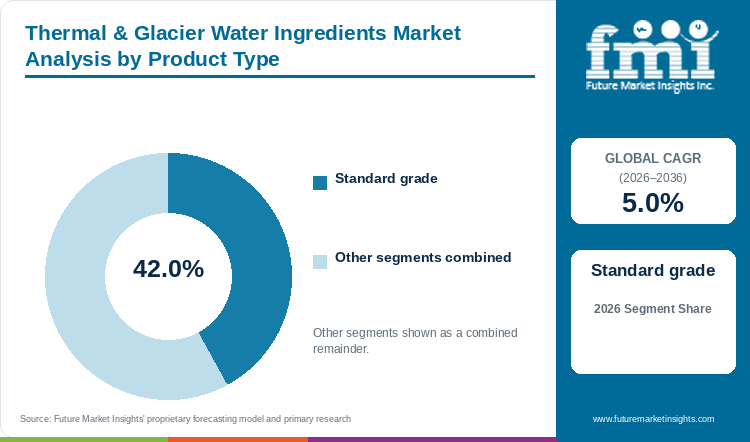
Table 4: Product Type Share for the Thermal & Glacier Water Ingredients Market (percentage share), 2026
| Product Type | Share (2026) |
|---|---|
| Standard grade | 42% |
| Other Segments Combined | 58% |
| Total | 100% |
Table 5: Product Type Leadership and Market Growth for the Thermal & Glacier Water Ingredients Market (segment and CAGR percentage), 2026 to 2036
| Metric | Value |
|---|---|
| Global CAGR (2026 to 2036) | 5% |
| Leading Segment | Standard grade |
Standard grade leads the product type category with 42% of revenue in 2026, according to FMI. Cosmetic chemists prefer this tier for emulsions, gels, sprays and skin toners, as a steady water input at a set cost fits routine specifications. High-purity grades and customised systems stay smaller, as brands reserve these tiers for strict sensitive-skin claims. In March 2026, an Applied Sciences review found mineral content varying widely between springs, which keeps premium tiers in use for clinical claims [1]. Standard grade is expected to remain the largest product type through 2036, and customised systems will gain ground in premium launches.
- Standard grade holds a 42% share in 2026, as this tier fits routine formulas and cost targets without a clinical test file.
- Spring composition can change between batches, so buyers ask for mineral and microbiology results on each lot before approving a reorder.
What draws function demand toward anti-aging?
Anti-aging is placed at 29% of function revenue in 2026, reflecting brand focus on firming and longevity claims.
FMI notes that anti-aging leads the function category with 29% of revenue in 2026, owing to premium serums and creams combining a named water with firming actives. Hydration and barrier, soothing, brightening and UV protection uses follow, as these claims add less to shelf price. L'Oréal said the launch of Collagen Specialist 16 helped Vichy grow in 2025 [2]. In April 2026, Croda Beauty presented Matrixyl Neolide, a peptide delivery system with early firming results in two weeks, at in-cosmetics global in Paris [14]. Anti-aging is projected to keep the top function position, as brands look for longer-lasting skin claims through 2036.
- Premium serums pairing named waters with firming actives bring anti-aging to 29% of function revenue in 2026.
- Croda Beauty's Matrixyl Neolide received a BSB Innovation Award in April 2026, and brands pairing such peptides with a named water run stability tests before launch [14].
Why is facial skincare the main application for named waters?
Facial skincare is likely to account for 39% of application sales in 2026, led by serums, essences and mists naming the water source.
Facial skincare is the largest application at 39% of sales in 2026, as face mists, serums and essences are mostly water and carry the source name on pack. Body care, haircare, color cosmetics and suncare follow, as named water plays a smaller role in those formulas. In March 2026, a review cited a 47% fall in skin sensitivity scores after seven days of Avène thermal water use [1]. Brands of face mists and sensitive-skin creams print such results on pack and in store displays. Facial skincare is expected to stay close to two-fifths of application sales through 2036.
- Facial skincare holds 39% of application sales in 2026, supported by spring-origin comfort claims printed on serums and mists.
- Brands naming the spring on pack need a supplier able to document the same source over many years of reorders.
Why does standard cosmetic grade cover half of grade revenue?
Standard cosmetic grade takes 50% of grade revenue in 2026 by meeting mainstream safety rules without certification fees.
FMI estimates that standard cosmetic grade covers 50% of grade revenue in 2026, the largest share in the category. Mainstream product briefs need safety and quality data but no special certificate, keeping qualification costs low for brand owners. COSMOS and natural certified grades form the main alternative, with more than 31,100 COSMOS certified products sold in 80 countries in January 2026 [5]. Mibelle Biochemistry sells Lipobelle Glacier, a liposomal Swiss glacier water, with COSMOS and NATRUE approval [8]. Pharma, clinical and organic grades serve narrower claims, and certified grades are expected to gain share through 2036.
- Lower qualification cost keeps standard cosmetic grade at 50% of grade revenue in 2026.
- Brands planning a natural claim check that the certificate covers the exact water grade ordered, as Mibelle lists COSMOS and NATRUE approval for Lipobelle Glacier [8].
Why do brands buy named waters directly from suppliers?
Direct to brands sales are forecast to make up 50% of channel revenue in 2026, as approval needs close formulation work.
Direct to brands holds 50% of channel revenue in 2026, as a brand formulator needs source records, composition data and microbial limits during approval. In April 2026, Symrise met formulators at a Cellexora MD seminar during in-cosmetics global in Paris [4]. Specialty distributors serve smaller brands, contract manufacturers buy for owned formulas, and online B2B supports early product searches. Each of these routes handles less approval work, so each holds a smaller share. Direct supply is expected to keep about half of channel revenue through 2036 as approval files grow longer.
- Direct supply to brands makes up 50% of channel revenue in 2026, as joint approval work keeps large accounts on this route.
- Suppliers selling direct keep one document set ready for U.S., EU and Korean filings to shorten each approval.
What are the drivers, restraints, and opportunities in the thermal and glacier water ingredients market?
Key trends in the thermal and glacier water ingredients market point to measured skin results driving brand purchases and ready-to-approve water systems opening new contracts. Batch variation and plain Aqua labelling restrain price premiums.
- Driver: Key drivers of the thermal and glacier water ingredients market include skincare brands needing measured soothing, hydration and barrier results behind each claim.
- Restraint: Mineral variation between batches and microbial control remain top challenges, and labels listing the water only as Aqua limit the price premium.
- Opportunity: Sales of thermal and glacier water ingredients can grow through ready-made systems combining a named water with preservatives, actives and filing documents in one approved package.
Measured Skin Results Lift Brand Demand
Skincare brands are adding named waters to products with a skin result shoppers can see. In March 2026, an Applied Sciences review reported that Vichy thermal water cut water loss through the skin by 18% against an untreated control at week three [1]. Results of this kind give brands a claim that plain demineralised water cannot support. Due to this, sales of K-beauty products and Western dermocosmetics will keep brands asking for tested spring and glacial waters through 2036.
Batch Variation Limits Price Premiums
Mineral content in spring and glacial water changes between sources and batches, forcing brands to retest finished products. In February 2026, the FDA upgraded the Cosmetics Direct portal for the first two-yearly MoCRA renewals, with more than 14,000 cosmetic facilities registered [9]. A change in water composition can push brands to update files across a full product range. Many finished labels also list the water only as Aqua or Water, so shoppers may never see the named source [8]. Batch variation and plain labels are likely to slow price increases for named waters in mass skincare.
Ready-made Water Systems Open New Contracts
Brands prefer approving one package over testing a water, a preservative and an active separately. In March 2025, Clariant launched Nipaguard SCE Vita, a natural-origin preservative blend with a 100% Renewable Carbon Index [7]. Givaudan completed the b.kolor acquisition in July 2024, adding finished-formula development skills [15]. Suppliers bundling a named water with preservation and actives are expected to gain new brand contracts over the forecast period.
Which country CAGRs are profiled in the thermal and glacier water ingredients market?
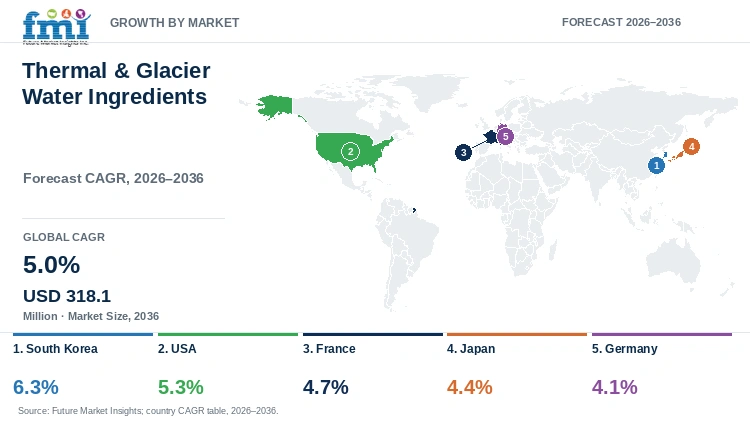
FMI expects South Korea to lead the five profiled countries with a 6.3% CAGR from 2026 to 2036, ahead of the USA, France, Japan and Germany. Germany posts the slowest pace in the group at a 4.1% CAGR through 2036. Sales of named spring and glacier waters rise fastest in countries with frequent skincare export launches and strict ingredient file rules.
Table 6: Country CAGRs and Primary Growth Levers for the Thermal & Glacier Water Ingredients Market (CAGR percentage), 2026 to 2036
| Country | CAGR (2026-2036) | Primary Growth Lever |
|---|---|---|
| South Korea | 6.3% | Fast skincare export launches |
| USA | 5.3% | Stable ingredient records for MoCRA renewals |
| France | 4.7% | Spa brands adding plant capacity |
| Japan | 4.4% | Sensitive-skin ranges with full safety files |
| Germany | 4.1% | Rising home sales of face care |
Source: Future Market Insights
South Korea Thermal & Glacier Water Ingredients Market Outlook (2026-2036)
Korean cosmetics exports rose 11.8% in 2025 to a record USD 11.4 billion, with skincare worth USD 8.5 billion [6]. The Ministry of Food and Drug Safety released these figures in May 2026 [6]. Olive Young counted 116 brands above KRW 10 billion in yearly sales in 2025 [16]. Korean skincare brands need a fresh hero ingredient for each launch, and glacier water offers a calming option with clear origin for toners and essences. Demand for thermal and glacier water ingredients among Korean brands will expand at a 6.3% CAGR through 2036, the fastest profiled rate. Shipments to China dropped 19% to about USD 2 billion, so suppliers holding U.S. and Japanese filing documents can follow Korean brands into new markets [6].
Key takeaway: Korean export launches will create the most new orders for glacier and thermal waters through 2036.
USA Thermal & Glacier Water Ingredients Market Outlook (2026-2036)
Adoption of thermal and glacier water ingredients in the USA will rise at a 5.3% CAGR from 2026 to 2036, second only to South Korea. U.S. cosmetic facilities face the first two-yearly registration renewals under MoCRA in 2026, and the FDA counted more than 14,000 registered sites [9]. New tariffs weigh on imported French thermal water skincare, as French cosmetics exports to the USA fell almost 19% to EUR 2.4 billion in 2025 [17]. Korean brands are gaining ground, with cosmetics exports to the USA up 15% to USD 2.2 billion, now Korea's top market [6].
Key takeaway: Stable ingredient records that pass each MoCRA renewal will secure U.S. brand contracts.
France Thermal & Glacier Water Ingredients Market Outlook (2026-2036)
France posts a 4.7% CAGR from 2026 to 2036, just below the 5% global rate. Spa brands lead sales at home, and Pierre Fabre will invest nearly EUR 50 million to double Avène plant output to 200 million units a year by 2029 [3]. Exports have stalled, as French cosmetics exports slipped 0.1% to EUR 22.4 billion in 2025, the first fall since 2008 outside the health crisis [17]. French labs lacking an owned spring will need certified thermal water to compete with Avène, La Roche-Posay and Vichy.
Key takeaway: French growth comes from home-grown spa brands adding capacity, as exports stand still.
Japan Thermal & Glacier Water Ingredients Market Outlook (2026-2036)
Shiseido's Japan sales rose only 0.4% to JPY 295.3 billion in 2025, and purchases by foreign tourists fell in the fourth quarter [18]. Korean brands are competing harder for Japanese shoppers, with Korean cosmetics exports to Japan reaching USD 1.1 billion in 2025 [6]. Japanese brands add new waters slowly, as the Japan Cosmetic Industry Association calls quality and safety the most basic requirement [13]. Sales of thermal and glacier water ingredients to Japanese formulators will grow at a 4.4% CAGR through 2036, ahead of only Germany. Sensitive-skin lines such as Shiseido's IHADA, which gained from tourist-focused digital sales, give water suppliers the clearest entry point [18].
Key takeaway: Water suppliers in Japan gain most from sensitive-skin ranges backed by complete safety files.
Germany Thermal & Glacier Water Ingredients Market Outlook (2026-2036)
Domestic sales of skin and face care in Germany rose 7% in the first half of 2026, the strongest gain in cosmetics, according to IKW [19]. Exports picked up as well, with foreign sales of beauty care products up 4.5% in the same half year [19]. The rebound follows a weak 2025, when IKW projected a 2.1% fall in foreign sales of German personal and household care [12]. German brands change approved water phases slowly, holding thermal and glacier water ingredients to a 4.1% CAGR through 2036, the lowest in the group.
Key takeaway: Strong home sales of face care, backed by a 2026 export rebound, will shape German orders for named waters.
Who are the notable companies in the thermal and glacier water ingredients market?
Profiled suppliers include Symrise, Clariant, Ashland, Evonik, IFF, Givaudan, DSM-Firmenich, Lubrizol, Croda and BASF across water, actives and formulation roles.
In FMI's view, competition in the thermal and glacier water ingredients market is moderately fragmented. Ingredient houses compete on water sourcing, skin actives and formulation support, not on spring ownership. Symrise, Clariant and Lubrizol focus on water and natural-origin systems, and Evonik, IFF, Givaudan, DSM-Firmenich and Croda bring actives with measured skin benefits. Ashland and BASF supply the stabilisers, preservatives and texturisers keeping water-rich formulas stable in production. Leading suppliers are launching new actives and buying formulation businesses to offer brands a complete package.
- Water and natural-origin systems: Symrise, Clariant and Lubrizol sell water phases and botanical systems with preservation support.
- Bioactive hydration and barrier platforms: Evonik, IFF, Givaudan, DSM-Firmenich and Croda add peptide, ceramide and botanical actives with measured skin benefits to water-rich formulas.
- Formulation and scale-up enablers: Ashland and BASF supply stabilisers, preservatives and texturisers that keep water-rich formulas stable in production. BASF also sells peptide actives such as NeoHelix Regenerate [20].
Competitive Benchmarking: Thermal & Glacier Water Ingredients Market
Table 7: Competitive Benchmarking for the Thermal & Glacier Water Ingredients Market (qualitative capability ratings), 2026
| Company | Water Source | Skin Actives | Formulation | Reach |
|---|---|---|---|---|
| Symrise | High | High | High | High |
| Clariant | Medium | Medium | High | High |
| Ashland | Medium | Medium | High | High |
| Evonik | Medium | High | High | High |
| IFF | Medium | High | High | High |
| Givaudan | Medium | High | High | High |
| DSM-Firmenich | Medium | High | High | High |
| Lubrizol | Medium | Medium | High | High |
| Croda | Medium | High | High | High |
| BASF | Medium | High | High | High |
A High rating reflects broad documented capability in named water, skin active or formulation supply, Medium reflects related but narrower capability, and Low denotes limited public documentation. Ratings compare capability on one common scale across all profiled companies.
Key Developments in the Thermal & Glacier Water Ingredients Market
- In April 2026, Symrise launched Cellexora MD, Mindera Euca and SymConcentrole Barrier Boost at in-cosmetics global in Paris, targeting regeneration, rinse-off product protection and barrier strength [4].
- In April 2026, BASF's NeoHelix Regenerate, a peptide active for collagen renewal, received a BSB Innovation Award at in-cosmetics Global [20].
- Croda Beauty received the BSB Innovation Award Cosmetics 2026 for the Matrixyl Neolide peptide delivery system and presented COSMOS-certified SphingoCARE ceramides at the same April 2026 event [14].
- In March 2025, Clariant widened the company's natural-origin preservation range with Nipaguard SCE Vita, a blend of renewable sorbitan caprylate and benzoic acid of natural origin [7].
Key Players in the Thermal & Glacier Water Ingredients Market
Water and Natural-Origin Systems
- Symrise AG
- Clariant AG
- The Lubrizol Corporation
Bioactive Hydration and Barrier Platforms
- Evonik Industries AG
- International Flavors & Fragrances Inc. (IFF)
- Givaudan SA
- DSM-Firmenich AG
- Croda International Plc
Formulation and Scale-Up Enablers
- Ashland Inc.
- BASF SE
Thermal & Glacier Water Ingredients Market - Report Scope
Table 8: Report Scope for the Thermal & Glacier Water Ingredients Market (coverage fields and definitions), 2026 to 2036
| Coverage field | Report scope |
|---|---|
| Market breakdown | Product type; function; application; grade; sales channel; region |
| Quantitative units | USD million |
| Market definition | B2B revenue from thermal or mineral spring water ingredients, glacier-origin water ingredients and standardised or customised water-based ingredient systems. Finished-product revenue, ordinary process water without a named thermal or glacier origin, and actives sold without the named water are excluded. |
| Regions covered | North America; Latin America; Western Europe; Eastern Europe; East Asia; South Asia and Pacific; Middle East and Africa |
| Countries covered | South Korea; USA; France; Japan; Germany |
| Key companies profiled | Symrise, Clariant, Ashland, Evonik, IFF, Givaudan, DSM-Firmenich, Lubrizol, Croda, BASF |
| Forecast period | 2026 to 2036 |
| Approach | Bottom-up estimates by water grade, application and sales channel, reconciled with top-down dermocosmetic brand sales and country cosmetics trade data. |
Thermal & Glacier Water Ingredients Market - Research Methodology
Table 9: Research Methodology for the Thermal & Glacier Water Ingredients Market (research methods and approach), 2026 edition
| Method | Approach |
|---|---|
| Primary Research | Primary research draws on interviews with water ingredient suppliers, specialty distributors, skincare brand formulators, contract manufacturers and procurement teams. Interviews cover sourcing, approval criteria, price levels and test file needs. |
| Desk Research | Desk research covers peer-reviewed thermal water studies, FDA and Korean regulator notices, cosmetics trade statistics, certification data and company releases. |
| Market Sizing and Forecasting | Market sizing starts from the 2025 base value and applies segment shares, water grade prices, application use, approval cycles and demand conditions in each country. |
| Data Validation | Estimates are reconciled with company disclosures, trade statistics and interview findings. Finished-product revenue and actives sold without a named water are left out so that no value is counted twice. |
Thermal & Glacier Water Ingredients Market by Segments
Thermal & Glacier Water Ingredients Market segmented by Product Type:
- Standard grade
- High-purity / clinical grade
- Natural & certified grade
- Customized systems
Thermal & Glacier Water Ingredients Market segmented by Function:
- Anti-aging
- Hydration & barrier
- Brightening
- Soothing & sensitive
- UV & protection
Thermal & Glacier Water Ingredients Market segmented by Application:
- Facial skincare
- Body care
- Haircare
- Color cosmetics
- Suncare
Thermal & Glacier Water Ingredients Market segmented by Grade:
- Standard cosmetic grade
- COSMOS / natural certified
- Pharma & clinical grade
- Organic certified
Thermal & Glacier Water Ingredients Market segmented by Sales Channel:
- Direct to brands
- Specialty distributors
- Contract manufacturers
- Online B2B
Thermal & Glacier Water Ingredients Market by Region
- North America
- United States
- Canada
- Latin America
- Brazil
- Mexico
- Argentina
- Chile
- Western Europe
- Germany
- France
- United Kingdom
- Italy
- Spain
- Benelux
- Nordics
- Eastern Europe
- Poland
- Czech Republic
- Romania
- Hungary
- East Asia
- Japan
- South Korea
- South Asia and Pacific
- ASEAN
- Australia and New Zealand
- Middle East and Africa
- GCC Countries
- South Africa
- Türkiye
- Israel
Research Sources and Bibliography
- [1] Mourelle, M. L., and Araujo, A. R. T. S., Applied Sciences, 16(6), 2753 (MDPI). (2026, March 13). Thermal Spring Waters as Cosmeceuticals: An Update.https://www.mdpi.com/2076-3417/16/6/2753
- [2] L'Oréal. (2026, February 12). 2025 Annual Results.https://www.loreal-finance.com/eng/press-release/2025-annual-results
- [3] Premium Beauty News. (2026, May 28). Pierre Fabre plans to double production capacity at Avène plant in France.https://www.premiumbeautynews.com/en/news/industry-buzz/pierre-fabre-plans-to-double,27671
- [4] Symrise AG. (2026, April 14). Symrise accelerates innovation and champions longevity and inner beauty at in-cosmetics global 2026.https://www.symrise.com/newsroom/article/symrise-accelerates-innovation-and-champions-longevity-and-inner-beauty-at-in-cosmetics-global-2026/
- [5] COSMOS-standard AISBL. (2026, January (data)). COSMOS organic and natural certification for cosmetics and raw materials.https://www.cosmos-standard.org/en/
- [6] Korea JoongAng Daily, citing Ministry of Food and Drug Safety. (2026, May 23). Korea surpasses U.S. in cosmetics exports with record $11.4 billion.https://www.koreajoongangdaily.com/business/korea-surpasses-us-in-cosmetics-exports-with-record-114-billion/12713991
- [7] Clariant AG. (2025, March 11). New Nipaguard SCE Vita: Clariant's latest fully naturally derived preservation blend for cosmetics.https://www.clariant.com/en/Corporate/News/2025/03/New-Nipaguardtrade-SCE-Vita-Clariants-latest-fully-naturally-derived-preservation-blend-for-cosmetic
- [8] Mibelle Biochemistry (Solabia Biochemistry AG). (n.d. (accessed 2026, October)). Lipobelle Glacier.https://mibellebiochemistry.com/lipobelle-glacier
- [9] U.S. Food and Drug Administration. (2026, February 11). FDA Updates Web Portal and Informational Materials to Help Cosmetic Facilities Prepare for Biennial Registration Renewal.https://www.fda.gov/cosmetics/cosmetics-news-events/fda-updates-web-portal-and-informational-materials-help-cosmetic-facilities-prepare-biennial
- [10] Korea.net (KOCIS), citing Ministry of Food and Drug Safety. (2025, May 28). Cosmetics exports in 2024 rank 3rd worldwide with USD 10.2B.https://www.korea.net/NewsFocus/Business/view?articleId=272319&pageIndex=1
- [11] Fédération des Entreprises de la Beauté (FEBEA). (2025, February 7). Le secteur cosmétique demeure le deuxième contributeur à la balance commerciale française mais enregistre une croissance moins forte en 2024.https://www.febea.fr/presse/le-secteur-cosmetique-demeure-le-deuxieme-contributeur-a-la-balance-commerciale-francaise
- [12] Volksstimme (dpa), citing Industrieverband Körperpflege- und Waschmittel (IKW). (2025, December 3). Auch 2026 Wachstum erwartet: Kosmetikbranche steigert Umsatz trotz Konsumflaute.https://www.volksstimme.de/deutschland-und-welt/wirtschaft/kosmetikbranche-steigert-umsatz-trotz-konsumflaute-4159466
- [13] Japan Cosmetic Industry Association. (2025, August). Message from the President.https://www.jcia.org/en/jcia/message
- [14] Croda International Plc (Croda Beauty). (2026, April 13). Croda Beauty at in-cosmetics global 2026: Innovation in every drop.https://www.crodabeauty.com/en-gb/resources/blog/croda-beauty-at-in-cosmetics-global-2026-innovation-in-every-drop
- [15] Givaudan SA. (2024, July 1). Givaudan completes the acquisition of b.kolormakeup & skincare.https://www.givaudan.com/media/media-releases/2024/givaudan-completes-acquisition-bkolormakeup
- [16] CJ Group Newsroom (CJ Olive Young). (2026, January 9). From Indie to Icon: 116 K-Beauty Brands Exceed 10 Billion KRW in Sales at Olive Young.https://newsroom.cj.net/from-indie-to-icon-116-k-beauty-brands-exceed-10-billion-krw-in-sales-at-olive-young/
- [17] Fédération des Entreprises de la Beauté (FEBEA). (2026, February 6). Coup de frein sur les exportations de cosmétiques français en 2025.https://www.febea.fr/sites/default/files/2026-02/CP%20FEBEA%20Export%202025.pdf
- [18] Shiseido Company, Limited. (2026, February 10). 2025 Results (January-December) and 2026 Outlook.https://corp.shiseido.com/en/ir/pdf/ir20260210_244.pdf
- [19] Retail-News Deutschland, citing Industrieverband Körperpflege- und Waschmittel (IKW). (2026, September 1). Kosmetik- und Haushaltspflegebranche wächst - Export legt wieder zu.https://retail-news.de/ikw-schoenheit-haushaltspflege-export-2026/
- [20] BASF SE. (2026, April 15). Award-winning science: BASF's Personal Care business honored at in-cosmetics Global 2026.https://www.basf.com/global/en/media/news-releases/2026/04/p-26-079
- [21] Evonik Industries AG. (2024, September 5). Evonik strengthens its botanical and natural actives portfolio with two new products.https://www.evonik.com/en/news/press-releases/2024/09/evonik-strengthens-its-botanical-and-natural-actives-portfolio-w.html
This bibliography is provided for reader reference and covers the main sources cited above. The full report contains the complete reference list and detailed citations.
This Report Answers
- What is the size of the thermal and glacier water ingredients market in 2026?
- By 2036, what value will sales of thermal and glacier water ingredients reach?
- Which water product type leads sales in 2026, and why do formulators prefer this type?
- Do facial skincare and anti-aging claims lead application and function revenue?
- Which of the five profiled countries is growing fastest in sales of named waters?
- Which ingredient suppliers are profiled, and on what capabilities is each supplier rated?
Frequently Asked Questions
How large is the thermal and glacier water ingredients market expected in 2026?
FMI values the thermal and glacier water ingredients market at USD 195.3 million in 2026, up from USD 186.0 million in 2025. Revenue will reach USD 318.1 million by 2036, as skincare brands add named waters with test records.
What CAGR is projected for the thermal and glacier water ingredients market through 2036?
Sales of thermal and glacier water ingredients will rise at a 5% CAGR from 2026 to 2036. Brands paying for named waters with skin test and safety data will keep this growth steady.
Which product type holds a notable market share in 2026?
Standard grade water will account for 42% of product type sales in 2026. Formulators will keep choosing this grade for routine emulsions, gels and sprays without a clinical test file.
Which application holds a notable share in 2026?
Facial skincare will take 39% of application sales in 2026. Serums, essences and face mists are mostly water and will keep naming the source on pack.
Which country has a notable expansion outlook through 2036?
South Korea will lead the five profiled countries at a 6.3% CAGR from 2026 to 2036. Korean brands launch skincare products often and will keep seeking calming ingredients such as glacier water.
Who are the key companies in the thermal and glacier water ingredients market?
Key companies include Symrise, Clariant, Ashland, Evonik, IFF, Givaudan, DSM-Firmenich, Lubrizol, Croda and BASF, according to FMI. Competition among these suppliers will center on named water supply, skin actives and formulation support.
Preview the report firsthand - request a free sample
Get SampleGet the brochure for pricing and purchase details.
Get PDFTable of Content
- Key Takeaways
- Market Size and CAGR
- Top Growth Driver
- Fastest Growing Segment
- Leading Region
- Key Companies
- Emerging Opportunities
- Executive Summary
- Global Market Outlook
- Demand-side Trends
- Supply-side Trends
- Technology Roadmap Analysis
- Analysis and Recommendations
- Analyst Perspective (What is happening? Why now? What should investors know?)
- Key Questions Answered
- How large is the market?
- What is the CAGR?
- What are key trends?
- Which region dominates?
- Who are the leaders?
- Market Overview
- Market Coverage / Taxonomy
- Market Definition / Scope / Limitations
- Research Methodology
- Chapter Orientation
- Analytical Lens and Working Hypotheses
- Market Structure, Signals, and Trend Drivers
- Benchmarking and Cross-market Comparability
- Market Sizing, Forecasting, and Opportunity Mapping
- Research Design and Evidence Framework
- Desk Research Programme (Secondary Evidence)
- Expert Input and Fieldwork (Primary Evidence)
- Tooling, Models, and Reference Databases
- Data Engineering and Model Build
- Quality Assurance and Audit Trail
- Market Background
- Market Dynamics (Drivers, Restraints, Opportunity, Trends)
- Scenario Forecast (Optimistic, Likely, Conservative)
- Impact Analysis
- AI Impact
- Sustainability Impact
- Regulatory Impact
- Technology Impact
- Consumer / Buyer Analysis
- Purchase Drivers
- Adoption Barriers
- Buyer Journey
- Opportunity Map Analysis
- Product Life Cycle Analysis
- Supply Chain Analysis
- Investment Feasibility Matrix
- Value Chain Analysis
- PESTLE and Porter's Analysis
- Regulatory Landscape
- Regional Parent Market Outlook
- Production and Consumption Statistics
- Import and Export Statistics
- Global Market Analysis and Forecast, 2021 to 2036
- Historical Market Size Value (USD Million) Analysis, 2021 to 2025
- Current and Future Market Size Value (USD Million) Projections, 2026 to 2036
- Y-o-Y Growth Trend Analysis
- Absolute $ Opportunity Analysis
- Global Market Pricing Analysis, 2021 to 2036
- Global Market Analysis and Forecast, By Product Type, 2021 to 2036
- Introduction / Key Findings
- Historical Market Size Value (USD Million) Analysis By Product Type, 2021 to 2025
- Current and Future Market Size Value (USD Million) Analysis and Forecast By Product Type, 2026 to 2036
- Standard grade
- High-purity / clinical grade
- Natural & certified grade
- Customized systems
- Y-o-Y Growth Trend Analysis By Product Type, 2021 to 2025
- Absolute $ Opportunity Analysis By Product Type, 2026 to 2036
- Global Market Analysis and Forecast, By Function, 2021 to 2036
- Introduction / Key Findings
- Historical Market Size Value (USD Million) Analysis By Function, 2021 to 2025
- Current and Future Market Size Value (USD Million) Analysis and Forecast By Function, 2026 to 2036
- Anti-aging
- Hydration & barrier
- Brightening
- Soothing & sensitive
- UV & protection
- Y-o-Y Growth Trend Analysis By Function, 2021 to 2025
- Absolute $ Opportunity Analysis By Function, 2026 to 2036
- Global Market Analysis and Forecast, By Application, 2021 to 2036
- Introduction / Key Findings
- Historical Market Size Value (USD Million) Analysis By Application, 2021 to 2025
- Current and Future Market Size Value (USD Million) Analysis and Forecast By Application, 2026 to 2036
- Facial skincare
- Body care
- Haircare
- Color cosmetics
- Suncare
- Y-o-Y Growth Trend Analysis By Application, 2021 to 2025
- Absolute $ Opportunity Analysis By Application, 2026 to 2036
- Global Market Analysis and Forecast, By Grade, 2021 to 2036
- Introduction / Key Findings
- Historical Market Size Value (USD Million) Analysis By Grade, 2021 to 2025
- Current and Future Market Size Value (USD Million) Analysis and Forecast By Grade, 2026 to 2036
- Standard cosmetic grade
- COSMOS / natural certified
- Pharma & clinical grade
- Organic certified
- Y-o-Y Growth Trend Analysis By Grade, 2021 to 2025
- Absolute $ Opportunity Analysis By Grade, 2026 to 2036
- Global Market Analysis and Forecast, By Sales Channel, 2021 to 2036
- Introduction / Key Findings
- Historical Market Size Value (USD Million) Analysis By Sales Channel, 2021 to 2025
- Current and Future Market Size Value (USD Million) Analysis and Forecast By Sales Channel, 2026 to 2036
- Direct to brands
- Specialty distributors
- Contract manufacturers
- Online B2B
- Y-o-Y Growth Trend Analysis By Sales Channel, 2021 to 2025
- Absolute $ Opportunity Analysis By Sales Channel, 2026 to 2036
- Global Market Analysis and Forecast, By Region, 2021 to 2036
- Introduction
- Historical Market Size Value (USD Million) Analysis By Region, 2021 to 2025
- Current Market Size Value (USD Million) Analysis and Forecast By Region, 2026 to 2036
- North America
- Latin America
- Western Europe
- Eastern Europe
- East Asia
- South Asia and Pacific
- Middle East and Africa
- Market Attractiveness Analysis By Region
- North America Market Analysis and Forecast, By Country, 2021 to 2036
- Historical Market Size Value (USD Million) Trend Analysis By Market Taxonomy, 2021 to 2025
- Market Size Value (USD Million) Forecast By Market Taxonomy, 2026 to 2036
- By Country
- United States
- Canada
- By Product Type
- By Function
- By Application
- By Grade
- By Sales Channel
- By Country
- Market Attractiveness Analysis
- By Country
- By Product Type
- By Function
- By Application
- By Grade
- By Sales Channel
- Key Takeaways
- Latin America Market Analysis and Forecast, By Country
- Historical Market Size Value (USD Million) Trend Analysis By Market Taxonomy, 2021 to 2025
- Market Size Value (USD Million) Forecast By Market Taxonomy, 2026 to 2036
- By Country
- Brazil
- Mexico
- Argentina
- Chile
- By Product Type
- By Function
- By Application
- By Grade
- By Sales Channel
- By Country
- Market Attractiveness Analysis
- By Country
- By Product Type
- By Function
- By Application
- By Grade
- By Sales Channel
- Key Takeaways
- Western Europe Market Analysis and Forecast, By Country
- Historical Market Size Value (USD Million) Trend Analysis By Market Taxonomy, 2021 to 2025
- Market Size Value (USD Million) Forecast By Market Taxonomy, 2026 to 2036
- By Country
- Germany
- France
- United Kingdom
- Italy
- Spain
- Benelux
- Nordics
- By Product Type
- By Function
- By Application
- By Grade
- By Sales Channel
- By Country
- Market Attractiveness Analysis
- By Country
- By Product Type
- By Function
- By Application
- By Grade
- By Sales Channel
- Key Takeaways
- Eastern Europe Market Analysis and Forecast, By Country
- Historical Market Size Value (USD Million) Trend Analysis By Market Taxonomy, 2021 to 2025
- Market Size Value (USD Million) Forecast By Market Taxonomy, 2026 to 2036
- By Country
- Poland
- Czech Republic
- Romania
- Hungary
- By Product Type
- By Function
- By Application
- By Grade
- By Sales Channel
- By Country
- Market Attractiveness Analysis
- By Country
- By Product Type
- By Function
- By Application
- By Grade
- By Sales Channel
- Key Takeaways
- East Asia Market Analysis and Forecast, By Country
- Historical Market Size Value (USD Million) Trend Analysis By Market Taxonomy, 2021 to 2025
- Market Size Value (USD Million) Forecast By Market Taxonomy, 2026 to 2036
- By Country
- Japan
- South Korea
- By Product Type
- By Function
- By Application
- By Grade
- By Sales Channel
- By Country
- Market Attractiveness Analysis
- By Country
- By Product Type
- By Function
- By Application
- By Grade
- By Sales Channel
- Key Takeaways
- South Asia and Pacific Market Analysis and Forecast, By Country
- Historical Market Size Value (USD Million) Trend Analysis By Market Taxonomy, 2021 to 2025
- Market Size Value (USD Million) Forecast By Market Taxonomy, 2026 to 2036
- By Country
- ASEAN
- Australia and New Zealand
- By Product Type
- By Function
- By Application
- By Grade
- By Sales Channel
- By Country
- Market Attractiveness Analysis
- By Country
- By Product Type
- By Function
- By Application
- By Grade
- By Sales Channel
- Key Takeaways
- Middle East and Africa Market Analysis and Forecast, By Country
- Historical Market Size Value (USD Million) Trend Analysis By Market Taxonomy, 2021 to 2025
- Market Size Value (USD Million) Forecast By Market Taxonomy, 2026 to 2036
- By Country
- GCC Countries
- South Africa
- Türkiye
- Israel
- By Product Type
- By Function
- By Application
- By Grade
- By Sales Channel
- By Country
- Market Attractiveness Analysis
- By Country
- By Product Type
- By Function
- By Application
- By Grade
- By Sales Channel
- Key Takeaways
- Key Countries Market Analysis
- United States
- Pricing Analysis
- Market Share Analysis, 2025
- By Product Type
- By Function
- By Application
- By Grade
- By Sales Channel
- Canada
- Pricing Analysis
- Market Share Analysis, 2025
- By Product Type
- By Function
- By Application
- By Grade
- By Sales Channel
- Mexico
- Pricing Analysis
- Market Share Analysis, 2025
- By Product Type
- By Function
- By Application
- By Grade
- By Sales Channel
- Brazil
- Pricing Analysis
- Market Share Analysis, 2025
- By Product Type
- By Function
- By Application
- By Grade
- By Sales Channel
- Chile
- Pricing Analysis
- Market Share Analysis, 2025
- By Product Type
- By Function
- By Application
- By Grade
- By Sales Channel
- Germany
- Pricing Analysis
- Market Share Analysis, 2025
- By Product Type
- By Function
- By Application
- By Grade
- By Sales Channel
- United Kingdom
- Pricing Analysis
- Market Share Analysis, 2025
- By Product Type
- By Function
- By Application
- By Grade
- By Sales Channel
- Italy
- Pricing Analysis
- Market Share Analysis, 2025
- By Product Type
- By Function
- By Application
- By Grade
- By Sales Channel
- Spain
- Pricing Analysis
- Market Share Analysis, 2025
- By Product Type
- By Function
- By Application
- By Grade
- By Sales Channel
- France
- Pricing Analysis
- Market Share Analysis, 2025
- By Product Type
- By Function
- By Application
- By Grade
- By Sales Channel
- ASEAN
- Pricing Analysis
- Market Share Analysis, 2025
- By Product Type
- By Function
- By Application
- By Grade
- By Sales Channel
- Australia and New Zealand
- Pricing Analysis
- Market Share Analysis, 2025
- By Product Type
- By Function
- By Application
- By Grade
- By Sales Channel
- Japan
- Pricing Analysis
- Market Share Analysis, 2025
- By Product Type
- By Function
- By Application
- By Grade
- By Sales Channel
- South Korea
- Pricing Analysis
- Market Share Analysis, 2025
- By Product Type
- By Function
- By Application
- By Grade
- By Sales Channel
- Poland
- Pricing Analysis
- Market Share Analysis, 2025
- By Product Type
- By Function
- By Application
- By Grade
- By Sales Channel
- Hungary
- Pricing Analysis
- Market Share Analysis, 2025
- By Product Type
- By Function
- By Application
- By Grade
- By Sales Channel
- Türkiye
- Pricing Analysis
- Market Share Analysis, 2025
- By Product Type
- By Function
- By Application
- By Grade
- By Sales Channel
- South Africa
- Pricing Analysis
- Market Share Analysis, 2025
- By Product Type
- By Function
- By Application
- By Grade
- By Sales Channel
- United States
- Market Structure Analysis
- Competition Dashboard
- Competition Benchmarking
- Market Share Analysis of Top Players
- By Regional
- By Product Type
- By Function
- By Application
- By Grade
- By Sales Channel
- Emerging Startups
- Innovation Benchmarking
- Competition Analysis
- Competition Deep Dive
- Symrise
- Overview
- Product Portfolio
- Profitability by Market Segments
- Sales Footprint
- Strategy Overview
- Marketing Strategy
- Product Strategy
- Channel Strategy
- Clariant
- Ashland
- Evonik
- IFF
- Givaudan
- DSM-Firmenich
- Lubrizol
- Croda
- BASF
- Symrise AG
- Clariant AG
- The Lubrizol Corporation
- Evonik Industries AG
- International Flavors & Fragrances Inc. (IFF)
- Givaudan SA
- DSM-Firmenich AG
- Croda International Plc
- BASF SE
- Symrise
- Case Studies
- Success Stories
- Recent Developments
- Competition Deep Dive
- Assumptions & Acronyms Used


