

- Market Size (2026)
- USD 1168.7 Mn
- Forecast (2036)
- USD 2094.6 Mn
- CAGR (2026 to 2036)
- 6.0%
How big is the Thermal Gap Compounds Market in 2026?
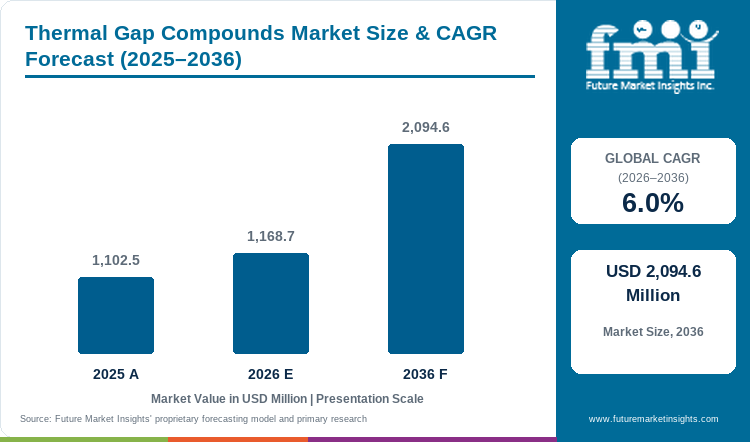
As per the analysis from FMI, the thermal gap compounds market is estimated to be valued at USD 1,168.7 Million in 2026 and is all set to reach USD 2,094.6 Million by 2036, up from USD 1,102.5 Million in 2025.
Sales of thermal gap compounds are forecasted to grow at a 6.0% CAGR till 2036. Increasing consumer adoption, improved accessibility, and competitive offerings amplify market penetration for market players. Thermal gap compounds manufacturers focus on strategic collaborations and partnerships to enhance distribution and service delivery. Demand is also increasing owing to the integration of data-driven analytics, digital platforms, and sustainable practices reinforces operational efficiency and customer engagement.
The International Energy Agency’s (IEA) Global EV Outlook report in May 2026 highlighted that global electric vehicle (EV) sales exceeded 20 million in 2025, representing roughly 25% of all new car sales worldwide. As EV production scales, manufacturers prioritize early specification and recurring procurement of these compounds to ensure reliability and efficiency. Geographic variations such as Germany’s cost-sensitive OEMs, the USA’s data-center spillover, and South Korea’s traceability requirements further shape compound adoption, linking IEA-reported EV growth directly to global thermal gap compounds market expansion.
Key Takeaways
- Market growth is driven by miniaturization and rising demand for efficient thermal management in electronics.
- Increasing adoption in electric vehicle batteries and high-performance devices enhances market demand.
- Material innovations focus on high-thermal-conductivity and eco-friendly compound development.
- Established material science companies like Dow, Henkel, and Shin-Etsu dominate the market.
- Asia-Pacific is emerging as the largest market for both production and consumption.
Analyst Perspective
“Data centers, AI accelerators, GPUs, and high-performance laptops are creating demand for TGCs capable of dissipating high TDP in minimal spaces. Thermal gap compounds with ≥4-6 W/mK conductivity are increasingly standard.”
--Nikhil Kaitwade, Principal Consultant, Future Market Insights
How is the thermal gap compounds market segmented?
The thermal gap compounds market is segmented by chemistry into silicone gap fillers, non-silicone compounds, epoxy-based gap compounds, acrylic gap compounds, and phase-change compounds. By application, the market is classified into battery packs, power electronics, telecom equipment, LED modules, and industrial drives.
Based on thermal conductivity, the market is divided into 1-3 W/mK, below 1 W/mK, 3-6 W/mK, and above 6 W/mK. By end use, the market is segmented into EVs, consumer electronics, data centers, industrial electronics, and renewable energy. By sales channel, the market is studied based on sales through electronics OEMs, thermal material distributors, EV Tier-1s, and direct specialty suppliers and regions with over 30+ countries.
What makes Silicone gap fillers central to the Chemistry category?
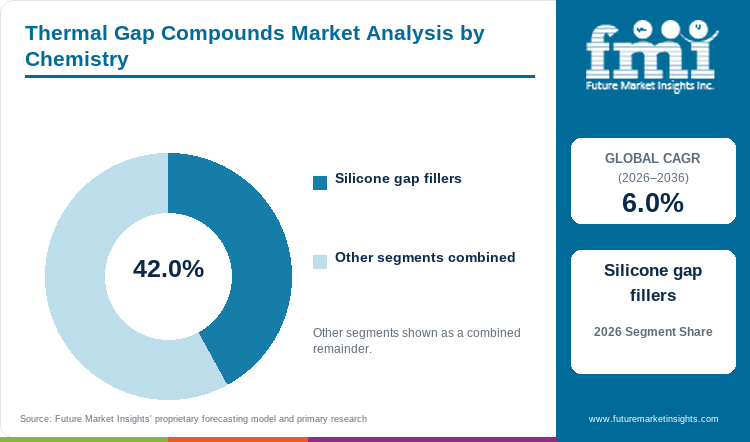
Silicone-based gap fillers dominate the thermal gap compounds market due to their unique combination of chemical stability, thermal performance, and mechanical versatility in high-demand applications such as consumer electronics, electric vehicles (EVs), telecommunications, and data center infrastructure.
In June 2025, Dow, Shin-Etsu Chemical and Wacker Chemie all document two-part silicone gap fillers for automotive and electronic heat transfer, and Wacker introduced SEMICOSIL 9649 TC, a room-temperature-curing grade of about 4 W/mK for EV power electronics.
- Demand for silicone gap fillers is projected to rise at 42% market share of chemistry revenue in 2026.
- Silicone polymers maintain stability over a wide temperature range (-40 °C to 250 °C), making them ideal for automotive electronics, EV battery packs, and telecom infrastructure exposed to fluctuating environments.
Why are Battery packs expected to lead the Application category?
Battery packs are expected to lead the application category in the thermal gap compounds market due to multiple interrelated factors rooted in both technological necessity and market dynamics. High-energy-density cells (e.g., lithium-ion, nickel-rich, LFP) produce significant thermal loads that must be efficiently dissipated to prevent performance loss, degradation, or safety hazards such as thermal runaway. Thermal gap compounds serve as essential interfaces between cells, modules, and housings, ensuring uniform heat transfer to cooling systems.
- Sales of battery packs are likely to see a market share of 34% in 2026.
- Battery packs, especially in electric vehicles (EVs), generate substantial heat during charging and discharging cycles.
What supports 1-3 W/mK in the Thermal Conductivity category?
The 1-3 W/mK class materials account for significant share of the thermal conductivity gaps market in 2026 due to a combination of physical performance characteristics, application suitability, and economic factors. Materials in the 1-3 W/mK range provide a balance between insulation and heat conduction, which is ideal for thermal interface materials (TIMs) that bridge devices and heat sinks.
Higher W/mK materials (e.g., ≥10 W/mK) are more thermally conductive but often stiffer, harder to compress, or anisotropic, leading to poor wetting and larger contact resistance at the joint. Very low W/mK materials (<1 W/mK) are insufficient for efficient heat transfer, unsuitable for modern electronics, industrial machinery, or battery systems.
- The 1-3 W/mK range represents 38% market share in 2026 and a sweet spot in which materials are soft enough to conform to micro-gaps while providing meaningful thermal conductivity, optimizing real-world thermal impedance.
- Dow lists DOWSIL TC-5533 as a 3.0 W/mK gap filler for battery pack assembly, whilst Henkel’s 1.7 W/mK silicone-free battery grade sits in the same band. Higher-conductivity compounds will continue to serve concentrated hot spots, yet buyers still measure thermal impedance at the finished bond line, so processability will remain part of the decision along with bulk conductivity.
What drives EVs in the End Use category?
In terms of end use, EVs are expected to remain the leading segment, primarily due to the number of heat sources packed into one vehicle. Battery cells sit alongside inverters, converters, on-board chargers and control units, and each has to stay inside defined limits through charging and driving cycles. Electric-car sales exceeded 20 million globally in 2025, according to the International Energy Agency, and that volume is widening the base of platforms that need thermal-interface design. Compounds are used where rigid tolerances or manual pad placement would slow assembly. Consumer and industrial electronics will stay important, but EV production is giving suppliers larger qualified programs and repeat consumption across vehicle platforms till 2036.
- Battery packs and power electronics that need repeatable thermal paths across several high-heat interfaces will keep EVs formidable, with 35.0% of end-use revenue in 2026.
- Vehicle volumes are growing, as the International Energy Agency reported in May 2026 that electric cars reached a 25% share of new-car sales in 2025.
How do Electronics OEMs shape the Sales Channel category?
In terms of sales channel, Electronics OEMs are expected to retain the largest share, primarily because compounds are usually specified before a board, battery module or power unit enters series production. Engineering teams set the geometry and temperature limits. Manufacturing teams then validate mixing, dispense rate, cure, cleanliness and line takt, and procurement buys against that approved process. This design-in sequence will continue to favor suppliers that bring applications engineering and dispensing support along with the material. Thermal material distributors will keep serving fragmented demand, EV Tier-1s control many automotive programs, and direct specialty suppliers compete where a unique formulation or fast technical response justifies a narrower route.
- Specification and manufacturing validation carried out at the original equipment design stage will keep Electronics OEMs formidable, with 37.0% of sales channel revenue in 2026.
- Process-ready formats are gaining ground with OEM lines, as Parker Chomerics introduced THERM-A-GAP CIP 35E in July 2025, a 1:1 two-component cure-in-place material of 3.5 W/mK for manual or automated dispensing.
What are the drivers, restraints, and opportunities in the thermal gap compounds market?
As per the analysis from FMI, higher heat density will continue to widen design-in demand till 2036, whilst multi-variable qualification is expected to slow conversion, and faster-dispensing specialty grades are all set to create room for differentiation.
- Driver: Electrification and AI-oriented computing will continue to raise thermal loads in batteries, power conversion equipment and dense electronics.
- Restraint: OEM qualification will continue to require validation of interface performance, dispensing and cure, along with insulation and line integration, before volume purchase.
- Opportunity: Fast-dispensing silicone-free, low-density and high-conductivity compounds are expected to address new battery and sensitive-electronics designs.
Miniaturization to Amplify Growth
Miniaturization and higher power density in electronics are increasing heat concentration, creating greater demand for materials that fill microscopic gaps and improve heat transfer between components and heat sinks. Growth in electric vehicles and advanced battery systems is accelerating adoption, as gap compounds help transfer heat from battery cells to cooling plates, reduce hot spots, and support battery performance and safety. Demand for reliable thermal management in high-performance applications is rising as manufacturers seek materials that combine thermal conductivity with electrical insulation, conformability, and long-term thermal stability.
Electric-car sales passed 20 million in 2025, and Lawrence Berkeley National Laboratory estimated in June 2026 that USA data centers could account for 11.8% of national electricity use by 2030 under its reference case, within a range of 9.5% to 15.3%. The two systems create different thermal problems, yet both are adding power-dense assemblies that must move heat through imperfect interfaces. In the FMI report, thermal gap compounds are expected to gain wherever engineers need a conformable material that can be dispensed at scale into batteries and converters, along with servers and related electronics.
Material Challenges Persists
Material and processing challenges can limit adoption, particularly for highly filled compounds that may be abrasive, difficult to pump, and require specialized dispensing equipment for accurate application. Balancing thermal conductivity with softness and processing performance remains challenging, as higher filler loading can improve heat transfer but may complicate dispensing or increase compression forces during assembly. Application-specific material requirements, including silicone sensitivity, electrical insulation, durability, and compatibility with different substrates, can restrict the use of standard formulations and increase formulation complexity.
Which country CAGRs are profiled in the thermal gap compounds market?
| Country | CAGR, 2026 to 2036 |
|---|---|
| Australia | 6.2% |
| South Korea | 5.9% |
| Canada | 5.5% |
| USA | 5.2% |
| France | 4.9% |
| Germany | 4.5% |
| Japan | 4.2% |
How do country-level CAGRs compare?
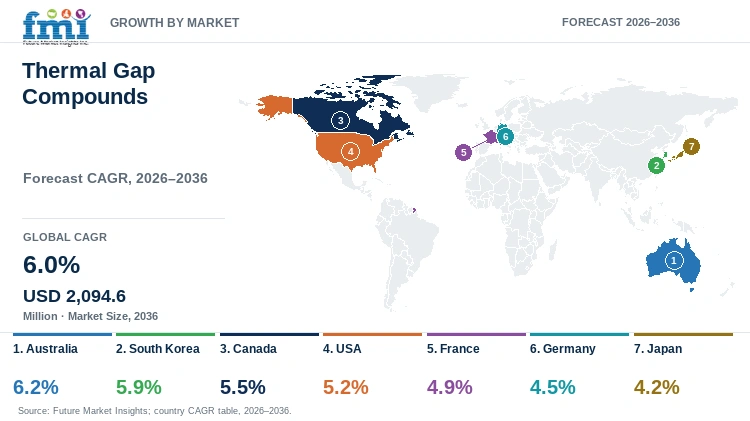
As per the analysis from FMI, the seven profiled country CAGRs span 2.0 percentage points till 2036. Australia is expected to record the strongest growth in the thermal gap compound market, with a CAGR of 6.2% from 2026 to 2036, followed by South Korea at 5.9%. Canada and the USA are projected to grow at 5.5% and 5.2%, respectively. Growth is comparatively moderate in France and Germany, while Japan is expected to expand at a steady CAGR of 4.2%.
Australia and South Korea form the top band on the back of battery and energy-system investment, whilst Canada at 5.5% and the USA at 5.2% draw on North American battery, vehicle and computing build-outs. France at 4.9% sits between that group and the slower German and Japanese profiles. These rates describe growth pace, not absolute market size, so planning will need to weigh them against the number of qualifying programs, local manufacturing scale and channel access.
- Australia leads at 6.2%, making it the fastest-growing market among the countries listed.
- South Korea follows closely at 5.9%, only 0.3 percentage points below Australia.
- Canada and the USA show solid growth at 5.5% and 5.2%, respectively, placing North America in the middle-to-upper part of the ranking.
- France is expected to grow at 4.9%, moderately ahead of Germany at 4.5%.
- Japan records the lowest CAGR at 4.2%, although this still represents steady market expansion over the forecast period.
The full FMI report provides country-level CAGR analysis across North America, Latin America, Western Europe, Eastern Europe, East Asia, South Asia and Pacific, and the Middle East and Africa, covering 30+ countries.
Country Outlook
- Australia’s thermal gap compound market is projected to grow at a 6.2% CAGR from 2026 to 2036. Growth is supported by rising demand for advanced electronics, renewable energy systems, and electric vehicles. Increasing need for efficient heat dissipation and reliable thermal management is expected to strengthen adoption across applications. The federal Cheaper Home Batteries Program passed half a million installed home batteries in August 2026, which is widening the base of inverters and storage electronics in service.
- Sales of thermal gap compounds in South Korea are all set to grow at a 5.9% CAGR till 2036. Growth is supported by expanding semiconductor, consumer electronics, and electric vehicle production. Rising power densities and increasingly compact electronic designs are strengthening demand for efficient heat dissipation and advanced thermal management materials.
- Canada is forecasted to increase at a 5.5% CAGR during the forecast period. Electrification of transportation, growing battery manufacturing activity, and expansion of data infrastructure are creating new thermal management needs. Improvements in high-performance computing and power electronics should further broaden the use of thermally conductive gap compounds. Innovation, Science and Economic Development Canada announced in July 2026 up to CAD 70 million for Volta Energy Solutions Canada’s CAD 760.9 million copper-foil project in Granby, Quebec, which will serve EV battery cells and energy storage.
- Demand for thermal gap compounds in the USA is forecasted to grow at a 5.2% CAGR till 2036, primarily due to a buyer base that spans automotive OEMs and Tier-1s, along with semiconductor, server and data-center equipment makers. Lawrence Berkeley National Laboratory reported in June 2026 that data centers could use 11.8% of USA electricity by 2030 in its reference case, raising the value of efficient heat paths in servers and power-conversion hardware.
- Adoption in France is forecasted to grow at a 4.9% CAGR through 2036. Adoption is driven owing to domestic battery-cell scale-up and automotive electrification. The government launched France Batterie on 24 March 2026, bringing together 40 industrial members and major research bodies around a target of 100 to 120 GWh of gigafactory capacity by 2030.
- Germany is forecasted to grow at a 4.5% CAGR through 2036. Demand is rising in Germany due to established automotive and advanced manufacturing sectors, where the transition toward electric mobility is increasing thermal management requirements. Higher-performance batteries, power electronics, and fast-charging technologies are creating sustained demand for efficient heat-dissipation materials. The Federal Ministry for Economic Affairs and Energy reported in January 2026 that battery-electric registrations reached 545,142 in 2025, up 43.2% year on year and 19.1% of new cars. Cost and qualification pressure will remain the friction, as OEMs want reliable materials without extra line complexity.
- Demand in Japan is all set to grow at a 4.2% CAGR till 2036, primarily due to buyers who place heavy weight on material reliability and close supplier engineering across batteries and power electronics. METI revised its battery strategy on 2 June 2026 as the Battery and Power Industry Strategy, setting a domestic manufacturing base of 150 GWh a year from 2030 into the mid-2030s and citing power-control needs from AI data centers. Continued development of high-performance thermal interface materials is expected to support steady market expansion.
Who are the notable companies in the thermal gap compounds market?
Global leaders in the market include Henkel, Dow, Parker Hannifin, Wacker Chemie, Shin-Etsu Chemical, Momentive Performance Materials, T-Global Technology, Qnity Electronics (Laird), and 3M, out of many players covered by FMI.
As per the analysis from FMI, Differentiation factors include thermal conductivity per unit cost, ease of dispensing and compatibility with automated assembly, technical customization (viscosity, cure profile, bond-line thickness), and material performance, supply security, and integration expertise. Technological differentiation includes innovation in nano-enhanced fillers, hybrid formulations, and AI-driven thermal simulation. Automation of dispensing systems improving consistency by 15-25%. Key companies in the market can be classified in the following categories.
- Automotive-Qualified Dispensing Platforms: Henkel, Dow, Parker Hannifin and Wacker Chemie are competing through two-part dispensable systems, reliability data and line support for battery and power-electronics production.
- Silicone and Putty Formulation Specialists: Shin-Etsu Chemical, Momentive Performance Materials and T-Global Technology are competing through silicone and non-silicone formulation depth, wide conductivity ranges and putties that conform to irregular electronic geometries.
- Diversified Electronics Thermal Portfolios: Qnity Electronics (Laird) and 3M are competing through broad thermal-management and electronics-material portfolios, with Qnity focused on dispensable and pad-format interface materials and 3M on adjacent battery materials and component-level design access.
Competitive Benchmarking
| Company | Dispensable Gap-Filler Breadth | High-Conductivity Options | Automotive / Electronics Process Fit | Geographic Reach |
|---|---|---|---|---|
| Henkel | High | High | High | Global |
| Dow | High | High | High | Global |
| Parker Hannifin | High | High | High | North America, Europe, and Asia-Pacific |
| Wacker Chemie | Medium | Medium | High | Europe, Asia-Pacific, and North America |
| Shin-Etsu Chemical | High | High | High | Japan, Asia-Pacific, North America, and Europe |
| Momentive Performance Materials | High | High | Medium | Global |
| T-Global Technology | High | High | Medium | Asia-Pacific with international channels |
| Qnity Electronics (Laird) | High | High | High | North America, Europe, and Asia-Pacific |
| 3M | Low | Low | Medium | Global |
Scoring basis: Dispensable Gap-Filler Breadth measures documented coverage of liquid, putty, gel or cure-in-place systems for production use. High-Conductivity Options measures documented grades above the mainstream 1-3 W/mK band. Automotive / Electronics Process Fit measures documented evidence on dispensing, cure, low-force assembly, controlled volatility and application engineering for battery or electronics lines. High indicates broad, clearly documented capability; Medium indicates credible but narrower documented capability; Low indicates limited public documentation for that criterion. Geographic Reach reflects evidenced sales, facility or channel activity. Scores are based on company public documentation reviewed by FMI in September 2026.
Key Developments
- In July 2026, Henkel launched Bergquist Gap Filler TGF 6500LVO, a two-component low-volatile silicone gap filler of 6.5 W/mK for ADAS, ECUs and EV power conversion, with room-temperature or heat-accelerated cure.
- In February 2026, Parker Chomerics introduced THERM-A-GAP GEL 120, a one-component dispensable silicone gel of 12.0 W/mK designed for robotic dispensing without secondary cure.
- In July 2025, Parker Chomerics launched THERM-A-GAP CIP 35E, a two-component cure-in-place gap filler of 3.5 W/mK for energy storage, power electronics and consumer devices.
- In June 2025, Wacker Chemie presented SEMICOSIL 9649 TC at The Battery Show Europe, a room-temperature-curing silicone gap filler of about 4 W/mK for EV power electronics.
Key Players
Automotive-Qualified Dispensing Platforms
- Henkel
- Dow
- Parker Hannifin
- Wacker Chemie
Silicone and Putty Formulation Specialists
- Shin-Etsu Chemical
- Momentive Performance Materials
- T-Global Technology
Diversified Electronics Thermal Portfolios
- Qnity Electronics (Laird)
- 3M
Report Scope and Methodology
| Coverage field | Report scope |
|---|---|
| Market breakdown | 6 categories: Chemistry (Silicone gap fillers, Non-silicone compounds, Epoxy-based gap compounds, Acrylic gap compounds, Phase-change compounds), Application (Battery packs, Power electronics, Telecom equipment, LED modules, Industrial drives), Thermal Conductivity (1-3 W/mK, Below 1 W/mK, 3-6 W/mK, Above 6 W/mK), End Use (EVs, Consumer electronics, Data centers, Industrial electronics, Renewable energy), Sales Channel (Electronics OEMs, Thermal material distributors, EV Tier-1s, Direct specialty suppliers), and Region |
| Quantitative units | USD Million |
| Market definition | Revenue includes thermally conductive gap-filling compounds sold as dispensable, putty, gel or cure-in-place formulations within the defined segmentation. It excludes downstream finished products, preformed thermal pads or sheets, heat sinks, cold plates, thin-film thermal greases, and adjacent adhesives or encapsulants not sold as thermal gap compounds. |
| Regions covered | North America, Latin America, Western Europe, Eastern Europe, East Asia, South Asia and Pacific, Middle East and Africa |
| Countries covered | 30+ countries, including Australia, South Korea, Canada, the USA, France, Germany, and Japan |
| Key companies profiled | A few of the notable companies out of many players covered by FMI: Henkel, Dow, Parker Hannifin, Wacker Chemie, Shin-Etsu Chemical, Momentive Performance Materials, T-Global Technology, Qnity Electronics (Laird), and 3M |
| Forecast period | 2026 to 2036 |
| Approach | FMI applies a hybrid bottom-up and top-down sizing framework that combines product and application mapping with supplier and channel evidence, country end-use indicators, pricing and mix assumptions, and cross-checks against industry activity. |
Research Methodology
| Method | Approach |
|---|---|
| Primary research | FMI’s primary-research framework engages thermal-material manufacturers, specialty distributors, Electronics OEM and EV Tier-1 engineering and procurement teams, and subject-matter specialists to test product boundaries, purchase criteria, channel behavior, price logic and qualification requirements. |
| Desk research | The analysis reviews government statistics, policy documents, company newsrooms, manufacturer product documentation, technical literature and country industrial programs. Finished-product revenue and adjacent thermal-management categories are kept outside the market boundary. |
| Market sizing and forecasting | A bottom-up product and application view is reconciled with top-down checks on EV, electronics, data-center, industrial and energy-system activity. Forecast assumptions consider product mix, pricing, qualification cycles, end-use production, technical substitution and country investment. |
| Data validation | Market definitions, company roles, country indicators and dated developments are cross-checked across independent and first-party sources where feasible. Validation removes double counting, including overlapping brand and parent-company entries, along with unsupported claims and revenue from substitutes or downstream systems. |
Thermal Gap Compounds Market by Segments
Thermal Gap Compounds Market Segmented by Chemistry
- Silicone gap fillers
- Non-silicone compounds
- Epoxy-based gap compounds
- Acrylic gap compounds
- Phase-change compounds
Thermal Gap Compounds Market Segmented by Application
- Battery packs
- Power electronics
- Telecom equipment
- LED modules
- Industrial drives
Thermal Gap Compounds Market Segmented by Thermal Conductivity
- 1-3 W/mK
- Below 1 W/mK
- 3-6 W/mK
- Above 6 W/mK
Thermal Gap Compounds Market Segmented by End Use
- EVs
- Consumer electronics
- Data centers
- Industrial electronics
- Renewable energy
Thermal Gap Compounds Market Segmented by Sales Channel
- Electronics OEMs
- Thermal material distributors
- EV Tier-1s
- Direct specialty suppliers
Thermal Gap Compounds Market Segmented by Region
- North America
- United States
- Canada
- Latin America
- Brazil
- Mexico
- Argentina
- Chile
- Western Europe
- Germany
- France
- United Kingdom
- Italy
- Spain
- Benelux
- Nordics
- Eastern Europe
- Poland
- Czech Republic
- Romania
- Hungary
- East Asia
- China
- Japan
- South Korea
- South Asia and Pacific
- India
- ASEAN
- Australia and New Zealand
- Middle East and Africa
- GCC Countries
- South Africa
- Türkiye
- Israel
Research Sources and Bibliography
- International Energy Agency (2026, May 20). Global EV Outlook 2026: Trends in electric cars.
- Lawrence Berkeley National Laboratory (2026, June). United States Data Center Energy Usage Report: 2025 Update.
- Federal Ministry for Economic Affairs and Energy, Germany (2026, January 27). Gute Aussichten fürs Herumstromern.
- Ministry of Economy, Trade and Industry, Japan (2026, June 2). “Battery Industry Strategy” Revised as the “Battery and Power Industry Strategy”.
- Ministry of Trade, Industry and Resources, Republic of Korea (2026, May 20). Korea to Build Circular Battery Ecosystem with Used Battery Safety Framework.
- Prime Minister of Australia (2026, August 14). Half a million cheaper home batteries bringing down bills for Australian homes and businesses.
- Innovation, Science and Economic Development Canada (2026, July 30). Government of Canada invests $70 million to strengthen the EV battery supply chain in Quebec.
- Direction générale des Entreprises, France (2026, March 24). Avec France Batterie, la France structure une filière compétitive et souveraine.
- Henkel (2026, July 21). Henkel launches next-generation thermal gap filler with 6.5W/m·K conductivity.
- Henkel (2026, May 12). Henkel launches thermal gap filler and thermally conductive adhesive to improve EV battery thermal management.
- Dow (2026, May 28). Dow launches DOWSIL™ TC-3120 Thermal Gel.
- Qnity Electronics (2026, July 28). Qnity Advances Thermal Management Portfolio as AI and High-Power Electronics Push Heat to the Center of Design.
- Qnity Electronics (2026, March 12). Qnity expands Laird’s portfolio of non-silicone based gap filler for next-generation innovations with Laird™ Tflex™ SF16.
- DuPont (2025, November 3). DuPont Completes Separation of Qnity Electronics.
- Electronics Cooling (2026, February 9). Introducing THERM-A-GAP GEL 120: Parker Chomerics’ Highest Performing Thermal Gap Filler Gel.
- CIE (2025, July 17). New two-component thermal gap filler and CIP material simplify application process.
- Wacker Chemie AG (2025, June 2). Battery Show Europe 2025: WACKER presents new gap filler for electromobility.
- Shin-Etsu Silicone (2025, November 12-14). Exhibition Report: 14th PLASTIC JAPAN.
- Electric & Hybrid Vehicle Technology International (2025, September 8). Innovative EV battery solutions (3M).
This bibliography is provided for reader reference and is not exhaustive. The full FMI report contains the complete reference list and detailed citations.
This Report Answers
- What is the Thermal Gap Compounds Market size in 2026, and what value is FMI forecasting for 2036?
- Which electrification and electronics-industry pressures will continue to support demand for thermal gap compounds?
- Why are Silicone gap fillers expected to hold the leading position within the Chemistry category in 2026?
- How will Battery packs influence demand within the Application category?
- Why is the 1-3 W/mK band expected to lead the Thermal Conductivity category?
- How do growth rates differ across Australia, South Korea, Canada, the USA, France, Germany, and Japan till 2036?
- How should buyers assess the roles of automotive-qualified platforms, formulation specialists and diversified portfolios?
- Which qualification and manufacturing constraints can limit adoption or supplier switching?
- What should Electronics OEM and EV thermal-management teams evaluate before approving a thermal gap compound?
Frequently Asked Questions
How big is the thermal gap compounds market expected to be in 2026?
As per the analysis from FMI, the thermal gap compounds market is expected to reach USD 1,168.7 Million in 2026 and USD 2,094.6 Million by 2036. Growth will continue to follow higher heat density in EV batteries, power electronics and AI-related computing.
What is the CAGR of the thermal gap compounds market from 2026 to 2036?
The thermal gap compounds market is forecasted to grow at a 6.0% CAGR from 2026 to 2036. The pace will depend on how quickly compounds are designed into automated production rather than added as a late thermal fix.
Which chemistry holds the largest share?
Silicone gap fillers are expected to remain formidable with 42.0% of chemistry revenue in 2026, primarily because their soft cure profile tolerates thermal cycling and variable bond lines.
Which application leads the market?
Battery packs are expected to account for 34.0% of application revenue in 2026, primarily due to the large, uneven interfaces between cells or modules and cooling structures.
Which country is expected to grow fastest?
Australia is all set to grow at a 6.2% CAGR till 2036, followed by South Korea at 5.9%. Japan is forecasted to grow at 4.2%, the slowest of the seven profiled countries.
What notable restraint affects the thermal gap compounds market?
Qualification will continue to be the main restraint, as buyers must validate thermal impedance and bond-line control along with cure, insulation and line repeatability on the actual assembly. That work lengthens approval and makes switching harder once a compound is embedded in the process.
Which companies are active in the thermal gap compounds market?
Henkel, Dow, Parker Hannifin, Wacker Chemie, Shin-Etsu Chemical, Momentive Performance Materials, T-Global Technology, Qnity Electronics (Laird), and 3M are a few of the notable companies, out of many players covered by FMI. They are competing as automotive-qualified dispensing platforms, silicone and putty formulation specialists, and diversified electronics thermal portfolios.
What should electronics and battery thermal-management teams evaluate?
Teams will need to compare thermal impedance at the intended bond line with bulk conductivity and electrical behavior. They should also test cure profile and dispensing rate whilst checking contamination risk, rework implications and long-term reliability before series approval.
Preview the report firsthand - request a free sample
Get SampleGet the brochure for pricing and purchase details.
Get PDFTable of Content
- Key Takeaways
- Market Size and CAGR
- Top Growth Driver
- Fastest Growing Segment
- Leading Region
- Key Companies
- Emerging Opportunities
- Executive Summary
- Global Market Outlook
- Demand-side Trends
- Supply-side Trends
- Technology Roadmap Analysis
- Analysis and Recommendations
- Analyst Perspective (What is happening? Why now? What should investors know?)
- Key Questions Answered
- How large is the market?
- What is the CAGR?
- What are key trends?
- Which region dominates?
- Who are the leaders?
- Market Overview
- Market Coverage / Taxonomy
- Market Definition / Scope / Limitations
- Research Methodology
- Chapter Orientation
- Analytical Lens and Working Hypotheses
- Market Structure, Signals, and Trend Drivers
- Benchmarking and Cross-market Comparability
- Market Sizing, Forecasting, and Opportunity Mapping
- Research Design and Evidence Framework
- Desk Research Programme (Secondary Evidence)
- Expert Input and Fieldwork (Primary Evidence)
- Tooling, Models, and Reference Databases
- Data Engineering and Model Build
- Quality Assurance and Audit Trail
- Market Background
- Market Dynamics (Drivers, Restraints, Opportunity, Trends)
- Scenario Forecast (Optimistic, Likely, Conservative)
- Impact Analysis
- AI Impact
- Sustainability Impact
- Regulatory Impact
- Technology Impact
- Consumer / Buyer Analysis
- Purchase Drivers
- Adoption Barriers
- Buyer Journey
- Opportunity Map Analysis
- Product Life Cycle Analysis
- Supply Chain Analysis
- Investment Feasibility Matrix
- Value Chain Analysis
- PESTLE and Porter's Analysis
- Regulatory Landscape
- Regional Parent Market Outlook
- Production and Consumption Statistics
- Import and Export Statistics
- Global Market Analysis and Forecast, 2021 to 2036
- Historical Market Size Value (USD Million) Analysis, 2021 to 2025
- Current and Future Market Size Value (USD Million) Projections, 2026 to 2036
- Y-o-Y Growth Trend Analysis
- Absolute $ Opportunity Analysis
- Global Market Pricing Analysis, 2021 to 2036
- Global Market Analysis and Forecast, By Chemistry, 2021 to 2036
- Introduction / Key Findings
- Historical Market Size Value (USD Million) Analysis By Chemistry, 2021 to 2025
- Current and Future Market Size Value (USD Million) Analysis and Forecast By Chemistry, 2026 to 2036
- Silicone gap fillers
- Non-silicone compounds
- Epoxy-based gap compounds
- Acrylic gap compounds
- Phase-change compounds
- Y-o-Y Growth Trend Analysis By Chemistry, 2021 to 2025
- Absolute $ Opportunity Analysis By Chemistry, 2026 to 2036
- Global Market Analysis and Forecast, By Application, 2021 to 2036
- Introduction / Key Findings
- Historical Market Size Value (USD Million) Analysis By Application, 2021 to 2025
- Current and Future Market Size Value (USD Million) Analysis and Forecast By Application, 2026 to 2036
- Battery packs
- Power electronics
- Telecom equipment
- LED modules
- Industrial drives
- Y-o-Y Growth Trend Analysis By Application, 2021 to 2025
- Absolute $ Opportunity Analysis By Application, 2026 to 2036
- Global Market Analysis and Forecast, By Thermal Conductivity, 2021 to 2036
- Introduction / Key Findings
- Historical Market Size Value (USD Million) Analysis By Thermal Conductivity, 2021 to 2025
- Current and Future Market Size Value (USD Million) Analysis and Forecast By Thermal Conductivity, 2026 to 2036
- 1-3 W/mK
- Below 1 W/mK
- 3-6 W/mK
- Above 6 W/mK
- Y-o-Y Growth Trend Analysis By Thermal Conductivity, 2021 to 2025
- Absolute $ Opportunity Analysis By Thermal Conductivity, 2026 to 2036
- Global Market Analysis and Forecast, By End Use, 2021 to 2036
- Introduction / Key Findings
- Historical Market Size Value (USD Million) Analysis By End Use, 2021 to 2025
- Current and Future Market Size Value (USD Million) Analysis and Forecast By End Use, 2026 to 2036
- EVs
- Consumer electronics
- Data centers
- Industrial electronics
- Renewable energy
- Y-o-Y Growth Trend Analysis By End Use, 2021 to 2025
- Absolute $ Opportunity Analysis By End Use, 2026 to 2036
- Global Market Analysis and Forecast, By Sales Channel, 2021 to 2036
- Introduction / Key Findings
- Historical Market Size Value (USD Million) Analysis By Sales Channel, 2021 to 2025
- Current and Future Market Size Value (USD Million) Analysis and Forecast By Sales Channel, 2026 to 2036
- Electronics OEMs
- Thermal material distributors
- EV Tier-1s
- Direct specialty suppliers
- Y-o-Y Growth Trend Analysis By Sales Channel, 2021 to 2025
- Absolute $ Opportunity Analysis By Sales Channel, 2026 to 2036
- Global Market Analysis and Forecast, By Region, 2021 to 2036
- Introduction
- Historical Market Size Value (USD Million) Analysis By Region, 2021 to 2025
- Current Market Size Value (USD Million) Analysis and Forecast By Region, 2026 to 2036
- North America
- Latin America
- Western Europe
- Eastern Europe
- East Asia
- South Asia and Pacific
- Middle East and Africa
- Market Attractiveness Analysis By Region
- North America Market Analysis and Forecast, By Country, 2021 to 2036
- Historical Market Size Value (USD Million) Trend Analysis By Market Taxonomy, 2021 to 2025
- Market Size Value (USD Million) Forecast By Market Taxonomy, 2026 to 2036
- By Country
- United States
- Canada
- By Chemistry
- By Application
- By Thermal Conductivity
- By End Use
- By Sales Channel
- By Country
- Market Attractiveness Analysis
- By Country
- By Chemistry
- By Application
- By Thermal Conductivity
- By End Use
- By Sales Channel
- Key Takeaways
- Latin America Market Analysis and Forecast, By Country
- Historical Market Size Value (USD Million) Trend Analysis By Market Taxonomy, 2021 to 2025
- Market Size Value (USD Million) Forecast By Market Taxonomy, 2026 to 2036
- By Country
- Brazil
- Mexico
- Argentina
- Chile
- By Chemistry
- By Application
- By Thermal Conductivity
- By End Use
- By Sales Channel
- By Country
- Market Attractiveness Analysis
- By Country
- By Chemistry
- By Application
- By Thermal Conductivity
- By End Use
- By Sales Channel
- Key Takeaways
- Western Europe Market Analysis and Forecast, By Country
- Historical Market Size Value (USD Million) Trend Analysis By Market Taxonomy, 2021 to 2025
- Market Size Value (USD Million) Forecast By Market Taxonomy, 2026 to 2036
- By Country
- Germany
- France
- United Kingdom
- Italy
- Spain
- Benelux
- Nordics
- By Chemistry
- By Application
- By Thermal Conductivity
- By End Use
- By Sales Channel
- By Country
- Market Attractiveness Analysis
- By Country
- By Chemistry
- By Application
- By Thermal Conductivity
- By End Use
- By Sales Channel
- Key Takeaways
- Eastern Europe Market Analysis and Forecast, By Country
- Historical Market Size Value (USD Million) Trend Analysis By Market Taxonomy, 2021 to 2025
- Market Size Value (USD Million) Forecast By Market Taxonomy, 2026 to 2036
- By Country
- Poland
- Czech Republic
- Romania
- Hungary
- By Chemistry
- By Application
- By Thermal Conductivity
- By End Use
- By Sales Channel
- By Country
- Market Attractiveness Analysis
- By Country
- By Chemistry
- By Application
- By Thermal Conductivity
- By End Use
- By Sales Channel
- Key Takeaways
- East Asia Market Analysis and Forecast, By Country
- Historical Market Size Value (USD Million) Trend Analysis By Market Taxonomy, 2021 to 2025
- Market Size Value (USD Million) Forecast By Market Taxonomy, 2026 to 2036
- By Country
- China
- Japan
- South Korea
- By Chemistry
- By Application
- By Thermal Conductivity
- By End Use
- By Sales Channel
- By Country
- Market Attractiveness Analysis
- By Country
- By Chemistry
- By Application
- By Thermal Conductivity
- By End Use
- By Sales Channel
- Key Takeaways
- South Asia and Pacific Market Analysis and Forecast, By Country
- Historical Market Size Value (USD Million) Trend Analysis By Market Taxonomy, 2021 to 2025
- Market Size Value (USD Million) Forecast By Market Taxonomy, 2026 to 2036
- By Country
- India
- ASEAN
- Australia and New Zealand
- By Chemistry
- By Application
- By Thermal Conductivity
- By End Use
- By Sales Channel
- By Country
- Market Attractiveness Analysis
- By Country
- By Chemistry
- By Application
- By Thermal Conductivity
- By End Use
- By Sales Channel
- Key Takeaways
- Middle East and Africa Market Analysis and Forecast, By Country
- Historical Market Size Value (USD Million) Trend Analysis By Market Taxonomy, 2021 to 2025
- Market Size Value (USD Million) Forecast By Market Taxonomy, 2026 to 2036
- By Country
- GCC Countries
- South Africa
- Türkiye
- Israel
- By Chemistry
- By Application
- By Thermal Conductivity
- By End Use
- By Sales Channel
- By Country
- Market Attractiveness Analysis
- By Country
- By Chemistry
- By Application
- By Thermal Conductivity
- By End Use
- By Sales Channel
- Key Takeaways
- Key Countries Market Analysis
- United States
- Pricing Analysis
- Market Share Analysis, 2025
- By Chemistry
- By Application
- By Thermal Conductivity
- By End Use
- By Sales Channel
- Canada
- Pricing Analysis
- Market Share Analysis, 2025
- By Chemistry
- By Application
- By Thermal Conductivity
- By End Use
- By Sales Channel
- Mexico
- Pricing Analysis
- Market Share Analysis, 2025
- By Chemistry
- By Application
- By Thermal Conductivity
- By End Use
- By Sales Channel
- Brazil
- Pricing Analysis
- Market Share Analysis, 2025
- By Chemistry
- By Application
- By Thermal Conductivity
- By End Use
- By Sales Channel
- Chile
- Pricing Analysis
- Market Share Analysis, 2025
- By Chemistry
- By Application
- By Thermal Conductivity
- By End Use
- By Sales Channel
- Germany
- Pricing Analysis
- Market Share Analysis, 2025
- By Chemistry
- By Application
- By Thermal Conductivity
- By End Use
- By Sales Channel
- United Kingdom
- Pricing Analysis
- Market Share Analysis, 2025
- By Chemistry
- By Application
- By Thermal Conductivity
- By End Use
- By Sales Channel
- Italy
- Pricing Analysis
- Market Share Analysis, 2025
- By Chemistry
- By Application
- By Thermal Conductivity
- By End Use
- By Sales Channel
- Spain
- Pricing Analysis
- Market Share Analysis, 2025
- By Chemistry
- By Application
- By Thermal Conductivity
- By End Use
- By Sales Channel
- France
- Pricing Analysis
- Market Share Analysis, 2025
- By Chemistry
- By Application
- By Thermal Conductivity
- By End Use
- By Sales Channel
- India
- Pricing Analysis
- Market Share Analysis, 2025
- By Chemistry
- By Application
- By Thermal Conductivity
- By End Use
- By Sales Channel
- ASEAN
- Pricing Analysis
- Market Share Analysis, 2025
- By Chemistry
- By Application
- By Thermal Conductivity
- By End Use
- By Sales Channel
- Australia and New Zealand
- Pricing Analysis
- Market Share Analysis, 2025
- By Chemistry
- By Application
- By Thermal Conductivity
- By End Use
- By Sales Channel
- China
- Pricing Analysis
- Market Share Analysis, 2025
- By Chemistry
- By Application
- By Thermal Conductivity
- By End Use
- By Sales Channel
- Japan
- Pricing Analysis
- Market Share Analysis, 2025
- By Chemistry
- By Application
- By Thermal Conductivity
- By End Use
- By Sales Channel
- South Korea
- Pricing Analysis
- Market Share Analysis, 2025
- By Chemistry
- By Application
- By Thermal Conductivity
- By End Use
- By Sales Channel
- Poland
- Pricing Analysis
- Market Share Analysis, 2025
- By Chemistry
- By Application
- By Thermal Conductivity
- By End Use
- By Sales Channel
- Hungary
- Pricing Analysis
- Market Share Analysis, 2025
- By Chemistry
- By Application
- By Thermal Conductivity
- By End Use
- By Sales Channel
- Türkiye
- Pricing Analysis
- Market Share Analysis, 2025
- By Chemistry
- By Application
- By Thermal Conductivity
- By End Use
- By Sales Channel
- South Africa
- Pricing Analysis
- Market Share Analysis, 2025
- By Chemistry
- By Application
- By Thermal Conductivity
- By End Use
- By Sales Channel
- Australia
- Pricing Analysis
- Market Share Analysis, 2025
- By Chemistry
- By Application
- By Thermal Conductivity
- By End Use
- By Sales Channel
- United States
- Market Structure Analysis
- Competition Dashboard
- Competition Benchmarking
- Market Share Analysis of Top Players
- By Regional
- By Chemistry
- By Application
- By Thermal Conductivity
- By End Use
- By Sales Channel
- Emerging Startups
- Innovation Benchmarking
- Competition Analysis
- Competition Deep Dive
- Henkel
- Overview
- Product Portfolio
- Profitability by Market Segments
- Sales Footprint
- Strategy Overview
- Marketing Strategy
- Product Strategy
- Channel Strategy
- Dow
- Parker Hannifin
- Wacker Chemie
- Shin-Etsu Chemical
- Momentive Performance Materials
- T-Global Technology
- Qnity Electronics (Laird)
- 3M
- Henkel
- Case Studies
- Success Stories
- Recent Developments
- Competition Deep Dive
- Assumptions & Acronyms Used


