

- Market Size (2026)
- USD 980.7 Mn
- Forecast (2036)
- USD 1789.7 Mn
- CAGR (2026 to 2036)
- 6.2%
How big is the Tire Curing Bladders Market in 2026?
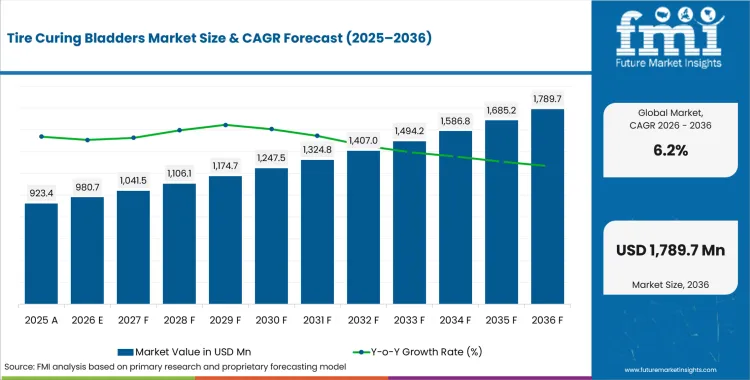
USD 980.7 million in 2026 and USD 1,789.7 million by 2036 at a 6.2% CAGR.
Demand for tire curing bladders is projected to rise at a CAGR of 6.2% by 2036, driving industry valuation from USD 980.7 million in 2026 to USD 1,789.7 million during the forecast period. Tire curing bladders are moving from basic press consumables into production-control inputs used to protect cure quality and plant continuity. Tire plants evaluate bladder contour and release behavior before products enter repeated curing cycles. USTMA projected total USA tire shipments at 338.9 million units in 2026, giving bladder suppliers a measurable demand base across original-equipment and replacement tire programs.
India tire plants are predicted to seek quicker bladder access for localized production and replacement cycles. Japan accounts are expected to review contour control and release quality before plant approval. Tire OEMs and retread operators need bladders connecting pressure transfer and mold compatibility with measurable plant outcomes. Continental reports annual production of more than 750,000 ContiBladders used across customer plants worldwide, highlighting how bladder availability promotes repeat curing activity. Higher curing intensity gives tire production teams more reason to assess bladders determined by defect reduction and press-fit documentation.
Buyers compare tire curing bladders led by compound traceability and technical support across tire plants and replacement channels. VDA reported 864,000 electric cars produced in Germany in the first half of 2025, with electric vehicles reaching 40.0% of domestic car production during the period. Evolving tire structures give buyers stronger reasons to assess EV tires and curing bladder choices through trial evidence and supplier response.
| Metric | Value |
|---|---|
| 2025 Market Size | USD 923.4 million |
| 2026 Market Size | USD 980.7 million |
| 2036 Market Size | USD 1,789.7 million |
| Forecast CAGR (2026-2036) | 6.2% |
| Sales Channel Focus | Direct OEM |
| Direct OEM Share (2026) | 61.2% |
| End Use Focus | Tire OEMs |
| Tire OEMs Share (2026) | 46.0% |
| Bladder Type Focus | Passenger Tire Bladders |
| Passenger Tire Bladders Share (2026) | 44.5% |
| Fastest-growing Country | India |
| India CAGR by 2036 | 8.1% |
Summary of the Tire Curing Bladders Market
| Market Signal | Commercial Impact |
|---|---|
| Demand and Growth Drivers | Demand for tire curing bladders is increasing as tire plants connect bladder use with cure consistency and production control.
|
| Product and Segment View | Segment demand is led by direct OEM support and tire OEM use requiring validated curing performance.
|
| Geography and Growth Outlook | Country demand is higher across tire systems with vehicle production scale and manufacturing modernization.
|
| Competitive Landscape | Competition focuses on curing know-how and mill-ready rubber support.
|
| Analyst Perspective | Tire curing bladders are developing into a performance-validation segment linked to cure quality and press efficiency.
|
How is the Tire Curing Bladders Market segmented?
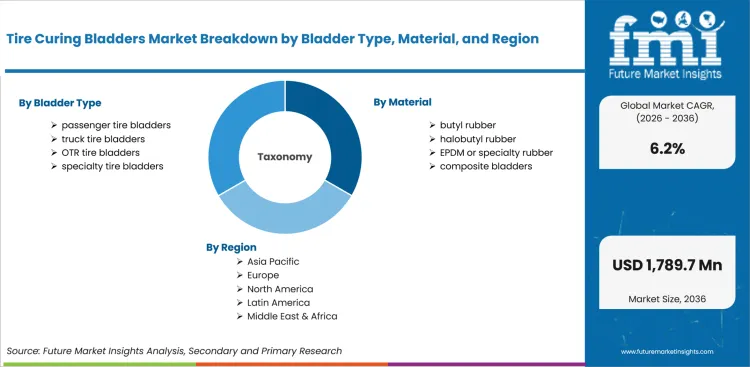
The tire curing bladders market is segmented by bladder type, material, mold process, end use, sales channel and region.
The tire curing bladders sector is segmented by bladder type, material, mold process, end use, sales channel and region. By bladder type, coverage includes passenger tire bladders, truck tire bladders, OTR tire bladders and specialty tire bladders. By material, coverage includes butyl rubber, halobutyl rubber, EPDM or specialty rubber and composite bladders. By mold process, coverage includes radial tire curing, bias tire curing, retread curing and specialty curing. By end use, coverage includes tire OEMs, retreaders and mold or press service providers. By sales channel, coverage includes direct OEM, aftermarket replacement and distributors, with regional coverage across North America, Latin America, Europe, East Asia, South Asia and Pacific and the Middle East and Africa.
Why does direct OEM lead within the sales channel segment?
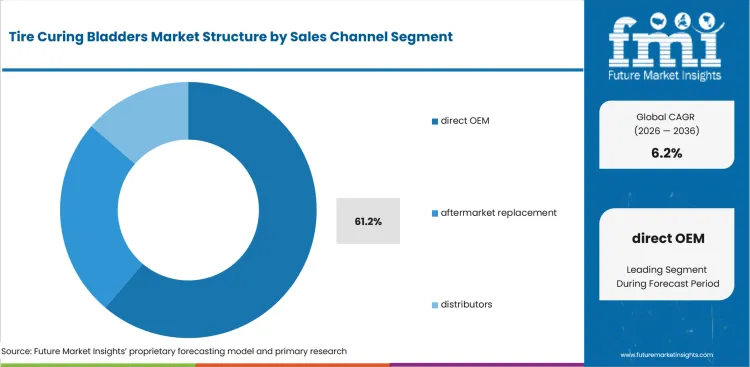
Direct OEM leads due to technical coordination and practical plant support. Tire factories use direct supplier programs as press-fit checks and replacement schedules are easier to document. USTMA reported its member companies operate 55 tire-related manufacturing facilities across 16 USA states, influencing demand for direct routes supporting factory qualification and service accountability.
- Direct OEM is expected to account for 61.2% share in 2026, backed by demand for accountable supply that can support routine press operation. Buyers prefer direct routes supporting installation guidance without extra escalation burden.
- Aftermarket replacement and distributors remain useful for replenishment and regional reach. Direct OEM gains selection attention once tire teams compare application response and approved-product continuity during production reviews.
How do tire OEMs create value within end use demand?
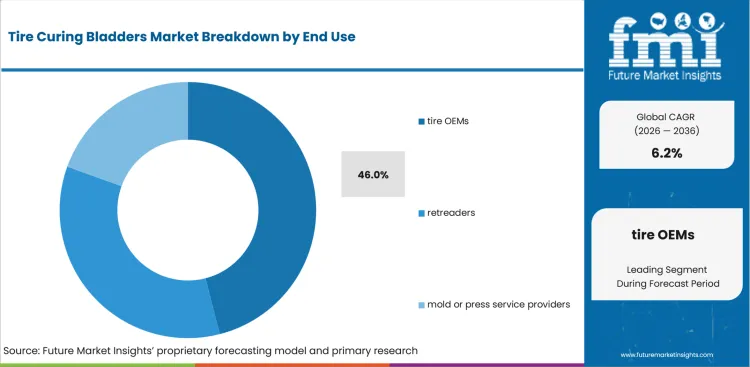
Tire OEMs generate the main demand pool for curing bladders as press cycles are frequent and defect records are closely monitored. Production teams use bladder programs in plants requiring repeatability without avoidable mold disruption. USTMA’s November 2025 forecast expected original-equipment passenger tire shipments to change by -3.5% versus 2024. Light truck and truck tire shipments were expected to change by -3.7% and -18.1%, reinforcing stronger plant discipline during tire OEM planning.
- Tire OEMs are anticipated to hold 46.0% share in 2026, led by production programs requiring cure stability and fit consistency. Suppliers gain approval once technical files and bladder trials are clear.
- Retreaders and mold service providers remain useful in targeted replacement programs. Tire OEMs gain attention as buyers connect bladder life and release performance with measurable plant outcomes.
How do buyers evaluate passenger tire bladders within bladder type demand?
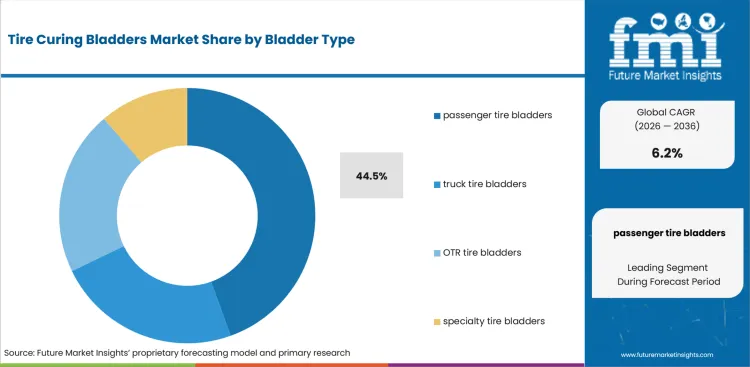
Passenger tire bladders create the main demand pool as passenger tire lines require frequent curing and tight dimensional control. Buyers evaluate bladder options led by contour stability and service life across repeated press cycles. Germany produced 635,000 battery-electric cars during the first half of 2025, reinforcing passenger tire complexity linked to green tires and changing load requirements.
- Passenger tire bladders are expected to represent 44.5% share in 2026, influenced by high-volume tire programs needing repeatable cure response. Bladder suppliers gain commercial access once trials connect product use with plant uptime and tire uniformity outcomes.
- OTR tire and specialty tire programs use more targeted bladder strategies. Passenger tire operations often need tighter support as press frequency and size variation affect factory income.
Why does butyl rubber guide material decisions?
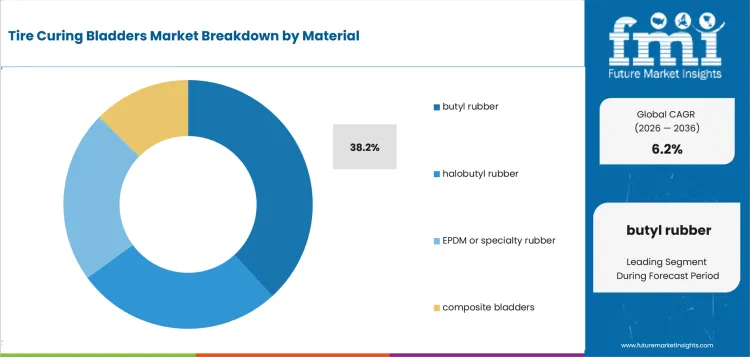
Butyl rubber is a direct technical measure for tire curing bladder performance. Heat exposure and pressure transfer can create failure risk, so suppliers are required to connect compound stability with measurable curing outcomes. ExxonMobil Product Solutions stated transportation accounts for about 25.0% of global energy-related carbon emissions, linking tire air retention with material selection for innerliner and bladder programs.
- Butyl rubber is projected to capture 38.2% share in 2026, guided by tire plants needing consistent bladder behavior across changing tire sizes and curing schedules. Buyers assess material programs based on bladder trials and service follow-up.
- Halobutyl rubber and composite bladder options remain close evaluation areas. Butyl rubber gains attention once production teams link compound behavior with longer bladder life and lower avoidable press disruption.
How is radial tire curing positioned within the mold process segment?
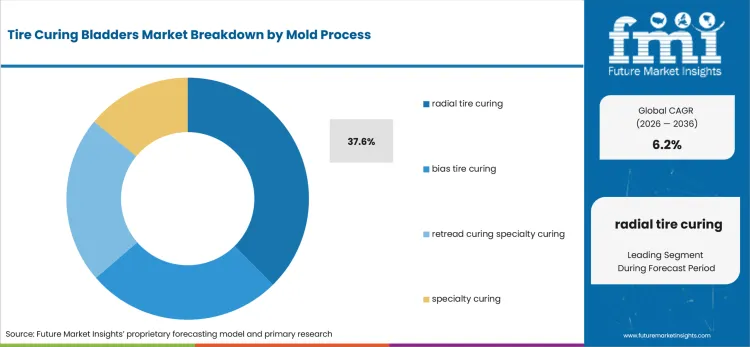
Radial tire curing is central to bladder buying as technical files and trial plans attach to tire programs. Buyers want supplier accountability during press review and plant performance tracking. JAMA reported Japan had 78.74 million motor vehicles in use at the end of 2024, giving suppliers a practical reason to support tire replacement and radial curing systems.
- Radial tire curing is expected to capture 37.6% share in 2026, driven by product approval work completed before production rollout. Suppliers gain strength by supporting tire and press teams through qualification.
- Bias curing and retread curing remain useful for specific production routines. Larger tire programs move toward radial curing support once bladder performance and documentation are accepted by plant decision teams.
What are the drivers, restraints, and opportunities in the Tire Curing Bladders Market?
Near-term purchases are shaped by curing validation and plant-specific support outlined below.
- Driver: Vehicle production and tire replacement demand increase the need for bladders improving cure predictability.
- Restraint: Adoption can slow if suppliers lack material characterization and press-fit evidence.
- Opportunity: EV tire programs create room for compound-specific bladder support and technical service packages.
Tire curing bladder demand rises as buyers treat bladders as operating tools. Tire programs are required to protect cure performance and support quality documentation. USTMA projected replacement passenger tire shipments at 223.3 million units in 2026, reflecting how replacement-linked input decisions can affect large tire value chains.
Buyer pressure is higher in tire systems required to handle variable compounds and maintain predictable cure records. European Chemicals Agency’s REF-12 project covered 2,603 controls across 29 countries during 2024, including checks on imported substances and articles. Supplier files need product characterization and chemical evidence before buyers accept wider plant inclusion.
Implementation risk remains a practical constraint for bladder programs. Production and plant service teams need shared success measures before wider adoption. Continental reports it keeps about 70,000 bladders in inventory for quick delivery, showing why bladder programs must account for replacement timing and service responsiveness.
Which country CAGRs are profiled in the Tire Curing Bladders Market?
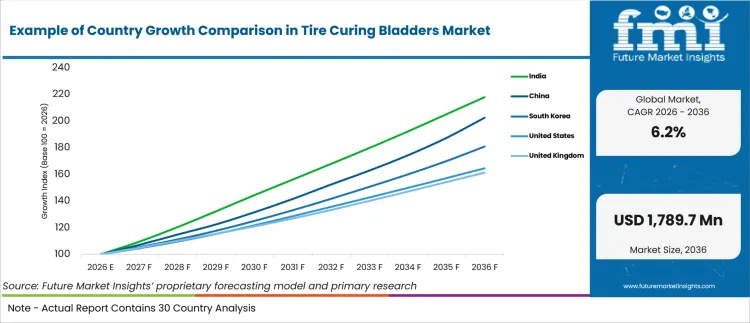
| Country | CAGR |
|---|---|
| India | 8.1% |
| China | 7.3% |
| South Korea | 6.1% |
| United States | 5.1% |
| United Kingdom | 4.9% |
| Germany | 4.7% |
| Japan | 4.6% |
Source: Future Market Insights analysis, 2026.
How do country-level CAGRs compare in the Tire Curing bladders Market?
Country demand in tire curing bladders is expected to be led by tire production intensity and curing-plant modernization. India and China connect bladder demand with large automotive systems and expanding tire quality needs. South Korea, United States, United Kingdom, Germany and Japan connect adoption with documentation and tighter production control. Senior buyers assess which countries can connect supplier evidence with repeatable curing outcomes.
- India is projected to post 8.1% CAGR by 2036, driven by expanding vehicle production and localized tire manufacturing. OICA reported Indian vehicle production at 6.49 million units in fiscal 2025-26, providing bladder suppliers a large base for curing support and replacement planning.
- China is forecast to grow at 7.3% CAGR by 2036, influenced by tire integration and vehicle production scale. OICA reported China reached 34.53 million vehicles produced in 2025, supporting a dense manufacturing base for tire curing systems.
- South Korea is projected to record 6.1% CAGR through 2036, reflected by compact automotive supply chains and quality requirements. OICA listed South Korea at 3,844,338 vehicles produced in 2025, giving curing bladder suppliers a measurable base for tire production support.
- United States is expected to expand at 5.1% CAGR through 2036, backed by original-equipment and replacement tire production systems needing quality-controlled curing inputs. USTMA projected original-equipment truck tire shipments to change by 8.3% in 2026, supporting bladder review across commercial tire programs.
- United Kingdom is forecast to register 4.9% CAGR by 2036, shaped by tire import reliance and producer focus on service continuity. SMMT reported UK vehicle production at 764,715 units in 2025, supporting demand for bladders that can meet traceability and quality expectations.
- Germany is anticipated to grow at 4.7% CAGR by 2036, underpinned by tire safety requirements and high documentation standards. VDA reported electric vehicles accounted for 40.0% of German domestic car production in the first half of 2025, increasing tire complexity and curing review needs.
- Japan is expected to post 4.6% CAGR through 2036, aided by quality expectations and controlled tire programs. JAMA reported Japan produced 8.41 million vehicles in 2025, giving tire suppliers a practical base for service-led bladder programs.
Who are the notable companies in the Tire Curing Bladders Market?
Bridgestone, Michelin, Continental, Yokohama Rubber, LANXESS Rhein Chemie and Shandong Yanggu Huatai Chemical are the notable companies influencing tire curing bladders and rubber-curing support pathways.
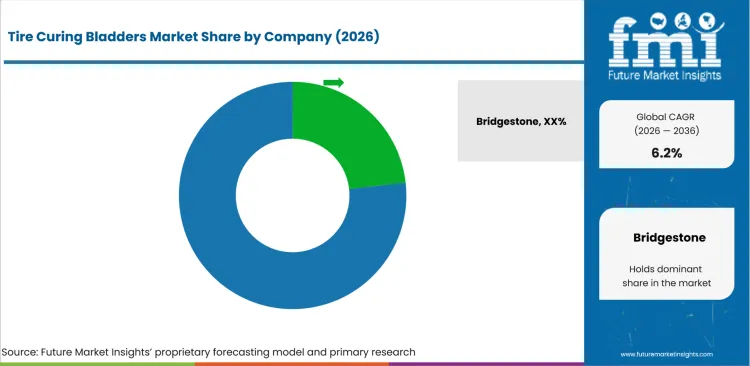
Competition in tire curing bladders is grouped by how buyers want bladder proof to work. Bridgestone and Michelin are stronger in tire manufacturing and production-process experience. LANXESS Rhein Chemie and Shandong Yanggu Huatai Chemical strengthen competition led by rubber additives and compound support. Yokohama Rubber supports programs requiring tire production guidance and specification continuity.
- Bridgestone has an advantage led by tire manufacturing and plant-process capabilities. Buyers can connect supplier support with tire trials and curing performance risk management.
- Continental supports buyer review based on curing bladder depth. ContiBladders exposure gives tire teams a clearer route for bladder selection and application support.
- LANXESS Rhein Chemie and Shandong Yanggu Huatai Chemical strengthen competition due to rubber additive and compound-support positioning. Tire programs use such capabilities as curing consistency and bladder material behavior affect commercial outcomes.
- Michelin and Yokohama Rubber compete based on tire production reach and technical manufacturing support. Buyers compare these companies through production evidence and regional service continuity.
Competitive Benchmarking: Tire Curing Bladders Market
| Company | Tire Production Coverage | Technical Service Alignment | Compound or Bladder Integration | Geographic Reach |
|---|---|---|---|---|
| Bridgestone | High | High | Strong | Global |
| Michelin | High | High | Strong | Global |
| Continental | High | High | High | Global |
| Yokohama Rubber | Strong | Strong | Medium | Global |
| LANXESS Rhein Chemie | Medium | Strong | High | Global |
| Shandong Yanggu Huatai Chemical | Medium | Medium | Strong | Global |
Source: Future Market Insights competitive analysis, 2026.
Key Developments in the Tire Curing Bladders Market
- In November 2024, Bridgestone announced an investment of approximately US$85 million for its Pune and Indore plants in India. Capacity expansion is expected to add around 1.1 million tires annually at the Pune plant by 2029, supporting tire production activity linked to curing consumables.
- In September 2025, Michelin rolled out its first Made-in-India passenger car tyres from its Chennai facility. Michelin also stated that availability in the Indian market is planned from Q2 2026, supporting local passenger tire output and curing-process demand.
- In September 2025, LANXESS reported Continental as the first tire manufacturer to use Vulkanox HS Scopeblue in tire production. The additive offers a carbon footprint more than 30.0% lower than conventional Vulkanox HS, supporting rubber compound programs connected with vulcanization control.
Key Players in the Tire Curing Bladders Market
Tire Manufacturers with Curing Know-How
- Bridgestone
- Michelin
- Yokohama Rubber
Bladder and Tire Production Support Suppliers
- Continental
- LANXESS Rhein Chemie
Rubber Chemical and Compound Support Suppliers
- Shandong Yanggu Huatai Chemical
Tire Curing Bladders Market - Report Scope
| Coverage field | Report scope |
|---|---|
| Market breakdown | Tire curing bladders market breakdown by bladder type, material, mold process, end use, sales channel and region |
| Market Definition | Inflatable rubber bladder systems and related tire-curing support products used in vulcanization presses to transfer heat and pressure, shape green tires, support release behavior and protect repeatable curing performance |
| Regions Covered | North America, Latin America, Europe, East Asia, South Asia and Pacific, Middle East and Africa |
| Countries Covered | United States, China, India, Germany, United Kingdom, Japan, South Korea and 30+ countries |
| Key Companies Profiled | Bridgestone, Michelin, Continental, Yokohama Rubber, LANXESS Rhein Chemie and Shandong Yanggu Huatai Chemical |
| Forecast Period | 2026 to 2036 |
| Approach | Hybrid bottom-up and top-down methodology using tire production demand, curing bladder replacement, material adoption, supplier portfolios, sales-channel structure and country-level indicators |
Source: Future Market Insights analysis, 2026.
Tire Curing Bladders Market - Research Methodology
| Method | Approach |
|---|---|
| Primary Research | FMI analysts gathered input from manufacturers, service providers, technology developers, distributors, end users, sourcing teams, and subject-matter experts. Interviews examined purchasing decisions, product or service evaluation, adoption barriers, approval requirements, pricing considerations, and expectations for technical or commercial support. Respondents were also asked what evidence is required before a trial, pilot, or initial order develops into regular purchasing. |
| Desk Research | Desk research covered government statistics, regulatory publications, trade data, industry associations, technical literature, standards, company filings, product information, and official corporate announcements. Sources were reviewed for relevance, publication date, geographic coverage, and consistency with the defined market scope. Claims relating to performance, applications, approvals, capacity, investment, and commercial activity were retained only when supported by credible public evidence. |
| Market Sizing and Forecasting | The market model combined the baseline value with historical performance, segment structure, pricing and volume indicators, adoption levels, company participation, and country-level demand conditions. Forecast assumptions considered economic activity, investment trends, regulatory developments, technology adoption, purchasing cycles, supply availability, and barriers to wider market use. Segment and regional estimates were reconciled before the final market total was calculated. |
| Data Validation | Estimates were checked against multiple independent indicators, including public data, company activity, trade patterns, industry developments, and findings from primary interviews. Validation also tested whether products, services, applications, and company revenues fell within the defined market boundaries. Adjacent categories, unsupported claims, overlapping revenues, and activities without direct market relevance were excluded to reduce double counting and maintain consistency across segments and countries. |
Tire Curing Bladders Market by Segments
Tire Curing Bladders Market segmented by Bladder Type:
- Passenger tire bladders
- Truck tire bladders
- OTR tire bladders
- Specialty tire bladders
Tire Curing Bladders Market segmented by Material:
- Butyl rubber
- Halobutyl rubber
- EPDM / specialty rubber
- Composite bladders
Tire Curing Bladders Market segmented by Mold Process:
- Radial tire curing
- Bias tire curing
- Retread curing
- Specialty curing
Tire Curing Bladders Market segmented by End Use:
- Tire OEMs
- Retreaders
- Mold / press service providers
Tire Curing Bladders Market segmented by Sales Channel:
- Direct OEM
- Aftermarket replacement
- Distributors
Tire Curing Bladders Market by Region:
- North America
- United States
- Canada
- Mexico
- Latin America
- Brazil
- Chile
- Rest of Latin America
- Western Europe
- Germany
- United Kingdom
- Italy
- Spain
- France
- Nordic
- BENELUX
- Rest of Western Europe
- Eastern Europe
- Poland
- Hungary
- Balkan and Baltic
- Rest of Eastern Europe
- East Asia
- China
- Japan
- South Korea
- South Asia and Pacific
- India
- ASEAN
- Australia and New Zealand
- Rest of South Asia and Pacific
- Middle East and Africa
- Kingdom of Saudi Arabia
- Other GCC Countries
- Turkiye
- South Africa
- Other African Union
- Rest of Middle East and Africa
Research Sources and Bibliography
- Bridgestone. (2024, November 8). Bridgestone announces US$85 million investment to reinforce premium passenger car tire production and development in India. Bridgestone Corporation.
- Continental Tires. (2026, January 21). Curing bladders. Continental Tires.
- European Chemicals Agency. (2025, December 10). Forum REF-12 project report: Enforcement of compliance of imported substances, mixtures and articles. European Chemicals Agency.
- ExxonMobil Product Solutions. (2025). Air retention matters!. ExxonMobil Product Solutions.
- German Association of the Automotive Industry. (2025, August 4). Production and market in July 2025. German Association of the Automotive Industry.
- International Organization of Motor Vehicle Manufacturers. (2026, April 23). Auto industry growth shifted east in 2025 amid global repositioning. International Organization of Motor Vehicle Manufacturers.
- Japan Automobile Manufacturers Association. (2025, September 26). The motor industry of Japan 2025. Japan Automobile Manufacturers Association.
- LANXESS. (2025, September 9). Continental is the first tire manufacturer to use new sustainable rubber additive from LANXESS. LANXESS.
- Michelin India. (2025, September 30). Michelin marks key milestone with roll-out of first Made-in-India passenger car tyres. Michelin India.
- Michelin. (2026, June 22). Market trends. Compagnie Générale des Établissements Michelin.
- Shandong Yanggu Huatai Chemical Co., Ltd. (2026). Rubber additive product portfolio and tire industry applications. Shandong Yanggu Huatai Chemical Co., Ltd.
- Society of Motor Manufacturers and Traders. (2026, January 29). Tough year for auto but new models and industrial strategy can deliver growth. Society of Motor Manufacturers and Traders.
- USA Tire Manufacturers Association. (2025, December 2). USTMA November 2025 forecast predicts slightly higher 2025 tire shipments for USA tire market. USA Tire Manufacturers Association.
- USA Tire Manufacturers Association. (2026, March 4). USTMA February 2026 forecast predicts slightly higher 2026 tire shipments for USA tire market. USA Tire Manufacturers Association.
This bibliography is provided for reader reference and is not exhaustive. The full report contains the complete reference list and detailed citations.
This Report Answers
- What is the expected global value of the tire curing bladders market in 2026 and 2036?
- What CAGR is forecast for the tire curing bladders market during the 2026 to 2036 period?
- Which sales channel segment is used to assess direct OEM tire curing bladder demand in 2026?
- Why do tire plants and retread operators buy controlled tire curing bladder systems?
- How do butyl rubber and radial tire curing shape tire production choices?
- Which countries are compared in the tire curing bladders forecast?
- Which companies compete across tire curing bladder and rubber support pathways?
- What bladder systems and applications are included within the tire curing bladders definition?
- How does FMI size and forecast tire curing bladder demand across segments and countries?
- What implementation and supplier-selection factors should executives assess?
Frequently Asked Questions
What is driving growth in the Tire Curing Bladders Market?
Demand is driven by tire shape control and the need to maintain press performance across commercial tire programs. Buyers are also giving more attention to bladders reducing uncertainty during curing and plant-level performance review.
Why should executives track the Tire Curing Bladders Market?
Executives are anticipated to track this segment since bladder approval affects plant productivity and supplier accountability. Supplier selection can influence tire quality and commercial performance across curing operations.
What business problem does the Tire Curing Bladders Market address?
Tire curing bladders help tire plants and retread operators reduce uncertainty around press response and repeatable use in commercial operations. It also supports buyers that need clearer links between bladder use and operating control.
What should sourcing leaders evaluate before selecting suppliers?
Sourcing leaders are likely to compare documentation quality and supply reliability before supplier approval. Technical service and tire-specific evidence should also guide supplier review.
What can limit return on investment for buyers?
Return on investment is expected to be delayed if trial evidence is weak or bladder handling requires press changes. Buyers can reduce such risk by phasing trials before wider use.
How can suppliers build executive confidence?
Suppliers build confidence through verified product data and accountable support during commercial curing rollout. Clear trial protocols and consistent batch documentation can strengthen buyer approval.
Which companies lead Tire Curing Bladders Market?
Competitive strength is based on Bridgestone and Michelin, due to tire manufacturing depth and plant-process knowledge. Continental adds bladder application experience led by ContiBladders capacity and tire-plant support.
What demand driver supports Tire Curing Bladders Market?
Tire plants need bladders supporting cure consistency and press stability. EV tire programs add approval pressure for better contour control and release behavior.
Preview the report firsthand - request a free sample
Get SampleGet the brochure for pricing and purchase details.
Get PDFTable of Content
- Key Takeaways
- Market Size and CAGR
- Top Growth Driver
- Fastest Growing Segment
- Leading Region
- Key Companies
- Emerging Opportunities
- Executive Summary
- Global Market Outlook
- Demand-side Trends
- Supply-side Trends
- Technology Roadmap Analysis
- Analysis and Recommendations
- Analyst Perspective (What is happening? Why now? What should investors know?)
- Key Questions Answered
- How large is the market?
- What is the CAGR?
- What are key trends?
- Which region dominates?
- Who are the leaders?
- Market Overview
- Market Coverage / Taxonomy
- Market Definition / Scope / Limitations
- Research Methodology
- Chapter Orientation
- Analytical Lens and Working Hypotheses
- Market Structure, Signals, and Trend Drivers
- Benchmarking and Cross-market Comparability
- Market Sizing, Forecasting, and Opportunity Mapping
- Research Design and Evidence Framework
- Desk Research Programme (Secondary Evidence)
- Expert Input and Fieldwork (Primary Evidence)
- Tooling, Models, and Reference Databases
- Data Engineering and Model Build
- Quality Assurance and Audit Trail
- Market Background
- Market Dynamics (Drivers, Restraints, Opportunity, Trends)
- Scenario Forecast (Optimistic, Likely, Conservative)
- Impact Analysis
- AI Impact
- Sustainability Impact
- Regulatory Impact
- Technology Impact
- Consumer / Buyer Analysis
- Purchase Drivers
- Adoption Barriers
- Buyer Journey
- Opportunity Map Analysis
- Product Life Cycle Analysis
- Supply Chain Analysis
- Investment Feasibility Matrix
- Value Chain Analysis
- PESTLE and Porter's Analysis
- Regulatory Landscape
- Regional Parent Market Outlook
- Production and Consumption Statistics
- Import and Export Statistics
- Global Market Analysis and Forecast, 2021 to 2036
- Historical Market Size Value (USD Mn) Analysis, 2021 to 2025
- Current and Future Market Size Value (USD Mn) Projections, 2026 to 2036
- Y-o-Y Growth Trend Analysis
- Absolute $ Opportunity Analysis
- Global Market Pricing Analysis, 2021 to 2036
- Global Market Analysis and Forecast, By Bladder Type, 2021 to 2036
- Introduction / Key Findings
- Historical Market Size Value (USD Mn) Analysis By Bladder Type, 2021 to 2025
- Current and Future Market Size Value (USD Mn) Analysis and Forecast By Bladder Type, 2026 to 2036
- passenger tire bladders
- truck tire bladders
- OTR tire bladders
- specialty tire bladders
- passenger tire bladders
- Y-o-Y Growth Trend Analysis By Bladder Type, 2021 to 2025
- Absolute $ Opportunity Analysis By Bladder Type, 2026 to 2036
- Global Market Analysis and Forecast, By Material, 2021 to 2036
- Introduction / Key Findings
- Historical Market Size Value (USD Mn) Analysis By Material, 2021 to 2025
- Current and Future Market Size Value (USD Mn) Analysis and Forecast By Material, 2026 to 2036
- butyl rubber
- halobutyl rubber
- EPDM or specialty rubber
- composite bladders
- butyl rubber
- Y-o-Y Growth Trend Analysis By Material, 2021 to 2025
- Absolute $ Opportunity Analysis By Material, 2026 to 2036
- Global Market Analysis and Forecast, By Mold Process, 2021 to 2036
- Introduction / Key Findings
- Historical Market Size Value (USD Mn) Analysis By Mold Process, 2021 to 2025
- Current and Future Market Size Value (USD Mn) Analysis and Forecast By Mold Process, 2026 to 2036
- radial tire curing
- bias tire curing
- retread curing specialty curing
- specialty curing
- radial tire curing
- Y-o-Y Growth Trend Analysis By Mold Process, 2021 to 2025
- Absolute $ Opportunity Analysis By Mold Process, 2026 to 2036
- Global Market Analysis and Forecast, By End Use, 2021 to 2036
- Introduction / Key Findings
- Historical Market Size Value (USD Mn) Analysis By End Use, 2021 to 2025
- Current and Future Market Size Value (USD Mn) Analysis and Forecast By End Use, 2026 to 2036
- tire OEMs
- retreaders
- mold or press service providers
- tire OEMs
- Y-o-Y Growth Trend Analysis By End Use, 2021 to 2025
- Absolute $ Opportunity Analysis By End Use, 2026 to 2036
- Global Market Analysis and Forecast, By Sales Channel, 2021 to 2036
- Introduction / Key Findings
- Historical Market Size Value (USD Mn) Analysis By Sales Channel, 2021 to 2025
- Current and Future Market Size Value (USD Mn) Analysis and Forecast By Sales Channel, 2026 to 2036
- direct OEM
- aftermarket replacement
- distributors
- direct OEM
- Y-o-Y Growth Trend Analysis By Sales Channel, 2021 to 2025
- Absolute $ Opportunity Analysis By Sales Channel, 2026 to 2036
- Global Market Analysis and Forecast, By Region, 2021 to 2036
- Introduction
- Historical Market Size Value (USD Mn) Analysis By Region, 2021 to 2025
- Current Market Size Value (USD Mn) Analysis and Forecast By Region, 2026 to 2036
- North America
- Latin America
- Western Europe
- Eastern Europe
- East Asia
- South Asia and Pacific
- Middle East & Africa
- Market Attractiveness Analysis By Region
- North America Market Analysis and Forecast, By Country, 2021 to 2036
- Historical Market Size Value (USD Mn) Trend Analysis By Market Taxonomy, 2021 to 2025
- Market Size Value (USD Mn) Forecast By Market Taxonomy, 2026 to 2036
- By Country
- USA
- Canada
- By Bladder Type
- By Material
- By Mold Process
- By End Use
- By Sales Channel
- By Country
- Market Attractiveness Analysis
- By Country
- By Bladder Type
- By Material
- By Mold Process
- By End Use
- By Sales Channel
- Key Takeaways
- Latin America Market Analysis and Forecast, By Country
- Historical Market Size Value (USD Mn) Trend Analysis By Market Taxonomy, 2021 to 2025
- Market Size Value (USD Mn) Forecast By Market Taxonomy, 2026 to 2036
- By Country
- Brazil
- Mexico
- Chile
- Rest of Latin America
- By Bladder Type
- By Material
- By Mold Process
- By End Use
- By Sales Channel
- By Country
- Market Attractiveness Analysis
- By Country
- By Bladder Type
- By Material
- By Mold Process
- By End Use
- By Sales Channel
- Key Takeaways
- Western Europe Market Analysis and Forecast, By Country
- Historical Market Size Value (USD Mn) Trend Analysis By Market Taxonomy, 2021 to 2025
- Market Size Value (USD Mn) Forecast By Market Taxonomy, 2026 to 2036
- By Country
- Germany
- UK
- Italy
- Spain
- France
- Nordic
- BENELUX
- Rest of Western Europe
- By Bladder Type
- By Material
- By Mold Process
- By End Use
- By Sales Channel
- By Country
- Market Attractiveness Analysis
- By Country
- By Bladder Type
- By Material
- By Mold Process
- By End Use
- By Sales Channel
- Key Takeaways
- Eastern Europe Market Analysis and Forecast, By Country
- Historical Market Size Value (USD Mn) Trend Analysis By Market Taxonomy, 2021 to 2025
- Market Size Value (USD Mn) Forecast By Market Taxonomy, 2026 to 2036
- By Country
- Russia
- Poland
- Hungary
- Balkan & Baltic
- Rest of Eastern Europe
- By Bladder Type
- By Material
- By Mold Process
- By End Use
- By Sales Channel
- By Country
- Market Attractiveness Analysis
- By Country
- By Bladder Type
- By Material
- By Mold Process
- By End Use
- By Sales Channel
- Key Takeaways
- East Asia Market Analysis and Forecast, By Country
- Historical Market Size Value (USD Mn) Trend Analysis By Market Taxonomy, 2021 to 2025
- Market Size Value (USD Mn) Forecast By Market Taxonomy, 2026 to 2036
- By Country
- China
- Japan
- South Korea
- By Bladder Type
- By Material
- By Mold Process
- By End Use
- By Sales Channel
- By Country
- Market Attractiveness Analysis
- By Country
- By Bladder Type
- By Material
- By Mold Process
- By End Use
- By Sales Channel
- Key Takeaways
- South Asia and Pacific Market Analysis and Forecast, By Country
- Historical Market Size Value (USD Mn) Trend Analysis By Market Taxonomy, 2021 to 2025
- Market Size Value (USD Mn) Forecast By Market Taxonomy, 2026 to 2036
- By Country
- India
- ASEAN
- Australia & New Zealand
- Rest of South Asia and Pacific
- By Bladder Type
- By Material
- By Mold Process
- By End Use
- By Sales Channel
- By Country
- Market Attractiveness Analysis
- By Country
- By Bladder Type
- By Material
- By Mold Process
- By End Use
- By Sales Channel
- Key Takeaways
- Middle East & Africa Market Analysis and Forecast, By Country
- Historical Market Size Value (USD Mn) Trend Analysis By Market Taxonomy, 2021 to 2025
- Market Size Value (USD Mn) Forecast By Market Taxonomy, 2026 to 2036
- By Country
- Kingdom of Saudi Arabia
- Other GCC Countries
- Türkiye
- South Africa
- Other African Union
- Rest of Middle East & Africa
- By Bladder Type
- By Material
- By Mold Process
- By End Use
- By Sales Channel
- By Country
- Market Attractiveness Analysis
- By Country
- By Bladder Type
- By Material
- By Mold Process
- By End Use
- By Sales Channel
- Key Takeaways
- Key Countries Market Analysis
- USA
- Pricing Analysis
- Market Share Analysis, 2025
- By Bladder Type
- By Material
- By Mold Process
- By End Use
- By Sales Channel
- Canada
- Pricing Analysis
- Market Share Analysis, 2025
- By Bladder Type
- By Material
- By Mold Process
- By End Use
- By Sales Channel
- Mexico
- Pricing Analysis
- Market Share Analysis, 2025
- By Bladder Type
- By Material
- By Mold Process
- By End Use
- By Sales Channel
- Brazil
- Pricing Analysis
- Market Share Analysis, 2025
- By Bladder Type
- By Material
- By Mold Process
- By End Use
- By Sales Channel
- Chile
- Pricing Analysis
- Market Share Analysis, 2025
- By Bladder Type
- By Material
- By Mold Process
- By End Use
- By Sales Channel
- Germany
- Pricing Analysis
- Market Share Analysis, 2025
- By Bladder Type
- By Material
- By Mold Process
- By End Use
- By Sales Channel
- UK
- Pricing Analysis
- Market Share Analysis, 2025
- By Bladder Type
- By Material
- By Mold Process
- By End Use
- By Sales Channel
- Italy
- Pricing Analysis
- Market Share Analysis, 2025
- By Bladder Type
- By Material
- By Mold Process
- By End Use
- By Sales Channel
- Spain
- Pricing Analysis
- Market Share Analysis, 2025
- By Bladder Type
- By Material
- By Mold Process
- By End Use
- By Sales Channel
- France
- Pricing Analysis
- Market Share Analysis, 2025
- By Bladder Type
- By Material
- By Mold Process
- By End Use
- By Sales Channel
- India
- Pricing Analysis
- Market Share Analysis, 2025
- By Bladder Type
- By Material
- By Mold Process
- By End Use
- By Sales Channel
- ASEAN
- Pricing Analysis
- Market Share Analysis, 2025
- By Bladder Type
- By Material
- By Mold Process
- By End Use
- By Sales Channel
- Australia & New Zealand
- Pricing Analysis
- Market Share Analysis, 2025
- By Bladder Type
- By Material
- By Mold Process
- By End Use
- By Sales Channel
- China
- Pricing Analysis
- Market Share Analysis, 2025
- By Bladder Type
- By Material
- By Mold Process
- By End Use
- By Sales Channel
- Japan
- Pricing Analysis
- Market Share Analysis, 2025
- By Bladder Type
- By Material
- By Mold Process
- By End Use
- By Sales Channel
- South Korea
- Pricing Analysis
- Market Share Analysis, 2025
- By Bladder Type
- By Material
- By Mold Process
- By End Use
- By Sales Channel
- Russia
- Pricing Analysis
- Market Share Analysis, 2025
- By Bladder Type
- By Material
- By Mold Process
- By End Use
- By Sales Channel
- Poland
- Pricing Analysis
- Market Share Analysis, 2025
- By Bladder Type
- By Material
- By Mold Process
- By End Use
- By Sales Channel
- Hungary
- Pricing Analysis
- Market Share Analysis, 2025
- By Bladder Type
- By Material
- By Mold Process
- By End Use
- By Sales Channel
- Kingdom of Saudi Arabia
- Pricing Analysis
- Market Share Analysis, 2025
- By Bladder Type
- By Material
- By Mold Process
- By End Use
- By Sales Channel
- Türkiye
- Pricing Analysis
- Market Share Analysis, 2025
- By Bladder Type
- By Material
- By Mold Process
- By End Use
- By Sales Channel
- South Africa
- Pricing Analysis
- Market Share Analysis, 2025
- By Bladder Type
- By Material
- By Mold Process
- By End Use
- By Sales Channel
- USA
- Market Structure Analysis
- Competition Dashboard
- Competition Benchmarking
- Market Share Analysis of Top Players
- By Regional
- By Bladder Type
- By Material
- By Mold Process
- By End Use
- By Sales Channel
- Emerging Startups
- Innovation Benchmarking
- Competition Analysis
- Competition Deep Dive
- Bridgestone
- Overview
- Product Portfolio
- Profitability by Market Segments
- Sales Footprint
- Strategy Overview
- Marketing Strategy
- Product Strategy
- Channel Strategy
- Michelin
- Continental
- Yokohama Rubber
- LANXESS Rhein Chemie
- Shandong Yanggu Huatai Chemical
- Bridgestone
- Case Studies
- Success Stories
- Recent Developments
- Competition Deep Dive
- Assumptions & Acronyms Used


