

- Market Size (2026)
- USD 111.4 Bn
- Forecast (2036)
- USD 225.4 Bn
- CAGR (2026 to 2036)
- 7.3%
How big is the traditional toys and games market in 2026?
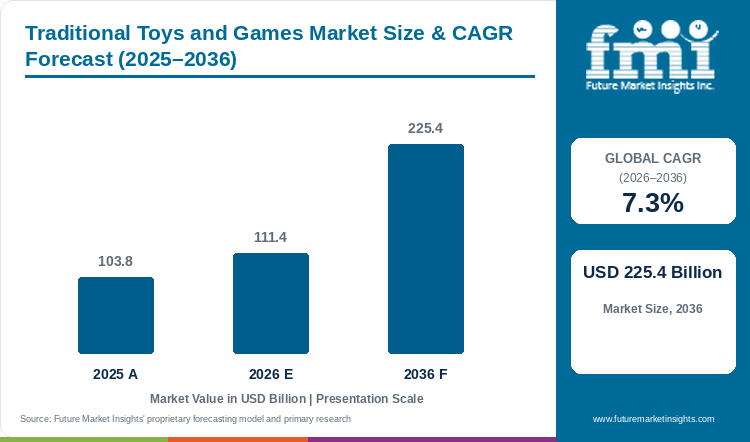
Demand is projected to expand at 7.3% CAGR from 2026 to 2036. Market value rises from USD 103.82 billion in 2025 to USD 111.4 billion in 2026 and USD 225.4 billion by 2036. [1]
FMI values the traditional toys and games market at USD 111.4 billion in 2026, compared with USD 103.82 billion in 2025, and projects USD 225.4 billion by 2036 at a 7.3% CAGR. [1] Board games account for 42.0% by product and online channels represent 38.0% by sales channel in 2026, leading their respective classifications of physical toys and games. [1] A physical set combines the pieces and rules needed for play, with intended age and the activity offered helping families, hobby players and education buyers select an appropriate product. The American Academy of Pediatrics' clinical report describes toys as instruments for caregiver-child interaction, directing attention to the play experience and suitability for the intended child. [2] CPSC small-parts guidance provides a defined boundary for relevant products intended for children under three, including consideration of pieces released during the applicable testing procedure. [3] Manufacturers consequently need construction and age presentation to fit the product's intended use, while adult hobby games require a different assessment of the likely user. New titles can complement an existing collection and durable sets support replay, connecting demand with product choice and purchase occasions beyond physical replacement of worn pieces. China has the fastest profiled growth rate at 8.6% CAGR from 2026 to 2036, within an outlook covering board games, building sets, dolls and other physical formats. [1] Suppliers can strengthen the offer through readable local-language rules, complete component descriptions and access to replacement pieces, helping customers assess how the set will be used after purchase.
Key Market Trends and Insights
- Board games represent 42.0% of the forecast product mix. [1]
- Online channels carry 38.0% of the channel mix. [1]
- Play interaction and age suitability provide more specific assessment criteria than an educational label. [2][3]
Regional Highlights
- Fastest-growing profiled market: China at 8.6% CAGR from 2026 to 2036. [1]
- US small-parts provisions address products intended for children under three, including pieces released during relevant testing, and this links the intended age group with component design and safety assessment. [3]
Market Size and Forecast
Table 1: Market size and forecast for the traditional toys and games market in USD billion and percentage
| Metric | Value |
|---|---|
| 2025 market size | USD 103.82 billion |
| Estimated market size in 2026 | USD 111.4 billion |
| Projected market size by 2036 | USD 225.4 billion |
| CAGR 2026 to 2036 | 7.3% |
| Added revenue 2026 to 2036 | USD 114 billion |
| Market expansion multiple | 2.0x |
New titles, replacement sets and different play occasions support purchases. Educational toys address learning activities, while stuffed and plush toys offer another physical-play format, and a durable set can remain in use across repeated sessions.
Physical Play and Small-Parts Assessment
Pediatric guidance addresses play and product selection. CPSC requirements specify small-parts safety considerations for defined age groups, connecting the intended user with the product's components. [2][3]
Table 2: Evidence and adoption indicators for the traditional toys and games market
| Indicator | Data point or finding | Commercial relevance | Source |
|---|---|---|---|
| Pediatric clinical report | Published January 2019 | Evaluates toys through play and caregiver interaction | [2] |
| US intended-age boundary | Small-parts provisions cover relevant under-three products | Age and construction affect qualification | [3] |
| Detached components | Use-and-abuse testing can release small parts | Assessment extends beyond the intact packaged toy | [3] |
Analyst Perspective
"A physical toy or game needs to suit the intended player and offer an activity that the pieces and rules can support. Families and education buyers can assess that experience directly, while an educational label alone cannot establish a learning result. Toy kitchens and play food provide another concrete format for shared play. Clear instructions, accurate age information and a complete set of components make the purchase easier to judge and support repeated use after the first session."
- Rahul Pandita, Principal Consultant, FMI
How is the traditional toys and games market segmented?
The market covers 3 commercial axes and region: product; sales channel; application.
By product: Board games; Building sets; Dolls; Action figures; Puzzles; Other toys and games. By sales channel: Toy specialty stores; Online; Department stores; Direct sales; Other channels. By application: Educational play; Skill development; Family entertainment.
Why do board games lead demand within the product category?
The board games segment accounts for 42.0% of product demand in 2026. [1]
Board games provide a ruleset and the physical pieces required for a repeatable play session, giving buyers a product whose use can be assessed before purchase. Families and hobby players can add new titles to an existing collection, while readable instructions help them understand the activity and level of complexity. Expansions and replacement components extend the offer around the core set. Smart and AI toys introduce digital interaction within a different format, whereas a traditional board game remains centered on the rules and pieces used together during play.
- Board games account for 42.0% of product demand in 2026, leading the physical-product mix that also includes building sets, dolls, action figures, puzzles and other traditional toys and games. [1]
- Readable rules and complete component descriptions help buyers assess the intended play experience, while replacement pieces and expansions support continued use of a board-game set across repeated sessions and purchase occasions.
Table 3: Leading product share for the traditional toys and games market
| Product | Share in 2026 |
|---|---|
| Board games | 42.0% |
| Other segments combined | 58.0% |
| Total | 100.0% |
Table 4: Segment leadership and market growth for the traditional toys and games market
| Metric | Value |
|---|---|
| Global CAGR 2026 to 2036 | 7.3% |
| Leading segment | Board games |
Why does online lead demand within the sales channel category?
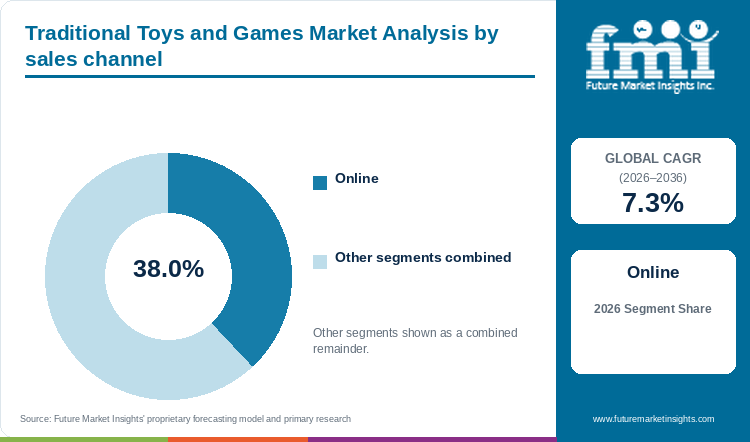
The online segment accounts for 38.0% of sales channel demand in 2026. [1]
Online channels give customers a way to compare the intended age, components and rules of a physical set before choosing a title or toy. Product images and readable instructions help communicate what the box contains and how the activity works, linking the listing with the experience delivered after purchase. Stock availability also matters when an owner needs replacement pieces or wants an additional title in a range. These practical information and availability requirements support online purchasing across the different physical formats included in the report.
- Online channels account for 38.0% of sales-channel demand in 2026, leading the classification that also covers toy specialty stores, department stores, direct sales and other channels for physical toys and games. [1]
- Accurate images, readable instructions and clear age information help online customers judge a set before delivery, while available stock supports replacement components and additional titles connected with the original purchase.
What are the drivers restraints and opportunities in the traditional toys and games market?
- Driver: Families, hobby players and education buyers choose physical sets for different users and occasions, supporting demand for new titles that complement existing collections while durable pieces and reusable rules allow repeated play across the product's useful life.
- Restraint: Small components can change a product's suitability for young children, with relevant US requirements considering pieces released during testing and requiring manufacturers to assess construction and intended use alongside the age information presented on the product. [3]
- Opportunity: Readable instructions and access to missing components help buyers use a physical set repeatedly, giving suppliers a concrete opportunity to improve the play offer through understandable rules and replacement support matched to the intended player.
Different play occasions create demand for physical sets
Families, hobby players and education buyers purchase physical sets for different users and occasions, with new titles complementing existing collections while durable pieces and reusable rules support replay and distinguish demand from automatic replacement each year.
Age and component mismatches can restrict product suitability
A small game piece can affect suitability for the intended child, with US requirements also considering components released during relevant testing and connecting construction and use with the age information presented for the finished product. [3]
Understandable rules and replacement support strengthen the offer
Readable instructions and access to missing components help buyers use a physical set repeatedly, allowing them to assess the actual play experience and interaction when choosing a product for a family or educational setting.
Which country CAGRs are profiled in the traditional toys and games market?
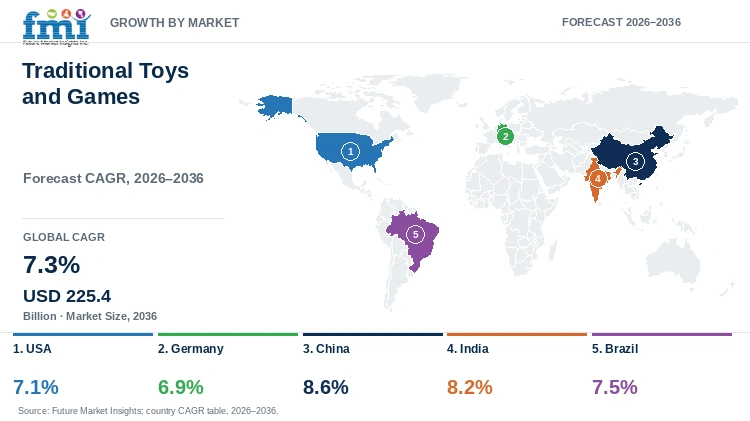
Table 5: Country CAGR comparison for the traditional toys and games market
| Country | CAGR 2026 to 2036 |
|---|---|
| USA | 7.1% |
| Germany | 6.9% |
| China | 8.6% |
| India | 8.2% |
| Brazil | 7.5% |
Country-wise Analysis
USA
US manufacturers and importers need to connect a children’s toy’s intended age with the applicable construction and small-parts requirements, because the product presented to the buyer must be assessed for its actual users. CPSC guidance identifies the small-parts ban for relevant products intended for children under three and the separate warning requirements affecting specified products. [3] The USA outlook projects 7.1% CAGR from 2026 to 2036, spanning physical toys and games with different age groups and purposes. [1] An adult hobby game and a toy for a young child therefore create different purchasing questions, even when both contain numerous pieces. Retailers can make the intended use and contents clear through photographs and descriptions, while complete inventories and replacement support help buyers assess how the set can continue to be used after the initial purchase.
Germany
A board game sold in Germany needs rules that the intended players can understand, because an attractive box and complete component set still leave the buyer dependent on instructions to begin using it. Clear German-language explanations can help families assess player count, playing time and the level of adult help needed, while replacement support becomes useful when a frequently used set loses a piece. FMI projects 6.9% CAGR from 2026 to 2036 for Germany, with those product details giving suppliers practical ways to distinguish their physical games. [1] A publisher can connect online photographs with an accurate contents list, allowing the customer to compare the actual activity rather than infer it from the theme. Providing a usable route for questions and missing components helps maintain the value of repeated play after the transaction.
China
Retailers expanding a toy assortment in China need to identify which items are complete sets and which require a separate base product, particularly when construction ranges contain related boxes with different contents. That information helps customers choose a usable purchase and gives the retailer a clearer account of what it is stocking. China’s outlook records 8.6% CAGR from 2026 to 2036, the fastest rate in the profiled set, alongside the need to maintain consistent component descriptions as ranges expand. [1] A supplier can make those distinctions visible through package information and online listings, while an accurate inventory helps resolve a later question about missing pieces. New titles can broaden the offer, but the continuing usefulness of a physical product depends on understandable rules and a set that contains the components needed for the activity described.
India
Price and the space available for play can influence an Indian household’s choice between a compact board game and a larger construction or activity set, while language determines how easily players can understand the rules. A classroom buyer has a further reason to examine how many children can take part and what assistance the activity requires. The India forecast projects 8.2% CAGR from 2026 to 2036, within demand shaped by those practical differences in use. [1] Suppliers can explain an educational presentation through the activity itself rather than make a broad promise about learning, with the American Academy of Pediatrics’ guidance emphasizing play and caregiver interaction when selecting toys for young children. [2] Clear age information, complete contents and understandable instructions give retailers a useful basis for helping buyers assess whether a set fits the intended household or classroom.
Brazil
Portuguese-language rules and an accurate piece inventory make a physical game easier for Brazilian buyers to assess before purchase, particularly when the theme alone does not explain how the activity is played. A retailer can identify player count, the expected playing time and any base set needed for an expansion, giving customers a clearer comparison between similar-looking boxes. FMI projects 7.5% CAGR for Brazil from 2026 to 2036, with those product details supporting demand for usable sets and repeat play. [1] After the sale, a missing component can interrupt the activity even when the rest of the product remains sound, making an accessible support route relevant to ownership. Suppliers that keep instructions, online descriptions and package contents consistent help buyers understand the purchase and give retail staff a concrete way to handle questions about the set.
Who are the notable companies in the traditional toys and games market?
Hasbro; LEGO; Ravensburger; Mattel; Spin Master
Competitive Benchmarking
Table 6: Competitive positioning for the traditional toys and games market
| Company or institution | Positioning | Evidence or purchasing distinction |
|---|---|---|
| Hasbro | Board games and physical toys | Physical games and licensed toy properties [1] |
| LEGO | Construction sets | Core sets and expansion products [1] |
| Ravensburger | Games and puzzles | Rules, components and replacement support [1] |
| Mattel | Physical toys and games | Official catalog includes dolls, action figures, building sets and games. [4] |
| Spin Master | Physical toys, games and puzzles | Official shop lists toy collections alongside games and puzzles. [5] |
Key Developments in the Traditional Toys and Games Market
- The American Academy of Pediatrics' clinical report assesses toys within caregiver-child play, highlighting age suitability and the surrounding interaction as product-selection considerations while an educational label alone does not establish a developmental result for the child. [2]
- CPSC small-parts guidance includes components released during relevant testing, connecting a young-child product's construction with the applicable choking-hazard requirements and making its intended age relevant alongside the pieces supplied in the original box. [3]
Key Players in the Traditional Toys and Games Market
Mattel; Hasbro; LEGO; Ravensburger; Spin Master; MGA Entertainment; Bandai.
Traditional Toys and Games Market Report Scope
The market covers physical board games, building sets, dolls, action figures, puzzles and other traditional toys. Age guidance and small-parts requirements apply to the product's intended users and component design; digital services and licensing have separate transaction boundaries.
Table 7: Report coverage for the traditional toys and games market
| Coverage field | Report scope |
|---|---|
| Market breakdown | Product; Sales channel; Application; region |
| Quantitative units | USD billion |
| Market definition | Physical toys and games in the reported product set, including board games, building sets, dolls, action figures and puzzles. Standalone video games and digital subscription services are excluded. |
| Regions covered | North America; Latin America; Western Europe; Eastern Europe; East Asia; South Asia and Pacific; Middle East and Africa |
| Countries profiled | USA; Germany; China; India; Brazil |
| Key companies profiled | Mattel; Hasbro; LEGO; Ravensburger; Spin Master; MGA Entertainment; Bandai |
| Forecast period | 2026 to 2036 |
Traditional Toys and Games Market Research Methodology
Table 8: Research methods for the traditional toys and games market
| Method | Approach |
|---|---|
| Market definition | The study examines the traditional toys and games market through product, sales channel and application, identifying the products or services and purchasing transactions covered. |
| Public documentary research | FMI market research, pediatric play guidance, CPSC small-parts information and official product catalogs inform the analysis of product characteristics, operating conditions and market context. |
| Company portfolio research | Official product pages and company disclosures describe relevant offerings, intended customers and participation within wider business portfolios. |
| Segment assessment | The product, sales channel and application categories are examined through product or service characteristics, practical use and purchase conditions. |
| Country research | Local distribution, purchasing arrangements and applicable public requirements inform country analysis alongside the reported market outlook. |
| Regulatory and technical assessment | Physical pieces, rules and intended age inform product comparison, alongside the small-parts requirements relevant to the users and construction of each set. |
| Forecast coverage | The forecast considers the demand drivers, purchasing constraints and supplier opportunities affecting the market across the study period. |
Traditional Toys and Games Market by Segments
By product
- Board games
- Building sets
- Dolls
- Action figures
- Puzzles
- Other toys and games
By sales channel
- Toy specialty stores
- Online
- Department stores
- Direct sales
- Other channels
By application
- Educational play
- Skill development
- Family entertainment
Traditional Toys and Games Market by Region
- North America
- USA
- Canada
- Latin America
- Brazil
- Mexico
- Argentina
- Chile
- Western Europe
- Germany
- France
- UK
- Italy
- Spain
- Benelux
- Nordics
- Eastern Europe
- Poland
- Czech Republic
- Romania
- Hungary
- East Asia
- China
- Japan
- South Korea
- South Asia and Pacific
- India
- ASEAN
- Australia and New Zealand
- Middle East and Africa
- GCC countries
- South Africa
- Türkiye
- Israel
Research Sources and Bibliography
- [1] Future Market Insights. Published outlook accessed 12 October 2026. Traditional Toys and Games Market.
- [2] American Academy of Pediatrics. January 2019; published online December 2018. Selecting Appropriate Toys for Young Children in the Digital Era.
- [3] US Consumer Product Safety Commission. Accessed October 2026. Small Parts Ban and Choking Hazard Labeling.
- [4] Mattel. Accessed October 2026. Mattel Shop.
- [5] Spin Master. Accessed October 2026. Collections.
This Report Answers
- How big is the traditional toys and games market in 2026?
- What market value is projected by 2036?
- Which product segment leads demand?
- Which other commercial categories shape the market?
- Which countries have the fastest profiled growth?
- Which companies and institutions participate in the market?
Frequently Asked Questions
How large is the traditional toys and games market in 2026?
FMI estimates market value at USD 111.4 billion in 2026. The estimated 2025 value is USD 103.82 billion. [1]
What value and CAGR are projected through 2036?
Market value is projected to reach USD 225.4 billion by 2036 at a 7.3% CAGR from 2026 to 2036. [1]
Which product segment leads in 2026?
Board games account for 42.0% of this category. [1]
What is the report segmentation?
Product; Sales channel; Application, and region.
Which profiled market records the highest CAGR?
China has the highest profiled rate at 8.6% from 2026 to 2036. [1]
Who are the key participants?
Mattel; Hasbro; LEGO; Ravensburger; Spin Master; MGA Entertainment; Bandai.
Preview the report firsthand - request a free sample
Get SampleGet the brochure for pricing and purchase details.
Get PDFTable of Content
- Key Takeaways
- Market Size and CAGR
- Top Growth Driver
- Fastest Growing Segment
- Leading Region
- Key Companies
- Emerging Opportunities
- Executive Summary
- Global Market Outlook
- Demand-side Trends
- Supply-side Trends
- Technology Roadmap Analysis
- Analysis and Recommendations
- Analyst Perspective (What is happening? Why now? What should investors know?)
- Key Questions Answered
- How large is the market?
- What is the CAGR?
- What are key trends?
- Which region dominates?
- Who are the leaders?
- Market Overview
- Market Coverage / Taxonomy
- Market Definition / Scope / Limitations
- Research Methodology
- Chapter Orientation
- Analytical Lens and Working Hypotheses
- Market Structure, Signals, and Trend Drivers
- Benchmarking and Cross-market Comparability
- Market Sizing, Forecasting, and Opportunity Mapping
- Research Design and Evidence Framework
- Desk Research Programme (Secondary Evidence)
- Expert Input and Fieldwork (Primary Evidence)
- Tooling, Models, and Reference Databases
- Data Engineering and Model Build
- Quality Assurance and Audit Trail
- Market Background
- Market Dynamics (Drivers, Restraints, Opportunity, Trends)
- Scenario Forecast (Optimistic, Likely, Conservative)
- Impact Analysis
- AI Impact
- Sustainability Impact
- Regulatory Impact
- Technology Impact
- Consumer / Buyer Analysis
- Purchase Drivers
- Adoption Barriers
- Buyer Journey
- Opportunity Map Analysis
- Product Life Cycle Analysis
- Supply Chain Analysis
- Investment Feasibility Matrix
- Value Chain Analysis
- PESTLE and Porter's Analysis
- Regulatory Landscape
- Regional Parent Market Outlook
- Production and Consumption Statistics
- Import and Export Statistics
- Global Market Analysis and Forecast, 2021 to 2036
- Historical Market Size Value (USD Billion) Analysis, 2021 to 2025
- Current and Future Market Size Value (USD Billion) Projections, 2026 to 2036
- Y-o-Y Growth Trend Analysis
- Absolute $ Opportunity Analysis
- Global Market Pricing Analysis, 2021 to 2036
- Global Market Analysis and Forecast, By product, 2021 to 2036
- Introduction / Key Findings
- Historical Market Size Value (USD Billion) Analysis By product, 2021 to 2025
- Current and Future Market Size Value (USD Billion) Analysis and Forecast By product, 2026 to 2036
- Board games
- Building sets
- Dolls
- Action figures
- Puzzles
- Other toys and games
- Y-o-Y Growth Trend Analysis By product, 2021 to 2025
- Absolute $ Opportunity Analysis By product, 2026 to 2036
- Global Market Analysis and Forecast, By sales channel, 2021 to 2036
- Introduction / Key Findings
- Historical Market Size Value (USD Billion) Analysis By sales channel, 2021 to 2025
- Current and Future Market Size Value (USD Billion) Analysis and Forecast By sales channel, 2026 to 2036
- Toy specialty stores
- Online
- Department stores
- Direct sales
- Other channels
- Y-o-Y Growth Trend Analysis By sales channel, 2021 to 2025
- Absolute $ Opportunity Analysis By sales channel, 2026 to 2036
- Global Market Analysis and Forecast, By application, 2021 to 2036
- Introduction / Key Findings
- Historical Market Size Value (USD Billion) Analysis By application, 2021 to 2025
- Current and Future Market Size Value (USD Billion) Analysis and Forecast By application, 2026 to 2036
- Educational play
- Skill development
- Family entertainment
- Y-o-Y Growth Trend Analysis By application, 2021 to 2025
- Absolute $ Opportunity Analysis By application, 2026 to 2036
- Global Market Analysis and Forecast, By Region, 2021 to 2036
- Introduction
- Historical Market Size Value (USD Billion) Analysis By Region, 2021 to 2025
- Current Market Size Value (USD Billion) Analysis and Forecast By Region, 2026 to 2036
- North America
- Latin America
- Western Europe
- Eastern Europe
- East Asia
- South Asia and Pacific
- Middle East and Africa
- Market Attractiveness Analysis By Region
- North America Market Analysis and Forecast, By Country, 2021 to 2036
- Historical Market Size Value (USD Billion) Trend Analysis By Market Taxonomy, 2021 to 2025
- Market Size Value (USD Billion) Forecast By Market Taxonomy, 2026 to 2036
- By Country
- USA
- Canada
- By product
- By sales channel
- By application
- By Country
- Market Attractiveness Analysis
- By Country
- By product
- By sales channel
- By application
- Key Takeaways
- Latin America Market Analysis and Forecast, By Country
- Historical Market Size Value (USD Billion) Trend Analysis By Market Taxonomy, 2021 to 2025
- Market Size Value (USD Billion) Forecast By Market Taxonomy, 2026 to 2036
- By Country
- Brazil
- Mexico
- Argentina
- Chile
- By product
- By sales channel
- By application
- By Country
- Market Attractiveness Analysis
- By Country
- By product
- By sales channel
- By application
- Key Takeaways
- Western Europe Market Analysis and Forecast, By Country
- Historical Market Size Value (USD Billion) Trend Analysis By Market Taxonomy, 2021 to 2025
- Market Size Value (USD Billion) Forecast By Market Taxonomy, 2026 to 2036
- By Country
- Germany
- France
- UK
- Italy
- Spain
- Benelux
- Nordics
- By product
- By sales channel
- By application
- By Country
- Market Attractiveness Analysis
- By Country
- By product
- By sales channel
- By application
- Key Takeaways
- Eastern Europe Market Analysis and Forecast, By Country
- Historical Market Size Value (USD Billion) Trend Analysis By Market Taxonomy, 2021 to 2025
- Market Size Value (USD Billion) Forecast By Market Taxonomy, 2026 to 2036
- By Country
- Poland
- Czech Republic
- Romania
- Hungary
- By product
- By sales channel
- By application
- By Country
- Market Attractiveness Analysis
- By Country
- By product
- By sales channel
- By application
- Key Takeaways
- East Asia Market Analysis and Forecast, By Country
- Historical Market Size Value (USD Billion) Trend Analysis By Market Taxonomy, 2021 to 2025
- Market Size Value (USD Billion) Forecast By Market Taxonomy, 2026 to 2036
- By Country
- China
- Japan
- South Korea
- By product
- By sales channel
- By application
- By Country
- Market Attractiveness Analysis
- By Country
- By product
- By sales channel
- By application
- Key Takeaways
- South Asia and Pacific Market Analysis and Forecast, By Country
- Historical Market Size Value (USD Billion) Trend Analysis By Market Taxonomy, 2021 to 2025
- Market Size Value (USD Billion) Forecast By Market Taxonomy, 2026 to 2036
- By Country
- India
- ASEAN
- Australia and New Zealand
- By product
- By sales channel
- By application
- By Country
- Market Attractiveness Analysis
- By Country
- By product
- By sales channel
- By application
- Key Takeaways
- Middle East and Africa Market Analysis and Forecast, By Country
- Historical Market Size Value (USD Billion) Trend Analysis By Market Taxonomy, 2021 to 2025
- Market Size Value (USD Billion) Forecast By Market Taxonomy, 2026 to 2036
- By Country
- GCC countries
- South Africa
- Türkiye
- Israel
- By product
- By sales channel
- By application
- By Country
- Market Attractiveness Analysis
- By Country
- By product
- By sales channel
- By application
- Key Takeaways
- Key Countries Market Analysis
- USA
- Pricing Analysis
- Market Share Analysis, 2025
- By product
- By sales channel
- By application
- Canada
- Pricing Analysis
- Market Share Analysis, 2025
- By product
- By sales channel
- By application
- Mexico
- Pricing Analysis
- Market Share Analysis, 2025
- By product
- By sales channel
- By application
- Brazil
- Pricing Analysis
- Market Share Analysis, 2025
- By product
- By sales channel
- By application
- Chile
- Pricing Analysis
- Market Share Analysis, 2025
- By product
- By sales channel
- By application
- Germany
- Pricing Analysis
- Market Share Analysis, 2025
- By product
- By sales channel
- By application
- UK
- Pricing Analysis
- Market Share Analysis, 2025
- By product
- By sales channel
- By application
- Italy
- Pricing Analysis
- Market Share Analysis, 2025
- By product
- By sales channel
- By application
- Spain
- Pricing Analysis
- Market Share Analysis, 2025
- By product
- By sales channel
- By application
- France
- Pricing Analysis
- Market Share Analysis, 2025
- By product
- By sales channel
- By application
- India
- Pricing Analysis
- Market Share Analysis, 2025
- By product
- By sales channel
- By application
- ASEAN
- Pricing Analysis
- Market Share Analysis, 2025
- By product
- By sales channel
- By application
- Australia and New Zealand
- Pricing Analysis
- Market Share Analysis, 2025
- By product
- By sales channel
- By application
- China
- Pricing Analysis
- Market Share Analysis, 2025
- By product
- By sales channel
- By application
- Japan
- Pricing Analysis
- Market Share Analysis, 2025
- By product
- By sales channel
- By application
- South Korea
- Pricing Analysis
- Market Share Analysis, 2025
- By product
- By sales channel
- By application
- Poland
- Pricing Analysis
- Market Share Analysis, 2025
- By product
- By sales channel
- By application
- Hungary
- Pricing Analysis
- Market Share Analysis, 2025
- By product
- By sales channel
- By application
- Türkiye
- Pricing Analysis
- Market Share Analysis, 2025
- By product
- By sales channel
- By application
- South Africa
- Pricing Analysis
- Market Share Analysis, 2025
- By product
- By sales channel
- By application
- USA
- Market Structure Analysis
- Competition Dashboard
- Competition Benchmarking
- Market Share Analysis of Top Players
- By Regional
- By product
- By sales channel
- By application
- Emerging Startups
- Innovation Benchmarking
- Competition Analysis
- Competition Deep Dive
- Hasbro
- Overview
- Product Portfolio
- Profitability by Market Segments
- Sales Footprint
- Strategy Overview
- Marketing Strategy
- Product Strategy
- Channel Strategy
- LEGO
- Ravensburger
- Mattel
- Spin Master
- Hasbro
- Case Studies
- Success Stories
- Recent Developments
- Competition Deep Dive
- Assumptions & Acronyms Used


