

- Market Size (2026)
- USD 2.9 Bn
- Forecast (2036)
- USD 4.6 Bn
- CAGR (2026 to 2036)
- 4.8%
How big is Truck Toolboxes Market in 2026?
USD 2.9 Billion in 2026 and USD 4.6 Billion by 2036 at a 4.8% CAGR.
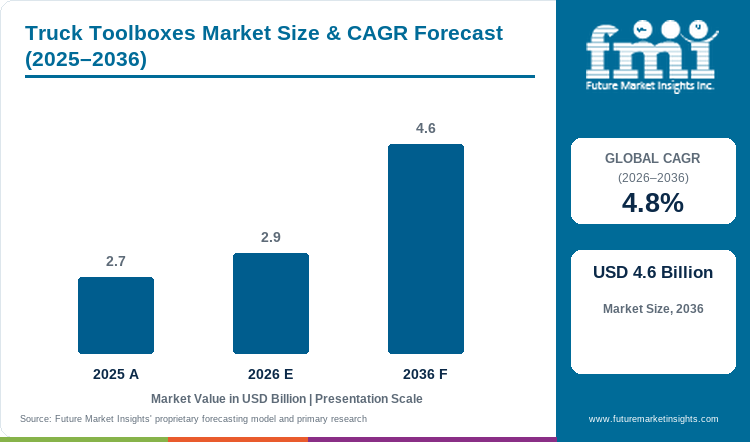
Demand for Truck Toolboxes is estimated at USD 2.9 Billion in 2026 and is forecast to reach USD 4.6 Billion by 2036, growing at a CAGR of 4.8%. The market was valued at USD 2.7 Billion in 2025. Purchases follow work-vehicle use and replacement rather than vehicle ownership by itself. Construction crews and service fleets use truck-mounted storage to secure tools while preserving cargo space. The USA Census Bureau reported on August 3, 2026 that June construction spending was running at a seasonally adjusted annual rate of USD 2,166.5 billion, illustrating the scale of project activity that keeps mobile crews and service vehicles in daily use. Toolbox demand converts when the box fits the vehicle, keeps tools accessible, and meets the buyer’s installed-cost threshold.
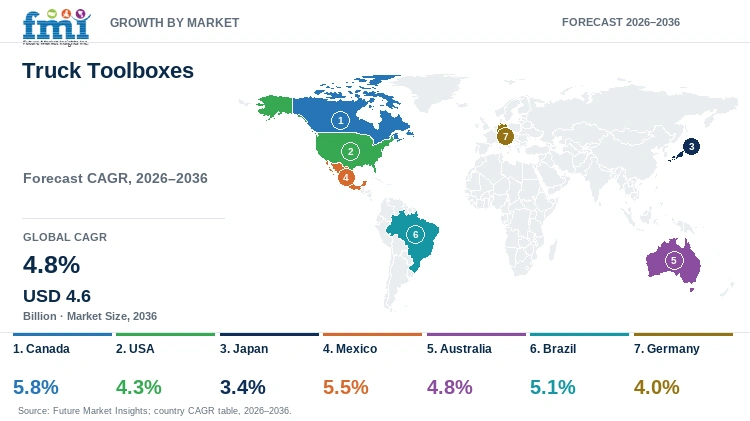
Country growth follows fleet use and replacement conditions. Canada has the highest selected CAGR at 5.8%, with Mexico at 5.5% and Brazil at 5.1%. Australia matches the global CAGR at 4.8%. The USA, Germany, and Japan grow more slowly at 4.3%, 4.0%, and 3.4%. These rates indicate pace rather than absolute market size. Suppliers still need vehicle-specific fitment and suitable local channels. Serviceable locking hardware also affects whether initial purchases become repeat fleet orders.
Key Takeaways
- The Truck Toolboxes Market is valued at USD 2.8 Billion in 2025. Demand is estimated at USD 2.9 Billion in 2026 and is forecast to reach USD 4.6 Billion by 2036, growing at a CAGR of 4.8% from 2026 to 2036.
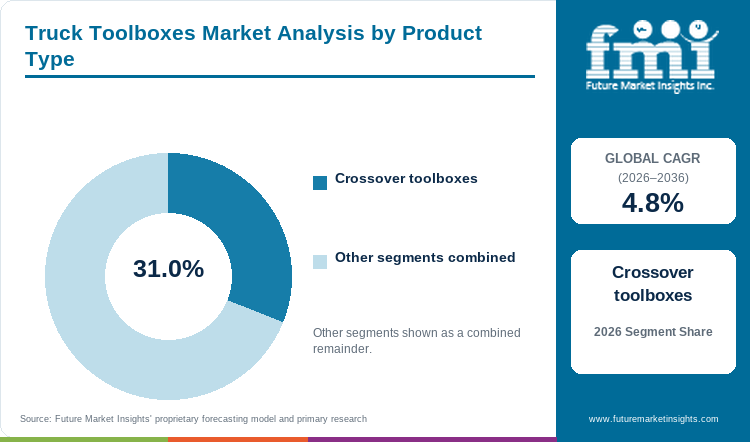
- Crossover toolboxes are estimated to account for 31.0% of Product Type demand in 2026, supported by their ability to preserve truck-bed floor space while keeping tools accessible.
- Aluminum is projected to hold 48.0% of the Material category in 2026 because its lower installed weight and corrosion resistance suit pickup and commercial vehicle applications.
- Pickup trucks are estimated to account for 44.0% of Vehicle Type demand in 2026 due to their broad compatibility with crossover, chest, side-mount, and other standalone toolbox formats.
- Construction trades remain a major source of demand as mobile crews require secure storage for tools and equipment across jobsites.
- Aftermarket retail remains an important sales channel because toolbox purchases and replacements can occur independently of the vehicle replacement cycle.
- Fitment remains a key purchasing constraint. Bed dimensions, wheel wells, towing hardware, tonneau covers, and mounting positions can affect product compatibility.
- Fleet programs create an opportunity for suppliers that provide repeatable mounting specifications, common keying systems, replacement parts, and standardized configurations across vehicles.
- Canada records the highest CAGR among the key countries in this market at 5.8% from 2026 to 2036, followed by Mexico at 5.5% and Brazil at 5.1%.
- Australia is forecast to grow at 4.8%, followed by the USA at 4.3%, Germany at 4.0%, and Japan at 3.4% from 2026 to 2036.
- Weather Guard, UWS, Better Built, Buyers Products, CamLocker, and RKI are among the notable companies operating in the Truck Toolboxes Market.
- Competitive differentiation centers on vehicle fitment, material choice, locking design, installation simplicity, and replacement support for professional and fleet users.
Analyst Perspective
Commercial advantage comes from making fitment and service predictable across repeated vehicle purchases. Clear dimensions and mounting logic reduce returns and installation errors. Security features become more valuable when fleets standardize keys across several boxes. Material choice should reflect payload limits, corrosion exposure, and expected service life.
- Nandini Roy Choudhury, Principal Analyst at Future Market Insights
How is the truck toolboxes market segmented?
The market is segmented by Product Type, Material, Vehicle Type, End Use, and Sales Channel.
Product Type separates the mounting architecture and point of access within the truck or trailer. Material distinguishes weight and corrosion resistance. It also separates impact behavior from cost. Vehicle Type captures differences in bed geometry and commercial body design. End Use reflects how frequently tools move with the vehicle and the security cost of downtime. Sales Channel identifies whether the box is selected after vehicle purchase or specified during fleet upfitting. It also distinguishes digital or catalog orders from direct OEM accessory supply. These axes intersect at the fitment decision because buyers ultimately need a box that matches the vehicle and the work pattern.
What makes Crossover toolboxes central to the Product Type category?
Crossover toolboxes sit on the pickup bed rails and bridge the space behind the cab. That geometry leaves most of the bed floor open for materials while giving users access from the sides of the vehicle. The format also supports multiple depths and lid profiles without changing the basic installation concept. This makes crossover designs easier to match to common full-size and midsize pickup use than highly specialized service-body or underbody boxes. Buyers still have to manage bed width and wheel-well clearance. Tonneau compatibility and towing hardware also matter. Even so, the architecture solves the most common need: secure tools without converting the whole bed into fixed storage.
- Crossover toolboxes hold a 31.0% share in 2026 because rail-mounted storage preserves bed-floor utility while keeping tools accessible from the vehicle sides.
- Buyers Products currently offers a broad truck-box range spanning crossover, underbody, topsider, storage-chest, and trailer-tongue configurations. That breadth illustrates how suppliers address different bed layouts without relying on one universal box format.
Why does Aluminum lead the Material category?
Aluminum balances two constraints that matter in working pickups: exposure to weather and the need to preserve payload. Its resistance to rust reduces the maintenance burden for boxes that remain outdoors, while its lower mass than comparable steel construction leaves more vehicle capacity for tools and materials. Steel remains important where buyers prioritize impact resistance and heavier construction. Stainless steel suits selected corrosion-sensitive applications at a higher material cost. Polymer and composite boxes can reduce weight further and avoid rust. They compete on different expectations for rigidity and lock reinforcement as well as long-term wear. The leading position therefore reflects a practical weight-versus-durability compromise.
- Aluminum holds a 48.0% share in 2026 because it combines corrosion resistance with a lower installed weight that fits pickup payload and fuel-efficiency priorities.
- Buyers Products lists a diamond-tread aluminum all-purpose chest for compact pickups. The product is designed to sit below the bed rails and supports tonneau-cover compatibility, showing how aluminum construction is paired with smaller-bed fitment.
How do Pickup trucks shape the Vehicle Type category?
Pickup trucks provide the broadest natural mounting surface for standalone toolboxes. Their open beds can accept crossover and chest configurations. Side-mount and selected drawer or rail-mounted formats also fit without the box becoming part of a complete service body. Individual tradespeople can buy and install a box after vehicle purchase, while fleets can standardize a preferred configuration across similar pickups. Service trucks and utility trucks support larger fixed-storage packages, yet they require more coordination with body builders and upfitters. Trailers and heavy-duty trucks create additional niches, but the purchase cycle is more application-specific. Pickup demand is therefore supported by fitment breadth and aftermarket purchasing freedom.
- Pickup trucks account for 44.0% of 2026 demand because their open-bed architecture supports the widest combination of direct-fit and universal toolbox configurations.
- In March 2024, Weather Guard introduced Saddle and Lo-Side truck-box updates with 1Key Ultralock, placing fleet key control and visible locking status directly into pickup-oriented storage products.
How do Construction trades shape the End Use category?
Construction trades create a high-frequency storage need because crews move power tools and jobsite equipment between locations while the vehicle remains exposed to weather and theft risk. A truck toolbox can reduce repeated loading into the cab and keep frequently used equipment separate from bulk materials in the bed. USA construction employment reached 8.343 million in July 2026 according to the Bureau of Labor Statistics, indicating a large professional workforce in which mobile tool access is routine. The purchase case depends on secure storage that does not compromise cargo space or vehicle use.
- Buyers Products currently markets professional truck-box families for contractors and work-truck users in both steel and aluminum. Its catalog covers configurations for pickups, flatbeds, service bodies, and trailers.
How does Aftermarket retail shape the Sales Channel category?
Aftermarket retail is important because a toolbox can be selected after the vehicle purchase, once the owner understands the actual cargo pattern and access needs. The buyer can compare box dimensions and finish against installed accessories before committing to a mounting layout. Replacement can also happen independently of the vehicle cycle when locks, seals, or box bodies no longer meet the job. Fleet upfitters remain relevant when a common specification must be repeated across several vehicles, while direct accessory programs offer tighter integration but less choice.
- UWS supports both online purchasing and local dealer lookup for its crossover truck toolboxes, showing how aftermarket access combines digital selection with local distribution.
What are the drivers, restraints, and opportunities in the truck toolboxes market?
Mobile construction and service work support recurring demand. Fitment constraints can delay a purchase, while standardized locking and repeatable installation create an opportunity in fleet upfits.
- Driver: Active field work keeps tools moving in pickups and service vehicles, creating recurring demand for secure storage.
- Restraint: Bed dimensions and towing hardware can turn a simple accessory purchase into a fitment problem. Tonneau covers and mounting choices add further constraints.
- Opportunity: Suppliers can win fleet programs by combining standardized key control, clear fitment, and modular box configurations across vehicle classes.
Construction and field-service activity create the strongest recurring demand mechanism. The USA Census Bureau reported USD 745.3 billion in seasonally adjusted annualized private nonresidential construction spending for June 2026, while public construction was USD 544.1 billion. Those project flows keep pickups and work trucks in daily use around tools, parts, and consumables. The toolbox purchase is not driven by construction value itself. It is driven by the operating requirement created when technicians and crews repeatedly transport equipment between sites. Suppliers benefit when storage reduces time spent locating tools and limits the exposure of valuable equipment in an open bed. Demand is strongest where the vehicle is a mobile work platform rather than simple transportation.
Fitment is the binding friction because truck beds are not uniform and many working pickups carry other accessories. Buyers Products offers a compact-truck aluminum chest designed to fit between the wheel wells and below the bed rails while retaining tonneau-cover compatibility. That design illustrates why a generic box does not solve every application. Buyers must consider rail width and bed depth, then confirm wheel-well and hitch clearance. Lid opening near the cab can create another constraint. Clear vehicle dimensions and mounting guidance therefore have direct commercial value because they reduce returns and abandoned purchases.
Fleet-standardized security is the clearest opportunity to move beyond a commodity box sale. Weather Guard’s March 2024 truck-box update added 1Key Ultralock with the ability to manage keys across multiple boxes and give users a visible locked-or-unlocked cue. That capability addresses a fleet problem rather than a single-user preference. As organizations add service pickups, duplicated keys and inconsistent locks create avoidable administrative work and downtime. Vendors can capture more value when they pair box hardware with common keying, replacement parts, and repeatable installation specifications. The opportunity is strongest through fleet upfitters and distributors that can enforce the same configuration across successive vehicle orders.
Which country CAGRs are included in the truck toolboxes market?
| Country | CAGR |
|---|---|
| Canada | 5.8% |
| USA | 4.3% |
| Japan | 3.4% |
| Mexico | 5.5% |
| Australia | 4.8% |
| Brazil | 5.1% |
| Germany | 4.0% |
How do country-level CAGRs compare in the truck toolboxes market?
Across the seven selected countries, growth spans 2.4 percentage points from Canada at 5.8% CAGR to Japan at 3.4% CAGR from 2026 to 2036. Canada and Mexico sit above 5.0%, with Brazil at 5.1%. Australia matches the global CAGR at 4.8%. USA and Germany are forecast at 4.3% and 4.0%. These rates describe expected pace rather than absolute market size. Commercial priority still depends on suitable work-vehicle density, replacement timing, and channel access.
- Canada versus Mexico: the 0.3-point gap is small enough that channel density and replacement conditions are likely to matter more than headline growth-rate separation.
- Mexico versus Brazil: the 0.4-point gap favors faster Mexican expansion, but local vehicle mix and distributor reach will determine which supplier can convert that pace into orders.
- Brazil versus Australia: the 0.3-point difference places both in a similar growth band, although Brazil faces stronger cost pressure while Australia has a large engineering and construction workload.
- Australia versus USA: the 0.5-point gap indicates a faster Australian path. USA still offers a deep professional-user base, while Germany and Japan require more selective fitment and replacement strategies.
CAGR should therefore be treated as one planning input. Market size and channel structure can outweigh modest rate differences. The full report assesses fitment, use intensity, and competitive access alongside growth.
Country-wise Analysis
- Canada: Contractors and fleet operators buy around vehicle upfits, replacement needs, and exposure to snow, road salt, and long travel distances. Demand for Truck Toolboxes in Canada is forecast to expand at 5.8% CAGR from 2026 to 2036. Statistics Canada reported in February 2026 that total building-construction investment reached CAD 272.1 billion in 2025, up 8.5% in current dollars. Statistics Canada also reported in March 2026 that new pickup-truck registrations increased 0.9% in 2025. The local friction is material and seal durability across harsh weather, plus distributor coverage outside major metros. Suppliers can respond with corrosion-resistant aluminum, durable powder-coated steel, weather sealing, and dealer support that reaches regional trade users.
- USA: Professional trades and mixed fleets use pickups as mobile work platforms, so toolbox purchases often follow vehicle acquisition or a change in crew assignment. Demand for Truck Toolboxes in the USA is forecast to rise at 4.3% CAGR from 2026 to 2036. The USA Census Bureau reported in August 2026 that June construction spending was running at USD 2,166.5 billion on a seasonally adjusted annual basis. The Federal Highway Administration’s Highway Statistics 2024 also provides state truck-registration data and national vehicle-travel measures by vehicle type. The friction is fragmented fitment across truck sizes and bed accessories. Suppliers need broad SKU coverage, clear installation guidance, and both retail and fleet-upfit routes to capture replacement demand.
- Japan: Truck users place high value on space utilization, operating efficiency, and equipment that fits the duty cycle without adding avoidable weight or obstruction. Demand for Truck Toolboxes in Japan is forecast to expand at 3.4% CAGR from 2026 to 2036. JAMA reported in April 2025 that large transport operators and financially improving operators showed stronger truck purchase intent, while driver shortages remained severe in transport businesses. The friction is a more compact vehicle mix and cautious replacement spending. Suppliers need narrower formats, vehicle-specific fit, and high access efficiency rather than oversized universal boxes.
- Mexico: Pickup and light-truck production gives the aftermarket a strong vehicle foundation and supports familiarity with truck-bed accessories. Demand for Truck Toolboxes in Mexico is forecast to rise at 5.5% CAGR from 2026 to 2036. INEGI reported on July 7, 2026 that light trucks represented 79.6% of Mexican light-vehicle production during the first half of 2026. The friction is uneven construction activity and price sensitivity across owner-operators. Suppliers need locally stocked sizes, durable value tiers, and distributor partnerships that can serve both professional users and fleet upfitters.
- Australia: Trades, agriculture, utilities, and engineering work create a strong need for weather-resistant storage on vehicles that often operate far from fixed workshops. Demand for Truck Toolboxes in Australia is forecast to expand at 4.8% CAGR from 2026 to 2036. The Australian Bureau of Statistics reported in February 2026 that construction work done totaled AUD 80.0 billion in the December 2025 quarter. Long distances and harsh exposure raise the cost of weak seals or difficult parts support. Suppliers can compete with corrosion-resistant materials, secure latches, practical field access, and serviceable hardware.
- Brazil: Professional users balance the need for secure mobile storage against project costs and the price of work-truck equipment. Demand for Truck Toolboxes in Brazil is forecast to rise at 5.1% CAGR from 2026 to 2036. IBGE reported on July 10, 2026 that the national construction cost index was up 7.26% over twelve months, with labor costs up 9.59%. That cost pressure can defer discretionary upfits even when tools still require protection. Suppliers need durable products at clear price points, replaceable locking parts, and distribution that limits freight and service costs.
- Germany: Fleet and trade buyers operate in a mature market where equipment purchases are scrutinized against vehicle utilization and total operating cost. Demand for Truck Toolboxes in Germany is forecast to expand at 4.0% CAGR from 2026 to 2036. Destatis reported in January 2026 that price-adjusted construction investment fell 0.9% in 2025, marking a fifth consecutive annual decline. Slower building activity limits urgency in some contractor segments. Suppliers can focus on utility fleets and infrastructure work. Vehicle-specific boxes with durable corrosion protection can support a clear service-life case.
Who are the notable companies in the truck toolboxes market?
Weather Guard, UWS, Better Built, Buyers Products, CamLocker, and RKI are the companies included in the competitive review based on current public evidence of truck-toolbox or work-truck storage offerings.
The competitive field separates by pickup-bed fitment and commercial work-truck coverage. UWS and CamLocker focus strongly on pickup-oriented crossover, side-mount, or chest storage. Weather Guard combines pickup boxes with fleet-oriented locking features. Buyers Products and RKI cover a wider mix of commercial truck-box architectures. Better Built participates through ProDriven’s work-truck and jobsite equipment portfolio. Buyers should compare the exact box family against bed geometry and mounting needs rather than infer capability from a parent brand alone.
- Pickup-bed fitment: UWS and CamLocker publish active crossover and related pickup-storage ranges. Weather Guard also maintains current Saddle and Lo-Side truck-box families.
- Fleet and work-truck configurations: Buyers Products and RKI publish broader commercial truck-box ranges, while Weather Guard adds fleet key-management features to pickup storage.
- Professional value positioning: Better Built operates within ProDriven Global Brands as a work-truck and jobsite equipment brand.
Competitive Benchmarking: Truck Toolboxes Market
| Company | Configuration Breadth | Fleet/Upfit Suitability | Material & Locking Options | Geographic Reach |
|---|---|---|---|---|
| Weather Guard | High | High | High | North American work-truck channels with broader ProDriven brand reach |
| UWS | High | Medium | High | United States online and dealer channels; local dealer lookup supported |
| Better Built | Medium | Medium | Medium | ProDriven work-truck and jobsite equipment channels |
| Buyers Products | High | High | High | United States manufacturing with broad truck-equipment distribution |
| CamLocker | Medium | Medium | High | United States direct and dealer sales |
| RKI | High | High | High | United States commercial truck-equipment and distributor network |
Scoring basis: Configuration Breadth reflects documented coverage across major truck-box architectures. Fleet/Upfit Suitability reflects mounting options and evidence of commercial work-truck use. Material & Locking Options reflects documented construction choices and security features. High indicates broad documented coverage, while Medium indicates a narrower but clearly evidenced offering. The scores are comparative editorial assessments.
Key Developments in the Truck Toolboxes Market
- In March 2024, Weather Guard introduced updated Saddle and Lo-Side truck boxes with 1Key Ultralock. The system combined key management across multiple boxes with a visible red push-button lock indicator and pickup-focused aluminum storage. The change pushed security beyond a single latch specification and toward fleet key standardization, which can reduce administrative friction when multiple work trucks use the same storage platform.
- In August 2024, WernerCo Professional Brands changed its corporate name to ProDriven Global Brands. The company stated that the change reflected a broader professional portfolio that includes Weather Guard and Knaack, while leaving brands and product offerings unchanged. The reorganization matters competitively because shared manufacturing, distribution, sales, and marketing infrastructure can support professional-storage brands even when their product positions remain distinct.
- Buyers Products currently lists a heavy-duty top-mount service-body truck toolbox series for single-rear-wheel and dual-rear-wheel service bodies. The range includes steel and diamond-tread aluminum configurations with locking hardware and weather-resistant storage features, extending the company’s coverage beyond pickup-bed boxes.
- Buyers Products also maintains a broad truck-box catalog covering crossover, underbody, topsider, storage-chest, trailer-tongue, backpack, and specialty configurations. The breadth matters for upfitters that need several mounting architectures within one supplier relationship.
Key Players in the Truck Toolboxes Market
Pickup-Bed Fitment and Access Specialists
- UWS
- Better Built
- CamLocker
Fleet and Work-Truck Storage Platforms
- Weather Guard
- Buyers Products
- RKI
Truck Toolboxes Market - Report Scope
| Coverage field | Report scope |
|---|---|
| Market breakdown | Product Type; Material; Vehicle Type; End Use; Sales Channel; Region |
| Quantitative Units | USD Billion |
| Market Definition | Revenue from truck-mounted or truck/trailer-mounted toolboxes sold within the defined product, material, vehicle, end-use, and sales-channel universe. Excludes complete vehicle revenue, full service-body revenue, portable hand toolboxes, fuel tanks, racks, and adjacent cargo-management products that are not sold as truck toolboxes. |
| Regions Covered | North America; Latin America; Western Europe; Eastern Europe; East Asia; South Asia and Pacific; Middle East and Africa |
| Countries Covered | Canada, USA, Japan, Mexico, Australia, Brazil, Germany, and more than twenty-five additional countries in the full report |
| Key Companies Included | Weather Guard, UWS, Better Built, Buyers Products, CamLocker, and RKI |
| Forecast Period | 2026 to 2036 |
| Approach | Hybrid bottom-up and top-down sizing using supplier activity, product and channel checks, vehicle and end-use demand indicators, and reconciliation across segment and country views while excluding adjacent-category revenue. |
Truck Toolboxes Market - Research Methodology
| Method | Approach |
|---|---|
| Primary Research | FMI primary research covers manufacturers, distributors, fleet upfitters, procurement teams, professional users, and subject-matter specialists. Discussions focus on fitment, material choice, locking requirements, replacement triggers, channel economics, installation practices, and differences between individual and fleet purchasing. |
| Desk Research | Public research reviews national construction and vehicle indicators, industry-association publications, company filings and newsroom releases, product documentation, distributor material, standards where relevant, and government statistics. Evidence is retained only when it informs the defined truck-toolbox revenue boundary or explains a specific buyer mechanism. |
| Market Sizing and Forecasting | Sizing reconciles supplier and channel activity with vehicle type, end-use intensity, product mix, material mix, replacement cycles, and country conditions. Forecast assumptions consider construction and service activity, truck and fleet replacement, fitment availability, material and security preferences, and route-to-market development through 2036. |
| Data Validation | Company, channel, vehicle, and country evidence is cross-checked before publication. The scope excludes complete vehicle bodies, downstream vehicle revenue, portable storage, and adjacent accessories outside the truck-toolbox definition. |
Truck Toolboxes Market by Segments
Truck Toolboxes Market segmented by Product Type:
- Crossover toolboxes
- Underbody toolboxes
- Side-mount toolboxes
- Chest toolboxes
- Service body toolboxes
- Trailer tongue toolboxes
Truck Toolboxes Market segmented by Material:
- Aluminum
- Steel
- Stainless steel
- Polymer/composite
Truck Toolboxes Market segmented by Vehicle Type:
- Pickup trucks
- Service trucks
- Utility trucks
- Trailers
- Heavy-duty trucks
Truck Toolboxes Market segmented by End Use:
- Construction trades
- DIY/professional users
- Fleet maintenance
- Agriculture
- Oilfield/service fleets
Truck Toolboxes Market segmented by Sales Channel:
- Aftermarket retail
- Fleet upfitters
- Online/catalog
- Direct OEM/accessory supply
Truck Toolboxes Market by Region:
- North America
- United States
- Canada
- Latin America
- Brazil
- Mexico
- Argentina
- Chile
- Western Europe
- Germany
- France
- United Kingdom
- Italy
- Spain
- Benelux
- Nordics
- Eastern Europe
- Poland
- Czech Republic
- Romania
- Hungary
- East Asia
- China
- Japan
- South Korea
- South Asia and Pacific
- India
- ASEAN
- Australia and New Zealand
- Middle East and Africa
- GCC Countries
- South Africa
- Türkiye
- Israel
Research Sources and Bibliography
- USA Census Bureau (2026, August 3). Monthly Construction Spending, June 2026.
- USA Bureau of Labor Statistics (2026, August 7). The Employment Situation, July 2026.
- Statistics Canada (2026, February 18). Investment in building construction, December 2025.
- Instituto Nacional de Estadística y Geografía (2026, July 7). Registro Administrativo de la Industria Automotriz de Vehículos Ligeros, junio de 2026.
- Japan Automobile Manufacturers Association (2025, April 15). 2024 Regular Truck Market Trend Survey.
- Australian Bureau of Statistics (2026, February 25). Construction Work Done, Australia, Preliminary, December 2025.
- Brazilian Institute of Geography and Statistics (2026, July 10). National Civil Construction Index accelerates to 1.19% in June.
- German Federal Statistical Office (2026, January 15). Gross domestic product up 0.2% in 2025.
- Federal Highway Administration (2026, January). Highway Statistics 2024, Table MV-1: State Motor-Vehicle Registrations.
- Statistics Canada (2026, March 12). New motor vehicle registrations, fourth quarter 2025.
- UWS (n.d.; accessed 2026, September 15). Crossover Truck Tool Boxes.
- UWS (n.d.; accessed 2026, September 15). How to Measure Your Truck Bed for a Tool Box.
- Buyers Products (n.d.; accessed 2026, September 15). Truck Tool Boxes.
- Weather Guard (2024, March 4). Weather Guard Introduces New Work Truck Product Advancements for Professional Tradesmen.
- ProDriven Global Brands (2024, August 5). WernerCo Announces New Company Name: ProDriven Global Brands.
- Buyers Products (accessed 2026, September 15). Heavy-Duty Diamond Tread Aluminum Top Mount Service Body Truck Tool Box Series.
- CamLocker (accessed 2026, September 15). Truck Tool Boxes.
- RKI (accessed 2026, September 15). Commercial Grade Truck Equipment and Truck Boxes.
- ProDriven Global Brands (accessed 2026, September 15). Brand portfolio and Better Built positioning.
This bibliography is provided for reader reference and is not exhaustive. The full report contains the complete reference list and detailed citations.
This Report Answers
- What is the Truck Toolboxes Market size in 2026 and what value is forecast for 2036?
- Which construction, service-work, and vehicle-use pressures support demand for truck toolboxes?
- Why do Crossover toolboxes hold the leading position within Product Type?
- How does Aluminum influence payload, corrosion resistance, and downstream purchasing decisions?
- Why do Pickup trucks account for the leading share of demand by Vehicle Type?
- How do forecast CAGRs differ across Canada, USA, Japan, Mexico, Australia, Brazil, and Germany?
- Which companies have current truck-toolbox or work-truck storage offerings?
- How do fitment constraints and installation compatibility limit adoption?
- What should fleet managers, upfitters, and professional users evaluate before purchasing truck toolboxes?
Frequently Asked Questions
What is driving growth in the Truck Toolboxes Market?
Growth is driven by mobile construction and service work that keeps tools moving in pickups and commercial vehicles. New-vehicle upfits, replacement needs, and fleet standardization convert that operating requirement into recurring purchases of secure truck-mounted storage.
Who are the key players in the Truck Toolboxes Market?
The companies included in the competitive review are Weather Guard, UWS, Better Built, Buyers Products, CamLocker, and RKI. Their positions differ by pickup fitment, commercial truck-box breadth, locking features, and route to market.
What notable restraint affects the Truck Toolboxes Market?
Fitment fragmentation is the main restraint because bed dimensions and wheel wells vary. Hitches and tonneau covers add constraints, as do mounting points. Poor compatibility can reduce cargo space, complicate installation, or cause a buyer to abandon the purchase.
Why should executives track the Truck Toolboxes Market?
The market links vehicle accessory spending with construction activity, fleet renewal, and professional tool-security requirements. Executives can use the category to assess where fitment breadth, distributor reach, and fleet-standardized specifications create repeatable revenue rather than isolated accessory sales.
What business problem does the Truck Toolboxes Market address?
Truck toolboxes keep tools organized, protected from weather, and harder to access without authorization while a vehicle moves between jobsites. They also separate high-use equipment from bulk cargo so crews can retrieve tools without repeatedly unloading the truck bed.
What should fleet managers evaluate in the Truck Toolboxes Market?
Fleet managers should evaluate vehicle fit and cargo-space impact first. Material weight and corrosion exposure also matter. Locking systems, mounting time, and replacement-part availability complete the decision. A standardized specification can reduce key-management complexity and make repeat upfits easier across successive vehicle orders.
What limits return on investment in the Truck Toolboxes Market?
Return on investment weakens when a box consumes critical bed space, interferes with towing equipment, or needs premature replacement because seals and locks fail. Installation labor, inconsistent keys, and difficult-to-source service parts can also raise lifecycle cost beyond the purchase price.
What supports long-term commercial confidence in the Truck Toolboxes Market?
Long-term confidence comes from a durable need to move valuable tools with work vehicles across construction and maintenance. Agriculture and service fleets reinforce the same need. The category also benefits from repeat vehicle replacement. Continued product work on fitment and corrosion resistance supports replacement demand, as do better security and access. Key Players
Preview the report firsthand - request a free sample
Get SampleGet the brochure for pricing and purchase details.
Get PDFTable of Content
- Key Takeaways
- Market Size and CAGR
- Top Growth Driver
- Fastest Growing Segment
- Leading Region
- Key Companies
- Emerging Opportunities
- Executive Summary
- Global Market Outlook
- Demand-side Trends
- Supply-side Trends
- Technology Roadmap Analysis
- Analysis and Recommendations
- Analyst Perspective (What is happening? Why now? What should investors know?)
- Key Questions Answered
- How large is the market?
- What is the CAGR?
- What are key trends?
- Which region dominates?
- Who are the leaders?
- Market Overview
- Market Coverage / Taxonomy
- Market Definition / Scope / Limitations
- Research Methodology
- Chapter Orientation
- Analytical Lens and Working Hypotheses
- Market Structure, Signals, and Trend Drivers
- Benchmarking and Cross-market Comparability
- Market Sizing, Forecasting, and Opportunity Mapping
- Research Design and Evidence Framework
- Desk Research Programme (Secondary Evidence)
- Expert Input and Fieldwork (Primary Evidence)
- Tooling, Models, and Reference Databases
- Data Engineering and Model Build
- Quality Assurance and Audit Trail
- Market Background
- Market Dynamics (Drivers, Restraints, Opportunity, Trends)
- Scenario Forecast (Optimistic, Likely, Conservative)
- Impact Analysis
- AI Impact
- Sustainability Impact
- Regulatory Impact
- Technology Impact
- Consumer / Buyer Analysis
- Purchase Drivers
- Adoption Barriers
- Buyer Journey
- Opportunity Map Analysis
- Product Life Cycle Analysis
- Supply Chain Analysis
- Investment Feasibility Matrix
- Value Chain Analysis
- PESTLE and Porter's Analysis
- Regulatory Landscape
- Regional Parent Market Outlook
- Production and Consumption Statistics
- Import and Export Statistics
- Global Market Analysis and Forecast, 2021 to 2036
- Historical Market Size Value (USD Billion) Analysis, 2021 to 2025
- Current and Future Market Size Value (USD Billion) Projections, 2026 to 2036
- Y-o-Y Growth Trend Analysis
- Absolute $ Opportunity Analysis
- Global Market Pricing Analysis, 2021 to 2036
- Global Market Analysis and Forecast, By Product Type, 2021 to 2036
- Introduction / Key Findings
- Historical Market Size Value (USD Billion) Analysis By Product Type, 2021 to 2025
- Current and Future Market Size Value (USD Billion) Analysis and Forecast By Product Type, 2026 to 2036
- Crossover toolboxes
- Underbody toolboxes
- Side-mount toolboxes
- Chest toolboxes
- Service body toolboxes
- Trailer tongue toolboxes
- Y-o-Y Growth Trend Analysis By Product Type, 2021 to 2025
- Absolute $ Opportunity Analysis By Product Type, 2026 to 2036
- Global Market Analysis and Forecast, By Material, 2021 to 2036
- Introduction / Key Findings
- Historical Market Size Value (USD Billion) Analysis By Material, 2021 to 2025
- Current and Future Market Size Value (USD Billion) Analysis and Forecast By Material, 2026 to 2036
- Aluminum
- Steel
- Stainless steel
- Polymer/composite
- Y-o-Y Growth Trend Analysis By Material, 2021 to 2025
- Absolute $ Opportunity Analysis By Material, 2026 to 2036
- Global Market Analysis and Forecast, By Vehicle Type, 2021 to 2036
- Introduction / Key Findings
- Historical Market Size Value (USD Billion) Analysis By Vehicle Type, 2021 to 2025
- Current and Future Market Size Value (USD Billion) Analysis and Forecast By Vehicle Type, 2026 to 2036
- Pickup trucks
- Service trucks
- Utility trucks
- Trailers
- Heavy-duty trucks
- Y-o-Y Growth Trend Analysis By Vehicle Type, 2021 to 2025
- Absolute $ Opportunity Analysis By Vehicle Type, 2026 to 2036
- Global Market Analysis and Forecast, By End Use, 2021 to 2036
- Introduction / Key Findings
- Historical Market Size Value (USD Billion) Analysis By End Use, 2021 to 2025
- Current and Future Market Size Value (USD Billion) Analysis and Forecast By End Use, 2026 to 2036
- Construction trades
- DIY/professional users
- Fleet maintenance
- Agriculture
- Oilfield/service fleets
- Y-o-Y Growth Trend Analysis By End Use, 2021 to 2025
- Absolute $ Opportunity Analysis By End Use, 2026 to 2036
- Global Market Analysis and Forecast, By Sales Channel, 2021 to 2036
- Introduction / Key Findings
- Historical Market Size Value (USD Billion) Analysis By Sales Channel, 2021 to 2025
- Current and Future Market Size Value (USD Billion) Analysis and Forecast By Sales Channel, 2026 to 2036
- Aftermarket retail
- Fleet upfitters
- Online/catalog
- Direct OEM/accessory supply
- Y-o-Y Growth Trend Analysis By Sales Channel, 2021 to 2025
- Absolute $ Opportunity Analysis By Sales Channel, 2026 to 2036
- Global Market Analysis and Forecast, By Region, 2021 to 2036
- Introduction
- Historical Market Size Value (USD Billion) Analysis By Region, 2021 to 2025
- Current Market Size Value (USD Billion) Analysis and Forecast By Region, 2026 to 2036
- North America
- Latin America
- Western Europe
- Eastern Europe
- East Asia
- South Asia and Pacific
- Middle East and Africa
- Market Attractiveness Analysis By Region
- North America Market Analysis and Forecast, By Country, 2021 to 2036
- Historical Market Size Value (USD Billion) Trend Analysis By Market Taxonomy, 2021 to 2025
- Market Size Value (USD Billion) Forecast By Market Taxonomy, 2026 to 2036
- By Country
- United States
- Canada
- By Product Type
- By Material
- By Vehicle Type
- By End Use
- By Sales Channel
- By Country
- Market Attractiveness Analysis
- By Country
- By Product Type
- By Material
- By Vehicle Type
- By End Use
- By Sales Channel
- Key Takeaways
- Latin America Market Analysis and Forecast, By Country
- Historical Market Size Value (USD Billion) Trend Analysis By Market Taxonomy, 2021 to 2025
- Market Size Value (USD Billion) Forecast By Market Taxonomy, 2026 to 2036
- By Country
- Brazil
- Mexico
- Argentina
- Chile
- By Product Type
- By Material
- By Vehicle Type
- By End Use
- By Sales Channel
- By Country
- Market Attractiveness Analysis
- By Country
- By Product Type
- By Material
- By Vehicle Type
- By End Use
- By Sales Channel
- Key Takeaways
- Western Europe Market Analysis and Forecast, By Country
- Historical Market Size Value (USD Billion) Trend Analysis By Market Taxonomy, 2021 to 2025
- Market Size Value (USD Billion) Forecast By Market Taxonomy, 2026 to 2036
- By Country
- Germany
- France
- United Kingdom
- Italy
- Spain
- Benelux
- Nordics
- By Product Type
- By Material
- By Vehicle Type
- By End Use
- By Sales Channel
- By Country
- Market Attractiveness Analysis
- By Country
- By Product Type
- By Material
- By Vehicle Type
- By End Use
- By Sales Channel
- Key Takeaways
- Eastern Europe Market Analysis and Forecast, By Country
- Historical Market Size Value (USD Billion) Trend Analysis By Market Taxonomy, 2021 to 2025
- Market Size Value (USD Billion) Forecast By Market Taxonomy, 2026 to 2036
- By Country
- Poland
- Czech Republic
- Romania
- Hungary
- By Product Type
- By Material
- By Vehicle Type
- By End Use
- By Sales Channel
- By Country
- Market Attractiveness Analysis
- By Country
- By Product Type
- By Material
- By Vehicle Type
- By End Use
- By Sales Channel
- Key Takeaways
- East Asia Market Analysis and Forecast, By Country
- Historical Market Size Value (USD Billion) Trend Analysis By Market Taxonomy, 2021 to 2025
- Market Size Value (USD Billion) Forecast By Market Taxonomy, 2026 to 2036
- By Country
- China
- Japan
- South Korea
- By Product Type
- By Material
- By Vehicle Type
- By End Use
- By Sales Channel
- By Country
- Market Attractiveness Analysis
- By Country
- By Product Type
- By Material
- By Vehicle Type
- By End Use
- By Sales Channel
- Key Takeaways
- South Asia and Pacific Market Analysis and Forecast, By Country
- Historical Market Size Value (USD Billion) Trend Analysis By Market Taxonomy, 2021 to 2025
- Market Size Value (USD Billion) Forecast By Market Taxonomy, 2026 to 2036
- By Country
- India
- ASEAN
- Australia and New Zealand
- By Product Type
- By Material
- By Vehicle Type
- By End Use
- By Sales Channel
- By Country
- Market Attractiveness Analysis
- By Country
- By Product Type
- By Material
- By Vehicle Type
- By End Use
- By Sales Channel
- Key Takeaways
- Middle East and Africa Market Analysis and Forecast, By Country
- Historical Market Size Value (USD Billion) Trend Analysis By Market Taxonomy, 2021 to 2025
- Market Size Value (USD Billion) Forecast By Market Taxonomy, 2026 to 2036
- By Country
- GCC Countries
- South Africa
- Türkiye
- Israel
- By Product Type
- By Material
- By Vehicle Type
- By End Use
- By Sales Channel
- By Country
- Market Attractiveness Analysis
- By Country
- By Product Type
- By Material
- By Vehicle Type
- By End Use
- By Sales Channel
- Key Takeaways
- Key Countries Market Analysis
- United States
- Pricing Analysis
- Market Share Analysis, 2025
- By Product Type
- By Material
- By Vehicle Type
- By End Use
- By Sales Channel
- Canada
- Pricing Analysis
- Market Share Analysis, 2025
- By Product Type
- By Material
- By Vehicle Type
- By End Use
- By Sales Channel
- Mexico
- Pricing Analysis
- Market Share Analysis, 2025
- By Product Type
- By Material
- By Vehicle Type
- By End Use
- By Sales Channel
- Brazil
- Pricing Analysis
- Market Share Analysis, 2025
- By Product Type
- By Material
- By Vehicle Type
- By End Use
- By Sales Channel
- Chile
- Pricing Analysis
- Market Share Analysis, 2025
- By Product Type
- By Material
- By Vehicle Type
- By End Use
- By Sales Channel
- Germany
- Pricing Analysis
- Market Share Analysis, 2025
- By Product Type
- By Material
- By Vehicle Type
- By End Use
- By Sales Channel
- United Kingdom
- Pricing Analysis
- Market Share Analysis, 2025
- By Product Type
- By Material
- By Vehicle Type
- By End Use
- By Sales Channel
- Italy
- Pricing Analysis
- Market Share Analysis, 2025
- By Product Type
- By Material
- By Vehicle Type
- By End Use
- By Sales Channel
- Spain
- Pricing Analysis
- Market Share Analysis, 2025
- By Product Type
- By Material
- By Vehicle Type
- By End Use
- By Sales Channel
- France
- Pricing Analysis
- Market Share Analysis, 2025
- By Product Type
- By Material
- By Vehicle Type
- By End Use
- By Sales Channel
- India
- Pricing Analysis
- Market Share Analysis, 2025
- By Product Type
- By Material
- By Vehicle Type
- By End Use
- By Sales Channel
- ASEAN
- Pricing Analysis
- Market Share Analysis, 2025
- By Product Type
- By Material
- By Vehicle Type
- By End Use
- By Sales Channel
- Australia and New Zealand
- Pricing Analysis
- Market Share Analysis, 2025
- By Product Type
- By Material
- By Vehicle Type
- By End Use
- By Sales Channel
- China
- Pricing Analysis
- Market Share Analysis, 2025
- By Product Type
- By Material
- By Vehicle Type
- By End Use
- By Sales Channel
- Japan
- Pricing Analysis
- Market Share Analysis, 2025
- By Product Type
- By Material
- By Vehicle Type
- By End Use
- By Sales Channel
- South Korea
- Pricing Analysis
- Market Share Analysis, 2025
- By Product Type
- By Material
- By Vehicle Type
- By End Use
- By Sales Channel
- Poland
- Pricing Analysis
- Market Share Analysis, 2025
- By Product Type
- By Material
- By Vehicle Type
- By End Use
- By Sales Channel
- Hungary
- Pricing Analysis
- Market Share Analysis, 2025
- By Product Type
- By Material
- By Vehicle Type
- By End Use
- By Sales Channel
- Türkiye
- Pricing Analysis
- Market Share Analysis, 2025
- By Product Type
- By Material
- By Vehicle Type
- By End Use
- By Sales Channel
- South Africa
- Pricing Analysis
- Market Share Analysis, 2025
- By Product Type
- By Material
- By Vehicle Type
- By End Use
- By Sales Channel
- Australia
- Pricing Analysis
- Market Share Analysis, 2025
- By Product Type
- By Material
- By Vehicle Type
- By End Use
- By Sales Channel
- United States
- Market Structure Analysis
- Competition Dashboard
- Competition Benchmarking
- Market Share Analysis of Top Players
- By Regional
- By Product Type
- By Material
- By Vehicle Type
- By End Use
- By Sales Channel
- Emerging Startups
- Innovation Benchmarking
- Competition Analysis
- Competition Deep Dive
- Weather Guard
- Overview
- Product Portfolio
- Profitability by Market Segments
- Sales Footprint
- Strategy Overview
- Marketing Strategy
- Product Strategy
- Channel Strategy
- UWS
- Better Built
- Buyers Products
- CamLocker
- RKI
- Weather Guard
- Case Studies
- Success Stories
- Recent Developments
- Competition Deep Dive
- Assumptions & Acronyms Used


