

- Market Size (2026)
- USD 420.6 Mn
- Forecast (2036)
- USD 725.3 Mn
- CAGR (2026 to 2036)
- 5.6%
How big is Ultrasonic Cement Analyzers Market in 2026?
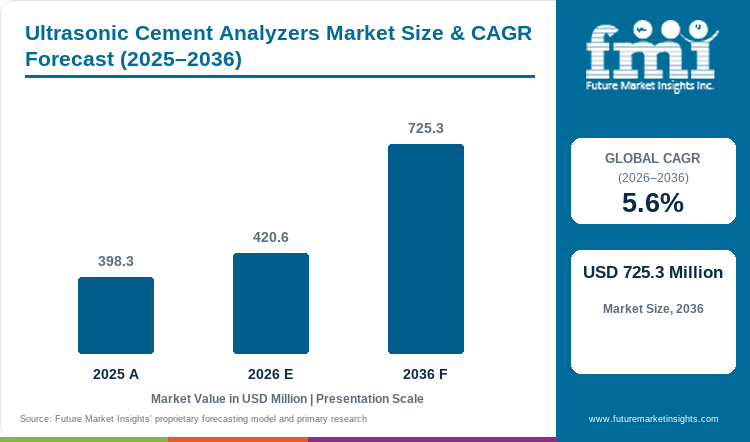
USD 420.6 Million in 2026 and USD 725.3 Million by 2036 at a 5.6% CAGR.
Demand for Ultrasonic Cement Analyzers is estimated at USD 420.6 Million in 2026 and is forecast to reach USD 725.3 Million by 2036, growing at a CAGR of 5.6%. The market was valued at USD 398.3 Million in 2025. Cement laboratories use ultrasonic analyzers to follow relative compressive-strength development without repeatedly destroying cured samples. The purchase case strengthens when a laboratory must compare slurry designs under controlled pressure and temperature or reduce uncertainty around wait-on-cement decisions. OFI Testing Equipment noted in April 2025 that the third edition of API RP 10B-2, published in July 2024, updated calibration recommendations in Annex B. That raises the value of documented calibration and dependable service over the instrument life.
Country demand follows different operating contexts. Norway combines mature offshore activity with expanding CO2-storage work. KSA and UAE support large upstream programs where HPHT capability and regional service matter. Japan is more project-led through CCS and research programs, while the USA combines conventional oilfield demand with regulated injection-well activity. Brazil adds deepwater requirements and Canada combines conventional oil and gas work with regulated well-integrity needs. In each case, an analyzer order depends on matching the pressure-temperature envelope to the actual cement program and maintaining calibration, software support, and spare-parts access.
Key Takeaways
- Laboratory demand increases as cement programs require faster and more traceable strength-development decisions under controlled temperature and pressure conditions.
- Updated API RP 10B-2 calibration guidance increases emphasis on documented calibration, measurement consistency, and service continuity.
- Offshore, unconventional-gas, and CCS well programs support demand for high-pressure testing capability and reproducible laboratory data.
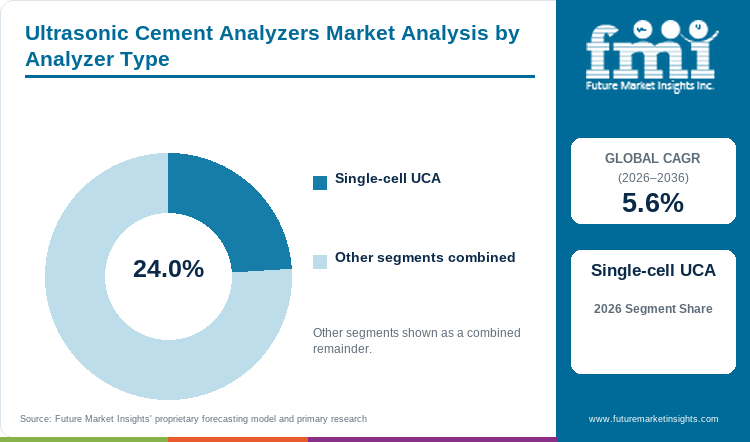
- Single-cell UCA accounts for 24.0% of Analyzer Type demand in 2026.
- Compressive strength development represents 31.0% of Application demand in 2026.
- Atmospheric systems account for 15.0% of the Pressure Rating category in 2026.
- Analyzer configuration depends on the required pressure and temperature envelope, testing frequency, and laboratory workflow.
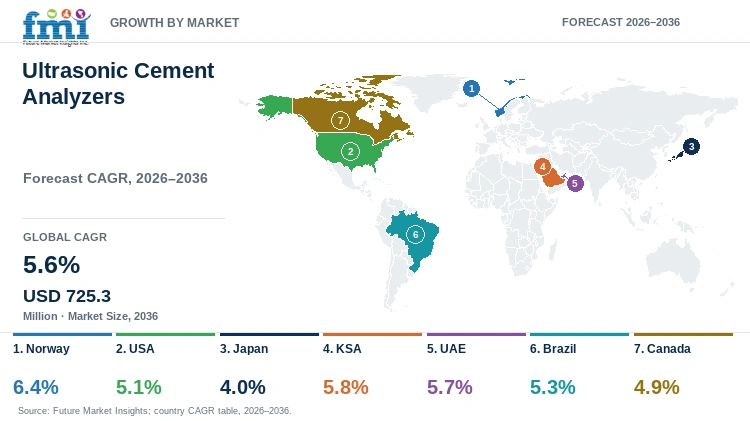
- Norway records the highest CAGR among the key countries in this market at 6.4% from 2026 to 2036.
- KSA and UAE are forecast to grow at 5.8% and 5.7%, respectively, while Brazil, USA, Canada, and Japan range from 5.3% to 4.0%.
- Competition centers on UCA configuration, operating envelope, control systems, calibration support, and after-sales service.
- Chandler Engineering, Fann Instrument Company, OFI Testing Equipment, Grace Instrument, Cement Test Equipment, and RIGCHINA are among the companies with direct UCA product offerings.
Analyst Perspective
Commercial adoption depends on matching the analyzer to the laboratory test schedule and keeping the instrument available over its service life. Twin-cell and automated systems can improve throughput where utilization is high. Calibration traceability and regional technical support become more important as test conditions become more demanding.
- Nikhil Kaitwade, Principal Analyst at Future Market Insights
How is the ultrasonic cement analyzers market segmented?
The market is evaluated by Analyzer Type, Pressure Rating, Application, End Use, and Sales Channel.
Analyzer Type separates basic one-cell workflows from dual-cell, automated, high-temperature, and HPHT architectures. Pressure Rating distinguishes lower-pressure laboratory needs from systems built for increasingly demanding simulated well conditions. Application separates compressive-strength development from set-time work, HPHT cement design, gas-migration evaluation, and slurry optimization. End Use identifies where the equipment is operated, with dedicated oilfield cement laboratories distinct from service company labs, research institutes, and additive suppliers. Sales Channel captures the route by which buyers obtain the instrument or its lifecycle support. Together, these axes explain why configuration, operating envelope, workflow role, buyer type, and service access do not move in lockstep.
What makes Single-cell UCA central to the Analyzer Type category?
Single-cell systems fit laboratories that need one controlled strength-development test at a time without paying for unused parallel capacity. They also suit replacement purchases where existing utilities, sample preparation routines, and operator practices were built around one pressure vessel. That lowers the change burden compared with a move to twin-cell or highly automated architectures. The same simplicity can support smaller regional labs and additive-development teams that run focused test programs rather than continuous batch queues. Dual-cell and automated units become more attractive when throughput is the bottleneck. HPHT variants serve narrower programs where pressure or temperature limits are the decisive specification.
- Single-cell UCA holds a 24.0% share in 2026. Its lead reflects a practical balance between core ultrasonic functionality and capital discipline. The simpler footprint also supports routine operation.
- Fann Instrument Company currently lists the Ultrasonic Cement Analyzer Model 304 alongside Modular UCA and Twin Cell UCA Model 420ATC. Its cement-testing range also includes the Model 520 HT UCA for higher-temperature work.
How does Atmospheric fit within the Pressure Rating category?
Atmospheric represents the lowest pressure band in the market taxonomy and is relevant where a test program does not require elevated-pressure simulation. Higher pressure bands extend the analyzer envelope for more demanding downhole conditions and carry greater hardware, qualification, and maintenance requirements. Instrument selection should therefore follow the intended cement program rather than maximum specification alone.
- Atmospheric represents a 15.0% share in 2026 within the stated Pressure Rating taxonomy.
- Grace Instrument released software updates for its M7370 Automatic Pressure Control Twin Cell UCA and M7390 HPHT Automatic Pressure Control Twin Cell UCA on November 13, 2024. The release notes state that the updates resolved non-concurrent data-collection and incomplete-export issues.
What supports Compressive strength development in the Application category?
Compressive-strength development is the defining measurement job for an ultrasonic cement analyzer. The instrument tracks the change in acoustic transit behavior as cement cures, then relates that response to relative strength over time. This gives cementing teams a continuous view of development instead of waiting for a sequence of destructive crush tests. The commercial value is strongest when a lab must compare slurry designs or determine when a cement system has reached an operational threshold. Cement set time, gas-migration evaluation, and slurry optimization remain important but often require additional instruments or complementary measurements. HPHT cement design increases the specification burden rather than replacing the core strength-development function.
- Compressive strength development holds a 31.0% share in 2026 because it is the primary continuous measurement delivered by UCA systems.
- OFI Testing Equipment stated on April 1, 2021 that its Model 4005 Automated Twin Cell UCA uses changes in acoustic velocity to determine well-cement compressive strength over time and independently controls temperature and pressure in each cell.
How do Oilfield cement labs shape the End Use category?
Oilfield cement laboratories are a core End Use because UCA data feeds directly into slurry design and strength-development testing. These labs compare cement systems under controlled schedules before field execution. Equipment must fit existing mixing, curing, data, and safety procedures. Service-company laboratories often place greater weight on throughput, while research institutes may require broader experimental flexibility. Cement additive suppliers use UCA data during formulation and customer qualification work.
- Chandler Engineering’s May 2025 Model 4262 Twin UCA manual documents twin-cell cement testing with temperature and pressure control for predicting relative compressive-strength development under simulated downhole conditions.
What drives Lab instrument OEMs in the Sales Channel category?
Lab instrument OEMs sit closest to the pressure hardware, control software, commissioning process, and replacement-parts path that keep a UCA usable. Buyers often need one accountable supplier for installation support, calibration procedures, software compatibility, and pressure-cell service. Regional distributors add local reach, while calibration and service contracts create recurring revenue after installation. Channel choice therefore depends on service responsibility as much as the initial instrument sale.
- OFI Testing Equipment stated on April 18, 2025 that the third edition of API RP 10B-2 updated Annex B calibration recommendations. The company also lists documented parts, calibration tools, and trained technician support.
What are the drivers, restraints, and opportunities in the ultrasonic cement analyzers market?
Demand is supported by more demanding cement qualification, while lifecycle cost and specialized service restrain purchases, and automation plus HPHT architectures create the clearest expansion opportunity.
- Driver: Higher-specification oil, gas, and CO2-injection wells increase the need to verify cement strength development under controlled pressure and temperature.
- Restraint: Capital cost and pressure-vessel maintenance can lengthen approval cycles. Calibration, training, and service access can also delay replacement.
- Opportunity: Twin-cell, automated, and HPHT platforms can raise laboratory throughput while expanding analyzer-specific service and calibration revenue.
Demand begins with the cement program. More demanding wells create additional slurry designs and pressure-temperature schedules that must be tested before field execution. OFI Testing Equipment noted in April 2025 that the third edition of API RP 10B-2 revised calibration recommendations, which makes traceability more visible in laboratory procedures. Norway and Brazil maintain technically demanding offshore activity, while KSA and UAE continue large upstream programs. The USA adds regulated injection-well applications. Suppliers improve the purchase case when the analyzer specification maps directly to these test requirements.
The main restraint is ownership cost across the instrument life. A UCA combines ultrasound electronics with a heated pressure vessel, control software, fluid utilities, calibration work, and safety procedures. Grace Instrument’s November 2024 software releases show that lifecycle performance includes data reliability as well as pressure hardware. Laboratories with low utilization may defer replacement or keep older units in service until throughput or test-envelope requirements justify a new system.
The clearest expansion opportunity is higher laboratory throughput. Twin-cell analyzers can run independent tests in one footprint, while automated pressure and temperature control reduces operator intervention. Fann documents twin-cell systems with separate cell operation, and OFI Testing Equipment’s Model 4005 independently controls both cells and supports standalone operation. Higher-temperature and higher-pressure variants extend the addressable test envelope. Suppliers can add recurring revenue through calibration, software support, training, and spare parts when utilization supports the investment.
Which country CAGRs are included in the ultrasonic cement analyzers market analysis?
| Country | CAGR |
|---|---|
| Norway | 6.4% |
| USA | 5.1% |
| Japan | 4.0% |
| KSA | 5.8% |
| UAE | 5.7% |
| Brazil | 5.3% |
| Canada | 4.9% |
How do country-level CAGRs compare in the ultrasonic cement analyzers market?
The seven selected countries span a 2.4 percentage-point range from Norway at 6.4% CAGR to Japan at 4.0% CAGR from 2026 to 2036. Norway forms the upper band because offshore activity and CO2-storage work create a strong well-integrity testing context. KSA and UAE sit close together at 5.8% and 5.7%. Brazil and USA occupy the next band at 5.3% and 5.1%, followed by Canada at 4.9%. Japan remains the slowest of the included group. These rates describe expansion pace rather than current market size. The commercial reading therefore depends on installed laboratories and project timing. Local procurement rules and the severity of required test conditions can change the order of priority.
- Norway leads KSA by 0.6 percentage points. That gap supports earlier investment in specialized offshore and CO2-storage testing capability, but suppliers still need local service credibility.
- KSA exceeds UAE by only 0.1 percentage points. The two markets should be treated as a common high-growth band, with differentiation driven more by operator qualification and localization than by headline CAGR.
- UAE, Brazil, USA, and Canada sit within 0.8 percentage points of one another. Channel investment should therefore follow buyer density, well complexity, and service coverage rather than small CAGR differences.
- Canada exceeds Japan by 0.9 percentage points. Canada benefits from a broader oil and gas well base, while Japan’s opportunity is more concentrated in staged CCS and research-led programs.
CAGR alone cannot determine the best commercial target. A market with slower percentage growth can still support attractive revenue when its installed base is large or its buyers replace high-value HPHT systems. Conversely, a faster-growth country may require local certification before demand converts. Service infrastructure or vendor qualification can be equally decisive. The broader report therefore reads country growth together with technical requirements, procurement conditions, and laboratory capacity across more than thirty markets.
Country-wise Analysis
- Norway: Norwegian cementing and well-integrity work is shaped by a mature offshore operating base where equipment downtime and qualification risk carry high consequences. Demand for ultrasonic cement analyzers in Norway is forecast to expand at 6.4% CAGR from 2026 to 2036. The Norwegian Offshore Directorate reported on January 8, 2026 that 2025 exploration results were among the best in several years and that CO2-storage interest on the continental shelf was significant. The friction is a demanding offshore qualification environment with high expectations for service response. Suppliers need reliable HPHT capability, documented maintenance, and technical support suited to long asset lives.
- USA: US buyers span oilfield service laboratories and independent test facilities. Research teams and organizations supporting regulated injection-well projects add another demand path. Demand for ultrasonic cement analyzers in the USA is forecast to rise at 5.1% CAGR from 2026 to 2036. USA EPA guidance states that deep CO2 injection wells use sophisticated construction with multiple layers of protective casing and cement. The market friction is fragmented procurement across operators and service companies. State and federal programs can add separate qualification paths. Suppliers can improve conversion with traceable calibration, broad service coverage, and configurations that support both conventional cementing and higher-pressure injection-well research.
- Japan: Japanese purchasing is more project-led, with research organizations and industrial partners often qualifying equipment against a defined CCS or technology-development program. Adoption of ultrasonic cement analyzers in Japan is forecast to expand at 4.0% CAGR from 2026 to 2036. JOGMEC announced on July 24, 2024 that it had selected nine Advanced CCS projects. Five involve domestic storage, and the combined project plan is about 20 million tonnes of CO2 storage per year. The friction is the smaller domestic upstream well base and staged project timing. Suppliers should emphasize flexible research configurations, distributor support, and reliable high-pressure data rather than volume-led sales tactics.
- KSA: KSA demand is concentrated around large operator and service-company programs where laboratory equipment is qualified for repeat use across major well campaigns. Sales of ultrasonic cement analyzers in KSA are forecast to expand at 5.8% CAGR from 2026 to 2036. Aramco announced on June 30, 2024 more than USD 25 billion of gas-expansion contracts, including 23 additional unconventional gas rig contracts and two directional drilling contracts. The friction is a high vendor-qualification threshold plus localization and service expectations. Suppliers need strong HPHT specifications and fast regional maintenance. Spare-parts access and documentation that fits standardized cement-lab procedures are also important.
- UAE: UAE buyers operate in an upstream environment that combines offshore complexity with a strong preference for local supplier capability and rapid technical response. Demand for ultrasonic cement analyzers in UAE is forecast to expand at 5.7% CAGR from 2026 to 2036. ADNOC’s 2025 review states that the group was working toward 4.85 million barrels per day of crude capacity by 2027 and had board-approved 2026-2030 capital expenditure of USD 150 billion. The friction is technical qualification but also in-country value expectations within procurement. Suppliers should pair suitable pressure-temperature capability with regional calibration, stocked spares, and locally accessible service partners.
- Brazil: Brazilian purchasing is shaped by deepwater cementing programs where laboratory qualification must support long offshore logistics chains and high-consequence well execution. Demand for ultrasonic cement analyzers in Brazil is forecast to expand at 5.3% CAGR from 2026 to 2036. Petrobras reported on July 29, 2025 that 14 new producing wells started in the second quarter across the Campos and Santos basins as multiple pre-salt systems ramped. The local friction is the cost of downtime and specialist service across a geographically concentrated but technically demanding offshore market. Suppliers need HPHT capability and Portuguese-language support. Responsive field service plus a dependable spare-parts path reduce offshore downtime risk.
- Canada: Canadian demand spans conventional oil and gas plus heavy-oil operations. Service-company laboratories and emerging carbon-management projects add further use cases. Sales of ultrasonic cement analyzers in Canada are forecast to rise at 4.9% CAGR from 2026 to 2036. The Alberta Energy Regulator released Directive 080 on May 8, 2025 and reaffirmed the broader framework of wellbore-integrity and cement-evaluation logging requirements. The friction is a dispersed buyer base plus strict operational documentation in regulated projects. Suppliers can compete through regional calibration programs, remote technical support, and service contracts that lower travel-related downtime for laboratories outside major equipment hubs.
Who are the notable companies in the ultrasonic cement analyzers market?
Chandler Engineering, Fann Instrument Company, OFI Testing Equipment, Grace Instrument, Cement Test Equipment, and RIGCHINA are the notable companies included in this market analysis.
Competition is clearest among suppliers that publish UCA-specific products and operating envelopes. Chandler Engineering, Fann Instrument Company, OFI Testing Equipment, Grace Instrument, Cement Test Equipment, and RIGCHINA each document ultrasonic cement analyzer offerings. Buyers should compare cell configuration, pressure-temperature capability, control software, calibration support, and service access against the intended cement workflow. Public evidence is stronger for dedicated UCA suppliers than for broader laboratory-service companies, so the competitive set below is limited to vendors with direct UCA documentation.
- Integrated UCA platform vendors: Chandler Engineering, Fann Instrument Company, OFI Testing Equipment, and Grace Instrument document dedicated UCA platforms with different cell configurations and control architectures.
- Specialized oilfield laboratory equipment suppliers: Cement Test Equipment and RIGCHINA document UCA products within broader oilfield laboratory portfolios.
Competitive Benchmarking: Ultrasonic Cement Analyzers Market
| Company | UCA Configuration Breadth | Pressure-Temperature Envelope | Lifecycle Service & Automation | Geographic Reach |
|---|---|---|---|---|
| Chandler Engineering | High | High | High | United States base; international customer support |
| Fann Instrument Company | High | High | High | International distributor-supported footprint |
| OFI Testing Equipment | High | High | High | United States base with international distribution and service |
| Grace Instrument | High | High | High | United States base with international installation and training support |
| RIGCHINA | Medium | Unscored | Unscored | China-based supply with export orientation |
| Cement Test Equipment | Medium | High | High | United States base with worldwide equipment and field service |
Scoring basis: UCA Configuration Breadth measures documented coverage across single-cell and twin-cell architectures. Automated, high-temperature, and HPHT variants extend the score where documented. Pressure-Temperature Envelope measures the publicly documented severity of simulated well conditions supported by the supplier’s UCA offering. Lifecycle Service & Automation measures controls and data functions tied to instrument ownership. Calibration, training, and service support extend that criterion. High indicates broad documented capability against the criterion, while Medium indicates credible but narrower coverage. Low is reserved for a documented limitation. Where public UCA-specific information is insufficient, the field is marked Unscored rather than treated as Low.
Key Developments in the Ultrasonic Cement Analyzers Market
- In April 2021, OFI Testing Equipment announced the Model 4005 Automated Twin Cell UCA with optional static-gel-strength measurement. The system independently controls temperature and pressure in each cell and supports a standalone touchscreen workflow. The development moved UCA design toward higher automation and parallel testing, which can reduce operator intervention in busy cement laboratories while linking compressive-strength work with a complementary gas-migration-related measurement.
- In November 2024, Grace Instrument released software updates for its M7370 Automatic Pressure Control Twin Cell UCA and M7390 HPHT Automatic Pressure Control Twin Cell UCA. The updates resolved data collection issues from non-concurrent tests and incomplete data export. The change is commercially relevant because twin-cell productivity depends on dependable independent test records, and software reliability becomes part of the lifecycle value proposition for automated analyzers.
- In April 2025, OFI Testing Equipment published guidance on updated calibration procedures following the third edition of API RP 10B-2. The company highlighted revised Annex B recommendations plus access to documented parts, calibration tools, and trained technician support. The development increases the commercial importance of service and calibration capability around the installed analyzer base, especially for laboratories that must preserve traceable test procedures and minimize instrument downtime.
- In May 2025, Chandler Engineering issued Revision AB of its Model 4262 Twin UCA instruction manual. The document covers elevated-temperature and elevated-pressure testing plus twin-cell operation. It also addresses data acquisition interfaces, maintenance, and pressure-vessel safety requirements. The revision signals continued lifecycle support for an established UCA platform. It also reinforces the value of current documentation where certified pressure components and maintenance practices influence laboratory qualification and long-term ownership decisions.
Key Players in the Ultrasonic Cement Analyzers Market
Integrated UCA Platform Vendors
- Chandler Engineering
- Fann Instrument Company
- OFI Testing Equipment
- Grace Instrument
Specialized Oilfield Laboratory Equipment Suppliers
- Cement Test Equipment
- RIGCHINA
Ultrasonic Cement Analyzers Market - Report Scope
| Coverage field | Report scope |
|---|---|
| Market breakdown | Analyzer Type; Pressure Rating; Application; End Use; Sales Channel |
| Quantitative Units | USD Million |
| Market Definition | Revenue includes ultrasonic cement analyzer systems, analyzer-specific options, and calibration or service contracts sold within the defined segmentation universe. It excludes field cement-bond logging systems, generic concrete NDT equipment, adjacent cement laboratory instruments, and downstream cement products. |
| Regions Covered | North America; Latin America; Western Europe; Eastern Europe; East Asia; South Asia and Pacific; Middle East and Africa |
| Countries Covered | Norway, USA, Japan, KSA, UAE, Brazil, Canada, plus more than twenty-five additional countries in the full report |
| Key Companies Included | Chandler Engineering, Fann Instrument Company, OFI Testing Equipment, Grace Instrument, Cement Test Equipment, RIGCHINA |
| Forecast Period | 2026 to 2036 |
| Approach | Market sizing uses a hybrid bottom-up and top-down approach that reconciles instrument demand, installed-base replacement, channel activity, and application-level spending within the defined revenue boundary. |
Ultrasonic Cement Analyzers Market - Research Methodology
| Method | Approach |
|---|---|
| Primary Research | Structured discussions with manufacturers, distributors, service specialists, laboratory users, procurement teams, and subject-matter experts are used to test product definitions, purchase criteria, replacement behavior, service requirements, and adoption frictions. |
| Desk Research | Authoritative standards, government and regulatory material, company product documentation, corporate announcements, public technical literature, and country operating data are reviewed for scope relevance and traceability. |
| Market Sizing and Forecasting | Bottom-up product and channel observations are reconciled with top-down demand indicators. Forecast assumptions consider installed-base replacement, new laboratory capacity, well-program intensity, pressure-temperature requirements, automation adoption, and service revenue within the defined market boundary. |
| Data Validation | Figures and conclusions are cross-checked across independent evidence types where available. Validation tests the stated market boundary and avoids duplicate revenue across direct and distributor channels while excluding field cement-bond logging, generic concrete testing, adjacent laboratory instruments, and downstream cement products. |
Ultrasonic Cement Analyzers Market by Segments
Ultrasonic Cement Analyzers Market segmented by Analyzer Type:
- Single-cell UCA
- Dual-cell UCA
- High-temperature UCA
- HPHT ultrasonic analyzers
- Automated cement analyzers
Ultrasonic Cement Analyzers Market segmented by Pressure Rating:
- Atmospheric
- Below 10,000 psi
- 10,000-20,000 psi
- Above 20,000 psi
Ultrasonic Cement Analyzers Market segmented by Application:
- Compressive strength development
- Cement set time
- HPHT cement design
- Gas migration evaluation
- Slurry optimization
Ultrasonic Cement Analyzers Market segmented by End Use:
- Oilfield cement labs
- Service company labs
- Research institutes
- Cement additive suppliers
Ultrasonic Cement Analyzers Market segmented by Sales Channel:
- Lab instrument OEMs
- Direct service company supply
- Regional distributors
- Calibration/service contracts
Ultrasonic Cement Analyzers Market by Region:
- North America
- United States
- Canada
- Latin America
- Brazil
- Mexico
- Argentina
- Chile
- Western Europe
- Germany
- France
- United Kingdom
- Italy
- Spain
- Benelux
- Nordics
- Eastern Europe
- Poland
- Czech Republic
- Romania
- Hungary
- East Asia
- China
- Japan
- South Korea
- South Asia and Pacific
- India
- ASEAN
- Australia and New Zealand
- Middle East and Africa
- GCC Countries
- South Africa
- Türkiye
- Israel
Research Sources and Bibliography
- Chandler Engineering (2025, May). Instruction Manual Model 4262 Twin UCA, Revision AB.
- Fann Instrument Company (accessed 2026, September 15). Oil Well Cement Testing Equipment.
- OFI Testing Equipment (2021, April 1). Model 4005 Automated UCA/SGSM.
- OFI Testing Equipment (2025, April 18). Updated Calibration Procedures in API RP 10B-2.
- Grace Instrument (2024, November 13). Software: M7370 and M7390 UCA updates.
- Cement Test Equipment (accessed 2026, September 15). M2000 Ultrasonic Cement Analyzer.
- RIGCHINA (accessed 2026, September 15). Products: Ultrasonic Cement Analyzer (UCA).
- Norwegian Offshore Directorate (2026, January 8). Best exploration year in several years.
- USA Environmental Protection Agency (2026, June 3). General Information About Injection Wells.
- Japan Organization for Metals and Energy Security (2024, July 24). Advanced Efforts for Commercialization of CCS: JOGMEC selects Nine projects as Japanese Advanced CCS Projects.
- Saudi Aramco (2024, June 30). Aramco’s strategic gas expansion progresses with $25bn contract awards.
- ADNOC (accessed 2026, September 15). ADNOC's 2025 in Review: The Energy to Lead. The Edge to Succeed.
- Petrobras (2025, July 29). Petrobras' oil and natural gas production increases 5% to 2.9 million barrels in the second quarter of 2025.
- Alberta Energy Regulator (2025, May 8). Directive 080: Well Logging.
This bibliography is provided for reader reference and is not exhaustive. The full report contains the complete reference list and detailed citations.
This Report Answers
- What are the Ultrasonic Cement Analyzers Market values in 2026 and 2036?
- Which well-construction and laboratory pressures support demand for ultrasonic cement analyzers?
- Why does Single-cell UCA hold the leading position within Analyzer Type?
- How does the Atmospheric pressure-rating segment influence equipment selection and upgrade paths?
- Why does Compressive strength development lead the Application category?
- How do forecast CAGRs differ across Norway, USA, Japan, KSA, UAE, Brazil, and Canada?
- Which companies provide documented UCA platforms and related lifecycle support?
- How do capital cost, calibration, training, and service access restrain adoption?
- What should cement-laboratory decision-makers evaluate before selecting a UCA platform?
Frequently Asked Questions
What is driving growth in the Ultrasonic Cement Analyzers Market?
Growth is driven by the need to qualify cement strength development under realistic pressure and temperature as offshore, unconventional, and injection-well programs become more demanding. Buyers also value better calibration traceability and faster laboratory throughput.
Who are the key players in the Ultrasonic Cement Analyzers Market?
The companies included are Chandler Engineering, Fann Instrument Company, OFI Testing Equipment, Grace Instrument, Cement Test Equipment, and RIGCHINA. Public product documentation confirms direct UCA offerings from each of these suppliers.
What notable restraint affects the Ultrasonic Cement Analyzers Market?
The main restraint is the full ownership burden of pressure-vessel hardware and calibration. Software upkeep, training, and specialized service add to that burden. Long equipment life can also delay replacement when an older unit still meets the laboratory’s core test envelope.
Why should executives track the Ultrasonic Cement Analyzers Market?
The market indicates where higher-specification cementing and laboratory automation are creating instrument replacement or capacity needs. It also shows whether growth can be captured through hardware alone or requires local calibration and lifecycle service.
What business problem does the Ultrasonic Cement Analyzers Market address?
Ultrasonic cement analyzers give laboratories a continuous non-destructive view of relative compressive-strength development while a slurry cures under controlled conditions. That information supports cement design comparisons and helps teams judge when a system reaches an operational strength threshold.
What should oilfield cement laboratory managers evaluate in the Ultrasonic Cement Analyzers Market?
Managers should match the pressure-temperature envelope and cell configuration to real test schedules rather than buying unused specification headroom. They should also compare automation and data export. Calibration requirements and pressure-vessel documentation matter as well, along with spare parts and local service response.
What limits return on investment in the Ultrasonic Cement Analyzers Market?
Return on investment weakens when instrument utilization is low or downtime erodes the benefit of a higher-throughput platform. Acquisition cost should therefore be assessed with calibration and training. Software support and utilities also matter. Maintenance needs and expected test volume should be assessed over the ownership period.
What supports long-term commercial confidence in the Ultrasonic Cement Analyzers Market?
Long-term confidence comes from the persistent need to validate cement behavior before high-consequence well operations and from ongoing investment in complex wells. Current OEM portfolios also show continued development in twin-cell automation and HPHT capability. Software and lifecycle service remain active areas of supplier support. Key Players
Preview the report firsthand - request a free sample
Get SampleGet the brochure for pricing and purchase details.
Get PDFTable of Content
- Key Takeaways
- Market Size and CAGR
- Top Growth Driver
- Fastest Growing Segment
- Leading Region
- Key Companies
- Emerging Opportunities
- Executive Summary
- Global Market Outlook
- Demand-side Trends
- Supply-side Trends
- Technology Roadmap Analysis
- Analysis and Recommendations
- Analyst Perspective (What is happening? Why now? What should investors know?)
- Key Questions Answered
- How large is the market?
- What is the CAGR?
- What are key trends?
- Which region dominates?
- Who are the leaders?
- Market Overview
- Market Coverage / Taxonomy
- Market Definition / Scope / Limitations
- Research Methodology
- Chapter Orientation
- Analytical Lens and Working Hypotheses
- Market Structure, Signals, and Trend Drivers
- Benchmarking and Cross-market Comparability
- Market Sizing, Forecasting, and Opportunity Mapping
- Research Design and Evidence Framework
- Desk Research Programme (Secondary Evidence)
- Expert Input and Fieldwork (Primary Evidence)
- Tooling, Models, and Reference Databases
- Data Engineering and Model Build
- Quality Assurance and Audit Trail
- Market Background
- Market Dynamics (Drivers, Restraints, Opportunity, Trends)
- Scenario Forecast (Optimistic, Likely, Conservative)
- Impact Analysis
- AI Impact
- Sustainability Impact
- Regulatory Impact
- Technology Impact
- Consumer / Buyer Analysis
- Purchase Drivers
- Adoption Barriers
- Buyer Journey
- Opportunity Map Analysis
- Product Life Cycle Analysis
- Supply Chain Analysis
- Investment Feasibility Matrix
- Value Chain Analysis
- PESTLE and Porter's Analysis
- Regulatory Landscape
- Regional Parent Market Outlook
- Production and Consumption Statistics
- Import and Export Statistics
- Global Market Analysis and Forecast, 2021 to 2036
- Historical Market Size Value (USD Million) Analysis, 2021 to 2025
- Current and Future Market Size Value (USD Million) Projections, 2026 to 2036
- Y-o-Y Growth Trend Analysis
- Absolute $ Opportunity Analysis
- Global Market Pricing Analysis, 2021 to 2036
- Global Market Analysis and Forecast, By Analyzer Type, 2021 to 2036
- Introduction / Key Findings
- Historical Market Size Value (USD Million) Analysis By Analyzer Type, 2021 to 2025
- Current and Future Market Size Value (USD Million) Analysis and Forecast By Analyzer Type, 2026 to 2036
- Single-cell UCA
- Dual-cell UCA
- High-temperature UCA
- HPHT ultrasonic analyzers
- Automated cement analyzers
- Y-o-Y Growth Trend Analysis By Analyzer Type, 2021 to 2025
- Absolute $ Opportunity Analysis By Analyzer Type, 2026 to 2036
- Global Market Analysis and Forecast, By Pressure Rating, 2021 to 2036
- Introduction / Key Findings
- Historical Market Size Value (USD Million) Analysis By Pressure Rating, 2021 to 2025
- Current and Future Market Size Value (USD Million) Analysis and Forecast By Pressure Rating, 2026 to 2036
- Atmospheric
- Below 10,000 psi
- 10,000-20,000 psi
- Above 20,000 psi
- Y-o-Y Growth Trend Analysis By Pressure Rating, 2021 to 2025
- Absolute $ Opportunity Analysis By Pressure Rating, 2026 to 2036
- Global Market Analysis and Forecast, By Application, 2021 to 2036
- Introduction / Key Findings
- Historical Market Size Value (USD Million) Analysis By Application, 2021 to 2025
- Current and Future Market Size Value (USD Million) Analysis and Forecast By Application, 2026 to 2036
- Compressive strength development
- Cement set time
- HPHT cement design
- Gas migration evaluation
- Slurry optimization
- Y-o-Y Growth Trend Analysis By Application, 2021 to 2025
- Absolute $ Opportunity Analysis By Application, 2026 to 2036
- Global Market Analysis and Forecast, By End Use, 2021 to 2036
- Introduction / Key Findings
- Historical Market Size Value (USD Million) Analysis By End Use, 2021 to 2025
- Current and Future Market Size Value (USD Million) Analysis and Forecast By End Use, 2026 to 2036
- Oilfield cement labs
- Service company labs
- Research institutes
- Cement additive suppliers
- Y-o-Y Growth Trend Analysis By End Use, 2021 to 2025
- Absolute $ Opportunity Analysis By End Use, 2026 to 2036
- Global Market Analysis and Forecast, By Sales Channel, 2021 to 2036
- Introduction / Key Findings
- Historical Market Size Value (USD Million) Analysis By Sales Channel, 2021 to 2025
- Current and Future Market Size Value (USD Million) Analysis and Forecast By Sales Channel, 2026 to 2036
- Lab instrument OEMs
- Direct service company supply
- Regional distributors
- Calibration/service contracts
- Y-o-Y Growth Trend Analysis By Sales Channel, 2021 to 2025
- Absolute $ Opportunity Analysis By Sales Channel, 2026 to 2036
- Global Market Analysis and Forecast, By Region, 2021 to 2036
- Introduction
- Historical Market Size Value (USD Million) Analysis By Region, 2021 to 2025
- Current Market Size Value (USD Million) Analysis and Forecast By Region, 2026 to 2036
- North America
- Latin America
- Western Europe
- Eastern Europe
- East Asia
- South Asia and Pacific
- Middle East and Africa
- Market Attractiveness Analysis By Region
- North America Market Analysis and Forecast, By Country, 2021 to 2036
- Historical Market Size Value (USD Million) Trend Analysis By Market Taxonomy, 2021 to 2025
- Market Size Value (USD Million) Forecast By Market Taxonomy, 2026 to 2036
- By Country
- United States
- Canada
- By Analyzer Type
- By Pressure Rating
- By Application
- By End Use
- By Sales Channel
- By Country
- Market Attractiveness Analysis
- By Country
- By Analyzer Type
- By Pressure Rating
- By Application
- By End Use
- By Sales Channel
- Key Takeaways
- Latin America Market Analysis and Forecast, By Country
- Historical Market Size Value (USD Million) Trend Analysis By Market Taxonomy, 2021 to 2025
- Market Size Value (USD Million) Forecast By Market Taxonomy, 2026 to 2036
- By Country
- Brazil
- Mexico
- Argentina
- Chile
- By Analyzer Type
- By Pressure Rating
- By Application
- By End Use
- By Sales Channel
- By Country
- Market Attractiveness Analysis
- By Country
- By Analyzer Type
- By Pressure Rating
- By Application
- By End Use
- By Sales Channel
- Key Takeaways
- Western Europe Market Analysis and Forecast, By Country
- Historical Market Size Value (USD Million) Trend Analysis By Market Taxonomy, 2021 to 2025
- Market Size Value (USD Million) Forecast By Market Taxonomy, 2026 to 2036
- By Country
- Germany
- France
- United Kingdom
- Italy
- Spain
- Benelux
- Nordics
- By Analyzer Type
- By Pressure Rating
- By Application
- By End Use
- By Sales Channel
- By Country
- Market Attractiveness Analysis
- By Country
- By Analyzer Type
- By Pressure Rating
- By Application
- By End Use
- By Sales Channel
- Key Takeaways
- Eastern Europe Market Analysis and Forecast, By Country
- Historical Market Size Value (USD Million) Trend Analysis By Market Taxonomy, 2021 to 2025
- Market Size Value (USD Million) Forecast By Market Taxonomy, 2026 to 2036
- By Country
- Poland
- Czech Republic
- Romania
- Hungary
- By Analyzer Type
- By Pressure Rating
- By Application
- By End Use
- By Sales Channel
- By Country
- Market Attractiveness Analysis
- By Country
- By Analyzer Type
- By Pressure Rating
- By Application
- By End Use
- By Sales Channel
- Key Takeaways
- East Asia Market Analysis and Forecast, By Country
- Historical Market Size Value (USD Million) Trend Analysis By Market Taxonomy, 2021 to 2025
- Market Size Value (USD Million) Forecast By Market Taxonomy, 2026 to 2036
- By Country
- China
- Japan
- South Korea
- By Analyzer Type
- By Pressure Rating
- By Application
- By End Use
- By Sales Channel
- By Country
- Market Attractiveness Analysis
- By Country
- By Analyzer Type
- By Pressure Rating
- By Application
- By End Use
- By Sales Channel
- Key Takeaways
- South Asia and Pacific Market Analysis and Forecast, By Country
- Historical Market Size Value (USD Million) Trend Analysis By Market Taxonomy, 2021 to 2025
- Market Size Value (USD Million) Forecast By Market Taxonomy, 2026 to 2036
- By Country
- India
- ASEAN
- Australia and New Zealand
- By Analyzer Type
- By Pressure Rating
- By Application
- By End Use
- By Sales Channel
- By Country
- Market Attractiveness Analysis
- By Country
- By Analyzer Type
- By Pressure Rating
- By Application
- By End Use
- By Sales Channel
- Key Takeaways
- Middle East and Africa Market Analysis and Forecast, By Country
- Historical Market Size Value (USD Million) Trend Analysis By Market Taxonomy, 2021 to 2025
- Market Size Value (USD Million) Forecast By Market Taxonomy, 2026 to 2036
- By Country
- GCC Countries
- South Africa
- Türkiye
- Israel
- By Analyzer Type
- By Pressure Rating
- By Application
- By End Use
- By Sales Channel
- By Country
- Market Attractiveness Analysis
- By Country
- By Analyzer Type
- By Pressure Rating
- By Application
- By End Use
- By Sales Channel
- Key Takeaways
- Key Countries Market Analysis
- United States
- Pricing Analysis
- Market Share Analysis, 2025
- By Analyzer Type
- By Pressure Rating
- By Application
- By End Use
- By Sales Channel
- Canada
- Pricing Analysis
- Market Share Analysis, 2025
- By Analyzer Type
- By Pressure Rating
- By Application
- By End Use
- By Sales Channel
- Mexico
- Pricing Analysis
- Market Share Analysis, 2025
- By Analyzer Type
- By Pressure Rating
- By Application
- By End Use
- By Sales Channel
- Brazil
- Pricing Analysis
- Market Share Analysis, 2025
- By Analyzer Type
- By Pressure Rating
- By Application
- By End Use
- By Sales Channel
- Chile
- Pricing Analysis
- Market Share Analysis, 2025
- By Analyzer Type
- By Pressure Rating
- By Application
- By End Use
- By Sales Channel
- Germany
- Pricing Analysis
- Market Share Analysis, 2025
- By Analyzer Type
- By Pressure Rating
- By Application
- By End Use
- By Sales Channel
- United Kingdom
- Pricing Analysis
- Market Share Analysis, 2025
- By Analyzer Type
- By Pressure Rating
- By Application
- By End Use
- By Sales Channel
- Italy
- Pricing Analysis
- Market Share Analysis, 2025
- By Analyzer Type
- By Pressure Rating
- By Application
- By End Use
- By Sales Channel
- Spain
- Pricing Analysis
- Market Share Analysis, 2025
- By Analyzer Type
- By Pressure Rating
- By Application
- By End Use
- By Sales Channel
- France
- Pricing Analysis
- Market Share Analysis, 2025
- By Analyzer Type
- By Pressure Rating
- By Application
- By End Use
- By Sales Channel
- India
- Pricing Analysis
- Market Share Analysis, 2025
- By Analyzer Type
- By Pressure Rating
- By Application
- By End Use
- By Sales Channel
- ASEAN
- Pricing Analysis
- Market Share Analysis, 2025
- By Analyzer Type
- By Pressure Rating
- By Application
- By End Use
- By Sales Channel
- Australia and New Zealand
- Pricing Analysis
- Market Share Analysis, 2025
- By Analyzer Type
- By Pressure Rating
- By Application
- By End Use
- By Sales Channel
- China
- Pricing Analysis
- Market Share Analysis, 2025
- By Analyzer Type
- By Pressure Rating
- By Application
- By End Use
- By Sales Channel
- Japan
- Pricing Analysis
- Market Share Analysis, 2025
- By Analyzer Type
- By Pressure Rating
- By Application
- By End Use
- By Sales Channel
- South Korea
- Pricing Analysis
- Market Share Analysis, 2025
- By Analyzer Type
- By Pressure Rating
- By Application
- By End Use
- By Sales Channel
- Poland
- Pricing Analysis
- Market Share Analysis, 2025
- By Analyzer Type
- By Pressure Rating
- By Application
- By End Use
- By Sales Channel
- Hungary
- Pricing Analysis
- Market Share Analysis, 2025
- By Analyzer Type
- By Pressure Rating
- By Application
- By End Use
- By Sales Channel
- Türkiye
- Pricing Analysis
- Market Share Analysis, 2025
- By Analyzer Type
- By Pressure Rating
- By Application
- By End Use
- By Sales Channel
- South Africa
- Pricing Analysis
- Market Share Analysis, 2025
- By Analyzer Type
- By Pressure Rating
- By Application
- By End Use
- By Sales Channel
- Norway
- Pricing Analysis
- Market Share Analysis, 2025
- By Analyzer Type
- By Pressure Rating
- By Application
- By End Use
- By Sales Channel
- KSA
- Pricing Analysis
- Market Share Analysis, 2025
- By Analyzer Type
- By Pressure Rating
- By Application
- By End Use
- By Sales Channel
- UAE
- Pricing Analysis
- Market Share Analysis, 2025
- By Analyzer Type
- By Pressure Rating
- By Application
- By End Use
- By Sales Channel
- United States
- Market Structure Analysis
- Competition Dashboard
- Competition Benchmarking
- Market Share Analysis of Top Players
- By Regional
- By Analyzer Type
- By Pressure Rating
- By Application
- By End Use
- By Sales Channel
- Emerging Startups
- Innovation Benchmarking
- Competition Analysis
- Competition Deep Dive
- Chandler Engineering
- Overview
- Product Portfolio
- Profitability by Market Segments
- Sales Footprint
- Strategy Overview
- Marketing Strategy
- Product Strategy
- Channel Strategy
- Fann Instrument Company
- OFI Testing Equipment
- Grace Instrument
- RIGCHINA
- Cement Test Equipment
- Chandler Engineering
- Case Studies
- Success Stories
- Recent Developments
- Competition Deep Dive
- Assumptions & Acronyms Used


