

- Industry Size (2026)
- USD 2.59 Bn
- Forecast (2036)
- USD 11.6 Bn
- CAGR (2026 to 2036)
- 16.20%
Unified Namespace Market Size, Market Forecast and Outlook By FMI
In 2025, the Unified Namespace market exceeded USD 2.23 billion. Projections place it at USD 2.59 billion in 2026, with long‑term expansion to USD 11.6 billion by 2036, representing a 16.20% CAGR. The shift toward hybrid deployment models is a major catalyst, driven by tier‑1 manufacturers dismantling traditional point‑to‑point SCADA integrations to free OT data for broader enterprise use.
Legacy automation networks structurally fail under the volume of telemetry generated by modern computer vision and predictive maintenance models. Operations directors must implement centralized MQTT brokers to translate proprietary machine protocols into standardized data streams. Integrators executing these digital transformations specify unified namespaces as the mandatory middleware layer bridging factory floor sensors with enterprise cloud applications.
Tier-1 industrial integrators are actively restructuring legacy telemetry architectures to ingest high-frequency data without paralyzing production networks. System architects specifying Industrial IOT infrastructure remove vendors incapable of natively publishing to enterprise brokers from preliminary qualification rounds. Procurement teams facing strict deployment timelines mandate pre-configured integration templates, forcing software suppliers to deliver out-of-the-box interoperability or face exclusion from next-generation smart factory tenders.
Summary of Unified Namespace Market
- Unified Namespace Market Definition
- Unified namespace constitutes a software-defined architectural pattern utilizing publish-subscribe messaging brokers, primarily MQTT, to centralize, standardize, and contextualize operational technology data in real-time. Systems architects deploy this event-driven infrastructure to decouple edge devices from enterprise applications, ensuring single-source-of-truth semantic data modeling across manufacturing networks.
- Demand Drivers in the Market
- Strict semantic modeling requirements force operators to standardize equipment telemetry formats prior to enterprise cloud ingestion.
- Escalating AI compute workloads require deterministic, low-latency data pipelines that legacy polling architectures cannot physically support.
- Accelerated merger and acquisition activity compels IT departments to unify disparate factory control systems under centralized governance frameworks.
- Key Segments Analyzed in the FMI Report
- Data Contextualization & Modeling: 36% share as platform vendors embed automated schema detection directly into edge gateways.
- Energy & Utilities: 52% share as grid operators deploy distributed broker architectures to manage renewable generation assets.
- India: 20.0% CAGR driven by tier-1 manufacturers establishing scalable telemetry standards for downstream contract networks.
- Analyst Opinion at FMI
- Nikhil Kaitwade, Principal Consultant for Industrial Automation, opines, “High‑performance procurement organizations now assess namespace architectures through a leadership lens, prioritizing low‑latency, high‑fidelity ingestion and automated semantic contextualization as non‑negotiables. Under intensifying data governance pressures, enterprises are making decisive moves to retire proprietary ecosystems and consolidate investment around open‑standard, event‑driven brokers that provide strategic control and enterprise‑wide scalability”
- Strategic Implications / Executive Takeaways
- Prioritize integration platforms offering native edge-to-cloud payload translation to bypass costly custom middleware development.
- Secure vendor agreements with broker providers demonstrating verified sub-millisecond latency for critical safety and control loops.
- Mandate standardized semantic models across all new equipment purchases to guarantee immediate namespace compatibility upon installation.
- Methodology
- Primary Research: Direct interviews with chief data officers, industrial network architects, and automation directors across North America, Europe, and Asia Pacific.
- Desk Research: Custom data extraction from official national technology surveys, verified vendor capacity announcements, and industrial cybersecurity vulnerability logs.
- Market-Sizing and Forecasting: Bottom-up adoption modeling tracking enterprise automation upgrade cycles and edge computing capital expenditures.
- Data Validation and Update Cycle: Verification against peer-reviewed automation symposium proceedings and quarterly software vendor earnings transcripts.
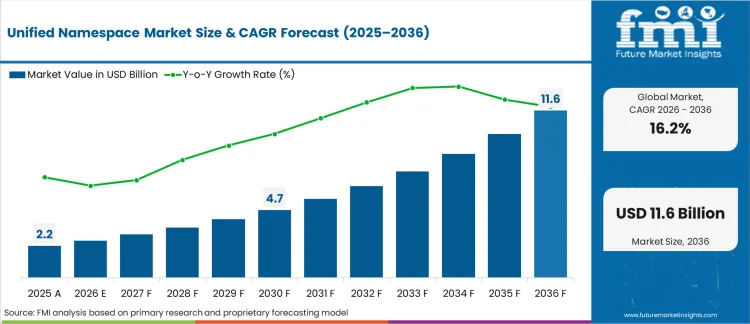
Anand Taparia, Principal Analyst at IoT Analytics, opined, “The concept of Unified Namespace (UNS) is becoming critical in industrial data management, providing a centralized framework for real-time data exchange and integration across OT and IT systems. Its success hinges on infrastructure readiness for complex querying, which will unlock granular insights and drive deeper integration, smarter operations, and significant innovation across industrial ecosystems.”[2] Platform developers must shift engineering focus from basic data extraction to automated semantic contextualization at the edge.
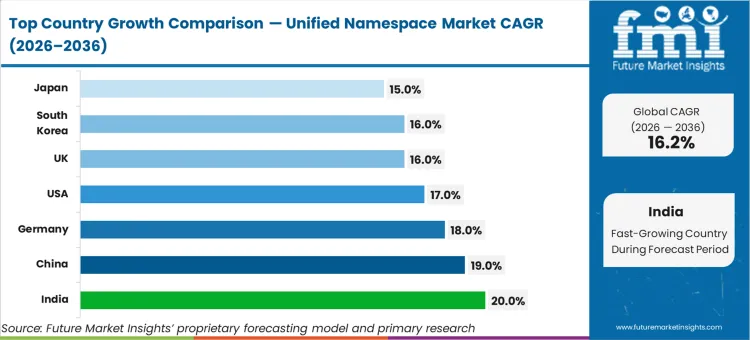
Regional commercialization trajectories diverge based on existing automation maturity and national digital infrastructure mandates. Cost-sensitive manufacturers in India target 20.0% CAGR through pilot-led replication, while Chinese industrial groups hit 19.0% CAGR driven by state digitalization quotas. Germany tracks at 18.0% CAGR as extreme robot density dictates interoperable standards, contrasting with the USA at 17.0% CAGR where cybersecurity frameworks force structured OT governance. South Korea and the UK parallel at 16.0% CAGR, executing distinct strategies around factory automation and cloud integration, while Japan advances at 15.0% CAGR anchored by automotive telemetry standardization.
Unified Namespace Market Definition
Unified namespace is an architectural software methodology utilizing standard message brokers, predominantly MQTT, to ingest, structure, and distribute industrial machine data across enterprise networks. System integrators utilize this framework to eliminate point-to-point connections, creating a centralized real-time repository where all operational events are semantically modeled. Heavy industries and discrete manufacturers rely on these architectures to synchronize factory floor programmable logic controllers with cloud analytics platforms. Deployment requires strict adherence to open communication protocols like OPC UA to ensure multi-vendor interoperability.
Unified Namespace Market Inclusions
The category includes commercial message brokers, data contextualization engines, semantic modeling software, and edge-to-cloud gateway applications specifically engineered for unified namespace architectures. Professional services covering architectural design, pilot implementation, and system integration within industrial environments are actively tracked. Hybrid, edge-hosted, and cloud-native broker topologies explicitly built for OT data standardization fall completely within the reporting boundaries.
Unified Namespace Market Exclusions
The scope strictly excludes general-purpose IT service buses and traditional relational database management systems lacking native operational technology protocol translation. Hardware components such as bare-metal servers, generic network switches, and basic sensor endpoints are outside the analytical frame. Legacy SCADA systems operating on closed, proprietary polling protocols without publish-subscribe capabilities are not measured within this market valuation.
Unified Namespace Market Research Methodology
- Primary Research: Direct consultations with tier-1 industrial automation leads, cloud infrastructure architects, and factory integration specialists across 20 countries.
- Desk Research: Structured analysis of national cloud adoption surveys, cybersecurity infrastructure advisories, and certified corporate product releases.
- Market-Sizing and Forecasting: Analysts constructed a bottom-up adoption model starting from regional industrial IoT capital expenditures, applying historical software deployment ratios to project scalable namespace licensing.
- Data Validation and Update Cycle: Findings underwent cross-verification against certified industrial standards body membership data and official technology deployment logs.
Segmental Analysis
Unified Namespace Market Analysis by Layer
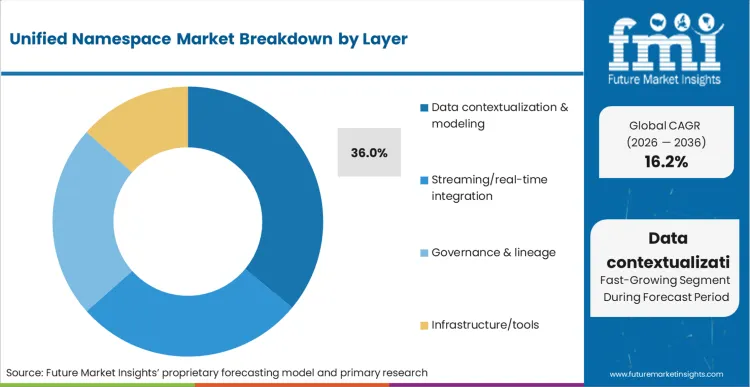
Software architects face mounting pressure to contextualize raw machine data before streaming payloads to expensive cloud environments. Data contextualization & modeling commands 36% of segment volumes as integrators shift processing power directly to the factory edge. Plant managers evaluating IOT in manufacturing solutions reject platforms that require manual tag mapping across thousands of distinct sensor nodes. Procurement criteria now mandate auto-discovery tools that dynamically build semantic models as new assets join the network. Vendors lacking pre-built information models tailored for specific machine types face immediate disqualification during technical evaluations.
- Procurement Shifts: Manual data tagging consumes unacceptable engineering hours during enterprise-wide integration rollouts.
- Technical Validation: Platforms must demonstrate automated payload structuring without introducing processing latency at the gateway level.
- Supplier Positioning: Developers embed native OPC UA information modeling capabilities directly into their MQTT bridging software.
Unified Namespace Market Analysis by Deployment
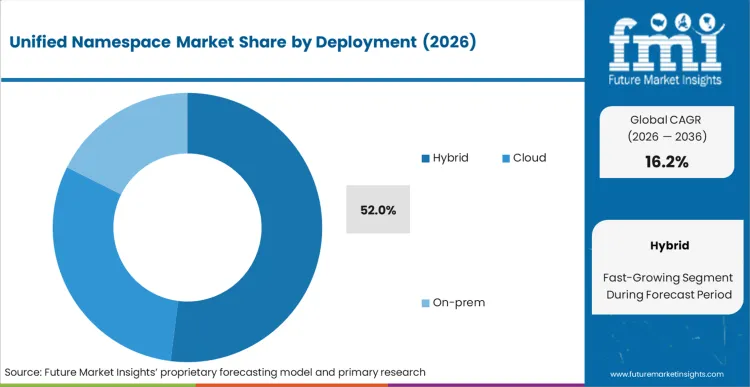
Enterprise IT directors require deployment flexibility to balance low-latency factory control with high-compute cloud analytics. Hybrid configurations capture 52% of the category share as manufacturers maintain critical safety loops on-premise while pushing aggregated telemetry to centralized data lakes. FMI analysts opine that hybrid architectures resolve the inherent conflict between OT security perimeters and IT data accessibility requirements. System integrators deploying factory automation and industrial controls must prove their edge brokers can cache data during network interruptions and seamlessly synchronize upon reconnection. Software providers delivering containerized brokers capable of running uniformly across edge appliances and cloud zones secure premium master service agreements.
- Adoption: Accelerates where multi-site manufacturers need unified visibility without compromising individual plant autonomy.
- Volume Concentration: Narrows to platform vendors offering unified management consoles for both local and cloud-hosted broker instances.
- Cost Structures: Tighten when operators attempt to run high-frequency polling architectures across expensive cloud ingress pipelines.
Unified Namespace Market Analysis by End use
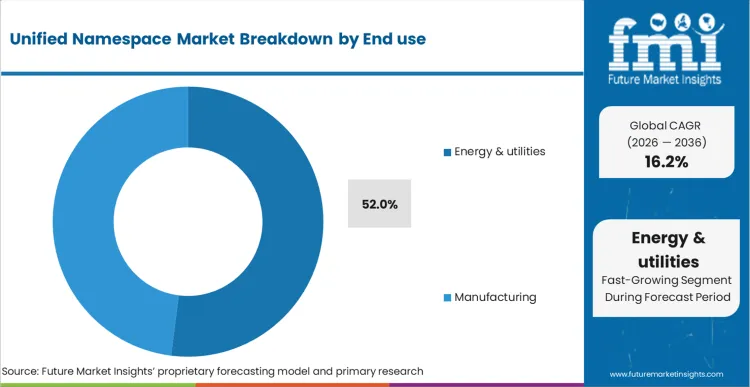
Energy & utilities secure 52% of total volume as grid managers replace siloed substation monitors with distributed publish-subscribe architectures. According to FMI's estimates, grid modernization initiatives depend entirely on low-latency data backbones to balance unpredictable solar and wind loads. Integrators building Edge AI for smart manufacturing and utility grids mandate namespace solutions capable of handling millions of concurrent client connections without dropping critical voltage alerts. Suppliers executing these specialized integration projects capture multi-decade infrastructure contracts.
- Requalification Cycles: Lengthen as utility operators lock into highly reliable, certified messaging brokers for critical infrastructure.
- Product Innovation: Integrators develop specialized adapters to translate legacy electrical protocols into standardized MQTT payloads.
- Logistics Advantage: Distributed architectures allow grid operators to process sensor data at regional substations, reducing central bandwidth requirements.
Unified Namespace Market Analysis by Component
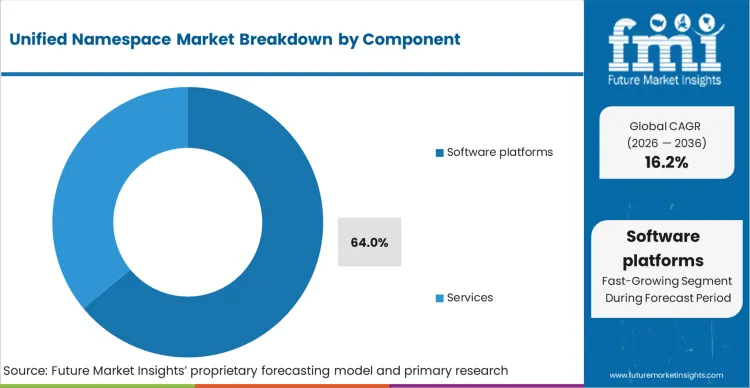
Industrial enterprises increasingly favor comprehensive commercial-off-the-shelf software packages over fragmented open-source assembly projects to accelerate digital transformation timelines. Software platforms command 64% of 2026 volumes as chief technology officers demand enterprise-grade support, security auditing, and guaranteed uptime SLAs. FMI analysts opine that commercial platforms drastically reduce the total cost of ownership associated with maintaining custom middleware environments. HighByte announced Industrial MCP Server for Agentic AI [6], proving that software vendors are advancing beyond basic connectivity to enable autonomous reasoning models. Operations managers expanding manufacturing execution systems demand integrated visualization tools, governance modules, and direct database connectors built directly into the core platform software.
- Process Compatibility: Commercial platforms offer certified connectors for all major industrial programmable logic controllers out of the box.
- Dietary Compliance: Strict software supply chain regulations compel buyers to specify commercial platforms with verified vulnerability scanning.
- Shelf Stability: Enterprise software vendors provide guaranteed long-term support release cycles, shielding factory operations from unexpected open-source deprecation.
Unified Namespace Market Drivers, Restraints, and Opportunities
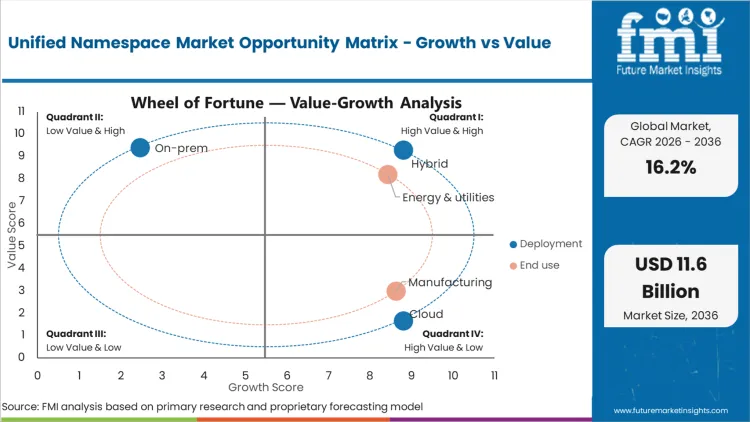
Asset-intensive industries face overwhelming pressure to deploy real-time analytics across highly fragmented legacy equipment networks. Inductive Automation released Ignition 8 3 [7]. Capital inflows accelerate the transition away from brittle, point-to-point SCADA integrations toward flexible event-driven architectures. Systems integrators must standardize payload structures to qualify for these modernization subsidies. Equipment manufacturers supplying non-compliant hardware face structural exclusion as buyers strictly enforce open communication specifications during the 2026 procurement cycle.
Severe cybersecurity vulnerabilities inherent in flattened industrial networks delay full enterprise namespace implementations. The World Economic Forums Global Cybersecurity Outlook 2026 states 87% of respondents identified AI-related vulnerabilities as the fastest-growing cyber risk over the course of 2025 [8]. Factory network architects mitigate these risks by deploying zero-trust brokers that strictly segregate OT subnets from corporate IT environments. Software vendors must provide granular, topic-level access control mechanisms to secure integration contracts within defense and critical infrastructure sectors.
- Edge Intelligence Integration: Automation vendors embed native namespace capability directly into industrial controllers.
- Cloud Analytics Convergence: Hyperscalers partner with industrial software providers to streamline factory data ingestion.
- Event-Driven Architectures: Software developers release specialized streaming modules designed specifically for operational technology pipelines. EMQ and Volt Active Data announced a strategic partnership [11].
Regional Analysis
Based on the regional analysis, the Unified Namespace market is segmented into North America, Latin America, Europe, East Asia, South Asia, Oceania and Middle East & Africa across 40+ countries. The full report also offers market attractiveness analysis based on regional trends.
.webp "Top Country Growth Comparison Unified Namespace Market Cagr (2026 2036)")
| Country | CAGR (2026 to 2036) |
|---|---|
| USA | 17.0% |
| Germany | 18.0% |
| UK | 16.0% |
| China | 19.0% |
| India | 20.0% |
| Japan | 15.0% |
| South Korea | 16.0% |
Source: Future Market Insights (FMI) analysis, based on proprietary forecasting model and primary research
Asia Pacific Unified Namespace Market Analysis
Asia Pacific integration patterns diverge sharply based on national strategic priorities, balancing cost-sensitive supply chain modernization against state-sponsored automation mandates. Facility engineers must abandon hierarchical polling networks as production throughput speeds exceed the physical limitations of legacy middleware. This aggressive shift toward sub-millisecond processing requires unified semantic models to ensure AI algorithms receive accurately structured payloads. Integrators operating within this high-growth theater must optimize broker architectures to handle extreme data concurrency across highly fragmented, multi-vendor equipment installations.
- China: State-mandated digital control quotas force large industrial groups to replace fragmented programmable logic controllers with unified data backbones capable of streaming audited telemetry directly to central compliance clouds. Procurement directors must deploy standardized MQTT message brokers before the 2028 inspection cycle opens, disqualifying vendors reliant on proprietary polling protocols that cannot natively integrate with enterprise data lakes.
- India: Cost-sensitive tier-1 manufacturers adopt edge-driven publish-subscribe patterns on pilot lines first, establishing lighthouse deployments that dictate supply chain interoperability requirements for downstream contract manufacturers. Plant operators running without node-level contextualization face severe uptime penalties as predictive algorithms lack normalized data feeds. Suppliers must provide edge gateways pre-configured for automated namespace generation to secure inclusion on approved vendor lists ahead of upcoming national digitalization subsidy windows.
- Japan: Aging workforce demographics compel automotive producers to weaponize extreme automation, replacing manual quality inspection with AI vision models that require sub-millisecond data synchronization across multi-vendor robotic cells. The International Federation of Robotics reports the Japanese auto industry installed approximately 13,000 robots in 2024 [14]. Operations managers managing these dense automation clusters must implement unified namespaces to bridge OT payload structures with IT analytics platforms. Vendors failing to deliver deterministic latency guarantees during the 2027 request for proposal cycles face permanent exclusion from Japanese automotive integration contracts.
- South Korea: Manufacturing execution system architects cannot maintain point-to-point middleware interfaces at this automation scale, making centralized namespace architectures a baseline operational requirement. Equipment builders failing to embed native unified namespace compatibility into their controllers cannot qualify for next-generation fabrication plant build-outs.
FMI's report includes comprehensive structural analysis tracking the acceleration of edge-native deployments across Taiwan, Vietnam, and Thailand. Semiconductor foundries across Taiwan aggressively upgrade operational technology backbones to support real-time digital twin synchronization, forcing regional component suppliers to adopt standardized payload schemas.
North America Unified Namespace Market Analysis
Strict cybersecurity enforcement protocols systematically force critical infrastructure operators to redesign OT data access paradigms. Plant security teams must implement governed broker architectures to eliminate direct connections between factory floor sensors and enterprise cloud applications. CISA states it released ten Industrial Control Systems advisories on August 7, 2025 [16]. Threat vectors expanding across industrial networks necessitate granular, topic-level access controls only natively available within modern MQTT namespace environments. Platform vendors must verify robust encryption capabilities to participate in municipal grid and defense manufacturing integration requests.
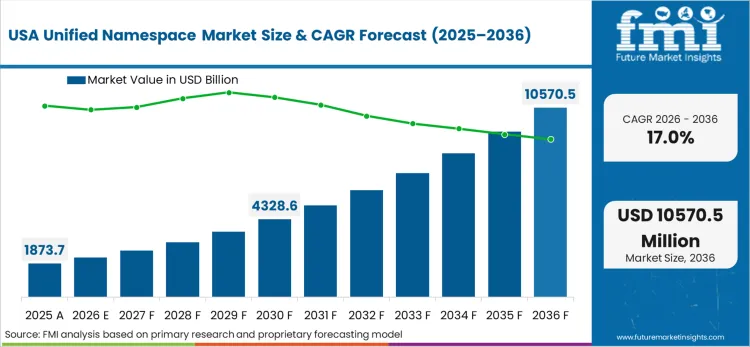
- USA: Escalating compliance advisories targeting critical infrastructure vulnerabilities compel energy operators and defense contractors to centralize OT network perimeters behind governed data brokers. Preliminary Census data showed AI adoption in the U.S. rose to 9.2% by Q2 2024, up from 5.7% in late 2023, largely fueled by cloud-based AI services [4]. Chief information security officers must implement namespace-driven zero-trust architectures to decouple legacy programmable logic controllers from direct cloud exposure. Integrators lacking verifiable secure-by-design credentials and granular access control capabilities face immediate disqualification from federal manufacturing modernization initiatives and associated prime contract awards.
FMI's report includes extensive coverage evaluating cross-border data telemetry integration patterns across Canada and Mexico. Canadian mining conglomerates mandate secure, low-bandwidth edge synchronization brokers to maintain operational visibility across remote extraction sites characterized by intermittent satellite connectivity.
Europe Unified Namespace Market Analysis
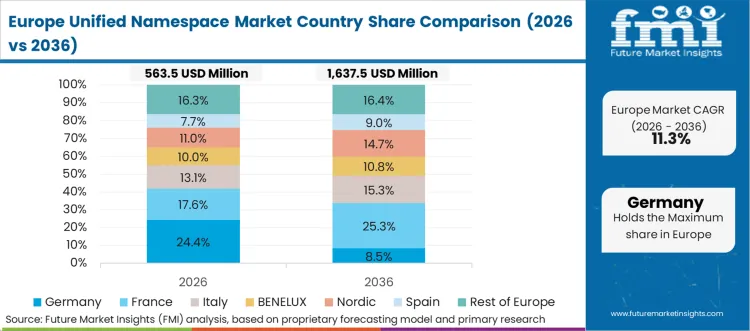
Deeply entrenched legacy automation networks present significant integration barriers, compelling European manufacturers to demand non-disruptive, parallel data architectures. Factory floor directors deploy lightweight edge brokers to harvest telemetry without altering existing programmable logic controller codebases. Global robot density increased from 163 to 177 robots per 10,000 employees globally [15]. FMI analysts opine that Europe's heavy industrial base requires namespace solutions uniquely capable of translating decades-old proprietary fieldbus protocols into modern semantic formats. European system integrators strictly favor vendors possessing native European data sovereignty certifications and comprehensive compliance architectures.
- Germany: High-intensity precision manufacturing environments dictate that component suppliers adopt open communication architectures to maintain synchronization with prime manufacturers digital twin environments. The OPC Foundation reports membership grew to 1,019 members worldwide, reflecting accelerating demand for interoperable industrial standards [3]. Facility engineers must migrate from hierarchical data silos to publish-subscribe event architectures to reduce machine integration lead times. Software providers lacking native OPC UA to MQTT translation capabilities will lose share to agile platform vendors executing hybrid edge-to-cloud integrations.
- UK: Widespread enterprise cloud maturity establishes the baseline architecture for unified namespace deployment, shifting industrial focus toward OT contextualization rather than foundational IT infrastructure build-outs. The focus shifting to OT contextualization drives integration. Digital transformation leaders must leverage this existing cloud footprint to unify distributed factory telemetry into cohesive enterprise data models. Platform vendors must prove their brokers can reliably stream contextualized asset data into AWS or Azure environments to pass preliminary vendor screening phases.
FMI's report includes deep functional assessments detailing data interoperability trends across France, Italy, and the Nordics. Automotive suppliers across Italy actively reconstruct telemetry pipelines to feed energy consumption models, rendering centralized broker architectures essential for meeting stringent regional carbon reporting requirements.
Competitive Aligners for Market Players
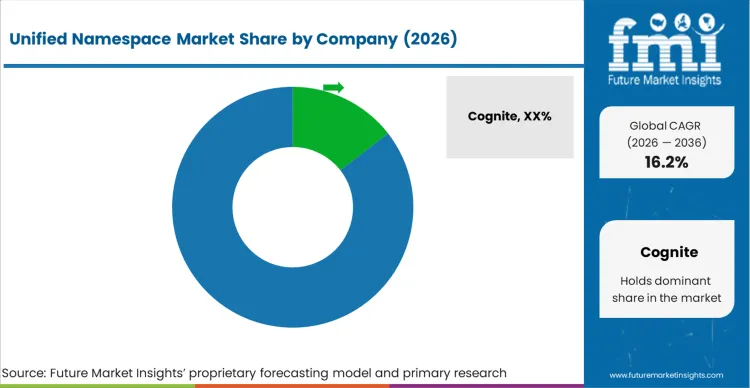
Market structure relies heavily on the ability of platform vendors to simplify complex OT-to-IT data translation. HiveMQ released HiveMQ Edge 2025 16 released, including streaming operational data into a unified namespace via HiveMQ Pulse connectivity [17]. Operations directors immediately bypass software providers lacking intuitive graphical interfaces for topic mapping and payload structuring. Suppliers offering pre-built templates for common industrial controllers significantly compress integration timelines, securing distinct commercial advantages over developers requiring extensive custom coding for basic connectivity.
Strategic alliances and partnerships reshape the vendor hierarchy by combining specialized edge connectivity with massive cloud compute power. Chief technology officers heavily favor integrated ecosystems over isolated software tools, forcing niche messaging brokers to align with major enterprise application providers. Integrators possessing verified certifications across both OT hardware and cloud analytics ecosystems dominate the execution of enterprise-wide digital transformation contracts.
Technological capability differentiates premium platforms from open-source alternatives through superior governance and semantic modeling engines. Siemens acquired Altair to create the most complete AI-powered portfolio of industrial software [5]. Enterprise IT security teams mandate comprehensive audit logs, granular access controls, and topic-level encryption protocols before authorizing factory data streams. Vendors failing to pass strict penetration testing and compliance reviews are systematically eliminated from tier-1 manufacturing and defense industry procurement lists.
Recent Developments
The report includes full coverage of key trends from competitive benchmarking. Some of the recent developments covered in the reports:
- In October 2025, Cognite announced that its Cognite Industrial AI and Data Platform, including Cognite Atlas AI and Cognite Data Fusion, was integrated with NVIDIA accelerated computing and software to advance real‑time industrial AI capabilities, particularly for anomaly detection. [1]
- In March 2025, Litmus announced a strategic partnership with Microsoft to deliver seamless edge‑to‑cloud industrial AI solutions through the integration of Litmus Edge with Microsoft Azure IoT Operations, enabling improved data orchestration, contextualization, and AI adoption in industrial environments. [10]
- In March 2025, PTC announced Kepware Edge, a new Linux‑based, container‑deployed industrial connectivity platform designed to modernize manufacturing data architectures, offering MQTT and OPC UA integrations and connectivity for major PLC/device brands. [9]
Key Players in Unified Namespace Market
- Cognite
- HighByte
- HiveMQ
- EMQX
- Litmus Automation
- PTC
- Siemens
- Inductive Automation
Scope of the Report
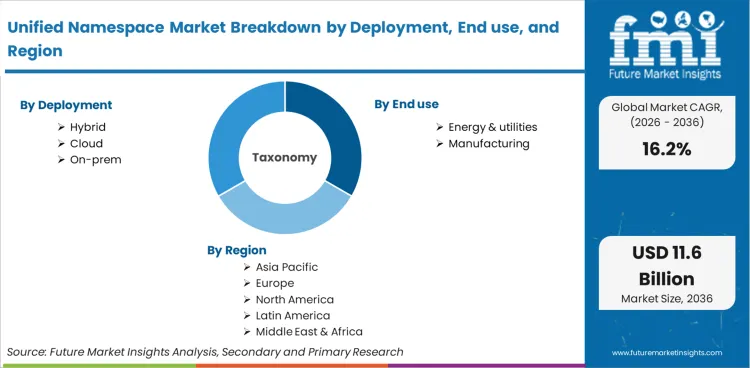
| Metric | Value |
|---|---|
| Quantitative Units | USD 2.59 billion to USD 11.6 billion, at a CAGR of 16.20% |
| Market Definition | Unified namespace constitutes a software-defined architectural pattern utilizing publish-subscribe messaging brokers, primarily MQTT, to centralize, standardize, and contextualize operational technology data in real-time. |
| Layer Segmentation | Data contextualization & modeling, Streaming/real-time integration, Governance & lineage, Infrastructure/tools |
| Deployment Segmentation | Hybrid, Cloud, On-prem |
| End use Segmentation | Manufacturing, Energy & utilities |
| Component Segmentation | Software platforms, Services |
| Regions Covered | North America, Latin America, Europe, East Asia, South Asia, Oceania, Middle East & Africa |
| Countries Covered | United States, Germany, UK, China, India, Japan, South Korea, and 40 plus countries |
| Key Companies Profiled | Cognite, HighByte, HiveMQ, EMQX, Litmus Automation, PTC, Siemens, Inductive Automation |
| Forecast Period | 2026 to 2036 |
| Approach | Bottom-up adoption modeling tracking enterprise automation upgrade cycles and edge computing capital expenditures validated by primary interviews. |
Source: Future Market Insights (FMI) analysis, based on proprietary forecasting model and primary research
Unified Namespace Market Analysis by Segments
Layer:
- Data contextualization & modeling
- Streaming/real-time integration
- Governance & lineage
- Infrastructure/tools
Deployment:
- Hybrid
- Cloud
- On-prem
End use:
- Manufacturing
- Energy & utilities
Component:
- Software platforms
- Services
Region:
- Asia Pacific
- India
- China
- Japan
- South Korea
- Indonesia
- Australia & New Zealand
- ASEAN
- Rest of Asia Pacific
- Europe
- Germany
- Italy
- France
- United Kingdom
- Spain
- Benelux
- Nordics
- Central & Eastern Europe
- Rest of Europe
- North America
- United States
- Canada
- Mexico
- Latin America
- Brazil
- Argentina
- Chile
- Rest of Latin America
- Middle East & Africa
- Kingdom of Saudi Arabia
- United Arab Emirates
- South Africa
- Turkey
- Rest of Middle East & Africa
Bibliography
- [1] Cognite. (2025, October 14). Cognite to unleash next-gen industrial AI (Press release).
- [2] HiveMQ. (2025, February 18). HiveMQ introduces HiveMQ Pulse, a next-generation distributed data intelligence platform.
- [3] OPC Foundation. (2025, December 01). Presidents welcome December 2025 (Industry report).
- [4] U.S. Census Bureau. (2024). Business Formation Statistics and Emerging Technology Adoption
- [5] Siemens. (2025, March 26). Siemens acquires Altair to create most complete AI-powered portfolio of industrial software (Press release).
- [6] HighByte. (2025, July 01). Press releases (Press release).
- [7] Inductive Automation. (2025, September 16). Inductive Automation releases Ignition 8 3 (Press release).
- [8] World Economic Forum. (2026, January 12). Global cybersecurity outlook 2026 (Industry report).
- [9] PTC. (2025, March 24). PTC announces Kepware Edge (Press release).
- [10] Litmus. (2025, March 31). Litmus announces strategic partnership with Microsoft (Press release).
- [11] EMQ. (2025, December 15). EMQ and Volt Active Data (Press release).
- [14] International Federation of Robotics. (2025, July 15). Japan’s Car Industry has Highest Robot Installations in Five Years (Industry report).
- [15] International Federation of Robotics. (2025). World Robotics 2025 – Industrial Robots (Industry report).
- [16] Cybersecurity and Infrastructure Security Agency. (2025, August 07). CISA releases ten industrial control systems advisories (Government report).
- [17] HiveMQ. (2025, October 01). HiveMQ Edge 2025.16 is Released (Press release).
This bibliography is provided for reader reference and is not exhaustive. The full report contains the complete reference list and detailed citations.
This Report Addresses
- Market size estimation and revenue forecasts from 2026 to 2036 supported by bottom-up technology adoption models tracking enterprise edge computing budgets.
- Growth opportunity mapping across cloud and hybrid deployment architectures detailing specific payload interoperability requirements.
- Segment and regional revenue forecasts covering critical automation layers including data contextualization, real-time integration, and semantic modeling.
- Competition strategy assessment detailing integration capabilities, protocol translation features, and vendor cybersecurity compliance frameworks.
- Regulatory impact analysis evaluating national digital modernization subsidies and critical infrastructure data security guidelines shaping integration mandates.
- Structural vulnerability assessment detailing the specific operational risks of legacy point-to-point SCADA polling networks under extreme AI workloads.
- Market report delivery in PDF, Excel, PPT, and interactive dashboard formats for executive and operational use.
Frequently Asked Questions
How large is the demand for Unified Namespace in the global market in 2026?
Demand for Unified Namespace in the global market is estimated to be valued at USD 2.59 billion in 2026.
What will be the market size of Unified Namespace in the global market by 2036?
Market size for Unified Namespace is projected to reach USD 11.6 billion by 2036.
What is the expected demand growth for Unified Namespace in the global market between 2026 and 2036?
Demand for Unified Namespace is expected to grow at a CAGR of 16.20% between 2026 and 2036.
How significant is the role of Energy & utilities in driving Unified Namespace adoption in 2026?
Energy & utilities represents 52% of segment share as grid operators deploy distributed broker architectures to manage renewable generation assets.
Which Layer is poised to lead global sales by 2026?
Data contextualization & modeling commands 36% in 2026 as integrators shift processing power directly to the factory edge.
What is driving demand in India?
Tier-1 manufacturers establishing scalable telemetry standards for downstream contract networks drive functional namespace adoption in India.
What compliance standards or regulations are referenced for India?
The Ministry of Heavy Industries IIoT implementation targets directly influence domestic modernization behavior.
What is the India growth outlook in this report?
India is projected to grow at a CAGR of 20.0% during 2026 to 2036.
Why is North America described as a priority region in this report?
Escalating compliance advisories targeting critical infrastructure vulnerabilities compel energy operators and defense contractors to centralize OT network perimeters.
What type of demand dominates in North America?
Cybersecurity-driven migration toward zero-trust, namespace-governed architectures dominates regional formulation demand.
What is China's growth outlook in this report?
China is projected to expand at a CAGR of 19.0% during 2026 to 2036.
Does the report cover United States in its regional analysis?
Yes, United States is included within North America under the regional scope of analysis.
What are the sources referred to for analyzing United States?
Official cloud technology adoption metrics from the US Census Bureau and federal cybersecurity vulnerability logs form the analytical basis.
What is the main demand theme linked to United States in its region coverage?
Zero-trust data perimeter enforcement and rapid decoupling of legacy programmable logic controllers from enterprise networks shapes continuous procurement demand.
Does the report cover United Kingdom in its regional analysis?
Yes, United Kingdom is included within Europe under the regional coverage framework.
What is the main United Kingdom related demand theme in its region coverage?
Widespread enterprise cloud maturity and the strategic necessity of extending existing IT frameworks into factory data models dominate regional buyer behavior.
Which product formats or configurations are strategically important for Asia Pacific supply chains?
Standardized MQTT message brokers capable of processing immense data concurrency across highly fragmented, multi-vendor robotic cells hold immense strategic importance.
What is Unified Namespace and what is it mainly used for?
It constitutes a software-defined architectural pattern utilizing publish-subscribe messaging brokers to centralize and contextualize operational technology data in real-time.
What does Unified Namespace mean in this report?
The market refers to the global commercialization, licensing, and integration of industrial message brokers and contextualization engines.
What is included in the scope of this Unified Namespace report?
Scope includes commercial message brokers, data contextualization engines, semantic modeling software, and edge-to-cloud gateway applications.
What is excluded from the scope of this report?
General-purpose IT service buses, bare-metal hardware, generic networking equipment, and legacy SCADA polling systems are strictly excluded.
What does market forecast mean on this page?
The market forecast represents a model-based projection built on defined industrial technology adoption and software capital expenditure assumptions for strategic planning purposes.
How does FMI build and validate the Unified Namespace forecast?
Forecasts combine top-down industrial IoT capital expenditure data with bottom-up adoption modeling, validated by primary consultations with factory integration specialists.
What does zero reliance on speculative third-party market research mean here?
Primary interviews, verified corporate capacity announcements, and official government technology adoption datasets are used exclusively instead of unverified syndicated estimates.
Preview the report firsthand - request a free sample
Get SampleGet the brochure for pricing and purchase details.
Get PDFTable of Content
- Executive Summary
- Global Market Outlook
- Demand-side Trends
- Supply-side Trends
- Technology Roadmap Analysis
- Analysis and Recommendations
- Market Overview
- Market Coverage / Taxonomy
- Market Definition / Scope / Limitations
- Research Methodology
- Chapter Orientation
- Analytical Lens and Working Hypotheses
- Market Structure, Signals, and Trend Drivers
- Benchmarking and Cross-market Comparability
- Market Sizing, Forecasting, and Opportunity Mapping
- Research Design and Evidence Framework
- Desk Research Programme (Secondary Evidence)
- Company Annual and Sustainability Reports
- Peer-reviewed Journals and Academic Literature
- Corporate Websites, Product Literature, and Technical Notes
- Earnings Decks and Investor Briefings
- Statutory Filings and Regulatory Disclosures
- Technical White Papers and Standards Notes
- Trade Journals, Industry Magazines, and Analyst Briefs
- Conference Proceedings, Webinars, and Seminar Materials
- Government Statistics Portals and Public Data Releases
- Press Releases and Reputable Media Coverage
- Specialist Newsletters and Curated Briefings
- Sector Databases and Reference Repositories
- FMI Internal Proprietary Databases and Historical Market Datasets
- Subscription Datasets and Paid Sources
- Social Channels, Communities, and Digital Listening Inputs
- Additional Desk Sources
- Expert Input and Fieldwork (Primary Evidence)
- Primary Modes
- Qualitative Interviews and Expert Elicitation
- Quantitative Surveys and Structured Data Capture
- Blended Approach
- Why Primary Evidence is Used
- Field Techniques
- Interviews
- Surveys
- Focus Groups
- Observational and In-context Research
- Social and Community Interactions
- Stakeholder Universe Engaged
- C-suite Leaders
- Board Members
- Presidents and Vice Presidents
- R&D and Innovation Heads
- Technical Specialists
- Domain Subject-matter Experts
- Scientists
- Physicians and Other Healthcare Professionals
- Governance, Ethics, and Data Stewardship
- Research Ethics
- Data Integrity and Handling
- Primary Modes
- Tooling, Models, and Reference Databases
- Desk Research Programme (Secondary Evidence)
- Data Engineering and Model Build
- Data Acquisition and Ingestion
- Cleaning, Normalisation, and Verification
- Synthesis, Triangulation, and Analysis
- Quality Assurance and Audit Trail
- Market Background
- Market Dynamics
- Drivers
- Restraints
- Opportunity
- Trends
- Scenario Forecast
- Demand in Optimistic Scenario
- Demand in Likely Scenario
- Demand in Conservative Scenario
- Opportunity Map Analysis
- Product Life Cycle Analysis
- Supply Chain Analysis
- Investment Feasibility Matrix
- Value Chain Analysis
- PESTLE and Porter’s Analysis
- Regulatory Landscape
- Regional Parent Market Outlook
- Production and Consumption Statistics
- Import and Export Statistics
- Market Dynamics
- Global Market Analysis 2021 to 2025 and Forecast, 2026 to 2036
- Historical Market Size Value (USD Million) Analysis, 2021 to 2025
- Current and Future Market Size Value (USD Million) Projections, 2026 to 2036
- Y-o-Y Growth Trend Analysis
- Absolute $ Opportunity Analysis
- Global Market Pricing Analysis 2021 to 2025 and Forecast 2026 to 2036
- Global Market Analysis 2021 to 2025 and Forecast 2026 to 2036, By Deployment
- Introduction / Key Findings
- Historical Market Size Value (USD Million) Analysis By Deployment , 2021 to 2025
- Current and Future Market Size Value (USD Million) Analysis and Forecast By Deployment , 2026 to 2036
- Hybrid
- Cloud
- On-prem
- Hybrid
- Y-o-Y Growth Trend Analysis By Deployment , 2021 to 2025
- Absolute $ Opportunity Analysis By Deployment , 2026 to 2036
- Global Market Analysis 2021 to 2025 and Forecast 2026 to 2036, By End use
- Introduction / Key Findings
- Historical Market Size Value (USD Million) Analysis By End use, 2021 to 2025
- Current and Future Market Size Value (USD Million) Analysis and Forecast By End use, 2026 to 2036
- Energy & utilities
- Manufacturing
- Energy & utilities
- Y-o-Y Growth Trend Analysis By End use, 2021 to 2025
- Absolute $ Opportunity Analysis By End use, 2026 to 2036
- Global Market Analysis 2021 to 2025 and Forecast 2026 to 2036, By Layer
- Introduction / Key Findings
- Historical Market Size Value (USD Million) Analysis By Layer, 2021 to 2025
- Current and Future Market Size Value (USD Million) Analysis and Forecast By Layer, 2026 to 2036
- Data contextualization & modeling
- Streaming/real-time integration
- Governance & lineage
- Infrastructure/tools
- Data contextualization & modeling
- Y-o-Y Growth Trend Analysis By Layer, 2021 to 2025
- Absolute $ Opportunity Analysis By Layer, 2026 to 2036
- Global Market Analysis 2021 to 2025 and Forecast 2026 to 2036, By Component
- Introduction / Key Findings
- Historical Market Size Value (USD Million) Analysis By Component, 2021 to 2025
- Current and Future Market Size Value (USD Million) Analysis and Forecast By Component, 2026 to 2036
- Software platforms
- Services
- Software platforms
- Y-o-Y Growth Trend Analysis By Component, 2021 to 2025
- Absolute $ Opportunity Analysis By Component, 2026 to 2036
- Global Market Analysis 2021 to 2025 and Forecast 2026 to 2036, By Region
- Introduction
- Historical Market Size Value (USD Million) Analysis By Region, 2021 to 2025
- Current Market Size Value (USD Million) Analysis and Forecast By Region, 2026 to 2036
- North America
- Latin America
- Western Europe
- Eastern Europe
- East Asia
- South Asia and Pacific
- Middle East & Africa
- Market Attractiveness Analysis By Region
- North America Market Analysis 2021 to 2025 and Forecast 2026 to 2036, By Country
- Historical Market Size Value (USD Million) Trend Analysis By Market Taxonomy, 2021 to 2025
- Market Size Value (USD Million) Forecast By Market Taxonomy, 2026 to 2036
- By Country
- USA
- Canada
- Mexico
- By Deployment
- By End use
- By Layer
- By Component
- By Country
- Market Attractiveness Analysis
- By Country
- By Deployment
- By End use
- By Layer
- By Component
- Key Takeaways
- Latin America Market Analysis 2021 to 2025 and Forecast 2026 to 2036, By Country
- Historical Market Size Value (USD Million) Trend Analysis By Market Taxonomy, 2021 to 2025
- Market Size Value (USD Million) Forecast By Market Taxonomy, 2026 to 2036
- By Country
- Brazil
- Chile
- Rest of Latin America
- By Deployment
- By End use
- By Layer
- By Component
- By Country
- Market Attractiveness Analysis
- By Country
- By Deployment
- By End use
- By Layer
- By Component
- Key Takeaways
- Western Europe Market Analysis 2021 to 2025 and Forecast 2026 to 2036, By Country
- Historical Market Size Value (USD Million) Trend Analysis By Market Taxonomy, 2021 to 2025
- Market Size Value (USD Million) Forecast By Market Taxonomy, 2026 to 2036
- By Country
- Germany
- UK
- Italy
- Spain
- France
- Nordic
- BENELUX
- Rest of Western Europe
- By Deployment
- By End use
- By Layer
- By Component
- By Country
- Market Attractiveness Analysis
- By Country
- By Deployment
- By End use
- By Layer
- By Component
- Key Takeaways
- Eastern Europe Market Analysis 2021 to 2025 and Forecast 2026 to 2036, By Country
- Historical Market Size Value (USD Million) Trend Analysis By Market Taxonomy, 2021 to 2025
- Market Size Value (USD Million) Forecast By Market Taxonomy, 2026 to 2036
- By Country
- Russia
- Poland
- Hungary
- Balkan & Baltic
- Rest of Eastern Europe
- By Deployment
- By End use
- By Layer
- By Component
- By Country
- Market Attractiveness Analysis
- By Country
- By Deployment
- By End use
- By Layer
- By Component
- Key Takeaways
- East Asia Market Analysis 2021 to 2025 and Forecast 2026 to 2036, By Country
- Historical Market Size Value (USD Million) Trend Analysis By Market Taxonomy, 2021 to 2025
- Market Size Value (USD Million) Forecast By Market Taxonomy, 2026 to 2036
- By Country
- China
- Japan
- South Korea
- By Deployment
- By End use
- By Layer
- By Component
- By Country
- Market Attractiveness Analysis
- By Country
- By Deployment
- By End use
- By Layer
- By Component
- Key Takeaways
- South Asia and Pacific Market Analysis 2021 to 2025 and Forecast 2026 to 2036, By Country
- Historical Market Size Value (USD Million) Trend Analysis By Market Taxonomy, 2021 to 2025
- Market Size Value (USD Million) Forecast By Market Taxonomy, 2026 to 2036
- By Country
- India
- ASEAN
- Australia & New Zealand
- Rest of South Asia and Pacific
- By Deployment
- By End use
- By Layer
- By Component
- By Country
- Market Attractiveness Analysis
- By Country
- By Deployment
- By End use
- By Layer
- By Component
- Key Takeaways
- Middle East & Africa Market Analysis 2021 to 2025 and Forecast 2026 to 2036, By Country
- Historical Market Size Value (USD Million) Trend Analysis By Market Taxonomy, 2021 to 2025
- Market Size Value (USD Million) Forecast By Market Taxonomy, 2026 to 2036
- By Country
- Kingdom of Saudi Arabia
- Other GCC Countries
- Turkiye
- South Africa
- Other African Union
- Rest of Middle East & Africa
- By Deployment
- By End use
- By Layer
- By Component
- By Country
- Market Attractiveness Analysis
- By Country
- By Deployment
- By End use
- By Layer
- By Component
- Key Takeaways
- Key Countries Market Analysis
- USA
- Pricing Analysis
- Market Share Analysis, 2025
- By Deployment
- By End use
- By Layer
- By Component
- Canada
- Pricing Analysis
- Market Share Analysis, 2025
- By Deployment
- By End use
- By Layer
- By Component
- Mexico
- Pricing Analysis
- Market Share Analysis, 2025
- By Deployment
- By End use
- By Layer
- By Component
- Brazil
- Pricing Analysis
- Market Share Analysis, 2025
- By Deployment
- By End use
- By Layer
- By Component
- Chile
- Pricing Analysis
- Market Share Analysis, 2025
- By Deployment
- By End use
- By Layer
- By Component
- Germany
- Pricing Analysis
- Market Share Analysis, 2025
- By Deployment
- By End use
- By Layer
- By Component
- UK
- Pricing Analysis
- Market Share Analysis, 2025
- By Deployment
- By End use
- By Layer
- By Component
- Italy
- Pricing Analysis
- Market Share Analysis, 2025
- By Deployment
- By End use
- By Layer
- By Component
- Spain
- Pricing Analysis
- Market Share Analysis, 2025
- By Deployment
- By End use
- By Layer
- By Component
- France
- Pricing Analysis
- Market Share Analysis, 2025
- By Deployment
- By End use
- By Layer
- By Component
- India
- Pricing Analysis
- Market Share Analysis, 2025
- By Deployment
- By End use
- By Layer
- By Component
- ASEAN
- Pricing Analysis
- Market Share Analysis, 2025
- By Deployment
- By End use
- By Layer
- By Component
- Australia & New Zealand
- Pricing Analysis
- Market Share Analysis, 2025
- By Deployment
- By End use
- By Layer
- By Component
- China
- Pricing Analysis
- Market Share Analysis, 2025
- By Deployment
- By End use
- By Layer
- By Component
- Japan
- Pricing Analysis
- Market Share Analysis, 2025
- By Deployment
- By End use
- By Layer
- By Component
- South Korea
- Pricing Analysis
- Market Share Analysis, 2025
- By Deployment
- By End use
- By Layer
- By Component
- Russia
- Pricing Analysis
- Market Share Analysis, 2025
- By Deployment
- By End use
- By Layer
- By Component
- Poland
- Pricing Analysis
- Market Share Analysis, 2025
- By Deployment
- By End use
- By Layer
- By Component
- Hungary
- Pricing Analysis
- Market Share Analysis, 2025
- By Deployment
- By End use
- By Layer
- By Component
- Kingdom of Saudi Arabia
- Pricing Analysis
- Market Share Analysis, 2025
- By Deployment
- By End use
- By Layer
- By Component
- Turkiye
- Pricing Analysis
- Market Share Analysis, 2025
- By Deployment
- By End use
- By Layer
- By Component
- South Africa
- Pricing Analysis
- Market Share Analysis, 2025
- By Deployment
- By End use
- By Layer
- By Component
- USA
- Market Structure Analysis
- Competition Dashboard
- Competition Benchmarking
- Market Share Analysis of Top Players
- By Regional
- By Deployment
- By End use
- By Layer
- By Component
- Competition Analysis
- Competition Deep Dive
- Cognite
- Overview
- Product Portfolio
- Profitability by Market Segments (Product/Age /Sales Channel/Region)
- Sales Footprint
- Strategy Overview
- Marketing Strategy
- Product Strategy
- Channel Strategy
- HighByte
- HiveMQ
- EMQX
- Litmus Automation
- PTC
- Siemens
- Inductive Automation
- Cognite
- Competition Deep Dive
- Assumptions & Acronyms Used


