

- Industry Size (2026)
- USD 63.0 Mn
- Forecast (2036)
- USD 110.7 Mn
- CAGR (2026 to 2036)
- 5.8%
Demand for Hydrocarbon Accounting Solution in United Kingdom Forecast and Outlook 2026 to 2036
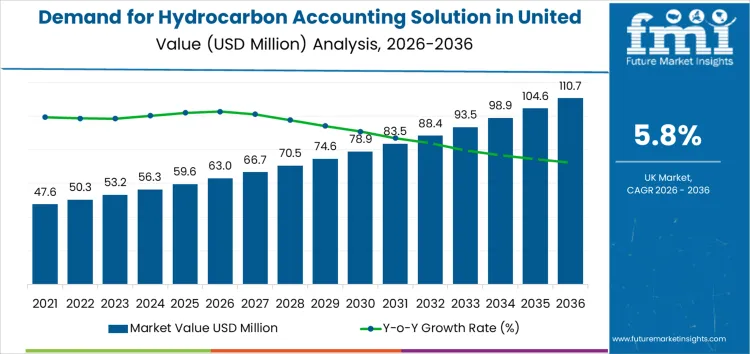
The hydrocarbon accounting solution market in the United Kingdom is expected to grow from USD 63.0 million in 2026 to USD 110.7 million by 2036, at a CAGR of 5.8%. Decision-makers should understand that economic exposure in this space is tied to fluctuations in global oil and gas prices, which can directly influence demand for accounting solutions. As the industry shifts towards greater transparency and regulatory compliance, prioritization will need to focus on software solutions that offer scalability and integration with evolving industry standards.
Timing is anticipated to be a crucial component, as investment in advanced accounting systems will help companies stay ahead of tightening regulations and improve operational efficiency. The longer-term adoption cycle, coupled with the initial capital investment, means that providers must ensure their offerings deliver clear, measurable returns to justify these expenditures. Firms that can offer reliable, adaptable solutions will have the greatest potential to capture market share and build enduring relationships with customers.
Quick Stats for the Demand for Hydrocarbon Accounting Solution in United Kingdom
- Hydrocarbon Accounting Solution in United Kingdom Value (2026): USD 63.0 million
- Hydrocarbon Accounting Solution in United Kingdom Forecast Value (2036): USD 110.7 million
- Hydrocarbon Accounting Solution in United Kingdom Forecast CAGR (2026 to 2036): 5.8%
- Hydrocarbon Accounting Solution in United Kingdom Leading Segment: On-Premises (58% share)
- Key Growth Regions of Hydrocarbon Accounting Solution in United Kingdom: England
- Top Players of Hydrocarbon Accounting Solution in United Kingdom: Infosys, SAP, Adept Solution, P2 Energy Solution, Tieto
What is the Growth Forecast for Hydrocarbon Accounting Solution in United Kingdom through 2036?
The demand for hydrocarbon accounting solutions in the United Kingdom is projected to rise from USD 63 million in 2026 to USD 110.7 million by 2036, reflecting a compound annual growth rate (CAGR) of 5.8%. Between 2026 and 2031, the industry will experience steady growth, with values increasing from USD 63 million to USD 83.5 million. From 2031 to 2036, growth will continue, reaching USD 110.7 million by the end of the forecast period.
The acceleration and deceleration pattern indicate that the industry will experience an initial acceleration in demand from 2026 to 2031. This is driven by the adoption of advanced software solutions and the increasing need for compliance and reporting in the energy sector. After 2031, the rate of growth is expected to decelerate as the industry matures and most large-scale operators implement hydrocarbon accounting systems. However, continued technological innovation and ongoing regulatory changes will sustain a steady pace of demand in the latter years of the forecast period. Despite the deceleration, the industry will continue to expand as the need for real-time, efficient, and transparent tracking of hydrocarbons persists in the evolving energy landscape.
Key Takeaways for Demand for Hydrocarbon Accounting Solution in United Kingdom
| Metric | Value |
|---|---|
| Industry Sales Value (2026) | USD 63 million |
| Industry Forecast Value (2036) | USD 110.7 million |
| Industry Forecast CAGR (2026 to 2036) | 5.8% |
Why is Demand for Hydrocarbon Accounting Solution in United Kingdom Growing?
Demand for hydrocarbon accounting solutions in the United Kingdom has grown as energy and hydrocarbon producers, midstream operators, and trading firms sought greater accuracy and transparency in their measurement and reporting processes. Historically, hydrocarbon accounting relied on manual data aggregation from disparate measurement points, which often produced delays and inconsistencies in production reporting. As UK operators modernized facilities and adopted digital measurement instrumentation, the complexity of data flows increased and exposed limitations in legacy accounting practices.
Organizations began investing in purpose built hydrocarbon accounting solutions that automate data capture, reconciliation, and allocation across wells, storage tanks, pipelines, and delivery points. This shift reduced reliance on manual spreadsheets and mitigated errors that can affect revenue reporting, regulatory compliance, and reservoir performance analysis. Finance and operations teams valued systems capable of aligning measurement data with corporate reporting frameworks, improving audit readiness in a regulatory environment where accuracy and traceability are essential.
Looking ahead, demand for hydrocarbon accounting solutions in the United Kingdom is expected to continue rising as upstream and midstream players pursue operational efficiency and data integrity. The transition toward digital oilfield initiatives and integration of enterprise software stacks will sustain interest in solutions that connect real time measurement with enterprise resource planning, production management, and fiscal reporting workflows. Operators managing multiple assets and complex contracts will prioritize systems that support flexible allocation rules, regulatory reporting requirements, and transparent audit trails across stakeholder groups.
For suppliers, differentiation will stem from offering scalable platforms that accommodate growth in data volumes, incorporate advanced analytics, and interface with third party measurement devices and SCADA systems. Service and support capabilities, including implementation expertise and ongoing system optimization, will be key factors for UK buyers assessing hydrocarbon accounting vendors. As commercial models and regulatory expectations evolve, companies that invest in robust accounting infrastructure will derive value from improved decision making, reduced reconciliation cycles, and strengthened governance over hydrocarbon measurement and reporting processes.
What Are the Key Segments in the Demand for Hydrocarbon Accounting Solutions in the United Kingdom?
Demand for hydrocarbon accounting solutions in the United Kingdom is driven by solution type and end-user segment. On-premises solutions lead the solution segment with 58%, while oilfield services companies dominate the end-user segment with 28.7%. Other end-users, such as oil and gas exploration and production (EP) companies, midstream companies, refineries, and energy trading and risk management (ETRM) firms, also contribute to the industry. These trends reflect the critical role of accurate hydrocarbon accounting in ensuring compliance, operational efficiency, and financial management within the oil and gas sector.
What Is the Solution Segment of Demand for Hydrocarbon Accounting Solutions in the United Kingdom?
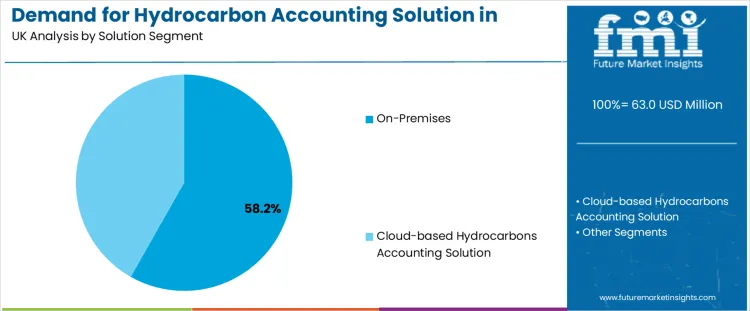
The solution segment for hydrocarbon accounting solutions in the United Kingdom is predominantly led by on-premises solutions, which account for 58% of the industry share. On-premises hydrocarbon accounting solutions provide organizations with full control over their systems, data, and infrastructure, ensuring security and compliance with industry regulations. These systems are particularly popular with companies that manage large volumes of data and require highly customizable solutions to meet their specific operational needs.
On-premises solutions offer greater flexibility in terms of integration with other internal systems, including finance, supply chain management, and production systems, making them a preferred option for larger organizations that require a tailored approach. Additionally, on-premises solutions tend to be favored by companies with established IT infrastructures, where managing the solution internally aligns with their existing operational model. Cloud-based hydrocarbon accounting solutions, while a smaller segment, are gaining in popularity due to their cost-effectiveness, scalability, and ease of implementation. Cloud-based solutions eliminate the need for heavy upfront capital expenditures and provide companies with the flexibility to scale their systems as their needs grow.
The shift toward cloud-based solutions is also driven by the increasing demand for real-time data access and collaboration across geographically dispersed teams. As cloud technology continues to evolve, its adoption in hydrocarbon accounting is expected to increase, providing businesses with greater operational efficiency and streamlined data management.
What Is the End-User Segment of Demand for Hydrocarbon Accounting Solutions in the United Kingdom?
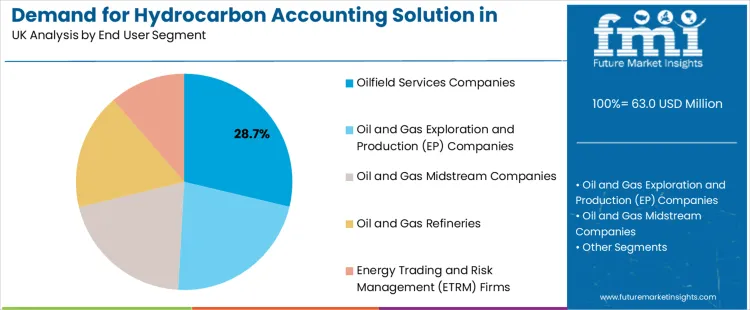
The end-user segment for hydrocarbon accounting solutions in the United Kingdom is primarily led by oilfield services companies, which account for 28.7% of the industry share. Oilfield services companies require robust hydrocarbon accounting systems to manage complex operations involving the extraction, transportation, and processing of hydrocarbons. These companies rely on accurate data to track production, monitor operational costs, and ensure compliance with regulatory standards. Hydrocarbon accounting solutions enable these companies to efficiently manage and reconcile their production data, improving operational transparency and financial performance.
Oil and gas exploration and production (EP) companies follow as another significant end-user, with solutions tailored to meet their specific needs in tracking the extraction and processing of oil and gas reserves. EP companies need hydrocarbon accounting systems to manage their assets, track production volumes, calculate royalties, and maintain accurate financial records. Midstream oil and gas companies, responsible for the transportation and storage of hydrocarbons, also contribute to the demand for hydrocarbon accounting solutions. These companies require systems that can track the flow of products through pipelines and storage facilities, ensuring that volumes are accurately measured and accounted for at each stage of the supply chain.
Oil and gas refineries represent another key segment, with hydrocarbon accounting solutions playing a vital role in managing the complexities of refining processes, ensuring that input and output quantities are accurately tracked, and supporting regulatory compliance. Energy trading and risk management (ETRM) firms also represent a growing segment, as these organizations rely on accurate hydrocarbon accounting to manage their portfolios, assess market conditions, and optimize trading strategies. As the demand for efficient and accurate hydrocarbon accounting systems continues to grow, end-users across the oil and gas industry are increasingly seeking solutions that enhance transparency, improve operational efficiency, and support financial management in a highly regulated environment.
What are the Key Dynamics in the Demand for Hydrocarbon Accounting Solutions in the United Kingdom?
Demand for hydrocarbon accounting solutions in the United Kingdom is driven by operational, regulatory, and commercial imperatives in energy, oil, gas, and petrochemical sectors. Hydrocarbon accounting solutions provide structured measurement, reconciliation, and reporting of volumes and energy flows across production, processing, storage, and distribution systems. Buyers-including operators of offshore platforms, refineries, and midstream assets-require accurate and auditable accounting to support revenue allocation, regulatory compliance, custody transfer, and performance optimisation. Procurement trends also reflect digital transformation initiatives aimed at replacing manual or disparate systems with integrated, automated platforms that improve data quality and decision support.
What are the Key Drivers for Hydrocarbon Accounting Solution Demand in the United Kingdom?
Several factors are underpinning demand for hydrocarbon accounting solutions in the United Kingdom. Regulatory requirements for accurate volumetric reporting, emissions calculation, and fiscal compliance compel organisations to adopt robust accounting systems that meet audit standards. Complex supply chains spanning offshore fields, terminals, and midstream infrastructure necessitate reconciliation of measurement data from diverse sources. Integration with process control (SCADA), production operations, and enterprise resource planning (ERP) systems enhances transparency and supports commercial settlements. Operators increasingly prioritise real time data capture, automated workflows, and analytical dashboards to reduce operational risk and support performance metrics. Digitalisation strategies aimed at improving asset efficiency and reducing discrepancies in mass balance reporting further bolster procurement.
What are the Restraints on Hydrocarbon Accounting Solution Demand in the United Kingdom?
Despite clear operational benefits, several restraints affect the adoption of hydrocarbon accounting solutions in the United Kingdom. High initial investment and implementation costs, including customisation to specific asset configurations, can deter smaller operators or service contractors with tight budgets. Legacy system dependencies and data silos complicate integration, resulting in prolonged deployment timelines and potential disruption to business processes. Skills shortages in data engineering and system maintenance can increase total cost of ownership and delay value realisation. Variable prioritisation of digital transformation across organisations may result in phased or deferred investments in hydrocarbon accounting platforms.
What are the Key Trends in Hydrocarbon Accounting Solution Demand in the United Kingdom?
Key trends shaping hydrocarbon accounting solution demand in the United Kingdom include greater emphasis on cloud enabled and software as a service (SaaS) delivery models that lower upfront infrastructure cost and enable scalable roll outs. There is growing integration of advanced analytics and machine learning to support anomaly detection, forecasting, and optimisation of mass balance results. Real time reconciliation and alerting capabilities are being embedded to reduce operational lag and support near instant commercial settlement. Vendors are enhancing interoperability with IoT sensors, edge computing, and distributed ledger technologies to improve traceability and audit readiness. Collaborative implementations with systems integrators and energy consultancies help organisations align hydrocarbon accounting platforms with broader digital transformation roadmaps and regulatory reporting frameworks.
What is the Country-Wise Demand for Hydrocarbon Accounting Solutions in the United Kingdom?
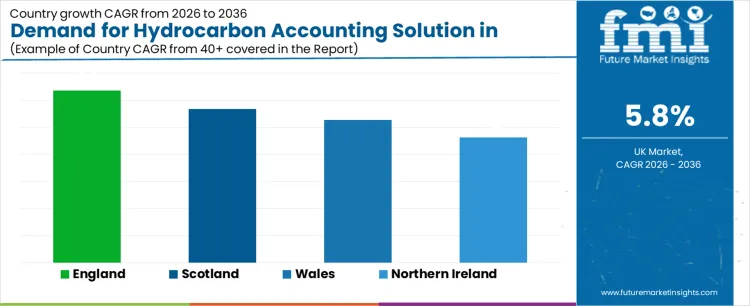
The demand for hydrocarbon accounting solutions in the United Kingdom shows regional variations, with England leading the industry. The demand is primarily driven by the country’s large energy sector, including oil and gas operations, where accurate tracking of hydrocarbon production, transportation, and storage is essential for regulatory compliance, financial reporting, and operational efficiency. Scotland, Wales, and Northern Ireland also show significant demand, particularly due to their involvement in oil and gas exploration and production activities. As the energy sector increasingly focuses on efficiency, transparency, and sustainability, the need for robust hydrocarbon accounting solutions is expected to grow across all regions. England remains the largest market due to its dominant energy infrastructure, but steady growth is expected in the other regions driven by the ongoing modernization of energy operations.
| Country | CAGR (2026 to 2036) |
|---|---|
| England | 6.4% |
| Scotland | 5.7% |
| Wales | 5.3% |
| Northern Ireland | 4.6% |
What is Driving the Demand for Hydrocarbon Accounting Solutions in England?
The demand for hydrocarbon accounting solutions in England is projected to grow at a CAGR of 6.4% from 2026 to 2036. England’s large and well-established oil and gas industry, along with its financial and regulatory requirements, are the primary drivers of this demand. Hydrocarbon accounting solutions are essential for ensuring accurate tracking of hydrocarbon volumes, costs, and revenues across the production chain, from exploration to distribution. With increasing focus on operational efficiency, risk management, and compliance with environmental regulations, companies in England are increasingly adopting advanced solutions to streamline these processes. Furthermore, the rise of digitalization in the energy sector and the growing emphasis on data-driven decision-making are further fueling the demand for advanced hydrocarbon accounting technologies. As the energy industry evolves to meet sustainability goals, the need for efficient and transparent accounting solutions will continue to grow, driving steady demand for these systems in England.
How is the Demand for Hydrocarbon Accounting Solutions Performing in Scotland?
In Scotland, the demand for hydrocarbon accounting solutions is expected to grow at a CAGR of 5.7% from 2026 to 2036. Scotland’s significant role in the North Sea oil and gas industry, coupled with increasing regulatory demands and operational efficiency needs, is driving this market. As Scotland’s energy sector continues to invest in modernization and sustainability, hydrocarbon accounting systems are becoming essential tools for ensuring accurate financial and operational reporting. The growing focus on transparency, compliance with environmental standards, and efficient resource management is contributing to the rise in demand for these solutions. Additionally, as Scotland increasingly explores and produces renewable energy alongside conventional oil and gas resources, companies are looking to integrate hydrocarbon accounting solutions with broader energy management systems. This trend is expected to support steady growth in the demand for these solutions in Scotland.
What Are the Growth Drivers for Hydrocarbon Accounting Solutions in Wales?
The demand for hydrocarbon accounting solutions in Wales is projected to grow at a CAGR of 5.3% through 2036. The energy sector in Wales, while smaller than in other parts of the UK, is contributing to the rising demand for efficient hydrocarbon tracking solutions. Wales’ involvement in offshore oil and gas exploration, along with its growing emphasis on regulatory compliance and sustainability, is driving the need for advanced accounting solutions. Companies in Wales are increasingly adopting hydrocarbon accounting systems to streamline their operations, improve transparency, and ensure accurate tracking of their energy production and consumption. As the Welsh energy sector continues to expand, particularly in offshore oil and gas and renewable energy, the integration of robust accounting systems will be crucial for managing and reporting hydrocarbon activities. The increasing focus on environmental regulations and cost management further supports the growth of this market in Wales.
What is the Outlook for Hydrocarbon Accounting Solutions Demand in Northern Ireland?
Northern Ireland’s demand for hydrocarbon accounting solutions is expected to grow at a CAGR of 4.6% from 2026 to 2036. Although Northern Ireland represents the smallest market for hydrocarbon accounting solutions in the United Kingdom, the demand is steadily increasing due to growing energy sector activities and evolving regulatory frameworks. Northern Ireland's oil and gas industry, while smaller in comparison, is modernizing and seeking better solutions for tracking and reporting hydrocarbon volumes, costs, and revenue. With increased emphasis on operational efficiency and the need for accurate reporting, the adoption of hydrocarbon accounting solutions is expected to rise steadily. Additionally, the ongoing focus on reducing environmental impact and improving sustainability in the energy sector is driving companies in Northern Ireland to adopt more advanced and efficient accounting systems. As the energy industry continues to grow in the region, the demand for hydrocarbon accounting solutions is expected to increase at a consistent rate.
What is the Competitive Landscape for Demand for Hydrocarbon Accounting Solutions in the United Kingdom?
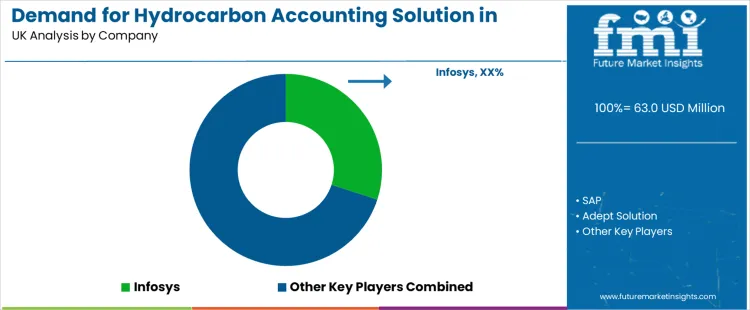
Demand for hydrocarbon accounting solutions in the United Kingdom is shaped by operational transparency requirements, regulatory reporting standards, fiscal tracking needs, and integration with upstream and midstream enterprise systems. Buyers in oil and gas operators, energy trading houses, and service providers assess platforms based on documented data integrity controls, audit traceability, and compliance reporting capabilities. Infosys is positioned as a leading provider, with solution documentation that outlines ledger architectures, documented reconciliation processes, and integration blueprints with existing ERP and production systems. These materials are reviewed by IT architects and functional procurement teams when aligning platform capabilities with business process requirements. Technical brochures from Infosys also list documented workflow templates, documented security controls, and documented support services that assist enterprises in evaluating total cost of ownership and implementation readiness.
SAP competes with hydrocarbon accounting modules embedded within broader enterprise suites, supported by documented master data structures, documented reporting engines, and documented change management frameworks. Buyers examine this documentation to ensure compatibility with legacy systems and to gauge scalability across production volumes. Adept Solution supplies specialist hydrocarbon accounting and measurement solutions with specification sheets that list documented allocation rules, documented measurement integration points, and documented audit logs. These details support functional teams in mapping solution fit to operational needs.
P2 Energy Solution offers documented hydrocarbon tracking and financial reporting systems tailored to energy sector processes, with product literature that outlines documented asset accounting methods and documented regulatory compliance features. Tieto provides hydrocarbon accounting platforms with documentation focused on cloud and on premise deployment options, documented service level commitments, and documented data governance provisions. UK energy companies incorporate documented performance metrics and documented service terms into vendor evaluations, placing emphasis on integration ease, data quality assurances, and documented regulatory alignment. Competitive activity in this segment reflects measurable technical specifications and documented supply commitments that inform procurement decisions by technology and operational leaders.
Key Players of the Demand for Hydrocarbon Accounting Solution in United Kingdom
- Infosys
- SAP
- Adept Solution
- P2 Energy Solution
- Tieto
Scope of the Report
| Items | Values |
|---|---|
| Quantitative Units (2026) | USD Million |
| Solution Segment | On-Premises, Cloud-based Hydrocarbons Accounting Solution |
| End User Segment | Oilfield Services Companies, Oil and Gas Exploration and Production (EP) Companies, Oil and Gas Midstream Companies, Oil and Gas Refineries, Energy Trading and Risk Management (ETRM) Firms |
| Companies | Infosys, SAP, Adept Solution, P2 Energy Solution, Tieto |
| Regions Covered | United Kingdom |
| Countries Covered | England, Scotland, Wales, Northern Ireland |
| Additional Attributes | Dollar by sales by solution segment, end user segment, and region. Includes market trends towards automation, efficiency, and the role of hydrocarbon accounting solutions in enhancing financial reporting and compliance in the energy sector. |
Key Segments of Demand for Hydrocarbon Accounting Solution in United Kingdom
Solution Segment
- On-Premises
- Cloud-based Hydrocarbons Accounting Solution
End User Segment
- Oilfield Services Companies
- Oil and Gas Exploration and Production (EP) Companies
- Oil and Gas Midstream Companies
- Oil and Gas Refineries
- Energy Trading and Risk Management (ETRM) Firms
Countries
- England
- Scotland
- Wales
- Northern Ireland
Bibliography
- Department for Energy Security and Net Zero. (2024). UK oil and gas production statistics. UK Government.
- North Sea Transition Authority. (2024). Stewardship expectations and compliance guidance. NSTA.
- International Energy Agency. (2024). Oil 2024: Supply and demand. International Energy Agency.
- Organisation for Economic Co-operation and Development. (2024). Governance and transparency in extractive industries. OECD Publishing.
- United Nations Conference on Trade and Development. (2024). Commodities and development report 2024. UNCTAD.
Frequently Asked Questions
How big is the demand for hydrocarbon accounting solution in united kingdom in 2026?
The demand for hydrocarbon accounting solution in united kingdom is estimated to be valued at USD 63.0 million in 2026.
What will be the size of hydrocarbon accounting solution in united kingdom in 2036?
The market size for the hydrocarbon accounting solution in united kingdom is projected to reach USD 110.7 million by 2036.
How much will be the demand for hydrocarbon accounting solution in united kingdom growth between 2026 and 2036?
The demand for hydrocarbon accounting solution in united kingdom is expected to grow at a 5.8% CAGR between 2026 and 2036.
What are the key product types in the hydrocarbon accounting solution in united kingdom?
The key product types in hydrocarbon accounting solution in united kingdom are on-premises and cloud-based hydrocarbons accounting solution.
Which end user segment segment is expected to contribute significant share in the hydrocarbon accounting solution in united kingdom in 2026?
In terms of end user segment, oilfield services companies segment is expected to command 28.7% share in the hydrocarbon accounting solution in united kingdom in 2026.
Preview the report firsthand - request a free sample
Get SampleGet the brochure for pricing and purchase details.
Get PDFTable of Content
- Executive Summary
- UK Market Outlook
- Demand-side Trends
- Supply-side Trends
- Technology Roadmap Analysis
- Analysis and Recommendations
- Market Overview
- Market Coverage / Taxonomy
- Market Definition / Scope / Limitations
- Market Background
- Market Dynamics
- Drivers
- Restraints
- Opportunity
- Trends
- Scenario Forecast
- Demand in Optimistic Scenario
- Demand in Likely Scenario
- Demand in Conservative Scenario
- Opportunity Map Analysis
- Product Life Cycle Analysis
- Supply Chain Analysis
- Investment Feasibility Matrix
- Value Chain Analysis
- PESTLE and Porter’s Analysis
- Regulatory Landscape
- Regional Parent Market Outlook
- Production and Consumption Statistics
- Import and Export Statistics
- Market Dynamics
- UK Market Analysis 2021 to 2025 and Forecast, 2026 to 2036
- Historical Market Size Value (USD Million) Analysis, 2021 to 2025
- Current and Future Market Size Value (USD Million) Projections, 2026 to 2036
- Y-o-Y Growth Trend Analysis
- Absolute $ Opportunity Analysis
- UK Market Pricing Analysis 2021 to 2025 and Forecast 2026 to 2036
- UK Market Analysis 2021 to 2025 and Forecast 2026 to 2036, By Solution Segment
- Introduction / Key Findings
- Historical Market Size Value (USD Million) Analysis By Solution Segment , 2021 to 2025
- Current and Future Market Size Value (USD Million) Analysis and Forecast By Solution Segment , 2026 to 2036
- On-Premises
- Cloud-based Hydrocarbons Accounting Solution
- On-Premises
- Y-o-Y Growth Trend Analysis By Solution Segment , 2021 to 2025
- Absolute $ Opportunity Analysis By Solution Segment , 2026 to 2036
- UK Market Analysis 2021 to 2025 and Forecast 2026 to 2036, By End User Segment
- Introduction / Key Findings
- Historical Market Size Value (USD Million) Analysis By End User Segment, 2021 to 2025
- Current and Future Market Size Value (USD Million) Analysis and Forecast By End User Segment, 2026 to 2036
- Oilfield Services Companies
- Oil and Gas Exploration and Production (EP) Companies
- Oil and Gas Midstream Companies
- Oil and Gas Refineries
- Energy Trading and Risk Management (ETRM) Firms
- Oilfield Services Companies
- Y-o-Y Growth Trend Analysis By End User Segment, 2021 to 2025
- Absolute $ Opportunity Analysis By End User Segment, 2026 to 2036
- Market Structure Analysis
- Competition Dashboard
- Competition Benchmarking
- Market Share Analysis of Top Players
- By Regional
- By Solution Segment
- By End User Segment
- Competition Analysis
- Competition Deep Dive
- Infosys
- Overview
- Product Portfolio
- Profitability by Market Segments (Product/Age /Sales Channel/Region)
- Sales Footprint
- Strategy Overview
- Marketing Strategy
- Product Strategy
- Channel Strategy
- SAP
- Adept Solution
- P2 Energy Solution
- Tieto
- Infosys
- Competition Deep Dive
- Assumptions & Acronyms Used
- Research Methodology


