

- Industry Size (2026)
- USD 18.1 Mn
- Forecast (2036)
- USD 30.1 Mn
- CAGR (2026 to 2036)
- 5.2%
Demand for Hydrocarbon Accounting Solution in South Korea Forecast and Outlook 2026 to 2036
The demand for hydrocarbon accounting solutions in South Korea is expected to reach USD 30.1 million by 2036, growing at a CAGR of 5.2% from USD 18.1 million in 2026. This market plays a critical role in the broader energy and resource sectors, where accurate tracking and reporting of hydrocarbons is essential for regulatory compliance and operational efficiency. Its influence is growing as companies within the oil and gas industries increasingly rely on digital solutions to streamline operations and manage complex supply chains. The competitive weight of this space is expanding, with a mix of established players and emerging technology firms vying for market share. Key drivers include the need for transparency, real-time data processing, and cost efficiency, making hydrocarbon accounting solutions a pivotal element in the digital transformation of energy companies. As demand increases, this market will continue to evolve, with advanced analytics and automation becoming central to its future growth.
Quick Stats for the Demand for Hydrocarbon Accounting Solution in South Korea
- Hydrocarbon Accounting Solution in South Korea Value (2026): USD 18.1 million
- Hydrocarbon Accounting Solution in South Korea Forecast Value (2036): USD 30.1 million
- Hydrocarbon Accounting Solution in South Korea Forecast CAGR (2026 to 2036): 5.2%
- Hydrocarbon Accounting Solution in South Korea Leading Segment: On-Premises (61%)
- Key Growth Regions of Hydrocarbon Accounting Solution in South Korea: Jeju (leading CAGR ~6.3%)
- Top Players of Hydrocarbon Accounting Solution in South Korea: Infosys, SAP, Adept Solution, P2 Energy Solution, Tieto
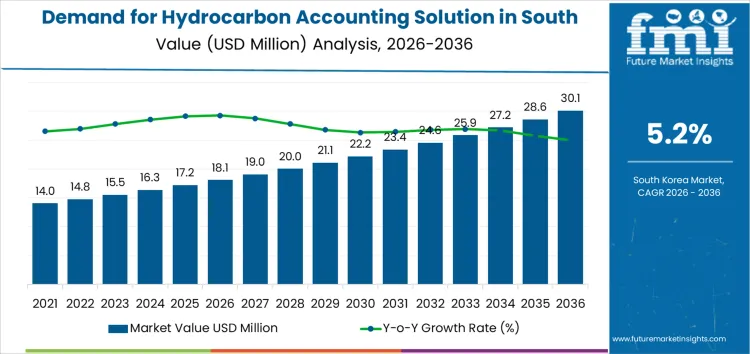
What is the Growth Forecast for the Hydrocarbon Accounting Solution Market in South Korea through 2036?
The hydrocarbon accounting solution market in South Korea is expected to experience steady growth from 2026 to 2036. Starting at USD 18.1 million in 2026, the market is projected to increase to USD 19.0 million in 2027. By 2028, the market will reach USD 20.0 million, followed by USD 21.1 million in 2029. Growth will continue with the market expected to reach USD 22.2 million in 2030 and USD 23.4 million in 2031.
In the following years, the market will see further expansion, reaching USD 24.6 million in 2032 and USD 25.9 million in 2033. By 2034, the market value will rise to USD 27.2 million, and it will continue to grow, reaching USD 28.6 million in 2035. By 2036, the market is projected to reach USD 30.1 million. The acceleration and deceleration pattern indicate a steady increase in demand, with slightly faster growth in the early years followed by a gradual deceleration in the later years. This pattern reflects the market's stabilization as it matures and adoption of solutions becomes more widespread within South Korea's energy industry.
Key Takeaways for Demand for Hydrocarbon Accounting Solution in South Korea
| Metric | Value |
|---|---|
| Industry Sales Value (2026) | USD 18.1 million |
| Industry Forecast Value (2036) | USD 30.1 million |
| Industry Forecast CAGR (2026 to 2036) | 5.2% |
Why is the Demand for Hydrocarbon Accounting Solution Growing in South Korea?
Demand for hydrocarbon accounting solutions in South Korea has increased as energy producers and midstream operators seek improved accuracy and compliance in resource measurement and reporting. South Korea’s refining, petrochemical, and liquefied natural gas sectors require robust systems to capture, allocate, and audit hydrocarbon flows from production to sales. Traditional manual processes and basic spreadsheets have proved insufficient given the complexity of modern supply chains and the volume of transaction data that must be reconciled. Hydrocarbon accounting solutions enable companies to standardise measurement across plants and terminals, reduce discrepancies between physical inventories and financial records, and support internal audit requirements. Regulatory authorities in South Korea require detailed hydrocarbon reporting to enforce environmental standards and ensure tax compliance, strengthening the case for dedicated accounting systems. Procurement teams and operations managers increasingly view hydrocarbon accounting solutions as essential infrastructure for managing product movement visibility, minimizing losses, and defending transfer pricing decisions with transparent audit trails.
Looking ahead, demand for hydrocarbon accounting solutions in South Korea is expected to grow as digital transformation priorities intensify across energy and industrial sectors. Suppliers that deliver modular, scalable solutions with real-time data integration and support for complex allocation rules will be attractive to enterprises managing multiple facilities. Opportunities exist for software providers to partner with system integrators who understand local regulatory frameworks and enterprise resource planning environments common within Korean refineries and terminals. Data interoperability with field measurement devices, tank gauging systems, and enterprise data warehouses will influence adoption decisions as companies seek seamless workflows. Service offerings that include implementation support, training, and ongoing compliance monitoring will differentiate vendors in the market. As energy companies pursue efficiency gains and tighter control over hydrocarbon inventories, the uptake of specialised accounting systems is likely to rise, providing a platform for improved decision support and operational control.
What Are the Key Segments in Demand for Hydrocarbon Accounting Solutions in South Korea?
The demand for hydrocarbon accounting solutions in South Korea is influenced by both solution type and end-user sector. Key solution segments include on-premises solutions, which account for 61% of the market, and cloud-based hydrocarbon accounting solutions. End-user segments encompass oilfield services companies, oil and gas exploration and production (EP) companies, oil and gas midstream companies, oil and gas refineries, and energy trading and risk management (ETRM) firms. As the oil and gas industry continues to evolve, there is growing demand for efficient, accurate accounting solutions to manage complex hydrocarbon transactions and operations.
How Does Solution Type Impact Demand for Hydrocarbon Accounting Solutions in South Korea?
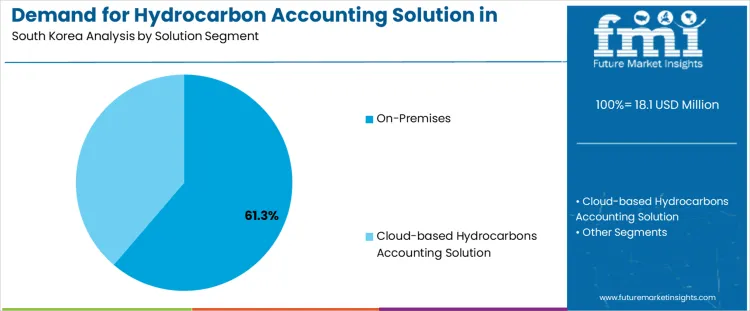
The demand for hydrocarbon accounting solutions in South Korea is largely driven by on-premises solutions, which account for 61% of the market share. On-premises solutions are preferred by many oil and gas companies due to their ability to provide complete control over data security and system customization. These solutions allow for the local installation of software, providing companies with full access to their accounting tools and data. The preference for on-premises solutions is particularly evident in industries where data privacy and regulatory compliance are paramount. These solutions are often integrated with other enterprise resource planning (ERP) systems, enabling seamless management of complex financial operations, supply chain data, and inventory control within oil and gas companies. Cloud-based hydrocarbon accounting solutions, although a smaller segment, are gaining traction due to the flexibility and scalability they offer. With cloud-based solutions, companies can access their data remotely, reduce the need for on-site infrastructure, and scale up resources as business demands grow. The growing adoption of cloud solutions reflects broader industry trends toward digital transformation and the increased need for real-time, accessible data. As South Korea’s oil and gas sector moves towards more advanced, cloud-enabled technologies, cloud-based hydrocarbon accounting solutions are expected to see significant growth, especially in large, multinational companies or firms looking for a more agile, cost-effective approach to managing their accounting operations.
What Is the Demand for Hydrocarbon Accounting Solutions by End-User in South Korea?
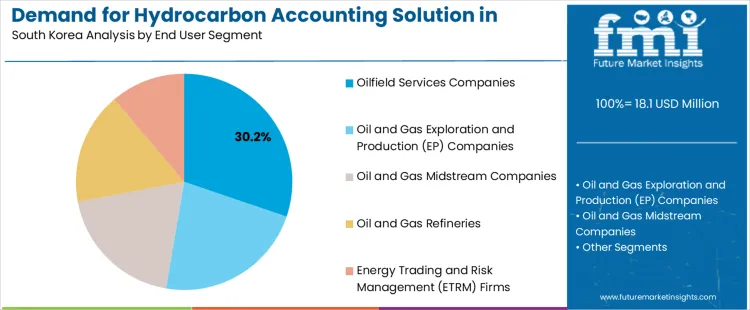
The demand for hydrocarbon accounting solutions in South Korea is primarily driven by oilfield services companies, which make up 30.2% of the market share. These companies require specialized solutions to track and manage the complex financial transactions that occur in oilfield operations, including the extraction, transportation, and distribution of hydrocarbons. Accurate accounting is critical for oilfield services companies to maintain compliance with industry regulations and optimize their operations. Oil and gas exploration and production (EP) companies also contribute significantly to the demand, as they require robust accounting solutions to manage production volumes, track reserves, and account for the financial complexities of drilling and exploration. Midstream oil and gas companies, which handle the transportation and storage of hydrocarbons, also rely on these solutions to track inventory, manage shipments, and reconcile transactions across various supply chain points. Oil refineries need hydrocarbon accounting solutions to manage the transformation of raw crude into refined products, ensuring precise financial reporting and operational efficiency. Finally, energy trading and risk management (ETRM) firms also represent a growing end-user segment, as they need accurate data to manage the financial risks associated with fluctuating energy prices and commodity trading. As the demand for transparency, accuracy, and real-time reporting in hydrocarbon operations increases, companies in all of these sectors are turning to advanced accounting solutions to streamline their operations and ensure compliance with industry standards.
What are the Key Dynamics in the Demand for Hydrocarbon Accounting Solutions in South Korea?
Demand for hydrocarbon accounting solutions in South Korea is shaped by the country’s energy import profile, refining capacity, petrochemical operations, and regulatory emphasis on accurate volumetric tracking. Operators in refinery complexes, petrochemical plants, and gas processing facilities require systems that consolidate data from measurement points, pipelines, storage tanks, and custody transfer stations. Hydrocarbon accounting underpins compliance reporting, loss detection, inventory reconciliation, and financial settlement between trading partners. South Korea’s position as a significant importer of crude oil and exporter of refined products creates complex material balance requirements. Integration with enterprise resource planning (ERP), supervisory control and data acquisition (SCADA), and distributed control systems (DCS) is central to workflow efficiency in upstream and downstream operations.
What are the Drivers of Demand for Hydrocarbon Accounting Solutions in South Korea?
Key drivers include stringent regulatory frameworks that mandate precise measurement and reporting of hydrocarbon flows for taxation, environmental compliance, and trade documentation. Refinery operators prioritize transparency and operational control to optimize processing margins, detect losses, and reconcile inventories in real time. Advancements in sensor technologies, data integration platforms, and digitalization strategies elevate expectations for automated, scalable accounting solutions that replace manual or spreadsheet-based tracking. South Korean energy companies, many of which operate large refinery and petrochemical complexes, seek solutions that support multi-facility consolidation and audit readiness. Global supply chain volatility and price fluctuation pressures also push firms to adopt robust accounting systems that improve forecasting and material planning accuracy.
What are the Restraints on Demand for Hydrocarbon Accounting Solutions in South Korea?
Restraints to wider adoption include capital expenditure considerations, particularly for smaller operators or joint ventures that may delay or phase ERP and MES (Manufacturing Execution System) upgrades. Integration challenges with legacy measurement and control systems require specialized engineering resources, which can extend deployment timelines and raise costs. Procurement decisions often hinge on demonstrating measurable return-on-investment, which demands detailed baseline auditing prior to implementation. Varied measurement standards and data formats across multiple facilities complicate standardized accounting system deployment. Protective attitudes toward proprietary operational data and concerns about cybersecurity influence decision cycles for adopting cloud-based or third-party solutions.
What Key Trends Affect Demand for Hydrocarbon Accounting Solutions in South Korea?
A notable trend is the convergence of hydrocarbon accounting with digital transformation initiatives that involve IoT sensor networks, edge computing, and predictive analytics. Operators want solutions that not only reconcile inventory but also flag anomalies in near real time to prevent losses and support operational decision-making. Integration of accounting platforms with advanced visualization tools and mobile dashboards enhances visibility for executive and field teams. Demand is also increasing for modular, scalable solutions that support phased implementation and lower initial capital outlay. Another emerging trend is the push toward standardized data models and interoperability frameworks that reduce custom engineering and improve system maintainability. Strategic partnerships between local systems integrators and global solution providers are enabling tailored offerings that align with South Korean regulatory and operational contexts.
What is the Regional Demand Outlook for Hydrocarbon Accounting Solutions in South Korea?
The demand for hydrocarbon accounting solutions in South Korea is growing across regions, driven by the country’s expanding energy sector, increasing need for compliance, and technological advancements in the oil and gas industries. South Gyeongsang, with a projected CAGR of 5.5%, shows strong demand, bolstered by its large petrochemical and energy production facilities. North Jeolla, with a growth rate of 4.2%, reflects moderate demand as the region continues to develop its energy sector and infrastructure. South Jeolla, with a projected CAGR of 5%, is seeing steady demand, as the region’s energy industries expand and require more advanced accounting solutions. Jeju, with the highest growth rate of 6.3%, stands out due to its increasing focus on sustainable energy solutions and regulatory compliance. These trends point to significant opportunities for suppliers of hydrocarbon accounting software and solutions to expand their presence across South Korea.
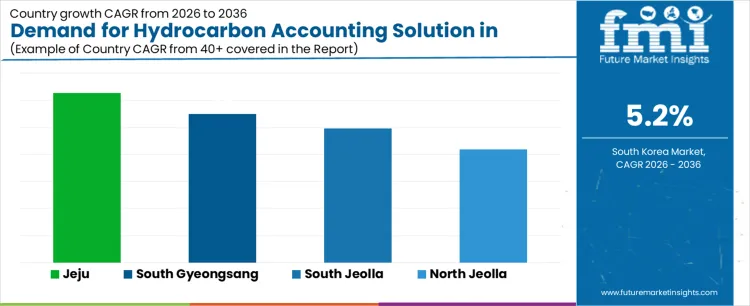
| Region | CAGR (2026 to 2036) |
|---|---|
| South Gyeongsang | 5.5% |
| North Jeolla | 4.2% |
| South Jeolla | 5.0% |
| Jeju | 6.3% |
How Can Suppliers Leverage the Market in South Gyeongsang for Hydrocarbon Accounting Solutions?
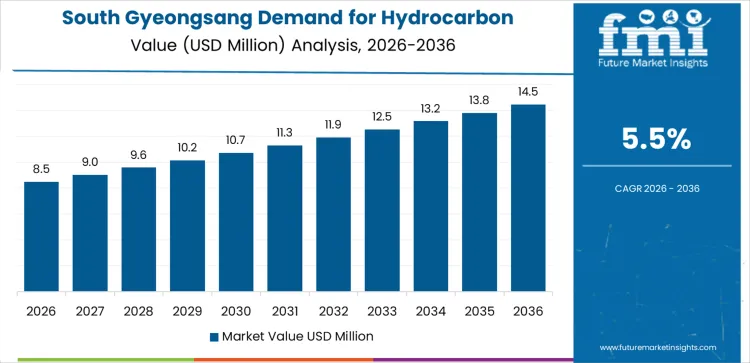
South Gyeongsang, with a projected CAGR of 5.5%, represents a promising market for hydrocarbon accounting solutions. The region is home to large petrochemical and energy production facilities that require robust accounting systems to track hydrocarbon production, distribution, and compliance with industry regulations. Suppliers targeting this market should focus on providing customizable, scalable solutions that meet the complex demands of South Gyeongsang’s energy sector. Partnerships with local energy firms and regulatory bodies could help build credibility and increase adoption. As South Gyeongsang continues to grow its energy and petrochemical industries, the demand for efficient, accurate hydrocarbon accounting systems will likely rise, presenting opportunities for growth in the sector.
What Factors Are Driving Hydrocarbon Accounting Solution Demand in North Jeolla?
North Jeolla, with a CAGR of 4.2%, is experiencing moderate demand for hydrocarbon accounting solutions. The region is still developing its energy infrastructure, but there is a clear trend toward increasing adoption of advanced accounting technologies. As the local energy sector grows, particularly in petrochemicals and renewable energy, the need for accurate, compliant tracking of hydrocarbon operations will continue to rise. Manufacturers of hydrocarbon accounting solutions should target this region by providing tailored solutions that simplify regulatory compliance and optimize resource management. As North Jeolla’s energy industry matures, the demand for hydrocarbon accounting systems is expected to gradually increase, creating opportunities for suppliers to offer essential software and services.
How is the Market for Hydrocarbon Accounting Solutions Growing in South Jeolla?
South Jeolla, with a projected CAGR of 5%, is experiencing steady growth in demand for hydrocarbon accounting solutions. The region’s energy industry, which includes petrochemicals, renewables, and local energy production, requires advanced software solutions for tracking hydrocarbon flow, optimizing production, and ensuring compliance with national regulations. Manufacturers targeting South Jeolla can capitalize on the growing demand by providing reliable and user-friendly solutions designed to meet the region’s energy sector requirements. Additionally, as South Jeolla invests in energy efficiency and sustainable practices, there is potential for increased demand for innovative hydrocarbon accounting systems that integrate with green energy initiatives. The steady growth in this sector offers long-term opportunities for suppliers.
Why is Jeju Leading the Demand for Hydrocarbon Accounting Solutions?
Jeju, with the highest projected CAGR of 6.3%, is seeing rapid growth in the demand for hydrocarbon accounting solutions. The region’s focus on sustainable energy solutions and its growing energy infrastructure are key factors contributing to this trend. As Jeju increases its commitment to renewable energy and energy efficiency, there is a corresponding rise in the need for advanced accounting solutions that track both traditional and renewable hydrocarbon flows. Suppliers can take advantage of this growing market by offering solutions that support regulatory compliance, optimize resource management, and integrate seamlessly with Jeju’s evolving energy ecosystem. As Jeju’s energy sector expands, the demand for sophisticated hydrocarbon accounting systems is expected to grow, creating significant opportunities for companies to provide cutting-edge solutions in this market.
What is the Competitive Landscape for Hydrocarbon Accounting Solution Demand in South Korea?
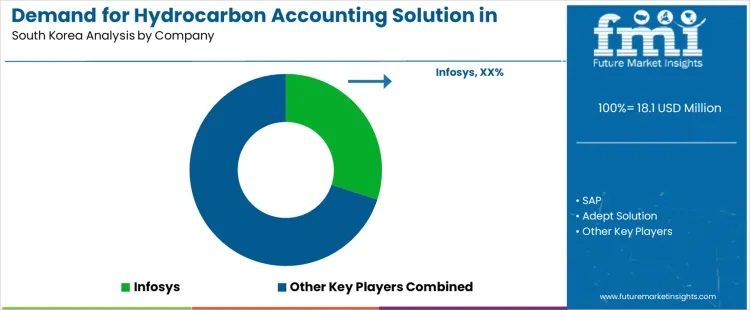
Demand for hydrocarbon accounting solutions in South Korea is driven by requirements in upstream energy, refining, and petrochemical sectors where accurate tracking of production, movement, and financial reporting is essential. South Korean energy companies, joint ventures, and state-affiliated enterprises are procuring systems that ensure transparent inventory records, regulatory compliance, and integration with enterprise resource planning (ERP) platforms. Specifications commonly include multi-location data consolidation, audit trail capabilities, and support for international reporting standards. Buyers frequently evaluate solutions on scalability, data accuracy, and ability to integrate with measurement systems used in field operations, terminals, and trading desks. Procurement criteria also incorporate vendor experience in energy markets, responsiveness of local support, and customisation options required for specific hydrocarbon streams such as crude, LPG, and refined products. Long planning cycles in capital projects and digital transformation initiatives have influenced adoption timing, with proof-of-concept engagements preceding full deployments in key facilities.
Competition among leading suppliers in South Korea’s hydrocarbon accounting solution segment is shaped by product breadth, documented functionality, and implementation support frameworks. Infosys is positioned as a leading provider, with solution brochures that outline accounting modules, data validation features, and integration patterns with common ERP environments. Materials include functional descriptions of volume balancing, loss tracking, and reporting engines used by energy firms. SAP documentation presents enterprise-scale accounting and analytics platforms with specification sheets for master data management, process automation, and compliance reporting that assist procurement teams. Adept Solution literature focuses on specialised accounting systems featuring configurability for local regulatory requirements and interfaces to measurement devices. P2 Energy Solution materials describe hydrocarbon accounting modules with emphasis on upstream production tracking, royalty calculations, and audit readiness, accompanied by technical data on data throughput and security controls. Tieto brochures detail modular solutions with analytics capabilities and cloud deployment options, including performance benchmarks and service level definitions relevant to IT and operations managers. Technical descriptions from these companies typically include system architecture, support matrices, and integration toolsets that help South Korean energy companies, system integrators, and procurement professionals compare offerings against operational and governance requirements.
Key Players of the Demand for Hydrocarbon Accounting Solution in South Korea
- Infosys
- SAP
- Adept Solution
- P2 Energy Solution
- Tieto
Scope of the Report
| Items | Values |
|---|---|
| Quantitative Units (2026) | USD Million |
| Solution Segment | On-Premises, Cloud-based Hydrocarbons Accounting Solution |
| End User Segment | Oilfield Services Companies, Oil and Gas Exploration and Production (EP) Companies, Oil and Gas Midstream Companies, Oil and Gas Refineries, Energy Trading and Risk Management (ETRM) Firms |
| Companies | Infosys, SAP, Adept Solution, P2 Energy Solution, Tieto |
| Region Covered | South Korea |
| Provinces Covered | South Gyeongsang, North Jeolla, South Jeolla, Jeju |
| Additional Attributes | Dollar sales by solution type and end-user segment. Demand is driven by digitalization of hydrocarbon value chains, increasing regulatory reporting needs, and adoption of cloud-based systems for production tracking, allocation, and reconciliation across upstream, midstream, and trading operations. |
Key Segments of Demand for Hydrocarbon Accounting Solution in South Korea
Solution Segment
- On-Premises
- Cloud-based Hydrocarbons Accounting Solution
- Other
End User Segment
- Oilfield Services Companies
- Oil and Gas Exploration and Production (EP) Companies
- Oil and Gas Midstream Companies
- Oil and Gas Refineries
- Energy Trading and Risk Management (ETRM) Firms
- Other
Provinces
- South Gyeongsang
- North Jeolla
- South Jeolla
- Jeju
Bibliography
- International Energy Agency. (2024). Digitalisation, data integrity, and accounting systems in the energy sector. IEA.
- Organisation for Economic Co-operation and Development. (2024). Digital reporting and compliance systems in energy markets. OECD Publishing.
- U.S. Energy Information Administration. (2024). Oil and gas data management and reporting standards. U.S. Department of Energy.
- International Organization for Standardization. (2024). ISO 29001 and ISO 14224: Data quality and asset reporting in oil and gas. ISO.
Frequently Asked Questions
How big is the demand for hydrocarbon accounting solution in south korea in 2026?
The demand for hydrocarbon accounting solution in south korea is estimated to be valued at USD 18.1 million in 2026.
What will be the size of hydrocarbon accounting solution in south korea in 2036?
The market size for the hydrocarbon accounting solution in south korea is projected to reach USD 30.1 million by 2036.
How much will be the demand for hydrocarbon accounting solution in south korea growth between 2026 and 2036?
The demand for hydrocarbon accounting solution in south korea is expected to grow at a 5.2% CAGR between 2026 and 2036.
What are the key product types in the hydrocarbon accounting solution in south korea?
The key product types in hydrocarbon accounting solution in south korea are on-premises and cloud-based hydrocarbons accounting solution.
Which end user segment segment is expected to contribute significant share in the hydrocarbon accounting solution in south korea in 2026?
In terms of end user segment, oilfield services companies segment is expected to command 30.2% share in the hydrocarbon accounting solution in south korea in 2026.
Preview the report firsthand - request a free sample
Get SampleGet the brochure for pricing and purchase details.
Get PDFTable of Content
- Executive Summary
- South Korea Market Outlook
- Demand-side Trends
- Supply-side Trends
- Technology Roadmap Analysis
- Analysis and Recommendations
- Market Overview
- Market Coverage / Taxonomy
- Market Definition / Scope / Limitations
- Market Background
- Market Dynamics
- Drivers
- Restraints
- Opportunity
- Trends
- Scenario Forecast
- Demand in Optimistic Scenario
- Demand in Likely Scenario
- Demand in Conservative Scenario
- Opportunity Map Analysis
- Product Life Cycle Analysis
- Supply Chain Analysis
- Investment Feasibility Matrix
- Value Chain Analysis
- PESTLE and Porter’s Analysis
- Regulatory Landscape
- Regional Parent Market Outlook
- Production and Consumption Statistics
- Import and Export Statistics
- Market Dynamics
- South Korea Market Analysis 2021 to 2025 and Forecast, 2026 to 2036
- Historical Market Size Value (USD Million) Analysis, 2021 to 2025
- Current and Future Market Size Value (USD Million) Projections, 2026 to 2036
- Y-o-Y Growth Trend Analysis
- Absolute $ Opportunity Analysis
- South Korea Market Pricing Analysis 2021 to 2025 and Forecast 2026 to 2036
- South Korea Market Analysis 2021 to 2025 and Forecast 2026 to 2036, By Solution Segment
- Introduction / Key Findings
- Historical Market Size Value (USD Million) Analysis By Solution Segment, 2021 to 2025
- Current and Future Market Size Value (USD Million) Analysis and Forecast By Solution Segment, 2026 to 2036
- On-Premises
- Cloud-based Hydrocarbons Accounting Solution
- On-Premises
- Y-o-Y Growth Trend Analysis By Solution Segment, 2021 to 2025
- Absolute $ Opportunity Analysis By Solution Segment, 2026 to 2036
- South Korea Market Analysis 2021 to 2025 and Forecast 2026 to 2036, By End User Segment
- Introduction / Key Findings
- Historical Market Size Value (USD Million) Analysis By End User Segment, 2021 to 2025
- Current and Future Market Size Value (USD Million) Analysis and Forecast By End User Segment, 2026 to 2036
- Oilfield Services Companies
- Oil and Gas Exploration and Production (EP) Companies
- Oil and Gas Midstream Companies
- Oil and Gas Refineries
- Energy Trading and Risk Management (ETRM) Firms
- Oilfield Services Companies
- Y-o-Y Growth Trend Analysis By End User Segment, 2021 to 2025
- Absolute $ Opportunity Analysis By End User Segment, 2026 to 2036
- Market Structure Analysis
- Competition Dashboard
- Competition Benchmarking
- Market Share Analysis of Top Players
- By Regional
- By Solution Segment
- By End User Segment
- Competition Analysis
- Competition Deep Dive
- Infosys
- Overview
- Product Portfolio
- Profitability by Market Segments (Product/Age /Sales Channel/Region)
- Sales Footprint
- Strategy Overview
- Marketing Strategy
- Product Strategy
- Channel Strategy
- SAP
- Adept Solution
- P2 Energy Solution
- Tieto
- Infosys
- Competition Deep Dive
- Assumptions & Acronyms Used
- Research Methodology


