

- Industry Size (2026)
- USD 5.7 Mn
- Forecast (2036)
- USD 10.2 Mn
- CAGR
- 5.9%2026 to 2036)
Demand for 3D Imaging Surgical Solution in South Korea Forecast and Outlook 2026 to 2036
The demand for 3D Imaging Surgical Solutions in South Korea is projected at USD 5.7 million in 2026 and is expected to grow to USD 10.2 million by 2036, expanding at a 5.9% CAGR. These figures signal a growing acceptance of advanced surgical technologies, with healthcare institutions increasingly prioritizing innovation to improve precision in procedures. Rising demand indicates that purchasing behavior is shifting toward long-term investments in technology that offer tangible clinical and operational benefits. This steady growth reflects supplier confidence, particularly as more hospitals and medical centers integrate 3D imaging into their standard equipment. However, the sustained investment needed to scale production and adoption suggests that suppliers will need to demonstrate clear value propositions to secure long-term commitments from buyers. These signals also point to a market poised for incremental, rather than rapid, growth as healthcare providers weigh cost versus the incremental benefits of adopting high-tech solutions.
Quick Stats for the Demand for 3D Imaging Surgical Solution in South Korea
- 3D Imaging Surgical Solution in South Korea Value (2026): USD 5.7 million
- 3D Imaging Surgical Solution in South Korea Forecast Value (2036): USD 10.2 million
- 3D Imaging Surgical Solution in South Korea Forecast CAGR (2026 to 2036): 5.9%
- 3D Imaging Surgical Solution in South Korea Leading Segment: Hospitals (53.0%)
- Key Growth Regions of 3D Imaging Surgical Solution in South Korea: Jeju (leading CAGR ~7.1%)
- Top Players of 3D Imaging Surgical Solution in South Korea: GE Healthcare, Philips Healthcare, Panasonic, Lockheed Martin, Able Software
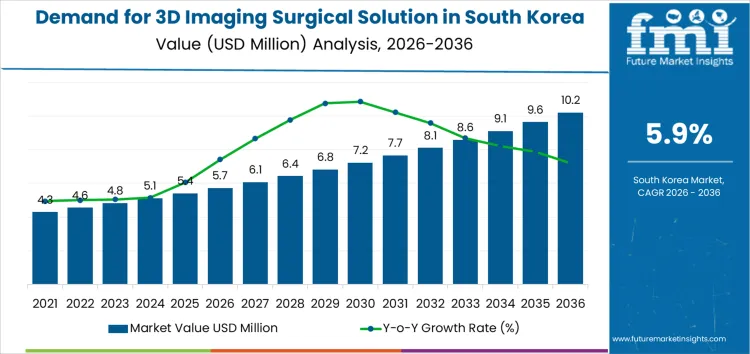
What is the Growth Forecast for the Demand for 3D Imaging Surgical Solutions in South Korea through 2036?
The growth trajectory for the demand for 3D imaging surgical solutions in South Korea is characterized by steady progress, with the market moving from USD 5.7 million in 2026 to USD 10.2 million by 2036. The breakpoint analysis reveals that the growth pattern is relatively smooth, with incremental increases in demand as healthcare institutions gradually adopt advanced surgical tools. These systems are gaining traction in both public and private healthcare settings, fueled by the increasing emphasis on precision medicine and the benefits offered by 3D imaging in complex procedures.
The analysis indicates that there are no major shifts or disruptions in demand over the forecast period, as the adoption of 3D imaging solutions follows a natural progression driven by technological advancements and rising healthcare needs. While demand accelerates slightly after certain technological breakthroughs, the overall growth remains consistent. By 2036, the demand for these systems will reach USD 10.2 million, underscoring the expanding role of 3D imaging in South Korea’s healthcare landscape and its crucial role in improving surgical practices.
Key Takeaways for Demand for 3D Imaging Surgical Solution in South Korea
| Metric | Value |
|---|---|
| Industry Sales Value (2026) | USD 5.7 million |
| Industry Forecast Value (2036) | USD 10.2 million |
| Industry Forecast CAGR (2026 to 2036) | 5.9% |
Why is the Demand for 3D Imaging Surgical Solutions Growing in South Korea?
Demand for 3D imaging surgical solutions in South Korea reflects evolving clinical practices where precision and visibility are critical. Surgeons across specialties such as orthopedics, neurosurgery, and otolaryngology are increasingly adopting systems that provide enhanced depth perception and spatial clarity compared with conventional 2D imaging. These solutions combine stereoscopic visualization, high resolution displays, and advanced optics to give surgical teams a more accurate view of anatomy during complex procedures. Hospitals and surgical centers, particularly in urban hubs like Seoul and Busan, invest in these technologies to support minimally invasive procedures, reduce operative time, and improve intraoperative decision making. Clinical procurement professionals assess system performance based on imaging quality, ergonomic design, integration with existing operating room infrastructure, and training support for surgical staff. These considerations drive interest in platforms that offer consistent, high fidelity imaging that aligns with procedural requirements and clinician preferences.
Looking forward, several factors are expected to support continued growth in demand for 3D imaging surgical solutions in South Korea. The aging population increases the volume of surgeries for conditions such as joint degeneration and spinal disorders, where enhanced visualization can improve outcomes. Government policies and hospital accreditation standards emphasize patient safety and procedural effectiveness, which encourages adoption of technologies that reduce complication rates. Integration with other advanced systems, including navigation tools and robotic assistance platforms, further elevates the value of 3D imaging as part of comprehensive surgical suites. Training programs and clinical education increasingly incorporate 3D visualization technologies, familiarizing new generations of surgeons with their use and reinforcing long term uptake. In addition, domestic medical device manufacturers and technology partners in South Korea are innovating to tailor solutions to local clinical workflows, potentially enhancing cost competitiveness and usability. These developments collectively contribute to sustained interest in 3D imaging surgical solutions across health systems and specialty care centers throughout the country.
What Shapes the Demand for 3D Imaging Surgical Solutions in South Korea?
The demand for 3D imaging surgical solutions in South Korea is driven by two main factors: the type of imaging solution and the end-user sector. 3D rendering holds the largest share at 45.3%, while hospitals lead the end-user segment with a 53.0% share. These segments play a critical role in advancing the integration of 3D imaging technologies in surgical procedures, as healthcare providers seek enhanced precision and visualization for complex surgeries. The growing adoption of 3D imaging in hospitals and specialty clinics reflects advancements in surgical planning and patient-specific treatment approaches.
Why Does 3D Rendering Dominate Imaging Solutions in South Korea?
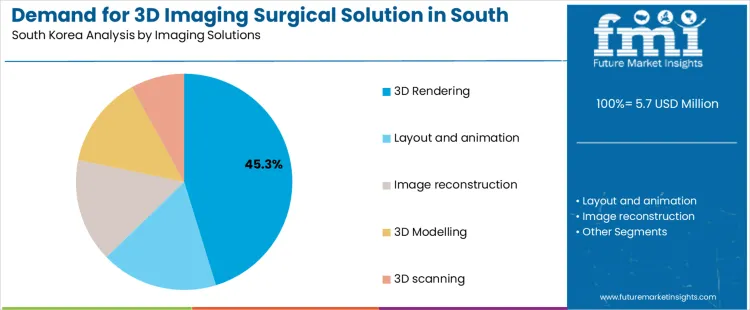
3D rendering holds a 45.3% share of the 3D imaging surgical solutions market in South Korea due to its ability to provide detailed, accurate visual representations of patient anatomy. Surgeons and medical professionals rely on 3D rendering for pre-operative planning, intra-operative navigation, and post-operative analysis, offering superior clarity compared to traditional 2D imaging methods. This technology allows for better visualization of complex structures, which is essential for procedures such as orthopedic surgery, tumor resection, and neurosurgery. As healthcare institutions in South Korea continue to adopt advanced technologies, the demand for 3D rendering grows because it facilitates more accurate and minimally invasive surgeries.
3D rendering enhances the educational aspect of medical procedures, helping medical teams better understand patient-specific conditions and improving the overall quality of care. With hospitals investing in high-tech surgical solutions to improve outcomes and efficiency, the widespread use of 3D rendering is expected to continue expanding, reinforcing its central role in surgical practices across the country.
Why Do Hospitals Lead the End-User Demand for 3D Imaging Solutions?
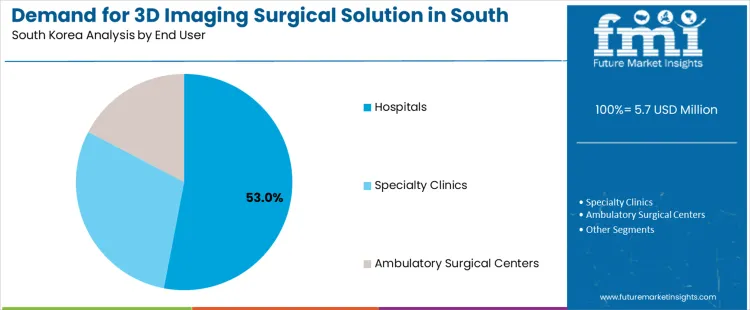
Hospitals represent the largest end-user segment for 3D imaging surgical solutions in South Korea, accounting for 53.0% of the market. Hospitals are at the forefront of adopting advanced imaging technologies due to their high patient volumes, the need for precision in a variety of surgical specialties, and their investment in cutting-edge equipment to enhance patient care. The integration of 3D imaging solutions in hospitals allows for improved surgical planning, better patient outcomes, and more efficient workflows.
The ability to create detailed 3D models and renderings aids in the preparation for complex surgeries, allowing surgeons to visualize critical anatomical structures in greater detail. Additionally, hospitals benefit from the ability to use these technologies across multiple specialties, from orthopedics to oncology, making 3D imaging a versatile tool in clinical practice. As South Korea’s healthcare system continues to prioritize patient-centered care and cutting-edge medical technologies, the demand for 3D imaging solutions in hospitals is likely to remain strong, with significant investments in both equipment and training.
What Is the Current Demand for 3D Imaging Surgical Solution in South Korea?
Demand for 3D imaging surgical solution in South Korea is rising as healthcare providers seek advanced visualization systems that improve precision during complex procedures. Hospitals and specialty surgical centers increasingly use 3D imaging modalities to support navigation in neurosurgery, cardiology, and orthopedics, aligning with broader uptake of surgical imaging technology in the country’s medical infrastructure. Procurement reflects the expanded use of minimally invasive surgery and the need for enhanced depth perception and spatial awareness in operative environments, which conventional 2D imaging cannot fully deliver. The local demand is part of wider regional growth in advanced surgical visualization technologies in Asia.
What Factors Are Driving Demand for 3D Imaging Surgical Solution in South Korea?
Several drivers underpin demand for 3D imaging surgical solution in South Korea. Increasing volumes of minimally invasive surgical procedures encourage adoption of systems that offer real time, high fidelity visualization, enabling surgeons to navigate intricate anatomical structures more effectively. Hospitals prioritizing clinical outcome improvements and reduced operative risks allocate capital to 3D capable imaging platforms integrated into operating theaters. The expansion of precision surgery and the integration of imaging with robotic and navigational tools amplify the need for 3D imaging. South Korea’s investment in healthcare infrastructure and technology innovation also supports procurement of advanced surgical imaging solutions, particularly in tertiary care settings and academic medical centers.
What Are the Constraints on Demand for 3D Imaging Surgical Solution in South Korea?
Despite growth drivers, several constraints affect demand for 3D imaging surgical solution. The high cost of advanced imaging systems and associated maintenance limits adoption in smaller hospitals or clinics with constrained budgets. Integration complexity with existing surgical equipment and the need for staff training can slow deployment, especially where established workflows rely on traditional imaging. Regulatory requirements for medical device certification and stringent safety standards extend procurement timelines, influencing investment decisions and delaying integration. In addition, competition from less expensive 2D imaging solutions and alternative technologies such as intraoperative ultrasound may temper demand in certain clinical settings.
What Trends Are Emerging in South Korea’s 3D Imaging Surgical Solution Sector?
Several trends are shaping the 3D imaging surgical solution landscape in South Korea. There is a notable shift toward integration with surgical robotics and navigation systems, where 3D visualization complements automation and precision tools to support complex operations. Systems that offer real time 3D rendering and augmented visualization are gaining interest as they can enhance anatomical clarity and decision support during procedures. Adoption of portable and flexible imaging platforms that fit diverse operating environments is increasing, driven by needs for versatile surgical suites. Demand is also influenced by digital health strategies and hospital modernization programs that prioritize interoperability, data analytics, and advanced imaging capabilities to support broader clinical services.
What is the Regional Outlook for the Demand for 3D Imaging Surgical Solutions in South Korea?
The demand for 3D imaging surgical solutions in South Korea is primarily driven by advancements in medical technology, healthcare infrastructure development, and the increasing need for precision in surgical procedures. Regions with strong healthcare facilities and medical technology adoption show higher growth. Jeju, South Gyeongsang, and South Jeolla exhibit strong demand, with Jeju seeing the highest projected growth, driven by the expansion of healthcare services and modern medical infrastructure. South Gyeongsang and South Jeolla follow with moderate but consistent demand, fueled by the increasing integration of 3D imaging technologies into surgical practices. North Jeolla is projected to see steady demand, benefiting from healthcare initiatives and growing adoption in regional hospitals and medical centers.
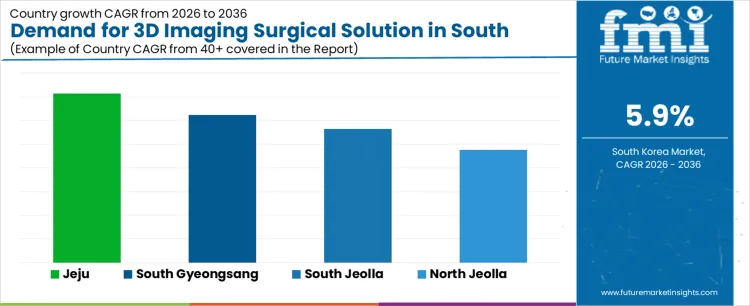
| Province | CAGR (2026–2036) |
|---|---|
| South Gyeongsang | 6.2% |
| North Jeolla | 4.8% |
| South Jeolla | 5.6% |
| Jeju | 7.1% |
What drives the demand for 3D Imaging Surgical Solutions in South Gyeongsang?
South Gyeongsang is projected to see a CAGR of 6.2% in the demand for 3D imaging surgical solutions from 2026 to 2036. The province has a strong healthcare sector with several prominent medical institutions and hospitals that are increasingly adopting advanced imaging technologies to enhance surgical precision and patient outcomes. The region’s commitment to medical innovation and the growing adoption of minimally invasive surgeries are key factors boosting the demand for 3D imaging solutions. As South Gyeongsang continues to invest in state-of-the-art medical equipment and expand its healthcare infrastructure, the need for high-quality imaging solutions to support complex surgeries will increase. Additionally, the province’s focus on improving healthcare services in both urban and rural areas, along with the rising number of patients requiring specialized surgical procedures, further accelerates the demand for 3D imaging technologies.
What influences the growth of 3D Imaging Surgical Solutions demand in North Jeolla?
North Jeolla is expected to experience a steady CAGR of 4.8% in the demand for 3D imaging surgical solutions from 2026 to 2036. While not as large as other regions, North Jeolla’s healthcare sector is growing, with increasing investments in medical facilities and technologies. The region is seeing a rise in the number of hospitals and medical centers adopting 3D imaging systems to improve surgical outcomes, particularly in specialized fields like orthopedics, neurosurgery, and cardiology. As healthcare professionals in North Jeolla integrate more advanced diagnostic and surgical tools into their practices, demand for 3D imaging technology is expected to rise. Government initiatives to enhance regional healthcare quality and reduce healthcare disparities also contribute to the steady adoption of high-end medical equipment like 3D imaging systems in North Jeolla.
What drives the demand for 3D Imaging Surgical Solutions in South Jeolla?
South Jeolla is projected to grow at a CAGR of 5.6% in the demand for 3D imaging surgical solutions from 2026 to 2036. The region’s healthcare infrastructure is expanding rapidly, with a focus on upgrading medical facilities and incorporating the latest technologies to improve patient care. The demand for 3D imaging solutions is being driven by the rising number of specialized surgeries, such as complex orthopedic, cardiac, and cancer surgeries, where 3D imaging is essential for accurate diagnosis and precise surgical planning. Additionally, the growing awareness of the benefits of advanced imaging techniques among medical professionals in South Jeolla supports the adoption of these systems. As the province continues to improve its healthcare services and adopt cutting-edge medical technologies, 3D imaging surgical solutions will play a critical role in advancing surgical precision and reducing complications.
Why is Jeju projected to have the highest demand growth for 3D Imaging Surgical Solutions?
Jeju is projected to see the highest CAGR of 7.1% in the demand for 3D imaging surgical solutions from 2026 to 2036. The island’s healthcare infrastructure is expanding as the region increasingly attracts medical tourists and invests in modern medical technologies. With a growing focus on high-quality healthcare services and specialized surgeries for both residents and tourists, Jeju is embracing advanced surgical tools, including 3D imaging systems, to improve surgical precision and patient outcomes. The rising popularity of medical tourism, coupled with Jeju’s status as a medical hub for international patients seeking advanced treatments, significantly boosts the demand for 3D imaging technologies. Additionally, Jeju’s emphasis on sustainable and high-quality healthcare practices aligns with the adoption of 3D imaging solutions, which enhance both the accuracy and efficiency of surgical procedures. As the region continues to develop its medical infrastructure and attract more specialized surgeries, demand for 3D imaging systems is expected to grow substantially.
How are Competitors Differentiating in the 3D Imaging Surgical Solution Market in South Korea?
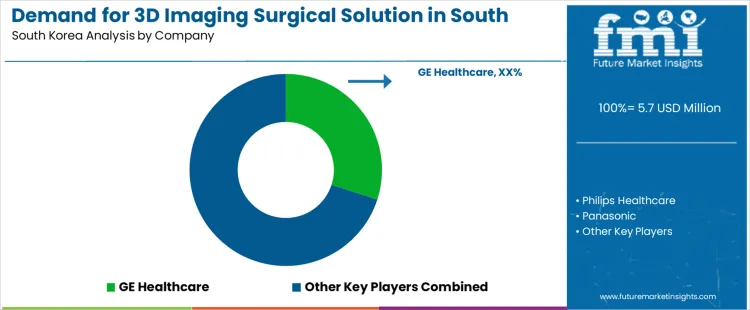
The demand for 3D imaging surgical solutions in South Korea is growing rapidly, driven by advancements in minimally invasive surgery and the increasing need for precise, real-time imaging during surgical procedures. GE Healthcare, the leading player, differentiates through its advanced imaging systems that offer high-resolution 3D visualization, aiding surgeons in making accurate decisions. Their solutions focus on integrated technologies that improve workflow efficiency and patient outcomes in the operating room. Philips Healthcare competes with its innovative 3D imaging systems that emphasize user-friendly interfaces, enhanced clarity, and flexibility for a wide range of surgical specialties, from orthopedics to neurosurgery. Panasonic focuses on providing compact, high-performance 3D imaging solutions that integrate seamlessly with existing hospital infrastructures, emphasizing portability and ease of use in busy surgical environments.
Other players like Lockheed Martin and Able Software cater to specialized niches within the surgical imaging market. Lockheed Martin applies its aerospace technology expertise to create highly advanced imaging solutions with a focus on precision and real-time data processing for complex surgical procedures. Able Software differentiates by offering 3D imaging solutions with customizable software features designed to meet the specific needs of surgeons, allowing for deeper patient insights and better pre-operative planning. Across these competitors, product brochures remain essential for showcasing system features such as resolution quality, integration with surgical tools, and compatibility with hospital IT systems. These brochures assist South Korean healthcare providers in evaluating the best fit for their specific surgical needs, ensuring the adoption of the most efficient, accurate, and reliable imaging technologies.
Key Players of the Demand for 3D Imaging Surgical Solution in South Korea
- GE Healthcare
- Philips Healthcare
- Panasonic
- Lockheed Martin
- Able Software
Scope of the Report
| Items | Values |
|---|---|
| Quantitative Units (2026) | USD Million |
| Technology Type | Stereoscopy, Auto-stereoscopy, Volumetric display, Holography, Anaglyphy |
| Imaging Solutions | 3D Rendering, Layout and animation, Image reconstruction, 3D Modelling, 3D scanning |
| End User | Hospitals, Specialty Clinics, Ambulatory Surgical Centers |
| Companies | GE Healthcare, Philips Healthcare, Panasonic, Lockheed Martin, Able Software |
| Region Covered | South Korea |
| Provinces Covered | South Gyeongsang, North Jeolla, South Jeolla, Jeju |
| Additional Attributes | Dollar sales by technology type, imaging solutions, and end user. The demand for 3D imaging solutions in surgical environments is fueled by advancements in precision medicine, improving surgical outcomes and reducing risks. Technologies like holography and volumetric displays are becoming increasingly important in complex surgeries, while hospitals remain the leading end users. |
Demand for 3D Imaging Surgical Solution in South Korea
Technology Type:
- Stereoscopy
- Auto-stereoscopy
- Volumetric Display
- Holography
- Anaglyphy
- Other
Imaging Solutions:
- 3D Rendering
- Layout and Animation
- Image Reconstruction
- 3D Modelling
- 3D Scanning
- Other
End User:
- Hospitals
- Specialty Clinics
- Ambulatory Surgical Centers
- Other
Provinces:
- South Gyeongsang
- North Jeolla
- South Jeolla
- Jeju
Bibliography
- World Health Organization (WHO). (2023). Global strategies for precision surgery: Adoption of advanced imaging systems. World Health Organization.
- South Korea Ministry of Health and Welfare (MOHW). (2023). The integration of advanced imaging technologies in South Korea's healthcare system. Ministry of Health and Welfare, Republic of Korea.
- Korea Institute for Healthcare Technology Assessment (KIHTA). (2023). Evaluating the role of 3D imaging in enhancing surgical outcomes in South Korea. Korea Institute for Healthcare Technology Assessment.
- National Institutes of Health (NIH). (2023). Advancements in imaging technologies and their clinical applications. National Institutes of Health.
- National Institutes of Health (NIH). (2023). Advancements in imaging technologies and their clinical applications. National Institutes of Health.
Frequently Asked Questions
How big is the demand for 3d imaging surgical solution in south korea in 2026?
The demand for 3d imaging surgical solution in south korea is estimated to be valued at USD 5.7 million in 2026.
What will be the size of 3d imaging surgical solution in south korea in 2036?
The market size for the 3d imaging surgical solution in south korea is projected to reach USD 10.2 million by 2036.
How much will be the demand for 3d imaging surgical solution in south korea growth between 2026 and 2036?
The demand for 3d imaging surgical solution in south korea is expected to grow at a 5.9% CAGR between 2026 and 2036.
What are the key product types in the 3d imaging surgical solution in south korea?
The key product types in 3d imaging surgical solution in south korea are stereoscopy, auto-stereoscopy, volumetric display, holography and anaglyphy.
Which imaging solutions segment is expected to contribute significant share in the 3d imaging surgical solution in south korea in 2026?
In terms of imaging solutions, 3d rendering segment is expected to command 45.3% share in the 3d imaging surgical solution in south korea in 2026.
Preview the report firsthand - request a free sample
Get SampleGet the brochure for pricing and purchase details.
Get PDFTable of Content
- Executive Summary
- South Korea Market Outlook
- Demand-side Trends
- Supply-side Trends
- Technology Roadmap Analysis
- Analysis and Recommendations
- Market Overview
- Market Coverage / Taxonomy
- Market Definition / Scope / Limitations
- Market Background
- Market Dynamics
- Drivers
- Restraints
- Opportunity
- Trends
- Scenario Forecast
- Demand in Optimistic Scenario
- Demand in Likely Scenario
- Demand in Conservative Scenario
- Opportunity Map Analysis
- Product Life Cycle Analysis
- Supply Chain Analysis
- Investment Feasibility Matrix
- Value Chain Analysis
- PESTLE and Porter’s Analysis
- Regulatory Landscape
- Regional Parent Market Outlook
- Production and Consumption Statistics
- Import and Export Statistics
- Market Dynamics
- South Korea Market Analysis 2021 to 2025 and Forecast, 2026 to 2036
- Historical Market Size Value (USD Million) Analysis, 2021 to 2025
- Current and Future Market Size Value (USD Million) Projections, 2026 to 2036
- Y-o-Y Growth Trend Analysis
- Absolute $ Opportunity Analysis
- South Korea Market Pricing Analysis 2021 to 2025 and Forecast 2026 to 2036
- South Korea Market Analysis 2021 to 2025 and Forecast 2026 to 2036, By Technology Type
- Introduction / Key Findings
- Historical Market Size Value (USD Million) Analysis By Technology Type , 2021 to 2025
- Current and Future Market Size Value (USD Million) Analysis and Forecast By Technology Type , 2026 to 2036
- Stereoscopy
- Auto-stereoscopy
- Volumetric display
- Holography
- Anaglyphy
- Stereoscopy
- Y-o-Y Growth Trend Analysis By Technology Type , 2021 to 2025
- Absolute $ Opportunity Analysis By Technology Type , 2026 to 2036
- South Korea Market Analysis 2021 to 2025 and Forecast 2026 to 2036, By Imaging Solutions
- Introduction / Key Findings
- Historical Market Size Value (USD Million) Analysis By Imaging Solutions, 2021 to 2025
- Current and Future Market Size Value (USD Million) Analysis and Forecast By Imaging Solutions, 2026 to 2036
- 3D Rendering
- Layout and animation
- Image reconstruction
- 3D Modelling
- 3D scanning
- 3D Rendering
- Y-o-Y Growth Trend Analysis By Imaging Solutions, 2021 to 2025
- Absolute $ Opportunity Analysis By Imaging Solutions, 2026 to 2036
- South Korea Market Analysis 2021 to 2025 and Forecast 2026 to 2036, By End User
- Introduction / Key Findings
- Historical Market Size Value (USD Million) Analysis By End User, 2021 to 2025
- Current and Future Market Size Value (USD Million) Analysis and Forecast By End User, 2026 to 2036
- Hospitals
- Specialty Clinics
- Ambulatory Surgical Centers
- Hospitals
- Y-o-Y Growth Trend Analysis By End User, 2021 to 2025
- Absolute $ Opportunity Analysis By End User, 2026 to 2036
- Market Structure Analysis
- Competition Dashboard
- Competition Benchmarking
- Market Share Analysis of Top Players
- By Regional
- By Technology Type
- By Imaging Solutions
- By End User
- Competition Analysis
- Competition Deep Dive
- GE Healthcare
- Overview
- Product Portfolio
- Profitability by Market Segments (Product/Age /Sales Channel/Region)
- Sales Footprint
- Strategy Overview
- Marketing Strategy
- Product Strategy
- Channel Strategy
- Philips Healthcare
- Panasonic
- Lockheed Martin
- Able Software
- GE Healthcare
- Competition Deep Dive
- Assumptions & Acronyms Used
- Research Methodology


