

- Industry Size (2025)
- USD 578.7 Mn
- Forecast (2035)
- USD 988.4 Mn
- CAGR (2025 to 2035)
- 5.5%
Hydrocarbon Accounting Solution Market Size, Market Forecast and Outlook By FMI
The hydrocarbon accounting solution market is expected to expand from USD 578.7 million in 2025 to USD 988.4 million by 2035. The market is anticipated to register a 5.5% CAGR during the forecast period. On-premises solutions are likely to lead with a 65.0% share, and oilfield services companies are projected to account for 35.0% of end user demand in 2025.
Summary of the Hydrocarbon Accounting Solution Market
- Demand and Growth Drivers
- Rising production complexity is expected to increase the need for reliable allocation and reconciliation systems across upstream assets.
- Joint venture operations are likely to raise demand for accounting platforms able to manage ownership calculations and partner settlements.
- Regulatory reporting needs are anticipated to increase investment in audit-ready production accounting and revenue tracking systems.
- Product and Segment View
- On-premises solutions are expected to lead the solution segment as operators prefer stronger control over sensitive production data.
- Cloud-based platforms are likely to gain adoption among smaller operators seeking faster deployment and lower upfront software spending.
- Oilfield services companies are anticipated to lead end user demand as multi-client production tracking needs become more demanding.
- Geography and Competitive Outlook
- China is expected to lead country-level expansion as state-owned energy companies invest in production accounting modernization.
- India is likely to record strong adoption as exploration programs and oilfield digitalization expand across domestic production assets.
- Vendors with strong ERP integration and energy accounting expertise are anticipated to strengthen their role across large operator accounts.
- Analyst Opinion
- Sudip saha, Co-founder at Future Market Insights, suggests, “The hydrocarbon accounting solution market is likely to gain from operators needing stronger production visibility and audit control. Vendors able to combine accounting accuracy with ERP integration and cloud migration services are expected to see better acceptance across oil and gas enterprises.”
- Hydrocarbon Accounting Solution Market Value Analysis
- The hydrocarbon accounting solution market is shifting from spreadsheet-led workflows toward integrated systems for production reconciliation.
- Demand is expected to rise as operators look for better control over production allocation and revenue assurance.
- Adoption is likely to improve as regulatory pressure increases the need for traceable audit records and reporting accuracy.
- Spending is anticipated to be guided by on-premises security needs and selective cloud migration across operator networks.
- Hydrocarbon Accounting Solution Market Analysis
- The market is expected to gain steady momentum as oil and gas operators replace manual accounting with integrated production systems.
- On-premises deployment is anticipated to keep a strong position as large operators prioritize data control and system customization.
- Cloud platforms are likely to see rising acceptance among firms seeking lower setup cost and easier multi-location access.
- Oilfield services companies are expected to lead end user demand as billing accuracy and field-level reporting requirements increase.
- China is anticipated to expand faster as energy security programs encourage investment in digital production management systems.
- Competitive intensity is likely to increase around AI analytics and compliance automation across hydrocarbon accounting platforms.
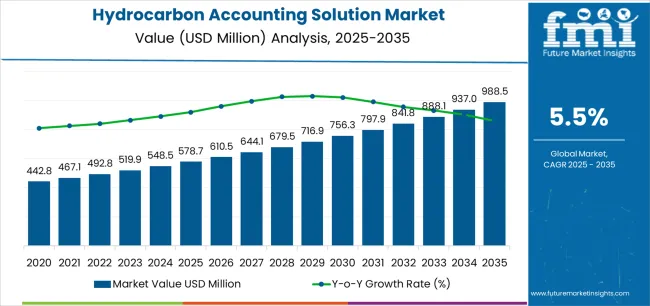
Key Takeaways, Market Size, and Forecast
| Metric | Value |
|---|---|
| Market Size (2025) | USD 578.7 Million |
| Market Size (2035) | USD 988.4 Million |
| CAGR (2025–2035) | 5.5% |
| Leading Solution (2025) | On-Premises Solutions |
| On-Premises Solutions Share (2025) | 65.0% |
| Leading End User (2025) | Oilfield Services Companies |
| Oilfield Services Companies Share (2025) | 35.0% |
| Fastest-Growing Country | China |
| China CAGR | 7.4% |
Where revenue comes from - now vs next (industry-level view)
| Period | Primary Revenue Buckets | Share | Notes |
|---|---|---|---|
| Today | Software licenses (on-premises installations) | 48% | Capex-driven, enterprise deployments |
| Implementation & integration services | 26% | System customization, data migration | |
| Maintenance & support contracts | 18% | Annual renewals, software updates | |
| Cloud subscription services | 8% | SaaS models, monthly/annual fees | |
| Future (3-5 yrs) | Cloud-based SaaS subscriptions | 40-45% | Consumption-based pricing, scalability |
| AI & analytics modules | 20-25% | Predictive insights, optimization algorithms | |
| Managed services & consulting | 15-20% | Ongoing optimization, process improvement | |
| Legacy system maintenance | 12-16% | On-premises support, gradual migration | |
| API & integration services | 8-12% | Third-party connectivity, IoT integration | |
| Regulatory compliance modules | 5-8% | Reporting automation, audit trails |
Hydrocarbon Accounting Solution Market Key Takeaways
| Metric | Value |
|---|---|
| Market Value (2025) | USD 578.7 million |
| Market Forecast (2035) | USD 988.4 million |
| Growth Rate | 5.5% CAGR |
| Leading Technology | On-Premises Solutions |
| Primary Application | Oilfield Services Companies |
The market demonstrates strong fundamentals with on-premises solutions capturing a dominant share through proven reliability capabilities and data security optimization. Oilfield services companies drive primary demand, supported by increasing production complexity and accounting accuracy requirements. Geographic expansion remains concentrated in developed markets with established oil and gas infrastructure, while emerging economies show accelerating adoption rates driven by production digitalization initiatives and rising operational efficiency standards.
Imperatives for Stakeholders in Hydrocarbon Accounting Solution Market
Design for integration, not just functionality
- Offer complete solutions: accounting software + data migration + user training + ongoing support + regulatory compliance updates.
- Preconfigured workflows: production allocation, revenue distribution, joint venture accounting, and regulatory reporting automation for operational optimization.
Cloud-first architecture
- Multi-tenant capabilities, elastic scalability, API-first design, and edge computing integration (field data collection, real-time reconciliation, mobile access).
Data accuracy assurance
- Automated validation rules, anomaly detection algorithms, audit trail generation, and blockchain integration for immutable transaction records and transparency.
Value-based pricing models
- Clear software licensing + transparent service tiers (basic support, managed services, premium analytics); subscriptions for cloud platforms with usage-based pricing and feature modules.
Segmental Analysis
Primary Classification: The market segments by solution type into on-premises and cloud-based hydrocarbon accounting solutions, representing the evolution from traditional installed software to modern cloud-native platforms for comprehensive production accounting optimization.
Secondary Classification: End-user segmentation divides the market into oilfield services companies, oil and gas exploration and production (EP) companies, oil and gas midstream companies, oil and gas refineries, and energy trading and risk management (ETRM) firms, reflecting distinct requirements for accounting complexity, transaction volumes, and integration standards.
Tertiary Classification: Regional distribution covers North America, Latin America, Western Europe, Eastern Europe, East Asia, South Asia Pacific, and Middle East & Africa, with developed markets leading adoption while emerging economies show accelerating growth patterns driven by oil and gas digitalization programs.
The segmentation structure reveals technology progression from legacy on-premises systems toward modern cloud platforms with enhanced scalability and real-time capabilities, while application diversity spans from upstream exploration to downstream trading operations requiring specialized accounting solutions.
By Solution Segment, the On-Premises Segment Accounts for Dominant Market Share
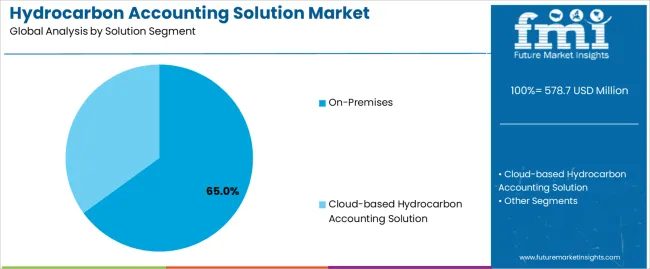
Market Position: On-Premises solutions command the leading position in the hydrocarbon accounting solution market with 65% market share through proven reliability features, including data sovereignty control, customization capability, and security assurance that enable energy companies to achieve optimal production accounting across diverse oil and gas operational environments.
Value Drivers: The segment benefits from enterprise preference for controlled deployment systems that provide data security, regulatory compliance, and operational independence without requiring internet connectivity dependencies. Advanced software features enable comprehensive production allocation, joint interest billing, and integration with existing ERP systems, where data control and customization represent critical operational requirements.
Competitive Advantages: On-Premises solutions differentiate through proven data security, extensive customization options, and integration with legacy operational systems that enhance accounting accuracy while maintaining optimal control standards suitable for diverse upstream and midstream applications.
Key market characteristics:
- Advanced accounting architectures with optimized production allocation and revenue distribution capabilities
- Enhanced data control effectiveness, enabling complete ownership of sensitive production and financial data with security protocols
- Enterprise system compatibility, including ERP integration, SCADA connectivity, and legacy system interfaces for accounting operations
Cloud-Based Solutions Show Digital Transformation Growth
Cloud-Based hydrocarbon accounting solutions maintain a 35% market position in the hydrocarbon accounting solution market due to their scalability properties and operational flexibility advantages. These systems appeal to companies requiring rapid deployment with lower upfront investment for modernization applications. Market growth is driven by digital transformation initiatives, emphasizing accessible accounting platforms and real-time collaboration through cloud-native architectures.
By End User Segment, the Oilfield Services Companies Segment Shows Fastest Growth
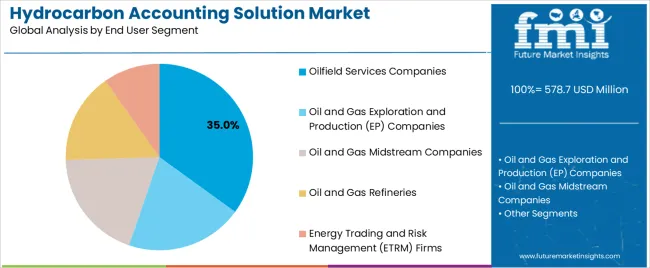
Market Context: Oilfield Services Companies demonstrate the highest growth rate in the hydrocarbon accounting solution market with 6.8% CAGR and 12.6% market share due to widespread adoption of production management systems and increasing focus on multi-client operations, field service optimization, and billing accuracy applications that maximize operational efficiency while maintaining accounting precision standards.
Appeal Factors: Oilfield services operators prioritize system scalability, multi-entity accounting, and integration with field operations that enables coordinated production tracking across multiple client engagements. The segment benefits from substantial service industry investment and field digitalization programs that emphasize the acquisition of accounting solutions for production tracking and revenue management applications.
Growth Drivers: Unconventional resource development programs incorporate advanced accounting systems as essential infrastructure for fracking operations and horizontal drilling management, while multi-basin operations increase demand for centralized accounting capabilities that comply with joint venture requirements and minimize reconciliation complexity.
Market Challenges: Varying client reporting requirements and contract structures may limit accounting system standardization across different service engagements or operational scenarios.
Application dynamics include:
- Strong growth in multi-client production management and joint venture accounting requiring flexible system capabilities
- Increasing adoption in field service coordination and real-time production tracking applications for service operators
- Rising integration with field automation systems for operational optimization and data accuracy assurance
Oil and Gas EP Companies Maintain Upstream Leadership
Oil and Gas Exploration and Production Companies capture 18.3% market share through upstream accounting requirements in reserve management, production allocation, and royalty calculation applications. These operators demand comprehensive accounting systems capable of handling complex ownership structures while providing accurate production and revenue tracking capabilities.
Oil and Gas Midstream Companies Show Infrastructure Focus
Oil and Gas Midstream Companies account for 18.3% market share, including pipeline operators, storage facilities, and transportation services requiring volumetric accounting with custody transfer validation and tariff billing for infrastructure operations.
Oil and Gas Refineries Drive Downstream Applications
Oil and Gas Refineries maintain 18.3% market share through processing operations, feedstock management, and product yield accounting requiring mass balance reconciliation and quality tracking for refining optimization.
ETRM Firms Lead Trading Applications
Energy Trading and Risk Management Firms capture 16.4% market share through commodity trading operations, position management, and mark-to-market valuation requiring real-time accounting with financial system integration for trading optimization.
What are the Drivers, Restraints, and Key Trends of the Hydrocarbon Accounting Solution Market?
| Category | Factor | Impact | Why It Matters |
|---|---|---|---|
| Driver | Production complexity & unconventional resources (shale plays, deepwater operations, complex reservoirs) | ★★★★★ | Unconventional production creates accounting challenges; multi-well pads, horizontal drilling, and enhanced recovery require sophisticated allocation and tracking systems. |
| Driver | Regulatory compliance & transparency requirements (SEC reporting, tax regulations, audit standards) | ★★★★★ | Stricter regulations mandate accurate accounting; financial reporting standards and tax authorities require detailed production and revenue documentation with audit trails. |
| Driver | Joint venture proliferation & partnership complexity (multiple owners, working interests, operating agreements) | ★★★★☆ | Multi-party ownership increases accounting complexity; joint ventures require precise production allocation, revenue distribution, and partner reconciliation capabilities. |
| Restraint | High implementation cost & resource requirements (especially for on-premises deployments) | ★★★★☆ | Large upfront investments limit adoption; comprehensive implementations require significant capital, IT resources, and organizational change management efforts. |
| Restraint | Data integration challenges & legacy system compatibility | ★★★☆☆ | Disparate operational systems create integration difficulties; connecting production data, financial systems, and field automation requires extensive customization and middleware. |
| Trend | Cloud migration & SaaS adoption (scalability, accessibility, lower upfront costs) | ★★★★★ | Cloud platforms transform deployment models; subscription-based access reduces capital requirements while enabling rapid scaling and remote accessibility. |
| Trend | AI & machine learning integration (predictive analytics, anomaly detection, optimization algorithms) | ★★★★☆ | Intelligent systems enhance accounting accuracy; AI-powered algorithms identify data discrepancies, predict production trends, and optimize allocation methodologies. |
Analysis of the Hydrocarbon Accounting Solution Market by Key Country
The market demonstrates varied regional dynamics with Growth Leaders including China (7.4% growth rate) and India (6.9% growth rate) driving expansion through oil and gas development initiatives and production digitalization programs. Steady Performers encompass Germany (6.3% growth rate), United States (5.2% growth rate), and developed regions, benefiting from established energy industries and operational technology advancement. Emerging Markets feature developing regions where hydrocarbon production growth and accounting modernization support consistent growth patterns.
Regional synthesis reveals East Asian markets leading adoption through energy security initiatives and production infrastructure development, while European countries maintain strong expansion supported by regulatory compliance requirements and digital transformation programs. North American markets show moderate growth driven by shale production accounting and unconventional resource management.
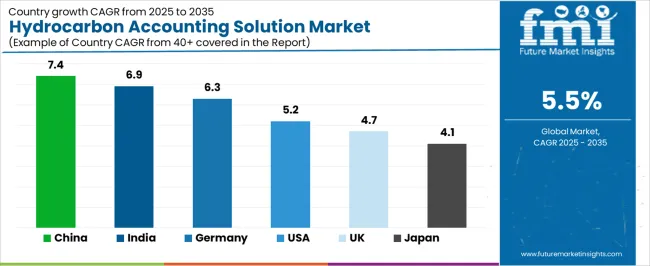
| Region/Country | 2025-2035 Growth | How to win | What to watch out |
|---|---|---|---|
| China | 7.4% | Focus on state enterprise solutions; local partnerships | Government controls; data sovereignty requirements |
| India | 6.9% | Lead with cost-effective cloud solutions; implementation support | Budget constraints; infrastructure limitations |
| Germany | 6.3% | Emphasize compliance features; renewable integration | Declining hydrocarbon production; energy transition |
| United States | 5.2% | Push shale accounting expertise; analytics capabilities | Market maturity; consolidation trends; price volatility |
| UK | 4.7% | Offer North Sea expertise; cloud migration services | Production decline; sector contraction |
| Japan | 4.1% | Premium quality; trading & risk management focus | Limited domestic production; import dependency |
China Drives Fastest Market Growth
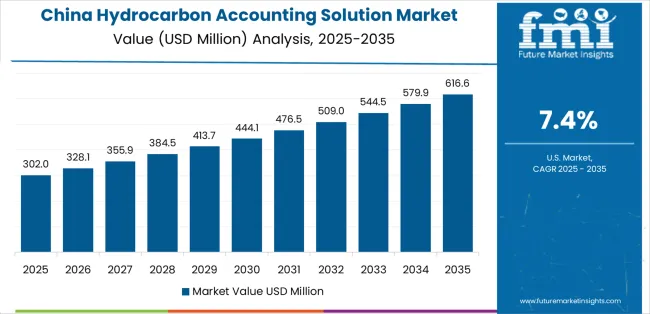
China establishes fastest market growth through aggressive energy security programs and comprehensive oil and gas production development, integrating hydrocarbon accounting solutions as standard components in state-owned enterprises and production facilities. The country's 7.4% growth rate reflects government initiatives promoting energy independence and production optimization that mandate the use of digital accounting systems in upstream and midstream facilities. Growth concentrates in major production regions, including Xinjiang, Sichuan, and offshore basins, where national oil company operations showcase integrated accounting systems that appeal to operators seeking production transparency and operational efficiency applications.
Chinese energy companies are adopting accounting solutions that combine international software capabilities with domestic system integration, including government reporting compliance and state enterprise requirements. Distribution channels through energy technology providers and system integrators expand market access, while government digitalization programs support adoption across diverse production and infrastructure segments.
Strategic Market Indicators:
- State-owned oil companies leading adoption with 82% deployment rate in production operations and joint venture management
- Government energy security programs providing substantial investment for production management and accounting modernization
- Local solution providers capturing 38% market share through government relationships and domestic customization capabilities
- Shale gas and tight oil development creating demand for advanced allocation and production tracking systems
India Emerges as High-Growth Market
In Mumbai, Delhi, and Chennai, oil and gas companies and oilfield services operations are implementing hydrocarbon accounting solutions as standard infrastructure for production management and joint venture accounting applications, driven by increasing domestic production and government exploration programs that emphasize the importance of production tracking capabilities. The market holds a 6.9% growth rate, supported by government energy independence initiatives and oilfield digitalization programs that promote accounting solutions for upstream and midstream facilities. Indian operators are adopting accounting systems that provide cost-effective production management and operational transparency, particularly appealing in emerging production regions where joint venture accounting and regulatory reporting represent critical operational requirements.
Market expansion benefits from growing offshore production infrastructure and expanding oilfield services sector that enable widespread deployment of accounting solutions for production and revenue applications. Technology adoption follows patterns established in energy software, where affordability and implementation support drive procurement decisions and system deployment.
Market Intelligence Brief:
- Upstream production and oilfield services segments driving initial adoption with 58% annual growth in accounting system implementation
- Government production-sharing contract requirements emphasizing accurate accounting for revenue distribution and tax calculation
- System integrators partnering with international software providers for implementation support and market development
- Cloud adoption accelerating among smaller operators seeking lower upfront investment for production management capabilities
Germany Maintains Market Leadership
Germany establishes market leadership through comprehensive energy management programs and advanced industrial software infrastructure development, integrating hydrocarbon accounting solutions across midstream operations and energy trading applications. The country's 6.3% growth rate reflects established energy industry relationships and mature software adoption that supports widespread use of accounting systems in pipeline operations and trading facilities. Growth concentrates in major energy centers, including Hamburg, Frankfurt, and Ruhr region, where midstream infrastructure showcases mature accounting deployment that appeals to operators seeking proven compliance capabilities and regulatory reporting applications.
German software providers leverage established energy distribution networks and comprehensive regulatory expertise capabilities, including emissions accounting programs and sustainability reporting that create customer relationships and operational advantages. The market benefits from mature energy regulations and carbon accounting requirements that support accounting solution adoption while encouraging technology advancement and reporting optimization.
Market Intelligence Brief:
- Midstream and trading facilities maintaining 88% adoption rate with mature accounting system deployment
- Established regulatory compliance requirements providing consistent demand for accounting technology advancement
- Energy software providers capturing 68% market share through compliance expertise and industry integration
- Energy transition programs expanding accounting capabilities to include renewable integration and carbon tracking scenarios
United States Shows Shale Production Leadership
United States demonstrates strong hydrocarbon accounting solution adoption with 5.2% growth rate, driven by unconventional resource production and complex joint venture structures. Major production regions including Permian Basin, Eagle Ford, and Bakken showcase advanced digital operations where accounting solutions manage multi-well pad allocations, working interest calculations, and partner reconciliation to ensure accurate production tracking and revenue distribution. The market benefits from extensive shale production infrastructure, sophisticated joint venture arrangements, and stringent regulatory reporting requirements. American operators prioritize system accuracy, scalability, and integration with financial systems for comprehensive enterprise management.
Distribution patterns favor established energy software vendors with industry expertise, while cloud-based solutions serve smaller independent operators through subscription models. Market growth concentrates in unconventional resource plays where production complexity justifies advanced accounting system investments.
Market Intelligence Brief:
- Shale production segment representing 62% of accounting system deployments with focus on horizontal drilling and multi-well operations
- Joint venture management driving 55% of functionality requirements through complex ownership structures and partner accounting
- Regulatory compliance creating sustained demand for SEC reporting, tax calculation, and audit trail capabilities
- Cloud adoption increasing among small-to-medium operators seeking operational efficiency without large IT infrastructure investments
United Kingdom Shows North Sea Maturity
United Kingdom's energy market demonstrates mature hydrocarbon accounting solution adoption with 4.7% growth rate, supported by North Sea operations expertise and established accounting practices. Major operational centers including Aberdeen, London, and operational bases showcase extensive production history where accounting solutions provide essential capabilities for mature field management, decommissioning accounting, and complex tax calculations. The market benefits from sophisticated regulatory frameworks, extensive joint venture experience, and declining production requiring enhanced cost management and operational efficiency.
British operators prioritize system reliability, regulatory compliance, and proven track record in North Sea operating conditions. Distribution channels through specialized energy software providers and consulting firms expand market access for both operators and service companies.
Strategic Market Considerations:
- Mature field operations and decommissioning activities leading adoption with focus on cost allocation and abandonment accounting
- Complex tax regime driving requirements for petroleum revenue tax calculation and compliance reporting
- Cloud migration trends creating opportunities for legacy system replacement and operational cost reduction
- Energy transition considerations affecting long-term investment decisions in hydrocarbon accounting infrastructure
Japan Shows Trading Focus
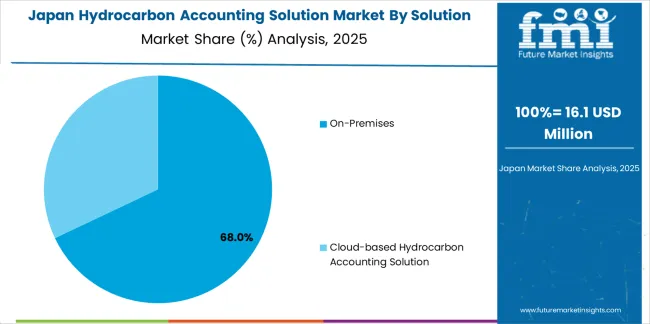
Japan's market expansion benefits from energy trading demand, including LNG imports in Tokyo and Osaka, commodity trading operations, and risk management programs that increasingly incorporate accounting solutions for position management applications. The country maintains a 4.1% growth rate, driven by import dependency and energy security concerns requiring sophisticated trading and accounting capabilities.
Market dynamics focus on trading-focused accounting systems that balance position management performance with financial integration important to Japanese energy companies. Growing LNG infrastructure creates continued demand for volumetric accounting in import facilities and trading operations.
Strategic Market Considerations:
- Energy trading and LNG operations segments leading growth with focus on commodity accounting and risk management
- Cultural preferences emphasizing proven reliability with comprehensive vendor support and quality documentation
- Software market dominated by international providers with established energy industry reputations and local support capabilities
- Integration requirements with Japanese accounting standards and financial reporting frameworks
Europe Market Split by Country
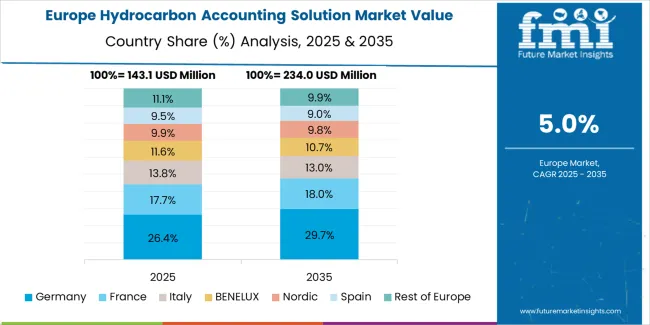
The hydrocarbon accounting solution market in Europe is projected to grow from USD 215.1 million in 2025 to USD 371.8 million by 2035, registering a CAGR of 5.6% over the forecast period. Germany is expected to maintain its leadership position with a 31.4% market share in 2025, supported by its advanced midstream infrastructure and major energy trading centers in Frankfurt, Hamburg, and industrial regions.
United Kingdom follows with a 26.8% share in 2025, driven by comprehensive North Sea production operations and established oil and gas accounting practices. France holds a 17.2% share through integrated energy companies and refining operations. Italy commands a 13.9% share, while Spain accounts for 10.7% in 2025. The rest of Europe region is anticipated to gain momentum, expanding its collective share from 7.6% to 8.9% by 2035, attributed to increasing accounting solution adoption in Nordic countries and emerging Eastern European oil and gas operations implementing production management programs.
South Korea Shows Petrochemical Integration
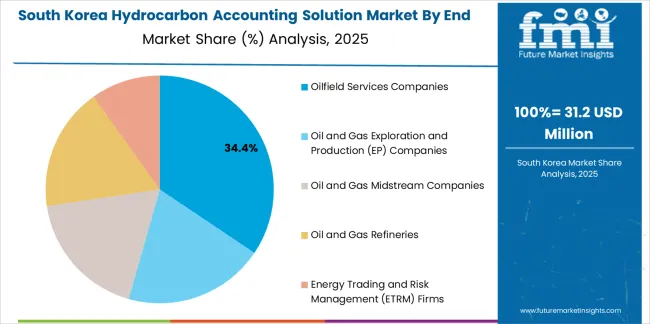
South Korea demonstrates moderate hydrocarbon accounting solution adoption with 5.8% growth rate, driven by refining and petrochemical industry requirements. Major industrial complexes including Ulsan, Yeosu, and Daesan showcase integrated energy facilities where accounting solutions manage feedstock allocation, product yield calculation, and inter-facility transfers to optimize refining operations and financial reporting. The market benefits from world-class refining capacity, integrated petrochemical production, and sophisticated supply chain management requiring accurate mass balance accounting.
Korean energy companies prioritize system integration with refining operations, real-time production tracking, and financial system connectivity. Market growth reflects both refinery optimization initiatives and expanding trading operations requiring position management. Distribution channels through industrial automation providers and enterprise software vendors serve manufacturing sectors, while growing interest in digital transformation creates modernization opportunities. Technology partnerships between Korean energy companies and international software providers facilitate customized implementations optimized for integrated refining and petrochemical operations including crude oil accounting, intermediate product tracking, and finished product distribution management with quality specifications and pricing mechanisms.
Competitive Landscape of the Hydrocarbon Accounting Solution Market
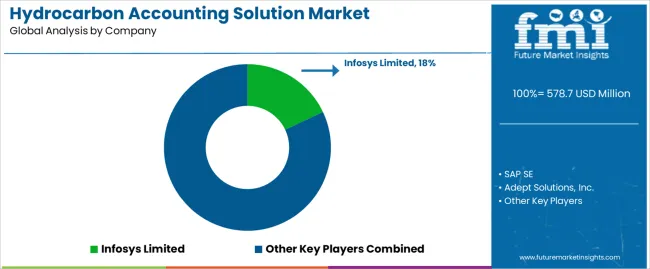
The hydrocarbon accounting solution market demonstrates moderately consolidated competitive dynamics with approximately 15-25 specialized software providers globally, where top 5 players control 60-65% revenue share through industry expertise, comprehensive functionality, and established client relationships. Market leadership requires balancing multiple capabilities including domain knowledge of oil and gas operations, software development excellence, regulatory compliance expertise, and implementation service capabilities across diverse upstream, midstream, and downstream segments.
Structure: Competitive landscape divides between established enterprise software companies with comprehensive energy management suites, specialized hydrocarbon accounting software vendors focused on niche functionality, oil and gas IT services firms offering customized solutions, and emerging cloud-native platforms targeting digital transformation initiatives. Traditional energy software leaders maintain advantage through industry relationships and proven functionality, while specialized vendors differentiate through deep accounting expertise, regulatory knowledge, and industry-specific workflows.
Leadership is maintained through: extensive client portfolios, continuous functionality enhancement, regulatory compliance updates, and comprehensive service networks (implementation consulting, training programs, ongoing support, system customization capabilities).
What's commoditizing: basic production allocation functionality, standard joint interest billing modules, and conventional reporting capabilities without advanced analytics or automation.
Margin Opportunities: cloud-based SaaS platforms with subscription models, AI-powered analytics and optimization modules, regulatory compliance automation, blockchain integration for transaction verification, managed services and outsourced accounting operations, and comprehensive digital transformation consulting engagements.
| Stakeholder | What they actually control | Typical strengths | Typical blind spots |
|---|---|---|---|
| Enterprise software leaders | Comprehensive ERP suites, global delivery, multi-industry platforms | Broad functionality, scalability, integration capability | Hydrocarbon specialization depth; industry workflow nuances; niche requirements |
| Specialized hydrocarbon software vendors | Deep domain expertise, industry-specific functionality, regulatory knowledge | Accounting accuracy, workflow optimization, industry credibility | Technology innovation pace; cloud-native architecture; broader ERP integration |
| IT services & consulting firms | Implementation expertise, customization capability, regional presence | Client relationships, tailored solutions, ongoing support | Product development; software IP ownership; global scalability |
| Cloud-native platform providers | Modern architecture, subscription models, rapid deployment | Innovation agility, lower TCO, continuous updates | Industry track record; complex customization; legacy migration expertise |
| Oilfield services technology arms | Field operations integration, operational data access, service workflows | Real-time connectivity, field-to-office integration, operational context | Pure accounting functionality; multi-client neutrality; competitor adoption |
Market competition intensifies around cloud migration capabilities, AI-powered analytics integration, and regulatory compliance automation. Companies investing in modern cloud architectures, machine learning algorithms for production optimization, and comprehensive API ecosystems position themselves advantageously for sustained market share gains. Success increasingly depends on balancing deep hydrocarbon accounting expertise with modern software delivery models and digital transformation capabilities that drive operational efficiency and strategic insights across diverse oil and gas operation segments.
Key Players in the Hydrocarbon Accounting Solution Market
- Infosys Limited
- SAP SE
- Adept Solutions, Inc.
- P2 Energy Solutions
- Tieto Corporation (TietoEVRY)
- Quorum Business Solutions
- Wipro Limited
- Weatherford International plc
- CGI Inc.
- Accenture plc
- Schlumberger Limited (SLB)
- Enertia Software
- OGsys, LLC
- Merrick & Company
- Validere Technologies Inc.
Scope of the Report
| Item | Value |
|---|---|
| Quantitative Units | USD 578.7 million |
| Solution Segment | On-Premises, Cloud-based Hydrocarbon Accounting Solution |
| End User Segment | Oilfield Services Companies, Oil and Gas Exploration and Production (EP) Companies, Oil and Gas Midstream Companies, Oil and Gas Refineries, Energy Trading and Risk Management (ETRM) Firms |
| Regions Covered | North America, Latin America, Western Europe, Eastern Europe, East Asia, South Asia Pacific, Middle East & Africa |
| Countries Covered | China, India, Germany, United States, United Kingdom, Japan, South Korea, Canada, Norway, Australia, and 25+ additional countries |
| Key Companies Profiled | Infosys Limited, SAP SE, Adept Solutions Inc., P2 Energy Solutions, Tieto Corporation, Quorum Business Solutions, Wipro Limited, Weatherford International plc, CGI Inc. |
| Additional Attributes | Dollar sales by solution type and end-user categories, regional adoption trends across North America, East Asia, and Western Europe, competitive landscape with energy software providers and IT services firms, operator preferences for accounting accuracy and regulatory compliance, integration with ERP platforms and operational technology systems, innovations in cloud architecture and AI-powered analytics, and development of digital accounting solutions with enhanced performance and production management optimization capabilities. |
Hydrocarbon Accounting Solution Market by Segments
Solution Segment:
- On-Premises
- Cloud-based Hydrocarbon Accounting Solution
End User Segment:
- Oilfield Services Companies
- Oil and Gas Exploration and Production (EP) Companies
- Oil and Gas Midstream Companies
- Oil and Gas Refineries
- Energy Trading and Risk Management (ETRM) Firms
Region:
- North America
- United States
- Canada
- Mexico
- Latin America
- Brazil
- Argentina
- Rest of Latin America
- Western Europe
- Germany
- United Kingdom
- France
- Italy
- Spain
- Norway
- Nordic
- BENELUX
- Rest of Western Europe
- Eastern Europe
- Russia
- Poland
- Rest of Eastern Europe
- East Asia
- China
- Japan
- South Korea
- South Asia Pacific
- India
- Australia
- ASEAN
- New Zealand
- Rest of South Asia Pacific
- Middle East & Africa
- Kingdom of Saudi Arabia
- Other GCC Countries
- United Arab Emirates
- Turkey
- South Africa
- Other African Union
- Rest of Middle East & Africa
Frequently Asked Questions
How big is the hydrocarbon accounting solution market in 2025?
The global hydrocarbon accounting solution market is estimated to be valued at USD 578.7 million in 2025.
What will be the size of hydrocarbon accounting solution market in 2035?
The market size for the hydrocarbon accounting solution market is projected to reach USD 988.4 million by 2035.
How much will be the hydrocarbon accounting solution market growth between 2025 and 2035?
The hydrocarbon accounting solution market is expected to grow at a 5.5% CAGR between 2025 and 2035.
What are the key product types in the hydrocarbon accounting solution market?
The key product types in hydrocarbon accounting solution market are on-premises and cloud-based hydrocarbon accounting solution.
Which end user segment segment to contribute significant share in the hydrocarbon accounting solution market in 2025?
In terms of end user segment, oilfield services companies segment to command 35.0% share in the hydrocarbon accounting solution market in 2025.
Preview the report firsthand - request a free sample
Get SampleGet the brochure for pricing and purchase details.
Get PDFTable of Content
- Executive Summary
- Global Market Outlook
- Demand-side Trends
- Supply-side Trends
- Technology Roadmap Analysis
- Analysis and Recommendations
- Market Overview
- Market Coverage / Taxonomy
- Market Definition / Scope / Limitations
- Market Background
- Market Dynamics
- Drivers
- Restraints
- Opportunity
- Trends
- Scenario Forecast
- Demand in Optimistic Scenario
- Demand in Likely Scenario
- Demand in Conservative Scenario
- Opportunity Map Analysis
- Product Life Cycle Analysis
- Supply Chain Analysis
- Investment Feasibility Matrix
- Value Chain Analysis
- PESTLE and Porter’s Analysis
- Regulatory Landscape
- Regional Parent Market Outlook
- Production and Consumption Statistics
- Import and Export Statistics
- Market Dynamics
- Global Market Analysis 2020 to 2024 and Forecast, 2025 to 2035
- Historical Market Size Value (USD Million) Analysis, 2020 to 2024
- Current and Future Market Size Value (USD Million) Projections, 2025 to 2035
- Y-o-Y Growth Trend Analysis
- Absolute $ Opportunity Analysis
- Global Market Pricing Analysis 2020 to 2024 and Forecast 2025 to 2035
- Global Market Analysis 2020 to 2024 and Forecast 2025 to 2035, By Solution Segment
- Introduction / Key Findings
- Historical Market Size Value (USD Million) Analysis By Solution Segment , 2020 to 2024
- Current and Future Market Size Value (USD Million) Analysis and Forecast By Solution Segment , 2025 to 2035
- On-Premises
- Cloud-based Hydrocarbon Accounting Solution
- Y-o-Y Growth Trend Analysis By Solution Segment , 2020 to 2024
- Absolute $ Opportunity Analysis By Solution Segment , 2025 to 2035
- Global Market Analysis 2020 to 2024 and Forecast 2025 to 2035, By End User Segment
- Introduction / Key Findings
- Historical Market Size Value (USD Million) Analysis By End User Segment, 2020 to 2024
- Current and Future Market Size Value (USD Million) Analysis and Forecast By End User Segment, 2025 to 2035
- Oilfield Services Companies
- Oil and Gas Exploration and Production (EP) Companies
- Oil and Gas Midstream Companies
- Oil and Gas Refineries
- Energy Trading and Risk Management (ETRM) Firms
- Y-o-Y Growth Trend Analysis By End User Segment, 2020 to 2024
- Absolute $ Opportunity Analysis By End User Segment, 2025 to 2035
- Global Market Analysis 2020 to 2024 and Forecast 2025 to 2035, By Region
- Introduction
- Historical Market Size Value (USD Million) Analysis By Region, 2020 to 2024
- Current Market Size Value (USD Million) Analysis and Forecast By Region, 2025 to 2035
- North America
- Latin America
- Western Europe
- Eastern Europe
- East Asia
- South Asia and Pacific
- Middle East & Africa
- Market Attractiveness Analysis By Region
- North America Market Analysis 2020 to 2024 and Forecast 2025 to 2035, By Country
- Historical Market Size Value (USD Million) Trend Analysis By Market Taxonomy, 2020 to 2024
- Market Size Value (USD Million) Forecast By Market Taxonomy, 2025 to 2035
- By Country
- USA
- Canada
- Mexico
- By Solution Segment
- By End User Segment
- By Country
- Market Attractiveness Analysis
- By Country
- By Solution Segment
- By End User Segment
- Key Takeaways
- Latin America Market Analysis 2020 to 2024 and Forecast 2025 to 2035, By Country
- Historical Market Size Value (USD Million) Trend Analysis By Market Taxonomy, 2020 to 2024
- Market Size Value (USD Million) Forecast By Market Taxonomy, 2025 to 2035
- By Country
- Brazil
- Chile
- Rest of Latin America
- By Solution Segment
- By End User Segment
- By Country
- Market Attractiveness Analysis
- By Country
- By Solution Segment
- By End User Segment
- Key Takeaways
- Western Europe Market Analysis 2020 to 2024 and Forecast 2025 to 2035, By Country
- Historical Market Size Value (USD Million) Trend Analysis By Market Taxonomy, 2020 to 2024
- Market Size Value (USD Million) Forecast By Market Taxonomy, 2025 to 2035
- By Country
- Germany
- UK
- Italy
- Spain
- France
- Nordic
- BENELUX
- Rest of Western Europe
- By Solution Segment
- By End User Segment
- By Country
- Market Attractiveness Analysis
- By Country
- By Solution Segment
- By End User Segment
- Key Takeaways
- Eastern Europe Market Analysis 2020 to 2024 and Forecast 2025 to 2035, By Country
- Historical Market Size Value (USD Million) Trend Analysis By Market Taxonomy, 2020 to 2024
- Market Size Value (USD Million) Forecast By Market Taxonomy, 2025 to 2035
- By Country
- Russia
- Poland
- Hungary
- Balkan & Baltic
- Rest of Eastern Europe
- By Solution Segment
- By End User Segment
- By Country
- Market Attractiveness Analysis
- By Country
- By Solution Segment
- By End User Segment
- Key Takeaways
- East Asia Market Analysis 2020 to 2024 and Forecast 2025 to 2035, By Country
- Historical Market Size Value (USD Million) Trend Analysis By Market Taxonomy, 2020 to 2024
- Market Size Value (USD Million) Forecast By Market Taxonomy, 2025 to 2035
- By Country
- China
- Japan
- South Korea
- By Solution Segment
- By End User Segment
- By Country
- Market Attractiveness Analysis
- By Country
- By Solution Segment
- By End User Segment
- Key Takeaways
- South Asia and Pacific Market Analysis 2020 to 2024 and Forecast 2025 to 2035, By Country
- Historical Market Size Value (USD Million) Trend Analysis By Market Taxonomy, 2020 to 2024
- Market Size Value (USD Million) Forecast By Market Taxonomy, 2025 to 2035
- By Country
- India
- ASEAN
- Australia & New Zealand
- Rest of South Asia and Pacific
- By Solution Segment
- By End User Segment
- By Country
- Market Attractiveness Analysis
- By Country
- By Solution Segment
- By End User Segment
- Key Takeaways
- Middle East & Africa Market Analysis 2020 to 2024 and Forecast 2025 to 2035, By Country
- Historical Market Size Value (USD Million) Trend Analysis By Market Taxonomy, 2020 to 2024
- Market Size Value (USD Million) Forecast By Market Taxonomy, 2025 to 2035
- By Country
- Kingdom of Saudi Arabia
- Other GCC Countries
- Turkiye
- South Africa
- Other African Union
- Rest of Middle East & Africa
- By Solution Segment
- By End User Segment
- By Country
- Market Attractiveness Analysis
- By Country
- By Solution Segment
- By End User Segment
- Key Takeaways
- Key Countries Market Analysis
- USA
- Pricing Analysis
- Market Share Analysis, 2024
- By Solution Segment
- By End User Segment
- Canada
- Pricing Analysis
- Market Share Analysis, 2024
- By Solution Segment
- By End User Segment
- Mexico
- Pricing Analysis
- Market Share Analysis, 2024
- By Solution Segment
- By End User Segment
- Brazil
- Pricing Analysis
- Market Share Analysis, 2024
- By Solution Segment
- By End User Segment
- Chile
- Pricing Analysis
- Market Share Analysis, 2024
- By Solution Segment
- By End User Segment
- Germany
- Pricing Analysis
- Market Share Analysis, 2024
- By Solution Segment
- By End User Segment
- UK
- Pricing Analysis
- Market Share Analysis, 2024
- By Solution Segment
- By End User Segment
- Italy
- Pricing Analysis
- Market Share Analysis, 2024
- By Solution Segment
- By End User Segment
- Spain
- Pricing Analysis
- Market Share Analysis, 2024
- By Solution Segment
- By End User Segment
- France
- Pricing Analysis
- Market Share Analysis, 2024
- By Solution Segment
- By End User Segment
- India
- Pricing Analysis
- Market Share Analysis, 2024
- By Solution Segment
- By End User Segment
- ASEAN
- Pricing Analysis
- Market Share Analysis, 2024
- By Solution Segment
- By End User Segment
- Australia & New Zealand
- Pricing Analysis
- Market Share Analysis, 2024
- By Solution Segment
- By End User Segment
- China
- Pricing Analysis
- Market Share Analysis, 2024
- By Solution Segment
- By End User Segment
- Japan
- Pricing Analysis
- Market Share Analysis, 2024
- By Solution Segment
- By End User Segment
- South Korea
- Pricing Analysis
- Market Share Analysis, 2024
- By Solution Segment
- By End User Segment
- Russia
- Pricing Analysis
- Market Share Analysis, 2024
- By Solution Segment
- By End User Segment
- Poland
- Pricing Analysis
- Market Share Analysis, 2024
- By Solution Segment
- By End User Segment
- Hungary
- Pricing Analysis
- Market Share Analysis, 2024
- By Solution Segment
- By End User Segment
- Kingdom of Saudi Arabia
- Pricing Analysis
- Market Share Analysis, 2024
- By Solution Segment
- By End User Segment
- Turkiye
- Pricing Analysis
- Market Share Analysis, 2024
- By Solution Segment
- By End User Segment
- South Africa
- Pricing Analysis
- Market Share Analysis, 2024
- By Solution Segment
- By End User Segment
- USA
- Market Structure Analysis
- Competition Dashboard
- Competition Benchmarking
- Market Share Analysis of Top Players
- By Regional
- By Solution Segment
- By End User Segment
- Competition Analysis
- Competition Deep Dive
- Infosys Limited
- Overview
- Product Portfolio
- Profitability by Market Segments (Product/Age /Sales Channel/Region)
- Sales Footprint
- Strategy Overview
- Marketing Strategy
- Product Strategy
- Channel Strategy
- SAP SE
- Adept Solutions, Inc.
- P2 Energy Solutions
- Tieto Corporation (TietoEVRY)
- Quorum Business Solutions
- Wipro Limited
- Weatherford International plc
- CGI Inc.
- Accenture plc
- Schlumberger Limited (SLB)
- Enertia Software
- OGsys, LLC
- Merrick & Company
- Validere Technologies Inc.
- Infosys Limited
- Competition Deep Dive
- Assumptions & Acronyms Used
- Research Methodology


