

- Market Size (2026)
- USD 295.8 Mn
- Forecast (2036)
- USD 604.0 Mn
- CAGR (2026 to 2036)
- 7.4%
How big is Upcycled Floral & Petal Ingredients (Marigold, Edible Flowers) Market size?
USD 295.8 million in 2026 and USD 604.0 million by 2036 at a 7.4% CAGR.
Sales of upcycled floral & petal ingredients (marigold, edible flowers) are estimated to rise at 7.4% CAGR through 2036, increasing valuation from USD 295.8 million in 2026 to USD 604.0 million by 2036. Carefully handling flowers and petals during harvesting protects valuable pigments and delicate aroma compounds before drying or extraction. A study published in ACS Sustainable Chemistry & Engineering in August 2025 assessed 9 Mediterranean flower and fruit sources. This research demonstrated that useful natural colors can be successfully recovered from various botanical waste streams. Food and cosmetic manufacturers only accept these upcycled ingredients from suppliers who provide clear identity records and prove that natural colors remain stable over time.
International buyers evaluate such upcycled botanical ingredients based on distinct regional priorities. Buyers in the United States and Germany favor clear ingredient documentation and delivery methods that protect sensitive compounds. Processors in China and India emphasize nearby flower farming and lab-tested extraction quality. Government agricultural data highlights the scale of this botanical supply. In November 2025, the German Federal Statistical Office recorded 2,421 hectares used for growing cut flowers and ornamental plants. Such widespread farming network reinforces why European buyers require strict supplier tracking records. Regional purchasing strategies reflect a balance between local farming access and specific ingredient regulations.
-market-value-analysis.webp "Upcycled Floral And Petal Ingredients (marigold, Edible Flowers) Market Value Analysis")
Key Takeaways for the Upcycled Floral & Petal Ingredients (Marigold, Edible Flowers) Market
- Demand for upcycled floral and petal ingredients is influenced by natural-color formulation and carotenoid use, requiring food-grade recovery promptly following harvest.
- Marigold is projected to account for 57.5% share of source in 2026, guided by contracted cultivation and established lutein extraction routes.
- Lutein/color is forecasted to lead product with 41.2% share in 2026, helped by measurable assay and color-strength specifications.
- Seasonal biomass availability and increasing active loss restrict commercial yield unless collection and storage follow controlled operating limits.
- Competition includes Kemin, OmniActive, Kalsec, PIVEG, Synthite, and BASF, with differentiation based on source control and formulation-ready delivery formats.
Analyst Perspective
“Upcycled floral ingredients create commercial value depending on early specification design. Collection teams need clear species identity and food-grade handling records from harvest. Processing teams then preserve color or active content based on validated drying and protected delivery. Repeat purchasing follows consistent assay and performance inside finished food or supplement matrices.”
- Nandini Roy Choudhury, Principal Analyst for Food and Beverage at Future Market Insights
How is Upcycled Floral & Petal Ingredients (Marigold, Edible Flowers) Market segmented?
The upcycled floral and petal ingredients industry is segmented by source, product, application, and region.
The upcycled floral and petal ingredients industry is segmented by source, product, application, and region. Source coverage includes marigold, edible flowers, and petal waste across distinct traceability and active profiles. Product coverage separates lutein/color from flavor and texture outputs. Application coverage addresses color, functional F&B, and supplements across different dose and stability requirements. Regional coverage includes North America and Latin America together with Western Europe. Eastern Europe and East Asia extend geographic assessment across botanical processing centers. South Asia and Pacific with Middle East and Africa complete commercial analysis.
Why does Marigold lead Source demand?
-market-analysis-by-source.webp "Upcycled Floral And Petal Ingredients (marigold, Edible Flowers) Market Analysis By Source")
Marigold offers recognized carotenoid targets and organized cultivation routes suited to repeatable extraction. Variety selection and harvest timing influence lutein content prior to stabilization. Contract farming supports lot records and planned delivery into drying facilities. Petal Waste needs stricter segregation since mixed species or decorative handling may compromise food-grade status. OmniActive announced formal EU non-novel recognition for Lutemax 2020 in May 2025, strengthening commercial support for documented marigold-derived carotenoid supply across food supplements.
- By source, marigold is projected to represent 57.5% share in 2026, supported by well-known carotenoid profiles and repeatable cultivation-to-extraction controls. Supplier qualification centers on farm records and active assays instead of nominal flower volume.
- Edible flowers and petal waste provide access to varied pigments or flavors across selected applications. Commercial conversion requires early species separation and protected handling to prevent contamination or active loss during collection.
What supports lutein/color as the leading product?
Lutein and color outputs support measurable purchasing specifications across food and supplement programs. Buyers assess active concentration and shade through defined release tests. Flavor fractions face greater volatile loss across drying and storage. Texture fractions remain application-specific and require matrix trials across processing conditions. Kemin reported in May 2024 on Macu-LZ use across 5 supplement and beverage formats, supporting standardized lutein delivery across varied product designs.
- Lutein/color is anticipated to account for 41.2% share of product in 2026, reflecting clear assay and performance endpoints across customer specifications. Protected formats improve dosing consistency during manufacturing and storage.
- Flavor and texture products extend floral recovery beyond pigment extraction through aroma or functional solids. Success rests on low-loss stabilization and application testing suited to each finished matrix.
How does Color lead Application demand?
Color delivers an immediate functional result assessed through shade and stability testing. Marigold xanthophylls support yellow-to-orange systems across suitable food and feed uses. Other edible flowers provide separate pigment chemistries with different heat and pH responses. Functional F&B and Supplements require dose evidence and claim support beyond visual performance. Kemin reported in August 2024 on more than 100 clinical studies supporting FloraGLO lutein, illustrating the evidence depth required for functional applications beyond visual color performance.
- Based on application, color is expected to hold 40.6% share in 2026 as it is driven by low inclusion levels and direct performance assessment during product development. Commercial orders favor repeatable shade strength across routine production lots.
- Functional F&B and supplements use floral actives within nutrition-focused formats carrying stricter identity and dose controls. Product approval requires finished-matrix stability and jurisdiction-specific claim review.
What are drivers, restraints, and opportunities in upcycled floral & petal ingredients (marigold, edible flowers) market?
Natural-color purchasing supports ingredient conversion and unstable biomass limits usable output. Local recovery infrastructure creates expansion potential across controlled botanical side streams.
- Driver: Food and supplement developers seek floral pigments and carotenoids with traceable origin and repeatable technical performance.
- Restraint: Seasonal supply and active degradation weaken yield consistency during delayed or poorly controlled post-harvest handling.
- Opportunity: Regional stabilization and extraction hubs support rapid biomass conversion into assay-controlled ingredients for nearby processors.
Natural-color reformulation supports demand for natural food colors derived from controlled botanical inputs. United States Food and Drug Administration approved 3 food colors from natural sources in May 2025, expanding formulation options for manufacturers replacing synthetic dyes. Regulatory expansion encourages food manufacturers to assess floral pigments carrying stable shade and clear origin documentation. Ingredient suppliers need application data proving performance across heat and storage exposure.
Processing variability constrains release consistency across marigold-derived lutein products. Kim and colleagues reported lutein content near 42 mg per 100 mg dry weight for one orange cultivar in April 2024, highlighting cultivar and drying effects on active retention. Cultivar and drying response influence assay planning across commercial lots. Processors need validated temperature limits and retention checks prior to specification assignment.
Extraction improvement offers a practical route for expanding usable output from controlled flower streams. Rahman and colleagues reported a 10.0% improvement in lutein extraction yield from optimized ultrasound-assisted processing in December 2024. Higher recovery supports better use of contracted marigold biomass without relying on additional cultivation volume. Commercial adoption requires solvent control and repeatable scale-up performance across production batches.
How are country CAGRs aligned in upcycled floral & petal ingredients (marigold, edible flowers) market?
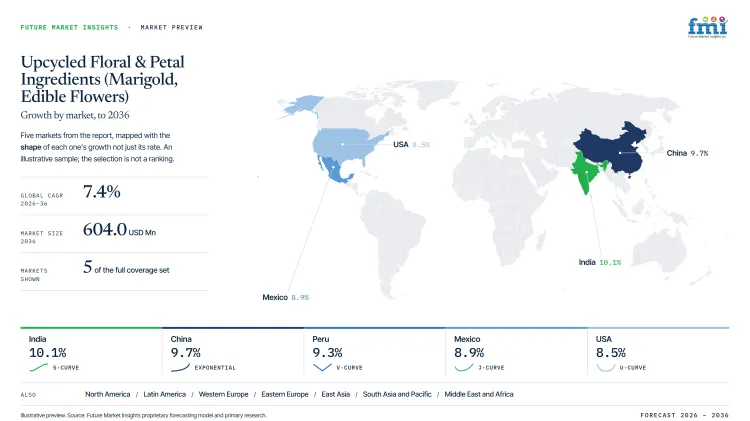
| Country or Market | CAGR |
|---|---|
| India | 10.1% |
| China | 9.7% |
| Peru | 9.3% |
| Mexico | 8.9% |
| USA | 8.5% |
Source: Future Market Insights analysis, 2026.
How do country-level CAGRs compare in upcycled floral & petal ingredients (marigold, edible flowers) market?
Country comparison shows a gradual step-down across profiled markets. India occupies first position, followed by China. Peru forms a close middle position across botanical application development. Mexico and United States complete disclosed comparison through different certification and sourcing conditions. A 1.6 percentage-point spread separates India from United States, reflecting moderate divergence instead of a divided forecast pattern.
- India is expected to establish South Asia as lead development center across supplied country rates.
- China is anticipated to follow India with extensive flower cultivation and established processing capacity.
- Peru is likely to occupy third position through edible-flower application research and botanical export experience.
- Mexico is predicted to follow through certified agricultural networks and proximity to USA food manufacturers.
- United States is projected to completes disclosed comparison through demanding documentation and dispersed floriculture sourcing.
Markets carrying similar CAGRs may present different entry conditions through crop concentration, certification access, and processing readiness. Full report coverage extends across North America and Latin America with Western Europe and Eastern Europe. East Asia, South Asia and Pacific, and Middle East and Africa complete regional analysis.
Country-wise Analysis
- The floral-derived ingredients industry in India is projected to expand at 10.1% CAGR by 2036, driven by deep flower cultivation and established marigold extraction skills. Press Information Bureau reported estimated flower production of 45.84 lakh tonnes during 2025-26 in June 2026, providing substantial biomass across ornamental and commercial routes. Ingredient conversion requires dedicated food-grade streams instead of mixed ceremonial waste. Rapid drying and assay control decide how much collected material reaches saleable specification.
- Xinhua reported in March 2026 on flower cultivation near 1.39 million hectares during 2025, illustrating extensive agricultural depth. Local cultivation supports nearby drying and extraction capacity across selected botanical clusters. Sales in China are forecast to advance at 9.7% CAGR between 2026 and 2036 as processors connect scale with consistent identity and active testing. Export programs need specification alignment across domestic rules and destination-market permissions.
- Sector in Peru is projected to scale at 9.3% CAGR from 2026 to 2036, influenced by botanical application development. Mendoza Guevara and colleagues reported best pastry-cream acceptance from a 15 g hibiscus dosage in June 2025, supporting measured edible-flower formulation. Local formulation research supports movement from decorative use into measured food applications. Commercial suppliers need species authentication and contaminant documentation suitable for export customers.
- National Service of Animal and Plant Health, Food Safety and Quality reported 21 certification bodies supporting organic production in December 2025, providing an established assurance base for traceable botanical streams. Certified systems may support controlled aggregation and documented processing for edible flowers or petal fractions. Adoption in Mexico is estimated to rise at 8.9% CAGR during the study period due to regional processing and access to USA customers. Processors need rapid stabilization and species-level records across fragmented flower collection.
- The market in United States is anticipated to progress at 8.5% CAGR during the assessment period, backed by natural-color interest and strict ingredient documentation. United States Department of Agriculture reported individual floriculture coverage for 28 main producing states in June 2026, illustrating a geographically dispersed source base. Dispersed supply raises aggregation and food-grade segregation requirements for upcycled inputs. Buyers favor qualified ingredients carrying identity evidence and stable performance across finished applications.
Who are the notable companies in upcycled floral & petal ingredients (marigold, edible flowers) market?
Kemin, OmniActive, Kalsec, PIVEG, Synthite, and BASF are the prominent companies profiled to contribute in the upcycled floral and petal ingredients market.
-market-analysis-by-company.webp "Upcycled Floral And Petal Ingredients (marigold, Edible Flowers) Market Analysis By Company")
Competition centers on contaminant management and customer-ready documentation. PIVEG and Synthite connect cultivation access with botanical extraction and pigment standardization. Kalsec contributes natural-color formulation support across food applications. BASF supplies carotenoid and nutrition capabilities within a global ingredient portfolio.
- Kemin and OmniActive compete through branded marigold carotenoids supported by protected delivery formats. Buyers examine scientific evidence alongside lot consistency during supplier review.
- PIVEG and Synthite maintain cultivation-linked botanical extraction capabilities. Customers assess active retention together with export documentation during ingredient qualification.
- Kalsec and BASF offer established color and carotenoid portfolios. Food companies review shade stability alongside technical guidance across formulation programs.
Competitive Benchmarking: Upcycled Floral & Petal Ingredients (Marigold, Edible Flowers) Market
| Company | Floral Source Control | Active and Colour Standardisation | Delivery-Format Support | Geographic Reach |
|---|---|---|---|---|
| Kemin | High | High | High | Global nutrition and feed network |
| OmniActive | High | High | High | Global nutraceutical network with Indian supply base |
| Kalsec | Medium | High | High | Americas, Europe, and Asia application network |
| PIVEG | High | High | Medium | Mexico- and Peru-linked supply with export reach |
| Synthite | High | High | Medium | India-based botanical extraction with global customers |
| BASF | Medium | High | High | Global nutrition and formulation network |
Assessment basis: Future Market Insights analysis, 2026.
Key Developments in the Upcycled Floral & Petal Ingredients (Marigold, Edible Flowers) Market
- In June 2025, OmniActive announced USA regulatory acknowledgement for Lutemax Free Lutein use in infant formula. Clearance extended a marigold-derived lutein ingredient into tightly controlled early-life nutrition, increasing demand for documented purity and production consistency.
- In July 2025, OmniActive reported NSF-GMP certification for manufacturing facilities in Pune and Hosur. Certification strengthened audit assurance for botanical ingredient production and supported customers seeking traceable quality systems across global supply programs.
- In April 2026, OmniActive established an Amsterdam office and centralized Rotterdam warehouse. European inventory access shortened regional supply paths and improved support for food-supplement customers using standardized botanical actives.
Key Players in the Upcycled Floral & Petal Ingredients (Marigold, Edible Flowers) Market
Branded Marigold Carotenoid Systems
- Kemin
- OmniActive
Botanical Extraction and Pigment Supply
- PIVEG
- Synthite
Natural Color and Formulation Platforms
- Kalsec
- BASF
Upcycled Floral & Petal Ingredients (Marigold, Edible Flowers) Market - Report Scope
| Coverage field | Report scope |
|---|---|
| Market breakdown | Upcycled Floral & Petal Ingredients (Marigold, Edible Flowers) Market breakdown by Source, Product, Application, and Region |
| Quantitative Units | Revenue in USD Million, CAGR in %. |
| Market Definition | Revenue from food-grade and supplement-grade color, lutein, flavor, texture, and functional ingredients recovered from Marigold, Edible Flowers, and Petal Waste. Ornamental flowers, fresh bouquets, and unprocessed decorative petals are excluded. |
| Regions Covered | North America, Latin America, Western Europe, Eastern Europe, East Asia, South Asia and Pacific, Middle East and Africa |
| Countries Covered | India, USA, China, Mexico, Peru, and more than 25 additional countries in full report |
| Key Companies Profiled | Kemin, OmniActive, Kalsec, PIVEG, Synthite, BASF |
| Forecast Period | 2026 to 2036 |
| Approach | Ingredient volumes and prices are reconciled with floral source, food-grade collection, drying, extraction, standardisation, product form, active content, application dose, country permission, and claim eligibility. |
Source: Future Market Insights analysis, 2026.
Upcycled Floral & Petal Ingredients (Marigold, Edible Flowers) Market - Research Methodology
| Method | Approach |
|---|---|
| Primary Research | FMI analysts gathered input from manufacturers, service providers, technology developers, distributors, end users, procurement teams, and subject-matter experts. Interviews examined purchasing decisions, product or service evaluation, adoption barriers, approval requirements, pricing considerations, and expectations for technical or commercial support. Respondents were also asked what evidence is required before a trial, pilot, or initial order develops into regular purchasing. |
| Desk Research | Desk research covered government statistics, regulatory publications, trade data, industry associations, technical literature, standards, company filings, product information, and official corporate announcements. Sources were reviewed for relevance, publication date, geographic coverage, and consistency with the defined market scope. Claims relating to performance, applications, approvals, capacity, investment, and commercial activity were retained only when supported by credible public evidence. |
| Market Sizing and Forecasting | The market model combined the baseline value with historical performance, segment structure, pricing and volume indicators, adoption levels, company participation, and country-level demand conditions. Forecast assumptions considered economic activity, investment trends, regulatory developments, technology adoption, purchasing cycles, supply availability, and barriers to wider market use. Segment and regional estimates were reconciled before the final market total was calculated. |
| Data Validation | Estimates were checked against multiple independent indicators, including public data, company activity, trade patterns, industry developments, and findings from primary interviews. Validation also tested whether products, services, applications, and company revenues fell within the defined market boundaries. Adjacent categories, unsupported claims, overlapping revenues, and activities without direct market relevance were excluded to reduce double counting and maintain consistency across segments and countries. |
Source: Future Market Insights analysis, 2026.
Upcycled Floral & Petal Ingredients (Marigold, Edible Flowers) Market by Segments
Upcycled Floral & Petal Ingredients (Marigold, Edible Flowers) Market segmented by Source:
- Marigold
- Edible Flowers
- Petal Waste
Upcycled Floral & Petal Ingredients (Marigold, Edible Flowers) Market segmented by Product:
- Lutein/Color
- Flavor
- Texture
Upcycled Floral & Petal Ingredients (Marigold, Edible Flowers) Market segmented by Application:
- Color
- Functional F&B
- Supplements
Upcycled Floral & Petal Ingredients (Marigold, Edible Flowers) Market by Region:
- North America
- United States
- Canada
- Latin America
- Brazil
- Mexico
- Argentina
- Chile
- Western Europe
- Germany
- France
- United Kingdom
- Italy
- Spain
- Benelux
- Nordics
- Eastern Europe
- Poland
- Czech Republic
- Romania
- Hungary
- East Asia
- China
- Japan
- South Korea
- South Asia and Pacific
- India
- ASEAN
- Australia and New Zealand
- Middle East and Africa
- GCC Countries
- South Africa
- Türkiye
- Israel
Research Sources and Bibliography
- Jordán-Núñez, J., Costa-Torrado, I., Pérez-Cabezas, M., Belda, A., Boix, M., & Micó-Vicent, B. (2025, August 26). Extraction of natural pigments from Mediterranean flowers and fruits: A sustainable approach to plant-based colorants. ACS Sustainable Chemistry & Engineering, 13(39), 16265-16285.
- German Federal Statistical Office. (2025, November 24). Cultivation of ornamental plants.
- USA Food and Drug Administration. (2025, May 9). FDA approves three food colors from natural sources.
- Kemin Industries. (2024, May 21). Introducing Macu-LZ™ Lutein & Zeaxanthin Isomers for Comprehensive Nutraceutical Solutions.
- Kemin Industries. (2024, August 29). Supporting Young Eyes and Minds with FloraGLO® Lutein.
- Kim, J. H., Lim, Y. J., Kim, J.-H., & Eom, S. H. (2024, April 9). Impact of dry processing on secondary metabolites in the petals of marigold (Tagetes spp.) cultivar. Horticulturae, 10(4), 382.
- Mendoza Guevara, K. R., Paz Sánchez, J. A., Bohórquez-Medina, S. L., & Bohórquez-Medina, A. L. (2025, June 29). Development and sensory evaluation of edible flower incorporation in pastry products using avant-garde techniques. Canrea Journal: Food Technology, Nutritions, and Culinary Journal, 8(1), 83-104.
- National Service of Animal and Plant Health, Food Safety and Quality. (2025, December 29). Organic food production remained strong in 2025.
- OmniActive Health Technologies. (2025, May 14). OmniActive secures EU non-novel status for Lutemax 2020.
- OmniActive Health Technologies. (2025, June 4). FDA acknowledges Lutemax Free Lutein for infant formula.
- OmniActive Health Technologies. (2025, July 31). Clean. Verified. Trusted: OmniActive’s facilities achieve prestigious NSF-GMP certification.
- OmniActive Health Technologies. (2026, April 28). OmniActive expands European operations with Netherlands hub and regional team growth.
- Press Information Bureau, Government of India. (2026, June 11). Department of Agriculture & Farmers Welfare releases second advance estimates of horticultural crop area and production for 2025-26.
- Rahman, Z., Panda, B. P., Ahmad, S., & Aeri, V. (2024, December 27). Green extraction and optimization of lutein from Tagetes erecta by ultrasound-assisted extraction method and identification by high-performance liquid chromatography method. Separation Science Plus, 8(1), e202400127.
- Xinhua. (2026, March 11). Fields to vases: China’s “beautiful economy” blooms globally.
- United States Department of Agriculture, National Agricultural Statistics Service. (2026, June 23). Floriculture.
This bibliography coverage is provided for reader reference and is not exhaustive. The full report coverage contains complete reference records and detailed source checks.
This Report Answers
- How large is upcycled floral & petal ingredients (marigold, edible flowers) market in 2026 and 2036?
- How do source, product, and application segments influence ingredient demand?
- What commercial conditions support marigold leadership within Source?
- How does lutein/color support product purchasing?
- Why does color influence downstream formulation decisions?
- How do India, China, Peru, Mexico, and USA differ in adoption conditions?
- Who supplies branded carotenoids and natural-color systems?
- How do seasonal supply and pigment instability restrict usable floral biomass?
- How are forecasts validated through source recovery and application-dose analysis?
- What evidence supports botanical sourcing and finished-matrix approval?
Frequently Asked Questions
How big is the Upcycled Floral & Petal Ingredients (Marigold, Edible Flowers) Market in 2026?
The upcycled floral & petal ingredients (marigold, edible flowers) market is valued at USD 295.8 million in 2026 and is forecast to reach USD 604.0 million by 2036, driven by growing demand for traceable natural colorants and carotenoid ingredients across food, supplement, and functional beverage applications.
What is the CAGR of the Upcycled Floral & Petal Ingredients (Marigold, Edible Flowers) Market from 2026 to 2036?
The upcycled floral & petal ingredients (marigold, edible flowers) market is projected to grow at a CAGR of 7.4% between 2026 and 2036, supported by natural-color reformulation demand and increasing food and supplement developer interest in floral pigments with traceable origin and repeatable technical performance.
Which source leads the Upcycled Floral & Petal Ingredients (Marigold, Edible Flowers) Market?
Marigold accounts for 57.5% of the upcycled floral & petal ingredients (marigold, edible flowers) market by source in 2026, driven by recognized carotenoid profiles, contract cultivation networks, and repeatable extraction controls that support consistent lot quality across food and supplement programs.
What is the growth outlook for India in the Upcycled Floral & Petal Ingredients (Marigold, Edible Flowers) Market?
The upcycled floral & petal ingredients (marigold, edible flowers) market in India is projected to expand at a CAGR of 10.1% through 2036, ahead of the overall market average of 7.4%, underpinned by deep flower cultivation infrastructure, estimated flower production of 45.84 lakh tonnes in 2025–26, and established marigold extraction capabilities.
Who are the leading companies in the Upcycled Floral & Petal Ingredients (Marigold, Edible Flowers) Market?
Leading companies in the upcycled floral & petal ingredients (marigold, edible flowers) market include Kemin, OmniActive, Kalsec, PIVEG, Synthite, and BASF, competing across branded marigold carotenoid systems, botanical extraction and pigment supply, and natural-color formulation platforms with global and regional reach.
Preview the report firsthand - request a free sample
Get SampleGet the brochure for pricing and purchase details.
Get PDFTable of Content
- Key Takeaways
- Market Size and CAGR
- Top Growth Driver
- Fastest Growing Segment
- Leading Region
- Key Companies
- Emerging Opportunities
- Executive Summary
- Global Market Outlook
- Demand-side Trends
- Supply-side Trends
- Technology Roadmap Analysis
- Analysis and Recommendations
- Analyst Perspective (What is happening? Why now? What should investors know?)
- Key Questions Answered
- How large is the market?
- What is the CAGR?
- What are key trends?
- Which region dominates?
- Who are the leaders?
- Market Overview
- Market Coverage / Taxonomy
- Market Definition / Scope / Limitations
- Research Methodology
- Chapter Orientation
- Analytical Lens and Working Hypotheses
- Market Structure, Signals, and Trend Drivers
- Benchmarking and Cross-market Comparability
- Market Sizing, Forecasting, and Opportunity Mapping
- Research Design and Evidence Framework
- Desk Research Programme (Secondary Evidence)
- Expert Input and Fieldwork (Primary Evidence)
- Tooling, Models, and Reference Databases
- Data Engineering and Model Build
- Quality Assurance and Audit Trail
- Market Background
- Market Dynamics (Drivers, Restraints, Opportunity, Trends)
- Scenario Forecast (Optimistic, Likely, Conservative)
- Impact Analysis
- AI Impact
- Sustainability Impact
- Regulatory Impact
- Technology Impact
- Consumer / Buyer Analysis
- Purchase Drivers
- Adoption Barriers
- Buyer Journey
- Opportunity Map Analysis
- Product Life Cycle Analysis
- Supply Chain Analysis
- Investment Feasibility Matrix
- Value Chain Analysis
- PESTLE and Porter's Analysis
- Regulatory Landscape
- Regional Parent Market Outlook
- Production and Consumption Statistics
- Import and Export Statistics
- Global Market Analysis and Forecast, 2021 to 2036
- Historical Market Size Value (USD Million) Analysis, 2021 to 2025
- Current and Future Market Size Value (USD Million) Projections, 2026 to 2036
- Y-o-Y Growth Trend Analysis
- Absolute $ Opportunity Analysis
- Global Market Pricing Analysis, 2021 to 2036
- Global Market Analysis and Forecast, By Source, 2021 to 2036
- Introduction / Key Findings
- Historical Market Size Value (USD Million) Analysis By Source, 2021 to 2025
- Current and Future Market Size Value (USD Million) Analysis and Forecast By Source, 2026 to 2036
- Marigold
- Edible Flowers
- Petal Waste
- Marigold
- Y-o-Y Growth Trend Analysis By Source, 2021 to 2025
- Absolute $ Opportunity Analysis By Source, 2026 to 2036
- Global Market Analysis and Forecast, By Product, 2021 to 2036
- Introduction / Key Findings
- Historical Market Size Value (USD Million) Analysis By Product, 2021 to 2025
- Current and Future Market Size Value (USD Million) Analysis and Forecast By Product, 2026 to 2036
- Lutein/Color
- Flavor
- Texture
- Lutein/Color
- Y-o-Y Growth Trend Analysis By Product, 2021 to 2025
- Absolute $ Opportunity Analysis By Product, 2026 to 2036
- Global Market Analysis and Forecast, By Application, 2021 to 2036
- Introduction / Key Findings
- Historical Market Size Value (USD Million) Analysis By Application, 2021 to 2025
- Current and Future Market Size Value (USD Million) Analysis and Forecast By Application, 2026 to 2036
- Color
- Functional F&B
- Supplements
- Color
- Y-o-Y Growth Trend Analysis By Application, 2021 to 2025
- Absolute $ Opportunity Analysis By Application, 2026 to 2036
- Global Market Analysis and Forecast, By Region, 2021 to 2036
- Introduction
- Historical Market Size Value (USD Million) Analysis By Region, 2021 to 2025
- Current Market Size Value (USD Million) Analysis and Forecast By Region, 2026 to 2036
- North America
- Latin America
- Western Europe
- Eastern Europe
- East Asia
- South Asia and Pacific
- Middle East & Africa
- Market Attractiveness Analysis By Region
- North America Market Analysis and Forecast, By Country, 2021 to 2036
- Historical Market Size Value (USD Million) Trend Analysis By Market Taxonomy, 2021 to 2025
- Market Size Value (USD Million) Forecast By Market Taxonomy, 2026 to 2036
- By Country
- USA
- Canada
- By Source
- By Product
- By Application
- By Country
- Market Attractiveness Analysis
- By Country
- By Source
- By Product
- By Application
- Key Takeaways
- Latin America Market Analysis and Forecast, By Country
- Historical Market Size Value (USD Million) Trend Analysis By Market Taxonomy, 2021 to 2025
- Market Size Value (USD Million) Forecast By Market Taxonomy, 2026 to 2036
- By Country
- Brazil
- Mexico
- Chile
- Rest of Latin America
- By Source
- By Product
- By Application
- By Country
- Market Attractiveness Analysis
- By Country
- By Source
- By Product
- By Application
- Key Takeaways
- Western Europe Market Analysis and Forecast, By Country
- Historical Market Size Value (USD Million) Trend Analysis By Market Taxonomy, 2021 to 2025
- Market Size Value (USD Million) Forecast By Market Taxonomy, 2026 to 2036
- By Country
- Germany
- UK
- Italy
- Spain
- France
- Nordic
- BENELUX
- Rest of Western Europe
- By Source
- By Product
- By Application
- By Country
- Market Attractiveness Analysis
- By Country
- By Source
- By Product
- By Application
- Key Takeaways
- Eastern Europe Market Analysis and Forecast, By Country
- Historical Market Size Value (USD Million) Trend Analysis By Market Taxonomy, 2021 to 2025
- Market Size Value (USD Million) Forecast By Market Taxonomy, 2026 to 2036
- By Country
- Russia
- Poland
- Hungary
- Balkan & Baltic
- Rest of Eastern Europe
- By Source
- By Product
- By Application
- By Country
- Market Attractiveness Analysis
- By Country
- By Source
- By Product
- By Application
- Key Takeaways
- East Asia Market Analysis and Forecast, By Country
- Historical Market Size Value (USD Million) Trend Analysis By Market Taxonomy, 2021 to 2025
- Market Size Value (USD Million) Forecast By Market Taxonomy, 2026 to 2036
- By Country
- China
- Japan
- South Korea
- By Source
- By Product
- By Application
- By Country
- Market Attractiveness Analysis
- By Country
- By Source
- By Product
- By Application
- Key Takeaways
- South Asia and Pacific Market Analysis and Forecast, By Country
- Historical Market Size Value (USD Million) Trend Analysis By Market Taxonomy, 2021 to 2025
- Market Size Value (USD Million) Forecast By Market Taxonomy, 2026 to 2036
- By Country
- India
- ASEAN
- Australia & New Zealand
- Rest of South Asia and Pacific
- By Source
- By Product
- By Application
- By Country
- Market Attractiveness Analysis
- By Country
- By Source
- By Product
- By Application
- Key Takeaways
- Middle East & Africa Market Analysis and Forecast, By Country
- Historical Market Size Value (USD Million) Trend Analysis By Market Taxonomy, 2021 to 2025
- Market Size Value (USD Million) Forecast By Market Taxonomy, 2026 to 2036
- By Country
- Kingdom of Saudi Arabia
- Other GCC Countries
- Türkiye
- South Africa
- Other African Union
- Rest of Middle East & Africa
- By Source
- By Product
- By Application
- By Country
- Market Attractiveness Analysis
- By Country
- By Source
- By Product
- By Application
- Key Takeaways
- Key Countries Market Analysis
- USA
- Pricing Analysis
- Market Share Analysis, 2025
- By Source
- By Product
- By Application
- Canada
- Pricing Analysis
- Market Share Analysis, 2025
- By Source
- By Product
- By Application
- Mexico
- Pricing Analysis
- Market Share Analysis, 2025
- By Source
- By Product
- By Application
- Brazil
- Pricing Analysis
- Market Share Analysis, 2025
- By Source
- By Product
- By Application
- Chile
- Pricing Analysis
- Market Share Analysis, 2025
- By Source
- By Product
- By Application
- Germany
- Pricing Analysis
- Market Share Analysis, 2025
- By Source
- By Product
- By Application
- UK
- Pricing Analysis
- Market Share Analysis, 2025
- By Source
- By Product
- By Application
- Italy
- Pricing Analysis
- Market Share Analysis, 2025
- By Source
- By Product
- By Application
- Spain
- Pricing Analysis
- Market Share Analysis, 2025
- By Source
- By Product
- By Application
- France
- Pricing Analysis
- Market Share Analysis, 2025
- By Source
- By Product
- By Application
- India
- Pricing Analysis
- Market Share Analysis, 2025
- By Source
- By Product
- By Application
- ASEAN
- Pricing Analysis
- Market Share Analysis, 2025
- By Source
- By Product
- By Application
- Australia & New Zealand
- Pricing Analysis
- Market Share Analysis, 2025
- By Source
- By Product
- By Application
- China
- Pricing Analysis
- Market Share Analysis, 2025
- By Source
- By Product
- By Application
- Japan
- Pricing Analysis
- Market Share Analysis, 2025
- By Source
- By Product
- By Application
- South Korea
- Pricing Analysis
- Market Share Analysis, 2025
- By Source
- By Product
- By Application
- Russia
- Pricing Analysis
- Market Share Analysis, 2025
- By Source
- By Product
- By Application
- Poland
- Pricing Analysis
- Market Share Analysis, 2025
- By Source
- By Product
- By Application
- Hungary
- Pricing Analysis
- Market Share Analysis, 2025
- By Source
- By Product
- By Application
- Kingdom of Saudi Arabia
- Pricing Analysis
- Market Share Analysis, 2025
- By Source
- By Product
- By Application
- Türkiye
- Pricing Analysis
- Market Share Analysis, 2025
- By Source
- By Product
- By Application
- South Africa
- Pricing Analysis
- Market Share Analysis, 2025
- By Source
- By Product
- By Application
- USA
- Market Structure Analysis
- Competition Dashboard
- Competition Benchmarking
- Market Share Analysis of Top Players
- By Regional
- By Source
- By Product
- By Application
- Emerging Startups
- Innovation Benchmarking
- Competition Analysis
- Competition Deep Dive
- Kemin
- Overview
- Product Portfolio
- Profitability by Market Segments
- Sales Footprint
- Strategy Overview
- Marketing Strategy
- Product Strategy
- Channel Strategy
- OmniActive
- Kalsec
- PIVEG
- Synthite
- BASF
- Kemin
- Case Studies
- Success Stories
- Recent Developments
- Competition Deep Dive
- Assumptions & Acronyms Used


