

- Market Size (2026)
- USD 271.0 Mn
- Forecast (2036)
- USD 911.7 Mn
- CAGR (2026 to 2036)
- 12.9%
How big is Upcycled Grain Snacks Market in 2026?
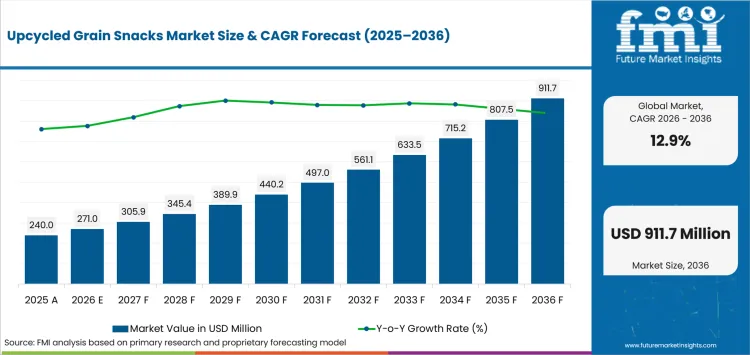
USD 271.0 Million in 2026 and USD 911.7 Million by 2036 at a 12.9% CAGR.
Demand for upcycled grain snacks is projected to expand at 12.9% CAGR between 2026 and 2036, increasing valuation from USD 271.0 Million in 2026 to USD 911.7 Million by 2036. Commercial scale depends on converting food-processing side streams into repeatable snack ingredients without adding enough drying, handling or formulation cost to undermine shelf economics.
Food-waste policy gives manufacturers a stronger reason to evaluate edible side streams before lower-value outlets are selected. The USA Department of Agriculture announced a national strategy in June 2024 that supports a 50% reduction in food loss and waste by 2030. That target does not create snack demand by itself. It does raise the value of food-grade recovery when processors can preserve safety, specifications and sensory quality.
Key Takeaways of Upcycled Grain Snacks Market
- Side-stream stabilization determines whether waste avoidance can become repeat snack production at normal retail economics.
- Brewers' Spent Grain is projected at 31.4% of Source Stream demand in 2026 because concentrated brewery output can be dried and milled into food ingredients.
- Puffs are estimated at 25.7% of Product Type demand in 2026 as extrusion can place milled side streams inside familiar snack textures.
- Upcycled Certified is forecast at 35.7% of Claim demand in 2026 because third-party certification gives buyers a consistent basis for evaluating upcycling claims.
- Pouches are estimated at 49.3% of Packaging demand, while Supermarkets & Hypermarkets account for 28.6% of Sales Channel demand in 2026.
- Moisture, variable composition and stabilization cost can weaken the raw-material advantage before an ingredient reaches a snack production line.
- Upcycled Foods (ReGrained), Renewal Mill, Pulp Pantry, Seven Sundays, Kazoo Snacks, B-SIDES, Barnana and Matriark Foods serve ingredient or consumer snack routes.
Analyst Perspective
"Commercial viability is decided before the circularity claim reaches the pack. Side-stream suppliers need rapid stabilization, food-grade traceability and specifications that behave consistently in repeated production. Snack brands then need to make the recovered ingredient unobtrusive to the eating experience while keeping its origin easy to verify."
- Nandini Roy Choudhury, Principal Consultant, Future Market Insights
How is the Upcycled Grain Snacks Market segmented?
The upcycled grain snacks market is segmented by Source Stream, Product Type, Claim, Packaging, Sales Channel and Region.
Source Stream identifies the residual material that supplies upcycled ingredients and determines stabilization requirements. Product Type separates the eating format and processing route. Claim covers certification and nutrition-led propositions. Packaging reflects shelf-life protection and portion architecture, while Sales Channel shows where consumers encounter the product. Packaged snack demand centers on products that turn recovered inputs into familiar formats with repeatable taste and shelf performance.
Why do Puffs account for 25.7% of Product Type?
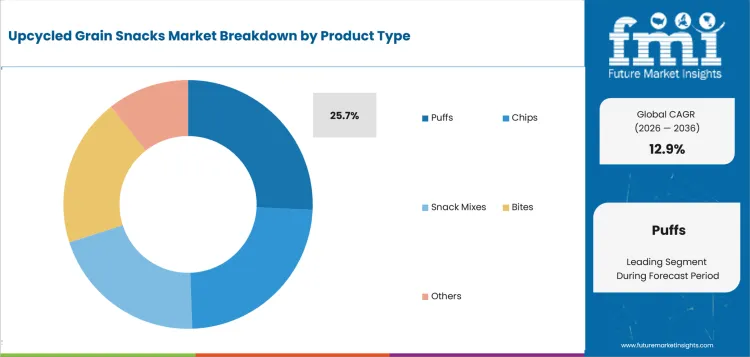
Puffs give formulators a practical route to combine upcycled grain fractions with starch or protein systems while preserving a familiar eating format. Extrusion controls expansion, density and shape, although high fiber loading can reduce expansion or harden texture. The commercial case therefore depends on inclusion levels that preserve eating quality. This processing logic aligns with established extruded snacks production systems and familiar consumer expectations.
- Puffs are estimated to represent 25.7% of Product Type demand in 2026 because extrusion can translate milled side streams into familiar shapes with controlled texture and portioning.
- Seven Sundays lists PB Puffs made with upcycled non-GMO corn and upcycled oat protein, providing a current consumer example of recovered grain inputs in a puff format.
Why does Brewers' Spent Grain account for 31.4% of Source Stream?
Brewers' spent grain is generated at concentrated brewery sites and can contribute fiber and protein after stabilization. Fresh material carries substantial moisture, so collection speed and drying economics are central to commercial feasibility. Milling then has to deliver a predictable particle size and composition for food formulation. A 2023 Journal of Agricultural and Food Chemistry review described brewers' spent grain as an opportunity for plant-based nutrition ingredients, while commercial platforms show how the stream can move into finished foods.
- Brewers' Spent Grain is projected to account for 31.4% of Source Stream demand in 2026 because a concentrated brewing side stream can be standardized into flour-like inputs for snack development.
- Upcycled Foods commercializes ReGrained SuperGrain+ from brewers' grain as a food ingredient for snack, bakery and other food applications.
Why does Upcycled Certified account for 35.7% of Claim?
An upcycling claim depends on a condition shoppers cannot assess directly at the shelf: the ingredient would otherwise have left the human food supply. Third-party certification gives retailers and consumers a common basis for evaluating the claim. Upcycled Certified is administered as a third-party certification program by the Upcycled Food Association and Where Food Comes From. For upcycled food products, the mark can strengthen ingredient-origin communication without making circularity the sole purchase reason.
- Upcycled Certified is forecast to account for 35.7% of Claim demand in 2026 because third-party certification can reduce uncertainty around ingredient origin and claim credibility.
- Renewal Mill lists recovered flour, protein and fiber ingredients with Upcycled Certified status, giving brand formulators certified inputs across several application routes.
Why do Pouches account for 49.3% of Packaging?
Pouches fit dry puffs, chips and snack mixes because flexible films can protect crispness from moisture while using less shipping volume than rigid packs. Resealable closures and multiple fill weights can be introduced without changing the basic packaging architecture. Upcycled brands also use the pack to explain ingredient provenance, so barrier performance and claim clarity need to coexist without making the package feel disproportionate to the product.
- Pouches are estimated to account for 49.3% of Packaging demand in 2026 because dry snack formats require moisture protection, efficient shelf presentation and flexible portion sizes.
- Kazoo Snacks has sold tortilla chips in bagged formats through USA grocery and e-commerce channels, illustrating the fit between dry upcycled snacks and flexible packs.
Why do Supermarkets & Hypermarkets account for 28.6% of Sales Channel?
Mainstream grocery places upcycled products beside conventional chips, puffs and other snack alternatives during routine shopping. That shelf context can reduce the education burden because consumers compare a familiar format before they process the circularity story. Retailers then impose practical tests through velocity, price architecture and replenishment discipline. This same shelf competition connects the category with established plant-based snacks where taste and value remain necessary for repeat purchase.
- Supermarkets & Hypermarkets are projected to account for 28.6% of Sales Channel demand in 2026 because they combine routine snack discovery with direct shelf comparison.
- Seven Sundays announced in May 2026 that PB Puffs and other products were expanding into Target stores nationwide, illustrating how a familiar upcycled format can move through a mass-retail channel.
What are the drivers, restraints and opportunities in the Upcycled Grain Snacks Market?
Food-waste prevention strengthens side-stream recovery, while stabilization cost and variable feedstock quality constrain repeat production; familiar snack formats create a defined commercial route.
- Driver: Food manufacturers and retailers have stronger incentives to retain edible processing side streams in human food when safety and economics are workable.
- Restraint: Wet or variable side streams require stabilization and food-grade control before formulation, which can raise cost before a snack reaches the shelf.
- Opportunity: Familiar puffs, chips and bites can carry certified upcycled ingredients into routine retail without asking consumers to learn a new eating occasion.
food waste management policy gives upcycling a clearer role inside prevention and recovery. USDA announced the USA National Strategy for Reducing Food Loss and Waste and Recycling Organics in June 2024, supporting a national goal to cut food loss and waste by 50% by 2030. That goal can change how processors evaluate edible side streams with residual nutritional value. Revenue still forms only when the recovered material can be converted into food-grade ingredients that meet normal taste and value expectations.
The binding friction sits between side-stream generation and repeatable food production. Brewers' spent grain, okara and produce residues can leave primary processing with substantial moisture. The Institute of Food Technologists noted in August 2024 that upcycled ingredients may carry added stabilization or transport cost and that manufacturers need reliable supply at a competitive price. Brands therefore have to qualify both the ingredient and the process that makes repeated batches behave consistently.
The commercial opening is clearest when upcycled ingredients enter formats with established shelf logic. Seven Sundays' 2026 PB Puffs use upcycled corn and oat protein, while B-SIDES launched Crunch Puffs with upcycled oat and corn ingredients in 2025. Ingredient suppliers can support this route with stable specifications and application work. Brand owners then need the circularity story to complement flavor and nutrition instead of replacing them as the reason for repeat purchase.
Which country CAGRs are profiled in the Upcycled Grain Snacks Market?
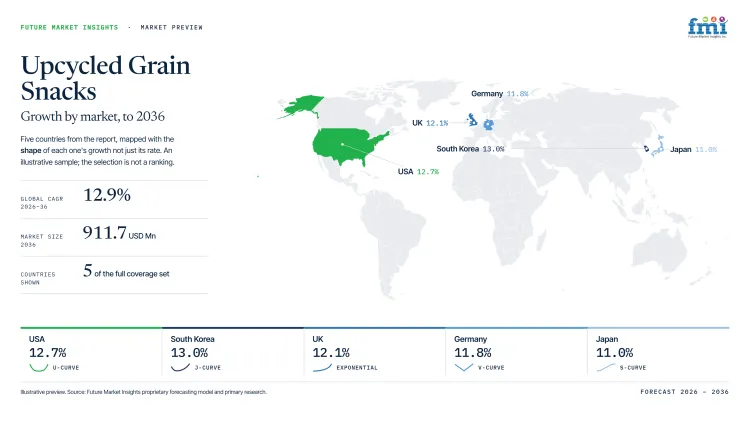
| Country | CAGR |
|---|---|
| USA | 12.7% |
| UK | 12.1% |
| Germany | 11.8% |
| Japan | 11.0% |
| South Korea | 13.0% |
How do country-level CAGRs compare in the Upcycled Grain Snacks Market?
The five country CAGRs run from 11.0% to 13.0%, a spread of 2.0 percentage points. The spacing describes expected expansion from 2026 to 2036 rather than current revenue pools. Commercial entry can therefore differ even where two growth rates sit close together because side-stream access, channel structure and qualification cost vary by country.
- USA is forecast at 12.7% CAGR. Broad grocery and e-commerce access can support testing, while mainstream shelf economics still determine repeat listings.
- UK is forecast at 12.1% CAGR. The food and drink waste hierarchy supports prevention and higher-value routes, but a snack conversion still has to outperform established alternatives on safety and economics.
- Germany is forecast at 11.8% CAGR. Food-waste reduction policy supports resource efficiency, while consumer acceptance still depends on normal product quality and price.
- Japan is forecast at 11.0% CAGR. Formal food-loss measurement provides a circular-economy context, while product consistency and trusted quality cues can shape commercialization.
- South Korea is forecast at 13.0% CAGR. Policy attention to segregated food by-products supports higher-value recovery, while human-food use still depends on food-grade handling and traceability.
CAGR should be read with local operating conditions rather than used as a stand-alone market-entry rule. The rate does not reveal the current retail base or the cost of stabilizing local side streams. It also does not show what shelf price consumers will accept. Regional analysis therefore needs to combine growth pace with sourcing economics and channel fit.
Country-wise Analysis
- USA: USA grocery buyers can test upcycled snacks through natural retail, conventional grocery and online channels, but expansion still depends on shelf velocity. Demand for Upcycled Grain Snacks in USA is forecast to expand at 12.7% CAGR from 2026 to 2036. USDA announced a national strategy in June 2024 that supports a 50% reduction in food loss and waste by 2030. The local commercial friction is economic because stabilization can raise ingredient cost while shoppers compare the product with ordinary snacks. Suppliers need food-grade sourcing evidence and familiar formats at retailer-ready price points so the waste-reduction story adds value without becoming the only reason to buy.
- UK: UK food manufacturers operate within a formal waste hierarchy that prioritizes preventing surplus and directs businesses toward higher-value routes before disposal. Demand for Upcycled Grain Snacks in UK is forecast to expand at 12.1% CAGR from 2026 to 2036. Defra guidance updated in January 2024 provides the operating context for surplus food and waste decisions. The commercial task is to show that a snack route is safe and economically credible relative to existing alternatives. Suppliers need traceable food-grade handling and evidence of reliable diversion, while retailers still expect normal taste and price performance.
- Germany: Germany combines a food-waste reduction strategy with established grocery channels where sustainability claims compete with normal quality and value expectations. Demand for Upcycled Grain Snacks in Germany is forecast to expand at 11.8% CAGR from 2026 to 2036. The Federal Government adopted a national strategy to reduce food waste with a 2030 reduction objective. For snack suppliers, resource efficiency does not offset an unfamiliar texture or a material shelf premium. Commercialization therefore depends on stable ingredient specifications and credible provenance, followed by retailer execution that makes the product feel comparable with other better-for-you snacks.
- Japan: Japanese commercialization places substantial weight on product consistency, portion discipline and clear quality cues. Demand for Upcycled Grain Snacks in Japan is forecast to expand at 11.0% CAGR from 2026 to 2036. Japan's Ministry of the Environment reported in June 2026 that food loss and waste in FY2024 was approximately 4.61 million tonnes, keeping reduction activity visible within the circular-economy agenda. The market challenge is to translate side-stream sourcing into language that signals controlled food production rather than waste. Suppliers can reduce trial risk through precise specifications, clear ingredient communication and pack formats suited to local channel expectations.
- South Korea: South Korean retail and digital channels can support rapid testing of novel snack formats when the product proposition is easy to understand. Demand for Upcycled Grain Snacks in South Korea is forecast to expand at 13.0% CAGR from 2026 to 2036. In December 2024, environment and agriculture authorities announced a regulatory-exception pilot for separately handled food by-products aimed at higher-value reuse. For snack suppliers, commercial development depends on segregated food-grade sourcing, traceability and formulations that fit local flavor and convenience expectations.
Who are the notable companies in the Upcycled Grain Snacks Market?
Upcycled Foods (ReGrained), Renewal Mill, Pulp Pantry, Seven Sundays, Kazoo Snacks, B-SIDES, Barnana and Matriark Foods are relevant companies serving the upcycled grain snacks market.
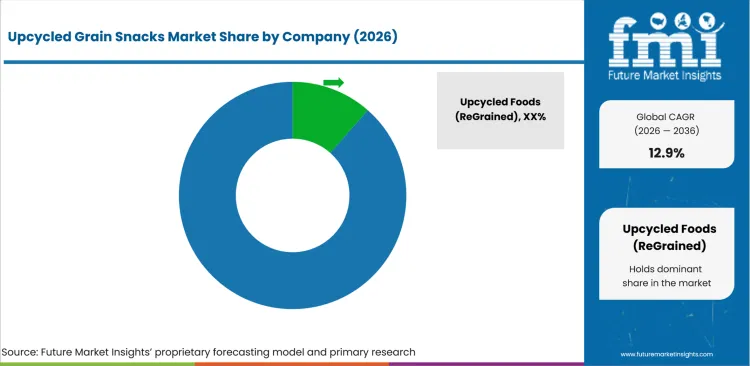
Competition spans direct snack brands and companies that convert food side streams into ingredients. Upcycled Foods (ReGrained) and Renewal Mill build value around food-grade processing inputs. Pulp Pantry, Seven Sundays, Kazoo Snacks and B-SIDES provide consumer snack examples. Barnana and Matriark Foods broaden the category through rescued produce and other recovered food streams, while upcycled vegetable snacks show how familiar chip formats can carry circular sourcing into retail.
- Grain-side-stream and formulation platforms: Upcycled Foods (ReGrained) and Renewal Mill compete through feedstock conversion know-how and application development.
- Retail snack-format specialists: Pulp Pantry, Seven Sundays, Kazoo Snacks and B-SIDES demonstrate recognizable consumer formats across retail or e-commerce routes.
- Broader upcycled-food models: Barnana and Matriark Foods show how rescued produce and processing remnants can support consumer or institutional foods outside the core grain-snack niche.
Competitive Benchmarking: Upcycled Grain Snacks Market
| Company | Upcycled Side-Stream Depth | Retail Snack Format Breadth | Traceability & Certification | Geographic Reach |
|---|---|---|---|---|
| Upcycled Foods (ReGrained) | High | Medium | High | United States; B2B collaborations and consumer snack applications |
| Renewal Mill | High | Medium | Medium | United States; retail products and B2B ingredient partnerships |
| Pulp Pantry | Medium | High | Medium | United States; retail and DTC snack channels |
| Seven Sundays | Medium | High | Medium | United States; national grocery and mass-retail distribution |
| Barnana | Medium | High | Medium | United States retail with produce-linked sourcing |
| Kazoo Snacks | High | High | Medium | United States; grocery and e-commerce distribution |
| Matriark Foods | Medium | Low | High | United States; foodservice, institutional and retail food applications |
| B-SIDES | High | Medium | Medium | United States; retail, DTC and Amazon distribution |
Scoring basis: Upcycled Side-Stream Depth measures the scale and variety of recovered food streams used in commercial products. Retail Snack Format Breadth assesses consumer-facing snack formats. Traceability & Certification covers certification, source transparency and chain-of-custody practices. High indicates broad capability within the criterion, Medium indicates focused capability and Low indicates limited activity. Geographic Reach reflects market distribution or sourcing activity.
Key Developments in the Upcycled Grain Snacks Market
- In May 2026, Seven Sundays announced a Target expansion that included PB Puffs made with plant protein and upcycled corn flour. The launch places a recovered grain input inside a familiar puff format through a national mass-retail route.
- In August 2025, Renewal Mill listed Upcycled Broken Oats for bulk or supersack supply. The ingredient is made from oat fragments captured during oat-flake production and provides a formulation-ready route for cereals, bars and other food applications.
- In April 2025, B-SIDES launched Crunch Puffs on Amazon, expanding nationwide e-commerce access for snacks made with upcycled oat and corn ingredients.
Key Players in the Upcycled Grain Snacks Market
Grain-Side-Stream Platforms and Formulation Specialists
- Upcycled Foods (ReGrained)
- Renewal Mill
Retail Snack-Format Specialists
- Pulp Pantry
- Seven Sundays
- Kazoo Snacks
- B-SIDES
Broader Upcycled Food and Produce-Rescue Brands
- Barnana
- Matriark Foods
Upcycled Grain Snacks Market - Report Scope
| Coverage field | Report scope |
|---|---|
| Market breakdown | By Source Stream, Product Type, Claim, Packaging, Sales Channel and Region. |
| Quantitative Units | USD Million. |
| Market Definition | Revenue covers packaged snacks intended for human consumption when the product intentionally uses an upcycled food-processing side stream. Stand-alone ingredient revenue, beverages, bakery products and meals fall outside this market unless sold as a packaged snack within the stated taxonomy. |
| Regions Covered | North America, Latin America, Western Europe, Eastern Europe, East Asia, South Asia and Pacific, and Middle East and Africa. |
| Countries Covered | USA, UK, Germany, Japan, South Korea and more than twenty-five additional countries included in the full report. |
| Key Companies | Upcycled Foods (ReGrained), Renewal Mill, Pulp Pantry, Seven Sundays, Kazoo Snacks, B-SIDES, Barnana, Matriark Foods. |
| Forecast Period | 2026 to 2036. |
| Approach | Primary and secondary research with market triangulation. |
Upcycled Grain Snacks Market - Research Methodology
| Method | Approach |
|---|---|
| Primary Research | FMI analysts gathered input from ingredient developers, snack manufacturers, retailers, distributors and channel partners. Interviews covered side-stream sourcing, stabilization requirements, formulation performance, pricing, retail acceptance and repeat-purchase conditions. |
| Desk Research | Desk research covered government food-waste policy, peer-reviewed literature, certification standards, company filings, product information and retail activity. The analysis focused on food-grade side streams, packaged snack formats, processing requirements and channel development. |
| Market Sizing and Forecasting | The market model combined the 2026 baseline with segment structure, source-stream conditions, channel participation, country growth assumptions and company activity. Forecast assumptions considered commercialization pace, stabilization economics, certification, retail access and the ability to meet conventional snack taste and value expectations. |
| Data Validation | Market estimates were reconciled across source-stream availability, product mix, channel participation and country demand conditions. Segment and country assumptions were checked for consistency with the global market total and the 2026 to 2036 forecast period. |
Upcycled Grain Snacks Market by Segments
Upcycled Grain Snacks Market segmented by Source Stream:
- Brewers' Spent Grain
- Okara (Soy Pulp)
- Oat Fiber Residue
- Fruit & Veg Pomace Blends
- Others
Upcycled Grain Snacks Market segmented by Product Type:
- Puffs
- Chips
- Snack Mixes
- Bites
- Others
Upcycled Grain Snacks Market segmented by Claim:
- Upcycled Certified
- High-Fiber
- Plant-Based
- Others
Upcycled Grain Snacks Market segmented by Packaging:
- Pouches
- Single-Serve
- Multipacks
- Others
Upcycled Grain Snacks Market segmented by Sales Channel:
- Supermarkets & Hypermarkets
- Online / DTC
- Convenience Stores
- Specialty & Health Stores
- Others
Upcycled Grain Snacks Market by Region:
- North America
- United States
- Canada
- Latin America
- Brazil
- Mexico
- Argentina
- Chile
- Western Europe
- Germany
- France
- United Kingdom
- Italy
- Spain
- Benelux
- Nordics
- Eastern Europe
- Poland
- Czech Republic
- Romania
- Hungary
- East Asia
- China
- Japan
- South Korea
- South Asia and Pacific
- India
- ASEAN
- Australia and New Zealand
- Middle East and Africa
- GCC Countries
- South Africa
- Türkiye
- Israel
Research Sources and Bibliography
- USA Department of Agriculture. (2024, June 12). National Strategy to Reduce Food Loss and Waste and Recycle Organics.
- Department for Environment, Food & Rural Affairs. (2024, January 1). Food and drink waste hierarchy guidance.
- Federal Government of Germany. (2019, February 20). National Strategy to Reduce Food Waste.
- Ministry of the Environment, Japan. (2026, June 30). Estimated amount of food loss and waste generated in FY2024.
- Ministry of Environment, Republic of Korea. (2024, December 17). Regulatory-exception pilot for food by-products used as livestock feed.
- Institute of Food Technologists. (2024, August 26). Upcycled Foods Break New Ground.
- Nyhan, L. et al. (2023). Brewers' Spent Grain: an opportunity for sustainable plant-based nutrition ingredients.
- Upcycled Food Association. Upcycled Certified Standard and certification program.
- Upcycled Foods, Inc. (2025, March 3). Upcycled breads co-developed with Misfits Market using ReGrained SuperGrain+.
- Upcycled Foods, Inc. ReGrained ingredient portfolio and food applications.
- Renewal Mill. Upcycled ingredient portfolio.
- Renewal Mill. (2025, August 5). Bulk ingredients, including Upcycled Broken Oats.
- Pulp Pantry. Current snack portfolio and ingredient information.
- Seven Sundays. PB Puffs product information.
- Seven Sundays. (2026, May 12). Seven Sundays Brings a Better Bowl to Target with New PB Puffs and Exclusive Dye-Free Cereal.
- Barnana. Current snack portfolio and upcycling information.
- Kazoo Snacks. (2022, December 1). USA distribution and water-savings update.
- Matriark Foods. Current upcycled food portfolio and sourcing approach.
- B-SIDES. (2025, April 1). B-SIDES Launches Upcycled Crunch Puffs on Amazon.
This bibliography is provided for reader reference and is not exhaustive. The full report contains the complete reference list and detailed citations.
This Report Answers
- How large is the Upcycled Grain Snacks Market in 2026 and 2036?
- Which operating conditions support recurring demand for snacks made with recovered food-processing side streams?
- Why does Brewers' Spent Grain account for 31.4% of Source Stream demand in 2026?
- How does the puff format shape processing choices for upcycled grain ingredients?
- Why does Upcycled Certified account for 35.7% of Claim demand in 2026?
- How do country growth rates affect market-entry conditions across USA, UK, Germany, Japan and South Korea?
- Which companies serve ingredient, snack-format or broader upcycled-food routes?
- Which stabilization and shelf-economics constraints can limit commercialization?
Frequently Asked Questions
How big is the Upcycled Grain Snacks Market in 2026?
USD 271.0 Million represents the upcycled grain snacks market value in 2026. The market is forecast to reach USD 911.7 Million by 2036 as more food-grade side streams are stabilized for consumer snack applications and brands secure repeat retail distribution.
What is the CAGR of the Upcycled Grain Snacks Market from 2026 to 2036?
A 12.9% CAGR is forecast for the upcycled grain snacks market between 2026 and 2036. Growth depends on stable side-stream specifications and food-grade processing, followed by consumer products that meet ordinary expectations for taste and shelf value.
Which Source Stream segment accounts for 31.4% of the Upcycled Grain Snacks Market?
Brewers' Spent Grain is projected to account for 31.4% of Source Stream demand in 2026. Brewery concentration creates a recoverable grain stream, while commercial value depends on rapid stabilization and consistent milling before the ingredient enters snack formulations.
How much will the Upcycled Grain Snacks Market add between 2026 and 2036?
USD 640.7 Million is expected to be added to the upcycled grain snacks market between 2026 and 2036. The increase depends on scaling food-grade recovery without allowing drying, transport or formulation cost to remove the economic advantage of the side stream.
Which companies are relevant to the Upcycled Grain Snacks Market?
Companies relevant to the market include Upcycled Foods (ReGrained), Renewal Mill, Pulp Pantry, Seven Sundays, Kazoo Snacks, B-SIDES, Barnana and Matriark Foods. The group spans ingredient conversion platforms and consumer snack brands using recovered food streams.
Preview the report firsthand - request a free sample
Get SampleGet the brochure for pricing and purchase details.
Get PDFTable of Content
- Key Takeaways
- Market Size and CAGR
- Top Growth Driver
- Fastest Growing Segment
- Leading Region
- Key Companies
- Emerging Opportunities
- Executive Summary
- Global Market Outlook
- Demand-side Trends
- Supply-side Trends
- Technology Roadmap Analysis
- Analysis and Recommendations
- Analyst Perspective (What is happening? Why now? What should investors know?)
- Key Questions Answered
- How large is the market?
- What is the CAGR?
- What are key trends?
- Which region dominates?
- Who are the leaders?
- Market Overview
- Market Coverage / Taxonomy
- Market Definition / Scope / Limitations
- Research Methodology
- Chapter Orientation
- Analytical Lens and Working Hypotheses
- Market Structure, Signals, and Trend Drivers
- Benchmarking and Cross-market Comparability
- Market Sizing, Forecasting, and Opportunity Mapping
- Research Design and Evidence Framework
- Desk Research Programme (Secondary Evidence)
- Expert Input and Fieldwork (Primary Evidence)
- Tooling, Models, and Reference Databases
- Data Engineering and Model Build
- Quality Assurance and Audit Trail
- Market Background
- Market Dynamics (Drivers, Restraints, Opportunity, Trends)
- Scenario Forecast (Optimistic, Likely, Conservative)
- Impact Analysis
- AI Impact
- Sustainability Impact
- Regulatory Impact
- Technology Impact
- Consumer / Buyer Analysis
- Purchase Drivers
- Adoption Barriers
- Buyer Journey
- Opportunity Map Analysis
- Product Life Cycle Analysis
- Supply Chain Analysis
- Investment Feasibility Matrix
- Value Chain Analysis
- PESTLE and Porter's Analysis
- Regulatory Landscape
- Regional Parent Market Outlook
- Production and Consumption Statistics
- Import and Export Statistics
- Global Market Analysis and Forecast, 2021 to 2036
- Historical Market Size Value (USD Million) Analysis, 2021 to 2025
- Current and Future Market Size Value (USD Million) Projections, 2026 to 2036
- Y-o-Y Growth Trend Analysis
- Absolute $ Opportunity Analysis
- Global Market Pricing Analysis, 2021 to 2036
- Global Market Analysis and Forecast, By Source Stream, 2021 to 2036
- Introduction / Key Findings
- Historical Market Size Value (USD Million) Analysis By Source Stream, 2021 to 2025
- Current and Future Market Size Value (USD Million) Analysis and Forecast By Source Stream, 2026 to 2036
- Brewers' Spent Grain
- Okara (Soy Pulp)
- Oat Fiber Residue
- Fruit & Veg Pomace Blends
- Others
- Brewers' Spent Grain
- Y-o-Y Growth Trend Analysis By Source Stream, 2021 to 2025
- Absolute $ Opportunity Analysis By Source Stream, 2026 to 2036
- Global Market Analysis and Forecast, By Product Type, 2021 to 2036
- Introduction / Key Findings
- Historical Market Size Value (USD Million) Analysis By Product Type, 2021 to 2025
- Current and Future Market Size Value (USD Million) Analysis and Forecast By Product Type, 2026 to 2036
- Puffs
- Chips
- Snack Mixes
- Bites
- Others
- Puffs
- Y-o-Y Growth Trend Analysis By Product Type, 2021 to 2025
- Absolute $ Opportunity Analysis By Product Type, 2026 to 2036
- Global Market Analysis and Forecast, By Claim, 2021 to 2036
- Introduction / Key Findings
- Historical Market Size Value (USD Million) Analysis By Claim, 2021 to 2025
- Current and Future Market Size Value (USD Million) Analysis and Forecast By Claim, 2026 to 2036
- Upcycled Certified
- High-Fiber
- Plant-Based
- Others
- Upcycled Certified
- Y-o-Y Growth Trend Analysis By Claim, 2021 to 2025
- Absolute $ Opportunity Analysis By Claim, 2026 to 2036
- Global Market Analysis and Forecast, By Packaging, 2021 to 2036
- Introduction / Key Findings
- Historical Market Size Value (USD Million) Analysis By Packaging, 2021 to 2025
- Current and Future Market Size Value (USD Million) Analysis and Forecast By Packaging, 2026 to 2036
- Pouches
- Single-Serve
- Multipacks
- Others
- Pouches
- Y-o-Y Growth Trend Analysis By Packaging, 2021 to 2025
- Absolute $ Opportunity Analysis By Packaging, 2026 to 2036
- Global Market Analysis and Forecast, By Sales Channel, 2021 to 2036
- Introduction / Key Findings
- Historical Market Size Value (USD Million) Analysis By Sales Channel, 2021 to 2025
- Current and Future Market Size Value (USD Million) Analysis and Forecast By Sales Channel, 2026 to 2036
- Supermarkets & Hypermarkets
- Online / DTC
- Convenience Stores
- Specialty & Health Stores
- Others
- Supermarkets & Hypermarkets
- Y-o-Y Growth Trend Analysis By Sales Channel, 2021 to 2025
- Absolute $ Opportunity Analysis By Sales Channel, 2026 to 2036
- Global Market Analysis and Forecast, By Region, 2021 to 2036
- Introduction
- Historical Market Size Value (USD Million) Analysis By Region, 2021 to 2025
- Current Market Size Value (USD Million) Analysis and Forecast By Region, 2026 to 2036
- North America
- Latin America
- Western Europe
- Eastern Europe
- East Asia
- South Asia and Pacific
- Middle East & Africa
- Market Attractiveness Analysis By Region
- North America Market Analysis and Forecast, By Country, 2021 to 2036
- Historical Market Size Value (USD Million) Trend Analysis By Market Taxonomy, 2021 to 2025
- Market Size Value (USD Million) Forecast By Market Taxonomy, 2026 to 2036
- By Country
- USA
- Canada
- By Source Stream
- By Product Type
- By Claim
- By Packaging
- By Sales Channel
- By Country
- Market Attractiveness Analysis
- By Country
- By Source Stream
- By Product Type
- By Claim
- By Packaging
- By Sales Channel
- Key Takeaways
- Latin America Market Analysis and Forecast, By Country
- Historical Market Size Value (USD Million) Trend Analysis By Market Taxonomy, 2021 to 2025
- Market Size Value (USD Million) Forecast By Market Taxonomy, 2026 to 2036
- By Country
- Brazil
- Mexico
- Chile
- Rest of Latin America
- By Source Stream
- By Product Type
- By Claim
- By Packaging
- By Sales Channel
- By Country
- Market Attractiveness Analysis
- By Country
- By Source Stream
- By Product Type
- By Claim
- By Packaging
- By Sales Channel
- Key Takeaways
- Western Europe Market Analysis and Forecast, By Country
- Historical Market Size Value (USD Million) Trend Analysis By Market Taxonomy, 2021 to 2025
- Market Size Value (USD Million) Forecast By Market Taxonomy, 2026 to 2036
- By Country
- Germany
- UK
- Italy
- Spain
- France
- Nordic
- BENELUX
- Rest of Western Europe
- By Source Stream
- By Product Type
- By Claim
- By Packaging
- By Sales Channel
- By Country
- Market Attractiveness Analysis
- By Country
- By Source Stream
- By Product Type
- By Claim
- By Packaging
- By Sales Channel
- Key Takeaways
- Eastern Europe Market Analysis and Forecast, By Country
- Historical Market Size Value (USD Million) Trend Analysis By Market Taxonomy, 2021 to 2025
- Market Size Value (USD Million) Forecast By Market Taxonomy, 2026 to 2036
- By Country
- Russia
- Poland
- Hungary
- Balkan & Baltic
- Rest of Eastern Europe
- By Source Stream
- By Product Type
- By Claim
- By Packaging
- By Sales Channel
- By Country
- Market Attractiveness Analysis
- By Country
- By Source Stream
- By Product Type
- By Claim
- By Packaging
- By Sales Channel
- Key Takeaways
- East Asia Market Analysis and Forecast, By Country
- Historical Market Size Value (USD Million) Trend Analysis By Market Taxonomy, 2021 to 2025
- Market Size Value (USD Million) Forecast By Market Taxonomy, 2026 to 2036
- By Country
- China
- Japan
- South Korea
- By Source Stream
- By Product Type
- By Claim
- By Packaging
- By Sales Channel
- By Country
- Market Attractiveness Analysis
- By Country
- By Source Stream
- By Product Type
- By Claim
- By Packaging
- By Sales Channel
- Key Takeaways
- South Asia and Pacific Market Analysis and Forecast, By Country
- Historical Market Size Value (USD Million) Trend Analysis By Market Taxonomy, 2021 to 2025
- Market Size Value (USD Million) Forecast By Market Taxonomy, 2026 to 2036
- By Country
- India
- ASEAN
- Australia & New Zealand
- Rest of South Asia and Pacific
- By Source Stream
- By Product Type
- By Claim
- By Packaging
- By Sales Channel
- By Country
- Market Attractiveness Analysis
- By Country
- By Source Stream
- By Product Type
- By Claim
- By Packaging
- By Sales Channel
- Key Takeaways
- Middle East & Africa Market Analysis and Forecast, By Country
- Historical Market Size Value (USD Million) Trend Analysis By Market Taxonomy, 2021 to 2025
- Market Size Value (USD Million) Forecast By Market Taxonomy, 2026 to 2036
- By Country
- Kingdom of Saudi Arabia
- Other GCC Countries
- Türkiye
- South Africa
- Other African Union
- Rest of Middle East & Africa
- By Source Stream
- By Product Type
- By Claim
- By Packaging
- By Sales Channel
- By Country
- Market Attractiveness Analysis
- By Country
- By Source Stream
- By Product Type
- By Claim
- By Packaging
- By Sales Channel
- Key Takeaways
- Key Countries Market Analysis
- USA
- Pricing Analysis
- Market Share Analysis, 2025
- By Source Stream
- By Product Type
- By Claim
- By Packaging
- By Sales Channel
- Canada
- Pricing Analysis
- Market Share Analysis, 2025
- By Source Stream
- By Product Type
- By Claim
- By Packaging
- By Sales Channel
- Mexico
- Pricing Analysis
- Market Share Analysis, 2025
- By Source Stream
- By Product Type
- By Claim
- By Packaging
- By Sales Channel
- Brazil
- Pricing Analysis
- Market Share Analysis, 2025
- By Source Stream
- By Product Type
- By Claim
- By Packaging
- By Sales Channel
- Chile
- Pricing Analysis
- Market Share Analysis, 2025
- By Source Stream
- By Product Type
- By Claim
- By Packaging
- By Sales Channel
- Germany
- Pricing Analysis
- Market Share Analysis, 2025
- By Source Stream
- By Product Type
- By Claim
- By Packaging
- By Sales Channel
- UK
- Pricing Analysis
- Market Share Analysis, 2025
- By Source Stream
- By Product Type
- By Claim
- By Packaging
- By Sales Channel
- Italy
- Pricing Analysis
- Market Share Analysis, 2025
- By Source Stream
- By Product Type
- By Claim
- By Packaging
- By Sales Channel
- Spain
- Pricing Analysis
- Market Share Analysis, 2025
- By Source Stream
- By Product Type
- By Claim
- By Packaging
- By Sales Channel
- France
- Pricing Analysis
- Market Share Analysis, 2025
- By Source Stream
- By Product Type
- By Claim
- By Packaging
- By Sales Channel
- India
- Pricing Analysis
- Market Share Analysis, 2025
- By Source Stream
- By Product Type
- By Claim
- By Packaging
- By Sales Channel
- ASEAN
- Pricing Analysis
- Market Share Analysis, 2025
- By Source Stream
- By Product Type
- By Claim
- By Packaging
- By Sales Channel
- Australia & New Zealand
- Pricing Analysis
- Market Share Analysis, 2025
- By Source Stream
- By Product Type
- By Claim
- By Packaging
- By Sales Channel
- China
- Pricing Analysis
- Market Share Analysis, 2025
- By Source Stream
- By Product Type
- By Claim
- By Packaging
- By Sales Channel
- Japan
- Pricing Analysis
- Market Share Analysis, 2025
- By Source Stream
- By Product Type
- By Claim
- By Packaging
- By Sales Channel
- South Korea
- Pricing Analysis
- Market Share Analysis, 2025
- By Source Stream
- By Product Type
- By Claim
- By Packaging
- By Sales Channel
- Russia
- Pricing Analysis
- Market Share Analysis, 2025
- By Source Stream
- By Product Type
- By Claim
- By Packaging
- By Sales Channel
- Poland
- Pricing Analysis
- Market Share Analysis, 2025
- By Source Stream
- By Product Type
- By Claim
- By Packaging
- By Sales Channel
- Hungary
- Pricing Analysis
- Market Share Analysis, 2025
- By Source Stream
- By Product Type
- By Claim
- By Packaging
- By Sales Channel
- Kingdom of Saudi Arabia
- Pricing Analysis
- Market Share Analysis, 2025
- By Source Stream
- By Product Type
- By Claim
- By Packaging
- By Sales Channel
- Türkiye
- Pricing Analysis
- Market Share Analysis, 2025
- By Source Stream
- By Product Type
- By Claim
- By Packaging
- By Sales Channel
- South Africa
- Pricing Analysis
- Market Share Analysis, 2025
- By Source Stream
- By Product Type
- By Claim
- By Packaging
- By Sales Channel
- USA
- Market Structure Analysis
- Competition Dashboard
- Competition Benchmarking
- Market Share Analysis of Top Players
- By Regional
- By Source Stream
- By Product Type
- By Claim
- By Packaging
- By Sales Channel
- Emerging Startups
- Innovation Benchmarking
- Competition Analysis
- Competition Deep Dive
- Upcycled Foods (ReGrained)
- Overview
- Product Portfolio
- Profitability by Market Segments
- Sales Footprint
- Strategy Overview
- Marketing Strategy
- Product Strategy
- Channel Strategy
- Renewal Mill
- Pulp Pantry
- Seven Sundays
- Barnana
- Kazoo Snacks
- Matriark Foods
- Take Two Foods
- Upcycled Foods (ReGrained)
- Case Studies
- Success Stories
- Recent Developments
- Competition Deep Dive
- Assumptions & Acronyms Used


