

- Market Size (2026)
- USD 1080.4 Mn
- Forecast (2036)
- USD 1726.6 Mn
- CAGR (2026 to 2036)
- 4.8%
How big is Upcycled & Sustainable Vitamin C Market in 2026?
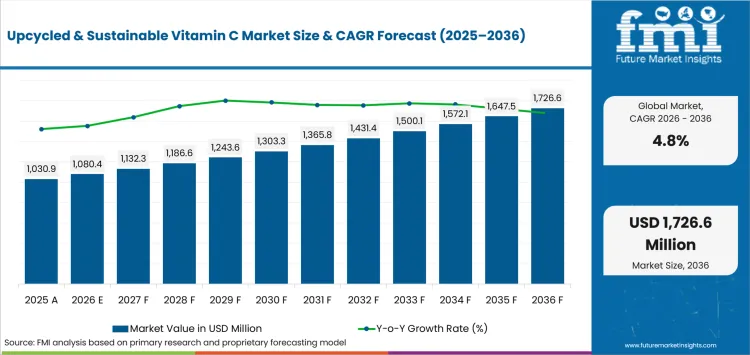
USD 1,080.4 million in 2026 and USD 1,726.6 million by 2036 at a 4.8% CAGR.
Demand for upcycled and sustainable vitamin C is projected to expand at 4.8% CAGR between 2026 and 2036. The valuation is expected to increase from USD 1080.4 million in 2026 to USD 1726.6 million by 2036. Food and supplement manufacturers need ingredients that deliver reliable potency across repeated production lots and varied applications. The FDA updated its ascorbic acid inventory in April 2026 and lists antioxidant and nutrient-supplement functions across regulated food uses. That application breadth supports commercial demand but does not validate every botanical source or recovery process. Acerola extracts compete through recognizable sourcing and measured vitamin content across natural supplement and beverage formulations. Fermented ingredients retain scale advantages through controlled purification and repeatable release testing across large commercial orders and customer specifications.
India and China carry faster projected growth rates through expanding nutrition production and broad domestic manufacturing capacity. The United States and Europe place greater weight on intended-use evidence and source documentation during ingredient qualification. EFSA reviewed its novel food procedure in May 2026 and requires detailed product and production evidence for new foods entering the European Union. That route matters for recovered vitamin C ingredients whose source or processing history differs from established ascorbic acid. Programs based on food waste recovery need traceable mass balances and contaminant controls prior to commercial use. Clean-label ingredients convert into repeat orders through stable potency and complete application records across new product launches. Country performance therefore depends on local approval pathways and dependable technical support rather than the forecast rate alone.
Key Takeaways of Upcycled & Sustainable Vitamin C Market
- Nutrition brands require stable vitamin potency and defensible production evidence across repeated commercial lots and finished-product applications.
- By source, fermentation is expected to retain 50.8% share in 2026 through repeatable process control and established high-volume release testing.
- Powder is projected to account for 40.4% share in 2026 through precise dry dosing across tablets and beverage premixes.
- Supplements are anticipated to capture 43.8% share in 2026 through defined serving quantities and familiar vitamin claim structures.
- Variable botanical composition and incomplete environmental boundaries remain material barriers that weaken release confidence and claim credibility across customer programs.
- dsm-firmenich and CSPC Pharmaceutical Group compete through fermentation scale; Symrise and Givaudan differentiate through standardized acerola and application support. Döhler and Nexira contribute fruit processing expertise; Kemin applies acerola-derived ascorbic acid to targeted food preservation.
Analyst Perspective
“Upcycled vitamin C earns a premium through evidence that links feedstock origin with stable assay performance across repeated commercial lots. Botanical recovery needs detailed contaminant controls; fermentation producers must prove that energy use and intermediate chemistry support the stated resource benefit. Strong programs address potency testing and regulatory authorization as distinct workstreams and define environmental boundaries for each production route and customer application.”
- Nandini Roy Choudhury, Principal Analyst, Future Market Insights
How is the Upcycled & Sustainable Vitamin C Market segmented?
The market is segmented by source, form, application, and region.
The source dimension separates controlled fermentation, recovered botanical material, and conventional synthetic production according to the evidence burden attached to each route. Form analysis covers powder, liquid, granules, and paste through dosing behavior, moisture sensitivity, and blending needs. Application analysis follows supplements, fortified foods, and beverages across dosage, processing, sensory, and shelf-life requirements. Regional assessment considers ingredient authorization, claim wording, distributor support, and local technical service across national markets. These dimensions determine whether a product fits the market boundary rather than treating every ascorbic acid ingredient as equivalent.
Why does fermentation lead the source category?
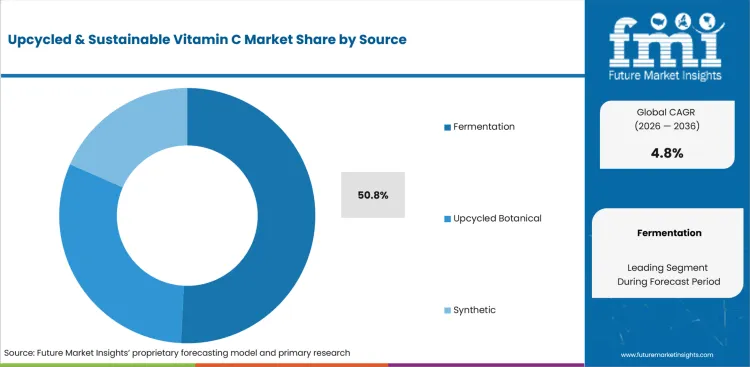
Fermentation remains the principal scale route through controlled reaction stages and purification across repeat production. CSPC Pharmaceutical Group reported in March 2026 that vitamin C sales increased during 2025 through stronger overseas demand. The result confirms active bulk demand without proving identical environmental performance across every production site. Precision fermentation advances provide broader context for biological process control and traceable release data across commercial production.
- By source, fermentation is estimated to hold 50.8% in 2026 owing to repeatable output across large commercial orders. Defined reactors reduce variation from field material and support comparable records across successive production campaigns. Manufacturers also receive clearer deviation histories through identifiable process stages and validated purification controls during release reviews.
- Pharmaceutical and food manufacturers adopt fermentation through release data and formal change-control commitments from qualified producers. The route loses appeal if energy use or intermediate chemistry weakens the intended resource claim. Long-term contracts therefore depend on consistent assay performance and comparable environmental boundaries across production sites and customer applications during scheduled audits.
How does powder shape the form category?
Powder converts vitamin C potency into a format suited to weighing and blending across several production lines. Döhler presented new supplement powder systems at Vitafoods Europe in May 2025 through concepts built around functional ingredients. The development confirms active formulation work in dry nutrition formats without proving performance for every acerola powder. Organic fruit powders provide useful comparisons for drying methods and carrier selection during stability planning.
- Powder is likely to capture 40.4% share in 2026 attributable to precise dry dosing across customer production lines. Measured handling supports tablets and beverage premixes without dedicated liquid equipment across manufacturing plants and production sites. The format also gives formulation teams greater control over addition points and declared concentration targets across several finished products.
- Nutrition manufacturers favor powder for stable logistics and flexible dosage design across supplements and fortified products. Carriers can obscure vitamin content and moisture can reduce stability during extended storage or transport. Commercial approval therefore compares assay retention and dispersibility with packaging protection and timely technical responses to results outside specification across production lots.
What supports supplements within the application category?
Supplement products provide a direct route for stated vitamin quantity and dosage instructions across capsules and liquid drops. Boots launched Modern Chemistry in May 2025 with liposomal vitamin C drops sold through stores and online channels. The launch confirms commercial interest in differentiated delivery formats without proving superior performance across every formulation. Dietary supplement formulations show why dosage design and claim discipline remain central across retail channels.
- The supplements segment is set to lead the application category with 43.8% share in 2026 due to defined commercial serving quantities. Brands can declare vitamin content through measured doses and select capsules or drops that protect stability across intended shelf lives. Clear dosage visibility simplifies qualification compared with fortified foods containing several interacting ingredients across multiple processing stages.
- Supplement manufacturers adopt sustainable or botanical vitamin C through reliable assay values and acceptable sensory performance in finished formats. Product teams must confirm the regulatory category and permitted claims for every destination market and retail channel. Repeat purchasing depends on balancing the source narrative with cost and shelf-life evidence throughout the package lifecycle and customer communication.
What are the drivers, restraints, and opportunities in the Upcycled & Sustainable Vitamin C Market?
Natural-source substitution supports demand but source variability and authorization requirements constrain adoption. Traceable side-stream recovery creates a commercial opening through stable potency and application-specific formulation support.
- Driver: Natural-source substitution creates demand for documented acerola performance across food applications that require color protection or vitamin delivery.
- Restraint: Variable botanical composition and source-specific authorization requirements increase testing costs and delay approval across finished-product categories.
- Opportunity: Standardized recovery from food side streams can create higher-value ingredients through documented safety and consistent vitamin potency.
Natural-source substitution is a notable demand driver in food applications that need color protection and recognizable ingredient labels. Kemin reported in April 2025 that its FORTIUM A line uses acerola extract for oxidation control as synthetic antioxidants face greater scrutiny. The evidence concerns a defined processing function rather than broad supplement demand or generalized natural-product preference. Producers secure repeat orders through application trials that confirm color performance and ingredient compatibility across commercial recipes and processing conditions.
Regulatory and compositional uncertainty forms the principal restraint for recovered botanical sources entering commercial formulations. The European Commission explained in February 2026 that food additives require authorization with defined conditions of use. A familiar vitamin identity therefore does not validate every extraction route or source matrix within finished foods. Manufacturers must fund additional safety and specification work prior to broader commercial use across regulated food applications. Smaller projects can become uneconomic as review costs approach the value created by the source narrative.
Traceable side-stream recovery creates an opportunity to convert discarded material into a controlled nutrient input rather than a low-value outlet. The Ellen MacArthur Foundation stated in May 2025 that upcycled ingredients require verifiable supply chains and suitable processing technology. Producers can apply that requirement to functional beverage applications through stable vitamin potency and controlled sensory behavior. Revenue improves through repeatable specifications that separate measurable ingredient performance from a general waste-origin narrative. Commercial contracts must also assign responsibility for variable feedstock quality and corrective processing across repeated production cycles.
Which country CAGRs are profiled in the Upcycled & Sustainable Vitamin C Market?
| Country | CAGR |
|---|---|
| China | 6.3% |
| USA | 5.9% |
| Germany | 5.1% |
| India | 6.7% |
| UK | 5.5% |
How do country-level CAGRs compare in the Upcycled & Sustainable Vitamin C Market?
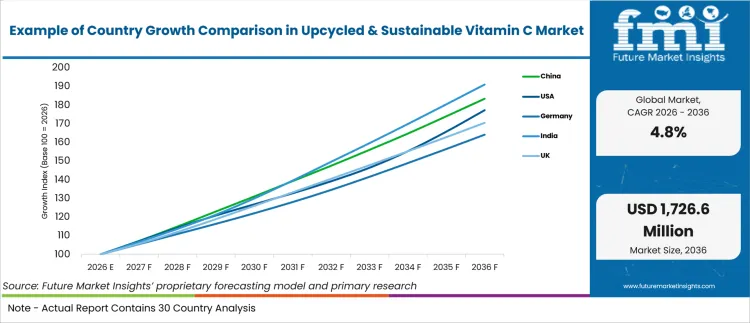
The country forecasts remain relatively close across the upcycled & sustainable vitamin C market, suggesting that interest in environmentally responsible sourcing and circular ingredient production is gaining traction across multiple regions. India and China form an upper group, supported by expanding nutraceutical, food and beverage applications that increasingly prioritize sustainability credentials. The USA follows within a narrow range and remains closely connected to the broader market trend. The UK and Germany create a lower pair with limited separation between their forecasts, reflecting steady but more measured adoption patterns.
- India shows a notable position within the comparison as manufacturers increasingly explore sustainable sourcing models and upcycled raw materials for nutritional ingredients and dietary supplements.
- China remains closely aligned with India through continued expansion of vitamin ingredient production and growing interest in resource-efficient manufacturing practices.
- The USA benefits from strong demand for clean-label supplements and functional food products, encouraging the adoption of sustainably produced vitamin C ingredients.
- The UK reflects steady market development as brands incorporate environmental claims and circular economy principles into ingredient sourcing strategies.
- Germany maintains a meaningful presence within the comparison as demand for sustainably sourced nutritional ingredients supports investment in alternative production and recovery methods.
Comparable CAGRs do not create identical market conditions across countries. Differences in raw material availability, sustainability standards, certification requirements and end-user purchasing preferences can influence commercialization pathways and adoption rates. Similar growth forecasts may therefore reflect distinct approaches to sourcing, production and market positioning within the vitamin C value chain. The full report provides country-level CAGR analysis across North America, Latin America, Europe, East Asia, South Asia, Oceania and the Middle East and Africa.
Country-wise Analysis
- Chinese manufacturers must classify vitamin C by its function within the finished product and apply the relevant national standard. The Chinese upcycled and sustainable vitamin C sector is projected to record 6.3% CAGR during the assessment period, supported by large food and supplement production clusters. The National Health Commission explained in September 2025 that vitamin C used as a nutrient fortifier requires content and nutrient-reference labeling under GB 28050-2025. Domestic production capacity and established export logistics provide a direct enabler for qualified bulk ingredients. Recovered botanical routes can face additional review if their source or processing method falls outside established specifications. Local dossier support and responsive distribution remain necessary to prevent labeling questions from delaying customer approval.
- United States formulators begin with the intended use and exact safety basis for each ascorbic acid or botanical ingredient. In the United States, upcycled and sustainable vitamin C demand is predicted to advance at 5.9% CAGR through 2036; established supplement and fortified food channels reinforce the outlook. National ingredient distributors and contract manufacturers provide a direct route for formulation testing across production regions. HHS directed FDA in March 2025 to explore rulemaking that would eliminate self-affirmed GRAS determinations and require public notification for new ingredients. A recovered matrix can require separate compositional and contaminant evidence despite recognized functions for ascorbic acid. Litigation exposure and detailed label review remain material frictions for natural-source or environmental claims that exceed documented evidence.
- German businesses must notify food supplements and remain responsible for lawful composition and presentation under national and European rules. Germany’s upcycled and sustainable vitamin C outlook is anticipated to advance at 5.1% CAGR over the assessment period, shaped by mature nutrition channels and cautious ingredient review. The Federal Office of Consumer Protection and Food Safety reconstituted its food and medicine classification commission in March 2025. Strong laboratory capacity and established European distribution provide a direct enabler for documented vitamin ingredients. Classification becomes a commercial friction for products that approach medicinal presentation or use unfamiliar source narratives. Supplement notification does not establish ingredient authorization and cannot support therapeutic wording across consumer marketing materials.
- Indian manufacturers first determine whether a vitamin product fits the health supplement framework or requires non-specified ingredient approval. India’s upcycled and sustainable vitamin C market is estimated to post 6.7% CAGR over the forecast period, reinforced by expanding branded nutrition manufacturing. Large contract manufacturers and national ingredient distributors provide a direct enabler across formulation and packaging workflows. FSSAI posted an application-status update in July 2026 and states that non-specified food approval follows risk analysis by scientific panels. Recovered sources with variable biomass composition can require extensive safety and specification evidence across successive lots. Approval timing remains a material friction as incomplete technical files delay licensing and customer qualification.
- United Kingdom businesses must confirm whether a vitamin ingredient fits an existing authorization or the regulated-products process prior to commercial sale. By 2036, the United Kingdom upcycled and sustainable vitamin C market is projected to grow at 5.5% CAGR; established pharmacy and nutrition retail channels drive demand. The Food Standards Agency implemented market-authorization reforms in April 2025 and retained safety assessment for regulated products including additives. Specialist distributors and contract supplement manufacturers provide a direct route across powders and liquid dosage formats. Post-Brexit differences from European Union decisions remain a material friction for companies serving both jurisdictions. Businesses must verify Great Britain status separately and maintain documentation for the exact source and intended use.
Who are the notable companies in the Upcycled & Sustainable Vitamin C Market?
dsm-firmenich, CSPC Pharmaceutical Group, Northeast Pharmaceutical, North China Pharmaceutical Group, Symrise, Givaudan, Döhler, Nexira, and Kemin are notable companies shaping this market.
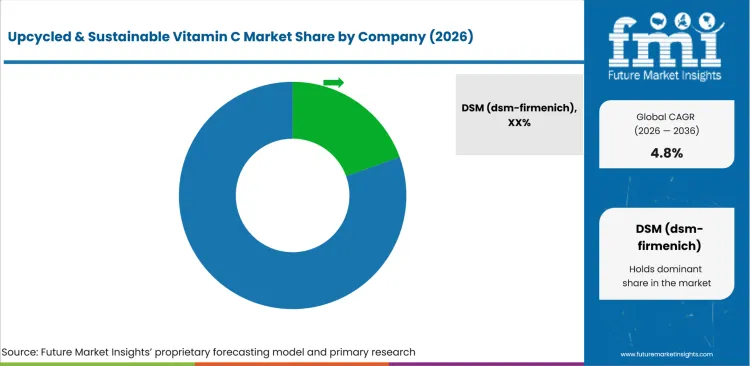
Competition separates large fermentation producers from botanical acerola specialists that emphasize source documentation and formulation support across nutrition applications. dsm-firmenich combines pharmaceutical-grade vitamin C with international technical coverage; CSPC Pharmaceutical Group and Northeast Pharmaceutical add bulk manufacturing routes with broad export access. Symrise and Givaudan connect standardized acerola with supplement and functional beverage concepts; Döhler and Nexira combine fruit processing with powder design. Kemin applies acerola-derived ascorbic acid to food oxidation control; Givaudan’s November 2025 UEBT membership strengthens traceability governance for natural ingredients. Broader botanical ingredient portfolios expand formulation choices but do not replace grade-specific potency evidence and stability support for commercial production.
- dsm-firmenich addresses fermentation-derived vitamin C through integrated production and technical support for pharmaceutical and nutrition customers. CSPC Pharmaceutical Group and Northeast Pharmaceutical add bulk manufacturing routes with international customer access across several nutrition segments. Each route must demonstrate consistent release quality and responsive technical service rather than relying on production capacity alone.
- Symrise and Givaudan develop standardized acerola platforms for supplements and functional foods across international networks. Their commercial models combine botanical sourcing with formulation concepts and analytical characterization for declared vitamin potency. Food and supplement manufacturers must compare source documentation with stability evidence for each offered grade and finished-product format.
- Döhler and Nexira support botanical powders through fruit processing and application work across several nutrition formats. Kemin focuses on oxidation control in food processing through acerola-derived ingredients and targeted formulation support. Selection depends on documented specifications and prompt technical service across customer production conditions and approval timelines.
Competitive Benchmarking: Upcycled & Sustainable Vitamin C Market
| Company | Traceability Evidence | Vitamin C Specification | Application Support | Geographic Reach |
|---|---|---|---|---|
| dsm-firmenich | High | High | Medium | Global |
| CSPC Pharmaceutical Group | Medium | High | Medium | Global |
| Northeast Pharmaceutical | Medium | High | Medium | Global |
| Symrise | Medium | High | Medium | Global |
| Givaudan | Medium | Medium | High | Global |
| Döhler | Medium | Medium | High | Global |
| Nexira | Medium | Medium | Medium | International |
| Kemin | Medium | Medium | Low | Global |
Key Developments in the Upcycled & Sustainable Vitamin C Market
- In November 2025, dsm-firmenich's Dalry facility received Bayer's 2025 Procurement Supplier Decarbonization Excellence Award, with a verified life-cycle assessment confirming a 49% lower carbon footprint for Dalry vitamin C against mainstream alternatives. Renewable electricity and process improvements supported the result through a third-party life-cycle assessment aligned with ISO 14040 and ISO 14044. The development gives pharmaceutical and nutrition customers a measurable sourcing distinction without extending the result to unrelated plants or recovered botanical sources. Commercial reviews should compare site-specific evidence rather than broad environmental statements during sourcing and qualification decisions.
- In May 2025, Symrise presented Acerowell™ at Vitafoods Europe with complete polyphenol characterization and standardization for its acerola vitamin C. The development connected natural sourcing with analytical definition across supplement concepts such as soft chews and concentrated shots. Commercial adoption depends on finished-format stability and permitted claims rather than the ingredient story alone. Formulation teams also need carrier and dosage data that remain valid across intended storage conditions.
- In November 2025, Döhler formed a North American partnership with VitaWorks for nutrition formulation and manufacturing. The agreement supports tablets, capsules, soft gels, powders, gummies, and liquids through two manufacturing sites and a planned West Coast Development Lab. Customers gain a more integrated concept-to-market route across development and manufacturing stages within the North American partnership. They must confirm exact acerola specifications within each finished product and define responsibility for stability testing across commercial-scale production changes.
- In December 2025, Givaudan presented wholefood acerola concepts for functional beverages and bakery products at Food Ingredients Europe. The program connected natural vitamin C with formulation support across distinct food matrices and sensory requirements. Commercial relevance depends on declared potency and stability data that match the final product rather than a broad botanical positioning claim. Manufacturers also need application evidence covering processing conditions and expected shelf life for each concept.
Upcycled & Sustainable Vitamin C Market - Report Scope
| Coverage field | Report scope |
|---|---|
| Market breakdown | Source, form, application, and region. |
| Quantitative Units | Revenue USD Million and CAGR in %. |
| Market Definition | Vitamin C produced through controlled fermentation or recovered from botanical and food-processing side streams with documented ingredient identity and resource claims. |
| Regions Covered | North America, Latin America, Western Europe, Eastern Europe, East Asia, South Asia and Pacific, and Middle East and Africa. |
| Countries Covered | China, USA, Germany, India, and UK, with more than twenty-five additional countries covered in the full report. |
| Key Companies Profiled | dsm-firmenich, CSPC Pharmaceutical Group, Northeast Pharmaceutical, Symrise, Givaudan, Döhler, Nexira, and Kemin |
| Forecast Period | 2026 to 2036. |
| Approach | Hybrid bottom-up and top-down market sizing supported by primary interviews and official desk research. |
Upcycled & Sustainable Vitamin C Market - Research Methodology
| Method | Approach |
|---|---|
| Primary Research | FMI analysts gathered input from manufacturers, service providers, technology developers, distributors, end users, procurement teams, and subject-matter experts. Interviews examined purchasing decisions, product or service evaluation, adoption barriers, approval requirements, pricing considerations, and expectations for technical or commercial support. Respondents were also asked what evidence is required before a trial, pilot, or initial order develops into regular purchasing. |
| Desk Research | Desk research covered government statistics, regulatory publications, trade data, industry associations, technical literature, standards, company filings, product information, and official corporate announcements. Sources were reviewed for relevance, publication date, geographic coverage, and consistency with the defined market scope. Claims relating to performance, applications, approvals, capacity, investment, and commercial activity were retained only when supported by credible public evidence. |
| Market Sizing and Forecasting | The market model combined the baseline value with historical performance, segment structure, pricing and volume indicators, adoption levels, company participation, and country-level demand conditions. Forecast assumptions considered economic activity, investment trends, regulatory developments, technology adoption, purchasing cycles, supply availability, and barriers to wider market use. Segment and regional estimates were reconciled before the final market total was calculated. |
| Data Validation | Estimates were checked against multiple independent indicators, including public data, company activity, trade patterns, industry developments, and findings from primary interviews. Validation also tested whether products, services, applications, and company revenues fell within the defined market boundaries. Adjacent categories, unsupported claims, overlapping revenues, and activities without direct market relevance were excluded to reduce double counting and maintain consistency across segments and countries. |
Upcycled & Sustainable Vitamin C Market by Segments
Upcycled & Sustainable Vitamin C Market segmented by Source:
- Fermentation
- Upcycled Botanical
- Synthetic
Upcycled & Sustainable Vitamin C Market segmented by Form:
- Powder
- Liquid
- Granules
- Paste
Upcycled & Sustainable Vitamin C Market segmented by Application:
- Supplements
- Fortified F&B
- Beverages
Upcycled & Sustainable Vitamin C Market by Region:
- North America
- United States
- Canada
- Latin America
- Brazil
- Mexico
- Argentina
- Chile
- Western Europe
- Germany
- France
- United Kingdom
- Italy
- Spain
- Benelux
- Nordics
- Eastern Europe
- Poland
- Czech Republic
- Romania
- Hungary
- East Asia
- China
- Japan
- South Korea
- South Asia and Pacific
- India
- ASEAN
- Australia and New Zealand
- Middle East and Africa
- GCC Countries
- South Africa
- Türkiye
- Israel
Research Sources and Bibliography
- USA Food and Drug Administration. (2026, April 21). Substances Added to Food (formerly EAFUS): ASCORBIC ACID.
- European Food Safety Authority. (2026, May 6). Novel food application procedure.
- CSPC Pharmaceutical Group Limited. (2026, March 25). Annual results for the year ended 31 December 2025.
- Döhler. (2025, May 7). Shaping the Future of Nutrition - Döhler Enters VITAFOODS Europe 2025 with Innovative Functional Ingredient Solutions.
- Boots UK. (2025, May 2). Boots launches new ingredient-led, science-backed own label brand, Modern Chemistry.
- Kemin Industries. (2025, April 28). Synthetic Antioxidants Face Scrutiny in the USA as Looming Bans Continue.
- European Commission. (2026, February 5). Food additives in the EU: Safe use and clear labelling.
- Ellen MacArthur Foundation. (2025, May 22). 10 circular design levers: Building a resilient food business.
- National Health Commission of the People’s Republic of China. (2025, September 25). 《食品安全国家标准 预包装食品营养标签通则》(GB 28050-2025)问答 [Questions and answers on GB 28050-2025 for nutrition labeling of prepackaged foods].
- USA Department of Health and Human Services. (2025, March 10). HHS Secretary Kennedy Directs FDA to Explore Rulemaking to Eliminate Pathway for Companies to Self-Affirm Food Ingredients Are Safe.
- Federal Office of Consumer Protection and Food Safety. (2025, March 11). Im Grenzbereich zwischen Arznei- und Lebensmitteln.
- Food Safety and Standards Authority of India. (2026, July 22). Non-specified food.
- Food Standards Agency. (2025, April 1). Reforms to the market authorisation process for regulated products come into force.
- dsm-firmenich. (2026, May 11). The vitamin C carbon problem, and how a pharma partnership solved it.
- Symrise. (2025, May 6). Symrise and Probi join forces at Vitafoods 2025 presenting health-active and biotic solutions.
- Döhler. (2025, November 12). Döhler and VitaWorks Partner to Drive Innovation in Health and Nutrition Across North America.
- Givaudan. (2025, December). Discover our naturals at FI Europe.
- Northeast Pharmaceutical Group Co., Ltd. (2026, April 27). 公司简介 [Company profile].
- Nexira. (2025, May 7). Embracing the future of nutribeauty.
- Givaudan. (2025, November 18). Givaudan becomes full member of UEBT: Sourcing with respect.
This bibliography is provided for reader reference and is not exhaustive. The full report contains the complete reference list and detailed citations.
This Report Answers
- How large is the upcycled and sustainable vitamin C market in 2026 and 2036?
- Why does fermentation account for the dominant source share in 2026?
- How does powder support commercial handling across supplements and fortified products?
- Why do supplements capture the significant application share in 2026?
- Which evidence requirements separate lower-impact production from unsupported environmental claims?
- How do country growth rates differ across India, China, the USA, the UK, and Germany?
- Which companies provide fermentation-derived or botanical vitamin C platforms?
- What regulatory and compositional issues slow adoption of recovered botanical sources?
- How can side-stream recovery produce repeatable commercial value without weakening vitamin specifications?
Frequently Asked Questions
How big is the Upcycled & Sustainable Vitamin C Market in 2026?
The upcycled & sustainable vitamin C market is valued at USD 1,080.4 million in 2026 and is forecast to reach USD 1,726.6 million by 2036. Growth is supported by food and supplement manufacturers requiring ingredients that deliver reliable potency across repeated production lots and varied applications with defensible source documentation.
What is the CAGR of the Upcycled & Sustainable Vitamin C Market from 2026 to 2036?
The upcycled & sustainable vitamin C market grows at a CAGR of 4.8% between 2026 and 2036, supported by rising demand for clean-label ingredients and traceable production routes once stable potency and complete application records convert into repeat commercial orders across supplement and fortified food channels in regulated national markets.
Which source leads the Upcycled & Sustainable Vitamin C Market?
Fermentation accounts for 50.8% of the upcycled & sustainable vitamin C market by source in 2026, driven by repeatable output across large commercial orders, defined reactor controls that reduce variation from field material, and comparable release records across successive production campaigns that support pharmaceutical and food manufacturer qualification programs.
How much will the Upcycled & Sustainable Vitamin C Market add between 2026 and 2036?
The upcycled & sustainable vitamin C market is set to add USD 646.2 million between 2026 and 2036, growing from USD 1080.4 million to USD 1726.6 million as traceable fermentation and botanical recovery routes enter commercial supplement, fortified food, and beverage channels across a widening base of regulated national markets.
Who are the leading companies in the Upcycled & Sustainable Vitamin C Market?
Eight companies shape the upcycled & sustainable vitamin C market, including dsm-firmenich, CSPC Pharmaceutical Group, Northeast Pharmaceutical, Symrise, Givaudan, Döhler, Nexira, and Kemin, competing through fermentation-scale production, standardized acerola platforms, botanical powder expertise, and targeted food oxidation control applications across global and international nutrition channels.
Preview the report firsthand - request a free sample
Get SampleGet the brochure for pricing and purchase details.
Get PDFTable of Content
- Key Takeaways
- Market Size and CAGR
- Top Growth Driver
- Fastest Growing Segment
- Leading Region
- Key Companies
- Emerging Opportunities
- Executive Summary
- Global Market Outlook
- Demand-side Trends
- Supply-side Trends
- Technology Roadmap Analysis
- Analysis and Recommendations
- Analyst Perspective (What is happening? Why now? What should investors know?)
- Key Questions Answered
- How large is the market?
- What is the CAGR?
- What are key trends?
- Which region dominates?
- Who are the leaders?
- Market Overview
- Market Coverage / Taxonomy
- Market Definition / Scope / Limitations
- Research Methodology
- Chapter Orientation
- Analytical Lens and Working Hypotheses
- Market Structure, Signals, and Trend Drivers
- Benchmarking and Cross-market Comparability
- Market Sizing, Forecasting, and Opportunity Mapping
- Research Design and Evidence Framework
- Desk Research Programme (Secondary Evidence)
- Expert Input and Fieldwork (Primary Evidence)
- Tooling, Models, and Reference Databases
- Data Engineering and Model Build
- Quality Assurance and Audit Trail
- Market Background
- Market Dynamics (Drivers, Restraints, Opportunity, Trends)
- Scenario Forecast (Optimistic, Likely, Conservative)
- Impact Analysis
- AI Impact
- Sustainability Impact
- Regulatory Impact
- Technology Impact
- Consumer / Buyer Analysis
- Purchase Drivers
- Adoption Barriers
- Buyer Journey
- Opportunity Map Analysis
- Product Life Cycle Analysis
- Supply Chain Analysis
- Investment Feasibility Matrix
- Value Chain Analysis
- PESTLE and Porter's Analysis
- Regulatory Landscape
- Regional Parent Market Outlook
- Production and Consumption Statistics
- Import and Export Statistics
- Global Market Analysis and Forecast, 2021 to 2036
- Historical Market Size Value (USD Million) Analysis, 2021 to 2025
- Current and Future Market Size Value (USD Million) Projections, 2026 to 2036
- Y-o-Y Growth Trend Analysis
- Absolute $ Opportunity Analysis
- Global Market Pricing Analysis, 2021 to 2036
- Global Market Analysis and Forecast, By Source, 2021 to 2036
- Introduction / Key Findings
- Historical Market Size Value (USD Million) Analysis By Source, 2021 to 2025
- Current and Future Market Size Value (USD Million) Analysis and Forecast By Source, 2026 to 2036
- Fermentation
- Upcycled Botanical
- Synthetic
- Fermentation
- Y-o-Y Growth Trend Analysis By Source, 2021 to 2025
- Absolute $ Opportunity Analysis By Source, 2026 to 2036
- Global Market Analysis and Forecast, By Form, 2021 to 2036
- Introduction / Key Findings
- Historical Market Size Value (USD Million) Analysis By Form, 2021 to 2025
- Current and Future Market Size Value (USD Million) Analysis and Forecast By Form, 2026 to 2036
- Powder
- Liquid
- Granules
- Paste
- Powder
- Y-o-Y Growth Trend Analysis By Form, 2021 to 2025
- Absolute $ Opportunity Analysis By Form, 2026 to 2036
- Global Market Analysis and Forecast, By Application, 2021 to 2036
- Introduction / Key Findings
- Historical Market Size Value (USD Million) Analysis By Application, 2021 to 2025
- Current and Future Market Size Value (USD Million) Analysis and Forecast By Application, 2026 to 2036
- Supplements
- Fortified F&B
- Beverages
- Supplements
- Y-o-Y Growth Trend Analysis By Application, 2021 to 2025
- Absolute $ Opportunity Analysis By Application, 2026 to 2036
- Global Market Analysis and Forecast, By Region, 2021 to 2036
- Introduction
- Historical Market Size Value (USD Million) Analysis By Region, 2021 to 2025
- Current Market Size Value (USD Million) Analysis and Forecast By Region, 2026 to 2036
- North America
- Latin America
- Western Europe
- Eastern Europe
- East Asia
- South Asia and Pacific
- Middle East & Africa
- Market Attractiveness Analysis By Region
- North America Market Analysis and Forecast, By Country, 2021 to 2036
- Historical Market Size Value (USD Million) Trend Analysis By Market Taxonomy, 2021 to 2025
- Market Size Value (USD Million) Forecast By Market Taxonomy, 2026 to 2036
- By Country
- USA
- Canada
- By Source
- By Form
- By Application
- By Country
- Market Attractiveness Analysis
- By Country
- By Source
- By Form
- By Application
- Key Takeaways
- Latin America Market Analysis and Forecast, By Country
- Historical Market Size Value (USD Million) Trend Analysis By Market Taxonomy, 2021 to 2025
- Market Size Value (USD Million) Forecast By Market Taxonomy, 2026 to 2036
- By Country
- Brazil
- Mexico
- Chile
- Rest of Latin America
- By Source
- By Form
- By Application
- By Country
- Market Attractiveness Analysis
- By Country
- By Source
- By Form
- By Application
- Key Takeaways
- Western Europe Market Analysis and Forecast, By Country
- Historical Market Size Value (USD Million) Trend Analysis By Market Taxonomy, 2021 to 2025
- Market Size Value (USD Million) Forecast By Market Taxonomy, 2026 to 2036
- By Country
- Germany
- UK
- Italy
- Spain
- France
- Nordic
- BENELUX
- Rest of Western Europe
- By Source
- By Form
- By Application
- By Country
- Market Attractiveness Analysis
- By Country
- By Source
- By Form
- By Application
- Key Takeaways
- Eastern Europe Market Analysis and Forecast, By Country
- Historical Market Size Value (USD Million) Trend Analysis By Market Taxonomy, 2021 to 2025
- Market Size Value (USD Million) Forecast By Market Taxonomy, 2026 to 2036
- By Country
- Russia
- Poland
- Hungary
- Balkan & Baltic
- Rest of Eastern Europe
- By Source
- By Form
- By Application
- By Country
- Market Attractiveness Analysis
- By Country
- By Source
- By Form
- By Application
- Key Takeaways
- East Asia Market Analysis and Forecast, By Country
- Historical Market Size Value (USD Million) Trend Analysis By Market Taxonomy, 2021 to 2025
- Market Size Value (USD Million) Forecast By Market Taxonomy, 2026 to 2036
- By Country
- China
- Japan
- South Korea
- By Source
- By Form
- By Application
- By Country
- Market Attractiveness Analysis
- By Country
- By Source
- By Form
- By Application
- Key Takeaways
- South Asia and Pacific Market Analysis and Forecast, By Country
- Historical Market Size Value (USD Million) Trend Analysis By Market Taxonomy, 2021 to 2025
- Market Size Value (USD Million) Forecast By Market Taxonomy, 2026 to 2036
- By Country
- India
- ASEAN
- Australia & New Zealand
- Rest of South Asia and Pacific
- By Source
- By Form
- By Application
- By Country
- Market Attractiveness Analysis
- By Country
- By Source
- By Form
- By Application
- Key Takeaways
- Middle East & Africa Market Analysis and Forecast, By Country
- Historical Market Size Value (USD Million) Trend Analysis By Market Taxonomy, 2021 to 2025
- Market Size Value (USD Million) Forecast By Market Taxonomy, 2026 to 2036
- By Country
- Kingdom of Saudi Arabia
- Other GCC Countries
- Türkiye
- South Africa
- Other African Union
- Rest of Middle East & Africa
- By Source
- By Form
- By Application
- By Country
- Market Attractiveness Analysis
- By Country
- By Source
- By Form
- By Application
- Key Takeaways
- Key Countries Market Analysis
- USA
- Pricing Analysis
- Market Share Analysis, 2025
- By Source
- By Form
- By Application
- Canada
- Pricing Analysis
- Market Share Analysis, 2025
- By Source
- By Form
- By Application
- Mexico
- Pricing Analysis
- Market Share Analysis, 2025
- By Source
- By Form
- By Application
- Brazil
- Pricing Analysis
- Market Share Analysis, 2025
- By Source
- By Form
- By Application
- Chile
- Pricing Analysis
- Market Share Analysis, 2025
- By Source
- By Form
- By Application
- Germany
- Pricing Analysis
- Market Share Analysis, 2025
- By Source
- By Form
- By Application
- UK
- Pricing Analysis
- Market Share Analysis, 2025
- By Source
- By Form
- By Application
- Italy
- Pricing Analysis
- Market Share Analysis, 2025
- By Source
- By Form
- By Application
- Spain
- Pricing Analysis
- Market Share Analysis, 2025
- By Source
- By Form
- By Application
- France
- Pricing Analysis
- Market Share Analysis, 2025
- By Source
- By Form
- By Application
- India
- Pricing Analysis
- Market Share Analysis, 2025
- By Source
- By Form
- By Application
- ASEAN
- Pricing Analysis
- Market Share Analysis, 2025
- By Source
- By Form
- By Application
- Australia & New Zealand
- Pricing Analysis
- Market Share Analysis, 2025
- By Source
- By Form
- By Application
- China
- Pricing Analysis
- Market Share Analysis, 2025
- By Source
- By Form
- By Application
- Japan
- Pricing Analysis
- Market Share Analysis, 2025
- By Source
- By Form
- By Application
- South Korea
- Pricing Analysis
- Market Share Analysis, 2025
- By Source
- By Form
- By Application
- Russia
- Pricing Analysis
- Market Share Analysis, 2025
- By Source
- By Form
- By Application
- Poland
- Pricing Analysis
- Market Share Analysis, 2025
- By Source
- By Form
- By Application
- Hungary
- Pricing Analysis
- Market Share Analysis, 2025
- By Source
- By Form
- By Application
- Kingdom of Saudi Arabia
- Pricing Analysis
- Market Share Analysis, 2025
- By Source
- By Form
- By Application
- Türkiye
- Pricing Analysis
- Market Share Analysis, 2025
- By Source
- By Form
- By Application
- South Africa
- Pricing Analysis
- Market Share Analysis, 2025
- By Source
- By Form
- By Application
- USA
- Market Structure Analysis
- Competition Dashboard
- Competition Benchmarking
- Market Share Analysis of Top Players
- By Regional
- By Source
- By Form
- By Application
- Emerging Startups
- Innovation Benchmarking
- Competition Analysis
- Competition Deep Dive
- DSM (dsm-firmenich)
- Overview
- Product Portfolio
- Profitability by Market Segments
- Sales Footprint
- Strategy Overview
- Marketing Strategy
- Product Strategy
- Channel Strategy
- Biovit
- CSPC
- NHU
- Northeast Pharma
- BASF
- DSM (dsm-firmenich)
- Case Studies
- Success Stories
- Recent Developments
- Competition Deep Dive
- Assumptions & Acronyms Used


