

- Market Size (2026)
- USD 198.1 Mn
- Forecast (2036)
- USD 684.5 Mn
- CAGR (2026 to 2036)
- 13.2%
How big is Upcycled Vegetable Chips Market in 2026?
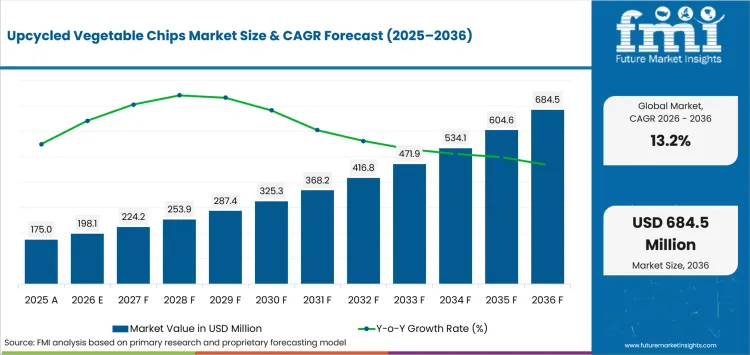
USD 198.1 million in 2026 and USD 684.5 million by 2036 at a 13.2% CAGR.
Demand for upcycled vegetable chips is projected to expand at 13.2% CAGR between 2026 and 2036, increasing valuation from USD 198.1 million in 2026 to USD 684.5 million by 2036. The commercial task is to turn edible vegetable seconds, pulp or trim into a packaged snack that performs like a conventional chip on food safety, crunch and replenishment reliability.
Upcycling works only when the recovered material remains suitable for human consumption before conversion. USA Environmental Protection Agency guidance places upcycling in a preferred tier of wasted-food pathways, while the Upcycled Food Association ties upcycled products to inputs that would otherwise leave human consumption and are handled through traceable supply chains. Chip manufacturers therefore need intake specifications and controlled segregation before processing begins.
Key Takeaways of Upcycled Vegetable Chips Market
- Food-waste prevention creates a commercial route for edible vegetable seconds when the material remains suitable for human food before processing.
- Potato Seconds are projected to account for 27.9% of Vegetable Source demand in 2026 because irregular potatoes can fit established slicing and frying operations.
- Kettle-Fried is estimated at 37.9% of Process demand, while Upcycled Certified is forecast at 32.8% of Claim demand in 2026.
- Standard Bags are estimated at 45.6% of Packaging demand and Supermarkets & Hypermarkets at 43.0% of Sales Channel demand in 2026.
- Variable moisture, feedstock stability and documentation costs can weaken economics before the recovered input reaches the fryer or oven.
- Pulp Pantry, Uglies (Dieffenbach's), Spudsy, Rind Snacks, Barnana, Rubies in the Rubble, Outcast Foods and Kazoo Snacks represent direct or adjacent upcycled food routes.
Analyst Perspective
“Upcycled vegetable chips become commercially viable when a recovered stream behaves like a food ingredient before it reaches the fryer or oven. Brands need intake specifications that protect texture and food safety, while claim documentation must be simple enough for retail teams to review. Expansion should follow repeat purchase rather than novelty around the waste story.”
- Nandini Roy Choudhury, Principal Consultant, Future Market Insights
How is the Upcycled Vegetable Chips Market segmented?
The upcycled vegetable chips market is segmented by vegetable source, process, claim, packaging, sales channel and region.
The market separates the recovered input from the conversion method, consumer-facing claim, pack format and route to purchase. Vegetable Source covers Potato Seconds, Carrot & Root Pulp, Beet Pulp, Leafy Trim Blends and Others. Process covers Kettle-Fried, Baked, Dehydrated and Others. Claim includes Upcycled Certified, Non-GMO, Vegan and Others. Packaging covers Standard Bags, Single-Serve, Multipacks and Others, while Sales Channel covers Supermarkets & Hypermarkets, Online / DTC, Convenience Stores, Specialty & Health Stores and Others. These decisions sit within the wider upcycled foods category, while the counted market remains limited to qualifying vegetable-chip products.
Why does Upcycled Certified lead the Claim category?
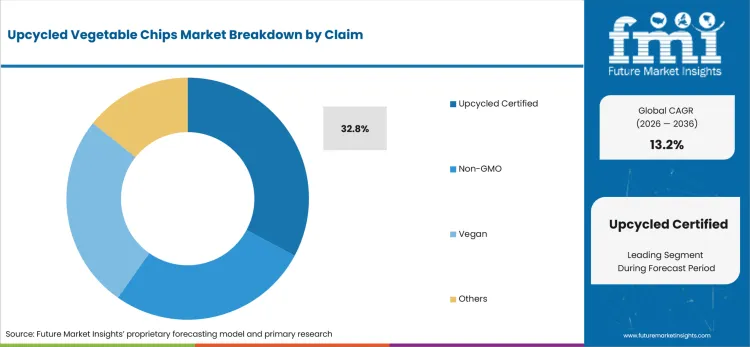
An upcycled claim has commercial value when buyers can identify what material was diverted and how the product qualifies. Non-GMO and Vegan claims can support positioning, but they do not explain the recovered input itself. Third-party certification gives retailers and consumers a recognizable route for reviewing the upcycling claim without relying only on brand-created language.
- Upcycled Certified is forecast to account for 32.8% of Claim demand in 2026 because the program provides a structured third-party route for qualifying upcycled products and ingredients.
- The Upcycled Certified program requires qualifying inputs and supply-chain documentation, connecting front-of-pack claims with sourcing and production controls.
Why do Potato Seconds lead the Vegetable Source category?
Potato seconds fit established chip-making operations because cosmetic rejection does not automatically make a potato unsuitable for food. Carrot and root pulp, beet pulp and leafy trim blends usually require more formulation work to manage moisture, fiber and flavor. The familiar potato base also lets brands enter the existing veggie chips aisle without asking shoppers to learn a new snack format.
- Based on Vegetable Source, Potato Seconds are projected to account for 27.9% in 2026 because irregular potatoes can be sliced and cooked through familiar chip processes when they meet food-grade intake specifications.
- Uglies describes its kettle chips as using potatoes with cosmetic imperfections or farmer surplus, showing how grade-out potatoes can remain within a conventional packaged-chip route.
Why does Kettle-Fried lead the Process category?
Kettle-fried chips preserve a recognizable crunch and can accommodate recovered potato inputs without changing the basic consumption experience. Baked and dehydrated products provide alternative process routes, but they can require tighter control of moisture and texture when the incoming recovered material varies from batch to batch.
- Kettle-Fried is estimated at 37.9% of Process demand in 2026 because the method aligns recovered potato inputs with an established finished-chip texture and familiar shelf position.
- Uglies uses kettle cooking across its core potato and sweet-potato chip range, illustrating how an upcycled input can remain inside a conventional salty-snack process.
Why do Standard Bags lead the Packaging category?
Standard bags use the format shoppers already expect in the snack aisle and provide enough front-of-pack space for an upcycling claim. Single-serve packs suit controlled portions, while multipacks support household and lunchbox use. The format also fits the shelf conventions used across healthy snacks where familiar packaging lowers the learning burden for a differentiated ingredient story.
- Standard Bags are estimated to account for 45.6% of Packaging demand in 2026 because they fit existing salty-snack merchandising, case packing and shelf-replenishment practices.
- A conventional bag format lets the sustainability message sit alongside flavor and nutrition cues instead of forcing a separate merchandising system.
Why do Supermarkets & Hypermarkets lead the Sales Channel category?
Supermarkets and hypermarkets place upcycled chips beside familiar snack alternatives and support repeated household purchase. Online channels can explain a new ingredient story in more detail, while specialty stores can support early trial around sustainability or dietary claims. Mainstream grocery becomes important once the product must compete on flavor, price and availability with conventional plant-based snacks bought during routine shopping trips.
- Supermarkets & Hypermarkets are projected to account for 43.0% of Sales Channel demand in 2026 because mainstream grocery expands discovery and repeat shelf exposure beyond specialist sustainability shoppers.
- Upcycled Food Association material has documented Sprouts availability for upcycled snack brands, illustrating how established grocery distribution can support repeated purchase.
What are the drivers, restraints and opportunities in the Upcycled Vegetable Chips Market?
Food-waste prevention supports demand, while feedstock variability and handling costs slow scaling as processor-linked sourcing creates a practical route to broader commercial use.
- Driver: Edible vegetable seconds and by-products can be converted into familiar packaged snacks instead of leaving human consumption.
- Restraint: Variable moisture, collection logistics and qualification requirements can raise cost before a recovered stream becomes a dependable food ingredient.
- Opportunity: Partnerships close to potato processors, juicers or produce packers can improve source separation and shorten the path from by-product generation to controlled food processing.
Food-waste prevention provides a direct operating rationale for upcycling when edible material remains in human use. EPA guidance places upcycling in a preferred wasted-food pathway. For a chip brand, the sustainability rationale still has to meet ordinary commercial tests including food safety, taste, price and repeat retail availability.
Supply variability is the central restraint because recovered vegetable streams can change in moisture, fiber and flavor. This makes intake specifications and preprocessing more important than they are for a tightly standardized conventional ingredient. The same issue appears across upcycled ingredients where collection logistics and qualification determine whether a side stream can become a repeatable commercial input.
Processor-linked sourcing creates a workable opportunity because segregation can happen before edible vegetable material is mixed with broader waste. ReFED identifies manufacturer partnerships and improved product utilization as routes for reducing surplus food. For chip producers, the practical advantage comes from controlling the recovered stream near the point where it is generated.
Which country CAGRs are profiled in the Upcycled Vegetable Chips Market?
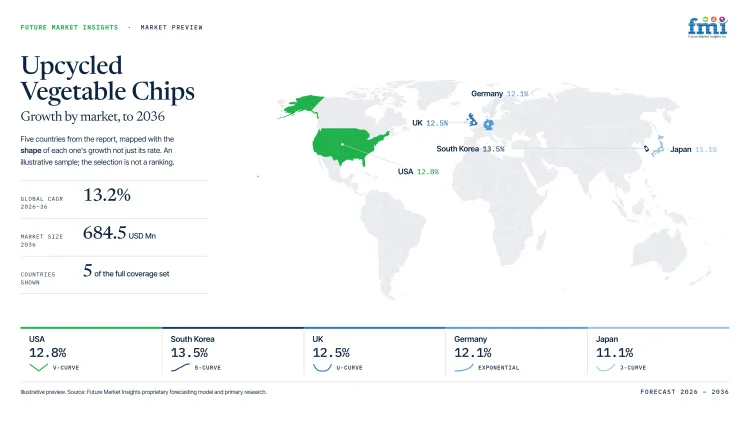
| Country | CAGR |
|---|---|
| South Korea | 13.5% |
| USA | 12.8% |
| UK | 12.5% |
| Germany | 12.1% |
| Japan | 11.1% |
How do country-level CAGRs compare in the Upcycled Vegetable Chips Market?
The five profiled CAGRs span 2.4 percentage points across different food-waste policies and retail systems. The rates describe forecast expansion rather than current market size, so commercial entry still depends on local retailer access and the ability to secure food-grade recovered feedstocks with consistent handling.
- South Korea is forecast at 13.5% CAGR from 2026 to 2036, with separate collection principles showing the importance of protecting usable by-products before they enter mixed waste streams.
- USA is projected at 12.8% CAGR, supported by a food-waste policy context that recognizes upcycling among preferred pathways for keeping edible material in human use.
- UK is forecast at 12.5% CAGR, where the food and drink waste hierarchy places prevention of surplus ahead of lower-value waste routes.
- Germany is projected at 12.1% CAGR, while the federal KLAV competence center provides a national coordination point for food-waste reduction activity.
- Japan is forecast at 11.1% CAGR; official FY2024 estimates put food loss and waste at about 4.61 million tonnes, including 2.37 million tonnes from businesses.
Comparable growth rates can still create different market-entry conditions. A country with a slightly lower CAGR can be commercially attractive when suitable recovered inputs are concentrated near processors or when grocery distribution is efficient, while a faster-growth market can require more sourcing coordination before scale is practical.
Country-wise Analysis
- South Korea: Demand for Upcycled Vegetable Chips in South Korea is forecast to rise at a 13.5% CAGR from 2026 to 2036. A government food-by-product pilot has used separate collection to keep designated material from mixing with ordinary food waste before higher-value conversion. The program targets feed rather than human-food snacks, but the handling principle is relevant to any effort to protect a usable recovered stream.
- USA: Demand for Upcycled Vegetable Chips in USA is forecast to expand at a 12.8% CAGR from 2026 to 2036. EPA guidance recognizes upcycling as a preferred route for keeping edible material in human use, giving processors and retailers a public framework for prevention-oriented sourcing while snack performance remains essential for repeat purchase.
- UK: Demand for Upcycled Vegetable Chips in UK is projected to grow at a 12.5% CAGR from 2026 to 2036. Defra food and drink waste hierarchy guidance directs businesses first toward preventing surplus and waste, supporting processor discussions around edible material that can be separated before disposal-oriented routes are considered.
- Germany: Demand for Upcycled Vegetable Chips in Germany is forecast to rise at a 12.1% CAGR from 2026 to 2036. The federal agriculture ministry launched the KLAV competence center in April 2025 as a contact point for companies and associations working on food-waste reduction, creating an institutional route for collaboration while consumer acceptance still depends on taste and supply consistency.
- Japan: Demand for Upcycled Vegetable Chips in Japan is forecast to advance at an 11.1% CAGR from 2026 to 2036. The Ministry of the Environment estimated FY2024 food loss and waste at about 4.61 million tonnes, including 2.37 million tonnes from businesses. Vegetable-chip upcycling requires part of that material to remain edible and separately handled before quality deteriorates.
Who are the notable companies in the Upcycled Vegetable Chips Market?
Pulp Pantry, Uglies (Dieffenbach's), Spudsy, Rind Snacks, Barnana, Rubies in the Rubble, Outcast Foods and Kazoo Snacks are notable direct or adjacent companies in the upcycled vegetable chips market.
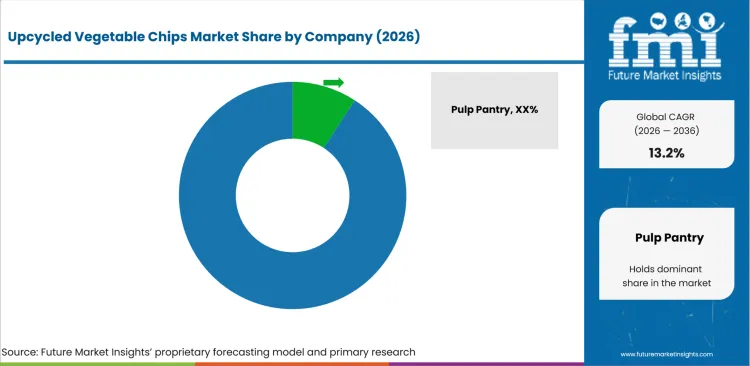
Competition includes direct vegetable-chip and sweet-potato snack brands alongside companies that use other upcycled food streams. Direct participants compete on recovered-feedstock control, finished texture, certification and retail access. Adjacent companies matter because they shape buyer expectations around upcycled claims and grocery execution even when their principal products sit outside vegetable chips.
- Pulp Pantry, Uglies (Dieffenbach's) and Spudsy have direct relevance through vegetable or potato inputs converted into finished snack products.
- Rind Snacks, Barnana and Kazoo Snacks participate through adjacent upcycled snack formats using fruit, plantain or corn inputs.
- Rubies in the Rubble and Outcast Foods convert surplus produce into condiments or dried ingredients, giving them relevance to recovered-produce sourcing while their core products remain outside packaged vegetable chips.
Competitive Benchmarking: Upcycled Vegetable Chips Market
| Company | Vegetable Feedstock Relevance | Upcycling Positioning | Finished Snack Relevance | Geographic Reach |
|---|---|---|---|---|
| Pulp Pantry | High | High | High | United States |
| Uglies (Dieffenbach's) | High | High | High | United States |
| Spudsy | High | High | High | United States |
| Rind Snacks | Low | High | Medium | United States |
| Barnana | Low | High | High | United States |
| Rubies in the Rubble | Medium | High | Low | United Kingdom |
| Outcast Foods | High | High | Low | Canada and United States |
| Kazoo Snacks | Low | High | High | United States |
Scoring basis: Vegetable Feedstock Relevance is High where the company uses vegetables, potatoes or vegetable pulp as recovered inputs, Medium for broader surplus-produce use and Low where the upcycled input sits outside vegetables. Upcycling Positioning reflects whether upcycling is central to the product or company proposition. Finished Snack Relevance is High for packaged snack products, Medium for an adjacent snack format and Low for condiments or ingredient businesses outside finished chips. Geographic Reach reflects the stated operating market and is not a measure of corporate size.
Key Developments in the Upcycled Vegetable Chips Market
- In February 2026, the USA Food Waste Pact published its 2025 Data Report covering retail and foodservice food-waste performance. The report gives manufacturers and retailers a current operating reference for unsold-food rates and destination pathways, reinforcing the value of prevention and higher-use recovery before disposal.
- In June 2026, ReFED published a review of upcycled-food trends with participation from the Upcycled Food Association, Where Food Comes From and UpSnack Brands, the owner of Spudsy. The discussion focused on scaling upcycling and certification as the category moves beyond early-stage sustainability positioning.
- In June 2025, the Upcycled Food Association highlighted a newly revised Upcycled Certified Standard during its Upcycling Food Waste: Trends & Predictions program. The revision increased the relevance of certification requirements for brands that want a recognizable third-party upcycling claim on packaged food products.
Key Players in the Upcycled Vegetable Chips Market
Direct Upcycled Vegetable Snack Specialists
- Pulp Pantry
- Uglies (Dieffenbach's)
- Spudsy
Adjacent Upcycled Snack Platforms
- Rind Snacks
- Barnana
- Kazoo Snacks
Surplus Produce Conversion Platforms
- Rubies in the Rubble
- Outcast Foods
Upcycled Vegetable Chips Market - Report Scope
| Coverage field | Report scope |
|---|---|
| Market breakdown | By vegetable source, process, claim, packaging, sales channel and region. |
| Quantitative Units | USD Million. |
| Market Definition | Packaged upcycled vegetable chips that use edible vegetable seconds, pulp, trim or related recovered vegetable feedstocks as a defining input. Fruit snacks, corn-based snacks, condiments and ingredient powders are outside the counted market boundary. |
| Regions Covered | North America, Latin America, Western Europe, Eastern Europe, East Asia, South Asia and Pacific, and Middle East and Africa. |
| Countries Covered | USA, UK, Germany, Japan, South Korea, and additional countries included in the full report. |
| Key Companies Profiled | Pulp Pantry, Uglies (Dieffenbach's), Spudsy, Rind Snacks, Barnana, Rubies in the Rubble, Outcast Foods and Kazoo Snacks. |
| Forecast Period | 2026 to 2036. |
| Approach | Primary and secondary research with market triangulation. |
Upcycled Vegetable Chips Market - Research Methodology
| Method | Approach |
|---|---|
| Primary Research | FMI analysts gather input from ingredient suppliers, snack manufacturers, food processors, retailers, distributors and procurement teams. Interviews examine feedstock qualification, food-safety controls, processing behavior, certification requirements, packaging decisions and conditions required for repeat purchasing. |
| Desk Research | Desk research covers government food-waste guidance, nonprofit industry standards, technical literature, company filings, product information and official corporate announcements relevant to edible recovered inputs and finished snack products. |
| Market Sizing and Forecasting | The market model combines the 2026 baseline with historical performance, segment structure, pricing and volume indicators, adoption patterns, company participation and country-level demand conditions. Forecast assumptions consider supply availability, processing economics, retailer access and barriers to regular purchase. |
| Data Validation | Estimates are checked against independent indicators including public food-waste data, company activity, certification information and retail distribution. Fruit, corn, condiment and ingredient activities remain separated from qualifying vegetable-chip revenue. |
Upcycled Vegetable Chips Market by Segments
Upcycled Vegetable Chips Market segmented by Vegetable Source:
- Potato Seconds
- Carrot & Root Pulp
- Beet Pulp
- Leafy Trim Blends
- Others
Upcycled Vegetable Chips Market segmented by Process:
- Kettle-Fried
- Baked
- Dehydrated
- Others
Upcycled Vegetable Chips Market segmented by Claim:
- Upcycled Certified
- Non-GMO
- Vegan
- Others
Upcycled Vegetable Chips Market segmented by Packaging:
- Standard Bags
- Single-Serve
- Multipacks
- Others
Upcycled Vegetable Chips Market segmented by Sales Channel:
- Supermarkets & Hypermarkets
- Online / DTC
- Convenience Stores
- Specialty & Health Stores
- Others
Upcycled Vegetable Chips Market by Region:
- North America
- United States
- Canada
- Latin America
- Brazil
- Mexico
- Argentina
- Chile
- Western Europe
- Germany
- France
- United Kingdom
- Italy
- Spain
- Benelux
- Nordics
- Eastern Europe
- Poland
- Czech Republic
- Romania
- Hungary
- East Asia
- China
- Japan
- South Korea
- South Asia and Pacific
- India
- ASEAN
- Australia and New Zealand
- Middle East and Africa
- GCC Countries
- South Africa
- Türkiye
- Israel
Research Sources and Bibliography
- USA Environmental Protection Agency. (2026, January 20). Wasted Food Scale.
- USA Environmental Protection Agency. (2023). From Field to Bin: The Environmental Impacts of USA Food Waste Management Pathways.
- Department for Environment, Food & Rural Affairs. (2024, January 1). Food and drink waste hierarchy: deal with surplus and waste.
- Bundesministerium für Landwirtschaft, Ernährung und Heimat. (2025, April 9). Kompetenzstelle gegen Lebensmittelverschwendung geht an den Start.
- Ministry of the Environment, Japan. (2026, June 30). MOE Japan Discloses the Estimated Amount of Food Loss and Waste Generated in FY2024.
- Ministry of Environment, Republic of Korea. (2024, December 17). Food By-products Reborn as Livestock Feed to Become Future Resources.
- United Nations Environment Programme. (2024). Food Waste Index Report 2024.
- ReFED. (2025, February 25). 2025 ReFED USA Food Waste Report.
- USA Food Waste Pact. (2026, February 25). 2025 Data Report.
- ReFED. (2026, June 23). The Future of Upcycled Food.
- Upcycled Food Association. (2025, June 4). Upcycling Food Waste: Trends & Predictions.
- Upcycled Food Association. (Accessed 2026, August 25). The Upcycled Certified Standard.
- Upcycled Food Association. (Accessed 2026, August 25). About Upcycled Food.
- Upcycled Food Association. (2023). Find Upcycled Certified Products at Sprouts Farmers Market.
- Dieffenbach's Potato Chips. (2024, March 6). Upcycled Uglies Kettle Chips Rescues 25 Millionth Pound of Ugly Potatoes.
- Uglies Snacks. (Accessed 2026, August 25). Uglies Kettle Chips.
- Spudsy. (Accessed 2026, August 25). Our Story and Mission to Save the Spud.
- Pulp Pantry. (Accessed 2026, August 25). Pulp Chips at Your Store.
- Rind Snacks. (2024, February 12). RIND Snacks Acquires Small Batch Organics.
- Barnana. (Accessed 2026, August 25). Organic Plantain Scoops.
- Rubies in the Rubble. (Accessed 2026, August 25). About.
- Outcast Foods. (Accessed 2026, August 25). Outcast Foods USA.
- Kazoo Snacks. (2023, April 6). Kazoo Snacks Kicks Off Earth Month With Brand New Packaging and Nationwide Distribution in Sprouts Farmers Markets.
This bibliography is provided for reader reference and is not exhaustive. The full report contains the complete reference list and detailed citations.
This Report Answers
- How large is the Upcycled Vegetable Chips Market in 2026 and what value is forecast by 2036?
- Which operating conditions allow edible vegetable seconds and processing residues to become repeatable packaged-chip inputs?
- Why do Potato Seconds account for 27.9% of Vegetable Source demand in 2026?
- Why does Kettle-Fried account for 37.9% of Process demand in 2026?
- Why does Upcycled Certified account for 32.8% of Claim demand in 2026?
- How do Packaging and Sales Channel choices shape retail access for upcycled vegetable chips?
- How do country growth rates differ across USA, UK, Germany, Japan and South Korea?
- Which companies serve direct vegetable-chip formats or adjacent upcycled food activities?
Frequently Asked Questions
How big is the upcycled vegetable chips market in 2026?
USD 198.1 million represents the upcycled vegetable chips market value in 2026. Demand is forecast to reach USD 684.5 million by 2036 as edible vegetable seconds and by-products move into repeatable packaged-snack formats.
What is the CAGR of the upcycled vegetable chips market from 2026 to 2036?
A 13.2% CAGR is projected for the upcycled vegetable chips market between 2026 and 2036. Expansion depends on food-grade segregation, processing consistency and retail replenishment that can support repeat purchase.
Which Vegetable Source segment is projected to account for 27.9% in 2026?
Potato Seconds are projected to account for 27.9% of Vegetable Source demand in 2026. Irregular potatoes can fit established slicing and frying operations when they remain suitable for human food and meet intake specifications.
Which Process segment is projected to account for 37.9% in 2026?
Kettle-Fried is projected to account for 37.9% of Process demand in 2026. The method gives recovered potato inputs a familiar crunch and shelf position without requiring consumers to adopt a new snack format.
How much value will the upcycled vegetable chips market add between 2026 and 2036?
USD 486.4 million is expected to be added to the upcycled vegetable chips market between 2026 and 2036. The increase reflects wider commercial use of recovered vegetable inputs across established snack-processing and retail routes.
Which companies are active in the upcycled vegetable chips market?
Companies profiled directly or for adjacent context include Pulp Pantry, Uglies, Spudsy, Rind Snacks, Barnana, Rubies in the Rubble, Outcast Foods and Kazoo Snacks. Their activities span vegetable snacks, upcycled snack formats and surplus-produce conversion.
Preview the report firsthand - request a free sample
Get SampleGet the brochure for pricing and purchase details.
Get PDFTable of Content
- Key Takeaways
- Market Size and CAGR
- Top Growth Driver
- Fastest Growing Segment
- Leading Region
- Key Companies
- Emerging Opportunities
- Executive Summary
- Global Market Outlook
- Demand-side Trends
- Supply-side Trends
- Technology Roadmap Analysis
- Analysis and Recommendations
- Analyst Perspective (What is happening? Why now? What should investors know?)
- Key Questions Answered
- How large is the market?
- What is the CAGR?
- What are key trends?
- Which region dominates?
- Who are the leaders?
- Market Overview
- Market Coverage / Taxonomy
- Market Definition / Scope / Limitations
- Research Methodology
- Chapter Orientation
- Analytical Lens and Working Hypotheses
- Market Structure, Signals, and Trend Drivers
- Benchmarking and Cross-market Comparability
- Market Sizing, Forecasting, and Opportunity Mapping
- Research Design and Evidence Framework
- Desk Research Programme (Secondary Evidence)
- Expert Input and Fieldwork (Primary Evidence)
- Tooling, Models, and Reference Databases
- Data Engineering and Model Build
- Quality Assurance and Audit Trail
- Market Background
- Market Dynamics (Drivers, Restraints, Opportunity, Trends)
- Scenario Forecast (Optimistic, Likely, Conservative)
- Impact Analysis
- AI Impact
- Sustainability Impact
- Regulatory Impact
- Technology Impact
- Consumer / Buyer Analysis
- Purchase Drivers
- Adoption Barriers
- Buyer Journey
- Opportunity Map Analysis
- Product Life Cycle Analysis
- Supply Chain Analysis
- Investment Feasibility Matrix
- Value Chain Analysis
- PESTLE and Porter's Analysis
- Regulatory Landscape
- Regional Parent Market Outlook
- Production and Consumption Statistics
- Import and Export Statistics
- Global Market Analysis and Forecast, 2021 to 2036
- Historical Market Size Value (USD Million) Analysis, 2021 to 2025
- Current and Future Market Size Value (USD Million) Projections, 2026 to 2036
- Y-o-Y Growth Trend Analysis
- Absolute $ Opportunity Analysis
- Global Market Pricing Analysis, 2021 to 2036
- Global Market Analysis and Forecast, By Vegetable Source, 2021 to 2036
- Introduction / Key Findings
- Historical Market Size Value (USD Million) Analysis By Vegetable Source, 2021 to 2025
- Current and Future Market Size Value (USD Million) Analysis and Forecast By Vegetable Source, 2026 to 2036
- Potato Seconds
- Carrot & Root Pulp
- Beet Pulp
- Leafy Trim Blends
- Others
- Potato Seconds
- Y-o-Y Growth Trend Analysis By Vegetable Source, 2021 to 2025
- Absolute $ Opportunity Analysis By Vegetable Source, 2026 to 2036
- Global Market Analysis and Forecast, By Process, 2021 to 2036
- Introduction / Key Findings
- Historical Market Size Value (USD Million) Analysis By Process, 2021 to 2025
- Current and Future Market Size Value (USD Million) Analysis and Forecast By Process, 2026 to 2036
- Kettle-Fried
- Baked
- Dehydrated
- Others
- Kettle-Fried
- Y-o-Y Growth Trend Analysis By Process, 2021 to 2025
- Absolute $ Opportunity Analysis By Process, 2026 to 2036
- Global Market Analysis and Forecast, By Claim, 2021 to 2036
- Introduction / Key Findings
- Historical Market Size Value (USD Million) Analysis By Claim, 2021 to 2025
- Current and Future Market Size Value (USD Million) Analysis and Forecast By Claim, 2026 to 2036
- Upcycled Certified
- Non-GMO
- Vegan
- Others
- Upcycled Certified
- Y-o-Y Growth Trend Analysis By Claim, 2021 to 2025
- Absolute $ Opportunity Analysis By Claim, 2026 to 2036
- Global Market Analysis and Forecast, By Packaging, 2021 to 2036
- Introduction / Key Findings
- Historical Market Size Value (USD Million) Analysis By Packaging, 2021 to 2025
- Current and Future Market Size Value (USD Million) Analysis and Forecast By Packaging, 2026 to 2036
- Standard Bags
- Single-Serve
- Multipacks
- Others
- Standard Bags
- Y-o-Y Growth Trend Analysis By Packaging, 2021 to 2025
- Absolute $ Opportunity Analysis By Packaging, 2026 to 2036
- Global Market Analysis and Forecast, By Sales Channel, 2021 to 2036
- Introduction / Key Findings
- Historical Market Size Value (USD Million) Analysis By Sales Channel, 2021 to 2025
- Current and Future Market Size Value (USD Million) Analysis and Forecast By Sales Channel, 2026 to 2036
- Supermarkets & Hypermarkets
- Online / DTC
- Convenience Stores
- Specialty & Health Stores
- Others
- Supermarkets & Hypermarkets
- Y-o-Y Growth Trend Analysis By Sales Channel, 2021 to 2025
- Absolute $ Opportunity Analysis By Sales Channel, 2026 to 2036
- Global Market Analysis and Forecast, By Region, 2021 to 2036
- Introduction
- Historical Market Size Value (USD Million) Analysis By Region, 2021 to 2025
- Current Market Size Value (USD Million) Analysis and Forecast By Region, 2026 to 2036
- North America
- Latin America
- Western Europe
- Eastern Europe
- East Asia
- South Asia and Pacific
- Middle East & Africa
- Market Attractiveness Analysis By Region
- North America Market Analysis and Forecast, By Country, 2021 to 2036
- Historical Market Size Value (USD Million) Trend Analysis By Market Taxonomy, 2021 to 2025
- Market Size Value (USD Million) Forecast By Market Taxonomy, 2026 to 2036
- By Country
- USA
- Canada
- By Vegetable Source
- By Process
- By Claim
- By Packaging
- By Sales Channel
- By Country
- Market Attractiveness Analysis
- By Country
- By Vegetable Source
- By Process
- By Claim
- By Packaging
- By Sales Channel
- Key Takeaways
- Latin America Market Analysis and Forecast, By Country
- Historical Market Size Value (USD Million) Trend Analysis By Market Taxonomy, 2021 to 2025
- Market Size Value (USD Million) Forecast By Market Taxonomy, 2026 to 2036
- By Country
- Brazil
- Mexico
- Chile
- Rest of Latin America
- By Vegetable Source
- By Process
- By Claim
- By Packaging
- By Sales Channel
- By Country
- Market Attractiveness Analysis
- By Country
- By Vegetable Source
- By Process
- By Claim
- By Packaging
- By Sales Channel
- Key Takeaways
- Western Europe Market Analysis and Forecast, By Country
- Historical Market Size Value (USD Million) Trend Analysis By Market Taxonomy, 2021 to 2025
- Market Size Value (USD Million) Forecast By Market Taxonomy, 2026 to 2036
- By Country
- Germany
- UK
- Italy
- Spain
- France
- Nordic
- BENELUX
- Rest of Western Europe
- By Vegetable Source
- By Process
- By Claim
- By Packaging
- By Sales Channel
- By Country
- Market Attractiveness Analysis
- By Country
- By Vegetable Source
- By Process
- By Claim
- By Packaging
- By Sales Channel
- Key Takeaways
- Eastern Europe Market Analysis and Forecast, By Country
- Historical Market Size Value (USD Million) Trend Analysis By Market Taxonomy, 2021 to 2025
- Market Size Value (USD Million) Forecast By Market Taxonomy, 2026 to 2036
- By Country
- Russia
- Poland
- Hungary
- Balkan & Baltic
- Rest of Eastern Europe
- By Vegetable Source
- By Process
- By Claim
- By Packaging
- By Sales Channel
- By Country
- Market Attractiveness Analysis
- By Country
- By Vegetable Source
- By Process
- By Claim
- By Packaging
- By Sales Channel
- Key Takeaways
- East Asia Market Analysis and Forecast, By Country
- Historical Market Size Value (USD Million) Trend Analysis By Market Taxonomy, 2021 to 2025
- Market Size Value (USD Million) Forecast By Market Taxonomy, 2026 to 2036
- By Country
- China
- Japan
- South Korea
- By Vegetable Source
- By Process
- By Claim
- By Packaging
- By Sales Channel
- By Country
- Market Attractiveness Analysis
- By Country
- By Vegetable Source
- By Process
- By Claim
- By Packaging
- By Sales Channel
- Key Takeaways
- South Asia and Pacific Market Analysis and Forecast, By Country
- Historical Market Size Value (USD Million) Trend Analysis By Market Taxonomy, 2021 to 2025
- Market Size Value (USD Million) Forecast By Market Taxonomy, 2026 to 2036
- By Country
- India
- ASEAN
- Australia & New Zealand
- Rest of South Asia and Pacific
- By Vegetable Source
- By Process
- By Claim
- By Packaging
- By Sales Channel
- By Country
- Market Attractiveness Analysis
- By Country
- By Vegetable Source
- By Process
- By Claim
- By Packaging
- By Sales Channel
- Key Takeaways
- Middle East & Africa Market Analysis and Forecast, By Country
- Historical Market Size Value (USD Million) Trend Analysis By Market Taxonomy, 2021 to 2025
- Market Size Value (USD Million) Forecast By Market Taxonomy, 2026 to 2036
- By Country
- Kingdom of Saudi Arabia
- Other GCC Countries
- Türkiye
- South Africa
- Other African Union
- Rest of Middle East & Africa
- By Vegetable Source
- By Process
- By Claim
- By Packaging
- By Sales Channel
- By Country
- Market Attractiveness Analysis
- By Country
- By Vegetable Source
- By Process
- By Claim
- By Packaging
- By Sales Channel
- Key Takeaways
- Key Countries Market Analysis
- USA
- Pricing Analysis
- Market Share Analysis, 2025
- By Vegetable Source
- By Process
- By Claim
- By Packaging
- By Sales Channel
- Canada
- Pricing Analysis
- Market Share Analysis, 2025
- By Vegetable Source
- By Process
- By Claim
- By Packaging
- By Sales Channel
- Mexico
- Pricing Analysis
- Market Share Analysis, 2025
- By Vegetable Source
- By Process
- By Claim
- By Packaging
- By Sales Channel
- Brazil
- Pricing Analysis
- Market Share Analysis, 2025
- By Vegetable Source
- By Process
- By Claim
- By Packaging
- By Sales Channel
- Chile
- Pricing Analysis
- Market Share Analysis, 2025
- By Vegetable Source
- By Process
- By Claim
- By Packaging
- By Sales Channel
- Germany
- Pricing Analysis
- Market Share Analysis, 2025
- By Vegetable Source
- By Process
- By Claim
- By Packaging
- By Sales Channel
- UK
- Pricing Analysis
- Market Share Analysis, 2025
- By Vegetable Source
- By Process
- By Claim
- By Packaging
- By Sales Channel
- Italy
- Pricing Analysis
- Market Share Analysis, 2025
- By Vegetable Source
- By Process
- By Claim
- By Packaging
- By Sales Channel
- Spain
- Pricing Analysis
- Market Share Analysis, 2025
- By Vegetable Source
- By Process
- By Claim
- By Packaging
- By Sales Channel
- France
- Pricing Analysis
- Market Share Analysis, 2025
- By Vegetable Source
- By Process
- By Claim
- By Packaging
- By Sales Channel
- India
- Pricing Analysis
- Market Share Analysis, 2025
- By Vegetable Source
- By Process
- By Claim
- By Packaging
- By Sales Channel
- ASEAN
- Pricing Analysis
- Market Share Analysis, 2025
- By Vegetable Source
- By Process
- By Claim
- By Packaging
- By Sales Channel
- Australia & New Zealand
- Pricing Analysis
- Market Share Analysis, 2025
- By Vegetable Source
- By Process
- By Claim
- By Packaging
- By Sales Channel
- China
- Pricing Analysis
- Market Share Analysis, 2025
- By Vegetable Source
- By Process
- By Claim
- By Packaging
- By Sales Channel
- Japan
- Pricing Analysis
- Market Share Analysis, 2025
- By Vegetable Source
- By Process
- By Claim
- By Packaging
- By Sales Channel
- South Korea
- Pricing Analysis
- Market Share Analysis, 2025
- By Vegetable Source
- By Process
- By Claim
- By Packaging
- By Sales Channel
- Russia
- Pricing Analysis
- Market Share Analysis, 2025
- By Vegetable Source
- By Process
- By Claim
- By Packaging
- By Sales Channel
- Poland
- Pricing Analysis
- Market Share Analysis, 2025
- By Vegetable Source
- By Process
- By Claim
- By Packaging
- By Sales Channel
- Hungary
- Pricing Analysis
- Market Share Analysis, 2025
- By Vegetable Source
- By Process
- By Claim
- By Packaging
- By Sales Channel
- Kingdom of Saudi Arabia
- Pricing Analysis
- Market Share Analysis, 2025
- By Vegetable Source
- By Process
- By Claim
- By Packaging
- By Sales Channel
- Türkiye
- Pricing Analysis
- Market Share Analysis, 2025
- By Vegetable Source
- By Process
- By Claim
- By Packaging
- By Sales Channel
- South Africa
- Pricing Analysis
- Market Share Analysis, 2025
- By Vegetable Source
- By Process
- By Claim
- By Packaging
- By Sales Channel
- USA
- Market Structure Analysis
- Competition Dashboard
- Competition Benchmarking
- Market Share Analysis of Top Players
- By Regional
- By Vegetable Source
- By Process
- By Claim
- By Packaging
- By Sales Channel
- Emerging Startups
- Innovation Benchmarking
- Competition Analysis
- Competition Deep Dive
- Pulp Pantry
- Overview
- Product Portfolio
- Profitability by Market Segments
- Sales Footprint
- Strategy Overview
- Marketing Strategy
- Product Strategy
- Channel Strategy
- Uglies (Dieffenbach's)
- Spudsy
- Rind Snacks
- Barnana
- Rubies in the Rubble
- Outcast Foods
- Kazoo Snacks
- Pulp Pantry
- Case Studies
- Success Stories
- Recent Developments
- Competition Deep Dive
- Assumptions & Acronyms Used


