

- Market Size (2026)
- USD 146.0 Mn
- Forecast (2036)
- USD 465.7 Mn
- CAGR (2026 to 2036)
- 12.3%
How big is Upcycled Grain Crackers Market in 2026?
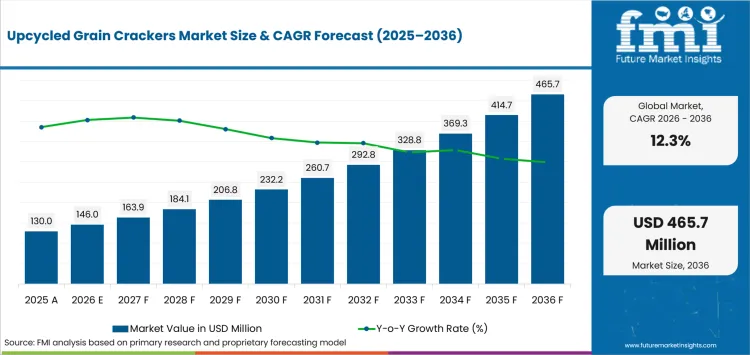
USD 146.0 million in 2026 and USD 465.7 million by 2036 at a 12.3% CAGR.
Demand for upcycled grain crackers is projected to expand at 12.3% CAGR between 2026 and 2036, increasing valuation from USD 146.0 million in 2026 to USD 465.7 million by 2036. The market was valued at USD 130.0 million in 2025. Commercial growth depends on converting edible processing side streams into consistent ingredients that can pass routine cracker tests for texture, shelf life and repeat purchase.
Brewers' spent grain offers a recurring recovery stream, but handling economics determine whether it can enter food production. Research published in 2025 notes that fresh spent grain can contain very high moisture and deteriorate quickly without stabilization. Drying, storage and particle-size control therefore sit upstream of the consumer proposition and influence whether recovered grain can behave like a dependable bakery ingredient.
Key Takeaways of Upcycled Grain Crackers Market
- Food-waste reduction creates a commercial opening when edible side streams can be standardized for ordinary cracker production.
- Brewers' Spent Grain is projected to account for 30.5% of Source Stream demand in 2026 where brewery collection and stabilization can be organized consistently.
- Snack Crackers are estimated at 45.5% of Product Type demand, while Upcycled Certified is forecast at 35.5% of Claim demand in 2026.
- Boxes are projected at 45.2% of Packaging demand and Supermarkets & Hypermarkets at 25.3% of Sales Channel demand in 2026.
- Wet and variable side streams can add stabilization cost before an upcycled ingredient reaches a cracker line.
- Brewer's Crackers, Upcycled Foods, Inc. (ReGrained), Renewal Mill, Kazoo Snacks, Pulp Pantry, Mary's Gone Crackers, Simple Mills and From The Ground Up represent direct participants, ingredient platforms or relevant cracker reference companies.
Analyst Perspective
“Upcycled grain crackers become commercially viable when recovered inputs arrive with the consistency expected from ordinary food ingredients. Buyers will test texture, shelf life and service levels before they reward a circularity claim, so the operational work upstream determines whether the proposition survives at shelf.”
- Nandini Roy Choudhury, Principal Consultant, Future Market Insights
How is the Upcycled Grain Crackers Market segmented?
The upcycled grain crackers market is segmented by source stream, product type, claim, packaging, sales channel and region.
The market separates recovered inputs from the finished format, consumer-facing claim, pack architecture and route to purchase. Source Stream covers Brewers' Spent Grain, Okara (Soy Pulp), Wheat Bran Residue and Others. Product Type includes Snack Crackers, Flatbread Crackers, Crispbreads and Others. Claim covers Upcycled Certified, High-Fiber, Organic and Others. Packaging includes Boxes, Pouches and Others, while Sales Channel covers Supermarkets & Hypermarkets, Online / DTC, Convenience Stores, Specialty & Health Stores and Others. These streams also connect with the broader upcycled ingredients category, where stabilization and food-grade recovery determine whether side streams can enter repeatable formulations.
Why does Upcycled Certified account for 35.5% of the Claim category?
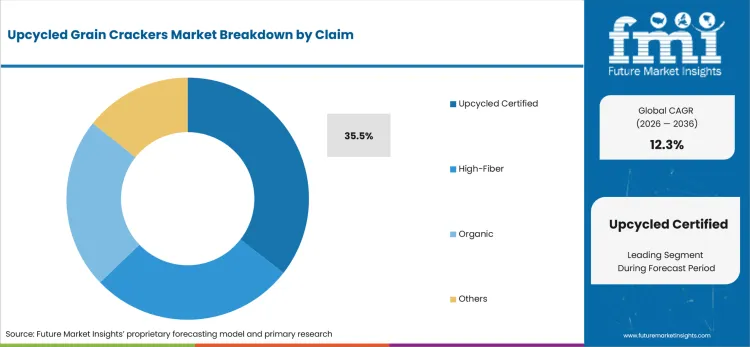
Upcycled Certified gives retailers and consumers a structured way to distinguish an intentional recovery claim from broad sustainability language. Version 3 of the standard, published in June 2025, requires qualifying products to use upcycled inputs that would otherwise leave human consumption and to maintain an auditable supply chain. For cracker brands, that framework can simplify buyer review when the ingredient name alone does not explain why a recovered stream qualifies as upcycled.
- Upcycled Certified is projected to account for 35.5% of Claim demand in 2026 because third-party criteria provide a defined basis for assessing the core sourcing proposition.
- The 2025 Upcycled Certified Standard requires qualifying food products to identify upcycled inputs and maintain an auditable supply chain, connecting the claim with sourcing controls.
Why does Brewers' Spent Grain account for 30.5% of the Source Stream category?
Brewers' spent grain combines recurring brewery output with useful fiber and protein, giving formulators a direct route from a processing side stream into savory baked foods. Its commercial constraint is high moisture, which narrows the time available for collection and stabilization. Suppliers that standardize drying, particle size and food-safety controls can reduce variation before the material reaches a cracker line. The finished product still has to meet the texture and shelf-life expectations of the wider cracker market rather than rely on circular sourcing as the main purchase reason.
- Based on Source Stream, Brewers' Spent Grain is projected to account for 30.5% in 2026 where brewery partnerships support repeatable food-grade collection.
- Brewer's Foods sells flatbread crackers made with upcycled brewery grains, providing direct evidence that spent grain can be carried into a shelf-ready cracker format.
Why do Snack Crackers account for 45.5% of the Product Type category?
Snack crackers give upcycled ingredients a familiar consumption occasion and allow seasoning systems to moderate grain notes that may emerge from recovered inputs. The format also fits portioned grocery snacking without requiring shoppers to learn a new use case. Flatbread crackers and crispbreads remain relevant for differentiated textures, while snack crackers offer broad flexibility across flavor, thickness and serving occasions.
- In 2026, Snack Crackers are expected to account for 45.5% of Product Type demand because the format combines routine usage with formulation flexibility.
- Brewer's Foods uses spent grain in flatbread-style crackers, showing how an upcycled grain proposition can remain within a familiar savory baked-snack format.
Why do Boxes account for 45.2% of the Packaging category?
Boxes suit brittle crackers because cartons can provide secondary protection while creating front-panel and side-panel space for ingredient and sourcing information. Pouches remain relevant where material efficiency or direct shipping matters. Packaging still has to protect breakage and shelf presentation, linking this category with wider developments in sustainable packaging without making the pack itself the primary reason for purchase.
- Boxes are forecast to account for 45.2% of Packaging demand in 2026 as brands balance breakage control with room for product and sourcing communication.
- Carton-led formats can support certification marks and ingredient explanations while retaining the structural protection expected for brittle crackers.
Why do Supermarkets & Hypermarkets account for 25.3% of the Sales Channel category?
Supermarkets and hypermarkets place upcycled crackers next to established snack alternatives, which forces new products to compete on ordinary category metrics such as velocity, price and service levels. Online / DTC can explain the sourcing story in more detail, while specialty stores support discovery. Grocery becomes more material once the product can sustain repeat purchase without extended education at shelf. This progression mirrors the broader route from specialist discovery into mainstream retail across upcycled foods.
- Supermarkets & Hypermarkets are projected to account for 25.3% of Sales Channel demand in 2026 because conventional grocery provides recurring traffic and direct comparison with established crackers.
- Retailer partnerships used by upcycled ingredient suppliers show how recovered inputs can enter mainstream grocery programs once specification and service requirements are controlled.
What are the drivers, restraints and opportunities in the Upcycled Grain Crackers Market?
Food-waste reduction supports demand, stabilization requirements constrain scale, and retailer or manufacturer partnerships create a route into conventional cracker programs.
- Driver: Food processors have stronger incentives to keep edible side streams in productive use as waste-reduction policies and procurement programs place more attention on prevention and recovery.
- Restraint: Wet and variable side streams require stabilization before they can meet cracker standards for microbial control, texture and shelf life.
- Opportunity: Ingredient specialists can enter conventional cracker programs through retailer partnerships or established manufacturers that already understand grocery execution.
The demand driver begins upstream. Public food-waste strategies in the USA and Europe encourage prevention and higher-value use before disposal-oriented routes. These measures do not create cracker purchases directly, but they increase the commercial incentive to recover edible side streams. The operating logic sits alongside the broader food waste market, where source separation and destination control determine whether material can remain in productive use.
The restraint sits between recovery and baking. Brewers' spent grain can leave production with very high moisture, while fresh okara also deteriorates quickly because of its moisture and nutrient content. Drying, storage and transport therefore affect cost before a cracker manufacturer has tested flavor or texture. If stabilization changes particle characteristics or the recovered input varies by batch, line yield and breakage can become procurement issues.
Partnership creates a practical expansion route. Upcycled Foods, Inc. placed ReGrained SuperGrain+ into Misfits Market private-label breads in March 2025, showing how a specialist ingredient can enter a retailer-owned program. Crackers can use the same route when an ingredient supplier handles recovery and standardization while an established food manufacturer manages baking, packaging and retail service levels.
Which country CAGRs are profiled in the Upcycled Grain Crackers Market?
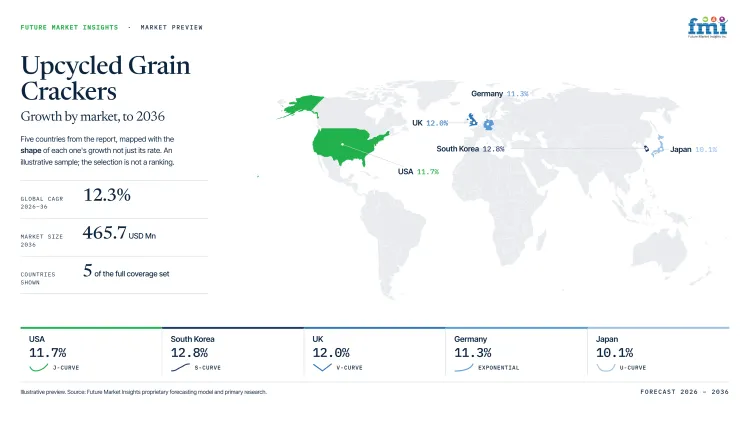
| Country | CAGR |
|---|---|
| South Korea | 12.8% |
| UK | 12.0% |
| USA | 11.7% |
| Germany | 11.3% |
| Japan | 10.1% |
How do country-level CAGRs compare in the Upcycled Grain Crackers Market?
The five profiled CAGRs span 2.7 percentage points across different retail systems and food-waste policies. The rates describe expected expansion from 2026 to 2036 and should not be read as a ranking of current market size. Commercial entry still depends on sourcing feasibility, channel access and local claim requirements.
- South Korea is forecast at 12.8% CAGR from 2026 to 2036, with public food-waste initiatives reinforcing attention on preserving value from unsold food and by-products.
- UK is projected at 12.0% CAGR, while workplace recycling rules introduced in England in March 2025 require food waste to be separated from residual waste.
- USA is forecast at 11.7% CAGR, supported by a national food-loss and waste strategy that targets a 50% reduction by 2030.
- Germany is projected at 11.3% CAGR, with food-retail waste reduction programs influencing how retailers and suppliers discuss surplus and recovery.
- Japan is forecast at 10.1% CAGR; the second Basic Policy on food-loss and waste reduction was approved in March 2025 and raised the business-sector reduction target.
Comparable growth rates can create different market-entry conditions. A country with a slightly lower CAGR can still be attractive when ingredient supply and retailer access are easier to secure. Forecast pacing therefore needs to be read alongside food-grade recovery, localization and channel economics.
Country-wise Analysis
- South Korea: Demand for Upcycled Grain Crackers in South Korea is forecast to expand at a 12.8% CAGR from 2026 to 2036. Public initiatives around unsold food and food-waste reduction keep recovery visible, but suppliers still need stable grain inputs and a finished cracker that competes on taste and price.
- UK: Demand for Upcycled Grain Crackers in the UK is forecast to expand at a 12.0% CAGR from 2026 to 2036. Workplace recycling rules in England changed on March 31, 2025 and require covered businesses to separate food waste from residual waste. Cracker suppliers still need familiar flavor, shelf life and pricing within established grocery sets.
- USA: Demand for Upcycled Grain Crackers in the USA is forecast to expand at an 11.7% CAGR from 2026 to 2036. The national strategy to reduce food loss and waste supports a 50% reduction goal by 2030, increasing attention on edible recovery while national retail service still requires standardized ingredients across locations.
- Germany: Demand for Upcycled Grain Crackers in Germany is forecast to expand at an 11.3% CAGR from 2026 to 2036. Food-retail waste reduction programs create a supportive policy context, while product acceptance remains tied to traceable inputs and category economics.
- Japan: Demand for Upcycled Grain Crackers in Japan is forecast to expand at a 10.1% CAGR from 2026 to 2036. The second Basic Policy on food-loss and waste reduction was approved on March 25, 2025. Product acceptance will still depend on sensory execution and locally understandable sourcing language.
Who are the notable companies in the Upcycled Grain Crackers Market?
Brewer's Crackers, Upcycled Foods, Inc. (ReGrained), Renewal Mill, Kazoo Snacks, Pulp Pantry, Mary's Gone Crackers, Simple Mills and From The Ground Up are direct participants, ingredient platforms or relevant cracker reference companies around the upcycled grain crackers market.
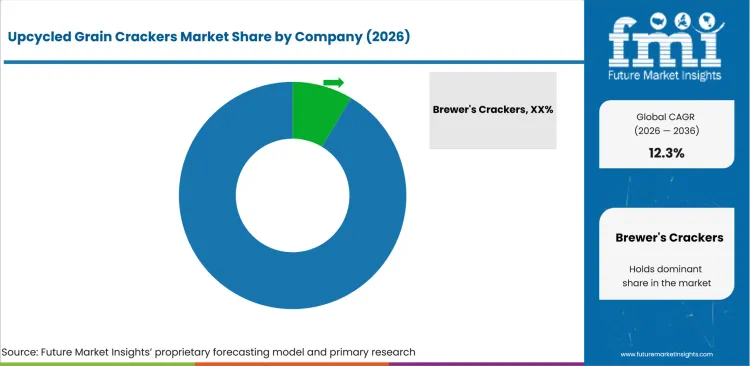
The competitive set contains a direct upcycled-cracker specialist, ingredient platforms and adjacent savory or cracker brands that establish shelf expectations. Brewer's Crackers is directly tied to spent-grain crackers. Upcycled Foods, Inc. and Renewal Mill provide upcycled ingredient capability that can enter partner products. Kazoo Snacks and Pulp Pantry show consumer use of recovered inputs in savory snacks, while Mary's Gone Crackers, Simple Mills and From The Ground Up provide cracker reference companies for texture, packaging and grocery execution.
- Brewer's Crackers represents direct upcycled cracker activity through flatbread crackers made with spent grain recovered from brewing.
- Upcycled Foods, Inc. (ReGrained), Renewal Mill, Kazoo Snacks and Pulp Pantry participate through upcycled ingredient or savory-snack platforms that can inform formulation and retail execution.
- Mary's Gone Crackers, Simple Mills and From The Ground Up are adjacent cracker reference companies that shape shelf expectations for texture, pack design and grocery service.
Competitive Benchmarking: Upcycled Grain Crackers Market
| Company | Upcycled Feedstock Integration | Cracker / Savory Relevance | Retail & Partner Commercialization | Geographic Reach |
|---|---|---|---|---|
| Brewer's Crackers | High | High | Medium | United States |
| Upcycled Foods, Inc. (ReGrained) | High | Medium | High | United States; B2B partnerships |
| Renewal Mill | High | Low | High | United States; grocery and ingredient partnerships |
| Kazoo Snacks | High | Medium | Medium | United States |
| Pulp Pantry | High | Medium | Medium | United States |
| Mary's Gone Crackers | Low | High | High | United States |
| Simple Mills | Low | High | High | United States |
| From The Ground Up | Low | High | Medium | United States |
Scoring basis: Upcycled Feedstock Integration reflects use of recovered food-production streams. Cracker / Savory Relevance reflects direct participation in crackers or closely related savory snacks. Retail & Partner Commercialization reflects grocery access or partner programs. High indicates a central capability, Medium a narrower role, and Low limited relevance to the criterion. Geographic Reach describes the active market used for comparison and is not a measure of corporate size.
Key Developments in the Upcycled Grain Crackers Market
- In June 2025, Where Food Comes From published Version 3 of the Upcycled Certified Standard. The revision set current criteria for upcycled ingredients and finished products, including auditable supply chains and clear identification of upcycled inputs, strengthening the framework used for packaged-food claims.
- In March 2025, Upcycled Foods, Inc. and Misfits Market launched Upcycled Certified private-label breads using ReGrained SuperGrain+. Bread sits outside the cracker revenue boundary, but the program shows how a standardized recovered grain ingredient can enter a retailer-owned baked-food platform.
- In February 2025, Flowers Foods completed its acquisition of Simple Mills. Simple Mills remains an adjacent cracker reference company, and the transaction gives the brand access to a scaled bakery parent focused on broader distribution and product innovation.
Key Players in the Upcycled Grain Crackers Market
Direct Upcycled Cracker & Grain Platforms
- Brewer's Crackers
- Upcycled Foods, Inc. (ReGrained)
- Renewal Mill
Upcycled Savory Snack Benchmarks
- Kazoo Snacks
- Pulp Pantry
Cracker Shelf References
- Mary's Gone Crackers
- Simple Mills
- From The Ground Up
Upcycled Grain Crackers Market - Report Scope
| Coverage field | Report scope |
|---|---|
| Market breakdown | By source stream, product type, claim, packaging, sales channel and region. |
| Quantitative Units | USD Million. |
| Market Definition | Revenue from packaged cracker products made with upcycled grain or grain-adjacent food-processing streams and sold within the stated segmentation universe. Standalone ingredient sales and adjacent finished foods such as breads, bars, chips, cereals or baking mixes are excluded. |
| Regions Covered | North America, Latin America, Western Europe, Eastern Europe, East Asia, South Asia and Pacific, and Middle East and Africa. |
| Countries Covered | USA, UK, Germany, Japan, South Korea and additional countries included in the full report. |
| Key Companies Profiled | Brewer's Crackers, Upcycled Foods, Inc. (ReGrained), Renewal Mill, Kazoo Snacks, Pulp Pantry, Mary's Gone Crackers, Simple Mills and From The Ground Up. |
| Forecast Period | 2026 to 2036. |
| Approach | Primary and secondary research with market triangulation across product, channel and country evidence. |
Upcycled Grain Crackers Market - Research Methodology
| Method | Approach |
|---|---|
| Primary Research | FMI analysts gather input from food manufacturers, upcycled ingredient processors, distributors, retail buyers and end users. Interviews examine purchasing decisions, product qualification, sourcing reliability, formulation constraints, pricing and the conditions required before trial volumes move into repeat purchasing. |
| Desk Research | Desk research covers government food-waste policy, peer-reviewed food science, certification standards, company announcements and current product information. Sources are used to explain the market boundary, country conditions and company participation. |
| Market Sizing and Forecasting | The market model combines the baseline value with segment structure, pricing and volume indicators, channel adoption, company participation and country demand conditions. Forecast assumptions consider source-stream availability, stabilization cost, retailer conversion and barriers to repeat purchase. |
| Data Validation | Estimates are compared with public policy indicators, company commercialization, product availability and findings from primary research. Adjacent foods and standalone ingredient sales remain outside market revenue, while overlapping channel activity is excluded from the defined market total. |
Upcycled Grain Crackers Market by Segments
Upcycled Grain Crackers Market segmented by Source Stream:
- Brewers' Spent Grain
- Okara (Soy Pulp)
- Wheat Bran Residue
- Others
Upcycled Grain Crackers Market segmented by Product Type:
- Snack Crackers
- Flatbread Crackers
- Crispbreads
- Others
Upcycled Grain Crackers Market segmented by Claim:
- Upcycled Certified
- High-Fiber
- Organic
- Others
Upcycled Grain Crackers Market segmented by Packaging:
- Boxes
- Pouches
- Others
Upcycled Grain Crackers Market segmented by Sales Channel:
- Supermarkets & Hypermarkets
- Online / DTC
- Convenience Stores
- Specialty & Health Stores
- Others
Upcycled Grain Crackers Market by Region:
- North America
- United States
- Canada
- Latin America
- Brazil
- Mexico
- Argentina
- Chile
- Western Europe
- Germany
- United Kingdom
- France
- Italy
- Spain
- Benelux
- Nordics
- Rest of Western Europe
- Eastern Europe
- Poland
- Czech Republic
- Romania
- Hungary
- Rest of Eastern Europe
- East Asia
- China
- Japan
- South Korea
- South Asia and Pacific
- India
- ASEAN
- Australia and New Zealand
- Rest of South Asia and Pacific
- Middle East and Africa
- GCC Countries
- South Africa
- Türkiye
- Israel
- Other African Union Countries
- Rest of Middle East and Africa
Research Sources and Bibliography
- USA Environmental Protection Agency. (2024, June 12). National Strategy to Reduce Food Loss and Waste and Recycle Organics.
- Department for Environment, Food & Rural Affairs. (2025, March 31). New rules simplifying recycling for workplaces in England come into force.
- Department for Environment, Food & Rural Affairs. (2025). Simpler recycling: workplace recycling in England.
- Consumer Affairs Agency, Japan. (2025, March 25). The 2nd Basic Policy on the Promotion of the Reduction of Food Loss and Waste.
- German Federal Government. (2025, September 29). Government Press Conference of 29 September 2025.
- Ministry of Climate, Energy and Environment, Republic of Korea. (2026, June 14). Platform-based closing discount service for unsold food.
- Dancker, P., Glas, K., & Gastl, M. (2025). Potential utilisation methods for brewer's spent grain: a review. International Journal of Food Science & Technology.
- Asghar, A. et al. (2023). Valorization and food applications of okara (soybean residue). Food Production, Processing and Nutrition.
- Where Food Comes From. (2025, June 1). Upcycled Certified Standard, Version 3.
- Where Food Comes From. (2025, January 21). Upcycled Certified Program growth and impact update.
- Upcycled Foods, Inc. (2025, March 3). Upcycled Foods, Inc. and Misfits Market launch upcycled breads for grocer private label.
- Flowers Foods, Inc. (2025, February 21). Flowers Foods, Inc. completes acquisition of Simple Mills.
- Brewer's Foods. Upcycled flatbread crackers and spent-grain product information.
- Renewal Mill. Upcycled flour and food-manufacturing side-stream information.
- Kazoo Snacks. Upcycled corn germ and product information.
- Pulp Pantry. Upcycled savory snack and ingredient information.
- Mary's Gone Crackers. Current cracker portfolio.
- Simple Mills. Current cracker portfolio and Flowers Foods brand information.
- From The Ground Up. Current cracker portfolio.
This bibliography is provided for reader reference and is not exhaustive. The full report contains the complete reference list and detailed citations.
This Report Answers
- How large is the Upcycled Grain Crackers Market in 2026 and what value is forecast by 2036?
- Which food-waste and processing conditions support demand for upcycled grain crackers?
- Why does Brewers' Spent Grain account for 30.5% of Source Stream demand in 2026?
- Why do Snack Crackers account for 45.5% of Product Type demand in 2026?
- How do certification and packaging choices affect buyer evaluation?
- How do sales channels change the path from product trial to repeat purchase?
- How do country growth rates affect market-entry planning?
- Which companies participate directly or set relevant cracker reference companies?
Frequently Asked Questions
How big is the upcycled grain crackers market in 2026?
USD 146.0 million represents the upcycled grain crackers market value in 2026. Demand is forecast to reach USD 465.7 million by 2036 as recovered grain streams move into standardized food ingredients and familiar savory formats.
What is the CAGR of the upcycled grain crackers market from 2026 to 2036?
A 12.3% CAGR is forecast for the upcycled grain crackers market between 2026 and 2036. Growth depends on reliable stabilization, acceptable cracker texture and retail economics that support repeat purchase after initial trial.
Which Source Stream segment accounts for 30.5% of the upcycled grain crackers market?
Brewers' Spent Grain is projected to account for 30.5% of Source Stream demand in 2026. Brewery side streams provide recurring supply, while rapid stabilization and food-grade handling determine whether that supply can enter commercial cracker production.
Which Product Type segment accounts for 45.5% of the upcycled grain crackers market?
Snack Crackers are projected to account for 45.5% of Product Type demand in 2026. Familiar savory usage and formulation flexibility allow recovered grain ingredients to enter an established snack format without requiring a new consumption occasion.
How much will the upcycled grain crackers market add between 2026 and 2036?
The market is expected to add USD 319.7 million between 2026 and 2036. The increase requires broader grocery access and more consistent recovered ingredients rather than reliance on a sustainability claim by itself.
Which companies are active around the upcycled grain crackers market?
Brewer's Crackers is directly active in upcycled grain crackers. Upcycled Foods, Inc. and Renewal Mill provide upcycled ingredient capability, while Kazoo Snacks and Pulp Pantry show adjacent savory upcycling. Mary's Gone Crackers, Simple Mills and From The Ground Up provide cracker shelf references.
Preview the report firsthand - request a free sample
Get SampleGet the brochure for pricing and purchase details.
Get PDFTable of Content
- Key Takeaways
- Market Size and CAGR
- Top Growth Driver
- Fastest Growing Segment
- Leading Region
- Key Companies
- Emerging Opportunities
- Executive Summary
- Global Market Outlook
- Demand-side Trends
- Supply-side Trends
- Technology Roadmap Analysis
- Analysis and Recommendations
- Analyst Perspective (What is happening? Why now? What should investors know?)
- Key Questions Answered
- How large is the market?
- What is the CAGR?
- What are key trends?
- Which region dominates?
- Who are the leaders?
- Market Overview
- Market Coverage / Taxonomy
- Market Definition / Scope / Limitations
- Research Methodology
- Chapter Orientation
- Analytical Lens and Working Hypotheses
- Market Structure, Signals, and Trend Drivers
- Benchmarking and Cross-market Comparability
- Market Sizing, Forecasting, and Opportunity Mapping
- Research Design and Evidence Framework
- Desk Research Programme (Secondary Evidence)
- Expert Input and Fieldwork (Primary Evidence)
- Tooling, Models, and Reference Databases
- Data Engineering and Model Build
- Quality Assurance and Audit Trail
- Market Background
- Market Dynamics (Drivers, Restraints, Opportunity, Trends)
- Scenario Forecast (Optimistic, Likely, Conservative)
- Impact Analysis
- AI Impact
- Sustainability Impact
- Regulatory Impact
- Technology Impact
- Consumer / Buyer Analysis
- Purchase Drivers
- Adoption Barriers
- Buyer Journey
- Opportunity Map Analysis
- Product Life Cycle Analysis
- Supply Chain Analysis
- Investment Feasibility Matrix
- Value Chain Analysis
- PESTLE and Porter's Analysis
- Regulatory Landscape
- Regional Parent Market Outlook
- Production and Consumption Statistics
- Import and Export Statistics
- Global Market Analysis and Forecast, 2021 to 2036
- Historical Market Size Value (USD Million) Analysis, 2021 to 2025
- Current and Future Market Size Value (USD Million) Projections, 2026 to 2036
- Y-o-Y Growth Trend Analysis
- Absolute $ Opportunity Analysis
- Global Market Pricing Analysis, 2021 to 2036
- Global Market Analysis and Forecast, By Source Stream, 2021 to 2036
- Introduction / Key Findings
- Historical Market Size Value (USD Million) Analysis By Source Stream, 2021 to 2025
- Current and Future Market Size Value (USD Million) Analysis and Forecast By Source Stream, 2026 to 2036
- Brewers' Spent Grain
- Okara (Soy Pulp)
- Wheat Bran Residue
- Others
- Brewers' Spent Grain
- Y-o-Y Growth Trend Analysis By Source Stream, 2021 to 2025
- Absolute $ Opportunity Analysis By Source Stream, 2026 to 2036
- Global Market Analysis and Forecast, By Product Type, 2021 to 2036
- Introduction / Key Findings
- Historical Market Size Value (USD Million) Analysis By Product Type, 2021 to 2025
- Current and Future Market Size Value (USD Million) Analysis and Forecast By Product Type, 2026 to 2036
- Snack Crackers
- Flatbread Crackers
- Crispbreads
- Others
- Snack Crackers
- Y-o-Y Growth Trend Analysis By Product Type, 2021 to 2025
- Absolute $ Opportunity Analysis By Product Type, 2026 to 2036
- Global Market Analysis and Forecast, By Claim, 2021 to 2036
- Introduction / Key Findings
- Historical Market Size Value (USD Million) Analysis By Claim, 2021 to 2025
- Current and Future Market Size Value (USD Million) Analysis and Forecast By Claim, 2026 to 2036
- Upcycled Certified
- High-Fiber
- Organic
- Others
- Upcycled Certified
- Y-o-Y Growth Trend Analysis By Claim, 2021 to 2025
- Absolute $ Opportunity Analysis By Claim, 2026 to 2036
- Global Market Analysis and Forecast, By Packaging, 2021 to 2036
- Introduction / Key Findings
- Historical Market Size Value (USD Million) Analysis By Packaging, 2021 to 2025
- Current and Future Market Size Value (USD Million) Analysis and Forecast By Packaging, 2026 to 2036
- Boxes
- Pouches
- Others
- Boxes
- Y-o-Y Growth Trend Analysis By Packaging, 2021 to 2025
- Absolute $ Opportunity Analysis By Packaging, 2026 to 2036
- Global Market Analysis and Forecast, By Sales Channel, 2021 to 2036
- Introduction / Key Findings
- Historical Market Size Value (USD Million) Analysis By Sales Channel, 2021 to 2025
- Current and Future Market Size Value (USD Million) Analysis and Forecast By Sales Channel, 2026 to 2036
- Supermarkets & Hypermarkets
- Online / DTC
- Convenience Stores
- Specialty & Health Stores
- Others
- Supermarkets & Hypermarkets
- Y-o-Y Growth Trend Analysis By Sales Channel, 2021 to 2025
- Absolute $ Opportunity Analysis By Sales Channel, 2026 to 2036
- Global Market Analysis and Forecast, By Region, 2021 to 2036
- Introduction
- Historical Market Size Value (USD Million) Analysis By Region, 2021 to 2025
- Current Market Size Value (USD Million) Analysis and Forecast By Region, 2026 to 2036
- North America
- Latin America
- Western Europe
- Eastern Europe
- East Asia
- South Asia and Pacific
- Middle East & Africa
- Market Attractiveness Analysis By Region
- North America Market Analysis and Forecast, By Country, 2021 to 2036
- Historical Market Size Value (USD Million) Trend Analysis By Market Taxonomy, 2021 to 2025
- Market Size Value (USD Million) Forecast By Market Taxonomy, 2026 to 2036
- By Country
- USA
- Canada
- By Source Stream
- By Product Type
- By Claim
- By Packaging
- By Sales Channel
- By Country
- Market Attractiveness Analysis
- By Country
- By Source Stream
- By Product Type
- By Claim
- By Packaging
- By Sales Channel
- Key Takeaways
- Latin America Market Analysis and Forecast, By Country
- Historical Market Size Value (USD Million) Trend Analysis By Market Taxonomy, 2021 to 2025
- Market Size Value (USD Million) Forecast By Market Taxonomy, 2026 to 2036
- By Country
- Brazil
- Mexico
- Chile
- Rest of Latin America
- By Source Stream
- By Product Type
- By Claim
- By Packaging
- By Sales Channel
- By Country
- Market Attractiveness Analysis
- By Country
- By Source Stream
- By Product Type
- By Claim
- By Packaging
- By Sales Channel
- Key Takeaways
- Western Europe Market Analysis and Forecast, By Country
- Historical Market Size Value (USD Million) Trend Analysis By Market Taxonomy, 2021 to 2025
- Market Size Value (USD Million) Forecast By Market Taxonomy, 2026 to 2036
- By Country
- Germany
- UK
- Italy
- Spain
- France
- Nordic
- BENELUX
- Rest of Western Europe
- By Source Stream
- By Product Type
- By Claim
- By Packaging
- By Sales Channel
- By Country
- Market Attractiveness Analysis
- By Country
- By Source Stream
- By Product Type
- By Claim
- By Packaging
- By Sales Channel
- Key Takeaways
- Eastern Europe Market Analysis and Forecast, By Country
- Historical Market Size Value (USD Million) Trend Analysis By Market Taxonomy, 2021 to 2025
- Market Size Value (USD Million) Forecast By Market Taxonomy, 2026 to 2036
- By Country
- Russia
- Poland
- Hungary
- Balkan & Baltic
- Rest of Eastern Europe
- By Source Stream
- By Product Type
- By Claim
- By Packaging
- By Sales Channel
- By Country
- Market Attractiveness Analysis
- By Country
- By Source Stream
- By Product Type
- By Claim
- By Packaging
- By Sales Channel
- Key Takeaways
- East Asia Market Analysis and Forecast, By Country
- Historical Market Size Value (USD Million) Trend Analysis By Market Taxonomy, 2021 to 2025
- Market Size Value (USD Million) Forecast By Market Taxonomy, 2026 to 2036
- By Country
- China
- Japan
- South Korea
- By Source Stream
- By Product Type
- By Claim
- By Packaging
- By Sales Channel
- By Country
- Market Attractiveness Analysis
- By Country
- By Source Stream
- By Product Type
- By Claim
- By Packaging
- By Sales Channel
- Key Takeaways
- South Asia and Pacific Market Analysis and Forecast, By Country
- Historical Market Size Value (USD Million) Trend Analysis By Market Taxonomy, 2021 to 2025
- Market Size Value (USD Million) Forecast By Market Taxonomy, 2026 to 2036
- By Country
- India
- ASEAN
- Australia & New Zealand
- Rest of South Asia and Pacific
- By Source Stream
- By Product Type
- By Claim
- By Packaging
- By Sales Channel
- By Country
- Market Attractiveness Analysis
- By Country
- By Source Stream
- By Product Type
- By Claim
- By Packaging
- By Sales Channel
- Key Takeaways
- Middle East & Africa Market Analysis and Forecast, By Country
- Historical Market Size Value (USD Million) Trend Analysis By Market Taxonomy, 2021 to 2025
- Market Size Value (USD Million) Forecast By Market Taxonomy, 2026 to 2036
- By Country
- Kingdom of Saudi Arabia
- Other GCC Countries
- Türkiye
- South Africa
- Other African Union
- Rest of Middle East & Africa
- By Source Stream
- By Product Type
- By Claim
- By Packaging
- By Sales Channel
- By Country
- Market Attractiveness Analysis
- By Country
- By Source Stream
- By Product Type
- By Claim
- By Packaging
- By Sales Channel
- Key Takeaways
- Key Countries Market Analysis
- USA
- Pricing Analysis
- Market Share Analysis, 2025
- By Source Stream
- By Product Type
- By Claim
- By Packaging
- By Sales Channel
- Canada
- Pricing Analysis
- Market Share Analysis, 2025
- By Source Stream
- By Product Type
- By Claim
- By Packaging
- By Sales Channel
- Mexico
- Pricing Analysis
- Market Share Analysis, 2025
- By Source Stream
- By Product Type
- By Claim
- By Packaging
- By Sales Channel
- Brazil
- Pricing Analysis
- Market Share Analysis, 2025
- By Source Stream
- By Product Type
- By Claim
- By Packaging
- By Sales Channel
- Chile
- Pricing Analysis
- Market Share Analysis, 2025
- By Source Stream
- By Product Type
- By Claim
- By Packaging
- By Sales Channel
- Germany
- Pricing Analysis
- Market Share Analysis, 2025
- By Source Stream
- By Product Type
- By Claim
- By Packaging
- By Sales Channel
- UK
- Pricing Analysis
- Market Share Analysis, 2025
- By Source Stream
- By Product Type
- By Claim
- By Packaging
- By Sales Channel
- Italy
- Pricing Analysis
- Market Share Analysis, 2025
- By Source Stream
- By Product Type
- By Claim
- By Packaging
- By Sales Channel
- Spain
- Pricing Analysis
- Market Share Analysis, 2025
- By Source Stream
- By Product Type
- By Claim
- By Packaging
- By Sales Channel
- France
- Pricing Analysis
- Market Share Analysis, 2025
- By Source Stream
- By Product Type
- By Claim
- By Packaging
- By Sales Channel
- India
- Pricing Analysis
- Market Share Analysis, 2025
- By Source Stream
- By Product Type
- By Claim
- By Packaging
- By Sales Channel
- ASEAN
- Pricing Analysis
- Market Share Analysis, 2025
- By Source Stream
- By Product Type
- By Claim
- By Packaging
- By Sales Channel
- Australia & New Zealand
- Pricing Analysis
- Market Share Analysis, 2025
- By Source Stream
- By Product Type
- By Claim
- By Packaging
- By Sales Channel
- China
- Pricing Analysis
- Market Share Analysis, 2025
- By Source Stream
- By Product Type
- By Claim
- By Packaging
- By Sales Channel
- Japan
- Pricing Analysis
- Market Share Analysis, 2025
- By Source Stream
- By Product Type
- By Claim
- By Packaging
- By Sales Channel
- South Korea
- Pricing Analysis
- Market Share Analysis, 2025
- By Source Stream
- By Product Type
- By Claim
- By Packaging
- By Sales Channel
- Russia
- Pricing Analysis
- Market Share Analysis, 2025
- By Source Stream
- By Product Type
- By Claim
- By Packaging
- By Sales Channel
- Poland
- Pricing Analysis
- Market Share Analysis, 2025
- By Source Stream
- By Product Type
- By Claim
- By Packaging
- By Sales Channel
- Hungary
- Pricing Analysis
- Market Share Analysis, 2025
- By Source Stream
- By Product Type
- By Claim
- By Packaging
- By Sales Channel
- Kingdom of Saudi Arabia
- Pricing Analysis
- Market Share Analysis, 2025
- By Source Stream
- By Product Type
- By Claim
- By Packaging
- By Sales Channel
- Türkiye
- Pricing Analysis
- Market Share Analysis, 2025
- By Source Stream
- By Product Type
- By Claim
- By Packaging
- By Sales Channel
- South Africa
- Pricing Analysis
- Market Share Analysis, 2025
- By Source Stream
- By Product Type
- By Claim
- By Packaging
- By Sales Channel
- USA
- Market Structure Analysis
- Competition Dashboard
- Competition Benchmarking
- Market Share Analysis of Top Players
- By Regional
- By Source Stream
- By Product Type
- By Claim
- By Packaging
- By Sales Channel
- Emerging Startups
- Innovation Benchmarking
- Competition Analysis
- Competition Deep Dive
- Brewer's Crackers
- Overview
- Product Portfolio
- Profitability by Market Segments
- Sales Footprint
- Strategy Overview
- Marketing Strategy
- Product Strategy
- Channel Strategy
- Upcycled Foods (ReGrained)
- Renewal Mill
- Kazoo Snacks
- Pulp Pantry
- Mary's Gone Crackers
- Simple Mills
- From The Ground Up
- Brewer's Crackers
- Case Studies
- Success Stories
- Recent Developments
- Competition Deep Dive
- Assumptions & Acronyms Used


