

- Market Size (2026)
- USD 490.0 Mn
- Forecast (2036)
- USD 14173.0 Mn
- CAGR (2026 to 2036)
- 40.0%
How big is Urban L4 Delivery Vans (Road-Legal) Market size?
USD 490.0 Million in 2026 and USD 14,173.0 Million by 2036 at a 40.0% CAGR.
The urban l4 delivery vans (road-legal) sales are estimated to advance from USD 490.0 million in 2026 to USD 14,173.0 million by 2036, reflecting a 40.0% CAGR during the forecast period. A United States Census Bureau report published in May 2026 recorded e-commerce representing 16.9% of total retail sales during the first quarter of 2026. Such extensive and recurring parcel volumes make road-legal Level 4 cargo vans ideal for handling scheduled last-mile deliveries across public streets. By utilizing sealed cargo bodies and remote fleet supervision and logistics operators can smoothly execute repeat routes inside approved operating zones without needing an onboard safety driver. Success on these urban deliveries depends heavily on careful route design incorporating curb management and remote-response procedures in mixed traffic.
Eurostat reported in February 2025 recording online purchases among 77% of European Union internet users during 2024. This widespread digital shopping habit creates the high route density required to make autonomous urban fulfillment financially viable. Regional priorities shape operational strategies based on deploying these driverless fleets across public roads. Operators in China and India focus primarily on local vehicle supply, service coverage, and route density. Logistics providers across the United States and Japan place their heaviest emphasis on detailed operating-domain records and active regulator engagement.
-market-value-analysis.webp "Urban L4 Delivery Vans (road Legal) Market Value Analysis")
Summary of Urban L4 Delivery Vans (Road-Legal) Market
| Market Signal | Commercial Impact |
|---|---|
| Demand and Growth Drivers | Commercial expansion is expected to reflect reduced driver exposure and clearer road-access processes. Operator decisions are projected to focus on service continuity and incident-response evidence.
|
| Product and Segment View | Segment leadership is estimated to concentrate in vehicles along with delivery-as-a-service and Purpose-built delivery pods. Specification reviews are likely to emphasize cargo volume and road-ready vehicle design.
|
| Geography and Growth Outlook | Country performance is projected to vary through road-access policy and urban delivery density. China and United States are anticipated to lead profiled expansion through large operating zones and active developer programs.
|
| Competitive View | Competition is expected to focus on vehicle payload and fleet-service support. Commercial progress is likely to favor developers combining road permits with dependable remote operations.
|
| Analyst Perspective | Urban Level 4 delivery is developing into a route-economics decision for retailers and logistics providers. Commercial progress is expected to improve through regulator confidence and repeatable operating evidence.
|
Source: Future Market Insights analysis, 2026.
How is Urban L4 Delivery Vans (Road-Legal) Market segmented?
The urban L4 delivery vans (road-legal) industry is segmented by vehicle type, application, component, end use, business model and region.
The urban L4 delivery vans (road-legal) market is segmented by vehicle type, application, component, end use, business model and region. Vehicle type includes purpose-built delivery pods alongside retrofitted vans, compact road robots and refrigerated food units. Application includes grocery delivery, parcel routes, food and restaurant delivery and retail replenishment. Component includes vehicles, autonomy software and fleet operations. End use includes grocers, parcel and post operators, restaurants and platforms and retail chains. Business model includes delivery-as-a-service, direct ownership, subscription and pilot programs. Regional coverage includes USA, Eastern Europe, China, India and Japan.
How do purpose-built delivery pods shape vehicle type purchasing?
-market-analysis-by-vehicle-type.webp "Urban L4 Delivery Vans (road Legal) Market Analysis By Vehicle Type")
Purpose-built delivery pods lead vehicle type purchasing through cab-less packaging and cargo-focused engineering. WeRide announced in February 2025 showcasing 5.5 cubic meters of cargo space in Robovan W5, enabling grouped urban loads without passenger cabin hardware. Fleet teams assess body access and charging needs across repeat delivery zones.
- Purpose-built delivery pods are likely to garner 46.0% share in 2026, guided by cargo-first bodies and sealed compartment options. Operators compare pod dimensions with curb access and loading workflow across grocery or parcel routes.
- Retrofitted vans support fleet conversion and compact road robots serve lighter loads. Refrigerated food units address temperature-controlled programs needing dedicated cargo systems.
How does grocery delivery influence application demand?
-market-analysis-by-application.webp "Urban L4 Delivery Vans (road Legal) Market Analysis By Application")
United States Department of Agriculture Foreign Agricultural Service reported in July 2025 projecting India online grocery activity to increase 45% from 2025 to 2030, supporting dense store-to-home routes suited to road-legal autonomous vans. Grocery delivery holds a prominent application position led by repeat household orders and fixed store catchments. Grocers compare loading time and handoff controls during fleet review.
- In 2026, grocery delivery is estimated to secure 34.0% share in 2026 due to repeat ordering and predictable store-origin routes. Sealed cargo access supports grouped orders across scheduled residential delivery windows.
- Parcel routes and food delivery create additional volume through network hubs or restaurant clusters. Retail replenishment supports store-to-store movement across approved urban operating zones.
Why do vehicles lead component demand?
-market-analysis-by-component.webp "Urban L4 Delivery Vans (road Legal) Market Analysis By Component")
Vehicles account for the principal share of component value based on substantial chassis and cargo-body content. Nuro reported in December 2025 citing more than 1.7 million autonomous miles completed without an at-fault incident, strengthening buyer attention toward integrated vehicle safety evidence. Software reviews include software defined vehicle architecture and connected vehicle technology supporting remote diagnostics across fleet programs.
- By component, vehicles are anticipated to represent 50.0% share in 2026 as it is driven by hardware cost across road-ready autonomous cargo platforms. Fleet owners assess service access and sensor protection during vehicle selection.
- Autonomy software and fleet operations support remote assistance and route control. Last-mile delivery software links dispatch tasks with cargo status across multi-vehicle programs.
How do grocers shape end-use purchasing?
-market-analysis-by-end-use.webp "Urban L4 Delivery Vans (road Legal) Market Analysis By End Use")
Grocers represent a key end-use purchasing group driven by recurring orders and store-based dispatch points. Road-legal vans offer higher payload and weather protection for larger grocery baskets. Walmart's June 2025 announcement covered 100 stores through planned drone expansion, reflecting retailer interest in automated fulfilment options across local delivery networks.
- Grocers are expected to hold 32.0% share of end-use in 2026, helped by scheduled routes and repeat customer addresses. Vehicle reviews focus on food separation, compartment access and service recovery.
- Parcel and post operators prioritize hub connectivity and cargo security. Restaurants or retail chains evaluate smaller route zones linked to meal bundles and store replenishment.
Why does delivery-as-a-service lead business model demand?
-market-analysis-by-business-model.webp "Urban L4 Delivery Vans (road Legal) Market Analysis By Business Model")
Delivery-as-a-service attracts business model preference depending on lower fleet ownership exposure and bundled operating support. Clevon reported in October 2025 noting a 4-month unmanned delivery trial by indiGO and Omniva across Tallinn and Tartu, illustrating service-led evaluation across defined urban routes. Robotics as a service (RaaS) structures support fleet access depending on recurring fees and shared operating responsibility.
- Based on business model, delivery-as-a-service is predicted to represent 48.0% share in 2026 since it is aided by bundled vehicles and maintenance. Retailers gain route capacity without building a complete autonomous operations team.
- Direct ownership supports operators seeking asset control and custom integration. Subscription or pilot programs provide measured entry paths for smaller route groups.
What are drivers, restraints, and opportunities in Urban L4 Delivery Vans (Road-Legal) Market?
Road-legal van selection advances through repeat delivery density and documented operating controls.
- Driver: Streamlined exemption processes and city road permits shorten commercial route preparation for qualified developers.
- Restraint: Safety evidence and incident-response requirements increase engineering review across public-street deployments.
- Opportunity: Refrigerated or modular cargo bodies support grocery, pharmacy and food-platform contracts needing controlled handling.
National Highway Traffic Safety Administration reported in June 2025 indicating Part 555 exemptions permit sales of up to 2,500 noncompliant motor vehicles per manufacturer each year, creating a defined path for purpose-built automated vehicles lacking conventional driver controls. Applicants need equivalent safety evidence and public-interest support, raising documentation quality across commercial programs.
Developers face intensive validation work covering vulnerable road users and remote incident response. National Highway Traffic Safety Administration's April 2025 estimate placed United States traffic deaths during 2024 at 39,345, keeping road safety central to autonomous route authorization.
Neolix reported in September 2025 announcing delivery of its 10,000th autonomous vehicle, demonstrating manufacturing scale for purpose-built urban logistics fleets. Higher production volume supports expanded cargo configurations and service coverage across retail or parcel programs.
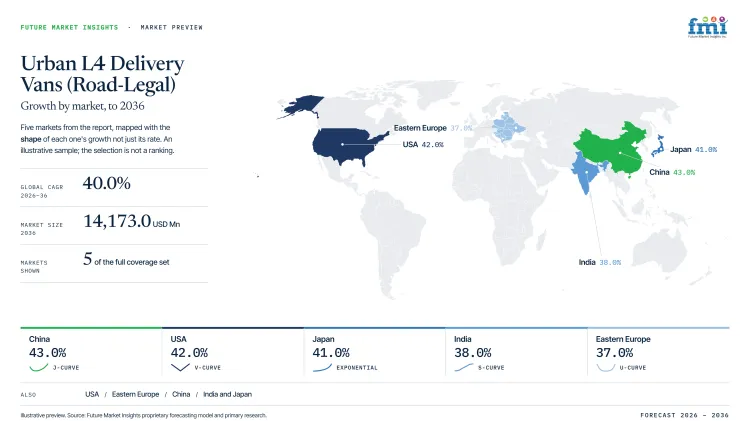
What is country-wise CAGR outlook for urban L4 delivery vans (road-legal) market?
| Country | CAGR |
|---|---|
| China | 43.0% |
| USA | 42.0% |
| Japan | 41.0% |
| India | 38.0% |
| Eastern Europe | 37.0% |
Source: Future Market Insights analysis, 2026.
How do country-level CAGRs compare in the Urban L4 Delivery Vans (Road-Legal) Market?
The comparison spans 6.0 percentage points across the urban L4 delivery vans (road-legal) market. China records the highest CAGR at 43.0%, followed by the United States at 42.0% and Japan at 41.0%. India reaches 38.0%, while Eastern Europe posts 37.0%. The ranking reflects different levels of investment in autonomous commercial vehicles, urban delivery automation and supporting transport infrastructure.
- China leads with a CAGR of 43.0%. Logistics providers and vehicle developers are advancing Level 4 autonomous delivery van programs to improve last-mile distribution, increase fleet efficiency and support high-frequency urban delivery operations.
- The United States follows at 42.0%, 1.0 percentage point below China. Commercial fleet operators continue evaluating road-legal autonomous delivery vans for urban freight movement, with deployment focused on improving route efficiency and reducing operating costs across delivery networks.
- Japan records a CAGR of 41.0%, 1.0 percentage point behind the United States. Market activity centers on integrating autonomous driving technologies into delivery fleets that operate in dense urban environments where consistent routing and automated vehicle control are priorities.
- India posts a CAGR of 38.0%, 3.0 percentage points below Japan. Interest in autonomous delivery vans is increasing as logistics companies assess automation technologies that improve urban goods movement and strengthen distribution efficiency across expanding delivery networks.
- Eastern Europe reaches a CAGR of 37.0%, 1.0 percentage point behind India. The market reflects continued evaluation of autonomous commercial vehicle technologies as fleet modernization and logistics automation become part of long-term transport development plans.
Comparable CAGRs do not indicate identical market conditions. Differences in autonomous vehicle regulation, logistics infrastructure, commercial fleet investment and urban mobility strategies influence deployment timelines and long-term commercial opportunities. The full report provides country-level CAGR analysis across North America, Latin America, Europe, East Asia, South Asia, Oceania and the Middle East and Africa.
Country-wise Analysis
- The market in China is projected to record 43.0% CAGR during the assessment period, driven by purpose-built vehicle manufacturing and municipal road-testing programs. Permit progress supports movement from vehicle production into multi-district commercial operations. WeRide's July 2025 announcement covered a 2nd active road-testing permit for Robovan W5, expanding multi-district validation for urban logistics.
- Nuro reported in November 2024 covering driverless expansion across multiple cities in 2 states, strengthening operating evidence for commercial fleet partners. Accumulated operating experience helps fleet partners assess service continuity and public-road readiness. Adoption in the United States is expected to rise at 42.0% CAGR from 2026 to 2036, guided by exemption pathways and private autonomous programs.
- Sector in Japan is anticipated to expand at 41.0% CAGR by 2036, helped by coordinated policy work and controlled demonstrations. National demonstration programs provide developers with a structured path toward public-road evaluation. Ministry of Economy, Trade and Industry reported in February 2025 outlining a 3-year intensive demonstration period for autonomous delivery robots, encouraging structured route trials.
- Press Information Bureau reported in September 2024 stating Swiggy operated across nearly 700 cities, showing extensive platform reach for local delivery programs. Extensive platform coverage creates a sizeable operating base for autonomous delivery trials. Sales in India are predicted to grow at 38.0% CAGR between 2026 and 2036, aided by urban grocery density and service-platform networks.
- Industry in the Eastern Europe is forecast to post 37.0% CAGR during the study period, reflected by compact-city pilots and regional vehicle developers. Compact urban networks support controlled testing across defined service zones. Clevon's February 2024 statement announced plans for a 25-vehicle driverless fleet on Lithuanian public roads during 2025, supporting practical urban route evaluation.
Notable Companies in Urban L4 Delivery Vans (Road-Legal) Market
Neolix and WeRide offer road-ready cargo vehicles, indiGO Technologies supplies lightweight unmanned delivery platforms and Nuro licenses Level 4 driving technology to vehicle partners.
-market-analysis-by-company.webp "Urban L4 Delivery Vans (road Legal) Market Analysis By Company")
Competition includes purpose-built vehicle developers and licensed autonomy providers serving urban logistics programs. Commercial reviews are expected to emphasize payload range and remote fleet support. Vehicle developers benefit from autonomy specialists compete due to reusable driving stacks and service operators combine route management with maintenance.
- Neolix is expected to compete based on X-series RoboVans and retailer or logistics partnerships.
- WeRide is projected to compete led by Robovan W5 engineering and public-road testing permits.
- indiGO Technologies is anticipated to compete due to compact unmanned vehicles and European delivery trials.
- Nuro is likely to compete depending on vehicle-agnostic Level 4 autonomy licensing and driverless deployment experience.
Competitive Benchmarking in Urban L4 Delivery Vans (Road-Legal) Market
| Company | Vehicle Platform Depth | Road Access Evidence | Service Model | Geographic Reach |
|---|---|---|---|---|
| Neolix | High | Commercial fleet programs | Vehicle and fleet program | China-led with overseas pilots |
| WeRide | High | Public-road test permits | Vehicle and autonomy stack | China-led with overseas activity |
| indiGO Technologies | Medium | Public-road service trials | Vehicle deployment and route service | Europe and United States |
| Nuro | Medium | Driverless deployment record | Licensed autonomy platform | United States and partner expansion |
Source: Future Market Insights analysis, 2026.
Key Developments in Urban L4 Delivery Vans (Road-Legal) Market
- In July 2025, Neolix signed a letter of intent with Incheon Metropolitan City covering autonomous-driving demonstration operations. The cooperation included intelligent logistics services across major facilities, supporting commercial validation for road-legal urban delivery fleets.
- In September 2024, Cainiao announced the public sale and scaled deployment of its latest Level 4 unmanned vehicles. The vehicles were intended for parcel delivery on public roads, strengthening commercial availability across urban logistics operations.
Key Players in Urban L4 Delivery Vans (Road-Legal) Market
Purpose-built road-legal delivery vehicle developers:
- Neolix
- WeRide
- indiGO Technologies (formerly Clevon)
Level 4 autonomy platform provider:
- Nuro
Urban L4 Delivery Vans (Road-Legal) Market - Report Scope
-market-breakdown-by-vehicle-type,-application,-and-region.webp "Urban L4 Delivery Vans (road Legal) Market Breakdown By Vehicle Type, Application, And Region")
| Parameter | Details |
|---|---|
| Market Breakdown | Urban L4 Delivery Vans (Road-Legal) Market is segmented by vehicle type, application, component, end use, business model and region |
| Quantitative Units | Revenue in USD Million, CAGR in %. |
| Market Definition | Road-legal Level 4 cargo vans built or configured for driverless goods delivery on public streets inside approved operating zones. |
| Regions Covered | USA, Eastern Europe, China, India and Japan |
| Countries Covered | United States, China, Japan, India and selected Eastern European countries |
| Key Companies Profiled | Neolix, WeRide, indiGO Technologies and Nuro |
| Forecast Period | 2026 to 2036 |
| Approach | Hybrid bottom-up and top-down methodology using segment shares, country CAGRs, route density, operating permits, vehicle platform depth and service exposure |
Source: Future Market Insights analysis, 2026.
Urban L4 Delivery Vans (Road-Legal) Market - Research Methodology
| Method | Approach |
|---|---|
| Primary Research | FMI analysts gathered input from manufacturers, service providers, technology developers, distributors, end users, procurement teams, and subject-matter experts. Interviews examined purchasing decisions, product or service evaluation, adoption barriers, approval requirements, pricing considerations, and expectations for technical or commercial support. Respondents were also asked what evidence is required before a trial, pilot, or initial order develops into regular purchasing. |
| Desk Research | Desk research covered government statistics, regulatory publications, trade data, industry associations, technical literature, standards, company filings, product information, and official corporate announcements. Sources were reviewed for relevance, publication date, geographic coverage, and consistency with the defined market scope. Claims relating to performance, applications, approvals, capacity, investment, and commercial activity were retained only when supported by credible public evidence. |
| Market Sizing and Forecasting | The market model combined the baseline value with historical performance, segment structure, pricing and volume indicators, adoption levels, company participation, and country-level demand conditions. Forecast assumptions considered economic activity, investment trends, regulatory developments, technology adoption, purchasing cycles, supply availability, and barriers to wider market use. Segment and regional estimates were reconciled before the final market total was calculated. |
| Data Validation | Estimates were checked against multiple independent indicators, including public data, company activity, trade patterns, industry developments, and findings from primary interviews. Validation also tested whether products, services, applications, and company revenues fell within the defined market boundaries. Adjacent categories, unsupported claims, overlapping revenues, and activities without direct market relevance were excluded to reduce double counting and maintain consistency across segments and countries. |
Source: Future Market Insights analysis, 2026.
Urban L4 Delivery Vans (Road-Legal) Market by Segments
Urban L4 Delivery Vans (Road-Legal) Market segmented by Vehicle Type:
- Purpose-built delivery pods
- Retrofitted vans
- Compact road robots
- Refrigerated food units
Urban L4 Delivery Vans (Road-Legal) Market segmented by Application:
- Grocery delivery
- Parcel routes
- Food and restaurant delivery
- Retail replenishment
Urban L4 Delivery Vans (Road-Legal) Market segmented by Component:
- Vehicles
- Autonomy software
- Fleet operations
Urban L4 Delivery Vans (Road-Legal) Market segmented by End Use:
- Grocers
- Parcel and post operators
- Restaurants and platforms
- Retail chains
Urban L4 Delivery Vans (Road-Legal) Market segmented by Business Model:
- Delivery-as-a-service
- Direct ownership
- Subscription
- Pilot programs
Urban L4 Delivery Vans (Road-Legal) Market by Region:
- USA
- Eastern Europe
- China
- India
- Japan
Research Sources and Bibliography
- Clevon. (2024, February 22). Clevon and LastMile’s 2025 robotic fleet growth initiative and expansion to Europe.
- Neolix. (2025, July 24). Accelerating global expansion: Neolix signs letter of intent with Incheon, South Korea.
- Cainiao. (2024, September 10). Cainiao to scale up deployment of L4 unmanned vehicles for public road use and delivery.
- Clevon. (2025, October 8). indiGO and Omniva are teaming up.
- Eurostat. (2025, February 20). Online shopping in the EU keeps growing.
- Ministry of Economy, Trade and Industry. (2025, February 26). Future perspectives on autonomous delivery robots compiled.
- National Highway Traffic Safety Administration. (2025, April 8). NHTSA estimates 39,345 traffic fatalities in 2024.
- National Highway Traffic Safety Administration. (2025, June 13). USA Transportation Secretary Sean P. Duffy streamlines exemption process for noncompliant automated vehicles.
- Neolix. (2025, September 23). Neolix completes delivery of 10,000 autonomous vehicles, leading industry into new phase of commercial development.
- Nuro. (2024, November 19). Nuro goes driverless in three cities and advances capabilities of Nuro Driver.
- Nuro. (2025, December 18). 2025: A year of momentum and milestones.
- Press Information Bureau. (2024, September 7). Ministry of Skill Development and Entrepreneurship and Swiggy collaborate to enhance skills, increase employability of the workforce through Swiggy Skills initiative.
- United States Census Bureau. (2026, May 18). Quarterly retail e-commerce sales, 1st quarter 2026.
- United States Department of Agriculture, Foreign Agricultural Service. (2025, July 23). India's e-commerce and quick commerce market.
- Walmart. (2025, June 5). Walmart takes flight with drone delivery expansion to five new cities, redefining fast and flexible retail.
- WeRide. (2025, February 6). WeRide launches Robovan W5, pioneering new class of autonomous delivery vehicle.
- WeRide. (2025, July 2). WeRide secures first driverless logistics vehicle test permit in Guangzhou's Huangpu District for Robovan W5.
This bibliography is provided for reader reference and is not exhaustive. Full report contains complete reference records and detailed citations.
This Report Answers
- What segments shape urban Level 4 delivery van activity across vehicle type, application, component, end use and business model?
- How do grocery and parcel operators evaluate road-legal autonomous vans for scheduled urban routes?
- How do country CAGRs differ across profiled markets?
- What companies compete through purpose-built vehicles and licensed Level 4 autonomy?
- How are forecasts validated using a hybrid bottom-up and top-down approach?
- What factors do fleet teams address during public-road route preparation?
- How do cargo volume and remote fleet support affect vehicle selection?
- What limits return on investment for operators adding road-legal autonomous vans?
- How do operating records and regulator engagement influence commercial approval?
- What vendor capabilities improve long-term fleet confidence?
Frequently Asked Questions
What supports activity in Urban L4 Delivery Vans (Road-Legal) Market?
Activity is expected to be supported by grocers and parcel operators seeking scheduled cargo movement across approved urban routes. Operator reviews are likely to favor vehicle developers combining safety evidence and service coverage.
Who are key players in Urban L4 Delivery Vans (Road-Legal) Market?
Key companies are anticipated to include Neolix, WeRide, indiGO Technologies and Nuro. Competition is projected to reflect vehicle engineering and fleet-support capability.
What restraint affects Urban L4 Delivery Vans (Road-Legal) Market?
A major restraint involves extensive safety validation and city-level road authorization across mixed-traffic environments. Route launches slow if developers lack operating-domain evidence or dependable incident response.
Why do executives track Urban L4 Delivery Vans (Road-Legal) Market?
Executives are expected to track road-legal autonomous vans as delivery capacity influences fulfilment cost and service planning. Vehicle payload and route density shape investment reviews.
What business problem does Urban L4 Delivery Vans (Road-Legal) Market?
Urban L4 delivery vans address recurring goods movement across routes facing driver availability and service consistency pressures. Cargo-focused vehicles support scheduled delivery capacity inside approved public-street zones.
What do fleet teams evaluate prior to selecting vendors?
Fleet teams are likely to evaluate operating-domain records and remote support capability during vendor review. Maintenance coverage and software integration are expected to guide final selection.
What limits return on investment for operators?
Return on investment weakens if route density or authorization coverage fails to support planned service levels. Idle fleet time and manual recovery activity reduce expected operating gains.
How do vendors build long-term fleet confidence?
Vendors build fleet confidence through consistent vehicle performance and operating evidence specific to public-road delivery. Responsive maintenance and transparent incident reporting are anticipated to influence repeat contracts.
Preview the report firsthand - request a free sample
Get SampleGet the brochure for pricing and purchase details.
Get PDFTable of Content
- Key Takeaways
- Market Size and CAGR
- Top Growth Driver
- Fastest Growing Segment
- Leading Region
- Key Companies
- Emerging Opportunities
- Executive Summary
- Global Market Outlook
- Demand-side Trends
- Supply-side Trends
- Technology Roadmap Analysis
- Analysis and Recommendations
- Analyst Perspective (What is happening? Why now? What should investors know?)
- Key Questions Answered
- How large is the market?
- What is the CAGR?
- What are key trends?
- Which region dominates?
- Who are the leaders?
- Market Overview
- Market Coverage / Taxonomy
- Market Definition / Scope / Limitations
- Research Methodology
- Chapter Orientation
- Analytical Lens and Working Hypotheses
- Market Structure, Signals, and Trend Drivers
- Benchmarking and Cross-market Comparability
- Market Sizing, Forecasting, and Opportunity Mapping
- Research Design and Evidence Framework
- Desk Research Programme (Secondary Evidence)
- Expert Input and Fieldwork (Primary Evidence)
- Tooling, Models, and Reference Databases
- Data Engineering and Model Build
- Quality Assurance and Audit Trail
- Market Background
- Market Dynamics (Drivers, Restraints, Opportunity, Trends)
- Scenario Forecast (Optimistic, Likely, Conservative)
- Impact Analysis
- AI Impact
- Sustainability Impact
- Regulatory Impact
- Technology Impact
- Consumer / Buyer Analysis
- Purchase Drivers
- Adoption Barriers
- Buyer Journey
- Opportunity Map Analysis
- Product Life Cycle Analysis
- Supply Chain Analysis
- Investment Feasibility Matrix
- Value Chain Analysis
- PESTLE and Porter's Analysis
- Regulatory Landscape
- Regional Parent Market Outlook
- Production and Consumption Statistics
- Import and Export Statistics
- Global Market Analysis and Forecast, 2021 to 2036
- Historical Market Size Value (USD Mn) Analysis, 2021 to 2025
- Current and Future Market Size Value (USD Mn) Projections, 2026 to 2036
- Y-o-Y Growth Trend Analysis
- Absolute $ Opportunity Analysis
- Global Market Pricing Analysis, 2021 to 2036
- Global Market Analysis and Forecast, By Vehicle Type, 2021 to 2036
- Introduction / Key Findings
- Historical Market Size Value (USD Mn) Analysis By Vehicle Type, 2021 to 2025
- Current and Future Market Size Value (USD Mn) Analysis and Forecast By Vehicle Type, 2026 to 2036
- Purpose-built delivery pods
- Retrofitted vans
- Compact road robots
- Refrigerated - food units
- Purpose-built delivery pods
- Y-o-Y Growth Trend Analysis By Vehicle Type, 2021 to 2025
- Absolute $ Opportunity Analysis By Vehicle Type, 2026 to 2036
- Global Market Analysis and Forecast, By Application, 2021 to 2036
- Introduction / Key Findings
- Historical Market Size Value (USD Mn) Analysis By Application, 2021 to 2025
- Current and Future Market Size Value (USD Mn) Analysis and Forecast By Application, 2026 to 2036
- Grocery delivery
- Parcel routes
- Food & restaurant
- Retail replenishment
- Grocery delivery
- Y-o-Y Growth Trend Analysis By Application, 2021 to 2025
- Absolute $ Opportunity Analysis By Application, 2026 to 2036
- Global Market Analysis and Forecast, By Component, 2021 to 2036
- Introduction / Key Findings
- Historical Market Size Value (USD Mn) Analysis By Component, 2021 to 2025
- Current and Future Market Size Value (USD Mn) Analysis and Forecast By Component, 2026 to 2036
- Vehicles
- Autonomy software
- Fleet operations
- Vehicles
- Y-o-Y Growth Trend Analysis By Component, 2021 to 2025
- Absolute $ Opportunity Analysis By Component, 2026 to 2036
- Global Market Analysis and Forecast, By End-use, 2021 to 2036
- Introduction / Key Findings
- Historical Market Size Value (USD Mn) Analysis By End-use, 2021 to 2025
- Current and Future Market Size Value (USD Mn) Analysis and Forecast By End-use, 2026 to 2036
- Grocers
- Parcel & post
- Restaurants & platforms
- Retail chains
- Grocers
- Y-o-Y Growth Trend Analysis By End-use, 2021 to 2025
- Absolute $ Opportunity Analysis By End-use, 2026 to 2036
- Global Market Analysis and Forecast, By Business Model, 2021 to 2036
- Introduction / Key Findings
- Historical Market Size Value (USD Mn) Analysis By Business Model, 2021 to 2025
- Current and Future Market Size Value (USD Mn) Analysis and Forecast By Business Model, 2026 to 2036
- Delivery-as-a-service
- Direct
- Subscription
- Pilot programs
- Delivery-as-a-service
- Y-o-Y Growth Trend Analysis By Business Model, 2021 to 2025
- Absolute $ Opportunity Analysis By Business Model, 2026 to 2036
- Global Market Analysis and Forecast, By Region, 2021 to 2036
- Introduction
- Historical Market Size Value (USD Mn) Analysis By Region, 2021 to 2025
- Current Market Size Value (USD Mn) Analysis and Forecast By Region, 2026 to 2036
- North America
- Latin America
- Western Europe
- Eastern Europe
- East Asia
- South Asia and Pacific
- Middle East & Africa
- Market Attractiveness Analysis By Region
- North America Market Analysis and Forecast, By Country, 2021 to 2036
- Historical Market Size Value (USD Mn) Trend Analysis By Market Taxonomy, 2021 to 2025
- Market Size Value (USD Mn) Forecast By Market Taxonomy, 2026 to 2036
- By Country
- USA
- Canada
- By Vehicle Type
- By Application
- By Component
- By End-use
- By Business Model
- By Country
- Market Attractiveness Analysis
- By Country
- By Vehicle Type
- By Application
- By Component
- By End-use
- By Business Model
- Key Takeaways
- Latin America Market Analysis and Forecast, By Country
- Historical Market Size Value (USD Mn) Trend Analysis By Market Taxonomy, 2021 to 2025
- Market Size Value (USD Mn) Forecast By Market Taxonomy, 2026 to 2036
- By Country
- Brazil
- Mexico
- Chile
- Rest of Latin America
- By Vehicle Type
- By Application
- By Component
- By End-use
- By Business Model
- By Country
- Market Attractiveness Analysis
- By Country
- By Vehicle Type
- By Application
- By Component
- By End-use
- By Business Model
- Key Takeaways
- Western Europe Market Analysis and Forecast, By Country
- Historical Market Size Value (USD Mn) Trend Analysis By Market Taxonomy, 2021 to 2025
- Market Size Value (USD Mn) Forecast By Market Taxonomy, 2026 to 2036
- By Country
- Germany
- UK
- Italy
- Spain
- France
- Nordic
- BENELUX
- Rest of Western Europe
- By Vehicle Type
- By Application
- By Component
- By End-use
- By Business Model
- By Country
- Market Attractiveness Analysis
- By Country
- By Vehicle Type
- By Application
- By Component
- By End-use
- By Business Model
- Key Takeaways
- Eastern Europe Market Analysis and Forecast, By Country
- Historical Market Size Value (USD Mn) Trend Analysis By Market Taxonomy, 2021 to 2025
- Market Size Value (USD Mn) Forecast By Market Taxonomy, 2026 to 2036
- By Country
- Russia
- Poland
- Hungary
- Balkan & Baltic
- Rest of Eastern Europe
- By Vehicle Type
- By Application
- By Component
- By End-use
- By Business Model
- By Country
- Market Attractiveness Analysis
- By Country
- By Vehicle Type
- By Application
- By Component
- By End-use
- By Business Model
- Key Takeaways
- East Asia Market Analysis and Forecast, By Country
- Historical Market Size Value (USD Mn) Trend Analysis By Market Taxonomy, 2021 to 2025
- Market Size Value (USD Mn) Forecast By Market Taxonomy, 2026 to 2036
- By Country
- China
- Japan
- South Korea
- By Vehicle Type
- By Application
- By Component
- By End-use
- By Business Model
- By Country
- Market Attractiveness Analysis
- By Country
- By Vehicle Type
- By Application
- By Component
- By End-use
- By Business Model
- Key Takeaways
- South Asia and Pacific Market Analysis and Forecast, By Country
- Historical Market Size Value (USD Mn) Trend Analysis By Market Taxonomy, 2021 to 2025
- Market Size Value (USD Mn) Forecast By Market Taxonomy, 2026 to 2036
- By Country
- India
- ASEAN
- Australia & New Zealand
- Rest of South Asia and Pacific
- By Vehicle Type
- By Application
- By Component
- By End-use
- By Business Model
- By Country
- Market Attractiveness Analysis
- By Country
- By Vehicle Type
- By Application
- By Component
- By End-use
- By Business Model
- Key Takeaways
- Middle East & Africa Market Analysis and Forecast, By Country
- Historical Market Size Value (USD Mn) Trend Analysis By Market Taxonomy, 2021 to 2025
- Market Size Value (USD Mn) Forecast By Market Taxonomy, 2026 to 2036
- By Country
- Kingdom of Saudi Arabia
- Other GCC Countries
- Türkiye
- South Africa
- Other African Union
- Rest of Middle East & Africa
- By Vehicle Type
- By Application
- By Component
- By End-use
- By Business Model
- By Country
- Market Attractiveness Analysis
- By Country
- By Vehicle Type
- By Application
- By Component
- By End-use
- By Business Model
- Key Takeaways
- Key Countries Market Analysis
- USA
- Pricing Analysis
- Market Share Analysis, 2025
- By Vehicle Type
- By Application
- By Component
- By End-use
- By Business Model
- Canada
- Pricing Analysis
- Market Share Analysis, 2025
- By Vehicle Type
- By Application
- By Component
- By End-use
- By Business Model
- Mexico
- Pricing Analysis
- Market Share Analysis, 2025
- By Vehicle Type
- By Application
- By Component
- By End-use
- By Business Model
- Brazil
- Pricing Analysis
- Market Share Analysis, 2025
- By Vehicle Type
- By Application
- By Component
- By End-use
- By Business Model
- Chile
- Pricing Analysis
- Market Share Analysis, 2025
- By Vehicle Type
- By Application
- By Component
- By End-use
- By Business Model
- Germany
- Pricing Analysis
- Market Share Analysis, 2025
- By Vehicle Type
- By Application
- By Component
- By End-use
- By Business Model
- UK
- Pricing Analysis
- Market Share Analysis, 2025
- By Vehicle Type
- By Application
- By Component
- By End-use
- By Business Model
- Italy
- Pricing Analysis
- Market Share Analysis, 2025
- By Vehicle Type
- By Application
- By Component
- By End-use
- By Business Model
- Spain
- Pricing Analysis
- Market Share Analysis, 2025
- By Vehicle Type
- By Application
- By Component
- By End-use
- By Business Model
- France
- Pricing Analysis
- Market Share Analysis, 2025
- By Vehicle Type
- By Application
- By Component
- By End-use
- By Business Model
- India
- Pricing Analysis
- Market Share Analysis, 2025
- By Vehicle Type
- By Application
- By Component
- By End-use
- By Business Model
- ASEAN
- Pricing Analysis
- Market Share Analysis, 2025
- By Vehicle Type
- By Application
- By Component
- By End-use
- By Business Model
- Australia & New Zealand
- Pricing Analysis
- Market Share Analysis, 2025
- By Vehicle Type
- By Application
- By Component
- By End-use
- By Business Model
- China
- Pricing Analysis
- Market Share Analysis, 2025
- By Vehicle Type
- By Application
- By Component
- By End-use
- By Business Model
- Japan
- Pricing Analysis
- Market Share Analysis, 2025
- By Vehicle Type
- By Application
- By Component
- By End-use
- By Business Model
- South Korea
- Pricing Analysis
- Market Share Analysis, 2025
- By Vehicle Type
- By Application
- By Component
- By End-use
- By Business Model
- Russia
- Pricing Analysis
- Market Share Analysis, 2025
- By Vehicle Type
- By Application
- By Component
- By End-use
- By Business Model
- Poland
- Pricing Analysis
- Market Share Analysis, 2025
- By Vehicle Type
- By Application
- By Component
- By End-use
- By Business Model
- Hungary
- Pricing Analysis
- Market Share Analysis, 2025
- By Vehicle Type
- By Application
- By Component
- By End-use
- By Business Model
- Kingdom of Saudi Arabia
- Pricing Analysis
- Market Share Analysis, 2025
- By Vehicle Type
- By Application
- By Component
- By End-use
- By Business Model
- Türkiye
- Pricing Analysis
- Market Share Analysis, 2025
- By Vehicle Type
- By Application
- By Component
- By End-use
- By Business Model
- South Africa
- Pricing Analysis
- Market Share Analysis, 2025
- By Vehicle Type
- By Application
- By Component
- By End-use
- By Business Model
- USA
- Market Structure Analysis
- Competition Dashboard
- Competition Benchmarking
- Market Share Analysis of Top Players
- By Regional
- By Vehicle Type
- By Application
- By Component
- By End-use
- By Business Model
- Emerging Startups
- Innovation Benchmarking
- Competition Analysis
- Competition Deep Dive
- Nuro (US)
- Overview
- Product Portfolio
- Profitability by Market Segments
- Sales Footprint
- Strategy Overview
- Marketing Strategy
- Product Strategy
- Channel Strategy
- Clevon (EE)
- Udelv (US)
- Nuro (US)
- Case Studies
- Success Stories
- Recent Developments
- Competition Deep Dive
- Assumptions & Acronyms Used


