

- Market Size (2026)
- USD 471.7 Mn
- Forecast (2036)
- USD 902.2 Mn
- CAGR (2026 to 2036)
- 6.7%
How big is Vacuum Insulated Shippers Market in 2026?
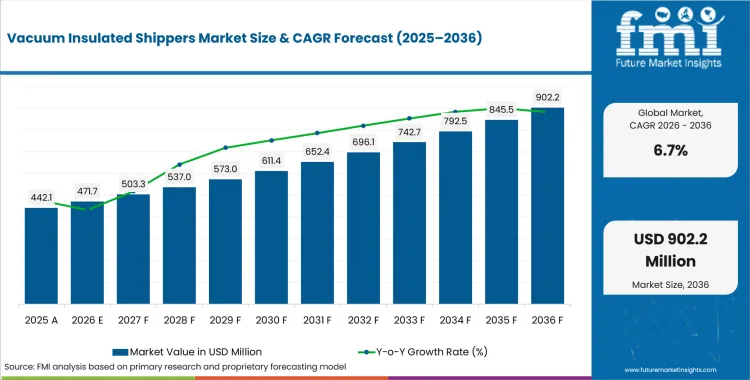
USD 471.7 million in 2026 and USD 902.2 million by 2036 at a 6.7% CAGR.
Demand for vacuum insulated shippers is forecast to grow at a 6.7% CAGR from 2026 to 2036, lifting market value from USD 471.7 million to USD 902.2 million. The underlying need is practical: more goods are moving through parcel networks, while the cost of a temperature excursion can be substantial for healthcare, food and other sensitive products. In the United States alone, first-quarter 2026 retail e-commerce sales reached USD 326.7 billion, 9.8% above the same quarter a year earlier, according to the USA Census Bureau.
What buyers need from an insulated shipper depends on the route, the payload and the consequence of failure. A routine parcel may need dependable thermal protection for a defined window, while a high-value healthcare shipment can justify a more heavily qualified system. That difference shapes the economics of the market. Freight weight, conditioning effort, assembly time and recovery after use can matter as much as insulation depth. Standard-duty formats therefore remain relevant for repeat parcel lanes, while temperature-assured systems serve shipments where longer exposure or tighter control warrants the added complexity.
Key Takeaways
- Growth in parcel volumes and temperature-sensitive distribution is expanding the number of shipments that need both physical protection and thermal control.
- Standard formats are expected to account for 40.0% of Format Type demand in 2026. Common dimensions make them easier to stock, train around, and use repeatedly across fulfillment operations.
- Paper-based systems are projected to hold 32.0% of Material demand in 2026 as buyers look for insulation formats that provide adequate protection while fitting more familiar fiber-recovery and disposal routes.
- Standard duty is forecast to represent 40.0% of Performance Class demand in 2026. For routine parcel lanes, buyers often prioritize dependable protection and simple handling over maximum thermal duration.
- E-commerce & parcel is expected to contribute 35.0% of End Use demand in 2026, reflecting the recurring packaging requirement created by every fulfilled order.
- Direct accounts are projected to account for 43.0% of Sales Channel demand in 2026. Larger shipping programs often involve design support, qualification work, and implementation planning before the packaging becomes part of routine operations.
- Higher-performance systems can face slower adoption when conditioning, validation, or return logistics add operational burden. The opportunity lies in designs that provide the required duration with less material, simpler handling, or a practical recyclable or reusable model.
- Signode, Pregis, Smurfit Westrock, va-Q-tec, Peli BioThermal, Storopack, Cold Chain Technologies, Sealed Air, Sonoco ThermoSafe, and Ranpak compete across cold-chain systems, protective packaging, reusable solutions, and fiber-based parcel formats.
Analyst Perspective
"The commercial test for an insulated shipper is not maximum thermal duration. It is whether the chosen pack-out protects the payload for the real lane while keeping freight, assembly and recovery steps under control. Suppliers that make performance easy to specify and repeat will convert more trials into recurring programs."
- Nandini Roy Choudhury, Principal Consultant, Future Market Insights
How is the vacuum insulated shippers market segmented?
The market is segmented by Format Type, Material, Performance Class, End Use and Sales Channel.
The segmentation reflects how buyers actually specify the package. Format Type separates stocked designs from recyclable-optimized, premium and custom-engineered options. Material distinguishes paper, foam, air-and-film and other insulation architectures. Performance Class captures the protection level required for the lane, while End Use reflects the very different risk profiles of parcel commerce, industrial goods, healthcare and food. Sales Channel then shows whether the product is bought through a direct program, a distributor or an online B2B route.
Why do Standard formats lead the Format Type category?
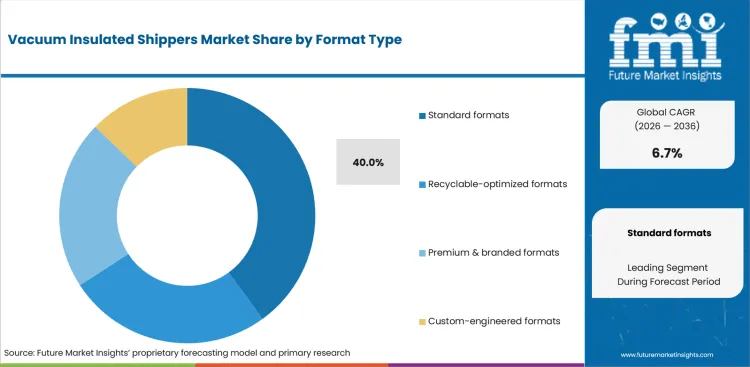
Standard formats fit the rhythm of repeat fulfillment. Common dimensions simplify storage, packing instructions and freight planning, and they allow the same pack-out to be used across teams or sites with less retraining. Custom designs still have a place when payload geometry or thermal duration demands it, but routine programs usually benefit from fewer variables.
- Standard formats are forecast to hold a 40.0% share of Format Type demand in 2026.
- Cold Chain Technologies introduced the CCT Tower Elite in 2025 with compatibility for both Euro and USA pallets, illustrating how common interfaces can reduce regional variation while preserving temperature-control capability.
Why do Paper-based systems lead the Material category?
Paper-based systems are gaining ground where buyers want thermal protection without creating a difficult disposal problem at the destination. Fiber-heavy liners and structural components can move through familiar paper-recovery streams in applications that do not require the deepest insulation. More demanding pharmaceutical lanes can still call for vacuum panels or phase-change materials, so material choice increasingly follows the protection window rather than a blanket preference for one insulation type.
- Paper-based systems are forecast to account for 32.0% of Material demand in 2026.
- Cold Chain Technologies launched the TRUEtemp Naturals shipper in May 2025 as a curbside-recyclable parcel solution using recycled materials, showing how thermal packaging suppliers are combining defined temperature performance with simpler fiber recovery.
Why does Standard duty lead the Performance Class category?
Many shipments need dependable insulation without the operating burden associated with the most demanding cold-chain lanes. For those routine movements, buyers tend to optimize cost per shipment and packing speed. Heavy-duty and temperature-assured configurations remain important where the payload is more sensitive or the route is longer, but they are not required for every insulated parcel.
- Standard duty is forecast to hold a 40.0% share of Performance Class demand in 2026.
- European good-distribution guidance calls for qualified equipment when temperature-sensitive medicinal products are transported. That requirement creates a distinct threshold for regulated lanes instead of making temperature-assured packaging necessary for every shipment.
Why does E-commerce & parcel lead the End Use category?
E-commerce creates demand one shipment at a time. Every fulfilled order needs a pack-out, and food or healthcare parcels add a thermal requirement to that same workflow. This makes dimensional efficiency and packing speed commercially important. Suppliers that reduce void space or simplify assembly can lower fulfillment cost while still meeting the required protection level.
- E-commerce & parcel is forecast to account for 35.0% of End Use demand in 2026.
- The USA Census Bureau reported first-quarter 2026 retail e-commerce sales of USD 326.7 billion, 9.8% above the same quarter a year earlier. Higher order flow expands the number of recurring pack-outs that fulfillment teams must source and manage.
Why do Direct accounts lead the Sales Channel category?
Direct purchasing becomes more valuable once an insulated shipper is treated as part of a repeat logistics program instead of a generic packaging item. Larger accounts may need pack-out design, lane qualification and continuity of supply before approving a format for routine use. Distributors remain useful for mixed baskets and local availability, while online B2B channels suit standard packs where specification risk is low.
- Direct accounts are forecast to hold a 43.0% share of Sales Channel demand in 2026.
What are the drivers, restraints and opportunities in the Vacuum Insulated Shippers Market?
Rising parcel and temperature-sensitive distribution supports demand, qualification and operating complexity can slow adoption, and right-duration recyclable or reusable systems create room for lower total logistics cost.
- Driver: Higher parcel throughput and temperature-sensitive distribution create recurring demand for protective and thermal shipper formats.
- Restraint: Qualification, refrigerant conditioning, storage and reusable-asset handling can extend approval cycles and raise operating cost.
- Opportunity: Recyclable, reusable and payload-efficient systems can expand adoption when they meet the required protection window without excessive freight or handling cost.
Parcel frequency is the clearest demand trigger. More online orders mean more pack-outs, and a growing share of those shipments carry food, healthcare or other goods that cannot tolerate uncontrolled temperature exposure. Buyers therefore weigh insulation against payload space and freight cost rather than choosing purely on thermal duration.
The harder part comes when a shipment needs documented temperature performance. European good-distribution guidance requires qualified equipment for temperature-sensitive medicines, which can add lane testing and operating controls before a shipper enters routine use. Refrigerant conditioning, cold storage and reusable-asset handling can add further work, making simplicity an important part of the supplier proposition.
A useful opportunity sits between basic insulation and highly engineered temperature-assured systems. Regulation (EU) 2025/40 raises the importance of recyclability and reuse across European packaging supply chains from August 2026. This creates room for fiber-heavy liners, reusable transport formats and designs that use only the insulation needed for the lane. Adoption improves when those changes reduce total logistics cost instead of shifting effort elsewhere in the process.
Which country CAGRs are covered in the Vacuum Insulated Shippers Market?
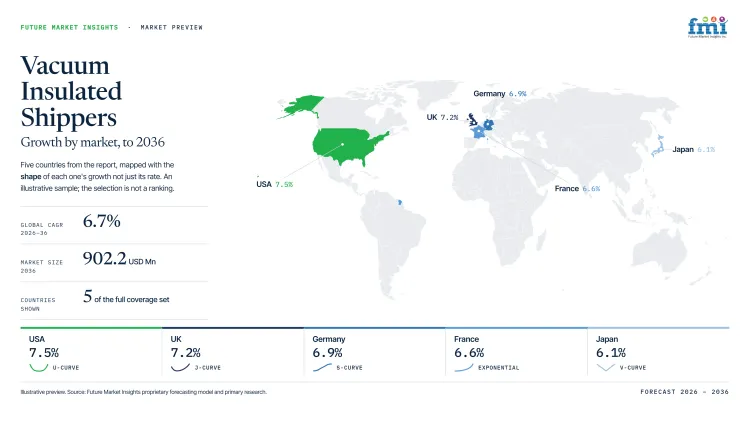
| Country | CAGR |
|---|---|
| USA | 7.5% |
| Germany | 6.9% |
| France | 6.6% |
| UK | 7.2% |
| Japan | 6.1% |
| South Korea | 7.8% |
| Saudi Arabia | 8.1% |
| UAE | 8.4% |
How do country-level CAGRs compare in the Vacuum Insulated Shippers Market?
Growth rates vary by 2.3 percentage points across the countries covered, from 8.4% in the UAE to 6.1% in Japan between 2026 and 2036. The faster rates in the UAE, Saudi Arabia and South Korea reflect a different stage of parcel and specialized-logistics development than the more mature markets of Germany, France and Japan. These percentages indicate market pace rather than absolute size.
- USA: 7.5% CAGR. Scale is the defining factor, with fulfillment density making dimensional efficiency and qualification support important in supplier selection.
- Germany: 6.9% CAGR. Mature online purchasing and European packaging rules are pushing recovery pathways and material design higher on the buying agenda.
- France: 6.6% CAGR. High transaction volumes support pack-out demand, while lower average basket values keep pressure on the cost of each shipment.
- UK: 7.2% CAGR. A high online share of retail activity favors compact formats that can move efficiently through dense parcel networks.
- Japan: 6.1% CAGR. Demand spans food, electronics and health-related online categories, each with a different protection requirement.
- South Korea: 7.8% CAGR. Frequent mobile-led purchasing raises the value of fast assembly and dependable local replenishment.
- Saudi Arabia: 8.1% CAGR. Broader digital-payment use is supporting online ordering and creating space for locally stocked standard and temperature-assured formats.
- UAE: 8.4% CAGR. A more formal e-commerce operating environment increases the value of clear specifications, local availability and direct account support.
Regional coverage spans North America, Latin America, Western Europe, Eastern Europe, East Asia, South Asia and Pacific, and the Middle East and Africa.
Country-wise Analysis
- USA: Parcel scale gives the USA market a broad base for insulated shipping demand, with growth forecast at 7.5% CAGR from 2026 to 2036. The USA Census Bureau reported USD 326.7 billion in retail e-commerce sales during the first quarter of 2026, 9.8% above the prior-year period. That volume supports standardized, space-efficient formats for routine shipments. Healthcare and food move under a different set of economics, where the cost of an excursion can justify qualified thermal systems.
- Germany: The market is projected to grow at 6.9% CAGR through 2036, but the purchasing logic is already shaped by a mature online economy. Destatis reported that 86% of people aged 16 to 74 had bought goods or services online by 2025. For routine applications, this favors fiber-heavy formats that are easier to recover after use. More sensitive shipments still require validated temperature performance, so recyclability does not replace the need for thermal assurance.
- France: A large e-commerce workload is meeting persistent pressure on shipment economics. Fevad reported EUR 196.4 billion in e-commerce sales across 3.2 billion transactions in 2025, while average basket value declined. Vacuum Insulated Shippers demand is forecast to expand at 6.6% CAGR through 2036. Standard and material-efficient formats fit ordinary parcel flows, while premium insulated systems are more likely to be used when the value or sensitivity of the payload justifies the extra cost.
- UK: Online retail already accounts for a substantial share of consumer purchasing, which makes fulfillment efficiency central to packaging decisions. The Office for National Statistics reported that online sales represented 27.8% of total retail sales in the second quarter of 2026. Against this backdrop, the market is expected to grow at 7.2% CAGR through 2036. Compact shippers that reduce dimensional weight and packing effort have a clear role, while temperature-assured systems need to earn their place through route-specific performance.
- Japan: The market is projected to grow at 6.1% CAGR from 2026 to 2036. METI reported B2C e-commerce sales of JPY 26.1 trillion in 2024, with food and health-related categories continuing to expand online. The opportunity is fragmented by use case: grocery, electronics and healthcare shipments differ in payload size and thermal exposure. Suppliers therefore benefit from modular format families that can be matched to the shipment instead of relying on one high-performance design.
- South Korea: High order frequency is central to the market, with demand forecast to grow at 7.8% CAGR through 2036. Online shopping reached KRW 24.2904 trillion in December 2025, including KRW 18.7991 trillion through mobile channels, according to the Ministry of Data and Statistics. This puts a premium on easy assembly and dependable replenishment. Food and healthcare shipments add another requirement: documented thermal performance that does not slow a fast-moving fulfillment operation.
- Saudi Arabia: Digital purchasing is becoming more deeply embedded in retail activity. The Saudi Central Bank reported that electronic payments represented 85% of retail payments in 2025, covering 14.6 billion transactions. Vacuum Insulated Shippers demand is forecast to rise at 8.1% CAGR through 2036. For routine commerce, locally stocked formats that are easy to specify can remove friction. Food and healthcare programs require a more controlled proposition built around temperature assurance and reliable availability.
- UAE: The market is forecast to grow at 8.4% CAGR from 2026 to 2036. Government guidance updated in April 2026 reinforced licensing and technology requirements for e-commerce, adding structure to the operating environment for digital sellers. As parcel volumes increase, insulated shipper suppliers can differentiate through clear product specifications and dependable local distribution. Higher-value accounts are also likely to place greater weight on repeatable pack-out procedures and direct implementation support.
Who are the notable companies in the Vacuum Insulated Shippers Market?
Signode, Pregis, Smurfit Westrock, va-Q-tec, Peli BioThermal, Storopack, Cold Chain Technologies, Sealed Air, Sonoco ThermoSafe, and Ranpak
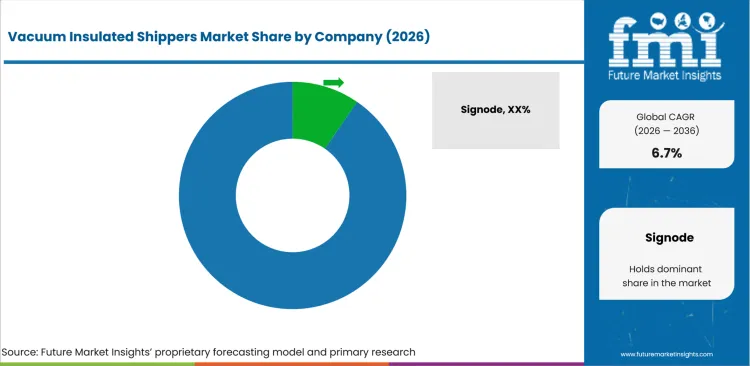
Competition reflects two different ways of creating value. va-Q-tec, Peli BioThermal, Cold Chain Technologies and Sonoco ThermoSafe are built around temperature-controlled logistics, where qualification support and thermal engineering are central. Pregis, Storopack and Sealed Air bring insulated products into broader protective-packaging portfolios. Signode, Smurfit Westrock and Ranpak approach the market from transit, fiber and parcel systems, where material efficiency and fulfillment compatibility carry more weight.
- Temperature-controlled specialists: va-Q-tec, Peli BioThermal, Cold Chain Technologies and Sonoco ThermoSafe compete through passive thermal design, reusable or single-use systems and cold-chain implementation support.
- Protective packaging platforms: Pregis, Storopack and Sealed Air combine insulated solutions with broader cushioning, protective materials and fulfillment capabilities.
- Transit and fiber platforms: Signode, Smurfit Westrock and Ranpak address parcel and transport packaging through standardized structures, fiber-based materials and fulfillment-oriented systems.
Competitive Benchmarking: Vacuum Insulated Shippers Market
| Company | Primary position | Insulation / format focus | Customer model | Reach |
|---|---|---|---|---|
| Signode | Transit packaging platform | Protective and transit formats | Industrial account and channel support | Americas, EMEA and Asia-Pacific |
| Pregis | Protective packaging platform | Insulated and protective parcel formats | Direct accounts and distribution | North America and Europe |
| Smurfit Westrock | Fiber packaging platform | Corrugated and fiber transit systems | Large account and regional supply | Global |
| va-Q-tec | Thermal packaging specialist | VIP and PCM boxes and transport systems | Direct engineering, purchase and rental options | Europe with international channels |
| Peli BioThermal | Cold-chain specialist | Reusable and single-use parcel and bulk shippers | Qualification, lease and service programs | Americas, Europe and Asia-Pacific |
| Storopack | Protective packaging platform | Insulated and protective packaging | Direct and distributor support | Europe, North America and Asia-Pacific |
| Cold Chain Technologies | Cold-chain specialist | Parcel and pallet temperature-controlled systems | Qualification, digital and hub services | Americas, Europe and Asia-Pacific |
| Sealed Air | Diversified packaging platform | Protective and insulated solutions | Enterprise account and channel support | Global |
| Sonoco ThermoSafe | Temperature-assurance specialist | Parcel and pallet cold-chain shippers | Design, testing and qualification support | Americas, EMEA and Asia |
| Ranpak | Fiber protection platform | Paper-based cold-chain liners and coolants | Direct engineering and distribution | North America and Europe with international distribution |
The comparison highlights how suppliers differ in thermal specialization, format coverage and customer support. A cold-chain specialist may offer deeper qualification expertise, while a broader packaging platform can bring stronger integration with routine fulfillment operations. The table is therefore best read as a capability map rather than a supplier ranking.
Key Developments in the Vacuum Insulated Shippers Market
- In April 2025, Sonoco ThermoSafe launched the ChillTherm Bio pallet shipper for pharmaceutical and life-science logistics. The flat-packed design delivers more than 120 hours of qualified 2 C to 8 C performance and uses biodegradable expanded polystyrene, combining long-duration passive control with storage and end-of-life considerations.
- In May 2025, Cold Chain Technologies launched the TRUEtemp Naturals shipper as a curbside-recyclable parcel solution. It is qualified for up to 48 hours at 2 C to 8 C and targets first-mile and parcel-sized temperature-sensitive shipments, extending the company's recyclable cold-chain range.
- In October 2025, Peli BioThermal launched Vero One, a single-use curbside-recyclable dry-ice shipper for pharmaceutical and biopharmaceutical shipments. The launch added an option for lanes where reusable asset recovery is impractical while retaining temperature-controlled protection for high-value products.
- In June 2025, va-Q-tec introduced vacuum-insulated transport boxes developed for e-grocery logistics. The boxes combine vacuum insulation panels with integrated phase-change ice packs and can maintain fresh or frozen conditions for up to 48 hours without refrigerated vehicles or dry ice, linking insulation efficiency with simpler last-mile operations.
Key Players in the Vacuum Insulated Shippers Market
Temperature-Controlled Cold-Chain Systems
- va-Q-tec
- Peli BioThermal
- Cold Chain Technologies
- Sonoco ThermoSafe
Protective and Insulated Packaging Platforms
- Pregis
- Storopack
- Sealed Air
Transit and Fiber-Based Parcel Systems
- Signode
- Smurfit Westrock
- Ranpak
Vacuum Insulated Shippers Market - Report Scope
| Coverage field | Report scope |
|---|---|
| Market breakdown | Format Type; Material; Performance Class; End Use; Sales Channel |
| Quantitative Units | USD Million |
| Market Definition | Revenue includes vacuum insulated and thermally engineered shipper systems sold within the stated segmentation boundary, including insulation, structural packaging and integrated thermal components supplied as part of the shipper. Downstream product revenue, active refrigerated transport equipment and protective packaging without an insulated shipper function are excluded. |
| Regions Covered | North America; Latin America; Western Europe; Eastern Europe; East Asia; South Asia and Pacific; Middle East and Africa |
| Countries Covered | USA; Germany; France; UK; Japan; South Korea; Saudi Arabia; UAE; and additional countries across the covered regions |
| Key Companies | Signode, Pregis, Smurfit Westrock, va-Q-tec, Peli BioThermal, Storopack, Cold Chain Technologies, Sealed Air, Sonoco ThermoSafe, and Ranpak |
| Forecast Period | 2026 to 2036 |
| Approach | Market sizing reconciles shipper-level demand with format, material, performance, end-use, channel and regional indicators within the defined market boundary. |
Vacuum Insulated Shippers Market - Research Methodology
| Method | Approach |
|---|---|
| Primary Research | FMI engages manufacturers, packaging converters, distributors, logistics buyers, packaging engineers, procurement teams and subject-matter experts to understand specification priorities, pricing, qualification needs, channel behavior and implementation friction. |
| Desk Research | Research reviews public statistics, packaging regulation, good-distribution guidance, company filings, product documentation, standards material and industry-association releases that explain the defined shipper market and buyer mechanisms. |
| Market Sizing and Forecasting | Sizing considers shipper revenue patterns, format and material mix, performance requirements, end-use demand, sales channels, country adoption conditions, parcel activity, qualification requirements and reuse economics through 2036. |
| Data Validation | Findings are cross-checked across independent source types and company evidence. Validation removes double counting, downstream product value and adjacent protective packaging that does not meet the market definition. |
Vacuum Insulated Shippers Market by Segments
Vacuum Insulated Shippers Market segmented by Format Type:
- Standard formats
- Recyclable-optimized formats
- Premium & branded formats
- Custom-engineered formats
Vacuum Insulated Shippers Market segmented by Material:
- Paper-based systems
- Foam systems
- Air & film systems
- Thermal insulated systems
Vacuum Insulated Shippers Market segmented by Performance Class:
- Standard duty
- Heavy duty
- Temperature-assured
Vacuum Insulated Shippers Market segmented by End Use:
- E-commerce & parcel
- Electronics & industrial
- Pharma & healthcare
- Food & grocery
Vacuum Insulated Shippers Market segmented by Sales Channel:
- Direct accounts
- Packaging distributors
- Online B2B
Vacuum Insulated Shippers Market by Region:
- North America
- United States
- Canada
- Latin America
- Brazil
- Mexico
- Argentina
- Chile
- Western Europe
- Germany
- France
- United Kingdom
- Italy
- Spain
- Benelux
- Nordics
- Eastern Europe
- Poland
- Czech Republic
- Romania
- Hungary
- East Asia
- China
- Japan
- South Korea
- South Asia and Pacific
- India
- ASEAN
- Australia and New Zealand
- Middle East and Africa
- GCC Countries
- South Africa
- Türkiye
- Israel
Research Sources and Bibliography
- USA Census Bureau (2026, May 18). Quarterly Retail E-Commerce Sales.
- Office for National Statistics (2026, July 24). Internet sales as a percentage of total retail sales.
- Federal Statistical Office of Germany (2025, November 27). Internet users and online shoppers.
- Fevad (2026, February 11). French e-commerce results for 2025.
- Ministry of Economy, Trade and Industry, Japan (2025, August 26). Results of FY2024 E-Commerce Market Survey Compiled.
- Ministry of Data and Statistics, Republic of Korea (2026, February 2). Online Shopping in December 2025.
- Saudi Central Bank (2026, April 12). E-payments account for 85% of total retail payments in 2025.
- The Official Platform of the UAE Government (2026, April 30). eCommerce.
- European Parliament and Council (2025, January 22). Regulation (EU) 2025/40 on packaging and packaging waste.
- European Commission (2013, November 23). Guidelines on Good Distribution Practice of medicinal products for human use.
- Cold Chain Technologies (2025). Launch of the Universal CCT Tower Elite.
- Cold Chain Technologies (2025, May 1). TRUEtemp Naturals curbside-recyclable parcel shipper launch.
- Sonoco ThermoSafe (2025, April 3). ChillTherm Bio biodegradable EPS pallet shipper launch.
- Peli BioThermal (2025, October 9). Vero One dry-ice shipper launch.
- va-Q-tec (2025, June 23). Vacuum-insulated transport boxes developed for the e-grocery market.
This Report Answers
- What parcel and temperature-sensitive distribution mechanisms support demand for vacuum insulated shippers?
- Why do standard formats remain important for recurring fulfillment programs?
- How do paper-based systems change material selection and disposal economics?
- When does a standard-duty shipper provide better economics than a temperature-assured design?
- How does e-commerce shipment frequency influence pack-out and stocking decisions?
- How do purchasing conditions differ across USA, Germany, France, UK, Japan, South Korea, Saudi Arabia and UAE?
- Which capabilities separate cold-chain specialists from broader protective-packaging platforms?
- How do qualification, conditioning and return logistics affect adoption?
- What should packaging and logistics teams evaluate before selecting an insulated shipper system?
Frequently Asked Questions
What is driving growth in the Vacuum Insulated Shippers Market?
More parcels are moving through distribution networks, and a growing share contain food, healthcare or other products that cannot tolerate temperature excursions. Spending increases when insulated packaging can lower that loss risk without adding excessive freight or pack-out cost.
Who are the key players in the Vacuum Insulated Shippers Market?
Signode, Pregis, Smurfit Westrock, va-Q-tec, Peli BioThermal, Storopack, Cold Chain Technologies, Sealed Air, Sonoco ThermoSafe, and Ranpak are among the key companies serving thermal, protective, transit and parcel packaging requirements.
What notable restraint affects the Vacuum Insulated Shippers Market?
Adoption can slow when a shipper needs extensive lane qualification or demanding operating procedures. Refrigerant conditioning, cold storage and reusable-asset handling can all add cost before the packaging reaches routine use.
Why should executives track the Vacuum Insulated Shippers Market?
The category directly affects shipment economics. The insulation system influences freight weight and waste, while its thermal performance determines whether sensitive goods remain within the required condition window.
What business problem does the Vacuum Insulated Shippers Market address?
Vacuum insulated shippers protect temperature-sensitive payloads through parcel and freight networks without requiring active refrigeration inside the package. Their role is to give the shipment enough thermal protection for the route while keeping the pack-out practical to handle.
What should packaging and logistics decision-makers evaluate?
The decision should start with the lane. Required duration, payload space, pack-out labor and conditioning effort all affect total cost. Recovery or reuse after delivery also matters, as do qualification support and local availability.
What limits return on investment?
Returns deteriorate when the shipper provides more thermal duration than the route needs, when its outer dimensions raise freight cost or when reusable assets fail to return. Complex pack-outs can create another hidden cost through additional labor.
What supports long-term commercial confidence?
Recurring parcel activity and formal temperature-control requirements provide a continuing demand base. At the same time, packaging rules are pushing suppliers to improve recyclability and reuse, creating regular redesign and replacement opportunities.
Preview the report firsthand - request a free sample
Get SampleGet the brochure for pricing and purchase details.
Get PDFTable of Content
- Key Takeaways
- Market Size and CAGR
- Top Growth Driver
- Fastest Growing Segment
- Leading Region
- Key Companies
- Emerging Opportunities
- Executive Summary
- Global Market Outlook
- Demand-side Trends
- Supply-side Trends
- Technology Roadmap Analysis
- Analysis and Recommendations
- Analyst Perspective (What is happening? Why now? What should investors know?)
- Key Questions Answered
- How large is the market?
- What is the CAGR?
- What are key trends?
- Which region dominates?
- Who are the leaders?
- Market Overview
- Market Coverage / Taxonomy
- Market Definition / Scope / Limitations
- Research Methodology
- Chapter Orientation
- Analytical Lens and Working Hypotheses
- Market Structure, Signals, and Trend Drivers
- Benchmarking and Cross-market Comparability
- Market Sizing, Forecasting, and Opportunity Mapping
- Research Design and Evidence Framework
- Desk Research Programme (Secondary Evidence)
- Expert Input and Fieldwork (Primary Evidence)
- Tooling, Models, and Reference Databases
- Data Engineering and Model Build
- Quality Assurance and Audit Trail
- Market Background
- Market Dynamics (Drivers, Restraints, Opportunity, Trends)
- Scenario Forecast (Optimistic, Likely, Conservative)
- Impact Analysis
- AI Impact
- Sustainability Impact
- Regulatory Impact
- Technology Impact
- Consumer / Buyer Analysis
- Purchase Drivers
- Adoption Barriers
- Buyer Journey
- Opportunity Map Analysis
- Product Life Cycle Analysis
- Supply Chain Analysis
- Investment Feasibility Matrix
- Value Chain Analysis
- PESTLE and Porter's Analysis
- Regulatory Landscape
- Regional Parent Market Outlook
- Production and Consumption Statistics
- Import and Export Statistics
- Global Market Analysis and Forecast, 2021 to 2036
- Historical Market Size Value (USD Million) Analysis, 2021 to 2025
- Current and Future Market Size Value (USD Million) Projections, 2026 to 2036
- Y-o-Y Growth Trend Analysis
- Absolute $ Opportunity Analysis
- Global Market Pricing Analysis, 2021 to 2036
- Global Market Analysis and Forecast, By Format Type, 2021 to 2036
- Introduction / Key Findings
- Historical Market Size Value (USD Million) Analysis By Format Type, 2021 to 2025
- Current and Future Market Size Value (USD Million) Analysis and Forecast By Format Type, 2026 to 2036
- Standard formats
- Recyclable-optimized formats
- Premium & branded formats
- Custom-engineered formats
- Standard formats
- Y-o-Y Growth Trend Analysis By Format Type, 2021 to 2025
- Absolute $ Opportunity Analysis By Format Type, 2026 to 2036
- Global Market Analysis and Forecast, By Material, 2021 to 2036
- Introduction / Key Findings
- Historical Market Size Value (USD Million) Analysis By Material, 2021 to 2025
- Current and Future Market Size Value (USD Million) Analysis and Forecast By Material, 2026 to 2036
- Paper-based systems
- Foam systems
- Air & film systems
- Thermal insulated systems
- Paper-based systems
- Y-o-Y Growth Trend Analysis By Material, 2021 to 2025
- Absolute $ Opportunity Analysis By Material, 2026 to 2036
- Global Market Analysis and Forecast, By Performance Class, 2021 to 2036
- Introduction / Key Findings
- Historical Market Size Value (USD Million) Analysis By Performance Class, 2021 to 2025
- Current and Future Market Size Value (USD Million) Analysis and Forecast By Performance Class, 2026 to 2036
- Standard duty
- Heavy duty
- Temperature-assured
- Standard duty
- Y-o-Y Growth Trend Analysis By Performance Class, 2021 to 2025
- Absolute $ Opportunity Analysis By Performance Class, 2026 to 2036
- Global Market Analysis and Forecast, By End Use, 2021 to 2036
- Introduction / Key Findings
- Historical Market Size Value (USD Million) Analysis By End Use, 2021 to 2025
- Current and Future Market Size Value (USD Million) Analysis and Forecast By End Use, 2026 to 2036
- E-commerce & parcel
- Electronics & industrial
- Pharma & healthcare
- Food & grocery
- E-commerce & parcel
- Y-o-Y Growth Trend Analysis By End Use, 2021 to 2025
- Absolute $ Opportunity Analysis By End Use, 2026 to 2036
- Global Market Analysis and Forecast, By Sales Channel, 2021 to 2036
- Introduction / Key Findings
- Historical Market Size Value (USD Million) Analysis By Sales Channel, 2021 to 2025
- Current and Future Market Size Value (USD Million) Analysis and Forecast By Sales Channel, 2026 to 2036
- Direct accounts
- Packaging distributors
- Online B2B
- Direct accounts
- Y-o-Y Growth Trend Analysis By Sales Channel, 2021 to 2025
- Absolute $ Opportunity Analysis By Sales Channel, 2026 to 2036
- Global Market Analysis and Forecast, By Region, 2021 to 2036
- Introduction
- Historical Market Size Value (USD Million) Analysis By Region, 2021 to 2025
- Current Market Size Value (USD Million) Analysis and Forecast By Region, 2026 to 2036
- North America
- Latin America
- Western Europe
- Eastern Europe
- East Asia
- South Asia and Pacific
- Middle East & Africa
- Market Attractiveness Analysis By Region
- North America Market Analysis and Forecast, By Country, 2021 to 2036
- Historical Market Size Value (USD Million) Trend Analysis By Market Taxonomy, 2021 to 2025
- Market Size Value (USD Million) Forecast By Market Taxonomy, 2026 to 2036
- By Country
- USA
- Canada
- By Format Type
- By Material
- By Performance Class
- By End Use
- By Sales Channel
- By Country
- Market Attractiveness Analysis
- By Country
- By Format Type
- By Material
- By Performance Class
- By End Use
- By Sales Channel
- Key Takeaways
- Latin America Market Analysis and Forecast, By Country
- Historical Market Size Value (USD Million) Trend Analysis By Market Taxonomy, 2021 to 2025
- Market Size Value (USD Million) Forecast By Market Taxonomy, 2026 to 2036
- By Country
- Brazil
- Mexico
- Chile
- Rest of Latin America
- By Format Type
- By Material
- By Performance Class
- By End Use
- By Sales Channel
- By Country
- Market Attractiveness Analysis
- By Country
- By Format Type
- By Material
- By Performance Class
- By End Use
- By Sales Channel
- Key Takeaways
- Western Europe Market Analysis and Forecast, By Country
- Historical Market Size Value (USD Million) Trend Analysis By Market Taxonomy, 2021 to 2025
- Market Size Value (USD Million) Forecast By Market Taxonomy, 2026 to 2036
- By Country
- Germany
- UK
- Italy
- Spain
- France
- Nordic
- BENELUX
- Rest of Western Europe
- By Format Type
- By Material
- By Performance Class
- By End Use
- By Sales Channel
- By Country
- Market Attractiveness Analysis
- By Country
- By Format Type
- By Material
- By Performance Class
- By End Use
- By Sales Channel
- Key Takeaways
- Eastern Europe Market Analysis and Forecast, By Country
- Historical Market Size Value (USD Million) Trend Analysis By Market Taxonomy, 2021 to 2025
- Market Size Value (USD Million) Forecast By Market Taxonomy, 2026 to 2036
- By Country
- Russia
- Poland
- Hungary
- Balkan & Baltic
- Rest of Eastern Europe
- By Format Type
- By Material
- By Performance Class
- By End Use
- By Sales Channel
- By Country
- Market Attractiveness Analysis
- By Country
- By Format Type
- By Material
- By Performance Class
- By End Use
- By Sales Channel
- Key Takeaways
- East Asia Market Analysis and Forecast, By Country
- Historical Market Size Value (USD Million) Trend Analysis By Market Taxonomy, 2021 to 2025
- Market Size Value (USD Million) Forecast By Market Taxonomy, 2026 to 2036
- By Country
- China
- Japan
- South Korea
- By Format Type
- By Material
- By Performance Class
- By End Use
- By Sales Channel
- By Country
- Market Attractiveness Analysis
- By Country
- By Format Type
- By Material
- By Performance Class
- By End Use
- By Sales Channel
- Key Takeaways
- South Asia and Pacific Market Analysis and Forecast, By Country
- Historical Market Size Value (USD Million) Trend Analysis By Market Taxonomy, 2021 to 2025
- Market Size Value (USD Million) Forecast By Market Taxonomy, 2026 to 2036
- By Country
- India
- ASEAN
- Australia & New Zealand
- Rest of South Asia and Pacific
- By Format Type
- By Material
- By Performance Class
- By End Use
- By Sales Channel
- By Country
- Market Attractiveness Analysis
- By Country
- By Format Type
- By Material
- By Performance Class
- By End Use
- By Sales Channel
- Key Takeaways
- Middle East & Africa Market Analysis and Forecast, By Country
- Historical Market Size Value (USD Million) Trend Analysis By Market Taxonomy, 2021 to 2025
- Market Size Value (USD Million) Forecast By Market Taxonomy, 2026 to 2036
- By Country
- Kingdom of Saudi Arabia
- Other GCC Countries
- Türkiye
- South Africa
- Other African Union
- Rest of Middle East & Africa
- By Format Type
- By Material
- By Performance Class
- By End Use
- By Sales Channel
- By Country
- Market Attractiveness Analysis
- By Country
- By Format Type
- By Material
- By Performance Class
- By End Use
- By Sales Channel
- Key Takeaways
- Key Countries Market Analysis
- USA
- Pricing Analysis
- Market Share Analysis, 2025
- By Format Type
- By Material
- By Performance Class
- By End Use
- By Sales Channel
- Canada
- Pricing Analysis
- Market Share Analysis, 2025
- By Format Type
- By Material
- By Performance Class
- By End Use
- By Sales Channel
- Mexico
- Pricing Analysis
- Market Share Analysis, 2025
- By Format Type
- By Material
- By Performance Class
- By End Use
- By Sales Channel
- Brazil
- Pricing Analysis
- Market Share Analysis, 2025
- By Format Type
- By Material
- By Performance Class
- By End Use
- By Sales Channel
- Chile
- Pricing Analysis
- Market Share Analysis, 2025
- By Format Type
- By Material
- By Performance Class
- By End Use
- By Sales Channel
- Germany
- Pricing Analysis
- Market Share Analysis, 2025
- By Format Type
- By Material
- By Performance Class
- By End Use
- By Sales Channel
- UK
- Pricing Analysis
- Market Share Analysis, 2025
- By Format Type
- By Material
- By Performance Class
- By End Use
- By Sales Channel
- Italy
- Pricing Analysis
- Market Share Analysis, 2025
- By Format Type
- By Material
- By Performance Class
- By End Use
- By Sales Channel
- Spain
- Pricing Analysis
- Market Share Analysis, 2025
- By Format Type
- By Material
- By Performance Class
- By End Use
- By Sales Channel
- France
- Pricing Analysis
- Market Share Analysis, 2025
- By Format Type
- By Material
- By Performance Class
- By End Use
- By Sales Channel
- India
- Pricing Analysis
- Market Share Analysis, 2025
- By Format Type
- By Material
- By Performance Class
- By End Use
- By Sales Channel
- ASEAN
- Pricing Analysis
- Market Share Analysis, 2025
- By Format Type
- By Material
- By Performance Class
- By End Use
- By Sales Channel
- Australia & New Zealand
- Pricing Analysis
- Market Share Analysis, 2025
- By Format Type
- By Material
- By Performance Class
- By End Use
- By Sales Channel
- China
- Pricing Analysis
- Market Share Analysis, 2025
- By Format Type
- By Material
- By Performance Class
- By End Use
- By Sales Channel
- Japan
- Pricing Analysis
- Market Share Analysis, 2025
- By Format Type
- By Material
- By Performance Class
- By End Use
- By Sales Channel
- South Korea
- Pricing Analysis
- Market Share Analysis, 2025
- By Format Type
- By Material
- By Performance Class
- By End Use
- By Sales Channel
- Russia
- Pricing Analysis
- Market Share Analysis, 2025
- By Format Type
- By Material
- By Performance Class
- By End Use
- By Sales Channel
- Poland
- Pricing Analysis
- Market Share Analysis, 2025
- By Format Type
- By Material
- By Performance Class
- By End Use
- By Sales Channel
- Hungary
- Pricing Analysis
- Market Share Analysis, 2025
- By Format Type
- By Material
- By Performance Class
- By End Use
- By Sales Channel
- Kingdom of Saudi Arabia
- Pricing Analysis
- Market Share Analysis, 2025
- By Format Type
- By Material
- By Performance Class
- By End Use
- By Sales Channel
- Türkiye
- Pricing Analysis
- Market Share Analysis, 2025
- By Format Type
- By Material
- By Performance Class
- By End Use
- By Sales Channel
- South Africa
- Pricing Analysis
- Market Share Analysis, 2025
- By Format Type
- By Material
- By Performance Class
- By End Use
- By Sales Channel
- USA
- Market Structure Analysis
- Competition Dashboard
- Competition Benchmarking
- Market Share Analysis of Top Players
- By Regional
- By Format Type
- By Material
- By Performance Class
- By End Use
- By Sales Channel
- Emerging Startups
- Innovation Benchmarking
- Competition Analysis
- Competition Deep Dive
- Signode
- Overview
- Product Portfolio
- Profitability by Market Segments
- Sales Footprint
- Strategy Overview
- Marketing Strategy
- Product Strategy
- Channel Strategy
- Pregis
- Smurfit Westrock
- va-Q-tec
- Peli BioThermal
- Storopack
- Cold Chain Technologies
- Sealed Air
- Sonoco ThermoSafe
- Ranpak
- Signode
- Case Studies
- Success Stories
- Recent Developments
- Competition Deep Dive
- Assumptions & Acronyms Used


