
- Market Size (2026)
- USD 8.8 Bn
- Forecast (2036)
- USD 14.2 Bn
- CAGR (2026 to 2036)
- 4.9%
How big is the VAE Emulsion Market in 2026?
The VAE Emulsion Market is projected to reach USD 14.2 billion by 2036, growing at a 4.9% CAGR from 2026 to 2036. The market is estimated at USD 8.8 billion in 2026. The market was valued at USD 8.4 billion in 2025. Two of the largest suppliers reported recent results. On 29 October 2026 Wacker reported third-quarter Polymers division sales of EUR 381 million, up 11% on a year earlier. Its EBITDA was EUR 75 million, up 58% [1]. On 2 November 2026 Celanese reported Acetyl Chain net sales of USD 1,209 million, 14% above the third quarter of 2025 [2]. Celanese places its emulsion polymers business inside that segment [3]. Celanese describes vinyl acetate monomer from its own acetyl chain as the primary raw material for its emulsion polymers business [3]. Wacker said the Polymers result in the third quarter reflected higher prices in some cases and volatile commodity prices [1].
Input cost is the main swing factor in 2026. Wacker says its VINNAPAS dispersions are made in an integrated ethylene system that reuses raw materials, by-products and energy [6]. German statistics show how sharp the cost shock has been. Producer prices of industrial products rose 6.7% year on year in September 2026. Mineral oil products rose 51.3% and basic chemicals 11.3%. The statistics office tied the oil move to the conflict in Iran and the Middle East [15]. Import prices of plastics in primary forms were 17.4% higher [16].
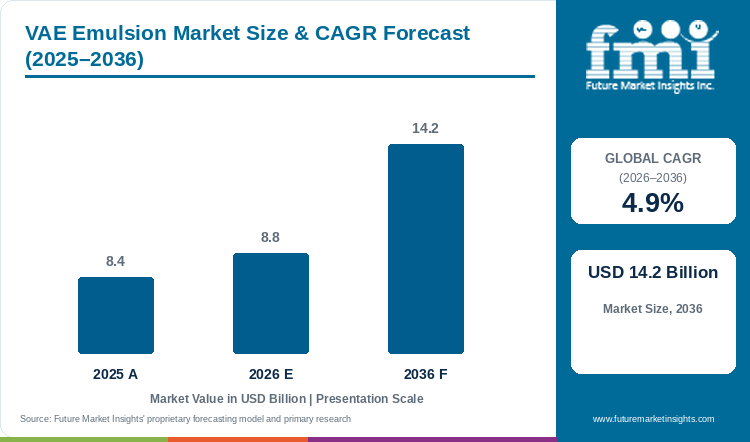
Key Market Trends & Insights
- Polymer makers are recovering margin after a weak 2025. Wacker's Polymers division reported EBITDA of EUR 158.3 million for 2025, down 18.6% on 2024. Its third-quarter 2026 EBITDA was EUR 75 million, 58% above the same quarter of 2025 [1][4].
- Capacity additions continue. Wacker's 2025 Polymers capital spending of EUR 55.2 million included additional VAE dispersion production capacity at its US site in Calvert City [4].
- Building activity is soft in three large Western markets. US construction spending fell 1.9% in September 2026, to a seasonally adjusted annual rate of USD 2,186.1 billion [13]. UK construction output fell 1.0% in the three months to August 2026 [14]. French construction business sentiment slipped to 95 in October 2026 [17].
Regional Highlights
- United States: private residential construction spending was a seasonally adjusted USD 848.8 billion annual rate in September 2026, 5.5% below August, while private nonresidential spending rose 1.1% to USD 790.6 billion [13]. Adhesive and coating binders follow both streams.
- Western Europe: Wacker named the construction slump in China and western Europe as a drag on its 2025 Polymers sales, which fell in every region [4]. German producer prices for basic chemicals were 11.3% higher in September 2026 than a year earlier [15].
- Italy: Vinavil, headquartered in Milan, reported on 30 October 2026 on Paint & Coatings 2026 in Milan. The show drew more than 1,500 visitors on its first day. Over the two days it drew about 45% more visitors than the previous edition [9][10].
VAE Emulsion Market Size and Forecast
Table 1: VAE Emulsion Market Size and Forecast
| Market size and forecast | Value |
|---|---|
| Market size in 2025 | USD 8.4 billion |
| Estimated market size in 2026 | USD 8.8 billion |
| Projected market size by 2036 | USD 14.2 billion |
| CAGR from 2026 to 2036 | 4.9% |
Source: Future Market Insights analysis of the vae emulsion market, 2026.
Analyst Perspective
“VAE emulsion is a cost-pass-through business in 2026. Producers with their own vinyl acetate or ethylene position can hold supply and price discipline while others buy at spot. Buyers who read only construction statistics will miss the signal that matters. That signal is the spread between monomer cost and the price producers can obtain from paint, adhesive and mortar customers. Supply agreements that name the producing site, the grade and a transparent cost index will hold up better than spot buying in the next two years.”
- Nikhil Kaitwade, Principal Consultant, FMI
How is the VAE Emulsion Market segmented?
- By product: Waterproof VAE Emulsions and Ordinary VAE Emulsions
- By application: Adhesives, Re-dispersible Powder, Paints and Coatings, Textile Chemicals and Others
- By region: North America and Europe
Why do Waterproof VAE Emulsions lead by Product in the VAE Emulsion Market in 2026?
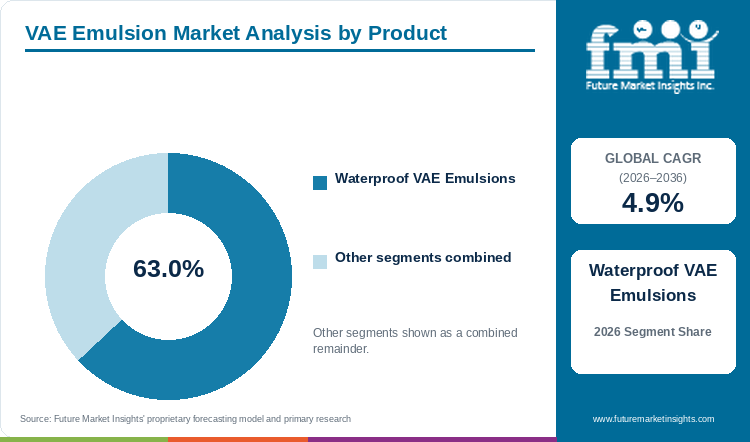
Waterproof VAE Emulsions is estimated to account for 63.0% of the VAE Emulsion Market by product in 2026. The lead reflects where the polymer ends up. Paints, decorative coatings, exterior wall systems, floor and tile adhesives and mortar modifiers all face moisture. Buyers in those uses select grades for resistance, not for price alone. Wacker says certain VINNAPAS polymer compositions add water repellency, heat resistance or flame retardancy on top of the strong binding power of the base grades [6]. Vinavil's published range shows how that choice is made. Its VAE copolymer page lists self-crosslinking grades such as VINAVIL EVA 479-RS and EVA 50-R for textile uses. It also lists a grade described for high chemical and alkali resistance in paints, and application lists that cover exterior paints, ETICS thermal insulation systems and floor and mosaic adhesives [8]. Moisture-exposed building uses sit at the centre of those lists. That fits resistant grades holding the larger share, while ordinary grades serve drier work such as paper and packaging.
Table 2: Product, 2026 Share
| Leading Share | 2026 market share |
|---|---|
| Waterproof VAE Emulsions | 63.0% |
| All Other Segments Combined Share | 37.0% |
Source: Future Market Insights analysis of the vae emulsion market, 2026.
Why does Adhesives lead by Application in the VAE Emulsion Market in 2026?
Adhesives is estimated to account for 38.0% of the VAE Emulsion Market by application in 2026. VAE gives a fast-setting, water-based bond to porous and plastic surfaces. The producers' own application lists put adhesives first. Vinavil lists wood and PVC/MDF lamination, plastics, paper and cardboard, packaging, mosaic and floor adhesives, adhesion promoters and tobacco-industry uses for its VAE copolymers [8]. Wacker lists adhesives among the uses of its VINNAPAS and ETONIS VAE dispersions, alongside construction, nonwovens, carpets, paper, caulks and sealants [5]. Grades are matched to the substrate. Vinavil's EVA 2607 L is a 60% solids grade described for high heat resistance and good creep resistance on PVC and wood. EVA 2606 L is a 55% solids grade for repulpable adhesives, and EVA 2609 L is a 50% solids grade with good adhesion to plastics [8]. Sumitomo Chemical sells its SUMIKAFLEX ethylene-vinyl acetate emulsions for woodworking and paper adhesives, and for products such as wet paper hand towels and paper packaging [12]. That spread of substrates and grades, also covered in the construction adhesives market, helps adhesives stay ahead of paints and textile uses.
Table 3: Application, 2026 Share
| Leading Share | 2026 market share |
|---|---|
| Adhesives | 38.0% |
| All Other Segments Combined Share | 62.0% |
Source: Future Market Insights analysis of the vae emulsion market, 2026.
What are the key drivers, restraints and opportunities?
Driver
Spread of end uses. VAE is one of several coating resins and adhesive binders, so demand is spread across products, not tied to one cycle. Celanese says VAE emulsions are a key component of water-based architectural coatings, adhesives and non-wovens, and that customers of its emulsion polymers and powders business are manufacturers of water-based paints and coatings [3]. Wacker markets VINNAPAS for construction, paints and coatings, adhesives, nonwovens and textiles, and composites [6]. Weakness in one of these streams does not stop volume in the others.
Powders in dry-mix mortar. Redispersible powders made from VAE dispersions go into factory-made mortars. Wacker says it first produced dispersible polymer powders in 1957 and calls itself the world market leader, with VAE powders sold as VINNAPAS, VINNACEL and ETONIS for construction and concrete modification [7]. Celanese sells redispersible powders under the Elotex brand [3]. Because the powder is spray-dried from a dispersion, every tonne of powder sold also pulls on emulsion capacity.
Restraint
Weak building output. Wacker said the construction slump, especially in China and western Europe, hurt its Polymers business in 2025. Polymers sales fell 5.8% to EUR 1.4 billion [4]. The slump has not ended in 2026. US residential construction spending fell 5.5% month on month in September 2026 [13]. UK new work fell 1.4% in the three months to August 2026 [14]. French building contractors' opinion of their past activity worsened markedly in October 2026 [17].
Volatile inputs. Celanese lists changes in the price and supply of ethylene among its raw material risks [2]. Wacker says its forecast stays highly uncertain because of Middle East developments [1]. German import prices of plastics in primary forms rose 17.4% in the year to September 2026 [16]. Celanese said modest demand softness was offset by pricing in its acetyl chain [2]. Buyers that cannot pass costs on to paint or adhesive customers bear the squeeze.
Opportunity
Low-VOC and renewable-content paints. Vinavil lists VAE grade EVA 4612 as odourless and very low in VOC for paints, at 52% solids [8]. Canada's Volatile Organic Compound Concentration Limits for Architectural Coatings Regulations set a limit of 100 g/L for flat coatings that fall outside the special categories [20]. Wacker offers eco grades made from renewable resources [6]. Celanese sells VAE emulsions under the EcoVAE name, among others [3]. Producers that document VOC level and origin can win specifications that price alone cannot. Readers who follow the waterborne coatings market can compare how binder choice affects those regulated products.
Nonwovens, textiles and carpets. Vinavil lists nonwovens, textile printing, flocking and carpet consolidation as uses for its VAE copolymers, with soft-hand self-crosslinking grades [8]. Wacker lists nonwovens and carpets among VAE dispersion uses [5]. Vinavil describes its textile grades by hand feel, from very soft to medium-stiff, and by self-crosslinking behaviour [8], so selection is technical, not commodity-led. Textile chemicals account for 13.0% of the market in 2026, well behind adhesives, so textile buyers matter more for grade depth than for tonnage.
VAE Emulsion Market by Country (2026 to 2036)
Table 4: VAE Emulsion Market Country Growth Forecast
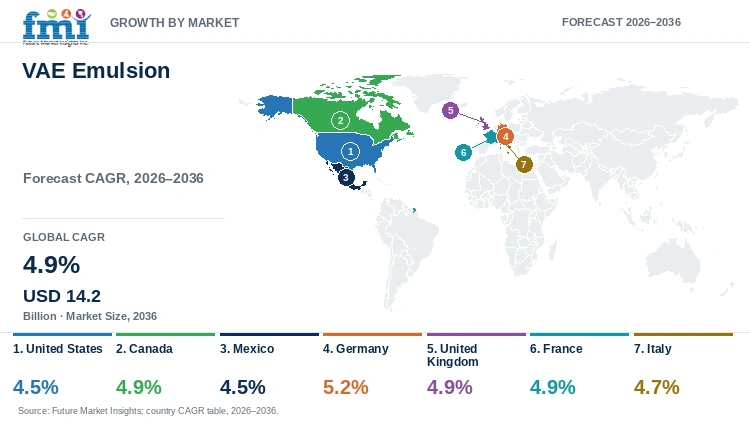
| Country | CAGR, 2026 to 2036 |
|---|---|
| United States | 4.5% |
| Canada | 4.9% |
| Mexico | 4.5% |
| Germany | 5.2% |
| United Kingdom | 4.9% |
| France | 4.9% |
| Italy | 4.7% |
Source: Future Market Insights analysis of the vae emulsion market, 2026.
United States
Wacker added VAE dispersion capacity at its Calvert City site in the United States in 2025 [4]. That gives US buyers more local supply. Celanese, headquartered in Irving, Texas, names VAE emulsions as a key input for water-based architectural coatings, adhesives and non-wovens [3].
Demand sits on a mixed building picture. Private residential spending fell 5.5% to USD 848.8 billion in September 2026, while private nonresidential spending rose 1.1% to USD 790.6 billion [13]. Adhesive and coating makers that serve commercial work are therefore better placed than those tied to housing.
Vinavil lists a US business, VINAVIL Americas [9]. Italian-origin grades can therefore reach US buyers through a local entity as well as through imports. Buyers should ask suppliers to name the plant for each grade. Wacker, Celanese and Vinavil all run plant networks across several countries [3][9][21].
Canada
Regulation gives Canada a clear technical benchmark. The VOC Concentration Limits for Architectural Coatings Regulations, SOR/2009-264, were registered on 9 September 2009 and came into force on registration. For flat coatings that register a gloss of less than 15 on an 85 degree meter, the limit is 100 g/L. The limit is effective on the first anniversary of coming into force. The regulation was last amended on 17 June 2019 [20].
Statistics Canada reported on 5 November 2026 that national capital spending rose 1.6% in 2025, after a 0.3% increase in 2024, and that business investment in engineering structures rose 3.4% [19]. The release does not split out residential building. Infrastructure-led demand suits adhesives, sealants and mortar systems better than housing paint.
Celanese lists Canada among the ten countries where it has production sites [3]. Canadian buyers should confirm the plant of origin and grade for each shipment. The same brand can be supplied from different plants.
Mexico
Celanese lists Mexico among its production countries and Mexico City among its administrative offices [3]. Its filing identifies production by country, not by product, so it does not show VAE output in Mexico.
Wacker reports nine production sites in the Americas among its 27 worldwide [21], and it added VAE dispersion capacity at its US Calvert City site in 2025 [4]. Mexican converters importing from the United States benefit from that added regional capacity, because it widens the source options for emulsions used in adhesives and paints.
Mexican demand follows the same segments as the United States: adhesives, mortar powders and paint. Buyers should negotiate pricing against a published monomer or ethylene index, because the German data show how fast input costs moved in 2026 [15][16].
Germany
Germany is the home base of Wacker, the largest supplier by share in this market. Wacker calls Burghausen its key production site and operates 27 production sites worldwide [21]. Its 2025 Polymers capital spending included infrastructure measures at Burghausen [4]. On 29 October 2026 Wacker reported third-quarter group sales of EUR 1,465.7 million, up 9.4%. EBITDA reached EUR 217.2 million, against EUR 111.7 million a year earlier. Wacker kept its 2026 EBITDA forecast at EUR 625 million to EUR 750 million, with the upper half likely [1].
German input costs rose sharply in 2026. Destatis reported on 20 October 2026 that producer prices were 6.7% higher in September 2026 than a year earlier. This was the largest increase since March 2023. Energy rose 14.9%, naphtha 53.8% and basic chemicals 11.3% [15]. On 30 October 2026 Destatis reported import prices up 10.4%, with plastics in primary forms up 17.4% [16]. Producers with integrated ethylene systems are better insulated than those buying monomer.
Germany has the highest forecast CAGR of the profiled countries at 5.2%. Wacker's Burghausen site and its 2025 infrastructure spending support local dispersion and powder supply [4][21]. German buyers should still name the producing site and a cost index in contracts, since price moves can outrun contract reviews.
United Kingdom
The Office for National Statistics reported on 15 October 2026 that construction output in Great Britain fell 1.0% in the three months to August 2026, the second consecutive fall in that series. New work fell 1.4% and repair and maintenance fell 0.3% over the three months [14].
The monthly detail matters more for VAE buyers. In August 2026 output fell 0.2%, its fourth consecutive monthly decrease. Private new housing fell 1.9%, while repair and maintenance rose 0.4% [14]. Repair work uses adhesives, sealants and paints in smaller, frequent orders. It supports distributor-led demand even while new housing is weak.
UK formulators that buy from continental plants face cost exposure of the kind Destatis reports for Germany. German import prices of plastics in primary forms rose 17.4% [16]. Contracts that fix the grade, the plant and the index can limit that exposure.
France
INSEE reported on 22 October 2026 that the French construction business climate fell one point to 95 in October, from 96 in September. The long-term average is 100. Building contractors' opinion of their past activity worsened markedly, while their expectations for future activity improved again [17].
Weak recent activity and better expectations point to cautious buying. Wacker said the construction slump in western Europe hurt its 2025 Polymers sales [4]. French adhesive, mortar and paint formulators are likely to keep orders cautious until contractors report a recovery.
Wacker's German network and Vinavil's Italian base both supply continental buyers [9][21]. French buyers should compare delivered cost across origins. They should also check how the 6.7% year-on-year rise in German producer prices in September 2026 [15] feeds into quotes.
Italy
Italy is the home market of Vinavil, which is headquartered in Milan and lists five production sites worldwide, three R&D centres and annual production of about 450,000 tonnes [9]. Its VAE copolymer page lists 12 named VAE grades across adhesives, textiles and paints, from 60% solids adhesive grades to a 46% solids self-crosslinking grade [8].
Vinavil attended Paint & Coatings 2026 in Milan with its distributor Cominder [10]. Attendance signals trade interest in coatings, not volume.
ISTAT reported on 28 October 2026 that building construction producer prices were down 0.1% in September 2026 from August. They were up 3.2% year on year, while roads and railways rose 6.6% year on year [18]. Higher building costs squeeze contractor budgets. Italian paint and adhesive buyers are therefore likely to watch binder prices closely and favour local suppliers with short lead times.
Who are the notable companies in the VAE Emulsion Market?
Notable companies in the VAE Emulsion Market include Wacker Chemie AG, Celanese Corporation, Vinavil and Sumitomo Chemical.
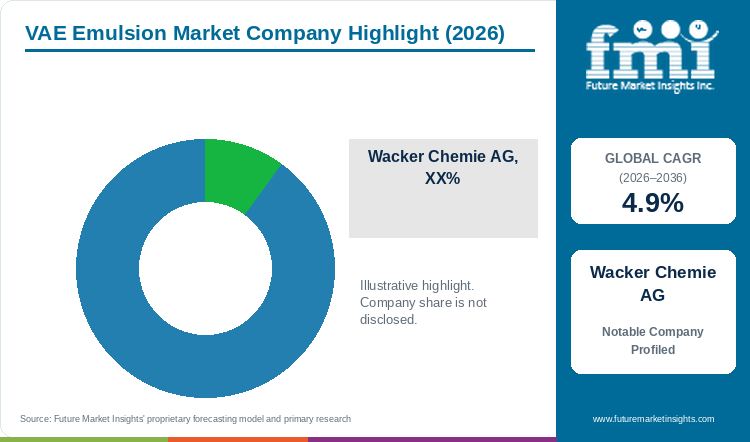
Raw material position decides how the large suppliers compete. Celanese makes the vinyl acetate monomer that feeds its emulsion business [3], and Wacker runs an integrated ethylene system [6]. Both then sell across emulsions and powders, so a tonne of monomer can end up as a paint binder, an adhesive or a mortar additive. Among the companies profiled here, Wacker holds 11.5% of the market, Celanese 10.1% and Vinavil 7.8%.
Grade breadth and powder capability set the offers apart. Wacker sells VINNAPAS and ETONIS VAE dispersions and a range of dispersible powders, and says it has made VAE grades since the 1960s [5][6][7]. Celanese sells emulsions under the EcoVAE, Mowilith and Vinamul names and powders as Elotex [3]. Vinavil publishes a table of 12 named VAE grades with solids, viscosity, pH and glass transition values, a level of detail that suits adhesive formulators who qualify by substrate [8].
Smaller or specialist offers target narrower uses. Sumitomo Chemical's SUMIKAFLEX emulsions are positioned for woodworking and paper adhesives [12]. Technical depth separates the larger suppliers. Wacker reported Polymers research and development expenses of EUR 37.0 million in 2025 and 1,612 employees in the division at year end [4], and Vinavil names three R&D centres [9]. Plant footprint shapes geographic reach. Wacker reports ten sites in Europe, nine in the Americas and eight in Asia [21]. Celanese names ten production countries [3]. Vinavil names five production sites and a US business, VINAVIL Americas [9].
Key Developments in the VAE Emulsion Market
- On 29 October 2026, Wacker reported third-quarter 2026 Polymers division sales of EUR 381 million, up 11%, with EBITDA of EUR 75 million, up 58%. It kept its 2026 group EBITDA outlook at EUR 625 million to EUR 750 million [1].
- On 2 November 2026, Celanese reported third-quarter Acetyl Chain net sales of USD 1,209 million, up 14% on a year earlier. Operating profit was USD 141 million, against USD 237 million in the second quarter of 2026 [2].
- On 30 October 2026, Vinavil reported on Paint & Coatings 2026 in Milan, where it exhibited with its distributor Cominder at an event with more than 1,500 first-day visitors [10].
- Wacker's 2025 annual report records Polymers capital spending of EUR 55.2 million that included additional VAE dispersion production capacity at Calvert City in the United States [4].
Key Players in the VAE Emulsion Market
- Wacker Chemie AG
- Celanese Corporation
- Vinavil S.p.A.
- Sumitomo Chemical Co., Ltd.
VAE Emulsion Market Report Scope
Table 5: VAE Emulsion Market Report Scope
| Coverage field | Report scope |
|---|---|
| Market definition | Vinyl acetate-ethylene (VAE) emulsions, measured by value of sales to end-use applications |
| Product | Waterproof VAE Emulsions, Ordinary VAE Emulsions |
| Application | Adhesives, Re-dispersible Powder, Paints and Coatings, Textile Chemicals, Others |
| Regions and profiled countries | North America and Europe (United States, Canada, Mexico, Germany, United Kingdom, France, Italy) |
| Companies covered | Wacker Chemie AG, Celanese Corporation, Vinavil S.p.A., Sumitomo Chemical Co., Ltd. |
| Forecast period | 2026 to 2036, with 2025 as the historical base year |
| Quantitative Units | USD billion |
Source: Future Market Insights analysis of the vae emulsion market, 2026.
VAE Emulsion Market by Segments
VAE Emulsion Market segmented by Product:
- Waterproof VAE Emulsions
- Ordinary VAE Emulsions
VAE Emulsion Market segmented by Application:
- Adhesives
- Re-dispersible Powder
- Paints and Coatings
- Textile Chemicals
- Others
VAE Emulsion Market by Region
- North America
- Europe
- United States
- Canada
- Mexico
- Germany
- United Kingdom
- France
- Italy
Research Sources and Bibliography
- [1] WACKER Chemie AG. (2026, October 29). WACKER reports significant year-over-year increase in earnings in Q3. https://www.wacker.com/cms/en-in/press-and-media/press/press-releases/2026/press-releases-detail-2026-319680.html
- [2] Celanese Corporation. (2026, November 2). Third quarter 2026 earnings release (Form 8-K, Exhibit 99.1). https://www.sec.gov/Archives/edgar/data/1306830/000130683026000129/q320268-kex991.htm
- [3] Celanese Corporation. (2026, February 24). Annual Report on Form 10-K for the year ended December 31, 2025. https://www.sec.gov/Archives/edgar/data/1306830/000130683026000031/ce-20251231.htm
- [4] WACKER Chemie AG. (2026). Annual Report 2025: Polymers segment. https://reports.wacker.com/2025/annual-report/management-report/segments/polymers.html
- [5] WACKER Chemie AG. (n.d.). Polymer Dispersions. https://www.wacker.com/cms/en-in/products/product-groups/polymer-dispersions/polymer-dispersions.html
- [6] WACKER Chemie AG. (n.d.). VINNAPAS. https://www.wacker.com/cms/en-in/products/brands/vinnapas/vinnapas.html
- [7] WACKER Chemie AG. (n.d.). Dispersible Polymer Powders. https://www.wacker.com/cms/en-in/products/product-groups/polymer-powders/polymer-powders.html
- [8] Vinavil S.p.A. (n.d.). Copolimeri VAE. https://www.vinavil.com/it/it/prodotti/dispersioni/copolimeri-vae
- [9] Vinavil S.p.A. (2026, November 5). Home page and company profile. https://www.vinavil.com/it/it/home-page
- [10] Vinavil S.p.A. (2026, October 30). Paint & Coatings 2026: confronto, innovazione e nuove opportunita a Milano. https://www.vinavil.com/it/it/news-ed-eventi/dettaglio/2026/10/30/paint---coatings-2026--confronto--innovazione-e-nuove-opportunità-a-milano
- [11] Vinavil S.p.A. (2026, November 5). Vinavil a Techniktag 2026: innovazione e sostenibilita per il settore dei coating. https://www.vinavil.com/it/it/news-ed-eventi/dettaglio/2026/11/05/vinavil-a-techniktag-2026--innovazione-e-sostenibilità-per-il-settore-dei-coating
- [12] Sumitomo Chemical Co., Ltd. (n.d.). SUMIKAFLEX. https://www.sumitomo-chem.co.jp/english/products/detail/en_c05001.html
- [13] U.S. Census Bureau. (2026, November 2). Monthly Construction Spending, September 2026. https://www.census.gov/construction/c30/current/index.html
- [14] Office for National Statistics. (2026, October 15). Construction output in Great Britain: August 2026. https://www.ons.gov.uk/businessindustryandtrade/constructionindustry/bulletins/constructionoutputingreatbritain/latest
- [15] Statistisches Bundesamt (Destatis). (2026, October 20). Producer prices in September 2026: +6.7% on September 2025. https://www.destatis.de/EN/Press/2026/10/PE26_373_61241.html
- [16] Statistisches Bundesamt (Destatis). (2026, October 30). Import prices in September 2026: +10.4% on September 2025. https://www.destatis.de/EN/Press/2026/10/PE26_379_614.html
- [17] INSEE. (2026, October 22). In October 2026, the business climate has picked up slightly. https://www.insee.fr/en/statistiques/9099771
- [18] ISTAT. (2026, October 28). Industrial and Construction producer prices, September 2026. https://www.istat.it/en/press-release/industrial-and-construction-producer-prices-september-2026/
- [19] Statistics Canada. (2026, November 5). Provincial and territorial economic accounts, 2025. https://www150.statcan.gc.ca/n1/daily-quotidien/261105/dq261105a-eng.htm
- [20] Government of Canada. (2009, September 9). Volatile Organic Compound (VOC) Concentration Limits for Architectural Coatings Regulations, SOR/2009-264. https://laws-lois.justice.gc.ca/eng/regulations/SOR-2009-264/FullText.html
- [21] WACKER Chemie AG. (2026). Annual Report 2025: Business model. https://reports.wacker.com/2025/annual-report/management-report/group-business-fundamentals/business-model.html
Table of Content
Table of Content
- Key Takeaways
- Market Size and CAGR
- Top Growth Driver
- Fastest Growing Segment
- Leading Region
- Key Companies
- Emerging Opportunities
- Executive Summary
- Global Market Outlook
- Demand-side Trends
- Supply-side Trends
- Technology Roadmap Analysis
- Analysis and Recommendations
- Analyst Perspective (What is happening? Why now? What should investors know?)
- Key Questions Answered
- How large is the market?
- What is the CAGR?
- What are key trends?
- Which region dominates?
- Who are the leaders?
Read More...
- Market Overview
- Market Coverage / Taxonomy
- Market Definition / Scope / Limitations
- Research Methodology
- Chapter Orientation
- Analytical Lens and Working Hypotheses
- Market Structure, Signals, and Trend Drivers
- Benchmarking and Cross-market Comparability
- Market Sizing, Forecasting, and Opportunity Mapping
- Research Design and Evidence Framework
- Desk Research Programme (Secondary Evidence)
- Expert Input and Fieldwork (Primary Evidence)
- Tooling, Models, and Reference Databases
- Data Engineering and Model Build
- Quality Assurance and Audit Trail
- Market Background
- Market Dynamics (Drivers, Restraints, Opportunity, Trends)
- Scenario Forecast (Optimistic, Likely, Conservative)
- Impact Analysis
- AI Impact
- Sustainability Impact
- Regulatory Impact
- Technology Impact
- Consumer / Buyer Analysis
- Purchase Drivers
- Adoption Barriers
- Buyer Journey
- Opportunity Map Analysis
- Product Life Cycle Analysis
- Supply Chain Analysis
- Investment Feasibility Matrix
- Value Chain Analysis
- PESTLE and Porter's Analysis
- Regulatory Landscape
- Regional Parent Market Outlook
- Production and Consumption Statistics
- Import and Export Statistics
- Global Market Analysis and Forecast, 2021 to 2036
- Historical Market Size Value (USD Billion) Analysis, 2021 to 2025
- Current and Future Market Size Value (USD Billion) Projections, 2026 to 2036
- Y-o-Y Growth Trend Analysis
- Absolute $ Opportunity Analysis
- Global Market Pricing Analysis, 2021 to 2036
- Global Market Analysis and Forecast, By Product, 2021 to 2036
- Introduction / Key Findings
- Historical Market Size Value (USD Billion) Analysis By Product, 2021 to 2025
- Current and Future Market Size Value (USD Billion) Analysis and Forecast By Product, 2026 to 2036
- Waterproof VAE Emulsions
- Ordinary VAE Emulsions
- Y-o-Y Growth Trend Analysis By Product, 2021 to 2025
- Absolute $ Opportunity Analysis By Product, 2026 to 2036
- Global Market Analysis and Forecast, By Application, 2021 to 2036
- Introduction / Key Findings
- Historical Market Size Value (USD Billion) Analysis By Application, 2021 to 2025
- Current and Future Market Size Value (USD Billion) Analysis and Forecast By Application, 2026 to 2036
- Adhesives
- Re-dispersible Powder
- Paints and Coatings
- Textile Chemicals
- Others
- Y-o-Y Growth Trend Analysis By Application, 2021 to 2025
- Absolute $ Opportunity Analysis By Application, 2026 to 2036
- Global Market Analysis and Forecast, By Region, 2021 to 2036
- Introduction
- Historical Market Size Value (USD Billion) Analysis By Region, 2021 to 2025
- Current Market Size Value (USD Billion) Analysis and Forecast By Region, 2026 to 2036
- North America
- Europe
- Market Attractiveness Analysis By Region
- North America Market Analysis and Forecast, By Country, 2021 to 2036
- Historical Market Size Value (USD Billion) Trend Analysis By Market Taxonomy, 2021 to 2025
- Market Size Value (USD Billion) Forecast By Market Taxonomy, 2026 to 2036
- By Country
- By Product
- By Application
- Market Attractiveness Analysis
- By Country
- By Product
- By Application
- Key Takeaways
- Europe Market Analysis and Forecast, By Country
- Historical Market Size Value (USD Billion) Trend Analysis By Market Taxonomy, 2021 to 2025
- Market Size Value (USD Billion) Forecast By Market Taxonomy, 2026 to 2036
- By Country
- United States
- Canada
- Mexico
- Germany
- United Kingdom
- France
- Italy
- By Product
- By Application
- By Country
- Market Attractiveness Analysis
- By Country
- By Product
- By Application
- Key Takeaways
- Key Countries Market Analysis
- United States
- Pricing Analysis
- Market Share Analysis, 2025
- By Product
- By Application
- Canada
- Pricing Analysis
- Market Share Analysis, 2025
- By Product
- By Application
- Mexico
- Pricing Analysis
- Market Share Analysis, 2025
- By Product
- By Application
- Germany
- Pricing Analysis
- Market Share Analysis, 2025
- By Product
- By Application
- United Kingdom
- Pricing Analysis
- Market Share Analysis, 2025
- By Product
- By Application
- Italy
- Pricing Analysis
- Market Share Analysis, 2025
- By Product
- By Application
- France
- Pricing Analysis
- Market Share Analysis, 2025
- By Product
- By Application
- United States
- Market Structure Analysis
- Competition Dashboard
- Competition Benchmarking
- Market Share Analysis of Top Players
- By Regional
- By Product
- By Application
- Emerging Startups
- Innovation Benchmarking
- Competition Analysis
- Competition Deep Dive
- Wacker Chemie AG
- Overview
- Product Portfolio
- Profitability by Market Segments
- Sales Footprint
- Strategy Overview
- Marketing Strategy
- Product Strategy
- Channel Strategy
- Celanese Corporation
- Vinavil S.p.A.
- Sumitomo Chemical Co., Ltd.
- Wacker Chemie AG
- Case Studies
- Success Stories
- Recent Developments
- Competition Deep Dive
- Assumptions & Acronyms Used
List of Tables
- Table 1: Global Market Value (USD Billion) Forecast by Region, 2021 to 2036
- Table 2: Global Market Value (USD Billion) Forecast by Product, 2021 to 2036
- Table 3: Global Market Value (USD Billion) Forecast by Application, 2021 to 2036
- Table 4: North America Market Value (USD Billion) Forecast by Country, 2021 to 2036
- Table 5: North America Market Value (USD Billion) Forecast by Product, 2021 to 2036
- Table 6: North America Market Value (USD Billion) Forecast by Application, 2021 to 2036
- Table 7: Europe Market Value (USD Billion) Forecast by Country, 2021 to 2036
- Table 8: Europe Market Value (USD Billion) Forecast by Product, 2021 to 2036
- Table 9: Europe Market Value (USD Billion) Forecast by Application, 2021 to 2036
List of Figures
- Figure 1: Global Market Pricing Analysis
- Figure 2: Global Market Value (USD Billion) Forecast 2021-2036
- Figure 3: Global Market Value Share and BPS Analysis by Product, 2026 and 2036
- Figure 4: Global Market Y-o-Y Growth Comparison by Product, 2026-2036
- Figure 5: Global Market Attractiveness Analysis by Product
- Figure 6: Global Market Value Share and BPS Analysis by Application, 2026 and 2036
- Figure 7: Global Market Y-o-Y Growth Comparison by Application, 2026-2036
- Figure 8: Global Market Attractiveness Analysis by Application
- Figure 9: Global Market Value (USD Billion) Share and BPS Analysis by Region, 2026 and 2036
- Figure 10: Global Market Y-o-Y Growth Comparison by Region, 2026-2036
- Figure 11: Global Market Attractiveness Analysis by Region
- Figure 12: North America Market Incremental Dollar Opportunity, 2026-2036
- Figure 13: Europe Market Incremental Dollar Opportunity, 2026-2036
- Figure 14: North America Market Value Share and BPS Analysis by Country, 2026 and 2036
- Figure 15: North America Market Value Share and BPS Analysis by Product, 2026 and 2036
- Figure 16: North America Market Y-o-Y Growth Comparison by Product, 2026-2036
- Figure 17: North America Market Attractiveness Analysis by Product
- Figure 18: North America Market Value Share and BPS Analysis by Application, 2026 and 2036
- Figure 19: North America Market Y-o-Y Growth Comparison by Application, 2026-2036
- Figure 20: North America Market Attractiveness Analysis by Application
- Figure 21: Europe Market Value Share and BPS Analysis by Country, 2026 and 2036
- Figure 22: Europe Market Value Share and BPS Analysis by Product, 2026 and 2036
- Figure 23: Europe Market Y-o-Y Growth Comparison by Product, 2026-2036
- Figure 24: Europe Market Attractiveness Analysis by Product
- Figure 25: Europe Market Value Share and BPS Analysis by Application, 2026 and 2036
- Figure 26: Europe Market Y-o-Y Growth Comparison by Application, 2026-2036
- Figure 27: Europe Market Attractiveness Analysis by Application
- Figure 28: Global Market - Tier Structure Analysis
- Figure 29: Global Market - Company Share Analysis
Frequently Asked Questions
How big is the VAE emulsion market in 2026?
The VAE Emulsion Market is estimated at USD 8.8 billion in 2026, up from USD 8.4 billion in 2025. It is projected to reach USD 14.2 billion by 2036, a 4.9% CAGR from 2026 to 2036.
Which product and application lead the VAE emulsion market?
Waterproof VAE emulsions lead by product with 63.0% of the market in 2026, and adhesives lead by application with 38.0%. Vinavil lists wood and PVC/MDF lamination, packaging, mosaic and floor adhesives among the uses of its VAE copolymers [8]. Wacker lists adhesives among the uses of its VAE dispersions [5].
Which other applications matter?
Re-dispersible powder holds 22.0%, paints and coatings 16.0%, textile chemicals 13.0% and others 11.0%. Wacker sells VAE powders for construction and concrete modification [7], and Celanese says VAE emulsions are a key component of water-based architectural coatings, adhesives and non-wovens [3].
Which profiled country is forecast to grow fastest?
Germany has the highest forecast CAGR of the seven profiled countries at 5.2% from 2026 to 2036, ahead of Canada, the United Kingdom and France at 4.9% each and Italy at 4.7%. The United States and Mexico follow at 4.5% each. German producer prices of basic chemicals were 11.3% higher in September 2026 than a year earlier [15], which shows the cost pressure behind that growth forecast.
What regulation and demand data affect VAE emulsion buyers?
Canada's SOR/2009-264 sets a limit of 100 g/L for flat coatings, effective one year after the regulation came into force on 9 September 2009 [20]. On demand, US construction spending was USD 2,186.1 billion at a seasonally adjusted annual rate in September 2026, down 1.9% from August [13]. UK construction output fell 1.0% in the three months to August 2026 [14].
What should a buyer check when choosing a VAE grade?
Check solids, viscosity, pH and glass transition first, then the substrate. Vinavil lists EVA 2607 L at 60% solids for PVC and wood adhesives and EVA 2606 L at 55% solids for repulpable adhesives [8]. Then confirm the producing site and the cost index in the contract, since German import prices of plastics in primary forms rose 17.4% in the year to September 2026 [16].
Preview the report firsthand - request a free sample
Get SampleGet the brochure for pricing and purchase details.
Get PDF
