

- Industry Size (2026)
- USD 42 Bn
- Forecast (2036)
- USD 78 Bn
- CAGR (2026 to 2036)
- 6.4%
Ventilation Market Forecast and Outlook 2026 to 2036
The ventilation market expands from USD 42 billion in 2026 to USD 78 billion by 2036, representing a CAGR of 6.40%. Cost structures vary materially across the industry, driven by differences in sheet metal fabrication, motor sourcing, control electronics, and installation complexity. These differences shape competitive positioning more than shipment volumes alone. Manufacturers that control fan design, motor integration, and control logic retain greater pricing authority, since performance certification and energy compliance are embedded in specifications. By contrast, assembler’s dependent on third party components operate with narrower margins and higher exposure to input cost volatility. Value capture therefore concentrates among suppliers that combine engineering ownership with manufacturing scale.
Over the period, profitability outcomes diverge according to channel structure and project mix rather than by headline market growth. Large commercial and infrastructure projects support more stable margins because technical compliance, testing, and commissioning are priced into contracts. In contrast, price led residential and light commercial segments exert persistent pressure on unit economics. Service, retrofit, and controls upgrades provide a higher margin layer that is less sensitive to equipment price competition. Working capital cycles and logistics coordination further affect realized returns. The market grows in size, though operating profits remain concentrated among firms with strong specification influence and integrated production capabilities.
Quick Stats of the Ventilation Market
- Ventilation Market Value (2026): USD 42 billion
- Ventilation Forecast Value (2036): USD 78 billion
- Ventilation Forecast CAGR 2026 to 2036: 6.4%
- Leading Type in Ventilation Market: Mechanical Ventilation (46 % share)
- Leading End-User Segment in Ventilation Market: Residential (41 % share)
- Key Growth Regions in Ventilation Market: India, China, Brazil, USA, UK
- Top Players in Ventilation Market: Daikin Industries, Carrier Global Corporation, Johnson Controls, Lennox International, Panasonic, Systemair AB, Greenheck Fan Corporation
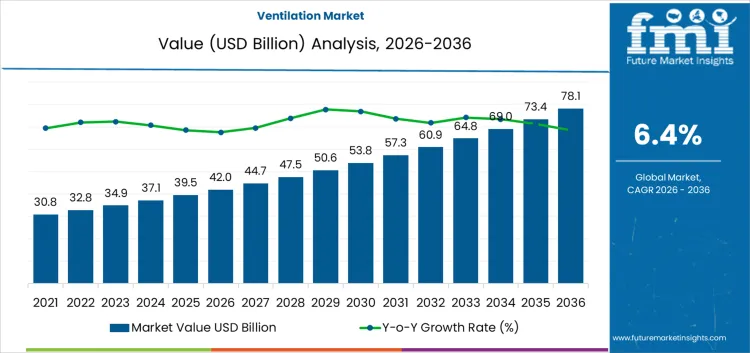
What is the Growth Forecast for Ventilation Market through 2036?
Between 2026 and 2031, the ventilation market is projected to expand from USD 42 billion along a trajectory consistent with a 6.4% CAGR, driven by building performance standards and occupancy expectations rather than by simple construction volume. In this phase, demand is shaped by the need to manage indoor air quality, thermal comfort, and energy efficiency at the same time, which turns ventilation from a basic utility into a design variable. Commercial buildings, healthcare facilities, and large residential projects account for a growing share of installations as codes and certification schemes tighten. Purchasing decisions increasingly weigh lifecycle energy use, noise levels, and controllability instead of only airflow capacity. Growth comes from both new builds and retrofits where older systems are replaced to meet current performance targets.
From 2031 to 2036, the market is expected to reach USD 78 billion, with expansion increasingly tied to refurbishment cycles and operational optimization rather than to headline floor space additions. As building owners focus on operating cost control and occupant well-being, ventilation systems become more integrated with broader climate and energy management architectures. This raises system value per project even when physical scale remains similar. Demand is supported by upgrades in offices, schools, hospitals, and residential complexes where continuous operation and reliability matter more than peak specification. Competitive positioning depends on engineering depth, system integration capability, and service coverage, as customers prioritize long-term performance stability over lowest upfront cost.
Ventilation Market Key Takeaways
| Metric | Value |
|---|---|
| Market Value (2026) | USD 42 billion |
| Forecast Value (2036) | USD 78 billion |
| Forecast CAGR 2026 to 2036 | 6.4% |
How Is the Ventilation Market Enhancing Indoor Air Quality and Building Efficiency?
The ventilation market is increasingly adopted to maintain airflow, regulate temperature, and improve indoor air quality across residential, commercial, and industrial buildings. Historically, ventilation relied on passive methods or basic fans, which offered limited control over air exchange, humidity, and contaminant removal, often leading to discomfort and health risks. Modern ventilation systems integrate energy-efficient fans, heat recovery units, and automated controls to provide precise airflow management, reduce energy consumption, and support HVAC system performance. Building developers, facility managers, and HVAC contractors prioritize system efficiency, reliability, and regulatory compliance. Early adoption focused on high-performance commercial and institutional buildings, while current demand spans residential complexes, hospitals, and manufacturing facilities, driven by air quality awareness, energy efficiency regulations, and occupant comfort requirements. System capacity, control precision, and energy efficiency influence supplier selection.
Rising focus on energy efficiency, indoor environmental quality, and regulatory compliance is shaping market growth. Compared with conventional systems, modern ventilation solutions emphasize automated airflow control, filtration, and integration with building management systems for optimized indoor conditions. Cost structures depend on fan and motor efficiency, ductwork design, and control systems, concentrating margins among suppliers capable of delivering reliable, high-performance solutions. Developers and facility operators adopt advanced ventilation systems to improve air quality, enhance occupant comfort, and reduce operational costs. By 2036, modern ventilation systems are expected to become standard in residential, commercial, and industrial buildings, supporting energy efficiency, indoor environmental quality, and sustainable building operations.
What Factors Are Shaping the Demand for Ventilation Systems by Airflow Strategy and Building Use in 2026?
The ventilation market in 2026 is segmented by system type and by end user category. By airflow strategy, demand is divided into mechanical, natural, hybrid or mixed mode, and exhaust ventilation, each offering different levels of control, energy use, and reliability. By end user, demand is organized around residential, commercial, industrial, and healthcare or institutional buildings, which differ in occupancy patterns, regulatory oversight, and tolerance for air quality variation. These segments reflect how designers and building owners balance health requirements, operating cost, climate conditions, and maintenance responsibility when selecting ventilation approaches for spaces that must perform continuously across changing seasons and usage profiles.
Why Does Mechanical Ventilation Represent the Largest Share of Installations?
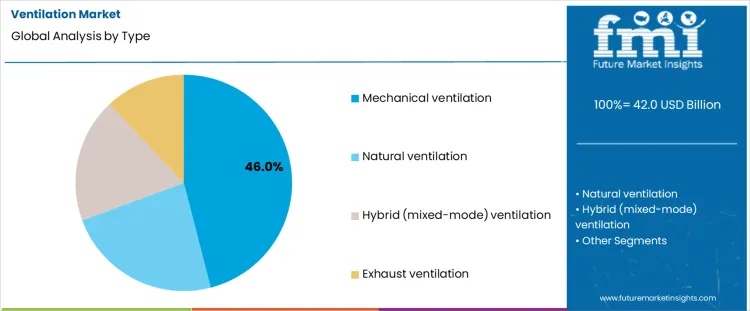
Mechanical ventilation accounts for about 46% of demand in 2026, reflecting the need for predictable and controllable air exchange in most modern buildings. These systems operate independently of weather and outdoor air pressure differences, which allows designers to meet fixed air quality targets under all conditions. Filtration, heat recovery, and precise airflow distribution can be integrated into one controlled system. This is especially important in dense urban buildings where window opening is limited or undesirable. Mechanical systems also support zoning and time based control, which improves comfort management. The ability to guarantee airflow rates, filtration levels, and pressure balance keeps mechanical ventilation as the primary choice across a wide range of building types.
Natural, hybrid, and exhaust only systems address more specific priorities. Natural ventilation depends on climate and building orientation, which limits reliability in many regions. Hybrid systems combine passive and mechanical elements, yet they require careful design coordination and user behavior alignment. Exhaust ventilation focuses on removing air rather than managing supply and is often used in simpler or smaller buildings. These approaches reduce energy use or installation cost in suitable conditions, yet they cannot provide the same level of consistency and control. Their adoption therefore remains selective, while mechanical systems continue to dominate projects that require dependable, code compliant air management.
Why Does Residential Construction Account for the Largest End User Share?
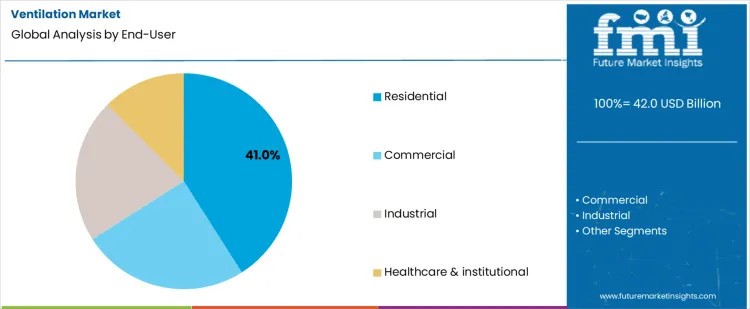
Residential buildings represent about 41% of demand in 2026 because housing accounts for the largest number of structures requiring basic ventilation solutions. Urbanization, apartment construction, and tighter building envelopes increase the need for planned air exchange rather than reliance on leakage or window opening. Building codes in many regions now require defined ventilation rates in homes to manage moisture and indoor pollutants. Each dwelling requires at least one system, which multiplies unit demand even when individual installations are small. Replacement and retrofit activity also contributes, as older homes are upgraded for better indoor air quality and energy performance. This large and fragmented building base keeps residential use as the biggest volume driver.
Commercial, industrial, and healthcare buildings follow different demand patterns. Commercial spaces require more complex systems, yet the number of buildings is lower. Industrial facilities use ventilation based on process needs, which varies widely by sector. Healthcare and institutional buildings demand high performance air control, though project counts are limited and highly regulated. These segments account for significant value per project, yet they do not match the sheer number of residential installations. As a result, residential construction and renovation continue to anchor overall unit demand, even while nonresidential projects drive a large share of system complexity and engineering effort.
Why Are Building Health Standards and Occupancy Use Patterns Driving the Ventilation Market through 2036?
Demand is being pulled by how buildings are specified and regulated rather than by construction volume alone. Offices, schools, hospitals, and industrial sites now treat air exchange as a controlled parameter tied to health, productivity, and liability. Higher occupancy density, longer indoor dwell times, and more sealed building envelopes increase dependence on mechanical ventilation. After repeated air quality incidents, many owners no longer accept minimum code compliance as sufficient. Retailers, employers, and landlords also use air quality metrics in tenant and employee assurance. Once ventilation rates and monitoring are written into operating standards, spending becomes structural, linked to building use and risk management rather than discretionary comfort upgrades.
What Energy Penalties, Retrofit Complexity, and Cost Recovery Challenges Are Limiting Faster Uptake?
The main restraint is operating economics. Moving and conditioning air consumes significant energy, and higher ventilation rates directly raise heating and cooling loads. In existing buildings, upgrading ductwork, shafts, and plant rooms is disruptive, expensive, and sometimes physically impossible. Owners struggle to recover these costs through rent or productivity gains that are hard to quantify. Maintenance requirements for filters, fans, and controls also add ongoing burden. In price sensitive segments, designers often choose the lowest compliant solution rather than optimal performance. These factors slow retrofit activity and keep many projects focused on incremental improvements instead of comprehensive ventilation system upgrades.
How Are Performance Based Design, Monitoring, and System Integration Reshaping This Category?
The category is moving from static sizing to managed performance. Designers increasingly specify ventilation based on measured air quality targets rather than fixed air change rules. This drives adoption of sensors, variable airflow systems, and closer integration with heating and cooling controls. Building operators want visibility into how systems perform over time, not just at commissioning. In parallel, modular and decentralized units are gaining ground where central ducting is impractical. Regulations and certifications are also becoming more outcome focused. Ventilation is evolving from hidden infrastructure into an actively managed building system, judged on continuous performance, energy impact, and documented indoor air quality results.
What is the Demand for Ventilation by Country?
| Country | CAGR (%) |
|---|---|
| USA | 6.0% |
| UK | 5.8% |
| China | 7.0% |
| India | 7.2% |
| Brazil | 6.3% |
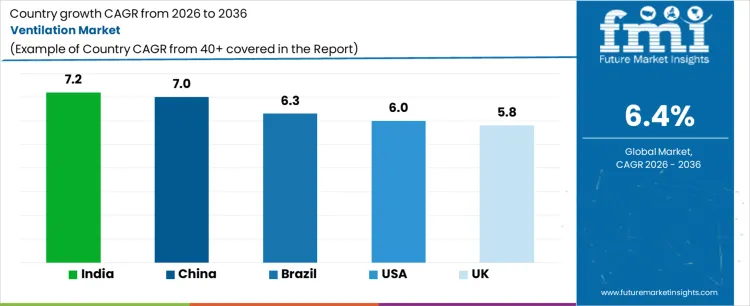
Demand for ventilation systems is rising as commercial, residential, and industrial sectors prioritize indoor air quality, energy efficiency, and regulatory compliance. India leads with a 7.2% CAGR, driven by rapid urbanization, expanding construction activities, and increasing adoption of modern HVAC and ventilation solutions. China follows at 7.0%, supported by industrial growth, urban development, and rising awareness of air quality standards. Brazil records 6.3% growth, shaped by commercial infrastructure expansion and industrial applications. The USA grows at 6.0%, influenced by modernization of ventilation systems and adoption in energy-efficient buildings. The UK shows 5.8% CAGR, reflecting steady growth in commercial and residential ventilation demand.
How is the United States experiencing growth in the ventilation market?
United States is experiencing growth at a CAGR of 6%, driven by increasing demand for improved indoor air quality, energy-efficient HVAC systems, and compliance with building ventilation standards. Ventilation solutions are optimized for commercial buildings, industrial facilities, and residential applications, offering air filtration, temperature control, and energy-efficient operation. Demand is concentrated in metropolitan areas such as New York, Chicago, and Los Angeles, where urban density and commercial construction are high. Investments focus on system reliability, energy efficiency, and adherence to ASHRAE and local building codes. Growth reflects rising awareness of health and safety, modernization of infrastructure, and adoption of smart building technologies.
- Indoor air quality drives adoption.
- Systems optimize energy efficiency and filtration.
- Urban commercial hubs concentrate demand.
- Reliability and regulatory compliance guide investment.
How is the United Kingdom witnessing growth in the ventilation market?
United Kingdom is witnessing growth at a CAGR of 5.8%, supported by upgrading building ventilation in office complexes, hospitals, and industrial facilities. Ventilation systems are optimized for energy efficiency, air quality improvement, and integration with smart building management platforms. Demand is concentrated in London, Manchester, and Birmingham, where commercial and institutional construction is prominent. Investments prioritize system reliability, operational efficiency, and compliance with UK building and safety regulations. Growth reflects increased emphasis on occupant health, energy-efficient retrofitting, and adoption of modern ventilation technologies in urban buildings.
- Commercial and institutional upgrades drive adoption.
- Systems enhance energy efficiency and indoor air quality.
- Major cities concentrate demand.
- Reliability and regulatory compliance guide investment.
How is China experiencing growth in the ventilation market?
China is experiencing growth at a CAGR of 7%, fueled by rapid urbanization, industrial facility expansion, and stricter air quality regulations in cities such as Beijing, Shanghai, and Guangzhou. Ventilation systems are optimized for industrial, commercial, and large residential complexes, focusing on energy-efficient air distribution and pollutant filtration. Demand is concentrated in industrial zones, high-rise commercial buildings, and large residential communities. Investments focus on energy efficiency, system durability, and compliance with national building codes. Growth reflects increased construction activity, regulatory pressure for clean indoor air, and adoption of smart building technologies.
- Urbanization and industrial growth drive adoption.
- Systems optimize energy efficiency and pollutant filtration.
- Industrial zones and high-rise complexes concentrate demand.
- Durability and regulatory compliance guide investment.
How is India witnessing growth in the ventilation market?
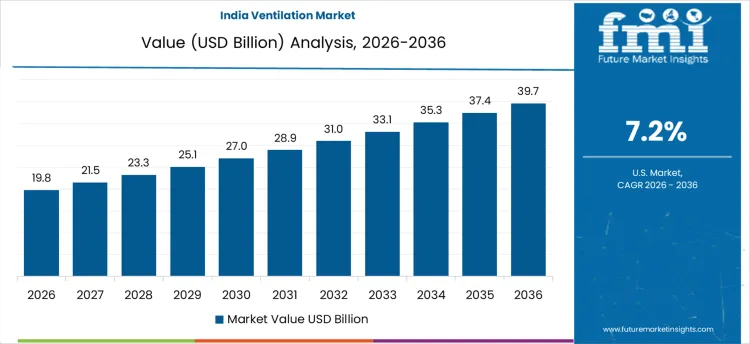
India is witnessing growth at a CAGR of 7.2%, supported by rising construction of commercial offices, hospitals, and industrial facilities in Mumbai, Delhi, and Bengaluru. Ventilation systems are optimized for temperature control, energy efficiency, and air purification under tropical climates. Demand is concentrated in commercial complexes, healthcare facilities, and manufacturing hubs. Investments prioritize system reliability, energy-efficient operation, and adherence to national building and safety regulations. Growth reflects increasing industrialization, urban construction, and adoption of modern ventilation solutions for occupational health and productivity.
- Commercial and healthcare facilities drive adoption.
- Systems enhance temperature control and energy efficiency.
- Urban industrial hubs concentrate demand.
- Reliability and regulatory compliance guide investment.
How is Brazil experiencing growth in the ventilation market?
Brazil is experiencing growth at a CAGR of 6.3%, fueled by industrial, commercial, and institutional infrastructure expansion in São Paulo, Rio de Janeiro, and Minas Gerais. Ventilation solutions are optimized for tropical climate conditions, air circulation efficiency, and energy savings. Demand is concentrated in industrial plants, office buildings, and hospitals. Investments focus on operational reliability, energy-efficient design, and compliance with Brazilian building and safety regulations. Growth reflects modernization of existing facilities, rising focus on indoor air quality, and adoption of energy-efficient ventilation technologies.
- Industrial and commercial expansion drives adoption.
- Systems optimize air circulation and energy efficiency.
- Industrial and institutional hubs concentrate demand.
- Operational reliability and compliance guide investment.
Who Competes in the Ventilation Market and What Defines Their Capabilities?
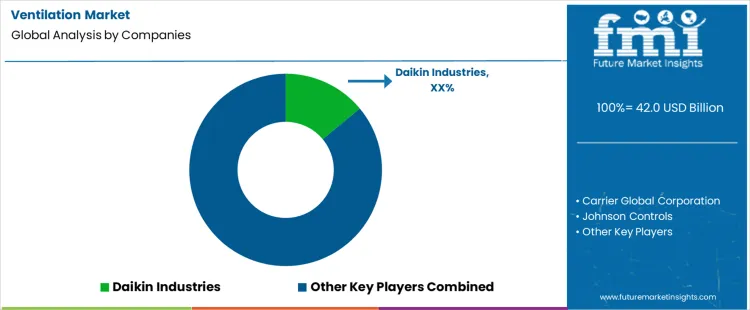
Competition in the ventilation market is shaped by airflow performance, energy efficiency, control integration, and suitability for residential, commercial, and industrial applications. Daikin Industries supplies ventilation solutions designed to integrate with HVAC systems, emphasizing balanced airflow, energy recovery, and reliability across climates. Carrier Global Corporation offers energy efficient ventilation units and air handling systems that integrate with its broader HVAC platforms for buildings and industrial facilities. Johnson Controls provides modular ventilation products with advanced control options for indoor air quality monitoring and building automation. Lennox International develops residential and commercial ventilation equipment focused on quiet operation, filtration capacity, and energy savings.
Panasonic supplies ventilation fans and energy recovery ventilators designed for residential and small commercial environments with emphasis on low noise and moisture control. Systemair AB delivers a range of ventilation units, ducts, and accessories engineered for flexibility and scalable airflow in institutional and industrial settings. Greenheck Fan Corporation offers high performance fans, louvers, and ventilation systems engineered for commercial and industrial applications that require rigorous airflow and safety standards. Other regional and niche manufacturers focus on compact units, specialized fan blade technology, or integration with air purification systems. Competitive differentiation arises from airflow efficiency, energy usage, control integration with building automation, noise levels, durability, and compliance with ventilation and indoor air quality standards. Suppliers with broad product lines, strong distribution networks, and service support maintain relevance across segments where ventilation performance and regulatory compliance are priorities. Replacement parts, maintenance services, and digital control interfaces also influence purchasing decisions in both new installations and retrofit projects.
Key Players in the Ventilation Market
- Daikin Industries
- Carrier Global Corporation
- Johnson Controls
- Lennox International
- Panasonic
- Systemair AB
- Greenheck Fan Corporation
Scope of the Report
| Items | Values |
|---|---|
| Quantitative Units (2026) | USD billion |
| Type | Mechanical Ventilation, Natural Ventilation, Hybrid (Mixed-Mode) Ventilation, Exhaust Ventilation |
| End-User | Residential, Commercial, Industrial, Healthcare & Institutional |
| Regions Covered | Asia Pacific, Europe, North America, Latin America, Middle East & Africa |
| Countries Covered | China, Japan, South Korea, India, Australia & New Zealand, ASEAN, Germany, United Kingdom, France, Italy, Spain, Nordic, BENELUX, United States, Canada, Mexico, Brazil, Chile, Saudi Arabia, Turkey, South Africa, and other regional markets |
| Key Companies Profiled | Daikin Industries, Carrier Global Corporation, Johnson Controls, Lennox International, Panasonic, Systemair AB, Greenheck Fan Corporation |
| Additional Attributes | Dollar sales by ventilation type and end-user, mechanical ventilation representing the largest share of installations due to need for predictable and controllable air exchange, residential buildings representing the largest share of unit demand because of the large housing base and code-mandated ventilation rates, market economics shaped by control over fan design, motor integration, and control electronics, margin concentration among suppliers with integrated engineering and manufacturing, growing role of retrofit, service, and controls upgrades in value creation, demand driven by indoor air quality standards, energy efficiency regulations, and occupancy requirements, increasing integration with building management systems and performance-based ventilation design, and competitive positioning based on airflow efficiency, energy usage, control integration, noise levels, durability, and compliance with ventilation and indoor air quality standards rather than equipment price alone. |
Ventilation Market Segmentation
Type:
- Mechanical ventilation
- Natural ventilation
- Hybrid (mixed-mode) ventilation
- Exhaust ventilation
End-User:
- Residential
- Commercial
- Industrial
- Healthcare & institutional
Region
Asia Pacific
- China
- Japan
- South Korea
- India
- Australia & New Zealand
- ASEAN
- Rest of Asia Pacific
Europe
- Germany
- United Kingdom
- France
- Italy
- Spain
- Nordic
- BENELUX
- Rest of Europe
North America
- United States
- Canada
- Mexico
Latin America
- Brazil
- Chile
- Rest of Latin America
Middle East & Africa
- Kingdom of Saudi Arabia
- Other GCC Countries
- Turkey
- South Africa
- Other African Union
- Rest of Middle East & Africa
Bibliography
- American Society of Heating, Refrigerating and Air-Conditioning Engineers (ASHRAE). (2023). ASHRAE standard 62.1: Ventilation for acceptable indoor air quality. ASHRAE.
- International Energy Agency (IEA). (2023). Energy efficiency in building ventilation systems. International Energy Agency.
- USA Environmental Protection Agency (EPA). (2023). Indoor air quality and ventilation standards. USA Environmental Protection Agency.
- Building Performance Institute (BPI). (2023). Ventilation and energy efficiency: Best practices for modern buildings. Building Performance Institute.
- World Health Organization (WHO). (2023). Indoor air quality guidelines for ventilation in urban buildings. World Health Organization.
- European Commission. (2023). Energy efficiency and ventilation systems in commercial buildings. European Commission.
Frequently Asked Questions
How big is the ventilation market in 2026?
The global ventilation market is estimated to be valued at USD 42.0 billion in 2026.
What will be the size of ventilation market in 2036?
The market size for the ventilation market is projected to reach USD 78.1 billion by 2036.
How much will be the ventilation market growth between 2026 and 2036?
The ventilation market is expected to grow at a 6.4% CAGR between 2026 and 2036.
What are the key product types in the ventilation market?
The key product types in ventilation market are mechanical ventilation , natural ventilation, hybrid (mixed‑mode) ventilation and exhaust ventilation.
Which end‑user segment to contribute significant share in the ventilation market in 2026?
In terms of end‑user, residential segment to command 41.0% share in the ventilation market in 2026.
Preview the report firsthand - request a free sample
Get SampleGet the brochure for pricing and purchase details.
Get PDFTable of Content
- Executive Summary
- Global Market Outlook
- Demand-side Trends
- Supply-side Trends
- Technology Roadmap Analysis
- Analysis and Recommendations
- Market Overview
- Market Coverage / Taxonomy
- Market Definition / Scope / Limitations
- Market Background
- Market Dynamics
- Drivers
- Restraints
- Opportunity
- Trends
- Scenario Forecast
- Demand in Optimistic Scenario
- Demand in Likely Scenario
- Demand in Conservative Scenario
- Opportunity Map Analysis
- Product Life Cycle Analysis
- Supply Chain Analysis
- Investment Feasibility Matrix
- Value Chain Analysis
- PESTLE and Porter’s Analysis
- Regulatory Landscape
- Regional Parent Market Outlook
- Production and Consumption Statistics
- Import and Export Statistics
- Market Dynamics
- Global Market Analysis 2021 to 2025 and Forecast, 2026 to 2036
- Historical Market Size Value (USD Million) Analysis, 2021 to 2025
- Current and Future Market Size Value (USD Million) Projections, 2026 to 2036
- Y-o-Y Growth Trend Analysis
- Absolute $ Opportunity Analysis
- Global Market Pricing Analysis 2021 to 2025 and Forecast 2026 to 2036
- Global Market Analysis 2021 to 2025 and Forecast 2026 to 2036, By Type
- Introduction / Key Findings
- Historical Market Size Value (USD Million) Analysis By Type, 2021 to 2025
- Current and Future Market Size Value (USD Million) Analysis and Forecast By Type, 2026 to 2036
- Mechanical ventilation
- Natural ventilation
- Hybrid (mixed‑mode) ventilation
- Exhaust ventilation
- Mechanical ventilation
- Y-o-Y Growth Trend Analysis By Type, 2021 to 2025
- Absolute $ Opportunity Analysis By Type, 2026 to 2036
- Global Market Analysis 2021 to 2025 and Forecast 2026 to 2036, By End‑User
- Introduction / Key Findings
- Historical Market Size Value (USD Million) Analysis By End‑User, 2021 to 2025
- Current and Future Market Size Value (USD Million) Analysis and Forecast By End‑User, 2026 to 2036
- Residential
- Commercial
- Industrial
- Healthcare & institutional
- Residential
- Y-o-Y Growth Trend Analysis By End‑User, 2021 to 2025
- Absolute $ Opportunity Analysis By End‑User, 2026 to 2036
- Global Market Analysis 2021 to 2025 and Forecast 2026 to 2036, By Region
- Introduction
- Historical Market Size Value (USD Million) Analysis By Region, 2021 to 2025
- Current Market Size Value (USD Million) Analysis and Forecast By Region, 2026 to 2036
- North America
- Latin America
- Western Europe
- Eastern Europe
- East Asia
- South Asia and Pacific
- Middle East & Africa
- Market Attractiveness Analysis By Region
- North America Market Analysis 2021 to 2025 and Forecast 2026 to 2036, By Country
- Historical Market Size Value (USD Million) Trend Analysis By Market Taxonomy, 2021 to 2025
- Market Size Value (USD Million) Forecast By Market Taxonomy, 2026 to 2036
- By Country
- USA
- Canada
- Mexico
- By Type
- By End‑User
- By Country
- Market Attractiveness Analysis
- By Country
- By Type
- By End‑User
- Key Takeaways
- Latin America Market Analysis 2021 to 2025 and Forecast 2026 to 2036, By Country
- Historical Market Size Value (USD Million) Trend Analysis By Market Taxonomy, 2021 to 2025
- Market Size Value (USD Million) Forecast By Market Taxonomy, 2026 to 2036
- By Country
- Brazil
- Chile
- Rest of Latin America
- By Type
- By End‑User
- By Country
- Market Attractiveness Analysis
- By Country
- By Type
- By End‑User
- Key Takeaways
- Western Europe Market Analysis 2021 to 2025 and Forecast 2026 to 2036, By Country
- Historical Market Size Value (USD Million) Trend Analysis By Market Taxonomy, 2021 to 2025
- Market Size Value (USD Million) Forecast By Market Taxonomy, 2026 to 2036
- By Country
- Germany
- UK
- Italy
- Spain
- France
- Nordic
- BENELUX
- Rest of Western Europe
- By Type
- By End‑User
- By Country
- Market Attractiveness Analysis
- By Country
- By Type
- By End‑User
- Key Takeaways
- Eastern Europe Market Analysis 2021 to 2025 and Forecast 2026 to 2036, By Country
- Historical Market Size Value (USD Million) Trend Analysis By Market Taxonomy, 2021 to 2025
- Market Size Value (USD Million) Forecast By Market Taxonomy, 2026 to 2036
- By Country
- Russia
- Poland
- Hungary
- Balkan & Baltic
- Rest of Eastern Europe
- By Type
- By End‑User
- By Country
- Market Attractiveness Analysis
- By Country
- By Type
- By End‑User
- Key Takeaways
- East Asia Market Analysis 2021 to 2025 and Forecast 2026 to 2036, By Country
- Historical Market Size Value (USD Million) Trend Analysis By Market Taxonomy, 2021 to 2025
- Market Size Value (USD Million) Forecast By Market Taxonomy, 2026 to 2036
- By Country
- China
- Japan
- South Korea
- By Type
- By End‑User
- By Country
- Market Attractiveness Analysis
- By Country
- By Type
- By End‑User
- Key Takeaways
- South Asia and Pacific Market Analysis 2021 to 2025 and Forecast 2026 to 2036, By Country
- Historical Market Size Value (USD Million) Trend Analysis By Market Taxonomy, 2021 to 2025
- Market Size Value (USD Million) Forecast By Market Taxonomy, 2026 to 2036
- By Country
- India
- ASEAN
- Australia & New Zealand
- Rest of South Asia and Pacific
- By Type
- By End‑User
- By Country
- Market Attractiveness Analysis
- By Country
- By Type
- By End‑User
- Key Takeaways
- Middle East & Africa Market Analysis 2021 to 2025 and Forecast 2026 to 2036, By Country
- Historical Market Size Value (USD Million) Trend Analysis By Market Taxonomy, 2021 to 2025
- Market Size Value (USD Million) Forecast By Market Taxonomy, 2026 to 2036
- By Country
- Kingdom of Saudi Arabia
- Other GCC Countries
- Turkiye
- South Africa
- Other African Union
- Rest of Middle East & Africa
- By Type
- By End‑User
- By Country
- Market Attractiveness Analysis
- By Country
- By Type
- By End‑User
- Key Takeaways
- Key Countries Market Analysis
- USA
- Pricing Analysis
- Market Share Analysis, 2025
- By Type
- By End‑User
- Canada
- Pricing Analysis
- Market Share Analysis, 2025
- By Type
- By End‑User
- Mexico
- Pricing Analysis
- Market Share Analysis, 2025
- By Type
- By End‑User
- Brazil
- Pricing Analysis
- Market Share Analysis, 2025
- By Type
- By End‑User
- Chile
- Pricing Analysis
- Market Share Analysis, 2025
- By Type
- By End‑User
- Germany
- Pricing Analysis
- Market Share Analysis, 2025
- By Type
- By End‑User
- UK
- Pricing Analysis
- Market Share Analysis, 2025
- By Type
- By End‑User
- Italy
- Pricing Analysis
- Market Share Analysis, 2025
- By Type
- By End‑User
- Spain
- Pricing Analysis
- Market Share Analysis, 2025
- By Type
- By End‑User
- France
- Pricing Analysis
- Market Share Analysis, 2025
- By Type
- By End‑User
- India
- Pricing Analysis
- Market Share Analysis, 2025
- By Type
- By End‑User
- ASEAN
- Pricing Analysis
- Market Share Analysis, 2025
- By Type
- By End‑User
- Australia & New Zealand
- Pricing Analysis
- Market Share Analysis, 2025
- By Type
- By End‑User
- China
- Pricing Analysis
- Market Share Analysis, 2025
- By Type
- By End‑User
- Japan
- Pricing Analysis
- Market Share Analysis, 2025
- By Type
- By End‑User
- South Korea
- Pricing Analysis
- Market Share Analysis, 2025
- By Type
- By End‑User
- Russia
- Pricing Analysis
- Market Share Analysis, 2025
- By Type
- By End‑User
- Poland
- Pricing Analysis
- Market Share Analysis, 2025
- By Type
- By End‑User
- Hungary
- Pricing Analysis
- Market Share Analysis, 2025
- By Type
- By End‑User
- Kingdom of Saudi Arabia
- Pricing Analysis
- Market Share Analysis, 2025
- By Type
- By End‑User
- Turkiye
- Pricing Analysis
- Market Share Analysis, 2025
- By Type
- By End‑User
- South Africa
- Pricing Analysis
- Market Share Analysis, 2025
- By Type
- By End‑User
- USA
- Market Structure Analysis
- Competition Dashboard
- Competition Benchmarking
- Market Share Analysis of Top Players
- By Regional
- By Type
- By End‑User
- Competition Analysis
- Competition Deep Dive
- Daikin Industries
- Overview
- Product Portfolio
- Profitability by Market Segments (Product/Age /Sales Channel/Region)
- Sales Footprint
- Strategy Overview
- Marketing Strategy
- Product Strategy
- Channel Strategy
- Carrier Global Corporation
- Johnson Controls
- Lennox International
- Panasonic
- Systemair AB
- Greenheck Fan Corporation
- Daikin Industries
- Competition Deep Dive
- Assumptions & Acronyms Used
- Research Methodology


