

- Market Size (2026)
- USD 1120.6 Mn
- Forecast (2036)
- USD 2374.9 Mn
- CAGR (2026 to 2036)
- 7.8%
How big is the Wet Grip Resins Market in 2026?
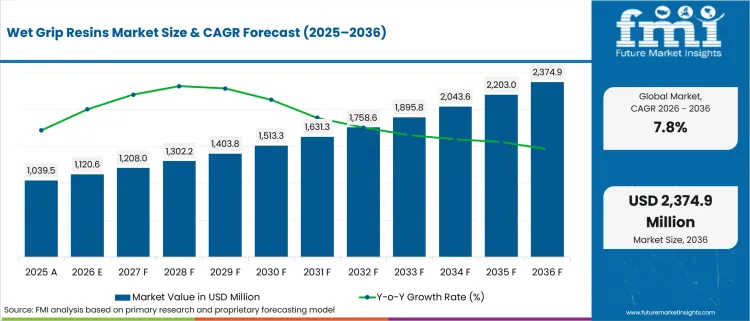
USD 1,120.6 million in 2026 and USD 2,374.9 million by 2036 at a 7.8% CAGR.
Demand for wet grip resins is projected to expand at 7.8% CAGR between 2026 and 2036, increasing valuation from USD 1,120.6 million in 2026 to USD 2,374.9 million by 2036. Wet grip resins are moving from standard tread inputs into formulation tools used to balance wet braking and tread wear. Tire makers evaluate compound compatibility and batch stability before resins enter approved tread systems. OICA reported global vehicle production at 96.4 million units in 2025, giving resin suppliers a wider tire qualification base across OEM and replacement programs.
India and China tire accounts are expected to favor local resin trials because passenger tire output and EV tread demand are expanding quickly. Japan and Germany accounts are projected to stress batch reliability before replacing approved resin grades. Formulation teams compare glass transition behavior and elastomer compatibility before a wet grip resin moves into a tread recipe. IEA reported in May 2026 that electric car sales rose to 21 million units in 2025. EV scale gives tire teams a clearer reason to test resins against wet grip, abrasion and rolling efficiency before wider account approval.
Key Takeaways
- Growth in wet grip resin demand is linked to tire manufacturers seeking stronger wet-road traction while maintaining rolling efficiency, tread life, and stable compound performance.
- Direct OEM is projected to lead the sales channel category with 59.1% share in 2026, reflecting the importance of technical support, material approval, and direct access to tire development programs.
- Passenger tires are expected to account for 45.0% share in 2026, driven by regular vehicle launches, replacement tire demand, and closer attention to braking performance across conventional and electric vehicles.
- Hydrocarbon resins are forecast to capture 38.0% share in 2026, owing to their predictable mixing behavior, compatibility with established tread formulations, and consistent softening characteristics.
- SSBR/BR is estimated to hold 36.2% share in 2026, reflecting its use in silica-filled tire compounds that balance wet traction, abrasion resistance, and lower rolling loss.
- Wet grip improvement is projected to lead the function category with 34.7% share in 2026, highlighting the direct role of traction performance in resin selection and tire-compound qualification.
- Limited trial evidence, variations in resin compatibility, chemical cost pressure, and lengthy tire approval procedures remain the main obstacles to broader commercial adoption.
- Competition includes Synthomer, Kraton Corporation, Kolon Industries, ExxonMobil Product Solutions, Arakawa Chemical Industries, Zeon Corporation, ENEOS Materials, Cray Valley, and Ecopower, with companies differentiated by resin chemistry, batch reliability, technical service, and tire-compound validation support.
Analyst Perspective
“Wet grip resins are becoming a performance-focused material category tied closely to tire safety, braking control, and energy efficiency. Tire manufacturers are giving greater weight to technical evidence that links stronger road grip with controlled rolling loss. Companies that provide clear compound documentation, testing support, and application guidance are more likely to secure approvals. Local tire-development support also improves account access beyond the basic supply of resin materials.”
— Nikhil Kaitwade, Principal Consultant for Chemicals and Materials, Future Market Insights
How is the Wet Grip Resins Market segmented?
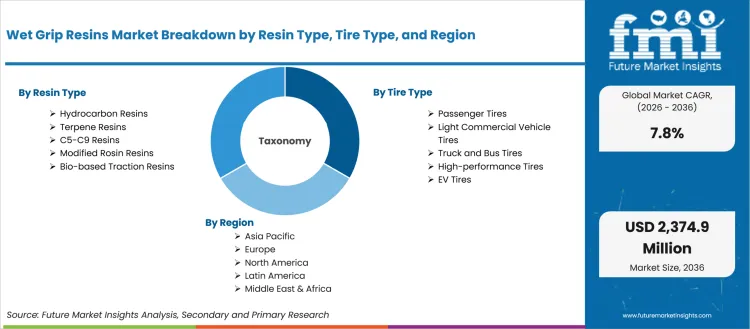
The wet grip resins industry is segmented by resin type, tire type, rubber compatibility, function, sales channel and region.
The wet grip resins market is segmented by resin type, tire type, rubber compatibility, function, sales channel and region. By resin type, coverage includes hydrocarbon resins, terpene resins, C5/C9 resins, modified rosin resins and bio-based traction resins. By tire type, coverage includes passenger tires, light commercial vehicle tires, truck and bus tires, high-performance tires and EV tires. By rubber compatibility, coverage includes SSBR / BR, natural rubber blends, SBR blends, NR / BR systems and specialty elastomer compounds.
By function, coverage includes wet grip improvement, rolling resistance balance, tread wear control, tack enhancement and processing support. By sales channel, coverage includes direct OEM, compounder distribution, tire manufacturer contracts and specialty chemical distributors, with regional coverage across North America, Latin America, Europe, East Asia, South Asia and Pacific and Middle East and Africa.
How does direct OEM shape demand within the sales channel category?
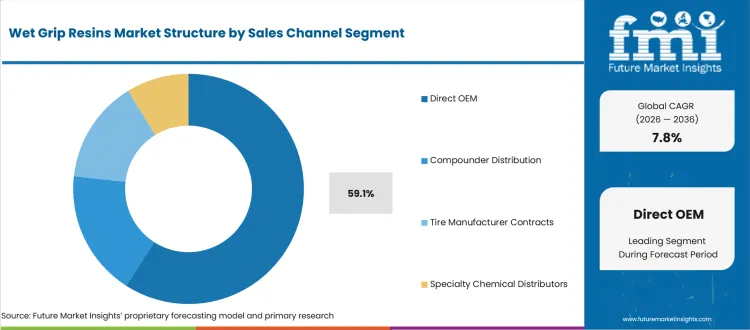
Direct OEM routes are central to wet grip resin buying because tire approval work starts before commercial launch. Technical teams need resin identity, trial records and supplier accountability during compound review. USTMA projected in December 2025 that total USA tire shipments would reach 337.4 million units in 2025. Direct contact helps resin suppliers answer compound questions before approved material lists are frozen.
- Direct OEM is expected to capture 59.1% share in 2026, driven by product approval work completed before commercial tire roll-out. Suppliers gain strength by supporting tire design and compound teams through qualification.
- Compounder distribution remains useful for reach and replenishment. Larger tire programs move toward direct supply once resin performance and documentation are accepted by technical decision teams.
Why do passenger tires lead within the tire type segment?
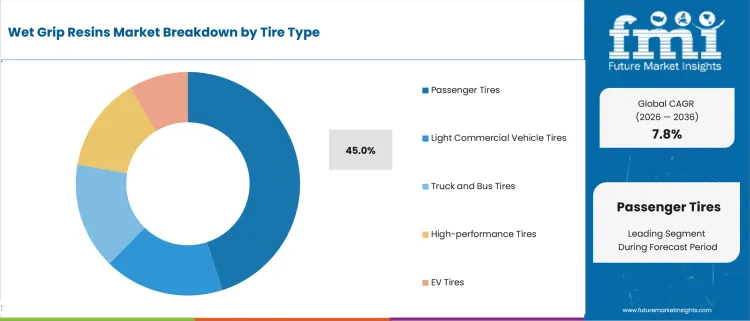
Passenger tire programs create the main demand pool because tread labels and model refresh cycles keep wet braking under review. ACEA reported in January 2026 that EU new car registrations rose 1.8% in 2025. Battery-electric cars captured 17.4% share in the same release. The shift keeps resin choices close to passenger tire compounds used for EV-ready tread designs.
- Passenger Tires are expected to represent 45.0% share in 2026, influenced by OEM and replacement programs needing repeatable wet-road response. Resin suppliers gain commercial access once trials connect product use with braking, wear and rolling-loss records.
- High-performance and EV tire programs use more targeted resin strategies. Passenger tire operations often need tighter support as tread labeling and consumer safety expectations affect purchase decisions.
What keeps hydrocarbon resins relevant within resin type?
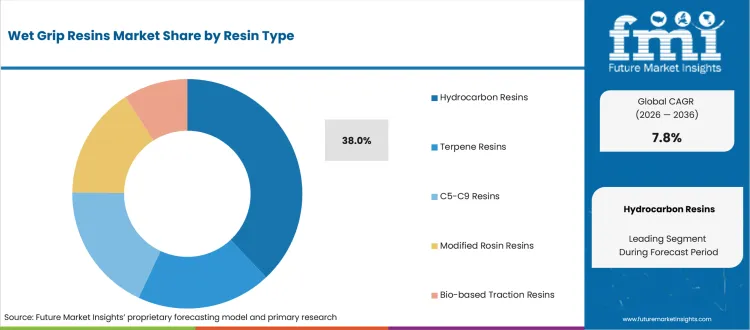
Hydrocarbon resins support tread programs that need predictable softening profiles and steady mixing behavior. Tire teams use hydrocarbon grades when traction support must fit existing recipes without heavy process changes. American Chemistry Council reported in June 2026 that USA major plastic resin production reached 9.3 billion pounds in May 2026. The volume signal keeps resin availability and formulation stability in the buyer review.
- Hydrocarbon resins are anticipated to hold 38.0% share in 2026, led by tread programs requiring controlled compatibility and compound stability. Suppliers gain approval once resin identity and formulation behavior are clear.
- C5/C9 and bio-based traction resins remain useful in targeted tread programs. Hydrocarbon options gain attention as buyers connect resin softening profile and mixing behavior with measurable tire performance outcomes.
How do buyers evaluate SSBR / BR within rubber compatibility demand?
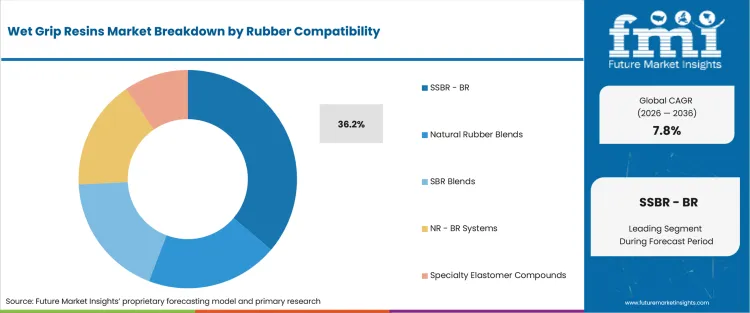
SSBR / BR creates a demanding compatibility test because silica-filled tread compounds need the resin, polymer and filler to work together. ENEOS Materials said in November 2025 that it would add 10,000 tons of SSBR capacity at its Yokkaichi Plant. The expansion supports high-grip and fuel-efficient tires, which gives resin suppliers a clearer compatibility path into lower-styrene tread formulations.
- SSBR / BR is expected to represent 36.2% share in 2026, influenced by tire programs needing repeatable wet grip support and energy-performance balance. Resin suppliers gain access once compatibility evidence supports compound approval across silica-filled tread systems.
- Natural rubber blends and SBR blends remain useful for truck and replacement tire applications. SSBR / BR systems often require tighter supplier support as formulation teams compare rolling-loss and abrasion outcomes during approval trials.
Why does wet grip improvement guide function decisions?
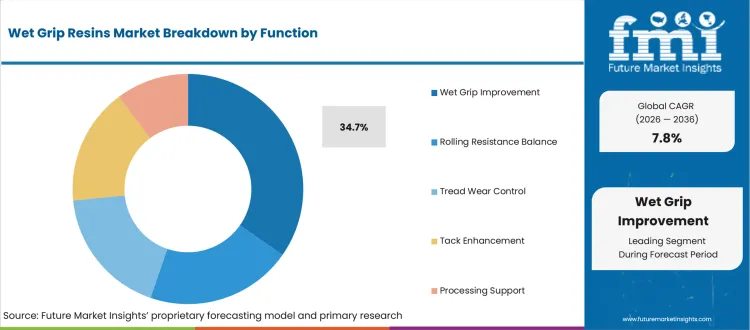
Wet grip improvement is the clearest performance reason tire makers examine these resins. Weak traction results create label pressure and lower buyer confidence, so resin suppliers need evidence from tread tests. Evonik stated in February 2026 that its silica and silane system reduced wet braking distance by 18 meters at 80 km/h in a tire comparison. Resin selection stays close to the same safety-performance trade-off during compound review.
- Wet grip improvement is projected to capture 34.7% share in 2026, guided by tire makers needing consistent traction performance across passenger and EV tire lines. Buyers assess resin programs based on compound trials and service follow-up.
- Rolling resistance balance and tread wear control remain close evaluation areas. Wet grip improvement gains attention once tire teams link resin use with braking performance and lower avoidable reformulation work.
What are the drivers, restraints, and opportunities in the Wet Grip Resins Market?
Near-term purchases are projected to be shaped by compound validation, supplier documentation and EV-tread reformulation.
- Driver: Tire makers are expected to buy resins that improve tread predictability when wet braking and rolling-efficiency targets sit in the same compound.
- Restraint: Adoption is anticipated to slow where suppliers lack product characterization and compound evidence for repeat tire production.
- Opportunity: EV tire programs are projected to open room for resin packages tied to technical service and measured tread response.
Chemical cost pressure is expected to make resin qualification more cautious in Europe. Cefic reported in December 2025 that European gas prices were around three times USA levels. That cost gap keeps buyers focused on supply continuity and batch records before a resin grade enters repeated tire-compound use.
The output base gives compound teams a clearer reason to test resins for rolling efficiency, tread wear and wet-road response.
Which country CAGRs are profiled in the Wet Grip Resins Market?
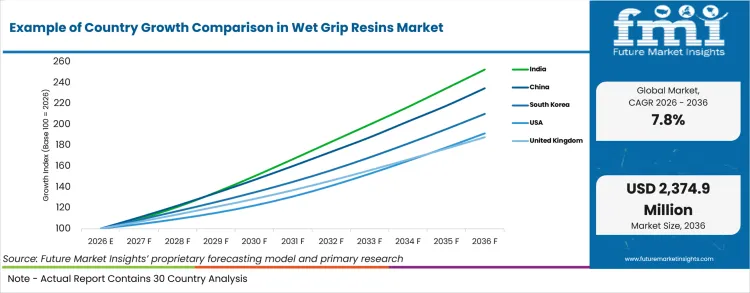
| Country | CAGR |
|---|---|
| India | 9.7% |
| China | 8.9% |
| South Korea | 7.7% |
| United States | 6.7% |
| United Kingdom | 6.5% |
| Germany | 6.3% |
| Japan | 6.2% |
Source: FMI's proprietary forecasting model and primary research
How do country-level CAGRs compare in the Wet Grip Resins Market?
How do country-level CAGRs compare in the Wet Grip Resins Market?
The country comparison spans 3.5 percentage points and reveals three defined growth groups across the wet grip resins market. India and China form the upper group, with only 0.8 percentage points separating their forecasts. South Korea and the United States create the middle group, although a 1.0-point gap separates the two countries. The United Kingdom, Germany and Japan form a closely aligned lower group within only 0.3 percentage points. Countries with stronger tire production, electric vehicle output and local compounding capacity generally demonstrate faster resin demand growth.
- India leads the comparison as passenger vehicle demand and domestic tire production support localized tread formulation and wet-grip performance trials.
- China remains 0.8 percentage points below India as electric vehicle production and large tire-compounding capacity support wider resin qualification.
- South Korea remains 1.2 percentage points below China, reflecting export-oriented tire manufacturing and advanced automotive supply networks.
- The United States remains 1.0 percentage point below South Korea as replacement tire demand and formal OEM qualification shape resin adoption.
- The United Kingdom remains only 0.2 percentage points below the United States, supported by export vehicle production and performance tire requirements.
- Germany remains 0.2 percentage points below the United Kingdom as electric vehicle output encourages work on efficient and durable tread compounds.
- Japan remains only 0.1 percentage point below Germany, reflecting strict approval practices and controlled tire formulation programs.
Comparable CAGRs can still produce different market-entry conditions. Differences in tire production, electric vehicle output, material qualification, local compounding and technical support influence adoption timelines and commercial strategies. The full report provides country-level CAGR analysis across North America, Latin America, Europe, East Asia, South Asia, Oceania and the Middle East and Africa.
Country-wise Analysis
- India combines expanding passenger vehicle sales with a large domestic tire production base. Wet grip resin demand in India is projected to rise at 9.7% CAGR through 2036, driven by local manufacturing and replacement tire requirements. SIAM recorded passenger vehicle sales of 46.43 lakh units in FY2025-26. This volume gives resin companies a larger base for localized tread trials and high-volume passenger tire programs. Tire manufacturers balance wet-road grip with durability and cost across approved formulations. Resin companies require consistent grades, practical application support and disciplined pricing to secure repeat orders.
- China combines large automotive production with extensive tire-compounding capacity and rapid electric vehicle adoption. The China wet grip resins market is forecast to grow at 8.9% CAGR through 2036, supported by vehicle output and compound development. State Council statistics reported automobile production of 34.531 million units in 2025, up 10.4% from 2024. This scale supports tread formulations requiring wet grip and resin compatibility. Tire companies require dependable supplies and evidence from compound-level trials. Material providers need local technical support to assist passenger and electric vehicle tire qualification.
- South Korea has export-focused tire manufacturers and advanced automotive supply networks serving international vehicle platforms. Wet grip resin demand in South Korea is projected to expand at 7.7% CAGR during the study period, supported by export tire programs. MOTIR reported automobile exports of USD 6.4 billion in March 2026. The figure supports material demand tied to global OEM and replacement tire accounts. Export programs require repeatable compound performance and complete technical records. Resin companies need regional application support to assist tire makers during formulation testing and tread-performance reviews.
- United States tire demand combines a large replacement channel with controlled qualification for original-equipment programs. The United States wet grip resins market is expected to advance at 6.7% CAGR from 2026 to 2036, backed by vehicle use and replacement demand. Federal Reserve data recorded total vehicle sales at an annualized rate of 16.508 million units in May 2026. This base supports resin use across service and new vehicle tire programs. Tire manufacturers compare compound consistency and long-term availability before approving grades. Commercial plans require dependable delivery and repeatable performance across large production volumes.
- United Kingdom tire demand remains linked to exported vehicles and international performance requirements. The United Kingdom wet grip resins market is forecast to register 6.5% CAGR during the forecast period, shaped by export-led vehicle manufacturing. SMMT reported that 555,826 UK-built cars were exported in 2025. The export base supports tire compounds designed for global vehicle platforms and wet-road standards. Resin grades require clear technical documentation and stable availability throughout production programs. Material providers need dependable distribution and formulation support to maintain approved positions across customer accounts.
- Germany combines electric vehicle production with advanced tire engineering and strict material qualification. Germany’s wet grip resins market is anticipated to grow at 6.3% CAGR through 2036, supported by efficient vehicle and tire design. VDA reported that battery-electric car production rose 15% to 1.22 million units in 2025. The increase gives tire formulators a clear reason to evaluate resins supporting grip, rolling efficiency and abrasion resistance. Electric vehicles also place higher loads on tire compounds. Resin companies require application teams and reliable trial evidence during customer approval reviews.
- Japan has controlled tire-compound programs and strict expectations for material quality and production consistency. The Japan wet grip resins market is expected to grow at 6.2% CAGR through 2036, aided by established OEM and replacement channels. The International Trade Administration recorded passenger vehicle sales of 4,421,494 units in 2024. This vehicle base supports resin programs across original-equipment and replacement tires. Japanese tire manufacturers review batch reliability, formulation behavior and long-term supply before approving new grades. Resin companies require dependable manufacturing and continuing technical support throughout lengthy qualification programs.
Who are the notable companies in the Wet Grip Resins Market?
Synthomer and Kraton Corporation are notable companies influencing wet grip resin support. Kolon Industries and ExxonMobil Product Solutions also shape tire compound pathways. Arakawa Chemical Industries and Zeon Corporation support specialty resin choices. ENEOS Materials and Cray Valley add tire material depth. Ecopower, Evonik and Momentive Performance Materials support additive programs.
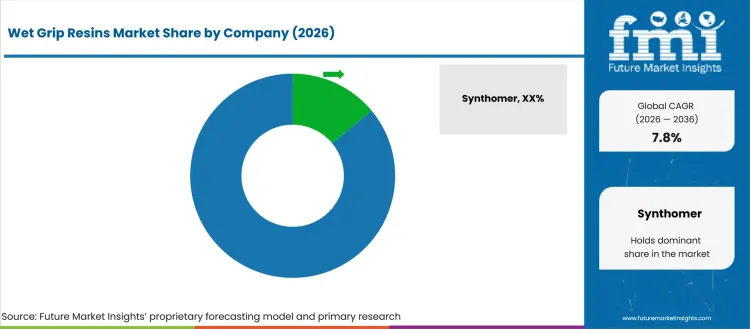
Competition in wet grip resins is shaped by how tire makers expect proof to work. Suppliers compete on resin chemistry, tread trial support and document speed. Direct access to compound teams carries weight because wet braking and rolling-loss targets must be tested inside each recipe. Accounts are expected to separate suppliers by application help, batch reliability and regional service access before approved material lists change.
- Synthomer supports tire accounts through IMPERA hydrocarbon resins used for rolling resistance, wet grip and abrasion in tread compounds. Buyers are expected to value this portfolio where product identity and application support reduce trial uncertainty.
- Kraton is relevant where pine-based tread enhancement additives help compounders balance wet grip, rolling resistance and wear. Tire teams are expected to compare its compatibility evidence when lower-styrene SSBR systems need resin support.
- Kolon Industries, ExxonMobil Product Solutions and Arakawa Chemical Industries compete where resin scale and grade consistency shape tire-compound purchasing. These companies are expected to receive attention from accounts that need stable supply across C5/C9 and specialty resin routes.
- Zeon Corporation and ENEOS Materials support adjacent tire-material decisions through elastomer knowledge. Cray Valley and Ecopower add resin systems while Evonik supports additive service. Tire makers are expected to compare them where supplier evidence must fit local compound trials.
Competitive Benchmarking: Wet Grip Resins Market
| Company | Resin Portfolio Alignment | Technical Service Alignment | Tire Compound Integration | Geographic Reach |
|---|---|---|---|---|
| Synthomer | High | High | High | Global |
| Kraton Corporation | High | High | Strong | Global |
| Kolon Industries | Strong | Medium | High | Asia and global export markets |
| ExxonMobil Product Solutions | High | High | High | Global |
| Arakawa Chemical Industries | Medium | Strong | Medium | Asia and global export markets |
| Zeon Corporation | Strong | Strong | Strong | Global |
| ENEOS Materials | Medium | Strong | Strong | Asia |
| Cray Valley | Medium | Medium | Strong | Global |
| Ecopower | Strong | Medium | Strong | China and export markets |
Source: Future Market Insights competitive analysis, 2026. Ratings reflect relative portfolio relevance and workflow fit. Service capability and geographic reach shape the remaining comparison.
Key Developments in the Wet Grip Resins Market
- In March 2026, Kraton highlighted next-generation pine-based tread enhancement additives for tire compounds. Its official knowledge-center note described SYLVATRAXX TEA technology as a non-reactive additive that helps tune compound behavior across wet grip, rolling resistance and abrasion resistance. The item is relevant because lower-styrene sSBR formulas need resin support that protects tread performance.
- In March 2026, Ecopower presented tire additives at Tire Technology Expo 2026 in Hannover. The company said its showcase covered tackifying resins for green tack, resin systems for filler dispersion and materials for thermal stability. The showcase is relevant to wet grip resin purchasing because compounders need processing help before functional resin packages move into routine tire trials.
- In March 2026, Evonik joined Tire Technology Expo 2026 with tire additive and silica/silane systems for EV tire applications. The official event page said the company showcased materials for lower rolling resistance, abrasion resistance and wet grip. The development supports resin-adjacent tire chemistry because tread teams often evaluate resins beside silica, silanes and elastomer modifiers.
- In February 2026, Momentive advanced NRX and NXT silane technologies for Tire Technology Expo 2026. The company said NXT P97 was developed for passenger car tires and EV cars where low rolling resistance, durability and tread stability are critical. The launch is relevant because resin suppliers are compared beside silane and elastomer systems during wet-grip compound trials.
Key Players in the Wet Grip Resins Market
Hydrocarbon and Synthetic Resin Suppliers
- Synthomer
- Kolon Industries
- ExxonMobil Product Solutions
- Cray Valley
Bio-based and Specialty Resin Suppliers
- Kraton Corporation
- Arakawa Chemical Industries
- Ecopower
Elastomer and Tire Material Specialists
- Zeon Corporation
- ENEOS Materials
- Evonik
- Momentive Performance Materials
Wet Grip Resins Market - Report Scope
| Coverage field | Report scope |
|---|---|
| Market breakdown | Wet grip resins market breakdown by resin type, tire type, rubber compatibility, function, sales channel and region |
| Market Definition | Tire tread resin inputs and related performance materials used in rubber compounds to support wet grip, rolling resistance balance, tread wear control, tack enhancement and processing support |
| Regions Covered | North America, Latin America, Europe, East Asia, South Asia and Pacific, Middle East and Africa |
| Countries Covered | United States, China, India, Germany, United Kingdom, Japan, South Korea and 30+ countries |
| Key Companies Profiled | Synthomer, Kraton Corporation, Kolon Industries, ExxonMobil Product Solutions, Arakawa Chemical Industries, Zeon Corporation, ENEOS Materials, Cray Valley, Ecopower and Evonik |
| Forecast Period | 2026 to 2036 |
| Approach | Hybrid bottom-up and top-down methodology using tire output, resin inclusion, compounder demand, tread performance requirements, supplier portfolios, sales-channel structure and country-level indicators |
Source: Future Market Insights - analysis driven by proprietary forecasting models and primary research
Wet Grip Resins Market - Research Methodology
| Method | Approach |
|---|---|
| Primary Research | FMI analysts reviewed inputs from tire compounders, resin suppliers, rubber processors, tire manufacturers, specialty chemical distributors and application teams. Discussions focused on product use, adoption barriers, formulation support and measurable operating value. |
| Desk Research | Desk research covered official automotive sources, tire industry bodies, company pages, product information, chemical production datasets and public safety resources. Product coverage was checked against resin type, tire type, rubber compatibility, function, sales-channel route and commercial application. |
| Market Sizing and Forecasting | Model inputs combined 2026 baseline value, resin inclusion intensity, tire demand, compound compatibility, supplier reach, channel structure and country CAGR assumptions. Forecast design was adjusted for EV tire demand, wet grip adoption and technical service needs. |
| Data Validation | Forecasts were checked against vehicle production signals, tire shipment indicators, company portfolio activity and supplier qualification patterns. Company portfolios were reviewed to avoid counting adjacent products without direct wet grip resin use. |
Source: Future Market Insights (FMI) analysis, based on proprietary forecasting model and primary research
Wet Grip Resins Market by Segments
Wet Grip Resins Market segmented by Resin Type:
- Hydrocarbon Resins
- Terpene Resins
- C5/C9 Resins
- Modified Rosin Resins
- Bio-based Traction Resins
Wet Grip Resins Market segmented by Tire Type:
- Passenger Tires
- Light Commercial Vehicle Tires
- Truck and Bus Tires
- High-performance Tires
- EV Tires
Wet Grip Resins Market segmented by Rubber Compatibility:
- SSBR / BR
- Natural Rubber Blends
- SBR Blends
- NR / BR Systems
- Specialty Elastomer Compounds
Wet Grip Resins Market segmented by Function:
- Wet Grip Improvement
- Rolling Resistance Balance
- Tread Wear Control
- Tack Enhancement
- Processing Support
Wet Grip Resins Market segmented by Sales Channel:
- Direct OEM
- Compounder Distribution
- Tire Manufacturer Contracts
- Specialty Chemical Distributors
Wet Grip Resins Market by Region:
- North America
- United States
- Canada
- Mexico
- Latin America
- Brazil
- Chile
- Rest of Latin America
- Western Europe
- Germany
- United Kingdom
- Italy
- Spain
- France
- Nordic
- BENELUX
- Rest of Western Europe
- Eastern Europe
- Poland
- Hungary
- Balkan and Baltic
- Rest of Eastern Europe
- East Asia
- China
- Japan
- South Korea
- South Asia and Pacific
- India
- ASEAN
- Australia and New Zealand
- Rest of South Asia and Pacific
- Middle East and Africa
- Kingdom of Saudi Arabia
- Other GCC Countries
- Türkiye
- South Africa
- Other African Union
- Rest of Middle East and Africa
Research Sources and Bibliography
- American Chemistry Council. (2026, June 26). ACC releases May 2026 resin production and sales statistics. American Chemistry Council.
- European Automobile Manufacturers’ Association. (2026, January 27). New car registrations: +1.8% in 2025; battery-electric 17.4% market share. European Automobile Manufacturers’ Association.
- European Chemical Industry Council. (2025, December 15). Cefic launches 2025 Facts & Figures report. European Chemical Industry Council.
- European Tyre and Rubber Manufacturers’ Association. (2025, July 28). Tyre replacement sales: Consumer market turns negative in the first half of 2025. European Tyre and Rubber Manufacturers’ Association.
- Evonik Industries. (2026, February). The silica/silane system contributes to fuel-saving tires. Evonik Industries.
- Evonik Industries. (2026, March 3). Tire Technology Expo 2026. Evonik Industries.
- International Energy Agency. (2026, May). Technology: Electric vehicles - Global Energy Review 2026. International Energy Agency.
- International Organization of Motor Vehicle Manufacturers. (2026, April 23). Auto industry growth shifted east in 2025 amid global repositioning. International Organization of Motor Vehicle Manufacturers.
- Kraton Corporation. (2026). Advancing tire performance with next-generation bio-based tread enhancement additives. Kraton Corporation.
- ENEOS Materials Corporation. (2025, November 4). Reinforcement of SSBR production capacity at Yokkaichi Plant. ENEOS Materials Corporation.
- Momentive Performance Materials. (2026, February 24). Momentive advances NRX and NXT silane technologies at Tire Technology Expo 2026. Momentive Performance Materials.
- Ministry of Trade, Industry and Resources. (2026). March 2026 automobile exports reach USD 6.4 billion. Government of the Republic of Korea.
- Society of Indian Automobile Manufacturers. (2026, April). Auto industry performance of March 2026 and Q4/FY2025-26. Society of Indian Automobile Manufacturers.
- Society of Motor Manufacturers and Traders. (2026). UK car manufacturing and production data. Society of Motor Manufacturers and Traders.
- State Council of the People’s Republic of China. (2026, January 14). China’s auto output, sales reach new highs in 2025. State Council of the People’s Republic of China.
- USA Federal Reserve Bank of St. Louis. (2026, June 25). Total vehicle sales. Federal Reserve Economic Data.
- USA Tire Manufacturers Association. (2025, December 2). USTMA November 2025 forecast. USA Tire Manufacturers Association.
- Verband der Automobilindustrie. (2026, February 3). Production and market in January 2026. Verband der Automobilindustrie.
This bibliography is provided for reader reference and uses primary government and standards-body sources. Official trade body and company sources support company-specific evidence.
This Report Answers
- What is the expected global value of the wet grip resins market in 2026 and 2036?
- What CAGR is forecast for the wet grip resins market during the 2026 to 2036 period?
- Which sales channel segment is used to assess direct OEM wet grip resin demand in 2026?
- Why do tire makers buy controlled wet grip resin systems?
- How do hydrocarbon resins and SSBR / BR compatibility shape tire compound choices?
- Which countries are compared in the wet grip resins forecast?
- Which companies compete across wet grip resin and tire compound support pathways?
- What resin systems and applications are included within the wet grip resins definition?
- How does FMI size and forecast wet grip resin demand across segments and countries?
- What implementation and supplier-selection factors should executives assess?
Frequently Asked Questions
What is driving growth in the wet grip resins market?
Demand is driven by wet grip improvement and the need to maintain rolling-efficiency balance across commercial tire programs. Buyers give more attention to resin systems reducing uncertainty during compound qualification and tire performance review.
Why should executives track the wet grip resins market?
Key players include Synthomer, Kraton Corporation, Kolon Industries, ExxonMobil Product Solutions and Arakawa Chemical Industries. Competition is expected to center on resin chemistry and trial support.
What business problem does the wet grip resins market address?
Wet grip resins help tire makers and compounders reduce uncertainty around traction response and repeatable use in commercial tire production. Wet grip resin programs support buyers needing clearer links between resin use and operating control.
What should sourcing leaders evaluate before selecting suppliers?
Sourcing leaders are likely to compare documentation quality and supply reliability before supplier approval. Technical service and compound-specific evidence should guide supplier review.
What may limit return on investment for buyers?
Return on investment is expected to be delayed if trial evidence is weak or resin handling requires compound changes. Buyers may reduce such risk by phasing trials before wider use.
How do suppliers build executive confidence?
Suppliers build confidence through verified product data and accountable support during commercial tire compound roll-out. Clear trial protocols and consistent batch documentation strengthen buyer approval.
Which companies lead wet grip resins market?
Competition is based on Synthomer and Kraton, led by tread resin depth and compounder support continuity. Kolon Industries, ExxonMobil Product Solutions and Arakawa Chemical Industries gain position depending on hydrocarbon resin scale and tire-grade consistency.
What demand driver supports wet grip resins market?
Tire makers seek resins improving wet grip performance amid EV tire and passenger tire reformulation. Replacement tire programs strengthen demand through tread evidence and tire-compound quality control.
Preview the report firsthand - request a free sample
Get SampleGet the brochure for pricing and purchase details.
Get PDFTable of Content
- Key Takeaways
- Market Size and CAGR
- Top Growth Driver
- Fastest Growing Segment
- Leading Region
- Key Companies
- Emerging Opportunities
- Executive Summary
- Global Market Outlook
- Demand-side Trends
- Supply-side Trends
- Technology Roadmap Analysis
- Analysis and Recommendations
- Analyst Perspective (What is happening? Why now? What should investors know?)
- Key Questions Answered
- How large is the market?
- What is the CAGR?
- What are key trends?
- Which region dominates?
- Who are the leaders?
- Market Overview
- Market Coverage / Taxonomy
- Market Definition / Scope / Limitations
- Research Methodology
- Chapter Orientation
- Analytical Lens and Working Hypotheses
- Market Structure, Signals, and Trend Drivers
- Benchmarking and Cross-market Comparability
- Market Sizing, Forecasting, and Opportunity Mapping
- Research Design and Evidence Framework
- Desk Research Programme (Secondary Evidence)
- Expert Input and Fieldwork (Primary Evidence)
- Tooling, Models, and Reference Databases
- Data Engineering and Model Build
- Quality Assurance and Audit Trail
- Market Background
- Market Dynamics (Drivers, Restraints, Opportunity, Trends)
- Scenario Forecast (Optimistic, Likely, Conservative)
- Impact Analysis
- AI Impact
- Sustainability Impact
- Regulatory Impact
- Technology Impact
- Consumer / Buyer Analysis
- Purchase Drivers
- Adoption Barriers
- Buyer Journey
- Opportunity Map Analysis
- Product Life Cycle Analysis
- Supply Chain Analysis
- Investment Feasibility Matrix
- Value Chain Analysis
- PESTLE and Porter's Analysis
- Regulatory Landscape
- Regional Parent Market Outlook
- Production and Consumption Statistics
- Import and Export Statistics
- Global Market Analysis and Forecast, 2021 to 2036
- Historical Market Size Value (USD Million) Analysis, 2021 to 2025
- Current and Future Market Size Value (USD Million) Projections, 2026 to 2036
- Y-o-Y Growth Trend Analysis
- Absolute $ Opportunity Analysis
- Global Market Pricing Analysis, 2021 to 2036
- Global Market Analysis and Forecast, By Resin Type, 2021 to 2036
- Introduction / Key Findings
- Historical Market Size Value (USD Million) Analysis By Resin Type, 2021 to 2025
- Current and Future Market Size Value (USD Million) Analysis and Forecast By Resin Type, 2026 to 2036
- Hydrocarbon Resins
- Terpene Resins
- C5-C9 Resins
- Modified Rosin Resins
- Bio-based Traction Resins
- Hydrocarbon Resins
- Y-o-Y Growth Trend Analysis By Resin Type, 2021 to 2025
- Absolute $ Opportunity Analysis By Resin Type, 2026 to 2036
- Global Market Analysis and Forecast, By Tire Type, 2021 to 2036
- Introduction / Key Findings
- Historical Market Size Value (USD Million) Analysis By Tire Type, 2021 to 2025
- Current and Future Market Size Value (USD Million) Analysis and Forecast By Tire Type, 2026 to 2036
- Passenger Tires
- Light Commercial Vehicle Tires
- Truck and Bus Tires
- High-performance Tires
- EV Tires
- Passenger Tires
- Y-o-Y Growth Trend Analysis By Tire Type, 2021 to 2025
- Absolute $ Opportunity Analysis By Tire Type, 2026 to 2036
- Global Market Analysis and Forecast, By Rubber Compatibility, 2021 to 2036
- Introduction / Key Findings
- Historical Market Size Value (USD Million) Analysis By Rubber Compatibility, 2021 to 2025
- Current and Future Market Size Value (USD Million) Analysis and Forecast By Rubber Compatibility, 2026 to 2036
- SSBR - BR
- Natural Rubber Blends
- SBR Blends
- NR - BR Systems
- Specialty Elastomer Compounds
- SSBR - BR
- Y-o-Y Growth Trend Analysis By Rubber Compatibility, 2021 to 2025
- Absolute $ Opportunity Analysis By Rubber Compatibility, 2026 to 2036
- Global Market Analysis and Forecast, By Function, 2021 to 2036
- Introduction / Key Findings
- Historical Market Size Value (USD Million) Analysis By Function, 2021 to 2025
- Current and Future Market Size Value (USD Million) Analysis and Forecast By Function, 2026 to 2036
- Wet Grip Improvement
- Rolling Resistance Balance
- Tread Wear Control
- Tack Enhancement
- Processing Support
- Wet Grip Improvement
- Y-o-Y Growth Trend Analysis By Function, 2021 to 2025
- Absolute $ Opportunity Analysis By Function, 2026 to 2036
- Global Market Analysis and Forecast, By Sales Channel, 2021 to 2036
- Introduction / Key Findings
- Historical Market Size Value (USD Million) Analysis By Sales Channel, 2021 to 2025
- Current and Future Market Size Value (USD Million) Analysis and Forecast By Sales Channel, 2026 to 2036
- Direct OEM
- Compounder Distribution
- Tire Manufacturer Contracts
- Specialty Chemical Distributors
- Direct OEM
- Y-o-Y Growth Trend Analysis By Sales Channel, 2021 to 2025
- Absolute $ Opportunity Analysis By Sales Channel, 2026 to 2036
- Global Market Analysis and Forecast, By Region, 2021 to 2036
- Introduction
- Historical Market Size Value (USD Million) Analysis By Region, 2021 to 2025
- Current Market Size Value (USD Million) Analysis and Forecast By Region, 2026 to 2036
- North America
- Latin America
- Western Europe
- Eastern Europe
- East Asia
- South Asia and Pacific
- Middle East & Africa
- Market Attractiveness Analysis By Region
- North America Market Analysis and Forecast, By Country, 2021 to 2036
- Historical Market Size Value (USD Million) Trend Analysis By Market Taxonomy, 2021 to 2025
- Market Size Value (USD Million) Forecast By Market Taxonomy, 2026 to 2036
- By Country
- USA
- Canada
- By Resin Type
- By Tire Type
- By Rubber Compatibility
- By Function
- By Sales Channel
- By Country
- Market Attractiveness Analysis
- By Country
- By Resin Type
- By Tire Type
- By Rubber Compatibility
- By Function
- By Sales Channel
- Key Takeaways
- Latin America Market Analysis and Forecast, By Country
- Historical Market Size Value (USD Million) Trend Analysis By Market Taxonomy, 2021 to 2025
- Market Size Value (USD Million) Forecast By Market Taxonomy, 2026 to 2036
- By Country
- Brazil
- Mexico
- Chile
- Rest of Latin America
- By Resin Type
- By Tire Type
- By Rubber Compatibility
- By Function
- By Sales Channel
- By Country
- Market Attractiveness Analysis
- By Country
- By Resin Type
- By Tire Type
- By Rubber Compatibility
- By Function
- By Sales Channel
- Key Takeaways
- Western Europe Market Analysis and Forecast, By Country
- Historical Market Size Value (USD Million) Trend Analysis By Market Taxonomy, 2021 to 2025
- Market Size Value (USD Million) Forecast By Market Taxonomy, 2026 to 2036
- By Country
- Germany
- UK
- Italy
- Spain
- France
- Nordic
- BENELUX
- Rest of Western Europe
- By Resin Type
- By Tire Type
- By Rubber Compatibility
- By Function
- By Sales Channel
- By Country
- Market Attractiveness Analysis
- By Country
- By Resin Type
- By Tire Type
- By Rubber Compatibility
- By Function
- By Sales Channel
- Key Takeaways
- Eastern Europe Market Analysis and Forecast, By Country
- Historical Market Size Value (USD Million) Trend Analysis By Market Taxonomy, 2021 to 2025
- Market Size Value (USD Million) Forecast By Market Taxonomy, 2026 to 2036
- By Country
- Russia
- Poland
- Hungary
- Balkan & Baltic
- Rest of Eastern Europe
- By Resin Type
- By Tire Type
- By Rubber Compatibility
- By Function
- By Sales Channel
- By Country
- Market Attractiveness Analysis
- By Country
- By Resin Type
- By Tire Type
- By Rubber Compatibility
- By Function
- By Sales Channel
- Key Takeaways
- East Asia Market Analysis and Forecast, By Country
- Historical Market Size Value (USD Million) Trend Analysis By Market Taxonomy, 2021 to 2025
- Market Size Value (USD Million) Forecast By Market Taxonomy, 2026 to 2036
- By Country
- China
- Japan
- South Korea
- By Resin Type
- By Tire Type
- By Rubber Compatibility
- By Function
- By Sales Channel
- By Country
- Market Attractiveness Analysis
- By Country
- By Resin Type
- By Tire Type
- By Rubber Compatibility
- By Function
- By Sales Channel
- Key Takeaways
- South Asia and Pacific Market Analysis and Forecast, By Country
- Historical Market Size Value (USD Million) Trend Analysis By Market Taxonomy, 2021 to 2025
- Market Size Value (USD Million) Forecast By Market Taxonomy, 2026 to 2036
- By Country
- India
- ASEAN
- Australia & New Zealand
- Rest of South Asia and Pacific
- By Resin Type
- By Tire Type
- By Rubber Compatibility
- By Function
- By Sales Channel
- By Country
- Market Attractiveness Analysis
- By Country
- By Resin Type
- By Tire Type
- By Rubber Compatibility
- By Function
- By Sales Channel
- Key Takeaways
- Middle East & Africa Market Analysis and Forecast, By Country
- Historical Market Size Value (USD Million) Trend Analysis By Market Taxonomy, 2021 to 2025
- Market Size Value (USD Million) Forecast By Market Taxonomy, 2026 to 2036
- By Country
- Kingdom of Saudi Arabia
- Other GCC Countries
- Türkiye
- South Africa
- Other African Union
- Rest of Middle East & Africa
- By Resin Type
- By Tire Type
- By Rubber Compatibility
- By Function
- By Sales Channel
- By Country
- Market Attractiveness Analysis
- By Country
- By Resin Type
- By Tire Type
- By Rubber Compatibility
- By Function
- By Sales Channel
- Key Takeaways
- Key Countries Market Analysis
- USA
- Pricing Analysis
- Market Share Analysis, 2025
- By Resin Type
- By Tire Type
- By Rubber Compatibility
- By Function
- By Sales Channel
- Canada
- Pricing Analysis
- Market Share Analysis, 2025
- By Resin Type
- By Tire Type
- By Rubber Compatibility
- By Function
- By Sales Channel
- Mexico
- Pricing Analysis
- Market Share Analysis, 2025
- By Resin Type
- By Tire Type
- By Rubber Compatibility
- By Function
- By Sales Channel
- Brazil
- Pricing Analysis
- Market Share Analysis, 2025
- By Resin Type
- By Tire Type
- By Rubber Compatibility
- By Function
- By Sales Channel
- Chile
- Pricing Analysis
- Market Share Analysis, 2025
- By Resin Type
- By Tire Type
- By Rubber Compatibility
- By Function
- By Sales Channel
- Germany
- Pricing Analysis
- Market Share Analysis, 2025
- By Resin Type
- By Tire Type
- By Rubber Compatibility
- By Function
- By Sales Channel
- UK
- Pricing Analysis
- Market Share Analysis, 2025
- By Resin Type
- By Tire Type
- By Rubber Compatibility
- By Function
- By Sales Channel
- Italy
- Pricing Analysis
- Market Share Analysis, 2025
- By Resin Type
- By Tire Type
- By Rubber Compatibility
- By Function
- By Sales Channel
- Spain
- Pricing Analysis
- Market Share Analysis, 2025
- By Resin Type
- By Tire Type
- By Rubber Compatibility
- By Function
- By Sales Channel
- France
- Pricing Analysis
- Market Share Analysis, 2025
- By Resin Type
- By Tire Type
- By Rubber Compatibility
- By Function
- By Sales Channel
- India
- Pricing Analysis
- Market Share Analysis, 2025
- By Resin Type
- By Tire Type
- By Rubber Compatibility
- By Function
- By Sales Channel
- ASEAN
- Pricing Analysis
- Market Share Analysis, 2025
- By Resin Type
- By Tire Type
- By Rubber Compatibility
- By Function
- By Sales Channel
- Australia & New Zealand
- Pricing Analysis
- Market Share Analysis, 2025
- By Resin Type
- By Tire Type
- By Rubber Compatibility
- By Function
- By Sales Channel
- China
- Pricing Analysis
- Market Share Analysis, 2025
- By Resin Type
- By Tire Type
- By Rubber Compatibility
- By Function
- By Sales Channel
- Japan
- Pricing Analysis
- Market Share Analysis, 2025
- By Resin Type
- By Tire Type
- By Rubber Compatibility
- By Function
- By Sales Channel
- South Korea
- Pricing Analysis
- Market Share Analysis, 2025
- By Resin Type
- By Tire Type
- By Rubber Compatibility
- By Function
- By Sales Channel
- Russia
- Pricing Analysis
- Market Share Analysis, 2025
- By Resin Type
- By Tire Type
- By Rubber Compatibility
- By Function
- By Sales Channel
- Poland
- Pricing Analysis
- Market Share Analysis, 2025
- By Resin Type
- By Tire Type
- By Rubber Compatibility
- By Function
- By Sales Channel
- Hungary
- Pricing Analysis
- Market Share Analysis, 2025
- By Resin Type
- By Tire Type
- By Rubber Compatibility
- By Function
- By Sales Channel
- Kingdom of Saudi Arabia
- Pricing Analysis
- Market Share Analysis, 2025
- By Resin Type
- By Tire Type
- By Rubber Compatibility
- By Function
- By Sales Channel
- Türkiye
- Pricing Analysis
- Market Share Analysis, 2025
- By Resin Type
- By Tire Type
- By Rubber Compatibility
- By Function
- By Sales Channel
- South Africa
- Pricing Analysis
- Market Share Analysis, 2025
- By Resin Type
- By Tire Type
- By Rubber Compatibility
- By Function
- By Sales Channel
- USA
- Market Structure Analysis
- Competition Dashboard
- Competition Benchmarking
- Market Share Analysis of Top Players
- By Regional
- By Resin Type
- By Tire Type
- By Rubber Compatibility
- By Function
- By Sales Channel
- Emerging Startups
- Innovation Benchmarking
- Competition Analysis
- Competition Deep Dive
- Synthomer
- Overview
- Product Portfolio
- Profitability by Market Segments
- Sales Footprint
- Strategy Overview
- Marketing Strategy
- Product Strategy
- Channel Strategy
- Kraton Corporation
- Kolon Industries
- ExxonMobil Product Solutions
- Arakawa Chemical Industries
- Zeon Corporation
- ENEOS Materials
- Cray Valley
- Ecopower
- Evonik
- Momentive Performance Materials
- Synthomer
- Case Studies
- Success Stories
- Recent Developments
- Competition Deep Dive
- Assumptions & Acronyms Used


