

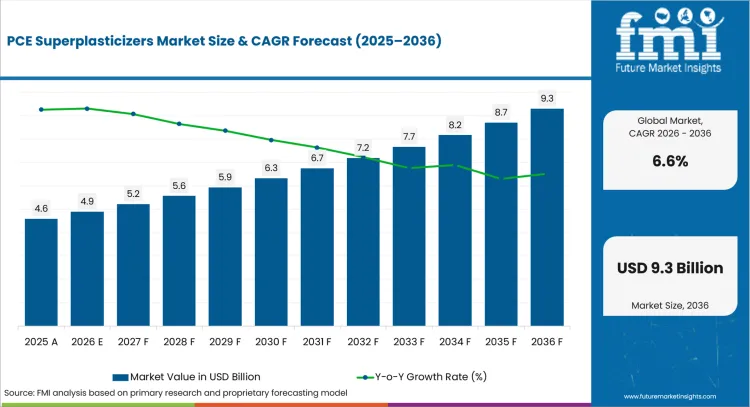
- Market Size (2026)
- USD 4.9 Bn
- Forecast (2036)
- USD 9.3 Bn
- CAGR (2026 to 2036)
- 6.6%
How big is PCE Superplasticizers Market in 2026?
USD 4.9 billion in 2026 and USD 9.3 billion by 2036 at a 6.6% CAGR.
Demand for PCE superplasticizers is projected to rise from USD 4.9 billion in 2026 to USD 9.3 billion by 2036 at 6.6% CAGR. Concrete plants pay for controlled water reduction and workable placement time because unstable rheology can cause pumping delays or rejected loads. Master Builders Solutions opened two USA admixture plants in May 2026, bringing its combined U.S. and Canada manufacturing network to 17 sites. Shorter supply routes for concrete admixture systems reduce order turnaround and improve response during repeat formulation work.
Construction cycles and concrete logistics shape purchase timing more than headline building activity alone. Dubai Municipality reported in February 2026 that 23,270 buildings were under construction during 2025 and concrete shortages were delaying projects. Dense project activity raises the value of dependable ready-mix supply and nearby construction chemicals support. Mature markets place more weight on cost-in-use and compatibility trials as new construction activity softens.
Key Takeaways of PCE Superplasticizers Market
- Concrete plants increase PCE demand as they lower mixing water without surrendering the workability required for transport and placement.
- By product type, high range water reducing PCE is estimated to hold 31.0% in 2026 owing to direct water-reduction requirements in performance concrete.
- The liquid form is likely to capture 58.0% share in 2026 attributable to automated dosing and rapid plant-level formulation adjustment.
- By concrete type, ready-mix concrete is forecast to represent 42.0% in 2026 driven by delivery windows that make slump retention commercially important.
- Concrete plants delay formulation changes until each PCE passes mix trials across local cement and aggregate combinations for regular use.
- Sika, Master Builders Solutions, GCP Applied Technologies / Saint-Gobain, CHRYSO / Saint-Gobain, Fosroc / Saint-Gobain, Mapei, MC-Bauchemie and Kao Corporation are some key companies.
Analyst Perspective
“Concrete plants should compare PCE grades against their actual cement blend and delivery window before negotiating unit price. A stable dosage range paired with nearby laboratory support shortens requalification following changes in cement or aggregate sources.”
- Nikhil Kaitwade, Principal Consultant, Future Market Insights
How is the PCE Superplasticizers Market segmented?
The PCE superplasticizers market is segmented by product type, form, concrete type, end use, sales channel and region.
Product type covers high range water reducing PCE, slump retention PCE, early strength PCE, low-clay tolerant PCE and precast PCE admixtures. Form includes liquid, powder, concentrate and customized admixture blends. Concrete type covers ready-mix concrete, precast concrete, self-consolidating concrete, high performance concrete and dry-mix mortar. End use includes buildings, infrastructure, precast plants, industrial flooring and underground or tunneling applications. Sales channels comprise concrete admixture producers, direct construction chemical supply, distributors and project-specific formulations.
What supports demand for buildings within the end use category?
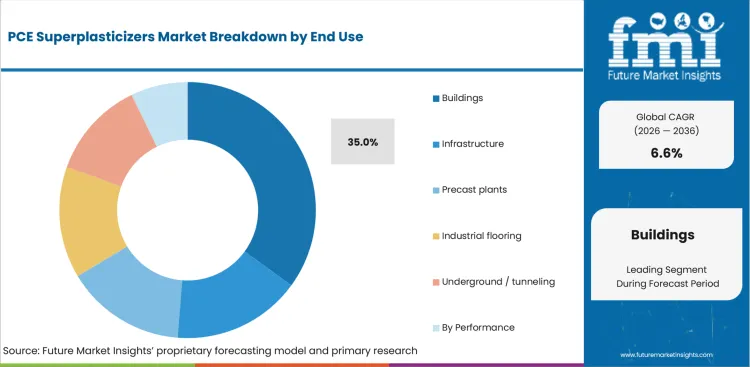
Building projects repeat concrete placements across floors and structural elements that demand predictable pumping and workability. The USA Census Bureau reported 1.367 million building permits at a seasonally adjusted annual rate in June 2026. That pipeline keeps precast concrete and cast-in-place producers focused on dosage consistency across repeated placements.
- The end use category is forecast to be led by buildings at 35.0% share in 2026 due to recurring workability needs across concrete grades.
- Residential and commercial projects give admixture formulators repeated specification opportunities beyond a single infrastructure pour. Formulations that hold performance across pump distance and ambient temperature reduce adjustment work between successive placements.
What makes high range water reducing PCE central to the product type category?
High range water reducing PCE solves the core batching problem of maintaining flow at lower mixing water. Excessive viscosity can slow pumping and finishing, so concrete plants compare dosage against target strength and placement time across scheduled pours.
- Based on product type, high range water reducing PCE is projected to account for 31.0% in 2026 due to its direct fit with water-reduction specifications.
- MAPEI introduced Dynamon XTEND 4047 in April 2026 with extended workability and strength development for ready-mix and precast concrete. The launch gives ultra-high-performance concrete formulators another current PCE option for lowering water content without losing placement control.
How do plant operators evaluate liquid within the form category?
Liquid PCE fits automated batching as plant operators can meter dosage directly without dissolving a powder first. Sika opened its Haines City admixture plant in December 2025 to produce ViscoCrete and ViscoFlow superplasticizers for southeastern USA customers.
- In 2026, liquid is expected to lead form with 58.0% share because automated dosing systems support controlled addition and rapid formulation adjustment.
- Plant teams adjust liquid dosage against temperature and cement behavior during routine ready-mix production without interrupting normal batching. That flexibility lets the same dosing equipment accommodate formulation changes without reworking the dry ingredient system or adding a dissolution step.
How does ready-mix concrete shape demand within the concrete type category?
Ready-mix concrete exposes PCE formulations to transport time and changing site conditions between batching and discharge. Small dosage changes can alter truck turnaround, so plant teams assess slump retention with water reduction and strength. Site feedback becomes part of formulation approval for regular production.
- Ready-mix concrete is set to lead the concrete type with 42.0% share in 2026 due to delivery windows making slump retention a core production requirement.
- Master Builders Solutions launched MasterAtlas R3 in January 2026 for USA ready-mix producers managing returned concrete with admixtures and monitoring. The program ties admixture control to routine plant operations and concrete recovery across production cycles.
What are the drivers, restraints and opportunities in the PCE Superplasticizers Market?
Performance-sensitive concrete increases demand for controllable water reduction as variable raw materials lengthen qualification and local laboratories shorten the path to repeat orders.
- Driver: Higher water-reduction and retention requirements increase the cost of unstable concrete behavior during pumping or placement.
- Restraint: Changing cement chemistry and recycled inputs force repeated trial batching until formulations prove transferable across plants or projects.
- Opportunity: Local production and concrete laboratories shorten mix validation cycles for formulations designed around regional raw materials.
Precast Strength Targets Raise PCE Value
Precast plants need high water reduction without delaying early strength or mold turnover during repeated casting cycles. Kao Industrial (Thailand) presented MIGHTY PC high-range water-reducing superplasticizers for precast concrete in February 2026 with accelerated early-strength development. PCE grades aligned with set-control admixtures and curing schedules balance workable casting with faster mold release, giving producers a clearer basis for repeat dosage approval.
Variable Inputs Lengthen Qualification
Concrete producers are evaluating PCE superplasticizers within lower-carbon mix designs that rely on recycled aggregates and alternative material combinations. MC-Bauchemie reported in April 2025 that PCE chemistry restored workability in concrete made with 100% recycled aggregate. Similar low-carbon concrete additives and self-compacting concrete mixes can shift absorption or rheology enough to require fresh trial batches during transfer between plants. Concrete laboratories must recheck dosage windows once local cement or aggregate characteristics fall outside the validated mix range.
Local Laboratories Shorten Plant Qualification
Regional technical support is becoming more important as concrete producers adapt PCE formulations to local materials and project requirements. Master Builders Solutions opened an automated Brazilian plant in May 2026 with quality-control and concrete laboratories for regional projects. Local testing lets ready-mix and precast teams compare candidate PCE dosages against local cement and aggregate conditions during pre-production qualification. Nearby technical teams can correct formulation issues during plant trials, reducing off-site iterations and protecting scheduled concrete placements as approved formulations enter repeat ordering.
Which country CAGRs are profiled in the PCE Superplasticizers Market?
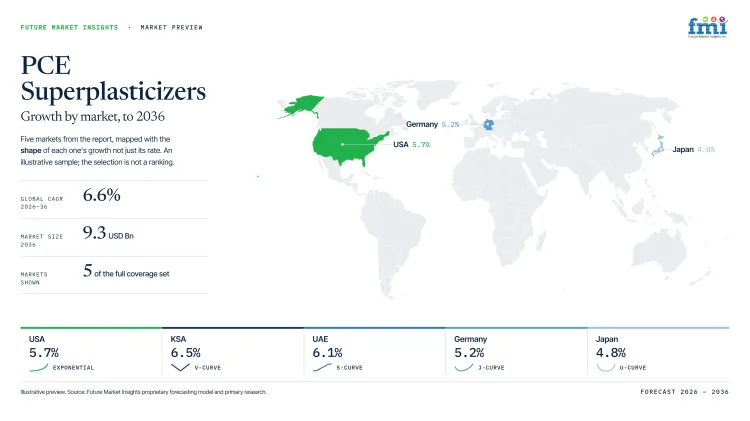
| Country | CAGR |
|---|---|
| KSA | 6.5% |
| UAE | 6.1% |
| USA | 5.7% |
| Germany | 5.2% |
| Japan | 4.8% |
How do country-level CAGRs compare in the PCE Superplasticizers Market?
The 1.7-point range separates a Gulf growth band from mature markets centered on qualification. KSA and UAE combine concentrated project execution with hot-weather ready-mix logistics that require local technical response. USA forms the transition market across a dispersed plant network. Germany and Japan rely on technical differentiation within established concrete networks.
- KSA combines hot deliveries with large pours that require local slump-retention support.
- UAE concentrates ready-mix activity within dense schedules that tighten daily dispatch control.
- USA spreads demand across many regional plants that require broad technical-service coverage.
- Germany emphasizes replacement compatibility trials as weak construction activity raises cost scrutiny.
- Japan links high-performance mixes to scheduled maintenance work at constrained repair sites.
Similar growth rates produce different entry conditions once service distance and qualification burden are considered. The full report provides country-level CAGR analysis across North America, Latin America, Europe, East Asia, South Asia, Oceania and the Middle East and Africa.
Country-wise Analysis
- Saudi ready-mix producers manage hot delivery windows and large project pours across development corridors that require dependable local stock plus rapid dosage correction to maintain approved PCE formulations from batching to placement. KSA is estimated to post 6.5% CAGR over the forecast period as GASTAT recorded 5,056 building permits in May 2026 with a 33.3% year-on-year decline that exposed uneven construction timing across active packages. Permit volatility can shift PCE orders between months, so formulators need nearby inventory and project-level laboratories that can recheck slump retention quickly as each major concrete package enters active execution across large development programs.
- UAE ready-mix plants work within hot conditions and dense dispatch schedules that leave limited time for dosage correction between batching and placement during tower and villa pours across Dubai's concentrated project clusters. The Government of Dubai Media Office reported 824,381 cubic meters of concrete supplied to active sites during Q1 2026 and the recorded throughput gives formulators a direct measure of recurring plant demand. Adoption of PCE superplasticizers in UAE is estimated to expand at 6.1% CAGR through 2036, aided by recurring pours that reward local stock and technicians able to adjust dosage without delaying scheduled site delivery.
- United States ready-mix plants operate across a dispersed network with enough variation in cement sources and aggregate characteristics to make local dosage economics plus rapid formulation correction part of routine qualification. Demand for PCE superplasticizers in USA is forecast to rise at 5.7% CAGR over the forecast period, supported by an established batching base that gives regional laboratories repeated opportunities to maintain approved mix performance. Price scrutiny rises as construction activity softens, and the USA Census Bureau reported June 2026 construction spending at a USD 2,166.5 billion annual rate that keeps service coverage and cost-in-use evidence central to replacement decisions.
- German concrete plants use specification-led purchasing that requires PCE formulations to remain stable across regional cements and lower-clinker binder combinations during trial batching ahead of replacing an established admixture system at commercial scale. By 2036, Germany is projected to grow at 5.2% CAGR due to recurring qualification within mature concrete networks whose experienced laboratories document dosage windows across changing binder chemistry and replacement reviews. Replacement reviews are becoming more cost-sensitive as Destatis data for 2025 showed construction output contracting for the fifth consecutive year, underpinned by falling building permits and persistently weak residential investment, which raises the burden on formulators to prove compatibility and cost-in-use gains at commercial plants.
- Japanese concrete maintenance programs often involve restricted worksites and detailed engineering approvals across public asset programs that place more weight on repeatable placement performance than rapid switching between PCE formulations. Japan's Ministry of Land Infrastructure Transport and Tourism reported in July 2026 that 42% of road bridges were over 50 years old as of 2025 and the aging base keeps repair logistics commercially relevant. PCE superplasticizer sales in Japan are forecast to expand at 4.8% CAGR by 2036, shaped by high-performance repair and precast work as technical documentation plus dependable local service reduce approval risk across scheduled public works.
Who are the notable companies in the PCE Superplasticizers Market?
Sika, Master Builders Solutions, GCP Applied Technologies / Saint-Gobain, CHRYSO / Saint-Gobain, Fosroc / Saint-Gobain, Mapei, MC-Bauchemie and Kao Corporation are the notable companies serving this market.
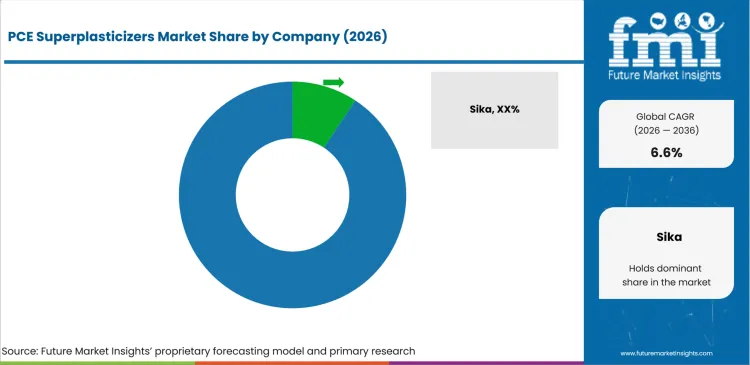
Competition is concentrated among integrated admixture groups and specialist formulators that can support concrete plants during mix qualification. Global groups combine PCE chemistry with local dosing service across ready-mix and precast operations. Project-focused companies also work alongside concrete curing compounds during placement planning. Their portfolios can extend to concrete floor systems with finishing performance that depends on stable rheology. Entry barriers rise for companies without local laboratories, dependable supply or qualification records across varied binder combinations.
- Sika and Master Builders Solutions compete as integrated global admixture specialists with broad manufacturing networks and direct technical support for concrete producers.
- GCP Applied Technologies / Saint-Gobain, CHRYSO / Saint-Gobain and Fosroc / Saint-Gobain combine specialty construction-chemical reach with concrete admixture access across several regions.
- Mapei and MC-Bauchemie emphasize project-specific formulation support, while Kao Corporation adds performance-chemical depth in water-reducing admixtures for concrete.
Competitive Benchmarking: PCE Superplasticizers Market
| Company | PCE Formulation Breadth | Ready-mix / Precast Application Depth | Difficult-material Optimization | Geographic Reach |
|---|---|---|---|---|
| Sika | High | High | Medium | Global; local admixture production across major regions |
| Master Builders Solutions | High | High | High | Europe, Americas, Middle East and selected Asia markets |
| GCP Applied Technologies / Saint-Gobain | High | High | Medium | North America and wider Saint-Gobain construction-chemicals network |
| CHRYSO / Saint-Gobain | High | High | High | Europe, Americas, Asia-Pacific, Middle East and Africa |
| Fosroc / Saint-Gobain | Medium | High | Medium | India, Middle East, Asia-Pacific and wider Saint-Gobain network |
| Mapei | Medium | High | Medium | Americas, Europe, Asia-Pacific and Middle East project markets |
| MC-Bauchemie | High | High | High | Europe, Asia, Middle East, Africa and selected Americas markets |
| Kao Corporation | Medium | Medium | Low | Japan and selected international performance-chemical markets |
Key Developments in the PCE Superplasticizers Market
- In September 2025, Master Builders Solutions acquired Brexton Dominicana to add a concrete-admixture platform and local market access in the Dominican Republic.
- In April 2025, Sika opened a Kazakhstan production facility with concrete-admixture lines and a modern laboratory for regional formulation support.
- In February 2025, Saint-Gobain completed the acquisition of Fosroc and added a construction-chemicals platform with twenty manufacturing plants across global markets.
Key Players in the PCE Superplasticizers Market
Integrated Global Admixture Specialists
- Sika
- Master Builders Solutions
Saint-Gobain Concrete Platforms
- GCP Applied Technologies / Saint-Gobain
- CHRYSO / Saint-Gobain
- Fosroc / Saint-Gobain
Project and Polymer Specialists
- Mapei
- MC-Bauchemie
- Kao Corporation
PCE Superplasticizers Market - Report Scope
| Coverage field | Report scope |
|---|---|
| Market breakdown | By product type, form, concrete type, end use, sales channel and region. |
| Quantitative Units | Revenue in USD billion and CAGR in %. |
| Market Definition | Commercial polycarboxylate ether superplasticizer formulations used to lower concrete water demand while controlling workability and placement performance. |
| Regions Covered | North America, Latin America, Europe, East Asia, South Asia and Pacific, and Middle East and Africa. |
| Countries Covered | KSA, UAE, USA, Germany, Japan, and 20+ countries included in the full report. |
| Key Companies Profiled | Sika, Master Builders Solutions, GCP Applied Technologies / Saint-Gobain, CHRYSO / Saint-Gobain, Fosroc / Saint-Gobain, Mapei, MC-Bauchemie, Kao Corporation. |
| Forecast Period | 2026 to 2036. |
| Approach | Primary and secondary research with market triangulation. |
PCE Superplasticizers Market - Research Methodology
| Method | Approach |
|---|---|
| Primary Research | FMI analysts gathered input from manufacturers, service providers, technology developers, distributors, end users, procurement teams, and subject-matter experts. Interviews examined purchasing decisions, product or service evaluation, adoption barriers, approval requirements, pricing considerations, and expectations for technical or commercial support. Respondents were also asked what evidence is required before a trial, pilot, or initial order develops into regular purchasing. |
| Desk Research | Desk research covered government statistics, regulatory publications, trade data, industry associations, technical literature, standards, company filings, product information, and official corporate announcements. Sources were reviewed for relevance, publication date, geographic coverage, and consistency with the defined market scope. Claims relating to performance, applications, approvals, capacity, investment, and commercial activity were retained only when supported by credible public evidence. |
| Market Sizing and Forecasting | The market model combined the baseline value with historical performance, segment structure, pricing and volume indicators, adoption levels, company participation, and country-level demand conditions. Forecast assumptions considered economic activity, investment trends, regulatory developments, technology adoption, purchasing cycles, supply availability, and barriers to wider market use. Segment and regional estimates were reconciled before the final market total was calculated. |
| Data Validation | Estimates were checked against multiple independent indicators, including public data, company activity, trade patterns, industry developments, and findings from primary interviews. Validation also tested whether products, services, applications, and company revenues fell within the defined market boundaries. Adjacent categories, unsupported claims, overlapping revenues, and activities without direct market relevance were excluded to reduce double counting and maintain consistency across segments and countries. |
PCE Superplasticizers Market by Segments
PCE Superplasticizers Market segmented by Product Type:
- High Range Water Reducing PCE
- Slump Retention PCE
- Early Strength PCE
- Low-Clay Tolerant PCE
- Precast PCE Admixtures
PCE Superplasticizers Market segmented by Form:
- Liquid
- Powder
- Concentrate
- Customized Admixture Blend
PCE Superplasticizers Market segmented by Concrete Type:
- Ready-Mix Concrete
- Precast Concrete
- Self-Consolidating Concrete
- High Performance Concrete
- Dry-Mix Mortar
PCE Superplasticizers Market segmented by End Use:
- Buildings
- Infrastructure
- Precast Plants
- Industrial Flooring
- Underground / Tunneling
PCE Superplasticizers Market segmented by Sales Channel:
- Concrete Admixture Producers
- Direct Construction Chemical Supply
- Distributors
- Project-Specific Formulations
PCE Superplasticizers Market by Region:
- North America
- United States
- Canada
- Latin America
- Brazil
- Mexico
- Chile
- Rest of Latin America
- Western Europe
- Germany
- United Kingdom
- Italy
- Spain
- France
- Nordics
- Benelux
- Rest of Western Europe
- Eastern Europe
- Russia
- Poland
- Hungary
- Balkan and Baltic States
- Rest of Eastern Europe
- East Asia
- China
- Japan
- South Korea
- South Asia and Pacific
- India
- ASEAN
- Australia and New Zealand
- Rest of South Asia and Pacific
- Middle East and Africa
- Kingdom of Saudi Arabia
- Other GCC Countries
- Türkiye
- South Africa
- Other African Union Countries
- Rest of Middle East and Africa
Research Sources and Bibliography
- Master Builders Solutions. (2026, May 22). Master Builders Solutions Expands USA Manufacturing Footprint with Two New Admixture Sites
- Dubai Municipality. (2026, February 17). Dubai Municipality meets concrete firms on market supply
- MAPEI. (2026, April 14). MAPEI introduces Dynamon XTEND 4047
- Sika Corporation. (2025, December 3). Sika Opens New Highly Automated Admixture Production Plant in Haines City, Florida
- Master Builders Solutions. (2026, January 21). Master Builders Solutions Launches MasterAtlas R3 Returned Concrete Program
- USA Census Bureau and USA Department of Housing and Urban Development. (2026, July 17). Monthly New Residential Construction, June 2026
- Kao Industrial (Thailand) Co., Ltd. (2026, March 12). Kao Chemical participated in The 20th Annual Concrete Conference (ACC20)
- MC-Bauchemie. (2025, April 24). Concrete in transition - sustainable and specialty concrete
- Master Builders Solutions. (2026, May 19). Master Builders Solutions Expands Brazil Operations with New Automated Manufacturing Plant
- General Authority for Statistics. (2026, July 20). GASTAT: Operating Revenues Index for short-term business increases by 11.4% in May 2026
- Government of Dubai Media Office. (2026, March 25). Dubai records strong performance, issues 10,700+ building permits in Q1 2026
- USA Census Bureau. (2026, August 3). Monthly Construction Spending, June 2026
- Federal Statistical Office of Germany. (2026, January 15). Gross domestic product up 0.2% in 2025
- Ministry of Land, Infrastructure, Transport and Tourism. (2026, July 28). Roads in Japan 2026
- Master Builders Solutions. (2025, September 9). Master Builders Solutions acquires Brexton Construction Products - Leader in Concrete Admixtures in the Dominican Republic
- Sika. (2025, April 15). Sika is generating growth in Q1 despite unpredictable markets and continues investing worldwide
- Saint-Gobain. (2025, July 31). Half-year financial report 2025
- Master Builders Solutions. (2026, March 10). Master Builders Solutions Closes Strategic Acquisition of Arkaz Al Sharq Building Materials (Arkaz)
- Saint-Gobain. (2025, June 18). Saint-Gobain enhances its digital construction chemicals platform with the acquisition of Maturix
- MC-Bauchemie. (2025, July 31). Murasan Hydrotech 864: Two compaction-aiding admixtures
- MC-Bauchemie. (2026, February 3). MC Egypt achieved ISO 9001 & ISO 45001 certification
- Sika. (2026, July 28). Half-Year Report 2026
- Saint-Gobain. (2026, March 11). 2025 Universal Registration Document
- MAPEI. (2026, March 13). Investing to grow: Mapei's first manufacturing plant in Belgium
- Kao Corporation. (2026, May 12). FY2026 Q1 Results
This bibliography is provided for reader reference and is not exhaustive. The full report contains the complete reference list and detailed citations
This Report Answers
- How large is the PCE superplasticizers market in 2026 and what valuation is projected for 2036?
- Which concrete performance requirements explain the purchase case for PCE formulations beyond polymer price alone?
- Why do high range water reducing PCE and liquid formulations hold the strongest current segment positions?
- How does ready-mix production change the value of slump retention and local technical service?
- Which raw-material conditions create the greatest qualification burden for PCE superplasticizer suppliers?
- How do country growth rates differ across KSA, UAE, USA, Germany and Japan?
- Which supplier capabilities separate integrated admixture groups from project-focused construction-chemical specialists?
- What do recent acquisitions and plant investments reveal about regional supply and technical-service priorities?
Frequently Asked Questions
How big is the PCE Superplasticizers Market in 2026?
The PCE superplasticizers market is expected to be valued at USD 4.9 billion in 2026 and reach USD 9.3 billion by 2036. Concrete plants use these formulations to reduce mixing water while preserving workable placement time.
What is the CAGR of the PCE Superplasticizers Market from 2026 to 2036?
The PCE superplasticizers market is projected to grow at a CAGR of 6.6% between 2026 and 2036. Expansion reflects broader use of performance-sensitive concrete that requires dependable water reduction and slump retention.
Which form leads the PCE Superplasticizers Market?
By form, liquid formulation is projected to hold 58.0% share in 2026. Automated batching systems favor liquid dosing by letting plant teams adjust dosage without adding a powder-dissolution step.
How much value will the PCE Superplasticizers Market add between 2026 and 2036?
The PCE superplasticizers market is expected to add USD 4.4 billion in value between 2026 and 2036. The increase reflects broader use across concrete mixes that require dependable water reduction and workability retention.
Which companies are active in the PCE Superplasticizers Market?
The PCE superplasticizers market includes Sika, Master Builders Solutions, GCP Applied Technologies / Saint-Gobain and CHRYSO / Saint-Gobain among eight profiled companies. Fosroc / Saint-Gobain, Mapei, MC-Bauchemie and Kao Corporation compete across concrete-admixture production and project-specific formulation.
Preview the report firsthand - request a free sample
Get SampleGet the brochure for pricing and purchase details.
Get PDFTable of Content
- Key Takeaways
- Market Size and CAGR
- Top Growth Driver
- Fastest Growing Segment
- Leading Region
- Key Companies
- Emerging Opportunities
- Executive Summary
- Global Market Outlook
- Demand-side Trends
- Supply-side Trends
- Technology Roadmap Analysis
- Analysis and Recommendations
- Analyst Perspective (What is happening? Why now? What should investors know?)
- Key Questions Answered
- How large is the market?
- What is the CAGR?
- What are key trends?
- Which region dominates?
- Who are the leaders?
- Market Overview
- Market Coverage / Taxonomy
- Market Definition / Scope / Limitations
- Research Methodology
- Chapter Orientation
- Analytical Lens and Working Hypotheses
- Market Structure, Signals, and Trend Drivers
- Benchmarking and Cross-market Comparability
- Market Sizing, Forecasting, and Opportunity Mapping
- Research Design and Evidence Framework
- Desk Research Programme (Secondary Evidence)
- Expert Input and Fieldwork (Primary Evidence)
- Tooling, Models, and Reference Databases
- Data Engineering and Model Build
- Quality Assurance and Audit Trail
- Market Background
- Market Dynamics (Drivers, Restraints, Opportunity, Trends)
- Scenario Forecast (Optimistic, Likely, Conservative)
- Impact Analysis
- AI Impact
- Sustainability Impact
- Regulatory Impact
- Technology Impact
- Consumer / Buyer Analysis
- Purchase Drivers
- Adoption Barriers
- Buyer Journey
- Opportunity Map Analysis
- Product Life Cycle Analysis
- Supply Chain Analysis
- Investment Feasibility Matrix
- Value Chain Analysis
- PESTLE and Porter's Analysis
- Regulatory Landscape
- Regional Parent Market Outlook
- Production and Consumption Statistics
- Import and Export Statistics
- Global Market Analysis and Forecast, 2021 to 2036
- Historical Market Size Value (USD Billion) Analysis, 2021 to 2025
- Current and Future Market Size Value (USD Billion) Projections, 2026 to 2036
- Y-o-Y Growth Trend Analysis
- Absolute $ Opportunity Analysis
- Global Market Pricing Analysis, 2021 to 2036
- Global Market Analysis and Forecast, By Product Type, 2021 to 2036
- Introduction / Key Findings
- Historical Market Size Value (USD Billion) Analysis By Product Type, 2021 to 2025
- Current and Future Market Size Value (USD Billion) Analysis and Forecast By Product Type, 2026 to 2036
- High range water reducing PCE
- Slump retention PCE
- Early strength PCE
- Low-clay tolerant PCE
- Precast PCE admixtures
- By Product Type
- High range water reducing PCE
- Y-o-Y Growth Trend Analysis By Product Type, 2021 to 2025
- Absolute $ Opportunity Analysis By Product Type, 2026 to 2036
- Global Market Analysis and Forecast, By Form, 2021 to 2036
- Introduction / Key Findings
- Historical Market Size Value (USD Billion) Analysis By Form, 2021 to 2025
- Current and Future Market Size Value (USD Billion) Analysis and Forecast By Form, 2026 to 2036
- Liquid
- Powder
- Concentrate
- Customized admixture blend
- By Formwork Type
- Liquid
- Y-o-Y Growth Trend Analysis By Form, 2021 to 2025
- Absolute $ Opportunity Analysis By Form, 2026 to 2036
- Global Market Analysis and Forecast, By Concrete Type, 2021 to 2036
- Introduction / Key Findings
- Historical Market Size Value (USD Billion) Analysis By Concrete Type, 2021 to 2025
- Current and Future Market Size Value (USD Billion) Analysis and Forecast By Concrete Type, 2026 to 2036
- Ready-mix concrete
- Precast concrete
- Self-consolidating concrete
- High performance concrete
- Dry-mix mortar
- By Application
- Ready-mix concrete
- Y-o-Y Growth Trend Analysis By Concrete Type, 2021 to 2025
- Absolute $ Opportunity Analysis By Concrete Type, 2026 to 2036
- Global Market Analysis and Forecast, By End Use, 2021 to 2036
- Introduction / Key Findings
- Historical Market Size Value (USD Billion) Analysis By End Use, 2021 to 2025
- Current and Future Market Size Value (USD Billion) Analysis and Forecast By End Use, 2026 to 2036
- Buildings
- Infrastructure
- Precast plants
- Industrial flooring
- Underground / tunneling
- By Performance
- Buildings
- Y-o-Y Growth Trend Analysis By End Use, 2021 to 2025
- Absolute $ Opportunity Analysis By End Use, 2026 to 2036
- Global Market Analysis and Forecast, By Sales Channel, 2021 to 2036
- Introduction / Key Findings
- Historical Market Size Value (USD Billion) Analysis By Sales Channel, 2021 to 2025
- Current and Future Market Size Value (USD Billion) Analysis and Forecast By Sales Channel, 2026 to 2036
- Concrete admixture producers
- Direct construction chemical supply
- Distributors
- Project-specific formulations
- By Sales Channel
- Concrete admixture producers
- Y-o-Y Growth Trend Analysis By Sales Channel, 2021 to 2025
- Absolute $ Opportunity Analysis By Sales Channel, 2026 to 2036
- Global Market Analysis and Forecast, By Region, 2021 to 2036
- Introduction
- Historical Market Size Value (USD Billion) Analysis By Region, 2021 to 2025
- Current Market Size Value (USD Billion) Analysis and Forecast By Region, 2026 to 2036
- North America
- Latin America
- Western Europe
- Eastern Europe
- East Asia
- South Asia and Pacific
- Middle East & Africa
- Market Attractiveness Analysis By Region
- North America Market Analysis and Forecast, By Country, 2021 to 2036
- Historical Market Size Value (USD Billion) Trend Analysis By Market Taxonomy, 2021 to 2025
- Market Size Value (USD Billion) Forecast By Market Taxonomy, 2026 to 2036
- By Country
- USA
- Canada
- By Product Type
- By Form
- By Concrete Type
- By End Use
- By Sales Channel
- By Country
- Market Attractiveness Analysis
- By Country
- By Product Type
- By Form
- By Concrete Type
- By End Use
- By Sales Channel
- Key Takeaways
- Latin America Market Analysis and Forecast, By Country
- Historical Market Size Value (USD Billion) Trend Analysis By Market Taxonomy, 2021 to 2025
- Market Size Value (USD Billion) Forecast By Market Taxonomy, 2026 to 2036
- By Country
- Brazil
- Mexico
- Chile
- Rest of Latin America
- By Product Type
- By Form
- By Concrete Type
- By End Use
- By Sales Channel
- By Country
- Market Attractiveness Analysis
- By Country
- By Product Type
- By Form
- By Concrete Type
- By End Use
- By Sales Channel
- Key Takeaways
- Western Europe Market Analysis and Forecast, By Country
- Historical Market Size Value (USD Billion) Trend Analysis By Market Taxonomy, 2021 to 2025
- Market Size Value (USD Billion) Forecast By Market Taxonomy, 2026 to 2036
- By Country
- Germany
- UK
- Italy
- Spain
- France
- Nordic
- BENELUX
- Rest of Western Europe
- By Product Type
- By Form
- By Concrete Type
- By End Use
- By Sales Channel
- By Country
- Market Attractiveness Analysis
- By Country
- By Product Type
- By Form
- By Concrete Type
- By End Use
- By Sales Channel
- Key Takeaways
- Eastern Europe Market Analysis and Forecast, By Country
- Historical Market Size Value (USD Billion) Trend Analysis By Market Taxonomy, 2021 to 2025
- Market Size Value (USD Billion) Forecast By Market Taxonomy, 2026 to 2036
- By Country
- Russia
- Poland
- Hungary
- Balkan & Baltic
- Rest of Eastern Europe
- By Product Type
- By Form
- By Concrete Type
- By End Use
- By Sales Channel
- By Country
- Market Attractiveness Analysis
- By Country
- By Product Type
- By Form
- By Concrete Type
- By End Use
- By Sales Channel
- Key Takeaways
- East Asia Market Analysis and Forecast, By Country
- Historical Market Size Value (USD Billion) Trend Analysis By Market Taxonomy, 2021 to 2025
- Market Size Value (USD Billion) Forecast By Market Taxonomy, 2026 to 2036
- By Country
- China
- Japan
- South Korea
- By Product Type
- By Form
- By Concrete Type
- By End Use
- By Sales Channel
- By Country
- Market Attractiveness Analysis
- By Country
- By Product Type
- By Form
- By Concrete Type
- By End Use
- By Sales Channel
- Key Takeaways
- South Asia and Pacific Market Analysis and Forecast, By Country
- Historical Market Size Value (USD Billion) Trend Analysis By Market Taxonomy, 2021 to 2025
- Market Size Value (USD Billion) Forecast By Market Taxonomy, 2026 to 2036
- By Country
- India
- ASEAN
- Australia & New Zealand
- Rest of South Asia and Pacific
- By Product Type
- By Form
- By Concrete Type
- By End Use
- By Sales Channel
- By Country
- Market Attractiveness Analysis
- By Country
- By Product Type
- By Form
- By Concrete Type
- By End Use
- By Sales Channel
- Key Takeaways
- Middle East & Africa Market Analysis and Forecast, By Country
- Historical Market Size Value (USD Billion) Trend Analysis By Market Taxonomy, 2021 to 2025
- Market Size Value (USD Billion) Forecast By Market Taxonomy, 2026 to 2036
- By Country
- Kingdom of Saudi Arabia
- Other GCC Countries
- Türkiye
- South Africa
- Other African Union
- Rest of Middle East & Africa
- By Product Type
- By Form
- By Concrete Type
- By End Use
- By Sales Channel
- By Country
- Market Attractiveness Analysis
- By Country
- By Product Type
- By Form
- By Concrete Type
- By End Use
- By Sales Channel
- Key Takeaways
- Key Countries Market Analysis
- USA
- Pricing Analysis
- Market Share Analysis, 2025
- By Product Type
- By Form
- By Concrete Type
- By End Use
- By Sales Channel
- Canada
- Pricing Analysis
- Market Share Analysis, 2025
- By Product Type
- By Form
- By Concrete Type
- By End Use
- By Sales Channel
- Mexico
- Pricing Analysis
- Market Share Analysis, 2025
- By Product Type
- By Form
- By Concrete Type
- By End Use
- By Sales Channel
- Brazil
- Pricing Analysis
- Market Share Analysis, 2025
- By Product Type
- By Form
- By Concrete Type
- By End Use
- By Sales Channel
- Chile
- Pricing Analysis
- Market Share Analysis, 2025
- By Product Type
- By Form
- By Concrete Type
- By End Use
- By Sales Channel
- Germany
- Pricing Analysis
- Market Share Analysis, 2025
- By Product Type
- By Form
- By Concrete Type
- By End Use
- By Sales Channel
- UK
- Pricing Analysis
- Market Share Analysis, 2025
- By Product Type
- By Form
- By Concrete Type
- By End Use
- By Sales Channel
- Italy
- Pricing Analysis
- Market Share Analysis, 2025
- By Product Type
- By Form
- By Concrete Type
- By End Use
- By Sales Channel
- Spain
- Pricing Analysis
- Market Share Analysis, 2025
- By Product Type
- By Form
- By Concrete Type
- By End Use
- By Sales Channel
- France
- Pricing Analysis
- Market Share Analysis, 2025
- By Product Type
- By Form
- By Concrete Type
- By End Use
- By Sales Channel
- India
- Pricing Analysis
- Market Share Analysis, 2025
- By Product Type
- By Form
- By Concrete Type
- By End Use
- By Sales Channel
- ASEAN
- Pricing Analysis
- Market Share Analysis, 2025
- By Product Type
- By Form
- By Concrete Type
- By End Use
- By Sales Channel
- Australia & New Zealand
- Pricing Analysis
- Market Share Analysis, 2025
- By Product Type
- By Form
- By Concrete Type
- By End Use
- By Sales Channel
- China
- Pricing Analysis
- Market Share Analysis, 2025
- By Product Type
- By Form
- By Concrete Type
- By End Use
- By Sales Channel
- Japan
- Pricing Analysis
- Market Share Analysis, 2025
- By Product Type
- By Form
- By Concrete Type
- By End Use
- By Sales Channel
- South Korea
- Pricing Analysis
- Market Share Analysis, 2025
- By Product Type
- By Form
- By Concrete Type
- By End Use
- By Sales Channel
- Russia
- Pricing Analysis
- Market Share Analysis, 2025
- By Product Type
- By Form
- By Concrete Type
- By End Use
- By Sales Channel
- Poland
- Pricing Analysis
- Market Share Analysis, 2025
- By Product Type
- By Form
- By Concrete Type
- By End Use
- By Sales Channel
- Hungary
- Pricing Analysis
- Market Share Analysis, 2025
- By Product Type
- By Form
- By Concrete Type
- By End Use
- By Sales Channel
- Kingdom of Saudi Arabia
- Pricing Analysis
- Market Share Analysis, 2025
- By Product Type
- By Form
- By Concrete Type
- By End Use
- By Sales Channel
- Türkiye
- Pricing Analysis
- Market Share Analysis, 2025
- By Product Type
- By Form
- By Concrete Type
- By End Use
- By Sales Channel
- South Africa
- Pricing Analysis
- Market Share Analysis, 2025
- By Product Type
- By Form
- By Concrete Type
- By End Use
- By Sales Channel
- USA
- Market Structure Analysis
- Competition Dashboard
- Competition Benchmarking
- Market Share Analysis of Top Players
- By Regional
- By Product Type
- By Form
- By Concrete Type
- By End Use
- By Sales Channel
- Emerging Startups
- Innovation Benchmarking
- Competition Analysis
- Competition Deep Dive
- Sika
- Overview
- Product Portfolio
- Profitability by Market Segments
- Sales Footprint
- Strategy Overview
- Marketing Strategy
- Product Strategy
- Channel Strategy
- Master Builders Solutions
- GCP Applied Technologies / Saint-Gobain
- Mapei
- Fosroc
- CHRYSO / Saint-Gobain
- Arkema
- Sobute New Materials
- Kao Corporation
- MC-Bauchemie
- Sika
- Case Studies
- Success Stories
- Recent Developments
- Competition Deep Dive
- Assumptions & Acronyms Used


