

- Market Size (2026)
- USD 703.2 Mn
- Forecast (2036)
- USD 1490.3 Mn
- CAGR (2026 to 2036)
- 7.8%
How big is Whole-Body Deodorants Market in 2026?
USD 703.2 Million in 2026 and USD 1,490.3 Million by 2036 at a 7.8% CAGR.
The whole-body deodorants market is valued at USD 703.2 Million in 2026 and is forecast to reach USD 1,490.3 Million by 2036. The Whole-Body Deodorants Market was valued at USD 652.3 Million in 2025.The projected CAGR is 7.8% from 2026 to 2036. Within the broader antiperspirants and deodorants market, growth in whole-body products depends on consumers adding odor control beyond their underarms. Replacing a familiar underarm stick alone does not expand the routine. These options let consumers choose an applicator for another body area without turning to a clinical treatment.
Personal care already has a meaningful place in household spending. Based on 2025 cosmetics and personal care retail sales, spending on personal care is roughly €216 per person in Germany, €212 in the UK and €211 in France. For whole-body deodorants this matters because brands are competing for an existing personal-care budget rather than asking consumers to create a new spending category.
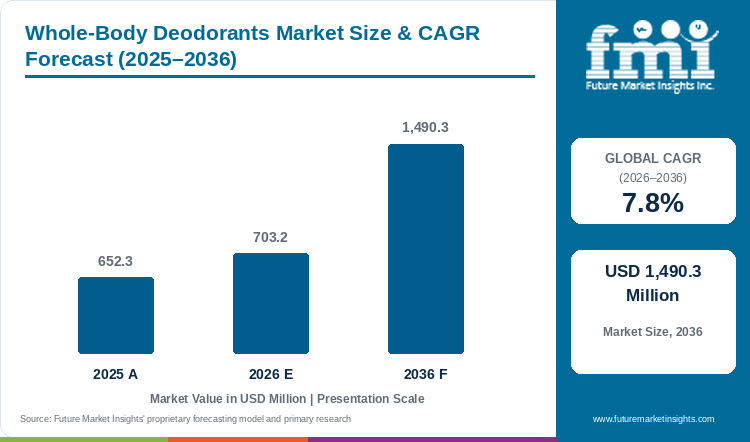
Whole-Body Deodorants Market Size & CAGR Forecast (2025-2036)
| Year | Basis | Market value (USD million) |
|---|---|---|
| 2025 | Actual | 652.3 |
| 2026 | Estimate | 703.2 |
| 2036 | Forecast | 1,490.3 |
| CAGR, 2026 to 2036 | 7.8% | |
Source: Future Market Insights proprietary forecasting model and primary research.
Key Takeaways
- Product Type: Core / classic lines lead with 33.0% in 2026.
- Nature: Conventional leads with 55.0% in 2026. It appeals to buyers who put performance first, without requiring a particular ingredient or ethical preference.
- Format: Cream & balm leads with 28.0% in 2026. Controlled placement can suit small external areas where broad spraying is unnecessary. [1]
- Purchasing friction: Consumers must distinguish odor protection from sweat reduction and avoid treating whole-body wording as permission for unrestricted application. [3, 23]
- Profiled companies: Unilever, Procter & Gamble, L'Oreal, Beiersdorf, Estee Lauder Companies, Kao Corporation, Shiseido, Coty, e.l.f. Beauty and Amorepacific. Their documented category roles differ; inclusion is not a claim that each sells a verified whole-body range.
Analyst Perspective
A second deodorant earns a permanent place in the basket only when precise usage guidance turns a new application occasion into comfortable repeat use.
- Rahul Pandita, Principal Analyst at Future Market Insights
How is the whole-body deodorants market segmented?
The market is segmented by Product Type, Nature, Format, Price Positioning and Sales Channel.
Product Type covers Core / classic lines, Targeted treatment lines, Sensitive & gentle lines, Premium & clinical lines, and Kits & sets. Nature comprises Conventional, Vegan & cruelty-free, Natural & organic, Dermocosmetic / clinical, and Fragrance-free & sensitive. Format includes Cream & balm, Liquid & serum, Stick & solid, Spray & mist, Sheet & patch, and Powder. Price Positioning spans Mass, Masstige, Premium, and Professional. Sales Channel comprises Specialty beauty retail, E-commerce & DTC, Pharmacies & drugstores, Supermarkets & hypermarkets, and Salons & spas. Each dimension is analyzed separately. Where descriptions overlap, products are classified by their main positioning within that dimension; the categories are not added together as separate markets. Treatment and clinical labels do not automatically establish a regulated medical indication. [23]
What supports Conventional positioning within Nature?
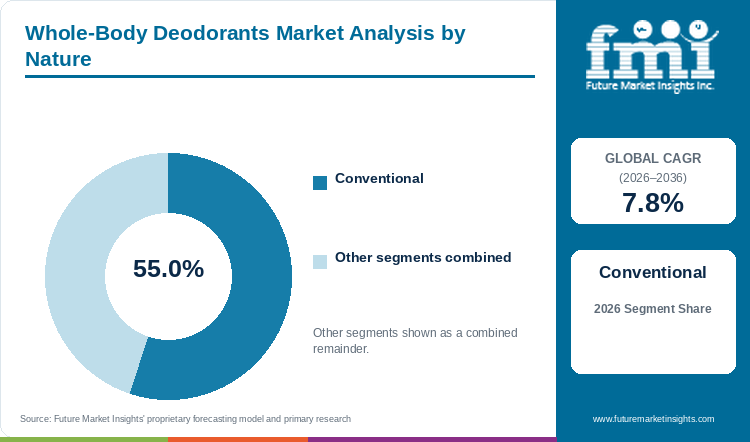
| Nature | Share (2026) |
|---|---|
| Conventional | 55.0% |
| Other segments combined | 45.0%* |
| Total | 100.0% |
| Metric | Value |
|---|---|
| Global CAGR (2026-2036) | 7.8% |
| Leading segment | Conventional |
Conventional describes how a product is positioned; it does not mean the ingredients are harsh. Buyers still need a formula that controls odor and suits the intended body site. Vegan & cruelty-free and Natural & organic offers appeal to additional consumer preferences, including those addressed in the wider organic personal care market. Dermocosmetic / clinical and Fragrance-free & sensitive lines address different reassurance needs. A product can share several attributes, so those claims should not be interpreted as separate purchases. Functional evidence remains relevant across all these positions.
- 2026 leading share: Conventional represents 55.0% of Nature revenue; it can serve consumers whose first requirement is effective daily odor care.
- Dated example: In February 2026, Unilever described pH and microbiome research behind its whole-body formulas. That work illustrates a performance-led route to product differentiation. [25]
Why do Core / classic lines anchor Product Type demand?
A general-purpose odor-control product gives consumers a simple starting point: learn where to apply it and whether it fits their routine. There is less to assess than with a complex treatment promise, which can support replenishment once the benefit is clear. Targeted treatment lines address narrower concerns. Sensitive & gentle lines prioritize tolerance while Premium & clinical lines require a stronger justification for differentiation. Kits & sets can introduce several products but should not turn unrelated bundle contents into deodorant revenue. A compact core range can cover routine use, with specialized lines added for specific needs.
- Core / classic lines account for 33.0% of Product Type revenue; the advantage is a simple entry proposition.
- Dated example: Unilever France’s October 2025 catalog lists ordinary Dove whole-body products in several formats. That illustrates a routine-care offer rather than an exclusively specialist treatment category. [5]
What are the drivers, restraints and opportunities in the whole-body deodorants market?
Odor care beyond the underarms creates another purchase occasion. Unclear application limits can discourage repeat use, while gentle products with supporting evidence can help retain cautious buyers.
- Driver: Products designed for additional body sites create a new personal-care buying occasion.
- Restraint: Misunderstood safety and wetness claims can undermine satisfaction after the first purchase.
- Opportunity: Evidence-backed gentle products can improve trust among cautious first-time buyers.
Consumers considering odor beyond the underarms need a product with a relevant application method rather than more fragrance alone. In April 2024, Procter & Gamble explained how its whole-body collections differed from deodorants tested only for underarm use. [2] The purchase starts with a practical question: does odor care for another body area justify a separate product? Retailers can organize that decision around the intended use instead of brand novelty. Incremental spending is conditional on a real perceived benefit. Merely moving an existing underarm product to another shelf does not create new demand.
Problems often emerge after the first trial, when buyers judge the product against a promise that is too broad. The American Academy of Dermatology’s May 2025 guidance distinguishes odor control from reducing perspiration and cautions against interpreting whole-body language literally. [3] A consumer expecting complete dryness may reject an effective deodorant for the wrong reason. Irritation can also discourage a second purchase. Brands therefore need visible application exclusions and claims matched to the specific formula. Retail assortment teams should not treat a general safety slogan as a substitute for product directions. The restraint limits conversion and retention rather than eliminating every use occasion.
Brands can reach cautious buyers by answering their questions about fragrance and sensitive application sites. White Plains Hospital’s June 2024 guidance warns that fragranced products may irritate delicate skin even when marketed as natural. [7] Fragrance-free formulas still need clear limits on where they can be used. Suppliers need tolerance evidence appropriate to their intended sites and packaging that makes those boundaries easy to understand. Brands with documented testing capabilities are positioned to pursue this route. Pharmacy and beauty-retail partners can support the proposition by communicating limitations without turning cosmetic odor control into a medical-treatment promise.
Which country CAGRs are profiled in the whole-body deodorants market?
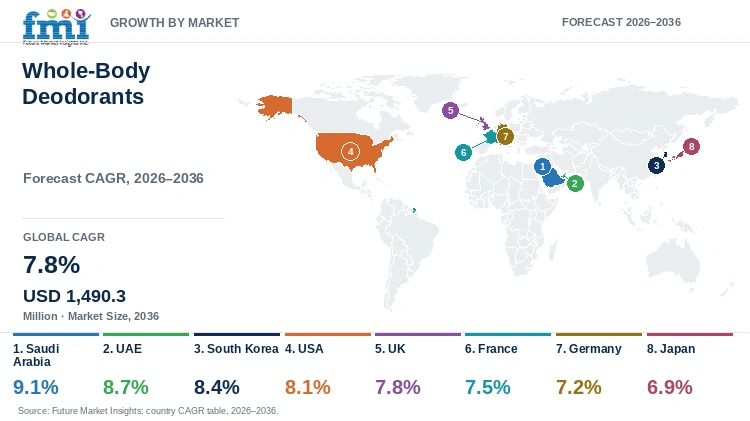
| Country | CAGR |
|---|---|
| Saudi Arabia | 9.1% |
| UAE | 8.7% |
| South Korea | 8.4% |
| USA | 8.1% |
| UK | 7.8% |
| France | 7.5% |
| Germany | 7.2% |
| Japan | 6.9% |
Country-wise Analysis
- A credible import and notification route is the first commercial test for a new whole-body line. Saudi Arabia’s forecast CAGR is 9.1% from 2026 to 2036. SFDA cosmetic-notification guidance requires products to be listed before importation or trading. [8] Suppliers therefore need a local responsible business arrangement before retailers can build a dependable assortment. Suppliers should align the product description with cosmetic odor control and maintain consistent information across packaging and the listing. The fastest profiled growth rate should not be mistaken for frictionless entry. Public notification guidance supports the market-access analysis but does not establish country-specific consumer adoption.
- The UAE is forecast to grow at an 8.7% CAGR from 2026 to 2036, with product registration requirements affecting how suppliers enter the market. Meydan Free Zone’s guide updated in August 2026 describes Dubai’s registration process for cosmetics and personal-care goods. [9] The Dubai example is relevant to UAE distribution planning but should not be presented as identical administration in every emirate. A whole-body supplier needs a distributor able to maintain the product file and respond to registration questions. Launching many fragrances at once can increase coordination work. Starting with a smaller range can make that work easier to manage.
- Beauty retail offers an explanatory setting for a category that consumers may not yet recognize as separate from body care. For South Korea, growth is forecast at 8.4% CAGR from 2026 to 2036. CJ Olive Young’s March 2025 announcement described multilingual assistance and expanded shopping-information services in selected stores. [10] This is evidence of retail capability rather than measured whole-body deodorant demand. Suppliers need to explain the product’s purpose and application clearly at the shelf. A cosmetic body cleanser or refreshing mist is not an interchangeable substitute in market sizing. Conversion still requires an odor-control benefit that merits a separate leave-on purchase.
- Mass-retail exposure gives consumers an opportunity to add whole-body odor care without changing where they shop. Degree announced nationwide Walmart availability in March 2025. [6] The USA outlook carries an 8.1% CAGR from 2026 to 2036. Scale of availability alone does not resolve the distinction between deodorizing and reducing perspiration. FDA guidance treats a deodorant that is also an antiperspirant as a cosmetic/drug combination. [23] Brands therefore need to separate the benefit promised by each product rather than extend underarm conventions indiscriminately. Retail buyers can compare application instructions and replenishment economics without assuming that every new format provides an identical benefit.
- Unilever’s February 2026 announcement connected Dove and Dove Men+Care whole-body entry with a defined retail rollout. [4] A 7.8% CAGR from 2026 to 2036 places the UK in line with the global forecast rate. The next step is helping shoppers use each applicator correctly. Retail activation can help shoppers identify why a cream or spray belongs in their routine. However, adding another fragrance does not itself answer questions about suitable body sites. Suppliers need product-level instructions that remain clear across retailer listings and packaging. The opportunity is a repeatable body-care habit rather than a temporary launch-led basket addition.
- Multi-format availability provides a practical base for local assortment planning. France is projected to grow at 7.5% CAGR from 2026 to 2036. Unilever’s October 2025 French product list includes Dove whole-body creams alongside spray and stick formats. [5] A catalog listing supports availability of an offer, not the number of consumers using it or a launch-date claim. Buyers can compare where each applicator fits before expanding the assortment. Suppliers should preserve the distinctions between format-specific directions instead of importing a single blanket promise from another country. Suppliers need to explain the deodorizing role of each format, even when the applicator already looks familiar.
- Drugstore access deserves attention even though Specialty beauty retail leads the global channel segmentation. In its December 2025 market review, IKW identifies drugstores as the main cosmetics-purchasing channel. [11] Germany’s whole-body deodorants CAGR is 7.2% from 2026 to 2036. This broader beauty evidence describes the shopping environment rather than the country’s whole-body channel shares. A dm product page also documents a Dove Men+Care whole-body spray offer. [24] Suppliers therefore have a concrete retail route to assess. Shelf clarity and straightforward comparisons with underarm-only products matter because an added deodorant must justify its separate role within an established personal-care shopping trip.
- An additional odor-control product must compete for attention with convenient sweat-care routines. Japan has a 6.9% CAGR over 2026 to 2036. In December 2025, Kao announced a Bioré Zero mist for a planned March 2026 Japanese rollout. [12] Its stated purpose was reducing sticky perspiration through a portable application format. That is adjacent-use evidence, not proof that the mist belongs in whole-body deodorant revenue. For entrants, the practical question is whether consumers can apply odor care discreetly and easily. Suppliers need a distinct deodorizing claim and convenient use rather than relying on freshness language shared with alternative body-care products.
Who are the notable companies in the whole-body deodorants market?
Unilever, Procter & Gamble, L'Oreal, Beiersdorf, Estee Lauder Companies, Kao Corporation, Shiseido, Coty, e.l.f. Beauty, Amorepacific are the notable companies profiled in this market.
The profiled companies have different roles in this category. Unilever and Procter & Gamble document multi-format products specifically intended for use beyond the underarms. [1, 2, 4] L'Oreal and Estee Lauder Companies have identifiable Vichy and Clinique deodorant offers. Beiersdorf documents deodorant development while Kao Corporation provides a relevant sweat-care comparison. [12, 13, 14, 15] Shiseido’s historical personal-care transfer also cautions against assigning legacy brands to a current portfolio without checking ownership. [16] e.l.f. Beauty and Amorepacific provide body-care context rather than a verified direct launch in the evidence reviewed. [17, 18] Documented multi-format whole-body portfolios: Unilever and Procter & Gamble compete through explicit application coverage and format choice. [1, 2, 4]
- Deodorant and sweat-care adjacencies: L'Oreal, Beiersdorf, Estee Lauder Companies and Kao Corporation have relevant neighboring capabilities; current whole-body applicability is not established by those sources alone. [12, 13, 14, 15]
- Broader beauty portfolios with unverified direct category participation: Shiseido, Coty, e.l.f. Beauty and Amorepacific remain in coverage without a presumed whole-body launch. [16, 17, 18]
Competitive Benchmarking: Whole-Body Deodorants Market
| Company | Multi-site use evidence | Format breadth | Application guidance | Geographic Reach |
|---|---|---|---|---|
| Unilever | High | High | High | USA and UK; product listings also document France and Germany. [4, 5, 21, 24, 25] |
| Procter & Gamble | High | High | High | USA whole-body launch and product guidance verified. [1, 2] |
| L'Oreal | Unscored | Unscored | Unscored | Whole-body geographic reach not verified. |
| Beiersdorf | Unscored | Unscored | Unscored | Whole-body geographic reach not verified. |
| Estee Lauder Companies | Unscored | Unscored | Unscored | Whole-body geographic reach not verified. |
| Kao Corporation | Unscored | Unscored | Unscored | Whole-body geographic reach not verified. |
| Shiseido | Unscored | Unscored | Unscored | Whole-body geographic reach not verified. |
| Coty | Unscored | Unscored | Unscored | Whole-body geographic reach not verified. |
| e.l.f. Beauty | Unscored | Unscored | Unscored | Whole-body geographic reach not verified. |
| Amorepacific | Unscored | Unscored | Unscored | Whole-body geographic reach not verified. |
Scoring basis: Multi-site use evidence is High for explicitly documented use on several external sites and Medium for one non-underarm site; Low requires a stated narrow limitation. Format breadth is High for at least three applicable formats and Medium for two; Low means one documented format. Application guidance is High when use boundaries and relevant testing are described and Medium when only use directions are available; Low requires documented restricted guidance. Ratings assess public documentation of the specific offer rather than comparative clinical superiority. Low denotes a documented limitation; unavailable or inapplicable public information is left Unscored. [1, 2, 4, 25]
Key Developments in the Whole-Body Deodorants Market
- In February 2024, Procter & Gamble launched Old Spice Total Body Deodorant with cream alongside stick and spray formats. The US launch made beyond-underarm odor care available through a familiar brand. Its commercial relevance was application choice rather than evidence that every consumer needed another deodorant product. [1]
- In March 2025, Unilever introduced Degree Whole Body Deodorant at Walmart nationwide through a campaign featuring JuJu Watkins. The launch combined an accessible price proposition with an existing mass-retail shopping route. This pairing addressed trial affordability and shelf access without demonstrating a market-wide change in consumer behavior. [6]
- In February 2026, Unilever announced Dove and Dove Men+Care whole-body entry in the UK with spray alongside stick and cream formats. Retail activation accompanied the rollout. The development extended local choice and created a need for clear format-specific instructions rather than simply adding another fragrance to the underarm shelf. [4]
Key Players in the Whole-Body Deodorants Market
Documented whole-body portfolio developers
- Unilever
- Procter & Gamble
Deodorant and sweat-care adjacent participants
- L'Oreal
- Beiersdorf
- Estee Lauder Companies
- Kao Corporation
Beauty portfolios requiring direct whole-body verification
- Shiseido
- Coty
- e.l.f. Beauty
- Amorepacific
Whole-Body Deodorants Market - Report Scope
| Coverage field | Report scope |
|---|---|
| Market breakdown | Product Type, Nature, Format, Price Positioning, Sales Channel |
| Quantitative Units | USD Million |
| Market Definition | Revenue from finished products expressly marketed for odor control beyond the underarms on permitted external body sites; only the qualifying deodorant component of Kits & sets is included. Underarm-only products, fragrance-only substitutes, body cleansers, ingredients, downstream non-deodorant finished goods and service revenue are excluded. |
| Regions Covered | North America, Latin America, Western Europe, Eastern Europe, East Asia, South Asia and Pacific, Middle East and Africa |
| Countries Covered | USA, Germany, France, UK, Saudi Arabia, UAE, Japan, South Korea |
| Key Companies Profiled | Unilever, Procter & Gamble, L'Oreal, Beiersdorf, Estee Lauder Companies, Kao Corporation, Shiseido, Coty, e.l.f. Beauty, Amorepacific |
| Forecast Period | 2026 to 2036 |
| Approach | Primary and secondary research with market triangulation. |
Whole-Body Deodorants Market - Research Methodology
| Method | Approach |
|---|---|
| Primary Research | FMI analysts gathered input from manufacturers, service providers, technology developers, distributors, end users, procurement teams and subject-matter experts. Interviews examined purchasing decisions, product or service evaluation, adoption barriers, approval requirements, pricing considerations and expectations for technical or commercial support. Respondents were also asked what evidence is required before a trial, pilot, or initial order develops into regular purchasing. |
| Desk Research | Desk research covered government statistics, regulatory publications, trade data, industry associations, technical literature, standards, company filings, product information and official corporate announcements. Sources were reviewed for relevance, publication date, geographic coverage and consistency with the defined market scope. Claims relating to performance, applications, approvals, capacity, investment and commercial activity were retained only when supported by credible public evidence. |
| Market Sizing and Forecasting | The market model combined the baseline value with historical performance, segment structure, pricing and volume indicators, adoption levels, company participation and country-level demand conditions. Forecast assumptions considered economic activity, investment trends, regulatory developments, technology adoption, purchasing cycles, supply availability and barriers to wider market use. Segment and regional estimates were reconciled before the final market total was calculated. |
| Data Validation | Estimates were checked against multiple independent indicators, including public data, company activity, trade patterns, industry developments and findings from primary interviews. Validation also tested whether products, services, applications and company revenues fell within the defined market boundaries. Adjacent categories, unsupported claims, overlapping revenues and activities without direct market relevance were excluded to reduce double counting and maintain consistency across segments and countries. |
Whole-Body Deodorants Market by Segments
Whole-Body Deodorants Market segmented by Product Type:
- Core / classic lines
- Targeted treatment lines
- Sensitive & gentle lines
- Premium & clinical lines
- Kits & sets
Whole-Body Deodorants Market segmented by Nature:
- Conventional
- Vegan & cruelty-free
- Natural & organic
- Dermocosmetic / clinical
- Fragrance-free & sensitive
Whole-Body Deodorants Market segmented by Format:
- Cream & balm
- Liquid & serum
- Stick & solid
- Spray & mist
- Sheet & patch
- Powder
Whole-Body Deodorants Market segmented by Price Positioning:
- Mass
- Masstige
- Premium
- Professional
Whole-Body Deodorants Market segmented by Sales Channel:
- Specialty beauty retail
- E-commerce & DTC
- Pharmacies & drugstores
- Supermarkets & hypermarkets
- Salons & spas
Research Sources and Bibliography
- [1] Procter & Gamble / Old Spice (2024, February 1). Introducing Old Spice Total Body Deodorant for 24/7 Freshness from Pits to Toes and Down Below.
- [2] Procter & Gamble (2024, April 11). P&G Myth-Busters Series: Body Odor happens but you don’t have to smell.
- [3] American Academy of Dermatology (2025, May 16). Should I use whole-body deodorant?.
- [4] Unilever (2026, February 17). Dove enters whole body market as Unilever expands deodorant portfolio.
- [5] Unilever France (2025, October). Liste produits MAJ Octobre 2025 [Product list; French].
- [6] Unilever / Degree (2025, March 3). USC Basketball Star, JuJu Watkins, Joins Degree to Introduce Breakthrough Whole Body Deodorant Line - NEW at Walmart.
- [7] Adams, L. E. / White Plains Hospital (2024, June 4). Whole-Body Deodorant: What to Know.
- [8] Saudi Food and Drug Authority (n.d.). Guidance and Requirements of Cosmetic product Notification, Volume No. 2.
- [9] Meydan Free Zone (2026, August 4; updated). Get Dubai Municipality Product Approval Hassle-Free in Dubai, UAE.
- [10] CJ Olive Young (2025, March 18). Olive Young Adds Shopping Convenience Services for Global Shoppers.
- [11] German Cosmetic, Toiletry, Perfumery and Detergent Association (IKW) (2025, December 3). Renewed Growth for the Beauty and Home Care Industry.
- [12] Kao Corporation (2025, December 10). Bioré Zero introduces a mist for quickly relieving sticky perspiration away from home [English translation of Japanese release title].
- L'Oreal / Vichy (n.d.). Deodorants and antiperspirants: product range.
- [14] Beiersdorf (2026). Research and Development: Annual Report 2025.
- Estee Lauder Companies / Clinique (n.d.). Antiperspirant-Deodorant Roll-On.
- [16] Shiseido (2021, February 3). Commitment to further growth.
- e.l.f. Beauty (2023, August 29). e.l.f. Beauty Announces Definitive Agreement to Acquire Naturium.
- [18] Amorepacific (n.d.). HAPPY BATH.
- [19] Unilever / Dove Men+Care (2025, January 6). Dove Men+Care Teams Up with Marshawn Lynch to Release New Scents for their Whole Body Deodorant Range.
- [20] Unilever (2025, March 11). SXSW: AI, machine learning and data behind Unilever’s latest launches.
- [21] Unilever (2024, April 4). Dove Men+Care’s new whole-body deodorant taps into fast-growing trend.
- [22] Procter & Gamble (2026, June 1). P&G Brands Top Circana’s 2025 New Product Pacesetters List.
- [23] U.S. Food and Drug Administration (2024, September 11). Is It a Cosmetic, a Drug, or Both? (Or Is It Soap?).
- [24] dm-drogerie markt (n.d.). Dove MEN+CARE Deospray Whole Bodydeo, 150 ml.
- [25] Unilever (2026, February 6). Sweating the science: how innovation is boosting Unilever’s deodorants business.
This bibliography is provided for reader reference and is not exhaustive. The full report contains the complete reference list and detailed citations.
This Report Answers
- How large is the whole-body deodorants market in 2026 and what value is forecast for 2036?
- Which changes in body-odor care create an additional purchase rather than simple underarm-product substitution?
- Why do Core / classic lines lead the Product Type segmentation?
- What supports Conventional positioning within the Nature segmentation?
- How do forecast growth rates differ across the eight profiled countries?
- Which profiled companies document direct whole-body products and which provide only adjacent capabilities?
- What application and performance uncertainties limit trial conversion or supplier switching?
- What should consumers and retail buyers evaluate before adding a whole-body deodorant to a routine or assortment?
Frequently Asked Questions
How big is the whole-body deodorants market in 2026 and what is forecast for 2036?
The market is valued at USD 703.2 Million in 2026 and is forecast to reach USD 1,490.3 Million by 2036. The boundary covers qualifying whole-body deodorant products rather than all deodorants or all body-care revenue.
What is the whole-body deodorants market CAGR from 2026 to 2036?
The forecast CAGR is 7.8% from 2026 to 2036. Realizing that trajectory requires successful repeat purchase after consumers try a new application occasion.
Which Product Type segment leads the whole-body deodorants market?
Core / classic lines lead with 33.0% of Product Type revenue in 2026. Their commercial advantage is a straightforward odor-control proposition rather than a specialist treatment requirement.
Which Nature segment leads the whole-body deodorants market?
Conventional leads with 55.0% of Nature revenue in 2026. It addresses performance-led purchasing without requiring the consumer to prioritize a separate ingredient or ethical positioning.
Which profiled countries have the highest whole-body deodorants growth rates?
Saudi Arabia has the highest forecast CAGR at 9.1% from 2026 to 2036 and UAE follows at 8.7%. Faster growth does not establish which country has the larger absolute market.
Which companies are active in the whole-body deodorants market?
Unilever and Procter & Gamble have directly documented whole-body portfolios. [1, 2, 4] Other profiled companies are L'Oreal, Beiersdorf, Estee Lauder Companies, Kao Corporation, Shiseido, Coty, e.l.f. Beauty and Amorepacific; their adjacent capabilities or unverified direct participation should not be confused with established whole-body product availability. [12, 13, 14, 15, 16, 17, 18]
Preview the report firsthand - request a free sample
Get SampleGet the brochure for pricing and purchase details.
Get PDFTable of Content
- Key Takeaways
- Market Size and CAGR
- Top Growth Driver
- Fastest Growing Segment
- Leading Region
- Key Companies
- Emerging Opportunities
- Executive Summary
- Global Market Outlook
- Demand-side Trends
- Supply-side Trends
- Technology Roadmap Analysis
- Analysis and Recommendations
- Analyst Perspective (What is happening? Why now? What should investors know?)
- Key Questions Answered
- How large is the market?
- What is the CAGR?
- What are key trends?
- Which region dominates?
- Who are the leaders?
- Market Overview
- Market Coverage / Taxonomy
- Market Definition / Scope / Limitations
- Research Methodology
- Chapter Orientation
- Analytical Lens and Working Hypotheses
- Market Structure, Signals, and Trend Drivers
- Benchmarking and Cross-market Comparability
- Market Sizing, Forecasting, and Opportunity Mapping
- Research Design and Evidence Framework
- Desk Research Programme (Secondary Evidence)
- Expert Input and Fieldwork (Primary Evidence)
- Tooling, Models, and Reference Databases
- Data Engineering and Model Build
- Quality Assurance and Audit Trail
- Market Background
- Market Dynamics (Drivers, Restraints, Opportunity, Trends)
- Scenario Forecast (Optimistic, Likely, Conservative)
- Impact Analysis
- AI Impact
- Sustainability Impact
- Regulatory Impact
- Technology Impact
- Consumer / Buyer Analysis
- Purchase Drivers
- Adoption Barriers
- Buyer Journey
- Opportunity Map Analysis
- Product Life Cycle Analysis
- Supply Chain Analysis
- Investment Feasibility Matrix
- Value Chain Analysis
- PESTLE and Porter's Analysis
- Regulatory Landscape
- Regional Parent Market Outlook
- Production and Consumption Statistics
- Import and Export Statistics
- Global Market Analysis and Forecast, 2021 to 2036
- Historical Market Size Value (USD Million) Analysis, 2021 to 2025
- Current and Future Market Size Value (USD Million) Projections, 2026 to 2036
- Y-o-Y Growth Trend Analysis
- Absolute $ Opportunity Analysis
- Global Market Pricing Analysis, 2021 to 2036
- Global Market Analysis and Forecast, By Product Type, 2021 to 2036
- Introduction / Key Findings
- Historical Market Size Value (USD Million) Analysis By Product Type, 2021 to 2025
- Current and Future Market Size Value (USD Million) Analysis and Forecast By Product Type, 2026 to 2036
- Core / classic lines
- Targeted treatment lines
- Sensitive & gentle lines
- Premium & clinical lines
- Kits & sets
- Y-o-Y Growth Trend Analysis By Product Type, 2021 to 2025
- Absolute $ Opportunity Analysis By Product Type, 2026 to 2036
- Global Market Analysis and Forecast, By Nature, 2021 to 2036
- Introduction / Key Findings
- Historical Market Size Value (USD Million) Analysis By Nature, 2021 to 2025
- Current and Future Market Size Value (USD Million) Analysis and Forecast By Nature, 2026 to 2036
- Conventional
- Vegan & cruelty-free
- Natural & organic
- Dermocosmetic / clinical
- Fragrance-free & sensitive
- Y-o-Y Growth Trend Analysis By Nature, 2021 to 2025
- Absolute $ Opportunity Analysis By Nature, 2026 to 2036
- Global Market Analysis and Forecast, By Format, 2021 to 2036
- Introduction / Key Findings
- Historical Market Size Value (USD Million) Analysis By Format, 2021 to 2025
- Current and Future Market Size Value (USD Million) Analysis and Forecast By Format, 2026 to 2036
- Cream & balm
- Liquid & serum
- Stick & solid
- Spray & mist
- Sheet & patch
- Powder
- Y-o-Y Growth Trend Analysis By Format, 2021 to 2025
- Absolute $ Opportunity Analysis By Format, 2026 to 2036
- Global Market Analysis and Forecast, By Price Positioning, 2021 to 2036
- Introduction / Key Findings
- Historical Market Size Value (USD Million) Analysis By Price Positioning, 2021 to 2025
- Current and Future Market Size Value (USD Million) Analysis and Forecast By Price Positioning, 2026 to 2036
- Mass
- Masstige
- Premium
- Professional
- Y-o-Y Growth Trend Analysis By Price Positioning, 2021 to 2025
- Absolute $ Opportunity Analysis By Price Positioning, 2026 to 2036
- Global Market Analysis and Forecast, By Sales Channel, 2021 to 2036
- Introduction / Key Findings
- Historical Market Size Value (USD Million) Analysis By Sales Channel, 2021 to 2025
- Current and Future Market Size Value (USD Million) Analysis and Forecast By Sales Channel, 2026 to 2036
- Specialty beauty retail
- E-commerce & DTC
- Pharmacies & drugstores
- Supermarkets & hypermarkets
- Salons & spas
- Y-o-Y Growth Trend Analysis By Sales Channel, 2021 to 2025
- Absolute $ Opportunity Analysis By Sales Channel, 2026 to 2036
- Global Market Analysis and Forecast, By Region, 2021 to 2036
- Introduction
- Historical Market Size Value (USD Million) Analysis By Region, 2021 to 2025
- Current Market Size Value (USD Million) Analysis and Forecast By Region, 2026 to 2036
- North America
- Latin America
- Western Europe
- Eastern Europe
- East Asia
- South Asia and Pacific
- Middle East and Africa
- Market Attractiveness Analysis By Region
- North America Market Analysis and Forecast, By Country, 2021 to 2036
- Historical Market Size Value (USD Million) Trend Analysis By Market Taxonomy, 2021 to 2025
- Market Size Value (USD Million) Forecast By Market Taxonomy, 2026 to 2036
- By Country
- United States
- Canada
- By Product Type
- By Nature
- By Format
- By Price Positioning
- By Sales Channel
- By Country
- Market Attractiveness Analysis
- By Country
- By Product Type
- By Nature
- By Format
- By Price Positioning
- By Sales Channel
- Key Takeaways
- Latin America Market Analysis and Forecast, By Country
- Historical Market Size Value (USD Million) Trend Analysis By Market Taxonomy, 2021 to 2025
- Market Size Value (USD Million) Forecast By Market Taxonomy, 2026 to 2036
- By Country
- Brazil
- Mexico
- Argentina
- Chile
- By Product Type
- By Nature
- By Format
- By Price Positioning
- By Sales Channel
- By Country
- Market Attractiveness Analysis
- By Country
- By Product Type
- By Nature
- By Format
- By Price Positioning
- By Sales Channel
- Key Takeaways
- Western Europe Market Analysis and Forecast, By Country
- Historical Market Size Value (USD Million) Trend Analysis By Market Taxonomy, 2021 to 2025
- Market Size Value (USD Million) Forecast By Market Taxonomy, 2026 to 2036
- By Country
- Germany
- France
- United Kingdom
- Italy
- Spain
- Benelux
- Nordics
- By Product Type
- By Nature
- By Format
- By Price Positioning
- By Sales Channel
- By Country
- Market Attractiveness Analysis
- By Country
- By Product Type
- By Nature
- By Format
- By Price Positioning
- By Sales Channel
- Key Takeaways
- Eastern Europe Market Analysis and Forecast, By Country
- Historical Market Size Value (USD Million) Trend Analysis By Market Taxonomy, 2021 to 2025
- Market Size Value (USD Million) Forecast By Market Taxonomy, 2026 to 2036
- By Country
- Poland
- Czech Republic
- Romania
- Hungary
- By Product Type
- By Nature
- By Format
- By Price Positioning
- By Sales Channel
- By Country
- Market Attractiveness Analysis
- By Country
- By Product Type
- By Nature
- By Format
- By Price Positioning
- By Sales Channel
- Key Takeaways
- East Asia Market Analysis and Forecast, By Country
- Historical Market Size Value (USD Million) Trend Analysis By Market Taxonomy, 2021 to 2025
- Market Size Value (USD Million) Forecast By Market Taxonomy, 2026 to 2036
- By Country
- China
- Japan
- South Korea
- By Product Type
- By Nature
- By Format
- By Price Positioning
- By Sales Channel
- By Country
- Market Attractiveness Analysis
- By Country
- By Product Type
- By Nature
- By Format
- By Price Positioning
- By Sales Channel
- Key Takeaways
- South Asia and Pacific Market Analysis and Forecast, By Country
- Historical Market Size Value (USD Million) Trend Analysis By Market Taxonomy, 2021 to 2025
- Market Size Value (USD Million) Forecast By Market Taxonomy, 2026 to 2036
- By Country
- India
- ASEAN
- Australia and New Zealand
- By Product Type
- By Nature
- By Format
- By Price Positioning
- By Sales Channel
- By Country
- Market Attractiveness Analysis
- By Country
- By Product Type
- By Nature
- By Format
- By Price Positioning
- By Sales Channel
- Key Takeaways
- Middle East and Africa Market Analysis and Forecast, By Country
- Historical Market Size Value (USD Million) Trend Analysis By Market Taxonomy, 2021 to 2025
- Market Size Value (USD Million) Forecast By Market Taxonomy, 2026 to 2036
- By Country
- GCC Countries
- South Africa
- Türkiye
- Israel
- By Product Type
- By Nature
- By Format
- By Price Positioning
- By Sales Channel
- By Country
- Market Attractiveness Analysis
- By Country
- By Product Type
- By Nature
- By Format
- By Price Positioning
- By Sales Channel
- Key Takeaways
- Key Countries Market Analysis
- United States
- Pricing Analysis
- Market Share Analysis, 2025
- By Product Type
- By Nature
- By Format
- By Price Positioning
- By Sales Channel
- Canada
- Pricing Analysis
- Market Share Analysis, 2025
- By Product Type
- By Nature
- By Format
- By Price Positioning
- By Sales Channel
- Mexico
- Pricing Analysis
- Market Share Analysis, 2025
- By Product Type
- By Nature
- By Format
- By Price Positioning
- By Sales Channel
- Brazil
- Pricing Analysis
- Market Share Analysis, 2025
- By Product Type
- By Nature
- By Format
- By Price Positioning
- By Sales Channel
- Chile
- Pricing Analysis
- Market Share Analysis, 2025
- By Product Type
- By Nature
- By Format
- By Price Positioning
- By Sales Channel
- Germany
- Pricing Analysis
- Market Share Analysis, 2025
- By Product Type
- By Nature
- By Format
- By Price Positioning
- By Sales Channel
- United Kingdom
- Pricing Analysis
- Market Share Analysis, 2025
- By Product Type
- By Nature
- By Format
- By Price Positioning
- By Sales Channel
- Italy
- Pricing Analysis
- Market Share Analysis, 2025
- By Product Type
- By Nature
- By Format
- By Price Positioning
- By Sales Channel
- Spain
- Pricing Analysis
- Market Share Analysis, 2025
- By Product Type
- By Nature
- By Format
- By Price Positioning
- By Sales Channel
- France
- Pricing Analysis
- Market Share Analysis, 2025
- By Product Type
- By Nature
- By Format
- By Price Positioning
- By Sales Channel
- India
- Pricing Analysis
- Market Share Analysis, 2025
- By Product Type
- By Nature
- By Format
- By Price Positioning
- By Sales Channel
- ASEAN
- Pricing Analysis
- Market Share Analysis, 2025
- By Product Type
- By Nature
- By Format
- By Price Positioning
- By Sales Channel
- Australia and New Zealand
- Pricing Analysis
- Market Share Analysis, 2025
- By Product Type
- By Nature
- By Format
- By Price Positioning
- By Sales Channel
- China
- Pricing Analysis
- Market Share Analysis, 2025
- By Product Type
- By Nature
- By Format
- By Price Positioning
- By Sales Channel
- Japan
- Pricing Analysis
- Market Share Analysis, 2025
- By Product Type
- By Nature
- By Format
- By Price Positioning
- By Sales Channel
- South Korea
- Pricing Analysis
- Market Share Analysis, 2025
- By Product Type
- By Nature
- By Format
- By Price Positioning
- By Sales Channel
- Poland
- Pricing Analysis
- Market Share Analysis, 2025
- By Product Type
- By Nature
- By Format
- By Price Positioning
- By Sales Channel
- Hungary
- Pricing Analysis
- Market Share Analysis, 2025
- By Product Type
- By Nature
- By Format
- By Price Positioning
- By Sales Channel
- Türkiye
- Pricing Analysis
- Market Share Analysis, 2025
- By Product Type
- By Nature
- By Format
- By Price Positioning
- By Sales Channel
- South Africa
- Pricing Analysis
- Market Share Analysis, 2025
- By Product Type
- By Nature
- By Format
- By Price Positioning
- By Sales Channel
- Saudi Arabia
- Pricing Analysis
- Market Share Analysis, 2025
- By Product Type
- By Nature
- By Format
- By Price Positioning
- By Sales Channel
- UAE
- Pricing Analysis
- Market Share Analysis, 2025
- By Product Type
- By Nature
- By Format
- By Price Positioning
- By Sales Channel
- United States
- Market Structure Analysis
- Competition Dashboard
- Competition Benchmarking
- Market Share Analysis of Top Players
- By Regional
- By Product Type
- By Nature
- By Format
- By Price Positioning
- By Sales Channel
- Emerging Startups
- Innovation Benchmarking
- Competition Analysis
- Competition Deep Dive
- Unilever
- Overview
- Product Portfolio
- Profitability by Market Segments
- Sales Footprint
- Strategy Overview
- Marketing Strategy
- Product Strategy
- Channel Strategy
- Procter & Gamble
- L'Oreal
- Beiersdorf
- Estee Lauder Companies
- Kao Corporation
- Shiseido
- Coty
- e.l.f. Beauty
- Amorepacific
- Unilever
- Case Studies
- Success Stories
- Recent Developments
- Competition Deep Dive
- Assumptions & Acronyms Used


