

- Market Size (2026)
- USD 202.6 Mn
- Forecast (2036)
- USD 308.7 Mn
- CAGR (2026 to 2036)
- 4.3%
How big is GCC Hammam Bath Products Market in 2026?
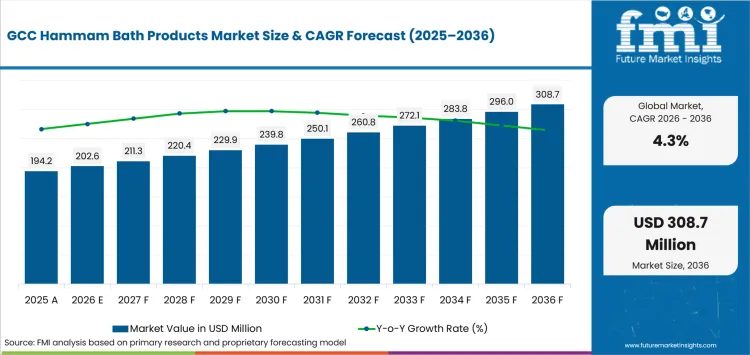
USD 202.6 million in 2026 and USD 308.7 million by 2036 at a 4.3% CAGR.
Demand for GCC hammam bath products is projected to rise from USD 202.6 million in 2026 to USD 308.7 million by 2036 at a 4.3% CAGR. Hotel and wellness exposure gives consumers a place to learn cleansing and exfoliation before buying a home routine. Saudi Vision 2030's 2025 annual report recorded more than 596.9 thousand licensed tourism rooms in 2025 compared with more than 280.8 thousand in 2023. The larger licensed room base expands product trial points without counting accommodation revenue as bath-product sales.
Digital retail supports repeat purchase after hospitality or specialty-store discovery across GCC markets. A mature replenishment route lowers the cost of reordering a known scrub or cleanser after physical trial, while local cosmetic safety obligations still govern claims, artwork and product availability.
Key Takeaways
- Hospitality discovery expands demand only when a cleanser or scrub becomes part of a repeatable home sequence.
- Core - classic lines is set to lead product type with 36.0% share in 2026 due to a familiar cleansing and exfoliation sequence.
- The conventional segment is likely to capture 53.0% share in 2026 attributable to broad formulation choices that fit mass and premium price points.
- Liquid & serum is projected to hold 28.0% share in 2026 owing to dosing formats that fit shower use and treatment-led body care.
- Registration and claims controls delay imported launches when artwork or product dossiers do not fit the local sale route.
- Some of the key players in this market include Rituals, L'Occitane Group, Lush, Unilever, Procter & Gamble, L'Oreal, Beiersdorf, Kao Corporation, Estee Lauder Companies, and Coty.
Analyst Perspective
"Hammam ranges earn repeat revenue when shoppers can recreate the cleansing and exfoliation order without store guidance. The same registered range earns more commercial value through simple replenishment without losing the ritual cues that justified the first purchase."
- Rahul Pandita, Principal Consultant, Future Market Insights
How is the GCC hammam bath products market segmented?
The market is segmented by Product Type, Nature, Format, Price Positioning, Sales Channel and Region.
The GCC hammam bath products market is segmented by product type, nature, format, price positioning, sales channel and region. Product type covers core - classic lines, targeted treatment lines, sensitive & gentle lines, premium & clinical lines and kits & sets. Nature covers conventional, vegan & cruelty-free, natural & organic, dermocosmetic - clinical and fragrance-free & sensitive. Format includes liquid & serum, cream & balm, stick & solid, spray & mist, sheet & patch and powder. Price positioning covers mass, masstige, premium and professional. Sales channels include e-commerce & DTC, specialty beauty retail, pharmacies & drugstores, supermarkets & hypermarkets and salons & spas.
How do liquid & serum formats lead the format category?
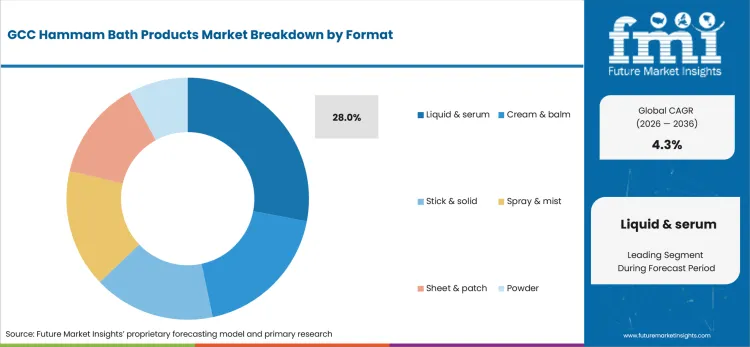
Liquid & serum formats fit shower behaviour and allow controlled dosing for cleansers or treatment-led body care. Unilever's 2025 annual report records Dove Serum Shower Collection expansion into India at the end of 2025 after its 2024 North American launch. The expansion places treatment-style ingredients inside a liquid cleansing format rather than a separate post-bath step.
- In 2026, liquid & serum is expected to lead format with 28.0% share because shower-ready dosing also supports active-benefit positioning.
- Creams and balms suit post-bath conditioning. Stick-based body lotions offer portable moisturisation for targeted use.
What makes core - classic lines central to the product type category?
Core - classic lines give shoppers a complete ritual before they decide whether a treatment-led variant is necessary. L'Occitane Group marked its 50th anniversary in January 2026 with more than 3 thousand boutiques and 2.5 thousand partner hotels worldwide. Premium cosmetics can scale in similar discovery settings once the cleansing and exfoliation order is easy to recognise.
- Based on product type, core - classic lines is projected to account for 36.0% in 2026 due to a recognisable cleansing and exfoliation sequence.
- Specialty stores and hotel boutiques can introduce adjacent body scrubs after the cleansing step has been explained.
Why does conventional lead the nature category?
Conventional formulations give brand teams more room to balance fragrance and texture at several price points. Beiersdorf launched NIVEA Creme Natural Touch in Germany in January 2026 with a vegan formula and 99% natural-origin ingredients while keeping the classic NIVEA Creme available. The side-by-side launch preserves a familiar option and gives ingredient-led shoppers a separate choice. Adjacent natural cosmetics ranges increase that choice without displacing the conventional base.
- By nature, conventional is estimated to hold 53.0% in 2026 owing to formulation flexibility that serves frequent-use and gifting occasions.
- Vegan cosmetics address defined ingredient preferences but the same products must still meet sensory and repeat-use expectations.
What supports mass in the price positioning category?
Mass pricing fits cleansers and shower products that are replenished frequently enough for trial cost to influence selection. Coty launched five adidas Vibes Hair & Body Mists in June 2025 for drugstore and mass-retail cosmetics aisles. The release gives mass retailers a lower-entry body format beside higher-priced fragrance.
- Mass is set to lead the price positioning category with 34.0% share in 2026 due to broad access and a lower barrier to routine repurchase.
- Fragrance products can raise basket value in mass channels if scent cues remain clear enough to justify an adjacent body purchase.
What drives e-commerce & DTC in the sales channel category?
Digital channels become more useful after shoppers already know a scent or product sequence. Estee Lauder Companies and Jo Malone London launched Scent Scanner on Pinterest in June 2026 for personalised fragrance discovery in the United States and France. The tool turns saved visual preferences into fragrance recommendations that link discovery with a purchase page.
- E-commerce & DTC is likely to capture 30.0% share in 2026, aided by repeat ordering and bundle presentation without fixed shelf-space limits.
- Beauty and personal care products with clear product information can keep sensitive variants available after specialty-store trial without duplicating every SKU in each shop.
What are the drivers, restraints and opportunities in the GCC Hammam Bath Products Market?
Hospitality discovery expands trial, cosmetics compliance delays some launches and modular home routines open a route to higher basket value.
- Driver: Hotels and wellness venues give consumers a controlled setting to try scented cleansers and exfoliants before a home purchase.
- Restraint: Registration and claims controls add documentation work before imported products can reach local shelves.
- Opportunity: Step-based home routines can extend a classic hammam purchase into treatment and sensitive-skin products.
Hospitality trial widens product discovery
Hotel and wellness visits let consumers test scent or texture before choosing a home routine. Qatar Tourism recorded about 42,500 hotel room keys at year-end 2025 with average occupancy of 71.3%. Qatar's hotel base gives scrubs and cleansers more trial points. Hotel spas can also introduce healing skin care products after bathing without turning the visit into a clinical sale. Repeat revenue still depends on a retail or digital channel that carries the same product after the stay.
Compliance work can delay regional assortment rollout
Cosmetic assortments cannot be moved between GCC countries without checking the local sale requirements. Saudi Arabia's SFDA adopted updated Gulf safety and claims regulations for cosmetics on June 24 2025. The revised rules require local and imported companies to meet the updated requirements before products circulate in the Saudi market. Late artwork or claims changes can delay launch and force separate inventory.
Modular routines extend the classic set
A step-based home offer can start with cleansing and exfoliation then add targeted body care once the sequence is understood. Rituals announced a 1,500-boutique renewal in July 2026 with click & collect plus endless aisle and ship-from-store services. The program ties guided store discovery to digital replenishment without changing the product boundary. Hammam brands can use the same channel logic if local assortments are registered before launch.
Which country CAGRs are profiled in the GCC Hammam Bath Products Market?
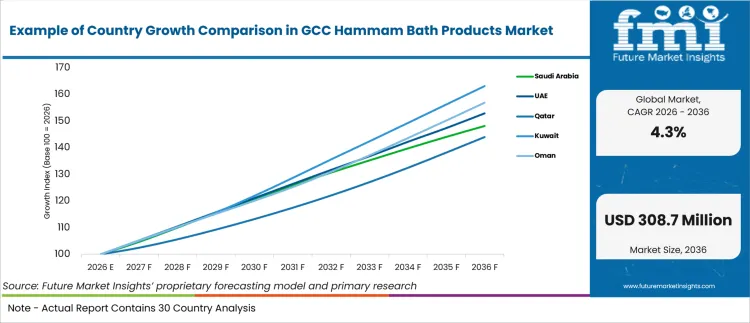
| Country | CAGR |
|---|---|
| Kuwait | 5.0% |
| UAE | 4.3% |
| Saudi Arabia | 4.0% |
| Qatar | 3.7% |
How do country-level CAGRs compare in the GCC Hammam Bath Products Market?
The 1.3 percentage-point range between Kuwait and Qatar is narrow enough for execution to outweigh rank. Kuwait forms the upper end while the UAE aligns with the overall 4.3% CAGR. Saudi Arabia and Qatar sit lower because their addressable channels differ in scale and concentration. The table measures forecast pace rather than current market size.
- Kuwait needs disciplined distributor coverage in a concentrated consumer base.
- UAE destination retail concentrates premium gifting and product trial in physical stores.
- Saudi Arabia offers a broader resident base for frequent-use body care.
- Qatar's lower rate raises the importance of repeat ordering over store expansion.
Similar CAGRs can therefore produce different entry economics. The report provides country-level CAGR analysis for GCC markets covered in the assessment.
Country-wise Analysis
- Kuwait is using a national tourism platform to bring travel planning and partner offers into one digital gateway. GCC hammam bath products demand in Kuwait is forecast to rise at 5.0% CAGR over the forecast period because visitor-facing services can concentrate product discovery. Kuwait Government Online stated in September 2025 that Visit Kuwait would include e-visas and an interactive destination map plus partner offers. The platform gives hotel-linked bath ranges and travel gifts a clearer discovery channel while a concentrated consumer base limits the economics of wide store networks. Brands entering Kuwait need a distributor that can support curated retail placement and digital replenishment without carrying an oversized local assortment.
- Destination beauty retail in the UAE pairs physical discovery with regional e-commerce fulfilment. The UAE's GCC hammam bath products outlook is anticipated to advance at 4.3% CAGR over the assessment period owing to high visitor exposure and mature digital retail. Dubai's Law No. 5 of 2025 requires consumer products to be registered before placement along the product chain and restricts unapproved health claims. High visitor turnover supports gifting and premium trial but frequent assortment changes increase registration work for importers. A stable cosmetics and personal care range with a local stock partner improves launch economics by keeping compliant products aligned with digital and specialty retail.
- Saudi Arabia's licensed hospitality base is expanding quickly and gives hotels more settings for controlled product trial. GASTAT recorded 5,622 licensed tourism hospitality facilities in Q3 2025 at 40.6% above the same quarter of 2024. The Saudi GCC hammam bath products sector is projected to record 4.0% CAGR during the assessment period as more trial points feed pharmacy and digital replenishment. SFDA safety and claims requirements still limit direct reuse of regional artwork. Saudi-ready claims files let brands convert hotel discovery into repeat retail purchases and give hospitality a larger role than in markets built mainly on specialty beauty.
- Bath and body discovery in Qatar is concentrated in hotels and modern retail serving a small resident base. Qatar News Agency reported in August 2025 that first-half international visitors exceeded 2.6 million and hotel occupancy reached 71%. GCC hammam bath products demand in Qatar is predicted to advance at 3.7% CAGR through 2036 driven by visitor traffic that supports spa and gifting occasions. The smaller resident pool makes wide SKU duplication expensive despite concentrated product trial. Compact gift sets and digital ordering extend availability beyond hotel or specialty-store discovery for imported brands without requiring a large standalone store network.
Who are the notable companies in the GCC Hammam Bath Products Market?
Rituals, L'Occitane Group, Lush, Unilever, Procter & Gamble, L'Oreal, Beiersdorf, Kao Corporation, Estee Lauder Companies, and Coty are the notable companies profiled in this market.
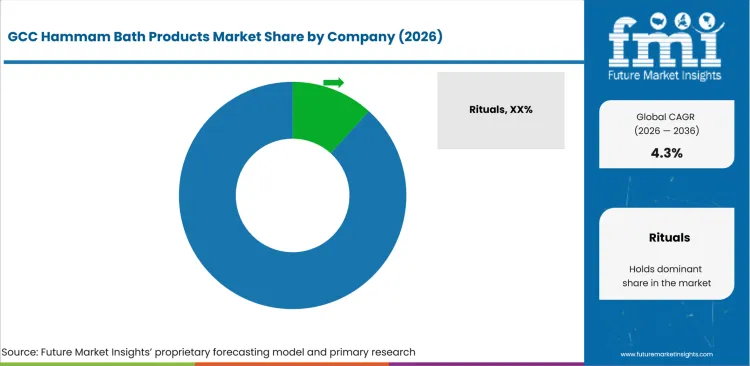
Company advantage depends on how clearly the bath sequence is explained and whether the same item stays available for repeat purchase. Ritual specialists rely on specialty discovery. Scaled groups use frequent-use cleansing while prestige groups use fragrance or treatment depth to raise gifting value.
- Ritual-led bath and body specialists: Rituals and L'Occitane Group use specialty retail and hospitality touchpoints to explain multi-step routines. Lush uses bath-led product breadth and specialty stores for discovery.
- Scaled personal-care platforms: Unilever and Procter & Gamble serve frequent cleansing through mass and digital channels. L'Oreal and Beiersdorf bring deeper skin-care and treatment portfolios.
- Prestige fragrance and selective body-care groups: Kao Corporation and Estee Lauder Companies compete through selective beauty. Coty extends fragrance into lower-entry body formats.
Competitive Benchmarking: GCC Hammam Bath Products Market
| Company | Ritual or Body-Care Breadth | Treatment & Sensitive-Skin Depth | Retail and Digital Reach | Geographic Reach |
|---|---|---|---|---|
| Rituals | High | Medium | High | Europe, Middle East, Asia and North America |
| L'Occitane Group | High | Medium | High | More than 90 countries |
| Lush | High | Medium | High | Global specialty retail with active Middle East presence |
| Unilever | High | High | High | Global mass and digital channels |
| Procter & Gamble | Medium | High | High | Global including IMEA |
| L'Oreal | Medium | High | High | Global beauty distribution including SAPMENA-SSA |
| Beiersdorf | Medium | High | High | Global mass and dermocosmetic reach |
| Kao Corporation | High | High | High | Asia, Europe, Middle East and Africa |
| Estee Lauder Companies | Medium | High | High | About 150 countries and territories |
| Coty | Medium | Medium | High | More than 120 countries and territories |
Scoring basis: High breadth requires at least three documented bath or body routes. Medium requires two while Low identifies one. High treatment depth requires at least three documented treatment groups. Two groups support Medium and one supports Low. High retail and digital reach requires both routes. One confirmed route supports Medium and narrower access supports Low.
Key Developments in the GCC Hammam Bath Products Market
- In June 2026, Procter & Gamble's Native brand launched reformulated body washes with updated cleansing and moisturising performance. The launch puts treatment-style benefits into the frequent-use shower step used by home bath routines.
- In January 2026, Rituals reported more than 200 boutique openings during 2025 including new flagships in London and Barcelona. The larger store base gives multi-step bath ranges more physical trial points.
- In August 2025, Estee Lauder Companies reported about 40 net new fragrance freestanding stores opened globally in fiscal 2025 led by Jo Malone London and Le Labo. Selective fragrance stores give scent-led body extensions more discovery points.
Key Players in the GCC Hammam Bath Products Market
Ritual-led bath and body specialists
- Rituals
- L'Occitane Group
- Lush
Scaled skin and personal-care platforms
- Unilever
- Procter & Gamble
- L'Oreal
- Beiersdorf
Prestige fragrance and selective body-care groups
- Kao Corporation
- Estee Lauder Companies
- Coty
GCC Hammam Bath Products Market - Report Scope
| Coverage field | Report scope |
|---|---|
| Market breakdown | By product type, nature, format, price positioning, sales channel and region. |
| Quantitative Units | USD million. |
| Market Definition | Product revenue from hammam-positioned bath and body products sold through the stated retail and professional channels. Spa treatment fees and hospitality service revenue are excluded. |
| Regions Covered | North America; Latin America; Western Europe; Eastern Europe; East Asia; South Asia and Pacific; Middle East and Africa. |
| Countries Covered | Saudi Arabia, UAE, Qatar, Kuwait and additional GCC markets covered in the full report. |
| Key Companies Profiled | Rituals, L'Occitane Group, Lush, Unilever, Procter & Gamble, L'Oreal, Beiersdorf, Kao Corporation, Estee Lauder Companies, Coty. |
| Forecast Period | 2026 to 2036. |
| Approach | Primary and secondary research with market triangulation. |
GCC Hammam Bath Products Market - Research Methodology
| Method | Approach |
|---|---|
| Primary Research | FMI analysts gathered input from manufacturers, service providers, technology developers, distributors, end users, procurement teams, and subject-matter experts. Interviews examined purchasing decisions, product or service evaluation, adoption barriers, approval requirements, pricing considerations, and expectations for technical or commercial support. Respondents were also asked what evidence is required before a trial, pilot, or initial order develops into regular purchasing. |
| Desk Research | Desk research covered government statistics, regulatory publications, trade data, industry associations, technical literature, standards, company filings, product information, and official corporate announcements. Sources were reviewed for relevance, publication date, geographic coverage, and consistency with the defined market scope. Claims relating to performance, applications, approvals, capacity, investment, and commercial activity were retained only when supported by credible public evidence. |
| Market Sizing and Forecasting | The market model combined the baseline value with historical performance, segment structure, pricing and volume indicators, adoption levels, company participation, and country-level demand conditions. Forecast assumptions considered economic activity, investment trends, regulatory developments, technology adoption, purchasing cycles, supply availability, and barriers to wider market use. Segment and regional estimates were reconciled before the final market total was calculated. |
| Data Validation | Estimates were checked against multiple independent indicators, including public data, company activity, trade patterns, industry developments, and findings from primary interviews. Validation also tested whether products, services, applications, and company revenues fell within the defined market boundaries. Adjacent categories, unsupported claims, overlapping revenues, and activities without direct market relevance were excluded to reduce double counting and maintain consistency across segments and countries. |
GCC Hammam Bath Products Market by Segments
GCC Hammam Bath Products Market segmented by Product Type:
- Core - classic lines
- Targeted treatment lines
- Sensitive & gentle lines
- Premium & clinical lines
- Kits & sets
GCC Hammam Bath Products Market segmented by Nature:
- Conventional
- Vegan & cruelty-free
- Natural & organic
- Dermocosmetic - clinical
- Fragrance-free & sensitive
GCC Hammam Bath Products Market segmented by Format:
- Liquid & serum
- Cream & balm
- Stick & solid
- Spray & mist
- Sheet & patch
- Powder
GCC Hammam Bath Products Market segmented by Price Positioning:
- Mass
- Masstige
- Premium
- Professional
GCC Hammam Bath Products Market segmented by Sales Channel:
- E-commerce & DTC
- Specialty beauty retail
- Pharmacies & drugstores
- Supermarkets & hypermarkets
- Salons & spas
Research Sources and Bibliography
- Saudi Vision 2030. (2026, July 19). Vision 2030 Annual Report 2025.
- L'Occitane Group. (2026, January 12). L'OCCITANE Group celebrates 50 years of L'Occitane en Provence.
- Beiersdorf. (2026, January 5). Iconic blue tin now available in two versions: Beiersdorf launches NIVEA Creme Natural Touch in Germany.
- Unilever PLC. (2026). Unilever annual report and accounts 2025.
- Coty. (2025, June 11). Introducing Adidas Vibes Fragrance Hair & Body Mists - The Mood-boosting Sportswear Scents For Hair And Body.
- The Estee Lauder Companies. (2026, June 17). The Estee Lauder Companies and Jo Malone London launch experience that turns visual taste into a personalized fragrance wardrobe, exclusively on Pinterest.
- Qatar Tourism. (2026). 2025 annual performance report.
- Saudi Food and Drug Authority. (2025, June 24). SFDA adopts updates to Gulf technical regulations for cosmetics.
- Rituals. (2026, July 13). Rituals launches unique retail transformation: 1,500 boutiques renewed in 30 working days.
- Kuwait Government Online. (2025, September 21). Info. Min. kicks off Kuwait's "Leadership by Will" campaign.
- Government of Dubai. (2025). Law No. (5) of 2025 concerning public health in the Emirate of Dubai.
- General Authority for Statistics. (2026, January 8). GASTAT publishes tourism establishments statistics for Q3 of 2025.
- Qatar News Agency. (2025, August 11). Qatar maintains tourism growth in 2025 H1, achieving record visitor numbers.
- Rituals. (2026, January 28). Rituals Cosmetics marks 25 years with over €2.4bn in revenue, driving global expansion and positive impact.
- Procter & Gamble. (2026, June 25). Native launches reformulated deodorant and body washes with enhanced performance and improved formulations.
- The Estee Lauder Companies. (2025, August 20). The Estee Lauder Companies reports fiscal 2025 results.
- Lush. (2025). Lushs nya kollektion till mors dag.
- Procter & Gamble. (2025, August 30). P&G releases 2025 annual report.
- L'Oreal. (2026, March 23). Dive into the beauty of performance with the 2025 Annual Report.
- Beiersdorf. (2026, March 3). Annual report 2025.
- Kao Corporation. (2026, June 30). Kao releases the Kao Integrated Report 2026 and the Kao Sustainability Report 2026.
- Coty. (2026, August 20). Coty Announces Filing of Annual Report on Form 10-K for the Fiscal Year Ended June 30, 2026.
- Procter & Gamble. (2026, June 26). Native shakes up the body care category with new detoxifying body scrub collection.
- The Estee Lauder Companies. (2025, December 2). The Estee Lauder Companies and Jo Malone London introduce AI-powered scent advisor experience.
- L'Occitane Group. (2026, February 25). Sol de Janeiro travel retail corners established in Barcelona and Palma de Mallorca Airports.
- L'Oreal. (2026, March 31). L'Oreal completes the acquisition of Kering Beauté within the framework of its strategic alliance with Kering.
- Kao Corporation. (2026, August 25). Kao steps up EMEA skincare growth with Curél launch in the Nordics.
- L'Oreal. (2026, July 7). L'Oreal enters a 50-year exclusive worldwide beauty licence with Kering for the Gucci brand.
This Report Answers
- How large is the GCC hammam bath products market in 2026 and 2036?
- Which hospitality and home-use conditions support repeat demand for hammam-positioned bath products?
- Why do core - classic lines lead the product type category in 2026?
- Why does conventional hold the largest share of the nature category?
- How do liquid & serum formats fit shower use and treatment-led body care?
- Why does e-commerce & DTC matter after physical product discovery?
- How do country growth rates differ among the five profiled markets?
- Which companies compete through ritual depth, scaled personal care and prestige body-care extensions?
- How do registration and claims controls change launch timing in GCC countries?
Frequently Asked Questions
How big is the GCC Hammam Bath Products Market in 2026?
The GCC hammam bath products market is valued at USD 202.6 million in 2026 and is projected to reach USD 308.7 million by 2036. Growth follows hospitality discovery that converts into repeat home routines.
What is the CAGR of the GCC Hammam Bath Products Market from 2026 to 2036?
The GCC hammam bath products market is projected to grow at a CAGR of 4.3% between 2026 and 2036. Expansion follows repeat bath-and-body purchasing plus digital replenishment once shoppers know the product sequence.
Which product type leads the GCC Hammam Bath Products Market?
The core - classic lines segment is expected to hold 36.0% of the GCC hammam bath products market in 2026, attributable to a familiar cleansing and exfoliation sequence. The format reduces explanation at first purchase.
Which nature segment leads the GCC Hammam Bath Products Market?
The conventional segment is expected to hold 53.0% of the GCC hammam bath products market in 2026, supported by broad formulation and price flexibility. Natural and sensitive lines serve narrower ingredient or tolerance needs.
Which companies are active in the GCC Hammam Bath Products Market?
Key companies operating in the market include Rituals, L'Occitane Group, Lush, Unilever, Procter & Gamble, L'Oreal, Beiersdorf, Kao Corporation, Estee Lauder Companies, and Coty. They compete through ritual depth and retail reach plus skin-care or fragrance specialization.
Preview the report firsthand - request a free sample
Get SampleGet the brochure for pricing and purchase details.
Get PDFTable of Content
- Key Takeaways
- Market Size and CAGR
- Top Growth Driver
- Fastest Growing Segment
- Leading Region
- Key Companies
- Emerging Opportunities
- Executive Summary
- GCC Market Outlook
- Demand-side Trends
- Supply-side Trends
- Technology Roadmap Analysis
- Analysis and Recommendations
- Analyst Perspective (What is happening? Why now? What should investors know?)
- Key Questions Answered
- How large is the market?
- What is the CAGR?
- What are key trends?
- Which region dominates?
- Who are the leaders?
- Market Overview
- Market Coverage / Taxonomy
- Market Definition / Scope / Limitations
- Research Methodology
- Chapter Orientation
- Analytical Lens and Working Hypotheses
- Market Structure, Signals, and Trend Drivers
- Benchmarking and Cross-market Comparability
- Market Sizing, Forecasting, and Opportunity Mapping
- Research Design and Evidence Framework
- Desk Research Programme (Secondary Evidence)
- Expert Input and Fieldwork (Primary Evidence)
- Tooling, Models, and Reference Databases
- Data Engineering and Model Build
- Quality Assurance and Audit Trail
- Market Background
- Market Dynamics (Drivers, Restraints, Opportunity, Trends)
- Scenario Forecast (Optimistic, Likely, Conservative)
- Impact Analysis
- AI Impact
- Sustainability Impact
- Regulatory Impact
- Technology Impact
- Consumer / Buyer Analysis
- Purchase Drivers
- Adoption Barriers
- Buyer Journey
- Opportunity Map Analysis
- Product Life Cycle Analysis
- Supply Chain Analysis
- Investment Feasibility Matrix
- Value Chain Analysis
- PESTLE and Porter's Analysis
- Regulatory Landscape
- Regional Parent Market Outlook
- Production and Consumption Statistics
- Import and Export Statistics
- GCC Market Analysis and Forecast, 2021 to 2036
- Historical Market Size Value (USD Million) Analysis, 2021 to 2025
- Current and Future Market Size Value (USD Million) Projections, 2026 to 2036
- Y-o-Y Growth Trend Analysis
- Absolute $ Opportunity Analysis
- GCC Market Pricing Analysis, 2021 to 2036
- GCC Market Analysis and Forecast, By Product Type, 2021 to 2036
- Introduction / Key Findings
- Historical Market Size Value (USD Million) Analysis By Product Type, 2021 to 2025
- Current and Future Market Size Value (USD Million) Analysis and Forecast By Product Type, 2026 to 2036
- Core / classic lines
- Targeted treatment lines
- Sensitive & gentle lines
- Premium & clinical lines
- Kits & sets
- Core / classic lines
- Y-o-Y Growth Trend Analysis By Product Type, 2021 to 2025
- Absolute $ Opportunity Analysis By Product Type, 2026 to 2036
- GCC Market Analysis and Forecast, By Nature, 2021 to 2036
- Introduction / Key Findings
- Historical Market Size Value (USD Million) Analysis By Nature, 2021 to 2025
- Current and Future Market Size Value (USD Million) Analysis and Forecast By Nature, 2026 to 2036
- Conventional
- Vegan & cruelty-free
- Natural & organic
- Dermocosmetic / clinical
- Fragrance-free & sensitive
- Conventional
- Y-o-Y Growth Trend Analysis By Nature, 2021 to 2025
- Absolute $ Opportunity Analysis By Nature, 2026 to 2036
- GCC Market Analysis and Forecast, By Format, 2021 to 2036
- Introduction / Key Findings
- Historical Market Size Value (USD Million) Analysis By Format, 2021 to 2025
- Current and Future Market Size Value (USD Million) Analysis and Forecast By Format, 2026 to 2036
- Liquid & serum
- Cream & balm
- Stick & solid
- Spray & mist
- Sheet & patch
- Powder
- Liquid & serum
- Y-o-Y Growth Trend Analysis By Format, 2021 to 2025
- Absolute $ Opportunity Analysis By Format, 2026 to 2036
- GCC Market Analysis and Forecast, By Price Positioning, 2021 to 2036
- Introduction / Key Findings
- Historical Market Size Value (USD Million) Analysis By Price Positioning, 2021 to 2025
- Current and Future Market Size Value (USD Million) Analysis and Forecast By Price Positioning, 2026 to 2036
- Mass
- Masstige
- Premium
- Professional
- Mass
- Y-o-Y Growth Trend Analysis By Price Positioning, 2021 to 2025
- Absolute $ Opportunity Analysis By Price Positioning, 2026 to 2036
- GCC Market Analysis and Forecast, By Sales Channel, 2021 to 2036
- Introduction / Key Findings
- Historical Market Size Value (USD Million) Analysis By Sales Channel, 2021 to 2025
- Current and Future Market Size Value (USD Million) Analysis and Forecast By Sales Channel, 2026 to 2036
- E-commerce & DTC
- Specialty beauty retail
- Pharmacies & drugstores
- Supermarkets & hypermarkets
- Salons & spas
- E-commerce & DTC
- Y-o-Y Growth Trend Analysis By Sales Channel, 2021 to 2025
- Absolute $ Opportunity Analysis By Sales Channel, 2026 to 2036
- GCC Market Analysis and Forecast, By Region, 2021 to 2036
- Introduction
- Historical Market Size Value (USD Million) Analysis By Region, 2021 to 2025
- Current Market Size Value (USD Million) Analysis and Forecast By Region, 2026 to 2036
- GCC
- Market Attractiveness Analysis By Region
- GCC Market Analysis and Forecast, By Country, 2021 to 2036
- Historical Market Size Value (USD Million) Trend Analysis By Market Taxonomy, 2021 to 2025
- Market Size Value (USD Million) Forecast By Market Taxonomy, 2026 to 2036
- By Country
- Saudi Arabia
- UAE
- Qatar
- Kuwait
- By Product Type
- By Nature
- By Format
- By Price Positioning
- By Sales Channel
- By Country
- Market Attractiveness Analysis
- By Country
- By Product Type
- By Nature
- By Format
- By Price Positioning
- By Sales Channel
- Key Takeaways
- Key Countries Market Analysis
- Saudi Arabia
- Pricing Analysis
- Market Share Analysis, 2025
- By Product Type
- By Nature
- By Format
- By Price Positioning
- By Sales Channel
- UAE
- Pricing Analysis
- Market Share Analysis, 2025
- By Product Type
- By Nature
- By Format
- By Price Positioning
- By Sales Channel
- Qatar
- Pricing Analysis
- Market Share Analysis, 2025
- By Product Type
- By Nature
- By Format
- By Price Positioning
- By Sales Channel
- Kuwait
- Pricing Analysis
- Market Share Analysis, 2025
- By Product Type
- By Nature
- By Format
- By Price Positioning
- By Sales Channel
- Saudi Arabia
- Market Structure Analysis
- Competition Dashboard
- Competition Benchmarking
- Market Share Analysis of Top Players
- By Regional
- By Product Type
- By Nature
- By Format
- By Price Positioning
- By Sales Channel
- Emerging Startups
- Innovation Benchmarking
- Competition Analysis
- Competition Deep Dive
- Rituals
- Overview
- Product Portfolio
- Profitability by Market Segments
- Sales Footprint
- Strategy Overview
- Marketing Strategy
- Product Strategy
- Channel Strategy
- L'Occitane Group
- Lush
- Unilever
- Procter & Gamble
- L'Oreal
- Beiersdorf
- Kao Corporation
- Estee Lauder Companies
- Coty
- Rituals
- Case Studies
- Success Stories
- Recent Developments
- Competition Deep Dive
- Assumptions & Acronyms Used


