
- Market Size (2026)
- USD 35.0 Bn
- Forecast (2036)
- USD 58.3 Bn
- CAGR (2026 to 2036)
- 5.2%
How big is the Wood Pallets Market in 2026?
The wood pallets market is forecast to reach USD 58.3 billion by 2036, from USD 35.0 billion in 2026 and USD 33.0 billion in 2025, at a 5.2% CAGR during 2026 to 2036. Manufacturing and distribution shipments support new supply, while collection, repair and rental sustain business from existing pallets. In FMI's 2026 assessment, 4-Way Block Pallet Design leads structural design at 56.0%, Softwood Pallets lead timber type at 73.1%, and User-Owned or Open-Exchange Systems lead operating model at 73.3%.
USDA APHIS requires compliant treatment and marking for regulated wood packaging entering the United States. The U.S. Environmental Protection Agency records 3.1 million tons of wood-pallet recycling in 2018, evidence of an established recovery stream. These conditions support documented export supply and repair services, with sorting and repair capacity affecting how quickly recovered assets return to circulation. Treatment costs and competition from plastic pallets constrain new wooden-unit sales, while extra reuse can reduce replacement purchases. UFP Industries provides a qualified manufacturing example: its May 2026 acquisition of three John Rock sites added approximately USD 82 million in annual sales to PalletOne. That transaction broadens one supplier's coverage; it does not establish a global shift in pallet demand.
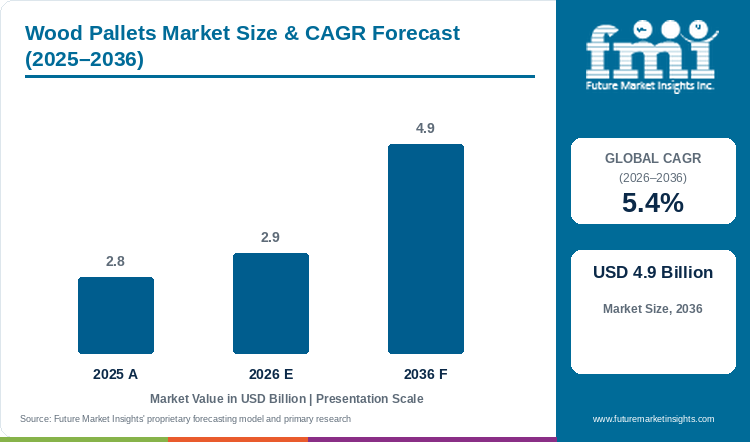
Key Market Trends & Insights
- APHIS does not issue phytosanitary certificates for wood packaging carrying other commodities, although packaging shipped as cargo has a different treatment. The distinction separates the packaging mark from the cargo certificate in a U.S. export offer.
- Brambles' 2030 programme expands its timber ambition from a tree count to the restoration, conservation or sustainable management of two hectares for each hectare required for timber sourcing. The target makes sourcing records part of its supplier programme; it is a company commitment rather than a measured benefit for every pallet customer.
- Brambles reports that U.S. repair-capacity constraints reduced FY26 pallet sales revenue by approximately USD 45 million. Repair throughput can therefore limit a pool operator's ability to serve demand even where assets are available; the reported impact concerns that company and year.
Regional Highlights
- In North America, regional manufacturing coverage and investment composition require separate readings. UFP's acquisition addresses a stated Northeast U.S. gap, while Mexico's official first-half 2025 investment release records 84.4% reinvested earnings. The two records support different commercial arguments, rather than a single region-wide new-factory cycle.
- European pallet circulation is adding digital identification to established physical exchanges. EPAL launched its pallet app in March 2025 after more than 2 million QR-coded Euro pallets had been produced. This is evidence of a specific open-pool tracking initiative, rather than a forecast for all European wooden pallets.
Wood Pallets Market Size and Forecast
Table 1: Wood Pallets Market Size and Forecast
| Market size and forecast | Value |
|---|---|
| Market size in 2025 | USD 33.0 billion |
| Market size in 2026 | USD 35.0 billion |
| Projected market size by 2036 | USD 58.3 billion |
| CAGR from 2026 to 2036 | 5.2% |
Source: Future Market Insights analysis of the wood pallets market, 2026.
Analyst Perspective
“The cost of a wood pallet depends partly on how often it can be recovered, repaired and used again. Pooling and logistics operators need reliable collection and inspection processes, while export customers also require the appropriate treatment and documentation for the destination market.”
- Nandini Roy Choudhury, Principal Consultant, FMI
How is the Wood Pallets Market segmented?
- By structural design: 4-Way Block Pallet Design, Stringer Pallets, Engineered LVL Pallets, and Others, sitting within the broader pallets market that FMI tracks across all pallet substrates.
- By timber type: Softwood Pallets, Hardwood Pallets, and Mixed-Wood Pallets and Others.
- By supply activity: New Pallet Supply, Recovered Pallet Supply and Repair, Rental Services, and Resale Services.
- By operating model: User-Owned or Open-Exchange Systems and Managed Rental Pooling. One-way supply within user-owned systems remains relevant to the single-use pallet market.
- By end-use sector: Food and Beverage, FMCG and E-Commerce, Chemicals and Industrial, Retail Cross-Docking, Export Consolidation, and Others.
- By region: North America, Latin America, Western Europe, Eastern Europe, East Asia, South Asia and Pacific, and Middle East and Africa.
Why does the 4-Way Block Pallet Design segment lead by Structural Design in the Wood Pallets Market in 2026?
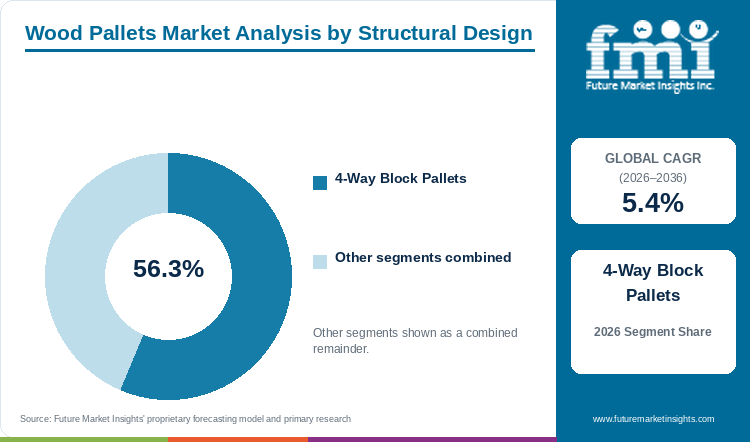
The 4-Way Block Pallet Design segment holds a 56.0% share of the Wood Pallets Market by Structural Design in 2026, according to FMI's assessment.
The segment’s lead is associated with pallet systems that require access from several sides and consistent exchange specifications. EPAL's Euro pallet programme offers a concrete example of an established wooden pallet exchange system; its March 2025 app launch adds digital identification and tracking to that existing circulation model.
Exchange-system compatibility and treatment compliance address different parts of the purchase. APHIS requires an approved treatment and marking route for regulated export packaging.
Stringer Pallets, Engineered LVL Pallets and Others together represent the remaining 44.0% by structural design.
Load conditions, handling equipment and the receiving network determine which design is specified, so a supplier needs to match the exchange programme as well as the physical load.
Table 2: Structural Design, 2026 Share
| Leading Share | 2026 market share |
|---|---|
| 4-Way Block Pallet Design | 56.0% |
| All Other Segments Combined Share | 44.0% |
Source: Future Market Insights analysis of the wood pallets market, 2026.
Why does the Softwood Pallets segment lead by Timber Type in the Wood Pallets Market in 2026?
The Softwood Pallets segment holds a 73.1% share of the Wood Pallets Market by Timber Type in 2026, according to FMI's assessment.
Softwood is used in both new manufacture and recovered pallet supply. A U.S. industry survey published in 2025 found that softwood accounted for 81% of the lumber used in 2021. That is a dated lumber-volume observation, not a global revenue measure. It supports a substantial sourcing role while leaving the global value assessment to FMI.
Softwood Pallets include kiln-dried, air-dried and green lumber; Hardwood Pallets and Mixed-Wood Pallets and Others remain separate. Drying and plant-health treatment address different purchase requirements. APHIS requires an approved treatment and certification route for regulated wood packaging. Neither the word softwood nor a kiln-dried description by itself proves destination compliance.
Hardwood Pallets and Mixed-Wood Pallets and Others together account for the remaining 26.9% by timber type.
The selected timber must therefore meet the load specification, moisture requirement and authorised treatment route independently of its commercial species label.
Table 3: Timber Type, 2026 Share
| Leading Share | 2026 market share |
|---|---|
| Softwood Pallets | 73.1% |
| All Other Segments Combined Share | 26.9% |
Source: Future Market Insights analysis of the wood pallets market, 2026.
Why does the User-Owned or Open-Exchange Systems segment lead by Operating Model in the Wood Pallets Market in 2026?
The User-Owned or Open-Exchange Systems segment holds a 73.3% share of the Wood Pallets Market by Operating Model in 2026, according to FMI's assessment.
Users retain ownership in these systems, buying or repairing pallets and, in open exchange networks, swapping serviceable units with other participants. EPAL's open and independent Euro pallet system is a concrete exchange example. It differs from a rental operator's retained-ownership fleet. The classification includes one-way supply where the receiving user takes ownership, as well as repeat exchange; reuse by itself does not make a pallet rental.
Managed Rental Pooling accounts for the remaining 26.7% by operating model.
One-way shipment routes remain part of user-owned supply; FMI also examines them in its single-use pallet coverage. Managed Rental Pooling instead keeps ownership with the operator and charges for use, collection and reissue. Brambles' operating network offers a documented rental example. These classes distinguish ownership and payment, rather than implying that open exchange pallets are discarded after one trip. Service territory, loss liability and recovery terms still determine whether rental or owned assets suit the account.
Table 4: Operating Model, 2026 Share
| Leading Share | 2026 market share |
|---|---|
| User-Owned or Open-Exchange Systems | 73.3% |
| All Other Segments Combined Share | 26.7% |
Source: Future Market Insights analysis of the wood pallets market, 2026.
Why does New Pallet Supply lead by Supply Activity in the Wood Pallets Market in 2026?
New Pallet Supply holds a 48.7% share of the Wood Pallets Market by Supply Activity in 2026, according to FMI's assessment.
New supply serves users buying specified dimensions and materials, whereas recovered supply depends on available cores, replacement boards and inspection. This classification separates the value of new sales, recovered supply and repair, rental fees and resale services. UFP's purchase of John Rock's operating pallet assets is a specific 2026 investment in the manufacturing side of that market.
Recovery remains a competing source of pallet utility. Millwood describes recycling, remanufacturing and repair-and-return services on its own service pages. Those activities explain why new production should be assessed alongside recovered supply rather than treated as the only response to more shipments. Recovered Pallet Supply and Repair, Rental Services and Resale Services together represent the remaining 51.3%. The classification concerns the activity purchased; it does not treat every hire of an existing pallet as a new pallet sale or assume that a food customer must always use new wood.
Table 5: Supply Activity, 2026 Share
| Leading Share | 2026 market share |
|---|---|
| New Pallet Supply | 48.7% |
| All Other Segments Combined Share | 51.3% |
Source: Future Market Insights analysis of the wood pallets market, 2026.
Why does Food and Beverage lead by End-Use Sector in the Wood Pallets Market in 2026?
Food and Beverage holds a 38.0% share of the Wood Pallets Market by End-Use Sector in 2026, according to FMI's assessment.
This breakdown identifies the industry served, separately from physical design, timber type, supply activity and ownership model. It therefore includes several pallet configurations and services rather than equating the entire category with newly manufactured stock.
Brambles identifies food rescue and redistribution among its partnership activities, demonstrating a specific food-distribution use of reusable platforms. Export packaging remains subject to the relevant destination's plant-health conditions. These records support food distribution as an important application, while they do not establish a universal requirement for new pallets or an unbroken preference for one design. FMI's wooden crates market coverage addresses an adjacent packaging format; it does not measure pallet demand. FMCG and E-Commerce, Chemicals and Industrial, Retail Cross-Docking, Export Consolidation and Others together account for 62.0% of this end-use breakdown.
Table 6: End-Use Sector, 2026 Share
| Leading Share | 2026 market share |
|---|---|
| Food and Beverage | 38.0% |
| All Other Segments Combined Share | 62.0% |
Source: Future Market Insights analysis of the wood pallets market, 2026.
What are the key drivers restraints and opportunities?
The 2036 outlook combines demand from manufacturing and distribution with repeated recovery of existing pallets. More shipments support pallet services, but longer asset life limits the number of newly manufactured units needed for a given flow.
Driver
Manufacturing investment supports demand when it becomes operating output and shipment activity. Mexico's official release reports USD 34.265 billion in first-half 2025 foreign direct investment, with 84.4% reinvested earnings and 9.2% new investment. Those categories warrant different interpretations: the total cannot be treated as expenditure on new factories. FMI links its 6.6% Mexican forecast to an expanded manufacturing and distribution base, subject to the timing of actual production. Export packaging is also relevant to the adjacent wooden crates market, while it remains a distinct product category.
Restraint
Lumber-price movements affect the cost of replacement boards and newly built pallets. The BLS softwood lumber producer-price series is a U.S. input benchmark, not evidence that every manufacturer uses the same price-reset period or absorbs the same margin loss. Suppliers with fixed selling prices and changing lumber costs face exposure until contracts reset; recovered boards and alternative sourcing change that exposure. FMI treats input volatility as a restraint without inferring an industry-wide hedging advantage from a single acquisition.
Opportunity
Repair, recovery and pallet management provide an opportunity beyond selling new units. Millwood's own service description includes inspection, remanufacturing and repair-and-return programmes. These services address existing assets and create a different revenue stream from manufacturing. The opportunity depends on collection volumes, repair economics and service territory; it is not established by a plastic-material metric or a presumed price advantage over plastic pallets.
How do government policies affect wood pallets purchasing?
Plant-health and load-performance requirements qualify different parts of a pallet order. ISO 8611-1:2025 specifies methods for evaluating new flat pallets through nominal-load, maximum-working-load and durability tests. It is a testing standard, not a blanket legal mandate on all pallet transactions. Where a buyer specifies it, the offer needs the relevant design and test evidence; ISPM 15 marking addresses plant health rather than load capacity.
Plant-health compliance changes supplier qualification and shipment risk. APHIS states that regulated wood packaging entering or transiting the United States must be pest-free, debarked, appropriately treated and marked; non-compliant packaging is not allowed entry. Heat treatment is an approved route rather than the only possible treatment, and the marking programme must match the supplier's authorisation.
The EU Deforestation Regulation requires a separate scope assessment. Current application dates are 30 December 2026 for large and medium operators and micro/small operators already covered by the EU Timber Regulation, and 30 June 2027 for other micro/small operators. Official guidance distinguishes standalone packaging products from pallets used exclusively to carry other goods; reusable packaging is excluded from the moment it is used for that purpose and onwards. Buyers should establish the product's actual status rather than assume every pallet movement needs a new declaration. China's 2025 express-delivery rules encourage reusable packaging, but they do not establish a wooden-pallet purchase quota.
What limits reliable wood pallets supply and quality?
Reliable supply depends on usable lumber, processing capacity, repairable returns and the specified delivery footprint. The BLS softwood series documents a U.S. input-price benchmark; it cannot establish a universal three-month pricing limit. Statistics Poland's 0.2% reduction in current-price forestry output in 2023 measures value, not a shortage of pallet lumber or higher imports. FMI therefore treats sourcing flexibility as a commercial issue without drawing a physical-supply conclusion from that nominal statistic.
Where can suppliers win additional business?
Suppliers can add repair services or expand coverage in a specific manufacturing corridor. Millwood offers repair-and-return and recovery programmes, while UFP's 2026 John Rock transaction explicitly addresses PalletOne's Northeast coverage gap. These examples support different approaches to winning accounts. Wood suppliers also compete with plastic pallets, but the evidence here does not quantify substitution. A defensible offer must match the shipment, recovery and documentation requirements of the customer rather than promise equivalent performance in every application.
Wood Pallets Market by Country (2026 to 2036)
Table 7: Wood Pallets Market Country Growth Forecast
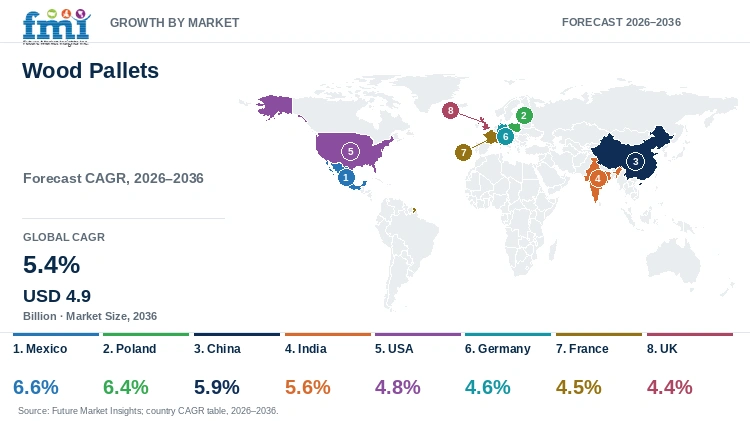
| Country | CAGR, 2026 to 2036 |
|---|---|
| Mexico | 6.6% |
| Poland | 6.4% |
| China | 5.9% |
| India | 5.6% |
| United States | 4.8% |
| Germany | 4.6% |
| France | 4.5% |
| United Kingdom | 4.4% |
Source: Future Market Insights analysis of the wood pallets market, 2026.
United States
UFP's purchase of three John Rock pallet plants makes regional coverage a concrete competitive issue in the United States. The May 2026 transaction brings the Coatesville and Mifflintown sites in Pennsylvania and Bowling Green site in Virginia into PalletOne, while the Dilwyn sawmill stays with the seller. Approximately USD 82 million in annual sales and nearly 250 employees are associated with the purchased operations. For FMI, the significance is the acquired manufacturing footprint in the Northeast, rather than evidence that the whole national industry has consolidated at the same pace.
The U.S. forecast of 4.8% CAGR during 2026 to 2036 combines manufacturing demand with a mature service market. APHIS' import requirements create a separate qualification hurdle for export-linked suppliers: marking and treatment compliance remain necessary even when a pallet meets the load specification. This favours documented supply programmes, although compliance alone does not guarantee repeat orders or prevent operational damage.
Repair is an equally relevant part of the competitive field. Millwood lists recovery, remanufacturing and repair-and-return services. Greater shipment activity can therefore increase repair and handling work without producing the same percentage increase in new pallet purchases. Suppliers assessing the U.S. opportunity need to distinguish new manufacture from managed circulation and match the service footprint to the actual account. FMI's value forecast covers the stated wood-pallet scope; it does not treat every recovered asset or every logistics service as a newly sold pallet.
Mexico
Mexico's investment composition gives a more useful reading of pallet demand than the headline inflow alone. The Secretaría de Economía recorded USD 34.265 billion of foreign direct investment in the first half of 2025, up 10.2% against originally published comparable 2024 figures. Reinvested earnings accounted for 84.4%, new investment for 9.2%, and intercompany accounts for 6.4%. Reinvestment can support established businesses, but the full total cannot be read as new factories about to order pallets.
FMI projects 6.6% annual growth for 2026 to 2036, the highest of the eight countries in this report. The commercial argument is an expanding addressable manufacturing and distribution base, with pallet demand emerging through actual production, warehousing and dispatch. Investment announcements and financial inflows precede that activity by different intervals. An order book tied to operating customers therefore provides stronger demand visibility than a general nearshoring claim.
Cross-border shipments add another distinction. Wood packaging entering the United States must satisfy APHIS requirements, so Mexican suppliers serving that route compete partly on treatment and marking reliability. Domestic movements and other export destinations have their own conditions; the U.S. rule is not a universal standard for every Mexican transaction. Demand for new pallets also competes with repaired and circulated assets. The forecast consequently supports opportunities in supply programmes and recovery services, while it does not imply a one-for-one link between investment dollars, additional factory floor space and new pallet volume.
China
China's packaging policy addresses express-delivery waste more directly than wooden pallets. The 2023 action plan set a target for 10% recycled express packaging in intracity deliveries by the end of 2025. Revised express-delivery regulations, announced in April 2025 and effective from June 2025, encourage environmentally friendly packaging and clarify responsibilities for reducing secondary packaging and recovering materials. These are concrete policy developments, but neither establishes the share of domestic freight carried on wood.
The distinction matters to FMI's 5.9% CAGR forecast for 2026 to 2036. Express parcels and palletised warehouse loads occupy different parts of distribution. More parcel activity may support upstream handling work, while packaging reduction can lower material consumption per shipment. A supplier should therefore assess the distribution operation and its return flows rather than convert an express-packaging target directly into wooden-pallet sales.
Within the report's taxonomy, FMCG and E-Commerce is separate from Food and Beverage and from Export Consolidation. This avoids treating every online order as the same pallet application. Rental pooling competes with one-way exchanges according to the collection network, contract terms and shipment pattern. For exporters, destination-specific plant-health requirements remain relevant to solid-wood packaging; a domestic environmental policy does not replace them. FMI's forecast allows for expansion in manufacturing and distribution, but the available official policy evidence does not quantify a national pallet-substitution rate. Suppliers with documented recovery and consistent specifications have an identifiable service proposition, subject to the actual account economics.
India
India's logistics programme offers a more concrete demand context than the age of its phytosanitary rules. A February 2024 Ministry of Commerce and Industry release records India's 38th place among 139 economies in the World Bank's 2023 Logistics Performance Index, compared with 44th in 2018. It identifies targeted work across customs, infrastructure, shipment arrangement, logistics services, tracking and timeliness, alongside the National Logistics Policy and PM GatiShakti initiatives. The ranking is historical infrastructure context, not a measurement of pallet consumption.
FMI's 5.6% CAGR for 2026 to 2036 reflects an opportunity for organised pallet supply as manufacturing and distribution operations develop. Better shipment visibility and coordinated facilities can support repeat supply and collection programmes. However, the published index does not establish that every warehouse uses standard pallets or that a national pooling network is already available. The distinction between planned integration and an operating return route matters when evaluating a rental model.
Export packaging adds a practical qualification requirement. India's wood-packaging conditions are identified separately in the cited importing-country record; suppliers still need to check the actual destination and treatment authorisation. Longevity of a rule does not by itself establish a lower compliance-risk premium than competing origins. New pallet supply and recovered supply remain distinct activities in the market. More goods moving through logistics networks may increase inspection, recovery and repair work as well as new purchases. FMI therefore sees account-specific service coverage and documented quality as relevant competitive conditions, without treating public logistics rankings as the source of the market forecast.
Poland
Poland's forestry accounts require care when reading the pallet outlook. Statistics Poland reports PLN 36.4 billion of forestry and logging gross output in 2023, down 0.2% in current prices. It also records 9.407 million hectares of forest land, with 96.7% of forest land available for wood supply. These figures describe the forestry sector's value and land coverage; they do not establish a fall in physical pallet-lumber availability or a rise in imported lumber.
That distinction leaves FMI's 6.4% CAGR forecast for 2026 to 2036 as a separate assessment of wood-pallet demand. Poland is grouped with Eastern Europe in the report, while the detailed taxonomy preserves neighbouring Czech, Romanian and Hungarian coverage. Demand associated with manufacturing shipments and exchange networks should be assessed independently of one nominal forestry statistic. A producer can face higher processing or transport costs even when forest area changes little, and forest area alone does not establish the amount of saleable pallet lumber.
The commercial opportunity therefore depends on the relationship between customer orders, timber procurement and recoverable used pallets. EPAL's European exchange system and its 2025 tracking-app initiative provide a relevant example of documentation within pallet circulation, without measuring Poland's national share. Manufacturers supplying standalone new wooden pallets into EU markets must also assess the applicable deforestation-regulation scope and timetable. Used packaging and pallets accompanying goods cannot simply be treated as identical regulatory transactions. FMI's growth case supports expanded pallet services, subject to these sourcing and circulation conditions.
Germany
Germany's pallet suppliers face two different documentation questions: the origin of relevant timber products and the management of pallets already in circulation. Current EU guidance distinguishes standalone packaging products from pallets used exclusively to support or carry other goods. That boundary is commercially significant for a market containing manufacturers, repairers and pooling operators, because their transactions are not interchangeable.
The current deforestation-regulation timetable begins on 30 December 2026 for large and medium operators and micro/small operators already within the EU Timber Regulation, with other micro/small operators following on 30 June 2027. The earlier 2025 and June 2026 dates are no longer the applicable schedule. This preparation work sits alongside FMI's 4.6% annual market-growth forecast for 2026 to 2036; it is not evidence that all German pallet firms already incur the same new cost or that a regulation increases pallet volumes.
There is also a specific digital-circulation development. EPAL launched its pallet app in March 2025, following production of more than 2 million QR-coded Euro pallets since January 2024. The example supports investment in identifying and tracking exchange assets, rather than a replacement of every conventional pallet. German suppliers competing within this environment need to distinguish the value of a compliant new unit from repair, exchange and tracking services attached to an existing one. Documentation may influence supplier qualification, while the customer's actual handling specification and service coverage still determine the offer. FMI retains these as separate commercial mechanisms when assessing a mature market's growth.
France
France's public reuse infrastructure gives wooden-pallet suppliers a relevant commercial setting beyond new production. ADEME's national observatory reports 2.9 billion packaging units reused in 2024 and monitors 13 extended-producer-responsibility sectors. The figure covers packaging broadly and cannot be treated as a count of wooden pallets. Its relevance is the increasing visibility of reuse activity, including the need to distinguish a further use of an asset from the purchase of another unit.
FMI forecasts 4.5% CAGR for France during 2026 to 2036. Within the report's wood-pallet scope, manufacturers compete alongside pooling and repair services. The public reuse evidence supports attention to recovery and measurement, but it does not demonstrate a universal pooling requirement or a national wooden-pallet share. Customers buying new units and customers paying for return-and-repair programmes make different commercial commitments, even where the same physical pallet specification is used.
European timber-product rules add a separate sourcing question. New standalone packaging and packaging already carrying goods require different scope assessments under current official guidance. That distinction affects how a French supplier describes its product and supporting records; it should not be replaced by a blanket statement that every reused pallet needs the same declaration. A competitive programme combines the applicable sourcing record with the actual collection territory and inspection specification. Longer asset life can strengthen service revenue while limiting replacement volume, so FMI does not equate reuse-policy visibility with an automatic increase in new wood-pallet purchases. This balance underpins the report's moderate national growth outlook.
United Kingdom
Wood-pallet repair is a measurable part of the United Kingdom's supply base. TIMCON's November 2025 industry report announcement records 46.3 million new wooden pallets manufactured in 2024, compared with 41.7 million in 2023, and an estimated 53.9 million repaired for reuse. New manufacture and repair are different activities; their totals cannot be combined as if each repaired pallet represented a newly sold unit. They show why suppliers compete on recovery and inspection as well as production capacity.
Against this background, FMI forecasts 4.4% CAGR for 2026 to 2036. The outlook involves a mature market where more distribution activity can create service demand while extending asset life restrains replacement purchases. Repair programmes must be judged by recoverable quality and collection coverage. The public production figures do not establish a particular customer's repair cost, pallet life or operating-model preference.
Great Britain's import and export guidance creates a separate commercial obligation. Solid-wood packaging entering Great Britain must meet ISPM 15; exports require checks against the destination's requirements. The official guidance also distinguishes movements involving Northern Ireland and explains that repaired or changed compliant packaging may require retreatment and remarking. These distinctions matter when pricing a return loop across a border. A domestic repair programme cannot automatically be offered on the same terms for every export route. FMI therefore associates the national opportunity with documented repair, suitable replacement stock and route-specific compliance, rather than treating all pallet circulation as one uniform market activity.
Who are the notable companies in the Wood Pallets Market?
Brambles Limited, UFP Industries and Millwood Inc. illustrate three commercial positions in wood pallets: managed circulation, manufacturing capacity and recovery services. Brambles operates CHEP and sets timber-sourcing and product-waste commitments through its 2030 sustainability programme. These commitments concern its own operating system; they do not establish that every pooling customer can claim the same emissions outcome.
UFP Industries expanded PalletOne's Northeast footprint in May 2026 by acquiring three John Rock operating locations for approximately USD 48 million. The acquisition includes around USD 82 million in annual sales and nearly 250 employees, while a fourth location, the Dilwyn sawmill, remains with the seller. The transaction gives an identifiable example of buying regional manufacturing coverage rather than proof of an industry-wide preference for acquisitions.
Millwood describes pallet recycling, repair-and-return and packaging services on its own website. Its corporate pages report more than 40 operated locations and more than 2,000 team members. This North American footprint supports a different customer offer from a new-pallet manufacturing acquisition: inspection and recovery services are sold alongside physical stock. Buyers comparing the three businesses need to distinguish production capacity, the collection territory and responsibility for assets already in use. These roles determine which part of an account a supplier can serve, rather than establishing a common global company ranking.
Key Developments in the Wood Pallets Market
- UFP Industries completed a USD 48 million acquisition of three John Rock Inc. pallet manufacturing sites in Pennsylvania and Virginia on 4 May 2026, adding roughly USD 82 million in annual sales and 250 employees to its PalletOne network.
Key Players in the Wood Pallets Market
- Brambles Limited (CHEP)
- UFP Industries, Inc. (PalletOne)
- Millwood Inc.
- Kamps Pallets
- IFCO Systems
- PECO Pallet, Inc.
- Relogistics Services, LLC
Wood Pallets Market Report Scope
Table 8: Wood Pallets Market Report Scope
| Coverage field | Report scope |
|---|---|
| Market definition | Annual net transaction value of wood-pallet goods and services; used-asset principal and overlapping supply-chain inputs excluded. |
| Structural Design | 4-Way Block Pallet Design; Stringer Pallets; Engineered LVL Pallets; Others |
| Timber Type | Softwood Pallets; Hardwood Pallets; Mixed-Wood Pallets and Others |
| Supply Activity | New Pallet Supply; Recovered Pallet Supply and Repair; Rental Services; Resale Services |
| Operating Model | User-Owned or Open-Exchange Systems; Managed Rental Pooling |
| End-Use Sector | Food and Beverage; FMCG and E-Commerce; Chemicals and Industrial; Retail Cross-Docking; Export Consolidation; Others |
| Regions covered | North America, Latin America, Western Europe, Eastern Europe, East Asia, South Asia and Pacific, Middle East and Africa |
| Profiled markets | Mexico, Poland, China, India, United States, Germany, France, United Kingdom |
| Companies covered | Brambles Limited (CHEP); UFP Industries, Inc. (PalletOne); Millwood Inc.; Kamps Pallets; IFCO Systems; PECO Pallet, Inc.; Relogistics Services, LLC |
| Quantitative Units | USD billion |
Source: Future Market Insights analysis of the wood pallets market, 2026.
Wood Pallets Market Research Methodology
The wood pallets assessment combines Census manufacturing statistics, BLS finished-product prices, industry surveys and operator accounts. FMI assesses annual net transaction value across new supply, remanufacturing, repair, resale services and rental, with consistent treatment of used-asset principal and inputs within pooling supply chains. Segment values are classified by design, timber type, supply activity, ownership model and end use. Country forecasts reflect local commercial conditions over the same 2026 to 2036 period. Circulating pallet stocks, lumber consumption and annual sales are reviewed as different measures.
Wood Pallets Market by Segments
Wood Pallets Market segmented by Structural Design:
- 4-Way Block Pallet Design
- Stringer Pallets
- Engineered LVL Pallets
- Others
Wood Pallets Market segmented by Timber Type:
- Softwood Pallets
- Hardwood Pallets
- Mixed-Wood Pallets and Others
Wood Pallets Market segmented by Supply Activity:
- New Pallet Supply
- Recovered Pallet Supply and Repair
- Rental Services
- Resale Services
Wood Pallets Market segmented by Operating Model:
- User-Owned or Open-Exchange Systems
- Managed Rental Pooling
Wood Pallets Market segmented by End-Use Sector:
- Food and Beverage
- FMCG and E-Commerce
- Chemicals and Industrial
- Retail Cross-Docking
- Export Consolidation
- Others
Wood Pallets Market by Region
- North America
- United States
- Canada
- Latin America
- Brazil
- Mexico
- Argentina
- Chile
- Western Europe
- Germany
- France
- United Kingdom
- Italy
- Spain
- Benelux
- Nordics
- Eastern Europe
- Poland
- Czech Republic
- Romania
- Hungary
- East Asia
- China
- Japan
- South Korea
- South Asia and Pacific
- India
- ASEAN
- Australia and New Zealand
- Middle East and Africa
- GCC Countries
- South Africa
- Türkiye
- Israel
Research Sources and Bibliography
- [1] USDA Animal and Plant Health Inspection Service, “Wood Packing Treatment Programs,” accessed November 2026. Import ISPM 15-Compliant Wood Packaging Material into the U.S., updated 27 July 2026; Export ISPM 15-Compliant Wood Packaging Material From the U.S., updated 25 January 2026. https://www.aphis.usda.gov/plant-imports/wood-packaging-material/import ; https://www.aphis.usda.gov/plant-exports/wood-packaging-material/export
- [2] Brambles Limited, “Brambles Renews Regenerative Ambition With Launch of 2030 Sustainability Programme,” press release, 10 September 2025.
- [3] UFP Industries, Inc., acquisition announcement regarding John Rock, Inc. pallet manufacturing locations, 4 May 2026.
- [4] U.S. Bureau of Labor Statistics, Producer Price Index by Commodity: Lumber and Wood Products: Softwood Lumber (WPU 0811), via Federal Reserve Economic Data (FRED), Federal Reserve Bank of St. Louis.
- [5] USDA Animal and Plant Health Inspection Service, “Stakeholder Reminder: Suspension of ISPM 15 Hyphen Requirement Ends December 31, 2025,” program update, 2025. https://www.aphis.usda.gov/news/program-update/reminder-temporary-suspension-ispm-15-hyphen-requirement-ends-december-31-2025
- [6] European Commission, Access2Markets, Application of EUDR Regulation on Deforestation-free Products Delayed Until December 2025, historical notice, 12 December 2024.
- [7] Centro de Estudios de las Finanzas Públicas, Mexican Chamber of Deputies, report on foreign direct investment, January to June 2025, document CEFP/038/2025.
- [8] Statistics Poland, Forest accounts in Poland in 2023,1 December 2025. https://stat.gov.pl/en/topics/agriculture-forestry/forestry/forest-accounts-in-poland-in-2023%2C3%2C8.html
- [9] The State Council of the People's Republic of China, “Eight Ministries and Departments Jointly Issued a Guideline on Standardization of Green Express Delivery Packaging,” official notice, December 2023.
- [10] Australian Government Department of Agriculture, Fisheries and Forestry, Manual of Importing Country Requirements (MICoR), India wood packaging import conditions, reviewed 16 September 2024.
- [11] Millwood Inc., About Millwood, Our Locations and Recycling Solutions, accessed 2 November 2026. https://www.millwoodinc.com/about-millwood/ ; https://www.millwoodinc.com/Locations ; https://www.millwoodinc.com/services/recycling-solutions/
- [12] UK Government, Wood packaging goods for import and export, accessed 2 November 2026. https://www.gov.uk/wood-packaging-import-export
- [13] India Ministry of Commerce and Industry, India ranks 38 out of 139 countries on World Bank Logistics Performance Index 2023,7 February 2024. https://www.pib.gov.in/PressReleasePage.aspx?PRID=2003541&lang=1®=3
- [14] European Pallet Association, Optimised pallet management with the new EPAL Pallet app,9 April 2025. https://www.epal-pallets.org/fileadmin/user_upload/EPAL_TPA_PR_EN.pdf
- [15] ADEME, National Observatory of Reuse and Reutilisation,2024 packaging reuse indicators, accessed 2 November 2026. https://observatoire-reemploi-reutilisation.ademe.fr/
- [16] Mexico Secretaría de Economía, Comunicado 76 on first-half 2025 foreign direct investment,21 August 2025. https://www.gob.mx/se/prensa/mexico-logra-el-mayor-nivel-de-atraccion-de-ied-en-un-segundo-trimestre-con-cifras-originalmente-publicadas?idiom=en
- [17] European Commission, Commission updates product scope and tools to support EUDR,13 July 2026. https://environment.ec.europa.eu/news/commission-updates-product-scope-and-tools-support-eudr-2026-07-13_en
- [18] European Commission, Guidance document for Regulation 2023/1115,July 2026,section 7 product scope. https://eur-lex.europa.eu/legal-content/EN/TXT/?uri=OJ%3AC_202603896
- [19] State Council of China, China unveils new regulations on express delivery sector,18 April 2025. https://english.www.gov.cn/news/202504/18/content_WS68023fe2c6d0868f4e8f1dd2.html
- [20] U.S. Environmental Protection Agency, Containers and Packaging Product Specific Data,2018 wood-pallet recycling, accessed 2 November 2026. https://www.epa.gov/facts-and-figures-about-materials-waste-and-recycling/containers-and-packaging-product-specific
- [21] TIMCON, Wood Packaging Report 2024 announcement,27 November 2025. https://www.timcon.org/news/
- [22] International Organization for Standardization, ISO 8611-1:2025, Pallets for materials handling — Flat pallets — Part 1 Test methods, published February 2025. https://www.iso.org/standard/87543.html
- [23] IFCO, Pooling reusable packaging is the smart choice, 14 August 2024, accessed 3 November 2026. https://www.ifco.com/blog/pooling-reusable-packaging/
- [24] PECO Pallet, company overview and English product brochure, accessed 3 November 2026. https://www.pecopallet.com/pdf/PECO_English_Brochure.pdf
- [25] Relogistics, Total Pallet Management services, accessed 3 November 2026. https://www.relogistics.com/
- [26] Brambles Limited, FY26 Full Year Statutory Accounts, 20 August 2026, Operating and Financial Review. https://www.brambles.com/Content/cms/FY26-Results/pdf/Brambles-FY26-Full-Year-Statutory-Accounts.pdf
- [27] U.S. Bureau of Labor Statistics, Producer Price Index: Wood Pallets and Pallet Containers, WPU084101, monthly observations through September 2026, updated 15 October 2026, via Federal Reserve Bank of St. Louis. https://fred.stlouisfed.org/data/WPU084101
- [28] U.S. Census Bureau, Manufacturing and International Trade Report: 2022 and 2021, NAPCS 2048350000 product shipments and trade, accessed 3 November 2026. https://www.census.gov/foreign-trade/Press-Release/MITR/2022/2022_Manufacturing_and_International_Trade_Report.pdf
- [29] Hobbs, S., Horvath, L. and Gething, B., Investigation of the status of the wooden pallet market during the COVD-19 pandemic, BioResources 20(2), 3047-3074, 2025; U.S. observations for 2019-2021. DOI: 10.15376/biores.20.2.3047-3074. https://bioresources.cnr.ncsu.edu/resources/investigation-of-the-status-of-the-wooden-pallet-market-during-the-covd-19-pandemic/
- [30] European Pallet Association, 109 million new EPAL Euro pallets produced in 2022, 27 March 2023; open exchange system and annual production. https://www.epal-pallets.org/fileadmin/user_upload/ntg_package/images/news/EPAL-PressRelease_Statistics-2022_EN.pdf
- [31] United Nations Industrial Development Organization, International Yearbook of Industrial Statistics 2025, manufacturing value-added context, published November 2025. https://www.unido.org/sites/default/files/unido-publications/2025-11/UNIDO%20Industrial%20Statistics%20Yearbook%202025.pdf
Table of Content
- Key Takeaways
- Market Size and CAGR
- Top Growth Driver
- Fastest Growing Segment
- Leading Region
- Key Companies
- Emerging Opportunities
- Executive Summary
- Global Market Outlook
- Demand-side Trends
- Supply-side Trends
- Technology Roadmap Analysis
- Analysis and Recommendations
- Analyst Perspective (What is happening? Why now? What should investors know?)
- Key Questions Answered
- How large is the market?
- What is the CAGR?
- What are key trends?
- Which region dominates?
- Who are the leaders?
Read More...
- Market Overview
- Market Coverage / Taxonomy
- Market Definition / Scope / Limitations
- Research Methodology
- Chapter Orientation
- Analytical Lens and Working Hypotheses
- Market Structure, Signals, and Trend Drivers
- Benchmarking and Cross-market Comparability
- Market Sizing, Forecasting, and Opportunity Mapping
- Research Design and Evidence Framework
- Desk Research Programme (Secondary Evidence)
- Expert Input and Fieldwork (Primary Evidence)
- Tooling, Models, and Reference Databases
- Data Engineering and Model Build
- Quality Assurance and Audit Trail
- Market Background
- Market Dynamics (Drivers, Restraints, Opportunity, Trends)
- Scenario Forecast (Optimistic, Likely, Conservative)
- Impact Analysis
- AI Impact
- Sustainability Impact
- Regulatory Impact
- Technology Impact
- Consumer / Buyer Analysis
- Purchase Drivers
- Adoption Barriers
- Buyer Journey
- Opportunity Map Analysis
- Product Life Cycle Analysis
- Supply Chain Analysis
- Investment Feasibility Matrix
- Value Chain Analysis
- PESTLE and Porter's Analysis
- Regulatory Landscape
- Regional Parent Market Outlook
- Production and Consumption Statistics
- Import and Export Statistics
- Global Market Analysis and Forecast, 2021 to 2036
- Historical Market Size Value (USD Billion) Analysis, 2021 to 2025
- Current and Future Market Size Value (USD Billion) Projections, 2026 to 2036
- Y-o-Y Growth Trend Analysis
- Absolute $ Opportunity Analysis
- Global Market Pricing Analysis, 2021 to 2036
- Global Market Analysis and Forecast, By Structural Design, 2021 to 2036
- Introduction / Key Findings
- Historical Market Size Value (USD Billion) Analysis By Structural Design, 2021 to 2025
- Current and Future Market Size Value (USD Billion) Analysis and Forecast By Structural Design, 2026 to 2036
- 4-Way Block Pallet Design
- Stringer Pallets
- Engineered LVL Pallets
- Others
- Y-o-Y Growth Trend Analysis By Structural Design, 2021 to 2025
- Absolute $ Opportunity Analysis By Structural Design, 2026 to 2036
- Global Market Analysis and Forecast, By Timber Type, 2021 to 2036
- Introduction / Key Findings
- Historical Market Size Value (USD Billion) Analysis By Timber Type, 2021 to 2025
- Current and Future Market Size Value (USD Billion) Analysis and Forecast By Timber Type, 2026 to 2036
- Softwood Pallets
- Hardwood Pallets
- Mixed-Wood Pallets and Others
- Y-o-Y Growth Trend Analysis By Timber Type, 2021 to 2025
- Absolute $ Opportunity Analysis By Timber Type, 2026 to 2036
- Global Market Analysis and Forecast, By Supply Activity, 2021 to 2036
- Introduction / Key Findings
- Historical Market Size Value (USD Billion) Analysis By Supply Activity, 2021 to 2025
- Current and Future Market Size Value (USD Billion) Analysis and Forecast By Supply Activity, 2026 to 2036
- New Pallet Supply
- Recovered Pallet Supply and Repair
- Rental Services
- Resale Services
- Y-o-Y Growth Trend Analysis By Supply Activity, 2021 to 2025
- Absolute $ Opportunity Analysis By Supply Activity, 2026 to 2036
- Global Market Analysis and Forecast, By Operating Model, 2021 to 2036
- Introduction / Key Findings
- Historical Market Size Value (USD Billion) Analysis By Operating Model, 2021 to 2025
- Current and Future Market Size Value (USD Billion) Analysis and Forecast By Operating Model, 2026 to 2036
- User-Owned or Open-Exchange Systems
- Managed Rental Pooling
- Y-o-Y Growth Trend Analysis By Operating Model, 2021 to 2025
- Absolute $ Opportunity Analysis By Operating Model, 2026 to 2036
- Global Market Analysis and Forecast, By End-Use Sector, 2021 to 2036
- Introduction / Key Findings
- Historical Market Size Value (USD Billion) Analysis By End-Use Sector, 2021 to 2025
- Current and Future Market Size Value (USD Billion) Analysis and Forecast By End-Use Sector, 2026 to 2036
- Food and Beverage
- FMCG and E-Commerce
- Chemicals and Industrial
- Retail Cross-Docking
- Export Consolidation
- Others
- Y-o-Y Growth Trend Analysis By End-Use Sector, 2021 to 2025
- Absolute $ Opportunity Analysis By End-Use Sector, 2026 to 2036
- Global Market Analysis and Forecast, By Region, 2021 to 2036
- Introduction
- Historical Market Size Value (USD Billion) Analysis By Region, 2021 to 2025
- Current Market Size Value (USD Billion) Analysis and Forecast By Region, 2026 to 2036
- North America
- Latin America
- Western Europe
- Eastern Europe
- East Asia
- South Asia and Pacific
- Middle East and Africa
- Market Attractiveness Analysis By Region
- North America Market Analysis and Forecast, By Country, 2021 to 2036
- Historical Market Size Value (USD Billion) Trend Analysis By Market Taxonomy, 2021 to 2025
- Market Size Value (USD Billion) Forecast By Market Taxonomy, 2026 to 2036
- By Country
- United States
- Canada
- By Structural Design
- By Timber Type
- By Supply Activity
- By Operating Model
- By End-Use Sector
- By Country
- Market Attractiveness Analysis
- By Country
- By Structural Design
- By Timber Type
- By Supply Activity
- By Operating Model
- By End-Use Sector
- Key Takeaways
- Latin America Market Analysis and Forecast, By Country
- Historical Market Size Value (USD Billion) Trend Analysis By Market Taxonomy, 2021 to 2025
- Market Size Value (USD Billion) Forecast By Market Taxonomy, 2026 to 2036
- By Country
- Brazil
- Mexico
- Argentina
- Chile
- By Structural Design
- By Timber Type
- By Supply Activity
- By Operating Model
- By End-Use Sector
- By Country
- Market Attractiveness Analysis
- By Country
- By Structural Design
- By Timber Type
- By Supply Activity
- By Operating Model
- By End-Use Sector
- Key Takeaways
- Western Europe Market Analysis and Forecast, By Country
- Historical Market Size Value (USD Billion) Trend Analysis By Market Taxonomy, 2021 to 2025
- Market Size Value (USD Billion) Forecast By Market Taxonomy, 2026 to 2036
- By Country
- Germany
- France
- United Kingdom
- Italy
- Spain
- Benelux
- Nordics
- By Structural Design
- By Timber Type
- By Supply Activity
- By Operating Model
- By End-Use Sector
- By Country
- Market Attractiveness Analysis
- By Country
- By Structural Design
- By Timber Type
- By Supply Activity
- By Operating Model
- By End-Use Sector
- Key Takeaways
- Eastern Europe Market Analysis and Forecast, By Country
- Historical Market Size Value (USD Billion) Trend Analysis By Market Taxonomy, 2021 to 2025
- Market Size Value (USD Billion) Forecast By Market Taxonomy, 2026 to 2036
- By Country
- Poland
- Czech Republic
- Romania
- Hungary
- By Structural Design
- By Timber Type
- By Supply Activity
- By Operating Model
- By End-Use Sector
- By Country
- Market Attractiveness Analysis
- By Country
- By Structural Design
- By Timber Type
- By Supply Activity
- By Operating Model
- By End-Use Sector
- Key Takeaways
- East Asia Market Analysis and Forecast, By Country
- Historical Market Size Value (USD Billion) Trend Analysis By Market Taxonomy, 2021 to 2025
- Market Size Value (USD Billion) Forecast By Market Taxonomy, 2026 to 2036
- By Country
- China
- Japan
- South Korea
- By Structural Design
- By Timber Type
- By Supply Activity
- By Operating Model
- By End-Use Sector
- By Country
- Market Attractiveness Analysis
- By Country
- By Structural Design
- By Timber Type
- By Supply Activity
- By Operating Model
- By End-Use Sector
- Key Takeaways
- South Asia and Pacific Market Analysis and Forecast, By Country
- Historical Market Size Value (USD Billion) Trend Analysis By Market Taxonomy, 2021 to 2025
- Market Size Value (USD Billion) Forecast By Market Taxonomy, 2026 to 2036
- By Country
- India
- ASEAN
- Australia and New Zealand
- By Structural Design
- By Timber Type
- By Supply Activity
- By Operating Model
- By End-Use Sector
- By Country
- Market Attractiveness Analysis
- By Country
- By Structural Design
- By Timber Type
- By Supply Activity
- By Operating Model
- By End-Use Sector
- Key Takeaways
- Middle East and Africa Market Analysis and Forecast, By Country
- Historical Market Size Value (USD Billion) Trend Analysis By Market Taxonomy, 2021 to 2025
- Market Size Value (USD Billion) Forecast By Market Taxonomy, 2026 to 2036
- By Country
- GCC Countries
- South Africa
- Türkiye
- Israel
- By Structural Design
- By Timber Type
- By Supply Activity
- By Operating Model
- By End-Use Sector
- By Country
- Market Attractiveness Analysis
- By Country
- By Structural Design
- By Timber Type
- By Supply Activity
- By Operating Model
- By End-Use Sector
- Key Takeaways
- Key Countries Market Analysis
- United States
- Pricing Analysis
- Market Share Analysis, 2025
- By Structural Design
- By Timber Type
- By Supply Activity
- By Operating Model
- By End-Use Sector
- Canada
- Pricing Analysis
- Market Share Analysis, 2025
- By Structural Design
- By Timber Type
- By Supply Activity
- By Operating Model
- By End-Use Sector
- Mexico
- Pricing Analysis
- Market Share Analysis, 2025
- By Structural Design
- By Timber Type
- By Supply Activity
- By Operating Model
- By End-Use Sector
- Brazil
- Pricing Analysis
- Market Share Analysis, 2025
- By Structural Design
- By Timber Type
- By Supply Activity
- By Operating Model
- By End-Use Sector
- Chile
- Pricing Analysis
- Market Share Analysis, 2025
- By Structural Design
- By Timber Type
- By Supply Activity
- By Operating Model
- By End-Use Sector
- Germany
- Pricing Analysis
- Market Share Analysis, 2025
- By Structural Design
- By Timber Type
- By Supply Activity
- By Operating Model
- By End-Use Sector
- United Kingdom
- Pricing Analysis
- Market Share Analysis, 2025
- By Structural Design
- By Timber Type
- By Supply Activity
- By Operating Model
- By End-Use Sector
- Italy
- Pricing Analysis
- Market Share Analysis, 2025
- By Structural Design
- By Timber Type
- By Supply Activity
- By Operating Model
- By End-Use Sector
- Spain
- Pricing Analysis
- Market Share Analysis, 2025
- By Structural Design
- By Timber Type
- By Supply Activity
- By Operating Model
- By End-Use Sector
- France
- Pricing Analysis
- Market Share Analysis, 2025
- By Structural Design
- By Timber Type
- By Supply Activity
- By Operating Model
- By End-Use Sector
- India
- Pricing Analysis
- Market Share Analysis, 2025
- By Structural Design
- By Timber Type
- By Supply Activity
- By Operating Model
- By End-Use Sector
- ASEAN
- Pricing Analysis
- Market Share Analysis, 2025
- By Structural Design
- By Timber Type
- By Supply Activity
- By Operating Model
- By End-Use Sector
- Australia and New Zealand
- Pricing Analysis
- Market Share Analysis, 2025
- By Structural Design
- By Timber Type
- By Supply Activity
- By Operating Model
- By End-Use Sector
- China
- Pricing Analysis
- Market Share Analysis, 2025
- By Structural Design
- By Timber Type
- By Supply Activity
- By Operating Model
- By End-Use Sector
- Japan
- Pricing Analysis
- Market Share Analysis, 2025
- By Structural Design
- By Timber Type
- By Supply Activity
- By Operating Model
- By End-Use Sector
- South Korea
- Pricing Analysis
- Market Share Analysis, 2025
- By Structural Design
- By Timber Type
- By Supply Activity
- By Operating Model
- By End-Use Sector
- Poland
- Pricing Analysis
- Market Share Analysis, 2025
- By Structural Design
- By Timber Type
- By Supply Activity
- By Operating Model
- By End-Use Sector
- Hungary
- Pricing Analysis
- Market Share Analysis, 2025
- By Structural Design
- By Timber Type
- By Supply Activity
- By Operating Model
- By End-Use Sector
- Türkiye
- Pricing Analysis
- Market Share Analysis, 2025
- By Structural Design
- By Timber Type
- By Supply Activity
- By Operating Model
- By End-Use Sector
- South Africa
- Pricing Analysis
- Market Share Analysis, 2025
- By Structural Design
- By Timber Type
- By Supply Activity
- By Operating Model
- By End-Use Sector
- United States
- Market Structure Analysis
- Competition Dashboard
- Competition Benchmarking
- Market Share Analysis of Top Players
- By Regional
- By Structural Design
- By Timber Type
- By Supply Activity
- By Operating Model
- By End-Use Sector
- Emerging Startups
- Innovation Benchmarking
- Competition Analysis
- Competition Deep Dive
- Brambles Limited (CHEP)
- Overview
- Product Portfolio
- Profitability by Market Segments
- Sales Footprint
- Strategy Overview
- Marketing Strategy
- Product Strategy
- Channel Strategy
- UFP Industries, Inc. (PalletOne)
- Millwood Inc.
- Kamps Pallets
- IFCO Systems
- PECO Pallet, Inc.
- Relogistics Services, LLC
- Brambles Limited (CHEP)
- Case Studies
- Success Stories
- Recent Developments
- Competition Deep Dive
- Assumptions & Acronyms Used
List of Tables
- Table 1: Global Market Value (USD Billion) Forecast by Region, 2021 to 2036
- Table 2: Global Market Value (USD Billion) Forecast by Structural Design, 2021 to 2036
- Table 3: Global Market Value (USD Billion) Forecast by Timber Type, 2021 to 2036
- Table 4: Global Market Value (USD Billion) Forecast by Supply Activity, 2021 to 2036
- Table 5: Global Market Value (USD Billion) Forecast by Operating Model, 2021 to 2036
- Table 6: Global Market Value (USD Billion) Forecast by End-Use Sector, 2021 to 2036
- Table 7: North America Market Value (USD Billion) Forecast by Country, 2021 to 2036
- Table 8: North America Market Value (USD Billion) Forecast by Structural Design, 2021 to 2036
- Table 9: North America Market Value (USD Billion) Forecast by Timber Type, 2021 to 2036
- Table 10: North America Market Value (USD Billion) Forecast by Supply Activity, 2021 to 2036
- Table 11: North America Market Value (USD Billion) Forecast by Operating Model, 2021 to 2036
- Table 12: North America Market Value (USD Billion) Forecast by End-Use Sector, 2021 to 2036
- Table 13: Latin America Market Value (USD Billion) Forecast by Country, 2021 to 2036
- Table 14: Latin America Market Value (USD Billion) Forecast by Structural Design, 2021 to 2036
- Table 15: Latin America Market Value (USD Billion) Forecast by Timber Type, 2021 to 2036
- Table 16: Latin America Market Value (USD Billion) Forecast by Supply Activity, 2021 to 2036
- Table 17: Latin America Market Value (USD Billion) Forecast by Operating Model, 2021 to 2036
- Table 18: Latin America Market Value (USD Billion) Forecast by End-Use Sector, 2021 to 2036
- Table 19: Western Europe Market Value (USD Billion) Forecast by Country, 2021 to 2036
- Table 20: Western Europe Market Value (USD Billion) Forecast by Structural Design, 2021 to 2036
- Table 21: Western Europe Market Value (USD Billion) Forecast by Timber Type, 2021 to 2036
- Table 22: Western Europe Market Value (USD Billion) Forecast by Supply Activity, 2021 to 2036
- Table 23: Western Europe Market Value (USD Billion) Forecast by Operating Model, 2021 to 2036
- Table 24: Western Europe Market Value (USD Billion) Forecast by End-Use Sector, 2021 to 2036
- Table 25: Eastern Europe Market Value (USD Billion) Forecast by Country, 2021 to 2036
- Table 26: Eastern Europe Market Value (USD Billion) Forecast by Structural Design, 2021 to 2036
- Table 27: Eastern Europe Market Value (USD Billion) Forecast by Timber Type, 2021 to 2036
- Table 28: Eastern Europe Market Value (USD Billion) Forecast by Supply Activity, 2021 to 2036
- Table 29: Eastern Europe Market Value (USD Billion) Forecast by Operating Model, 2021 to 2036
- Table 30: Eastern Europe Market Value (USD Billion) Forecast by End-Use Sector, 2021 to 2036
- Table 31: East Asia Market Value (USD Billion) Forecast by Country, 2021 to 2036
- Table 32: East Asia Market Value (USD Billion) Forecast by Structural Design, 2021 to 2036
- Table 33: East Asia Market Value (USD Billion) Forecast by Timber Type, 2021 to 2036
- Table 34: East Asia Market Value (USD Billion) Forecast by Supply Activity, 2021 to 2036
- Table 35: East Asia Market Value (USD Billion) Forecast by Operating Model, 2021 to 2036
- Table 36: East Asia Market Value (USD Billion) Forecast by End-Use Sector, 2021 to 2036
- Table 37: South Asia and Pacific Market Value (USD Billion) Forecast by Country, 2021 to 2036
- Table 38: South Asia and Pacific Market Value (USD Billion) Forecast by Structural Design, 2021 to 2036
- Table 39: South Asia and Pacific Market Value (USD Billion) Forecast by Timber Type, 2021 to 2036
- Table 40: South Asia and Pacific Market Value (USD Billion) Forecast by Supply Activity, 2021 to 2036
- Table 41: South Asia and Pacific Market Value (USD Billion) Forecast by Operating Model, 2021 to 2036
- Table 42: South Asia and Pacific Market Value (USD Billion) Forecast by End-Use Sector, 2021 to 2036
- Table 43: Middle East and Africa Market Value (USD Billion) Forecast by Country, 2021 to 2036
- Table 44: Middle East and Africa Market Value (USD Billion) Forecast by Structural Design, 2021 to 2036
- Table 45: Middle East and Africa Market Value (USD Billion) Forecast by Timber Type, 2021 to 2036
- Table 46: Middle East and Africa Market Value (USD Billion) Forecast by Supply Activity, 2021 to 2036
- Table 47: Middle East and Africa Market Value (USD Billion) Forecast by Operating Model, 2021 to 2036
- Table 48: Middle East and Africa Market Value (USD Billion) Forecast by End-Use Sector, 2021 to 2036
List of Figures
- Figure 1: Global Market Pricing Analysis
- Figure 2: Global Market Value (USD Billion) Forecast 2021-2036
- Figure 3: Global Market Value Share and BPS Analysis by Structural Design, 2026 and 2036
- Figure 4: Global Market Y-o-Y Growth Comparison by Structural Design, 2026-2036
- Figure 5: Global Market Attractiveness Analysis by Structural Design
- Figure 6: Global Market Value Share and BPS Analysis by Timber Type, 2026 and 2036
- Figure 7: Global Market Y-o-Y Growth Comparison by Timber Type, 2026-2036
- Figure 8: Global Market Attractiveness Analysis by Timber Type
- Figure 9: Global Market Value Share and BPS Analysis by Supply Activity, 2026 and 2036
- Figure 10: Global Market Y-o-Y Growth Comparison by Supply Activity, 2026-2036
- Figure 11: Global Market Attractiveness Analysis by Supply Activity
- Figure 12: Global Market Value Share and BPS Analysis by Operating Model, 2026 and 2036
- Figure 13: Global Market Y-o-Y Growth Comparison by Operating Model, 2026-2036
- Figure 14: Global Market Attractiveness Analysis by Operating Model
- Figure 15: Global Market Value Share and BPS Analysis by End-Use Sector, 2026 and 2036
- Figure 16: Global Market Y-o-Y Growth Comparison by End-Use Sector, 2026-2036
- Figure 17: Global Market Attractiveness Analysis by End-Use Sector
- Figure 18: Global Market Value (USD Billion) Share and BPS Analysis by Region, 2026 and 2036
- Figure 19: Global Market Y-o-Y Growth Comparison by Region, 2026-2036
- Figure 20: Global Market Attractiveness Analysis by Region
- Figure 21: North America Market Incremental Dollar Opportunity, 2026-2036
- Figure 22: Latin America Market Incremental Dollar Opportunity, 2026-2036
- Figure 23: Western Europe Market Incremental Dollar Opportunity, 2026-2036
- Figure 24: Eastern Europe Market Incremental Dollar Opportunity, 2026-2036
- Figure 25: East Asia Market Incremental Dollar Opportunity, 2026-2036
- Figure 26: South Asia and Pacific Market Incremental Dollar Opportunity, 2026-2036
- Figure 27: Middle East and Africa Market Incremental Dollar Opportunity, 2026-2036
- Figure 28: North America Market Value Share and BPS Analysis by Country, 2026 and 2036
- Figure 29: North America Market Value Share and BPS Analysis by Structural Design, 2026 and 2036
- Figure 30: North America Market Y-o-Y Growth Comparison by Structural Design, 2026-2036
- Figure 31: North America Market Attractiveness Analysis by Structural Design
- Figure 32: North America Market Value Share and BPS Analysis by Timber Type, 2026 and 2036
- Figure 33: North America Market Y-o-Y Growth Comparison by Timber Type, 2026-2036
- Figure 34: North America Market Attractiveness Analysis by Timber Type
- Figure 35: North America Market Value Share and BPS Analysis by Supply Activity, 2026 and 2036
- Figure 36: North America Market Y-o-Y Growth Comparison by Supply Activity, 2026-2036
- Figure 37: North America Market Attractiveness Analysis by Supply Activity
- Figure 38: North America Market Value Share and BPS Analysis by Operating Model, 2026 and 2036
- Figure 39: North America Market Y-o-Y Growth Comparison by Operating Model, 2026-2036
- Figure 40: North America Market Attractiveness Analysis by Operating Model
- Figure 41: North America Market Value Share and BPS Analysis by End-Use Sector, 2026 and 2036
- Figure 42: North America Market Y-o-Y Growth Comparison by End-Use Sector, 2026-2036
- Figure 43: North America Market Attractiveness Analysis by End-Use Sector
- Figure 44: Latin America Market Value Share and BPS Analysis by Country, 2026 and 2036
- Figure 45: Latin America Market Value Share and BPS Analysis by Structural Design, 2026 and 2036
- Figure 46: Latin America Market Y-o-Y Growth Comparison by Structural Design, 2026-2036
- Figure 47: Latin America Market Attractiveness Analysis by Structural Design
- Figure 48: Latin America Market Value Share and BPS Analysis by Timber Type, 2026 and 2036
- Figure 49: Latin America Market Y-o-Y Growth Comparison by Timber Type, 2026-2036
- Figure 50: Latin America Market Attractiveness Analysis by Timber Type
- Figure 51: Latin America Market Value Share and BPS Analysis by Supply Activity, 2026 and 2036
- Figure 52: Latin America Market Y-o-Y Growth Comparison by Supply Activity, 2026-2036
- Figure 53: Latin America Market Attractiveness Analysis by Supply Activity
- Figure 54: Latin America Market Value Share and BPS Analysis by Operating Model, 2026 and 2036
- Figure 55: Latin America Market Y-o-Y Growth Comparison by Operating Model, 2026-2036
- Figure 56: Latin America Market Attractiveness Analysis by Operating Model
- Figure 57: Latin America Market Value Share and BPS Analysis by End-Use Sector, 2026 and 2036
- Figure 58: Latin America Market Y-o-Y Growth Comparison by End-Use Sector, 2026-2036
- Figure 59: Latin America Market Attractiveness Analysis by End-Use Sector
- Figure 60: Western Europe Market Value Share and BPS Analysis by Country, 2026 and 2036
- Figure 61: Western Europe Market Value Share and BPS Analysis by Structural Design, 2026 and 2036
- Figure 62: Western Europe Market Y-o-Y Growth Comparison by Structural Design, 2026-2036
- Figure 63: Western Europe Market Attractiveness Analysis by Structural Design
- Figure 64: Western Europe Market Value Share and BPS Analysis by Timber Type, 2026 and 2036
- Figure 65: Western Europe Market Y-o-Y Growth Comparison by Timber Type, 2026-2036
- Figure 66: Western Europe Market Attractiveness Analysis by Timber Type
- Figure 67: Western Europe Market Value Share and BPS Analysis by Supply Activity, 2026 and 2036
- Figure 68: Western Europe Market Y-o-Y Growth Comparison by Supply Activity, 2026-2036
- Figure 69: Western Europe Market Attractiveness Analysis by Supply Activity
- Figure 70: Western Europe Market Value Share and BPS Analysis by Operating Model, 2026 and 2036
- Figure 71: Western Europe Market Y-o-Y Growth Comparison by Operating Model, 2026-2036
- Figure 72: Western Europe Market Attractiveness Analysis by Operating Model
- Figure 73: Western Europe Market Value Share and BPS Analysis by End-Use Sector, 2026 and 2036
- Figure 74: Western Europe Market Y-o-Y Growth Comparison by End-Use Sector, 2026-2036
- Figure 75: Western Europe Market Attractiveness Analysis by End-Use Sector
- Figure 76: Eastern Europe Market Value Share and BPS Analysis by Country, 2026 and 2036
- Figure 77: Eastern Europe Market Value Share and BPS Analysis by Structural Design, 2026 and 2036
- Figure 78: Eastern Europe Market Y-o-Y Growth Comparison by Structural Design, 2026-2036
- Figure 79: Eastern Europe Market Attractiveness Analysis by Structural Design
- Figure 80: Eastern Europe Market Value Share and BPS Analysis by Timber Type, 2026 and 2036
- Figure 81: Eastern Europe Market Y-o-Y Growth Comparison by Timber Type, 2026-2036
- Figure 82: Eastern Europe Market Attractiveness Analysis by Timber Type
- Figure 83: Eastern Europe Market Value Share and BPS Analysis by Supply Activity, 2026 and 2036
- Figure 84: Eastern Europe Market Y-o-Y Growth Comparison by Supply Activity, 2026-2036
- Figure 85: Eastern Europe Market Attractiveness Analysis by Supply Activity
- Figure 86: Eastern Europe Market Value Share and BPS Analysis by Operating Model, 2026 and 2036
- Figure 87: Eastern Europe Market Y-o-Y Growth Comparison by Operating Model, 2026-2036
- Figure 88: Eastern Europe Market Attractiveness Analysis by Operating Model
- Figure 89: Eastern Europe Market Value Share and BPS Analysis by End-Use Sector, 2026 and 2036
- Figure 90: Eastern Europe Market Y-o-Y Growth Comparison by End-Use Sector, 2026-2036
- Figure 91: Eastern Europe Market Attractiveness Analysis by End-Use Sector
- Figure 92: East Asia Market Value Share and BPS Analysis by Country, 2026 and 2036
- Figure 93: East Asia Market Value Share and BPS Analysis by Structural Design, 2026 and 2036
- Figure 94: East Asia Market Y-o-Y Growth Comparison by Structural Design, 2026-2036
- Figure 95: East Asia Market Attractiveness Analysis by Structural Design
- Figure 96: East Asia Market Value Share and BPS Analysis by Timber Type, 2026 and 2036
- Figure 97: East Asia Market Y-o-Y Growth Comparison by Timber Type, 2026-2036
- Figure 98: East Asia Market Attractiveness Analysis by Timber Type
- Figure 99: East Asia Market Value Share and BPS Analysis by Supply Activity, 2026 and 2036
- Figure 100: East Asia Market Y-o-Y Growth Comparison by Supply Activity, 2026-2036
- Figure 101: East Asia Market Attractiveness Analysis by Supply Activity
- Figure 102: East Asia Market Value Share and BPS Analysis by Operating Model, 2026 and 2036
- Figure 103: East Asia Market Y-o-Y Growth Comparison by Operating Model, 2026-2036
- Figure 104: East Asia Market Attractiveness Analysis by Operating Model
- Figure 105: East Asia Market Value Share and BPS Analysis by End-Use Sector, 2026 and 2036
- Figure 106: East Asia Market Y-o-Y Growth Comparison by End-Use Sector, 2026-2036
- Figure 107: East Asia Market Attractiveness Analysis by End-Use Sector
- Figure 108: South Asia and Pacific Market Value Share and BPS Analysis by Country, 2026 and 2036
- Figure 109: South Asia and Pacific Market Value Share and BPS Analysis by Structural Design, 2026 and 2036
- Figure 110: South Asia and Pacific Market Y-o-Y Growth Comparison by Structural Design, 2026-2036
- Figure 111: South Asia and Pacific Market Attractiveness Analysis by Structural Design
- Figure 112: South Asia and Pacific Market Value Share and BPS Analysis by Timber Type, 2026 and 2036
- Figure 113: South Asia and Pacific Market Y-o-Y Growth Comparison by Timber Type, 2026-2036
- Figure 114: South Asia and Pacific Market Attractiveness Analysis by Timber Type
- Figure 115: South Asia and Pacific Market Value Share and BPS Analysis by Supply Activity, 2026 and 2036
- Figure 116: South Asia and Pacific Market Y-o-Y Growth Comparison by Supply Activity, 2026-2036
- Figure 117: South Asia and Pacific Market Attractiveness Analysis by Supply Activity
- Figure 118: South Asia and Pacific Market Value Share and BPS Analysis by Operating Model, 2026 and 2036
- Figure 119: South Asia and Pacific Market Y-o-Y Growth Comparison by Operating Model, 2026-2036
- Figure 120: South Asia and Pacific Market Attractiveness Analysis by Operating Model
- Figure 121: South Asia and Pacific Market Value Share and BPS Analysis by End-Use Sector, 2026 and 2036
- Figure 122: South Asia and Pacific Market Y-o-Y Growth Comparison by End-Use Sector, 2026-2036
- Figure 123: South Asia and Pacific Market Attractiveness Analysis by End-Use Sector
- Figure 124: Middle East and Africa Market Value Share and BPS Analysis by Country, 2026 and 2036
- Figure 125: Middle East and Africa Market Value Share and BPS Analysis by Structural Design, 2026 and 2036
- Figure 126: Middle East and Africa Market Y-o-Y Growth Comparison by Structural Design, 2026-2036
- Figure 127: Middle East and Africa Market Attractiveness Analysis by Structural Design
- Figure 128: Middle East and Africa Market Value Share and BPS Analysis by Timber Type, 2026 and 2036
- Figure 129: Middle East and Africa Market Y-o-Y Growth Comparison by Timber Type, 2026-2036
- Figure 130: Middle East and Africa Market Attractiveness Analysis by Timber Type
- Figure 131: Middle East and Africa Market Value Share and BPS Analysis by Supply Activity, 2026 and 2036
- Figure 132: Middle East and Africa Market Y-o-Y Growth Comparison by Supply Activity, 2026-2036
- Figure 133: Middle East and Africa Market Attractiveness Analysis by Supply Activity
- Figure 134: Middle East and Africa Market Value Share and BPS Analysis by Operating Model, 2026 and 2036
- Figure 135: Middle East and Africa Market Y-o-Y Growth Comparison by Operating Model, 2026-2036
- Figure 136: Middle East and Africa Market Attractiveness Analysis by Operating Model
- Figure 137: Middle East and Africa Market Value Share and BPS Analysis by End-Use Sector, 2026 and 2036
- Figure 138: Middle East and Africa Market Y-o-Y Growth Comparison by End-Use Sector, 2026-2036
- Figure 139: Middle East and Africa Market Attractiveness Analysis by End-Use Sector
- Figure 140: Global Market - Tier Structure Analysis
- Figure 141: Global Market - Company Share Analysis
Frequently Asked Questions
What is the current size of the wood pallets market?
The market is estimated at USD 35.0 billion in 2026, up from USD 33.0 billion in 2025, and is forecast to reach USD 58.3 billion by 2036 at a CAGR of 5.2%.
Which structural design leads the wood pallets market in 2026?
4-Way Block Pallet Design leads structural design at 56.0% in FMI's 2026 assessment. Stringer Pallets, Engineered LVL Pallets and Others share the remaining 44.0%.
Which timber type and operating model lead in 2026?
Softwood Pallets hold 73.1% by timber type and User-Owned or Open-Exchange Systems hold 73.3% by operating model in FMI's 2026 assessment. Managed Rental Pooling is the separate operator-owned category.
Which country is forecast to grow fastest through 2036?
Mexico has the highest forecast CAGR at 6.6% during 2026 to 2036, followed by Poland at 6.4%. These are FMI forecasts rather than rates reported by the cited public agencies.
What drives demand for managed pallet rental?
Managed Rental Pooling represents 26.7% by operating model in 2026. Collection and reissue support its service offer where the operator retains ownership, subject to the actual territory and contract terms; Brambles' network provides a company example [26].
Preview the report firsthand - request a free sample
Get SampleGet the brochure for pricing and purchase details.
Get PDF
