

- Market Size (2026)
- USD 860.6 Mn
- Forecast (2036)
- USD 1570.5 Mn
- CAGR (2026 to 2036)
- 6.2%
How big is Zero-Point Clamping Systems Market in 2026?
USD 860.6 Million in 2026 and USD 1,570.5 Million by 2036 at a 6.2% CAGR.
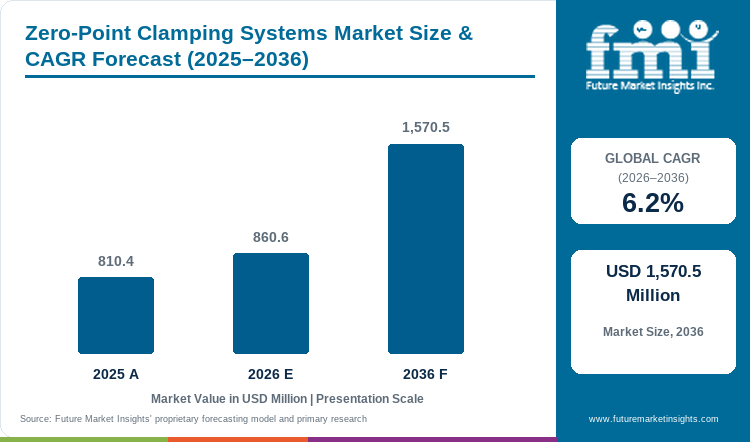
Demand for zero-point clamping systems is estimated at USD 860.6 Million in 2026 and is forecast to reach USD 1,570.5 Million by 2036, growing at a CAGR of 6.2%. The market was valued at USD 810.4 Million in 2025. Buyers compare recovered spindle time with the cost of base plates, pull studs and fixture conversion, making frequent changeover the clearest commercial case.
The Association for Manufacturing Technology reported on August 10, 2026 that US metalworking machinery orders reached USD 3.44 billion in the first half of 2026, up 36.0% from the same period in 2025. New machines create first-fit opportunities, while existing equipment supports retrofit demand where setup time constrains capacity.
Key Takeaways
- The market is forecast to rise from USD 860.6 Million in 2026 to USD 1,570.5 Million by 2036 at a 6.2% CAGR.
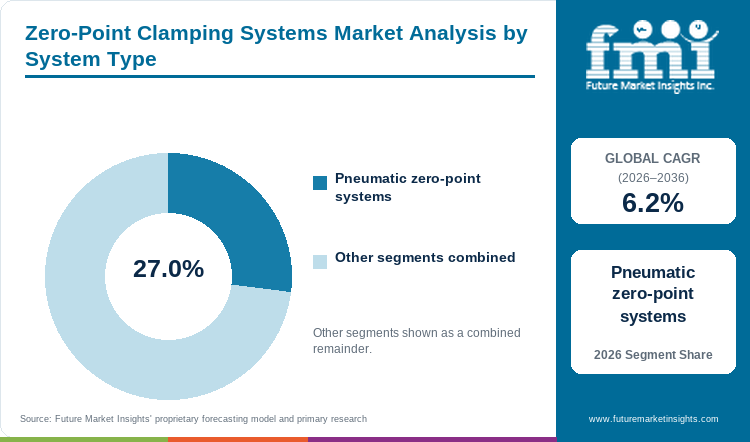
- Pneumatic zero-point systems are estimated at 27.0% of System Type demand in 2026 because factory air supports fast release cycles and practical automation integration.
- Below 5 kN is estimated at 19.0% of Clamping Force demand in 2026, reflecting compact modules used with smaller fixtures and space-constrained machining setups.
- CNC machining centers are estimated at 39.0% of Machine Type demand in 2026 because fixture-change frequency and broad installed bases favor repeatable locating interfaces.
- Retrofit approval can slow adoption when plate geometry, stack height, media routing or process revalidation erodes the expected setup-time saving.
- Schunk, Lang Technik, Jergens, AMF Andreas Maier, Römheld, 5th Axis, Erowa, System 3R / GF Machining Solutions, Stark Spannsysteme and Vektek are notable suppliers in the assessed competitive set.
Analyst Perspective
Commercial success depends on reducing integration risk. Suppliers need repeatability, machine compatibility and clear clamping-force behavior for the intended process. Sensor-ready interfaces become more valuable as users move from manual changeover to unattended operation.
- Nikhil Kaitwade, Principal Analyst at Future Market Insights
How is the Zero-Point Clamping Systems Market segmented?
The market is segmented by System Type, Clamping Force, Machine Type, End Use, Sales Channel and Region.
System Type covers actuation architecture, Clamping Force covers pull-in requirements and Machine Type reflects machine geometry. End Use captures the production setting, while Sales Channel reflects how buyers obtain fit checks, application support and replacement components.
What makes Pneumatic zero-point systems central to the System Type category?
Pneumatic zero-point systems use plant air for release while the mechanical interface secures the fixture during machining. This suits pallet exchange and robot tending because release and clamp confirmation can be coordinated with the cell controller, often without a dedicated hydraulic power unit.
- Pneumatic zero-point systems hold a 27.0% share in 2026, supported by fast actuation and practical integration with automated fixture exchange.
This demand sits inside the wider CNC workholding systems market, where machine fit, repeatability and quick-change economics determine whether a standardized base can replace conventional fixture changeover.
Why does Below 5 kN lead the Clamping Force category?
Below 5 kN modules suit compact fixtures and smaller workpieces. Their size can preserve tool access on dense five-axis setups while the vise or fixture supplies process-specific gripping force. Higher clamping bands become more relevant as pallet mass and cutting loads rise.
- Below 5 kN holds a 19.0% share in 2026, reflecting demand for compact modules used in small-part machining and space-constrained automation.
How do CNC machining centers anchor the Machine Type category?
CNC machining centers favor zero-point clamping because repeated setup can consume scheduled machine time. A fixed base lets different fixtures return to one reference, reducing indicating and supporting off-machine presetting across compatible vertical, horizontal and five-axis machines.
- CNC machining centers hold a 39.0% share in 2026 because fixture-change frequency and broad installed bases create recurring demand for standardized locating systems.
The commercial case strengthens as industrial automation programs connect workholding decisions with robot loading, controller logic and repeatable cell commissioning.
How does Die & mold shape End Use demand?
Die and mold production benefits from repeatable relocation across roughing, finishing, inspection and EDM. Stable reference positions reduce setup error on high-value components and support repeated movement of plates, vises and modular fixtures between process steps.
The same changeover logic is visible across factory automation and industrial controls investments where fixture state and machine readiness must be predictable before automated production begins.
How do Workholding distributors influence the Sales Channel category?
Workholding distributors matter when retrofits require base-plate selection, pull-stud geometry or stack-height checks. Direct OEM supply suits larger standardized rollouts, while machine-tool dealers and automation integrators gain relevance when the system is commissioned with a new machine or robot-tended cell.
What are the drivers, restraints and opportunities in the Zero-Point Clamping Systems Market?
Shorter non-cutting setup time supports adoption, retrofit and validation costs slow conversion, and sensorized automation-ready interfaces expand the opportunity for unattended machining.
- Driver: High-mix machining and automation raise the value of repeatable fixture exchange.
- Restraint: Retrofit cost and machine-specific validation can delay purchases on legacy equipment.
- Opportunity: Sensorized and electrically actuated systems can simplify clamp-status verification in unattended cells.
The principal driver is the cost of machine idle time where fixtures change frequently. Active machinery investment also creates first-fit opportunities for standardized workholding, while off-machine presetting improves the economics when one interface supports several pallets or fixtures.
Automation raises the specification because robot-tended cells require predictable seating and machine-readable clamp status. Workholding therefore becomes part of the cell-control design rather than a stand-alone mechanical purchase.
Retrofit approval is the main restraint. New plates, pull studs or fixture changes can extend validation and weaken payback. VDW reported in March 2026 that German machine-tool orders for 2025 were 3% lower overall and domestic orders fell 16%, increasing scrutiny of discretionary retrofits.
The opportunity is simpler verification in unattended cells. Sensorized modules and wireless clamp-state monitoring can confirm seating before machining. SCHUNK and STARK demonstrated sensor-enabled clamping concepts around EMO 2025, linking mechanical repeatability with status feedback.
Which country CAGRs are covered in the Zero-Point Clamping Systems Market?
| Country | CAGR |
|---|---|
| Czech Republic | 7.0% |
| USA | 5.8% |
| Japan | 5.1% |
| Germany | 5.5% |
| Mexico | 6.3% |
| Italy | 5.4% |
| South Korea | 6.0% |
How do country-level CAGRs compare in the Zero-Point Clamping Systems Market?
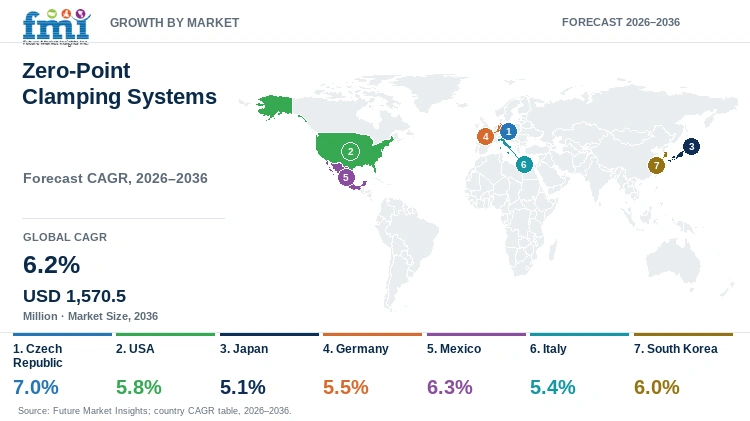
The country CAGRs span 1.9 percentage points, from Czech Republic at 7.0% to Japan at 5.1%. Mexico follows at 6.3%, South Korea at 6.0% and USA at 5.8%. Germany reaches 5.5% and Italy 5.4%. These rates indicate forecast pace, not absolute country revenue.
- Czech Republic exceeds Mexico by 0.7 percentage points.
- Mexico exceeds South Korea by 0.3 percentage points.
- South Korea exceeds USA by 0.2 percentage points.
- USA exceeds Germany by 0.3 percentage points, while Germany exceeds Italy by 0.1 percentage point.
- Italy exceeds Japan by 0.3 percentage points.
Country-wise Analysis
Czech Republic: Demand is forecast to expand at 7.0% CAGR from 2026 to 2036. The Czech Statistical Office reported June 2026 industrial production up 4.0% year on year and new industrial orders up 13.1%. Export-oriented machining supports standardized workholding where common equipment serves several production programs.
- USA: Sales are forecast to rise at 5.8% CAGR from 2026 to 2036. AMT reported first-half 2026 metalworking machinery orders of USD 3.44 billion, up 36.0% from the same period in 2025. New-machine purchases and automation projects create opportunities where fixture-change time is measurable.
- Japan: Adoption is forecast to expand at 5.1% CAGR from 2026 to 2036. JMTBA reported June 2026 machine-tool orders of JPY 203.38 billion, up 52.7% year on year. Precision machining favors compact, repeatable interfaces that fit established machine-tending strategies.
- Germany: Demand is forecast to increase at 5.5% CAGR from 2026 to 2036. VDW reported 2025 machine-tool orders down 3% overall and domestic orders down 16%. Buyers therefore place greater weight on quantified uptime gains before approving retrofit workholding.
- Mexico: Demand is forecast to rise at 6.3% CAGR from 2026 to 2036. INEGI reported 342,926 light vehicles produced in May 2026 and 306,288 exported. Automotive production supports repeatable changeover, while local parts and application support remain important across mixed machine platforms.
- Italy: Demand is forecast to expand at 5.4% CAGR from 2026 to 2036. UCIMU reported its machine-tool order index down 25.8% year on year in the second quarter of 2026, with domestic orders down 38.7%. This favors staged workholding upgrades with visible machine-level payback.
- South Korea: Adoption is forecast to rise at 6.0% CAGR from 2026 to 2036. Automated production increases the value of repeatable interfaces that coordinate with robot access and control logic. Sensor-ready hardware and local engineering support are therefore important for cell integration.
Who are the notable companies in the Zero-Point Clamping Systems Market?
Schunk, Lang Technik, Jergens, AMF Andreas Maier, Römheld, 5th Axis, Erowa, System 3R / GF Machining Solutions, Stark Spannsysteme and Vektek are notable companies serving the market.
Competition differs by interface breadth, automation support and application engineering. Platform providers link workholding with automated handling, while modular suppliers focus on reusable reference formats. Specialist clamping groups address demanding or monitored applications.
- Integrated workholding and automation: Schunk, Erowa and System 3R / GF Machining Solutions.
- Modular zero-point and fixture specialists: Lang Technik, Jergens, AMF Andreas Maier, 5th Axis and Vektek.
- Broader clamping and intelligent zero-point systems: Römheld and Stark Spannsysteme.
Competitive Benchmarking: Zero-Point Clamping Systems Market
| Company | Actuation & Module Breadth | Automation & Clamp Verification | Reference-System Portability | Geographic Reach |
|---|---|---|---|---|
| Schunk | High | High | High | Europe, North America, Asia and partner markets |
| Lang Technik | Medium | High | High | Europe, North America and selected global markets |
| Jergens | High | Medium | Medium | North America with international distribution |
| AMF Andreas Maier | High | High | Medium | Europe with international sales coverage |
| Römheld | Medium | High | Medium | Europe, North America, Asia and group partner markets |
| 5th Axis | Medium | Medium | High | North America with international distribution |
| Erowa | Medium | High | High | Europe, North America, Asia and global service markets |
| System 3R / GF Machining Solutions | Medium | High | High | Europe, North America, Asia and GF markets |
| Stark Spannsysteme | High | High | High | Europe plus group sales and service markets |
| Vektek | Medium | Medium | Medium | North America with international industrial customers |
Scoring basis: High indicates broad documented capability and Medium indicates credible but narrower coverage across module breadth, automation or reference portability. Geographic Reach describes documented commercial coverage and does not represent market share.
Key Developments in the Zero-Point Clamping Systems Market
- In June 2026, Erowa expanded Robot Six for mixed pallet and raw-part handling with a drawer magazine, automatic screwdriving and monitored clamping integrated with EROWA JMS 4.0.
- In October 2025, Schunk detailed battery-powered electromechanical VERO-S workholding with IO-Link Wireless, enabling clamp-status transmission without fixed signal cabling.
- In September 2025, Stark Spannsysteme presented STARK.spheric at EMO 2025, combining zero-point clamping with pendulum alignment and longitudinal compensation for large workpieces.
Key Players in the Zero-Point Clamping Systems Market
Integrated Workholding and Automation Platforms
- Schunk
- Erowa
- System 3R / GF Machining Solutions
Modular Zero-Point and Fixture Specialists
- Lang Technik
- Jergens
- AMF Andreas Maier
- 5th Axis
- Vektek
Broader Clamping and Intelligent Zero-Point Systems
- Römheld
- Stark Spannsysteme
Zero-Point Clamping Systems Market - Report Scope
| Coverage field | Report scope |
|---|---|
| Market breakdown | System Type; Clamping Force; Machine Type; End Use; Sales Channel; Region |
| Quantitative Units | USD Million |
| Market Definition | Zero-point modules, chucks, base plates, pallets, system-specific pull studs and dedicated assemblies for repeatable locating and quick-change workholding. Machine tools, robots and conventional fixtures without a zero-point interface are excluded. |
| Regions Covered | North America; Latin America; Western Europe; Eastern Europe; East Asia; South Asia and Pacific; Middle East and Africa |
| Countries Covered | Czech Republic; USA; Japan; Germany; Mexico; Italy; South Korea; additional countries across the standard regional coverage |
| Key Companies Covered | Schunk; Lang Technik; Jergens; AMF Andreas Maier; Römheld; 5th Axis; Erowa; System 3R / GF Machining Solutions; Stark Spannsysteme; Vektek |
| Forecast Period | 2026 to 2036 |
| Approach | Primary and desk research with market triangulation across product scope, machine-tool demand and adoption conditions. |
Zero-Point Clamping Systems Market - Research Methodology
| Method | Approach |
|---|---|
| Primary Research | Discussions with market participants test buying criteria, retrofit friction and application requirements. |
| Desk Research | National statistics, machine-tool associations, technical literature and official company documentation support market and country analysis. |
| Market Sizing and Forecasting | Sizing reconciles product scope, machine-tool investment, end-use exposure and country adoption. Forecast assumptions consider equipment cycles, automation intensity and retrofit economics. |
| Data Validation | Findings are cross-checked across independent source types. Adjacent machine tools, robots and conventional workholding are excluded from market revenue. |
Zero-Point Clamping Systems Market by Segments
Zero-Point Clamping Systems Market segmented by System Type:
- Pneumatic zero-point systems
- Hydraulic zero-point systems
- Manual zero-point systems
- Modular pallet systems
- Automation-ready zero-point systems
Zero-Point Clamping Systems Market segmented by Clamping Force:
- Below 5 kN
- 5-15 kN
- 15-30 kN
- Above 30 kN
Zero-Point Clamping Systems Market segmented by Machine Type:
- CNC machining centers
- 5-axis machines
- Turning centers
- Grinding machines
- EDM machines
Zero-Point Clamping Systems Market segmented by End Use:
- Die & mold
- Aerospace machining
- Automotive parts
- Medical devices
- Job shops
Zero-Point Clamping Systems Market segmented by Sales Channel:
- Workholding distributors
- Direct OEM supply
- Machine tool dealers
- Automation integrators
Zero-Point Clamping Systems Market by Region:
- North America
- United States
- Canada
- Latin America
- Brazil
- Mexico
- Argentina
- Chile
- Western Europe
- Germany
- France
- United Kingdom
- Italy
- Spain
- Benelux
- Nordics
- Eastern Europe
- Poland
- Czech Republic
- Romania
- Hungary
- East Asia
- China
- Japan
- South Korea
- South Asia and Pacific
- India
- ASEAN
- Australia and New Zealand
- Middle East and Africa
- GCC Countries
- South Africa
- Türkiye
- Israel
Research Sources and Bibliography
- Czech Statistical Office. (2026, August 6). Industry - June 2026.
- Association for Manufacturing Technology. (2026, August 10). 2026 Manufacturing Technology Orders Set Half-Year Record.
- Japan Machine Tool Builders' Association. (2026, August 5). The Current Condition of the Japanese Machine Tool Industry: Monthly Machine Tool Orders, June 2026.
- German Machine Tool Builders' Association, VDW. (2026, March 18). German machine tool industry leveling off - China further dominating production.
- UCIMU-SISTEMI PER PRODURRE. (2026, July 14). Order index still falling in the second quarter of 2026.
- INEGI. (2026, June 8). Registro Administrativo de la Industria Automotriz de Vehículos Ligeros, May 2026.
- Erowa. (2026, June 2). Mixed Handling with EROWA: combined pallet and raw part handling.
- Stark Spannsysteme. (2025, September 22-26). Review: STARK Spannsysteme at EMO 2025 - Six World Premieres in Focus.
- Schunk. (2025). An important step into an exciting future.
- Jergens, Inc. Zero Point System product and knowledge-center documentation.
- AMF Andreas Maier GmbH & Co. KG. Zero-point systems product documentation.
- GF Machining Solutions, System 3R. Tooling, automation and software solutions.
This bibliography is provided for reader reference. The full report contains additional references and detailed citations.
This Report Answers
- What is the Zero-Point Clamping Systems Market size in 2026 and what value is forecast for 2036?
- Which machining and automation conditions support demand for zero-point clamping systems?
- Why do Pneumatic zero-point systems hold the leading position in System Type?
- How does the Below 5 kN category support compact workholding?
- Why do CNC machining centers hold the leading position in Machine Type?
- How do country growth rates differ across Czech Republic, USA, Japan, Germany, Mexico, Italy and South Korea?
- Which companies compete through integrated automation, modular fixtures and specialist zero-point systems?
- What retrofit and validation conditions can delay adoption?
- What should manufacturing engineering teams verify before standardizing a zero-point platform?
Frequently Asked Questions
How big is the Zero-Point Clamping Systems Market in 2026?
The market is estimated at USD 860.6 Million in 2026 and is forecast to reach USD 1,570.5 Million by 2036 at a 6.2% CAGR.
What is the CAGR of the Zero-Point Clamping Systems Market from 2026 to 2036?
The Zero-Point Clamping Systems Market is forecast to grow at 6.2% CAGR from 2026 to 2036.
Which System Type leads the Zero-Point Clamping Systems Market?
Pneumatic zero-point systems are estimated to hold 27.0% of System Type demand in 2026.
Which Clamping Force category leads in 2026?
Below 5 kN is estimated to hold 19.0% of Clamping Force demand in 2026.
Which Machine Type leads the market in 2026?
CNC machining centers are estimated to hold 39.0% of Machine Type demand in 2026.
What is the main restraint on adoption?
Retrofit cost can delay adoption when base plates, pull studs, fixture changes, media routing or process revalidation reduce the expected setup-time saving.
Which companies are active in the Zero-Point Clamping Systems Market?
Notable companies include Schunk, Lang Technik, Jergens, AMF Andreas Maier, Römheld, 5th Axis, Erowa, System 3R / GF Machining Solutions, Stark Spannsysteme and Vektek.
Preview the report firsthand - request a free sample
Get SampleGet the brochure for pricing and purchase details.
Get PDFTable of Content
- Key Takeaways
- Market Size and CAGR
- Top Growth Driver
- Fastest Growing Segment
- Leading Region
- Key Companies
- Emerging Opportunities
- Executive Summary
- Global Market Outlook
- Demand-side Trends
- Supply-side Trends
- Technology Roadmap Analysis
- Analysis and Recommendations
- Analyst Perspective (What is happening? Why now? What should investors know?)
- Key Questions Answered
- How large is the market?
- What is the CAGR?
- What are key trends?
- Which region dominates?
- Who are the leaders?
- Market Overview
- Market Coverage / Taxonomy
- Market Definition / Scope / Limitations
- Research Methodology
- Chapter Orientation
- Analytical Lens and Working Hypotheses
- Market Structure, Signals, and Trend Drivers
- Benchmarking and Cross-market Comparability
- Market Sizing, Forecasting, and Opportunity Mapping
- Research Design and Evidence Framework
- Desk Research Programme (Secondary Evidence)
- Expert Input and Fieldwork (Primary Evidence)
- Tooling, Models, and Reference Databases
- Data Engineering and Model Build
- Quality Assurance and Audit Trail
- Market Background
- Market Dynamics (Drivers, Restraints, Opportunity, Trends)
- Scenario Forecast (Optimistic, Likely, Conservative)
- Impact Analysis
- AI Impact
- Sustainability Impact
- Regulatory Impact
- Technology Impact
- Consumer / Buyer Analysis
- Purchase Drivers
- Adoption Barriers
- Buyer Journey
- Opportunity Map Analysis
- Product Life Cycle Analysis
- Supply Chain Analysis
- Investment Feasibility Matrix
- Value Chain Analysis
- PESTLE and Porter's Analysis
- Regulatory Landscape
- Regional Parent Market Outlook
- Production and Consumption Statistics
- Import and Export Statistics
- Global Market Analysis and Forecast, 2021 to 2036
- Historical Market Size Value (USD Million) Analysis, 2021 to 2025
- Current and Future Market Size Value (USD Million) Projections, 2026 to 2036
- Y-o-Y Growth Trend Analysis
- Absolute $ Opportunity Analysis
- Global Market Pricing Analysis, 2021 to 2036
- Global Market Analysis and Forecast, By System Type, 2021 to 2036
- Introduction / Key Findings
- Historical Market Size Value (USD Million) Analysis By System Type, 2021 to 2025
- Current and Future Market Size Value (USD Million) Analysis and Forecast By System Type, 2026 to 2036
- Pneumatic zero-point systems
- Hydraulic zero-point systems
- Manual zero-point systems
- Modular pallet systems
- Automation-ready zero-point systems
- Y-o-Y Growth Trend Analysis By System Type, 2021 to 2025
- Absolute $ Opportunity Analysis By System Type, 2026 to 2036
- Global Market Analysis and Forecast, By Clamping Force, 2021 to 2036
- Introduction / Key Findings
- Historical Market Size Value (USD Million) Analysis By Clamping Force, 2021 to 2025
- Current and Future Market Size Value (USD Million) Analysis and Forecast By Clamping Force, 2026 to 2036
- Below 5 kN
- 5-15 kN
- 15-30 kN
- Above 30 kN
- Y-o-Y Growth Trend Analysis By Clamping Force, 2021 to 2025
- Absolute $ Opportunity Analysis By Clamping Force, 2026 to 2036
- Global Market Analysis and Forecast, By Machine Type, 2021 to 2036
- Introduction / Key Findings
- Historical Market Size Value (USD Million) Analysis By Machine Type, 2021 to 2025
- Current and Future Market Size Value (USD Million) Analysis and Forecast By Machine Type, 2026 to 2036
- CNC machining centers
- 5-axis machines
- Turning centers
- Grinding machines
- EDM machines
- Y-o-Y Growth Trend Analysis By Machine Type, 2021 to 2025
- Absolute $ Opportunity Analysis By Machine Type, 2026 to 2036
- Global Market Analysis and Forecast, By End Use, 2021 to 2036
- Introduction / Key Findings
- Historical Market Size Value (USD Million) Analysis By End Use, 2021 to 2025
- Current and Future Market Size Value (USD Million) Analysis and Forecast By End Use, 2026 to 2036
- Die & mold
- Aerospace machining
- Automotive parts
- Medical devices
- Job shops
- Y-o-Y Growth Trend Analysis By End Use, 2021 to 2025
- Absolute $ Opportunity Analysis By End Use, 2026 to 2036
- Global Market Analysis and Forecast, By Sales Channel, 2021 to 2036
- Introduction / Key Findings
- Historical Market Size Value (USD Million) Analysis By Sales Channel, 2021 to 2025
- Current and Future Market Size Value (USD Million) Analysis and Forecast By Sales Channel, 2026 to 2036
- Workholding distributors
- Direct OEM supply
- Machine tool dealers
- Automation integrators
- Y-o-Y Growth Trend Analysis By Sales Channel, 2021 to 2025
- Absolute $ Opportunity Analysis By Sales Channel, 2026 to 2036
- Global Market Analysis and Forecast, By Region, 2021 to 2036
- Introduction
- Historical Market Size Value (USD Million) Analysis By Region, 2021 to 2025
- Current Market Size Value (USD Million) Analysis and Forecast By Region, 2026 to 2036
- North America
- Latin America
- Western Europe
- Eastern Europe
- East Asia
- South Asia and Pacific
- Middle East and Africa
- Market Attractiveness Analysis By Region
- North America Market Analysis and Forecast, By Country, 2021 to 2036
- Historical Market Size Value (USD Million) Trend Analysis By Market Taxonomy, 2021 to 2025
- Market Size Value (USD Million) Forecast By Market Taxonomy, 2026 to 2036
- By Country
- United States
- Canada
- By System Type
- By Clamping Force
- By Machine Type
- By End Use
- By Sales Channel
- By Country
- Market Attractiveness Analysis
- By Country
- By System Type
- By Clamping Force
- By Machine Type
- By End Use
- By Sales Channel
- Key Takeaways
- Latin America Market Analysis and Forecast, By Country
- Historical Market Size Value (USD Million) Trend Analysis By Market Taxonomy, 2021 to 2025
- Market Size Value (USD Million) Forecast By Market Taxonomy, 2026 to 2036
- By Country
- Brazil
- Mexico
- Argentina
- Chile
- By System Type
- By Clamping Force
- By Machine Type
- By End Use
- By Sales Channel
- By Country
- Market Attractiveness Analysis
- By Country
- By System Type
- By Clamping Force
- By Machine Type
- By End Use
- By Sales Channel
- Key Takeaways
- Western Europe Market Analysis and Forecast, By Country
- Historical Market Size Value (USD Million) Trend Analysis By Market Taxonomy, 2021 to 2025
- Market Size Value (USD Million) Forecast By Market Taxonomy, 2026 to 2036
- By Country
- Germany
- France
- United Kingdom
- Italy
- Spain
- Benelux
- Nordics
- By System Type
- By Clamping Force
- By Machine Type
- By End Use
- By Sales Channel
- By Country
- Market Attractiveness Analysis
- By Country
- By System Type
- By Clamping Force
- By Machine Type
- By End Use
- By Sales Channel
- Key Takeaways
- Eastern Europe Market Analysis and Forecast, By Country
- Historical Market Size Value (USD Million) Trend Analysis By Market Taxonomy, 2021 to 2025
- Market Size Value (USD Million) Forecast By Market Taxonomy, 2026 to 2036
- By Country
- Poland
- Czech Republic
- Romania
- Hungary
- By System Type
- By Clamping Force
- By Machine Type
- By End Use
- By Sales Channel
- By Country
- Market Attractiveness Analysis
- By Country
- By System Type
- By Clamping Force
- By Machine Type
- By End Use
- By Sales Channel
- Key Takeaways
- East Asia Market Analysis and Forecast, By Country
- Historical Market Size Value (USD Million) Trend Analysis By Market Taxonomy, 2021 to 2025
- Market Size Value (USD Million) Forecast By Market Taxonomy, 2026 to 2036
- By Country
- China
- Japan
- South Korea
- By System Type
- By Clamping Force
- By Machine Type
- By End Use
- By Sales Channel
- By Country
- Market Attractiveness Analysis
- By Country
- By System Type
- By Clamping Force
- By Machine Type
- By End Use
- By Sales Channel
- Key Takeaways
- South Asia and Pacific Market Analysis and Forecast, By Country
- Historical Market Size Value (USD Million) Trend Analysis By Market Taxonomy, 2021 to 2025
- Market Size Value (USD Million) Forecast By Market Taxonomy, 2026 to 2036
- By Country
- India
- ASEAN
- Australia and New Zealand
- By System Type
- By Clamping Force
- By Machine Type
- By End Use
- By Sales Channel
- By Country
- Market Attractiveness Analysis
- By Country
- By System Type
- By Clamping Force
- By Machine Type
- By End Use
- By Sales Channel
- Key Takeaways
- Middle East and Africa Market Analysis and Forecast, By Country
- Historical Market Size Value (USD Million) Trend Analysis By Market Taxonomy, 2021 to 2025
- Market Size Value (USD Million) Forecast By Market Taxonomy, 2026 to 2036
- By Country
- GCC Countries
- South Africa
- Türkiye
- Israel
- By System Type
- By Clamping Force
- By Machine Type
- By End Use
- By Sales Channel
- By Country
- Market Attractiveness Analysis
- By Country
- By System Type
- By Clamping Force
- By Machine Type
- By End Use
- By Sales Channel
- Key Takeaways
- Key Countries Market Analysis
- United States
- Pricing Analysis
- Market Share Analysis, 2025
- By System Type
- By Clamping Force
- By Machine Type
- By End Use
- By Sales Channel
- Canada
- Pricing Analysis
- Market Share Analysis, 2025
- By System Type
- By Clamping Force
- By Machine Type
- By End Use
- By Sales Channel
- Mexico
- Pricing Analysis
- Market Share Analysis, 2025
- By System Type
- By Clamping Force
- By Machine Type
- By End Use
- By Sales Channel
- Brazil
- Pricing Analysis
- Market Share Analysis, 2025
- By System Type
- By Clamping Force
- By Machine Type
- By End Use
- By Sales Channel
- Chile
- Pricing Analysis
- Market Share Analysis, 2025
- By System Type
- By Clamping Force
- By Machine Type
- By End Use
- By Sales Channel
- Germany
- Pricing Analysis
- Market Share Analysis, 2025
- By System Type
- By Clamping Force
- By Machine Type
- By End Use
- By Sales Channel
- United Kingdom
- Pricing Analysis
- Market Share Analysis, 2025
- By System Type
- By Clamping Force
- By Machine Type
- By End Use
- By Sales Channel
- Italy
- Pricing Analysis
- Market Share Analysis, 2025
- By System Type
- By Clamping Force
- By Machine Type
- By End Use
- By Sales Channel
- Spain
- Pricing Analysis
- Market Share Analysis, 2025
- By System Type
- By Clamping Force
- By Machine Type
- By End Use
- By Sales Channel
- France
- Pricing Analysis
- Market Share Analysis, 2025
- By System Type
- By Clamping Force
- By Machine Type
- By End Use
- By Sales Channel
- India
- Pricing Analysis
- Market Share Analysis, 2025
- By System Type
- By Clamping Force
- By Machine Type
- By End Use
- By Sales Channel
- ASEAN
- Pricing Analysis
- Market Share Analysis, 2025
- By System Type
- By Clamping Force
- By Machine Type
- By End Use
- By Sales Channel
- Australia and New Zealand
- Pricing Analysis
- Market Share Analysis, 2025
- By System Type
- By Clamping Force
- By Machine Type
- By End Use
- By Sales Channel
- China
- Pricing Analysis
- Market Share Analysis, 2025
- By System Type
- By Clamping Force
- By Machine Type
- By End Use
- By Sales Channel
- Japan
- Pricing Analysis
- Market Share Analysis, 2025
- By System Type
- By Clamping Force
- By Machine Type
- By End Use
- By Sales Channel
- South Korea
- Pricing Analysis
- Market Share Analysis, 2025
- By System Type
- By Clamping Force
- By Machine Type
- By End Use
- By Sales Channel
- Poland
- Pricing Analysis
- Market Share Analysis, 2025
- By System Type
- By Clamping Force
- By Machine Type
- By End Use
- By Sales Channel
- Hungary
- Pricing Analysis
- Market Share Analysis, 2025
- By System Type
- By Clamping Force
- By Machine Type
- By End Use
- By Sales Channel
- Türkiye
- Pricing Analysis
- Market Share Analysis, 2025
- By System Type
- By Clamping Force
- By Machine Type
- By End Use
- By Sales Channel
- South Africa
- Pricing Analysis
- Market Share Analysis, 2025
- By System Type
- By Clamping Force
- By Machine Type
- By End Use
- By Sales Channel
- Czech Republic
- Pricing Analysis
- Market Share Analysis, 2025
- By System Type
- By Clamping Force
- By Machine Type
- By End Use
- By Sales Channel
- United States
- Market Structure Analysis
- Competition Dashboard
- Competition Benchmarking
- Market Share Analysis of Top Players
- By Regional
- By System Type
- By Clamping Force
- By Machine Type
- By End Use
- By Sales Channel
- Emerging Startups
- Innovation Benchmarking
- Competition Analysis
- Competition Deep Dive
- Schunk
- Overview
- Product Portfolio
- Profitability by Market Segments
- Sales Footprint
- Strategy Overview
- Marketing Strategy
- Product Strategy
- Channel Strategy
- Lang Technik
- Jergens
- AMF Andreas Maier
- Römheld
- 5th Axis
- Erowa
- System 3R / GF Machining Solutions
- Stark Spannsysteme
- Vektek
- Schunk
- Case Studies
- Success Stories
- Recent Developments
- Competition Deep Dive
- Assumptions & Acronyms Used


