

- Market Size (2026)
- USD 3.9 Bn
- Forecast (2036)
- USD 6.7 Bn
- CAGR (2026 to 2036)
- 5.6%
How big is CNC Workholding Systems Market in 2026?
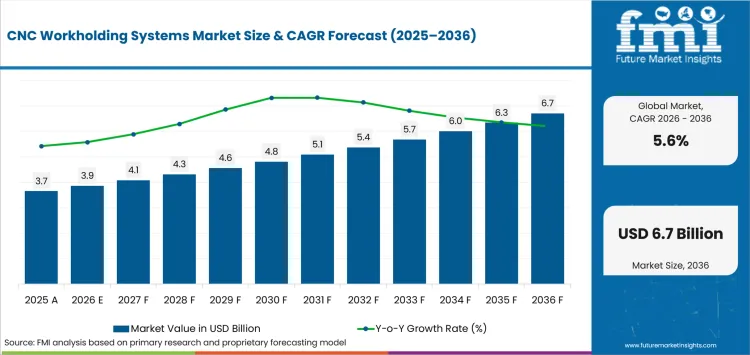
USD 3.9 billion in 2026 and USD 6.7 billion by 2036 at a 5.6% CAGR.
Demand for CNC workholding systems is projected to expand at 5.6% CAGR between 2026 and 2036, increasing valuation from USD 3.9 billion in 2026 to USD 6.7 billion by 2036. New CNC installations bring first-fit demand because every machine needs a validated clamping route before productive cutting begins. AMT reported on August 10, 2026 that June USA metalworking machinery orders were 56.8% above June 2025. That investment cycle pulls chucks, vises, fixture bases, and machine-specific interfaces into the commissioning plan.
Automation changes the workholding specification once a machine enters production. International Federation of Robotics data released April 8, 2026 placed South Korea at 1,220 industrial robots per 10,000 manufacturing employees, the highest density in its comparison. High robot density raises the value of repeatable pallet location, robot clearance, and clamp-state confirmation because unattended cells cannot rely on manual setup checks.
Key Takeaways
- New CNC installations and higher utilization targets increase workholding demand because each machine needs a proven clamping route before productive cutting begins.
- By system type, vises are estimated to hold 23.0% in 2026 owing to broad compatibility with milling and mixed-batch production.
- In 2026, milling centers are expected to lead machine type with 34.0% share because one platform accepts several stationary workholding formats.
- Manual actuation is projected to hold 31.0% share in 2026 due to retrofit flexibility and low utility requirements in mixed CNC fleets.
- Application engineering can delay higher-value adoption because machine fit, clamping force, tool clearance, and part distortion must be proven on the actual part family.
- Some of the key players in this market include Schunk, SMW Autoblok, Röhm, Kurt Workholding, Jergens, Kitagawa, Hainbuch, 5th Axis, Lang Technik, and Gerardi.
Analyst Perspective
"A workholding upgrade earns its place after the shop measures recovered setup time on the actual part family. The better investment preserves a proven machine interface and moves to powered clamping only where unattended hours repay extra controls and maintenance."
- Nikhil Kaitwade, Principal Consultant, Future Market Insights
How is the CNC workholding systems market segmented?
The market is segmented by system type, machine type, actuation, end use, sales channel and region.
The CNC workholding systems market is segmented by system type, machine type, actuation, end use, sales channel and region. System type covers vises, chucks, fixture plates, pallet systems, zero-point clamping and modular fixtures. Machine type separates milling, turning, five-axis, grinding and EDM platforms. Actuation distinguishes manual, hydraulic, pneumatic, mechanical quick-change and electric or smart formats. End use and sales channel identify the operating application and route to specification.
What makes vises central to the system type category?
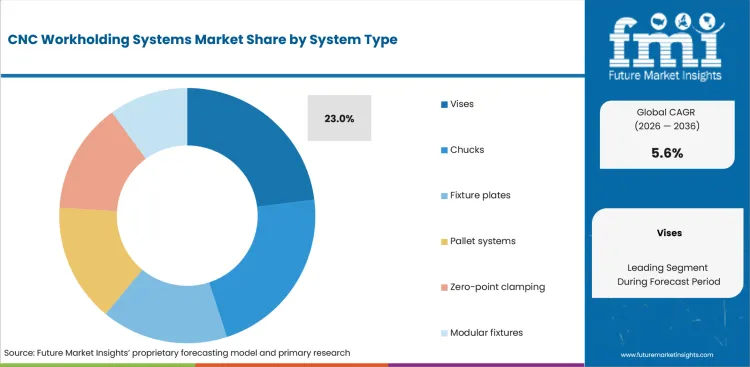
Vises cover prototype work and repeat production without requiring a dedicated fixture for every part family. Self-centering jaws also preserve tool access as the same base moves into five-axis or robot-tended machining daily.
- By system type, vises are estimated to hold 23.0% in 2026 owing to broad machine compatibility and lower part-specific engineering than dedicated fixtures.
- Jergens introduced pneumatic self-centering vises on August 3, 2026 for automated and unattended CNC machining. The launch gives existing vise-based setups powered opening and closing without forcing a custom fixture for every new part family during routine changeover.
Why do milling centers lead the machine type category?
Milling centers accept several stationary workholding formats on one table, so shops can change the clamping layer as programs change. That flexibility protects the machine asset while vises, columns, pallets, and zero-point bases carry different jobs.
- In 2026, milling centers are expected to lead machine type with 34.0% share because one platform can support several fixture architectures during its service life.
- Jergens launched cast-iron tooling column additions on May 5, 2025 with Ball Lock and QLS top-tool mounting. Horizontal machining users gained another quick-change route for multi-part setups without replacing the machine table or its existing locating scheme.
What supports manual actuation within the actuation category?
Manual workholding fits mixed CNC fleets without power units, air plumbing, valve islands, or controller I/O. A shop can move the same vise or chuck between machines and maintain it with familiar mechanical service.
- Manual actuation is projected to hold 31.0% share in 2026 due to retrofit flexibility and low utility requirements on machines that do not justify powered clamping.
- SMW Autoblok introduced its Manual Jack connection kit on March 11, 2025 for converting power chucks to manual operation. The kit fits milling, five-axis, and mill-turn machines without hydraulic or pneumatic table preparation.
Why does automotive machining lead the end use category?
Automotive machining repeats part families under tight cycle and transfer tolerances, so datum stability and predictable clamp release directly affect productive time. The cost of a slow changeover compounds over long automotive programs repeatedly.
- By end use, automotive machining is forecast to represent 29.0% in 2026 driven by production volumes that magnify non-cutting time and clamping variation.
- JMTBA documented a 63.4% month-on-month increase in Japanese machine-tool orders from motor-vehicle customers during June 2026. That capital activity keeps repeatable workholding relevant wherever new automotive capacity reaches machining cells with demanding cycle and transfer requirements.
What drives machine tool distributors in the sales channel category?
Workholding is approved at the machine interface, which makes local application knowledge more useful than a catalog-only sale. Distributors can check table patterns, jaw options, actuation, and mounting hardware before commissioning.
- The sales channel category is forecast to be led by machine tool distributors at 37.0% share in 2026 due to local inventory and machine-fit support.
- Kitagawa's December 2025 exhibition program named 1MTA as the distributor for MACH UK in April 2026. The listing shows how regional machine partners bring power chucks and related workholding closer to local technical support during machine selection and commissioning.
What are the drivers, restraints and opportunities in the CNC Workholding Systems Market?
Shorter setup time supports demand, application proof slows higher-value conversion, and verified digital fixture data reduces automation integration work.
- Driver: High-mix machining raises the cost of every setup, making quick-change workholding valuable after recovered spindle time is measured.
- Restraint: Powered and zero-point systems can stall during approval until machine fit, utilities, tool clearance, clamping force, and part distortion are proven.
- Opportunity: Manufacturer-verified fixture models can reduce programming and prove-out work before automated cells move from simulation into production.
High-mix production turns setup time into a visible capacity cost as one machine serves several part families. Jergens documented on May 28, 2025 that its custom-workholding process reviews concept, cost, timing, customer approval, and ROI before manufacturing starts. That sequence lets an engineered fixture compete on recovered machining time and repeatability instead of isolated clamp price.
Capital caution can postpone fixture replacement even after the technical case is proven. VDW reported on August 12, 2025 that German domestic machine-tool orders fell 22% in the first half of 2025. A powered or zero-point retrofit therefore needs payback evidence tied to the installed machine and actual part mix before capital approval.
Digital fixture geometry removes uncertainty before the first cutting trial. MachiningCloud announced on April 9, 2026 that manufacturer-verified 5th Axis vise, tombstone, and dovetail-fixture models were available for direct CAM use. A reliable digital fixture definition lets programmers check collisions and robot access before commissioning, which reduces integration work for factory automation controls and automated workholding.
Which country CAGRs are profiled in the CNC Workholding Systems Market?
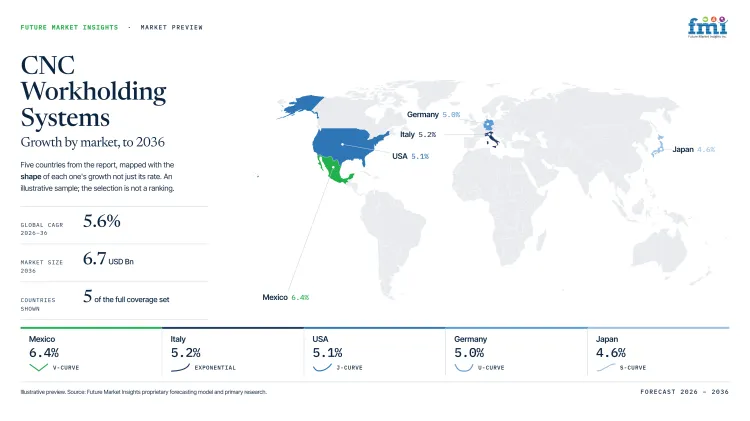
| Country | CAGR |
|---|---|
| Mexico | 6.4% |
| South Korea | 5.8% |
| Czech Republic | 5.7% |
| Italy | 5.2% |
| USA | 5.1% |
| Germany | 5.0% |
| Japan | 4.6% |
How do country-level CAGRs compare in the CNC Workholding Systems Market?
The 1.8 percentage-point range separates Mexico at 6.4% from a South Korea-Czech Republic pair near 5.8%. Italy, the USA, and Germany form a second cluster near 5.0%, while Japan closes the table at 4.6%. The spacing reflects replacement cycles, automation requirements, and service economics instead of current market size.
- Mexico localizes fixture support as vehicle programs transfer.
- South Korea prices robot access into workholding selection.
- Czech plants reuse bases during transferred vehicle programs.
- Italian machine-tool builders shorten feedback on complex retrofit workholding.
- USA job shops favor upgrades spanning machine generations.
- Germany preserves serviceable fixtures unless payback is clear.
- Japan values sealing and serviceability on long-lived machines.
Similar CAGRs still produce different order timing and service needs. The full report provides country-level CAGR analysis across North America, Latin America, Western Europe, Eastern Europe, East Asia, South Asia and Pacific and the Middle East and Africa.
Country-wise Analysis
- Mexican automotive suppliers transfer parts between Japanese, European, and USA CNC platforms, so fixture proof must survive mixed mounting interfaces and local maintenance practice. INEGI's August 7, 2026 update recorded 354,221 light vehicles produced in June and 301,009 exported, keeping replacement jaws and fixture changes tied to active vehicle programs. Mexico is projected to expand at 6.4% CAGR through 2036 because local workholding inventory can shorten repair delays during production transfers and keeps urgent spares closer to the line. Application support is less even below the largest provider tiers, which favors companies that can prove machine-specific setups without extending a vehicle launch.
- Robot-tended machining cells in South Korea reserve approach space and pallet positions early, placing clamping geometry inside the automation design before final commissioning. CNC workholding demand in South Korea is forecast to grow at 5.8% CAGR through 2036, tied to equipment renewal and highly automated production in electronics and transport machining. The Ministry of Data and Statistics published on August 31, 2026 that equipment investment was 24.9% higher year on year in July. Experienced integrators shorten commissioning, yet controller I/O and utility mapping can delay powered-clamp integration on mixed equipment and limit a fast conversion during retrofit work.
- Czech machining plants absorb transferred automotive programs through a dense local supply network, giving reusable bases an advantage before volumes justify dedicated fixtures. In September 2025, the Ministry of Industry and Trade stated that Toyota's Kolín plant sourced 65% of its parts from Czech suppliers. That local sourcing depth keeps fixture changes close to new vehicle programs and gives regional application partners a clear role during transfer work on short program timelines. Czech workholding demand is forecast to advance at 5.7% CAGR through 2036 owing to continued localization, although smaller machining firms still face thinner specialist coverage and higher qualification effort.
- Export orders often keep Italian machine-tool and precision shops busy during a weaker home investment cycle, so retrofit workholding must earn approval against cautious capital budgets in current programs. Italy is expected to register 5.2% CAGR through 2036 aided by export-led machining activity and later replacement demand from domestic plants serving export programs. UCIMU's April 21, 2026 release put first-quarter machine-tool orders 3.1% above a year earlier while domestic orders fell 28.8%. Modular vises and zero-point bases fit this uneven cycle because plants can improve current export cells without committing to a complete rebuild or interrupting proven machine interfaces.
- USA workholding companies serve high-mix job shops beside dedicated aerospace, medical, and transport cells, leaving one sales network to support many machine vintages nationally. The Census Bureau reported on August 26, 2026 that transportation-equipment orders rose 2.3% in July, keeping changeover economics visible in a machining-intensive customer base. Legacy interfaces remain the friction because a new base must preserve familiar fixture layers before automation hardware earns plant approval on older machines. CNC workholding sales in the USA are projected to record 5.1% CAGR through 2036 attributable to capital programs and staged upgrade demand in mixed production fleets.
- German precision manufacturers compare quick-change systems with fixtures that may already meet accuracy needs, raising the payback threshold for replacing a mature clamping base in current programs. Germany is projected to progress at 5.0% CAGR through 2036 given renewed machinery spending, yet validated geometry and service continuity constrain faster interface changes during plant conversion. Destatis data released on August 6, 2026 showed machinery and equipment orders 12.7% higher month on month in June nationally. Companies with repeatability records and retrofit plans can pursue that capital cycle without asking plants to discard serviceable workholding or restart proven machining processes during scheduled production.
- Japanese machining operations keep machine platforms in service for long programs, putting compact interference envelopes, sealing, maintenance records, and repeatability ahead of simple setup-speed claims in current production. METI's June 30, 2026 production forecast pointed to a 3.7% increase for June with production machinery among the strongest positive contributors. Japan is forecast to post 4.6% CAGR through 2036 propelled by steady equipment use and replacement activity in a mature manufacturing base through the assessment period. Conservative qualification of higher-cost automation favors companies with local service and documented accuracy over offers built mainly on faster changeover claims during initial conversion.
Who are the notable companies in the CNC Workholding Systems Market?
Schunk, SMW Autoblok, Röhm, Kurt Workholding, Jergens, Kitagawa, Hainbuch, 5th Axis, Lang Technik, and Gerardi are notable companies serving this market.
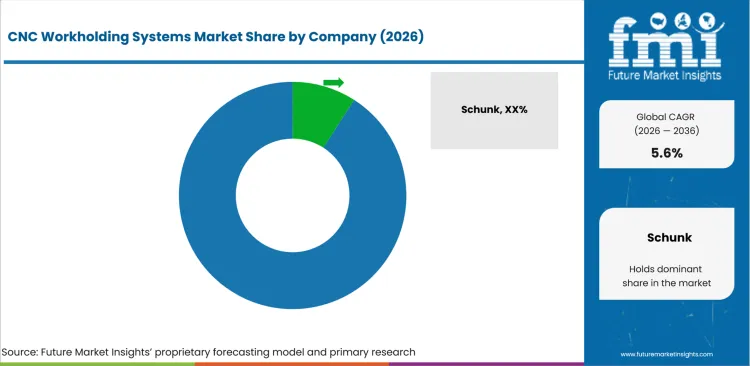
Competition follows the machine interface and depth of application support more than company scale. Turning specialists compete on chuck architecture, jaw change, and powered actuation, while milling specialists concentrate on vises, pallets, fixture plates, and zero-point systems. Entry becomes harder when a challenger cannot prove machine compatibility or supply replacement components close to the installed base.
- Turning and powered clamping: SMW Autoblok, Röhm, Kitagawa, and Hainbuch cover chucks, mandrels, collets, and automated changeover for turning-intensive applications.
- Milling and zero-point workholding: Schunk, 5th Axis, and Lang Technik focus on compact vises, quick-change bases, pallet interfaces, and automation-ready stationary workholding.
- Modular vise and fixture platforms: Kurt Workholding, Jergens, and Gerardi address configurable milling setups where machine fit and repeatable changeover govern selection.
Competitive Benchmarking: CNC Workholding Systems Market
| Company | Core CNC Workholding Breadth | Automation Integration | Application Support Depth | Geographic Reach |
|---|---|---|---|---|
| Schunk | High | High | High | Global |
| SMW Autoblok | High | High | High | Global |
| Röhm | High | Medium | High | Europe, North America and Asia-Pacific |
| Kurt Workholding | Medium | High | Medium | North America and international distributors |
| Jergens | Medium | High | High | North America, Europe and Asia |
| Kitagawa | High | High | High | Global |
| Hainbuch | High | High | High | Europe, North America and Asia |
| 5th Axis | Medium | High | High | North America and international sales |
| Lang Technik | Medium | High | High | More than 50 countries |
| Gerardi | Medium | High | Medium | Europe and international export markets |
Scoring basis: High breadth requires at least three documented CNC clamping routes. Medium breadth identifies a narrower verified family. High automation integration requires robot, controller, sensor, or automated changeover evidence, while Medium covers powered or quick-change integration. High application support requires documented engineering or technical service for several use cases, while Medium reflects a narrower support route. Geographic reach is descriptive and is not scored.
Key Developments in the CNC Workholding Systems Market
- In March 2026, Röhm introduced Fast-Lane adapters and flanges for standard power chucks to shorten machine-specific interface preparation. The service addresses the adapter work that can delay chuck commissioning on CNC machines and machining centers.
- In September 2025, Lang Technik placed a RoboTrex Compact system at FANUC's European Technical Center for robot-handled vise automation. The deployment gives machining users a working reference for automated vise exchange before committing to a production cell.
- In July 2025, SMW Autoblok introduced APS 138-E and APS 138-I zero-point modules with less than 0.005 mm repeatability. Their universal interface and robot-loading support target faster fixture change without rebuilding an established zero-point layout.
Key Players in the CNC Workholding Systems Market
Turning and Automated Clamping Platforms
- SMW Autoblok
- Röhm
- Kitagawa
- Hainbuch
Milling and Zero-Point Ecosystems
- Schunk
- 5th Axis
- Lang Technik
Modular Vise and Fixture Systems
- Kurt Workholding
- Jergens
- Gerardi
CNC Workholding Systems Market - Report Scope
| Coverage field | Report scope |
|---|---|
| Market breakdown | By system type, machine type, actuation, end use, sales channel and region. |
| Quantitative Units | USD billion. |
| Market Definition | Commercial CNC workholding systems used to locate, clamp, change, or automate workpieces on CNC and related machining platforms. |
| Regions Covered | North America, Latin America, Western Europe, Eastern Europe, East Asia, South Asia and Pacific and Middle East and Africa. |
| Countries Covered | Mexico, South Korea, Czech Republic, Italy, USA, Germany, Japan, and 30+ countries included in the full report. |
| Key Companies Profiled | Schunk, SMW Autoblok, Röhm, Kurt Workholding, Jergens, Kitagawa, Hainbuch, 5th Axis, Lang Technik, Gerardi. |
| Forecast Period | 2026 to 2036. |
| Approach | Primary and secondary research with market triangulation. |
CNC Workholding Systems Market - Research Methodology
| Method | Approach |
|---|---|
| Primary Research | FMI analysts gathered input from manufacturers, service providers, technology developers, distributors, end users, procurement teams, and subject-matter experts. Interviews examined purchasing decisions, product or service evaluation, adoption barriers, approval requirements, pricing considerations, and expectations for technical or commercial support. Respondents were also asked what evidence is required before a trial, pilot, or initial order develops into regular purchasing. |
| Desk Research | Desk research covered government statistics, regulatory publications, trade data, industry associations, technical literature, standards, company filings, product information, and official corporate announcements. Sources were reviewed for relevance, publication date, geographic coverage, and consistency with the defined market scope. Claims relating to performance, applications, approvals, capacity, investment, and commercial activity were retained only when supported by credible public evidence. |
| Market Sizing and Forecasting | The market model combined the baseline value with historical performance, segment structure, pricing and volume indicators, adoption levels, company participation, and country-level demand conditions. Forecast assumptions considered economic activity, investment trends, regulatory developments, technology adoption, purchasing cycles, supply availability, and barriers to wider market use. Segment and regional estimates were reconciled before the final market total was calculated. |
| Data Validation | Estimates were checked against multiple independent indicators, including public data, company activity, trade patterns, industry developments, and findings from primary interviews. Validation also tested whether products, services, applications, and company revenues fell within the defined market boundaries. Adjacent categories, unsupported claims, overlapping revenues, and activities without direct market relevance were excluded to reduce double counting and maintain consistency across segments and countries. |
CNC Workholding Systems Market by Segments
CNC Workholding Systems Market segmented by System Type:
- Vises
- Chucks
- Fixture plates
- Pallet systems
- Zero-point clamping
- Modular fixtures
CNC Workholding Systems Market segmented by Machine Type:
- Milling centers
- Turning centers
- 5-axis machines
- Grinding machines
- EDM machines
CNC Workholding Systems Market segmented by Actuation:
- Manual
- Hydraulic
- Pneumatic
- Mechanical quick-change
- Electric / smart
CNC Workholding Systems Market segmented by End Use:
- Automotive machining
- Aerospace
- Medical devices
- Mold & die
- General precision engineering
CNC Workholding Systems Market segmented by Sales Channel:
- Machine tool distributors
- Direct OEM supply
- Tooling integrators
- Catalog/e-commerce
CNC Workholding Systems Market by Region:
- North America
- United States
- Canada
- Latin America
- Brazil
- Mexico
- Argentina
- Chile
- Western Europe
- Germany
- France
- United Kingdom
- Italy
- Spain
- Benelux
- Nordics
- Eastern Europe
- Poland
- Czech Republic
- Romania
- Hungary
- East Asia
- China
- Japan
- South Korea
- South Asia and Pacific
- India
- ASEAN
- Australia and New Zealand
- Middle East and Africa
- GCC Countries
- South Africa
- Türkiye
- Israel
Research Sources and Bibliography
- Association for Manufacturing Technology. (2026, August 10). 2026 Manufacturing Technology Orders Set Half-Year Record
- International Federation of Robotics. (2026, April 8). Robot Density Surges in Europe, Asia, and Americas
- Jergens Inc. (2026, August 3). Jergens Inc. introduces its pneumatic self-centering vise for automated CNC machining applications
- Jergens Inc. (2025, May 5). Jergens Inc. launches American-made cast iron tooling column additions
- SMW Autoblok. (2025, March 11). New Manual Jack Connection Kit Easily Converts Power Chucks to Manual Chucks No Hydraulics or Pneumatics Needed
- Japan Machine Tool Builders' Association. (2026, August 5). The Current Condition of the Japanese Machine Tool Industry: Monthly Machine Tool Orders (June 2026)
- Kitagawa Europe. (2025, December 1). Exhibition: Mach UK
- Jergens Inc. (2025, May 28). Jergens Inc. Six Steps to Custom Design and Build Workholding Solutions
- VDW - German Machine Tool Builders' Association. (2025, August 12). Machine tool industry expecting no upturn until next year
- MachiningCloud. (2026, April 9). 5th Axis is Now Available on MachiningCloud
- Instituto Nacional de Estadística y Geografía. (2026, August 7). Venta, producción y exportación de vehículos ligeros
- Ministry of Data and Statistics, Republic of Korea. (2026, August 31). Monthly Industrial Statistics, July 2026
- Ministry of Industry and Trade of the Czech Republic. (2025, September 3). A major success for Czechia. Toyota to start producing electric cars and batteries in Kolín
- UCIMU-SISTEMI PER PRODURRE. (2026, April 21). UCIMU: IN THE FIRST QUARTER 2026 MACHINE TOOL ORDERS ON THE RISE (+3.1%) FOREIGN ORDERS (+28.9%); DOMESTIC ORDERS (-28.8%)
- USA Census Bureau. (2026, August 26). Monthly Advance Report on Durable Goods Manufacturers' Shipments, Inventories and Orders
- Federal Statistical Office of Germany. (2026, August 6). New orders in manufacturing in June 2026: +3.1% on the previous month
- Ministry of Economy, Trade and Industry, Japan. (2026, June 30). Indices of Industrial Production
- Röhm GmbH. (2026, March 18). Available in record time: Fast-Lane-Adapters and Flanges for Röhm Standard Power Chucks
- LANG Technik. (2025, September 9). RoboTrex Compact on display at the FANUC European Technical Center
- SMW Autoblok. (2025, July 22). New APS Zero-Point Clamping Modules Feature Universal Interface and Automation-Ready Features
- Röhm GmbH. (2025, April 24). Röhm invests in the future despite the economic crisis
- LANG Technik. (2026, May 12). Grand Opening - High-End Manufacturing Event
- Röhm GmbH. (2026, May 13). Custom in-house solution for manufacturing DURO-M lathe chucks: Greater productivity through multi-part clamping systems developed in-house
- SCHUNK. (2025, October). An important step into an exciting future
- SMW Autoblok. (2026, April 23). The Custom Workholding System Helping Lexair Valve It Up
- SCHUNK. (2025, September). Flexible and versatile clamping device
- SMW Autoblok. (2025, April 23). Automatic Quick Jaw Change with KNCS-matic
- Röhm GmbH. (2026, March 16). New! RÖHM's mobile clamping device inspection service
- Kurt Workholding. (2025, May 22). Boost 5-Axis Productivity with the New Kurt PFA620 Air Vise
- Jergens Inc. (2025, June 25). Jergens Inc. new Quick-Loc 2 combination pallet provides quick-change versatility
- Kitagawa Europe. (2025, March 10). Sealed low-grip force power chuck for carbide & glass manufacture
- Hainbuch GmbH. (2025, July 8). Fully automated. More flexible. More efficient. - Hainbuch at EMO 2025
- Thomas Skinner. (2025, April 28). New Partnership with 5th Axis to Deliver Industry-Leading Workholding and Automation Solutions Across Western Canada
- LANG Technik. (2026, August 24). AMB 2026: Showcasing technology. Discussing what matters.
- Gerardi S.p.A. (2025, March 10). Gerardi Expands Its Sales Network
- LANG Technik. (2026, September 3). Sales network
- 5th Axis. (2026, September 3). Factory Support Reps by State
This bibliography is provided for reader reference and is not exhaustive. The full report contains the complete reference list and detailed citations
This Report Answers
- How large is the CNC workholding systems market in 2026 and what value is forecast for 2036?
- Which equipment-investment and utilization conditions support demand for CNC workholding systems?
- Why do vises hold the leading position within system type in 2026?
- How does milling-center leadership affect demand for stationary and quick-change workholding?
- Why does manual actuation retain the leading share of the actuation category?
- How do country growth rates differ among Mexico, South Korea, Czech Republic, Italy, USA, Germany, and Japan?
- Which companies cover turning, milling, zero-point, modular fixture, and automated clamping requirements?
- What engineering and payback conditions can delay adoption of higher-value workholding?
- What should manufacturers verify before moving from manual fixtures into powered or automated workholding?
Frequently Asked Questions
How big is the CNC Workholding Systems Market in 2026?
The CNC workholding systems market is valued at USD 3.9 billion in 2026 and is projected to reach USD 6.7 billion by 2036. Growth follows new CNC installations and efforts to recover spindle time lost during setup changes.
What is the CAGR of the CNC Workholding Systems Market from 2026 to 2036?
The CNC workholding systems market is projected to grow at a CAGR of 5.6% between 2026 and 2036. Expansion depends on machine investment, higher utilization targets, and wider use of quick-change or automation-ready clamping.
Which system type leads the CNC Workholding Systems Market?
The vises segment is expected to hold 23.0% of the CNC workholding systems market in 2026, supported by broad milling compatibility. Self-centering and powered variants also let plants automate a familiar clamping format without replacing the complete fixture architecture.
Which machine type holds the largest current share in the CNC Workholding Systems Market?
The milling centers segment is projected to represent 34.0% of the CNC workholding systems market by machine type in 2026. One machine table can accept vises, pallets, columns, fixture plates, and zero-point bases as programs change.
Which companies are active in the CNC Workholding Systems Market?
Key companies operating in the market include Schunk, SMW Autoblok, Röhm, Kurt Workholding, Jergens, Kitagawa, Hainbuch, 5th Axis, Lang Technik, and Gerardi. Their positions differ by chucking depth, modular fixturing, automated changeover, application engineering, and regional service.
Preview the report firsthand - request a free sample
Get SampleGet the brochure for pricing and purchase details.
Get PDFTable of Content
- Key Takeaways
- Market Size and CAGR
- Top Growth Driver
- Fastest Growing Segment
- Leading Region
- Key Companies
- Emerging Opportunities
- Executive Summary
- Global Market Outlook
- Demand-side Trends
- Supply-side Trends
- Technology Roadmap Analysis
- Analysis and Recommendations
- Analyst Perspective (What is happening? Why now? What should investors know?)
- Key Questions Answered
- How large is the market?
- What is the CAGR?
- What are key trends?
- Which region dominates?
- Who are the leaders?
- Market Overview
- Market Coverage / Taxonomy
- Market Definition / Scope / Limitations
- Research Methodology
- Chapter Orientation
- Analytical Lens and Working Hypotheses
- Market Structure, Signals, and Trend Drivers
- Benchmarking and Cross-market Comparability
- Market Sizing, Forecasting, and Opportunity Mapping
- Research Design and Evidence Framework
- Desk Research Programme (Secondary Evidence)
- Expert Input and Fieldwork (Primary Evidence)
- Tooling, Models, and Reference Databases
- Data Engineering and Model Build
- Quality Assurance and Audit Trail
- Market Background
- Market Dynamics (Drivers, Restraints, Opportunity, Trends)
- Scenario Forecast (Optimistic, Likely, Conservative)
- Impact Analysis
- AI Impact
- Sustainability Impact
- Regulatory Impact
- Technology Impact
- Consumer / Buyer Analysis
- Purchase Drivers
- Adoption Barriers
- Buyer Journey
- Opportunity Map Analysis
- Product Life Cycle Analysis
- Supply Chain Analysis
- Investment Feasibility Matrix
- Value Chain Analysis
- PESTLE and Porter's Analysis
- Regulatory Landscape
- Regional Parent Market Outlook
- Production and Consumption Statistics
- Import and Export Statistics
- Global Market Analysis and Forecast, 2021 to 2036
- Historical Market Size Value (USD Billion) Analysis, 2021 to 2025
- Current and Future Market Size Value (USD Billion) Projections, 2026 to 2036
- Y-o-Y Growth Trend Analysis
- Absolute $ Opportunity Analysis
- Global Market Pricing Analysis, 2021 to 2036
- Global Market Analysis and Forecast, By System Type, 2021 to 2036
- Introduction / Key Findings
- Historical Market Size Value (USD Billion) Analysis By System Type, 2021 to 2025
- Current and Future Market Size Value (USD Billion) Analysis and Forecast By System Type, 2026 to 2036
- Vises
- Chucks
- Fixture plates
- Pallet systems
- Zero-point clamping
- Modular fixtures
- Vises
- Y-o-Y Growth Trend Analysis By System Type, 2021 to 2025
- Absolute $ Opportunity Analysis By System Type, 2026 to 2036
- Global Market Analysis and Forecast, By Machine Type, 2021 to 2036
- Introduction / Key Findings
- Historical Market Size Value (USD Billion) Analysis By Machine Type, 2021 to 2025
- Current and Future Market Size Value (USD Billion) Analysis and Forecast By Machine Type, 2026 to 2036
- Milling centers
- Turning centers
- 5-axis machines
- Grinding machines
- EDM machines
- Milling centers
- Y-o-Y Growth Trend Analysis By Machine Type, 2021 to 2025
- Absolute $ Opportunity Analysis By Machine Type, 2026 to 2036
- Global Market Analysis and Forecast, By Actuation, 2021 to 2036
- Introduction / Key Findings
- Historical Market Size Value (USD Billion) Analysis By Actuation, 2021 to 2025
- Current and Future Market Size Value (USD Billion) Analysis and Forecast By Actuation, 2026 to 2036
- Manual
- Hydraulic
- Pneumatic
- Mechanical quick-change
- Electric / smart
- Manual
- Y-o-Y Growth Trend Analysis By Actuation, 2021 to 2025
- Absolute $ Opportunity Analysis By Actuation, 2026 to 2036
- Global Market Analysis and Forecast, By End Use, 2021 to 2036
- Introduction / Key Findings
- Historical Market Size Value (USD Billion) Analysis By End Use, 2021 to 2025
- Current and Future Market Size Value (USD Billion) Analysis and Forecast By End Use, 2026 to 2036
- Automotive machining
- Aerospace
- Medical devices
- Mold & die
- General precision engineering
- Automotive machining
- Y-o-Y Growth Trend Analysis By End Use, 2021 to 2025
- Absolute $ Opportunity Analysis By End Use, 2026 to 2036
- Global Market Analysis and Forecast, By Sales Channel, 2021 to 2036
- Introduction / Key Findings
- Historical Market Size Value (USD Billion) Analysis By Sales Channel, 2021 to 2025
- Current and Future Market Size Value (USD Billion) Analysis and Forecast By Sales Channel, 2026 to 2036
- Machine tool distributors
- Direct OEM supply
- Tooling integrators
- Catalog/e-commerce
- Machine tool distributors
- Y-o-Y Growth Trend Analysis By Sales Channel, 2021 to 2025
- Absolute $ Opportunity Analysis By Sales Channel, 2026 to 2036
- Global Market Analysis and Forecast, By Region, 2021 to 2036
- Introduction
- Historical Market Size Value (USD Billion) Analysis By Region, 2021 to 2025
- Current Market Size Value (USD Billion) Analysis and Forecast By Region, 2026 to 2036
- North America
- Latin America
- Western Europe
- Eastern Europe
- East Asia
- South Asia and Pacific
- Middle East & Africa
- Market Attractiveness Analysis By Region
- North America Market Analysis and Forecast, By Country, 2021 to 2036
- Historical Market Size Value (USD Billion) Trend Analysis By Market Taxonomy, 2021 to 2025
- Market Size Value (USD Billion) Forecast By Market Taxonomy, 2026 to 2036
- By Country
- USA
- Canada
- By System Type
- By Machine Type
- By Actuation
- By End Use
- By Sales Channel
- By Country
- Market Attractiveness Analysis
- By Country
- By System Type
- By Machine Type
- By Actuation
- By End Use
- By Sales Channel
- Key Takeaways
- Latin America Market Analysis and Forecast, By Country
- Historical Market Size Value (USD Billion) Trend Analysis By Market Taxonomy, 2021 to 2025
- Market Size Value (USD Billion) Forecast By Market Taxonomy, 2026 to 2036
- By Country
- Brazil
- Mexico
- Chile
- Rest of Latin America
- By System Type
- By Machine Type
- By Actuation
- By End Use
- By Sales Channel
- By Country
- Market Attractiveness Analysis
- By Country
- By System Type
- By Machine Type
- By Actuation
- By End Use
- By Sales Channel
- Key Takeaways
- Western Europe Market Analysis and Forecast, By Country
- Historical Market Size Value (USD Billion) Trend Analysis By Market Taxonomy, 2021 to 2025
- Market Size Value (USD Billion) Forecast By Market Taxonomy, 2026 to 2036
- By Country
- Germany
- UK
- Italy
- Spain
- France
- Nordic
- BENELUX
- Rest of Western Europe
- By System Type
- By Machine Type
- By Actuation
- By End Use
- By Sales Channel
- By Country
- Market Attractiveness Analysis
- By Country
- By System Type
- By Machine Type
- By Actuation
- By End Use
- By Sales Channel
- Key Takeaways
- Eastern Europe Market Analysis and Forecast, By Country
- Historical Market Size Value (USD Billion) Trend Analysis By Market Taxonomy, 2021 to 2025
- Market Size Value (USD Billion) Forecast By Market Taxonomy, 2026 to 2036
- By Country
- Russia
- Poland
- Hungary
- Balkan & Baltic
- Rest of Eastern Europe
- By System Type
- By Machine Type
- By Actuation
- By End Use
- By Sales Channel
- By Country
- Market Attractiveness Analysis
- By Country
- By System Type
- By Machine Type
- By Actuation
- By End Use
- By Sales Channel
- Key Takeaways
- East Asia Market Analysis and Forecast, By Country
- Historical Market Size Value (USD Billion) Trend Analysis By Market Taxonomy, 2021 to 2025
- Market Size Value (USD Billion) Forecast By Market Taxonomy, 2026 to 2036
- By Country
- China
- Japan
- South Korea
- By System Type
- By Machine Type
- By Actuation
- By End Use
- By Sales Channel
- By Country
- Market Attractiveness Analysis
- By Country
- By System Type
- By Machine Type
- By Actuation
- By End Use
- By Sales Channel
- Key Takeaways
- South Asia and Pacific Market Analysis and Forecast, By Country
- Historical Market Size Value (USD Billion) Trend Analysis By Market Taxonomy, 2021 to 2025
- Market Size Value (USD Billion) Forecast By Market Taxonomy, 2026 to 2036
- By Country
- India
- ASEAN
- Australia & New Zealand
- Rest of South Asia and Pacific
- By System Type
- By Machine Type
- By Actuation
- By End Use
- By Sales Channel
- By Country
- Market Attractiveness Analysis
- By Country
- By System Type
- By Machine Type
- By Actuation
- By End Use
- By Sales Channel
- Key Takeaways
- Middle East & Africa Market Analysis and Forecast, By Country
- Historical Market Size Value (USD Billion) Trend Analysis By Market Taxonomy, 2021 to 2025
- Market Size Value (USD Billion) Forecast By Market Taxonomy, 2026 to 2036
- By Country
- Kingdom of Saudi Arabia
- Other GCC Countries
- Türkiye
- South Africa
- Other African Union
- Rest of Middle East & Africa
- By System Type
- By Machine Type
- By Actuation
- By End Use
- By Sales Channel
- By Country
- Market Attractiveness Analysis
- By Country
- By System Type
- By Machine Type
- By Actuation
- By End Use
- By Sales Channel
- Key Takeaways
- Key Countries Market Analysis
- USA
- Pricing Analysis
- Market Share Analysis, 2025
- By System Type
- By Machine Type
- By Actuation
- By End Use
- By Sales Channel
- Canada
- Pricing Analysis
- Market Share Analysis, 2025
- By System Type
- By Machine Type
- By Actuation
- By End Use
- By Sales Channel
- Mexico
- Pricing Analysis
- Market Share Analysis, 2025
- By System Type
- By Machine Type
- By Actuation
- By End Use
- By Sales Channel
- Brazil
- Pricing Analysis
- Market Share Analysis, 2025
- By System Type
- By Machine Type
- By Actuation
- By End Use
- By Sales Channel
- Chile
- Pricing Analysis
- Market Share Analysis, 2025
- By System Type
- By Machine Type
- By Actuation
- By End Use
- By Sales Channel
- Germany
- Pricing Analysis
- Market Share Analysis, 2025
- By System Type
- By Machine Type
- By Actuation
- By End Use
- By Sales Channel
- UK
- Pricing Analysis
- Market Share Analysis, 2025
- By System Type
- By Machine Type
- By Actuation
- By End Use
- By Sales Channel
- Italy
- Pricing Analysis
- Market Share Analysis, 2025
- By System Type
- By Machine Type
- By Actuation
- By End Use
- By Sales Channel
- Spain
- Pricing Analysis
- Market Share Analysis, 2025
- By System Type
- By Machine Type
- By Actuation
- By End Use
- By Sales Channel
- France
- Pricing Analysis
- Market Share Analysis, 2025
- By System Type
- By Machine Type
- By Actuation
- By End Use
- By Sales Channel
- India
- Pricing Analysis
- Market Share Analysis, 2025
- By System Type
- By Machine Type
- By Actuation
- By End Use
- By Sales Channel
- ASEAN
- Pricing Analysis
- Market Share Analysis, 2025
- By System Type
- By Machine Type
- By Actuation
- By End Use
- By Sales Channel
- Australia & New Zealand
- Pricing Analysis
- Market Share Analysis, 2025
- By System Type
- By Machine Type
- By Actuation
- By End Use
- By Sales Channel
- China
- Pricing Analysis
- Market Share Analysis, 2025
- By System Type
- By Machine Type
- By Actuation
- By End Use
- By Sales Channel
- Japan
- Pricing Analysis
- Market Share Analysis, 2025
- By System Type
- By Machine Type
- By Actuation
- By End Use
- By Sales Channel
- South Korea
- Pricing Analysis
- Market Share Analysis, 2025
- By System Type
- By Machine Type
- By Actuation
- By End Use
- By Sales Channel
- Russia
- Pricing Analysis
- Market Share Analysis, 2025
- By System Type
- By Machine Type
- By Actuation
- By End Use
- By Sales Channel
- Poland
- Pricing Analysis
- Market Share Analysis, 2025
- By System Type
- By Machine Type
- By Actuation
- By End Use
- By Sales Channel
- Hungary
- Pricing Analysis
- Market Share Analysis, 2025
- By System Type
- By Machine Type
- By Actuation
- By End Use
- By Sales Channel
- Kingdom of Saudi Arabia
- Pricing Analysis
- Market Share Analysis, 2025
- By System Type
- By Machine Type
- By Actuation
- By End Use
- By Sales Channel
- Türkiye
- Pricing Analysis
- Market Share Analysis, 2025
- By System Type
- By Machine Type
- By Actuation
- By End Use
- By Sales Channel
- South Africa
- Pricing Analysis
- Market Share Analysis, 2025
- By System Type
- By Machine Type
- By Actuation
- By End Use
- By Sales Channel
- USA
- Market Structure Analysis
- Competition Dashboard
- Competition Benchmarking
- Market Share Analysis of Top Players
- By Regional
- By System Type
- By Machine Type
- By Actuation
- By End Use
- By Sales Channel
- Emerging Startups
- Innovation Benchmarking
- Competition Analysis
- Competition Deep Dive
- Schunk
- Overview
- Product Portfolio
- Profitability by Market Segments
- Sales Footprint
- Strategy Overview
- Marketing Strategy
- Product Strategy
- Channel Strategy
- SMW Autoblok
- Röhm
- Kurt Workholding
- Jergens
- Kitagawa
- Hainbuch
- 5th Axis
- Lang Technik
- Gerardi
- Schunk
- Case Studies
- Success Stories
- Recent Developments
- Competition Deep Dive
- Assumptions & Acronyms Used


